“On Sara Gran’s Claire DeWitt and the Nature of Truth in Detective Fiction” (by Chad Baker)

In the days when EQMM had a Department of Second Stories, legal-aid attorney Chad Baker would have qualified. He makes his EQMM debut in our current issue, May/June 2019, with the story “The Smoking Bandit of Lakeside Terrace.” Previously, he had a paid fiction publication in the literary journal From the Depths. He’s also written several plays that have been performed at theater companies around the country and had a creative nonfiction piece published in the literary journal Lunch Ticket. Currently a Chicago-area resident, Chad is using his free time to pursue an M.A. in writing and publishing. It’s evident from this post that he has extensive knowledge of the crime-fiction genre, past and present. —Janet Hutchings

Above all, the inner knowing of the detective trumps every piece of evidence, every clue, every rational assumption. If we do not put it first and foremost, always, there is no point in carrying on, in detection or in life.

This admonition comes from Détection by Jacques Silette, a book that joins a grand tradition of fascinating texts-within-texts, volumes that you long to pluck from some dusty shelf and peruse but cannot. The book doesn’t exist. At least, not in our world. The book serves as something between a field manual and a spiritual text for Claire DeWitt, the PI created by author Sara Gran. The most recent Claire DeWitt novel, The Infinite Blacktop, came out last year, preceded by Claire DeWitt and the Bohemian Highway (2013) and Claire DeWitt and the City of the Dead (2011).

These character-centered mysteries feature some of the most engrossing, evocative prose I’ve read in contemporary mystery fiction, but my purpose here isn’t simply to recommend them (though I do), but rather to observe how the Claire DeWitt novels illuminate an important aspect of detective fiction: every detective story contains within it a theory of what truth is and how we can grasp it—or an “epistemology,” I’ll say, just to feel like I’m getting my money’s worth out of that liberal-arts degree. The epistemology we glimpse in mystery stories is one of the many reasons they are so culturally important.

Let’s start at the beginning. English-language detective fiction was born and raised in an increasingly scientific and rational age. Edgar Allan Poe’s creation C. Auguste Dupin, widely acknowledged to be fiction’s first detective, is the ultimate product of two centuries of Enlightenment-era love of reason. The method by which Dupin solves the crimes in his stories, which Poe called “ratiocination,” suggests that a sufficiently brilliant mind can get to the truth of any problem through a series of purely logical reasonings (whether that logic be deductive or inductive or abductive or superconductive or whatever). Poe’s master logician became the blueprint for every other classic or “cozy” detective written since, from Sherlock Holmes to Hercule Poirot to Lord Peter Wimsey.

In the epistemology of the classic murder mystery, the truth is a shining thing that lies at the center of a web of trivial details, waiting to be plucked by a hero with a keen eye and sharp mind. Once the detective learns that the butler is left-handed and what time the train to Hartford departed, he merely has to take a seat in the parlor, light his pipe, and puzzle it all out.

Then, in the interwar period, American authors like Dashiell Hammet and Raymond Chandler took detective fiction in a gritty new direction. Chandler thought there was very little truth in the traditional “Golden Age” English detective story, and he said so in his famous 1944 (revised in 1950) essay “The Simple Art of Murder.” He describes the problems of logic and deduction in classic detective stories as “too contrived, and too little aware of what goes on in the world.” He praises Hammet for interjecting realism into the genre: “Hammet took murder out of the Venetian vase and dropped it into the alley.”

At the core of the obvious and well-known differences between the hardboiled style and the classical mystery is a difference of epistemology. The paths that Hammet’s Sam Spade or Chandler’s Philip Marlowe take toward the truth are fundamentally different from those of Dupin, Holmes, and their progeny. For the hardboiled gumshoe, truth is not a genteel parlor game; it can only be gleaned by slinking down the darkest streets, tussling with the toughest thugs, and drinking an awful lot of liquor. Philip Marlowe is depicted as a bright guy but not a preternatural genius. He is more likely to fumble his way toward the case’s solution through a series of violent, happenstantial encounters than through an astounding feat of logical gymnastics. The epistemology contained within this era of noir is chaotic and tactile: you won’t know the truth until it jumps out from the shadows and saps you on the head.

Nor does the hardboiled PI always arrive at a complete and tidy truth. We don’t know who killed the chauffeur in The Big Sleep, and neither did the author. Chandler and other writers of hardboiled noir were less concerned with the truth at the center of a formal logic problem and more concerned with other, abstracted truths about human behavior. Truths about what life looks and sounds and tastes like down the mean streets of urban America. Truths about power—who wields it and who gets squashed by it.

Chandler believed that his tribe of “realist” fiction writers, unlike the authors of classic detective stories, revealed the world as it actually is—a world, as he says in the essay, “where a judge with a cellar full of bootleg liquor can send a man to jail for having a pint in his pocket.” And what use is formalist logic in this kind of corrupt, violent world where nothing makes sense?

That brings us back to Sara Gran and her detective, Claire DeWitt. If we must situate Gran’s work in the family tree of detective fiction, it sprouts from the hardboiled branch; there are echoes of Chandler’s lean brutality and weaponized wit in her style, and she cites James Sallis’s series featuring PI Lew Griffin as an influence. On a surface level, the plots of the Claire DeWitt books follow a hardboiled noir formula: a tough, wised-up PI gets a case, tracks down leads, ingests a lot of alcohol and other substances, gets into some violent scrapes, and eventually gets her culprit.

But Gran’s books are less about the solution to any particular mystery and more about mystery itself, about mystery as an essential aspect of what it means to be human. In each book, as Claire tries to solve a murder case, she also wrestles with more difficult unanswered questions: What happened to the best friend from her teen detective years in Brooklyn, who vanished when they were fifteen? How can she keep going after the random and meaningless murder of her mentor? Why does she alienate nearly everyone in her life? Along the way, Gran presents her own distinctive epistemology that breaks the previous molds.

Claire, the self-proclaimed world’s greatest detective, is a member of a small, esoteric school of investigation founded on the teachings of Jacques Silette as recorded in his only book, Détection. Like other mid-twentieth-century renegade French thinkers named Jacques (I’m thinking of Derrida and Lacan), many people find Silette’s writing bizarre and impenetrable. As Claire says, “the book is notoriously difficult—sometimes nonsensical, always contradictory.” Here’s an example of one of Détection’s quasi-mystical aphorisms, which Gran sprinkles throughout the books:

There are no innocent victims. The victim selects his role as carefully and unconsciously as the policeman, the detective, the client, or the villain. Each chooses his role and then forgets this, sometimes for many lifetimes, until one comes along who can remind him.

Most people dismiss Silette as a crank or a fraud (despite his perfect solve rate), but for the select few “Silletian” detectives, like Claire DeWitt, their first encounter with Détection reveals to them their true calling. Claire says that the book saved her life and ruined it.

In many ways, Claire uses standard investigating procedures: she fingerprints the scene, sifts through financial records, interviews witnesses. But she also employs less conventional methods. She consults the I Ching. She examines fingerprints not only to place individuals at the scene but also to divine characteristics of the owner’s nature, examining their “Destiny Whorl” and “Arc of Compassion.” She lets herself be guided by visions from her dreams, and she’s more likely to ask a witness how a crime scene felt to them rather than what they saw. She has ventured far from the pure rationality of the English parlor. One suspects Lord Peter Wimsey would not approve.

Raymond Chandler might not approve either: he maintained that fiction should aspire to be, above all things, realistic. The Claire DeWitt books take a place in a world that is, as Gran stated in an interview, “just a little to the left of reality.” There’s an undertone of strangeness and surreality shot through the landscapes of these novels. Copies of Détection appear as if by magic to those who need to read it. Claire consults oracle-like figures such as her “poker chip man,” who can hold, sniff, and lick a poker chip and then enter a kind of trance state in which he discovers precisely which casino table the chip came from.

In the epistemology of the Claire DeWitt books, logic and deduction will not, by themselves, lead you to the truth. In a conversation that occurs in The Infinite Blacktop, Claire tries to explain this to an operative of a traditional private-eye firm, a firm with the motto: “Facts are king.” Claire leads him in a meditative exercise, placing her hand on his belly:

“You know something here,” I said. “Where your nadis cross at your spine. Where your kundalini sleeps. You know something here . . . There is a snake coiled at the base of your spine,” I whispered to Christopher, dragging my hand, the warmth I now shared with him, the pieces of him it carried, down to his lower belly. “And there is nothing that snake doesn’t know. You just have to let it speak.”

Claire’s approach to knowledge is more expansive than the Western rationality that reigns over traditional English-language detective fiction, and it includes ways of knowing that are much older than C. Auguste Dupin, older than science, older than the Age of Enlightenment, and probably older than language itself. In an interview, Gran remarked that “the linguistic and historic link between mystic and mystery is not to be underestimated.”

But the core belief of the Silletian school of detection, the core belief that guides Claire DeWitt, is not mysticism exactly, but rather the simple and dangerous idea that truth is a sacred thing. To obtain it requires great sacrifice. To speak it makes one unpopular. But the truth is worth it. It is the only real meaning we’re going to find on our long journey through guaranteed heartbreak. The truth is our most important obligation to each other.

Those ideas feel more necessary than ever in a world that is now, we are told, “post-truth.” A world where basic, verifiable facts are contested or ignored by those in power and large swaths of the population. A world of sound bites and skim-reading. A world that has determined that deep understanding and authenticity are not particularly good for the bottom line.

Every detective story contains within it a theory of what truth is and how we can grasp it, and therefore every detective story necessarily assumes that truth exists and is worth looking for in the first place. That, in itself, has become a radical proposition.
Posted in Books, Characters, Classic Mystery, Criticism, Fiction, Genre, hardboiled, mystery fiction, Noir, Writers | Tagged , , , , , , , , , | Leave a comment

2019 EDGARS AND MALICE PHOTO GALLERY

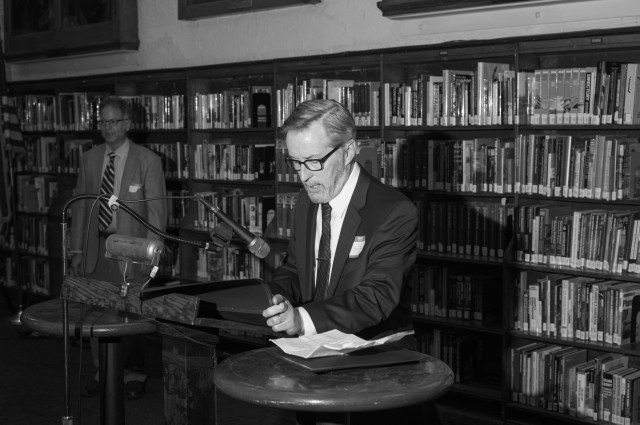
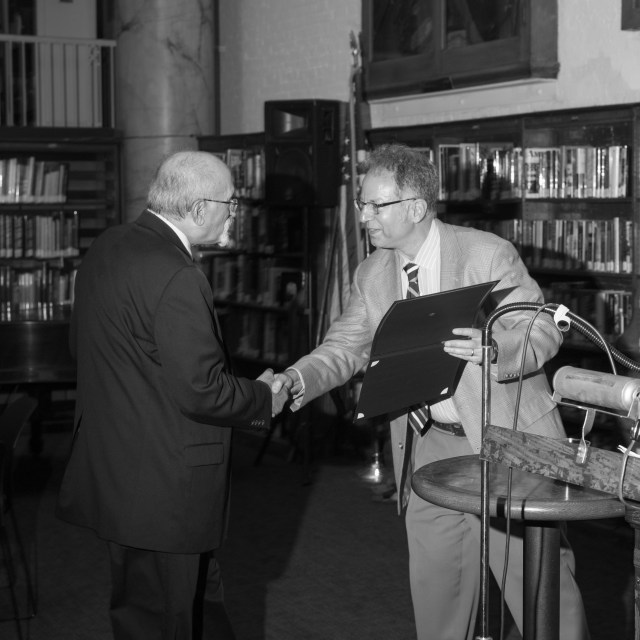
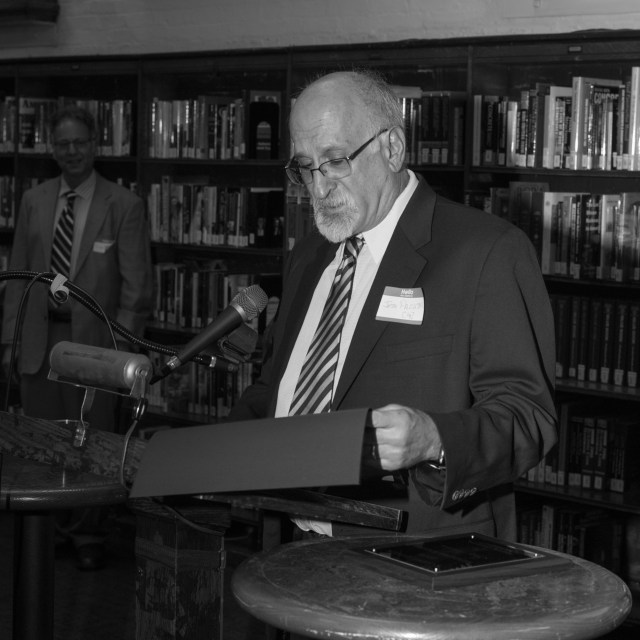
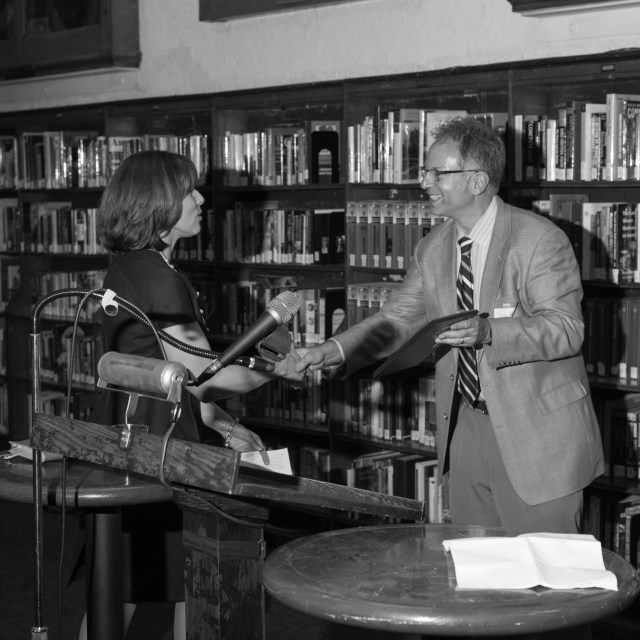
Spring of 2019 turned out to be a very special awards season for the Dell mystery magazines. Not only were our Readers Award winners all graduates of EQMM’s Department of First Stories, EQMM stories won both the Edgar Allan Poe Award for best short story and the Robert L. Fish Award for best short story by a new American writer. At the heart of the festivities was the selection of our colleague, Linda Landrigan, editor of our sister publication, Alfred Hitchcock’s Mystery Magazine, for the Ellery Queen Award, given by the Mystery Writers of America to outstanding people in the mystery-publishing industry. We’ll let pictures tell most of the story, but I’d like to touch on a few of the highlights of my experiences this year.

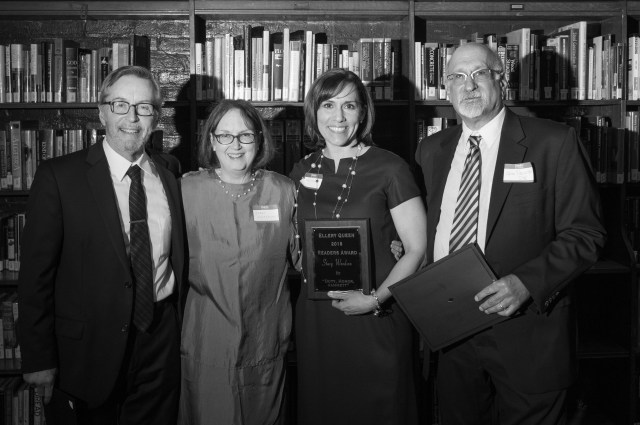
BTW, readers who missed this year’s Readers Award–winning stories when they were published in the magazine should soon be able to find them (for listening) in our podcast series. Stacy Woodson’s first-place story, “Duty, Honor, Hammett,” is remarkable for being only the second First story ever to come first in Readers Award voting. Stacy is a military vet and often takes up military themes in her fiction. That was the case with “Duty, Honor, Hammett,” from our November/December 2018 issue. The story combines little-known military ritual with taut suspense and a bit of mystery-genre history that I had not previously known.

Josh Pachter’s debut in our Department of First Stories occurred exactly fifty years before publication (in our November/December 2018 issue) of the story that took second place for the Readers Award this year. At sixteen, Josh was the second youngest person ever to be published in EQMM. In celebration of the 50th anniversary of that extraordinary event, he wrote a story entitled “50,” which brought back the characters from his first story. In addition to the many memorable stories Josh has contributed to our magazine and to numerous anthologies (now numbering nearly one hundred) Josh has been invaluable to EQMM as a translator from Flemish and Dutch and other languages, and as an anthologist of EQMM material. It was therefore very satisfying to all of us to see him recognized by our readers!

David Dean, who debuted in our Department of First Stories in 1990, is a repeat Readers Award winner. In third place this year, he has previously come in first and second. In recent years, David has frequently taken up the theme of what he calls “feral children” in his fiction—that is, children left to fend for themselves in contemporary suburban America. His third-place story “Sofee” (from our March/April 2018 issue) belongs to that group of stories. It’s moving, sad, and terrifyingly suspenseful—and it provides some food for thought as well. As I mentioned, we hope to have all of these stories available on podcast soon, so stay tuned.

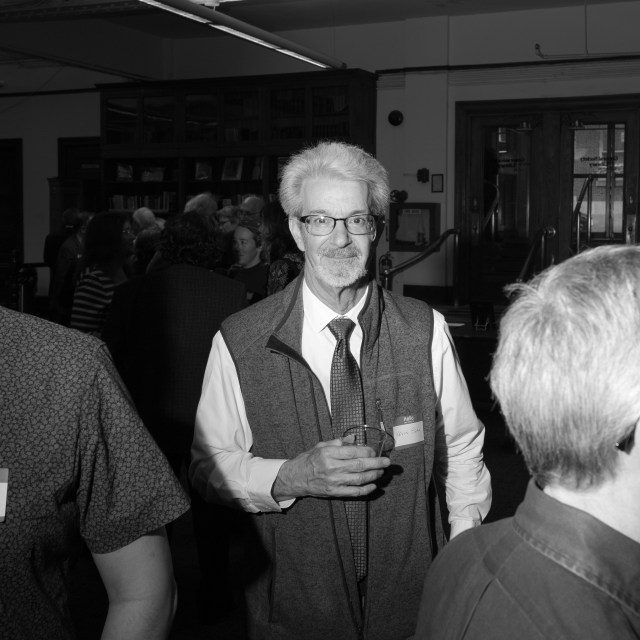
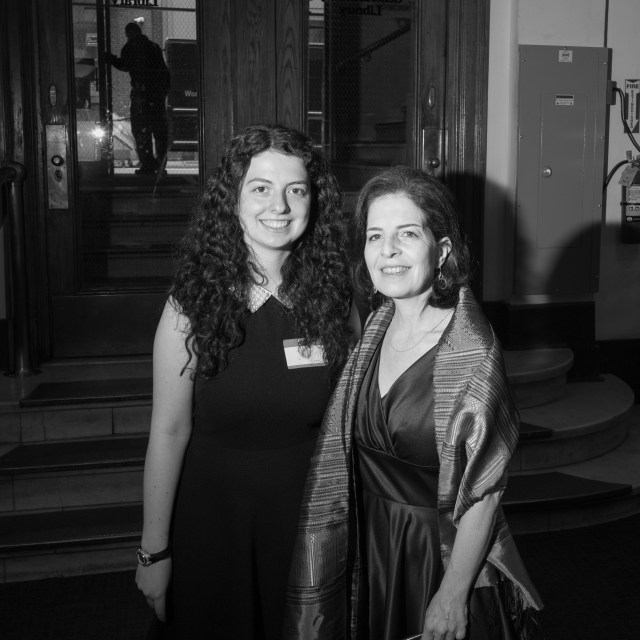
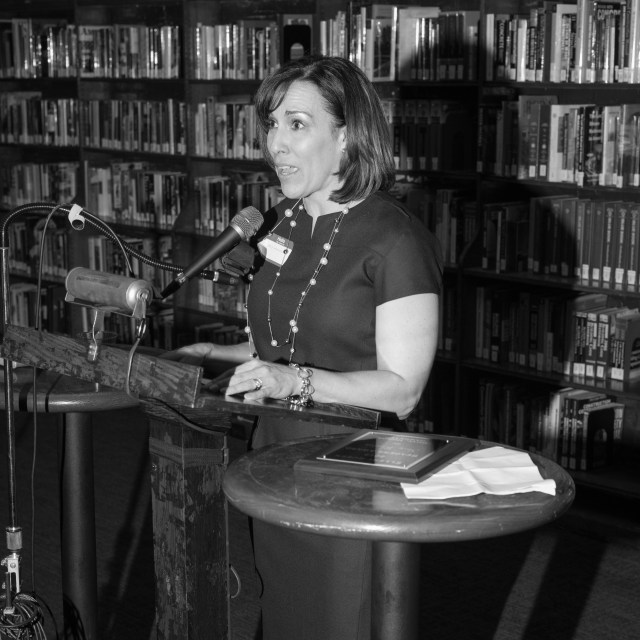
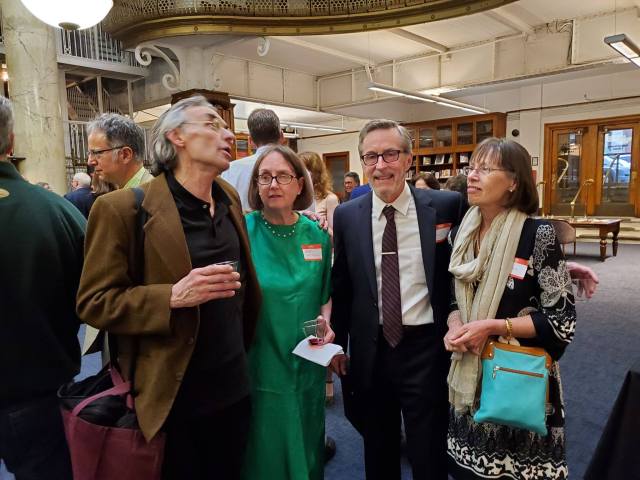
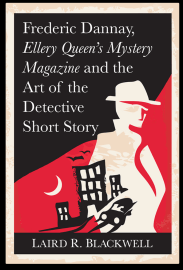
We had the good fortune this year to have all of our Readers Award winners present at our annual pre-Edgars party, where the Readers Awards are given. Many of the photos that follow are from that party, including some of each Readers Award winner. I made some new aquaintances at the party this year—people I’d only known through correspondence, including a few writers who will make their first appearance in EQMM in 2019 like Mark Stevens, Leslie Elman, Cecilia Fulton, and Jackie Freimor, and Laird Blackwell, whose latest book is one scholars and EQMM fans alike will want to read: Frederic Dannay, Ellery Queen’s Mystery Magazine, and the Art of the Detective Story.

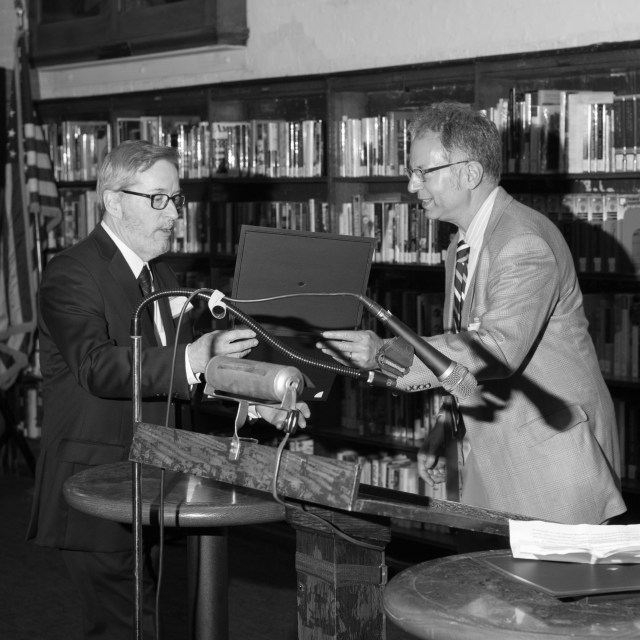
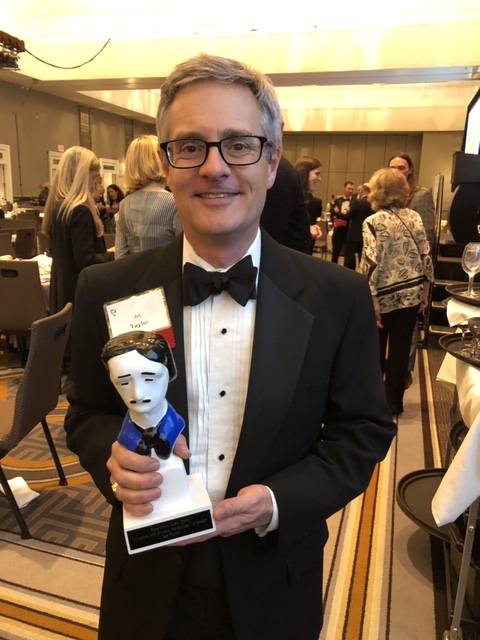
The culminating event of Edgars week, the Edgar Allan Poe Awards banquet, followed close on our party. Linda Landrigan’s eloquent acceptance of the Ellery Queen Award was one highlight of the night; another was Doug Allyn’s presentation of the Fish Award to Nancy Novick for her story “How Does He Die This Time?” (originally published in our September/October 2018 issue and currently available in our podcast series) and yet another (the first unknown, and quite a thrill!) the announcement that Art Taylor (who also got his start in EQMM’s Department of First Stories) had won the Edgar for “English 398: Fiction Workshop,” from the July/August 2018 EQMM and now in our podcast series. I blogged about Nancy’s and Art’s stories earlier on this site, so I’ll direct you there if you want a hint of what they’re about before listening to the podcasts.

A week after the Edgars, we were off to the Malice Domestic convention. There I met up with a lot of old friends, and again, made a few new aquaintances—notable among them Edith Maxwell, one of the convention’s Agatha Award nominees for best historical novel, who will have her first short story in EQMM soon. At the same afternoon event where I had the pleasure of chatting with Edith, I caught up with Edwin Hill, another EQMM Department of First Story-er, who was up for the Agatha for best first novel, and Barb Goffman, a multiple Agatha nominee and past Agatha winner who was up for the best short story Agatha for her EQMM (November/December 2018) debut “Bug Appétit”—one of the best holiday stories I have ever read (listen to her podcast of it!).

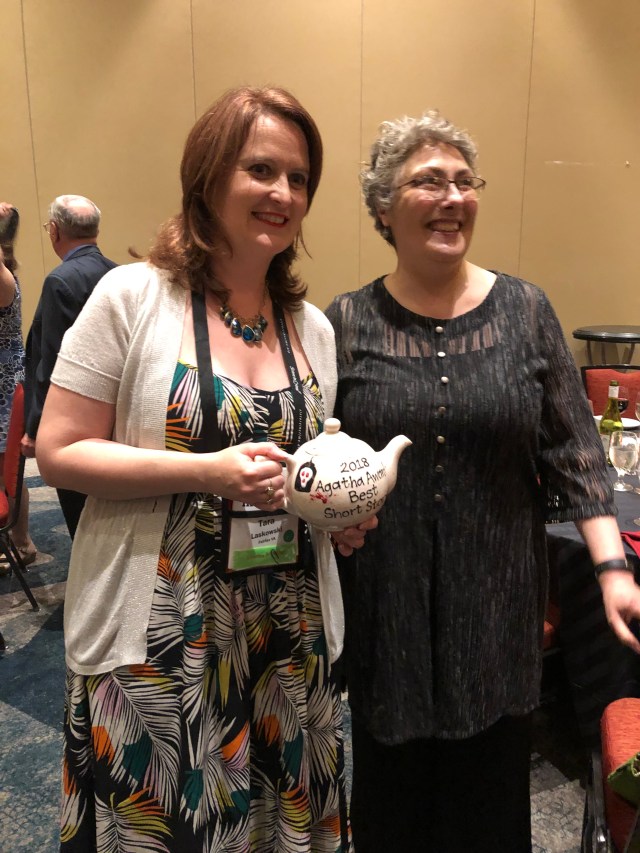
In one of the most suspenseful twists of the Malice Domestic convention, Art Taylor and his wife Tara Laskowski were both up for the Agatha Award for best short story, Art for his Edgar winning EQMM story “English 398: Fiction Workshop,” and Tara for her AHMM story “The Case of the Vanishing Professor” (AHMM May/June 2018). As it turned out, the voting resulted in a tie—the first ever!—though not between Tara and Art, between Tara and Leslie Budewitz, for the latter’s AHMM story “All God’s Sparrows (AHMM May/June 2018). Tara and Leslie are both also contributors to EQMM, Tara with a story coming up next month. What a delight to see them honored—and also for the first double short-story Agatha to go to AHMM in a year honoring the magazine’s editor, Linda Landrigan.

After a breakfast with close colleagues of the magazine—Doug Greene and Jeffrey Marks of Crippen & Landru, the most important publisher of single-author mystery short-story collections (often drawn from Dell Magazines’archives); EQMM’s book reviewer Steve Steinbock; our translator (and fiction contributor) Josh Pachter; one of the genre’s first short-story blog-site creators, James Lincoln Warren (also a fiction contributor), and my colleagues Linda Landrigan and the invaluable associate editor Jackie Sherbow (who, among many other things, recorded podcasts for us of Michael Bracken and Edith Maxwell at the convention), it was time to depart. Another April/May awards season over, but one we’ll remember!

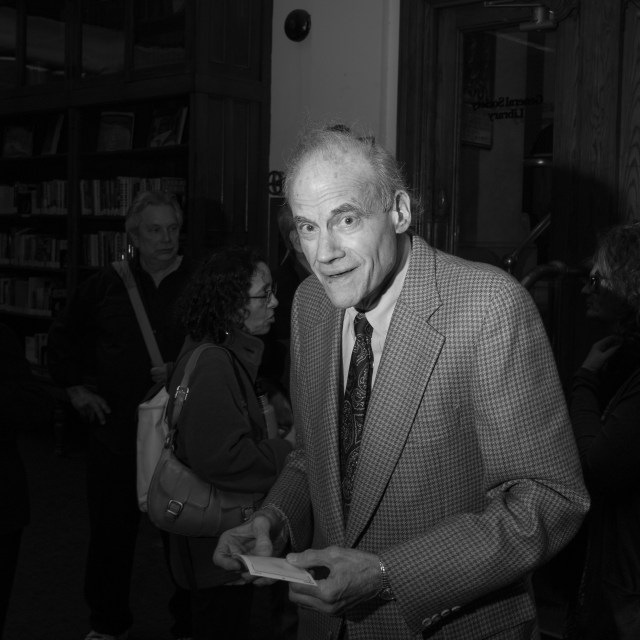
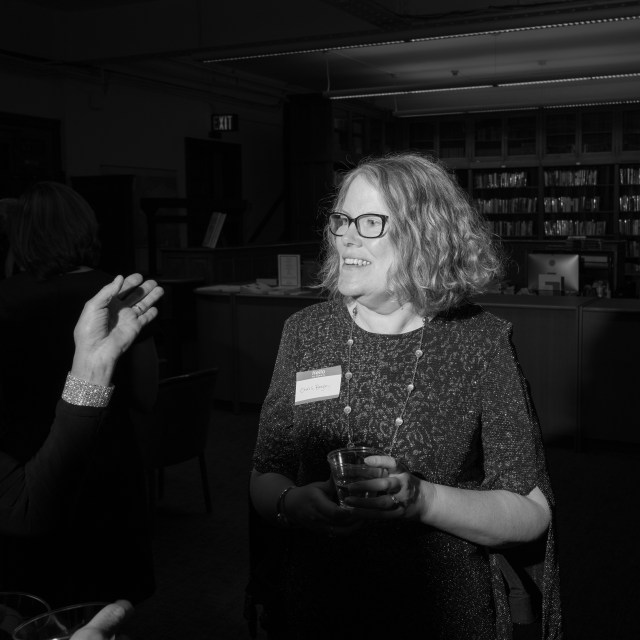
All black and white photos are by Ché Ryback.

Richard Dannay

VP, Editorial, Penny Publications, Christine Begley

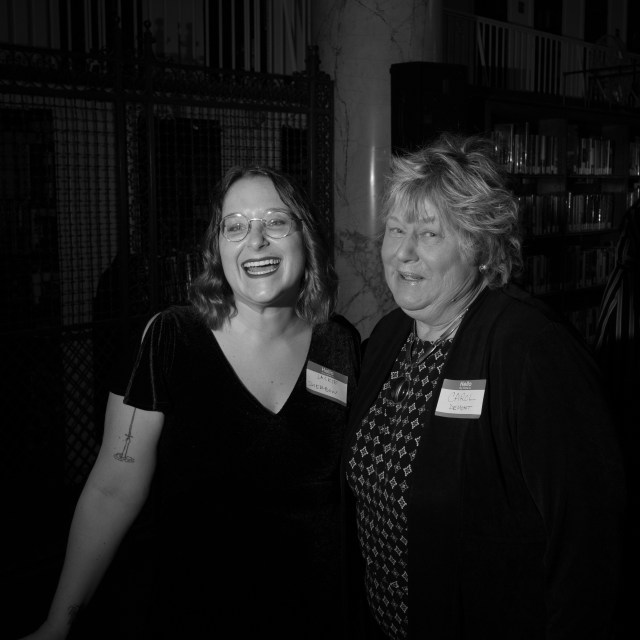
Associate Editor Jackie Sherbow, Contracts/Subrights Manager Carol Demont

Mark Stevens

Doug Allyn, Eve Allyn

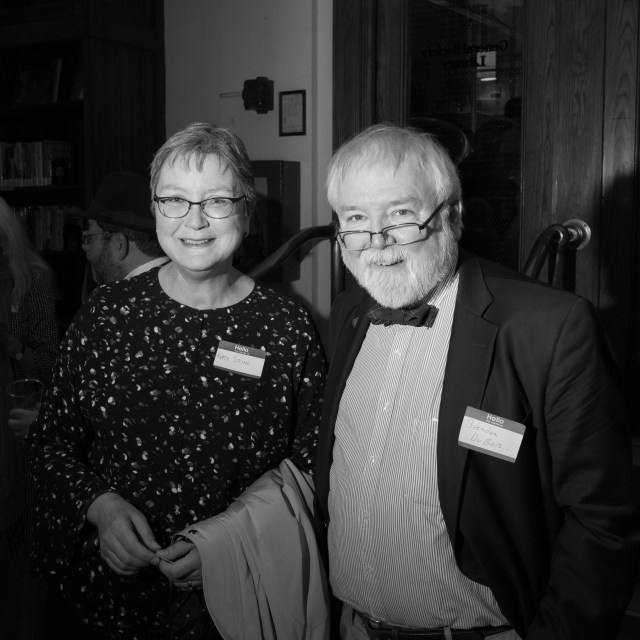
Kate Stine, Brendan DuBois

Joe Goodrich, S.J. Rozan

Kevin Egan

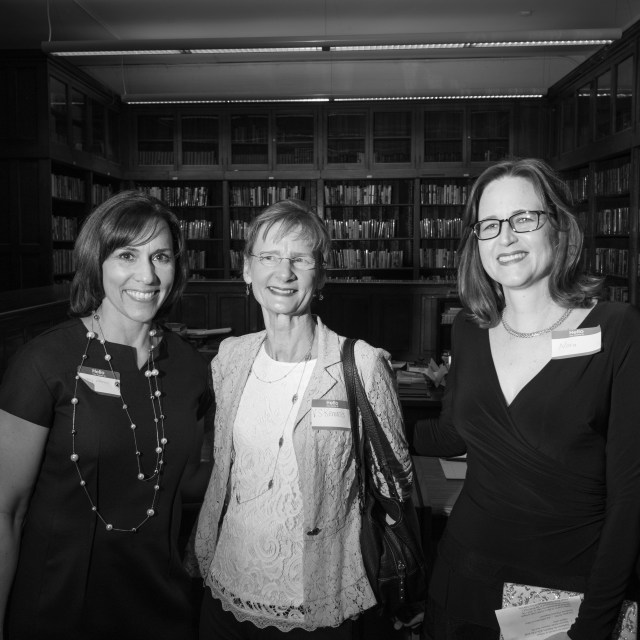
Julia Metzger, Nancy Novick

Stacy Woodson, V.S. Kemanis, Nora McFarland

Art Taylor, Dave Zeltserman

Edwin Hill, Linda Landrigan

David Dean, Peter Kanter, Publisher

David Dean

Josh Pachter, Peter Kanter, Publisher

Josh Pachter

Stacy Woodson, Peter Kanter, Publisher

Stacy Woodson

David Dean, Janet Hutchings, Stacy Woodson, Josh Pachter

Russell Atwood, Janet Hutchings, David Dean, Robin Dean (photo courtesy Russell Atwood)

Art Taylor with his Edgar Award

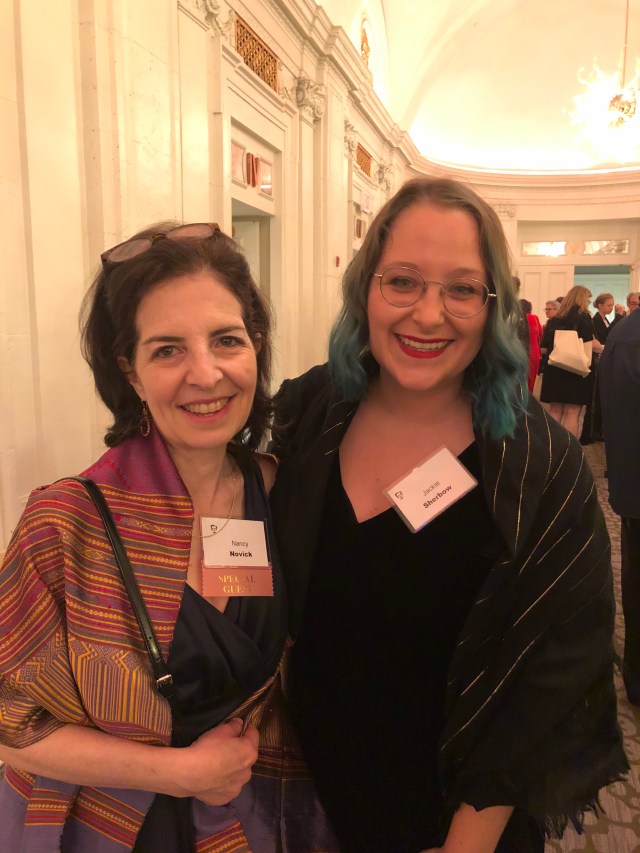
Nancy Novick, Jackie Sherbow

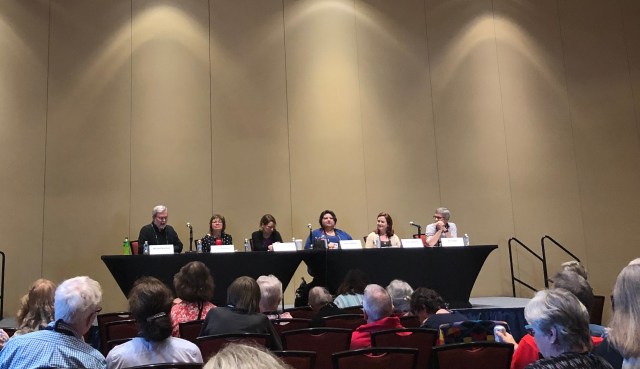
The Agatha Best Short Story Panel: Moderator Michael Bracken, Leslie Budewitz, Susanna Calkins, Barb Goffman, Tara Laskowski, Art Taylor

Margaret Warren, James Lincoln Warren

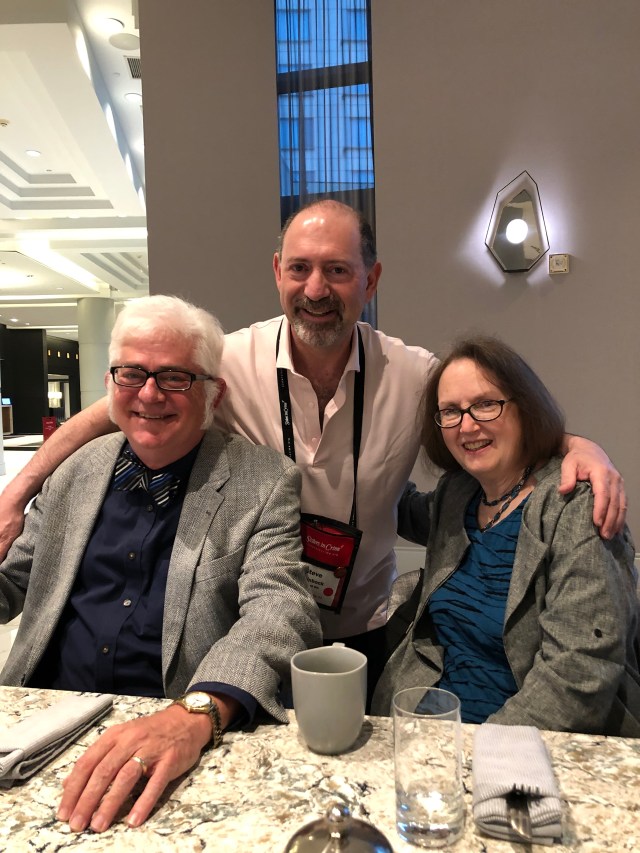
James Lincoln Warren, Steve Steinbock, Janet Hutchings

Michael Bracken recording his story for our podcast series

Edit Maxwell recording her story for our podcast series

Tara Laskowski, Linda Landrigan

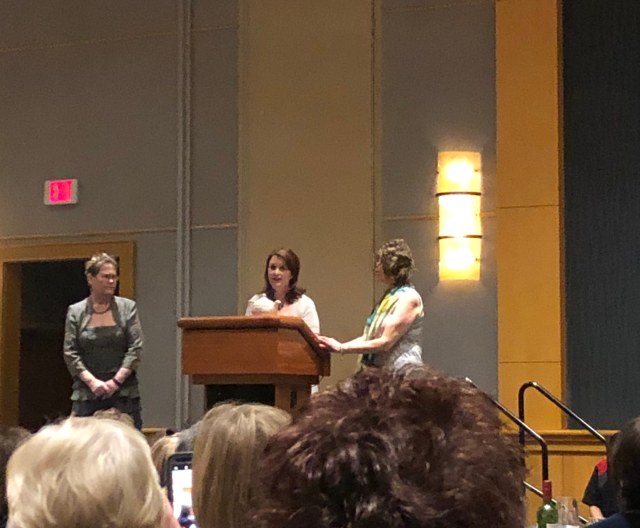
Tara Laskowski and Leslie Budewitz accept their Agatha Awards for Best Short Story

Posted in Awards, Conventions | Tagged , , , | 5 Comments

“The Other Face” (by Pat Black)

Pat Black makes his EQMM debut in our current issue (May/June 2019) and we have more of his work coming up. His stories have also been published in a number of anthologies, including Northern Crime One. He was the runner-up in the Bloody Scotland short-story contest, and one of the winners in the Daily Telegraph’s ghost stories competition. He has also just made his debut as a novelist with the thriller The Family. By day, Pat is a journalist working in Yorkshire, but his native city is Glasgow, and he tells us he will always belong to that place. In this post, he talks about a characteristic identified with the Scottish psyche that also pertains to crime fiction. —Janet Hutchings

Caledonian antisyzygy—hard to type, harder to say. It’s like a country you could never find on a map, one which could do with an emergency aid drop of vowels.

The term was coined 100 years ago by the writer G. Gregory Smith, and expanded upon a few years later by the poet Hugh MacDiarmid. It refers to two polarities which coexist in the one entity within the Scottish psyche.

To put it another way: Our national identity has two faces.

This has a number of manifestations. Scots can present themselves as abstemious and bibulous; hard-working and feckless; dour and manic; blunt and garrulous; stingy and generous; qualities which could be observed in one single guest over the course of a wedding. Viewed as a country, we can be split into highlanders and lowlanders, Weegies and Edinburghers, British Loyalists and Rebellious Scots, Protestants and Catholics—dare I say it, Celtic and Rangers.

This double-edged quality is by no means unique to Scotland, but our fiction, and particularly our crime fiction, thrives upon it.

The starting point in our antisyzygian journey must be James Hogg’s The Private Memoirs And Confessions of a Justified Sinner (1821). This brutal dissection of Calvinist doctrine follows a religious zealot, convinced he is predestined for paradise, as he begins a murderous campaign to ruin the life of his happier, more attractive brother. The devil is present in the novel, or at the very least one of his lieutenants, goading, prodding, and challenging the pale-faced inadequate into foul deeds. Doubles and doppelgangers haunt the story, and this leads us to Robert Louis Stevenson’s Strange Case Of Dr. Jekyll And Mr. Hyde (1886).

This tale serves as the very definition of Caledonian antisyzygy, and requires no introduction. The good doctor’s split personality lends itself to lots of different interpretations, even as times and tolerances change. I tend to take a more literal reading of the text: we probably all know someone who becomes a completely different person after taking a drink.

Antisyzygy (I swear I will type this correctly, first time, just once) is the foundation stone of Tartan Noir, a genre which gave the world Ian Rankin, Denise Mina, Val McDermid, Christopher Brookmyre and many other writers, starting with William McIlvanney’s Glasgow detective Laidlaw. We punch well above our weight in this arena, for a small country.

Irvine Welsh might not be most readily associated with crime novels, but Caledonian antisyzygy flows in his stories’ well-tapped veins. As a heroin addict, Trainspotting’s hero Renton might be a lowlife—but he has a brain, and at one point in his past he even had prospects. He can mingle in different circles, speak in different tongues, and eventually escapes Leith and its self-destructive distractions. He can switch modes for different scenarios, but he belongs in none of them. A man in a mask.

The Marabou Stork Nightmares is a better example, its split narrative contrasting the comatose Roy Strang’s recollections of a traumatic Leith childhood with a bizarre fever dream in which he hunts down an avian monster in a fictionalised South Africa. Who is that monster, really? Silly question . . .

Edinburgh dominates Tartan Noir. Its Old Town and New Town provides a geographic illustration of antisyzygy—the poverty, danger and squalor of one side of Scotland’s capital contrasting with the other’s wealth, gentility and urbanity. And the real city even comes preloaded with a prototype Jekyll-and-Hyde figure in Deacon Brodie; bible-thumper by day, housebreaker and debaucher by night.

Glasgow has its own claims as a city with two faces. It’s a place of astonishing scientific and engineering breakthroughs and its own generous helping of writers, artists, comedians, and musicians—but a city all too readily associated with drink, violence, and sectarian conflict. The best and worst of humanity, living side by side.

It does seem egotistical for Scotland to claim any sort of controlling stake in duality. We invented a lot of things, but this quality is hardly a Scottish construct. But it’s telling that storytellers hailing from Scotland return to this theme so many times, particularly in crime fiction. The genre came under fire latterly, with some commentators including the comedian Doon Mackichan lamenting the fact that so many crime dramas on the screen or the printed page feature murdered women. There’s a suggestion here that such stories are predisposed towards misogyny.

I’d tend to go with Val McDermid’s doughty defence of the genre, in which she said that the beauty of crime stories is that we actually gain an insight into victims, and the aftermath of crimes, which might be otherwise lacking in sober coverage of true-life incidents. In uncovering humanity’s dark side—separate from outright exploitation, of course—we gain sympathy for the victims and their families, or we are at least provided with an insight into how they felt.

And there is also the idea of closure; that in crime fiction, foul deeds will be fully uncovered, and perhaps even punished. Vengeance is mine, saith the crime writer. Viewed from this perspective, crime fiction can have a resolution which might be painfully lacking in real life.

The explosion in true crime podcasts and TV series has run into similar critical opposition. Is it exploitative to have real-life events exposed to such forensic detail, while victims and their families are still alive and well? Yes, if the material is handled clumsily. But I’d argue that dense, detailed examinations of horrible crimes can help to demythologise them—to move murders away from the realms of folklore and infamy, removing something of the dark allure of notorious crimes, and dragging evil acts into the light of proper scrutiny.

A great recent example is Hallie Rubenhold’s recent The Five, an illustration of Jack the Ripper’s victims. This book humanises the tragic lives of women whose names might have been represented in the past as a tick on an obscene scorecard. It is also sprinkled with the gold dust of new theories and information about the ultimate cold case. To take one example, Rubenhold suggests that the victims were attacked while they were sleeping, challenging Ripperologist orthodoxy.

Whether crime books are true life or fictional, the impulse to read them and to write them is the same: to examine the darker parts of human nature. To be fascinated by horrific crimes is normal, precisely because they are abnormal. Per capita of the population, murders are still relatively uncommon, and it’s only natural that we should be curious about how and why they take place, from both a forensic and psychological viewpoint. When it comes to crime, shrugging one’s shoulders and turning away is one of the worst options available to us.

And so we return to antisyzygy, as we consider the mug shots we see in our news feeds; the talking-heads videos featuring shocked neighbours, contending that a serial killer seemed like such a normal, regular person who kept themselves to themselves.

Aside from the puzzle-solving element, perhaps this is why crime writing is so endlessly fascinating: the idea that behind a face you thought you knew, a monster lurks, obscene and unfathomable.

And perhaps even worse, there’s the suspicion that if you had been dealt a different hand in life, the face of Mr. Hyde might have been the one you see in the mirror.

Posted in Characters, crime, Fiction, Genre, Guest, International, Setting | Tagged , , , , , , , , | Leave a comment

“Me and Mister Sherlock” (by Batya Swift Yasgur, MA, LSW)

Batya Swift Yasgur has been contributing regularly to our blog this year. The award-winning author got her start as a fiction writer in the pages of EQMM, in our Department of First Stories. Her latest story for us is January/February 2019’s “Poof.” As she reveals here, like many crime and mystery authors—including Frederic Dannay (of the Ellery Queen writing team)!— it was discovering the Sherlock Holmes stories as a child that really piqued her interest in the mystery genre.  We’d love to hear from others who count the Sherlock Holmes stories as one of their inspirations.—Janet Hutchings

I have always been inordinately influenced by what I read. Perhaps it’s because I was a lonely child who didn’t fit in very well with my peers. My parents were both European and had no idea how to help me integrate with American kids (and my father, in particular, had no desire to see it happen). I had a British accent. My father, a brilliant rabbinic orator, never talked down to me, so my vocabulary was in the stratosphere, compared to that of my schoolmates. (What four-year-old apologizes to her teacher for “causing undue anxiety?”) I wasn’t allowed to watch television and had no idea who Superman was. I had never heard of peanut butter. I was also from a more Orthodox family than my peers, so my skirts were longer than everyone else’s.

Needless to say, the other kids teased me relentlessly and my life at school was unending torment. Books were my comfort and haven. Through books, I was introduced to worlds that became more real than the “real world” that I inhabited. My goals and thoughts were shaped by what I read.

So when I read the Doctor Doolittle series, I decided I wanted to become a veterinarian and learn animal language. I mastered a fairly authentic sounding bark—sufficiently doglike to cause a few heads (human and canine) to turn. But I wondered what I was saying in dog language. Perhaps it was rude?

My interest in veterinary medicine petered out when I encountered Sherlock Holmes.

I don’t know who first introduced me to Holmes. It may be that I happened upon one of the books during a foray into the library. I was about twelve or thirteen and as soon as I read the first story, I was hooked. Dr. Doolittle became . . . well . . . just so yesterday. I wanted to be a detective, and not just any old detective—I wanted to be Sherlock Holmes himself.

I got a magnifying glass and attempted to do some sleuthing, which I called “Sherlocking.” I tried to be very observant of details, which didn’t go well, as I wasn’t detail-oriented even then (and I’m notoriously poor with details now).

But what also shaped me was my hero worship of the persona of Holmes himself. He fascinated me. There was much that I didn’t understand—I didn’t know what Scotland Yard was, for example. I didn’t know what cocaine was. But the magnetic persona of Holmes captivated me.

I eventually left my detective ambitions behind after reading I Never Promised You a Rose Gardenby Hannah Green. I was inspired by Dr. Freed (the protagonist’s psychiatrist) to become a psychiatrist—a complex path that eventually led me to where I am now—a social worker with a counseling practice.

Today, with the benefit of my clinical training, I would say that Holmes could be diagnosed with bipolar disorder. When he was working on a case, he would go without sleep or food, driven by his creative, single-minded mania. After the case was solved, he would often crash into depression. He also had what clinicians would call substance-use disorder, since he turned to drugs—especially cocaine—in the absence of stimulating cases. Today, we would say he had a “dual diagnosis.”

Fortunately, I knew nothing about any of this when I was young and I was able to approach Holmes with an open mind and no preconceptions. There is a Zen saying that Holmes himself would have undoubtedly liked: “In the beginner’s mind, there are many possibilities; in the expert’s mind, there are few.”

The connection with Zen isn’t so far-fetched. Sir Arthur Conan Doyle was a mystic and his spiritual propensities must have influenced his depiction of Holmes. There is much to learn from Holmes about meditation and mindfulness—wholly giving oneself over to the moment, paying attention to every minute detail, every nuance, one-pointed concentration, and quieting the mind.

Often, Holmes would sit in silence, smoking his pipe. In the story “The Red-Headed League,” Holmes described the conundrum he was contemplating as “a three-pipe problem” and asked Watson not to disturb him for fifty minutes. Or in The Hound of the Baskervilles, Watson wrote: “I knew that seclusion and solitude were very necessary for my friend [Holmes] in those hours of intense mental concentration.”

In fact, Watson talked about Holmes as engaging in meditation. In one of the stories (I forget which), Watson wrote (about Holmes): “He sat in meditative silence.”

My spiritual teacher Adyashanti recounts that at the age of nineteen or so, he read the word “Enlightenment” in a book and was immediately seized with the passion to know what that was and devote himself to finding out. Looking back now, I realize that Watson’s mention of meditation had a profound impact on me. I don’t think I had ever heard the word “meditation” before. Prayer, yes—of course—but not meditation. Something about that word seized me. I knew I had to start doing meditation, whatever that was.

Meditation is now central to my spiritual path. I meditate to encounter that inner Silence. Solitude and seclusion are essential as well. So is curiosity, which is (in Adyashanti’s words), an essential asset in the spiritual path. Adyashanti also likes to emphasize that attention and time are our two most prized commodities in the spiritual endeavor—all of these being hallmarks of Holmes.

So Holmes continues to reverberate in subtle ways in my spiritual life, and my quintessential quest for Truth. In the story “The Blanched Soldier” he said, “When you have eliminated all which is impossible, then whatever remains, however improbable, must be the truth.” It reminds me of the immortal Indian sage, Sri Ramana Maharshi (1879-1950) who said: “Let come what comes, let go what goes, and see what remains.”

Truth remains. Truth does not, cannot,“come and go.”It is both the core and the container of our reality, the most profound and abiding Mystery of who we are, and of existence itself.


Posted in Uncategorized | 2 Comments

“A Writing Career: What Does It Mean?” by Brendan DuBois

EQMM is very proud to say that Brendan DuBois debuted in our Department of First Stories. Usually, in introducing someone who has appeared in that department, I go on to say something about how their career has progressed. Brendan does that for us here, and the post should give encouragement to many beginning writers, since it doesn’t gloss over the difficult years nearly every writer will face. What Brendan left out of this account is that he is a two-time Shamus Award winner and three-time Edgar nominee for his short fiction! I’m sure that those honors, and many others, including an EQMM Readers Award, have lightened even the hardest parts of the journey.—Janet Hutchings

Prologue (Sweet Youth With Sweet Dreams)

When I started dreaming about being a published writer (or author, if we’re getting pretentious) I did a lot of writing, along with a lot of fantasizing.

In these pre-Internet days, I obsessively read copies of The Writer and Writer’s Digest magazine, along with the thick book Writer’s Guide to Markets, which came out every year. While I certainly read these magazines for writing tips and suggestions, I was also obsessed with what it was like to be a writer. I saw what it was like for my dad, uncles, aunts, and others to be fastened to a job with rotten bosses, poor pay, and bad hours.

Even before I was a teenager, I wanted more, and I loved the sense of freedom that came from successful authors. I read about writers who could set their own hours, traveled when they wanted, and who were only responsible to themselves and their agents, editors, and readers.

That was going to be life for me. That’s the career I wanted.

I imagined at some point later in my life, I would start off by selling short stories, which would lead to novels, and would leave to yearly or biyearly novels, having a career that would provide a comfortable and fulfilling life.

That was my plan.

Reality, Part One (Dreams Can Come True!)

I started writing and submitting short stories when I was twelve years old. I kept on doing this for a number of years. In my imagination, I thought being a writer of fiction like was attending the best party and celebration ever in a wonderful, multi-roomed mansion. At some point I was getting published as a journalist, but I wanted more. I wanted the satisfaction of seeing something I had created being published and paid for. In those long years, I felt like I was outside in a cold driving rain, peering in through the pantry door, whispering, “Let me in, let me in.”

Then the door did open for me, in 1985, when I sold my first short story, and then my second, and then my third, to Ellery Queen’s Mystery Magazine. God bless that magazine!

The door was finally opened, after 14 years (!) of trying.

My long-term career dream was about to take off.

Reality, Part Two (The World Is Wide Open)

I sold short stories, I got a couple of award nominations, and some of my stories were actually anthologized in “Year’s Best” anthologies. I went to my first Edgar Awards banquet. I went to my first post-Edgars party at Mary Higgins Clark’s luxurious apartment. It was time to start writing a novel (still using a typewriter, honest to God).

I wrote the novel. I spent a summer rewriting it, and sent it off to an agent. He sat on it for months. Then one night, when I was watching the movie In The Heat of the Night with my wife, the agent called from Florida. He loved the book, and wanted to represent me. He promised a quick sale.

My career seemed right on track.

Reality, Part Three (The Cruel Times)

The novel didn’t sell. My second novel didn’t sell. I got divorced. A third novel died aborning on my first Mac computer.

The sale of my short stories dropped off.

One miserable year, I didn’t publish a single short story.

My career seemed still-born.

I was working in corporate communications and was miserable.

It seemed like I had fallen into the trap that I thought I would always be available to avoid.

My writing career, dead before it could take off.

Reality, Part Four (The Bounce Back And Big Break)

I wrote my fourth novel, a first-person traditional detective novel.

My agent loved it

He sold it within three weeks of receiving it, and actually got a two-book deal out of it.

My short-story sales started to come around.

I got happily married for the second time.

There were bumps along the way (my first novel’s publication was delayed for two long, miserable, and disheartening years), but I felt my career was back on track. I didn’t make enough from the first two novels to quit my day job, but maybe by books number three or four . . .

I wrote the third novel in my mystery series, and then my publisher went out of business.

I was marooned.

What to do?

I decided to take a gamble, and I wrote an alternative history novel, called Resurrection Day.

Lightning struck.

The book went to auction. It was sold to nearly a dozen overseas publishers, and there was movie and TV interest.

Best of all, I had enough in the bank and in future income to quit my job in corporate communications, and become the full-time writer I always dreamed of.

My career had arrived!

Reality, Part Five (Reality Strikes Back)

Resurrection Day got great reviews, the best of my life, including a gushing starred review from Publisher’s Weekly. There was even TV and movie interest.

What it didn’t get were great sales.

It tanked.

The Hollywood promises faded away like morning frost in March.

My publisher and every other American publisher turned down my next standalone thriller. Only my U.K. publisher took it on, for which I’m eternally grateful.

My career seemed shattered right after it had such a promising start.

My bank account started to drain.

I wrote furiously.

Short story sales here and there.

My detective series got picked up by St. Martin’s Press.

I also sold some standalone thrillers.

But things were grim. My advances dropped dramatically. Only through the support of my wife could I afford to keep on writing full-time.

Yet my career was miserable. I had to fire my agent when I learned that, for a year, he hadn’t submitted a novel to an editor when he had indicated otherwise. Agents came and went. My last one told me that my two most recent novels were unpublishable.

And on one special occasion, having cake and coffee with my book editor, I was told that my publisher would no longer publish my traditional detective series.

Career? What was that?

Reality, Part Six (Fifth Stage, Acceptance)

But I kept on writing.

I could not think of not writing.

My short-story sales continued (as of this writing, they stand at 176 . . . honest!) and I found another publisher for my detective series. I branched out into writing science fiction (my first true love back when I was young) and broke into the SF novel and short-story field.

Things had calmed down some.

My career . . . well, perhaps I was going to be destined to be one of those writers only recognized and getting great sales after my passing.

Once I was at an Edgar Awards ceremony with the incredibly talented S.J. Rozan, and there was a slide show of past award winners and nominees, and we both saw names of past writer friends who . . .

Who were gone.

No, not dead.

They had just stopped writing, for a variety of reasons.

Their writing careers were over.

Perhaps they had made the wiser choice.

Reality, Part Seven (Resurrection Day, for real this time)

Things were quiet, almost satisfying in my writing. I now had an income stream—all right, more of a trickle than a stream—but I was content. Scarred, a bit bitter, but I was still here, and I was still at the keyboard.

Then lightning struck.

A publishing friend of mine told me that James Patterson, the most popular author in the world, was starting up a new publishing line, called Bookshots—novellas of only 40,000 words—and was looking for coauthors. I wrote a try-out, succeeded, and over the next year and a half, wrote three Bookshots.

Things seemed great.

Then they were going to get better, much better.

I did an outline for a fourth Bookshot and my editor at Hachette said that James Patterson wanted to personally talk to me . . . a first!

I nervously got on the phone with him. He was direct and to the point.

He liked the outline for the fourth Bookshot. He liked it so much that he wanted to know if I was interested in coauthoring a full-length novel with him based on the outline.

I said “yes” so fast that I think the phone nearly melted.

I wrote that book, called The First Lady, and then wrote a second full-length novel with him, called The Cornwalls Are Gone. A third novel has been completed and is the pipeline, and I’m about halfway finished with my fourth coauthored novel with Patterson.

My short-story output continues, and I just submitted my twelfth detective novel to my publisher.

As of today, The Cornwalls Are Gone is #2 on the New York Times Hardcover Bestseller List, and The First Lady is #6 on the trade paperback bestseller list. These two books have also appeared on the USA Today, Wall Street Journal, and Publisher’s Weekly bestseller lists.

At last, I thought, at last and finally . . . I have a writing career.

But you know what?

I look back on everything that had happened since 1985, and my career has always been there, staring at me in the face.

I just had to be smart enough to recognize it.

And for those of you out there dreaming of a writing career, may your dreams come true as well.

Maybe with just a few less detours.

Posted in Books, Guest, Publishing, Writers, Writing | Tagged , , , , , , , | 12 Comments

“The Legacy of Editor Queen” (by Laird Blackwell)

A professor emeritus at Sierra Nevada College, where he taught for over thirty years, and currently a teacher of  literature at Tahoe Expedition Academy, Laird Blackwell is an expert on detective fiction. His 2018 book The Metaphysical Mysteries of G.K. Chesterton: A Critical Study of the Father Brown Stories and Other Detective Fiction (McFarland Publishing) is currently nominated for the Edgar Allan Poe Award in the Best Critical/Biographical category (winner to be announced at the awards banquet on April 25!). His latest contribution to the genre is a book about Ellery Queen’s Mystery Magazine and its profoundly influential founding editor, Frederic Dannay. Entitled Frederic Dannay, Ellery Queen’s Mystery Magazine and the Art of the Detective Short Story (McFarland Publishing), it charts the influence that EQMM and various Queen anthologies had on shaping and ensuring the survival of our genre. In this post, the dedicated fan of short mystery fiction talks about the inspiration for and evolution of his new book.—Janet Hutchings

Ellery Queen—two magic words for lovers of classic detective fiction. For me—an avid fan of the genre—despite Queen’s over thirty detective novels, numerous broadcast scripts, and scores of short stories (including the longish and magnificent “The Lamp of God”), the main impact Queen (mostly Frederic Dannay) had on the detective-fiction genre was as editor—of numerous acclaimed anthologies of short stories, and of Ellery Queen’s Mystery Magazine, which is still thriving over seventy-five years after its inception in 1941 and over thirty years after Dannay’s death in 1982. Most critics agree that Queen, as editor, was the single most significant factor in preserving and nurturing the detective short story through the “dark years” into the present. In the 1940s, when the popularity of the detective story was waning and the periodicals in England that published it (such as the Strand, Pearson’s, and Argosy) were closing up shop, “there was a gleam of light from across the Atlantic. The steady flame of Ellery Queen was alive” (Michael Gilbert, “EQMM” in The Tragedy of Errors)—and it burned especially bright in EQMM and the early anthologies.

For me personally, Queen’s anthologies, especially 101 Years’ Entertainment (judged by many to be the finest detective-crime short-story anthology ever produced) and its follow-up, To the Queen’s Taste, introduced me to the wider world of detective short stories, for my adolescence and early teenage years were pretty much limited to Sherlock Holmes, Father Brown, Hercule Poirot, and Uncle Abner—resplendent and thrilling literary detective companions indeed, but (as I discovered from the Queen anthologies) only the detectival tip of the iceberg. It was through 101 Years’ Entertainment that I “awakened” to such luminary sleuths as The Thinking Machine, The Old Man in the Corner, Arsene Lupin (burglar and detective), Dr. Thorndyke, Max Carrados, Susan Dare, Roger Sheringham, Professor Poggioli, Reggie Fortune, and Prince Zaleski. As the years passed, I discovered numerous other Queen anthologies, and finally, in the dusty stacks of a San Francisco used bookstore, I came across the treasure trove that was EQMM.

For so many readers like me, for detective-story authors, and for the entire detective-crime short-story genre, Queen (especially Dannay as editor of EQMM) was the champion, protector, promoter, preserver, and inspirer. In EQMM and the early anthologies, the works of the detective-story Masters were brought back to the public’s attention and affection (almost 700 stories published), while novice detective authors (over 550 of them) were provided a stage and an audience (to say nothing of a warmly supportive but serious critical voice). The genre survived and thrived because of Queen. So many authors were nourished and developed, and so many readers were cultivated and enthralled, not only by the selections in the anthologies and in EQMM but also by Dannay’s accompanying commentary—a veritable literary history on its own! A book of just the commentary in EQMM over the years would be a wonderful tribute to Dannay as well as a valuable and fascinating history of the detective short story genre.

And, of course, Queen is not a secret—the sales of his numerous novels, short-story collections, and anthologies has reached astronomical figures, and EQMM is still the most acclaimed and honored detective-story magazine under the editorship of Janet Hutchings. However, despite these sales, Nevins’s biography The Art of Detection, and some wonderful articles, blogs, and websites, some of which give detailed looks inside Dannay and Lee’s professional and personal lives, I didn’t think that Queen’s enormous contribution to the detective-crime short-story genre had ever been sufficiently acknowledged and documented, so this was the intention and motivation behind my monograph: Frederic Dannay, Ellery Queen’s Mystery Magazine, and the Art of the Detective Story, which covers the years of Queen’s greatest influence from the first anthology in 1932 and the first edition of EQMM in 1941 until Dannay’s death in 1982.

In researching for this book, I thoroughly enjoyed re-reading my large collection of EQMM and Queen anthologies, following the threads of the enormous influence Queen had on the genre, its authors, and its readers. Dannay’s extensive commentary (especially in issues of EQMM in the 1940s and 1950s) was often at least as interesting as the stories it accompanied. I was amazed at the number of “Masters” he encouraged to write new stories (and sometimes even to create new detectives) and at the number of now-famous authors he “mid-wifed” and “baptized.” Writing this monograph involved me in a couple of years of unadulterated joy and admiration for Ellery Queen and his unrelenting passion for the detective-crime short story and his devotion to its survival and health. I hope that the joy and the admiration are evident in my book, for they both continue unabated and undiminished to this day and will accompany me as cherished friends into my old age.
Posted in Books, Editing, Ellery Queen, Genre, Guest, Magazine, research | Tagged , , , , , , , | 3 Comments

“Murder Becomes Her: 10 Captivating Female Killers in Fiction” (by Sophia Huneycutt)

A San Francisco-area resident who works as a freelance copywriter, Sophia Huneycutt makes her fiction debut with the very contemporary and timely story “A Perfect Life,” in our current issue, March/April 2019. There’s been a lot written in recent years about female investigators in crime fiction, but what about female culprits? In this post we get a look at some of the most fascinating of them all.—Janet Hutchings

There’s little doubt that fictional female killers are thrilling. But why?

Maybe it’s because they offer some variance in story. After reading about men slashing and shooting away to their heart’s content—fair, since only 10% of known murderers are female—a female killer feels like a breath of fresh, if bloody, air. They have different surface-level reasons for killing (often defensive), which can be nice for a change. Plus, after reading descriptions of so many dead female bodies, a live one doing the killing is riveting.

I tend to root for female killers, just as I quietly cheer for Lucifer in Paradise Lost or Erik Killmonger in the movie Black Panther—these villains often have, underneath their short-sighted worldview, a point. I know their revolutions will be quelled and am thankful for it, otherwise chaos would ensue, but I root for them nonetheless.

Every single female killer has centuries of grievances behind her: repression, sexual abuse, emotional abuse, discrimination, outrageous social pressure. The ones who turn to murder have more than the usual problems piled on top of those historical wrongs. Complex emotions—righteousness, fury, love, hurt, thwarted ambition, loneliness—pile up, suffocating them. Often, they see murder as the only way to breathe easy again. To see them burst out of their gender norms and tackle their problems aggressively is captivating but horrifying at the same time, like watching a moth fly into a bonfire.

My logical side screams when I see female killers start on their path toward murder. Why don’t you go to abuse shelters, contact the authorities, leave the man who is encumbering you and move on with your lives? I ask this knowing the answer: after a lifetime of circumventing problems, putting oneself second, managing emotional issues of those around you, working so hard to exist, some women decide to take what seems like the easier path: murder.

I’ve always loved these characters, these fictional women who, hardened by a world that tries to squeeze them into a certain mold or squashes their sense of freedom or simply isn’t how they want it to be, take revenge on it and those unlucky souls who get in their way.

Regardless of the reasons you might find them fascinating, read on to discover (or remember) some of the most riveting female killers in fiction.

Fictional Female Killer #1: Medea, from Medea by Euripides

Greek tragedies are nothing if not dramatic. At the end of Euripides’ play, Medea realizes that her husband Jason, for whom she betrayed her family, plans to abandon her and marry another woman. Unfortunately for Jason, Medea has divine relatives and an unforgiving nature. Revenge, complete and total, ensues, and possibly the most magnificent and surprising case of deus ex machina found in literature.

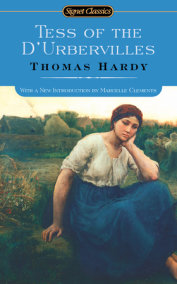
Fictional Female Killer #2: Tess Durbeyfield, from Tess of the d’Urbervilles by Thomas Hardy

The life of Tess Durbeyfield was never an easy one, and seeking to connect herself with her wealthy relatives doesn’t help. Readers watch the ups and downs of her character’s story with bated breath as she meets with tragedy after tragedy, hoping that by the tale’s conclusion the stars finally align for her. They don’t, of course. Tess’s final act is famously surprising—and bloody.

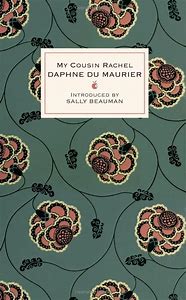
Fictional Female Killer #3: Rachel Ashley, from My Cousin Rachel by Daphne Du Maurier

After sending news of a hasty marriage and suspicion that his wife is not who he thought she was, Philip Ashley’s beloved uncle dies during an extended trip to Italy. While it’s not clear whether his wife, Rachel, is a killer, the possibility hangs over Philip Ashley—and the reader—throughout the entirety of Du Maurier’s work. Rachel is one of the most mysterious female villainesses (potential villainesses, I should say) in literature.

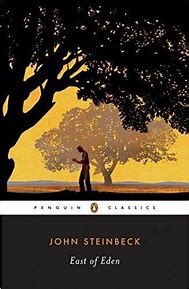
Fictional Female Killer #4: Cathy Ames, from East of Eden by John Steinbeck

At first glance, Cathy Ames can be defined as a psychopath, or as Steinbeck put it, a “psychic monster” with a “malformed soul.” Among other crimes, she kills her parents for making her stay in her hometown, shoots her husband when he tries to stop her from leaving him, and poisons her boss so she can become the madam of her brothel. Steinbeck referred to her as “[his] dear Cathy,” a sentiment revealed in both her detailed character description and arc.

Image result for we have always lived in the castleFictional Female Killer #5: Merricat, from We Have Always Lived In The Castle by Shirley Jackson

Merricat is, for the most part, a daydreaming and charming young girl who loves her sister. Throughout nearly the entire novel, Shirley Jackson manipulates the reader, making it seem as though young Merricat is entirely innocent—until we learn about the downfall of her other family members.

Image result for a dark-adapted eye

Fictional Female Killer #6: Vera Hillyard, from A Dark-Adapted Eye by Barbara Vine/Ruth Rendell

One of the most complex killers of all, Vera Hillyard’s character is explored through her niece Faith, who reflects on her currently imprisoned relative and the events that led up to her situation. Though we know Vera is a killer, Vine artfully hides who it is that Vera kills and why, making the bitter truth at the end utterly devastating.

Image result for the dressmaker rosalie hammFictional Female Killer #7: Tilly Dunnage, from The Dressmaker by Rosalie Ham

This story focuses on a fashionable dressmaker, who may or may not be the murderess of the tale, returning to town to care for her ailing mother. The plot sounds familiar, but Ham’s Gothic tale features some of the most interesting turns in fiction. Her exploration of small town dynamics, hopelessness, and self-fulfilling prophecies is worth a deep read.

Image result for gone girlFictional Female Killer #8: Amy Elliott Dunne, from Gone Girl by Gillian Flynn

Gillian Flynn has gotten a lot of attention recently, and for good reason: her novels often explore multifaceted, complex female characters who are often villains. Gone Girl focuses on one of her most complex characters, Amy Elliott Dunne, who, sick of the societal pressure she’s faced her whole life and the circumstances she finds herself in, breaks free.

Image result for jane steeleFictional Female Killer #9: Jane Steele, from Jane Steele by Lyndsay Faye

Brontë fans looking for a light and fun read will find Jane Steele’s character highly satisfying. Faye has taken the classic story of Jane Eyre and reimagined the titular character as an anachronistic, axe-happy young lady. Fun—and murder—ensue.

My Sister, the Serial Killer by Oyinkan BraithwaiteFictional Female Killer #10: Ayoola from My Sister, The Serial Killer by Oyinkan Braithwaite
Braithwaite’s novel is more than a thriller; it’s an exploration of where serial killers come from and what happens to the people in their lives. This tale, told from sister Korede’s view, is fun and gripping, starting out by giving you a picture of the serial killer in one way, then flipping your perspective toward the end.

Posted in Books, Characters, Fiction, Genre, Gothic, Guest, Novels, Readers | Tagged , , , , , , , , | Leave a comment

“The Unlikely Ladies of Nineteenth Century Crime Fiction” (by Nancy Novick)

Nancy Novick—a freelance journalist who writes about health, medicine, and the arts—made her fiction debut in Ellery Queen’s Mystery Magazine in the September/October 2018 issue, with “How Does He Die This Time?” The story went on to win the 2019 Robert L. Fish Memorial Award for best short story by a new American writer. Readers who missed the tale in print can listen to it in EQMM’s podcast series here. The author is clearly well read in the genre in which she has achieved such a notable start. In this post she brings to light some lesser-known contributors to the field from the nineteenth century.—Janet Hutchings

Imagine that you are playing mystery trivia and are asked to guess the best-selling author of a short story set in Paris some 150 years ago. Your host offers the following summary:

Two young officers, Bergamo, an Austrian, and Rolande, a Frenchman, enter the rooms of the elderly Monsieur St. Pierre, with whom Bergamo has been gambling on a nightly basis in the company of the older man’s daughter, Leontine. Rolande suspects that foul play is behind his friend’s heavy losses and soon discovers that Leontine has been drugging Bergamo—impairing his ability to play with a mere wave of her fan. A confrontation with the young woman results in the poisoning suicide of one character and the despair of another.

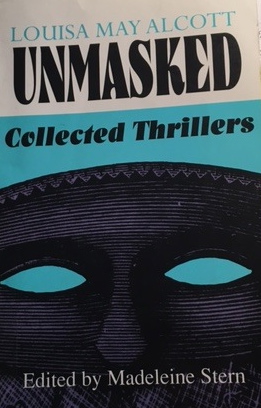
Modern-day readers are unlikely to come up with the answer: A.M. Barnard. But most will be familiar with the true name of the creator of “Fate in a Fan,” Louisa May Alcott!

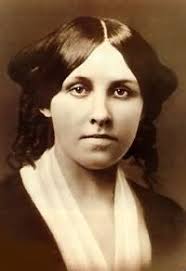
Louisa May Alcott

Alcott, of course, is best known by generations of readers as the author of Little Women, the classic tale of four young girls growing up in New England during and after the Civil War. In addition to providing an entertaining account of the family’s adventures and travails, Little Women and its sequels also taught lessons in self-sacrifice, humility, family loyalty, and ambition tempered by modesty. When the characters indulge in vanity or small acts of vindictiveness, they are visited by remorse, and tender apologies ensue. (That Alcott’s best-known work is infused with these values is not surprising given her close relationship with her father and teacher, Bronson Alcott, a noted Transcendentalist and friend of Emerson and Thoreau, who believed in the innate goodness of man.)

I think it is fair to say that Little Women is particularly notable for providing a role model in Jo March for generations of girls who wanted to write (the author of this post raises her hand). As devotees of the novel will recall, Jo experiences her first literary success writing sensational stories—in essence the gothic thrillers of her time. Alcott’s first commercial success was also as an author of what she called “sensation” or “blood and thunder” stories, when she won a magazine contest. Little was known about this phase of Alcott’s career until two rare book dealers, Madeleine B. Stern and Leona Rostenberg, connected the dots between the A.M. Barnard thrillers and Alcott in the early 1940s. And it wasn’t until 1975 that a collection of these works, Behind a Mask: The Unknown Thrillers of Louisa May Alcott, was published with full attribution to the author.

Replete with murders, blackmail, stabbings, and poisonings, the stories were a revelation to fans of Alcott’s family-friendly works. In “Fatal Follies,” Alcott tells the story of a young couple, in which each partner mistakenly believes the other of having a monomania—a desire to kill their spouse—with tragic results.

“Behind a Mask: or, A Woman’s Power”—perhaps the best known of Alcott’s thrillers—begins with the arrival of a frail and charming young governess at an English estate. (Scholars point to the influence of Charlotte Brontë’s Jane Eyre.) Within a matter of pages the reader learns that all is not what it seems; the delicate nineteen-year-old is actually “a haggard, worn, and moody scheming woman of thirty at least.” Jean Muir is a divorced, failed actress from France, rather than the innocent orphan from Scotland that she represents herself to be, and has designs on the titled head of the family, the widowed uncle of her charge.

Muir achieves her end through a series of deceptions and by pitting the two young men of the family against each other in an episode that results in a near-fatal stabbing. Given what most of us know about Alcott, Muir’s “happy” ending is remarkable. Her protagonist, who embodies every quality the March girls were taught to eschew, is rewarded for her deceptions and manipulations. (Other Alcott thrillers touched on more provocative themes for the times, including sadomasochism, extramarital affairs, and drug addiction.)

Although Alcott’s two principal genres—wholesome stories and mysteries (the author also published poetry and autobiographical sketches)—contrast widely in tone, both may reflect her support for women’s rights and women’s empowerment. In fact, the author was the first woman to register to vote in her hometown of Concord, Massachusetts. While the March girls may have been groomed for marriage and the family hearth, the sisters are also taught to value education and the arts, and, as noted, Jo’s role as author was an integral part of the novel as her earnings helped pay the household bills. In her thrillers, Alcott’s female characters are often powerful, as in the case of Jean Muir, even when they are not virtuous—an exercise in A Woman’s Power, indeed.

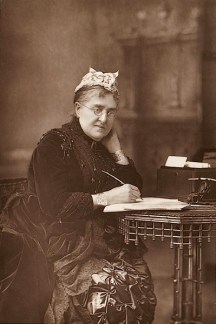
Eliza Lynn Linton

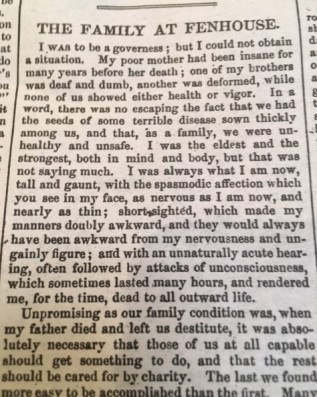
While Alcott was industriously writing story after story, and novel after novel, in the United States, another woman of strong convictions, the London-based Eliza Lynn Linton, an avowed antifeminist, journalist, and novelist was writing thrillers of her own. In one particularly gloomy tale, “The Family at Fenhouse”(originally published in the United States in Harper’s Weekly, along with an installment of Dickens Great Expectations), the unbecoming and unloved Jane Erfurt (Jane Eyre’s distant cousin?), describes her family: “My poor mother had been insane for many years before her death; one of my brothers was deaf and dumb, another was deformed, while none of us showed either health or vigor.”

Once again, the protagonist is a friendless servant, in this case a companion to the sickly wife of the household. In contrast to Jean Muir, things go from bad to worse for Jane, as she is verbally and physically abused by the man who hires her, as well as by his stepson. The story ends with her escape from the household but only after she has been framed for the stepson’s brutal murder and is branded a fugitive. Seeing herself described in posters as “a murderess and a maniac” Jane is left to a fate she describes in this way: “Seized with terror I fled: I fled like a wild being hunted and pursued, and have never rested since.”

The opening of “The Family at Fenhouse”

Women tend to have a bad time of it in Linton’s stories, as in “The Tenants of Hangman’s House,” in which an unhappily married woman is brought to the secluded eponymous house by the sea. Her sadistic husband takes in a shipwrecked “Spaniard” (who is, in fact, British) and further torments the wife by suggesting that he will give her to this “ruffian.” The Spaniard turns out to covet the wife as well and vows to save her form the brutal husband only if she will surrender to his advances. As the two men grapple at a cliff’s edge, and one falls to his death, the unfortunate heroine is killed in a fire set by her husband.

In “The Fate of Madame Cabanel,” a young Englishwoman (an orphan and a former governess!) newly wed to an older man of status is brought to his home in a small town in Brittany. The young woman with notably rosy red lips flourishes as her husband goes into a decline along with many of the townspeople, including little Adolphe, the nephew of Adele, Monsieur Cabanel’s housekeeper and former mistress. Adolphe is, in fact, Monsieur Cabanel’s son with Adele. While the plot is melodramatic and relies heavily on the ignorant and superstitious beliefs of the townspeople—the doomed heroine is rumored to be a vampire—Linton does provide a compelling portrait of mob psychology. Unfortunately for Madame C, reason prevails too late to save her, little Adolphe dies, and the embittered Adele leaps to her death into a deep pit.

It’s interesting to note that Linton’s biographers describe the author as a successful, independent woman, who bore little resemblance to the victims in her thrillers. She was an autodidact who took full advantage of her widowed father’s library and moved to London as a young woman to become a professional writer. She was married briefly to a political radical, William James Linton, from whom she is reported to have parted on amicable terms and from all accounts, happily resumed her single life.

The reading public apparently had an appetite for both Linton’s journalism as well as her thrillers, several of which were published in Charles Dickens’ publications, Household Words and All the Year Round. Linton had an additional connection with Dickens—he purchased his home, Gad’s Hill, from her—as well as with other literary lights of the time including the poet Walter Landor, who championed her career. Linton was the first woman journalist to draw a salary in England. She was also the author of a controversial essay, “The Girl of the Period,” in which she decries the habits of modern young women—immodesty and use of slang were cardinal sins—and mourns the loss of the traditional aspirations of young Englishwomen, to become “her husband’s friend and companion, but never his rival; one who would consider his interests as identical with her own.”

Accounts of Linton’s life suggest that she became increasingly conservative in her views as she aged, yet there’s no evidence that she ever regretted writing her thrillers, which contributed to her independent lifestyle. However, it is interesting to note that many were published under the name E. Lynn Linton, perhaps to distance these works from her journalistic writing. Alcott’s ambivalence about her sensation stories, however, is well documented. In a letter to a friend Alcott wrote, “I think my natural ambitions is for the lurid style. I indulge in gorgeous fancies and wish that I dare inscribe them upon my pages and set them before the public.” In Little Women, Jo wins a hundred dollars when she submits a sensation story to a publisher who is holding a contest, a fortune to the Marches, but is told by her father that she can do better. Later, Jo’s suitor, Professor Bhaer, calls sensation stories “poison”. Viewing her work anew, Jo shoves her bundle of stories into the fire and resolves to write no more of them.

Still, it’s hard to know how Alcott ultimately viewed these works; she also seemed to tire of the wholesome novels she penned. In a somewhat astonishing passage at the end of her third and final book about the March family, Jo’s Boys, she wrote: “It is a strong temptation to the weary historian to close the present tale with an earthquake which should engulf Plumfield and its environs so deeply in the bowels of the earth that no youthful Schliemann could ever find a vestige of it. But as that somewhat melodramatic conclusion might shock my gentle readers, I will refrain . . .”

Fortunately, contemporary women writers of crime fiction are rarely subjected to the moral judgments of others, but the fact that Linton’s crime stories are largely forgotten and that Alcott felt compelled to publish her thrillers under an androgynous pen name raises an interesting question about the past. While we may assume that the gender equity crime writers now enjoy is a relatively new development, how many more literary ladies of the nineteenth century—whose names are now lost to us—were penning the thrillers of their time?

Posted in Books, Gothic, Guest, History, Suspense, Thrillers, Writers | Tagged , , , , , , , , , , , , | 1 Comment

“Three Unique Variations on the Crime Novel” (by Michael Cowgill)

Michael Cowgill makes his professional fiction debut in the Department of First Stories of the current issue of Ellery Queen’s Mystery Magazine (March/April 2019), with the story “Call Me Chuckles.” His short fiction had previously appeared in two small literary publications. He also writes comics; he’s a member of the comics collective The DC Conspiracy, and his comics work has been published in the comics newspaper Magic Bullet and in the anthologies District Comics and Wild Ocean. It’s clear from this post that the Virginia author is a devoted reader of crime fiction, so it is not surprising that he has now entered our field with his own writing.—Janet Hutchings

As a reader and writer, what happens to a character usually interests me more than what happens. I do enjoy a good “what happens” story, but when a crime or detective story does both, I take notice. Here, I look at three crime novels that play with conventions to create unique variations on detective stories.

I first read Robert B. Parker’s Early Autumn (1980) the summer between eighth and ninth grade. The TV series Spenser: For Hire had stirred an interest, and I picked up paperbacks of The Promised Land and Early Autumn. While the novel doesn’t have a dense mystery, Parker pushes against typical hard-boiled detective ideas and perhaps more importantly pushes Spenser as a character, starting a string of novels through A Catskill Eagle (1985) that does the same.

It begins in an almost blatantly conventional way. An attractive divorcée walks into Spenser’s office, wiggles, and flirts, while Spenser makes wisecracks to her and the reader. Patty Giacomin’s ex-husband Mel has taken their 15-year-old son Paul and stashed him away as a salvo in their post-divorce drama. Spenser takes the case, and by the end of chapter three, with a little leg work, a few more wisecracks, and a threat or two of violence, he’s brought Paul home.

Things start to turn as he observes Paul on the ride home, then at dinner at a Chinese restaurant. Paul answers questions with shrugs, wears ill-fitting clothes, whines, and doesn’t know how to order food. As Spenser later tells his girlfriend Susan, “The kid’s never been taught how to act.” A few months later, Mel sends two thugs after Paul, and Spenser moves in to keep an eye on him. Parker serves up a big action scene, and then the book makes its biggest turn.

Spenser temporarily takes custody of Paul, and they go to a cabin near a lake. He tells Susan “I’ll teach him what I know. I know how to do carpentry. I know how to cook. I know how to punch. I know how to act.” He wants to give Paul autonomy from his lousy parents. They run, lift weights, punch boxing bags, and build a new cabin. Spenser gives Paul discipline, but he also listens to him, gets him to express his interests, and encourages those interests even when they don’t interest him. Paul wants to see and possibly study ballet, so they go to a ballet.

The novel returns to the external near the end, but even that serves this more internal story of Spenser and Paul. In order to solve Paul, Spenser has to get his parents out of the picture. As he often does, he resorts to blackmail and a little more violence. Still, Spenser doesn’t so much save Paul from bad guys as save him from their effects. The process also tests Spenser’s relationship with Susan and defines or redefines his worldview, his code, sometimes calling it into question.

Washington, D.C. writer George Pelecanos has divided his work between detective series and more stand-alone urban crime novels, and I gravitate to that second category. His latest novel The Man Who Came Uptown (2018) starts like a detective novel but quickly becomes something else. Through the point of view of Antonius, a young man in trouble for an armed robbery, Pelecanos introduces investigator Phil Ornazian, and he seems like the protagonist—a detective, a solver of problems. He can’t solve Antonius’s problems, but in passing, he asks Antonius to pass a message to another inmate Michael Hudson.

Anna, a mobile librarian at the D.C. Jail, curates books for prisoners, and through her influence Michael has become an avid reader. Pelecanos describes the way the library system works in the D.C. Jail and the details of Anna’s job, and over time he shows her leading book groups and portrays her life in a gentrifying area of Northwest D.C.

It doesn’t take long to see Ornazian’s less appealing side. In chapter three, he and retired police officer turned bondsman Ward violently rob a pimp. They view it as a Robin Hood-like effort, stealing from a crook and giving some of the money to the prostitute who tipped them off. Ornazian also justifies it because it helps his family, but it looks ugly.

Although Ornazian’s efforts (strong-arming a witness) get Michael’s charges dropped, his other behavior stands in contrast to both Michael and Anna. Michael returns home to his mother’s house and finds a job as a dishwasher at a brick-oven restaurant in his changing neighborhood. He also seeks out books, thinks about his future, and keeps his head down. He even runs into Anna with her husband at the restaurant, and though they seem to have a mutual attraction, neither pursues it. His life seems headed in the right direction until Ornazian calls in a favor. He and Ward need a wheel man for their next job (robbing the owner of an underground brothel), and Michael can’t say no. At this point, Ornazian becomes the villain of the novel.

I won’t spoil any more, but Pelecanos uses this stage in interesting ways. He confounds our expectations of certain characters and, as he always does, creates a portrait of Washington, D.C., at a given moment, presenting the changing nature of a diverse, unique city and recognizing the complexity of those changes for ill and for good.

Like Pelecanos, Megan Abbott often focuses on a specific world, though it changes from novel to novel. In You Will Know Me (2016), she turns her attention on competitive girls’ gymnastics. That doesn’t sound like the setting for a crime novel, and unlike Parker and Pelecanos, Abbott performs a different trick. She starts with a more traditionally literary setting and subject—the suburbs and family—and gradually reveals the crime story.

She shows this gymnastics world through the eyes of Katie, whose daughter Devon has Olympic potential. Abbott introduces this all through Katie’s slightly drunken memories of a tiki party for the girls and parents of BelStars gym, then backs up to three-year-old Devon losing toes in an accident with a lawnmower. That accident leads to gymnastics, which leads to Katie and her husband Eric throwing themselves into supporting Devon at the expense of their time, credit, and son Drew. Coach Teddy of BelStars suggests to them Devon’s full potential, and they put her on that track. She has a slight bobble at a major event, and this slows her progress, so they decide to skip that level and go for senior elites.

Not long before qualifiers, tragedy strikes the BelStars community. A hit-and-run driver kills Ryan, the young, handsome boyfriend of Teddy’s niece Hailey. Nerves fray, cops ask questions, Hailey attacks Devon in the locker room. As the community reels, Katie in a way takes on the role of detective. Always slightly on the outside of the other parents because of Devon’s stardom, lately on the outside of Eric and Devon’s relationship, she observes, yet for a long time she misses the clues right in front of her.

When someone hands her a piece of damning evidence, Katie becomes a woman of action, and the clues reveal themselves: “It was as if Katie were wearing glasses for the first time in her life, the world suddenly brought into sharp focus.” One clue leads to another. She reads diaries, visits the accident scene, and even interrogates one of the gymnasts. Later, she confronts that girl’s wealthy mother, who wields her power and knowledge like hundreds of other wealthy characters in detective novels. In the end, Katie gets a confession from the guilty party.

Abbott writes all of this in crisp, sensual language, reinforcing the events and emotions with the sound of her words. She also stirs in Gothic elements: she references haunted houses; Drew contracts scarlet fever; Hailey comes unhinged at the funeral reception; Katie, Devon, and Drew all have vivid nightmares. The interrogation plays like a visit with someone locked in her own house. These elements and the slow unraveling of the truth have the tension a crime novel, yet Abbott never loses sight of her overriding theme: what parents do to protect their children.

One of my teachers said you create a new form every time you write a novel, and to varying degrees Parker, Pelecanos, and Abbott do just that. Abbott creates the most unique version, but all three make something different from the norm that could appeal to readers of both crime and literary fiction.

Posted in Uncategorized | Leave a comment

“Chekhov for the Gun-Shy” (by Reed Johnson)

Reed Johnson’s fiction and nonfiction have appeared in many publications, including The Gettysburg Review, Meridian, New England Review, Narrative, and The New Yorker online. His first story for EQMM was November/December 2018’s “Open House,” which has been chosen for inclusion in Best American Mystery Stories 2019, edited by Jonathan Lethem. The author is not only a fiction writer but a scholar and teacher of expository writing at Harvard University. He holds a PhD in Slavic Languages and Literatures and an MFA in Creative Writing, both from the University of Virginia. In this post he brings some scholarly knowledge to bear on a topic that should interest both writers and readers of crime fiction (and fiction generally!). —Janet Hutchings

“Remove everything that has no relevance to the story,” Chekhov is said to have advised would-be authors. “If you say in the first chapter that there is a rifle hanging on the wall, in the second or third chapter it absolutely must go off. If it’s not going to be fired, it shouldn’t be hanging there.” Chekhov, of course, should know: as author of several hundred short stories along with plays like Uncle Vanya, The Three Sisters, and The Cherry Orchard, he is considered to be one of the few writers—perhaps the only writer—to create such a lasting legacy in two separate genres. Not only was Chekhov a great writer, but he was also an astute student and teacher of narrative forms, and this injunction—that is, to leave no pistol hanging on the wall unfired—has now come down to us repackaged in countless writing manuals as the dictum of “Chekhov’s gun.” If physics has its law of the conservation of momentum, then fiction has its own law, the law of conservation of detail, and Chekhov and his gun are usually credited with its discovery.

There is, however, one problem. Namely, exactly what makes Chekhov’s work so—well, Chekhovian, is the author’s apparent inability or unwillingness to follow his own gun-handling instructions. His stories are full of unrealized promises, of anticlimaxes and clear failures to deliver. The Russian critic Viktor Shklovsky described Chekhov’s anticlimactic denouements as nulevye okonchania, or “zero endings.” Which is to say that often nothing at all seems to change in Chekhovian story—we are returned to the beginning, back to zero. Indeed, the apparent violation of the author’s own law seems more egregious than even this: not only does nothing seem to change, but the story’s epiphany often hinges on this very failure to deliver the transformation that was telegraphed by the story’s plot. Chekhov clearly had little interest in traditional rules of storytelling, complaining that conventional endings demanded that, in his words, “either the hero gets married or shoots himself.” In his plays, a brace of old dueling pistols might hang above the mantle on stage, waiting for the moment when the hero might grab one and—to gasps from the audience—might turn it on himself and—click . . . click. The hanging pistol isn’t loaded, of course; why would it be? Chekhov’s actual gun thus only hangs on the wall for the purpose of making the reader, or viewer, believe that it might fire, and then, in the most dramatic fashion, fail to do so.

This is the deeper lesson we might derive from Chekhov’s work: an apparent nonevent, a failed moment of transformation, an anticlimax, might be just as powerful as the event, the transformation, the expected climax. For Conan Doyle, it’s the dog that didn’t bark. Or to transpose the technique into the visual arts, it is the negative space that gives form to the object. In the right writer’s hands, what doesn’t happen in story may be just as dramatic as what does.

Of course, our days are filled with these nonevents, which pass us by without fanfare or even notice. Every day on my way to work, I fail to be raptured up to heaven or accosted by giant trash-talking wallabies. Clearly, the nonevent has to be one that has been telegraphed or anticipated in some way, or else its failure to materialize holds little meaning to us. This is why the fictional narrative, and the mystery story above all, is not one story but two: The first is the plot as it actually exists on the page, and the second a sort of ghost plot that consists of anticipated but unrealized events—a chain of otherwise that exists in a sort of a continually evolving dialectic with the actual. Each of these two stories, real and ghost, gives the other its shape. For the critic Hans Robert Jauss, every story unfolds against the reader’s Erwartungshorizont, or “horizon of expectations.” In order to mentally parse the events of the yet-unfinished story, the reader anticipates the future meaning and implications of these events, adjusting as these expectations are borne out or fail to materialize. As the readers of this blog already know, misdirection and foiled expectations are the lifeblood of mystery and thrillers. A mystery is as good as its red herrings. And the best writers of suspense are skilled at making this horizon of expectations just as vivid in the reader’s mind as the events actually realized in the plot.

Genre, too, plays a critical role in defining this “ghost plot” of readerly expectations. The mystery writer, for instance, is forced to constantly innovate both within and against the conventions of the genre to avoid giving the mystery a predictable solution. But in writing against convention, the mystery writer must also contend with the way that these same innovations are themselves continually being incorporated into readers’ generic horizons of expectation. This game of anticipated reactions seems to echo the dizzyingly recursive logic of Wallace Shawn’s character in The Princess Bride as he prepares to drink a vial that may contain poisonYou expect me to expect that you will expect that I . . . , and so on. In this context, Chekhov’s gun is only part of the weaponry of a larger arms race. If we expect the gun not to go off, it should; if we expect that that it will, it surely shouldn’t.

But what about the gun that neither goes off nor fails to go off—neither a clue nor a red herring, not the crux of a climax or anticlimax, but a gun that simply hangs on the wall, dumb and inert? It may be that this unused and useless gun tells us something about character. After all, what sort of hero hangs guns on the wall as mere decoration? Perhaps a Chekhovian landowner, who keeps a brace of old dueling pistols above the mantle not because he expects to ever use them, but because they speak to some romantic nostalgia that is key to his character—the same part of him, say, that reads Dumas in Russian translation and drinks sherry and pontificates on the importance of lofty ideals even as he neglects the ragged tenant farmers on his estate. Chekhov, of course, was a master at using the telling detail to illuminate character.

Or perhaps these guns might say really nothing at all. Maybe the sheer randomness of their inclusion gives the illusion of a larger, messier world to which they might belong. The critic Roland Barthes calls this l’effet de réel, or the “reality effect,” the notion that a work’s verisimilitude, its illusion of real life, is sharpened by the inclusion of such small details, ones that serve no visible function in the development of plot or character. It is this excess or abundance, this lack of meaningfulness, that we associate more with reality than with story. In other words, here we have precisely the opposite lesson of Chekhov’s gun. The useless detail is useful, in other words, precisely because of its uselessness. Chekhov, too, understood this sort of gun, and filled his work with the unmotivated particulars of everyday life, the better to render its texture to the reader. And so too we have come to our own zero ending, our return to the world—all these fictional guns, just like real ones, may go off or fail to go off, or may even slay the reader while still hanging on the wall, not a single shot ever fired.

Posted in Fiction, Genre, Guest, History, International, Readers, Story, Writing | Tagged , , , , , , , | 2 Comments