“History Mystery” (by Amy Myers)

Ellery Queen thought the historical mystery the hardest of all to write. But he must have been drawn to the form, because he produced some of our genre’s most memorable stories involving history, such as “The President’s Half Disme,” and included many historical crime stories by others in EQMM.  Since the 1990s, Amy Myers has been one of our best and most frequent contributors of historicals. She mentions several of her EQMM stories in the following post. At least one of them can be found in an e-book (“Murder of a Distressed Gentleman” is in the collection That’s the Way He Did It); and at least eight of the historical novels involving her most famous sleuth, Auguste Didier, whom she talks about here, are soon to be released in e-book format by Headline.—Janet Hutchings

What do a late-Victorian master chef, an eighteenth-century country parson, and a mid-Victorian chimney sweep have in common? Answer: Auguste Didier, Tom Wasp, and Parson Pennywick are the sleuths in my historical mystery stories, which I’m very proud to have had published in Ellery Queen’s Mystery Magazine over the years. I also write in the contemporary field, but the historicals have a special place in my heart.

Why? I think it’s because history itself is a mystery. When I carry out research I feel I’m burrowing into the exciting but mysterious unknown, so when (like Alice in Wonderland down her rabbit hole) I arrive in this strange place I first have to get to know my way around and then people its landscape with my characters. That sets the stage for curtain up. Then, in the words of the immortal Ellery Queen himself in The Roman Hat Mystery, “are introduced a theatre audience and a corpse,” the latter being my contribution, the readers’ the former. At least I hope there’ll be readers! Quite a few of my stories haven’t made it past rehearsal stage. I once burrowed deep for a story based on Cleopatra’s Needle and even deeper for one on whether Shakespeare was Shakespeare, but the curtain never rose on them.

That’s another thing about history. If you try too hard to seek out its mysteries it sometimes becomes coy and refuses to “work” for you. Luckily, the research can be so rewarding that it becomes an enjoyable end in itself. If I had never burrowed into the great Shakespeare debate I would never had discovered the theory about the 17th Earl of Oxford. Personally, I see no reason why Shakespeare couldn’t just have been Shakespeare, but it was fascinating nevertheless.

Like Ellery Queen in his novels, historical settings set a challenge. His challenge is to the reader and mine is to me, the author. Will history prove friend or foe today? I wonder when I’m working on a story. Will my plot work amicably with the historical facts or will they fight each other every inch of the way?

Once, on a bad day, I discovered that King Edward VII couldn’t possibly have been in Kent as my story demanded, because having consulted the court circular column in The Times for that day I found he was opening something or other in the North of England. Oh, bother! Should I ignore it? No, I’d never look at the story again without feeling guilty. On a good day, however, history can decide to smile on you and produce a few ideas of its own that actually enhance your plot or take it in a new exciting direction. For two days on which I required His Majesty to be in Paris, I discovered that not only had he indeed been there, but his movements, as The Times recorded rather crossly, were unknown to the press. Suited me down to the ground. I knew exactly where he was.

I do my best to play fair by history. I try my hardest to check every detail that the reader could assume is historical fact and if I can’t get to the bottom of one of them, I omit, avoid, or write an author’s note about it. After all, history plays fair by me, as my favourite ideas have sprung from historical oddities that have stuck in my mind from various sources. They don’t always demand to be used right away; some prefer to lodge peaceably within me until I summon them forth to spin a web around them.

In this way Auguste Didier met the Distressed Gentleman in the Strand (“Murder of a Distressed Gentleman,” EQMM May 2008) and the Rightful King of England (“The Rightful King of England,” (EQMM November 2002); there really was a rumbustious Judge and Jury Club in a London pub of the 1860s (“A Case for Judge and Jury,” EQMM September/October 2002); and I couldn’t resist a recipe in a nineteenth-century cookbook for the King of Oudh’s Curry (“The King of Oudh’s Curry,” EQMM July 2011).  As for “The Pilgrim,” (EQMM July 2005), the original Becket’s tomb in Canterbury Cathedral did indeed display a huge ruby called the Regale of France, which was appropriated by King Henry VIII during the period of the dissolution of the monasteries, given to his daughter Mary to wear round her neck, and was then never heard of again. It didn’t seem too far-fetched to write a story in which the ruby’s history covered several centuries after that.

As many other writers used to writing novels, I was at first very nervous about writing short stories, particularly when I read all the well-meant advice on how to do it. Write a twist in the tail? Me? Panic. How does one do that? Answer: I still don’t know. I’m never sure when I write a story that I’ll get a punchy ending, but somehow the pen (and yes, I still use that historical utensil for the early stages of my work) usually writes it for me, once I get going.

Or perhaps that’s just history again playing fair to see I make a reasonable stab at presenting it to the public? I’ll never know about punchy endings, but what I do know is how much I like happy ones—by which I mean seeing them in the great Ellery Queen’s Mystery Magazine.

Posted in Characters, Fiction, Guest, Historicals, History, Setting, Writers | Tagged , , , , , , , , , | Leave a comment

“Truth or Point of View?” (by V.S. Kemanis)

I read a lot of unsolicited manuscripts and it sometimes seems to me as if everyone who ever earned a law degree at some point tries to write a mystery. The reasons are obvious: The law is meant to serve justice and those who work in the legal system know firsthand the ways in which it succeeds and the ways in which it fails. Besides, a lot of lawyers work directly with criminals and have opportunities the rest of us don’t have of observing the criminal mind. When I find in our submissions a lawyer-writer who can both write riveting, literate prose and weave a convincing story out of the material of the law, I’m always delighted. The ins and outs of the law really are fascinating, and I have found that stories by lawyers are often informed by an appealing irony. In the September/October issue, EQMM will publish “Collector’s Find” by V.S. Kemanis. Discovering this one on our submissions server was truly a pleasure. The Colorado lawyer turned author has several books of short stories to her credit, and her first novel, the legal thriller Thursday’s List, was called “a true page-turner” by Kirkus Reviews.  After reading her post for us today I thought I’d like to hear more of her lawyer stories—either in one of those fabled bars where lawyers congregate, or on the page.—Janet Hutchings

Q: How many lawyer jokes are there?

A: Only three. The rest are true stories.

I’ve heard them all. We’ve been called sharks, ambulance chasers, hired guns, shysters, and, at the other extreme, bookish nerds. But for every “true” story you hear about a lawyer, a litigator will have a great tale to tell. The courtroom is a place of high drama, and our legal system supplies the contradictions that so intrigue me as an attorney and fiction writer. My two favorites: instinct versus rule of law, and truth versus point of view.

Early on, I knew I was destined for the criminal arena. Corporations, contracts, tax—bo-ring. The dream went something like this: I would be a champion of the innocent, the next Perry Mason. The framed and unfairly maligned would flock to the law practice of Ms. Periwinkle Mason, Esq., mistress of the art of cross-examination. Lashed by her cutting inquisition, every lying accuser would crumble on the witness stand, inspiring that emotional outburst from the real murderer at the back of the courtroom.

Improbable endings aside, here’s what really happened.

First year law, I enthusiastically applied for a summer internship with the Public Defender. The young man who interviewed me couldn’t have been more than five years my senior. He started out with a hypothetical. We lawyers love hypotheticals.

“Your client, Mr. X, is charged with rape and murder. The prosecutor has an airtight case against him. Here’s the evidence. [INSERT: gory details, enough to make a naïve 23-year-old blanch and tug at the hem of her recently purchased interview suit.] Tell me, Ms. Kemanis, what is your objective in that case?”

Of course, I had the perfect answer. I had just gotten an “A” in Criminal Procedure. “Our Constitution guarantees everyone a fair trial, and it would be my job to uphold his rights.” Even the lowest worm has rights, don’t you know.

“Sorry,” he said. My face fell. “Your objective is to walk him. Get him out on the street!”

Really?

Perhaps he saw the disillusionment in my eyes. “If you want truth and justice, go to the D.A.’s office.”

Well, I like truth and justice. I went to the D.A.’s office.

Fast-forward five years. Alone with a handgun in a private ladies’ room of the Manhattan D.A.’s office, I blinked away tears, peering through a grimy window. A pair of pigeons on the stained ledge outside stared back. I had just suffered a felony acquittal of a really bad guy.

Don’t get nervous. The gun wasn’t loaded but encased in a clear plastic evidence bag, the bullets jingling loosely inside. And I hadn’t “walked him.” (Wasn’t that the other lawyer’s job?) The bad guy was on his way to New Jersey where he faced multiple felony charges. None of this made me feel any better. My gun possession case was supposed to be a slam dunk. But my defeat proved to be a lesson in instinct versus rule of law, truth versus point of view.

Just before his arrest, this defendant was driving a dented vehicle with New Jersey plates, attracting the attention of city police officers on radio motor patrol. Loping along behind, they called in the plate number and came up with a hit—the car was registered to a paroled felon wanted for recent crimes, including attempted murder. The officers figured that, even if the information didn’t pan out, they had him on a busted taillight.

Siren and flashing lights didn’t encourage the wanted felon to stop, but a traffic jam conveniently put up a roadblock—nowhere to run. The two officers alighted, coming up behind on either side with their service revolvers unholstered, pressed against thighs.

The situation required caution and guts. Inside the car—not good. Our felon in the driver’s seat was fumbling with something at waist level, ignoring commands to exit the vehicle until . . . he cracked the door. The partners reacted, tugging the doors open on either side, pushing, pulling, and shoving the man to the ground, cheek to grit. A loaded semiautomatic clunked onto the asphalt beside him.

Having gone to such trouble, we decided to give the defendant a New York record before sending him home to New Jersey. Felony weapons possession. Easy shmeezy.

The truth and just a bit of instinct assured a guilty verdict. The gun was on the ground but, of course, the defendant “possessed” it under the penal code—he was trying to hide the weapon and possibly thinking of using it when the officers came upon him. Here, however, is where the rule of law stepped in. I was precluded from introducing any evidence about the radio run. The jury would not learn what the officers knew about the defendant before they approached the vehicle. Why? We just can’t trust the jurors to ignore their nasty instinct that past behavior defines a person, or at least, makes it more likely that he committed another crime.

Oh, I put up a good fight, and a different judge might have allowed the jury to know that the officers received some sort of communication. But this judge gaveled away truth and instinct with the rule of law, leaving in their stead merely point of view, the tunnel through which this jury was allowed to see the arrest. And it looked pretty bad: gratuitous police brutality—for a mere traffic infraction! Add in a little personality problem and I was cooked. My testifying police officer was no Sergeant Joe Friday. There was just something about him—that little bit of surliness and slouch, a mildly suggestive evasiveness in his eyes. “You say that loaded gun just fell out of the car?” Defense counsel winked at the jury. A likely story.

Fast-forward an undisclosed number of years, and I’d rather be writing stories. There’s always something interesting to dig up in the nuances of the law, the personalities in the courtroom, the psychology of the battle. Exclusionary rules, inadmissible evidence, and the code of professional ethics are just so downright counterintuitive and fun! Okay, maybe that’s the bookish nerd talking.

Lawyers don’t have a monopoly on this stuff. You don’t have to be Fairstein or Turow to use a courtroom scene or gritty legal dilemma in your story. For the ring of authenticity, just ask one of your friends at the bar for some legal advice. There certainly are enough of us around—some would say a few too many.

Drunks to be sure, but I’m talking about lawyers.

Posted in Characters, Courtroom Mysteries, Fiction, Guest, Setting | Tagged , , , , , , , , , | 3 Comments

“Tips and Other Compensations” (by Terence Faherty)

Terence Faherty’s fiction has earned a number of honors, including multiple Shamus Awards from the Private Eye Writers of America. He writes both contemporary and historical mysteries for EQMM, mostly in two series, those featuring Owen Keane and Scott Elliott. Both series also have a number of novel-length entries, the latest of which is a case for Elliott, Dancing in the Dark. Recently, the New Jersey-born author, who is known for the highly reflective nature of his prose, has been producing Sherlock Holmes parodies, one of which appeared in our February 2013 issue. Another will follow late this year and a third in early 2014. He’s in a reflective mood again in this fascinating essay on one of the rewards of the writer’s life.—Janet Hutchings

Some time back I was asked to do a one-day writing program at an Indiana library for a group called the Midwest Writers. I showed up at the right place at the right time with my part of the program (there were two other writers on the bill) prepared and perhaps even over-prepared. I’d noticed on the schedule I’d been sent that there was to be an introduction, and I’d thought it would consist of giving name, rank, and serial number, smiling throughout. But when I was seated on the dais, I learned that I was expected to speak for ten minutes on some aspect of a writing career.

Luckily, I didn’t go first. The writer who preceded me mentioned the financial compensations of writing (no doubt disparagingly), and that inspired me to talk about the less tangible compensations of the writing life. As I’m a mystery writer, the compensation that came to mind was the chance to occasionally solve a mystery in one’s own life.

I told the group about a mystery concerning my father, who had been diagnosed with an inoperable brain tumor and subjected to radiation treatments. This was back in the 1970s, when those treatments were less precisely focused and very intense. When my father was released from the hospital, he wasn’t himself for a time. Early one morning, about two, he got up, dressed, and announced that he was going to the hardware store. No amount of argument or pointing to the clock would convince him to go back to bed. He wouldn’t say what he wanted, beyond wanting to go to the hardware store.

My sister, who was still living at home, dutifully drove him the three or four blocks to Cryer’s Hardware, which was locked up tighter than Jack Benny’s vault, as a ’40s P.I. might put it. Nevertheless, my father got out of the car to peer in the store’s windows and rattle its front door. While he was at this, the police showed up. My sister explained the situation to them, and they persuaded my father to go home and come back when the store opened at nine.

He did go home, but at nine he had no interest in hardware stores. He wouldn’t say what he’d been after at Cryer’s at two. He never did say, if, in fact, he knew himself.

The question stayed with me for years. To try to answer it, I wrote a story called “A Sense of Link.” The title was from a remark made by my wife, who, tired of some complaint I was lodging against teenagers, blurted out that I lacked a “sense of link” with other people. We laughed about her phrasing, but it was a serious charge to make against a would-be writer, as I then was, on the order of accusing a would-be composer of tone deafness.

I based the protagonist of “A Sense of Link” on myself, gave him a perceptive wife like mine and a six-year-old daughter, based on one of my nieces. (I have eleven and can’t imagine making do with fewer.) I set the story on a Saturday morning on which the protagonist and first-person narrator announces he’s going to a hardware store. He has a specific purchase in mind, but his perceptive wife knows that he’s also hoping to get away from his Saturday-morning duties for a time. So she sends the daughter along to keep an eye on him.

The pair make several stops and eventually land at Central Hardware. There the protagonist falls into thinking about his cancer-victim father, who had once made a two-in-the-morning hardware run, like mine, and wondering what his father had been after. It occurs to him that anything he sees on any shelf he passes might be his father’s holy grail.

Eventually, the narrator accidentally stumbles upon what he himself came after, ending the getaway. As they’re pulling into their driveway, the daughter thanks her father very formally for a nice time. The narrator realizes that he’s had a nice time too. It was a simple, ordinary morning spent with his daughter, but he’s enjoyed it. In that realization, he has the answer to his father’s mysterious hardware-store trip, and I had mine.

What the father had been after was a simple, ordinary, throwaway day, something you have by the hundreds and even thousands prior to a diagnosis of inoperable cancer but can never have afterward.

Was that the actual answer to my father’s mystery? I’ll never know. I know it satisfied me as a writer in a way no provable answer could. It gave me the kind of moment that is the true compensation of the writing life.

Posted in Characters, Fiction, Guest, Writers | Tagged , , , , , , | 8 Comments

ON FANS

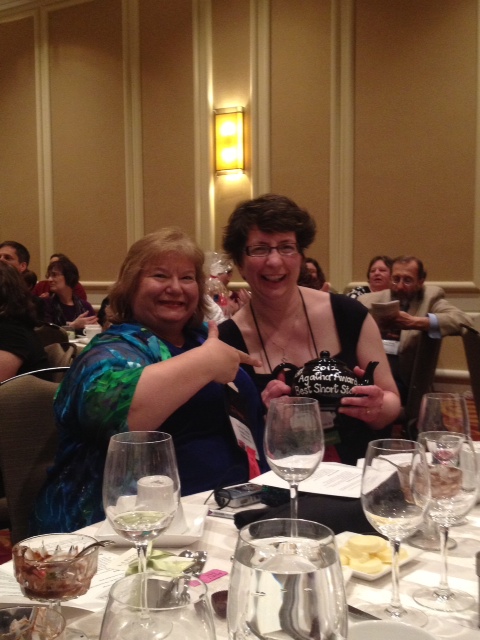
Since my last post, the nominees for this year’s Agatha Awards have been announced and EQMM wishes to congratulate all of the nominees in the short story category, but especially regular EQMM contributors Dana Cameron and Art Taylor. Dana earned her nomination for her November 2012 EQMM story “Mischief in Mesopotamia” and Art received his for “When Duty Calls,” from the anthology Chesapeake Crimes: This Job Is Murder. Other nominees include “Thea’s First Husand” by AHMM author B.K. Stevens. Altogether, it’s an impressive lineup, and the Cameron and Stevens stories are now available for reading online at our website.

The Agatha Awards are a highlight of one of our genre’s most important fan events, the Malice Domestic Convention, held each year near Washington, D. C.

Of all the mystery conventions I’ve attended, this is the one at which members most openly express their love for the great authors the field has produced and for their fictional creations. And I use the word “love” here advisedly.

The first time I attended a Malice Convention fancy-dress tea and saw dozens of fans not only in period costume (some inspired by mystery’s iconic sleuths) but in outlandish hats (which I soon learned were to be judged for a prize), I confess that I thought it all really over the top. But I had the seriousness then of someone not long out of the academic world, where writers with devoted followings inspire “societies” not “fan” clubs or conventions, the former word somehow suggesting an intellectual basis for the association. It was a revelation to me that so many readers would find it natural to express their passion for a writer’s work through exaggerated display, rather than by means of a journal article or discussion group. But it was all a lot more fun than plodding through scholarly analyses. And these people knew their stuff as well as any academic lecturing in the then newly forming curricula of popular fiction.

In the course of my editorship at EQMM, I’ve met many die-hard fans of mystery’s various authors, characters, and forms. I’ve observed many ways of paying homage, from the writing of pastiches to the creation of special Web sites to collecting or dramatizing an author’s work, to engaging in the kind of game familiar to most Sherlockians of offering theories to fill in gaps in the lives of fictional characters. For me, one of the most memorable events of my time at EQMM is the 2005 Ellery Queen Centenary Symposium, held at Columbia University, where, thirty-four years after the publication of the last Queen novel, fans gathered to celebrate two men whose writings under that byline were still a vital part of their lives. That day’s most surprising visitor, because of the distance he traveled, was Belgium’s Kurt Sercu, founder of the world’s largest Ellery Queen site, Ellery Queen: A Website on Deduction.

Regular EQMM readers already know the story of how that symposium turned out for Kurt and the friend he met there in person for the first time, Dale Andrews. On a train taking them from the symposium to Washington, D.C., the two of them, both previously unpublished in fiction, plotted out an Ellery Queen pastiche that subsequently appeared in EQMM. Dale posted an article about pastiche writing and its significance on this site on June 13, 2012. I will leave you to read Dale’s own account of the form’s relationship to fandom, saying only that his conclusion that the pastiche writer—the ultimate fan—is “in love” hits on a truth that most of us can recognize as applicable to our own experiences as readers, at least in some form.

If “in love” seems like poetic excess, take this case revived by the Associated Press this year on January 19th, Edgar Allan Poe’s birthday. Many will already know something of this story, but I at least had not been aware of many of the details. Poe’s grave in Baltimore had, for seventy years, a mysterious night visitor each January 19th, a man in concealing hat and scarf who left three roses and a partly consumed bottle of cognac on the grave. This is not an apocryphal story, at least, not unless all of the witnesses, over a period of decades, are lying. The mysterious commemoration began sometime in the 1930s and continued until the mid 1990s, when a note was left that said that the “Poe Toaster,” as he’d come to be known in the media, had died. But even then, the Toaster, who was never identified, apparently exacted a promise from his sons that they would carry on the tradition. And they—or someone, anyway—did, up until four years ago, when the practice suddenly stopped. If that kind of “fan,” braving inclement weather and the vicissitudes of sixty-plus years to faithfully pay homage, isn’t in some way “in love” with the object of his devotion, then what is he? His dedication was played out with the constancy of the mourner in Poe’s own “Annabel Lee.”

Extreme, and even bizarre, as this case is, it brings out the essentially selfless nature of most fandom—which is, I think, why the report in an English newspaper a couple of years ago of an Agatha Christie fan’s discovery of Agatha Christie’s mother’s lost jewels in a battered old chest she bought at auction for a hundred pounds struck a chord with so many people. The locked chest was purchased entirely for its connection to Christie and sat in the Christie fan’s house for several years as a subject for conversation, until she decided to have the locks forced and discovered a strongbox inside with jewelry said to be worth possibly a hundred thousand pounds.

That collector appears to have received an astonishing return on an investment made solely out of admiration, but most fans, of course, get only the return of a sense of connection with the object of their veneration. And there sometimes seems to be no length to which a true fan will not go to experience such a connection. At a gathering of Sherlockians in Toronto a few years ago, a séance to conjure Conan Doyle was included in the slate of activities. But given that Doyle is known to have had connections to the spiritualist movement of his day, that may not be so different from Chandler fans drinking gimlets on their idol’s birthday. And since we’ve finally brought a hardboiled writer into this conversation, it should be pointed out that however gritty and true-to-life that area of our genre is claimed to be, its followers are not above a little dressing up for the sake of tribute either. It has been reported, for example, that the guide of San Francisco’s well-known Hammett tour dons a trench coat to set the mood.

Certain of these examples may only serve as proof to some people that genre fandom exists at the fringes of the mainstream. After all, isn’t it abnormal to be so absorbed in fictional creations, or to celebrate their creators in such obsessive ways? I’ve come to think not. If there are extremes in fandom, they are usually not unhealthy extremes. And are there any avid fiction readers out there who haven’t at some time or other come across an author whose work spoke to them, or lifted them out of the commonplace, in a way that seemed to demand further reading? I think we’ve all had the experience of coming across a book that inspires us to search out everything else its author has written.

I was giving blood once when I noticed on the table beside the nurse who was drawing it a series romance novel—the kind with a formulaic plot and characters devised by the publisher. Somehow we got talking about it, and it turned out the woman was an insatiable reader of these books; they were, she said, the chief pleasure in her life—the thing that had gotten her through a lot of grief and loss within her family. I have reflected since that she was very fortunate to find the kind of books that could take her to a happier place, if only in imagination. And I never again looked down my nose at a “formulaic” romance.

There are so many ways in which a work of fiction can touch, elevate, even change its readers, so many faculties both intellectual and emotional that may be involved in the reading experience in any given case that it may seem wrong to lump all the different types of fiction “fans” (or “literary society” members) together. “Serious” fiction is, by definition, meant to reveal something about reality to its readers; the various genres of fiction are meant primarily to entertain, but in doing so may work on the emotions (as in romance), stimulate the puzzle-solving intellect or widen social consciousness (as in mystery), or broaden readers’ sense of possibility (as in science fiction). But when you think about it, all of those widely varying effects have something in common: they can be transformative for the reader. Whether it’s through seeing aspects of reality more clearly, or finding new challenges for the mind, or experiencing a new range of emotions, readers often are transformed by fiction. And when they are—when the fiction writer has done something significant for them—the gratitude readers feel often gets expressed through fandom, which is, I think, a kind of love.—Janet Hutchings

Posted in Books, Characters, Conventions, Fiction, History | Tagged , , , , , , , , | 1 Comment

“Murder, He Giggled” (by Jack Fredrickson)

Jack Fredrickson, whose fiction-writing career began in EQMM’s Department of First Stories in 2002, has gone on to write a series of award-nominated novels featuring Chicago P.I. Dek Elstrom. He has a distinctive style, creating noir  ambiance with wry prose. Readers can see that style for themselves in the author’s upcoming story for EQMM, “The Ace I” (June 2013), or in his latest novel, The Dead Caller from Chicago (out in April from Minotaur). Humor and the murder mystery may seem strange bedfellows at first glance, especially the noir story and humor, but Jack Fredrickson manages to make them get along just fine, and it’s interesting to see how he came to it all.—Janet Hutchings

I attended a day-long gathering of mystery fans last autumn. Men of Mystery was held in California, several miles—downhill, mercifully—from one of the Pacific Coast’s finest muffin shops. Hundreds of avid readers showed up to see headliners Joseph Finder, John Lescroart, and James Rollins, along with a full passel of other prominent crime-fiction writers. There was even room for relatively unknown tuna such as myself to bob about the proceedings, though I was kept at the back of the great hall, where my table manners at lunch would cause the least distraction.

It was no surprise that it was a large gathering. No matter what or when, folks will always love good, thrilling whodunits.

What did surprise me, though maybe not really, was how uproarious the thing was. Mssrs. Finder, Lescroart, Rollins, and their peers are genuinely funny guys. Even my fellow few bobbing tuna burbled wittily upon occasion.

And that got me thinking, once again, about my own journey into crime fiction, and how I’ve come to depend on humor in my own writing, and not always to disguise what I don’t understand about plotting suspense.

My first attempt at a crime story, “The Brick Thing,” (available as a podcast, if you’re having trouble sleeping) somehow slipped past the almost always-vigilant editor Janet Hutchings, and got published in Ellery Queen’s Mystery Magazine. It presented little humor, other than perhaps the laughable quality of its prose, but it was noteworthy, at least in my life, for what it set off. For I decided that if I could fool Janet Hutchings, I could fool a book publisher. I decided to write an entire crime novel.

It took no time to come up with a surefire seven-word beginning: “It was a dark and stormy night,” nor to craft a dynamite two word ender: “The End.” The rub was going to be the pesky eighty thousand words I’d need to connect the two.

I had some idea how to approach this. I knew someone should die, and that someone else should discover the corpse. A third person should be retained to investigate and point an accusing finger at a fourth person. Beyond that, though, I needed help. Fortunately, someone suggested I attend the Summer Writing Festival at the University of Iowa (I forget who; there were so many people anxious for me to leave town). In Iowa, it was rumored, real graduates of the university’s famed Writers’ Workshop, along with classmates, would “workshop,” or critique, whatever work I dragged in. And that, presumably, would put me on the road to great fame and fortune. All that was required was a small amount of tuition, and the twenty pages of manuscript to be critiqued.

I sent off the tuition, and wrote. And wrote. And wrote. And soon, I had twenty pages of widely spaced, widely margined manuscript, dotted here and there with more than several of the eighty thousand words I would ultimately need.

The instructor at my weeklong summer workshop was an esteemed writer of literary fiction. And she was a buckaroo, or rather, a buckarette, since she was . . . well, a she. She was fond of cowboy boots, pearl-buttoned shirts, and especially humor. The woman knew how to laugh.

She began our first session by passing around an enormous bag of M&Ms, that basic diet staple, and asked each of us to, “Tell us about your shoes.”

The class tittered. Being that she was a bona fide graduate of the esteemed Writers Workshop, we figured (a) she was weird, and (b) she might not simply be curious about our footwear and their origins, but instead was seeking to shock us into attention—that basic intention of any writer—right off. I mean, come on, travel all the way to Iowa to meet an established writer, only to begin by talking about our shoes?

As the M&Ms went round and round, the talk, the descriptions—the inventiveness—grew more aggressive and bold. She, and soon enough we, weren’t looking for mere exposition (“Well, uh, I went to Kohl’s, and these were, uh, on sale, and they fit, sort of, and, uh, since they’re cheap vinyl I don’t worry much about cleaning them, unless I step in a mound of, uh . . . ”) No; we were looking for outrageousness, words that would command attention, and it occurred to me then, as I sat with cheeks chock full of M&Ms, that I might strive to use a giggle as well as a gun in my crime fiction for, if done right, both would summon gasps.

The next days brought amplification. Our class transitioned to that other basic diet staple, beer, which required a change of venue. It was in a bar that the instructor parked her boots up on our table, leaned back, and focused on me as best she could.

“As regards your manuscript,” she said.

“Yes; yes?” I leaned forward. Several of the other workshoppers had perked up as well, lifting their heads off the table to see above the pitchers.

“First of all,” she said, “your work is very widely spaced and very widely margined.”

“Absolutely!” I shouted, delighted that she, a credentialed writer, had seen fit to notice one of the first tenets of my writing, the relentless incorporation of utterly blank space.

“That, of course, might reflect an author whose thoughts are also widely spaced apart,” she went on. “Be that as it may, you must offer up more glimpses of your world view.” And then she laughed, and knocked back an entire glass of beer.

The more charitable of my acquaintances try to laugh off my world view as stemming from a cracked prism in my brain, and for sure, the pages I’d brought to Iowa reflected that sensibility, or lack thereof. My protagonist was an odd duck who lived in a turret in a greasy, crooked suburb of Chicago (can you imagine: corruption in Chicago?) and hung around with an even odder duck.

The esteemed published writer buckarette was saying I’d begun too tentatively. I needed to work harder to engage my readers, to make them gasp in fear, certainly, but also from humor. I needed to lob every grenade I could muster.

I left Iowa five pounds heavier from candy, beer, and a sharpened sense of direction that, in a most modest way, has panned out. The New York Times, in its review of my second novel, spent good space on a humorous riff I did on Walmart, and the Wall Street Journal complimented me (I think) by noting that my work is quirky and affecting.

But then came one of those Word-A-Day jobs that gets very widely e-mailed to subscribers. They used my stuff to define the word “noir.”

Go figure; again, it’s all in the eye of the beholder. But I try to tease most of what I write with humor.

And M&Ms. And shoes.

Posted in Books, Characters, Editing, Fiction, Guest, Noir, Setting, Writers | Tagged , , , , , , , , , , | Leave a comment

“The Bridal Gown Theory of Creativity” (by Doug Allyn)

Several writers have told EQMM that they prefer writing short stories to novels because ideas come to them easily. The late Edward D. Hoch, for example, became impatient with the few novels he wrote because other story ideas had to be put on hold through the long process of completing a novel. Doug Allyn has distinguished himself as both a short story writer and a novelist, but he was already an award-winning short story writer before his first novel saw print, and he has remained a faithful practitioner of the short form. He has received many Edgar Allan Poe Award nominations for his short stories (so many that I’ve lost track) and he has won two short story Edgars. He is also the 2012 EQMM Readers Award winner and he has won that award nine times before. All of which makes me wonder if Doug isn’t one of those writers with such a rich flow of ideas that the short story is indispensable to him. In this post, he talks about the source of ideas for fiction, and if you ask me, he really has nailed it down.—Janet Hutchings

At every writer’s conference, one question always pops up. Where do you get your ideas?

Ask a hundred authors, you’ll get a hundred different answers. Most of them lame.

Writers who are paragons of clarity in print instantly drift into cloud cuckoo land when we try to explain the most basic element of our craft.

Some say that story ideas are everywhere, which is absolutely true, but much too vague to be useful.

Others say story ideas are like Art with a capital A, or porn, (no caps necessary). We know it when we see it.

Nuts.

Allow me to nail this sucker down, once and for all.

Story ideas are exactly like wedding dresses.

Not that I’ve ever worn a wedding dress myself, you understand, but I once married a girl who wore one. It was the luckiest day of my life.

I admit, this might make me overly fond of the analogy. But that doesn’t make it wrong.

Story ideas, like wedding dresses, derive from four components. You already know these famous four by heart.

Something Old? That one’s easy. Every writer begins as a reader. As a kid I read everything I could get my grubby paws on. Ten thousand books? Twenty, if you count comics. So in a sense, everything we create now is based, at least in part, on something old. My shiniest new idea is probably rooted in some forgotten paragraph penned by some forgotten scribe, who jotted it down with a goose quill. On a clay tablet.

How much of our work is rooted in the past? Sue Grafton uses the letters of the alphabet for her titles. I’m guessing she picked up her ABC skill set fairly early in her career. By age three, maybe? Four at the max.

Personally, I’ve dredged up inspiration (and ideas) from childhood sources as disparate as Marcus Aurelius and ZZ Top. I once wrote a series of medieval tales inspired by the cover of a Norah Lofts book I saw as a kid. I couldn’t read yet, so I can’t recall the title. It was a great cover, though.

Nothing is more fun than taking a piece of your childhood and giving it new life in something of your own. Which doesn’t mean we’re not capable of writing . . .

Something New.

Ever get that stale, ‘seen it all’ feeling? Take my word for it, any edition of a mystery magazine will blow your gloom to flindereens! (Which is a word I just made up, and you grasped it instantly. I rest my case.) New ideas pop up all the time. Archie Goodwin as a computer app, Doctor Watson as a Chinese chick? I’ve known my little brother since I was two, yet his savage stories still amaze me. The list of writers who stun me with the freshness of their work and ideas would take more space than I’ve been allotted here. I’d have to use the freakin’ Cloud. Instead, let’s move onto . . .

Something Borrowed.

Ah. . . . Here there be dragons, because the idea of borrowing can easily be misconstrued. I’m not talking about copping plots or story ideas. No good writer does that, or has to. But every writer consciously borrows inspirations. Breathes there a man with soul so dead, who’s never had the urge to take the wonderful rush of a Stevie Ray guitar lick or a snippet of dialog from a forgotten movie and spin it into something entirely new?

Example: in Lee Child’s wonderful Vengeance anthology, I read a story by Rick McMahan called “Moonshiner’s Lament.” I’d never seen the story before, but I kept getting a nagging feeling of déjà vu—suddenly I realized why it seemed familiar. I’d borrowed this material once myself. Not the story, the inspiration.

Rick and I were both galvanized by the same country song, “Copperhead Road,” a tune written back in the 80s by the marvelously talented Steve Earle.

My story was about insurance fraud. What I borrowed from Steve was the edgy mood of his music. I taped his song on an endless loop and played it over and over again for weeks as I wrote the story. I’ll bet I heard that tune a thousand times. I still love that song.

Rick’s repurposing of Earle’s world is equally fresh. If he hadn’t paid homage to his inspiration by mentioning the hero’s name and the song title in his story, you’d never make the connection.

Still, I think we should declare a moratorium on Steve Earl songs. If mystery writers keep copping his material, the poor guy won’t have a tune left to whistle.

Writers don’t borrow inspiration because we’re short of ideas, (ideas are everywhere, see above) but because we want to share the pleasure we derived from the original. How many retakes on Treasure Island or The Count of Monte Cristo have you seen already? How many new adventures of Sherlock Holmes or Sam Spade in cyberspace are waiting to be written? I hope that list is endless too.

Which brings us to our final, and darkest, category . . .

Something Blue.

Sex in the suspense story? Most classic mystery writers would swoon at the notion. Aunt Agatha never raised a hemline above the ankle. And Nero Wolfe in the altogether? Eeew!

Nobody mooned at greater length over lost love than Edgar Allan Poe, but even when he was coked out of his tree, (which was all too often) Ed never dreamed of portraying the physical act of love. Fifty Shades of Raven? For the love of God, Montressor! Nevermore!

Still, times change. The late, great James M. Cain made his initial reputation by introducing realistic (for the day) sex scenes into classic noir. Then came marvelous Mickey Spillane, and after him, the deluge.

Currently, our finest blue author is Lawrence Block. Early in his career, Larry wrote some soft porn stories under a pseudonym. I once did exactly the same thing for precisely the same reason.

Rent.

Larry’s blue past came to light when his novels exploded onto the bestseller lists. A publisher released his early work in an attempt to cash in on his newfound fame.

My own blue work suffered a sadder fate. The publisher went bankrupt before the book hit the stands. Trust me, this was no loss to literature. And yet, I do hope to see that forgotten novel again one day.

Not because it’s sexy. Nowadays, Nick At Nite shows racier stuff than mine. But if it ever does show up? It’ll mean that at long last, I have finally acquired a reputation worth stealing.

If that glorious day ever arrives, you’ll have no trouble spotting me on the red carpet.

I’ll be the guy dancing with the girl in the wedding dress.

Posted in Characters, Fiction, Guest, Setting, Writers | Tagged , , , , , , , | 5 Comments

“Sifting Through EQMM Buried Treasures” (by Sarah Weinman)

Many of EQMM’s subscribers, over the magazine’s long history, have been collectors of the magazine. Sometimes one hears of whole runs of the magazine being offered for sale, but more often several decades’ worth are offered to EQMM or mystery bookstores or used bookstores as a result of the clearing out of an estate or a move that prevents the collector from continuing to house the issues. EQMM contributor Sarah Weinman benefitted from the discovery of a partial run of old EQMMs in a mystery bookstore. She is the editor of Troubled Daughters, Twisted Wives: Stories from the Trailblazers of Domestic Suspense, which will be published later this year by Penguin, and which was put together with the help of those bookstore copies of EQMM. Sarah is also a wonderful short-story writer whose latest work for us, “Cog in the Wheel,” appeared in the December 2012 EQMM.Janet Hutchings

Several years back there was an upstart print magazine that fell in the trap new publications sometimes encounter: putting down the competition in order to make a name for themselves. The magazine, which billed itself as a quarterly devoted to noir fiction, saw fit to denigrate EQMM and sister publication AHMM for typical grievances: being fusty. Out of touch. Closed to stories where people act violently and speak profanely. Since the print magazine launched with the help of the Internet, controversy and debate raged in loud tones in blog comments sections.

The magazine, despite some top quality stories and reprints, lasted a grand total of two issues. EQMM celebrates its seventy-second birthday this year, while AHMM will turn fifty-seven.

Yes, it’s hard to launch a new magazine, especially one devoted to crime fiction that pays writers. It’s also needlessly stupid to promote oneself at the expense of your purported competition. But I bring up this cautionary tale because of something that got missed in the hubbub: quality isn’t just about whom you publish from the get-go. It’s about years of archives, issue after issue of publishing the best in the field, and—when you aren’t looking—helping to define a lost generation of writers.

I am proud to say that EQMM has been good to me as a fiction writer, publishing two of my stories six years apart (I’m slow.) But, even though I’d read issues of the magazine off and on, seeing familiar names like Ed Hoch, Doug Allyn, and Brendan DuBois, and paying close attention to the Department of First Stories to see which writers would publish further stories and novels, my sense of EQMM did not fully form until the spring and summer of 2012.

I’d just signed a contract to put together an anthology of stories by women writers who published their work primarily between the early 1940s and the mid 1970s. Some choices—Charlotte Armstrong, Margaret Millar, Dorothy B. Hughes, Shirley Jackson—were obvious, their reputations in the solid to standout range among avid mystery readers and, to a lesser extent, the general reading public. But for every enduring reputation, there were writers completely neglected, and it was—and is—my job to bring them out of the shadows and into the reading light.

As I began my research, sifting through online listings and paper records, I realized these women found a home, more often than not, in the pages of EQMM. Fred Dannay’s editorial sensibility from the magazine’s 1941 birth onwards was very kind not only to detective stories, but to suspense tales that centered around character and, in particular, family and domestic situations.

With a list in hand, I ventured to Greenwich Village on a sweltering July afternoon on a mission: The mystery bookstore Partners & Crime, I knew, had dozens of old EQMM issues for sale. I wasn’t sure how much they cost, one by one or in bulk, or if I’d be allowed to go through them piecemeal. But the daytime bookseller Steve Viola, whom I’d known for more than a decade—dating back to working occasional weekend shifts as a respite from graduate school, was kind to grant my wish. For the remainder of the afternoon, I sat on a couch at the back of the store, carefully going through issue after issue searching out hidden gems by writers previously unknown to me.

There were so many! Most of the stories, however, did not fit the banner of “domestic suspense” I was using to identify the anthology theme. One piece by a long-lost Edgar Award winner that I thought would be perfect for the anthology based on her past work turned out to be good, but not quite good enough. Another by a different Edgar winner was suspenseful, but not exactly domestic, or even chiefly concerned with a female perspective. But when I’d read my way through every old EQMM issue Partners & Crime stocked within my preferred publication range, I had no fewer than ten stories of interest, of which a half-dozen were sure inclusions, provided I could get the appropriate permissions. (Reader, I did, though not without some skillful, and hastily learned, negotiation, as well as able and recurring help from Janet Hutchings and Jackie Sherbow.)

That glorious afternoon reminded me anew about what made EQMM stand out from issue number one: Dannay’s insistence on excellence, a wide-ranging taste for mystery stories of all kinds, and a strong mix of new blood along with choice reprints. The hours of sifting also revealed that my thesis wasn’t a half-baked one: there really was a group of female writers who, because their creative endeavors centered more around family and domestic terrors, didn’t get the same sort of recognition as their male peers, but always had a home at EQMM.

My story ends on a bittersweet note, as those in the mystery world well know: Partners & Crime closed mere months later, after eighteen years in business. It turned out my search and shopping spree was, in actual fact, a liberation movement. And the store is yet one more thing, among so many, that EQMM outlasted.

Posted in Anthologies, Bookshops, Ellery Queen, Guest, History, Magazine, Writers | Tagged , , , , , , , , , | 7 Comments

“A Conversation with Myself” (by Robert S. Levinson)

This week’s post addresses something we at EQMM often hear about from mystery novelists: their fear of the short story and their belief that they can’t produce a publishable one. Robert S. Levinson had already received critical acclaim for his early novels before he was emboldened to try a short story—as he reveals in this post. But since then, the author of ten highly regarded thriller novels (the most recent Phony Tinsel, out this month) has produced dozens of short stories, including a Derringer winner and a Shamus Award-nominated tale. We hope his experiences will give heart to other talented writers who see the short story as a dangerous hurdle. —Janet Hutchings

What am I doing here?

Excellent question, Bob.

Thanks, Bob.

My answer goes something like this—

You know what it’s like, you say you can’t do something or other, this or that, often enough, how you come to believe it and don’t even try?

I hear you, Bob.

That’s how it was for me, Bob—about writing short stories—until about a dozen years ago, thanks to a chance encounter at an indie book store opening (Yes! They were still opening back then) with a fellow fallout from the music business, Jeff Gelb.

Jeff had heard I was one or two published mystery novels to the good, so felt comfortable asking if I’d be interested in contributing a short story to Flesh & Blood: Guilty as Sin, a mystery anthology he was putting together with Max Allan Collins.

I did a double take at Jeff’s invitation, expressed my appreciation, and declined.

“I don’t write short stories,” I said. “Can’t.”

“You ever try?”

“No.”

“Then how do you know you can’t?”

Okay, he had me there.

“I’ll give it a shot,” I said, figuring, worst case scenario: I’d prove what I’d been claiming for years.

Shortly, I set about expanding on a story idea set in the record business, barely a vague notion of where the story would lead or how long it would take to get there after opening this way:

When this happened in the sixties, the old Charlie Chaplin movie lot that hogged the southeast corner of Sunset Boulevard and La Brea Avenue had already passed through the hands of Red Skelton, the television clown, and become home to A&M Records for Herbie Alpert and his Tijuana Brass, Jewish hombres from Fairfax High who’d scored big with “The Lonely Bull” and turned Herbie into what the music business guys were calling a multibillionaire.

I steered forward, guided by the same formula I had applied to my first novel, The Elvis and Marilyn Affair, the follow-up, The James Dean Affair, and the next in line, The John Lennon Affair, blending show-business truths I’d experienced over the years and full-out fiction in a way that made it a guessing game for the reader, an approach that’s pretty much become my trademark.

The finished story, “Good Career Moves,” drew its title from these lines:

What is it they said when poor, sad, drugged-out, fat-beyond-Brando Elvis popped one too many and crapped out on the floor of his toilet in Graceland?

Good career move, they said.

And a good career move the story became for me.

It was my incentive to take a second shot at writing a short story, for submission to an anthology being assembled by the L.A. chapter of Sisters in Crime. Titled “Take My Word for It and You Don’t Have to Answer,” the story kicked off:

They found what remained of the body, really not much more than a gunnysack of bones, on the old decaying Mabel Normand soundstage, a tall, narrow, triangular building easy to miss a block north of Sunset Boulevard in the low rent Silverlake area, where Effie Street collides with Fountain Avenue.

And the writing came easier this time, once again no need to deal with sub-plots, secondary characters, other story elements that all too often add length, not strength, to a novel.

The soundstage was the least important landmark in the neighborhood, surrounded as it was by the outdoor location of Griffith’s monumental Intolerance—now a supermarket—the Monogram Studios, where Leo Gorcey, Huntz Hall and the Bowery Boys turned out dozens of cheap movies—now home to a PBS TV station—and the ABC television lot up the street at Prospect and Talmadge, but once a picturesque hillside owned by movie star Norma Talmadge, where Rin-Tin-Tin ran movie after movie to rescue the three Warner Brothers and their Vitaphone pictures from bankruptcy. 

Something else—

I was sufficiently pleased with the story that I decided to gamble, forget about Sisters in Crime, and submit it to Ellery Queen’s Mystery Magazine, until now nothing I’d ever figured as a possibility. For whatever ego comes with acceptance, there’s always a lesson to be learned by rejection, so—what the hell!—nothing to lose by taking a run at the queen of short mystery fiction publications.

Right, Bob?

Right, Bob.

And editor Janet Hutchings bought the story.

Bought it!

BOUGHT IT!

Ran the story in the December 2003 issue and—wonder of wonders—put my name on the cover, alongside my voracious-reader daughter Deborah’s absolute favorite author of short stories, the dean of Queen regulars, bless him, Edward D. Hoch.

My name on the cover.

The cover!

THE COVER!

Does it get much better than that?

Turns out it does.

Take my word for it and you don’t have to answer.

I began filling my writing time between novels with short stories that freed me from the hardcover prison of a mystery series, if not necessarily from some of my series characters who had developed a fan following. There was often a place for them in story ideas that began with What if? and helped me stretch as a writer, crafting answers to the question inside the box and, as often, outside the box.

Janet continued buying my stories, and I sold others to Linda Landrigan, editor of Alfred Hitchcock’s Mystery Magazine, Queen’s sister publication. Queen readers voted me onto their annual poll of favorite stories three times running. Stories have been reprinted in annual anthologies each of the past seven years, often the collections co-edited by the estimable Ed Gorman and Martin Greenberg. Robert J. Randisi came calling for original contributions to show business collections built around Hollywood and Broadway. Gary Phillips invited me in for a title he was editing in the Akashic series of noir publications.

Perhaps the topper—

Three nominations for a Derringer Award, with a win for “The Quick Brown Fox,” a story built around a writer who takes to stealing a short story after his creative juices dry up, and the consequences of such naughty behavior. (It’s included in one of the collections of stories I put together as an e-book original, up there wherever there is the technological opportunity to introduce more readers to the short story form.)

Hold it, Bob.

Huh? What, Bob? Where?

Sounds to me like you’re starting to go heavy on the bragging rights.

Actually, I’m heading to make a point, Bob.

I’m listening, Bob.

I’ve been trying to show by example the folly of saying I can’t or I don’t or I won’t about something—anything—without giving it your best shot. Is success guaranteed if you do? Absolutely not. I’ve lost track of how many short stories I’ve submitted to Queen and elsewhere over the years that have been rejected, and get this—

A few years ago, aware the L.A. chapter of Sisters in Crime was putting together another anthology, I wrote a story expressly for them, feeling some quirky sense of guilt for that early short story career boost the chapter unknowingly, indirectly gave me—my way of saying thank you.

Hold on, Bob. Are you about to tell me your story was rejected?

Bob, take my word for it and you don’t have to answer.

Posted in Books, Fiction, Guest, Writers | Tagged , , , , , | 3 Comments

“On Hoarding” (by John Boland)

John C. Boland’s short stories have appeared many times in the Dell Mystery Magazines (EQMM and AHMM) and for them he has received nominations for the Edgar, Shamus, and International Thriller Writers awards. His novels, which range from the private eye genre to science fiction thrillers, have earned starred reviews from Publishers Weekly. But he isn’t posting today about his writing. Instead, we find his wry voice employed on the topic of book collecting. Though he doesn’t mention it, we suspect the many voices whispering to him from his collection may have inspired him to become a publisher as well. His Perfect Crime Books puts out an impressive array of short story collections, classic reprints, critical non-fiction, and novels in several genres. Check it out!  —Janet Hutchings

There’s a story that may be true—I’m not going to risk spoiling it by research—that the Italian semiotician and novelist Umberto Eco built a splendid library on the second floor of his house. Eco didn’t take account of his books’ weight. Eventually an overburdened floor gave way, and part of the library relocated itself to Eco’s first floor.

I’m not sure when book hoarding becomes dangerous—or even when it becomes hoarding as opposed to casual accumulating or methodical collecting. It’s easier to tell these things with cats. When we had taken in five feral cats, my wife and I knew we were on the verge of slipping from eccentricity to pathology. We stopped inviting in strays and eventually turned to the more acceptable lunacy of raising a child. (People accumulate those too, but now we have a high fence in the backyard that toddlers looking for a dish of milk can’t scale.)

It’s not so easy with books. The strays arrive by mail, for the most part. You’ve paid the postage, you might as well let the thing in for a while.

Of course, when to put it back out becomes the problem. The weather is never quite right.

As books pile up, they’re much less unsanitary than rooms full of cats or children. They don’t always smell good, but thousands of volumes of moldy paper don’t smell too much mustier than one or two. There are no busybodies, moreover, likely to call the police if they think you’ve taken in too many books. There is no SPCA eager to euthanize feral copies of Scaramouche.

But books complicate the domestic order.

In a compatible household, everyone would agree that a room needs bookshelves regardless of its nominal function. I remarked to my wife a while ago that if we covered over all the dining room windows with shelves, we could have a very nice library. A reasonable person would have seen the point: If we really needed a dining room, there were several available in neighbors’ houses.

Mrs. Boland usually gets the point, but our dining room still has its windows.

Several years of recent arrivals—I almost said litters, because they sometimes arrive in fives and eights—have gone into plastic bins for temporary storage. (Try that with a cat or a teenager.) This isn’t at all satisfactory, because part of the pleasure of having a houseful of books is that as you pass their shelves, the voices of the authors murmur. They’re not insistent. The invitation is gentle (though it may be salacious, depending who hides in the covers), and it’s always friendly: Could I tell you again about this crime I solved, or the one I committed, or what life is really like out around Proxima C. (Some voices are more pretentious, but in our house they’ve grown silent from neglect.) Shelf after shelf, all those voices offering endurance, duplicity, eight or nine deadly sins the patriarchs never thought of, Dorothy Parker’s snide couplets, Aubrey Menen’s arrival in Limbo, Ray Bradbury’s secretive dwarfs, Charles Finney’s surreal circuses, Geoffrey Household’s pagan adventurers, Eric Ambler’s accidental spies, P.M. Hubbard’s crazed glass collectors, John MacDonald’s humming psychopaths, the pages chipping, and you think, Whoa, was that really the whisper of Garland Roarke? Or Winston Graham? Or Erle Stanley Gardner. It’s been a while.

All this is by way of a literary confession. It may be that I’ve listened to too many of these voices too lovingly for too long. Max Allan Collins, known for hardboiled tales, said in an interview that Donald Westlake was the last writer to significantly influence him—and that was back in his University of Iowa days, more than forty years ago. Collins developed his own voice, and in the dozens of novels he’s written since then it carries clear and strong.

I could go through the handful of novels I’ve written and say, Now that one does sound a little like Dick Francis. The reviewers said so, and the influence was there—never mind that they could also have mentioned Andrew Garve or even Len Deighton, whom I read diligently for his depictions of bureaucratic politics and the sharp economy of violence.

When I wrote a series of financial mysteries in a sassier voice, I wondered: Where did that come from? I wanted to think myself. But I knew my smart-aleck stockbroker owed a lot to smart-aleck actors, antiques dealers, and private eyes I’d met in other writers’ books.

I’m not sure I’d have it otherwise. Homage is a more self-exculpatory word than career-long theft. For a spy novel set in Budapest, I employed a gimmick I admired in Adam Hall, who throws his readers ahead into the next chapter without resolving what happened in the chapter just ended. (Hall, otherwise known as Elleston Trevor, has been dead awhile and can’t complain that I did it badly.)

For a reader, there is old and new pleasure in those murmuring voices. As a writer, I find endless instruction. Not everyone admires the highly prolific Stuart Woods, but there isn’t a page in his recent novels on which nothing happens. In Orchid Beach, his focal character seizes an opportunity to adopt a new career in about a page—something that would take most of us a chapter of agonizing, for the mistaken sake of verisimilitude.

If I wanted to understand the makings of a quietly disturbing voice, could I find a better teacher than Joel Townsley Rogers (of The Red Right Hand) or P.M. Hubbard, or—across the room in the science fiction department—J.G. Ballard or Philip K. Dick?

If I wanted to open a book without fuss or bother, but with the possibility of a cold finger on a reader’s neck, could I top Geoffrey Household’s The Courtesy of Death?: “I had never thought of the cottage as lonely.”

If I wanted to see how a well-aged pro delivers an emotional jab unexpectedly at the end, I could heed the murmurs of John Updike and turn to “Grandparenting” as Richard Maple holds his new grandchild and realizes: “Nobody belongs to us, except in memory.”

At night I never dream of having more cats, and the No. 1 Son is so satisfactory that I don’t yearn for a second or third. But I dream recurrently of rooms that seem to head off in a circle, one after another, with dingy linoleum on the floors and stacks of metal shelves in the middle congested with books. Room after room. Make of it what you will.

So the books arrive and never leave the house. Hoarding is considered a psychological aberration. What about hoarding the pleasures of other people’s minds? I don’t know if this is discussed in the DSM, but I have a copy of that tome on order. So I will find out, if the floor doesn’t give way.

Posted in Books, Guest, Writers | Tagged , , , , , , , , | Leave a comment

THE WIDE WORLD OF MYSTERY FICTION

The Edgar Allan Poe Award nominations for 2012 are out and the staff at EQMM wishes to congratulate Tom Piccirilli, author of the November 2012 EQMM story “The Void It Often Brings With It” and Teresa Solana, author of the March/April 2012 EQMM story “Still Life No.41,” for their nominations for best short story! If you haven’t yet read the stories, don’t miss them!

With the Edgars fresh on my mind as I sat down to write something for this week’s post, I thought, this is the perfect opportunity to say a few words about EQMM’s Passport to Crime department, because the Solana is the first story from the series to earn an Edgar nomination, and one of only a very few stories by non-English-speaking authors ever to get an Edgar nod.

The Passport to Crime department has been a particular pleasure for me to work on over the years. I suppose I have a certain sense of ownership in regard to it, since Passport is the only department in the magazine’s long history that began during my tenure. But that’s the most trivial reason for my attachment to it—there are other, better reasons that I’ll get to. In any case, Passport wasn’t entirely my idea. It grew from seeds planted by two other editors: Frederic Dannay, who brought EQMM into the world as a magazine with a global focus, and who frequently published stories in translation, including—most famously—the first work in English of the great Argentine writer Jorge Luis Borges; and Samuel Walker, founder of Walker & Company.

Early in my career I worked for Sam Walker, as Walker & Company’s editor for mystery fiction, and soon discovered I shared with him an interest in British mysteries. Sam was one of the first American publishers to feature books by British crime writers regularly—several on each season’s list. I call him an editor as well as a publisher because it was he who selected many of the British mysteries the company brought out in its early days.

When London was announced as the location for Bouchercon in 1990, I inquired about attending with high hopes. And the trip was, in fact, approved, but on one condition: I was also to see to some other business while in London. It was something that had been percolating in Sam’s mind for some time: He wanted to start a line of mystery fiction in translation. I was to do the rounds of British mystery publishers, talk to their editors, and gather opinions as to whether the project was feasible.

Why approach British publishers with the idea? Because, explained Sam, British publishers and editors, more often than their American counterparts, were fluent in other languages. They were more likely to have read the crime fiction being produced in non-English-speaking countries, and to know whether enough of it was of possible interest to American readers to make a series such as he imagined fly. They were also more likely to know of suitable translators, and agents specializing in foreign mystery fiction. Without a reliable stable of translators and a good idea of which authors we should be trying to sign, we’d have a tough time getting started.

Understand, this was a year before Soho Press started its international crime imprint, which, very slowly, over subsequent decades, helped to make crime-fiction imports a normal and expected part of the American publishing scene. I came back from England with dampening news. No one I had spoken to thought there was likely to be enough good material available to fill a separate imprint. Only a few mysteries in translation were seeing print even in the U.K. Worse, I had been unable to identify appropriate translators, or to make contact with agents specializing in the work of writers from other countries.

The matter was put on a back burner, with Sam presumably turning over, now and then, the prospects for pursuing it. Soon, the excitement of the whole thing—the chance to help launch a new imprint—faded for me; I was absorbed in my work with Walker’s American and British writers, and less than nine months later I’d left Walker for EQMM. Sadly, that same year, Sam Walker died in a canoeing accident.

A decade went by—a decade in which I mostly had too many other things to think about, especially with two changes of ownership at the magazines, to consider again whether it would be possible to do something along the lines of Sam’s idea. Then, suddenly—at least, it seemed sudden, everyone was talking about mysteries in translation. The International Association of Crime Writers, whose focus originally had been on issues such as fighting censorship under oppressive regimes, had shifted to getting non-English-speaking writers into translation for the American and British markets. Imprints such as Soho Crime had grown their lists. Many other publishers were getting in on the trend. I began to think about the possibilities for a short-story translation series, but at first I was skeptical.

Since I don’t read any language but English fluently enough to make literary judgments, I would have to depend entirely on scouts and translators, or already translated material, to identify authors for the series. And we would have to be willing to pay kill fees if, once the translation was done, I didn’t find the resulting work suitable. Then too, we’d be paying a lot more for these translated stories than for our usual fiction, since both author and translator would have to be paid. Would EQMM readers be sufficiently enthusiastic about the series to make it worth the extra work and cost? I had my doubts.

But counterbalancing those doubts was a perhaps justifiable sense that the magazine would benefit if I followed the strong appeal the project had for me personally, just as it had benefitted when Fred Dannay’s passionate search for forgotten mystery stories brought years of wonderful classic reprints to the magazine—passion being as important in editorial endeavors as in everything else. I was curious as to what was out there in other countries. Very curious.

What I found was fascinating. First of all, I noticed many different approaches to the mystery, with German writers more apt to be satirical; Argentine writers more labyrinthine; and the Japanese splitting into two schools—the last practitioners of the pure puzzle and the painters of finely detailed psychological portraits. There were also, of course, many revealing differences in cultural norms and style. My former colleague Cathleen Jordan, at our sister magazine AHMM, always used to say that the mystery story was comparable to the novel of manners. I think she meant that mysteries reveal a lot about societies—their structure, problems, and social dynamics. The point was illustrated particularly clearly for me in the translated stories we began to publish. Mysteries do reveal a lot about the societies from which they emerge, especially when put side by side with stories from other cultures. Nevertheless, more striking to me than the obvious differences the stories displayed were the similarities I discovered again and again in human reactions, motivation, and even sensibility.

Teresa Solana’s story provides a case in point. A few weeks after I bought it, and well before its publication, we received another excellent story set in the art world, by the American author Jonathan Santlofer (“The Muse”: EQMM September/October 2012). The two stories share an obvious similarity of theme, but what is more revealing is that behind both there seem to be eyes that see the world in nearly the same quirky, mocking way—I almost want to say, they’re informed by the same brand of intelligence. The Solana story is lighter in tone and more broadly humorous than the Santlofer, which is full of dark turns. Nevertheless, there appears to me to be much more in common between these two authors than one might have expected with an ocean and a language separating them. For some reason, which I won’t try to analyze here, I find those kinds of commonalities—those glimpses of what is universal in human experience—affirming, sometimes even thrilling. And that, I think, is one of the better reasons why it gives me so much pleasure to publish Passport to Crime.

Getting Passport going wasn’t easy; it was the project of several years. Fortunately, we had the help of Mary Frisque at IACW in identifying translators. And after a while, our network of contacts grew, so that we now have agents or translators alerting us to material in many parts of the world.

I think it’s been worth the effort. I hope our readers think so too.—Janet Hutchings, EQMM

Posted in Awards, Editing, Ellery Queen, Fiction, History, Magazine, Translation | Tagged , , , , , , , , | 1 Comment