
In this special blog post, Japanese literary scholar and critic Yusan Iiki gives readers a deep dive into the development of and differentiation of Japanese crime fiction in the 20th century
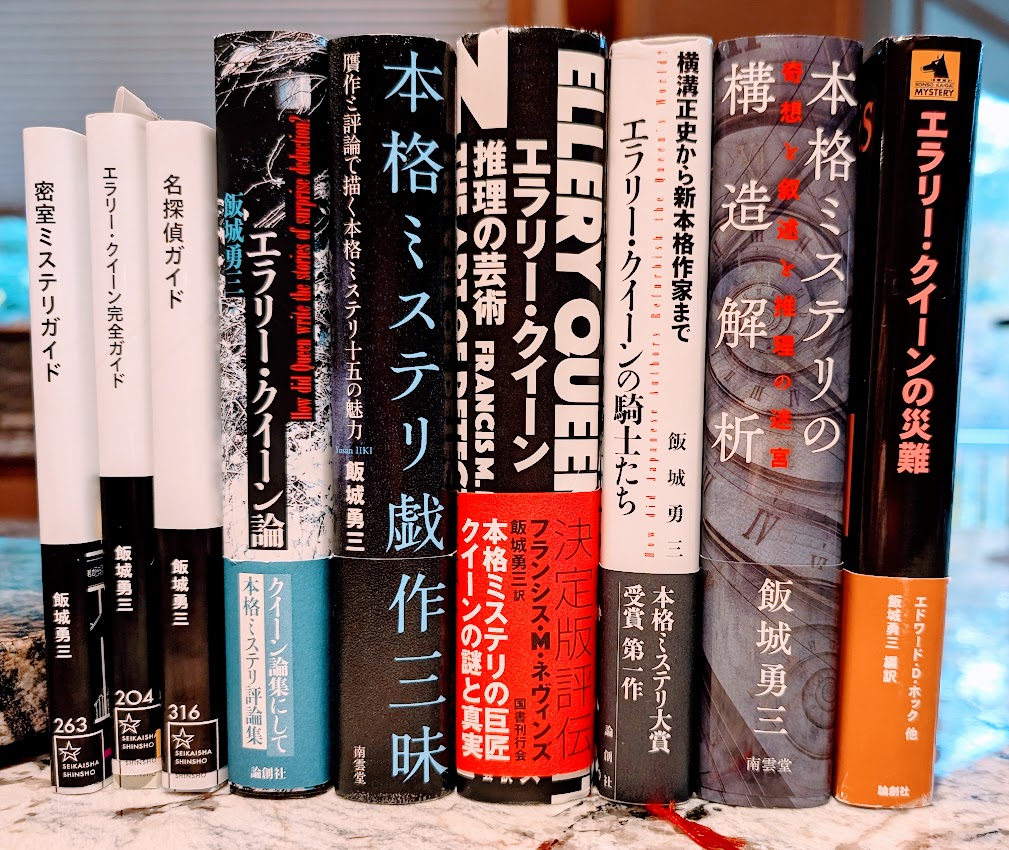
I’d like to pose a question: Is there a name for a subgenre that encompasses the writing styles of Agatha Christie, Freeman Wills Crofts, S.S. Van Dine, Ellery Queen, and John Dickson Carr. Terms like “traditional,” “classic,” “whodunnit,” “puzzler,” and “cozy” each come close, but are incomplete.
In Japanese we have a word—Honkaku—which I suggest covers it all. In the following article I would like to explain the definition of Honkaku and its scope in describing mystery fiction as used in Japan.
Defining Honkaku
The word Honkaku has been used in regard to detective fiction since before World War II. At that time, Honkaku meant things like “standard” or “orthodox.” In Japan until the 1920s, “standard” referred to mysteries such as Edgar Allan Poe’s “Dupin” series and Conan Doyle’s “Holmes” series. In short, Honkaku referred to a style of fiction writing in which the central theme was the detective’s process of unraveling clues to solve a mystery.
Eventually, works by British and American authors of the Golden Age—writers like Agatha Christie, S.S. Van Dine, and Ellery Queen who wrote “fair-play” mysteries—began to be translated into Japanese. As these books became available to Japanese readers, the style of these authors became the standard. Thus, the definition of Honkaku was further clarified to include the element of “fair play.”
Prior to World War II, the Japanese literary world didn’t make clear delineations between genres. Around 1934, Japanese detective novelist Saburo Koga complained that “lately, even science fiction, horror, and adventure stories are being referred to as detective stories.” Arguing for a more refined definition of detective fiction, Koga that anything other than Honkaku fiction should not be called “detective fiction.” Koga was saying that the term “detective fiction” (tantei shosetsu) should only be applied to works that have the solution of a mystery as its main theme and that practiced fair play with the reader. In other words, Koga was suggesting that “detective fiction” and honkaku were synonymous.
This distinction carried through to the period after World War II. Between the end of the war and around 1980, the most popular mystery imprint in Japan was the Sogen Mystery Library (Sogen Suiri Bunko), an imprint of Tokyo Sogensha. Each book’s cover had a symbol indicating the style of the work.
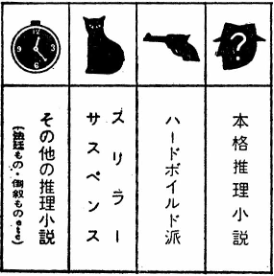
Reading from right to left, the labels for these symbols are:
“Honkaku Mystery Fiction” (image of a detective with question mark),
“Hard-Boiled” (image of a pistol),
“Thriller/Suspense” (image of a cat), and
“Other Mystery Fiction: Courtroom Mystery, Inverted Mystery, etc.” (clock image).
Interestingly, while most of Agatha Christie’s works are included in the “Honkaku” category, the publisher labeled Why Didn’t They Ask Evans? and The Seven Dials Mystery under the category of “Thriller/Suspense.” The publisher took these definitions seriously. Works that didn’t have “solution of a mystery” as their main focus were excluded from the Honkaku genre. Thus, readers who enjoy the process of solving mysteries and care about fair play needn’t worry about the author’s name. All they needed to do is read books that have the word Honkaku written on the cover. Writers who cared about the process of solving mysteries and playing fair with the readers also began to label their books as Honkaku.
And so, the Honkaku genre flourished in Japan.
The Scope of Honkaku
Authors whose books have been labeled Honkaku by the Sogen Mystery Library include Arthur Conan Doyle, G.K. Chesterton, Agatha Christie, Freeman Wills Crofts, S.S. Van Dine, Ellery Queen, and John Dickson Carr, all of whom have great popularity in Japan. In fact, there is likely no other subgenre that includes as many popular authors.
The Honkaku label isn’t limited to Golden Age authors. In a 1948 essay, Edogawa Rampo introduced authors such as Michael Innes, Nicholas Blake, and Margery Allingham, and collectively referred to them as the “British New Honkaku School.” In Japan, scope of the Honkaku subgenre has come to include works in the style of Innes and others.
So far, we’ve only discussed Western authors and their works and have neglected Japanese authors.
After World War II, authors such as Seishi Yokomizo, Akimitsu Takagi, and Tetsuya Ayukawa wrote many excellent detective stories which were heavily influenced by the Honkaku authors of the Golden Age, such Queen, Carr, and Crofts. For this reason, their style has come to be an integral part of Honkaku.
A seismic shift in Japanese mystery fiction occurred in the early 1960s, brought about by the detective stories of Seicho Matsumoto which explored human psychology, corruption, and societal malaise. Matsumoto’s novels became bestsellers and attracted many fans. This style of writing came to be called social mystery. It seemed at the time that the social mystery genre had eclipsed and driven out Honkaku mysteries. But the truth is that Honkaku and social mysteries are not incompatible. Social mysteries, for example, don’t ignore the importance of solving the mystery or playing fair with the readers. Matsumoto’s first novel, Ten to Sen (1958, translated as Points and Lines; recently published in a new translation as Tokyo Express) is highly regarded as a Honkaku mystery.
Many people assume that Matsumoto was critical of Honkaku mysteries in some of his essays. However, this is not accurate. If you read Matsumoto’s essays carefully, you will see that he was rejecting only one aspect of the Honkaku mystery genre, not the entire genre.
Let me explain this in more detail. At the time that Matsumoto began writing, Honkaku mysteries tended to rely on certain plot devices—misdirection, illusions, playing with the reader’s perception—which in Japanese we refer to as torikku (from the English “trick”). In Japan, works that use original “tricks” were highly valued. Matsumoto rejected works in which the author focused too much on gimmicks which neglected the culprit’s motive for using those tricks to commit murder.
Within the world of the novel, the person who devised the trick is the culprit, not the author. The culprit devised and used the trick not to boast about the originality of the trick, but to avoid being suspected. For example, in Matsumoto’s Ten to Sen, the culprit devised a false alibi to make the murder of two people look like the double suicides of two lovers. This deception was consistent with the culprit’s motive to discourage the police from conducting a detailed investigation. Matsumoto was critical of Honkaku mysteries in which the authors did not consider these things and neglected the culprit’s motive.
There’s another important proof that Matsumoto didn’t reject the entire Honkaku mystery genre itself. In 1966, Matsumoto served as the supervisor and editor of a series published by the Yomiuri Shimbunsya, which he named Shin Honkaku Suiri-shosetu Zenshu (New Honkaku Mystery Novel Collection).
The tradition of Honkaku mysteries continues into the present. In 1987, Yukito Ayatsuji made his debut with The Decagon House Murders (published in English by Locked Room International in 2007). Many other authors followed suit and made their debuts. When Ayatsuji and others were young, they were avid readers of the Honkaku branded works in the Sogen Suiri Bunko. They succeeded in writing Honkaku mystery novels in the style of Christie, Queen, and Carr. Their works and the works of their disciples came to be called Shin Honkaku (“New Honkaku”) Mysteries. And so, the Honkaku mystery movement has spread and continues to be popular in the Japanese publishing world.