“Sifting Through EQMM Buried Treasures” (by Sarah Weinman)

Many of EQMM’s subscribers, over the magazine’s long history, have been collectors of the magazine. Sometimes one hears of whole runs of the magazine being offered for sale, but more often several decades’ worth are offered to EQMM or mystery bookstores or used bookstores as a result of the clearing out of an estate or a move that prevents the collector from continuing to house the issues. EQMM contributor Sarah Weinman benefitted from the discovery of a partial run of old EQMMs in a mystery bookstore. She is the editor of Troubled Daughters, Twisted Wives: Stories from the Trailblazers of Domestic Suspense, which will be published later this year by Penguin, and which was put together with the help of those bookstore copies of EQMM. Sarah is also a wonderful short-story writer whose latest work for us, “Cog in the Wheel,” appeared in the December 2012 EQMM.Janet Hutchings

Several years back there was an upstart print magazine that fell in the trap new publications sometimes encounter: putting down the competition in order to make a name for themselves. The magazine, which billed itself as a quarterly devoted to noir fiction, saw fit to denigrate EQMM and sister publication AHMM for typical grievances: being fusty. Out of touch. Closed to stories where people act violently and speak profanely. Since the print magazine launched with the help of the Internet, controversy and debate raged in loud tones in blog comments sections.

The magazine, despite some top quality stories and reprints, lasted a grand total of two issues. EQMM celebrates its seventy-second birthday this year, while AHMM will turn fifty-seven.

Yes, it’s hard to launch a new magazine, especially one devoted to crime fiction that pays writers. It’s also needlessly stupid to promote oneself at the expense of your purported competition. But I bring up this cautionary tale because of something that got missed in the hubbub: quality isn’t just about whom you publish from the get-go. It’s about years of archives, issue after issue of publishing the best in the field, and—when you aren’t looking—helping to define a lost generation of writers.

I am proud to say that EQMM has been good to me as a fiction writer, publishing two of my stories six years apart (I’m slow.) But, even though I’d read issues of the magazine off and on, seeing familiar names like Ed Hoch, Doug Allyn, and Brendan DuBois, and paying close attention to the Department of First Stories to see which writers would publish further stories and novels, my sense of EQMM did not fully form until the spring and summer of 2012.

I’d just signed a contract to put together an anthology of stories by women writers who published their work primarily between the early 1940s and the mid 1970s. Some choices—Charlotte Armstrong, Margaret Millar, Dorothy B. Hughes, Shirley Jackson—were obvious, their reputations in the solid to standout range among avid mystery readers and, to a lesser extent, the general reading public. But for every enduring reputation, there were writers completely neglected, and it was—and is—my job to bring them out of the shadows and into the reading light.

As I began my research, sifting through online listings and paper records, I realized these women found a home, more often than not, in the pages of EQMM. Fred Dannay’s editorial sensibility from the magazine’s 1941 birth onwards was very kind not only to detective stories, but to suspense tales that centered around character and, in particular, family and domestic situations.

With a list in hand, I ventured to Greenwich Village on a sweltering July afternoon on a mission: The mystery bookstore Partners & Crime, I knew, had dozens of old EQMM issues for sale. I wasn’t sure how much they cost, one by one or in bulk, or if I’d be allowed to go through them piecemeal. But the daytime bookseller Steve Viola, whom I’d known for more than a decade—dating back to working occasional weekend shifts as a respite from graduate school, was kind to grant my wish. For the remainder of the afternoon, I sat on a couch at the back of the store, carefully going through issue after issue searching out hidden gems by writers previously unknown to me.

There were so many! Most of the stories, however, did not fit the banner of “domestic suspense” I was using to identify the anthology theme. One piece by a long-lost Edgar Award winner that I thought would be perfect for the anthology based on her past work turned out to be good, but not quite good enough. Another by a different Edgar winner was suspenseful, but not exactly domestic, or even chiefly concerned with a female perspective. But when I’d read my way through every old EQMM issue Partners & Crime stocked within my preferred publication range, I had no fewer than ten stories of interest, of which a half-dozen were sure inclusions, provided I could get the appropriate permissions. (Reader, I did, though not without some skillful, and hastily learned, negotiation, as well as able and recurring help from Janet Hutchings and Jackie Sherbow.)

That glorious afternoon reminded me anew about what made EQMM stand out from issue number one: Dannay’s insistence on excellence, a wide-ranging taste for mystery stories of all kinds, and a strong mix of new blood along with choice reprints. The hours of sifting also revealed that my thesis wasn’t a half-baked one: there really was a group of female writers who, because their creative endeavors centered more around family and domestic terrors, didn’t get the same sort of recognition as their male peers, but always had a home at EQMM.

My story ends on a bittersweet note, as those in the mystery world well know: Partners & Crime closed mere months later, after eighteen years in business. It turned out my search and shopping spree was, in actual fact, a liberation movement. And the store is yet one more thing, among so many, that EQMM outlasted.

Posted in Anthologies, Bookshops, Ellery Queen, Guest, History, Magazine, Writers | Tagged , , , , , , , , , | 7 Comments

“A Conversation with Myself” (by Robert S. Levinson)

This week’s post addresses something we at EQMM often hear about from mystery novelists: their fear of the short story and their belief that they can’t produce a publishable one. Robert S. Levinson had already received critical acclaim for his early novels before he was emboldened to try a short story—as he reveals in this post. But since then, the author of ten highly regarded thriller novels (the most recent Phony Tinsel, out this month) has produced dozens of short stories, including a Derringer winner and a Shamus Award-nominated tale. We hope his experiences will give heart to other talented writers who see the short story as a dangerous hurdle. —Janet Hutchings

What am I doing here?

Excellent question, Bob.

Thanks, Bob.

My answer goes something like this—

You know what it’s like, you say you can’t do something or other, this or that, often enough, how you come to believe it and don’t even try?

I hear you, Bob.

That’s how it was for me, Bob—about writing short stories—until about a dozen years ago, thanks to a chance encounter at an indie book store opening (Yes! They were still opening back then) with a fellow fallout from the music business, Jeff Gelb.

Jeff had heard I was one or two published mystery novels to the good, so felt comfortable asking if I’d be interested in contributing a short story to Flesh & Blood: Guilty as Sin, a mystery anthology he was putting together with Max Allan Collins.

I did a double take at Jeff’s invitation, expressed my appreciation, and declined.

“I don’t write short stories,” I said. “Can’t.”

“You ever try?”

“No.”

“Then how do you know you can’t?”

Okay, he had me there.

“I’ll give it a shot,” I said, figuring, worst case scenario: I’d prove what I’d been claiming for years.

Shortly, I set about expanding on a story idea set in the record business, barely a vague notion of where the story would lead or how long it would take to get there after opening this way:

When this happened in the sixties, the old Charlie Chaplin movie lot that hogged the southeast corner of Sunset Boulevard and La Brea Avenue had already passed through the hands of Red Skelton, the television clown, and become home to A&M Records for Herbie Alpert and his Tijuana Brass, Jewish hombres from Fairfax High who’d scored big with “The Lonely Bull” and turned Herbie into what the music business guys were calling a multibillionaire.

I steered forward, guided by the same formula I had applied to my first novel, The Elvis and Marilyn Affair, the follow-up, The James Dean Affair, and the next in line, The John Lennon Affair, blending show-business truths I’d experienced over the years and full-out fiction in a way that made it a guessing game for the reader, an approach that’s pretty much become my trademark.

The finished story, “Good Career Moves,” drew its title from these lines:

What is it they said when poor, sad, drugged-out, fat-beyond-Brando Elvis popped one too many and crapped out on the floor of his toilet in Graceland?

Good career move, they said.

And a good career move the story became for me.

It was my incentive to take a second shot at writing a short story, for submission to an anthology being assembled by the L.A. chapter of Sisters in Crime. Titled “Take My Word for It and You Don’t Have to Answer,” the story kicked off:

They found what remained of the body, really not much more than a gunnysack of bones, on the old decaying Mabel Normand soundstage, a tall, narrow, triangular building easy to miss a block north of Sunset Boulevard in the low rent Silverlake area, where Effie Street collides with Fountain Avenue.

And the writing came easier this time, once again no need to deal with sub-plots, secondary characters, other story elements that all too often add length, not strength, to a novel.

The soundstage was the least important landmark in the neighborhood, surrounded as it was by the outdoor location of Griffith’s monumental Intolerance—now a supermarket—the Monogram Studios, where Leo Gorcey, Huntz Hall and the Bowery Boys turned out dozens of cheap movies—now home to a PBS TV station—and the ABC television lot up the street at Prospect and Talmadge, but once a picturesque hillside owned by movie star Norma Talmadge, where Rin-Tin-Tin ran movie after movie to rescue the three Warner Brothers and their Vitaphone pictures from bankruptcy. 

Something else—

I was sufficiently pleased with the story that I decided to gamble, forget about Sisters in Crime, and submit it to Ellery Queen’s Mystery Magazine, until now nothing I’d ever figured as a possibility. For whatever ego comes with acceptance, there’s always a lesson to be learned by rejection, so—what the hell!—nothing to lose by taking a run at the queen of short mystery fiction publications.

Right, Bob?

Right, Bob.

And editor Janet Hutchings bought the story.

Bought it!

BOUGHT IT!

Ran the story in the December 2003 issue and—wonder of wonders—put my name on the cover, alongside my voracious-reader daughter Deborah’s absolute favorite author of short stories, the dean of Queen regulars, bless him, Edward D. Hoch.

My name on the cover.

The cover!

THE COVER!

Does it get much better than that?

Turns out it does.

Take my word for it and you don’t have to answer.

I began filling my writing time between novels with short stories that freed me from the hardcover prison of a mystery series, if not necessarily from some of my series characters who had developed a fan following. There was often a place for them in story ideas that began with What if? and helped me stretch as a writer, crafting answers to the question inside the box and, as often, outside the box.

Janet continued buying my stories, and I sold others to Linda Landrigan, editor of Alfred Hitchcock’s Mystery Magazine, Queen’s sister publication. Queen readers voted me onto their annual poll of favorite stories three times running. Stories have been reprinted in annual anthologies each of the past seven years, often the collections co-edited by the estimable Ed Gorman and Martin Greenberg. Robert J. Randisi came calling for original contributions to show business collections built around Hollywood and Broadway. Gary Phillips invited me in for a title he was editing in the Akashic series of noir publications.

Perhaps the topper—

Three nominations for a Derringer Award, with a win for “The Quick Brown Fox,” a story built around a writer who takes to stealing a short story after his creative juices dry up, and the consequences of such naughty behavior. (It’s included in one of the collections of stories I put together as an e-book original, up there wherever there is the technological opportunity to introduce more readers to the short story form.)

Hold it, Bob.

Huh? What, Bob? Where?

Sounds to me like you’re starting to go heavy on the bragging rights.

Actually, I’m heading to make a point, Bob.

I’m listening, Bob.

I’ve been trying to show by example the folly of saying I can’t or I don’t or I won’t about something—anything—without giving it your best shot. Is success guaranteed if you do? Absolutely not. I’ve lost track of how many short stories I’ve submitted to Queen and elsewhere over the years that have been rejected, and get this—

A few years ago, aware the L.A. chapter of Sisters in Crime was putting together another anthology, I wrote a story expressly for them, feeling some quirky sense of guilt for that early short story career boost the chapter unknowingly, indirectly gave me—my way of saying thank you.

Hold on, Bob. Are you about to tell me your story was rejected?

Bob, take my word for it and you don’t have to answer.

Posted in Books, Fiction, Guest, Writers | Tagged , , , , , | 3 Comments

“On Hoarding” (by John Boland)

John C. Boland’s short stories have appeared many times in the Dell Mystery Magazines (EQMM and AHMM) and for them he has received nominations for the Edgar, Shamus, and International Thriller Writers awards. His novels, which range from the private eye genre to science fiction thrillers, have earned starred reviews from Publishers Weekly. But he isn’t posting today about his writing. Instead, we find his wry voice employed on the topic of book collecting. Though he doesn’t mention it, we suspect the many voices whispering to him from his collection may have inspired him to become a publisher as well. His Perfect Crime Books puts out an impressive array of short story collections, classic reprints, critical non-fiction, and novels in several genres. Check it out!  —Janet Hutchings

There’s a story that may be true—I’m not going to risk spoiling it by research—that the Italian semiotician and novelist Umberto Eco built a splendid library on the second floor of his house. Eco didn’t take account of his books’ weight. Eventually an overburdened floor gave way, and part of the library relocated itself to Eco’s first floor.

I’m not sure when book hoarding becomes dangerous—or even when it becomes hoarding as opposed to casual accumulating or methodical collecting. It’s easier to tell these things with cats. When we had taken in five feral cats, my wife and I knew we were on the verge of slipping from eccentricity to pathology. We stopped inviting in strays and eventually turned to the more acceptable lunacy of raising a child. (People accumulate those too, but now we have a high fence in the backyard that toddlers looking for a dish of milk can’t scale.)

It’s not so easy with books. The strays arrive by mail, for the most part. You’ve paid the postage, you might as well let the thing in for a while.

Of course, when to put it back out becomes the problem. The weather is never quite right.

As books pile up, they’re much less unsanitary than rooms full of cats or children. They don’t always smell good, but thousands of volumes of moldy paper don’t smell too much mustier than one or two. There are no busybodies, moreover, likely to call the police if they think you’ve taken in too many books. There is no SPCA eager to euthanize feral copies of Scaramouche.

But books complicate the domestic order.

In a compatible household, everyone would agree that a room needs bookshelves regardless of its nominal function. I remarked to my wife a while ago that if we covered over all the dining room windows with shelves, we could have a very nice library. A reasonable person would have seen the point: If we really needed a dining room, there were several available in neighbors’ houses.

Mrs. Boland usually gets the point, but our dining room still has its windows.

Several years of recent arrivals—I almost said litters, because they sometimes arrive in fives and eights—have gone into plastic bins for temporary storage. (Try that with a cat or a teenager.) This isn’t at all satisfactory, because part of the pleasure of having a houseful of books is that as you pass their shelves, the voices of the authors murmur. They’re not insistent. The invitation is gentle (though it may be salacious, depending who hides in the covers), and it’s always friendly: Could I tell you again about this crime I solved, or the one I committed, or what life is really like out around Proxima C. (Some voices are more pretentious, but in our house they’ve grown silent from neglect.) Shelf after shelf, all those voices offering endurance, duplicity, eight or nine deadly sins the patriarchs never thought of, Dorothy Parker’s snide couplets, Aubrey Menen’s arrival in Limbo, Ray Bradbury’s secretive dwarfs, Charles Finney’s surreal circuses, Geoffrey Household’s pagan adventurers, Eric Ambler’s accidental spies, P.M. Hubbard’s crazed glass collectors, John MacDonald’s humming psychopaths, the pages chipping, and you think, Whoa, was that really the whisper of Garland Roarke? Or Winston Graham? Or Erle Stanley Gardner. It’s been a while.

All this is by way of a literary confession. It may be that I’ve listened to too many of these voices too lovingly for too long. Max Allan Collins, known for hardboiled tales, said in an interview that Donald Westlake was the last writer to significantly influence him—and that was back in his University of Iowa days, more than forty years ago. Collins developed his own voice, and in the dozens of novels he’s written since then it carries clear and strong.

I could go through the handful of novels I’ve written and say, Now that one does sound a little like Dick Francis. The reviewers said so, and the influence was there—never mind that they could also have mentioned Andrew Garve or even Len Deighton, whom I read diligently for his depictions of bureaucratic politics and the sharp economy of violence.

When I wrote a series of financial mysteries in a sassier voice, I wondered: Where did that come from? I wanted to think myself. But I knew my smart-aleck stockbroker owed a lot to smart-aleck actors, antiques dealers, and private eyes I’d met in other writers’ books.

I’m not sure I’d have it otherwise. Homage is a more self-exculpatory word than career-long theft. For a spy novel set in Budapest, I employed a gimmick I admired in Adam Hall, who throws his readers ahead into the next chapter without resolving what happened in the chapter just ended. (Hall, otherwise known as Elleston Trevor, has been dead awhile and can’t complain that I did it badly.)

For a reader, there is old and new pleasure in those murmuring voices. As a writer, I find endless instruction. Not everyone admires the highly prolific Stuart Woods, but there isn’t a page in his recent novels on which nothing happens. In Orchid Beach, his focal character seizes an opportunity to adopt a new career in about a page—something that would take most of us a chapter of agonizing, for the mistaken sake of verisimilitude.

If I wanted to understand the makings of a quietly disturbing voice, could I find a better teacher than Joel Townsley Rogers (of The Red Right Hand) or P.M. Hubbard, or—across the room in the science fiction department—J.G. Ballard or Philip K. Dick?

If I wanted to open a book without fuss or bother, but with the possibility of a cold finger on a reader’s neck, could I top Geoffrey Household’s The Courtesy of Death?: “I had never thought of the cottage as lonely.”

If I wanted to see how a well-aged pro delivers an emotional jab unexpectedly at the end, I could heed the murmurs of John Updike and turn to “Grandparenting” as Richard Maple holds his new grandchild and realizes: “Nobody belongs to us, except in memory.”

At night I never dream of having more cats, and the No. 1 Son is so satisfactory that I don’t yearn for a second or third. But I dream recurrently of rooms that seem to head off in a circle, one after another, with dingy linoleum on the floors and stacks of metal shelves in the middle congested with books. Room after room. Make of it what you will.

So the books arrive and never leave the house. Hoarding is considered a psychological aberration. What about hoarding the pleasures of other people’s minds? I don’t know if this is discussed in the DSM, but I have a copy of that tome on order. So I will find out, if the floor doesn’t give way.

Posted in Books, Guest, Writers | Tagged , , , , , , , , | Leave a comment

THE WIDE WORLD OF MYSTERY FICTION

The Edgar Allan Poe Award nominations for 2012 are out and the staff at EQMM wishes to congratulate Tom Piccirilli, author of the November 2012 EQMM story “The Void It Often Brings With It” and Teresa Solana, author of the March/April 2012 EQMM story “Still Life No.41,” for their nominations for best short story! If you haven’t yet read the stories, don’t miss them!

With the Edgars fresh on my mind as I sat down to write something for this week’s post, I thought, this is the perfect opportunity to say a few words about EQMM’s Passport to Crime department, because the Solana is the first story from the series to earn an Edgar nomination, and one of only a very few stories by non-English-speaking authors ever to get an Edgar nod.

The Passport to Crime department has been a particular pleasure for me to work on over the years. I suppose I have a certain sense of ownership in regard to it, since Passport is the only department in the magazine’s long history that began during my tenure. But that’s the most trivial reason for my attachment to it—there are other, better reasons that I’ll get to. In any case, Passport wasn’t entirely my idea. It grew from seeds planted by two other editors: Frederic Dannay, who brought EQMM into the world as a magazine with a global focus, and who frequently published stories in translation, including—most famously—the first work in English of the great Argentine writer Jorge Luis Borges; and Samuel Walker, founder of Walker & Company.

Early in my career I worked for Sam Walker, as Walker & Company’s editor for mystery fiction, and soon discovered I shared with him an interest in British mysteries. Sam was one of the first American publishers to feature books by British crime writers regularly—several on each season’s list. I call him an editor as well as a publisher because it was he who selected many of the British mysteries the company brought out in its early days.

When London was announced as the location for Bouchercon in 1990, I inquired about attending with high hopes. And the trip was, in fact, approved, but on one condition: I was also to see to some other business while in London. It was something that had been percolating in Sam’s mind for some time: He wanted to start a line of mystery fiction in translation. I was to do the rounds of British mystery publishers, talk to their editors, and gather opinions as to whether the project was feasible.

Why approach British publishers with the idea? Because, explained Sam, British publishers and editors, more often than their American counterparts, were fluent in other languages. They were more likely to have read the crime fiction being produced in non-English-speaking countries, and to know whether enough of it was of possible interest to American readers to make a series such as he imagined fly. They were also more likely to know of suitable translators, and agents specializing in foreign mystery fiction. Without a reliable stable of translators and a good idea of which authors we should be trying to sign, we’d have a tough time getting started.

Understand, this was a year before Soho Press started its international crime imprint, which, very slowly, over subsequent decades, helped to make crime-fiction imports a normal and expected part of the American publishing scene. I came back from England with dampening news. No one I had spoken to thought there was likely to be enough good material available to fill a separate imprint. Only a few mysteries in translation were seeing print even in the U.K. Worse, I had been unable to identify appropriate translators, or to make contact with agents specializing in the work of writers from other countries.

The matter was put on a back burner, with Sam presumably turning over, now and then, the prospects for pursuing it. Soon, the excitement of the whole thing—the chance to help launch a new imprint—faded for me; I was absorbed in my work with Walker’s American and British writers, and less than nine months later I’d left Walker for EQMM. Sadly, that same year, Sam Walker died in a canoeing accident.

A decade went by—a decade in which I mostly had too many other things to think about, especially with two changes of ownership at the magazines, to consider again whether it would be possible to do something along the lines of Sam’s idea. Then, suddenly—at least, it seemed sudden, everyone was talking about mysteries in translation. The International Association of Crime Writers, whose focus originally had been on issues such as fighting censorship under oppressive regimes, had shifted to getting non-English-speaking writers into translation for the American and British markets. Imprints such as Soho Crime had grown their lists. Many other publishers were getting in on the trend. I began to think about the possibilities for a short-story translation series, but at first I was skeptical.

Since I don’t read any language but English fluently enough to make literary judgments, I would have to depend entirely on scouts and translators, or already translated material, to identify authors for the series. And we would have to be willing to pay kill fees if, once the translation was done, I didn’t find the resulting work suitable. Then too, we’d be paying a lot more for these translated stories than for our usual fiction, since both author and translator would have to be paid. Would EQMM readers be sufficiently enthusiastic about the series to make it worth the extra work and cost? I had my doubts.

But counterbalancing those doubts was a perhaps justifiable sense that the magazine would benefit if I followed the strong appeal the project had for me personally, just as it had benefitted when Fred Dannay’s passionate search for forgotten mystery stories brought years of wonderful classic reprints to the magazine—passion being as important in editorial endeavors as in everything else. I was curious as to what was out there in other countries. Very curious.

What I found was fascinating. First of all, I noticed many different approaches to the mystery, with German writers more apt to be satirical; Argentine writers more labyrinthine; and the Japanese splitting into two schools—the last practitioners of the pure puzzle and the painters of finely detailed psychological portraits. There were also, of course, many revealing differences in cultural norms and style. My former colleague Cathleen Jordan, at our sister magazine AHMM, always used to say that the mystery story was comparable to the novel of manners. I think she meant that mysteries reveal a lot about societies—their structure, problems, and social dynamics. The point was illustrated particularly clearly for me in the translated stories we began to publish. Mysteries do reveal a lot about the societies from which they emerge, especially when put side by side with stories from other cultures. Nevertheless, more striking to me than the obvious differences the stories displayed were the similarities I discovered again and again in human reactions, motivation, and even sensibility.

Teresa Solana’s story provides a case in point. A few weeks after I bought it, and well before its publication, we received another excellent story set in the art world, by the American author Jonathan Santlofer (“The Muse”: EQMM September/October 2012). The two stories share an obvious similarity of theme, but what is more revealing is that behind both there seem to be eyes that see the world in nearly the same quirky, mocking way—I almost want to say, they’re informed by the same brand of intelligence. The Solana story is lighter in tone and more broadly humorous than the Santlofer, which is full of dark turns. Nevertheless, there appears to me to be much more in common between these two authors than one might have expected with an ocean and a language separating them. For some reason, which I won’t try to analyze here, I find those kinds of commonalities—those glimpses of what is universal in human experience—affirming, sometimes even thrilling. And that, I think, is one of the better reasons why it gives me so much pleasure to publish Passport to Crime.

Getting Passport going wasn’t easy; it was the project of several years. Fortunately, we had the help of Mary Frisque at IACW in identifying translators. And after a while, our network of contacts grew, so that we now have agents or translators alerting us to material in many parts of the world.

I think it’s been worth the effort. I hope our readers think so too.—Janet Hutchings, EQMM

Posted in Awards, Editing, Ellery Queen, Fiction, History, Magazine, Translation | Tagged , , , , , , , , | 1 Comment

“Make Way for Mr. Scaredy Pants” (by Geoffrey Thorne)

Geoffrey Thorne is multi-talented. He’s an actor who, in the 80s and 90s, appeared in many hit television shows, including Hillstreet Blues, ER, In the Heat of the Night, and Diagnosis Murder. By the early 2000s, he had turned to television writing and producing.  He was a writer-producer on the cable TV show Leverage, which ran through the end of 2012 and was recently voted Favorite Cable TV Drama; he has also written for Law and Order: Criminal Intent and other series. Novel writing is in the mix too: He’s the author of the Star Trek: Titan novel Sword of Damocles and other books, including several graphic novels. Several of Geoff’s short stories have appeared in nationally distributed anthologies, but his first mystery story is in the March/April issue of EQMM, which goes on sale next week.  Despite all of these accomplishments, the Los Angeles author has a reverence for the Mystery that has made him hesitate, previously, to try his hand at it. We’re glad he finally did!—Janet Hutchings

This isn’t my normal thing.

I want that out front so all the devotees of mystery fiction and gifted writers thereof understand that, for me, landing a story in America’s premier mystery fiction magazine is a miracle of cosmic proportion that is equal parts terror and thrill.

In fact, let’s all pause while I do an interpretive dance describing both my sense of achievement and absolute humility over this event.

*

*

*

*

*

*

Good. Thanks. Excellent. Now, as I was saying. . .

I’ve read only a few true mystery novels aside from the complete Doyle and a smattering of modern writers such as Turow. James Lee Burke’s Dave Robicheaux series is tops on my list, because, WOW.

I’ve read a few more short stories than novels. More than I thought before I sat down to write this but nowhere near as many, I’m sure, as have the folks who read this.

I would also like it known that, along with Comedy, I consider Mystery writing to be the most difficult branch of the tale-spinning field and, coward that I absolutely am, I have made a point of steering as far as possible from both of these genres for most of my so-called career.

You know why. You know it every time you make it halfway through a reasonably well-written mystery and you find yourself ahead of the story. You know it when you make it all the way to the end of the yarn where the bastard author “reveals” it was that no-name bellboy, the one who had one line, on one page, at the opening of the novel, who was the secret mastermind of all the killings even though he never appeared again in the entire six thousand-page tome.

You want to find that guy and murder him yourself, right? Sure, you do. We all do. His days are numbered.

But, the thing is, in that guy’s defense, this stuff is hard.

There are clichés to avoid and tropes to shore up; you have to play fair with the audience while never letting them get ahead of you. You can’t make the mystery too hard to solve; you can’t make it paper-thin. It’s a juggling act, done on a high-wire over a pit of vipers and, no, nope, sorry, I’m just not brave enough to climb up there. Because I’m just not, that’s why.

Mystery, like Comedy, is filled with traps and I make a point to avoid traps in all aspects of my life. Coward, remember? How many times do I have to say it?

So, why am I here, holding the tennis balls, about to step out on the wire?

Well, because of two things, really: the caprice of editors (Lord knows what goes on in that chaos behind their eyes) and my wife.

You see, generally, I write elves, superheroes, super spies, super thieves, space aliens, stuff like that. Stuff which, for the most part, she declines to read, even when it’s me writing. She wants something real, she says, even in her fiction.

To date this unfair (yet oddly firm) position of hers has prompted the writing of a novel, Better Angels, and the story I have in the upcoming issue of Ellery Queen’s Mystery Magazine.

The other reason I’m often drawn to Mystery as a reader while shying away from it as a writer is that mysteries, I think, more than other forms, more closely mirror Life. This means they are about death, even when they’re not.

Think about it. You creep through a mystery yarn, trying to find clues that will help you sort out the story. You think you have something but it turns out to be the wrong something but then that leads you to something else that you hadn’t thought of but which, for a time, makes things clearer. Life. Lifety, life, life.

Then, at the end, whether you sussed it all successfully or were pulled up short by the author (Fairly. Always fairly.), the story ends and you’re done. Over.

That’s life. At least it feels that way to me. Any story that feels like life, any genre that does, therefore, really, feels a little like death.

Every story that ends with anything other than the characters’ funerals is one that is cut short, yes? Because, no matter how many dragons are defeated by maidens rescuing their prince, Life really ends in the grave for everybody. Mysteries not only embrace this principle, they’re made of it.

Yikes, right? Chilly. So, you understand why I mostly shy.

But, I do love a good one, is the problem. Like moths love candlelight.

Filmed. Prosed. Poemed. Pencilled. There’s something hypnotizing about the form that keeps us all coming back. Even us cowards. Once you’ve been bespelled enough times, if you’re a writer, you’re going to want to put your toe in to test the waters.

The good news for me is, they don’t have to be played straight. One of my favorite mystery stories, “The Macbeth Murder Mystery” by Thurber, isn’t one. And yet it absolutely is. Neil Gaiman’s “Murder Mysteries” is set in Heaven and features several familiar angels; so magic is certainly acceptable as long as the rules are followed. The Colorado Kid, by Stephen King, has to be one of the most frustrating and engaging pieces of fiction, Mystery or otherwise, I’ve ever read. It proves breaking a fundamental rule can be as rewarding as following them all without flaw.

Brave guys like that make room for cowards like me to dip in that toe, to test. Spouses like mine add that extra push.

My test is “The Playlist.” It’s not as funny or deft as Mr. Thurber’s work (as if) nor as delicately beautiful as Gaiman’s (as if, again) but it’s my kind of mystery. Which is to say, it’s the sort I hope my wife will read. I hope it’s your sort too.

If it is, I’ll keep at it and, in a decade or so, I might be bold enough to try comedy.

Posted in Fiction, Guest, Writers | Tagged , , , , , , , , | 7 Comments

“A Lifetime With Ellery Queen” (by Francis M. Nevins)

On this first day of new postings for 2013, our first order of business has got to be to wish everyone who visits our blog a happy New Year! Our first post, however, is one in which we depart from the New Year’s tradition of ringing out the old and ringing in the new and hope that at least as it pertains to that great, but sometimes forgotten, writer Ellery Queen, we can help ring some of the old back into contemporary consciousness.
This month, Francis M. Nevins’s new critical book Ellery Queen: The Art of Detection: The Story of How Two Fractious Cousins Reshaped the Modern Detective Novel, sees print, from Perfect Crime Books. This blog has intentionally veered away from promotion of books by authors contributing guest posts, but in this case we make an exception, since everyone at EQMM hopes to see the writing duo that founded our magazine introduced to a new generation of readers.
 If anyone is in a position to write interestingly and incisively about our field in general and Ellery Queen in particular, it’s Francis M. Nevins (known to his friends in the field as Mike). He’s a two-time winner of the prestigious Edgar Allan Poe Award for critical work, once for an earlier study of Ellery Queen and once for his volume on Cornell Woolrich.  He is also a novelist, and a short-story writer whose work has appeared many times in the pages of EQMM.  I suspect we’d have seen much more fiction from Mike over the years had he not often been immersed in critical projects, but I’m looking forward to reading this new work on Queen, so I won’t object. —Janet Hutchings

On January 6 of this year I turned 70. On January 15 a hefty tome of mine called Ellery Queen: The Art of Detection will be published. In a sense I’ve come to the end of a road: at my age it’s unlikely I’ll write about Queen again, certainly not at such length. Where did that road begin?

I was one of those strange children who somehow learned to read before they first set their little feet in a classroom. I was about four years old at the time. In one of the last conversations I had with my mother before her death, she insisted she hadn’t taught me and guessed that somehow I had taught myself by playing with a set of alphabet blocks.

I never saw my father reading much but he must have been an avid reader as a young man. At age nine or ten I discovered on his shelves The Benson Murder Case (1926), the first of S.S. Van Dine’s once hugely popular Philo Vance detective novels. At the foot of the front cover was my father’s name (which was also mine) in tiny gold letters. Perhaps that was what led me to try reading the book. Big mistake. I gave up after a few chapters, skunked by Van Dine’s sesquipedalian ponderosity.

That abortive encounter was either my first or second experience with detective fiction. The other encounter, probably within a year before or after the Van Dine debacle, took place at the home of one of my uncles, a heart surgeon. What I was doing at his house I have no idea, but one or both of my parents must have been with me. Somehow I discovered a bookcase and happened to pluck out a volume with a bright orange cover and began reading. It was the International Readers’ League edition of The Chinese Orange Mystery (1934) by Ellery Queen. If I didn’t get past the first few chapters, it was only because my parents were taking me back home. I was a precocious kid but too shy, I guess, to ask my uncle if I could borrow the book. My loss.

The next time I encountered the Queen name was in the public library of Roselle Park, New Jersey. I was still too young to be allowed into the grown-ups section, but among the juvenile fiction I found and checked out was Ellery Queen, Master Detective (1940), which wasn’t a genuine Queen novel but a “novelization” based on the movie of the same name—which itself was more or less based on a genuine Queen novel! (The Door Between, if you want to get technical about it.) This novelization I read straight through. Almost sixty years later I still remember one line. It’s dinnertime and Ellery is “sawing manfully at his steak” which has been prepared for him by his culinarily deprived new girlfriend Nikki Porter. That and two other novelizations of movies about Ellery were not written by the cousins Frederic Dannay and Manfred B. Lee, as the genuine Queen novels and stories were, but were farmed out—or, as we say nowadays, outsourced—to ghosts. As chance would have it, I learned the name of one of those ghosts recently, in a document containing the vast majority of the letters Manny wrote to Fred while they were living on opposite coasts. The true author of Ellery Queen, Master Detective was Laurence Dwight Smith (1895-1952), a long-forgotten hack who also wrote mysteries (some for adults, some for kids) and nonfiction books under his own name. Whether he wrote the other EQ novelizations remains unknown.

On turning thirteen, I was given access to the adult sections of the library. It was there that, with chance or fate as the wind at my back, I found the mystery fiction shelves and discovered Sherlock Holmes and Charlie Chan and was hooked for life. Exactly when I started reading Ellery Queen I can’t recall but I can still see myself sitting in a creaky old green-painted rocking chair in front of my grandmother’s house during the heat of the 1957 summer, lost in ecstasy as I wandered with Ellery through the labyrinths of The Greek Coffin Mystery. I was fourteen at the time and had just completed my first year of high school. Before graduating from college seven years later I had read most of the Queen novels, several of them two or three times apiece. I had also watched both of the Queen TV series from those years—the low-budget, 30-minute films (1955-56) starring Hugh Marlowe, the first actor to play Ellery on radio, and the more elaborate hour-long program (1958-59), originally live and later on tape, with George Nader and then Lee Philips in the title role—but neither was remotely in the same league with the Queen novels and stories.

One Saturday afternoon during my senior year in high school I was returning to Roselle Park after taking the College Board entrance exam. Changing trains at Newark’s Penn Station, I passed a newsstand, saw the current issue of EQMM (April 1960), and plunked down 35 cents for it. By that time I must have bought many back issues at the secondhand bookstore I passed every day on the way home from school, but this was the first issue I had bought new. I still remember the occasion vividly.

After college I was offered a scholarship by New York University School of Law. The academic work was a thousand percent harder than anything I had encountered before, and for the three years of law school I all but stopped reading for enjoyment. A year or two after graduation and admission to the New Jersey bar came one of the great moments of my life, my first meeting with Fred Dannay. I can still see myself stepping off the train at Larchmont and being greeted by Fred and his then wife Hilda and being driven to their home on Byron Lane. Fred was in his early sixties at the time, several years younger than I am today. Since EQMM had a policy of publishing in every issue a story by someone who had never written a mystery before, he almost had to encourage everyone he met to try to write for the magazine. He certainly encouraged me.

I had exchanged a few letters with Fred’s cousin and collaborator, Manny Lee, but I only met him once. It was in April 1970, just before the annual Mystery Writers of America dinner. We had arranged to meet “under the clock” in the lounge of New York’s Biltmore Hotel. Just as we were shaking hands a young man sitting nearby jumped up like a jack-in-the-box and shouted “Manfred B. Lee! I think you’re the greatest writer that ever lived!” To which Manny replied: “That doesn’t say much for your taste.” I would have given much to have known him longer but he died less than a year later.

A few years passed between my first meeting with Fred and my first fiction sale, but when the May 1972 issue of EQMM hit the nation’s newsstands, there was my name on the cover along with those of Agatha Christie, John Creasey, Edward D. Hoch and other luminaries. It was all I could do to keep myself from shouting HEY!!! THAT’S ME!!! whenever I went into a store that carried the magazine. Until his death in 1982 Fred bought many more stories from me, as did his successor Eleanor Sullivan and her successor Janet Hutchings.

My book Royal Bloodline: Ellery Queen, Author and Detective was published in 1974 and received an Edgar award from Mystery Writers of America. I was in my early thirties then. As I write these words I’ve just turned 70. Perhaps Ellery Queen: The Art of Detection should have been called Royal Bloodline 2.0. It’s certainly more comprehensive than my earlier book, and better written (I hope), and does justice to Manny Lee as Royal Bloodline, I’m afraid, didn’t. What I wish most of all is that my hefty tome will return the name of Ellery Queen, author and detective, to the minds and hearts of the mystery-reading public, where it belongs.

Posted in Books, Ellery Queen, Guest, History, Magazine, Writers | Tagged , , , , , , , , , | 5 Comments

HOLIDAY SHORTS

With Christmas less than a week away, I decided to repeat the search for new anthologies of Christmas mysteries I made two years ago and update my post about it from the www.themysteryplace.com forum. In 2010, the only new holiday anthology I found in print was Otto Penzler’s Christmas at the Mysterious Bookshop, a collection of stories originally produced as limited-edition pamphlets and offered to customers of the bookstore as Christmas gifts. This year, I discovered that the trade paperback of that collection had appeared since my last post on the subject (October 2011, Vanguard). Another paperback of an earlier hardcover edition worth mentioning is Candy Cane Murder (Kensington, 2011), featuring three novellas by Joanne Fluke, Laura Levine, and Leslie Meier. (The latter has contributed to EQMM). Also in 2011, Wildside Press brought together holiday tales from authors who include EQMM/AHMM contributors Ron Goulart, John Gregory Betancourt, and Liz Zelvin, in X is for Xmas: 10 Christmas Mysteries. 2012, however, comes up dry—at least as far as my Googling reveals. There are a number of individual holiday stories available electronically, but no new Christmas anthologies.

A decade ago, Christmas was as reliable a theme with anthology readers as cats; anthology publishers snapped up anything Christmas-themed. Perhaps that’s changed with the rise in popularity of the noir anthology. Not that noir and Christmas don’t go together at all, but the great majority of Christmas mysteries, at both novel and short-story length, are whodunits, and they tend, stylistically, toward the cozy end of the spectrum. There’s scarcely a big name in the world of the traditional mystery who hasn’t, at one time or another, written a Christmas short story or novel, and most of those books remain in print. There’s at least one collection of Christmas short stories by Simenon in reissue; Agatha Christie’s Hercule Poirot’s Christmas seems to get reprinted every few years; Anne Perry has penned a whole series of Christmas mysteries (the latest, A Christmas Garland, released by Ballantine on October 30, 2012); and Mary Higgins Clark has collaborated with daughter Carol Higgins Clark on a series of Christmas suspense novels. Lists that will guide you to other notable Christmas mysteries can be found at several Web sites, including www.cozy-mystery.com and www.goodreads.com.

It’s easy to see why Christmas would appeal to mystery writers. There’s such a contrast between the conviviality and good cheer assailing one at every turn and the stresses that underlie the season. Just the kind of dramatic opposition a writer needs; and isn’t it also one of the governing principles of cozy writing that murder should occur in a setting in which it’s neither normal nor expected? Then there’s the fact that Christmas is rife with secrets: presents that are meant to be a surprise; kids trying to discover what’s been hidden away and perhaps uncovering some dangerous adult secrets along the way.

There’s also the similarity between the traditional country-house setting used by writers of mystery’s golden age and the ordinary household at Christmas time: the family and other guests all closed in together (especially if there’s a good snowstorm); a little naughtiness under the mistletoe; a few offensive guests tippling too much rum-laced eggnog. Pretty soon you’ve got some motive brewing, and as for ways to carry out a murder, all those Christmas treats with their concealing spices are a culinary killer’s delight.

A lot of the Christmas mysteries we see at short-story length are humorous or satirical; there’s a lot of room for that in the distance that exists between the ideal of Christmas and its frequent reality. Others stories are, in a spirit truer to the holiday, redemptive in tone. This year half of our holiday issue (January 2013) consists of Christmas or New Year’s stories, starting with Peter Lovesey’s whodunit about a traditional seasonal treat, the mince pie, and continuing with bell ringers, disaffected suburbanites, and, finally, a New Year’s ghost. They’ll give you a good idea of the range of stories the season inspires.

You also won’t want to miss episode 40 in our podcast series, “A Good Man of Business,” the Christmas story that won last year’s Robert L. Fish Award for best short story by a new writer. Its author, David Ingram, not only does the podcast’s reading, he composed and performed the accompanying music.

If I’ve missed any new holiday anthologies, I hope readers of this blog will write and mention them. This would also be a good time—with just five shopping days left!—to let others know what your favorite Christmas mystery novels and stories are, so that they can find their way into someone’s Christmas stocking.

We will be taking a two-week break from posting new articles on this site, returning on January 9th.

In the meantime, here’s wishing all of our readers holidays full of merriment, (gentle) mischief, and a little mystery! —Janet Hutchings, EQMM

Posted in Anthologies, Bookshops, Fiction, Setting | Tagged , , , , , , , | 1 Comment

“Something Is Going To Happen” (by Cheryl Rogers)

In her post for us this week, Australian Cheryl Rogers describes herself as a new writer. That may be true in terms of the length of time she’s been at it, but she is already a well-recognized writer of short stories. Two of her stories (“Cold War” and “King Brown”) have won the Partners in Crime (Sydney) yearly short story award. Another story, “Farewell to the Shade,” was shortlisted for the 2009 S.D. Harvey Award, and she also won the Henry Lawson Society of New South Wales Award three years running. An amazing record for a newcomer! Cheryl’s stories regularly appear in Woman’s Day and Woman’s Weekly (England) and much of her short crime fiction has appeared in EQMM after its first publication in Australia. —Janet Hutchings

In Art class last year my teenage son produced a photo-mosaic self portrait. It comprised 4400 tiny photographs that he’d taken around our home, in the vineyard and orchard that surrounds it, and at his school. They represented just some of the visual vignettes that had helped to shape his view of the world, as a person and as an artist.

That portrait hangs now on the landing and I pass it every time I climb the stairs to sit at this computer and try to write. From a distance, the images mesh together to flesh out a believable likeness of a boy I recognise as my son. Up close it’s a mish-mash; coloured pencils in the art room, the cane laundry basket where he throws his dirty clothes, an embroidered kneeler in the school chapel.

I’m no expert on art, but am told that the portrait embodies the Pop Art ethos of removing images from their context to create new meaning. That makes perfect sense to the writer in me. It’s what I try to do with words. I bang my head against the wall in an effort to bring together snippets of an eavesdropped conversation, a colourful turn of phrase, the bones of a storyline saved years ago in a shoebox, and somehow weave it all together into a believable shape.

As a novice in the field of crime-fiction writing, I am all too painfully aware that the shape must also be palatable enough for the reader to swallow; hook, line, and hopefully sinker.

How then do we fill the well, that store of reserves inside the notebooks and boxes, but mainly inside our head, where we spend so much of our time? How do we build up a collection of meaningful ideas for plots, settings, and characters? And where do we find the tools to extract them, dust them down and shape them into a believable whole? By answering these questions maybe we can start to unlock the mystery that is the process of writing.

I went looking for clues among the bricks that have helped to pave my personal writing journey. Because, as much as it might sound like a lame line from a lousy crook, I really don’t know how I got myself into this. Writing crime fiction, that is. It seems to have sprung from nowhere, like a menopause baby.

The tool “discipline” almost certainly entered the mix in primary school. We had a strict headmaster who made 10-minute creative writing exercises part of the morning routine. I was too young to appreciate the benefits of regular writing then, besides, I was too busy self-editing. He was a stickler for that, too.

Around this time black-and-white television came into our household and with it the dawn of realisation about technique. Alfred Hitchcock was a regular visitor to our lounge room, supplying my first taste of stories like Roald Dahl’s “Lamb to the Slaughter.” A re-run of O. Henry’s Full House, particularly “The Last Leaf,” both moved and intrigued me. I can still remember the sharp stab of surprise when that last leaf stayed put. Those great names meant nothing to me then, but their words and ideas had hooked the interest of this small girl on the other side of the world. Knocked for six by the sting in the tail. I’ve been a sucker for it ever since.

A Science degree sharpened my research skills and set up an interest in botany and zoology. They are useful tools now when I’m trying to work out a novel way to bump off a victim. Or trap a crook.

The best part of 15 years as a rural journalist honed my note-taking skills, taught me to respect editors, deadlines and readers, and to deliver the story whether or not the subject matter interested me.

That job also helped stock up my store of vignettes. It brought me into contact with vast wheatbelt landscapes, picture perfect farms, dense forests. And people. I was paid to listen, to write down what was said, then shape it all into something coherent back at the office. So developed my “ear” for nuances of speech and an appreciation for colourful turns of phrase. Words that would help inject some personality into a feature article.

A working holiday overseas brought new landscapes, new accents, and new and unfamiliar jobs into the mix. I spent a summer season as a press officer at a Butlin’s Holiday Centre in rugged North Wales, job-hopped as a temporary secretary in London, pumped a bicycle through the streets of glorious Cambridge during a year as a general reporter on the Cambridge Weekly News Series. All the while I was writing regular letters home and keeping a journal, building up a stash of pen portraits, anecdotes, snapshots of that fleeting phase. I had no idea then just how valuable those notes would become later, to help authenticate a place, a person, a mood. Had I known then what I know now, I’d have been more diligent.

It was only after I’d returned to Australia, married, had two children and was coping with the seasonal demands of a commercial vineyard and orchard, that I seriously contemplated writing short fiction. It had always appealed to me as a reader, because it is so accessible and can deliver such a satisfying punch.

I’d been reading quite a bit of short crime fiction—Roald Dahl’s Tales of the Unexpected; The Best British Mysteries—but hadn’t seriously considered writing it. I wasn’t even sure I could. I felt a bit like Lucy at the back of the wardrobe, pushing against the door into Narnia. Then I started entering the Scarlet Stiletto Awards, an annual award to recognise female crime writers in Australia, and scraped on to the shortlist once or twice.

The funniest thing is that once I’d started the process of trying to write crime, the story ideas came rushing in like a pack of wild dogs. All those vignettes, stored inside my head and in the journals and letters and notes stashed in archive boxes, came out of hiding to flesh out the bones. I found myself starting to think differently. My journalist’s mind had been trained to keep a lookout for interesting story ideas, but generally they had a rural or community theme. Suddenly, I was thinking an awful lot about crime. At a school athletics carnival, for example, my husband and I once found ourselves sitting a little apart from the other parents. We were quietly discussing the merits of a starter’s pistol as a murder weapon.

I don’t pretend to understand how the writing process works. I do know it is never, ever easy. And that something happens; bits from the past come together to help form characters, plot, even dialogue. That’s if I make a start on a story and leave myself open to whatever flotsam and jetsam enter the mind. Then I keep working at it, adding new layers, the way an artist might coax out an image.

For example, one day out in the vineyard, I was stung by a paper-nest wasp. I’d been rattling my brain for a plot to set in an old gold-mining settlement we’d once visited. The hot, sharp pain brought to mind the time my Grandad was stung on the tongue. He’d been given some wild honey containing fresh honeycomb and there must have been a groggy bee or at least the sting inside it. I played around with that as a murder method, matched it up with the gold-town setting and “Such Rage of Honey” (EQMM, March/April 2008) was the eventual result. Grandad survived that bee sting by the way—but Grandma needed a medicinal brandy.

The process of writing that story also threw out another idea from the memory store. I needed a tag, something to mark a character as eccentric. So I gave the villain an imaginary dog, which he’d “walk” using a reinforced collar and lead. Sounds far-fetched? It was based on something I’d seen a children’s entertainer do when working in Wales.

Once I got going, this sort of thinking started adding a whole new dimension to the family holiday experience.

On a trip to Broome, an old pearling town in the tropics north of Perth, other tourists seemed only to be interested in the beautiful beaches and the pearls. I was mesmerised by the number of whacky ways to die: sharks, crocodiles, stone fish, cone shells, tides that swept in faster than a man could run. All set in a place where the outback meets the ocean.

One night we were waiting for dinner in a little outdoor café. I became aware of an older couple, seated at another table, sipping their drinks in total silence. As they disappeared into the gloom towards their campervan, I leaned across to my husband and whispered: “Let’s just hope that if we stay married that long we have at least one word left to say to each other!”

“Pearler” (EQMM, February 2007) grew from that 10-minute observation. I saw domestic indifference, maybe even disharmony. A romance writer may perhaps have interpreted the same scene as companionable silence. Contentment, even.

“London Calling” (EQMM, September/October 2009) came from my hankering to revisit the white stucco house where I inhabited a tiny bedsit in the early eighties. Out came those letters, written home years before, to provide real events as a backdrop to the fiction and move the story along. The central character’s lifestyle bore a striking resemblance to what mine had been, hence she was relatively easy to write. For the record, my temping did not include a stint with a chemical company. Nor have I ever cocktailed anyone’s coffee with herbicide.

At first I stuck to writing about what I knew. It seemed safer. Then my son came home from school one night and described a forensic police officer he’d observed examining the scene of a classroom burglary—blonde, Mohican haircut, blue boiler suit. Straightaway I could see the potential for a character there and decided to run with it. DC Anna (“Spanner”) Swift has popped up in three stories now—“Cold War” (EQMM, September/October 2011), “Farewell to the Shade” (EQMM, February 2012) and “Wine On Ice” (pending publication in EQMM March/April, 2013). Spanner is young, fast-talking, has a passion for cars, and has what my Grandma used to call “a mechanical brain.” She’s a logical thinker, which is why she made the leap from Traffic to Major Crime. Having little interest in cars, I’d never even remotely considered creating a motor-mad motor-mouth but I like her and she’s good for me; she pushes me out of my comfort zone.

I’ve never had a full manicure complete with gel-tip nail extensions either. Unlike the central character in “Serious Bling” (EQMM, August 2011). That story grew from my bemusement at the amount of time and money spent on nail adornment. Which got me thinking: What if a nail technician had a unique style? And what if that particular style could be linked to a crime?

My new best friend Google helps out with the research now, whenever I venture into unfamiliar territory or want to revisit an old haunt. What luxury to be able to walk—or more accurately, haul myself along the marked arrows—down the pavements in a foreign country, thanks to Google Earth.

I’m hooked on this form of writing now, when the demands of family and the land we live on allow it, which is not often enough. I love trying to create a puzzle for the unknown reader whose intelligence must always be respected. Always trying to achieve that delicate balance between clues and red herrings. I get to create and spend time with some interesting characters driven by a range of emotions—greed, ambition, revenge, a sense of right and wrong. Crime is a serious and often sobering subject, but crime fiction is essentially entertainment, a form of escapism for both reader and writer.

EQMM has become an important part of this novice’s education. The magazine slips easily into my handbag, or the seat pocket in the car. So I can tap into the talent and try to learn something if there are a spare few minutes before the school bus pulls in. When a story really connects I search through old copies of the magazine for other work by the same writer. The late Edward D. Hoch and Brian Muir, Doug Allyn, Val McDermid, Melodie Johnson Howe, and David Dean are among the names on my growing watch list. British writer Mick Herron is a standout. He is so skilled at playing the reader like a fish, then delivering an ending that is as satisfying as it is unexpected.

I may never unlock the mystery of the writing process, how the bits come together like a montage on a wall. But then, why should analysis spoil the ride? It’s enough to know that when we sit down to try, something is going to happen. . . .

Posted in Characters, Editing, Fiction, Setting, Writers | Tagged , , , , , , | 2 Comments

“Looking Back on a Half-Century Love Affair with EQMM” (by Josh Pachter)

Josh Pachter falls into an unofficial group connected to EQMM that he doesn’t mention in the following post: most valued friends of the magazine.  He started out in the category we treasure most of all: devoted EQMM reader. From there, by the trail of events he describes, he became an accomplished short-story writer and contributor to the magazine. (Although he has had little time for fiction-writing over the years, he has produced at least four dozen published—and often reprinted—short stories!)  His work as a scout and translator for EQMM’s “Passport to Crime” feature has greatly enriched that department.  Few others have contributed to EQMM on so many levels or for so long.  We’re counting on him to be with us as we move into the future; it’s having people like Josh on board that makes EQMM  the magazine it is.—Janet Hutchings

We are a fairly exclusive club, I suppose, and our membership grows oxymoronically and sadly smaller every year.

Depending on whether or not you count Clayton Rawson, EQMM has had either three or four editors since its 1941 debut. Officially, Frederic Dannay (who, with his cousin Manfred B. Lee, wrote as Ellery Queen) served as the magazine’s editor-in-chief from its inaugural issue through 1981, long-time managing editor Eleanor Sullivan was editor-in-chief from 1982 until 1991, and Janet Hutchings, who took over the editor-in-chief’s chair in 1991, remains there today. Clayton Rawson was listed on the masthead as EQMM’s managing editor, never editor-in-chief, but he ran the day-to-day operations of the magazine from 1963 until his death in 1971.

And the club I mentioned above has as its membership those of us who’ve had the opportunity to get to know all four of them face-to-face. There can’t be all that many of us left.

In the spring of 1966, Fred Dannay was sixty-one years old, EQMM was twenty-four, and I was fourteen. One day, Mary Ryan, my ninth-grade English teacher, handed me a copy of the June ’66 issue of EQMM and told me she thought I might like it. I have no idea what it was about me—or about her—that caused her to single me out. Sure, I’d read a couple of the Sherlock Holmes stories, but they were really my only exposure to crime fiction up to then—and I don’t remember having found them especially interesting.
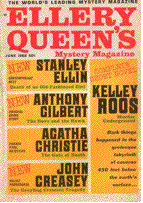
 EQMM June 1966

I took Miss Ryan’s gift home with me, though, and a whole new world opened up to me as I devoured Agatha Christie’s “The Gate of Death,” Stanley Ellin’s “Death of an Old-Fashioned Girl,” Kelley Roos’s “Murder Underground,” John Creasey’s “The Greyling Crescent Tragedy,” and the rest of the slim 159-page magazine’s contents.

Immediately, a new monthly ritual became the long walk up Jerusalem Avenue to the candy shop at the top of the hill, where I plunked down my fifty cents for the latest issue of the first magazine I’d truly enjoyed since Highlights for Children and Boy’s Life and MAD. Margery Allingham, Robert Bloch, John Dickson Carr, Celia Fremlin, Edward D. Hoch, Talmadge Powell, Joan Richter, Frank Sisk, Nedra Tyre, James Yaffe—and of course Ellery Queen himself—all new to me, all mysterious and brilliant and as addictive as crack.
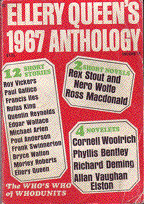
EQMM 1967 AnthologyIn addition to its regular monthly issues, EQMM began publishing an annual anthology of reprints in 1960. In 1963, these anthologies started appearing twice a year instead of once, and, early in 1967, I paid the candy-store proprietor $1.25 for a copy of Ellery Queen’s 1967 Anthology, which was #13 in the series—and which contained a reprint of Richard Deming’s “Open File,” a novelet which had originally appeared in the December 1953 EQMM. The story was a police procedural in which the investigating officers fail to solve a crime—a murder, if memory serves. When I finished reading the story, though, I thought—in my fifteen-year-old wisdom—that the cops had botched their investigation, that there was in fact sufficient evidence presented in the story to pin the crime on a specific one of its characters.

For reasons I won’t pretend to remember, I actually wrote a new ending to Deming’s story and sent it off to EQMM—and, in due course, I received a handwritten letter on EQMM stationery from Frederic Dannay himself!

For many years, that letter was one of my prize possessions. Sadly, I lost it when, after a dozen years in Holland and Germany, I moved back to the US in 1991. I can still remember, word for word, the way it ended, though: “Have you ever considered writing a detective story yourself? Seems to me, Josh, if I may, you should!”

So of course I did. I mean, duh.

I came up with the idea of a cop who loved mystery stories so much that he named all eleven of his kids—apparently Inspector Ross Griffen of the Tyson County Police Force was a Catholic—after famous fictional detectives: Albert Campion, Gideon Fell, Sherlock Holmes, John Jericho, Jane Marple, Perry Mason, Parker Pyne, Augustus Van Dusen, Peter Wimsey, Nero Wolfe—and, of course, Ellery Queen. In my story, sixteen-year-old Ellery “earned his name” by solving in a Queensian manner a jewel theft which was baffling his father . . . while simultaneously botching his investigation of a neighborhood mystery, the theft of three apple pies destined for a church bazaar.

I typed the story up on my little nonelectric typewriter and sent it off to Fred Dannay’s home in Larchmont, New York. A month or so later, I was in my bedroom one afternoon when the phone rang and my mother yelled up the stairs, “Josh! It’s for you!”

“Who is it?” I yelled back.

“It’s Frederic Dannay!”

Furious, I clomped downstairs to the kitchen, snatched up the receiver, and barked, “Dad, this isn’t funny.”

It wasn’t my father trying to be funny, though. It was Fred Dannay, telling me he liked my story and wanted to publish it.
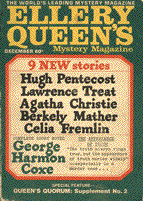
EQMM December 1968Fred wanted some changes, I gladly made them, and “E.Q. Griffen Earns His Name” appeared in the December 1968 issue of EQMM, #325 in the magazine’s “Department of First Stories.” I was sixteen when I wrote the story, seventeen by the time it was published, making me the second youngest writer ever to appear in the pages of EQMM. (The youngest was James Yaffee, whose first story was written at the age of fifteen and published in 1943.)

As a professionally published author, I was eligible for membership in the Mystery Writers of America. I applied, was accepted, and at seventeen became the youngest active member in the history of the organization. This got me an invitation to the MWA’s annual Edgar Allan Poe Awards banquet, where I had the opportunity to meet both Fred Dannay and Manny Lee face-to-face. Manny was polite, but Fred was absolutely effusive, and he led me around and introduced me to many of the writers I’d grown to idolize, treating me—as did almost everyone I met—as not just a punk kid but a colleague. Ed and Pat Hoch, John and Barbara Lutz, and Stan and Marilyn Cohen were especially kind to me, and over the years Dorothy Salisbury Davis, Patricia McGerr, Lawrence Treat, Bob Fish, Don Westlake, Joyce Harrington, Ed Wellen, Dan Marlowe, Morris Herschman, Chris Steinbrunner, Warren Murphy, and many others were also much nicer to me than I can possibly have deserved. I saw Mr. Dannay again at several subsequent Edgar banquets, and he always took the time to talk with me—and always left me feeling that our conversations mattered every bit as much to him as they did to me.

Since my family lived on Long Island, it was easy for me to take the train into Manhattan, and I would often go in during the day to visit the EQMM editorial offices at 229 Park Avenue South, then stick around for the monthly cocktail party in the MWA’s cramped offices in the Seville Hotel on East 29th Street. Fred worked from home in Larchmont, but managing editor Clayton Rawson was always in his office at 229 Park when I dropped by, and he always welcomed me, always made time to spend an hour with me. A professional magician himself, Clayton used the world of stage magic as the backdrop for most of his fiction—his four novels, all written in the late ’30s and early ’40s, and many of his short stories featured as their detective “The Great Merlini.” Whenever I would visit Clayton in his office, he would entertain me with sleight of hand, and he was good at it, certainly the best close-up magician I’ve ever seen. During one visit, Clayton handed me a copy of the April 1951 EQMM and told me to select any story in the issue, add up the digits of the page number of the story’s first page, and count to the that-manyeth word of the story. I did so—and he announced that the word was “problems,” which was correct. Although magicians traditionally don’t reveal the secrets of their tricks, he explained to me that Fred Dannay had edited the beginning of every story in the issue as a favor to magician Richard Himber, so that, no matter which story was selected, the word that appeared in the position corresponding to the sum of the digits of its first page would be “problems.” (Mike Nevins wrote about the April 1951 EQMM in his article “The Dannay Years,” which appeared in the magazine’s November 2011 issue.)
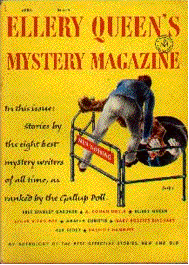
 EQMM April 1951

My most vivid memory of Clayton Rawson was the day when he handed me a book of matches and insisted that I light them, one at a time, and throw them, blazing merrily, into his open mouth. I’m not sure that technically qualifies as magic, but it was certainly magical to me.

After Clayton’s death, Eleanor Sullivan became EQMM’s managing editor, and she and I grew to be fast friends. Always smiling (though always a little harried and mussed), she, like Clayton before her, welcomed my visits, first to 229 Park and then, after the magazine’s editorial offices moved about twenty-two blocks uptown, to the new space at 380 Lexington. We’d often go out to lunch together, and when I visited her during the colder months, she always insisted on trying on the weird furry winter coat I’d bought at Barney’s Boys Town on 17th Street.

By the time Fred Dannay died, in 1981, he’d bought seven of my stories for EQMM—three about the Griffen family, another a spoof of two of Ed Hoch’s series characters (“The Theft of the Spy Who,” September 1972), and a couple of one-offs. I was married to a Dutch woman by then and living in Amsterdam, teaching for the University of Maryland’s European Division on US military bases in Holland, Germany, England, and Greece—and no longer writing fiction. Why did I stop? That’s complicated—it’s probably easiest to say that my focus had shifted from writing to teaching and leave it at that.

In 1982, as Eleanor Sullivan moved up from managing editor to editor-in-chief after the death of Fred Dannay, the University of Maryland sent me for four months to Bahrain, in the Persian Gulf, to teach at a little Navy base in Manama, the tiny island emirate’s capital (and only) city.

Bahrain fascinated me, and I wound up staying for eight months instead of four and returning to the writing of crime fiction with “The Dilmun Exchange,” the first of what would ultimately be a dozen stories about Mahboob Chaudri, a Pakistani detective on the Bahraini Public Security Force. Eleanor bought it for the July 1984 EQMM, and the last half of the ’eighties were far and away my most prolific period in the mystery-fiction bidnis.

In addition to the Chaudri stories, I also conceived the idea for a project I planned to call Partners in Crime. My idea was that the book would consist of a dozen or so short stories, each written by two authors working together—and, in each case, one of the two authors would be me. Although the book never happened, about fifteen stories wound up being written, and most of them were published individually. EQMM ran my collaborations with Ed Hoch (“The Spy and the Suicide Club,” January 1985), Stanley Cohen (“Annika Andersson,” February 1993) and Jon L. Breen (“The German Cologne Mystery,” September/October 2005), and I also sold Partners in Crime stories written with Edward Wellen (“Stork Trek,” Alfred Hitchcock’s Mystery Magazine, July 1985), Michael Avallone (“Better Safe Than Sorry,” Hardboiled, Summer/Fall 1987), Joe L. Hensley (“All That Mattered,” Robak’s Firm, 1987), John Lutz (“DDS 10752 Libra,” An Eye For Justice, 1988), Dan J. Marlowe (“The Seven-Year Bitch,” Hardboiled, 1990), and Francis M. Nevins (“The Leo’s Den Affair,” Dick Tracy: The Secret Files, 1990).

During this same period, I edited a series of “Author’s Choice” anthologies, beginning with Top Crime: The Author’s Choice (St. Martin’s Press, 1984) and continuing with Top Science Fiction, Top Fantasy and Top Horror (all of which were published in various European countries, but not in the US), and translated a couple of Janwillem van de Wetering’s Grijpstra and de Gier stories from Dutch into English for EQMM.

Meanwhile, my marriage didn’t survive my time in Bahrain, and I wound up living in Germany from 1983 to 1991, still teaching for the University of Maryland on American Army and Air Force bases.

And in ’91, right around the same time that Eleanor Sullivan passed away, I moved back to the US and settled in Cleveland, Ohio.

I haven’t done all that much in the mystery field since my return, although I’ve translated stories by Theo Capel, Rene Appel, Carla Vermaat and Tessa de Loo from Dutch into English and by Bavo Dhooge from Flemish into English for EQMM’s “Passport to Crime” series, which has given me the opportunity to get to know Janet Hutchings, who took over as editor-in-chief after Eleanor died and has now served in that position for over twenty years.

A couple of years ago, Janet bought a story called “History on the Bedroom Wall” and ran it in the “Department of First Stories” in EQMM’s September/October 2009 issue, which I believe makes me the only person who’s ever appeared in the DFS twice—first as a teenager in 1968 and again aged 58 in 2009.

How could such a thing happen? Well, although it wasn’t written as a part of my Partners in Crime project, “History on the Bedroom Wall” was written collaboratively, and the story was published as “by Rebecca K. Jones and Josh Pachter.” Rebecca K. Jones is my daughter Becca, who was born in Germany in 1986. In 2009, she was twenty-three and a second-year law student at the University of Arizona, and writing a story with her was unquestionably the high point of my “career” as a writer.

Today, Becca is a deputy county attorney in Phoenix, and my wife Laurie and I live in Virginia, where I teach communication and film-appreciation classes at Northern Virginia Community College. I continue to do translations for “Passport to Crime” from time to time, and every once in a while I write a new story of my own. When Janet published my “iMurder” in the July 2011 EQMM, that made me a member of another pretty exclusive club—there aren’t many of us who’ve published new fiction in the pages of Ellery Queen’s Mystery Magazine in six consecutive decades, but I’ve now been in there in the ’60s, ’70s, ’80s, ’90s, ’00s and ’10s. If I can hang on a few more years, perhaps I’ll show up in the ’20s, too, and I’m not sure if anyone has yet hit EQMM in seven consecutive decades.

When I moved from Germany back to the US in 1991, I lost not only my original 1967 letter from Fred Dannay but almost everything else I owned—looong story; I’ll spare you—including treasured photos of me with Fred, Clayton, and Eleanor.

In October of this year, though, Laurie and I drove to Cleveland the weekend of Bouchercon to visit with my dear old friend Les Roberts (who writes the Milan Jacovich novels and was B’con’s “Special Cleveland Guest”) and his lovely girlfriend Holly Albin. We also had the opportunity to spend some time with my even older friend John Lutz and his lovely wife Barbara, and Janet very graciously took time out of her busy schedule to have a drink with Laurie and me.

So I’ve at least got one photo of me with an EQMM editor, and I’m happy to share it with you here. (Janet’s the pretty one. I’m the other one.)
EQMM5

Fred, Clayton, Eleanor, and Janet: It’s actually kind of amazing to think that EQMM has only gone through three (or four, if you count Clayton) editors in over seventy years.

But I consider myself honored and blessed to have had the opportunity to have known all four (I darned well count Clayton, whether you do or not!) of them. They—and EQMM itself—have been a very important part of my life for almost half a century now, and I look forward to continuing my relationship with the magazine and its leadership till death do us part!


Posted in Conventions, Editing, Guest, History, Magazine, Writers | Tagged , , , , , , , , , , , , , , | 16 Comments

“Going Postal: The Particular Pleasures of Workplace Murders” (by Meredith Anthony)

When it comes to different lines of work, Meredith Anthony has known more than most people. She’s a humorist whose work has appeared in MAD Magazine and Hysteria; she’s done stand-up comedy; she was the writer and partner for the Spilled Milk collection of greeting cards; she’s a reviewer of theater and film; she has co-authored and produced a play and an award-winning short film; and she has written several feature-length screenplays. And that is not even to mention her primary career as copywriter for a major New York ad agency. Or her fiction writing, which includes novels and several stories for EQMM. Her most recent novel, Ladykiller (Oceanview 2010), was co-written with her husband, Lawrence Light.—Janet Hutchings

So a guy goes to his office and greets all his variously annoying colleagues. There is the usual variety of flirtations, animosities, eccentricities. He toils at meaningless paperwork all morning, unappreciated, underpaid, unhappy. At lunchtime, it’s his turn to go out to the deli. He takes everyone’s orders. When he comes back with a large, leaking paper bag, he finds the office strangely quiet. A quick inspection reveals that every single person at his workplace has been shot to death.

This, of course, is the beginning of James Grady’s great thriller Six Days of the Condor. I once asked Jim Grady about the enormous success of the book and the subsequent film, Three Days of the Condor, and he laughed and told me that he thought it struck a chord with every working stiff. Everyone at the office is dead. Haven’t we all secretly wished for that to happen?

I have always loved mysteries set in a workplace. I like the insider’s view of a profession I know nothing about, the chance to watch employees work, learn some of their jargon, be privy to the office politics, catch the rhythm of their days. I like to immerse myself in the world of this new profession. And when murder strikes, I like to watch how the workplace does or doesn’t go on in the wake of the shocking event. Do the employees dab their streaming eyes and carry on with working? Does the place shut down while the police investigate? Do colleagues begin to look at one another with distrust and suspicion?

I leave out books set in cop shops, detective agencies, and those about medical examiners, military police, and government spies. Procedurals certainly have their appeal, but I’m talking about books set in a workplace that typically does not deal with violence professionally.

Many professions have their exemplars. Robin Cook and Michael Crichton wrote medical thrillers that invited us into hospitals. More recently, Michael Palmer, Douglas Lyle, and CJ Lyons have mixed medicine and murder. John Grisham, Scott Turow, and others bring us inside the lawyer’s office and the courtroom. Steve Frey and Christopher Reich offer a glimpse into Wall Street. Journalism is the setting explored by Scotland’s Denise Mina and (full disclosure, he’s my husband!) the wonderful Larry Light.

For corporate America, Joseph Finder excels. His Killer Instinct, for instance, is set in a Boston electronics giant where an ambitious, but not very successful, young executive is unwittingly assisted by a security guy he befriends. The security man starts helpfully eliminating anyone who gets in the way of the hero’s upward mobility. The hero is, of course, aghast, but isn’t this every thwarted working person’s wish fulfillment? Don’t we all secretly want that bitch in the corner office to die?

Having worked in advertising for some years, I always wanted to find a mystery set in a big-city ad agency. My experience is that although ad agencies are high-pressure businesses with a typical corporate pyramid structure and a profit and loss statement, in fact they differ significantly from most white-collar office settings. Ad agencies are businesses where a great many of the employees are hired specifically for their imagination and artistic talents. Highly paid and skilled copywriters and art directors are not ordinary office drones. They pride themselves on their quirks and most agencies give them a lot of leeway in work habits, office décor, and dress. Cubicle walls may be covered in bananas, skulls, or fish. Christmas lights, black lights, or no lights are common. Clothes may be chosen to show off piercings and tattoos. Pets, unicycles, and mini-refrigerators full of booze are not uncommon. In fact, it occurs to me that these “creatives,” as they are called, frequently get away with murder. I decided to take that notion a step further. I was delighted to have a chance to explore this setting in a short story, “Murder at an Ad Agency,” which will appear in the March/April 2013 issue of EQMM.

Facing a rack at Barnes and Noble, or listing on Amazon.com, we all have our ways of choosing a new book to read. Some of us choose to read mysteries by subgenre—cozies, police procedurals, amateur sleuths, thrillers, noir. Others choose by setting—big cities, foreign settings, historicals, Westerns. Some look for a certain type of protagonist—strong women, damaged cops, cats. Some readers look only for favorite authors, series, or standalones. Me? I look for a new workplace—Jane Cleland’s antiques business, Hank Phillippi Ryan’s TV station, Julia Spencer-Fleming’s Episcopal church, Barry Eisler’s freelance assassin, Christa Faust’s porn star, to name just a few.

One of my all-time favorite office mysteries is a noir thriller by the amazing Duane Swierczynski. Severance Package is the perfect update on James Grady’s Condor classic. Here’s the set-up. The boss has asked seven employees to come in to work at 9 a.m. on a Saturday for a special meeting. Irritable and suspicious, they all comply. He locks them in and announces that he’s going to have to kill them all. Seriously? On a Saturday at 9 a.m.? Now, if that isn’t the beginning of a really bad day at the office, I don’t know what is.

Posted in Fiction, Guest, Setting, Writers | Tagged , , , , , , , , , | 17 Comments