
“Writing About What You Want to Know” (by Janice Law)

An Edgar Allan Poe Award nominee for her mystery fiction, Janice Law has always also written mainstream novels and stories, so her perspective on fiction writing is wide. She has taught writing, and she blogs regularly on Janice Law, writer, and as a guest on SleuthSayers.  She joins us today with some reflections on the old adage “Write what you know.” Her latest novel is The Fires of London. —Janet Hutchings

One of the cliches of the writing business, and standard advice for young writers, is write what you know. This is simply good sense, ignorance not being bliss in the writing game. The problem is that writing what you know is often construed too narrowly. If we only wrote what we knew, there would be a lot fewer spy novels and torrid romances. Many a cowboy would never leave the corral, and fairy princesses and Middle-earth types would be thin on the ground.

Fortunately, we need never worry that a lack of personal experience is going to curtail our favorite genres. Writers not only write what they know but to discover what they want to know, and, in the case of certain minds, to discover what they think but haven’t verbalized. Yet, write what you know remains good advice. Writers just need to discover connections between what they know for sure of sounds, smells, sights, emotions, and what they do not know for sure or know only at second hand.

This is the job of the imagination, and like other facets of writing, it improves with practice and with sacrifices to the Muse in the form of long hours at the keyboard or the writing desk. It also requires an alert recognition of potential interest even in areas outside one’s comfort zone.

I’ve been thinking about this, as my latest novel, The Fires of London, represents an interesting balance of what I know, what I decided to discover, and what, subconsciously—or gift of the Muse, take your pick—had been lurking in the back of my mind. The novel is a category mystery—the first I’ve written in a number of years—so that was familiar ground.

It’s set in London during the Blitz. I’m old, but not ancient enough to remember the Battle of Britain, but some of my earliest memories are of my parents packing up big parcels of coffee, chocolate, woolens, even garden seeds to ship back to Scotland, and of the anxiety that accompanied every news broadcast. I was too small to understand the battle reports, but for years I had a deep distaste for listening to radio news.

As for the details of the battle and the duties of an ARP warden, which my hero was going to be, these fell into the things-to-be-discovered category, a category easier now with the many WWII websites. I’d also done research in the same period for an earlier novel and still remembered a visit to the Imperial War Museum in London. So far, so good.

The sticking point, at least initially, was my hero and the raison d’être for the book: Francis Bacon. No, not the Tudor figure of scientific-method fame and putative ghostwriter for Shakespeare, but the twentieth-century Anglo-Irish Francis Bacon, a gay, promiscuous, alcoholic, genius painter.How are we different? Let me count the ways!

Here, discovery came to my assistance. Biographer Michael Peppiatt has written two fine books on the painter. I was much attracted by his account of the artist’s life, although at first there seemed to be nothing in the “what I know” category. Bacon was on his own from the time he was sixteen and caught trying on his mother’s underwear. He was sent off to Germany with what proved to be a “funny uncle” and shortly abandoned in Berlin to earn his living as best he could as a rent boy.

Amazingly resilient, he got himself to Paris, where his family had some fancy connections, and, thanks to a series of artistic lovers, he acquired the rudiments of oil painting and support to set himself up as a furniture designer. It wasn’t until I considered one of the key relationships in his life, his love for his ruthlessly devoted old nanny, that I found the passage from what I know to what I’d have to imagine. I must thank Bacon’s Nan for the resulting novel.

I grew up downstairs on a big upstairs/ downstairs estate, and the close, and conflicted, ties between children and their nannies was something I had observed closely. I thought I could understand Nan, though the domestics I knew were far more respectable than Bacon’s nanny, who vetted his paid companions and went shoplifting, despite being half blind, when they were on their uppers.

Still, one takes what one can get in the knowledge line. And then, despite his hard drinking and boisterous living and his fondness for rough trade and dubious types like the infamous Kray brothers, the real Bacon was a hard-working painter, up and busy in his studio first thing in the morning. He had a strong work ethic—and I guess an overwhelming need for the structure that art gave an otherwise rackety life.

As a long time writer and painter, I felt I had enough of a handle on his personality to begin a novel and see if discoveries in both the library and the subconscious would be sufficient. They were. And this is both delightful and—sometimes—a bit startling. It is always surprising which characters write easily. An extremely timid and peaceable personality, I am sometimes taken aback by the ease with which literary homicide surfaces in the little stories I write for EQMM and its sister publication AHMM, among others (and collected recently in Blood in the Water from Wildside).

My Francis developed very nicely with a minimum of fuss. Even his rather gaudy sex life did not prove the obstacle that I feared it might. His story got to 60 pages, then 120, and then on to novel length. I stuck fairly close to the events of his life, except for involving him in a murder investigation, and I tried to be accurate with the details of his milieu and of his friends.

Of course, at some point, probably rather early on, my Francis parted company with his historical inspiration. He became, as he had to, a character in a novel not personality analyzed in a biography. I suspect he is a bit nicer than the original and probably not as imaginative—who, after all, can conjure genius?

But I know what it feels like to face an empty canvas and to dream of images, and I discovered enough to understand a little corner of the horrors of the Blitz and of the terrible accidents occasioned by the Blackout. As the book developed, I grew acquainted with the smell of brick and stone dust and burning districts. I became familiar with bombed-out streets and death from the air via a variety of sinister weapons and with black-out regulations and fire-watching. I experienced these the writerly way, as a compound of reality and imagination, of what I knew and what I could discover.

I hung it all on the ever-flexible mystery framework, had Francis unluckily stumble over both a corpse and a seriously bent copper, and then, since I never plot out a novel and would be too bored to finish it if I did, waited to see what would happen. The Fires of London was the result.
Posted in Characters, Fiction, Guest, History, Writers | Tagged , , , , , , , , , | Leave a comment

“Does It Ever Get Easier?” (by Michael Z. Lewin)

An award-winning writer of novels, short stories, poems, radio plays, and stage plays, Michael Z. Lewin has the experience to speak knowledgably of the writing life. In his post this week he considers a writer’s need to connect with other writers. The timing of his piece could not be better, for in a few days more than a thousand writers and mystery-fiction fans will be gathering in Cleveland for the Bouchercon World Mystery Convention. One of Michael Z. Lewin’s EQMM stories (“Who I  Am”) is nominated for a Shamus Award at that convention. His latest novel is Family Way (Five Star Press). —Janet Hutchings

It was eight years after I published my first mystery that it finally occurred to me to meet with someone else who was doing the same thing. Anyone with any sense knows there are pleasures to be had and perceptions to be shared by talking shop. But there are lots of areas of my life in which I’ve been a slow learner.

The writer I sought out was Ross Macdonald and I met with him in Santa Barbara, California. I was already living in England, but when I planned a trip to visit my mother, who lived in L.A., I wrote to Macdonald. Not only had he written a generous review of my second novel, it was one of his books that got me started writing detective fiction in the first place.

I never read mysteries until my mid-twenties. When I did, it was P.I. fiction that appealed to me, but the plots left me puzzling. I just never remembered early details of the intricate and winding journey the stories took when they were explained at the end. Was it me, or were these P.I. writers just conning readers by throwing piles of facts at them that didn’t add up?

Now I look at that as the question of a cynical innocent—one truly ignorant of how much effort writers put into their books. But in 1969 I decided to find out. I took one of Ross Macdonald’s novels and outlined it, page by page. And, surprise surprise, I discovered that the story was indeed a coherent whole. It was me, the reader, who was deficient.

I’d picked the Macdonald novel for much more than its plot complexity. I enjoyed his literate writing and wit. And when I applied myself to his book this way I found that the detective stuff stuck in my mind. The result was, I began a jokey short story. That story failed to finish itself in a couple of weeks. It became my first Albert Samson novel, Ask the Right Question, the plot of which takes an intricate and winding journey. . . .

So, accompanied by my two children, I met Ross Macdonald by the pool at the Santa Barbara club where he regularly took his lunch. By then, I’d written six mysteries. And I asked him my burning question. “Does it ever get easier?”

“No,” he said.

Many years have passed since that lunch. I have written many, many words. And although I’ve learned that talking with other writers makes life pleasing and less lonely, I’ve also learned that Macdonald didn’t lie. It doesn’t get easier. I’ve even learned that I’m not the only young writer to hope that it did. For instance, Liza Cody tells me that she once asked the legendary H.R.F. Keating the exact same question. And Harry Keating gave her the exact same answer that Ross Macdonald gave me.

And I know the truth of it now. I may have learned how to do a few things more easily that I used to find hard. Like what to do if my plot is weak (leave explanation of it as late as possible and write “The end” quickly) or learning that it’s less confusing for readers if characters’ names begin with different letters.

But writing doesn’t get easier. Because your own standards get higher. And higher.

I was working on my current book this morning. I’ve gone through the text half a dozen times. Today I found a place on page 225 that contradicts something on page 87. The contradiction was subtle and not very important. And should a reader get as far as 225 he or she would—I hope—be so swept up in the gathering pace and revelations that a mini-goof on page 87 would be long brushed away. And how can anyone remember all the details of a complex story after just one reading anyway? This writer certainly can’t. Who knows what I’ll find on the seventh reading.

But that subtle contradiction mattered to me. As will the one I fear I will find tomorrow. But I will search for it. Because I need what I write—novels, stories or blog contributions—to be as good as I can make them on the day. Not Shakespeare good, but clear, and with a decent chance of a reader being able to get at what I mean to say. Should he or she be interested.

Wise man, Ross Macdonald, as well as a fine and complex writer.

Posted in Editing, Fiction, Guest, Writers | Tagged , , , , , , , , | 3 Comments

“Discovering a Character” (by Melodie Johnson Howe)

Melodie Johnson Howe’s fiction has been recognized at both novel and short-story length with nominations for the Edgar, Anthony, Agatha, and Barry Awards. Though her output is not large, she is one of our genre’s most dependable writers in terms of quality. The appearance of a new novel from her next spring, after many years devoted exclusively to short stories, is something to look forward to (see City of Mirrors: A Diana Poole Thriller from Pegasus Books).—Janet Hutchings

Every time I finish a short story I feel as if I just completed a magic trick; pulled a rabbit out of a hat; turned a scarf into a dove. I’m the hapless magician who doesn’t know how the rabbit got into the hat in the first place. Yes, I’m a professional writer, meaning I get paid for my work, and therefore I should understand exactly what I’m doing—but I don’t.

When I was an actress I had a script. I knew where the camera was. I knew my marks. I knew if I kept my focus and listened, or at least pretended to listen, to the other actors in the scene I could create a sense of reality. I also knew the camera loved me. And if the camera loves you, in Hollywood little else matters.

There is no camera, not even a net, when I’m writing. I sit in my chair and I begin. Poof! A rabbit. Poof! No rabbit! A good shake of the hat. Still no rabbit. File the story away.

In spring 2013, City of Mirrors, A Diana Poole Thriller, will be published. Diana Poole would not exist without the short stories I wrote about her for EQMM.

When I first began to write the novel I thought great, I have my rabbit in a hat. I’ll just plop Diana Poole down in a brand-new, suspense-ridden plot and I’ll be off to the races. But like so many of my ideas about writing, this didn’t work out that easily. I quickly learned that Diana Poole was born out of the short-story form. She was in essence a short-story character. What do I mean by that? A few sharp brushstrokes described her: “My husband Colin, a screenwriter, had died suddenly of a heart attack over a year ago. He left me with what the realtors euphemistically call a ‘tear-down’ in Malibu, an old Jaguar, two Oscars—each for Best Screenplay—an empty bank account, and an emptier heart. So I had gone back to what I had been doing before I married him—acting. Except now I was older and the parts were fewer.”

That is all I know about her. When I placed her against a much larger canvas, Diana dwindled. There was no rabbit in my hat.

Where did Diana come from? She needed to be fleshed out. I spent days trying to figure out how to do this. Give her a sister? A mother? A father? Multiple lovers? She had to have some connection to the real world. But if I gave her family members, then her aloneness would disappear and she’d just be barraged with the problems of relatives. Then I had an idea.

In an old manuscript I could never make work, I had created a wonderful character—an aging, ex-movie star. She had smarts, and a ruthless flair. I’d always regretted that she languished in a file on my desktop. So I took her out, dusted her off, and put her in the novel as a friend of Diana’s. But that didn’t work either. As friends, the scenes didn’t go anywhere: There was no tension. I couldn’t connect her to Diana’s life or, for that matter, the plot.

This is where hard work pays off. I had an epiphany. (My moments of insight rarely happen without the tossing away of many stupid ideas.) I would double-down, to use a popular phrase. If Diana had a dead husband why couldn’t she have a recently dead mother? A mother that had been a famous movie star. Diana’s early life was set. She grew up alone in boarding schools, coming home on vacations. Home was wherever her mother was filming at the time. And the house was always rented. And with each new house there was a new strange man. Diana earned her singularity and grit early in life.

The novel opens with her returning to one of these houses and sets the tone for the entire book.

If a dead husband is painful, a dead mother is powerful. Diana is riddled with memories. The character I rescued from an unfinished book not only defined Diana’s past, but also opened up the novel in unexpected and surprising ways. Because of these discoveries I was able to make connections that turned my narrative into a multi-layered piece. And isn’t this why writers write?

Will I still feel like a magician on tightrope the next time I sit down to write? Yes. I’ll be shaking that hat looking for the rabbit. After all, writers are always beginning.

Posted in Characters, Fiction, Guest | Tagged , , , , , , , , , , | 2 Comments

“The Human Condition” (by David Dean)

A contributor to EQMM for more than twenty years, David Dean has won the magazine’s Readers Award and been nominated for an Edgar Allan Poe Award for his EQMM stories.  His significant body of work was accomplished while also serving as a full-time police officer, most recently as chief of police for one of New Jersey’s popular resort towns. Now retired from police work, he is writing not only short stories but novels, the first of which, The Thirteenth Child, will be released in paperback and e-book on October 5th.—Janet Hutchings 

In her introduction to my story “Jenny’s Ghost,” in the June 2012 issue of EQMM, Janet Hutchings mentioned that the police were rarely central figures in my writings. She posited that perhaps this was because my stories concern themselves less with the solving of crimes than with the effects of crime upon its practitioners and victims. She was right on both counts. It’s not that I ignore the police—I spent twenty-five years being one, and one of my recurring characters is Chief Julian Hall of the Camelot Beach P.D.—but I do have an insider’s appreciation of their role and limitations.

The police tend to be the “middleman” when it comes to crime, being neither the criminal nor the victim. Generally, the crime itself has already been committed before an officer is ever involved, and once there, his primary job is to ensure the safety of those at the scene, identify witnesses, and secure the site for evidence-gathering. If possible, he makes an arrest. After the processing of the accused, the case slips from the officer’s control and arrives on a prosecutor’s desk. His role after this is relegated to that of witness. No matter how spectacular the arrest may have been, the officer is no longer in the driver’s seat; it’s up to a jury.

The police also get to leave at the end of their watch. Only the victim and, sometimes, the perpetrator, is left with the residual effects of what has been done. It’s not that police officers are unaffected—far from it, but the crime didn’t happen to them, and they didn’t commit it. So, when it comes to writing about it all, I do often favor the other characters over my stalwart, wise chief of police and his officers. It was not always thus.

My first several stories, way back in the early nineties, featured Julian Hall as a young patrolman and, not surprisingly, were police procedurals—a subgenre I still enjoy reading because of its focus on the officers themselves. However, as a writer, I wanted more room to grow the psychological and moral dimension of my stories. In Chief Hall’s later years, I gave him an unofficial partner in the person of Father Gregory Savartha, which allowed me to kill two birds with one stone—write about police and crime, while having access to more esoteric issues. In most of their outings, the priest has figured more largely than his police friend.

Some writers sidestep my conundrum by having their officers more “involved” with both criminals and victims, sometimes to the point where my ability to believe is strained to the breaking point—put a private-eye in the same situation and I have no problem. I guess it’s just a cop thing.

My overall concern as a writer, just as it was as a cop, is the human condition. Everything about police work is generated by people and their actions, just as everything that truly concerns a writer is about the same. What people, or characters, do and say is why I write . . . and read, for that matter. No one ever wrote about an empty cardboard box, unless that box had some significance, or impact, upon a human being. Simply describing the aesthetics of cardboard boxes is dreary. But reveal that the box once contained an urgently needed children’s vaccine, now gone missing, and you have the beginnings of something worthwhile.

Crime fiction is particularly good at focusing the reader on the various facets of human nature. The stressor of crime and its ramifications tends to clear the deck of the extraneous. It also brings character into sharp relief. Of course, there are many other avenues for writers to accomplish the same result, such as natural catastrophes, family tragedies, and war. But the fear of crime, particularly violent crime, is shared by most people, whatever their walk of life or status. In fiction, the expedient of crime allows the writer the freedom of exploration into the human psyche and soul.

A good friend of mine, who passed away a few years ago, once remarked, “Human behavior is very complicated, but the motivations for that behavior are very simple.” He had been a clinical psychologist within the prison system for many years, and knew a thing or two about people. I found his observation helpful whenever I interviewed suspects, and even more so when writing. No matter how convoluted a person’s actions may be you can usually reduce their motive for doing them down to a single sentence, or even a single word. Father Gregory might point to the Cardinal Sins for a listing of what gets people into trouble: greed, lust, envy, gluttony (include drugs and alcohol with this one), wrath, sloth, and, the most insidious of all, pride—the great enabler.

And true to my late friend’s observation, the behavior to mask these motives is couched in lies, denials, and pretense. How many of us have envied a colleague’s success and yet forced a smile to our lips when greeting them? Think of the elaborate schemes cheating spouses concoct in order to continue their liaisons; the deceptions practiced by the secret alcoholic. And none of these failings are even crimes. Just think if your freedom, or your very life, depended on it. What wouldn’t you do, or say?

Many people who are arrested for crimes are just like you and me. They didn’t set out to do anything wrong, but somehow it happened. Somehow, during the course of a normal day, events conspired against them. Their lives began to spin out of control. Something happened that shouldn’t have. At least, this is how they frame their new and altered reality. Mostly it’s self-justification. But, often there is a grain of truth in it. A new, or misunderstood, set of circumstances exposed their weaknesses and forever changed their lives, and those of their victims. Mostly, these are the criminals I write about: the hit-and-run driver of “Road Hazard,” who wants to settle a score with a bully; the young kleptomaniac in “The Vengeance Of Kali,” who steals something he should have left alone; or the husband in “The Wisdom Of Serpents,” who determines to kill his best friend over his mistaken belief that he is having an affair with his wife. Not a single Moriarty among them.

I have little interest in true career criminals simply because they tend to be so predictable. Sociopaths can be wily, of course, but in the end they cannot stop repeating themselves; they are slaves to their own psychopathy. The only skin they have in the game is the freedom to continue their behavior; lacking a true conscience and the capacity for remorse, they are as robotic as they are unrelenting. Admittedly, these characteristics can be exciting in crime fiction, but more for the shock value and juxtaposition with the protagonist than for the person—Hannibal Lector is one of the great villains of modern crime fiction, but more monster than man.

As for victims, I find I write more about them than any other character. In many of my stories, the criminal is a victim as well as a perpetrator. Much of what I have written is concerned with victims, or victims-to-be, coming to terms with their new, unwanted lives, such as the Marine in “Ibrahim’s Eyes,” who can’t quite accept his own survival. Sometimes, like the errant, drunken father of “Stolen,” they have materially contributed to their unwelcome status as victim, while others have misunderstood the clues, misinterpreted the warning signs along their path, like the young man in “Tap-Tap” who travels to Belize to investigate his lover’s suicide only to become a murderer. They are seldom completely blameless, and sometimes reemerge as antagonists, other times as heroes.

My time as a police officer, as well as my own personal experiences, has taught me that life is often murky, our way through it hazy and unclear. We look for signposts only to find they are indecipherable. Yet we are still forced to put one foot in front of the other, to take another step down the path. Mostly, we do our best, and that is good enough; sometimes it isn’t. But that is the human condition, and well worth writing about.

Posted in Characters, Fiction, Guest, Police Procedurals | Tagged , , , , , , , , , , | 3 Comments

Causes in Fiction

With Labor Day just past and the political season heating up, I thought I’d revisit a topic I made a post about in June 2010, on EQMM’s forum. For many people Labor Day is now nothing but an end-of-summer day off with great back-to-school sales, but when it was created by the union movement at the end of the nineteenth century the reason for the holiday was clearly understood. According to the U.S. Department of Labor, parades whose purpose was to show “the strength and esprit de corps of the trade and labor organizations” were held in many municipalities.  A hundred and thirty years have passed since the first Labor Day celebration, which was held in New York City under the sponsorship of the Central Labor Union. By 1894, the idea had caught on enough for the first Monday in September to become a legislated holiday in many states and, by act of Congress, in the District of Columbia and American territories.

The cause of labor may seem a nearly universal one—aren’t most of us workers of one sort or another?—but I wonder if such a holiday would gain traction in the political climate of our time. You have only to think of the causes of the recent recall election in Wisconsin to be reminded that labor unionism is one of the political hot buttons of the current election cycle. Which brings me to my topic. Writers, including genre writers, tend to write, in one way or another, about issues prominent in the societies to which they belong. Sometimes those issues are front and center in their work; sometimes they are part of the incidental background detail.

Fiction writers who write with the conscious purpose of furthering a cause are nothing new. Sometimes the literary value of such writers’ work can be separated from their success or failure in creating societal change, as with the great novels of Dickens. Sometimes, as with Harriet Beecher Stowe’s Uncle Tom’s Cabin, a novel (or story) may achieve profound and lasting importance because of its power to effect change and yet not withstand artistic criticism.

Mystery writers in particular have tried, through art, to further their share of causes—sometimes explicitly, sometimes not. Andrew Vachss, a legal advocate for children, has devoted his fiction-writing career to raising awareness of various forms of child abuse; John D. MacDonald was considered by many readers of his Travis McGee novels to be a crusader for the environment; more recently, the Sookie Stackhouse books of Charlaine Harris have been praised for containing a message of tolerance, especially towards sexual minorities. The list goes on.

If a cause is present in a work of fiction, it works best for me if it’s presented in a way that sets it above partisan politics. However, as our society becomes more and more polarized—with cable talk shows seeming to find a partisan slant in just about everything under the sun—it’s becoming more difficult to avoid offending some camp or other. This often presents difficulties for me as the editor of a magazine with a broad readership, especially since our primary purpose is to entertain and not to engage in polemics.

In the days shortly after 9/11, I got into an interesting correspondence with an author I highly respect about a story whose purpose was clearly, and very explicitly, to offer an impassioned critique of a law that had just been passed by Congress. The author’s view was that it was my responsibility to publish the story, as long as it stood up artistically. But as the editor of a magazine that hosts a readership with very diverse backgrounds and opinions, I felt it was, on the contrary, my responsibility to keep politics, as far as possible, out of our pages. And in those days of high emotion, to do otherwise was certain to anger some readers to the point of canceling subscriptions. Were we a journal of news or opinion, I would have seen my responsibilities differently, I’m sure.

But of course, it’s not quite as simple as that, is it? If one were to strip away from almost any work of fiction everything that could possibly be controversial, the author’s passion would go with it. Fiction necessarily (even inadvertently) presents points of view that aren’t going to meet with universal acceptance. But fiction also has the unique potential to show readers things they might not have seen before, where no amount of discussion or argument could. Charlaine Harris’s books are a good example: Readers who love her characters and see for themselves a parallel between their circumstances and those of sexual minorities in the real world may take away from the work something they could never get from debate about the latest proposition or law. If a work of fiction can influence through what it shows us, without comment, it has a better chance of finding a home at EQMM than a story that champions a cause by putting arguments into the mouths of its characters.

Janet Hutchings

Posted in Editing, Fiction, Magazine, Politics | Tagged , , , , , , , | 1 Comment

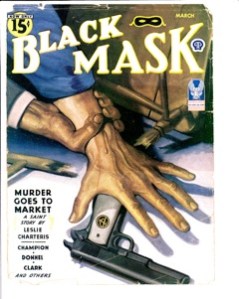
“Black Mask Magazine, Steve Fisher, and The Noir Revolution” by Keith Alan Deutsch

Keith Alan Deutsch is publisher and conservator of Black Mask Magazine, a publication that has a long-established connection to EQMM. He is also the co-author of several reference and scholarly books relating to Black Mask, hardboiled, and noir fiction. They include Black Mask Pulp Story Reader Volumes 1 – 6, Jo Gar’s Casebook, and The Black Lizard Big Book of Black Mask Stories.  His knowledge of key publications and acquaintance with many of the genre’s writers put him in a position to provide a fascinating overview of the field.Janet Hutchings

It is difficult to remember seventy-five years after the revolution, but Steve Fisher, Cornell Woolrich, and a few other second-wave Black Mask boys of the late 1930s ushered in a sea change in crime-fiction narration.

Fanny Ellsworth, who replaced Joseph Shaw at Black Mask in 1936, favored this change from the objective, hardboiled writing promoted by Shaw and the earlier editors of Black Mask Magazine to the subjective, psychologically and emotionally heightened writing that came in vogue under her guidance.

This little-noticed shift in style in Black Mask fiction, “The Ellsworth Shift,” led to the creation of the film genre we now know as noir through the writings of Steve Fisher, particularly in his film scripts, and through the novels and short fiction of Cornell Woolrich, whose writings we now also call noir, although the term was originally applied only to film.

This dark new style and psychology in crime-fiction narration jumped from magazine and book publications into screenplays, and led in the 1940s to the emergence in Hollywood of the classic age of the noir film thriller.

The obsessive, dreamlike narration favored by Fisher and Woolrich in their tense crime tales was a perfect match for the dark shadows and frightening, expressive camera angles developed in German and Hollywood horror cinema. Narrative fiction style and camera photography styles played against and enriched each other in the development of this new film genre.

In his seminal essay Pulp Literature: Subculture Revolution in the Late 1930s, from the Armchair Detective published in the1970s, Fisher was the first to note this paradigm shift in Black Mask Magazine fiction. The gifted new woman editor Fanny Ellsworth used Fisher and Woolrich to turn the emphasis in Black Mask away from the objective, unemotional, hardboiled writing style Hammett and the first wave of Black Mask writers introduced to the magazine, and for which Black Mask Magazine is celebrated.

Black Mask author William Brandon provides us with the most revealing portrait I know of Joseph Shaw discussing the art of objective writing in the early 1930s, when he was at the height of his influence. Brandon recounts many conversations he had with Shaw in his little-known memoir, “Back in the Old Black Mask” (The Massachusetts Review, Winter 1987):

“Shaw wanted action, naturally, as did any right-thinking pulp, but what Shaw wanted most of all was style.”

“Objectivity was part of what Shaw meant by style—a clean page, a clean line, an uncluttered phrase.”

“There was a lot of talk in those days about objective writing. Dashiell Hammett’s The Glass Key, serialized in Black Mask along about 1930, was the model of the genre. . . .”

“I remember him showing me a couple of lines in a manuscript of Raymond Chandler’s, something such as, ‘I looked into the fire and smoked a cigarette. Then I went to bed.’ This was the key line of the story, Shaw said. In those few minutes watching the fire the protagonist thought the problem through and reached his tough decision. You weren’t told that but you knew it. The line was clean, the effect was subtle but strong.”

“Objective writing was good hard prose as against the spongy prose of subjectivity. . . .”

“Even the illustrations—Shaw called them ‘end pieces’—that Shaw liked were of a certain elegance and were meant to excite the imagination rather than a surface emotion. But traditionally the pulps left nothing to the imagination, and the cruder the emotion the better. I think Shaw would have argued for hard and cruel emotion too but I think he felt it was better effected by clean and plausible and objective subtlety.”

Brandon makes it very clear that Shaw was not interested in character expressed through psychology, but only as it was expressed through external action.

Action, not character, was at the center of Shaw’s esthetic for exciting stories.

Shaw didn’t buy any of Brandon’s detective stories, but he introduced him to “Fanny Ellsworth across the hall, a pretty and witty and red-haired young woman who edited Ranch Romances (“Love Stories of the Real West”), and Fanny started buying—at rare intervals—Western stories I wrote in what I thought was a humorous vein.”

Fanny was comfortable with complexity in the stories she edited. She liked strong emotion and humor in a story, regardless of its genre.

Shaw was uncomfortable with humor, and he mistrusted complexity in his narratives, whether in plot or in psychological states.

By all contemporary accounts, Fanny Ellsworth was one of the great fiction editors of all time. Frank Gruber describes her as one of the brightest, most urbane people he met in New York. Gruber and Steve Fisher both assert that when Fanny Ellsworth took over control of Black Mask she came with a well-mapped vision for a change in the kind of crime fiction the famous magazine would feature.

She immediately started to buy stories from Gruber, who wrote lead stories for her Ranch Romances pulp, and also Steve Fisher, who she recognized had a natural talent for expressing strong and complex emotions. She also increased the number of stories she purchased from Cornell Woolrich, who also had a natural way with twisted, pathological emotional states presented in strange, dark, haunted plots.

Ellsworth quickly established a much more subjective, emotionally driven style of crime writing than Shaw. Commentators on Black Mask’s influence on film and popular culture have not often noticed these changes in style and direction.

Certainly, Curt Siodmak’s science fiction noir masterpiece, Donovan’s Brain, the darkest of obsessive, subjective, first-person narratives, serialized in Black Mask in 1942, years after Fanny Ellsworth had left, would not have made it into Black Mask if the talents of Fisher (nine stories from August 1937 to April 1939) and of Woolrich (twenty-two original stories from January of 1937 to June of 1944) had not first been let loose on its pages.

Black Mask writers and genres influenced Hollywood in more ways than hardboiled dialogue and tough-guy posturing in films based on Hammett’s, Chandler’s, and similar Black Mask writers’ popular series detectives.

The late Curt Siodmak’s work on horror films, especially at Universal scripting and creating The Wolf Man (1941), and with Val Lewton at RKO scripting I Walked with a Zombie (1943) is of interest, particularly with regard to the emergence of a noir film esthetic from out of the shadows of the “horror” films of 1930s and 1940s Hollywood (See my interview with Siodmak about his film experiences, particularly with Val Lewton).

Once the noir film emerged at the beginning of the 1940s, with the production of Steve Fisher’s novel, I Wake Up Screaming (1941), Fisher’s and Woolrich’s noir work flooded Hollywood:

In 1943, the great run of more than two-dozen noir films based on works by Cornell Woolrich, the genius of the dark thriller, began when Val Lewton produced The Leopard Man (1943): Robert Siodmak (Curt’s brother) directed Phantom Lady (1944); The Mark of the Whistler (1944) followed; Clifford Odets scripted Deadline at Dawn (1946); then came Black Angel (1946) and The Chase (1946), followed by The Guilty (1947) and Fear in the Night (1947).

Steve Fisher scripted Cornell Woolrich’s I Wouldn’t Be in Your Shoes (1948) with a telephone call assist from his pal Woolrich. When Fisher couldn’t come up with an appropriate ending for I Wouldn’t Be in Your Shoes, Woolrich suggested that Fisher resurrect the sexually obsessive, psychotic cop from I Wake Up Screaming, and turn him into the culprit, motivated by his lust for the framed man’s wife. Ironically, Fisher originally had based that haunting and haunted police detective, Ed Cornell, on his friend Cornell Woolrich.

The most famous Woolrich-inspired film, of course, is Alfred Hitchcock’s 1954 classic, Rear Window. François Truffaut’s two films based on Woolrich tales are also well known, The Bride Wore Black (1968), and Mississippi Mermaid (1969).

My aim is to mark this sea change in the esthetic of the crime thriller that started to take place in pulp fiction (and some would argue in American cinema) in the late 1930s, and which came of age in Hollywood films in the 1940s; and to note Black Mask’s, Steve Fisher’s, and Fanny Ellsworth’s role in that change.

As Bruce Eder notes in All Movie Guide: I Wake Up Screaming “opened up a whole new genre of psychologically centered crime thrillers, and also became one of the most heavily studied movies of its era.”

In Black Mask Magazine, Fisher and Woolrich shared a talent for presenting aberrant mental states, and for casting suspenseful plots with inventive incidents.

Fisher’s and Woolrich’s best Black Mask fiction set the stage for the noir revolution in popular fiction and popular film. Fisher’s novel, I Wake Up Screaming, created the blueprint, and Black Mask under Fanny Ellsworth was the inspiration, for the full emergence of the noir genre that has had an enduring impact on film and fiction in popular American and world entertainment.

Posted in Guest, History, Magazine, Noir | Tagged , , , , , , , , , , , | 5 Comments

“Edgar, Agatha, Hammett, Glauser—and Me” (by Mary Tannert)

Translators are the unsung heroes of the literary world. What they do requires not just knowledge of the language to be translated from but a writerly feel for the language they are translating to. Mary Tannert fits that bill. A former university teacher with a Ph.D. in German, she moved to Germany in 2000 to work first as a translation project manager for Siemens and subsequently as a freelance translator. She began translating crime fiction in 1993 and has contributed twenty-two German-language short story translations to EQMM.  In 1999, she and her research partner Henry Kratz published a groundbreaking anthology of translated historic German-language crime fiction entitled Early German and Austrian Detective Fiction: An Anthology (McFarland).  Her extensive knowledge of German (and Anglo-American) fiction and her skills as a writer make her one of our Passport to Crime department’s most valuable assets. We think a lot of eyes will be opened by what she has to say about the German tradition in crime writing.—Janet Hutchings

We translators of crime fiction straddle a fascinating divide. On one side is the Anglo-American crime fiction scene—the biggest and most competitive in the world. Nearly every foreign writer dreams of having his or her work translated and published in England or the U.S. On the other side is the richness and breadth of other crime-fiction traditions that have a lot to offer English-speaking readers. This knowledge fuels my dream, common to most crime-fiction translators, of being able to offer readers of English a brilliant translation of a really good foreign crime novel that has them beating down their booksellers’ doors asking for more. Oh, and earns me a million bucks and lets me leave my commercial translator’s existence for a life translating bestselling crime novels, being interviewed by Oprah, and letting my agent negotiate the endless stream of offers from Hollywood while I make guest appearances on this blog from an island in the Mediterranean where I work on the sunny terrace of my beach home, a caipirinha at my elbow . . .

Back to reality—and some background: I’ve been translating both historic and contemporary crime fiction from German to English since the early 1990s. And in case anyone’s thinking that in all that time I must have run out of work, at least of historic crime fiction, let me note that the German-language crime-fiction tradition is at least as old as the Anglo-American, if not older, as witness Adolph Müllner’s 1828 novella The Caliber: a crime novella that represents the very first fictional instance anywhere of the use of bullet caliber to prove a suspect’s innocence. That fact riveted me when I discovered the novella in the late 1980s, and in the process of following it up I stumbled upon a vast 19th- and early 20th-century crime-fiction tradition that would make most English and American crime-fiction writers of that time weep with envy. Novels, novellas, and a newspaper (Die Gartenlaube) that was serializing stories nearly forty years before The Strand began publication. Lay detectives, P.I.s, police detectives, even investigating magistrates. Urban crime, rural crime. Criminals of every social class from the nobility down to the peasantry. Police procedurals, courtroom dramas, psychological novels. You name it, they’d done it.

Then came two World Wars, and a lot of this tradition went up in smoke. Literally. Paper is extremely combustible, as all fans of weekend barbeques know—and when alarmed librarians and archivists scurry to hide their greatest treasures in the fireproof bomb cellar, they don’t typically think of the whodunits on their bedside tables. Hitler did his part by ordering mass book burnings of “decadent” literary genres, to which category he consigned crime fiction. And the landscape changed: The social class system prevalent in Europe, the political and dynastic divisions into principalities, kingdoms, and empires, even the early republics, all these disappeared. The fabric on which Europe’s sense of social justice, of order, of crime and retribution had been printed for centuries was torn apart—and what emerged after 1945 was so different that what had gone before must have appeared, at least as far as crime fiction is concerned, antiquated and irrelevant.

So it took a few decades for a German-language crime fiction tradition to reestablish itself, to re-grow its roots and wings. There were cities to rebuild first, and the untidiness of democracy to get used to. But people went on murdering and stealing and smuggling and spying as they always have, and pretty soon it became clear that the fictional world of European crime shouldn’t be left to non-Europeans like Graham Greene (The Third Man) or John Le Carré (The Spy Who Came In from the Cold). The crime-fiction market in those first postwar years may have relied heavily on translations from French, English, and Scandinavian crime novels (Boileau/Narcejac, Sjöwall/Wahlöö, etc.) but by the 1960s that balance had begun to shift in favor of crime novels authored in German and a tradition of socially-critical crime-writing.

Matters took a step forward when, in 1986, a handful of German crime-fiction writers, led by Fred Breinersdorf, founded DAS SYNDIKAT, the German-language crime writers’ organization and a member of AIEP since its founding. For more than twenty years now, the organization has awarded the Friedrich Glauser Prizes (named for a Swiss crime-fiction writer of the early 20th century who created a popular police detective) for German-language crime fiction in the categories best novel and, since 2002, best first novel and best short story. The prize money for the Glauser prizes is raised entirely by the authors who make up DAS SYNDIKAT and is presented to the winners at the organization’s yearly celebration, Criminale, in battered briefcases containing nonconsecutively numbered banknotes in small denominations. (No, I did not make this up.)

I’ve been to a few Criminale myself and seen the delight on the faces of the winners who’ve climbed the steps to the stage to receive that battered briefcase, gleaming under the stage lights. And as a permanent resident of Germany, I itched to participate in a small way. Partly, it’s the omnipresent internal pressure to help bridge the cultural divide between this nation and my native one, a pressure that many ex-pats experience from time to time. Partly it was my frustration with Anglo-American crime-fiction chauvinism (oh, puhleeze. Spare me the outraged look).  And to be truthful, it was also partly the dream of the Mediterranean island and the caipirinha. On the other hand, I have to earn my living, and like most translators I’ve received my share of unsolicited e-mail messages reading, “I’m convinced I’ve written the world’s next crime-fiction bestseller. Attached is the manuscript. Would you translate it for free? I would be sure to mention your name in the kindest of terms to the publisher of the English edition.” (Well, how nice of you to think of me. Excuse me a minute while I run give up my day job . . . )

An opportunity came when IACW’s Mary Frisque brought me together with Janet Hutchings around the time that EQMM’s Passport to Crime series was established. And to make a long story short, since then I have had the privilege—and the great pleasure—of translating, with only one exception, every short story that won the Glauser prize since its inception in 2002, and seeing them all published in Passport to Crime. It’s turned out to be a great deal for everybody. The authors are pleased at the prospect of being published in English without having to organize—or pay for—translation or publication themselves. For them, it’s the double chocolate icing on the cake of winning the Glauser. EQMM gets a good story for Passport to Crime. And it makes a great pro bono project for me because it’s contained—one short story, once a year—so I don’t have to worry about it taking on dimensions that would imperil my paying the electric bill. Working with the authors is rewarding, too; their excitement at seeing their stories in English is palpable. The most recent winner, Nina George, wrote that my translation of her work “… sounds like . . . wow! . . . like a writer, like a different, really good writer. It’s incredible the way you got into my story.”

I’m still waiting for Hollywood to call, and the only Mediterranean islands I see are in the Internet photos I drool over when I get fed up with the press releases, annual reports, brochures, and websites that currently make up my caipirinha-less working hours. But I know it takes twenty years to become an overnight success, and meanwhile I’ve got a whole host of new pals on both sides of the Atlantic and we’re all having a great time with really good crime fiction. Which is, after all, what it’s really about.

Posted in Editing, Fiction, Guest, Translation | Tagged , , , , , , , , , , , , , , | 1 Comment

“What is it about magic? Does the paranormal belong in mystery fiction?” by Elizabeth Zelvin

There’s been a big shift in readers’ perceptions of what belongs in the mystery and crime-fiction genre over the past decade. Here to talk about one area in which the boundaries have been expanded is Elizabeth Zelvin, who has recently made a foray of her own into the realm of the “paranormal whodunit” with a novelette that she says “features a nice Jewish girl who’s a rising country music star and a shapeshifter.” (See Untreed Reads/August)—Janet Hutchings

In the good old days, mysteries were mysteries. Sherlock Holmes, that most rational of sleuths, would cast the light of reason on an apparently diabolical phenomenon, such as the Hound of the Baskervilles, and illuminate the prosaic truth with a dismissive “Elementary, my dear Watson.” (I know, I know! He never said it. My point is that Holmes invariably deduced a rational explanation.) I can’t remember any client bringing a supposed curse to Nero Wolfe, but if one had, Wolfe’s response would undoubtedly be “Pfui!” Ghosts and curses kept to the realm of the Gothic, werewolves and vampires to horror fiction, and elves and wizards to fantasy. The heirs of Agatha Christie and Raymond Chandler were strictly segregated from the heirs of Bram Stoker and Tolkien. Nowadays, many writers have taken to mixing genres in their cauldrons and coming up with some surprisingly palatable potions. Crime and the paranormal, in particular, can make surprisingly comfy bedfellows, whether the supernatural elements weigh in on the good-guy or the bad-guy side, or both.

There are surely mystery purists who would argue that magic has no place in the annals of detection, that it’s cheating to allow the sleuth to rely on powers other than reason in conducting an investigation. There have always been purists in the mystery world. During the Golden Age of detective fiction, these would have been the folks who deplored any romantic entanglements on the part of sleuths. The puzzle is all, they cried. Messy human emotions only get in the way. On the contrary, without messy human emotions, we would have no crime and therefore nothing for crime-fiction writers to write about. Magic may not be essential to every story, but it can add elements of drama, surprise, fun, and imagination to a mystery without sacrificing the essence of the plot or the credibility of its characters.

An example that springs to my mind is Charlaine Harris’s protagonist—nope, not Sookie Stackhouse, so let’s not get sidetracked into discussing the books versus the TV show or whether or not you like vampires—Harper Connelly, whose utterly believable world operates in exactly the same way as the real world, except for this little ability (being able to find the dead and know how they died) that she has as a result of having been struck by lightning. The mysteries Harper has to address come to her as a result of this ability, but she still has to use her brain to solve them. And the way the people around her relate to her is very much affected by their reaction to her ability. But those reactions, Harris’s skillful characterization convinces us, are precisely those that real-life people would have if they met someone with this ability in real life.

Growing up in a household of card-carrying rationalists—both my parents were lawyers—I always had a secret hankering for magic. I still yearn for the utterly impossible, such as being able to fly, which, like the majority of us, I’ve experienced in dreams. But beyond that, in the category of extra-rational possibility in which some people believe and others do not, I long for the magic (telepathy, acupuncture, horse-whispering, the tunnel of light when we die) to be real, even as I’m stuck with my native skepticism. In fiction, whether as writer or reader, I get to enjoy having some of those dreams come true.

Posted in Fiction, Guest | Tagged , , , , , , , , , , , , | 9 Comments

On Editing

Bill Pronzini’s post on this blog, “Don’t Tell Me You’ve Got a Heater in Your Girdle, Madam!”, with its entertaining and instructive examples of bad crime writing, generated some dissenting opinions about one of the passages quoted. Several respondents felt that this sentence: “From the moment he crushed Cora’s skull, he knew it was going to be a rotten Monday” could escape the stamp “alternative classic” if put in the right context. I’d like to weigh in on this, in a roundabout way.

At writers’ conferences, one often hears this piece of advice offered to new writers: Make sure you have a great opening line. You need to grab the editor’s attention from the very beginning or your story will be tossed onto the rejection heap. My editorial hackles rise every time I hear this canard, because while it is certainly true that an experienced editor can usually tell within a few sentences whether a story is going to be worth a full read, that judgment has little to do with his or her attention having been grabbed by an artful line. I can tell you from my own experience that if an individual sentence gets my attention, it’s more often because there’s something wrong with it. That line about Cora and the crushed skull has the feel to me of an opening line—one that might have been written by someone following the get-the-editor’s-attention rule. And my advice is, leave that rule aside in favor of a more organic approach to your fiction.

One of the classic pieces of advice to writers that is worth listening to is Faulkner’s famous “Kill your darlings.” The point had been made at least as far back as Samuel Johnson, who said of editing one’s own work: “whenever you meet with a passage which you think is particularly fine, strike it out.”

Why strike out those lines that seem “particularly fine”? Simply put, because no line in a story has value apart from all the other lines that, together with it, make up the whole. If a line or passage stands out, individually grabs our attention, it probably isn’t serving its purpose of working toward what Edgar Allan Poe called the “unity of effect” of a story. Poe thought that every line in a story has equal importance, because every line, from the very first, must be working toward the effect on the reader that is to be achieved by the story’s end.

I’m not saying, of course, that lines from fiction cannot acquire a life of their own, apart from the work in which they appear. There’s the first line of Anna Karenina, for instance—”All happy families are like one another: each unhappy family is unhappy in its own way”—which encapsulates a truth in such succinct fashion that it has become a cultural reference for many who may not even have read the book to which it belongs. But in such cases it’s usually not the showiness of the line—not something startling about the language or image or figure of speech—that makes it memorable; it’s its simple, plain statement of something that strikes us as at least possibly true. (Something we will find out more about as we continue into the work of fiction.)

To return to that sentence “From the moment he crushed Cora’s skull, he knew it was going to be a rotten Monday”: I’m not certain this is an opening line, but if it were the opening line to a story that found its way onto my Kindle, I would probably read a few more lines to see if the author could spin something around the attitude taken. I would see whether a certain voice—presumably humorous—was immediately established, and so forth. To that extent, I agree with those who feel this sentence belongs in a different class from the other “alternative classics” presented in last week’s blog. Nevertheless, it has the feel to me of someone trying too hard to come up with a startling line. And that creates for me (for any reader, I think) an immediate distrust of the author as a narrator. I might read on a little further, but with skepticism.

Confronted with the more blatant kind of bad writing illustrated by most of Bill Pronzini’s examples, the editor’s acquisition decision should be simple: Don’t buy the work. Nowadays such rejected novels and stories may well end up as e-books and find their way into the possession of unfortunate readers, but most bad fiction (despite the number of examples Bill has come across) will not find publication by conventional means.

What is more problematic for an editor is how to respond to a manuscript that has flaws but also merit. Publishing involves the balancing of artistic goals, commercial considerations, time pressures, and, not least, the establishment and maintenance of personal relationships. Last week’s blog commented that “there is not a writer living or dead, no matter how accomplished, how critically acclaimed, who ever failed to perpetrate a line of awkward or downright bad prose; whose work would not benefit from editorial input . . .” This I wholeheartedly agree with, and I have rarely encountered authors who are flat-out against accepting an editorial hand. But it should be understood that the editorial process too is an imperfect one, involving compromises and subjective judgments.

Different editors have different approaches, based on their experiences and the circumstances in which they work. Fred Dannay, EQMM’s founding editor, was famous for making changes to stories—most often to their titles. One of our current contributors, who’s been with the magazine long enough to have worked with Fred, told me that Fred changed the ending of one of his stories entirely. Naturally, this caused the author some discomfort, but at that time, few authors would have said no to Fred, who (as Ellery Queen) was one of the bestselling mystery writers of all time. And Fred’s judgment must have been right, because for years afterward, the author tells me, he got compliments on that story’s ending.

Eleanor Sullivan, Fred’s successor, appears to have been more likely to iron out stylistic idiosyncrasies than I am, if the edited manuscripts still in the office when I took over from her in 1991 are anything to go by.  There are different philosophies of editing, and I think mine can be partly explained by reference to a passage I frequently recall from a story by Janice Law: “Oh, the writing was good: Marvin had an easy style that rolled from one paragraph to the next without the slightest hitch, but also without the oddity and flair that can illuminate an old story and make familiar characters fresh.”

Sometimes it’s the oddities in the prose—like an attractive rasp in the voice of a singer—that make all the difference in giving life to a work of fiction, and I try to err on the side of leaving as many such idiosyncrasies as possible. (Though some, of course, may say I err too far on that side.) I had occasion to consciously consider this when I was a book editor and inherited the orphaned novel of someone who had what I considered a stylistic tic. At more than twenty years distance I can’t recall with certainty what that tic was. (I believe it was a tendency to overuse anaphora—the deliberate repetition of a phrase in successive sentences.) What I do remember clearly is the author’s reaction to my attempt to eliminate the (to me) offending instances of it.  The impassioned letter of objection I received caused me to reconsider and to conclude that although this aspect of the prose was irritating to me, it might be one of the things that gave this author’s voice a distinctive quality. I had to concede that there is an area of subjectivity when it comes to such things. The book had been bought, after all, by another editor, who presumably had no serious reservations about its style.

Beyond pointing up how divergent editorial judgments can be, what that example shows is the need for a good working relationship between author and editor. Authors rightly fear the orphaning of their fiction—especially a novel—through changes of personnel at their publishing houses. A relationship of trust is essential to the smooth working of the editorial process, because there are times when words, sentences, or whole passages just do need to be penciled out. Sometimes passages must go not because they’re grammatically or syntactically incorrect, but because they’re simply wrong for the context—or involve overwriting—or are clumsily phrased. Unfortunately, these passages are sometimes the very ones their authors think “particularly fine” and that’s where trust in the editor becomes vital.

I generally find that when an author understands that I hold his or her work in esteem, a suggestion to remove even a cherished bit of prose gets a serious hearing. A fact that new writers may find interesting is that it is often the “biggest name” authors who object the least to being edited. I like to think that’s because they’ve realized over the course of their careers that despite all the imperfections in the process (including its areas of inherent subjectivity), most editors do their best to make sure the work that goes to press is as strong as it can possibly be.

Janet Hutchings

Posted in Editing, Fiction | Tagged , , , , , , , , , , | 5 Comments

“Don’t Tell Me You’ve Got a Heater in Your Girdle, Madam!” (by Bill Pronzini)

There can’t be many who know the mystery field better than Bill Pronzini. His fiction has earned him the Grand Master Award of the Mystery Writers of America, a Lifetime Achievement Award from the Private Eye Writers of America, France’s Grand Prix de Littérature Policière, and multiple Shamus Awards. His critical/biographical work has been recognized with a Macavity Award, and he is the editor of at least a hundred anthologies. He is also a voracious reader whose observations on writing and editing are well worth reading, especially since he’s come across some of the genre’s instructive low points as well as its high points. . . . —Janet Hutchings

It always amuses me, in a wry sort of way, when I hear of writers who insist on contract clauses stipulating that their work must be published exactly as written, without any editorial suggestion or “tampering.” To me, this seems not only the height of ego-flexing, but a potential disservice to the author and his or her readers. The simple fact is, there’s not a writer living or dead, no matter how accomplished, how critically acclaimed, who ever failed to perpetrate a line of awkward or downright bad prose; whose work would not benefit from editorial input and/or judicious wielding of a blue pencil. Not even Will Shakespeare wrote perfect sentences every time he set quill pen to paper.

Consider the mystery/suspense genre.  The casual observer might think that bad writing—and I mean really bad writing—is for the most part limited to unpublished manuscripts by novices; novels and stories that no amount of expert editing can render publishable. Not so. Thousands of remarkably poor works have been bought and published over the years, many of them bearing the bylines (or pseudonyms) of well-established professionals. Most are of average awfulness, to be sure, and not a few of those might have been elevated in quality if they had been properly edited, or indeed edited at all. One can’t help but wonder if some of their authors also had “no tampering” clauses in their contracts.

There is a special breed of bad published crime fiction, however, that defies the editorial process; that not even the likes of Maxwell Perkins could have salvaged. Why these books and stories were bought in the first place is an insoluble mystery in its own right. Absurd plots, trite characters, ridiculous descriptive passages, inane dialogue, strings of fractured similes and metaphors . . . whatever their flaws, they have one thing in common: they are quotably, sometimes hilariously funny. In their own unique way the worst of the worst are every bit as distinguished as the genre’s quality classics. Yes, and they also provide a capsule study course in how not to write mystery and detective stories.

I have been reading and collecting crime fiction as long as I’ve been writing it, close to half a century, and one of my guilty pleasures is the accumulation of the consummate howlers mentioned above—what I like to call “alternative classics.” My reading tastes are eclectic, so these works span the entire criminous spectrum, from Golden Age whodunits to hardboiled detective tales, spy stories to historicals, thrillers to cozies. The quantity as well as the “quality” of them might surprise you. Not only was I able to assemble enough to fill two books some years ago, Gun in Cheek, an affectionate history of bad crime fiction, and its companion volume, Son of Gun in Cheek, but in the years since I’ve dug up enough others to fill at least a third book.

To give you an idea of just how bad published crime writing can be, following is a sampling of some of my favorite “alternative” lines and passages. As difficult as it might be to believe that some of these actually made it into print, you have my word that they did.  Attributions have been omitted in all cases to protect the guilty.

I let the edges of my eyes siphon up the pleasure of her tall, slender figure in a blue evening gown that made a low-bridge criss-cross right above where the meat on a chicken is the whitest.

It was a morning gown of blue silk, one that stressed the grace of her figure and matched her complexion.

The whites of his eyes came up in their sockets like moons over an oasis lined with palm trees.

She unearthed one of her fantastic breasts from the folds of her sheath skirt.

The next day dawned bright and clear on my empty stomach.

Below his hat were enough eyebrows to stuff a pillow.

He ran his eyes over my silence.

 One of her breasts bobbed into view like a cantaloupe rolling off a display in a fruit store.

Her lips . . . rose from her face with the vivid freshness of lovely, sparkling champagne bubbles.

Pritchard sat up like a full-grown geranium.

Judith just didn’t look like a hot urge having its fling.

She laid a hand on my arm and I knew I really had her in the palm of my hand because her face was contorted.

He put his vocalizing on arrested motion.

He nodded once, mostly with his eyes.

She was visibly excited, yet not a vestige of her features betrayed her.

Her voice had a unique deep resonance, like a cannon fired in a cathedral.

I wanted to see the murderer of that beautiful creature seated in the gas chamber. I wanted it so bad my saliva glands throbbed.

When the gentleman who had been waiting for me walked into my office, it was evident by the look of fear in his eyes that he was frightened.

From the moment he crushed Cora’s skull, he knew it was going to be a rotten Monday.

When would this phantasmagoria that was all too real reality end? he asked himself.

The realization of what all this meant exploded inside my head and shot me from the mouth of a cannon.

It was full summer in Boston and the heat sat on the city like a possessive parent.

A pitiful sigh swayed above them, and Dr. Farmingham looked upward. With frightened, unveiled eyes Eva begged him silently. The immense inner beauty of her entreaty made him delirious with wisdom.

A shy man, he had learned to do without women. Until Poppy Ames unleashed his libido and put it right up front where he could really see it.

“Somehow, I am terribly afraid out here [swimming] tonight—more afraid even than I was back there on the schooner.” “You needn’t be!” Ronald cried out buoyantly.

“Who taught you to walk in that fashion? Your steps are feline and catlike.”

 “You have been a misogynist long enough. It’s not good to remain in a state of protracted animation.”

“I think your philosophy deplorable,” Tessa murmured with a Sphinx-like groan.

“Except for that rich old bitch who is like a terrible hurricane is, and for this innocent young thing who is the period at the end of the other one’s ideas, the flood behind her thunder, the silent backing up, I would have had that money, finished the research, and be living abroad with you.”

“I wish you would not speak so loud,” she cautioned. “There is no guarantee that one of those Yard men may not be a lip reader.”

“Don’t tell me you’ve got a heater in your girdle, madam!”

Thoughtfully he dropped his eyes down at the glass in his hands. A strong highball, whose strength was already beginning to gain an affection over his brink.

He looks like a basilisk [Jean thought]. She wasn’t quite sure about it— what a basilisk was, much less what one looked like—but its sound had the feeling of his face.

There’s something about being tied up that paralyzes your sense of freedom.

Eager editors played Ellen’s trial to a fare-thee-well, while an equally avid public welcomed the concupiscent and caitiff affair as an antidote for estival doldrums.

It was a whirlwind courtship that ended in marriage at St. Malachy’s three years later.

Almost the four corners of the U.S.A. are represented: Massachusetts, Wisconsin, Kansas, New Jersey.

He poured himself a drink and counted the money. It came to ten thousand even, mostly in fifties and twenty-fives.

[Cult leader] Simeon Taylor was killed—beheaded and left to die on a roadside in a Southern town.

I looked at her breasts outlined against the soft fabric of her dress, nipples like split infinitives.

See what I mean about the need, the sometimes desperate need, for editing?

Of course, editors are no more infallible than writers. Even the best of them is occasionally guilty of overlooking a chucklesome absurdity and allowing it to sneak into print. I ought to know.

It so happens I’m responsible for one of those quoted above.

No, I won’t tell you which one. I’ll just say that it appears in my first published novel. My editor at the time, one of the very best, did quite a bit of work on the manuscript; she missed that youthful clunker, but I have no doubt that she caught and blue-penciled any number of others. I’ll be forever grateful to her for sparing me any additional embarrassment.

Bill Pronzini’s latest books are the Nameless Detective novel Hellbox and the Carpenter and Quincannon novel The Bughouse Affair (co-written with Marcia Muller and due out in January).

Posted in Fiction, Guest | Tagged , , , , , , , , , | 17 Comments