
Now through September 2nd, get 50% off a digital subscription to EQMM as part of Magzter’s Labor Day Sale. Enjoy!

Now through September 2nd, get 50% off a digital subscription to EQMM as part of Magzter’s Labor Day Sale. Enjoy!
Using child characters in crime fiction involves navigating land mines. This is something I wrote about a couple of years ago on EQMM’s website, but as I’ve had a few additional thoughts about it since then, here’s an update to that post.
EQMM has always been reluctant to publish stories in which children are the victims of murder or other violent crimes. I’m told that under our founding editor, Fred Dannay, it was strictly taboo. I too tend not to like stories in which explicit harm is done to a child; mostly that’s because I don’t like to see crimes against children trivialized by becoming the stuff of entertainment. The subject will generally only become palatable to me in the hands of a very sensitive writer, or else when told from the perspective of an adult looking back at the childhood situation, so that there is a sense of distance from the horrific events, and less “on-camera” torture or abuse.
My disinclination to publish stories with graphic violence towards children certainly has not been shared by many others in the publishing industry over the past decade or so. In fact, child victims of crime, and in particular of sexual abuse, have become so common in crime fiction that it’s easy to feel there can’t be many interesting perspectives relating to such characters remaining to be explored. That’s one trap an author writing a story involving the sexual abuse of minors has got to get around; the story’s intended audience—especially the first part of that audience, the editors to whom the manuscript will be submitted—likely think they already know everything there is to know about the subject after being exposed to so many published stories and/or unpublished manuscripts in which it occurs. And beyond that, the villain of such a piece, the child molester, inspires such automatic antipathy that the author skirts one of the crime writer’s hardest but most important jobs: creating a multidimensional culprit. There are no shades of gray in such a story when it comes to the perpetrator, and in fiction that’s a definite minus, since most readers—and editors—find shades of gray a lot more compelling than stark portrayals of good and evil.
Different kinds of tripwires exist when a child appears in a story not as a victim but as a sleuth. Too often, I find, child sleuths are portrayed either as precocious (in which case I wonder if an adult might have served better in the role) or as having a truer moral sense than the adults in the story. The roots of the idea that children have a surer connection to what is good or moral in human life than adults do is found at least as far back in history as Rousseau, who famously thought that children are naturally innocent and that society is their corrupter. A corollary to this, for Rousseau, was that the human moral sense—this faculty he thought children were born with—weakens as children are socialized. I’ve never found this convincing; it doesn’t square with what I think are common, very widely shared observations about the behavior of children. And it’s certainly not a point of view I find convincing in fiction.
Far more convincing to me than the view of Rousseau and the Romantic movement is the portrayal of childhood found in a wonderful 1929 novel by Richard Hughes. If you’ve never read A High Wind in Jamaica, and you intend to write about children, I highly recommend this book. I came upon it back when I was a student interested in the philosophy of mind. What an eye-opening book. It stripped away that idealized view of childhood and opened the door for me to another way of seeing how morality forms. There’s a bit of a spoiler in what I’m about to say: In that novel, a child becomes a killer—and no, the killing doesn’t arise from the child having suffered abuse (as we might expect to find in a contemporary novel). The killing—or murder, if that word applies—arises partly from the child’s way of perceiving events, which is very different from how an adult would perceive the same circumstances, but also from the disposition children have, in the absence of controlling adults, to act on emotions and impulses that are more animalistic than human. In Hughes’s novel, the children are not evil, certainly. But they’re essentially amoral beings. They’re feral; they haven’t yet been molded to a sense of morality. Hughes’s depiction of that feral state is nothing at all like Rousseau’s happy state of innocence. We find these children very unsettling, and in much the same way we might find a dangerous wild animal so.
One of the best stories I’ve ever read with a child central character is David Dean’s December 2012 EQMM story “Mariel,” which is the tale of just such a feral child, in contemporary suburbia. I think it won’t be much of a spoiler if I say that Mariel is no killer, and she certainly isn’t the villain of the story. Nevertheless, the attitudes, emotions, and feelings that we associate with morality are disturbingly absent in her, and I think the reader comes away from the story thinking that Mariel might very well commit a serious crime some day if an adult doesn’t step in soon.
What David Dean’s “Mariel” touches on, with a light and entertaining hand, is something you can see played out to disastrous consequences nearly every day now in the real world—the failure to parent and socialize children. Hanna Rosin’s article “Murder by Craigslist” in the latest Atlantic illustrates this perfectly (though the piece is really focused on a different point). It’s an account of serial murders committed by the sociopathic adult Richard Beasley with the aid of a teenager, Brogan Rafferty, whose attachment to Beasley seems to have been motivated, at some primitive level, by the need for a strong adult presence in his life. It’s anything but a unique story: Think of the Beltway Sniper attacks of 2002, in which John Allen Muhammed recruited minor Lee Boyd Malvo in his killing spree.
Children who kill are perhaps the hardest of all child characters to depict convincingly in fiction. Romanticism’s view of childhood is so deeply entrenched in our culture that I think many writers feel they have to incorporate some history of abuse to explain (and excuse) the villainy of children. Almost always, the explanation or excuse chosen is previous sexual abuse. But often, real child killers have no such history. Brogan Rafferty, for instance, had never been abused, sexually or otherwise; the only complaint he articulated about his background appears to have been that his father was “too strict”—and what teenaged boy doesn’t think that? Nor was he a victim of neglect—at least not of the sort a parent might be arrested for. His father worked hard to make sure he had a roof over his head, enough to eat, went to school, and so forth. What the father couldn’t do, apparently, was deliver on the less tangible—but so important—aspects of parenting; he was a single dad, overworked and tired. Those appear to be the facts; whether the father’s inability to provide adequate parenting was determinative of the course his son took is something I’m sure not everyone interested in the case would agree about. But either way, this case is in direct conflict with Romanticism’s notion that it takes some violence, abuse, or criminal neglect to turn an otherwise good and innocent child bad. Jettisoning that idea opens the door to the very different view that in the absence of the strong guiding and shaping presence of adults, children have in them—naturally—a potential for violence. It’s that potential for violence in the feral child and the ways it can be (but often isn’t) diverted that I find interesting in many of the true crime cases I’ve read about involving children. And there are interesting treatments of this theme in fiction too. Patricia Highsmith’s “Summer Doldrums” (EQMM April 1994) about two teenaged boys who decide to commit murders to alleviate their boredom, comes to mind. (It was, incidentally, Highsmith’s last story for EQMM and probably her last story full stop.)
I said at the beginning of this post that there are a lot of land mines to be circumvented when writing of crimes involving children, especially in fiction. I think it takes courage to write truthfully about children when the subject is crime. There are so many unspoken expectations; so many taboos. Nearly twenty years ago Batya Swift Yasgur wrote a story for EQMM that I thought brave. “Me and Mr. Harry” (from our Mid-December 1994 issue) is a tale that deals with child sexual abuse, but in telling the story from the young girl’s point of view—a point of view that is as different from an adult viewpoint as are the thoughts of the children in Richard Hughes’s “A High Wind in Jamaica”— the author was able to bring something very thought-provoking to the situation. (The Edgars judges that year must have thought so too, because the story won the Robert L. Fish Award.) If I were to summarize what I like to see in stories like these, that ability to make us see things from a different angle—even if that angle is uncomfortable—would be right up there near the top.
Given the large and continually increasing number of children now committing murders and other violent crimes, I think it’s probably only a matter of time before a fiction writer of note emerges to shine a light on these killer kids in the way that Dickens, for example, took up the cause of the economically exploited children of the Victorian era. (And maybe that writer is already out there now; I don’t get much chance to read anything except EQMM’s submissions, so it’s possible I’ve missed a relevant author.) But if such a voice does appear, I hope it will be an unflinching one, free of any romantic or sentimental gloss.—Janet Hutchings
I’ve been deeply honored to be a part of the Ellery Queen and Dell Magazines stable of illustrators for some seventeen years now, having just completed my one hundred twenty-second “illo.” I am also deeply thankful to my art director, Victoria Green, and editor, Janet Hutchings, for continuing to send such delightful stories my way. It’s rather like being part of a longstanding, extended family, continuing the pulp tradition and following in the footsteps of so many of my artistic heroes—some of whose work is pictured in this homage collage:
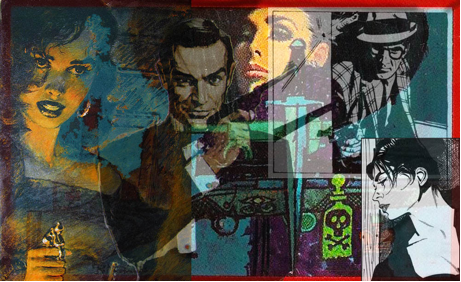
Above: Background—Robert McGinnis’s cover for Ellery Queen’s Best Mysteries of 1964; Left to Right: Saturday Evening Post illustration by Edwin Georgi from the ’40s; iconic image of Sean Connery from the poster for From Russia With Love by Renato Fratini, 1963; Alex Raymond’s comic strip detective, Rip Kirby, circa 1950; Peter O’Donnell’s exotic comic strip and book heroine Modesty Blaise by Jim Holloway.
I have the privilege to illustrate some of today’s finest authors of mystery fiction in the most intimate of settings—the short story. Stories that range from ironic, breathtaking, surprising, and creepy to outright hilarious, and when I say the finest authors, we’re talking masters here. As someone who grew up on TV shows like Mannix and Columbo, it’s been a thrill to have illustrated stories by William Link; then there are the classics and final works by the Late Great Edward D. Hoch. Once, I called Ian Rankin overseas with a specific question about a van—he didn’t have email then. Others I’ve illustrated include Jeffery Deaver, Peter Lovesey, Robert Barnard, Jeremiah Healy, Toni L.P. Kelner, Amy Myers, Steve Hockensmith, James Powell, Neil Schofield, Liza Cody, and many more, even Monk stories by Lee Goldberg. (My only regret is not being able to have Traylor Howard model for me on those!)
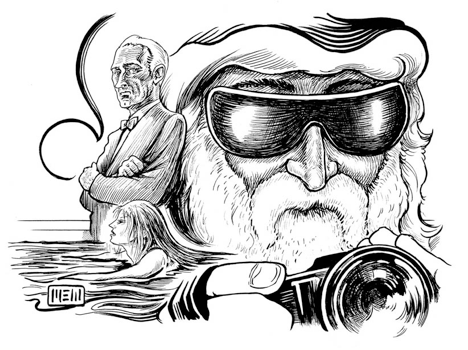
Illustration for “Santa in Sunglasses” by William Link
It’s always exciting to get a new assignment. I never know what will be thrown my way. As an old London hand and one-time student at Cambridge, I often get stories set in the UK, so they’re a natural fit. Sometimes however, the stories can be pretty tough to crack and I’ve wondered if that’s not on purpose—in a good way. Although not specified, there’s one major caveat: Don’t give away the plot! My goal as an artist is to come up with a compelling composition that tells enough or part of the story to get the reader interested and involved so they’ll want to dive right in. I always hope that by the end of the story the reader goes back to look at the art and has an “Aha!” moment.
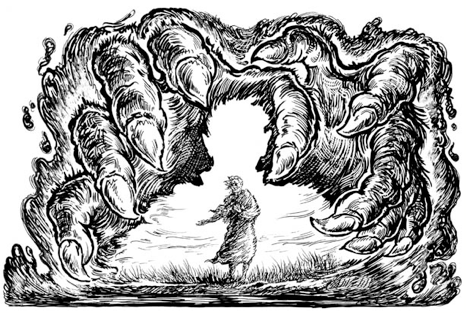
Illustration for “The Faceless Thing” by Edward D. Hoch
I’m always looking for a hook. Sometimes I may use a specific scene from the story; other times it’s a collage or composite; occasionally though, it may be something surrealistic or what I like to think of as “psychological,” as ironically graphic as the story. It’s gratifying in those cases when I’m allowed to step outside the box—keeping me and the art from becoming stagnant:
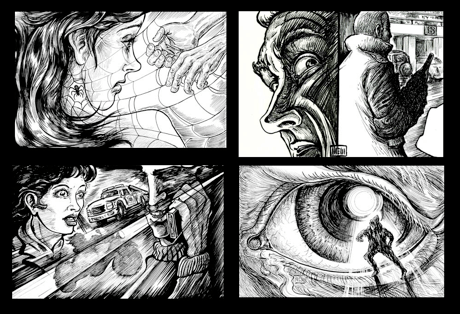
Here’s the process: Unlike the old days of getting the MS by snail mail (not a bottle) it has come by email for many moons. I’ll read the script and usually certain passages, characters, or ideas will jump out at me. Generally I start doing thumbnail sketches whilst the ideas are fresh. Sometimes if the story is complex or I’m stuck, I’ll rest on it a day or two; but the best way is to start right in as one idea leads to the next. I used to scribble these on the printed-out MS itself, but these days I read off the screen and the thumbs go right into my sketchbook.
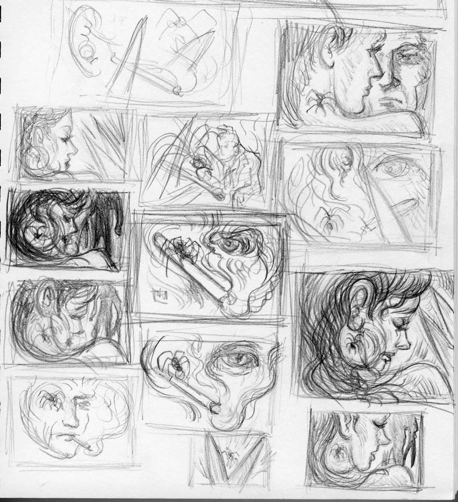
At this stage I usually step back for a few days to choose my three strongest concepts. I always revisit the story to check details. Then I draw three fairly tight sketches at the size at which they’ll be printed. These I present to the art director and editor for approval.
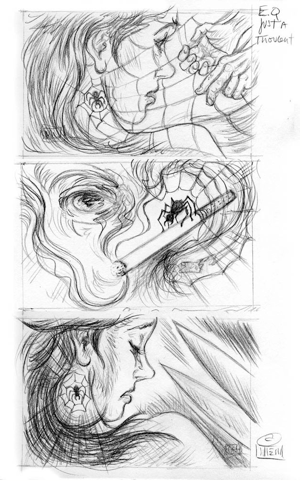
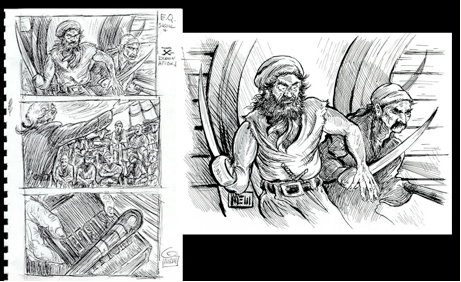
Sketches to Final Art for “Skull and X-Examinations” by Toni L.P. Kelner
I try to think through each sketch carefully so no matter which one is selected, I’ll feel confident going into the final. Many times, research is required about certain aspects of a story. This is something I have enjoyed immensely my entire artistic life, whether as a scenic designer in the theatre, an illustrator, or an author: To continually learn and explore, satisfying basic human curiosity, that’s the very basis of detection—the need to know, to discover. Part of detection is making connections.
At times I’ll use photography, often casting family, friends, actors, wait staff, and even Yrs. Trly as characters. Others come straight out of my head based on the story, and others from my travel sketchbooks or file photos. The fun part is you just never know. Most recently, I used my oldest friend and his younger brother as models in the same illustration. I’ve used their mom as well.
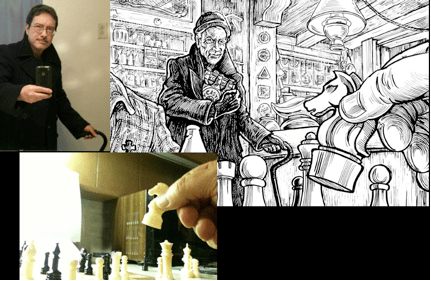
M.E.W. in the starring role for “Beer Money” by Shane Nelson
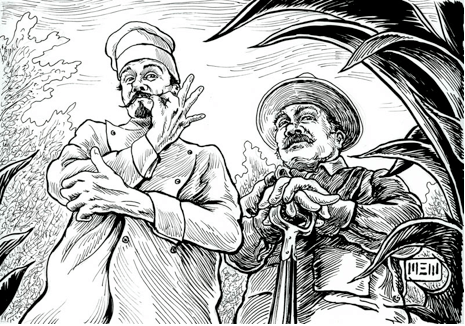
The Chef is a friend who is a dentist, actor, and filmmaker; the other guy didn’t show, so I made him up for “Murder in the Pineapple Pit”
The style has evolved some over the years, and it’s funny to think back to the original samples I sent in, which were in a woodcut style I’d developed doing packaging illustration for Pier 1 Imports. Originally, they were sent to Alfred Hitchcock’s Mystery Magazine, and not to Ellery Queen! Regular readers will note the cinematic and film noir influence in the angles and compositions.
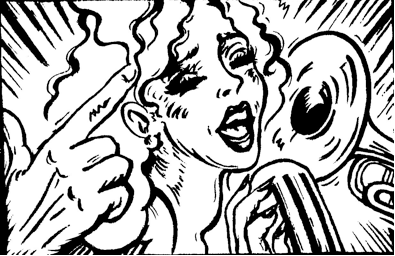
My very first Ellery Queen Illustration: “One Dead Canary”
As I mentioned, I’m also an author of mystery. The compulsion to write took hold at an early age, formulated by many factors. Popeye, Roy Rogers, and Lassie had been vanquished in the span of a couple of years by the explorations of John Glenn in outer space and Jacques Cousteau under the sea; seeing Lawrence of Arabia, 20,000 Leagues Under the Sea, and Fantasia; but then I was caught up in a real-life mystery, very close to home. By circumstances I may relate at another time I ended up in Dealey Plaza (a very familiar place, where the “Hertz Building” was) about three hours after President Kennedy’s assassination. After this, despite the Beatles, I became fascinated with mystery and crime.
Then the game-changer, seeing Goldfinger, and being totally caught up in the phenomenon that took the world by storm—James Bond, 007—the super-secret agent who traveled to exotic locations around the world and had incredible adventures and met beautiful women and fought the nastiest of villains. It was undoubtedly Ian Fleming who inspired me to write fiction.
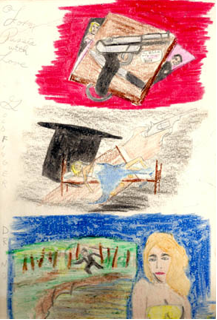
My earliest book covers circa 1965
It was a hot summer day in New York City, 1966, when I spied with my little eye copies of From Russia With Love and Doctor No at a used bookstall. The stylish cover art by Barye Phillips was especially tantalizing. Some pleading and allowance money soon found them clutched in my hot sweaty little nine-year-old hands. I was hooked.
Doctor No remains an accessible read. As a child I noted all the differences between book and film, one of the main ones being the spider /centipede passage. In the film, Professor Dent (not in the book) picks up a deadly spider in a scene memorable for both Ken Adam’s futuristic sets and the sonorous voice of the all-powerful, all-seeing unseen Doctor No. The scene that follows in the film is harrowing, yet in the novel, as written by Fleming, a deadly centipede is used to even greater effect. Other horrors await 007, but this particular sequence stands out. It is one of the most suspenseful passages anywhere, easily on a par with The Tell-Tale Heart. In the space of but three pages Fleming’s words transfixed and terrorized the nine year old that was me, and still do to this day. They were what first inspired me to write fiction.
I began to devour any and all mystery fiction and cinema, all the while still enjoying Sherlock Holmes, Stevenson, Poe, Lovecraft, Man From Uncle comics, and even the Hardy Boys.
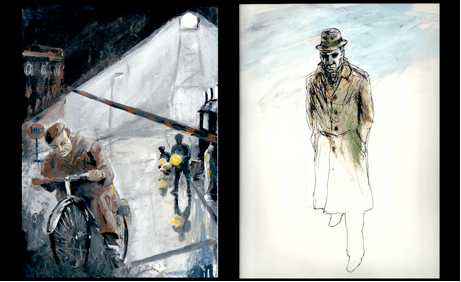
Early illustrations for The Spy Who Came in from the Cold, circa ’67-’68
But I had a problem. I simply could not understand plotting, or how to create a scenario and storyline. I also felt I simply didn’t know enough about life yet to write, so I set myself a goal—that I would start writing after I turned forty. I set about reading and learning—and living. Then, and to this day, I read everything I could of mysteries, thrillers, crime, and noir. Fast forward to the late eighties: I was in Puerto Vallarta, soaking up the sun, reading John D. MacDonald’s Darker Than Amber, the strains of the Fine Young Cannibals thudding in the background, and suddenly I was inspired. I started writing down all sorts of story ideas.
Within a year I made my first notes about a Scotland Yard Detective and three kids who always get mixed up in his cases. Concurrently, working a roadshow production of Les Miserables, I met an actor named Kelly Briggs, who was a relative of—and named for—the Late Grace Kelly, Her Royal Highness Princess Grace of Monaco. This sparked my imagination, but I made a small adjustment with the family name. About six years later I turned forty, and started writing the first incarnation of Kelly Riggs, which, fourteen years later, turned into my 2011 opus, The Case of the Blood Red Stars, A Kelly Riggs Mystery, illustrations c’est moi.
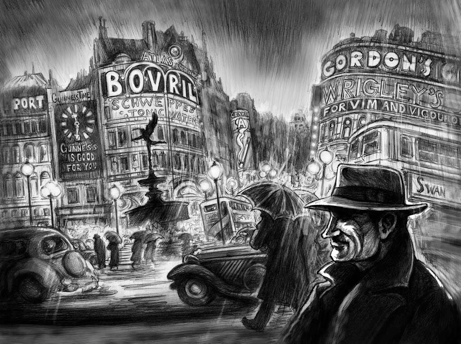
Kelly Riggs in Piccadilly in The Case of the Blood Red Stars
In the meantime, I began writing short stories with Forgotten Horrors author, cinematic and musical expert, journalist, and comic artist Michael H. Price, published by Midnight Marquee Press: What You See May Shock You! (2009). A collection of postmodern pulp fiction, the stories range from supernatural to horrific; ironical to whimsical. We are putting the final touches on new stories (and “illos”) for an expanded edition to be released Christmas 2013, entitled Dark Borderlands.
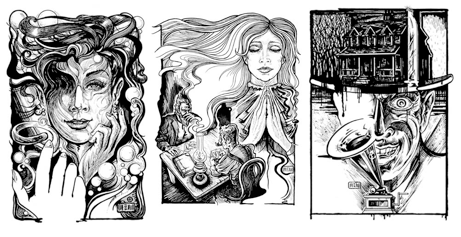
As a writer, I owe a huge debt of gratitude to Ian Fleming and the passage of a centipede, not to mention all those before me; and as an illustrator and lover of mystery, suspense, noir, the horrific and fantastical, I’m grateful and fortunate to be part of this rich, mysterious world.
Scandinavia consists of the countries Sweden, Denmark, and Norway. 9.5 million, 5.5 million, and 5 million people, respectively, live in these countries. The inhabitants of these countries can read and understand one another’s languages, so books can reach a market of twenty million readers.
Henning Mankell (born 1948), Håkan Nesser (born 1950), Liza Marklund (born 1962), and Lars Kepler are among the most famous Swedish writers. Lars Kepler is in fact an alias for Alexander Ahndori (born 1967) and Alexandra Coelho Ahndori (born 1966), a married couple who write together. The duo have been the most popular crime writers in Sweden for the last couple of years, with their first book, Hypnotisören (The Hypnotist), reaching number one on the bestseller list. But the couple kept their names a secret for a long time, and some journalists even presumed that Henning Mankell was behind the alias. Another famous Swedish name is the deceased Stieg Larsson(1954-2004) who had enormous success with three books after his death. The Girl With the Dragon Tattoo is perhaps the most well-known to the American audience, as it was made into a movie featuring Daniel Craig and Rooney Mara. All three Larsson books have also been adapted by the Swedish film industry. Noomi Rapace (born 1979), who played the lead role in all of the Swedish movies, has made a name for herself in Hollywood because of her strong performances in these films. She continued with roles in Prometheus (2012) and in Sherlock Holmes: A Game of Shadows (2011).
Jussi Adler-Olsen (born 1950), Anders Bodelsen (born 1936), and sister and brother Lotte Hammer (born 1955) and Søren Hammer (born 1952) are among the most famous Danish crime writers. The Danish writers may not have reached the same level of success as the Swedish writers, but they surely get first prize in Scandinavia for creating very strong crime TV-series. Forbrytelsen (Crime—shown on the BBC in England with subtitles as The Killing, to an enormous audience) and Broen are top-class entertainment. Broen has been made into an American version called The Bridge (2013).
Even though there are more well-known Swedish than Danish actors, the best Scandinavian movies in modern times are also made in Denmark. The most famous Scandinavian director by far is Lars von Trier. Mads Mikkelsen (born 1965) who plays the lead role in the TV series Hannibal, and also the bad guy in James Bond: Casino Royale from 2006, has made a career for himself over the last decade. Viggo Mortensen (born 1958) who plays Aragorn in The Lord of The Rings is perhaps the most famous Danish actor, and has also starred in several crime movies made in America.
In Norway there is no crime writer above or beside Jo Nesbø (born 1960). He has reached worldwide success with his crime novels about Harry Hole. The Norwegian movie Hodejegerne (Headhunters) was based on one of the books in the series, and it did well on the international market. Martin Scorsese was rumored to be about to make the first English-language movie based on Jo Nesbø’s books, but the American legend seems to be tied up in too many projects to find the time for this one. Other Norwegian crime writers well worth mentioning are Unni Lindell (born 1957), Gunnar Staalesen (born 1947), Karin Fossum (born 1954) and Anne Holt (born 1958). All of them have written novels that have been adapted for TV.
Since the writer of this post is Norwegian, I want to close this article with a little more about Norway and its crime writers. Richard Macker (born 1936) and I (Terje Thomassen, born 1968) are father and son, and Macker will soon have his ninth short story in EQMM. Richard Macker is an alias for Reidar Thomassen, but aliases are a dying breed in Norway. They were used more often in the past to separate writers who wrote books in several literary genres. The most infamous Norwegian crime writer was Jonas Lie (1899-1945). He was a government minister under Quisling when Norway was occupied by the Germans, and he was leader of the Nazi police department. He committed suicide in 1945. Before the war, he wrote a crime novel under the alias Max Mauser. Only Richard Macker and one other writer we know about use an alias in Norway today. In Norway (and I presume there has been much the same development in other countries in regard to crime fiction) we are now seeing a tendency towards much more violent and internationally focused plots in crime novels and series on TV. Like Agatha Christie, the likes of Macker and his generation often wrote mysteries that took place in a kind of closed environment. The essential part was not measuring the amount of blood and closely describing how the murder was executed. It seems now that writers want their readers to have a close encounter with the most sadistic murderers they can come up with. Not to say that this makes the crime fiction bad, but it is a development. Just think of how much more violence you can find now in children’s TV programs and video games.
When it comes to crime series on Norwegian TV, the most famous these days has to be the Varg Veum series, based on the crime novels by Gunnar Staalesen. Richard Macker had his time in the ’70s and ’80s with a series about two investigators named Helmer and Sigurdson. Another tendency in Norway seems to be that the writers have worked in the environment they write about. Jo Nesbø worked in finance before writing books set in that world, and Jørgen Lier Horst (born 1970) was a police officer before he became one of the new successful crime writers. Many more of these links could be mentioned, and it is surely positive for a writer to have had a close connection with the environment he describes in his books.
Finally, you cannot talk about crime literature in Norway without mentioning the close link it has to the Easter holiday. Nearly all Norwegian families own a cabin in the mountains, or by the sea. True to tradition, Norwegians flock to their cabins at Eastertime and read a lot of crime novels and watch crime series on TV. We even print crime riddles on milk cartons for the holiday!
Swedish authors:
Henning Mankell
Håkan Nesser
Liza Marklund
Lars Kepler
Stieg Larsson
Danish:
Jussi-Adler Olsen
Anders Bodelsen
Lotte and Søren Hammer
Norwegian:
Jo Nesbø
Gunnar Staalesen
Karin Fossum
Anne Holt
Jørn Lier Horst
The French author Honoré de Balzac once wrote that “behind every fortune lies a great crime,” and his words are borne out in “The Blue Carbuncle.” Belonging to a countess and worth at least £20,000, the precious stone brings nothing but trouble to whoever possesses it. Holmes dismisses the fetishization of such objects in a famous passage:
In the larger and older jewels every facet may stand for a bloody deed. This stone is not yet twenty years old . . . In spite of its youth, it has already a sinister history. There have been two murders, a vitriol-throwing, a suicide, and several robberies brought about for the sake of this forty-grain weight of crystallized charcoal.
Dismissing the immense wealth of an aristocratic countess as a piece of “crystallized charcoal” represents a fairly overt critique of the culturally constructed relationship between wealth and class.
In “The Noble Bachelor,” Holmes once again expresses his distaste for cases dealing with the nobility, “which call upon a man either to be bored or to lie,” while “the humbler are usually the more interesting.” Holmes even yawns as Watson first describes the case to him, and shows further contempt for the British class system, noting that “the status of my client is a matter of less moment to me than the interest of his case.”
This is one of many characteristics that make Holmes such a beloved archetypal hero. Money, class, status—none of it matters to him. But it mattered very much to the Victorians.
Lord St. Simon, whom Watson describes as “a man whose pleasant lot it had ever been to command and to be obeyed,” comes off as a condescending fool in his first exchange with the great detective:
[Lord St. Simon:] “I understand the you have already managed several delicate cases of this sort, sir, though I presume that they were hardly from the came class of society.”
[Holmes:] “No, I am descending.”
“I beg pardon?”
“My last client of the sort was a king.”
“Oh, really! I had no idea. And which king?”
Lord St. Simon also believes that his fiancé ran off because marrying into such a fabulously prominent family was simply too much for her. Needless to say, Holmes rejects this self-aggrandizing assertion.
This issue of wealth and class turns up again in “The Beryl Coronet,” in which one of “the highest, noblest, most exalted names in England” refers to £50,000 as a “trifling” sum before entrusting the coronet in question to a banker who is understandably hesitant to assume responsibility for such a priceless and irreplaceable object. That the nobleman makes this unorthodox arrangement in order to cover up some potentially embarrassing indiscretion goes without saying, of course.
Too much wealth concentrated in one place has a poisonous effect on human relations, and in this story we see it trickle down from the aristocracy to the bourgeoisie: The banker is awfully quick to presume his son’s guilt when a piece of the coronet goes missing, and when the jewels are returned, he hugs “his recovered gems to his bosom,” a display of affection he has not shown to his own family. Like Mr. Jabez Wilson in “The Red-Headed League,” the banker is another “portly” figure who resembles John Bull in the Paget illustrations, and who therefore could be said to symbolize English society in general.
In contrast to the “vacuous” Miss Mary Southerland in “A Case of Identity,” Holmes is “favorably impressed” by Miss Violet Hunter in “The Copper Beeches.” She is humble, brave, and above all, intelligent: Her story provides Holmes with all the details he needs, and unlike the petulant and privileged aristocrats who typically engage Holmes’s services, she is “a woman who has had her own way to make in the world.”
This time, the bourgeoisie take it directly on the chin: Mr. Rucastle is “a prodigiously stout man” who rubs his hands with glee as he ogles the prospective governesses for his child, a nasty little boy who enjoys trapping animals and “giving pain to any creature weaker than himself.” Oh, and Mr. Rucastle also keeps his own daughter locked in an upstairs room so he can keep all her money for himself.
Once again, he resembles John Bull in the Paget illustrations, and an academic might be tempted to suggest that if Mr. Rucastle represents England, his false good humor masking a homicidal coldness and greed, then his sins are visited upon his children: his son represents the cruelty that a system of such extreme economic inequality produces—the violence needed to enforce imperialism abroad and repressive values at home—while his daughter represents those who suffer from their vulnerability to the forces symbolized by the two male figures. But that might be going a bit far for some of you.*
Fortunately, a member of the working class, “a persevering man, as a good seaman should be,” in Holmes’s words, wins the girl’s heart and spirits her away.
(*And if you really want to go off the deep end, one might suggest that in “The Engineer’s Thumb,” the loss of Hatherly’s opposable thumb—a crucial characteristic of our development as a tool-making species—to an ax-wielding assailant in a room that has been converted into a giant hydraulic press represents how industrialization and its accompanying greed robs us of our humanity. [Warning: This is extreme literary analysis performed by a trained professional. Don’t try this at home.] Hatherly is another Doyle-like figure, most notably when he describes the troubles facing a newly minted engineer: “I suppose that everyone finds his first independent start in business a dreary experience. To me it has been exceptionally so. During two years I have had three consultations and one small job,” he laments, in words that could be describing Doyle’s own early struggles.)
Another arrogant bourgeois gets a taste of Holmes’s unique brand of justice in “Silver Blaze,” when Holmes notes, “The Colonel’s manner has been just a trifle cavalier to me. I am inclined now to have a little amusement at his expense.” Presumably Doyle’s audience lapped this up, just as we do today. (We still love to see arrogant rich people get their comeuppance, don’t we?)
Finally, we come to “The Yellow Face.” Though by no means one of the great Sherlock Holmes stories—and perhaps because of it—this story contains a number of references to cultural tensions between the English and the Scots, and seriously challenges the presumed moral superiority of the imperious English.
Though unstated in the story, Mr. Grant Munro is very likely Scottish (Leslie Klinger informs us in the New Annotated Sherlock Holmes that “both Grant and Munro are common Scottish names”). English popular culture of the time typically caricatured the Scots as backward country folk with thick accents who were ignorant of big city ways and, above all, cheap. (The Scots would counter that their characteristic frugality is a result of having their country’s wealth plundered by the English, but that’s another story.)
Munro has called while Holmes was out, leaving behind a pipe that Holmes examines closely and identifies as a well-made but relatively inexpensive model that has been “twice mended.” Doyle’s target audience was presumably expected to jump to the conclusion that this is a sign of cheapness, until Holmes points out that the repairs have been made with silver bands that “must have cost more than the pipe did originally.”
So instead of labeling Munro a cheapskate, Holmes deduces that he is a man who would rather repair something that has emotional significance for him than “buy a new one with the same money.” Munro is loyal to the things he loves, which has important ramifications later in the story.
We are soon told that Munro didn’t want his wife to sign her money over to him, even though she has “a capital of about four thousand five hundred pounds,” because he already has an income of “seven or eight hundred.” Again, there is a difference between appreciating what you have and being “cheap.” Munro (“a muscular man . . . with an excellent set of teeth”) compares quite favorably with the portly, overfed Englishmen in the other stories who are willing to abuse and imprison their family members for the sake of money.
Munro fears the worst—that his wife’s first husband has come back to haunt them, perhaps—and is greatly relieved when he learns that the big secret his wife has been keeping from him is that her first husband was black, and that they have a black child.
“It was a long two minutes before Grant Munro broke the silence,” we are told. Munro’s silence is apparently due to him processing the unpleasant revelation that his wife didn’t have enough faith to confide in him from the beginning. Thus the story suggests that the Scots may be more tolerant of racial difference than the English, perhaps because they identify more readily with oppressed minorities.
In his final speech, Munro can be seen as representing all of Scotland addressing their English neighbors to the south when he says: “I am not a very good man, Effie, but I think that I am a better one than you have given me credit for being.”
And just in case you start feeling superior to all those smug Victorians, Klinger points out that the first American publication of “The Yellow Face” lengthened Munro’s silence to ten minutes, suggesting that Munro is confronting the unpleasant revelation that his wife had a child with a black man—a very different emotional moment, to be sure.
There are many more examples of such implicit critiques of Victorian society in the Holmes canon, but I think that’s enough for now.
Thanks to E.J. Wagner for her helpful comments on an early draft of this material.
A number of today’s crime writers are also college professors who bring a unique critical approach to reading (and writing) crime fiction. In the course of teaching a college class that covers material stretching from Edgar Allan Poe and Dashiell Hammett to S.J. Rozan and Megan Abbott, I have uncovered evidence of numerous indirect criticisms of English society in the Sherlock Holmes stories, and a propensity for subverting revered Victorian institutions such as the aristocracy, the justice system, and even motherhood itself.
Any Holmes fan is familiar with the scenarios in which the police officials are completely baffled by a case, draw ridiculous conclusions from the available evidence, waste time chasing worthless clues, are stubbornly insistent upon arresting an innocent man, and then claim all the credit when Holmes solves the case.
This is not the cynical world of corrupt police officials found in the later American hardboiled school. In the Holmes stories, the incompetence and arrogance of the police inspectors is usually handled with a humorous wink at the reader. But any competent literary critic will tell you that in rigidly hierarchical societies such as Victorian England, humor is often the best vehicle for social commentary, since a direct attack on such institutions would be met with ostracism and even prosecution in some cases.
Think of that fabulously arch moment in the first published Holmes short story, “A Scandal in Bohemia,” when the king of Bohemia, so overdressed when we first meet him that Watson is unfavorably impressed by his “barbaric opulence,” speaks of Irene Adler:
“Would she not have made an admirable queen? Is it not a pity that she was not on my level?”
“From what I have seen of the lady, she seems, indeed, to be on a very different level to your Majesty,” said Holmes, coldly.
Meaning, of course, that she is far superior to the king.
That princes and kings can be cads is not exactly news, but we should take a moment to consider how radical it was to say so in print at the time, even if the criticism was safely displaced onto the Bohemian nobility. While some Victorian readers might have chuckled at the implied inferiority of the Central European nobility to a mere stage actress (and a commoner), many in the audience must have picked up on the indirect criticism of all such spoiled monarchs. The king in question, after all, has a German name—an almost comically absurd one at that—just as Queen Victoria’s mother and husband did (Princess Marie Luise Victoria of Saxe-Coburg-Saalfeld and Prince Albert of Saxe-Coburg and Gotha, respectively).
Some of these negative attitudes towards the aristocracy and the police are a result of the British class system. The audience for the Holmes stories clearly relished the depiction of the nobility as pompous asses who are every bit as criminal in their behaviors as the lowest thieves, and the besting of the plodding, lower-class British bobbies time and again by an amateur (and a gentleman) who is happy to work for free if the client is needy and the case has one or two points of interest, as Holmes himself would say.
However, if we recall that Victorian Britain considered itself to be the very pinnacle of civilization at the time—the aristocratic characters repeatedly treat police inspectors (and even Holmes himself) as mere servants who are there to serve their “superiors”—it is possible to perceive the sly subversion of that society in these unflattering portrayals of the noble classes and the criminal justice system. (Perhaps that is also one of the reasons Holmes keeps quoting French terms and catchphrases in the early stories as well.)
These carefully crafted critiques may also reflect Conan Doyle’s own experiences as the Scottish-born child of an Irish family (yes, they were an oppressed minority) living in England, who couldn’t directly attack the social structure that he desperately needed to be a part of, and as a young doctor who, despite his excellent medical qualifications, struggled for many years to gain recognition and build a client base, much like Holmes himself in the early stories. (In later stories, once his reputation has been better established, Holmes is shown working in closer collaboration with the police.)
Consider the case of Mr. Jabez Wilson in “The Red-Headed League.” As a businessman and a shopkeeper, he can be said to represent the very backbone of English middle-class society. He is also described as “a very stout, florid-faced, elderly gentleman, with fiery red hair.” In other words, he very much resembles John Bull, the symbol of England personified, especially in the original black-and-white illustrations by Sidney Paget. If we combine this image with Napoleon’s famous dictum that England is “a nation of shopkeepers,” Mr. Wilson can indeed be said to symbolize England. Yet Watson tells us that Mr. Wilson “bore every mark of being an average commonplace British tradesman, obese, pompous and slow.”
So a symbolic representative of the average Englishman is obese, pompous and slow—so slow that he doesn’t even recognize Holmes’s genius: “I thought at first that you had done something clever, but I see that there was nothing in it after all,” says Wilson, chuckling with self-satisfaction.
Once we leave 221B Baker Street, the main action of “The Red-Headed League” takes place in Saxe-Coburg Square (the surnames of Queen Victoria’s closest relatives), where we are introduced to Merryweather, a bank director dressed in an “oppressively respectable frock-coat” (now there’s a curious phrase) who apparently cares more about missing his card game than preventing a bank robbery, a police agent named Jones whom Holmes calls “an absolute imbecile,” and a criminal, John Clay, who as he is apprehended declares, apparently without irony: “I beg that you will not touch me with your filthy hands. You may not be aware that I have royal blood in my veins. Have the goodness also when you address me always to say ‘sir’ and ‘please.’”
No wonder Holmes declares near the end: “My life is spent in one long effort to escape from the commonplaces of existence.” After all, his remarkable gifts go unrecognized by the “oppressively respectable” and hypocritical society of his time. (To top it off, Holmes’s final remark is a quotation from Flaubert—another Frenchman.)
Crime so often shows the worst of human nature, so depicting an evil mother is not to be taken as a condemnation of all mothers. But consider the mother in “A Case of Identity” who connives with her second husband to take advantage of her daughter’s “short sight.” Not only is the Victorian ideal of the self-sacrificing mother inverted here, but even the daughter comes in for poor treatment. Watson tells us that Miss Mary Southerland has a “somewhat vacuous face,” gives a “rambling and inconsequential narrative,” and wears a “preposterous hat.” Watson notes her “vacuous” face twice and her shortsightedness several times. So much for the idealized image of the young woman as innocent victim of criminal deception.
In “The Boscombe Valley Mystery,” an innocent man has been charged. “Many men have been hanged on far slighter evidence,” says Watson. “Many men have been wrongfully hanged,” Holmes replies, questioning and subverting the exalted principles of British jurisprudence.
Naturally, Inspector Lestrade dismisses Holmes’s methods:
“I find it hard enough to tackle facts, Holmes, without flying away after theories and fancies.”
“You are right,” said Holmes, demurely; “you do find it very hard to tackle the facts.”
Holmes calls Lestrade an “imbecile” later in the story.
Some of Holmes’s frustration at being dismissed by those with inferior minds is derived from Poe’s Dupin, another man with a brilliant mind who is forced to waste his time dealing with ignorant and unappreciative people. But Dupin’s contempt was displaced from Poe’s America and aimed at the Prefect of the Parisian police. Doyle was writing about his own society.
One might even suggest that the happy ending of this Holmes story, in which the young couple will live “in ignorance of the black cloud which rests upon their past,” is a veiled condemnation of the average Briton’s ignorance of (or indifference to) the ravages of British colonialism, since the germ of the story’s conflict began years before in the diamond mines in Victoria, Australia. (Victoria, you say? Gee, that name sounds familiar…)
This week I’d like to expand on a post I made on November 8, 2010, on EQMM’s Web-site forum, concerning confession scenes. They’re a staple of our genre, so much so that I suspect most writers of crime fiction have resorted to one at least once to wrap up a story. I’m sympathetic: a confession scene must sometimes seem irresistible to an author struggling to bring a particularly vexing plot to resolution. But it’s precisely when it’s used for that reason that this literary device causes me to groan—and I’ll bet every reader has had that reaction at one time or another to a killer’s spilling of the solution. My disappointment in this type of denouement doesn’t only derive from the fact that it replaces a display of deductive brilliance. Often, it’s that the psychology of the whole business is either absent or just doesn’t feel right.
You know the kind of scene I’m thinking of: upstanding pillar of society suddenly turns a gun on the nosy sleuth he’s convinced is about to finger him for the crime. But before despatching the detective, he can’t resist bragging about his cleverness. Such conscienceless pride over heinous acts is, in the real world, behavior typically associated with sociopaths, and despite the fact that sociopaths are known to be extremely adept at appearing “normal,” I always feel that if a fiction writer is going to hang the story on such a personality, some groundwork should be laid.
Not all confessions in fiction come from the mouths of sociopaths, of course. Edgar Allan Poe’s story “The Tell-Tale Heart,” which involves perhaps the best-known confession in fiction, centers around a tortured conscience—something a sociopath, by definition, does not have. When I first posted on this subject I had just learned that Poe’s famous story was inspired by a real murder case that occurred in Salem, Massachusetts in 1830. The Smithsonian had just run an article by E.J. Wagner about the murder of Joseph White, an elderly former sea captain, and the subsequent trial of the men who conspired to kill him. White was a man of considerable fortune, with only nephews and a niece to inherit his estate were he to die intestate. Like many a wealthy old curmudgeon in mystery fiction, White was apparently fond of tormenting his family with changes to his will, and despite the picture newspapers painted of him as a “beloved old man,” he inspired hatred in some of his nearest and dearest.
What makes the case so interesting from the standpoint of mystery writing is that the perpetrators, in effect, led themselves to justice. It was their indiscretion in talking about the crime to at least one person who would later attempt to blackmail them—along with their own missteps in attempting to deflect suspicion—which led to their demise. The prosecutor on the case was the famous Daniel Webster—U.S. congressman and senator and twice Secretary of State. Regarded as the leading orator of his time, Webster was asked by a relative of the victim to assist the prosecution in the trial of one of the conspirators. After reading the Smithsonian article, I found a fuller text of Webster’s summation to the jury online, and I think it’s something every writer of confession scenes, at least of the non-sociopathological variety, should read.
According to E.J. Wagner, Samuel McCall, another lawyer and statesman of the time, called Webster’s speech “the greatest argument ever addressed to a jury.” It included these passages on the matter of conscience:
“He has done the murder. No eye has seen him . . . The secret is his own, and it is safe! Ah! Gentlemen, that was a dreadful mistake . . . such secrets of guilt are never safe from detection, even by men. True it is, generally speaking, that ‘murder will out.’ . . . the guilty soul cannot keep its own secret. It is false to itself, or rather, it feels an irresistible impulse of conscience to be true to itself. It labors under its guilty possession, and knows not what to do with it. The human heart was not made for the residence of such an inhabitant. It finds itself preyed on by a torrent which it dare not acknowledge to God or man. A vulture is devouring it, and it can ask no sympathy from heaven or earth. The secret which the murderer possesses soon comes to possess him, and like the evil spirits of which we read, it overcomes him, and leads him whithersoever it will. He feels it beating at his heart, rising to his throat, and demanding disclosure. He thinks the whole world sees it in his face, reads it in his eyes . . . it breaks down his courage . . . When suspicions from without begin to embarrass him, and the net of circumstances to entangle him, the fatal secret struggles with still greater violence to burst forth. It must be confessed, it will be confessed . . .”
Anyone who’s read “The Tell-Tale Heart” will have no trouble agreeing with Poe scholars that Webster’s words, which apparently would have been known to Poe, probably inspired the famous short story. And it wasn’t only Poe who was influenced by Webster’s eloquent speech. Wagner points out that Nathaniel Hawthorne was living in Salem at the time of the trial and contributing stories to the local newspaper. He says: “I discovered the murder case had even found its way into some of Nathaniel Hawthorne’s works, with its themes of tainted family fortunes, torrential guilt and ensuing retribution.” More specifically, some scholars have connected the influence of Webster’s speech on Hawthorne to the need Hawthorne’s character Dimmesdale feels to confess in The Scarlet Letter.
What this all leads me to is a plea to writers concluding their stories with confession scenes: If you must use this device, try to do it with a degree of psychological realism. The interesting killer —to me, at least—is a character conflicted over his crime. He or she may have an egotistical desire so boast of the cleverness of what’s been done. Webster notes this is his speech. He says: “Such is human nature, that some persons lose their abhorrence of crime in their admiration of its magnificent exhibitions. Ordinary vice is reprobated by them, but extraordinary guilt, exquisite wickedness, the high flights of poetry and crime, seize on the imagination, and lead them to forget the depths of the guilt, in admiration of the excellence of the performance. . . ” Webster is addressing those who admire the criminal, but the same point pertains to the criminal’s self admiration. And Webster is very clear that alongside that glorification of the crime is the guilt that abides and grows in the soul. In modern terms we would say that if not for that—if not for conscience— we’d be dealing with a sociopath, and the sociopath is a type of character that is interesting to me, in fiction, primarily as a freak. He or she can be fascinating, of course, but not in the way a human character compels our interest.
The type of confession scene that makes me groan is that in which there’s been a kind of “cop out.” The plot has been resolved, but at the expense of making any sense of the character. That upstanding pillar of society who turns the gun on the nosy sleuth without any remorse and with a gloating pleasure in recounting his exploits is a cipher in the character department. If a story is going to be resolved by a confession, I want to see something of the inner conflict that leads to it.—Janet Hutchings
Crime fiction was long thought of as the privileged—if not exclusive—province of English-speaking writers. The detective/mystery genre that began with Edgar Allan Poe, an American, achieved maturity at the hands of British authors like Agatha Christie, Dorothy L. Sayers, and more recently P. D. James. Add in such classic American figures as Dashiell Hammett, Raymond Chandler, and James M. Cain and it’s easy to understand why French, German, and even Latin American authors looked to the Anglophone world as a source of inspiration and technique.
That exclusivity is rapidly disappearing. More and more, writers outside the Anglo-American sphere are producing quality fiction in the genre—need I mention Stieg Larsson? Today I want to talk about a country more associated in the public mind with real-life crime than with crime fiction—Brazil.
For over 25 years I’ve been a translator of Brazilian works in all genres, from scholarly studies by leading academicians to cheery works for young adults. But of all the millions of words I’ve brought into English from Portuguese, the most gratifying—and most enjoyable—has been prose focusing on crime in all its guises.
Beyond the megalopolises of Rio de Janeiro and São Paulo, smaller cities and even the rural countryside serve as backdrop for a panoply of homicide and lesser transgressions. It is, however, urban crime that gets the headlines and makes the TV newscasts, where, as in the U.S., “if it bleeds, it leads.”
Unfortunately for the foreign aficionado of Brazilian crime fiction, the number of works translated into English is limited. In part this reflects the well-known (and lamentable) disinclination of Americans to read translations —and the subsequent reluctance of American publishers to take a chance on them. But they can be found; check your local library or Amazon.com.
The undisputed master of the genre known in Brazil as the policial is Rubem Fonseca. He has won every major literary prize in Latin America, including the Camões Prize in 2003, known as the Portuguese-language Nobel. An octogenarian who has been producing edgy, controversial fiction since the 1960s, he has inspired numerous younger writers. At the risk of appearing self-serving, I would like to call attention to two collections of his works still in print in this country. (Full disclosure: I am the translator of both, along with three of his novels.)
The Taker and Other Stories was published by Open Letter in 2008, the first collection of Fonseca stories available in English—fifteen tales of conflict and tension, leavened by the occasional foray into black humor. “Night Drive,” published in EQMM’s Prime Crimes anthology, is the embodiment of Hannah Arendt’s concept of the banality of evil: an unexceptional executive finds relief from ennui by nocturnal excursions in his high-performance car to run over luckless victims on deserted streets. The title story, “The Taker,” explores the acts of a psychopath whose random slaughter is channeled by a woman’s love into systematic terrorism. “Trials of a Young Writer” is a velocity exercise, a single eleven-page paragraph narrated by a hapless wannabe author whose thirst for glory leads to a death, a forged suicide note, and dubious fame. The protagonist of “Angels of the Marquees” (which first appeared in EQMM) learns to his regret that truly no good deed goes unpunished. “Happy New Year” led to the book in which it was published being banned by the military dictatorship that ruled Brazil from 1964 to 1985; it depicts in graphic terms the horrific upshot of the invasion of an upper-class Rio home on December 31 by a criminal gang. Much lighter in tone, “The Notebook” recounts how a cynical womanizer uses a small red notebook in furtherance of his sexual conquests.
Earlier this year, Winning the Game and Other Stories, comprising seventeen of Fonseca’s shorter works, was brought out by Tagus Press. The title story was published in EQMM and relates how, to quote the cover matter, “A loser elaborates a lethal plan to become, in his mind, a winner.” As in the earlier collection, the author’s somber view of humanity is lightened by flashes of humor. “Lonelyhearts” is the hilarious tale of a (male) former police reporter reduced to writing for a woman’s periodical under a feminine pseudonym. “The Game of Dead Men,” the first Portuguese-language work that I translated, is a chilling account of death-squad activities in Rio de Janeiro. “Belle,” “Xania,” and “Guardian Angel” feature a hit man, known only as José, a surprisingly complex personality who recurs in several of Fonseca’s works. “Mandrake” (the eponymous character is a lawyer with his own moral code) is a homage to American noir of the thirties and forties; the attentive reader will spot an allusion to The Big Sleep and perhaps to Farewell, My Lovely. More lighthearted is “Be My Valentine,” which takes place on Valentine’s Day and involves a rich banker on the prowl in his Mercedes, a transvestite, and Mandrake, called in to save the day when things turn ugly.
Fonseca’s novel Crimes of August (Agosto) is a recognized masterwork. Both a popular and critical success when published in 1990, it is an expert commingling of fact (the political intrigue leading to the suicide of President Getúlio Vargas in August 1954) and fiction (a bloody, possibly sex-related murder). It is forthcoming from Tagus Press.
Rubem Fonseca’s influence has now impacted two generations of Brazilian writers. Patrícia Melo, the leading female creator of Brazilian crime novels (The Killer and its sequel Lost World, Inferno, and In Praise of Lies—all available in English) found inspiration in Fonseca, and he in turn is a great admirer of her literary production. And a young phenom named Raphael Montes, whose novel Suicides was written when he was 19 and published at 21, readily acknowledges his admiration for Fonseca as well as the sway his work has exerted. (Montes’s story “Statement No. 060.719-67” is scheduled to appear in EQMM’s November 2013 issue.)
There is much more to say about the topic than space permits. I am currently organizing what I believe to be the first anthology of Brazilian crime fiction in English translation, which will include works by 25 authors ranging from the nineteenth to the twenty-first century. Including, needless to say, Rubem Fonseca.
Missed our last promotion? Fear not! From now until July 10th, you can receive 50% off a digital subscription to EQMM, only through Magzter.

 SOMETHING IS GOING TO HAPPEN