PULL UP A CHAIR

Starting in mid-October this year, most big retailers where I live had their halls decked with Christmas trees right beside the Halloween goblins. The effect was bizarre, but it did get me thinking early about holiday plans, especially holiday dinners—anticipating the special foods, of course, but also looking forward to having time to enjoy conversation with family and friends.

At the same time, it got me thinking about dinners in fiction, one of the most famous of which occurs at Christmastime, in James Joyce’s “The Dead.” In the mystery genre, dinner-table discussion often centers around puzzle-solving rather than the sorts of philosophical questions that absorb the diners in Joyce’s story. Enough conventions have grown up around this type of mystery that I think it can almost be considered a distinct subgenre of the classical whodunit.

Some of the most memorable examples of this genre were written by Isaac Asimov. EQMM still gets letters from readers who remember, fondly, Asimov’s Black Widower stories, in which a group of six men, plus an invited guest, regularly meet for dinner and attempt to solve a murder at table.

I’ll admit right away that although I liked a number of the Black Widower stories, I am not, in general, a big fan of the dinner-table mystery. The problem, for me, is that in such stories the reader is removed a step from the action. We aren’t witnessing the unfolding of the murder or its aftermath or its investigation, we’re witnessing a report and discussion of it. I generally find that an impediment to forming a sympathetic understanding of the victim and other key characters. And the element of vicarious experience that I enjoy in fiction is compromised by the added distance at which we’re made to stand from such stories’ events.

But of course, the central aim of such a story may be to present a dazzling puzzle—a purely intellectual challenge—not to engage the reader emotionally. And if the puzzle is clever enough, the story will probably appeal even to readers like me, to whom a good puzzle is important but not all we’re looking for.

An author who manages to combine brilliant puzzles with characters readers have genuine empathy for is France’s Paul Halter. He manages to do so even at one remove, in the story-within-a-story framework of the dinner-table mystery. (His slight variation on the form is often set in a gentlemen’s club in London, but I’ll come back to that in a moment.)

I said earlier that certain conventions have grown up around this type of mystery. One of them is that there is a recurring cast of characters, and the mysteries they solve together are often brought to them by someone outside their circle. This allows an atmosphere of bonhomie to pervade the story—a sense of being among friends. The resulting repartee among the diners can be highly entertaining in the hands of a good writer of dialogue. Through it, in the best of these stories, the reader may come to form an attachment to the individuals at table, especially if they are not presented as a bunch of inhuman clever clogs. Generally speaking, though, the more time is devoted to developing the characters around the table, the more removed the reader is going to be from the tale of murder that’s being told. Unless the other diners interrupt whoever is laying out the circumstances of the murder frequently to ask questions and offer opinions, readers won’t get a good sense of who they are. But with each interruption, the reader is pulled out of the frame of the murder story and becomes less able to enter back into it with any sense of immediacy.

In the 1990s, former screenwriter Dennis Palumbo (whose credits include My Favorite Year and Welcome Back, Kotter) began a series of dinner-table mysteries starring The Smart Guys Marching Society, the first of them published in EQMM. It’s a coffee table topped with beer and popcorn rather than a sumptuous restaurant with gourmet specialties in the Palumbo stories, but the formula is the same. You’d expect the stars of this series to be ostentatiously brainy, irritating in their sense of superiority. Not so. Palumbo, who became a psychotherapist after retiring from film writing, has a good sense of his characters’ inner lives and is able to humanize them (one a neatnik, another a bit of a slob, all of them aware of how they’re ageing), with the result that the stories have more warmth than I usually associate with this genre. (You can find a collection of the stories, From Crime to Crime: Mind-Boggling Tales of Mystery and Murder, here.)

In the Palumbo stories, the important characters—the ones we engage with—are in the framing story. It seems to me that Paul Halter flips this formula, involving readers most intensely with the characters in the story within the story. His Dr. Twist tales set in London’s Hades club leave me with very little sense of identification with the club’s members, chief among them, aside from Twist, Superintendent Cullen, but I do get drawn right in to the mystery they’re about to solve. The characters in the mystery are brought to life through long passages of narration that go uninterrupted by questions or comments from the listeners. And in the account of the crime there are more direct than indirect reports of speech. (This can be a copyeditor’s nightmare—all those quotes within quotes, as the speaker recounts the exact words of others—but it’s something that creates more immediacy for the reader.) Halter’s attention to atmospheric, not just practical details of setting in the murder story is another important factor in making the murder and not the framing story the focus of our attention. Our February 2014 issue contains “Jacob’s Ladder,” an entry in this series whose inner story is set in a section of the French countryside that I can almost guarantee you won’t forget after reading Halter’s descriptions of it. (You’ll find other good examples of Halter’s use of setting in his story collection The Night of the Wolf.)

It’s largely a matter of taste, of course, which variation on this genre you prefer. I’m more inclined toward the type of story that lets me get inside the mystery itself and focuses less on the cleverness of those around the table. But there are pleasures in both forms. Focusing on the solvers, and treating the mystery more abstractly, creates a lighter sort of entertainment. One more suitable, when you think about it, to a dinner with friends.

Like the marketers who’ve turned our various fall and winter holidays into a single amorphous season, I’d like to wish everyone Happy Thanksgiving early, even if you haven’t yet finished the Halloween candy. I won’t be blogging again before the turkey’s carved, but for that day I wish you a dinner filled with mystery, and a guest as clever as Isaac or Dr. Twist.—Janet Hutchings


Posted in Adventure, Characters, Editing, Genre, Setting, Writers | Tagged , , , , , , , , , , , | 5 Comments

“A Familiar Face” (by Tim L. Williams)

Tim L. Williams is one of the best short-story writers to enter the mystery field over the past decade. His EQMM story “Half-Lives” won the International Thriller Award for best short story of 2011; he’s received two nominations for the Shamus Award, and his work has been anthologized in Best American Mystery Stories. He’s a professor by day, and his knowledge of crime fiction is extensive. You can follow him on Twitter @TimLWilliams1.—Janet Hutchings

When I was in my late teens and first setting out to write fiction, I woke to news that would chart the course of my writing life. A twenty-year-old girl whom I’d flirted with at parties and who was now dating a friend had been murdered. Corinna Mullen’s beat-up Pontiac had been found outside a municipal garage; a worker had spotted blood smears on the interior and the body had been discovered in the trunk. By noon nearly everyone in town either knew or claimed to know the specifics. For days the murder was all that people who waited in line at the IGA, pumped gas at the Red Ace filling station, or loaded up on stale Little Debbie snack cakes and two-day-old bread at the Colonial Bakery discount store could talk about. Mutilated was the word most often used. As it turned out, the gossip erred on the side of understatement. Calling what had been done to her mutilation was like saying that the South Pole is cool in wintertime or that a ghost chili is on the spicy side.

Understand. Central City was a small mining town of five thousand on the edge of the Western Kentucky coalfields, but it was a long way from Mayberry. This was a hard town where people settled arguments with their fists, where teenagers drank beer and cheap wine and died in fiery car crashes, where bad things happened to people all the time. It wasn’t the fact of the murder or its grisly details or even the shock that came from knowing the victim, but the identity of the murderers that changed the assumptions I’d always made about life.

Since all of this occurred during the first great wave of America’s obsession with serial killers, it shouldn’t be a surprise that the local media, my neighbors, and I latched onto the idea that there was a genuine, honest-to-God serial killer in our midst. Surely, we believed, this was a faceless Michael Myers or an ingenious Hannibal Lecter who had intruded into our lives. But then the suspects were named, three of whom would later be convicted. One was a local police officer who often stopped by to drink coffee with my father, another a distant cousin of mine who was an infamous bully, and the third a casual acquaintance whom I’d once seen weep for a half an hour when his Beagle-mix puppy had been hit by car. Their acts were monstrous, but I knew for a fact that they weren’t monsters, or at least not in the sense that I understood the word.

In his seminal essay “The Simple Art of Murder,” Raymond Chandler speaks of giving “murder back to the kind of people who commit it . . .” The thunderclap of realization that came to me was that people who committed horribly brutal murders were people I knew, people I understood, people who weren’t all that different from the image I saw in the mirror.

In time I realized that the mystery and suspense novels I liked the most had villains who were completely and undeniably human. Even more than that, they were villains who seemed little different from the people I interacted with every day. Back then, it was the stories and novels of James M. Cain, most of Ross Macdonald’s Lew Archer series, the early Matthew Scudder novels from Lawrence Block, a handful of Patricia Highsmith’s darkly ironic short stories, and a couple of Charles Willeford’s Hoke Moseley novels that I kept returning to. Don’t get me wrong. I had and have a special place in my heart for Hannibal Lecter, the SPECTRE organization, and, of course, Professor Moriarty, that grandfather of all supervillains, but it is still the question of how such inhuman actions can be committed by such ordinary human beings that I find myself drawn to as both a writer and a reader.

What I’m talking about is a particular form of realism, I suppose. The verisimilitude of evil might be a suitable term. For me it is a realism that transcends genre and niche. When I read, I’m drawn to books and stories, whether they be hardboiled or cozy or noir or thrillers, with an antagonist or antagonists who are as human as my next door neighbor. Now let me make a confession. I don’t know a single movie star or mafia boss, but I’ve read books and stories about both that I absolutely cherish. These books have villains who are as familiar and identifiable as the woman in neon green sweatpants in line at Walmart. No matter the setting or social milieu, the story or novel that truly captures my interest is one that makes clear that even the worst of us is undeniably one of us.

Daniel Woodrell’s novels are wonderful examples of what I mean. Read The Death of Sweet Mister, and you’ll understand. The “villain” in that book is not only believable and utterly real, his motivations are heartbreakingly understandable. The same holds true for Larry Brown’s Joe or Father and Son. The spectacularly violent and ruthless characters who populate Frank Bill’s remarkable collection, Crimes in Southern Indiana, provide a perfect illustration of the type of ordinary evil I’m talking about. Bill makes us recognize, understand, and condemn, all in one fell swoop, men who molest children, betray their families, and cherish their meager possessions to the point where they are willing to commit murder over a hunting dog. This is a brutal, ugly, poverty-plagued world that is as familiar as the rusting coal shovels, trash-strewn fields, and cottonmouth-infested slews of my hometown, or any other rural area where drugs and despair are as common as Super Walmarts and EBT cards. While Bill’s stories are often exaggerations of the violence at the heart of “fly-over country,” they reflect its spirit and capture the darkest aspect of what Henry James referred to as “felt life” in a way that no documentary can. The situations, the characters, and their actions are extreme, but anyone who doesn’t believe that these people are real has never watched a nineteen-year-old murderer cradle his broken-backed puppy nor visited a West Kentucky dive bar late on a Saturday night.

While most of the fiction I’ve mentioned is what reviewers are fond of calling “country noir,” I certainly don’t mean to imply that this verisimilitude of evil is confined to a particular subgenre. Tommy Tillary of Lawrence Block’s Scudder novel, When the Sacred Ginmill Closes, the low-level, seedy mafia associates of Shane Stevens’ Dead City and the lost, desperate-to-have-a home sociopaths of Charles Willeford’s Miami Blues and Sideswipe are just three urban examples of these thoroughly human monsters that have always been a source of fascination and horror for me. Don’t get me wrong. I still love the shiver that comes from reading about the nearly superhuman villain who spins a web of ingenious evil. One of the things about crime and mystery fiction that I treasure the most is its infinite variety, its ability to let us visit English country estates or the mean streets of Los Angeles and New York or the back roads of the rural south or even the palaces of ancient Rome. To me the genre is like a city that is alive and growing with new arrivals. However, as a writer and reader, my particular neighborhood, the place I call home, is one in which the evil we meet is as flawed and conflicted and human as the protagonist.

Years ago when one of the perpetrators of that horrible murder in my hometown was convicted, his wife stood outside the courthouse saying over and over that, “He wouldn’t have done this. He’s a good father, a good man. He even bakes our daughter’s birthday cakes.” This was pretty much the refrain of everyone who knew the murderers. This good father who baked birthday cakes, this bully who loved his mother, this classmate who had once cradled a dying puppy in his arms had committed a crime so horrible that a number of people who attended the trial grew physically ill at the crime-scene photos. Corinna Mullen had been beaten, gang raped, tortured, and left in a car trunk to die. They couldn’t have done this. But they did.

The question of how ordinary people can commit such horrific acts is for me the ultimate mystery, and one that perhaps no other genre can address as well as crime and suspense fiction. When it does, it has a power and depth that can resonate long after a page is turned or a book closed. God knows that even after all these years the thing that brings me back to the genre again and again is that horrifying moment when we look into the face of the monster and are forced to realize that it is one which might belong to a neighbor or a friend or even the reflection we see in the mirror.

Posted in Books, Characters, Fiction, Genre, Guest, Noir, Novels, Setting, Thrillers, Writers | Tagged , , , , , , , | 4 Comments

“The Lee Strasberg Method School of Writing” (by Hilary Davidson)

Hilary Davidson was a travel journalist and the author of eighteen nonfiction books in that field before she turned to fiction writing. Two of her three mystery novels featuring travel-writer sleuth Lily Moore are set in foreign locations, as are some of her short stories, most notably “Darkness in the City of Light,” in EQMM’s November 2013 issue.  But she did not choose to write about setting—the external element in fiction—for this post; instead, she takes a look at what it sometimes takes to get inside a character.  And this Anthony Award winning writer, who will soon see the publication of her first standalone thriller, Blood Always Tells, is as good at breathing life into her characters as she is at conveying place.  Readers looking for short-story collections won’t want to miss Hilary’s The Black Widow Club. —Janet Hutchings

Years ago, when I was an intern at Harper’s Magazine in New York, I lived in a Salvation Army residence in Gramercy Park, at the corner of Irving Place and East Twentieth Street. It was an old-fashioned hotel for ladies, not unlike the residence in Sylvia Plath’s The Bell Jar (there was even a genteel parlor on the first floor for entertaining gentlemen callers; men weren’t allowed on the other floors of the building). The residence was filled with actresses who were studying at the Lee Strasberg School, which was nearby. I often came home in the evening to find them involved in dubious exercises, which I was sometimes roped into. The purpose of the exercises was to answer one question, which I heard daily: “What would motivate me to behave in the way the character does?”

While the exercises themselves sometimes baffled me (it’s strange to watch someone suddenly dissolve in tears for no apparent reason, then smile again a minute later), I was intrigued by the theory behind it. While stimulating memories and re-creating emotions to bring these feelings to a role seemed a little extreme, I was curious about getting into a character’s head. My actor friends let me borrow books to understand how it worked. This was how Lee Strasberg described his Method approach to acting:

The human being who acts is the human being who lives. That is a terrifying circumstance. Essentially the actor acts a fiction, a dream; in life the stimuli to which we respond are always real. The actor must constantly respond to stimuli that are imaginary. And yet this must happen not only just as it happens in life, but actually more fully and more expressively. Although the actor can do things in life quite easily, when he has to do the same thing on the stage under fictitious conditions he has difficulty because he is not equipped as a human being merely to playact at imitating life. He must somehow believe. He must somehow be able to convince himself of the rightness of what he is doing in order to do things fully on the stage.

It made sense, intuitively speaking, but it sounded like exhausting work. If an actor needed to dig deep inside his or her psyche to discover the roots of a character’s motivation, wouldn’t that leave the actor exhausted after each performance? When my internship ended, I left New York, and didn’t give another thought to Lee Strasberg or the Method for years. But it came back to haunt me when I started writing fiction.

I didn’t realize it at first. I was a professional journalist, so I was used to writing every day, but for a long time, I couldn’t understand why it took me roughly the same amount of time to write 500 words of fiction versus 2,000 words of an article for a magazine. I discovered that characters and stories took up more space in my brain than I ever imagined. I found myself emotionally tied to the characters on the page, so that if they were angry or frustrated or upset, my emotional state mirrored theirs. I wondered why I couldn’t easily leave those emotions behind on the page. Eventually it dawned on me: I was unconsciously using Lee Strasberg’s Method to write. I was putting myself through the same paces to write a character as my actor friends did to play a role.

It made a lot of sense, when I started to unravel it. What interests me most about a character is his or her psychological makeup. What causes someone to make a terrible choice? What trigger pushes a person to the brink? What’s damaged this person in the past, and what are they trying to hide? This is true for me whether I’m writing a short story or a novel. I want to know what’s underneath a character’s façade.

I wasn’t conscious of deliberately calling up memories to create realistic reactions until I’d written about two-thirds of my first novel, The Damage Done. I knew that the main character, Lily Moore, was claustrophobic, but when I tried to write about her terrified reaction to being locked in a small room, none of it felt very convincing to me. I tried to do it, but I couldn’t channel her terror at the situation. Finally, I focused on calling up a memory of feeling powerless and trapped. For me, that happened while I was scuba diving in the St. Lawrence River, and I lost my dive buddy underwater. The visibility was so bad that I couldn’t see more than ten feet around me, and I had no idea whether she’d been swept away by a current, or if she’d sunk further down. I searched for her, getting more panicked as each second ticked away. Rapid breathing uses up your oxygen supply quickly, causing further panic. Never before in my life had I felt so hopelessly trapped. That was how I finally figured out how to write about claustrophobia, and it helped me understand Lily so much better.

Since then, I’ve embraced the Method approach to writing, even though Lee Strasberg never intended it for use that way. Strasberg liked to say, “The actor creates with his own flesh and blood all those things which all the arts try in some way to describe.” But, in my mind, the goals of Method Acting and writing fiction are surprisingly similar: to make what’s in front of your audience’s eyes come alive so that it feels as real to them as it does to you.

Posted in Characters, Editing, Fiction, Guest | Tagged , , , , , , , , , | 4 Comments

“It’s the Heart that Counts” (by Evan Lewis)

Evan Lewis won the Robert L. Fish Award for best short story by a new American author for his February 2010 EQMM story “Skyler Hobbs and the Rabbit Man,” a humorous tale about a detective who believes himself to be the reincarnation of Sherlock Holmes. Since then, we’ve bought two more Hobbs stories for EQMM, the latest for our February 2014 issue. The author’s choice of topic for this post interested me as soon as I heard what it was going to be, since one of the things that sets his homages to Holmes apart from most others we see is the warmth we are made to feel for the characters. Even the lampooned characters, including Holmes wannabe Hobbs, are all too human. The Portland author has another series running in our sister publication, AHMM, starring a modern-day descendant of frontiersman Davy Crockett, and he provides links to some of his other short stories on his blog, Davy Crockett’s Almanac of Mystery, Adventure and the Wild West. —Janet Hutchings

How many times have you read a mystery story with an intriguing character, an unusual crime, and an ingenious solution—but reached the end only mildly satisfied?

In many cases, that’s a story where the author has done everything right—everything but the most important thing, to appeal to readers’ emotions.

At last year’s Willamette Writers Conference in Portland, entertainment researcher and consultant Gene Del Vecchio gave a presentation based on his book, Creating Blockbusters. Though the book focuses primarily on filmmaking, his research relates to all forms of storytelling. His studies show that while men, women, and children differ on what types of heroes, villains, conflicts, and themes they prefer, they all have pretty much the same emotional needs. And according to Mr. Del Vecchio, satisfying people’s deep desires is the single most important element of crafting successful entertainment.

Or, as he puts it, “It’s about EMOTION, stupid!”

For mystery writers, that’s an important reminder. While clever plotting is to be commended, the best stories are ultimately about people, and how the story’s events make them feel.

Surprisingly, few books on writing devote much space to the subject. There are entire volumes devoted to plot structure, scene building, conflict, dialogue, and characterization, but I’ve yet to see one focusing on emotion. And to my way of thinking, it’s heart, more than any other factor, that determines whether a story succeeds or fails.

“Heart” does not mean sappy sentimentalism, of course. It means connecting with readers on an emotional level by satisfying one or more basic human desire. We all want love and friendship, self-fulfillment, and the self-esteem that comes from success, appreciation, winning, freedom, and recognition. Under certain circumstances, we might also crave power, glory, or revenge. Thankfully for writers, each of those basic desires can be met in many ways, offering plenty of emotional ammunition.

The writer’s job is to hook onto one of those desires and place it at the core of the story. As the story plays out, fulfilling the protagonist’s emotional need, readers will be fulfilled as well. One way to achieve that is with a character arc, transforming the hero from loser to winner, weak to strong, sad to happy, poor to rich, cowardly to brave, lonely to loved, etc. The rewards for such personal change may be internal, giving the protagonist confidence, independence, or redemption. But they can also be external, bringing respect, admiration, or love from other characters.

We all have a deep-seated desire to improve ourselves—or our lot in life—but in reality, such changes usually come about over a long period, requiring plenty of trial and error. In fiction, we can deliver that kind of emotional satisfaction within the space of a few pages, allowing readers to imagine that such change is possible in their own lives.

While we all strive to be better, most of us also have a contrary streak that secretly yearns to be bad. This offers other opportunities for emotional wish fulfillment. A rebellious character can break rules, conventions, and even laws and get away with it. In real life, most people refrain, fearing the consequences. So seeing a fictional character misbehave and thrive provides an emotional charge. It’s this charge that has made the loveable rogue such an iconic character.

When characters go too far, giving in to their baser natures, we can relate to that, too. The five deadliest sins—greed, anger, envy, lust, and pride—are emotional minefields. They provide great motives for fictional criminals. And while seeing those criminals punished for their crimes is satisfying, it can be even more satisfying knowing we’ve dodged a bullet by not succumbing to those sins ourselves.

Writing coaches are great champions of conflict. Some want to see it on every page, every line, or every word. That’s great advice, because conflict drives the story and defines character. But conflict for its own sake will only take the story so far. Conflict between enemies—or even strangers—is much less powerful than conflict between friends, loved ones, and family members. Harsh words and warring agendas that threaten close personal relationships send a jolt to readers’ hearts because they hold those relationships so dear.

Now let’s talk about death.

In the old-fashioned whodunit, a murder was simply an inciting incident. The dead person was just a problem to be solved. But in real life, death really sucks. We’ve all lost someone—a parent, a friend, a spouse, a family member, even a pet—and nothing packs a greater emotional wallop. That loss leaves an emptiness that never completely heals. By keeping that in mind, and pouring those feelings onto the page, we can make our readers feel it too.

While death is the ultimate loss, many lesser forms pack a punch. We all fear situations that threaten our emotional needs. If the story’s hero is in danger of going from strong to weak, rich to poor, winner to loser, or loved to unloved, readers will feel the threat, because they face it in their own lives. Think of it as a reverse character arc. Threats to personal safety and survival can be equally emotional if we’ve given our characters enough to live for and given our readers enough reason to care.

While fear of loss can provide motivation for a hero, it can also supply a strong and relatable motive for a criminal. A character who sees his world slipping away and takes illegal action to salvage it is not a villain—it’s a person under great stress who must examine their priorities and make a tough decision. That’s a character who speaks to the heart of all of us.

Ultimately, appealing to our readers’ hearts means making them feel that on some level the story is about them. By making them feel that our protagonists’ triumphs, failures, joys and heartaches are their own, we give them an experience they’ll remember, and keep them coming back for more.

Posted in Adventure, Books, Characters, Editing, Fiction, Guest, Writers | Tagged , , , , , , , , | 4 Comments

“What’s in a Name?” (by Charles Ardai)

Charles Ardai has deep roots in nearly every area of the mystery field: He once worked in the subsidiary rights department for our fiction magazines (EQMM, AHMM, Analog, and Asimov’s), and in that capacity he edited and co-edited many short-story anthologies. He went on to co-found his own publishing company, Hard Case Crime, which recently had a number one New York Times bestseller with Stephen King’s novel Joyland. He’s an award-winning writer of both novels and short stories in our genre, and more recently he’s moved on to television, currently as writer/producer on the series Haven.  His topic for this post is approached from a writer’s standpoint, but also from that of a publisher, and it’s worth noting, since he talks about the work of Michael Crichton, that eight long-lost Crichton novels will be published by Hard Case Crime this month.—Janet Hutchings

When he was a student at Harvard Medical School, John Michael Crichton (later known better to the world after the surgical removal of his first name—much like the process that turned John Ross Macdonald into just Ross Macdonald, except that his real name was Kenneth Millar) wrote eight novels as John Lange.

Why? I’ve heard conflicting stories, only some of them from the man himself. Wikipedia points out that Crichton was abnormally tall—close to seven feet—and that “lange” means “long” in German. Maybe so. It’s true that he also wrote one book in the same period as Jeffrey Hudson, and Jeffrey Hudson was apparently the name of a dwarf in seventeenth- century England, so height does seems to have been on his mind. But that only speaks to the choice of pseudonyms, not to the choice to use a pseudonym in the first place.

Some say that he was concerned that Harvard would look unfavorably on one of their students spending enough time away from his studies to write paperback potboilers; some, that it was the content of those potboilers that worried him: plenty of sex and violence and unrepentant criminality and other conduct unbecoming a Harvard man (or anyway that Harvard might like to think of as such).

But I wonder. In the same period, he wrote and published his first big bestseller, The Andromeda Strain, and that was under his real name. Of course, the John Lange novels were somewhat sexier than The Andromeda Strain, and there were more of them. So maybe the other explanations have some truth. You can certainly imagine an academic advisor calling young John Michael on the carpet and asking, “Twelve novels in six years? Where do you find the time?”

But what I suspect is that he simply found the practice of writing under a pseudonym liberating. Particularly in the early stages of his career, when he was first trying things out. You see elements in the Lange novels that he would develop more fully elsewhere. In Drug of Choice, for instance, he has a mysterious Caribbean island where bioengineers have developed something extraordinary and plan to use it as the basis for a vacation resort like none the world has ever seen before. Is it cloned dinosaurs? No, it’s a drug, which may be why he called this book Drug of Choice and saved Jurassic Park for another one twenty years later. But you can see the germ taking root. Could he have written his bestseller The Great Train Robbery in 1975 if he hadn’t written the heist novel ODDS ON back in ’66 or the tomb-robbing adventure Easy Go in ’68? Well, sure, he could—but those gave him a trial run of sorts, free from the burdens of authorship. It wasn’t Michael Crichton, summa cum laude Harvard man, visiting lecturer in anthropology at Cambridge, whose name was on these things and whose reputation was consequently on the line. It was this Lange fellow, and surely he was impossible to embarrass. From all the evidence he was a bon vivant playboy who dashed off his risqué entertainments between trips to the French Riviera. And even if the reality was that he was a workaday novelist in Brooklyn, tapping away at the old Remington to make the mortgage payments, at least he was his own man, and had his own reputation to establish or to burn.

This all came to mind recently not only because I was working on preparing the eight Lange novels for their first republication in decades, and their first ever under the author’s real name, but because as I was doing this the news broke about J.K. Rowling having published a hardboiled private eye novel under the nom de plume Robert Galbraith.

Is The Cuckoo’s Calling any good? Yes. It’s a first-rate crime novel. Certainly nothing to be embarrassed by, nothing an author should feel the need to hide. And Rowling is anything but a first-time author, taking her tentative first steps into the world of publishing. But isn’t that precisely the point? As J.K. Rowling she has a reputation, and people have expectations about her books. The pressure involved must be crushing, and if there’s one thing that inhibits creativity it’s performance anxiety. What will people think? can be a paralyzing question even when you’re no one at all and not a living soul cares a whit what you do or don’t write. Now imagine if every reader on the planet knows your name and most of them have an opinion about your work. Imagine that you’re a lifelong fan of mystery novels but have never properly written one yourself (some of the Harry Potter books have elements of mystery fiction to them—but that’s not the same as an honest-to-God mystery novel). You want to write one, but you know the scrutiny it will be under. Apart from the question of whether the book will get a fair shake, there’s the question of whether you can put pen to paper and write it at all. I doubt I could. It would feel like having a roomful of people staring over my shoulder, muttering while I tried to decide between “he said” and “said he.”

So: Galbraith is born. A bluff and hearty sort, thoroughly male, military veteran, and unimpeachably not J.K. Rowling. And suddenly Jo Rowling is free! To write what she will how she will, and if it falls flat on its face, so be it. To mix metaphors, it’s Galbraith’s face the egg will land on, not hers. The consequence: a book that might easily have been strangled in its crib (or read as if it should have been) comes out beautifully.

I myself have had this experience. My first novel, Little Girl Lost, was nominated for the Edgar and Shamus Awards; its sequel, Songs of Innocence, won the Shamus; and I didn’t write either of them. I couldn’t. I tried—but I hit a wall after the first chapter of the first book, and ten years passed while I stared at those three pages and found myself unable to add a fourth. So what did I do? I farmed the work out to an unsavory fellow named Richard Aleas. (What’s that? His name is an anagram of mine? So it is.) He seemed to be the worst sort of workaday hack, the kind who’d write anything for the price of a pack of smokes and a pint of Makers Mark. And the book wasn’t going anywhere in my hands, so why not let Aleas take a crack at it?

Well, let me tell you. Old Aleas really tore the place up. And why? Because he had nothing to lose. He could write freely, unafraid of the consequences. So your book isn’t Ulysses, so the prose isn’t deathless, so the Nobel committee won’t leap to the red phone in Stockholm and shout the Swedish equivalent of “Stop the presses!” So what? The job of writing is writing, putting one word in front of another, and Aleas could do that.

And, as it turns out, he did it well. At least he did it well enough. And he had fun doing it, and learned a lot, and taught some of what he learned to that sluggard Ardai, who trailed along in his wake trying to keep up.

Michael Crichton went on to write better books as himself than he did as John Lange. But the Lange books are great fun, and he was justifiably proud of them. They gave him a priceless apprenticeship, and he wouldn’t have become the writer he became without them. Just like Lawrence Block, who started out writing as Sheldon Lord and Andrew Shaw and Chip Harrison and Lee Duncan; just like Donald Westlake, who was Alan Marshall and Tucker Coe and Richard Stark; just like Evan Hunter, who was Richard Marsten and Curt Cannon before he became Ed McBain (and who was actually born Salvatore Lombino); just like Martin Cruz Smith was Simon Quinn and Stephen King was Richard Bachman; just like all those others, Crichton was able to learn his craft and experiment with a wide variety of topics and themes and styles, all with the liberty that comes from having a disposable second identity. You don’t have to own up to the work now or ever—and that frees you to do good work.

When I launched Hard Case Crime and approached Michael to ask him about reissuing the Lange books—something he’d refused to do previously—I didn’t have high hopes. But he saw what our books looked like and what sort of stories we were telling and he got caught up in the spirit of the thing. His one request: We could reprint the books, but while he was alive we weren’t to breathe a word to anyone about who the author really was. This freed him once again to have some fun. No one was more surprised than me when, while we were working on re-editing Zero Cool, he emailed me a new pair of chapters he’d written to bookend the old story. It was the first new writing John Lange had done in 36 years, and Michael was tickled to death to have done it.

When does a Michael Crichton get to just play? A J.K. Rowling? To sling words without a care, to write for writing’s sake? Answer: When they’re starting out or starting over. When they’re able to shed who they are and be someone else.

As writers, we create characters—it’s what we do. And we should never forget that the first one we create for any book is the one whose name appears on the spine.

Posted in Anthologies, Books, Fiction, Genre, Guest, Novels, Publishing, Thrillers, Writers | Tagged , , , , , , | 1 Comment

THE IMPORTANCE OF STORY

Last week in Albany, New York, 1,500 readers, writers, editors, agents, and booksellers gathered for the 44th Bouchercon World Mystery convention. Bouchercons provide opportunities for authors to enjoy the company of other authors, and for business connections to be made, but more importantly, they’re a place for readers to talk about mysteries, meet some of the authors of their favorite series, attend panels on a number of topics relating to the genre (and to fiction generally), and discover new books.

I’ve found that being in the company of fans who read prolifically but are neither writers nor publishing people serves as a good reminder of what it is we’re all doing. In the end, it’s not about sales, publicity, movie deals, or awards: It’s about the need we all have for a good story.

I doubt it would be possible to find anyone in the modern world who does not enjoy the benefits of storytelling in one or another of its forms. The pool of fiction readers may have shrunk over the past few decades—TV and movies may have become the primary purveyors of stories—but the fictional arts remain an inextricable part of our lives. And that’s a good thing.

If you want to imagine what life would be like without storytelling, read Dickens’s Hard Times, with its merciless portrayal of the consequences of the pedagogy of that unforgettable character Mr. Gradgrind: “Now, what I want is, Facts. Teach these boys and girls nothing but Facts. Facts alone are wanted in life. Plant nothing else, and root out everything else. You can only form the minds of reasoning animals upon Facts: nothing else will ever be of any service to them.” In that novel, the outcome for the boys and girls raised according to Gradgrind’s philosophy is disastrous. It’s fortunate that such an experiment would be virtually impossible to carry out in the real world—at least nowadays. I’ve known parents who believe their children should read only nonfiction, and children who claim to have no interest in fiction. “Reality” shows have replaced many of the network TV spots formerly held by dramas or situation comedies. All of this is lamentable, but the producers of reality shows are good marketers: They know they’ve got to create a storyline for their “real” characters in order to hold an audience, and they do. They subtly fictionalize real lives in the process.

The children in Hard Times become incomplete, profoundly unhappy adults. Dickens focuses on various ways in which they’re deprived of an imaginative life in childhood; being forbidden to attend entertainments such as the circus, which they sneak out to see, is one. Dickens is concerned with the imaginative life in a wider sense than can be encapsulated entirely by the concept of storytelling, but I think it could be argued that all other imaginative experiences relate at least tangentially to the construction of a story. I’m reminded in this regard of Thomas Wolfe’s short story “Circus at Dawn,” about two boys who go to watch a circus setting up. Towards the end of the story the narrator says “ . . . we would turn our fascinated stares again upon these splendid and romantic creatures, whose lives were so different from our own, and whom we seemed to know with such familiar and affectionate intimacy.” Now isn’t that just how we expect to know a character in fiction—with familiar and affectionate intimacy? Part of the fascination of the circus for the boys in this story is that it inspires them to imaginatively construct stories about people they don’t, and won’t, ever really know—to create, in other words, a fictional narrative.

Dickens’s insight that the free play of imagination is essential to human health and happiness has been given a utilitarian twist in our time. It’s been argued that one of the benefits of having children read fiction is that it helps create an imaginative empathy with other people—particularly people of other races and cultures—and that societal good must result from this. Others have seen the benefit of fiction as a sort of personal therapy, for reader as well as writer—the working out imaginatively of real-world problems. I don’t dispute that fiction can help achieve these and many other positive outcomes. It can, and it’s a good thing that it can. But I think there’s something much more fundamental involved in our need for storytelling.

I was unable to attend the Bouchercon interview of International Guest of Honor Anne Perry, but I got a report of some of the things she said from someone who was there, including the story she told of meeting a reader who told her she was saving a couple of Perry’s books “for when she really needed them.” The reader, apparently, was in extremely poor health. What she must have meant by her remark, I think, is that she was saving the books she most expected to enjoy for a time when she needed most to be lifted imaginatively out of her life. Dickens’s insight, it seems to me, was that it’s not just people in dire straits who need a means of being lifted out of the real or “factual.” We all need it. We can’t remain forever on the plane of reality: There isn’t enough mental space there for us to flourish.

Which brings me back to Bouchercon, whose many devoted readers reminded me that we are, in fact, doing something that’s more important than making money or achieving fame. We’re involved, as writers, editors, publishers, and booksellers, in bringing people something essential to their lives. And that’s true, I think, whether the stories we’re writing, publishing, or selling are so-called “literary” creations or what critics used to call “mere entertainments.”—Janet Hutchings

Posted in Books, Conventions, Editing, Fiction, Genre, Writers | Tagged , , , , , , , | Leave a comment

“Brazilian Crime Fiction: Vibrant, Original, and Multifaceted” (by Clifford E. Landers)

Professor Clifford E. Landers’s July 10th post for this site left me wanting to know more about Brazilian crime fiction; he covers additional aspects of the subject here, with examples of how several different subgenres of the mystery have developed in South America’s largest country. . . . —Janet Hutchings

In a previous blog I talked in general terms about the rich mother lode of crime fiction coming out of Brazil. Today I deal with some of the motifs found in the Brazilian policial, as crime fiction is known, and point out a few works that exemplify the genre. (Unless otherwise noted, the titles mentioned are available in English.)

Despite the name, the policial is not restricted to the role of the police in solving (or not) a crime. And while the police procedural is part of the genre, it is less prevalent than in its American counterpart. One acclaimed example is the forthcoming novel Crimes of August by the venerable Rubem Fonseca, to appear in 2014 from Tagus Press. (Full disclosure: I am its translator.) Here the protagonist is police inspector Alberto Mattos, who becomes obsessed with solving a brutal murder in the highest echelons of Rio society. In the process of investigating the possible involvement of powerful political figures, he himself becomes the target of assassination attempts.

It’s pure speculation on my part, but one reason the police procedural is less common in Brazil may be the widespread belief that most cops, who are normally recruited from the lower socioeconomic brackets and are poorly paid, are little better than bandidos themselves. Shakedowns, graft, payoffs from the “bankers” of the illegal but ubiquitous “animal game” lottery–all contribute to the popular sentiment that police are unreliable at best and quasi-criminal at worst. Hardly the stuff from which literary heroes are made.

However, not all police are venal and corrupt, as Fonseca’s Mattos demonstrates. Another good-guy cop is Chief Inspector Espinosa, who operates out of Copacabana’s 12th Precinct in Luiz Alfredo Garcia-Roza’s novels (now numbering seven), translated by the scholar Benjamin Moser. Alone in the Crowd, the latest entry, is typical of the series.

The ultimate insider’s view of crime in Brazil is perhaps that of Captain Roberto Nascimento in the novel Elite Squad, made into the movie that won the 2008 Golden Bear at the Berlin Film Festival. The fact-based work is by Luiz Eduardo Soares (an anthropologist and political scientist), and André Batista and Rodrigo Pimentel (two former BOPE members). BOPE was the special division of the military police charged with ridding the favelas (hillside shantytowns) of entrenched drug gangs. Its methods were violent, sometimes crossing the line between law enforcement and vigilantism. Nascimento is portrayed as a basically decent but flawed individual whose capacity for empathy and mercy has been strained to the breaking point by the carnage he witnesses almost daily in the favelas.

Far more common in Brazil than the literary hero cop is the private investigator. Private detectives have been a staple in crime fiction since at least the time of Arthur Conan Doyle. In America, the 1930s marked the heyday of the so-called hardboiled detective school, with writers like Dashiell Hammett and Raymond Chandler. Significantly, it is this period that has had the greatest influence on Brazilian crime writers.

One example is Tony Bellotto, guitarist for the hugely popular rock band The Titans, who is also an author. His literary avatar, named Bellini, is a private eye whose deeds are recounted in Bellini and the Sphinx (made into a film) and two other novels. Not shying from violence and sex, Bellotto’s fiction unabashedly captures the sleazy underside of contemporary São Paulo. Unfortunately, at present his works are available only in Portuguese.

The greatest fictional private detective of all time, Sherlock Holmes, is the focus of late-night television personality Jô Soares’s hilarious pastiche A Samba for Sherlock, source of the film The Xango of Baker Street. By far the most polarizing work I have ever translated, it infuriated dyed-in-the-wool Sherlockians as much as it delighted more detached readers. In the 1880s, Holmes (who supposedly had learned fluent Portuguese when researching exotic poisons in Macau) and the clueless, Nigel Bruce-inspired Dr. Watson are in Rio de Janeiro at the invitation of Emperor Pedro II to find a stolen Stradivarius the monarch had given one of his many paramours. In the course of the investigation Holmes confronts a series of grisly murders of young women (and incidentally coins the term serial killer).

So whence the controversy? Because Soares’s Holmes invariably draws wrong conclusions, usually to comic effect. His misadventures include suffering diarrhea from the spicy Brazilian cuisine while in hot pursuit of the killer, and (horror of horrors for Baker Street Irregulars) falling in love with a beautiful biracial actress. In short, Sherlock becomes thoroughly “Brazilianized” by his exposure to Rio’s tropical paradise, even forsaking his cocaine habit for the local “Indian cigarettes” (cannabis). Reviews of the novel sharply divided into those who excoriated the blasphemous treatment of a hallowed icon and those who, going along with the joke, enjoyed an irreverent romp marked by wit and a good-natured parody.

Another common policial subgenre deals with the professional hit man (“rented assassin,” as he’s known in Portuguese). The internationally acclaimed Patrícia Melo first came to literary attention with her novel The Killer, made into the film Man of the Year. Its antihero Máiquel stumbles by accident upon the lucrative trade of murder for pay and is soon in great demand; hired by businessmen to rid the neighborhood of young thieves and troublemakers, he quickly gains “respectability,” until things begin to fall apart. A sequel, Lost World, picks up Máiquel’s story ten years later.

Rubem Fonseca, indispensable to any discussion of the policial, has used his complex and rounded hit man, known only as José, in several short stories and as protagonist of the novel The Seminarian (as yet untranslated into English). José narrates the intriguing “The Book of Panegyrics” from The Taker and Other Stories (Open Letter, 2008) as well as “Guardian Angel,” “Belle,” and “Xania,” from Winning the Game and Other Stories (Tagus Press, 2013). In “Teresa” (published in EQMM) he eliminates two parasites who are imprisoning and abusing an elderly widow. Afterwards he says, “I’m a hit man. I kill for money.” And adds, “Not always.”

Like detective/mystery works from other countries, Brazilian fiction sometimes highlights ordinary citizens, neither policeman nor PI, who are thrust into solving a crime. In Fonseca’s novel Bufo & Spallanzani, Gustavo Flávio is a “civilian” and would-be writer who works for an insurance company and comes upon a suspicious case: a healthy man in his thirties takes out a million-dollar policy and a month later dies of natural causes–or does he? Flávio’s obsession with the case will lead to tetrodotoxin, defenestration, a ruined career, and a near-fatal run-in with a jealous husband.

Space limitations oblige this to be a mere appetizer despite the copious smorgasbord of crime fiction in a constantly evolving genre coming out of South America’s largest country. In a future blog I plan to address some of the newer names emerging on the literary crime front in Brazil.

Posted in Books, Fiction, Genre, Guest, International, Passport, Translation | Tagged , , , , , , , , , , | 1 Comment

“Raoul Whitfield: Shoulder to Shoulder with the Best of Them” (by Boris Dralyuk)

Two weeks ago Mark Evan Walker contributed an article to this site about largely forgotten mystery writer Brett Halliday and his most famous character, Michael Shayne. This week another writer who has faded from memory—and was perhaps never given his full due during his lifetime—is discussed by Dr. Boris Dralyuk, whose articles have appeared in the Times Literary Supplement, The New Yorker, and many other publications.  Boris is also associate editor for Black Mask Press, where he works with Black Mask Magazine conservator and publisher Keith Alan Deutsch. In this capacity he has been involved in creating and editing e-books for the new Black Mask Library, which releases its first several titles by contributors to the classic Black Mask Magazine this month (MysteriousPress.com/Open Road Media). Raoul Whitfield, who was one of Black Mask’s most important contributors, is the subject of Boris’s post today. He has written an introduction to the Raoul Whitfield collection West of Guam: The Complete Cases of Jo Gar, which will be published by Black Mask Library in 2014, and shares with us some of his perspective on Whitfield. Readers who’d like to read more of Boris’s analysis will have to wait for the book. . . . —Janet Hutchings

Raoul Fauconnier Whitfield, one of the great pioneers of the hardboiled school of detective fiction, broke into the legendary Black Mask Magazine in March 1926, with the third-person aviation adventure “Scotty Troubles Trouble.” The February 1934 issue marked his final appearance in the magazine’s pages—a standalone first-person private-eye tale titled “Death on Fifth Avenue.” All told, he managed to place ninety stories with Black Mask, exploring a vast variety of settings, characters, and narrative perspectives. In the 1970s, Whitfield’s first wife, Prudence, told Keith Alan Deutsch, Black Mask’s current publisher and conservator, that Raoul saw himself as the originator of the “flying ace” genre. This may be true, but it is only a small part of his contribution. Whitfield’s characters—most notably, the Island detective Jo Gar, the conscientious gambler Alan Van Cleve, the dogged avenger Mal Ourney, and the prototypical Hollywood P.I., Ben Jardinn—have real depth and continue to resonate with modern readers.  They set a high standard for generations of hardboiled protagonists to come.

And yet, despite the originality and power of Whitfield’s fiction—as well as tireless boosting from Dashiell Hammett, F. Scott Fitzgerald, and EQMM’s own Frederic Dannay—he remains in the shadows.

It is now customary to weigh the lesser-known Black Mask boys against the two that made it, Dashiell Hammett and Raymond Chandler. To weigh them, that is, and find them wanting. Since Chandler put his own unmistakable spin on the Black Mask house style, it is Hammett’s work that generally serves as the gold standard for the pure hardboiled mode. And none of the other pulpsters, the majority of critics have it, quite measures up. This opinion took hold in the early 1930s, when a couple of Hammett’s colleagues followed him into the hardboiled market – and it has hurt no one as consistently as it has Raoul Whitfield.

Even those critics who appreciated Whitfield’s novels compared him unfavorably to Hammett. Burton Rascoe’s otherwise glowing review in the August 1931 issue of Arts & Decoration, which praises Black Mask’s editor Capt. Joseph T. Shaw for sponsoring Hammett and Whitfield, demonstrates this tendency:

Another writer Mr. Shaw has nurtured and developed in Black Mask is Raoul Whitfield and before the field gets too crowded with people congratulating Mr. Shaw on his discovery and shouting applause to Whitfield, I want to get in a yell for him. Take a look into his new novel. Death in a Bowl (Knopf). If you get that far, you will be glued to your chair until you finish reading it. So far Whitfield seems a notch below Hammett as a character creator and he is not as careful a writer as Hammett; but he is inventive and dramatic and his hard-boiled people are hard-boiled people.[1]

There were, of course, a few dissenting voices, like that of the New York Herald Tribune’s Will Cuppy, who declared Green Ice (1930) to be “by several miles the slickest detective job of the season,” besting Hammett’s The Maltese Falcon. But such voices were far between.

Cap Shaw himself gave in to the temptation to stack Whitfield against Hammett. Drafting an introduction to his Hard-Boiled Omnibus in 1947, Shaw characterized Whitfield as a “hard, patient, determined worker. His style from the first was hard and brittle and over-inclined to staccato. Later, he became more fluent.” When he writes that Whitfield rose to stand “shoulder to shoulder with the best of them,” it’s clear he has Hammett’s lanky frame in mind.

Shaw then relays a fascinating anecdote about Black Mask shoptalk:

Long and fascinating were the discussions between Whit and Dash. Whit maintained that, given characters and a general plot, it was a cinch to write a detective story. When in a spot, all you need do, is use the well-known props. A good writer should produce a novel without any of these appurtenances to achieve effect. And Dash’s comeback, “All right, if you want to make it the hard way, try writing a book omitting every word that has the letter ‘f’ for example.”

It appears that Whitfield had all the “well-known props” at hand, but aspired to get along without them, to be a “good writer.” As Shaw put it, “Whit was ambitious. He wanted to invade other fields than that of crime detection and criminal conflict.” This version of Whitfield—the competent, workaday storyteller reaching beyond his hard-won skills and meager talents—doesn’t quite jibe with the other, more intimate account that emerged at around the same time.

The only substantial description we have of Whitfield’s actual process comes from his first wife, Prudence, who took it upon herself to preserve her former husband’s legacy after his death in 1945. Between 1947 and 1949 Prue managed to republish six of Whitfield’s stories in Ellery Queen’s Mystery Magazine. Frederic Dannay, one half of the Queen franchise and the primary editor of EQMM, was himself an advocate of Whitfield’s work. He mined his conversations and correspondence with Prue for valuable, if not always reliable, information, which he then doled out in headnotes to the stories. Here is Prue’s vivid description of Whit at work, care of Dannay:

Raoul Whitfield always wrote very easily and quickly, and with a minimum of correction. He had a particular talent for starting with a title and writing around it. His wife has said that once he had a title, he had the story. He would place neat stacks of chocolate bars (which he ate by the thousands) to the right of his typewriter, and a picket fence of cigarettes to his left. He wrote and chain-smoked and ate, all in one unified operation. He could be surrounded by a cocktail party going at full blast—and keep right on writing. [2]

More on those cocktail parties later. First, another tidbit from Prue and Dannay:

The fact is, Raoul Whitfield needed very little to start him on a story. An incident which most people would consider trivial, a newspaper account buried on an inside page, a casual remark by a stranger—these were the fragile details out of which he wove flashing designs. [3]

Place this next to Prue’s image of “Hammett writing laboriously, alone in a room, with dirty dishes strewn all over the kitchen floor,”[4] and a neat dichotomy begins to take shape: Dash slaved away on masterpieces, while Whit dashed off “flashing designs.”

Shaw’s Whit is yeomanlike and ambitious, while Prue’s hums along like a well-oiled machine; neither can really match Hammett, the inspired perfectionist.

In truth, Whitfield was no less agile a hardboiled stylist than Hammett. On that score, one could cite the unfailing instincts of French connoisseurs: The first hardboiled novel translated by Marcel Duhamel, the editor of Gallimard’s Série Noire, was neither Red Harvest nor The Maltese Falcon, but Whitfield’s Green Ice (Les Émeraudes sanglantes, Gallimard, 1931).[5] As Jean-Paul Schweighaeuser writes in Le roman noir français (1984), for France, “Raoul Whitfield led the way.”[6] Meanwhile, F. Scott Fitzgerald—a native-born cognoscente of the genre—was ready to declare Whitfield “as good as Hammett” when suggesting neglected books to Malcolm Cowley in the April 18, 1934 issue of New Republic.[7]

Or one could take Dash’s own word for it. He and Whitfield had a profound appreciation for each other’s writing. It was Hammett who recommended Whitfield’s Black Mask “Crime Breeder” series to Blanche Knopf for hardcover publication as Green Ice. Some years earlier, Dannay reports, Whitfield had gone to bat for Dash in the magazine trade:

Whitfield was writing prolifically and being published like mad, but Hammett’s stories were appearing only now and then. Whitfield, who was surely one of Hammett’s first boosters, used to write many letters to editors asking: “Where is this man, Hammett? Why don’t you accept more of his stories?” [8]

Hammett’s review of Green Ice in the New York Evening Post gives us a good sense of just what he saw in his friend’s work: “The plot does not matter so much. What matters is that here are two hundred and eighty pages of naked action pounded into a tough compactness by staccato, hammerlike writing.”[9]

No, it wasn’t just the ease with which Whitfield spun his plots. The plots didn’t matter nearly as much as the “hammerlike” style, and the world of “naked action” it depicted. To be sure, Whitfield was capable of lyricism, and the language of the Jo Gar tales, like the detective himself, is redolent of “the climate of the Islands” (“Signals of Storm” [1930]). But it is Whitfield’s command of the tough, laconic mode that sets him apart. The following passage from Green Ice, in which the tough protagonist Mal Ourney peruses a newspaper account of a gangland murder, distills the hardboiled to its essence: “ ‘Angel’ Cherulli had been found in an alley behind his club, with a flock of thirty-eights in his stomach and chest. There wasn’t a clue. He had many enemies. The rest of the story was just writing.” Nothing else need be said. Each declarative sentence carries a load. Neither Ourney nor Whitfield is about to waste precious time on “just writing.”

And therein lies a key animating tension of hardboiled prose: It is a literature that aspires to silence. A protagonist boiled hard enough has no use for words at all. Action alone counts. At its best, the action of hardboiled fiction reflects not only the unrelenting brutality of life as its authors see it, but also a kind of transcendent mindfulness beyond matter, a presence in the moment. There is a strangely meditative quality to Whitfield’s most frantic and violent scenes, even if the Buddha ends up as collateral damage:

Van Cleve turned his back. He took two steps towards the door that led from the library to the living room and the phone. Then he leaped to one side. Barney’s gun crashed, and the Buddha on the library table shot jade chips across the amber light from the table lamp. Dale Byrons screamed. (Killers’ Carnival [1932], published under the pseudonym Temple Field)

The finest hardboiled stylists—like Whitfield, Hammett, and the consciously “ultra-hardboiled” Paul Cain—are true modernists; their dissatisfaction with language’s insufficiency, its inability to capture “naked action,” drives them toward ever-greater experimentation, ever-greater refinement. Ultimately, it drives them to silence.

Whitfield more or less abandoned writing during his second tempestuous marriage to a socialite named Emily O’Neill Davies Vanderbilt Thayer. It seems he began to leave his typewriter more and more often to join those cocktail parties going on around him. Decades later, Prudence told Keith Alan Deutsch that Whitfield “was bored with writing; plotting came too easily.” Maybe so—and maybe other things proved too hard.


[1] Burton Rascoe, review of Death in a Bowl, Arts & Decoration 35, no. 4 (August 1931): 83.

[2] Ellery Queen Mystery Magazine (October 1947): 16.

[3] EQMM (March 1949): 81.

[4] EQMM (May 1948): 40.

[5] See Marcel Duhamel, Raconte pas ta vie (Paris: Mercure de France, 1972), 293.

[6] Jean-Paul Schweighaeuser, Le roman noir français (Paris: Presses universitaires de France, 1984), 16.

[7] F. Scott Fitzgerald, in Malcolm Cowley, “Good Books That Almost Nobody Has Read,” New Republic 78 (April 18, 1934): 283.

[8] EQMM (May 1948): 40.

[9] Dashiell Hammett, review of Green Ice, New York Evening Post, July 19, 1930, p. 5A.

Posted in Business, Characters, Fiction, Guest, History, Noir, Novels, Writers | Tagged , , , , , , , , , , | 4 Comments

“When the Place Itself Is a Mystery: Ten Tips for Someone Writing in an Exotic Location” (by Nathan Beyerlein)

Nathan Beyerlein is a blogger, a teacher of English as a second language, and a world traveler. His first fiction, “The Tricky Business in Mai Chau,” appeared in EQMM’s Department of First Stories in June of this year. It was the start of a mystery series that blends classical plotting with hardboiled action, using the author’s current home, Hanoi, Vietnam, as backdrop. A second story in the series, “Following the Likely Path of the Moon Bear,” will be featured in our March/April 2014 issue. Nathan’s advice to writers working with exotic locations is complemented by photos from photographer Sebastiano Favretto. —Janet Hutchings
photo by Sebastiano Favretto.

photo by Sebastiano Favretto.

When friends or family come to visit my life in Hanoi, Vietnam they often leave with digital pictures in the thousands. If the old adage that a picture is worth a thousand words is correct, where does that leave a writer trying to include an exotic location in his own work? Of those millions of words that it would take to give any sort of real picture, which should a writer choose?

My recent series of short stories, the Nat Burg Mysteries, depict a Sherlockian detective and his friend solving mysteries in Vietnam’s remote jungles, countryside, and metropolises. I’ve lived abroad for six years in various countries around the world and have always struggled with the appropriate way to write about place. In this recent series, I think I’ve found my way. Below are my ten tips for anyone whose writing includes what for many is considered an exotic location.

photo by Sebastiano Favretto.

photo by Sebastiano Favretto.

1. Take Part in It

photo by Sebastiano Favretto.

photo by Sebastiano Favretto.

Three days ago I went to work in a swim suit and a poncho; I put my goggles on to keep the rain from pelting my eyes. I drove my motorbike much of the way there through ankle-deep brown water that smelled like things of which I’d rather not solve the mystery. The streets were packed with people engaged in a similar battle with their daily commute. It was fun.

Many of my Western colleagues either came late or took cabs. If you want to give a flavor of the life of a place, you’ve got to really live there: eat local food, drink in local watering holes, play games, gamble, try to chat with old ladies at tea stalls . . .

photo by Sebastiano Favretto.

photo by Sebastiano Favretto.

2. Learn the Language

By no means a simple task, but one that will open up any country to you. For months I found myself having the same conversation in Vietnamese with anyone willing. It led to many an interesting lunch invitation or confusing adventure. One example: an old woman giving me a local drug of Betel nut and areca leaf. Not to be taken lightly, the concoction is like a caffeine trip that begins and ends in two minutes.

3. Bring a Notebook Everywhere

Every walk down the street in Vietnam provides ample inspiration. There are so many people densely living in Hanoi that if one just stops and opens one’s eyes, one can see a myriad of mini dramas take place. As I sit at a cafe writing this: a man with two mattresses on the back of his motorbike, a little girl trying to float a cardboard boat in the gutter, two drunk men angrily pointing at each other at a Phở stand, the fat owner of my cafe peeling fruit with a sharp knife and watching football . . .

photo by Sebastiano Favretto.

photo by Sebastiano Favretto.

You can’t capture it all, but make sure you’re ready when you experience something that touches you. Personally, I’m a fan of Evernote, which allows you to store your notes on any computer or smart device. If my favorite notebook is at home, I can write on a napkin, take a photo, upload it later, and keep it forever.

4. Remember Your Objective

Don’t mince words. If you’re writing a mystery, the story needs to be driven by the plot. There will be a lot of moments from the napkins referred to above that you’ll want to include, but it’s not about them. If you’re not writing a travelogue, remember what you are writing and don’t let the place get in the way. The place is a spice. One should never make a meal completely out of nutmeg. (I tried that once after reading a W.S. Burroughs novel, and it nearly killed me.)

5. Be Mindful of Your Audience

Always good advice but especially in conjunction with tip number four. The more exotic the location, the more difficult it is to relate it in a way that will create an image. To test my relaying of an experience, I usually try to describe it to my more inquisitive friends from back home and see what questions they have. Below is a sample of one of those conversations.

Me: I went to laughing yoga this week.

Friend: I’ve never really seen you as the flexible type. Why do they call it laughing yoga?

Me: It’s not really the stretching sort of yoga. It’s just a large group of older people that meet by the lake at 5:30 A.M. and make each other laugh. It’s very good for your health they say.

Friend: How do they make themselves laugh . . . ?

The conversation continues and I start to realize that merely saying “laughing yoga” is not enough.

photo by Sebastiano Favretto.

photo by Sebastiano Favretto.

6. Sometimes It’s the Foreign Nature of the Language or Idea That’s Appealing

photo by Sebastiano Favretto.

photo by Sebastiano Favretto.

Inevitably, there will be a lot of things in your writing that the reader will have no real context for. If mentioning Mắm tôm, I don’t need to go into all the details of how it’s made from fermented shrimp paste (not the big shrimp, the tiny brine ones). It’s maybe enough that I mention a foul-smelling purple sauce that is placed in front of a character.

Also, think of how many times a mention of some exotic food or beverage, in literature you’ve read, has inspired a need to try it. The foreignness stimulates the imagination.

7. Listen to Your Friends’ Stories

It’s easy to get bogged down in your own experience of a place. For months, I had all sorts of notions of things that I thought I knew to be true about Vietnamese culture and ideas. Many of them turned out to be stereotypes that I’d formed from one or two incidents. A different perspective on foreign culture can keep your own flights of imagination in check. Also, they’ve probably got some interesting material you could “borrow.”

8. Get Over Your Inhibitions

Living in a foreign culture provides a chance to reinvent yourself somewhat. Try things that you wouldn’t normally do. Laugh with old people at 5:30 A.M. until your sides ache. Try the purple sauce that smells like death. If you want to flavor your story with the place, you’ve got to know what’s in it.

photo by Sebastiano Favretto.

photo by Sebastiano Favretto.

9. Don’t Lose Your Voice

Similar to point number four, you don’t want to get so lost in the thing that your unique voice is buried. I might be entering a phase of contradictions here, but I often have to remind myself that it is “me” doing this thing. This usually happens through the occasional out-of-body experience. Like when I look at myself gambling with a group of young Vietnamese people on a bamboo mat (we are all taking that five-dollar pot very seriously). Don’t lose the “you” when you write about the game.

10. Mystify It

When you keep yourself in the equation, it creates a certain sort of mythology of the place. Vietnam as experienced by Nathan Beyerlein. There will be inconsistencies and certain things that researchers may disagree with, but it will be a whole lot more interesting.

photo by Sebastiano Favretto.

photo by Sebastiano Favretto.

Posted in Adventure, Characters, Editing, Fiction, Guest, International, Setting, Writers | Tagged , , , , , , , , , , | 3 Comments

“Call for Michael Shayne” (by Mark Evan Walker)

Two weeks ago, when Mark Evan Walker posted about his career as an illustrator, I mentioned that he is also a knowledgeable fan of crime and mystery fiction. This week he shares with us some reflections on a character who’s barely remembered nowadays, but who dominated the mystery scene for several decades of the twentieth century: Michael Shayne.Janet Hutchings

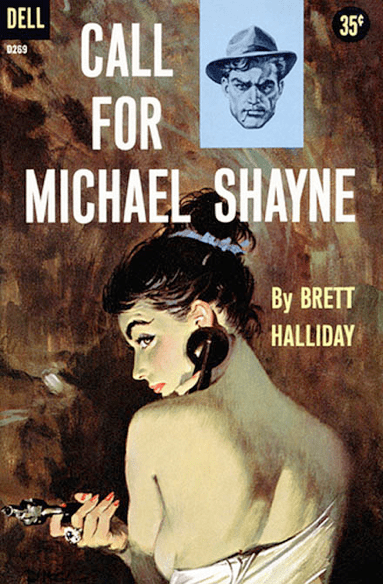
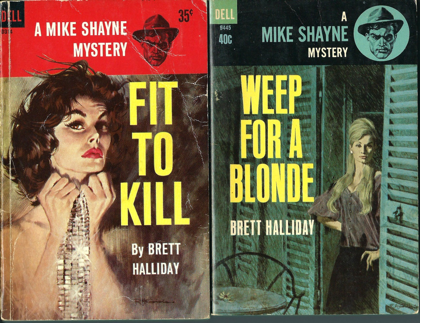
Above is one of many Michael Shayne covers by renowned illustrator Robert McGinnis for Dell Publishing. The iconic face of Shayne was done by another noted illustrator, Robert Stanley, who also provided many memorable Shayne covers.

This is exactly what I remember as a youngster from the supermarket check-out line or the circular paperback rack at Moreland’s Drug Store. The illustration shows the genius of Bob McGinnis: Whether the model’s hair color matches the girl in the story, or is even in or has any relationship to the story, is totally irrelevant. It smacks you right in the face. It’s brazen, jaw-dropping pulp. It’s innuendo. It says, “Read me, Baby, and I won’t let you down…”

And that’s pretty much right when it comes to Michael Shayne.

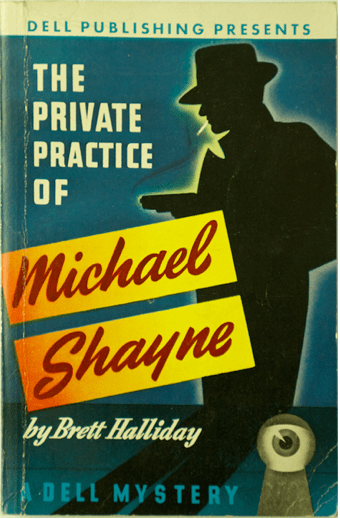
Below, another wonderful Dell “Keyhole” cover from the forties:

It’s surprising that Michael Shayne isn’t better known today, yet Brett Halliday’s two-fisted hard-drinking, hard-thinking private detective is certainly worth rediscovering. Perhaps in today’s world of CSI and forensics it might be easy to poke holes in the plot, yet taken in context, and with the police work at the time these were written, they come off quite well and are highly entertaining page turners. In my own children’s mystery The Case of the Blood Red Stars: A Kelly Riggs Mystery, the final chapter title, Blood on the Stars, is an ode to Michael Shayne and Brett Halliday (pseudonym of Davis Dresser) and the fifteenth Shayne novel—which is where the specific idea came from for my own plot’s “McGuffin.”

Described as tall and rangy, with coarse red hair, bushy eyebrows, and a corrugated forehead with deep trenched cheeks, Michael Shayne operates primarily from his apartment hotel in Miami, overlooking Biscayne Bay. Though some of the novels take place elsewhere, places such as El Paso and Colorado, the Miami settings are the most memorable and evocative. Halliday puts you right there with his mood-filled descriptions and it’s easy to transport yourself back to another era, when there was more open space, less traffic, and you could smell the bougainvillea and fresh sea air.

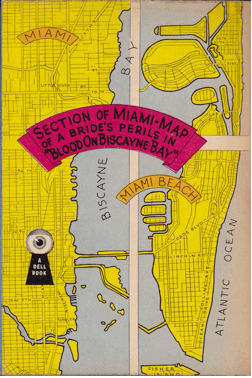
A Dell “Map Back” from the forties, here showing the geography of Biscayne Bay, sandwiched between Miami and Miami Beach.

A Dell “Map Back” from the forties, here showing the geography of Biscayne Bay, sandwiched between Miami and Miami Beach.

As you read, it’s always amusing to see how quickly, and by what page, Mike will take his first (of many) snorts of cognac—his favorite beverage—and this being fiction, he consumes more liquor in one sitting than is humanly possible. In fact, all the Michael Shaynes stretch credulity to the limit, but then that’s part of the fun.

The series featured a regular cast of recurring characters. Described as lean like a racing hound, tall, gangly reporter Tim Rourke is Mike’s best friend, and helps him in various ways to solve some of his best cases, whether he’s running down facts in the newspaper’s clipping “morgue,” being a sounding board over drinks, or in one case—transporting a body that refuses to go away—getting too close to the truth and narrowly escaping death.

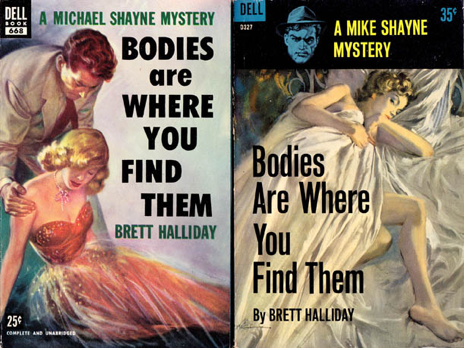
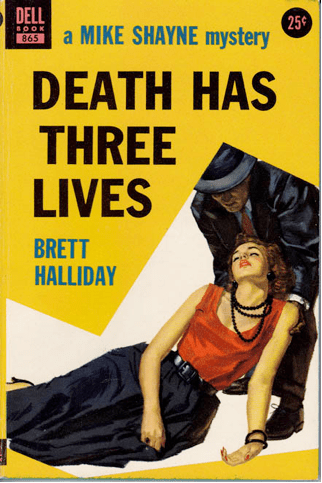
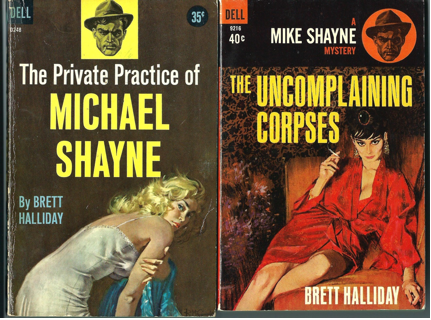
Fifties cover by Robert Stanley; early sixties cover by Robert McGinnis

Fifties cover by Robert Stanley; early sixties cover by Robert McGinnis

Shayne’s main antagonist is Miami Beach Chief of Detectives, the dapper little Peter Painter. Halliday’s description of Painter is so perfect that it’s always a pleasure when Shayne comes up against him and ultimately outwits him. On the other hand, Shayne has an ally on his side of the bay in Miami Police Chief Will Gentry, a big, florid, solid cop who lets Mike Shayne go the limit, and always seems to have his back.

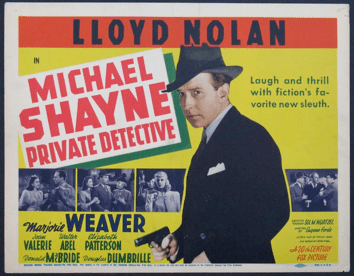
In his first case, Dividend on Death (1939), Shayne meets a young debutant, Phyllis Brighton. He encounters her again in the next novel, and this time they fall in love, though Shayne is fifteen years her senior. They marry, but Halliday had a difficult time working a married Shayne into the action, and when a lucrative movie deal came up it was decided Phyllis should be dropped from the series. She dies tragically in childbirth, and the child also succumbs.

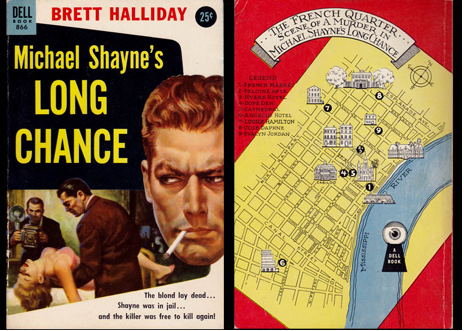
Cover by Robert Stanley and an earlier Dell “Map Back” of the same story from the forties

Cover by Robert Stanley and an earlier Dell “Map Back” of the same story from the forties

The tone of the series definitely changes at this stage, with Shayne leaving Miami for New Orleans in Michael Shayne’s Long Chance, (1944). There, he meets a local girl on his first case, Lucy Hamilton, who goes on to become his faithful secretary. After a couple of novels they return to Miami. Their relationship is complicated, and though they do mix business with pleasure, they do not sleep together. Lucy Hamilton is a wonderful character, and the complexity of her relationship with Shayne lends another layer of interest behind the mysteries.

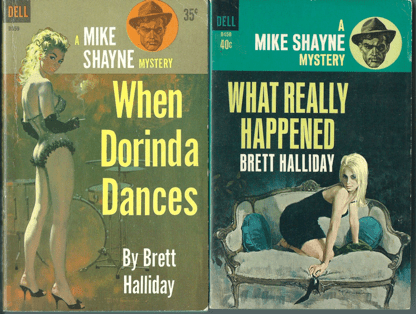
Cover Art by William George

Cover Art by William George

Michael Shayne was featured in mass-market Dell paperbacks for over three decades, with millions of copies sold worldwide. In 1955, Dresser created Michael Shayne’s Mystery Magazine, which went on to run for some thirty years. Halliday retired from writing full time in the late fifties, and subsequent novels were ghostwritten. This worked well for several years, but by the early seventies, the character of Shayne had become somewhat harsh and wooden at the same time. Also, Lucy Hamilton was dropped from the series so Shayne could become more of a cold Bondian-styled bed-hopper. I much prefer the earlier Halliday-written novels and the series up through the mid sixties.

As an illustrator and mystery writer and fan, Robert McGinnis is one of my heroes; I have collected his work along with many others whom I totally dig over the years either in paperback or filed digitally. Here are some more great Dell Shayne covers by McGinnis:

Shayne7

Michael Shayne has been all over media. In 1940, Twentieth Century Fox bought the rights, producing seven films starring the always reliable and likable character actor Lloyd Nolan as Shayne. Nolan plays up the Irish blarney, and he’s great in the role. Despite almost total deviations from the novels, these are quite well done and entertaining little mysteries. In 1946, Fox dropped the series, which was picked up by poverty row PRC (Producer’s Releasing Corporation), which cranked out five more much cheaper productions starring Hugh Beaumont (Leave it to Beaver).

Shayne was on radio during the forties and fifties, played variously by Wally Maher and screen actor Jeff Chandler. Then came the 1960-1961 hour-long NBC TV series starring Richard Denning in 32 episodes. My grandfather really liked this show and I remember it from my childhood. You can watch an episode now at TV4U.Com on the Detective Channel.

Interesting factoids: In addition to Michael Shayne, Richard Denning played on two other crime shows, Mr. and Mrs. North, and as the governor on the long-running Hawaii Five-O. Lloyd Nolan played TV detective Martin Kane in the fifties.

My own Kelly Riggs mystery owes a huge debt of gratitude to Brett Halliday and Michael Shayne. Revisit this great series yourself!

Part of detection is making connections.

Michael Shayne on eBay

Michael Shayne’s Amazon Page

Michael Shayne DVDs

Michael Shayne at Thrilling Detective

Posted in Books, Characters, Fiction, Genre, Guest, History, Illustration, Noir, Writers | Tagged , , , , , , , | 5 Comments