
“Translating is Gezellig” by Josh Pachter

The last time Josh Pachter posted on this site he talked about his lifelong love affair with EQMM. This time he provides a fascinating look at the process of literary translation. He is himself a writer of fiction, with some four dozen stories in print, but we never realized prior to reading this post what a creative hand he has in the stories he translates for this magazine and other publications. —Janet Hutchings

From 1979 to 1982, I lived in a tiny little apartment in Amsterdam, just outside the city center. (When I say “tiny,” I mean tiny. The place was so small that we—I was married to a Dutch woman at the time—didn’t even have a bathtub or shower. Three or four days a week, we’d bike over to the public bathhouse, where for one guilder—about 40 cents American—we got a sliver of hotel soap, the loan of a towel, and 15 minutes of hot water in a cramped shower stall.)

Although most Dutch people learn English in school and Lydia’s was perfect, her parents and younger brother struggled with my native language, so I decided to learn theirs. I subscribed to the Dutch edition of Donald Duck comics and, once a week, I’d settle down on the tiny little sofa in our tiny little living room and read it aloud. Because the stories were simple and illustrated, and because Lydia was there to help with the harder words and correct my pronunciation, it wasn’t long before I could read and speak (and eventually even write a little) Dutch.

I really like the Dutch language. Where English’s idiosyncrasies are primarily pronunciation based (“tough/though/through”), Dutch’s are more commonly spelling based. I mean, show me another language that includes such amazing words as gaaieeieren (“the eggs of a jay,” with its seven consecutive vowels) and angstschreeuw (“a cry of anguish,” with eight consecutive consonants) and zeeën (“oceans,” with a triple vowel) and Churchilllaan (“Churchill Lane,” with a triple consonant).
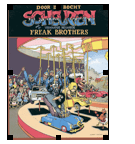
Lydia, meanwhile, was a rabid Beatles fan, and through her I met Har van Fulpen and Piet Schreuders, who were both active members of the Dutch National Beatles Fan Club. Har, it turned out, owned a company that published comic books and was interested in American underground comix, and Piet, it turned out, was a graphic designer with an interest in American pop culture.
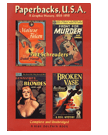
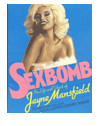
pachter2Har soon asked Lydia and me to translate several Robert Crumb and Gilbert Shelton comix from English into Dutch, and Piet asked me to translate Paperbacks, U.S.A., his 250-page nonfiction study of the cover art used on American paperback books during the 1940s and ’50s, from Dutch into English. And then Har hired me to translate his 175-page Beatles Diary, and Piet’s friends Guus Luijters and Gerard Timmer pachter3brought me in to translate their 160-page Sexbomb: The Life and Death of Jayne Mansfield . . . and all of a sudden I seemed to be a professional translator.
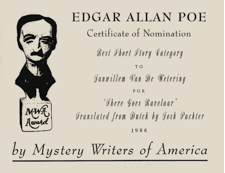
By 1984, I was divorced and living in what was then still West Germany, but I was editing short-story collections for Loeb Uitgevers, a small Dutch publishing house. Peter Loeb was releasing trade-paperback editions of the works of internationally popular Dutch crime novelist Janwillem van de Wetering, and somehow I wound up getting asked to translate two of Janwillem’s Grijpstra and de Gier stories for EQMM. “There Goes Ravelaar!” appeared in the January 1985 issue, followed almost immediately by “House of Mussels” in April, and the next year “There Goes Ravelaar!” was nominated for the Mystery Writers of America’s Best Short Story Edgar.
pachter4

And then in 1986 my daughter Becca was born, and suddenly I didn’t have time for writing or editing or translating any more. Instead, my days were filled with changing diapers, and my evenings were spent teaching for the University of Maryland’s European Division on US Army bases in Bavaria.

It was 20 years before I returned to translation.

In 2002, EQMM editor Janet Hutchings launched the magazine’s monthly “Passport to Crime” feature. Janet invited me to locate and translate a Dutch story, and I contacted my old friend Theo Capel, who long ago edited and published a glossy Dutch fanzine called Thrillers & Detectives for which I wrote a regular column about the American crime scene. Theo sent me one of his own stories and steered me to René Appel, “the king of the Dutch psychological thriller,” and all of a sudden I was a translator again.

Since 2004, I’ve translated stories by Dutch authors Capel, Appel, Carla Vermaat and Tessa de Loo, and more recently by Belgians Bavo Dhooge, Bob Van Laerhoven, Bram Dehouck and Pieter Aspe. Bavo talked me up to his fellow writer Toni Coppers, and during the summer of 2013 I translated my first novel, Coppers’ Stil Bloed, which will hopefully be published in the US as Dead Air in 2014.

There are, I think, three basic types of translation: literal, idiomatic, and creative. To explain what I mean, imagine a Dutch story in which a character is served a meal in a restaurant and, when the food is placed before him, says, “Het water loopt me in m’n mond.

Literally, that translates as “The water walks me in my mouth”—but only a particularly poorly programmed piece of software would translate the sentence that way. Any human translator worth his salt would know that the sentence actually means “My mouth is watering,” and would almost certainly translate it that way, idiomatically.

To me, though, “My mouth is watering” sounds clichéd and stale. I can’t remember ever having heard a living human being use that expression, and I’m pretty sure I’ve never used it myself. So I’d probably want to translate it creatively as “That looks great!” or, simply, “Beautiful!,” or words to that effect.

Creative translation by its very nature requires that the translator take liberties with the original text, and it’s for that reason that I’ve only ever translated works by living authors—and, in fact, by authors who were willing to be consulted during the translation process and to read and comment on a “finished” draft before I’m ready to take the quotation marks off the word “finished.”

In my own writing, I’ve always felt that a good title is essential. Most of the dozen Mahboob Chaudri stories I wrote for EQMM and AHMM in the late ’80s, for example, actually began with their titles. (The last night of Ramadan, for example, is called Eid al-Fitr, which means, “the Night of Power.” I heard that phrase and thought, Ah, that’s a Chaudri title! It seemed obvious that the story had to be set on the last night of Ramadan, and it had to have something to do with power . . . and, sure enough, “The Night of Power” appeared in the September 1986 issue of EQMM and was reprinted the next year in Walker & Co.’s The Years’ Best Mystery and Suspense Stories.)

Similarly, I’m always eager to find attention-grabbing titles for my translations. Sometimes a literal translation seems appropriate. Carla Vermaat’s “Een Lang Gekoesterde Droom” easily became “A Long Cherished Dream” (June 2009), for example, and Bavo Dhooge’s “Stinkend Gips” became “Stinking Plaster” for the September/October 2011 double issue.

Sometimes, though, I’ve had to be more creative. René Appel’s first “Passport to Crime” story, “Bloody Hot,” appeared in August 2006. A few months ago, he sent me a lovely piece titled “Heterdaad,” which is a word that doesn’t really ever get used by itself in Dutch. Instead, it almost always occurs in the phrase “op heterdaad betrapt,” which means “caught in the act.” I thought about calling the story “Caught in the Act,” but René consciously and purposely contracted the Dutch title to a single word, and I wanted to capture that contraction in English. I thought about using “In the Act,” but that seemed awfully bland. Another way to say “caught in the act” in English is “caught red-handed,” though, and, when my translation of “Heterdaad” is published in EQMM sometime within the next year, it’ll be titled “Red-Handed.”

Also coming up in “Passport” is a story by Pieter Aspe, who is currently the best selling crime novelist in Belgium. The story’s called “Vrienden,” which translates literally as “Friends.” Now, I don’t mind recycling a title that someone else has previously used—and titles can’t be copyrighted, so the recycling doesn’t raise any legal issues. Back in 1987, I co-opted the title of a 1957 novel by Australian Nevile Shute for one of my own stories, which appeared in Espionage as “On the Beach.” And, for yet another of my upcoming “Passport” translations, I changed Bram Dehouck’s ponderous “De Redder en de Dood” (“The Savior and Death,” which sounds like it could be a Woody Allen parody of an Ingmar Bergman film) to “After the Fall,” which was the name of a 1964 play by Arthur Miller.

I didn’t like the idea of giving Aspe’s tale of murder the same name as the name of a long-running American sitcom, though, and, since the story is ultimately a story of friendship betrayed, I decided to call it “Friends Like You,” which fits the first-person narrative voice and gives, I think, a nice little foreshadowing of the betrayal and counter betrayal which lie at the core of the piece.

Occasionally, the process of coming up with a good title can lead to changes in the story itself. Last year, Bob Van Laerhoven, another Belgian crime writer, sent me a Flemish story that already had an English-language title, “Chimbote Blues.” I thought the story was great, but explained to Bob that I thought his title was too evocative of the title of Elmore Leonard’s 2010 novel, Tishomingo Blues. I asked Bob if he could suggest an alternate title, but he couldn’t come up with anything he liked. The title “Checkmate in Chimbote” popped into my head, but unfortunately the story didn’t have anything whatsoever to do with chess. I asked Bob if he could “chess it up” a little, and he wound up inserting four or five chess references. I dropped one of them that I felt was a little far-fetched, added one of my own, and “Checkmate in Chimbote” is scheduled for publication in the June 2014 EQMM.

Added one of my own? Yep. One of the things which attracts me to what I call creative translation is that it’s more than “just” translation. A creative translator is also an editor and, at times, even a writer. “Josh isn’t just a translator,” Bavo Dhooge wrote, “but also an editor who dares to participate in the creative process.”

I’m not sure I can explain exactly how that creative process operates, but I can tell you what my goal is. When the original author reads my translation, I want her to think not just “Yes, that’s what I wrote” but “Yes, that’s what I wanted to write.” It’s not enough for me to move the author’s words from one language to another—I want the end result to be a better story than it was originally. And that, again, often involves taking liberties I can only take with the original author’s permission and cooperation.

When Carla Vermaat sent me “A Long Cherished Dream,” for example, I loved the story . . . but was completely disappointed by its ending. I emailed Carla and explained to her that, in American fiction, the “suddenly he woke up and realized that it had all been just a dream” finale has been done to death. Instead, I suggested, why not have the murder be real and not a dream? Carla took my advice and let me rewrite the ending myself, so the original Dutch story and the translation, which appeared in EQMM, aren’t just in different languages but really turned out to be very different stories.

Translation presents the translator with some fascinating challenges.

What, for example, do I do when the Dutch or Belgian author makes a cultural reference that will mystify American readers? In Toni Coppers’ novel Stil Bloed, there’s a moment when a character refers to Canvas, a C.S.I.-like forensic-investigation show which, despite its English-language title, is produced in Belgium and popular on Belgian television. From the title, though, it sounds like it’s an art-history program, which in the context of the scene wouldn’t have made any sense. I did a little research and discovered that C.S.I. itself is popular on Belgian TV—and, with Toni’s permission, simply substituted C.S.I. for Canvas.

In the same novel, on the other hand, there’s a passing reference to Father Damian, a name which every Belgian would instantly recognize but which most American readers wouldn’t know. In this case, there’s nothing equivalent to substitute, but the reference itself was too important to simply drop. So I added in a line of explanation, changing “brought home the body of Father Damian” to “brought home the body of Father Damian, the Belgian missionary who’d spent two decades ministering to lepers in Hawaii before dying of leprosy himself in 1889.” Enough explanation, I hope, to prevent the reference from being distractingly cryptic, but not so much as to interrupt the flow of the narrative.

And what about jokes that are funny in Dutch but simply not funny in English, and brand names of products that exist in Europe but are unknown in the US, and those moments when a Dutch or Belgian character suddenly inserts a word or phrase of English into her dialogue, which is something that Dutch and Belgian people often really do? And what about gezellig?

Each of these situations requires a decision on my part. I may need to look for an alternate joke which American readers will laugh at. I might want to use the Dutch brand name to preserve a sense of foreignness but need to quickly and unobtrusively explain what the heck the product is. When a Flemish character switches briefly to speaking English, maybe I’ll switch instead to French.

Fortunately, I haven’t yet had to deal with gezellig. If you should ever get invited to a Dutch home for a drink or a meal, the word is almost guaranteed to come up in the course of the evening. “Ah,” your host will sigh happily, “isn’t this gezellig!” Ask him what he means, and he’ll probably say “cozy”—and that’s the way the word is normally rendered into English. But it’s not quite right, and the Dutch state of gezelligheid is famously, notoriously, untranslatable. The closest I can come is to say that it’s the feeling of complete comfort you get when you’re as at home in someone else’s house as you would be in your own, except you’re allowed to feel that way in your own home and not just in someone else’s. Can you imagine having a character in a story turn to his dinner guests, though, and say, “Ah, don’t you just feel as comfortable in my home as you’d feel in your own?”

I mean, eeuw.

I think the biggest challenge of translation—for me, anyway—is the capturing not just of plot and character but of auctorial voice. Just like Bill Pronzini’s work sounds different from Robert Barnard’s, Tessa de Loo’s work sounds different from Bavo Dhooge’s—and neither of them sounds anything at all like me. So my job is to get inside the original authors’ heads and figure out how they would have written their stories if they were only fluent enough in English to write them in English.

Since the Dutch and Belgians all study English in school, they can read it fairly easily. And the highest praise I can get from a story’s original author—the praise I’m always shooting for—is when, say, René Appel emails me after reading what I’ve done with his work and says, “The story gives the impression of having been originally written in English and only coincidentally taking place in The Netherlands.”

Way back in 1976, when I was twenty-five years old and had seven EQMM and six AHMM stories to my credit, Writers Digest Books published a volume called Mystery Writer’s Handbook, edited by the wonderful Lawrence Treat. On page eight of that volume, Larry quoted me as saying “I hate the act of writing, but I love having written something.”

Today, almost 40 years later, it’s translation that allows me to enjoy the feeling of having written something without having to go through the agonizing act of actually writing.


Posted in Books, Editing, Fiction, Guest, International, Magazine, Passport, Publishing, Translation | Tagged , , , , , , | 5 Comments

“Discovery” (by Mike Cooper)

 The pseudonymous Mike Cooper has been published several times in EQMM. His new post is timely in that a lot of people may be having the very experience he describes as they search for books as gifts or for reading over the holidays. This would be a good opportunity for readers to reply with book recommendations—not only in the category in which Mike laments not being able to find what he’s looking for, but in the mystery genre. Mike Cooper’s latest thriller novel, from Viking, is Full Ratchet.Janet Hutchings

There are two million books out there. Why can’t I find anything to read?

At least two million—that’s just a rough estimate of what’s available on the Kindle, in English. Read one a day for fifty years and you’d get through fewer than one percent. But of course by the end of fifty years there would be another ten or twenty million titles, or more. We’re a long, long way from the chained libraries of the Middle Ages, where a diligent monk could easily work his way through all the written texts in his world.

And yet, with all this selection, I still find myself, all too often, staring at the stack of books near my desk thinking, “Naahhh . . . nothing there I really want to pick up now.”

Naturally, most of the problem is me. For example, I like great, universe-spanning science fiction grounded in known physics—“hard SF,” I suppose—which seems to be largely out of style. PI novels, sure, you can find a few now and then, but the mystery world has moved on. Swashbucklers? Pirates? Adventure stories? Good luck trying to find one without vampires, or ancient gods, or some other supernatural element.

Conversely, having read widely and enthusiastically for decades, here are a few sorts of novels I’m really, really tired of: serial killers. Sadistic murders of attractive young women. Military thrillers where every politician is a spineless appeaser, every civilian a hopeless rubbernecker. Dark, headbanging noir with too much booze and cigarettes, a few torture scenes, and no sense of humor whatsoever.

Even granting that I’m an irredeemable crank, there just don’t seem to be very many good books being published.

But that’s nonsense. Of course there are great books. The supply has expanded enormously, and in that vast ocean any reader’s tastes can be satisfied. The problem is how to find them—or, in the jargon, “discovery.”

In the old days we had reviewers. Lots of them, in newspapers and magazines and even on radio (not so much on television, Oprah notwithstanding). Paid a modest but livable wage, they performed a public service, pointing readers to worthy new titles. But cost-cutting, the death throes of print journalism, and, more than anything, the rise of customer reviews on the internet have together decimated the professional reviewers’ ranks.

In theory, crowdsourcing should easily replace all the book reviewers who’ve been laid off. The wisdom of crowds should lead to unbiased, broad-based evaluations, with a broader reach and a genuine sense of what most readers think.

It hasn’t worked out that way.

One reason is that even honest reviewers tend to rate high. The average Amazon review is 4.3 stars. YouTube? 4.6. It’s like Harvard, where anything less than an A- is below average. Lake Wobegon ratings don’t help much.

Second, sock-puppetry is, if not rife, definitely present. Some authors create their own fake personas, others get their friends involved; either way, some books are notorious for the blatantly absurd nature of their five-star reviews.

More discouragingly, people have figured out that if you want good reviews, you can simply buy them. The going rate for a 5-star Amazon review is still five dollars, which you can easily see at the online microlabor site Fiverr. And while it might strike some as a dubious practice, even unethical, paying for reviews is apparently now widely accepted. The president of the Florida chapter of Mystery Writers of America(!), quoted in The Third Degree, recommends Fiverr “if you need a quick review [or] blurb.”

Why five dollars? Why aren’t the Chinese gold farmers offering fake reviews at, say, ten cents? Partly because bad English would be a tip-off, but more because Amazon now requires “verified” status before letting you post a review (i.e., you need a legitimate account and a purchasing history).

Amazon knows they have a problem.

Five dollars a pop adds up fast, however. What’s a poor author to do? Well, especially on the self-published side of the business, the practice of “exchanging” reviews is far from unknown. You review my book—five stars, maybe?—and I’ll review yours. Everyone understands there’s no expectation of actually reading either one.

It’s difficult to say how widespread this practice is. Amazon, which knows it’s crucial that their ratings at least be seen as objective, will shut you down immediately if they find out, so people tend to be discreet. Still, I’ve been approached more than once; and simply reading the reviews of certain books is a giveaway.

Furthermore, Amazon is apparently in the business of trading favors for good reviews of the books it publishes itself:

Amazon is looking to revolutionize the process of getting author blurbs: provide a review for a book on an Amazon imprint and Amazon will give the reviewer—and his or her book—extra promotion as a thank you.

I haven’t even mentioned the various “legitimate” paid-review services like PW Select—legitimate in the sense that everyone understands the content is bought, but hardly legitimate in their exploitation of authors, readers and the process generally.

E-publishing has certainly smashed the gates open; anyone can now publish their work. Smashing the existing infrastructure of reviewing has not been so helpful. On the results, internet reviews are simply not providing a reliable substitute.

But we are in a transitional period, and there are—finally!—some signs that even a pessimist like myself might find hopeful.

For one thing, the decline of independent bookstores is leveling off. It turns out many readers still appreciate the browsing, the selection, and the personal advice from real people. Perhaps booksellers can take advantage of the need and leverage themselves into a larger “review and recommend” role.

Second, communities of readers keep popping up online. Goodreads has been subsumed into Amazon, so the jury remains out there, but how about Biblionasium? LitLovers? Some will be publisher fronts, many will fade away, but eventually someone will figure it out.

Finally, we may simply all end up reading more of the same books. Anita Elberse argues in Blockbusters that the long tail hasn’t worked out, that for all the micropublishing, sales continue to be dominated by a few mega-sellers. Which means that millions of authors can sell a few copies, and a few authors will sell millions.

And maybe that’s no bad thing. The loss of shared community, of collective interests and common pursuits, is part of a dangerous fragmentation of public life—especially in this country, which depends on knitting together a single polity from exceptionally diverse strands. Four hundred television channels lets everyone splinter off into their own interest groups, so to speak.

But if we’re all reading the same popular novels, or histories or Malcolm Gladwell or whatever—maybe we’ll draw back closer together.

And meanwhile, I continue my search for a good space opera.

Posted in Books, Business, Digital, Fiction, Guest | Tagged , , , , , , , , , | 1 Comment

HISTORY AND MYSTERY

Historical fiction has always had a powerful appeal for me, and it’s probably partly because of my love of mysteries. Didn’t Voltaire say that history is “little else than a picture of human crimes and misfortunes”? Think of the poison plots of the Borgias, the murder linked to Mary Queen of Scots, or the treachery of Rasputin.

The historical mystery novel is relatively new on the scene, at least as a recognized genre. But mainstream historical fiction, a centuries-old form, has always contained elements of mystery. Think of Sir Walter Scott’s Ivanhoe, which turns around extortion, kidnapping, and treason. What justifies the classification of a work as an “historical mystery” is usually the centrality to the plot of a murder that must be solved.

Scott’s Ivanhoe employs some real historical figures, as do several notable novels that belong inarguably to the mystery genre. Perhaps the best of them all is Josephine Tey’s The Daughter of Time, which deals with the question of whether Richard III was really the murderer of his nephews, the little princes in the Tower. Ellery Queen thought such mysteries the most difficult of all to write. “It is really a monumental task,” he said. “. . . The historical figure has to be convincing as well as authentic, and the theme, time, speech, and manners have to be projected with equal authenticity.”

In our submissions, I rarely come across real historical figures with more than cameo roles; the viewpoint character is usually conjured from whole cloth. I have, however, more than once received submissions in which Benjamin Franklin featured as sleuth, not a surprising choice given the curiosity and inventiveness for which the real Franklin was known. (For those interested in seeing a skillful use of Franklin as detective there are the books by Robert Lee Hall.) At least one other real figure is an obvious choice for mystery writers. Edgar Allan Poe is not only the father of the mystery; his life held many genuine elements of mystery, not least the lack of a known cause for his death. He was discovered delirious on a street in Baltimore and died soon afterward. The best mystery novel I know of that casts Poe in a starring role is Louis Bayard’s The Pale Blue Eye, which deals with Poe’s days at West Point.

Whether a historical writer uses real characters or not, the difficulty remains that the world being recreated has to come across as something so real the reader could step right into it; it must therefore relate in some way to the contemporary reader’s experience, and yet it can’t deviate too jarringly from known historical fact.

The historical writer’s task may get easier the closer a work comes to our own time, but even stories that involve a retrospective look at an earlier period in the author’s own lifetime require skills all good historical writers have: the ability to convey things that no longer exist without weighing the story down with explanation; the avoidance of anachronisms both technological and cultural; and a talent for conjuring the spirit of a bygone time. I consider mysteries set in the fifties and before historicals. This may seem an arbitrary cutoff point, but so many of the attitudes and mores of the 1960s and ahead are still with us today that I’m less inclined to include stories set in those decades in the category.

The differing values of societies preceding ours present a particular challenge for historical mystery writers, it seems to me. It’s important in our genre—more so than in other areas of fiction, I think—that readers are left with a sense that justice has been served. I was struck by this problem as I read Marilyn Todd’s submission of “Cover Them With Flowers” (EQMM November 2012) a couple of years ago. It’s a tale set in ancient Sparta, where male children judged not to be physically strong were disposed of by being thrown into an abyss. The heroine of the story risks death by torture to rescue the potential victims of this policy—a course that makes her very sympathetic to modern readers, but involves attributing to her attitudes probably not very likely in someone of her time. I think the author made the right decision in breaking with historical realism here: telling a story that readers can enter into emotionally comes first, and we get a strong sense of what Sparta was like despite the importation of contemporary points of view. But it’s a fine line to walk. An author who too often veers too far from what is commonly known about the attitudes and values of a bygone culture won’t be able to pull us into the story either.

Historical settings have advantages as well as disadvantages for writers, of course. For one thing, as Mary Jane Maffini pointed out in her post about Golden Age mysteries on this site, taking a step back into the past can make it easier to tackle certain elements of plot. Go far enough back and you won’t have to research either forensics or police procedure, for forensic science only became significant to the solution of crime around the 1960s, and there were few organized police forces anywhere in the world prior to the mid 1800s.

Not having the distraction of all that scientific detail can be a blessing for the reader as well. If you like reading tales painted with a broad brush, opening wide vistas to the mind, what can be better than a genre that brings to life past cultures, where by necessity the reader must fill in much of the detail with his or her own imagination? How different that is from the kind of modern mystery that employs expert knowledge in excruciating detail, on subjects the ordinary reader knows nothing about. I certainly enjoy learning the things modern forensic mysteries can teach, but often what I want more than that kind of information is a place for my imagination to roam, and I find that historicals offer that space more reliably than most other forms of the mystery.—Janet Hutchings

Posted in Books, Editing, Fiction, Genre, Historicals, History, Setting | Tagged , , , , , , | 1 Comment

“Is It Time for an Intervention? My Life With Mysteries” (by Joni Langevoort)

Joni Langevoort describes herself as a lifelong fan of books in general and of the mystery genre in particular. Her knowledge of the field is impressive, and she has come to be greatly appreciated by editors and others in the business through her role as publisher liaison on the board of directors of Malice Domestic, the annual conference celebrating the traditional mystery. She’s the first person on this site to talk about the interconnectedness of the various mystery conventions and the links between branches of the mystery community. My guess is that her experiences may inspire others to take a more active role in fandom.—Janet Hutchings

Take a look at some of the titles on my Kindle—The Righteous Mind: Why Good People Are Divided by Politics and Religion; The Hour Between Dog and Wolf: Risk Taking, Gut Feelings, and the Biology of Boom and Bust; Wall Street and the Financial Crisis; 1861: The Civil War Awakening; The Political Brain.

You might think, whoa, she’s deep. And smart. Maybe a little too serious. Trouble is, my law professor husband and I share the Kindle library, and these are his titles.

Here are some of mine: Diamonds for the Dead; The Curse of the Holy Pail; Deadly Descent; The Retribution; The Poisonous Seed; Wanted Man; The Fall of the House of Usher; Death Troupe; Seven Kinds of Hell. Authors? Well, there’s Louise Penny, Lee Child, Ann Cleeves, Deborah Crombie, Charlaine Harris, Edgar Allan Poe, P.D. James, Elizabeth Peters, Harlan Coben, Sue Grafton . . .

Well, I’m smart too, and sometimes deep and serious. But here’s my confession: I am addicted to mystery and crime fiction. (Although some of these titles might also indicate: “She’s a serial killer.”)

Being a mystery and crime novel fan is not a bad addiction to have, as addictions go. It’s a bit expensive, and may lead to an occasional nightmare, but that’s about it. I blame my dad; once I passed through the Nancy Drew stage, he said, “Why don’t you try this Agatha Christie?” (It was Mrs. McGinty’s Dead.) Then it was on to Dorothy Sayers, Margery Allingham, Rex Stout, Georges Simenon, Josephine Tey, and S.S. Van Dine. By that time, it was way beyond my poor ability to turn back.

I’m not a writer—the last piece of fiction I wrote was a short story in 8th grade, called “The Man With the Black Bag.” It was about the Boston Strangler, and it earned an A-. But I do have something in common with every single mystery author I’ve met (and I’ve met a lot by now): I’m a fan. I’m a reader.

I stumbled onto my first convention in 2001, when Bouchercon was in my hometown of Washington D.C. I went primarily to meet my e-mail pal and fellow Mississippi native, Bill Fitzhugh. Bill and I had never met, but we knew all the same people in Mississippi (it’s a small state . . .). Not only did I meet Bill (who is still a treasured friend), but I met all these amazing writers whose books I had read for years, like Val McDermid and Lee Child. I also met new authors who became instant friends and favorites, like Sarah Strohmeyer.

I noticed a table there with information about a local convention that celebrated the genre typified by the works of all those authors my dad had introduced me to so long ago. I attended the next Malice Domestic, in May of 2001, and I knew immediately that these were “my people.” Although there were lots of people there who read only traditional mysteries, or only “cozies,” I discovered that these convention goers often read across the mystery genre — there were fans of historical mysteries, paranormal stories, true crime, horrifying serial- killer books, nonfiction reference books, private eyes and cops, and every imaginable kind of mystery. I volunteered for a couple of years, and somehow found myself shanghaied onto—er, talked into being on the board of directors. I’ve been to twelve Malices now, and it really is like a homecoming to meet up with all the great fans and authors, about 600 of them most years.

I kept going to the big brother of mystery conventions, Bouchercon, where I would see some of my Malice friends (I remember coming up to Louise Penny one year, and her surprise and joy that I actually knew who she was and had read every book she had written), but also those nontraditional writers I so loved. They were gracious, every one of them—Lee Child let me go all fan girl on him, and Daniel Woodrell didn’t flinch at all when I told him I thought he was a genius. Val McDermid still laughs every time I invite her to Malice (“I don’t think they’d like what I do with knitters and cats”), even though I assure her she would find hundreds of people there who love her works.

I’ve attended and loved Left Coast Crime, once purely to harass Bill Fitzhugh when he was toastmaster. LCC is similar in size to Malice, but while Malice is strictly a fan convention (remember, all those authors are also fans), LCC attracts lots of people to their author-programming track. I’ve even made my way across the pond a couple of times to attend Theakston’s Old Peculier Crime Writing Festival in Harrogate. There’s a very different vibe there: All of the authors on panels are invited by the festival, and each separate event and panel is ticketed. This means there can be thousands of people there over the course of the festival weekend, even though the events themselves are similar in size to Bouchercon or Malice. Getting to know the British crowd, like Martin Edwards and Ann Cleeves, has been a delight.

I’ve met all the wonderful authors who are on my Kindle and my bookshelves, and some of them are my pals now. I’ve also made great friends in the mystery community at large. People like Ali Karim of Shots Magazine, whose encyclopedic knowledge of the world of crime fiction led our team to a close second-place finish at the Harrogate pub quiz one year, and Janet Rudolph, Kate Stine and Brian Skupin, and Margery Flax, who know everyone in the entire mystery world (I love to hang around with them!). As the publisher liaison on the Malice board, I have met and worked closely with fabulous publicists and editors from the great mystery publishing houses, like HarperCollins/Morrow, Poisoned Pen, Berkley Prime Crime, Dell Magazines, and Minotaur, and from the newer companies like Midnight Ink, Thomas & Mercer, and Henery Press. And I love the book dealers’ room!

I come away from every convention with more books than I need, but that hasn’t stopped me from eagerly snapping them up and getting them signed by the authors. If I buy no more books ever, I will be finished with my TBR pile around the turn of the next century. And then I can buy more mysteries! Or maybe I can buy another one tomorrow . . .

Posted in Books, Conventions, Fiction, Genre, Guest, Writers | Tagged , , , , , , , , , | 6 Comments

BLACK FRIDAY DIGITAL EDITION SALE

EQM_Magzter_BlackFriday_adOur newest digital subscription sale through Magzter offers 60% off subscriptions from now through November 29th. Don’t miss it!


Posted in Digital | Tagged , , | 2 Comments

“Today’s Literary Mystery—It’s Not What Your Granny Used to Read” (by Scott Loring Sanders)

Scott Loring Sanders teaches creative writing at Virginia Tech. He’s also a novelist and an award-winning short-story writer. His topic for this post—pigeonholing by publishers and booksellers—is something he knows about from personal experience. His first novel, The Hanging Woods, is a dark and disturbing mystery that he intended for an adult audience, but because its central character is fourteen, it was packaged for young-adult readers. His second book, Gray Baby, was released in the same category. His publisher’s projection must have been that more sales would be gained by targeting a limited age group than by releasing the novels for the general adult market. The trouble with this strategy is that often it’s only those in the targeted group who ever hear about the work. In the case of Scott’s books, many adult readers missed mysteries they’d have enjoyed (though those who are interested can still purchase the books).Janet Hutchings

In today’s market, there’s so much pigeonholing going on by publishers that a lot of good books and stories are being missed by readers. A work is labeled “Sci-Fi” and some will immediately run the other way. “Young Adult” and people think of a story only for teens. The same goes for “Mystery.” That word automatically turns off certain groups. I’m thinking mainly of scholars and academics who might feel that to read a mystery is to indulge in the superficial. An endeavor that will only fill their heads with fluff and poor, cliched writing. I’m here to tell you they are missing out. The current modern mystery is not only entertaining and suspenseful, it is often solid and legitimate literature.

Look at Dennis Lehane’s story “Until Gwen,” which was first published in The Atlantic and later anthologized in Otto Penzler’s Best American Mystery Stories (BAMS). The opening paragraph reads like this:

Your father picks you up from prison in a stolen Dodge Neon, with an 8-ball of coke in the glove compartment and a hooker named Mandy in the back seat. Two minutes into the ride, the prison still hanging tilted in the rearview, Mandy tells you that she only hooks part-time. The rest of the time she does light secretarial for an independent video chain and tends bar, two Sundays a month, at the local VFW. But she feels her calling—her true calling in life—is to write.

Bam! The hooks are set and I’m ready to go on the ride. The story has a nasty yet wonderful villain in the father. He’s murderous, he’s callous, yet he’s also funny and maybe even slightly endearing. The story never takes its foot off the reader’s neck; it’s packed with tension, violence, and suspense. Yet there’s something far more complex happening than just the on-the-surface murder mystery. The characters are fully fleshed out. They are living, breathing (or not breathing in some cases), three-dimensional people who pop off the page. They are intriguing, they are deeply flawed, and by the end you can’t help but feel empathy, especially for the narrator; in fact, his ultimate fate is heartbreaking. Lehane uses the second person “you” to write this story, which is unconventional and often seen as gimmicky. But he uses it for a specific purpose (to reinforce the narrator’s lack of identity/lack of self) and not just as some artsy tactic or device. The story is told in a nonlinear fashion; it jumps all over the place and challenges the reader to keep up and pay attention. There is no doubt Lehane thought deeply about how to approach this story before he ever started writing it. So yes, it’s a mystery, but it’s also an excellent literary achievement, hence why it was first published in The Atlantic, which, last time I checked, isn’t exactly famous for its “mystery” stories.

But that’s what today’s authors in the field are doing. Pushing the boundaries. Blending the traditional qualities of a classic mystery with the art and craft of highbrow literature. Who says we can’t have both, all in one nice package? As a reader, that’s exactly what I’m looking for. I want edgy, I want hard-hitting, I want dark. I want to squeeze the pages in anticipation as I read, I want to be entertained, I want to be scared. Or worried. Or nervous. But I also want to care and be invested in multilayered characters. I want to think and be challenged. I want to admire an author’s turn of phrase or how he/she incorporates the perfect metaphor. I want to see their skill with the craft. In a nutshell, I want it all.

Apparently the experts see it the same way. If you take a look at Best American Mystery Stories 2012, for example, not surprisingly you’ll find that three of the stories selected were first published in Ellery Queen’s Mystery Magazine. Yet The New Yorker had two of its stories selected. And I ask you, what is more highbrow than The New Yorker? Year in and year out, the BAMS series has quite an eclectic list of journals and magazines that they pull from. The reason? They don’t care what “category” a magazine generally publishes in; they are simply looking for quality. They are looking for the best stories of the year that deal with a mystery in some form or fashion.

And what types of authors are showing up in the anthology? Surely Stephen King and Lee Child, right? Nope. Instead, they are featuring authors like Alice Munro. She frequently appears in BAMS, and oh by the way, she just won the Nobel Prize for Literature. The freaking Nobel Prize. A Nobel Laureate writing mystery stories, you say? Unheard of? Preposterous? Not at all. How about Joyce Carol Oates? I don’t know many scholars who look down their noses at her, yet a large majority of her stories are mystery in nature. She publishes in Ellery Queen, The New Yorker, and everywhere in between. There are so many good authors out there today who are writing in this subgenre that I’m calling Literary Mystery. Some include Tom Franklin, Holly Goddard Jones, Donald Ray Pollock, Scott Wolven, and Daniel Woodrell. These are writers at the top of their game, mixing literature with suspense and mystery. Another is Ron Rash. I had the privilege of being on a panel with him a couple of years ago, where the main focus was discussing Appalachian literature, his bread and butter. But one question I asked him went something like this: “Many of your stories and novels, though always Appalachian in nature, have a mystery element to them. And I don’t mean an Agatha Christie type mystery, but instead that sense of darkness, of suspense, of intrigue. Could you comment on that?” His response was nearly identical to something I tell my students all the time. He said, and I’m liberally paraphrasing here, but this is the gist: “You can write down all the pretty words in the world. You can make it flowery, and describe setting, and create characters, but if you can’t tell a story then none of it matters. You have to be able to tell a story. And that’s why a lot of what I write has a mystery feel, because at the heart of all mysteries is story.”

The above is not a new idea. Dashiell Hammett knew it, so did Raymond Chandler, yet they are never mentioned in the same breath as, let’s say, Faulkner or Steinbeck, who were both obviously revered as literary icons. But those two icons wrote plenty of stuff I’d consider mystery. Light in August? Of Mice and Men? Yep, those are literary mysteries. Or how about Flannery O’Connor? Take for example “A Good Man is Hard to Find,” arguably the most famous short story ever written. You won’t find many English professors who will scoff at O’Connor. But what exactly is that story if it isn’t a mystery? It’s suspenseful, filled with tension and conflict, there’s a crime, and it has a cast of characters who are complex and forever ingrained in our minds. The Misfit? The grandmother? Who can forget either of them? Is it a literary story with much deeper meaning? Absolutely. Are there questions of religion at play? Yes. Are there underlying themes about O’Connor’s own Catholic faith? Yes. But it’s also an excellent mystery and lends itself perfectly to my point. It’s exactly what many of today’s modern writers are doing: blending genres. Or, back before the days of pigeonholing, it was simply called good storytelling.

Mystery and literature don’t have to be mutually exclusive. Mystery is not a bad word. In fact, it’s a wonderful word. It means I can feel confident knowing that the author has put a lot of thought into the story while still paying attention to the craft. It means sharp writing and spot-on dialogue. It means imagery, setting, and plot. But what solid narrative, mystery or otherwise, doesn’t have those qualities? And perhaps that’s where the lines get blurred. Ultimately, what it comes down to is one simple thing: mystery means story. As acclaimed writer (and my grad school mentor from years ago) Pinckney Benedict used to say: “Just tell me a story.” And in the end, isn’t that what it’s all about? Isn’t that why we read?

Posted in Books, Business, Fiction, Genre, Guest, Publishing, Writers | Tagged , , , , , , , , , | Leave a comment

“Just Send Me Back” (by Mary Jane Maffini)

There’s always at least a touch of humor in Mary Jane Maffini’s fiction—a spice that suits the traditional mystery. The Canadian author has won two major awards for stories in EQMM, and she’s also the author of three series of classical mysteries at novel-length, under her own name. More recently, she has teamed up with her daughter Victoria to write under the pseudonym Victoria Abbott. The second book in their series, which features book collecting, is out December 3rd. (See The Sayers Swindle.)
Before becoming a writer, Mary Jane was a librarian and co-owner of a mystery bookstore. She knows the classics of our genre, and she appreciates them in a way that only a writer can. . . .—Janet Hutchings

I’ve been buried in the past for the last couple of years. Usually I read a wide range of contemporary crime fiction, set in Canada, Europe, and the USA. But since embarking on the book-collector mystery series (co-written with my daughter), my reading and writing focus has been on the fascinating and collectible crime novels written by the greats of the past. This keeps me mostly in the twenties, thirties and forties, in the era known as The Golden Age of Detection. Of course, we can quibble with the time frame if we’re in a quibbling mood, but let’s just agree more or less around then. I must say that all this reading vintage mysteries for research is a highly recommended gig if you can get it.

Oh sure, in the so-called Golden Age of Detection there were social issues and life could be nasty, brutish, and short for those who weren’t in upper echelons of society. Even for them, appendicitis could be a death sentence, not to mention that the world was in the grip of depression for much of this era and there was the threat and the reality of a second world war that wiped out millions, regardless of social status. Get through one war and look, here’s another. But never mind that, for a contemporary writer, stuck in the quicksand of technology here as 2013 draws to an end, there’s still a lot of appeal.

I wonder if the greats of the Golden Age knew how much they had to be thankful for when it came to plotting and setting up their novels. Here are just a few of the advantages those writers had over those of us who are pounding keyboards in the Silicon Age. Not that I’m bitter, but have a look:

Back in the day, it was so easy to drop your characters into a remote location, or maroon them in a dark basement, or lock them in a high bell tower. There was no quick call to 911 or the significant other or even the hired help to come to the aid of the marooned detective. No cell phones whatsoever. Tell me, how convenient would that be? There would also be no need to have your hapless detective “forget” to charge the stupid thing or have it stolen by a passing villain. The author would never have to cause the device to “accidentally” fall into a puddle. There was no authorial requirement to invent “dead zones” when there’s a cell tower on every hill. The whole world was a dead zone. Bliss, if you ask me.

Even better, where there’s no cell phone, there’s no GPS in the nonexistent gadget to bring the police on the double to the exact location where the protagonist is in trouble. You have probably noticed that this often meant stuck in an isolated farmhouse in a snowstorm with a shrinking cast of characters and an unidentified and enthusiastic murderer on the prowl. You know what they say: What’s bad news for the character is good news for the author. You might still rig up the modern-day equivalent for a setting, but you’d have to work damn hard at it.

Related and added bonuses to the “no phones” era: no cell-phone cameras! Lovely. No urgent and silent texts and no video surveillance. Is it any wonder the crime rate is dropping in real life? Luckily, it’s not in fiction, and in vintage fiction, the writer can rely on witnesses, who are, by necessity, characters and therefore far better at conversation and more interesting than gadgets. For instance, the presence of footmen, upstairs maids, downstairs maids, cooks, laundresses, groomsmen, as well as the more upscale governesses, meant that in many a grand house, in addition to the luxury of servants, for the aristocratic occupants there was never an unobserved moment. The determined detective could weasel a lot out by cozying up to the servants or—and not so advisable—getting all heavy-handed and pulling rank. This leads to lots of good fun for the author and the reader and is not to be sneered at.

In many other ways, investigations were a bit easier on the author too. Think of it: There was no forensics (except for fingerprints the odd time). There’s nothing like DNA to complicate a case; DNA wasn’t even a twinkle in sharp old Poirot’s eye. There were no blood-splatter specialists, X-rays to ID gunshot residue, infrared spectrometry/spectroscopy or lasers for latent prints, or sophisticated tests for body fluids. This is all good. For one thing, there was a lot less of the messier aspects of murder (including decomp and the above mentioned body-fluid discussions). Far fewer terms to keep straight. The author could concentrate on observable clues, behavior of the suspects (all six of them), and pretty much steer clear of the lab and the pathologist’s lair. What’s not to love?

This brings me to databases: Well, where would you be without the well-known and well-organized international and national databases of fingerprints, firearms, stolen works of art, criminals, and unsolved cases and the ability to connect online, by e-mail, fax, and phone with other police forces? Left alone with your little grey cells, that’s where.

Not only were communications restricted to shouting into a black telephone receiver to the operator (if you could find a phone) but there was no squealing along in powerful vehicles, roof lights flashing, sirens wailing. Much of the time, there were no cars at all. The detective might purr through the countryside in his Bentley (watch the ruts in the road, Bunter!) but the local bobby will be wobbling along on his bike. I’ve just finished reading a book by Ngaio Marsh in which the very elegant Scotland Yard Inspector Alleyn and his Sergeant Fox have no way of getting to the location where a victim is in extreme danger except to run up a long and bumpy road—wearing, among other things, their heavy tweed overcoats. I’m betting there were hats too. Oh and, sorry to say, they were too late.

And speaking of hats. Hats almost need no explanation. The world is a much duller place without hats. Trust me. Ball caps can be used to obscure faces, but nothing replaces the zing that a new spring fedora gives the wearer and the reader. Just ask that well-known man about town and right hand of Nero Wolfe, the delectable Archie Goodwin. What would Archie wear to investigate on the streets of New York City today? Nothing as interesting, I am sure.

We contemporary types are missing out on other accessories too: particularly monocles, lorgnettes, pince-nez—something has been lost and soft daily contact lenses cannot in any way make up for it. Stick a monocle on a fellow and instantly you have a villain or a slightly foolish aristocrat. Think how Lord Peter Wimsey employed his monocle to underplay his own prodigious abilities.

Have I mentioned butlers? Trust me, today’s sleuth would be a lot further ahead if someone else laid out his or her wardrobe, handled the cleaning and maintenance of it, brushed your jacket before you left the house, all that kind of thing. All you would have to think about was the case at hand and not whether your shoes were shined or even a match. As the upper class like to say, it’s so hard to get good help these days. Tell me about it.

All in all, despite our political, personal, and technological choices, we writers have it tough today. So, I’m always happy with a trip to the past. Could you excuse me now, please? I believe that’s the upstairs maid bringing my breakfast in bed.

Posted in Adventure, Books, Characters, Editing, Fiction, Genre, Guest, Historicals, History, Police Procedurals, Setting, Writers | Tagged , , , , , , , , , , | 3 Comments

PULL UP A CHAIR

Starting in mid-October this year, most big retailers where I live had their halls decked with Christmas trees right beside the Halloween goblins. The effect was bizarre, but it did get me thinking early about holiday plans, especially holiday dinners—anticipating the special foods, of course, but also looking forward to having time to enjoy conversation with family and friends.

At the same time, it got me thinking about dinners in fiction, one of the most famous of which occurs at Christmastime, in James Joyce’s “The Dead.” In the mystery genre, dinner-table discussion often centers around puzzle-solving rather than the sorts of philosophical questions that absorb the diners in Joyce’s story. Enough conventions have grown up around this type of mystery that I think it can almost be considered a distinct subgenre of the classical whodunit.

Some of the most memorable examples of this genre were written by Isaac Asimov. EQMM still gets letters from readers who remember, fondly, Asimov’s Black Widower stories, in which a group of six men, plus an invited guest, regularly meet for dinner and attempt to solve a murder at table.

I’ll admit right away that although I liked a number of the Black Widower stories, I am not, in general, a big fan of the dinner-table mystery. The problem, for me, is that in such stories the reader is removed a step from the action. We aren’t witnessing the unfolding of the murder or its aftermath or its investigation, we’re witnessing a report and discussion of it. I generally find that an impediment to forming a sympathetic understanding of the victim and other key characters. And the element of vicarious experience that I enjoy in fiction is compromised by the added distance at which we’re made to stand from such stories’ events.

But of course, the central aim of such a story may be to present a dazzling puzzle—a purely intellectual challenge—not to engage the reader emotionally. And if the puzzle is clever enough, the story will probably appeal even to readers like me, to whom a good puzzle is important but not all we’re looking for.

An author who manages to combine brilliant puzzles with characters readers have genuine empathy for is France’s Paul Halter. He manages to do so even at one remove, in the story-within-a-story framework of the dinner-table mystery. (His slight variation on the form is often set in a gentlemen’s club in London, but I’ll come back to that in a moment.)

I said earlier that certain conventions have grown up around this type of mystery. One of them is that there is a recurring cast of characters, and the mysteries they solve together are often brought to them by someone outside their circle. This allows an atmosphere of bonhomie to pervade the story—a sense of being among friends. The resulting repartee among the diners can be highly entertaining in the hands of a good writer of dialogue. Through it, in the best of these stories, the reader may come to form an attachment to the individuals at table, especially if they are not presented as a bunch of inhuman clever clogs. Generally speaking, though, the more time is devoted to developing the characters around the table, the more removed the reader is going to be from the tale of murder that’s being told. Unless the other diners interrupt whoever is laying out the circumstances of the murder frequently to ask questions and offer opinions, readers won’t get a good sense of who they are. But with each interruption, the reader is pulled out of the frame of the murder story and becomes less able to enter back into it with any sense of immediacy.

In the 1990s, former screenwriter Dennis Palumbo (whose credits include My Favorite Year and Welcome Back, Kotter) began a series of dinner-table mysteries starring The Smart Guys Marching Society, the first of them published in EQMM. It’s a coffee table topped with beer and popcorn rather than a sumptuous restaurant with gourmet specialties in the Palumbo stories, but the formula is the same. You’d expect the stars of this series to be ostentatiously brainy, irritating in their sense of superiority. Not so. Palumbo, who became a psychotherapist after retiring from film writing, has a good sense of his characters’ inner lives and is able to humanize them (one a neatnik, another a bit of a slob, all of them aware of how they’re ageing), with the result that the stories have more warmth than I usually associate with this genre. (You can find a collection of the stories, From Crime to Crime: Mind-Boggling Tales of Mystery and Murder, here.)

In the Palumbo stories, the important characters—the ones we engage with—are in the framing story. It seems to me that Paul Halter flips this formula, involving readers most intensely with the characters in the story within the story. His Dr. Twist tales set in London’s Hades club leave me with very little sense of identification with the club’s members, chief among them, aside from Twist, Superintendent Cullen, but I do get drawn right in to the mystery they’re about to solve. The characters in the mystery are brought to life through long passages of narration that go uninterrupted by questions or comments from the listeners. And in the account of the crime there are more direct than indirect reports of speech. (This can be a copyeditor’s nightmare—all those quotes within quotes, as the speaker recounts the exact words of others—but it’s something that creates more immediacy for the reader.) Halter’s attention to atmospheric, not just practical details of setting in the murder story is another important factor in making the murder and not the framing story the focus of our attention. Our February 2014 issue contains “Jacob’s Ladder,” an entry in this series whose inner story is set in a section of the French countryside that I can almost guarantee you won’t forget after reading Halter’s descriptions of it. (You’ll find other good examples of Halter’s use of setting in his story collection The Night of the Wolf.)

It’s largely a matter of taste, of course, which variation on this genre you prefer. I’m more inclined toward the type of story that lets me get inside the mystery itself and focuses less on the cleverness of those around the table. But there are pleasures in both forms. Focusing on the solvers, and treating the mystery more abstractly, creates a lighter sort of entertainment. One more suitable, when you think about it, to a dinner with friends.

Like the marketers who’ve turned our various fall and winter holidays into a single amorphous season, I’d like to wish everyone Happy Thanksgiving early, even if you haven’t yet finished the Halloween candy. I won’t be blogging again before the turkey’s carved, but for that day I wish you a dinner filled with mystery, and a guest as clever as Isaac or Dr. Twist.—Janet Hutchings

Posted in Adventure, Characters, Editing, Genre, Setting, Writers | Tagged , , , , , , , , , , , | 5 Comments

“A Familiar Face” (by Tim L. Williams)

Tim L. Williams is one of the best short-story writers to enter the mystery field over the past decade. His EQMM story “Half-Lives” won the International Thriller Award for best short story of 2011; he’s received two nominations for the Shamus Award, and his work has been anthologized in Best American Mystery Stories. He’s a professor by day, and his knowledge of crime fiction is extensive. You can follow him on Twitter @TimLWilliams1.—Janet Hutchings

When I was in my late teens and first setting out to write fiction, I woke to news that would chart the course of my writing life. A twenty-year-old girl whom I’d flirted with at parties and who was now dating a friend had been murdered. Corinna Mullen’s beat-up Pontiac had been found outside a municipal garage; a worker had spotted blood smears on the interior and the body had been discovered in the trunk. By noon nearly everyone in town either knew or claimed to know the specifics. For days the murder was all that people who waited in line at the IGA, pumped gas at the Red Ace filling station, or loaded up on stale Little Debbie snack cakes and two-day-old bread at the Colonial Bakery discount store could talk about. Mutilated was the word most often used. As it turned out, the gossip erred on the side of understatement. Calling what had been done to her mutilation was like saying that the South Pole is cool in wintertime or that a ghost chili is on the spicy side.

Understand. Central City was a small mining town of five thousand on the edge of the Western Kentucky coalfields, but it was a long way from Mayberry. This was a hard town where people settled arguments with their fists, where teenagers drank beer and cheap wine and died in fiery car crashes, where bad things happened to people all the time. It wasn’t the fact of the murder or its grisly details or even the shock that came from knowing the victim, but the identity of the murderers that changed the assumptions I’d always made about life.

Since all of this occurred during the first great wave of America’s obsession with serial killers, it shouldn’t be a surprise that the local media, my neighbors, and I latched onto the idea that there was a genuine, honest-to-God serial killer in our midst. Surely, we believed, this was a faceless Michael Myers or an ingenious Hannibal Lecter who had intruded into our lives. But then the suspects were named, three of whom would later be convicted. One was a local police officer who often stopped by to drink coffee with my father, another a distant cousin of mine who was an infamous bully, and the third a casual acquaintance whom I’d once seen weep for a half an hour when his Beagle-mix puppy had been hit by car. Their acts were monstrous, but I knew for a fact that they weren’t monsters, or at least not in the sense that I understood the word.

In his seminal essay “The Simple Art of Murder,” Raymond Chandler speaks of giving “murder back to the kind of people who commit it . . .” The thunderclap of realization that came to me was that people who committed horribly brutal murders were people I knew, people I understood, people who weren’t all that different from the image I saw in the mirror.

In time I realized that the mystery and suspense novels I liked the most had villains who were completely and undeniably human. Even more than that, they were villains who seemed little different from the people I interacted with every day. Back then, it was the stories and novels of James M. Cain, most of Ross Macdonald’s Lew Archer series, the early Matthew Scudder novels from Lawrence Block, a handful of Patricia Highsmith’s darkly ironic short stories, and a couple of Charles Willeford’s Hoke Moseley novels that I kept returning to. Don’t get me wrong. I had and have a special place in my heart for Hannibal Lecter, the SPECTRE organization, and, of course, Professor Moriarty, that grandfather of all supervillains, but it is still the question of how such inhuman actions can be committed by such ordinary human beings that I find myself drawn to as both a writer and a reader.

What I’m talking about is a particular form of realism, I suppose. The verisimilitude of evil might be a suitable term. For me it is a realism that transcends genre and niche. When I read, I’m drawn to books and stories, whether they be hardboiled or cozy or noir or thrillers, with an antagonist or antagonists who are as human as my next door neighbor. Now let me make a confession. I don’t know a single movie star or mafia boss, but I’ve read books and stories about both that I absolutely cherish. These books have villains who are as familiar and identifiable as the woman in neon green sweatpants in line at Walmart. No matter the setting or social milieu, the story or novel that truly captures my interest is one that makes clear that even the worst of us is undeniably one of us.

Daniel Woodrell’s novels are wonderful examples of what I mean. Read The Death of Sweet Mister, and you’ll understand. The “villain” in that book is not only believable and utterly real, his motivations are heartbreakingly understandable. The same holds true for Larry Brown’s Joe or Father and Son. The spectacularly violent and ruthless characters who populate Frank Bill’s remarkable collection, Crimes in Southern Indiana, provide a perfect illustration of the type of ordinary evil I’m talking about. Bill makes us recognize, understand, and condemn, all in one fell swoop, men who molest children, betray their families, and cherish their meager possessions to the point where they are willing to commit murder over a hunting dog. This is a brutal, ugly, poverty-plagued world that is as familiar as the rusting coal shovels, trash-strewn fields, and cottonmouth-infested slews of my hometown, or any other rural area where drugs and despair are as common as Super Walmarts and EBT cards. While Bill’s stories are often exaggerations of the violence at the heart of “fly-over country,” they reflect its spirit and capture the darkest aspect of what Henry James referred to as “felt life” in a way that no documentary can. The situations, the characters, and their actions are extreme, but anyone who doesn’t believe that these people are real has never watched a nineteen-year-old murderer cradle his broken-backed puppy nor visited a West Kentucky dive bar late on a Saturday night.

While most of the fiction I’ve mentioned is what reviewers are fond of calling “country noir,” I certainly don’t mean to imply that this verisimilitude of evil is confined to a particular subgenre. Tommy Tillary of Lawrence Block’s Scudder novel, When the Sacred Ginmill Closes, the low-level, seedy mafia associates of Shane Stevens’ Dead City and the lost, desperate-to-have-a home sociopaths of Charles Willeford’s Miami Blues and Sideswipe are just three urban examples of these thoroughly human monsters that have always been a source of fascination and horror for me. Don’t get me wrong. I still love the shiver that comes from reading about the nearly superhuman villain who spins a web of ingenious evil. One of the things about crime and mystery fiction that I treasure the most is its infinite variety, its ability to let us visit English country estates or the mean streets of Los Angeles and New York or the back roads of the rural south or even the palaces of ancient Rome. To me the genre is like a city that is alive and growing with new arrivals. However, as a writer and reader, my particular neighborhood, the place I call home, is one in which the evil we meet is as flawed and conflicted and human as the protagonist.

Years ago when one of the perpetrators of that horrible murder in my hometown was convicted, his wife stood outside the courthouse saying over and over that, “He wouldn’t have done this. He’s a good father, a good man. He even bakes our daughter’s birthday cakes.” This was pretty much the refrain of everyone who knew the murderers. This good father who baked birthday cakes, this bully who loved his mother, this classmate who had once cradled a dying puppy in his arms had committed a crime so horrible that a number of people who attended the trial grew physically ill at the crime-scene photos. Corinna Mullen had been beaten, gang raped, tortured, and left in a car trunk to die. They couldn’t have done this. But they did.

The question of how ordinary people can commit such horrific acts is for me the ultimate mystery, and one that perhaps no other genre can address as well as crime and suspense fiction. When it does, it has a power and depth that can resonate long after a page is turned or a book closed. God knows that even after all these years the thing that brings me back to the genre again and again is that horrifying moment when we look into the face of the monster and are forced to realize that it is one which might belong to a neighbor or a friend or even the reflection we see in the mirror.

Posted in Books, Characters, Fiction, Genre, Guest, Noir, Novels, Setting, Thrillers, Writers | Tagged , , , , , , , | 4 Comments

“The Lee Strasberg Method School of Writing” (by Hilary Davidson)

Hilary Davidson was a travel journalist and the author of eighteen nonfiction books in that field before she turned to fiction writing. Two of her three mystery novels featuring travel-writer sleuth Lily Moore are set in foreign locations, as are some of her short stories, most notably “Darkness in the City of Light,” in EQMM’s November 2013 issue.  But she did not choose to write about setting—the external element in fiction—for this post; instead, she takes a look at what it sometimes takes to get inside a character.  And this Anthony Award winning writer, who will soon see the publication of her first standalone thriller, Blood Always Tells, is as good at breathing life into her characters as she is at conveying place.  Readers looking for short-story collections won’t want to miss Hilary’s The Black Widow Club. —Janet Hutchings

Years ago, when I was an intern at Harper’s Magazine in New York, I lived in a Salvation Army residence in Gramercy Park, at the corner of Irving Place and East Twentieth Street. It was an old-fashioned hotel for ladies, not unlike the residence in Sylvia Plath’s The Bell Jar (there was even a genteel parlor on the first floor for entertaining gentlemen callers; men weren’t allowed on the other floors of the building). The residence was filled with actresses who were studying at the Lee Strasberg School, which was nearby. I often came home in the evening to find them involved in dubious exercises, which I was sometimes roped into. The purpose of the exercises was to answer one question, which I heard daily: “What would motivate me to behave in the way the character does?”

While the exercises themselves sometimes baffled me (it’s strange to watch someone suddenly dissolve in tears for no apparent reason, then smile again a minute later), I was intrigued by the theory behind it. While stimulating memories and re-creating emotions to bring these feelings to a role seemed a little extreme, I was curious about getting into a character’s head. My actor friends let me borrow books to understand how it worked. This was how Lee Strasberg described his Method approach to acting:

The human being who acts is the human being who lives. That is a terrifying circumstance. Essentially the actor acts a fiction, a dream; in life the stimuli to which we respond are always real. The actor must constantly respond to stimuli that are imaginary. And yet this must happen not only just as it happens in life, but actually more fully and more expressively. Although the actor can do things in life quite easily, when he has to do the same thing on the stage under fictitious conditions he has difficulty because he is not equipped as a human being merely to playact at imitating life. He must somehow believe. He must somehow be able to convince himself of the rightness of what he is doing in order to do things fully on the stage.

It made sense, intuitively speaking, but it sounded like exhausting work. If an actor needed to dig deep inside his or her psyche to discover the roots of a character’s motivation, wouldn’t that leave the actor exhausted after each performance? When my internship ended, I left New York, and didn’t give another thought to Lee Strasberg or the Method for years. But it came back to haunt me when I started writing fiction.

I didn’t realize it at first. I was a professional journalist, so I was used to writing every day, but for a long time, I couldn’t understand why it took me roughly the same amount of time to write 500 words of fiction versus 2,000 words of an article for a magazine. I discovered that characters and stories took up more space in my brain than I ever imagined. I found myself emotionally tied to the characters on the page, so that if they were angry or frustrated or upset, my emotional state mirrored theirs. I wondered why I couldn’t easily leave those emotions behind on the page. Eventually it dawned on me: I was unconsciously using Lee Strasberg’s Method to write. I was putting myself through the same paces to write a character as my actor friends did to play a role.

It made a lot of sense, when I started to unravel it. What interests me most about a character is his or her psychological makeup. What causes someone to make a terrible choice? What trigger pushes a person to the brink? What’s damaged this person in the past, and what are they trying to hide? This is true for me whether I’m writing a short story or a novel. I want to know what’s underneath a character’s façade.

I wasn’t conscious of deliberately calling up memories to create realistic reactions until I’d written about two-thirds of my first novel, The Damage Done. I knew that the main character, Lily Moore, was claustrophobic, but when I tried to write about her terrified reaction to being locked in a small room, none of it felt very convincing to me. I tried to do it, but I couldn’t channel her terror at the situation. Finally, I focused on calling up a memory of feeling powerless and trapped. For me, that happened while I was scuba diving in the St. Lawrence River, and I lost my dive buddy underwater. The visibility was so bad that I couldn’t see more than ten feet around me, and I had no idea whether she’d been swept away by a current, or if she’d sunk further down. I searched for her, getting more panicked as each second ticked away. Rapid breathing uses up your oxygen supply quickly, causing further panic. Never before in my life had I felt so hopelessly trapped. That was how I finally figured out how to write about claustrophobia, and it helped me understand Lily so much better.

Since then, I’ve embraced the Method approach to writing, even though Lee Strasberg never intended it for use that way. Strasberg liked to say, “The actor creates with his own flesh and blood all those things which all the arts try in some way to describe.” But, in my mind, the goals of Method Acting and writing fiction are surprisingly similar: to make what’s in front of your audience’s eyes come alive so that it feels as real to them as it does to you.

Posted in Characters, Editing, Fiction, Guest | Tagged , , , , , , , , , | 4 Comments