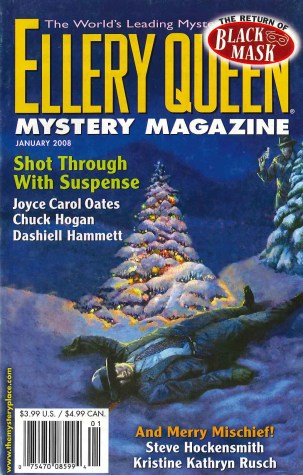
Cover of EQMM, January 2008
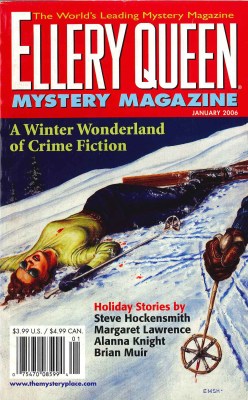
Cover of EQMM, January 2006

Cover of EQMM, January 2011

Cover of EQMM, January 2010

Cover of EQMM, January 2008
Cover of EQMM, January 2006
Cover of EQMM, January 2011
Cover of EQMM, January 2010
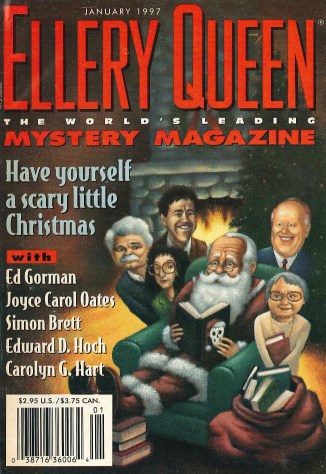
Cover of EQMM, January 1997
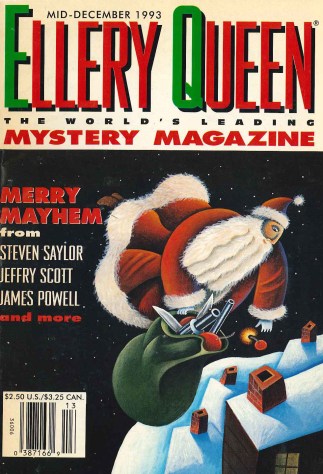
Cover of EQMM, Mid-December 1993
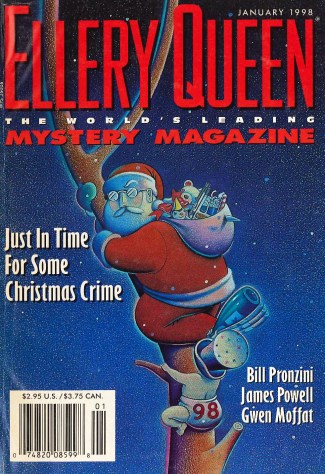
Cover of EQMM, January 1998
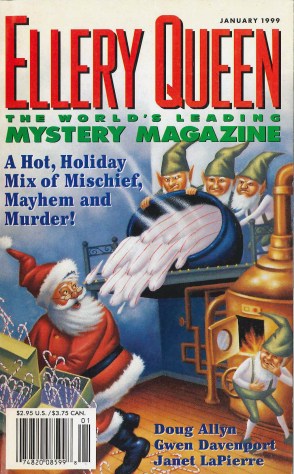
Cover of EQMM, January 1999
2014 is winding up at EQMM with a flurry of activity. The Bouchercon World Mystery Convention was more than a month later than usual this year, taking the mystery crowd to Long Beach, California at the end of the second week in November and leaving at least this editor breathless going into a holiday season that, in addition to the usual bustle of going over budgets and getting out holiday cards, has involved our packing for an office move that will take place at the very beginning of 2015.
However, before we turn the page on 2014, I want to mention various news items that we could not devote an entire column to as they occurred during the year.
The first major mystery events of 2014—spring’s Edgar Allan Poe Awards and the Malice Domestic Convention—were covered here, with photos, in my post of May 14. But there were a couple of other awards ceremonies that we at EQMM were unable to attend at which EQMM authors were recognized. The Crime Writers of Canada held their annual Arthur Ellis Awards banquet in Toronto on June 5, and Twist Phelan won in the short-story category for her July 2013 EQMM story “Footprints in Water.” A little over a month later, when the International Thriller Writers gathered in New York City for their annual convention, Twist joined two other EQMM authors, Kevin Mims and Stephen Vessels, on the list of short-story nominees and again claimed the award for “Footprints in Water.” The story had previously received the Colorado Authors’ League Award for best short fiction of the year.
Our summer ended (too soon) in September with a company picnic in Connecticut, where New York staff were able to connect with the people in our Connecticut offices who provide our magazines’ art, typesetting, marketing, production, subsidiary rights and Web services, and all the rest of the support that keeps us running. We’re including photos of some of those hard-working people here as I suspect the authors among you may like to see who works on your stories’ art and layout, makes sure your work gets to the printer without dropped pages, and handles distribution to bookstores and digital devices. (All photos taken by Ché Ryback.)

Lisa Begley, Marketing Assistant; Carol Demont, Subsidiary Rights and Licensing Manager

Kevin Doris, Senior Typesetting Coordinator

Joy Brienza, Digital Publishing Assistant

Bruce Sherbow, Senior VP of Sales, Marketing, and I.T.

Abigail Browning, Director of Marketing, Brand Licensing, and E-Commerce

Monique St. Paul, Direct Marketing Associate
It wasn’t long after the picnic before we began preparing for Bouchercon. For those who are not familiar with this yearly event, it’s named for Anthony Boucher, the foremost mystery critic in America from 1951 until his death in 1968. The host city for the convention named in his honor changes each year, with volunteers from the area organizing the many panels, talks, crime film showings, and other events that highlight the long weekend. I can’t tell you much about the panels this year; I was too busy meeting with those of our authors and other contributors whom I don’t get a chance to see the rest of the year. But the post-convention buzz seems to be that Long Beach turned out to be one of the best conventions ever.
At the opening reception on Thursday night (November 13), Art Taylor took home the Macavity Award for best short story for “The Care and Feeding of Houseplants,” from EQMM’s March/April 2013 issue. Pictured below celebrating with him that evening, after the ceremony, are Brendan DuBois, Melodie Johnson Howe, Sandy Balzo, and Steve Steinbock—all EQMM authors, and all, except Melodie, writers who got their start in our Department of First Stories.
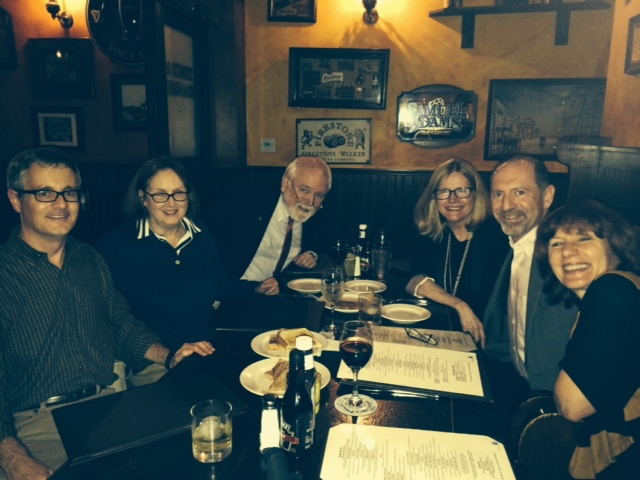
Thursday night at Bouchercon 2014, Long Beach. From L to R: Art Taylor, Janet Hutchings, Brendan DuBois, Melodie Johnson Howe, Steve Steinbock, and Sandy Balzo
Bouchercon Friday began, for me, with a breakfast meeting with EQMM indexer Marv Lachman, at which we discussed the possibility of creating and making available for sale a comprehensive index of the magazine’s nearly 75 years of stories and other content. Since it would be very helpful to know, at this juncture, whether there’s enough interest in such a book to make the project worthwhile, thumbs-up (or down) e-mails on this are welcome at [elleryqueenmm@dellmagazines.com].
Other highlights of the convention for me were my lunch with International Guest of Honor Edward Marston (a.k.a. Keith Miles) and his wife, author Judith Cutler—both regular contributors to EQMM; the Shamus Awards banquet, at which four of the five nominated short stories were from EQMM (Jack Fredrickson’s “The Ace I,” Mick Herron’s “What We Do,” Michael Z. Lewin’s “Extra Fries,” and Hayford Peirce’s “The Leethal Leeteg”); meals with writers and old friends Terrie Moran, Bob and Sandra Levinson, Dave and Judy Zeltserman, and James Lincoln Warren; and a chance to meet some writers newer to EQMM, including Paul Marks, Michael Wiley, and Iceland’s Ragnar Jónasson.

Bob and Sandra Levinson
2014 wasn’t all good news and good company, however. It brought its share of sad news for EQMM and the wider mystery community. A number of writers and others connected to the magazines died this year, including William Bankier, award-winning Canadian writer of short stories (most of which appeared in EQMM); James H. Cobb, one of the best contemporary writers of the classical whodunit at short-story length; Jeremiah Healy, legendary private-eye writer and longtime contributor to both EQMM and AHMM; Dorothy Salisbury Davis, longtime EQMM contributor and friend of EQMM’s founding editor Frederic Dannay; mystery novelists and short-story writers Seymour Shubin and Martin Meyers—both of whom occasionally contributed to EQMM; Britain’s “Queen of Crime,” P.D. James, a handful of whose stories were reprinted in EQMM in the ’eighties and ’nineties; Judy Crider, wife of mystery writer and EQMM columnist Bill Crider and co-author of the 2002 Anthony Award-winning story “Chocolate Moose”; and Rose Dannay, widow of Frederic Dannay (a.k.a. Ellery Queen).
As I post this final column for 2014, we are also just about ready to release EQMM’s May issue to our typesetters for final formatting for the printer. June 2015 is currently being proofread. That takes us, already, nearly halfway through the production of our 2015 issues—and there’s a lot that we think you’ll enjoy in our pages in the coming year.
As for the remainder of 2014, there will be no more formal posts on this site (we return January 7th) but we’ve got some seasonal features instead.
Wishing you happy holidays and all the best for 2015!—Janet Hutchings
The other day I was talking via email to that exemplary mystery writer and human being Ed Gorman, and I told him that I was tired of killing people. This, as you may imagine, was not a happy revelation for a woman who has made her living doing just that for nearly thirty-five years. But it turns out that even a hit woman, a.k.a. mystery writer, can get her fill of homicide.
That didn’t mean that I wanted to stop writing about murder altogether, perish the thought and pardon the pun.
What it meant was . . .
I didn’t know what it meant.
That’s why I contacted Sir Edward the Wise.
“I still want to write mysteries,” I e’ed him, “but I find myself more interested in investigating forgiveness than punishment. I want to write deep-feeling, generous-hearted books that might be, for lack of a better way to say it, a positive companion to their readers.”
I told him that when I’m entering new writing territory I like to study how other writers do it, so that I won’t reinvent a wheel and so that I can learn from my betters. I whined to Ed that I was having a hard time finding stories that dwell on life and death and yet resolve themselves with something closer to wisdom and mercy than to punishment and revenge.
“You might want to read some Ray Bradbury,” he wrote back. “If ever there was somebody who wrote big-hearted books, he was the guy.”
So I went to the library and picked up some Bradbury because Ed said so, and of course he was right. In writing and life, Bradbury was a force of positive nature. His stories are, indeed, loving, big-hearted, and boon companions. From the first page of this reading assignment I began to feel happier and more hopeful that new kinds of stories wait for me to write them.
When Ed sent me off to science fiction for inspiration, I started wondering if other mystery authors learn how to write, in part, by wandering outside the aisles of our genre to pluck books from other shelves. I thought, well, of course they must, but I suddenly wanted to know exactly what they have learned and from whom.
So I asked a few crime writers if they’ve ever been kicked in the head—otherwise known as having an epiphany—by authors who will never show up at Bouchercon, Malice Domestic, or Edgar Week, but would more likely attend a science-fiction convention, or fantasy, or romance, or Western, or a literary conclave.
First, I asked a couple of Edgar Award winners, “Have writers in other genres taught you how to be a better mystery writer? And if so, how?”
Margaret Maron (Bootlegger’s Daughter) said that the poet Edna St. Vincent Millay taught her the value of the specific over the generic.
“With Millay,” Margaret said, “it’s not just a ‘blue flower.’ It’s an iris, a forget-me-not. It’s not a vague herb garden. With her, you smell the tansy, the rosemary, and the lavender. If my writing has a sense of place, I learned it from her.”
Anyone who has read Margaret’s short stories and novels knows that Maron learned well from Millay.
Margaret also told me that it was a science-fiction writer—Robert Heinlein, she thinks—who taught her to appeal to the senses on every page.
“Every page?” I asked her, in a tone close to flabbergasted horror. “Good God, Margaret. I think I’m doing well if I can get all five of them at least once into every scene!”
“Yep. EVERY page,” she affirmed, but emphasized that she didn’t mean a writer should try to cram all five senses on every page. (Whew.) “I try to evoke at least one of the other four senses (other than sight) on each page. It’s easy to show what the character’s seeing, but what is he hearing, smelling, tasting, touching? I don’t always succeed but I do always try.”
Which made me think I could test if that might improve my pages, too.
Next, I asked T.J. MacGregor (Out of Sight), who told me that she also learned from a poet. “The poet Anne Sexton taught me that even taboos work when they are emotionally charged.”
“What do you mean?” I asked her, my ears all a’perk.
“I mean that Sexton wrote about abortion, incest, adultery, masturbation, menstruation, drug addiction,” Trish said. “These days, it’s the stuff of TV talk shows, but back then people didn’t talk about this stuff in polite conversation. Sexton showed that if you write from an authentic emotional place, readers will flock.”
Trish also said that it was from reading Stephen King that she began to understand that “regardless of genre, all terror is first conjured in your head, your heart, and in your body’s reactions to what you imagine you hear, see, feel, taste, smell.”
Of course, I asked Ed Gorman, too. (His latest mystery novel, Riders on the Storm, is getting wonderful reviews.) In addition to writing mysteries, Ed also writes out-of-genre—Westerns and horror, among others—so I’m guessing his own books cross-pollinate each other. But he said his most valuable lesson came from F. Scott Fitzgerald over in the literary aisle: “What people are ashamed of usually makes a good story.”
Gillian Roberts, (Anthony Award winner for her Amanda Pepper mystery series) also took inspiration from a master.
“I was most influenced—or would love to think I was—by Charles Dickens, in his enjoyment of his characters, his love of them no matter how strange or even despicable they are. He was in love with and sympathetic to the human condition. I so hope some of that rubbed off on me.”
There was a time, though, when Gillian wrote general fiction (Mendocino) under her real name, Judith Greber. And where did she find out-of-genre inspiration then? In the Mystery aisle! “Susan Isaac’s first book hit me over the head like a mallet with the idea that you were allowed to be funny (or try to be) in a book, even in a mystery.”
By now maybe you have a mental image like the one I’m getting of writers of all literary persuasions roaming bookstore aisles and magazine racks to learn from any writer who has something to teach them.
It’s a process of feeding, seeding, and cross-pollination.
Did I get cross-pollinated, so to speak, by reading Ray Bradbury’s classic novel The Martian Chronicles for the first time? Well, I guess I did, since I now am nearly finished with the first science-fiction story I’ve ever written! I got so much pleasure out of doing it. No character got murdered, either, no crime was investigated, and nobody went to jail.
Oh, I’ll go back to mowing people down. In fact, I’ve already killed a couple of characters since writing that story. But the ending of this new story is not the same as it would have been before I read Bradbury.
Can reading authors out of my own specialty really make me a better mystery writer? I think it just did.
So, thank you, Ed Gorman, Sage of Iowa.
My spaceship, traveling through mysterious time, feels steadier now.
Global peace index 2014. Guess what country ranked number one? Yes, Iceland. It also ranked as the number one most peaceful country in the world in 2013, 2012, 2011, 2010, 2009, 2008. . . . You get the picture. So this begs the question: Is it really possible to write crime stories set in Iceland?
Let’s also bear in mind that we currently have a population of 328,000 in Iceland. So the pool of suspects in any crime story is fairly limited!
Yet, people keep writing crime stories in Iceland—but this hasn’t always been the case.
The first Icelandic crime novel appeared in 1926, but in the following decades Iceland only saw a handful of books in the genre published—a total of seven novels between 1926 and 1950. Then, following quite a long period during which no crime thrillers were published, Viktor Arnar Ingólfsson (House of Evidence, The Flatey Enigma) started something of a trend in Icelandic crime writing. But it wasn’t until 1997 that crime fiction really took off. That was the year that trailblazer Arnaldur Indridason (Jar City, Silence of the Grave) published his first book. Until then, crime fiction had struggled to find readers, particularly because the general view was that Iceland could not be a believable setting for crime stories. Indridason really convinced us otherwise and, following 1997, there has really been no turning back, with an increasing number of titles published each year—and Icelandic crime more often than not topping bestseller lists.
Indridason very successfully entered foreign markets, including the English/US market, as have many of his colleagues, including Yrsa Sigurdardottir (My Soul to Take, I Remember You). In fact, Iceland has become such a popular place to set crime fiction that two English authors have set series there: Quentin Bates (Frozen Assets, Cold Comfort) and Michael Ridpath (Where the Shadows Lie, 66°North).
So, how can peaceful Iceland work as a setting for crime?
Firstly, there is one common belief about Iceland that isn’t necessarily true: “Iceland has no weapons.” Well, yes, we don’t have any military. And the police don’t usually carry guns (although there is some ongoing debate about whether to change that). But there are certainly weapons in Iceland. Historically a nation of hunters, people keep quite a lot of hunting weapons, including shotguns and rifles. According to some figures, there are approximately 60,000 weapons in Iceland—a lot when you bear in mind the fact that the population is 328,000. A few years ago, Iceland was ranked fifteenth in the world for the number of firearms per capita.
Secondly, crime writers have used some of the extremes of Iceland to their advantage to create an atmosphere of darkness and mystery. Darkness being the key word—Iceland gets very dark in winter and in some cases, in the northern part of the country, doesn’t see any sunlight for long periods throughout the winter months. The other extreme can also be useful for stories—the fact that summer has very, very long days, with midnight sun and bright nights. We also have weather to suit many types of crime stories: “It was a dark and stormy night.” Yes, indeed! In Iceland, you can get sunshine, rain, heavy storm, sleet, and snow—all in the same day! And let’s not forget the northern lights—murder under the northern lights is certainly an interesting premise.
Thirdly, writers in Iceland have been able to emphasize the setting, focusing, for example, on Icelandic nature, isolated small towns, or the area around the capital, Reykjavik. In terms of nature, the high mountains can provide a backdrop for murder, as can the large glaciers and volcanoes—many of which are still very active. The Icelandic highlands also offer an interesting setting, a vast area in the middle of the country in which it is very easy to get lost! Iceland is very sparsely populated; people mainly live in either the Reykjavik area or in smaller towns along the coastline, picturesque fjords surrounded by mountains. Some examples: Arnaldur Indridason’s recent Strange Shores is set in Iceland’s eastern fjords; Yrsa Sigurdardottir’s I Remember You is set in an isolated western fjord and her My Soul to Take in the area nearby a famous glacier, Snaefellsjokull; and Viktor Arnar Ingólfsson sets his Flatey Enigma on the small, picturesque island of Flatey.
Iceland is actually a place of extremes in more sense than one. We tend to collectively share some unusual hobbies. Every year, on a Saturday evening in May, the streets of Iceland are empty and everyone is glued to the TV, when the European song contest Eurovision is being broadcast live. We always proudly send a competitor from Iceland, certain that this is the year we will win. We haven’t won yet, though. The streets are empty when the Icelandic national handball team competes in major tournaments, and we are, once again, always sure that we will win the world championship title. We haven’t won yet. And right before Christmas, Icelanders buy lots and lots of books—the biggest titles probably selling between 20,000 and 30,000 copies (again, quite a lot per capita). We call it the Christmas Book Flood, and most new fiction is released in October or November, in time for Christmas.
Fortunately, Icelandic readers have become very supportive of homegrown crime fiction, enabling more local writers to focus on Icelandic crime, and the genre has found readers all around the world. We even have our own crime festival, Iceland Noir, in Reykjavik, held for the second time in November of this year.
Crime writing in Iceland? Really? The answer is yes. And hopefully we can continue to keep the momentum going, finding fresh and exciting new ways to create stunning crime fiction in this small and peaceful country.
Years ago, in my final year of convent school, the nuns brought us girls to Rome to see the Pope. We duly visited the Vatican, but were more interested in the Italian boys who swarmed around our bus as we went sightseeing. When we had the chance, we replied to their tentative English in Gaelic, our dying native language an obligatory subject on school curricula. The boys’ consternation was satisfying because they didn’t understand a word we said, but also off-putting because they believed Gaelic was English spoken with a funny accent. When, after our Roman week, we disembarked from the boat at Dun Laoghaire—back then airline deregulation still hadn’t happened and low-cost Ryanair still hadn’t overtaken European skies—my aunt who came to meet us told me a nun kissed the ground in thanksgiving we were all back safely on Irish soil. But that could have been a tall story, my aunt was good at those.
The point of this longwinded introduction is to explain that, being bilingual, translation becomes an automatic process. A similar switch occurred when I moved to Rome—a good many years after we nearly gave that poor nun a heart attack—and the inner translation chip switched to English/Italian. (By then the Irish language had become a lost one to me because I wasn’t speaking it anymore.) Learning Italian was like scaling Vesuvius: a tough trek with plenty of hard rocks to stumble on while climbing. A great big boulder was the Italian for “beyond,” would you believe actually three separate words with a crazy back translation meaning “at the of there.” When I’d achieved some level of competence—and al di là didn’t seem quite so crazy any more—I was ready to read two favourite authors translated into Italian. What better way to get to the top?
L’avessi mai fatto! (“It if I had never done!”) Hercule Poirot’s pate was still egg-shaped but it was a different kind of egg, his conversations with Hastings didn’t seem half as amusing and, worst of all, he failed to straighten the objects on his desk with the same finicky precision. Reading translations of the second author’s tales was an even greater disappointment, not a shiver did I feel. The House of Usher seemed deprived of its silent decayed menace, the fine subtlety of luring Fortunato to the Amontillado was absent, and the horror of the swarming rats and swinging pendulum didn’t penetrate through to my bones. I persevered, but couldn’t get rid of the feeling I was being cheated, robbed of an important part of my late childhood and teens. In the end, I decided I wasn’t having any more of this until I had a better knowledge of Italian and went back to the real thing. In the opening lines of “Berenice” I found consolation. “Misery is manifold. The wretchedness of earth is multiform.” What had been stolen was returned to me.
But there was also a downside, because that pesky chip in my head had me picking up pencil and paper. Dare I? I dared. Translating the first sentence into Italian, I wrote La miseria é molteplice. It didn’t look too bad. But on second thoughts, miseria wasn’t quite the right word, referring as it does to material poverty rather than to woe and despair. Also, the phrase Porca miseria remains a pretty strong expletive, so to avoid the association, I needed a substitute word to maintain the sense of inert despondency. I came up with ‘anguish’, perhaps closer to the author’s intentions, and quite liked the sentence that then read L’angoscia é molteplice. But it lacked the dirge-like music of the original, maybe because the lovely alliteration was lost. To restore the figure of speech, I tried L’angoscia è abbondante, but it looked so grammatically awkward, I was sorry I’d written it. Twisting it around to Abbondante é la mia angoscia provided a more poetic tilt, but one that drifted away from the author’s intentions. I left the problem aside to simmer and passed on to the second sentence. It seemed easy enough; L’abiezione della terra é multiforme. But was abiezione, ‘abjection’ quite the right word? I didn’t think it was, so it was clearly time to scrunch up the paper and throw it away and that’s what I did.
It’s easy to see that translators have a tough time of it, not least of which is getting over the lost in translation obstacle; a painful one because, more often than not, it just can’t be done. This came to mind recently while working on an Italian to English translation of a documentary, which included reference to a 1949 film, a classic of Italian neorealism. The film, Riso amaro (in Italian following capitals are dropped) starred Silvana Mangano as a worker in the rice fields of Northern Italy. In English, the title became Bitter Rice, a literal translation and a good one—except for the lost pun. Riso also means laughter and Bitter Rice, Bitter Laughter, although appropriate to the scenario, wouldn’t have sounded half as good.
But the greatest difficulty is the decision translators are faced with at the start; whether to opt for fidelity to the original text or discard fidelity in favour of style and current tendencies. In France in the 17th century, the phrase Les belles infedèles, literally ‘the beautiful unfaithfuls’, was coined to express the concept. Vincenzo Monti (1754-1828), Italian scholar, poet and translator, was criticized for his faithless Italian translation of Homer’s Iliad. Monti’s reply to the scorcher was “Preferirei una bella infedele ad una brutta fedele.” In French and Italian the adjectives ‘belle’ and ‘bella’ are also nouns meaning ‘beautiful woman’, and Monti’s preference for a ‘beautiful unfaithful’ over an ‘ugly faithful’ for many translators is the only way to go. It was true that Monti’s knowledge of ancient Greek was imperfect so that instead of working from Homer’s original text, he referred to later Latin translations. Nonetheless, his interpretations imbued Homer’s Trojan War epic with a new poetic unity so that even today, Monti’s Iliade is the one that wins all the kudos.
I often wonder how writers like Conrad and Nabokov were able to write so many works of fiction in a language not their own, but I suppose that’s genius. Conrad preferred to write in English rather than in his native Polish, while Nabokov wrote in Russian (that confusing Cyrillic script) and later took to writing in English. Swiss tennis player Roger Federer switches from German, to French, to English and back to German again quicker than it takes him to serve an ace, and he never seems never to stumble. Maybe the agony starts when getting to write down the words and stringing the sentences together. From my schooldays, I remember a teacher complaining that with all the English and Irish, we’d end up unable to write and spell properly in either language. And she was right. The trickiest words to get around are those insidious little prepositions: to, from, at, etcetera. In other words, the al di là conundrum. As for my spelling, not to mention the hybrid Italian-English words that keep popping up all the time, I can only exclaim Che figura! (and sometimes Porca miseria) while engaging in heated battles with my computer’s automatic corrector I’m very grateful to lose.
I always read with great interest the “Passport to Crime” stories on EQMM and wonder how each story was in the original language. If I know it, I sometimes try to see if I can pick up some clue from the phrasing and get back to the original sentence. One of my favourite “Passport” stories, published in the November 2013 issue, was written by Raphael Montes and translated by Clifford E. Landers from the Portuguese. It’s a language I don’t know, which luckily deactivates that wretched chip. Statement No. 060.710-67 is the perfect short story and, I’m willing to bet, a beautiful faithful.
Where do we find the earliest beginnings of the mystery story in literature, and who wrote the first whodunit? The answer lies further back than Arthur Conan Doyle, or Wilkie Collins, or even Edgar Allan Poe, who often receives credit as father of the genre. Much further back.
One of the first authorities to investigate this question about precursors was Dorothy Sayers. In the introduction to her landmark anthology The Omnibus of Crime (1929), Sayers identified a short list of what she called the “primitives” of the genre.
From ancient Roman literature Sayers cited the story of Hercules and Cacus. Driving his cattle along the Tiber River, Hercules stopped to take a nap. While he slept, the monster Cacus emerged from his cave in the Palatine Hill and nabbed some of the herd. When Hercules awoke, he counted the cattle and realized some were missing. He followed the tracks of the missing animals, reached a place where the hoofprints abruptly stopped, and was baffled. In fact, the clever Cacus had led the cattle in that direction then dragged them by their tails backward into his cave. Hercules—no great detective, obviously—was stumped until he heard the mooing of the missing cattle, located the cave, and killed the thief.
Sayers cited this story because the villain’s scheme hinged on what she called the “fabrication of false clues”—the hoofprints that led nowhere. What we have here is not a full-fledged murder mystery, but only a rudimentary element of crime fiction making perhaps its first appearance as a literary device. How old is the story? Though set in a prehistoric, mythical past, our earliest examples of the tale (such as the one in Vergil’s Aeneid) date from the first century B.C.; the great historian of Roman religion Georges Dumézil avers that “the legend of the rather unfriendly meeting of Hercules and Cacus was certainly not very old when Virgil reinforced it by his art.”
Going back a bit further, from Jewish literature Sayers cited two stories about the Biblical hero Daniel. One is the oft-painted story of Susanna and the elders. Two randy elders spy on Susanna while she bathes naked in a pool; aroused, the old goats accost her and demand she have sex with them, or else they’ll say she was meeting a lover. Susanna refuses, and the elders accuse her of adultery. Things look bad for the bathing beauty until Daniel comes to her rescue. He insists that the elders be questioned separately, and sure enough, their differing versions don’t add up. Exposed as liars and false accusers, the elders are put to death, and Susanna is vindicated. Sayers cited this as the first use of “analysis of testimony.”
Daniel also put his detecting skills to work to expose some idol-worshipping priests. Each night a great feast was set out for the idol Bel, the sanctum was sealed, and in the morning all the food was gone, apparently eaten by Bel. One day, just before the room was locked for the night, Daniel lingered behind and surreptitiously scattered ashes on the floor. The next morning, the footsteps of the charlatan priests could clearly be seen; they had been entering by a secret door at night and consuming the feast themselves. Sayers cited this as the first use of “analysis of material evidence.” Clearly, this Daniel was a clever fellow; we might even call him a detective (if not a solver of murders), and see in the story of Bel an ancestor of the locked-room mystery.
The date of these Daniel stories? Though they’re set in the time of the Jews’ Babylonian captivity (around 600 B.C.), the written stories (in Greek, found in what Protestants call the Apocrypha) date from the second to the first century B.C.—only a little before the tale of Hercules v. Cacus.
Delving yet further back in time, from ancient Greek literature Sayers cited Herodotus, the Father of History, and his tale about King Rhampsinitus of Egypt and a thief who repeatedly robbed the king’s treasure house. I don’t think I’ll give away the exact plot, since I wrote my own version, imagining this as the type of story my Roman sleuth, Gordianus the Finder, would have enjoyed hearing. (That story, “The Tale of the Treasure House,” is in the Roma Sub Rosa collection The House of the Vestals.) Suffice to say, the story has elements of a locked-room mystery, plus a duel of wits between the king and the clever thief, a precursor to the suave Raffles. Sayers cited Herodotus’s story as an example of “psychological method of detection: plot and counterplot.” This tale is the oldest yet, since the Histories of Herodotus are dated to 450-420 B.C.
And there Sayers left the matter of the “primitives.”
A little more that twenty years later, in 1951, Ellery Queen, in Queen’s Quorum: A History of the Detective-Crime Short Story, cited the same examples from ancient literature, calling them the “incunables” of mystery fiction. (Incunabula: the earliest stages or first traces of anything; from an ancient Latin word for the straps holding a baby in a cradle).
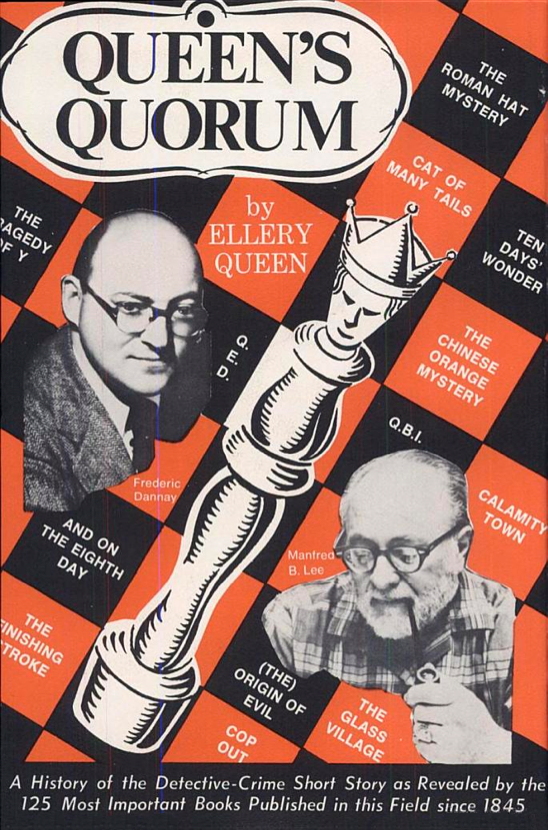
Cover of Queen’s Quorum: A History of the Detective-Crime Short Story (1951)
Frederic Dannay and Manfred Bennington Lee, the writing team known as Ellery Queen, were surely experts on all things to do with crime fiction, but their chronology for these “incunables” was a bit off the mark. Apparently assuming that anything Biblical must predate Hercules or Herodotus, they claimed that “the detective-crime-and-mystery story, like so many other forms of literature, had its genesis in the Bible . . . . The first detective . . . made his debut in the Apocryphal Scriptures [citing the stories about Daniel related above]. . . . The course of incunabular detection, having originated in ancient Hebrew literature, can next be traced through ancient Greek and Latin [citing Herodotus’ story of King Rhampsinitus and Virgil’s version of Hercules v. Cacus].”
As we have seen, the correct order for the writing of these stories, beginning with the oldest, runs 1) Rhampsinitus and the thief, 2) Daniel (exposing Bel and saving Susanna), 3) Hercules v. Cacus. If we’re talking about the setting of the stories, then the oldest would be Rhampsinitus (set in pre-Khufu Egypt), then Hercules v. Cacus (set before the founding of Rome), then the Daniel stories (set in the reign of Nebuchadnezzar).
As for the claim that Daniel was the first detective in literature, both Ellery Queen and Dorothy Sayers (surprisingly, since her Oxford education surely included the Classics) completely overlooked another candidate: Oedipus, King of Thebes.
The famous play by Sophocles that recounts the tragedy of Oedipus was first performed in Athens around 429 B.C.—centuries before those “incunables” about Daniel or Hercules were written, and perhaps even before Herodotus set down the tale of Rhampsinitus. Written fragments of the Oedipus story date back even further, to the very dawn of ancient literature, including snippets from Hesiod and Homer.
Not only is it likely that Sophocles’ Oedipus is the oldest of all the “primitives” or “incunables” cited here, it’s also a full-blown murder mystery with all the elements familiar to modern readers—a murderer, a victim, an eye-witness, and a detective who keeps delving for the truth until he’s opened the Pandora’s box of everyone’s shameful secrets.
I’m not the first to make this connection. The earliest such reference I’ve found is from a 1965 issue of The Tulane Drama Review, in which the Greek director and translator Marios Ploritis complained that another scholar was “obviously influenced by the old, ludicrous conception that Oedipus is the first detective story ever written.” Note that Ploritis called this an “old” idea even in 1965—though Oedipus wasn’t cited by either Sayers (in 1929) or Ellery Queen (in 1951). Ploritis also called it a “ludicrous” idea, but there he was dead wrong.
As the play begins, the city of Thebes is in the grip of a devastating plague. The only way to stop the plague is to discover who killed the previous king. It falls to the current king, Oedipus, to solve the crime.
But wait—how did Oedipus become king? Arriving in Thebes as a lone wanderer, he ended a previous plague by solving the famous riddle of the Sphinx (already showing off his mystery-solving skills); the grateful Thebans made him king to fill the vacancy left by the recently murdered King Laius. Oedipus even married the king’s widow, Jocasta. (We might call her a cougar, but the ruder MILF would be more accurate.)

Oedipus and the Sphinx (1808) by Jean-Auguste-Dominique Ingres
As Oedipus proceeds to investigate the crime, the meticulous plot construction by Sophocles feeds us one bit of evidence after another, letting us know just enough to keep us (and Oedipus) guessing, right up until the moment when, with a gasp, everyone on stage and in the audience realizes that . . .
[MOTHER OF ALL SPOILER ALERTS!!!]
. . . the killer of Laius was none other than Oedipus himself—and Laius was his father. The ramifications of this revelation drive Jocasta to commit suicide and Oedipus to blind himself.
The ancient Greeks knew that Sophocles had pulled off something special. Aristotle in his Poetics gave Oedipus a rave review: “Of all recognitions, the best is that which arises from the incidents themselves, where the startling discovery is made by natural means. Such is that in the Oedipus of Sophocles. . . . These recognitions alone dispense with the artificial aid of tokens or amulets.” In other words, the reveals in Oedipus come not by pulling a rabbit out of a hat, but from step-by-step detective work, and are all the more powerful for being arrived at by a process of inevitable deduction.
Had Sophocles told the story in linear fashion, we would have seen the murder first and then the aftermath, knowing all along whodunit. Instead, he began at the end of the story and constructed a fully-realized murder mystery plot, working, so far as we know, from no previous template. Not only did Sophocles invent the whodunit; he was also the first to subvert the genre, even as he created it, by making the detective and the killer the same person. (As king, Oedipus is also judge and jury, exacting punishment for the crime.)
Twenty-five hundred years later, the first whodunit still ranks among the greatest ever written.
Permanence for the written word was a quest of authors and other lovers of books long before the rise of digital publishing, but the new publishing formats have exacerbated concerns about valuable works being lost or forgotten. For one thing, questions have been raised about the durability of the technology itself. Writing in The American Scientist, Brian Hayes said:
“One cause for worry among archivists is the impermanence of digital storage media. In this respect civilization has been going downhill ever since Mesopotamia. Paper documents cannot match the longevity of the Sumerians’ clay tablets, and magnetic media seem to be even more evanescent than paper. That’s disturbing news, and yet I suspect that relatively few disks or tapes have yet died of old age. Long before the disk wears out or succumbs to bit rot, the machine that reads the disk has become a museum piece. So the immediate challenge is not preserving the information but preserving the means to get at it.”
Important as these challenges of digital preservation may be, I suspect they do not number very high on the list of detractions many book lovers see in e-book-only publishing. It seems to me that what worries people most about the possible future dominance of e-books is their lack of a social dimension: the fact that you can’t pull them off a shelf to lend to a friend, or easily give them as gifts, or donate them to a library where they may either make their way onto the institution’s shelves or end up at a sale where they become the property of another reader, and the whole cycle begins again. Physical books make their way through the world, falling into unlikely hands, making connections, creating a trail—and that gives them durability in the public’s awareness.
The e-book, on the other hand, mostly stays in the possession of its original owner, archived for him (or her) by the retailer once a reading device has become overcrowded. Though there’s now some limited sharing allowed by Amazon—a book can be loaned one time, for up to fourteen days—this hardly gives an e-book-only title the life span it might have had in the form of physical copies making their journeys of many decades from hand to hand.
It’s worth considering, however, that a very similar downside perception has always attached to magazines as a publishing format, especially for fiction. A magazine generally has a shelf life—at least in stores—of a month at most. Most unsold copies are pulped, and though magazines such as EQMM and its sister publications all have a significant number of collectors, prior to the Internet it probably would not have been as easy to obtain a copy of a past issue of one of our magazines as it would have been to unearth a copy of most contemporaneous books of short stories. The Internet marketplace has changed that somewhat—you can find some very old issues of fiction magazines on the ’Net—but I am not interested in making a case for the life span afforded by our type of publishing on such grounds. I’d like to point to some of the other factors involved, the chief of which is the longevity of the magazines themselves.
In her February 13, 2013 post for this site, “Sifting Through EQMM Buried Treasures,” Sarah Weinman talked of finding a partial run of old EQMMs in a mystery bookstore and how the discoveries she made between those covers formed the basis for her anthology Troubled Daughters, Twisted Wives: Stories from the Trailblazers of Domestic Suspense. Included in the book are EQMM stories from more than a half-century ago. Although Sarah did not find the copies she perused through us, we were able to assist her with the book’s permissions—a job that is often a stumbling block for the inclusion of old material in new anthologies. And sometimes, our office, with its nearly complete archive of seventy-three years of publication, actually becomes the reading room and place of research for such projects.

Inside EQMM, January 1945.
I think every short-story writer hopes that, decades hence, a new anthology will pick up their long-unseen work. And I believe the likelihood of that happening is greater if the story first saw life in a periodical such as ours than if it originally appeared in an isolated book. Our magazines are a centralized source for a very large quantity of material, which makes the job of anthologists drawing from our titles less gargantuan than it would be if miscellaneous out-of-print books had to be mined for their projects. No doubt that’s why almost all of the early collections of one of the most prolific anthologists our genre has ever produced, Martin H. Greenberg, drew almost exclusively from our magazines. It may also be one of the reasons why today’s leading publisher of single-author mystery short story collections, Douglas Greene (who was recently honored with a collection of essays on his work: Mysteries Unlocked: Essays in Honor of Douglas G. Greene) has relied so heavily on EQMM’s backlist of nearly 900 issues for his books’ selections.
I can’t count the number of times short-story writers have said to me that although they are thrilled to see their work in EQMM, they long for the permanence that a collection of their stories would provide. I understand that feeling, especially when I see the high quality of production provided by presses such as Doug Greene’s Crippen & Landru. (And by the way, if you haven’t yet come across any of those beautifully designed books, you should check them out!) But at the same time, I wonder if the sense of permanence so many of us attach to the printed book isn’t misplaced. From a purely aesthetic standpoint it’s easy to see why authors might prefer print-book publication to either magazine or e-book publication. But the determinants of how many lives a work of fiction ends up having are many. A few years ago, the print market for anthologies of reprinted stories narrowed drastically, and EQMM was only able to continue to put out anthologies of its older stories because of the birth of the e-book market—a case in which technology extended many stories’ longevity. Contractual issues prevent us from bringing back EQMM’s archive of back issues in electronic format (which I would love to do!), but 2015 will see the start of a reissue in electronic format of the twenty-volume hall-of-fame collections Masterpieces of Mystery, Selected by Ellery Queen. (Details to come on this site in 2015.)
Unlike most other fiction magazines on the market when ours was launched, EQMM began its long publishing adventure printed on very high quality paper, between stiff covers. It’s unfortunate that over the decades rising paper costs have made that kind of production impractical. But even high-caliber paper is subject to the ravages of time. As you’ll see from the attached photos, the more heavily thumbed issues in our archive are starting to crumble. We have the most delicate of them encased in acid-free plastic bags, but my hope is someday to have them all scanned and archived electronically (another case of digital technology being a potential lifesaver for the written word).

EQMM’s January 1945 and May 1944 issues.
I love the look and feel of print and the complex social interactions that printed books and magazines inspire; I hope our magazines always maintain print editions. But I’m also very thankful for the advent of electronic publishing and new digital technologies, because when it comes to achieving greater longevity and permanence for the written word, the more options we have, the better.
—Janet Hutchings
Lately, I have spent quite a lot of time with homeless people, and I’ve learned, when they tell me a story, to neither believe nor disbelieve it. Because if they can be bothered to talk to me at all, probably, like me, they’ll be telling a story for money. And it won’t be a story of glamour or success. It will be about hardship, obviously—if you urgently need a few pounds from a stranger it won’t be because you’ve done well in life. It’s usually because, on top of a whole cocktail of problems, you’ve been handed a double scoop of bad luck.
What follows is Sick Hazel’s story—told to me in dribs and drabs over the five or six years I knew her before her death. You’d think that if she was street-tagged “Sick Hazel” it would be to distinguish her at least from a Healthy Hazel. Her boyfriend, for instance, is known as Scots Jacko in contrast to a couple of other Jacks who roam the same area. But as far as I know there wasn’t another Hazel of any description. She begins and ends with unanswered questions.
When I first met them, Hazel and Jacko were inseparable. They were trying to collect enough money for bus fares for the journey to the Casualty Department at our local hospital. They had a complicated day ahead of them. They needed money to go to the hospital, money to come back, money for another bus to their Benefit Office on the other side of town. There, they would have to summon enough energy to argue about having to register as job-seekers when they were both clearly too sick to work. And finally, they had to go home—yet another bus ride they would be forced to raise the money for. The reason they had to go to Casualty in the first place was because, having no permanent address, they couldn’t register with a local doctor.
It can be exhausting to be homeless—not a job for sick people.
They were an odd couple. Hazel was short, black-haired, and considerably older than Jacko. He was wiry, nervous, and red-headed. At first it seemed, because of her loud wet bronchitis, that he was looking after her. But in fact they looked after each other. It’s true that he was in better physical shape, but she was the one who could fill in the mountains of application forms required to claim social benefits. She was the one who could read the leaflets that were issued regularly to tell them the rules had been changed and that they no longer qualified for assistance in this or that category. She could read bus and train timetables. She remembered to say “Thank you” to contributors to their common cause. A very necessary talent because Jacko was better at demanding money than asking for it. His lack of social skills, coupled with his prison tattoos, meant that without Hazel he might have starved.
Obviously, at that first meeting, I wasn’t told that they both had AIDS. Which was why they both needed constant medical attention—a tricky prospect when you haven’t got a doctor, and when the nearest hospital is seven miles away. They were very bad at keeping appointments because, of course, they both drank “to keep out the cold.”
Hazel, the talker, was quite frank about Jacko’s illness—he’d been infected by a dirty tattoo needle—but it was a long time before she told me about hers. Her stories about the past featured a lot of campfires and guitars. She was a hippy and a festival drug-taker who seemed, almost without noticing, to have crossed the line from sleeping out under the stars by choice to sleeping rough in all weathers. But that was before she met Jacko. And here the story becomes slightly implausible. She told it to me in order to extract sympathy and money so it may be less than or more than true.
She was gang raped on the canal towpath by guys she’d been hanging out with and sharing bottles of cheap wine with earlier that afternoon. Scots Jacko was one of them. Three of the men ran away, but Jacko was so drunk he fell asleep in the weeds near where Hazel was lying.
When she woke up and saw him there she hauled him to his feet and pushed him into the canal. Then she had to jump in and save his life because, although the canal is quite shallow, he was too pissed to save himself.
When they’d both sobered up a bit he burst into tears and wept for two solid hours—out of remorse, she said. He swore that from that time on he’d look after her until the day one of them died. It was a romance, she told me.
Sometimes the stories I hear are so random and messy, so lacking in either reasons or consequences, that I simply have to accept what I’m told. It’s only novelists who string together causes and effects like bead necklaces, as if stories really need to be logical. We pick them apart, looking for flaws in logic, forgetting that, more often than not, real life isn’t like that.
Crime writers often feel they should think like the detectives or lawyers they’re writing about. Crimes, once committed, should start a chain of events that lead to a satisfying conclusion.
What should I have asked Hazel? Why didn’t you go to the police? All crime stories begin with help being sought after an offence. But if someone is too drunk, broke, degraded, and exhausted to seek help or justice, no cop, detective, or law is invoked and therefore there’s no story. Well, there is a story, but no satisfactory explanation or logical consequence.
Tough. I have now told you everything that Hazel told me. I had no right to prod or pry any further—I am not a detective. I didn’t even know if Jacko was the one who infected Hazel with AIDS, or if it was the other way round. The way she told the story, she was loved and cared for by her rapist and killer.
Then she died and Jacko has been alone ever since. Every time I see him in the street now he rolls up his trouser legs to show me the raw lesions. Every time I look there are more. Is he saying, “Look, this is what I deserve. This sickness is my redemption. Yes, I raped her but she’s still killing me”? Probably not, he’s not much of a talker or a thinker. He’s probably just saying, “I’m sick, give me money.” But when I give him money who am I supporting? Am I, a feminist, giving money to a rapist and a killer? Or am I just giving a sick man the bus fare to the hospital?
Nothing is clear and you would have to be more naive than I am to believe everything you hear and then to judge a man on that basis.
Jacko is even less satisfactory as a storyteller than Hazel was. I want far more shape, many more answers than I’ve been given. But I’ll just have to make them up for myself because I’m addicted to looking for meaning, to filling in gaps. However, more likely than not, if I’m trying to find my way towards some sort of truth, I will be proved wrong. Because, apart from random conversations and sometimes cooking at a homeless shelter, I simply don’t walk in that world. And Sick Hazel, as far as I know, didn’t read detective stories. So she didn’t shape her story to suit her audience. She just told it like it was. Or wasn’t. As I said at the beginning, I’ve taught myself to be neither a believer nor a disbeliever.

 SOMETHING IS GOING TO HAPPEN