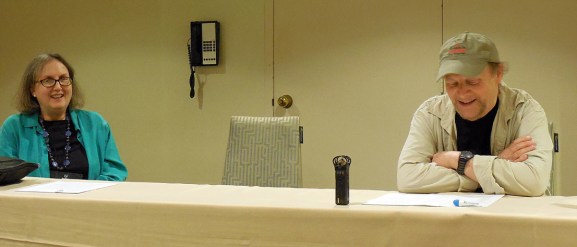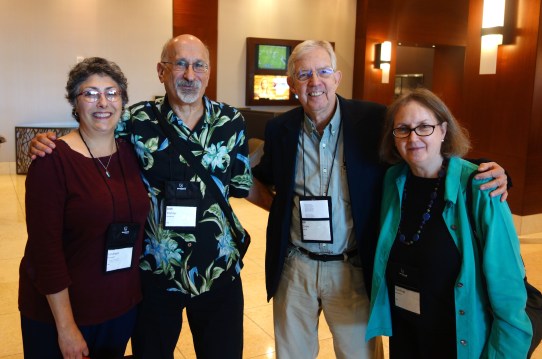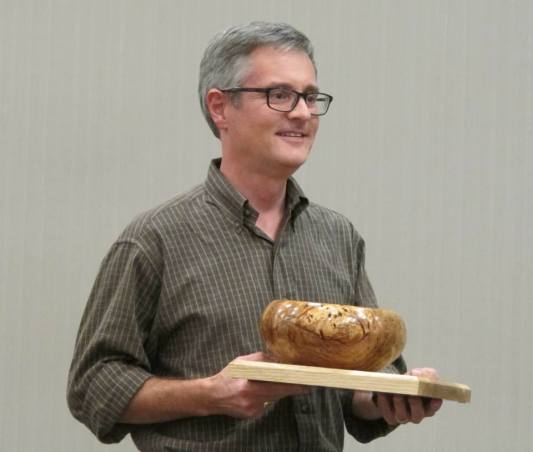
Ted Blain (whose fiction byline is W. Edward Blain) has been a contributor to EQMM for twenty years this month, having debuted for our magazine with December 1995’s “The Director’s Notes.” “The All-Nighter,” his latest EQMM tale and his first locked-room story, will appear in our March/April 2016 double issue. Though Ted is primarily a short-story writer, he is the author of two mystery novels, the first of which, Passion Play (Putnam, 1990) was nominated for a best first novel Edgar Allan Poe Award in a year when the competition included the first novels of Walter Mosley and Patricia Cornwell. For twenty-five years Ted has been the chairman of the English department at Woodberry Forest School, in Madison County, Virginia. When he isn’t teaching or writing fiction, he’s often directing plays. His post paints a vivid picture of how literature first got hold of him.—Janet Hutchings
Last week I received an email from a former advisee, now a college freshman, who said that he was compiling a personal reading list and wanted to know what books have changed my life. As an English teacher, I get these requests fairly regularly, and I always comply despite how daunting I find the task. The more I read, the more I recognize that the relationship between text and reader is frighteningly personal. I love The Scarlet Letter, but I didn’t read it until I was thirty years old. If that novel and I had met when I was, say, eighteen, our relationship would have been bristly. I know my eighteen-year-old self, and he would have resisted even the most eloquent blandishments of Hester Prynne, Arthur Dimmesdale, and Roger Chillingworth. He still sometimes murmurs an objection when the Puritan children exclaim, in language that no living child has ever uttered, “Behold, verily, there is the woman of the scarlet letter, and of a truth, moreover, there is the likeness of the scarlet letter running along by her side! Come, therefore, and let us fling mud at them!”
So I’m invariably cautious when I recommend a work to another reader, particularly to a younger one. I teach high-school seniors, and when we read Billy Lynn’s Long Halftime Walk or Pride and Prejudice or Henry IV, Part 1, I remind my students that they do not represent the target demographic for these writers. High-school readers are eavesdropping on a conversation intended for others, and they should remember not to blame the book if they struggle to follow it. With trepidation, therefore, I sent my advisee two titles that had spoken to me in my youth. One was Joseph Heller’s Catch-22, which I read for the first time at seventeen, and which awed me with its mingling of humor and profundity, its exhilarating revelations at the end, and its resilient and principled protagonist. The other title was Franklin W. Dixon’s While the Clock Ticked, Number 11 in the original Hardy Boys series. Ironically, however, I told him not to read the latter novel, even though I love it and unashamedly cite it as a book that changed my life.
We might consider the Hardy Boys series to be comparable to the upper register of sound waves, those that we lose the ability to hear as we age. The books in this series belong to a large family of works that speak intentionally and solely to the young. I met the Hardy Boys when I was nine years old. Until then books to me were thin, broad folios with lots of illustrations and minimal text. Here, however, delivered into my naive hands by an older cousin while I recuperated in bed from the flu, was a bound volume that looked like the kind of book read by grownups, a thick quarto consisting almost entirely of text but with a teasingly lurid jacket depicting two boys bound and gagged as a sinister adult stepped out of a secret hiding place behind a grandfather clock. I opened it. I began to read. And, somewhere early in Chapter One, that book changed my life. I forgot about the flu, forgot about the bed, forgot about the noise coming from my sister and brother elsewhere in the house. I was fully immersed in the adventures of two intrepid brothers, boys who never argued with each other the way that I did with my siblings, but who pooled their talents to solve nefarious crimes while putting their lives at risk. Almost from the moment I started to read that book, I experienced the kind of ekstasis that writers from Sophocles to Stephen King have generated in their audiences. As soon as possible I went back and read every single Hardy Boys adventure in order of appearance. I knew nothing about the Edward Stratemeyer Syndicate, and I had no idea that Franklin W. Dixon was a pseudonym for Leslie McFarlane and others who fleshed out Stratemeyer’s plot summaries to create the series. I knew only that Frank and Joe Hardy were as real as any friends and that their world was one that I never tired of entering.
When I sit down to write a story and everything is working right, I return to that trance-like experience of being somewhere else. I’m not the first writer to call it going inside, and while it’s not always easy to get there, it’s excruciating to be yanked out of that place prematurely. A pinging email, a phone call, the neighbor’s kid practicing his trumpet outdoors—any innocuous interruption can be exasperating. The movie Trumbo delivers a heartbreaking scene during which Dalton Trumbo’s sixteen-year-old daughter confronts her father for working through her birthday party. He’s not willing to stop writing even for a minute, not even to watch her blow out her candles, and when she does interrupt him, he explodes. When I watch that scene, I sympathize with both characters. Of course the daughter deserves to have a shred of attention from her father on her birthday if he’s there in the house and healthy. But Trumbo the writer had gone inside, and he was furious at being pulled out.
I’m forever grateful to the Hardy Boys for introducing me to the intensity of that inner life and, in the process, for schooling me in the elements of crime fiction. But while I still have all those Hardy Boys books on my shelf, I can no longer bear to read them. The prose is cringingly stilted; the characters, flat; the plots, ridiculous; the villains, obvious and cliched; the dialogue, banal. No matter. These books served their purpose. They taught me to love reading, and they taught me how to tell a mystery story. When I was an undergraduate English major, revering The New Yorker and dreaming of becoming its next John Updike, I was afraid to write fiction because I sensed that my work would never be as good as the stuff I was reading. I think lots of English teachers suffer from the malady of comparing themselves to the immortal writers they love and teach. How could I ever write a novel like Tom Jones? How could I ever write a passage like any paragraph in Faulkner’s “The Bear”? We know that we’re never going to create another Heathcliff or a Milkman, so we quit trying to write anything at all. That’s a mistake. The Hardy Boys remind us that the primary purpose of reading is to take the reader elsewhere, and if the entertainment happens to take the form of a murder mystery, there’s no need to apologize. Catch-22, I realize years later, is a mystery novel—the mystery of Snowden’s death in the back of the plane, the mystery of Orr’s disappearance at sea, the mystery of Yossarian’s struggle to survive in a bureaucracy that wants to absorb his soul. And what are Hamlet and Crime and Punishment—two works that my students read as “eavesdroppers” last year—if not studies of murderers and the detectives who are on to them? Half a century ago Clifton Fadiman described Oedipus Rex as the strangest murder mystery of all time, one in which the detective isn’t even aware that he himself is the murderer. Maybe not all mysteries qualify as great literature, but they can lead us to read the deepest, greatest mysteries, the ones we never tire of revisiting, even when we know whodunit.

 They say life imitates art, and while I was quietly plotting uprisings and murder taking place on that very spot, mechanical diggers had been in, foundations had been laid, bricks were going up—and my husband was busy clearing the land.
 Of course, the woodshed has gone. The land has been tamed. The buzzard showed its displeasure right down the patio doors, for a second I thought I’d blacked out.