
BOUCHERCON 2015

As in previous years, I came back from this year’s Bouchercon (Raleigh, North Carolina, October 8 – 11) to e-mailed photos taken by authors and friends at the convention, and with some tidbits of information I’d like to share.

Thursday’s opening ceremonies included presentation of the Barry, Macavity, and Derringer Awards. EQMM had two nominees for the Macavity for Best Short Story, Paul D. Marks’s “Howling at the Moon,” and Art Taylor’s “The Odds Are Against Us,” both from our November 2014 issue. (Craig Faustus Buck’s “Honeymoon Sweet,” from Murder at the Beach, an anthology edited by frequent EQMM contributor Dana Cameron, took home the trophy.)
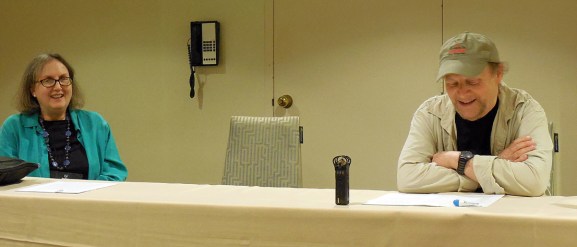
Janet Hutchings and Paul D. Marks recording a podcast for his story

Janet Hutchings and Paul D. Marks recording a podcast for his story “Howling at the Moon.” Photo courtesy of Amy Marks.

The Derringers had special meaning for me this year, since not only did eleven-time EQMM Readers Award winner Doug Allyn win the Best Novelette Derringer for his story “The Snow Angel” but James Powell, an author with a long and notable career writing primarily for EQMM, was honored as the latest recipient of the Edward D. Hoch Memorial Golden Derringer for Lifetime Achievement. Unable to get to Raleigh for the event, Jim had asked me to read his acceptance speech, and to use my discretion in shortening it to fit the time available. As a barbeque buffet was waiting for the hundreds of people at the opening ceremonies, I cut a small portion of his remarks, but afterwards so many people told me they’d been interested by what he had to say that I thought I’d post the whole of his acceptance speech here. I’ve worked with Jim on several stories a year for nearly twenty-five years, so his wit and whimsy are endearingly familiar to me, but I hope readers who don’t know his fiction may be inspired by his remarks to dip into his stories:

“I am very grateful to the Short Mystery Fiction Society for awarding me the Edward D. Hoch Memorial Golden Derringer for Lifetime Achievement, all the more so because Ed and I were friends. He was a frequent visitor to Canadian mystery events. I recall one Crime Writers of Canada awards dinner where he and I were chosen to present the Arthur Ellis for best novel and in my share of the remarks I wondered why it took two short story writers to do the job and I think he found that amusing.

We all know his tremendous output of stories. But he was also a prodigious reader. Here our paths crossed again. I had been reading Robert Louis Stevenson’s travel writing including The Amateur Immigrant and The Silverado Squatters where Stevenson described his trip to America for his health and the long train trip across the country to California. Not long after, reading one of Ed’s stories I saw he had been reading about that trip too, only he had found a mystery story on the way where I had not.

Most of my reading now is history and biography. Someone once wrote that the time of your father’s childhood is a golden age for readers. Perhaps it is for writers, too. That would be the beginning of the Twentieth Century for me. But my principle creation, the Ambrose Ganelon family, takes me farther back into the Nineteenth. I enjoy reading about these times. But it also helps me to perform that great hat trick, the greatest fiction of all, to convince the readers you know what you’re talking about.

For example, another Holmes (not Sherlock but Oliver Wendell) describes in Our Hundred Days in Europe, in 1887, taking with him two new devices he thought the residents might be interested in, the safety razor and the luminous matchbox. This last handy object allowed you, waking up in the dark, to find a match to light the wall gas fixture. I had previously read, by the way, that Pierre and Marie Curie used to amuse their dinner guests by turning out the lights and passing a lump of radium from hand to hand around the table! I used the illuminated matchbox in an upcoming story in Ellery Queen’s Mystery Magazine.

I have mentioned elsewhere that my first professional published story 48 years ago was based on an incident I heard about that took place in Monaco on the Riviera. But I had only spent an afternoon there and was afraid of being caught in some matter of fact so I invented my own principality with its own history and people and streets and buildings. To date I have written some thirty or so stories about San Sebastiano, as I named it. It is said that even Homer nodded. (And I have probably nodded as many times as all the Simpsons put together.) But in case some nitpicker discovers a street that doesn’t run the way in one of these stories as it does in another I have also provided the principality with a geological fault. Thus I can say, ‘Oh, that was before the earthquake.’ Or something equally face-saving.

In the end all our stories must be too short. May yours be as happy as mine have been. Thank you again.”—James Powell, 2015 Edward D. Hoch Memorial Golden Derringer for Lifetime Achievement recipient

Among the old friends and key contributors to the magazine that I was able to catch up with at this convention were Bill Crider, fiction writer par excellence and longtime author of EQMM’s Blog Bytes column; Josh Pachter, versatile contributor of solo fiction, collaborations, and translations for our Passport to Crime department; and Carol and Marv Lachman, the latter EQMM’s indexer and the author of a number of nonfiction articles for the magazine.

from L to R: Linda Landrigan, Josh Pachter, Bill Crider, and Janet Hutchings. Photo courtesy of Josh Pachter.

from L to R: AHMM editor Linda Landrigan, Josh Pachter, Bill Crider, and Janet Hutchings. Photo courtesy of Josh Pachter.

Seeing this year’s lifetime achievement award winner, Margaret Maron, who began her career as a short-story writer and is still one of the top writers in the short form in the genre, honored for a body of work that includes Edgar, Anthony, Agatha, and Macavity award winning novels was especially gratifying. And there were two more awards ceremonies at which the work of EQMM authors was singled out: On Friday night, at the Shamus Awards banquet, Richard Helms’s “Busting Red Heads” (also nominated for a Derringer Award) competed with four other stories for Best Private-Eye Story, a title that went to Gon Ben Ari’s “Clear Recent History,” from Tel Aviv Noir. On Saturday night, two EQMM stories, again Paul D. Marks’s “Howling at the Moon,” and Art Taylor’s “The Odds Are Against Us,” and the AHMM story “Of Dogs and Deceit” by John Shepphird, were among the stories nominated for the Anthony Award—a very good night for the Dell mystery magazines! The Anthony went to Art Taylor, pictured here with his trophy.
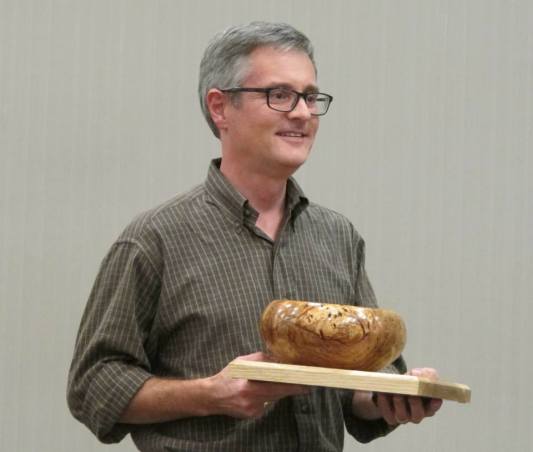
Art Taylor with his Anthony Award. Photo courtesy of Kaye Wilkinson Barley.
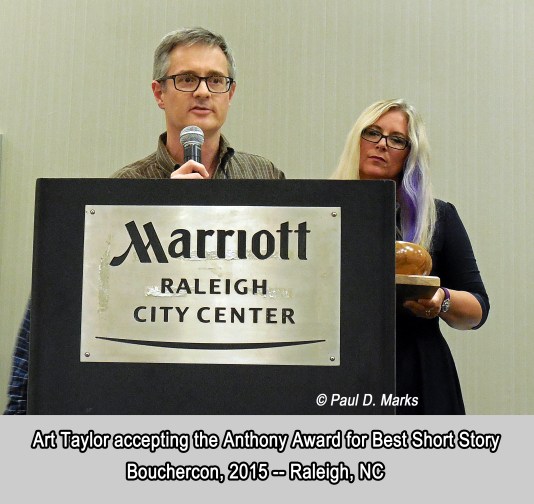
Art Taylor accepting the 2015 Anthony Award for Best Short Story. Photo courtesy of Amy Marks.
Art Taylor accepting the 2015 Anthony Award for Best Short Story. Photo courtesy of Amy Marks.

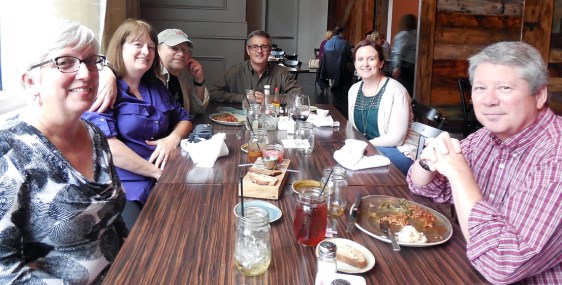
The EQMM nominees lunch. Pictured from L to R: Elaine Helms, Amy Marks, Paul Marks, Art Taylor, Tara Laskowski, and Rick Helms.

The EQMM nominees lunch. Pictured from L to R: Elaine Helms, Amy Marks, Paul Marks, Art Taylor, Tara Laskowski, and Rick Helms. Photo courtesy of Amy Marks.

At Bouchercons, it isn’t always at the organized events or meals that interesting discoveries are made, and this convention was no exception. It was by the merest chance that I was sitting in the lobby of one of the convention hotels one afternoon when Jeffrey Marks, a writer I knew was working on a biography of Ellery Queen, happened to sit down near me and mention that he had just unearthed a mass of information in the Library of Congress about the discussions and negotiations that led to the launch of EQMM. To me, this was astounding news. I’d had no idea such documents existed, and as 2016 will be EQMM’s 75th anniversary year—a time for looking back as well as for celebration—it’s information we’ll be able to put to very good use.

Whether meetings are serendipitous, like my running into Jeff, or planned in advance, most Bouchercon goers seem to come away from these weekends with the sense that they’ve learned something—not to mention being convinced that mystery writers and those who work in the business are an awfully nice bunch of people! Certainly Raleigh left me thinking those things. —Janet Hutchings

Posted in Awards, Conventions, Fiction, Genre, Writers | Tagged , , , , , | 1 Comment

“Dutch Treats” (by René Appel)

René Appel was a professor of Dutch as a second language at the University of Amsterdam until 2003. But he has been writing fiction since the 1970s, a decade in which his output was mostly short stories for literary magazines. In 1987, he moved into the mystery genre with the publication of his first psychological-thriller novel, Handicap. Since then he has produced a new crime novel nearly every year. Two of the books were winners of the Golden Noose Award from the Dutch Society of Crime Writers: De derde persoon (The Third Person) in 1991 and Zinloos geweld (Random Violence) in 2001. René has also written two children’s books, three collections of short stories, a series of radio plays, three scripts (for TV and film), and a theater play. Several of his short stories have been translated into English, including two that appeared in EQMM. His bestselling thriller novel Schone handen (Clean Hands) is the basis for a feature film that was released just last month. In this post, however, René talks not about his own extensive body of work but about the history and development of the crime-fiction genre in his native land.—Janet Hutchings

The Netherlands is famous for painters like Rembrandt van Rijn, Vincent van Gogh, and William de Kooning, for Amsterdam and its canals, for the fact that half the country (protected by dunes and dykes) is below sea level, for the easy availability of soft drugs, for the mills and the wooden shoes (hardly anybody wears them anymore), for Gouda cheese, and so on. But unfortunately, my country is not well-known for its crime writers. The reason may lie in the facts that the production of Dutch crime novels started relatively late and that, for a long time, thrillers had a low status as a literary genre in The Netherlands—an issue to which I will return later.

The first Dutch crime story was published in 1900, which was rather late, especially compared to Great Britain. P. Tesselhoff, Jr.’s The Detective’s Success was a traditional police story: a corpse, a detective, a few suspects, and finally the solution. From that beginning, this kind of crime novel became dominant in The Netherlands. The most important authors were Ivans and Havank, who each wrote more than thirty books. Perhaps it is significant that both of them used a pseudonym.

Robert van Gulik published a series of crime novels more or less based on traditional Chinese stories and featuring Judge Dee, the first one in 1957. Van Gulik, who was a diplomat in the Far East, wrote them in English because he wanted as many readers as possible. He is one of the few Dutch writers who have been published in English, and some of his books (such as The Chinese Gold Murders) are still available. His stories are rather slow, which perhaps explains why they’re not popular today; they don’t fit the fast lane of modern life.

For a long time, the most popular Dutch crime writer was an Amsterdam police officer, Appie Baantjer, who—starting in 1963—wrote seventy novels with Inspector De Cock as a rather old-fashioned detective. Baantjer often published two books a year, and many people in The Netherlands bought only two books a year—both of them by Baantjer. Efforts to publish Baantjer’s novels in the USA (with, for obvious reasons, another name for inspector De Cock) have not been successful.

The Dutch author who has had the most success in the United States to date was Janwillem van de Wetering. Outsider in Amsterdam, his first book featuring police detectives Grijpstra and de Gier, was published in 1975. Van de Wetering lived for many years in Maine and wrote his books in English, subsequently translating them himself into Dutch. (A number of his short stories were published in EQMM in the ’80s, and one—“There Goes Ravelaar,” translated by Josh Pachter—was nominated for the Mystery Writers of America’s Best Short Story Edgar in 1986).

New types of crime novels were introduced in the ’60s and ’70s, and one author, Joop van de Broek, can be considered the precursor of this “new” crime writing with the publication of Parels voor Nadra (Pearls for Nadra). Following foreign examples, authors said goodbye to the traditional pattern of the whodunit with its “decent” murders and civilized detectives. Their books became more realistic and hardboiled, introducing social aspects or political issues. For example, Gerben Hellinga (initially writing under the name Hellinger; there was still at that time a preference for pseudonyms) introduced Sid Stefan as his main character in Dollars (1963). Stefan was an ex-con who’d been convicted of murder. He was fond of beautiful women, traveled a lot in different European countries, and got mixed up in a criminal case.

The type of crime literature known as faction also became popular, especially through the work of Tomas Ross. (This was another pseudonym, based on the name of the American crime writer Ross Thomas. The story goes that an employee at the Dutch publisher got the name wrong and mistakenly deleted the h from Thomas.) In his more than thirty novels, Ross generally takes a hot issue out of the headlines; for example, one of his books is about Prince Bernhard (now deceased, but then alive and married to our Queen Juliana), who was mixed up in a corruption affair concerning the buying of Lockheed airplanes by KLM, the Dutch national airline. Ross filled in the unknown or hidden facts in order to create an interesting story full of suspense.

Today, the landscape of Dutch crime writing is varied:

  • More or less traditional crime stories are still published, with hardboiled thrillers dominating the market. Social and political issues are addressed, violence and horror scenes are not absent, serial killers are common. (Think of such Scandinavian authors as Jo Nesbo and Stieg Larsson, or the American Karin Slaughter.)
  • Quite a few authors follow in the footsteps of Tomas Ross. One example is Roel Janssen, who wrote a book about the gold bars stolen by the Germans during the WWII occupation of The Netherlands.
  • Charles den Tex has introduced the “corporate thriller” to The Netherlands. In his Bellicher Trilogy, management consultant Michael Bellicher is “immersed in conspiracies, identity theft and surveillance systems in an era in which internet technology and age-old crimes converge” (according to Barry Forshaw in Euro Noir: The Pocket Essential Guide to European Crime Fiction, Film & TV).
  • Psychological thrillers have become very popular. In the ’80s, I wrote my first books in this subgenre, inspired by the work of Patricia Highsmith and Ruth Rendell. But in the first decades of this century a new wave of female authors is responsible for many bestsellers, beginning with Saskia Noorts’ Terug naar de kust (Back to the Coast) in 2003. In addition to Saskia Noort, the most important authors in this category are Esther Verhoef, Simone van der Vlugt and Marion Pauw. (Van der Vlugt’s novel Blauw water has been translated into English as Safe as Houses.) Their books are often labeled “literary thrillers.”

The mainstream “literary world” in The Netherlands has come to resent this label, and has in turn developed a negative attitude toward crime fiction in general. You’ll often come across comments such as “What are they thinking, these writers of thrillers and detective stories? They produce fiction without literary value, without any impact on the mind of the readers, without addressing philosophical or psychological themes, written in a simple style.” Such comments reinforce the boundary between high and low culture.

This attitude has in turn negatively influenced the position of crime writers in The Netherlands, and has had an impact on people who feel an ambition to write. If you want to be taken “seriously” as a writer in my country, you would be stupid to start writing crime fiction.

Recently, though, this has begun to change, perhaps because of the fact that some of the “literary thrillers” by Saskia Noort and others have become major bestsellers—in some cases selling over 150,000 copies, which is quite a lot in a small country like The Netherlands, with its just under 17 million inhabitants. The success of these thrillers has provoked jealous reactions from the so-called “literary” writers.

In addition to the books written in The Netherlands, there are also many Belgian authors who write in Dutch, such as Jef Geeraerts (recently deceased), Pieter Aspe, and Bavo Dhooge. Perhaps an EQMM blog about crime writing in Belgium would also be interesting.

As I said in the beginning, it has been difficult for Dutch crime writers to succeed in the English-speaking market. We have, however, found a promising foothold: Over the last decade, such Dutch authors as Theo Capel, Michael Berg, Carla Vermaat, and myself have seen our short stories appear in EQMM’s “Passport to Crime” department. We hope you’ve enjoyed—and will continue to enjoy—these tasty “Dutch treats” from across the Atlantic.

Posted in Books, Fiction, Genre, Guest, History, International, Passport, Publishing, Readers, Writers | Tagged , , , , , , , , , | 3 Comments

“A Roadmap to Literary Mysteries” (by Bob Van Laerhoven)

Bob Van Laerhoven’s story “Checkmate in Chimbote” appeared in EQMM’s June 2014 issue and was read for our podcast series by his translator, Josh Pachter, earlier this year. The Belgian journalist made his fiction debut in 1977 as a short-story writer, and in 1985 as a literary novelist. More than thirty novels followed, some of them crossovers between literary fiction and the suspense novel.
He tells EQMM that as a journalist he explored trouble spots across the globe: Somalia, Liberia, Sudan, Gaza, Iran, Iraq, Myanmar, Mozambique, Lebanon, Burundi . . . to name but a few. During the Bosnian war, he was in besieged Sarajevo, and in 1995 he sneaked into Tuzla when the refugees arrived from the Muslim enclave of Srebrenica. His conversations with them resulted in the book Testimony to a Mass Murder.
Bob’s novel De wraak van Baudelaire won the Hercule Poirot Prize for best suspense novel of the year in Belgium in 2007. It appeared in English translation in 2014 as Baudelaire’s Revenge and won the USA Best Book Award for that year in the mystery/suspense category. His most recent book, a collection of stories with war as a background, is Dangerous Obsessions.
In addition to EQMM, Bob has contributed to English-language magazines such as Conclave: A Journal of Character and the UK literary magazine Wasafiri. Readers may want to look for his story in the upcoming anthology Brussels Noir from Akashic Books. In this post the multitalented author describes the journey he had to take to find his genre and his voice.—Janet Hutchings

It was 1977, I was twenty-four, my debut ten days old.

Proud as a peacock with a Napoleon complex, I sat behind a table, heaped with copies of my short-story collection High Voltage, in the big hall of the Antwerp Book Fair. Rows of people shuffled by. They threw themselves like lemmings on two bestselling writers of cookbooks who were sitting two tables further down the row. Even the ghastly, gas-inducing vegan recipes sold like hot dogs.

High Voltage did not.

After a few hours, my feathers had lost their color, my eyes had become glassy, and my mouth hung ajar.

A big-boned plump type—fortyish—with a lopsided smile that reminded me of Sartre, stopped before my virgin heap of copies. He raised both palms in my direction when he saw my hungry look for a buyer. “I work for the literary pages of De Standaard. We have received a review copy of your debut.”

I resisted the urge to comb my hair. Joedeloe, an interview in one of Flanders biggest newspapers!

“I’m Alex Braas,” the journalist said. “Young man, tell me, what is the most recent novel you have read?”

The Exorcist.” Strange question with which to start an interview about my book. The Exorcist didn’t need any more airplay, now did it? It sold a damn lot of millions.

“What did you think of it?”

“Suspenseful! Wow!”

“Mmm . . . But not really written with elegance and flair, is it?”

Huh? Flair? Elegance? From the novel, I only remembered the rotating, vomiting, and screeching head of what-was-her-name again? Who needed elegance when you had suspense, for Christ’s sake?

“Try to read other writers. Kurt Vonnegut, for instance, or E.L. Doctorow.”

“Why?” Never heard of these guys.

“You may have the stories, but you don’t have the style, son. That’s why you should read the stylists.”

***

Stylists?

Pedantic literary writers with page-long sentences drizzling cobwebs of words in my head?

“Overblown and baroque” Alex Braas had commented on my style.

And I had put so much effort into penning horrible bloody scenes, accompanied by a lot of cursing, yelling, and groaning, wheezing, panting, screaming . . . Enfin, just like fights to the death in real life, for sure. I had made sure that Gothic blood dribbled from every page. I was also mighty proud to be ahead of my time: My heroines were faster, stronger, and smarter than my male characters. And they were all masters in a secret form of hapkido-ju-jitsu, jiehaaaa!

They were also full-breasted.

So, why should I become a stylist?

After all these years, I still remember the conclusion of that nasty journalist after a quasi-monologue of thirty minutes. “If you want to be a striking writer, in mystery or any other genre, you’ll have to find your own voice, and then refine it.”

Braas noticed my dazed expression, smiled thinly, and added, “You can only do that by self-control. But the question is: Do you have what it takes?”

He turned on his heels. I fought the urge to throw a copy of High Voltage at his egg-head.

The strolling crowd in the book fair swallowed him.

A challenge.

The troll had challenged me.

***

Thus, by ego, and ego alone, started my journey toward control over that elusive and hard to define “literary” genre. I read that it needed “complex characters, a multilayered plot, and a refined style.”

That was a whole mouthful.

Complex characters. Mmmm, I could always throw in some childhood traumas. Or a pinch of well-hidden madness. Bullied in youth. Raised by über-greedy parents. Shouldn’t be too hard.

Multilayered plot. No problem there. My plots were such multilayered labyrinths that even the Minotaur would get lost in them.

A refined style. Yikes, that was a tough one.

Do you have what it takes? bleated a small green devil in my head.

To gain time, I decided that I first had to determine which styles I liked.

Until then I had been an avid reader of action thrillers, and my ambition was to become a writer who took his readers on a roller-coaster of blood-curdling situations, spiced up with a bit of hanky-panky.

I had to change that. Gnashing my teeth, I laboriously began to read in different genres.

And was, after a few months, struck by lightning when I read Vonnegut’s Slaughterhouse Five.

Vonnegut was the first to show me that suspense was a Medusa with a lot of heads, and that style could be one of them.

***

After a few years, I sensed that I was making progress, but there was still something that bothered me.

I looked up the meaning of mystery:

Anything that is kept secret or remains unexplained or unknown; any affair, thing, or person that presents features or qualities so obscure as to arouse curiosity or speculation; a novel, short story, play, or film whose plot involves a crime or other event that remains puzzlingly unsettled until the very end; any truth that is unknowable except by divine revelation.

Roughly sketched, the great stylists I had learned to admire—André Baillon, Irène Némirovsky, Franz Kafka, Graciliano Ramos, Thomas Mann, Gustave Flaubert, Curzio Malaparte, John Cheever, and many others—often lacked the mystery side I was looking for, and the action thrillers I read lacked in style.

***

I decided to exercise with short pieces that I called—a little prematurely—“literary mysteries.” I strived for compelling stories with captivating characters, and a strong literary style.

Those stories were a mess. I still felt the need to follow the rules of “action thrillers.” For instance, I wriggled myself into a thousand curves to “show” and not to “tell,” and as a result of that my style meandered from terse to lyrical, from clipped to a poetic singsong.

Then, by chance, I read Rites of Sacrifice by Windsor Chorlton.

At the end of the eighties, the English author Chorlton made waves with this novel, a mixture of suspense, politics, Tibetan demonology, and a riveting plot. Rites of Sacrifice was all I looked for in a literary mystery: a lean, evocative style, characters behaving like real people, and a mysterious background, populated with the shadows of Tibetan ghosts, but also by the all too palpable Himalayan Tibetans’ fight for independence.

The total package of the novel felt awesome. There was grand drama, there were cunning subplots, tormented characters, war, and hardship. And this sizzling cocktail was set in the majestic but lethal ice plateaus of the Himalaya.

Mystery combined with social and political upheaval with a dazzling background of the grimmest nature.

I felt I finally had come home.

I felt I could do this, write a book like that.

One thing I forgot, though.

Although the reviews were raves, Mr. Chorlton didn’t enjoy commercial success with his magnificent novel.

Too literary for most thriller readers.

And literary readers at that time still looked down their nose at “thrillers.”

***

This meant I had be patient and work harder.

Slowly, the atmosphere changed. I noticed it when I read Mascara by the South-American literary writer Ariel Dorfman early in the nineties.

Mr. Dorfman violated every rule for writing suspense novels.

His strange and convoluted tale was more telling than showing, and possessed only small amounts of dialogue. Nevertheless, the novel had an eerie atmosphere, full of suppressed violence, and a Kafkaesque sense of alienation and danger.

Not long afterwards, after having read, among others, The Cowards by Josef Skvorecký, Archangel by Robert Harris, and the novels of J.G. Ballard and William Boyd, I concocted my own definition of the literary mystery: novels you want to read more than once.

Hallelujah, I felt free, loosened all reins, and started to write without following any rule except those of my instincts, feelings, and longings.

I used diaries, letters, monologues, portions of “tell, don’t show,” in short: the complete set of tools that writers in the nineteenth century used to showcase their style and literary agility.

I felt challenged to surpass myself.

It cost me another five-or-so novels until I had perfected this mélange satisfactory enough to harbor the feeling that I had refined my voice.

It turned out that, at thirty-nine, this voice had built up an audience that was faithful and big enough to make me a full-time author in a small language community (Flanders has 5 million people).

***

Writing this blog text, ferreting through old material, I found another of my beginner’s books, a novella actually. A small Dutch publisher with a veined nose and an eternal scotch-breath edited it when I was twenty.

Forty-two years ago.

I had completely forgotten about it.

I blinked when I saw the title.

This Gory Memory of Mine.

I opened the booklet, read five lines, closed it gently.

And felt the urge to throw the copy at my dog’s head.

Instead I planted five kisses behind her lovely drooping ears.

Because I’m a literary mystery writer now.

And one of the main and most fascinating features of a literary mystery is that humans are very—and often quite strangely—unpredictable.

Posted in Books, Editing, Fiction, Genre, Guest, Novels, Passport, Readers, Story, Suspense, Writers, Writing | Tagged , , , , , , , , , | 2 Comments

“Murder Under the Oaks” (by Art Taylor)

Art Taylor debuted in EQMM’s Department of First Stories in 1995. He has gone on to win a Macavity and multiple Agatha and Derringer awards for his short fiction. The last time the Virginia author posted on this site, in March of this year, his EQMM story “The Odds Are Against Us” was up for the Agatha. It won that award and currently the story is nominated for the Anthony and Macavity awards, the winners to be determined at the Bouchercon World Mystery Convention, to be held in Raleigh, North Carolina October 8–11. This month, Art’s first book, On the Road With Del and Louise (Henery Press), a “novel in stories,” was released. A review of the novel (which incorporates two stories previously published in EQMM) will appear in our January issue. For this post, the author takes off his mystery-writing hat and dons that of anthology editor. It’s an interesting turnabout!—Janet Hutchings

For a second year in a row, Bouchercon, the World Mystery Convention, has produced an anthology of mystery stories, and for the second year in a row, a regular EQMM contributor has served as guest editor of the collection.

In 2014, for the Bouchercon in Long Beach, California, Dana Cameron selected and edited the stories in Murder at the Beach. This year, Bouchercon is in Raleigh, North Carolina, and the anthology shares the conference’s own title, Murder Under the Oaks, in honor of Raleigh being called the City of Oaks.

As a native North Carolinian myself, I was grateful to be invited to edit this year’s anthology—and what a learning experience it’s been, finding myself there on the other side of the process.

The anthology features several well-known writers, including many of this year’s Bouchercon guests of honor: Margaret Maron, Tom Franklin, Zoë Sharp, Sarah Shaber, Lori Armstrong, and Sean Doolittle. The blind submission process brought in stories from several well-known masters of the short story—Robert Lopresti and B.K. Stevens, for example, whose works are surely familiar to readers of EQMM and AHMM—and also delivered stories by up-and-coming writers already making their marks in a big way.

For those folks going to Bouchercon next week, I’d urge you to check out the official launch of the anthology on Saturday morning, October 10, with very short presentations by contributors in attendance and then a group signing. And let me stress that neither I nor any of the contributors are earning any money from the anthology; instead, proceeds from the anthology will benefit the Wake County Public Library system, a fine cause.

I’m hoping that folks will enjoy the collection that we’ve put together here—I’m very much looking forward to what readers think!—but in the meantime, I also wanted to share a couple of those learning experiences I mentioned above, reflections that stuck with me and that might be of small use or enjoyment to other writers and to readers as well. (And apologies here to my host, Janet Hutchings, who will likely find all of this underwhelmingly obvious—having experienced it all from an editor’s perspective for so long now herself!)

Trends Exist (And not simply the expected ones)

Serial Killers! The Paranormal! Zombies everywhere! . . . Um, actually, I didn’t get any of those myself. Perhaps there were indeed vast outbreaks of paranormal activity in the 150-plus submissions that the first readers encountered, but I didn’t see them in the batch of semifinalists I received—and I might well have welcomed them, since I’ve enjoyed stories in that direction by a number of fine crime writers. Instead, two other trends stood out to me. The first trend related to revenge tales—usually revenge against men who had done women wrong (sometimes awfully awfully wrong). The second were tales involving older characters—with a surprisingly large portion of the submissions I saw focused on the challenges of aging. This might prompt questions for you (as it did me): Were such trends in my semifinalist pile representative of the larger submissions (a proportional slice) or merely representative of some of the leanings of those first readers toward revenge tales and stories about aging protagonists, victims, and killers? Given that I saw these trends across both the invited contributors (those Bouchercon guests of honor) and the blind submissions, I’d expect the former to be true. What’s surprising is that this wouldn’t necessarily seem to be market-driven. (Zombies sell, so I should write zombie fiction, right?) Maybe it’s simply that mystery writers collectively circle around certain ideas of victims and injustice and justice, and these archetypal situations and stories seem promising—which leads to . . .

Innovation Counts

Related to the above, as I was reading a half-dozen tales about women exacting frequently painful revenge against men, it was easy for similar treatments of that same theme to blur together into one another. What rose to the top were the authors who did something different with a common idea—offering a fresh perspective, a clever approach, an unexpected twist. Similarly, those writers who generally took risks stood out. Fans of Zoë Sharp’s work will certainly appreciate “Kill Me Again Slowly,” a thrilling new story in her Charlie Fox series, but what excited me most was the opening scene—which brought together real-life figures such as Marilyn Monroe, Dorothy Parker, and Groucho Marx and restricted their dialogue to actual quotes attributed to each of them. Zowie! Refreshing and delightful. Writers, always push to stand out.

Your Style Is Like Your Signature

Much as I’m encouraging innovation and creativity to help writers make their work spark, I have to add an asterisk of sorts at this point. Except in special circumstances, it’s very possible that your personal style or trademark themes will shine through your work no matter what. I wouldn’t have recognized Margaret Maron’s story “Spring Break” as hers; she pointedly was trying something experimental here—a story told completely in dialogue. But the first of the blind submissions that I decided to accept, “#grenadegranny,” struck me with a familiar brand of humor, a sharp-witted conversational style, and a concern with economic issues that I felt like I recognized; so it wasn’t a surprise to me weeks later when the writer was revealed as Karen Pullen, another North Carolina writer whose works I’ve followed and admired. Who we are, how we write—maybe they’re inevitably intertwined.

First-time Writers Can Hold Their Own

Conventional wisdom might have it that the veteran writers are the more polished ones—they’re pros for a reason, right? But just as I’m often most impressed by authors in EQMM’s Department of First Stories, so too was I wowed here by some of the relatively lesser-known writers, including one author making her mystery debut in this anthology: J.D. Allen, whose six-part story “Grasshoppers” revealed an uncommon confidence right from the start. Many readers may well gravitate toward the bigger-name authors in an anthology like this, toward those authors they already know, but those readers would surely be doing themselves a disservice in that case. The rookies can indeed rule.

Technical Issues Can Be Trumped (And Fixed)

Finally, I guess it’s common sense that a writer’s submission should be the strongest it can be: polished to perfection in terms of character, plot, and prose—and free of typos too! (As with resumes, a single misplaced comma might undermine an editor’s confidence in a writer.) But what intrigued me about being in the editor’s seat here were those stories which had even serious missteps—a plot twist that wasn’t prepared for, say, or some unnecessarily muddied passages of prose—but whose storytelling overall kept me riveted and stuck with me long after I’d moved on to other submissions. Those tales lingered in my memory, something about them that transcended specific struggles. The most distinctive aspects of them kept tugging at me, wouldn’t quite let me go. And in turn, I ultimately didn’t let them go—but instead worked with several authors to address some of my concerns, find ways to build profitably on what was outstanding while at the same time smoothing away some of the rough spots—profitable for all of us, I hope, the readers especially.

More than anything, editing Murder Under the Oaks gave me a great opportunity—two, in fact. First, I got to celebrate a terrific group of authors who truly deserve all the credit here, and second, I earned a renewed understanding of the diversity of the mystery genre—and a renewed sense of how to serve readers. Crime fiction, as we know, covers a lot of territory—from cozy to noir, from domestic suspense to international intrigue, and from the whodunit to the caper tale to the police procedural and beyond. Different writers, different readers, different interests—and maybe the editor’s toughest job (mine, at least!) lay not just in delivering a fine batch of stories but also in trying to serve all tastes. Fingers crossed that our efforts worked.

Posted in Anthologies, Books, Conventions, Editing, Fiction, Genre, Guest, Publishing, Writers | Tagged , , , , , , | 5 Comments

“Hot on the Trail of a Minnesota Mystery” (by Susan Koefod)

Susan Koefod is the author of the Arvo Thorson mystery-novel series, from North Star Press, and also a widely published poet. She was a recipient, in 2013, of a $25,000 McKnight Artist Fellowship for writers. Just this week she received the news that her first YA book, a coming-of-age novel with an element of mystery, entitled Naming the Stars, will be published in September of 2016 by Curiosity Quills Press. Susan’s second story for EQMM will appear in this year’s December issue, on sale October 27. One would expect such a varied writing life to have many different sources of inspiration; in today’s post she talks about one important thread that runs through it all.—Janet Hutchings

Minnesota has a well-known reputation of “Minnesota Nice”—the natives friendly and helpful—but transplants quickly learn that while we smile, say hello, and are polite, we keep our distance. If you’re hoping we might drop over with a casserole when you move into the neighborhood, you better be patient. We won’t do that right away, possibly not even in the first six months, or even years after that. But we’ll always wave when you walk by. Just don’t expect us to ask you in.

Minnesotans consider it rude to be direct. If you ask us whether we like the meal we share at a restaurant—if a momentous occasion like that comes to pass—we’ll probably say, “It’s different.” What we really mean is, “I don’t like this.”

Minnesotans remain such a mystery to outsiders that you need to have the skills of a sleuth to get to know us. Let’s invent one for the sake of this post. We’ll call our detective Minnie Hartahknowya.

Minnie’s first lead comes in with the infamous Minnesota weather. The joke around here is that if you don’t like the weather, just wait fifteen minutes and it will change. She wonders where’s the humor in that joke after she spends her first winter in Minnesota, which lasts eight long months, but feels much longer. Every month but July has seen snow. She discovers that wind-chill is not something you endure for a mere fifteen minutes, hoping things will quickly warm up. Wind-chill means to keep your distance from winter or you’ll freeze to death. Padded by layers of parkas, sweaters, hats, scarves, and thick boots, a Minnesotan does not look very human outdoors in winter and there isn’t much time for a teeth-chattering chat before even the hardiest locals dash indoors.

Minnie wonders if brutal winters have taught Minnesotans they need to survive without much contact with other humans, possibly for three-quarters of the year. This seems too obvious, especially to a sharp detective like Minnie. She knows that mysteries earn their keep by throwing out false leads. If it’s too obvious a solution, it probably isn’t the solution.

So Minnie looks elsewhere, and analyzes the available physical evidence, going directly to the DNA. She learns that over 32 percent of Minnesotans have Scandinavian ancestry—most of us have Norwegian and Swedish heritage coursing through our veins.

Following the hard physical evidence, the sleuth quickly develops a hunch. And because she’s a character in a 1,500-word blog for short-story mystery-fiction readers and writers, she’s in a hurry to solve the case. She figures there must be something that connects this brooding Scandinavian ancestry, and possibly the weather (maybe that first lead wasn’t a false one), to mystery writing.

Next stop, the library information desk.

The Minnesota-nice librarian tells her that Minnesota is home to award-winning bestselling mystery authors, including Kent Krueger (his recent novel, Ordinary Grace won the Edgar, the Anthony, the Barry, the Macavity, the Dilys, the Squid, and the Silver Falchion), Ellen Hart (winner of many Lambda Literary Awards), Julie Kramer, Erin Hart, and David Housewright; newcomers Allen Eskens (winner of a Rosebud for his debut, and finalist in the Edgar, Anthony, Barry, and Thriller Awards) and Kristi Belcamino (also a first-novel finalist for a Macavity and an Anthony); and many more established and upcoming mystery authors.

Minnesota is also home to a Raven Award winning mystery bookstore, Once Upon A Crime, nestled in a thriving independent bookstore scene (over 50 in the Minneapolis area alone), a vibrant community of writers and readers, and one of the nation’s largest literary centers, the acclaimed Loft Literary Center.

Is there something deep in that Scandinavian heritage, so deep that it hitched along for the ride, crossing the Atlantic into Minnesota culture? Minnie browses at one of the library’s computers, noting an article by Nathaniel Rich of Slate reporting on the popularity of Scandinavian crime fiction. Speaking of Henning Mankell, Peter Høeg, and others, he said that what “distinguishes these books is not some element of Nordic grimness but their evocation of an almost sublime tranquility.” By sublime tranquility, he was referring to the bucolic settings of Scandinavian crime—something that is so pronounced that it appears in the titles of novels (Smilla’s Sense of Snow, anyone?). Is this at the heart of the Minnesota mystery?

I happen to be sitting nearby Minnie, working on a mystery blog post. I invite her to coffee at Fika, a cafe in Minneapolis’s American Swedish Institute. Fika takes its name from the Swedish tradition of “fika,” a coffee break with food.

She asks me about my heritage, the name Koefod. I tell her my husband has one hundred percent Scandinavian heritage and the name originated in the island of Bornholm (off Denmark), home to the most bloodthirsty Vikings, the Jomsvikings. I have some Swedish and Finnish heritage.

She asks me what inspires me as a native Minnesotan with Scandinavian ancestry in writing mysteries.

I tell her the varied landscape and moody climate inspired me as a child. I used to skip home from the bus stop, imagining myself as a character in a novel. To this day, that mix of moodiness and landscape inspires me in my work. My novels are set in a small Minnesota town along the Mississippi River. My detective has Scandinavian heritage. And there are many coffee breaks—fika—in my novels. I agree with her when she cites her personal evidence—which she’s felt as an outsider and learned as a sleuth—that it’s hard to get to know us.

I tell Minnie that even a Minnesotan’s friends and family don’t pry too much into each other’s personal business. A now close friend of mine told me it took me ten years to open up to her. The family continues to befuddle my Parisian-born sister-in-law. The writer in me follows those leads, wondering what motivates behavior, good and bad. Mystery writing is the natural outlet for such a passion.

Minnie thanks me for our interview and asks to have fika together in the future. After I give her the famed Minnesota Long Goodbye and make Minnesota mystery novel recommendations, I answer her invitation with a firm “maybe.”

Posted in Books, Characters, Fiction, Guest, History, International, Noir, Setting, Story, Writers, Writing | Tagged , , , , , , , , , , , , , | 1 Comment

“The Italian Butcher” (by Michael Berg)

Michael Berg made his EQMM debut in our 2015 September/October double issue, with “The Last Run,” translated from the Dutch by Josh Pachter.  A former television and radio host, interviewer, documentarian, and program director in the Netherlands, he set off on a new career as a crime-fiction writer in 2008 and has since produced seven novels, receiving the prestigious Golden Noose Award and a half-dozen nominations for other awards along the way. His latest thriller, Het meisje op de weg (The Girl on the Road) is due for release this fall. Broadcasting and crime writing are not the only fields in which the author excels, however.  He is also a composer who has written songs for radio, TV, and theater, including the music and lyrics for a children’s television series. In this revealing post he pays tribute to someone who helped him achieve success in his writing career.—Janet Hutchings

That evening my wife and I got very drunk. I’d just received a letter from a Dutch publisher informing me that they would like to buy my thriller. This was the news I was hoping for. I was almost fifty. Publishing a thriller before I reached fifty was on my bucket list and the reason I’d given up my very lucrative job in Dutch radio. I took the leap and moved to a small hamlet (in the middle of nowhere in southwest France) to become a writer. My colleagues thought I’d gone nuts. Did I really think I could write a book and get it published? And even if I did, was I aware of how little money a writer actually earned? For that misery, I would be giving up my professional career and all of the benefits that came with it. At the age when they, my ex colleagues, would retire and start enjoying their pensions, I’d be as poor as hell. Did I actually realize that?

Yes, I did.

But still I decided to follow my dream. I loved thrillers. Patricia Highsmith was one of my favorite authors. Could I write something like that? Probably not as good as she did, but I was sure I could write a thriller and—not hindered by any false modesty—I was convinced I would find a Dutch publisher.

The mail I received proved that I was right.

The next morning, with a huge hangover, I called the publisher. “Congratulations”, the man began with a pleasant voice. “You’ve written a great thriller. We’d be delighted to present your book next year, in the spring.” After another minute of additional compliments, he sighed deeply and proceeded to tell me that there were some things in the book that could, however, be better. Most importantly, I’d revealed the identity of the murderer too soon. He gave me a list of pages and sections that needed editing. If I could do that, he said, the book would be totally perfect. Of course I would do that, I answered.

I worked for another two weeks on the manuscript, repaired the suggested sections, and checked all pages to improve everything that could be better and smoother; this also made the story quicker. Finished, I sent the manuscript back to the publisher. Yes, this was excellent, was the reaction of the man after reading my revisions.

Job done, I thought. Now I could relax for the next few months and enjoy waiting for the moment when the book would be in the bookshops and I would celebrate my debut as a writer. Okay, by that time I would be a bit older than fifty, but still, my goal had been reached.

But . . . the book wasn’t done yet, the publisher told me. The manuscript would first be sent to the editor, some Dutch guy who’d studied Dutch literature, lived in Italy, and worked freelance for Dutch publishers. This guy’s job was to make the manuscript fit to print. He sounded like somebody who was going to do some final corrections. Nothing to get nervous about.

A couple of weeks later, the publisher sent the manuscript back to me. The editor had finished his work. It was up to me to now either approve or deny the suggestions the editor had made. The publisher assured me in his letter: As author, I had the final cut.

Okay, I thought. No problem.

When I opened the document and saw the first page, I couldn’t believe my eyes. It looked as if some raving drunk had attacked my text with pens in both his hands and left it a total mess. My carefully written manuscript was full of red and blue balloons filled with comments, corrections, and explanations as to why the original text wasn’t any good. I felt devastated and very depressed. As I started to have a quick look at the rest of the manuscript, things only got worse. More balloons, more colors, more remarks—ten to twenty on every page. One chapter of the book was completely deleted. What?! Why? I was in shock. My first reaction was to call the publisher and complain about this editor who had massacred my book. I’d written an excellent thriller, the publisher had said, or hadn’t I? I still couldn’t understand it. After a couple of drinks and a lot more cigarettes, I decided to wait before calling the publisher and first let the situation sink in.

The next morning, after a sleepless night, I started to read the comments in the manuscript. The more I read, the more I understood what the editor had done. He’d deleted all the things that were redundant or didn’t contribute anything to the story or to the suspense. I’d written a lot about the house in the French countryside that my heroine had bought. The descriptions of the region and the plush surroundings were rather poetical, but was poetry appropriate in a thriller? Perhaps for a few sentences, but definitely not a two-page poetical description of my heroine’s garden. Too long, too boring. The editor also cut out all sections where I’d explained things for a second and even third time to the reader. And the editor was damn right . . . as if the reader him- or herself was not clever enough to follow my intended hints.

I remembered reading books myself where the author had treated me, the reader, as an imbecile. I now realized, clearly, that the editor was spot-on in deleting a full chapter where nothing happened and that didn’t contribute anything to the story or the suspense. The editor had made the book better. I was so glad that somebody had had a close look at the manuscript. So, finally, I approved almost all of the suggestions/corrections.

Actually, what the man had done was the same as what I used to do when I was working as a chief editor for Dutch radio. Freelancers and I would listen to their productions together and I would offer my advice. “Do we really need this? I’ve heard this story before. Maybe we should put this section in the beginning to tease the audience.” Succinctly: eliminate the extraneous junk to make things better. I remembered the shock of freelancers when they first thought that somebody was killing their darlings, but at the end they were always happy with the result.

Every artist needs a butcher. A nice butcher, a professional butcher with good taste who is not afraid to criticize the artist; one who does his/her utmost to make a piece of art shine. Artists who work on their own tend to get blind. Somebody has to open their eyes.

My Italian editor took care of my first five books. We have never met. I never even knew his street address. We were not friends, but we both had the same goal: to produce the best book possible. My editor taught me how to write. After the third book, my manuscripts were not as full of balloons and remarks anymore—I considered myself a writer for the first time. In the last book he edited, the pages stayed almost as white as snow. This book should earn an award, the editor wrote at the end. A year later I won the Golden Noose, the most prestigious prize for Dutch crime literature.

Thanks to the Italian butcher.

Posted in Books, Editing, Guest, Novels, Publishing, Writers, Writing | Tagged , , , , , , , | 1 Comment

“Desirable Trash” (by Philip Lowery)

Next week, when EQMM’s November issue goes on sale, Philip Lowery will make his debut as a published fiction writer. A civil engineer by day, he has long been a devoted fan of crime fiction, as is evident from this post. The talented new author was born and raised in the U.K., but moved to the U.S. more than twenty years ago, and is now an American citizen living outside of Philadelphia with his daughter. His surprising first story, entitled “Ninth Caller,” is something you won’t want to miss. —Janet Hutchings

I made a mistake this summer. Almost three thousand miles from home, I passed up the opportunity to purchase an old mass-market paperback, a TV tie-in novel, one of those short, rushed hack jobs that a publisher wants on the streets as fast as possible to cash in on the popularity of a hit series.

Seriously? One of those books?

I know what you mean.

As soon as I picked it from the shelf (the bottom shelf, as it happened) I began to have complicated thoughts. Why would I want a piece of junk like that? Surely it would be all adverbs and plodding dialogue, with plot twists paced to align with commercial breaks instead of dramatic arcs. Did I honestly see myself reading it? Did I have any expectation of even minimal enjoyment from the experience?

Or, these complicated thoughts went on, was this just a trophy for my own bookshelf at home, a collectible intended to remain unread? (And if so, when did I become that person?) Because this also happened to be a book by a favorite author, a book I hadn’t thought could possibly still exist in 2015. Even as I stood between the towering stacks, turning the near-orange pages with hesitant fingers, I didn’t really believe it. It was like finding out they had a unicorn available for adoption over at the animal shelter. Why wouldn’t I snap it up?

So went my odd reaction to finding this tattered treasure.

But you want to know who, and what, right?

The writer was Jim Thompson, the book a paperback original from 1967: Ironside. Yes, Ironside, the TV show, featuring the wheelchair-bound San Francisco detective. Apparently Thompson wrote these things for a few TV series—after a stint writing actual episodes for various other shows—as an income supplement when the novels weren’t bringing in much (or selling at all). No one could fault a writer for making a living any way he had to, of course. But as an admirer of his writing, my inclination was to discount any such piecework; after all, it couldn’t be one hundred percent pure Thompson. In fact, I had conveniently forgotten these books had ever existed, let alone kept a mental note to look for them in used bookstores.

My complicated reaction to stumbling across Ironside by Jim Thompson (and how strange title and author looked together on the cover) had its roots in my regard for the man as a novelist and my sympathy for the man as an unappreciated talent. It’s been well documented that Thompson had a varied and sometimes difficult life, endured a lack of critical acknowledgment during that life, and in suitably noir fashion was doomed to miss out on a resurrection of his works and reputation by dying before the rest of the world caught up to him—a trajectory full of the bleak irony that characterizes the novels themselves.

I am currently “working my way through” Jim Thompson, and so far have read about ten of his books. (For the sake of veracity, I checked; I’ve read nine.) Of those few, three have upended my understanding of what’s possible within the genre of noir and suspense fiction, namely The Killer Inside Me (of course), Savage Night, and Pop. 1280, the latter being an over-the-top masterpiece, in my opinion. Jim Thompson wrote many more books (more than thirty, says Wikipedia) so I have a long way to go. And I know, too, that the quality of his writing was variable (I believe that’s the charitable term), a result of deadline pressures and financial pressures. The man couldn’t catch a break, it seems, despite periods of relative success born of sheer hard work and productivity. I’ve already read a couple of the lesser novels, along with some that were just fine, and if nothing else there’s some compelling writing going on in all of them.

But I find myself a little reluctant to go all-in, to plumb the depths, in part because I’m afraid of what might happen to the great works in comparison. Will they seem less good? I worry. Will I see borrowings and repetitions, failures of execution that will throw a cloud over what I have considered up to now (in thrall to my squeaky fandom) to be breathtakingly courageous moves, bordering on if not embodying genius? Such are the worries of a diehard-fan-in-the-making, afraid to see the humanity and frailty, wanting to revere where reverence might be—who am I kidding? We’re human. Most definitely is—misplaced.

It doesn’t help that the commentary of others, coming on top of my own perplexed reactions to certain of his books, supports the presumption that all might not be well in Thompson country. Even the greatest of his admirers would have to admit that some of Jim Thompson’s writing is repellent; there’s no other word for it. Where cruelty and perversion might seem groundbreaking, bold, and revelatory in the safe hands of a writer at his peak, the same twists can come across as depraved, foul, and crass when deployed cynically. (It turns out, for me at least, that this is a pretty fine line.)

This is what I fear for the books yet unread. I will read them, I have no doubt, but I am pacing myself. I want to savor them—the good ones—but I know I might also need time to cleanse the palate, to forgive Jim his sins when I read a clunker or two.

Which brings me to these novelizations, or whatever they are; TV tie-ins, for God’s sake. Is this in any way a good idea? Do I need to own physical evidence that a great writer was reduced to hackwork? Isn’t it enough that I know his life was hard, that much of his work was written under financial and often physical duress? Do I really need to read a book I assume the guy didn’t want to write in the first place? I feel bad enough for him already . . .

Here’s the thing. Here’s why I know in forehead-slapping retrospect that I made a big blunder that summer day in the bookstore. I read the first paragraph of Ironside, standing there in the swirl of secondhand dust motes between the pillars of literature. And the very first sentence was one hundred percent pure Thompson:

“It was the kind of a place where if you didn’t spit on the floor at home you could go down there and do it.”

Despite recognizing it as such, even thinking, Look at that, he didn’t slum, even for a piece of crap like this, I re-shelved the book and went on with my day, not recognizing the early pangs of regret even as I moved downstack to the Donald Westlake section.

What a moron.

Jim Thompson wrote from an unusual vantage point—down there—looking up at the world, seeing it for what it is from an odd and disturbingly revealing angle. He saw the dark, venal, and ugly side of life in ultrahigh definition, with a clarity that was at times almost comically horrifying. That’s how he wrote; that’s the only way he could write, evidently, regardless of the project at hand, and that’s what makes him a treasure, hard as he might be to love. My misgivings about a “lesser” work—so prissy and fretful, so cautious of me—are pale and ridiculous in that fierce glare. How I wish I’d bought that book that day.

Of course, it has since dawned on me—after reminding myself that I grew up in the ’70s and ’80s but no longer actually live there—to check online. I was surprised to find listings for three copies of the book. Not a bonanza, by any means, but somewhat less rare than the unicorn I thought I’d cornered then allowed to escape. (Incidentally, I owe the Internet, in the form of Book Dirt Blog by Kelly Robinson, a further nod for providing the exact wording of the quote reproduced above; my own version of it, mangled by imperfect memory, contained two separate “something-something”s.)

Powell’s, in Portland, Oregon (the labyrinthine bookstore where this sorry tale unfolded) has an excellent website, and is one of the original online booksellers, as far as I know. Powells.com’s “warehouse” is basically the store itself, the place is so vast. I saw employees wandering the corridors of shelves holding baskets and tickets, filling orders at a strolling pace, the product most certainly touched by human hands. (What’s next, selling candy by the ounce, poured from big glass jars into little paper bags fastened with a twisty-tie?) I went to Powells.com in the hopes that the actual copy of Ironside by Jim Thompson, the one I’d held in my hands, might by some miracle be available still. According to the website, it was. (And it might be my good fortune that the online catalogue listed the book as Ironside by Jim Thompon, whoever he is.)

I gratefully placed my order, and now look forward to my second chance to read a deeply flawed potboiler flecked with pulp gold. And the next time I come across a unicorn made from cheap paper and smelling like grandma’s house, I will lasso that beast, wrestle it down to the register, and pay cash on the barrel, no questions asked.

Posted in Books, Bookshops, Genre, Guest, Noir, Novels, Writers | Tagged , , , , , , , , | 4 Comments

“A Belgian Mystery (Solved by Poirot Himself)” (By Hilde Vandermeeren)

Hilde Vandermeeren, a psychologist and former teacher, had authored some forty books for children (winning numerous literary prizes for them) before she wrote her first crime novel, When Darkness Fell, in 2013—and it won the Hercule Poirot Public (or “Readers”) Award.  A second thriller, The Witnesses, followed in 2014, and a third, Quiet Ground, in May 2015. The author’s EQMM debut is coming soon, in our March/April 2016 double issue. In this post Hilde discusses some of the obstacles women writers face in the field of crime fiction in her native Belgium.—Janet Hutchings

Belgium is a small country in Europe with three official languages: Dutch (Flemish), French, and German. It is well known for its chocolate, fries, and . . . the lack of female Flemish crime writers.

In my opinion, as a psychologist and a female Flemish crime writer myself, that last issue is worth some consideration. What are we talking about? In statistical terms: At this moment there are approximately forty male Flemish crime writers (more or less active) and only a handful of female colleagues. For the crime writers and readers among us: This smells like an interesting mystery that asks to be solved. Because my position—as an enthusiastic female Flemish crime writer—is not neutral, I called for help. And two wonderful characters created by Agatha Christie, who accompanied me during my teenage years, agreed to help solve this mystery. So I’m pleased to introduce the ingenious Hercule Poirot (a Belgian detective!) with his petites cellules grises* and the amazing Miss Marple.

We meet during teatime in a cosy pub in St. Mary Mead (England) and Hercule Poirot is using a white handkerchief to clean his chair before he sits down. Miss Marple has a very friendly smile when she arrives, but when we shake hands she says to me: “You seem to be nervous, Hilde.”

“Indeed I am, Miss Marple. I’ve never met two of my literary idols before.”

“Two?” mumbles Poirot. “There’s only one genius at this table.”

Miss Marple is wise enough to sit down without saying a word.

Poirot folds his hands, closes his eyes, and asks what exactly we’re dealing with. I tell them about the new case: The current lack of female Flemish crime writers.

“That’s not our problem,” says Poirot and he starts to rise. “And it’s absolutely not a matter of public interest.”

“My dear Hercule,” says Miss Marple, “it definitely is our problem. And it’s also a matter of public interest.”

“In what way?” asks Poirot.

“If Agatha Christie, our literary mum, had not had the opportunity to publish as a female British crime writer, then your petites cellules grises would never have impressed anyone.”

Poirot remains seated and takes a sip from his sirop de cassis before directing a flood of questions at me.

“How many female Flemish crime writers have appeared on TV programs over the past few years? I mean, other than local shows.”

“I think hardly any,” I say.

“But male Flemish crime writers did?”

“Only the famous few.”

“How many female Flemish crime writers have been interviewed by the press—I mean, besides the local press?”

“Again, barely any.”

“How many books by female Flemish crime writers have been adapted for screen?”

“As far as I know, not a single one.”

Thoughtfully, Poirot drinks from his sirop de cassis.

“How are people to know that female Flemish writers exist if the Flemish press doesn’t give them a voice? It’s a vicious circle,” he says.

“There are two Flemish awards for crime writers,” I say. “The first is the Hercule Poirot Award.”

“What’s in a name,” says Poirot.

“And the other is the Diamond Bullet (also open for Dutch crime writers),” I continue. “Winning such an award can really launch the carrier of a female Flemish crime writer.”

“Don’t make me laugh, my dear,” says Miss Marple. “I did a little research after you called me and what I found shocked me.”

“Tell me all about it, Miss Marple,” says Poirot.

“So far only 15.3 percent of the winners of the Diamond Bullet are female, and the Hercule Poirot Award does even worse: So far only 11.7 percent of the winners are female.”

“Seen statistically, since there are fewer female than male Flemish crime writers, it’s not surprising that the percentage of awards given them would be lower,” says Poirot. “But not that low, quelle horreur.”

“We are not totally without a chance,” I say. “In 2013 I was the only woman nominated for the Hercule Poirot Award and I won the Knack Hercule Poirot Public Award (a prize awarded by the public for the best Flemish thriller novel).”

“But in 2014 something strange happened,” says Miss Marple. “That year not a single woman was nominated for the short lists of either Flemish award: Ten male crime writers were nominated versus zero female ones.”

“Yes, it was that year that I honestly thought of giving up crime writing,” I say, “with no prospects at all as a female crime writer in Flanders. And besides, nobody cares.”

“I do,” says Poirot. “You mustn’t give up, Hilde. You are the first female Flemish crime writer who’ll publish a short story in EQMM. As a role model, you make us proud.”

“I heard something else that bothers me,” says Miss Marple. “It’s well known that most crime readers are female, but in Flanders all the important crime reviewers are male, is that correct?”

“Yes, and the members of the juries for the two major Flemish crime awards are also almost exclusively male.”

“I thought the Victorian Era had passed,” says Poirot.

“Conclusion: Female Flemish crime writers have too little support and face too many obstacles,” says Miss Marple.

“The mystery is solved, but the problem is not,” says Poirot.

“Thanks for the help,” I say. “It was really nice meeting you. Since my teenage years both of you have inspired me to write crime fiction.”

I tell Poirot how I cried all evening long, as a fourteen-year-old girl, after I finished Curtain: Poirot’s Last Case.

“Don’t be sad,” Poirot says. “People like me—I mean, people like Miss Marple and me—are immortal.”

“I know,” I say.

“So, Hilde, this is not a farewell,” says Miss Marple. “Some day we’ll meet again.”

She gives me a hug.

“Let us know when you receive one of the major awards, when your crime novels are translated, or when one of your stories is adapted to screen,” she says.

Instead of a hug Poirot gives me some thoughtful advice.

“Do what my petites cellules grises always do, Hilde: Never give up. Not even if there are a lot of obstacles in your way.”

I promise them to do so and there I’m standing, outside that pub in St. Mary Mead, waving them goodbye for a long time after they have already disappeared.

* little grey cells
Posted in Books, Business, Characters, Fiction, Genre, Guest, International, Passport | Tagged , , , , , , , , , , , , , , | Leave a comment

“The Joys and Challenges of Journeys to the Past” by R.J. Koreto

R.J. Koreto will make his fiction debut in EQMM’s Department of First stories in the December 2015 issue. The award-winning journalist and magazine editor chose a contemporary setting for that first published work of fiction. But what really inspires him is history and in 2016 his first novel, Death on the Sapphire, the first in an Edwardian-era series featuring suffragist-detective Lady Frances Ffolkes and her maid/bodyguard, will be published by Crooked Lane Books. It will be followed by another novel featuring Lady Frances, Death Among Rubies. In his post, the author shares with us the unexpected challenges he has encountered writing historical mysteries. —Janet Hutchings

The first rule of writing a historical mystery is keeping the characters in the same place. I realized this when writing my first historical mystery, set in Regency England. I backed myself into a situation that required my London-based protagonist to visit another city 300 miles away. Even considering he was a good rider on a strong horse, I suddenly realized I was sending him on a two-week round trip. It was a plotting nightmare.

What would happen to him in all that time? Was there any way to freeze all the other characters in London meanwhile? Wouldn’t it just be easier to keep everyone in London?

But I had gotten the historical writing bug, and happily jumped into the challenges and joys of creating characters who lived in another era. My next historical book is my upcoming Death on the Sapphire, which is set a century after the Regency, during the Edwardian period. Now, I was able to give my characters telephones, motorcars, and, best of all, fast trains all over the country. But there’s a lot more to keep in mind, even in turn-of-the-century England.

Let’s start with how people can die in a murder mystery. They can get shot, but with what? Semiautomatic handguns were around, but rare. A revolver was much more likely. Actually, guns were loud, heavy, and expensive. The nineteenth-century murder preference, I uncovered, was the garrote: quick, cheap, and silent. Indeed, the high collar of early constables, or “bobbies,” was designed to prevent such murderous sneak attacks.

“Bobbies,” by the way, is in honor of Sir Robert Peel, who founded the Metropolitan Police Service. The service’s early headquarters were in the courtyard of a building once used by the kings of Scotland as an embassy—hence the nickname it retains to this day: Scotland Yard.

But all is not murder. Even detectives have time for entertainment. Today we like to see a detective brooding in dark movie theater as he turns over the case in his mind. Fortunately, the Edwardian detective, I discovered, had the same retreat: The British film industry was already underway. The Charlton Heston Ben-Hur was actually the third movie version of the famous book. It was first filmed in 1907, using firefighters and their horses in the chariot-race scene. And although Edwardians didn’t have James Cameron, they did have real-life Titanic survivor Dorothy Gibson, an actress who played herself in the first filming of the nautical tragedy, Saved from the Titanic, in 1912. (Sadly, all copies were destroyed in a fire decades ago.)

Still, my protagonist, Lady Frances Ffolkes, is a little highbrow, and the golden age of such stars as Charlie Chaplin and Mary Pickford was still in the future. She preferred the “legitimate” theatre, and was lucky, living when George Bernard Shaw was penning masterpieces. She got to see the original production of Major Barbara. She even might’ve noticed a young actor named Edmund Gwenn, who later became well-known to American audiences for playing Santa Claus in Miracle on 34th Street.

I had to figure out what else Lady Frances did for fun. She danced, and in Edwardian times, that meant the waltz, which was popular and perfectly respectable. But it hadn’t always been that way. I delved into the history of social dancing: In the early nineteenth century, the waltz was risqué—men and women dancing so closely!

But the Edwardians faced their own scandalous dances. At the turn of the century, the shocking tango made its way from Argentina to Europe—clergymen even spoke out against it! And I imagined Lady Frances dabbing her brow with a lace handkerchief as she watched tango dancers—and considered learning it herself.

And as all this transpired, I had to make sure the vocabulary was correct. Without thinking, I had an Edwardian character refer to the “fallout” from a problem. Fortunately, I caught it before sending off the final draft. And I’ve had to be careful about where you use “OK”—and who says it.

At least those things can be looked up. More of a challenge are attitudes. For Death on the Sapphire I had to research the Boer War (1899–1902) in South Africa. Yes, there are plenty of accounts, and I know what public opinion was. But what would my characters feel? Perhaps Lady Frances looked at it the way many would look at the Vietnam War, half a century later: an imperial power fighting a citizen army in a distant land. I decided she would have pride in British and colonial fighting men and anger at the politicians who sent husbands, brothers, and sons overseas. Life was different in 1906, but attitudes on love and glory are timeless.

And in the upcoming sequel, Death Among Rubies, I introduce a lesbian couple. Lovers may look at each other the same way throughout history, but I had placed these two in a time where such a union couldn’t even be discussed, let alone admitted. Worse, a sheltered woman from a wealthy family would have no one to ask about her feelings, no place to look them up, even as she was pushed to make a suitable marriage. My characters see the fact that they found each other as a small miracle, but they would also be fearful at being uncovered. Still, lovers have a long literary tradition of fighting for their love since the days of Arthurian romances, and why should Edwardian same-sex couples be any different?

Those are some of the big issues, but as a writer of historical mysteries, I had to look at the small ones too. Take the relationship between a well-born lady and her maid. Historical mysteries love servant-employer pairings, after all: Lord Peter Wimsey had his Bunter, Albert Campion had his Lugg, and any aristocratic female detective had to have a lady’s maid. The trick is translating a kind of friendship that was common enough then but is unheard of today. How many lady’s maids, valets, and butlers do you know?

I decided that Lady Frances and her maid Mallow would share a lot of things—but not necessarily discuss them. Friendship was one thing, but the gulf of class distinctions was wide. It would be impossible for Lady Frances to hide the fact that she had a serious suitor, but it would be difficult to discuss him with her maid. On rare occasions, I imagined, both women might lower their guard briefly and forget they were mistress and maid, sharing confidences—but those would be exceptions. Their relationship, with no parallel today, provides endless fascination for me as I take them through one adventure after another. Yes, there is mutual respect and affection with an almost sisterly love, but feelings are shown more by a change of tone, a raised eyebrow, and a smile than by overt statements.

I learned a lot about Edwardian clothing, manners, weapons, and cars when researching my book. These are just trappings, though. Feelings of love, anger, hatred, greed and jealously never change. What differs is how an earlier society may address these emotions, and the criminal responses they may be driven to. Creating complex characters with believable emotions and motives was the hard part, I found out, no matter when they lived. The historical details are a piece of cake in comparison.

Sorry. That phrase wasn’t likely known to the Edwardians. Make that, “easy as pie.”

Posted in Characters, Editing, Fiction, Genre, Guest, Historicals, History, International, Novels, Setting, Writing | Tagged , , , , , , , , | 1 Comment

UNNATURAL CAUSES

Doctors and nurses make sinister villains in fiction, don’t you think? Most people, at one time or another, have experienced the sense of powerlessness that goes with having to put themselves in the hands of medical professionals. Although the Internet has been said to empower patients to make decisions about their own health, when something serious comes along, a leap of faith in the medical system is almost always required. It seems to me that when, in crime fiction, we encounter a doctor or nurse with murderous impulses lying beneath the caring façade, it touches on a primal fear of being helpless in the face of danger.

Medical mysteries make a lot of readers squeamish, and writers who revel in descriptions of appalling injuries or disease tend to turn me off too, even though there isn’t much of that sort that I haven’t read about before. Over the past fifteen years or so, since the debut of TV’s CSI, it seems to have become obligatory for crime dramas to display at least one corpse on an autopsy table per episode. Forensic pathologists and medical examiners have become stock characters of crime shows, as well as the stars of several bestselling series of novels, including those of Tess Gerritsen and, of course, Patricia Cornwell (whom many consider the originator of the forensic mystery).

Tess Gerritsen is, like one of her protagonists, Maura Isles, a medical doctor. There are several doctors among EQMM’s contributors, though not all of them write stories that could be classified as “medical mysteries.” Short-story specialist John H. Dirckx, for instance, rarely focuses on the medical aspects of cases for his series cop Cyrus Auburn. Former forensic pathologist Keith McCarthy, on the other hand, does; he’s produced several well-reviewed books featuring fictional pathologist John Eisenmenger. McCarthy’s mysteries intrigue me because his medical knowledge is arcane, and is matched by frighteningly believable characterization. You know more about the human body by the time you finish a McCarthy story or novel than you did going into it, and more about the human psyche, too.

McCarthy’s mysteries are generally classical whodunits, and his doctor is on the side of justice, but medical knowledge lends itself at least as readily to the thriller, and sometimes to the creation of an evil doctor—the best known of all, probably, Thomas Harris’s Dr. Hannibal Lecter.

The protagonist—or antagonist—in a medical thriller isn’t always a doctor, of course; it can as easily be a research scientist, a forensic toxicologist, a forensic anthropologist (as in Kathy Reichs’s books) or an infectious-disease specialist. But having a doctor in the starring role—especially one who sees patients—may humanize a story heavy on technical detail and scientific fact. Besides, a doctor—a good one—is already a kind of detective. As every fan of Sherlock Holmes knows, the model for Arthur Conan Doyle’s Holmes was Dr. Joseph Bell, a professor of surgery at Edinburgh University, and the chief characteristics of Bell that Doyle drew on were related to the doctor’s prodigious powers of observation.

It’s only to be expected that doctors would be good observers, particularly of human behavior, which so often impacts disease. What is surprising, to me at any rate, is that there are not more doctors who write mystery fiction. In our submissions, we must encounter at least ten writing lawyers for every doctor who confronts the blank page. Very often, lawyer crime writers weave corruption in their own profession into their plots; the dishonest or dissembling lawyer is a literary stereotype (one that draws many yawns from editors, by the way). Doctors are much more often portrayed as upright, dependable, compassionate. Yet it isn’t as if real life fails to provide plenty of examples of doctors who engage in crimes related to their profession, ranging from insurance fraud to sexual abuse and even murder. The most recent case that comes to my mind is that of the star M.D. Anderson oncologist convicted, in 2014, of the attempted murder of a colleague.

So why don’t doctors and other medical personnel feature more often in mystery fiction as villains? Is the perversion of a figure we’re sometimes forced to trust with our lives a possibility we simply don’t want to entertain, even in imagination? (Whereas everyone loves to be given a reason to hate lawyers?) Perhaps because it’s only rarely that I encounter an evil doctor or nurse in our submissions, I often remember such stories, especially those that display psychological subtlety. Of the dozens of stories that Edgar Allan Poe Award winner Peter Turnbull has written for EQMM, for example, one that has stayed in my mind for more than seventeen years is May 1998’s “Wee Betty Pope,” about a serial-killer nurse. Nevertheless, if I were asked to choose some favorite medical mysteries from EQMM’s archives, there’d be a number of the good-doctor variety too. They’d include Robin Hathaway’s Dr. Fenimore mysteries (whose central character was based on her doctor husband) and Ellis Peters’s medieval mysteries featuring herbalist Brother Cadfael, a sort of medical man of that time. (FYI, though both authors are deceased, both series have available novel-length entries.)

I’m always interested in hearing what books and series readers visiting this site like. If you have any recommendations for this category of mystery, I hope you’ll jump in.—Janet Hutchings

Posted in Books, Characters, Fiction, Genre, Setting, Story, Thrillers, Writing | Tagged , , , , , , , , , | 3 Comments