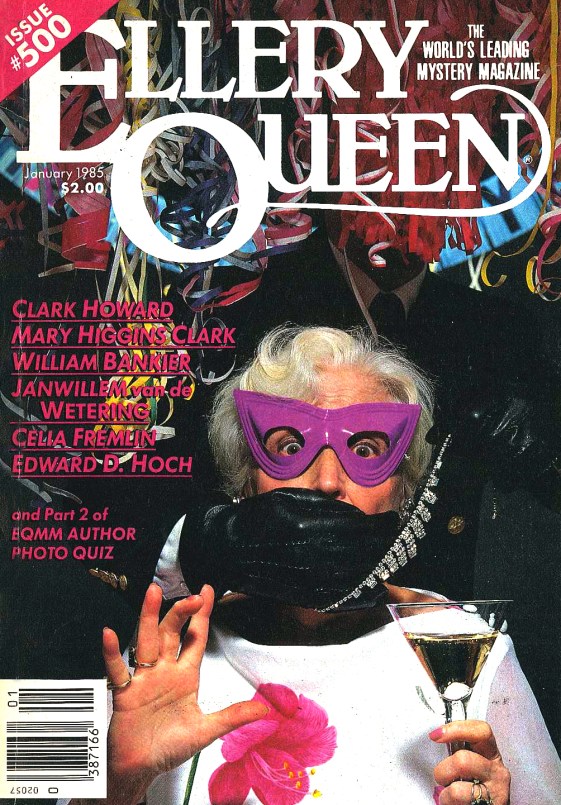
Cover of EQMM, January 1985
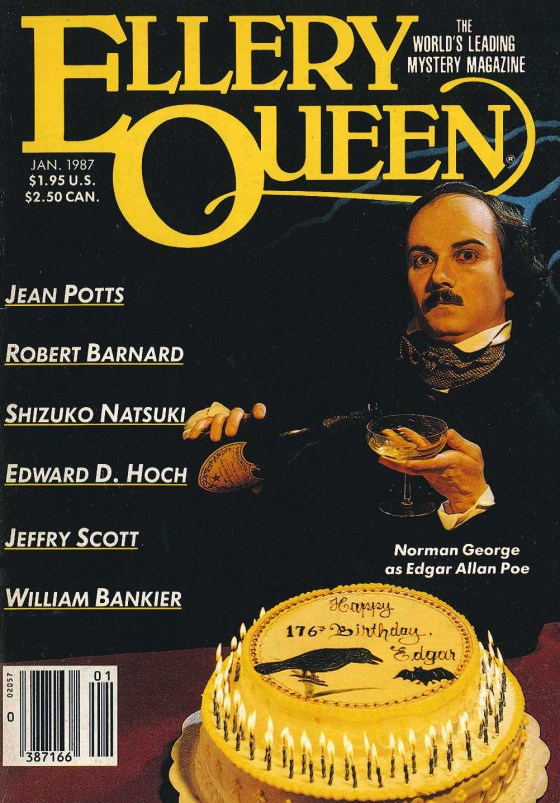
Cover of EQMM, January 1987

Cover of EQMM, January 1985
Cover of EQMM, January 1987

Festive Wall Street

The New York Stock Exchange
Last week, EQMM January 2016, the first issue in our 75th year in continuous publication, went on sale. I hope you’ve seen it!
In celebration of this diamond anniversary year, special features are planned for each of the 2016 issues. Before we close out 2015, I’d like to give you a preview of some of what’s coming up . . .
Our January issue opens with a reprint of a classic Ellery Queen story—one new to EQMM!—and in all subsequent issues we’ll be bringing out treasures from our own archives. They include February’s Robert Arthur tale, which won EQMM’s third-annual contest (1948) in the best Sherlockiana category; March/April’s reprint of the original story William Faulkner entered into EQMM’s first-annual contest in 1946; the story editor Frederic Dannay was often heard to say had made him famous, the first English translation of the work of the great Argentinian writer Jorge Luis Borges, which we’re reprinting in May; and an award-winning tale by EQMM’s beloved longtime contributor MWA Grand Master Edward D. Hoch, for the June 2016 issue. (We’ll announce more From Our Archives stories as their issues get closer.)
Several themed issues are ahead too, including March/April’s nod to a goal stated in the manifesto for EQMM: “to raise the sights of mystery writers generally to a genuine literary form.” Many of the stories in this jam-packed spring double issue are by writers with feet in both the mystery genre and the world of mainstream literature. In May, in commemoration of the “All Nations” issue of August 1948, we bring together stories from all continents but Antarctica, most in translation, all revealing how interconnected the world of crime fiction has truly become. June 2016 celebrates the Mystery Writers of America with stories exclusively by writers who have won one of the MWA’s awards, the Edgar or the Robert L. Fish Award. In July, authors who got their start in our Department of First Stories claim the spotlight; even if you didn’t see their EQMM debuts in years past, you’ll know who most of them are now! August is dedicated to EQMM’s past editors, with articles about the lives and editorial contributions of Frederic Dannay, Manfred B. Lee, and Eleanor Sullivan, plus a short story in which Fred Dannay stars as sleuth, in a case involving Dashiell Hammett.
And September/October? That’s the issue we’ve chosen to correspond to “Fall 1941,” EQMM’s first issue—therefore, the designated “anniversary issue.” We’re going to keep to ourselves for a little while longer some of the special contents of that issue, except to say that its cover is a new work by famed American artist and designer Milton Glaser (whose first published art was a 1954 cover for EQMM) and to let you know that the scene will be set by an article from Marv Lachman on the world of 1941—the literary setting and the wider environment into which EQMM emerged, on the brink of the America’s entrance into World War II.
A number of nonfiction pieces in the 2016 issues focus specifically on EQMM’s history. What has made this especially exciting is that information not previously available to us was unearthed recently by Ellery Queen biographer Jeffrey Marks at the Library of Congress, including the original contract for EQMM (between Frederic Dannay and Manfred B. Lee and The American Mercury Press) and the transcript of an oral-history recording in which EQMM’s first publisher, Lawrence Spivak (best know as the founder of the TV show Meet the Press) talks frankly—and surprisingly—about how the idea for EQMM came to him.
In addition to the year’s special issues, our anniversary celebration will include a two-month EQMM exhibit at Columbia University’s Butler Rare Book and Manuscript Library, from mid-September to mid-November 2016. The library’s excellent curators have a wealth of edited manuscripts, correspondence, and art to choose from, and we hope those in reach of New York City will stop by and have a look.
Also coming up is a half-day symposium hosted by Columbia University in September 2016. Stay tuned here for the date, topics, and participants—we should have it all finalized soon.
It’s due largely to our intelligent readers and talented writers that we’ve reached this happy milestone in the magazine’s history, and as we close out another successful year (something I find a little bittersweet!) and launch into 2016’s celebrations, I want to thank all of you, on behalf of all of us at EQMM, for coming on this journey with us.
Happy holidays! —Janet Hutchings
Last week I received an email from a former advisee, now a college freshman, who said that he was compiling a personal reading list and wanted to know what books have changed my life. As an English teacher, I get these requests fairly regularly, and I always comply despite how daunting I find the task. The more I read, the more I recognize that the relationship between text and reader is frighteningly personal. I love The Scarlet Letter, but I didn’t read it until I was thirty years old. If that novel and I had met when I was, say, eighteen, our relationship would have been bristly. I know my eighteen-year-old self, and he would have resisted even the most eloquent blandishments of Hester Prynne, Arthur Dimmesdale, and Roger Chillingworth. He still sometimes murmurs an objection when the Puritan children exclaim, in language that no living child has ever uttered, “Behold, verily, there is the woman of the scarlet letter, and of a truth, moreover, there is the likeness of the scarlet letter running along by her side! Come, therefore, and let us fling mud at them!”
So I’m invariably cautious when I recommend a work to another reader, particularly to a younger one. I teach high-school seniors, and when we read Billy Lynn’s Long Halftime Walk or Pride and Prejudice or Henry IV, Part 1, I remind my students that they do not represent the target demographic for these writers. High-school readers are eavesdropping on a conversation intended for others, and they should remember not to blame the book if they struggle to follow it. With trepidation, therefore, I sent my advisee two titles that had spoken to me in my youth. One was Joseph Heller’s Catch-22, which I read for the first time at seventeen, and which awed me with its mingling of humor and profundity, its exhilarating revelations at the end, and its resilient and principled protagonist. The other title was Franklin W. Dixon’s While the Clock Ticked, Number 11 in the original Hardy Boys series. Ironically, however, I told him not to read the latter novel, even though I love it and unashamedly cite it as a book that changed my life.
We might consider the Hardy Boys series to be comparable to the upper register of sound waves, those that we lose the ability to hear as we age. The books in this series belong to a large family of works that speak intentionally and solely to the young. I met the Hardy Boys when I was nine years old. Until then books to me were thin, broad folios with lots of illustrations and minimal text. Here, however, delivered into my naive hands by an older cousin while I recuperated in bed from the flu, was a bound volume that looked like the kind of book read by grownups, a thick quarto consisting almost entirely of text but with a teasingly lurid jacket depicting two boys bound and gagged as a sinister adult stepped out of a secret hiding place behind a grandfather clock. I opened it. I began to read. And, somewhere early in Chapter One, that book changed my life. I forgot about the flu, forgot about the bed, forgot about the noise coming from my sister and brother elsewhere in the house. I was fully immersed in the adventures of two intrepid brothers, boys who never argued with each other the way that I did with my siblings, but who pooled their talents to solve nefarious crimes while putting their lives at risk. Almost from the moment I started to read that book, I experienced the kind of ekstasis that writers from Sophocles to Stephen King have generated in their audiences. As soon as possible I went back and read every single Hardy Boys adventure in order of appearance. I knew nothing about the Edward Stratemeyer Syndicate, and I had no idea that Franklin W. Dixon was a pseudonym for Leslie McFarlane and others who fleshed out Stratemeyer’s plot summaries to create the series. I knew only that Frank and Joe Hardy were as real as any friends and that their world was one that I never tired of entering.
When I sit down to write a story and everything is working right, I return to that trance-like experience of being somewhere else. I’m not the first writer to call it going inside, and while it’s not always easy to get there, it’s excruciating to be yanked out of that place prematurely. A pinging email, a phone call, the neighbor’s kid practicing his trumpet outdoors—any innocuous interruption can be exasperating. The movie Trumbo delivers a heartbreaking scene during which Dalton Trumbo’s sixteen-year-old daughter confronts her father for working through her birthday party. He’s not willing to stop writing even for a minute, not even to watch her blow out her candles, and when she does interrupt him, he explodes. When I watch that scene, I sympathize with both characters. Of course the daughter deserves to have a shred of attention from her father on her birthday if he’s there in the house and healthy. But Trumbo the writer had gone inside, and he was furious at being pulled out.
I’m forever grateful to the Hardy Boys for introducing me to the intensity of that inner life and, in the process, for schooling me in the elements of crime fiction. But while I still have all those Hardy Boys books on my shelf, I can no longer bear to read them. The prose is cringingly stilted; the characters, flat; the plots, ridiculous; the villains, obvious and cliched; the dialogue, banal. No matter. These books served their purpose. They taught me to love reading, and they taught me how to tell a mystery story. When I was an undergraduate English major, revering The New Yorker and dreaming of becoming its next John Updike, I was afraid to write fiction because I sensed that my work would never be as good as the stuff I was reading. I think lots of English teachers suffer from the malady of comparing themselves to the immortal writers they love and teach. How could I ever write a novel like Tom Jones? How could I ever write a passage like any paragraph in Faulkner’s “The Bear”? We know that we’re never going to create another Heathcliff or a Milkman, so we quit trying to write anything at all. That’s a mistake. The Hardy Boys remind us that the primary purpose of reading is to take the reader elsewhere, and if the entertainment happens to take the form of a murder mystery, there’s no need to apologize. Catch-22, I realize years later, is a mystery novel—the mystery of Snowden’s death in the back of the plane, the mystery of Orr’s disappearance at sea, the mystery of Yossarian’s struggle to survive in a bureaucracy that wants to absorb his soul. And what are Hamlet and Crime and Punishment—two works that my students read as “eavesdroppers” last year—if not studies of murderers and the detectives who are on to them? Half a century ago Clifton Fadiman described Oedipus Rex as the strangest murder mystery of all time, one in which the detective isn’t even aware that he himself is the murderer. Maybe not all mysteries qualify as great literature, but they can lead us to read the deepest, greatest mysteries, the ones we never tire of revisiting, even when we know whodunit.
One particular pleasure in writing crime fiction is the opportunity to deliver justice on the page. Think how often you’ve heard a variation of, “Be careful not to tick her off or you’ll wind up murdered in her next book.” But if your writing centers on the criminal’s story, as mine often does, you don’t want to be constantly slamming your characters. And even authors whose protagonists live firmly on the right side of the law work hard to make criminals real and believable—with motivations readers can understand even if they’d never empathize.
I spend a lot of time hanging around in my mind with the kind of people I’d rather avoid in real life. Part of my job is getting to know them, figuring out what makes them tick, and how they rationalize their actions. It could be that’s what makes me look at real criminals a bit differently than I otherwise might. I’m not talking about truly evil people—who I realize do exist—but people who find themselves in situations that drive them to do things they otherwise wouldn’t. Or for whom the line between right and wrong has been shifted a bit off-center based on where they live and what they’ve experienced.
Before someone picks up on the fact I’m Canadian, and suggests I must be somehow preternaturally polite and tolerant, I think a quick examination of Canadian crime might be in order. We’ve got our fair share of dark and nasty types, whether you want to talk serial killers, fraud artists, bikers, or street thugs. I won’t start listing them here because they don’t deserve the attention, but a quick online search will be enough to convince people our reputation for rough edges isn’t limited to the hockey arena.
And while one particular big city mayor stole international headlines a couple years ago with antics that would have been deemed unbelievable by any crime-fiction editor, he found himself in good company. Or, bad company, rather. At the time, about a half-dozen other mayors across the country were under investigation or facing charges for everything from raiding the municipal piggy bank to running long-term kickback schemes tied to organized crime. Yeah, we’re all pure as driven snow.
I’m not trying to equate municipal corruption, or the partying antics of our political elite, with the kinds of crime that lands even Canadians in maximum security, but when I’m looking for fodder for a short story or my next novel, the newspaper coughs up inspiration by the bucket load.
And behind each of those stories is a person who made choices, moral or otherwise.
Like the guy who whacked his neighbour—and we’ll never know for sure why—with a baseball bat. He might have got away with it had he not returned to the scene of the crime a few days later to steal what he could from the dead man’s rural home. The car, in particular, looked like it was worth a few bucks. He took a buddy along with him because, as any good thief will tell you, four arms are better than two. When asked before a judge why he’d knocked off his one-time friend, the man explained that he’d taken his bat to defend himself against the man’s dog, and the dead man was just . . . unlucky.
Tell me there’s not a story in that.
If the killing was deemed manslaughter, and I believe it was, the killer is likely out of prison by now. And if he’d like to stay out, he’d be well-advised to give up on thieving. Or any crime where success is based on good decision-making skills.
Of course, apart from the more-accomplished cat burglars, bank robbers, or fraudsters, sound judgment isn’t something a lot of criminals seem to possess. And even the best of them can mess things up pretty bad.
One of my favorite failures in Canadian crime lore happened a couple years ago west of Toronto. Five seriously committed bank robbers spent several nights breaking into a bank vault. Working after bank staff had gone home for the day, they accessed it through vacant office space upstairs. They used acetylene oxygen blowtorches, sledgehammers, and concrete saws to cut through two feet of reinforced floor. They were smart enough to disable electronic security systems and eventually got their hands on the loot.
But what happened next was more like a Guy Ritchie flick.
It seems there was a secondary alarm inside the vault itself—something they’d failed to disarm. Fair enough, nobody’s perfect. The cops showed up and were bewildered. The building was secure, with no evidence of broken glass or movement inside. Still, something had tripped the alarm, so after bank staff showed up and everyone agreed something bad must have gone down, they called in the canine unit.
In no time, the police dog tracked the burglars to their hiding spot. And yes, that’s the right name for it. Like any bunch of kids playing neighborhood hide-and-seek, the bank robbers had hidden themselves up a tree. Beside the bank parking lot. You can imagine them shushing each other among the branches as the cops ran their building checks. Maybe they were planning on going back to work once the heat had cooled? I mean . . . all those safety-deposit boxes . . . all their planning . . . maybe they didn’t want to give up.
The worst part? The tree they were hiding in was next to a railroad track. You know, one of those lines that cuts through a neighborhood that would have let them disappear into the night without walking down the road where, understandably, they might have feared running into a cop wondering what they were doing there, all dusty- and sweaty-like in the middle of the night.
But, who knows. Perhaps these guys were novices. Out-of-work construction workers—a bit of an oxymoron in hypergrowth Toronto these days, but whatever. Maybe they were just a bunch of regular guys looking to make a quick buck so they could send their kids to one of them fancy private schools.
Far less excusable is a major fail by people who call themselves professional outlaws—or, rather, the police call them that. The same week those earnest bank robbers got caught up a tree, two serious bad guys with motorcycle gang ties escaped from a jail north of Montreal via helicopter. No comedy here. This was serious action-thriller material. They swung from a rope dangling from the stolen chopper and were swept away to deep forest north of the city.
Pretty impressive so far. Except what happened next suggests the planners ran out of napkin to write on. Because once in cottage country, they approached a cabin, kicked its occupants out, and . . . and what?
You can imagine the conversation.
“Hey, guys. Welcome to freedom. We brought beer.”
“Great, what’s the plan.”
“Plan?”
“You got us out. What next?”
“Next? Talk about ungrateful. You know how hard it is to hijack a helicopter?”
“Yeah, but where are we gonna go?”
“We ordered pizza. Should be here any minute. The kind you like.”
Within hours, they were back in custody. Not that the people they kicked out of the cabin had anything to do with the police finding them.
Stories like this make me curious. What is it that makes criminals, petty or otherwise, take the kind of risks most of us manage to avoid? What would the world be like if more of the bad guys were smarter? Is it only the dumb ones who get caught?
And when so many of them create situations where they’re bound to fail, is it really all that bad if a few of them get away? For the next story, I mean. We all need material.
I’m sure devotees of the mysteries come to the genre in all sorts of different ways. Through schools, Edgar Allan Poe is an early experience for many of us, although that doesn’t always take. Some probably inherit a lasting taste for suspense from a parent or older sibling. At a relatively early age they discover stray Agatha Christies or Raymond Chandlers around the house. Maybe a person fractured a leg, was laid up and looking for a way not to die of boredom. Some kind soul brought round some Hillermans, Paretskys, J.D. Robbs or Daniel Silvas. I’ve noticed that Lawrence Sanders tends to hang out for years in the slush piles at country inns just waiting to trap the unsuspecting.
I got hooked in an unusual way and in an unusual place.
In the early 1980s, I was a correspondent for United Press International in the Central American nation of Nicaragua. The United States opposed the government there at the time and was soon supporting a rebel force that was attempting to at least weaken if not overthrow the existing order. Journalists from all over the world poured into Nicaragua, until at times it seemed there was one reporter for every Nicaraguan citizen.
Government leaders frequently called press conferences to denounce the rebels—and the U.S.—or to make other announcements. Because of the war, security at those events had to be very tight. Every piece of equipment carried by journalists—cameras, common tape recorders, large sound boxes used by television “sound men”—had be screened for bombs. That all took a lot of time, so that reporters had to be on the premises at least two hours before the conference was to begin.
I employed only a pen and notebook, had no equipment to inspect, and I was waved right into the conference space. A few other colleagues were also low tech and would join me there. We would chat a bit, but since we saw each other fairly often, the gossip lasted only so long. I soon decided to bring reading material with me in order to not waste hours of my life.
Since I was covering a nation in conflict, I was reading famous authors who had written about war: Tolstoy, Crane, Hemingway, James Jones, early Tim O’Brien. I tried to bring those works with me to read preconference, but it simply didn’t work. As the room filled up, it grew noisier and what I was trying to read was just too dense, too demanding to hold my attention in the rising din. I needed a book that was faster, plot-driven, more compulsively readable.
I cannot remember how it is that the first Ross Macdonald fell into my hands. And I can’t recall if it was The Goodbye Look, The Zebra-Striped Hearse, The Galton Case, or The Wycherly Woman. But the moment I opened Macdonald I was hooked. They could have held the press conference right around me and I wouldn’t have known it was going on. Well, almost.
I read a bunch of them. I sampled other authors as well, but it was Macdonald’s tightly-woven plots that really grabbed me. A couple of years later, still reporting in Nicaragua and other nearby countries, I decided that I knew enough about the Central American conflicts and also enough about mystery novels to write one of my own. My first novel was Heat Lightning, set in San Francisco, where I had once lived. It dealt with a murder in the Salvadoran community there, a killing with connections to the civil war back in El Salvador. It was published by Putnam in 1987, edited by Neil Nyren, who is now editor-in-chief at Putnam. It was nominated for an Edgar Award by the Mystery Writers of America and optioned by Columbia Pictures.
I’ve bounced back and forth between journalism and fiction writing ever since. I’m at work on my eighth book.
I recently reread The Galton Case. Macdonald is still magic.
The novel pretty much writes itself. Couple move to France. They buy some land, build a house, and while it’s going up, unearth a body.
Except this isn’t fiction.
This happened to us.
Cognac (yes, that Cognac, where the world’s finest brandy comes from) isn’t exactly renowned for violence. More for tourists, weaving through its narrow cobbled streets and photographing its delightful half-timbered buildings, sipping coffee at a pavement café, strolling the quays beside the river, and sampling its smooth amber delights.

In fact, the best Cognac sees by way of aggression is water-jousting. Proof that Ancient Roman traditions are still alive and well, water-jousting is where opposing teams row hell for leather towards each other in shallow boats, the aim being that their lancer, balanced precariously on a special platform, knocks their opponent in the river. Thirsty work, stirring stuff, but not so competitive as to want to kill each other.
Having said that, we’re not exactly in the centre of the town. The plot we chose—a field, basically—lies at the edge of a village of just four hundred souls which, although only a short distance as the crow flies, is very much in the country.
And it absolutely reeks with history.
The ancient Gauls left few traces, certainly none round here. But shortly before we moved to our hilltop paradise, local archaeologists discovered a Roman bridge across one of the many arms of the little river that flows beneath the bluff just fifty yards from us. The Via Agrippa (think Roman interstate) passes half a mile away. And in winter, when the trees are bare, we can, if we lean far enough over the balcony without falling off, just about make out the slate roofs of a château, whose foundations date back to the Crusades. Not bad for a neighbour.
This idyll quickly became the inspiration for Scorpion Rising. Riddled with caves, perched on a rocky promontory shaped like an arrow head, and with a stream at the bottom with more arms than the goddess Kali, this was why we made this plot our home. And given that one of the castle’s many incarnations was a seminary for Catholic priests, it seemed only right that I continue the theme. In my case, with a college of nature priestesses, who kept men as sex slaves (down, boys!) in a compound at the top of the hill.
Right where our house was being built.
 They say life imitates art, and while I was quietly plotting uprisings and murder taking place on that very spot, mechanical diggers had been in, foundations had been laid, bricks were going up—and my husband was busy clearing the land.
Which, in many ways, was a pity. Brimming with wildflowers and littered with fallen trees, it was a haven for wildlife. Keen-eyed buzzards perched on the poles, kestrels hovered overhead, and at one point a deer raised two fawns in the garden. But what was, not so long ago, part of a woodland and a field for sheep needed to be tidied. If only to let us to drive in! Bit by bit, Mr. Todd tamed the invasive tangle of brambles and shrubs, cut down grass that was chest high in places, and disposed of the chestnut trees rotting happily away into sawdust. Finally, he was free to tackle the four-metre high, three-metre deep, thirty-metre wide mountain of greenery that formed our front boundary.
Within no time, all manner of stuff began turning up. Rusted gates, iron bedframes, charred timbers, rubble, even a ploughshare, all bound together by fist-thick roots and tendrils of ivy. So when he spotted a lump of corrugated iron he wasn’t exactly surprised. Another contribution for the local amenity tip! But as he wrestled more branches, and more snakes, he realized it hadn’t been dumped. This was the roof of an old shed, that had once served as a woodstore, and the shed was still standing.
Instant echoes of Cold Comfort Farm. “Something nasty in the woodshed.” Whoohoo.
Over the course of the next few days, other items saw daylight for the first time in decades. Gloves, jacket, boots, socks, an old blanket. And with every new find, we’d try to imagine what illicit purposes this ramshackle shed might have been put to. Was this the local red-light district? A lovers’ tryst? Or, since the stuff turning up was purely menswear, evidence of cottaging in this village of just four hundred scattered souls?
To add to the intrigue, the woman who sold us the land was divorced, the husband apparently not seen again afterwards. Could this have been his hiding place? His refuge from nagging? Was that why he divorced her, he couldn’t take any more? Or did she divorce him, because he spent all his time in the woodshed, rather than working? Either way, Monsieur P. hadn’t been seen for over twenty years, and when a pair of boots turned up—well, talk about conspiracy heaven!
Then my husband came home and said, “I’ve found bones.”
You could have heard a pin drop.
Suddenly, all those jokes about Monsieur P. running as fast as he could after the divorce weren’t so funny.
Time to call in the cavalry.
Needless to say, what bones remained had been shattered beneath decades of rubble and junk, but there was certainly a skeleton in there.
The good news was, Monsieur P. was alive and well. That’s to say, it wasn’t his remains in the garden, and what a relief that turned out to be. The bad news is that some poor animal, most likely a wild boar—the skull was never recovered—had crawled in there to die. Certain pig bones bearing a worryingly close resemblance to human bones. (Remember that, next time you tuck into BBQ ribs).
We also learned that village life isn’t quite so tranquil as one might think. After the Revolution, when vast areas of France were completely lawless, there was a gang roaming this area, nicknamed Les Chauffeurs. Nothing to do with taxis or stretch limos. Chauffe is all about heat. Direct heat. These charmers would break into the homes of local peasants, tie them up, then hold their feet in the fire until they told them where their money was hidden.
Even today, very recently, a woman living alone was found dead in her home under suspicious circumstances. We’ve had burglaries, brawls, even helicopters searching for an inmate who escaped from prison forty kilometres away and felt our woods would make the perfect hiding place. Not.
 Of course, the woodshed has gone. The land has been tamed. The buzzard showed its displeasure right down the patio doors, for a second I thought I’d blacked out.
Another mess for Mr. Todd to clear up.
I love to write crime fiction set in Africa. I’m particularly fond of Kenya and Zimbabwe, but my favorite country to write about is Tanzania. Why Tanzania? Because there’s so much material. An endless amount, really. That, and I’ve spent the majority of my adult life working on and researching various issues in Tanzania. Some story ideas I’ve actually witnessed firsthand, others are suggested to me, and other ideas I get from reading the Swahili and English newspapers. I particularly like crimes that would be unlikely to happen in the U.S., or at least wouldn’t happen in the same way. Those are an absolute delight to write. But the stories are also very challenging to get down on paper. And perhaps not for the reason you might think.
Africa is a huge continent. It is approximately two and a half times the size of the U.S. and currently contains fifty-five internationally recognized states (and a couple of unrecognized ones). Each country has its own language(s), culture(s), and socio-political environments. And don’t even get me started about the variation in landscape and how that can affect the setting for a story. When I taught African Studies, a sizeable majority of students came into my class calling Africa a country. I’m proud to say that none of them left my class under that misconception. But I still get asked on a regular basis whether there are cities in Africa (Hint: There are), and I’ve even had one student ask a very indulgent guest speaker whether she had ever worn clothes before coming to the U.S. (Hint: She had). For me, these are cringe-worthy moments, but I recognize that most Americans, me included, had almost no education about Africa—or any of its countries—in high school. I think I had to memorize some capitals for a geography quiz. But that was about it. I’d like to think it’s getting better—and really, it couldn’t get much worse—but I’m skeptical.
News organizations don’t help us fill in the blanks in our knowledge either, or at least not in a meaningful, well-rounded way. Much like in the U.S., the news coming out of Africa tends to be negative and sensational. Wars, famines, HIV, Ebola, malaria, female genital mutilation, and let’s not forget terrorism. When I look at that list, it’s amazing I ever spent time in Tanzania. Why not stay in safe, comfortable, first-world U.S.A.? Because, of course, that’s not the whole picture. Any more than it is when we listen to the news of horrible happenings in the U.S. Serial killers? Check. School shootings? Check. High rates of incarceration? Riots? Gridlocked Congress? Check, check, check. These are facets of life in the U.S., yet most of us wouldn’t define ourselves by these “benchmarkers.” Most likely we would say, “Yes, but . . .” and offer a more balanced account of life in the U.S. And there definitely are more balanced accounts on Africa. But we have to look hard to find them unless we’ve been lucky enough to spend lots of time with our boots on the ground.
Crime fiction, however, creates an uncomfortable dilemma when writing about Africa, because it generally focuses on the underbelly of society. Happy, well-adjusted, rational protagonists—and especially antagonists—do not a good crime story make. Focusing on dark desires, desperate situations, and conflict, conflict, conflict . . . well, now you’re talking. When Michael Connelly writes about LA, I love all the dirty little details and the big hidden secrets. I like that LA’s beautiful, colorful sky is often the result of smog. What a great analogy to get at the underbelly. Yet, I know that isn’t all of LA. Maybe only a small part. Most people go on their merry way, living their lives the best way they know how. Allison Leotta, a former federal sex-crimes prosecutor, writes about crime in Washington, DC. There’s gang violence, the sex-slave trade, and corrupt politicians (yeah, okay, that one is probably more fact than fiction). But having lived in the greater Metro DC area for almost a dozen years now, I can tell you that there are also many warm, generous people who aren’t actively strategizing how to cover up brutal crimes . . . unless they’re crime-fiction writers too. It leads to some interesting discussions on the Metro. But I digress.
Because so much of what we know about Africa as a whole is negative, it’s problematic for me to then add to that perception knowing that most Americans don’t have a well-balanced picture to begin with. This isn’t true of just countries in Africa, by the way, but is true of many places around the world where people seem very “Other” to us. And let me be clear on this: I wouldn’t have spent so much of my life on a country (Tanzania) and its peoples if I didn’t love and respect them deeply—warts and all.
So I continually ask myself, what’s my responsibility as a crime-fiction writer? Certainly not to get up on my soap box in the middle of a story. Too much of that quickly throws the reader out of the tale. I’m a storyteller first and foremost. But what about context? I do think providing context is key, so that the reader gains a little insight into why certain people do things a certain way. But that’s easier said than done. In a novel there is more space to play with the context, add it in piece by piece, a little here, a little there, but short stories don’t leave a lot of room for extras. Each word has to count. I don’t always feel as if I’m totally successful in making the unfamiliar, well, familiar. But I keep trying.
Additionally, my own academic work—which focused on human rights and violence in East/Central Africa—lends a very particular lens to how I approach a crime story. It certainly isn’t the only lens. Alexander McCall Smith takes a whimsical approach and tone to Botswana. His Botswana has an almost magical, going-to-the-Shire feel to it, which I love and visit often. I’m also a huge fan of Deon Meyer, a gritty, South African thriller writer who writes in Afrikaans, but is also translated into English. I adore his protagonist, detective inspector Bennie Griessel, and I enjoy reading Meyer’s understandings of race, class, and privilege in South Africa and how he weaves those dynamics into a killer story. McCall Smith’s and Meyer’s depictions of countries in Southern Africa couldn’t be further apart, and yet they both bring to their stories a note of truth that has earned them countless fans. I strive to write my own truth, my own stories that readers will enjoy.
For me, staying true to the story I’m telling has everything to do with character. Years ago, I wrote a first draft of a mystery novel set in Tanzania. At the time, I was so certain I was going to be a novelist—I would have laughed if someone had told me then that I’d become a short-story writer instead—that I rushed ahead and wrote the novel without giving much thought to who should be telling this story. Unfortunately for me, I chose the wrong protagonist. While there were some gems in that manuscript, it will remain in a drawer, never to see the light of day. It was discouraging, and I moved on, writing about other places, other peoples, leaving Tanzania behind.
Then one day, a character spoke to me. She said, “I have a story to tell,” and at first I didn’t listen, pushed her away. As most writers can attest, sometimes a character refuses to be ignored. This was the beginning of Mwanza’s finest, police constable Kokuteta Mkama. Her first story, “Twilight Ladies,” appeared in EQMM’s March/April 2015 issue. The crime was one that spun notions of gender relations and power on its head; a young woman mugging wealthy men. When I began writing, I realized that Mkama was pregnant and had a philandering husband. Tanzania is a polygynous society, where even Christian men may have more than one wife, so dalliances with outside partners are rather the norm. Girlfriends are called nyumba ndogo, small houses, and while no wife likes for her husband to stray, it is, if not expected, then at least not unexpected. Besides her family life, I quickly learned that Mkama is resourceful, tactful, and has an admirer. Her partner, police constable Lubadsa (he didn’t even have a first name in this story), is clearly sweet on her, although too decent to act on his crush with a married woman. I hadn’t intended that to happen, but again, I heard him whispering things in my ear. . . and probably sweet nothings to Mkama if I’d let him.
Jamhuri—finally, a first name!—Lubadsa kept talking to me long after “Twilight Ladies” was written, submitted, and accepted. He had a story to tell, too, and also refused to be ignored. Lubadsa’s character reveals himself in the upcoming EQMM story, “Murder Under the Baobab,” where his voice now tells the story instead of Mkama’s. Lubadsa is an honest man and a true gentleman. He wants to be an actual detective, which is still a relatively new concept in policing in Tanzania. Police are generally peacekeepers, not true detectives, but Lubadsa is determined to change that. When his story unfolded, I didn’t realize how perfect the juxtaposition between witchcraft beliefs and his own would be until I’d reached the end of the tale. That is all I will say on this story since it hasn’t made its debut yet and I don’t want to give anything away.
Even with my two protagonists talking to me, I still argue with myself a lot because while I don’t want to stereotype Tanzania as backward, superstitious, or violent, I also am unwilling to overlook its very real underbelly. Violence, crime, and cruelty are facets of life in Tanzania . . . as they are in the U.S. So my challenge is to also show the kindness, community, and humanity that exist alongside the crimes I write about without making it sound like I’m giving an African Studies lecture, and, at the same time, stay true to the story I’m telling. Mkama and Lubadsa are part of that truth, and as long as they keep talking to me, I’ll keep writing about them and their truths.
Have you ever bought a genre car, genre houseplant, or genre drugs (don’t answer the last one)? Genre is a noun. So what is genre fiction? I don’t know, but I’m uncomfortable with the word genre as a noun or as an adjective—sounds like someone’s put on her fancy pants. I grew up in a South Carolina mill village. We said category, which has more syllables, but no particular attitude. How to categorize a story, for instance. I’m not talking about literary journals that publish someone who uses seriously the words sturm und drang to describe his angst, marriage, or circumstances. A memory of a writers’ group experience: I heard a literary mag editor say that he had a weight problem as a kid, and he might not publish a story if a fat person were in it. That fact was not in the mag’s writing guidelines. What I’m wondering about aside from that editor’s issues (sorry, a pun escaped) is is it a thriller, a cozy, a whodunit, a howdunit, or a justget’erdunit story? Maybe it’s a police procedural or a hardboiled crime. Is it a mystery story? There is so much overlapping. Science fiction does differ a bit, as does romance, but to me all stories are, for good or ill, love stories. Why categorize a story? One reason is that some editors must categorize for a target audience. I concede it may be fun to be part of a distinct and specific group, especially if you get to wear costumes. What is a mystery? All these questions! I’m getting dizzy, and you’re on the verge of The Big Snore. Hmmm. My four-year-old grandson walks behind my chair, so I ask him, with good reason: Grandchildren are smarter than all their elders.
“Sweetie, what is a mystery?”
“I don’t know.”
Exactly! The boy is brilliant. A mystery is something unknown. You knew? Stay with me. I’m out for a little spin, and, like Evil, I crave company.
I need an additional source or two for the meaning of mystery. My choice is Wikipedia, a name that to me sounds like a disease to put fear into the hearts of men, and into the hearts of women if I’m telling the truth. Truth? Please wait while I bite my tongue. Note to me: check Wikipedia on origin of idiom “to bite one’s tongue.” It’s probably Shakespeare. In the mill village, we did use “bite your tongue,” and the more succinct imperative “Hush up.”
Wikipedia is infallible, like all things Internet, but if I can’t find there the facts required, I make’em up. It’s the license and freedom of fiction without adult supervision. I love the word fiction, how it feels, how it has the velar “k” followed by the fricative “sh.” Say it . . . slowly. Feels sexy, doesn’t it? No? Really? Well, no offense intended, but see the above comments on the name Wikipedia. It’s a suggestion, and it’s speculative. It doesn’t mean I think you have Wikipedia. Not everybody gets it.
Due to my trying to help you, here’s another suggestion, gratis, because I’m a giver. If, despite all the news items, cautionary tales, true crime, short stories, and novels offering you saner counsel replete with examples, you intend to post your profile, or whatever it’s called, on one of those serial killer dating/matchmaking sites, and want to get some responses, feel free to use my personal relationship with the word fiction. Best not to let it be your lead. Try to sidle up to that aspect of yourself so you’ll sound not crass or weird, but mysteriously alluring. Also, you will come across as intelligent. Don’t go for erudite. Erudite is too too, probably involves some sturm und drang, and a lot of people might think you belong to an obscure religious cult. Okay, maybe that would depend on the dating site. In any event, no need to thank me or to hold me responsible for any disastrous results of decisions you make. I’m merely a writer, and like many writers I’m just putting the word out there so you might be reminded that our world yesterday, today, and tomorrow is lovely, kind, good, generous, beautiful, and deadly.
My unselfish interest in your life and safety took us off on a tangent. God made tangents as side trips for writers where a path emerges for the solitary traveler (without earbuds) to search out the creatures, characters, turns, and unexpected reaches of his very own mind. God, He/She, loves writers. You can look it up. There’s a book in which God spoke to writers. Actually it is a book of assembled books, and you could take an interest in these writings. Here’s a sample, and because this book has various versions and translations, I paraphrase slightly: This is what happened when Xerxes was king. That’s a pretty good opening sentence (it’s not strictly grammatically correct, but let it go). Not a gimmicky hook, but a simple declarative sentence to appeal to the inquisitive nature in all of us, the nature that is tantalized by a mystery, and yearns for answers to who, what, where, when, why, and how. I believe that inquisitiveness is a survival mechanism hardwired in us since man huddled hairy and wary in a dark cave and whispered, What was that noise? So, are you intrigued by an overheard assassination plot, a tale of a hateful scheme to commit genocide, an account of battles and revengeful acts, and (the author of the book, although unknown, was no dummy) the story of a brave, beautiful woman? Guess what, Xerxes is aka Ahasuerus. Already there’s an alias and a dame! Add one hundred eighty days of beauty treatments, two crafty banquets, and the description of home decorative elements. Then there’s a hanging, not a tapestry, but a “You won’t see him around no more” hanging. Did I mention there are some eunuchs? I like a eunuch.
Whew! That’s a story to rival any lengthy novel, yet it has ten short chapters. Everything I’ve listed is in it. If you haven’t guessed already, this story is the Old Testament narrative Esther.
To give the New Testament its due, I’ll suggest there would be fewer horror movies if it were not for the book of The Revelation to John. As a source for story titles, that book is a stand out.
Writers research history, poetry, music, philosophy, science, plus many other disciplines, faiths, beliefs, cultures, and endless minutiae to enhance their own work. Therein we meet true mystery. The creative process—there’s our mystery, but how does it work, this creating of people, worlds, times, and events? There are as many answers to that question as there are writers. I sincerely hope that mystery is never solved or answered definitively. The mystery of creative artistry is dear to me almost to the point of the love and need I have for the mystery of religious faith.
Back to literary genre (got on my fancy pants now—I look good. Oh, hush up). As a writer what I will do is follow the editor’s guidelines. As a reader I do not care about genre, because I don’t have to care. What I am interested in is good writing. I do not mean “make your college professor happy” writing (if you have a college professor do try to write as directed so you get out of that class with a grade that won’t wreck your GPA). What I want to read is the writing I cannot escape, writing with the pull that is visceral, emotional, dark, or perhaps so out there lunatic mad I cannot resist, whether it’s a horror tale, murder mystery, war diary, memoir, a beyond hilarious story like Michael Malone’s Handling Sin which I could barely read for laughing out loud until I had to rest before I could continue, and that is not an exaggeration. You may be astonished I’m including a cookbook, but here the unsurpassed M.F.K. Fisher comes to mind. When I encounter a work of style, form, honesty, slant, and recklessness, and most specifically an ear for how people really talk, you know, what we say when we are real, then I believe willingly in the covenant of the writer. I don’t mind that I will never be so good as the writers whom I admire. It is sufficient that they are kind enough to share their gifts.
I almost forgot. A form of “bite your tongue” is attributed to Shakespeare, Henry VI. It is actually there. I checked.
November’s EQMM podcast will be me reading Bavo Dhooge’s “Stinking Plaster,” a story I translated for the Passport to Crime department of the magazine’s September/October 2011 issue. And on November 3—just in time to miss Halloween—Simon451 (a new speculative imprint of Simon & Schuster) will publish Styx, a zombie cop novel on which Bavo and I collaborated.
Regular EQMM readers may be aware that I’ve done quite a few translations of Belgian and Dutch stories for Passport to Crime, going back to Theo Capel’s “The Red Mercedes” in 2004—and in 1985, long before “Passport” became a regular feature of the magazine, I translated two of Janwillem van de Wetering’s Grijpstra and de Gier stories. (Just under two years ago, I contributed a post about translating to “Something Is Going to Happen.”)
Readers may also know that—in addition to my translations and solo stories—I’ve also written a number of collaborative stories for Ellery Queen (and other publications), and in conjunction with the “Stinking Plaster” podcast and the publication of Styx, Janet Hutchings has invited me this week to share some thoughts with you about my experiences with collaborative writing.
Thirty years ago, I came up with an idea for a short-story collection I wanted to call Partners in Crime. The concept was that the book would include some 15-20 stories, each written by two people working together, and that in each case I would be one of the two authors. To make things more challenging, I decided that the collaborative method would have to be different in each case. And to make things insanely challenging, I was living in Germany at the time, and this was pre-Internet . . . so all of the work would have to be done by exchange of transatlantic snail mail.
I approached a bunch of the writers I’d come to know through my membership in the Mystery Writers of America and attendance (in the ’70s, before I moved overseas) at various MWA cocktail parties and Edgar Awards dinners, and almost all of them agreed that the project sounded like fun. Sure enough, I wound up producing about 15 collaborative stories. At the time, the book never materialized, but most of the stories were published individually, three of them in EQMM.
The first Partners in Crime story to see the light of print was “The Spy and the Suicide Club,” which I wrote with the legendary Edward D. Hoch. When my first short story—written when I was 16 years old—appeared in EQMM’s “Department of First Stories” in 1968 and I was accepted for membership in the MWA, Ed and Pat Hoch took me under their wing, made sure I was seated with them at the Edgars, introduced me to dozens of established authors I was absolutely in awe of. Ed was the first person I approached about Partners, and he told me that he never wrote collaboratively but would make an exception for me, as long as I was willing to play by his rules. As it turned out, there was really only one rule: I would plot the story, and he would write it. He proposed that we use his Jeffery Rand character from the British Department of Concealed Communications and that the story have something to do with the existence of a Robert Louis Stevenson-like “suicide club.” I took it from there and plotted out a story, Ed used most of what I came up with, and the result was published in the January 1985 EQMM.
My second Partners story was written with another Ed—the unjustly not well enough remembered today Edward Wellen—and this one was the most fun of them all to create. In response to my invitation to work on a story collaboratively, Ed—who knew that before Germany I’d lived for several years in Amsterdam—sent me a two-line “filler” from a newspaper: European storks, according to the clipping, migrate back and forth between Holland and South Africa. Since diamonds are mined in South Africa and cut in Amsterdam, Ed proposed, perhaps our story could involve a migratory stork being used to smuggle diamonds from Africa to Europe. I wrote back to say that I loved the idea, and that, as it happens, one of my favorite Dutch words is ooievaar, which contains six vowels out of eight letters and means “stork.” What if, I suggested, I was to provide him with a list of my favorite Dutch words and their meanings, and he then crafted a plot for a story in which all of those words could be used? Ed loved wordplay and signed on eagerly, and I came up with a list that included such ridiculously unrelated terms as gaaieeieren (which has seven consecutive vowels and means “the eggs of a jay”), angstschreeuw (with its eight consecutive consonants, meaning “a cry of anguish”), zeeën (with a triple vowel, meaning “oceans”), Churchilllaan (with a triple consonant, the name of a street in Amsterdam), wolkenkrabber (literally “cloud scratcher” but the Dutch way of saying “skyscraper”), straaljager (literally “sunbeam chaser” but meaning “jet airplane”), stofzuiger (literally “dust sucker” but meaning “vacuum cleaner”) and on and on and on, some 30 of them in all. Ed wove the entire list into an outrageously complicated plot, I added a few additional wrinkles, we took turns writing alternating scenes, I came up with the groaner title “Stork Trek,” and Cathleen Jordan bought it for the July 1985 issue of Alfred Hitchcock’s Mystery Magazine.
And so on. For EQMM, Stanley Cohen (who wrote Angel Face, one of the very best police procedurals ever penned by someone named neither Lawrence Treat nor Ed McBain) and I wrote a suspense story titled “Annika Andersson” (February 1993) and Jon L. Breen and I had fun with an Ellery Queen parody (featuring Celery Green and his father, Inspector Wretched Green), “The German Cologne Mystery” (September/October 2005).
Other stories appeared in other places. Michael Avallone, notorious as “The Fastest Typewriter in the East,” helped me write “Better Safe Than Sorry” (Hardboiled, Summer/Fall 1987). Joe L. Hensley and I sold “All That Mattered” to The Saint Mystery Magazine, which folded before it could run (or pay us for!) the story, but Joe later included it in his collection Robak’s Firm (Doubleday Crime Club, 1987). John Lutz and I introduced his series character Alo Nudger to my AHMM Zodiac Detectives Byrnes and Allen in “DDS 10752 Libra,” which was included in An Eye for Justice, the third Private Eye Writers of America anthology (Mysterious Press, 1988), and later reprinted in a high-school textbook, Detectives (Amsco School Publications, 2000). And Francis M. Nevins and I paired Byrnes and Allen with his series character Gene Holt for “Leo’s Den,” which Mike later adapted into a Dick Tracy story and sold (as “The Leo’s Den Affair”) to Max Allan Collins’ paperback original Dick Tracy: The Secret Files (Tor, 1990).
The one Partners story that involved some actual face-to-face time with my collaborator began when Dan J. Marlowe and I coincidentally wound up sitting side-by-side on a flight from New York to Detroit in the late ’70s. It shouldn’t surprise you that the two of us used our in-the-air time to plot out a short story—which, as our plane touched down, Dan extremely graciously told me I could have. I didn’t get around to writing it up at the time, but, when the Partners project materialized, I suggested we write it together, and we did. As “The Seven-Year Bitch,” it was published in the final issue of Hardboiled in 1990.
My only female partner in crime was the wonderful Patricia McGerr, winner of the French Grand Prix de Literature Policiere in 1952 and creator of the series character Selena Mead. Pat and I worked on two stories together, one a mystery and one a sort of science-fiction/fantasy—and both manuscripts were in her possession at the time she died in 1985. I contacted Pat’s sister, who was also her executor, and asked her to look for the stories and return them to me, but I never got them.
Decades later, I was absolutely thrilled when another wonderful woman—my daughter, Rebecca Kathleen Jones—asked me if I’d be interested in writing a story with her. Perhaps not surprisingly, I jumped at the chance. By this time, I was back in the US, living in Cleveland, OH, and Becca was an undergraduate at Middlebury College in Vermont. Working sometimes in person during her vacations home and sometimes by e-mail and phone, we passed ideas and eventually drafts back and forth and experimented with several different titles, beginning with “Somewhere Under the Rainbow,” switching to “Bearding the Lion,” and eventually settling on “History on the Bedroom Wall,” which is a quote from an Ani DiFranco song and the title under which the story was eventually published in EQMM’s “Department of First Stories” (September/October 2009)—making me the only person who’s ever been featured in that section of the magazine twice . . . 41 years apart!
Seeing my daughter’s name in print was certainly a high point of my half a century of writing crime fiction. The closest I’ve come to matching it was last month, when a story I wrote collaboratively with my wife Laurie Pachter appeared in the online edition of The Saturday Evening Post. Laurie writes nonfiction professionally and has long yearned to write fiction. The only problem, she’s always told me, is that she “doesn’t do plot.” I don’t know why it took me as long as it did to suggest that I plot a story and she write it, but that’s what finally happened. Laurie and I first “met” online, thanks to a well known dating website, and it was probably inevitable that our story, “Coffee Date,” is about a couple who also meet that way. (In our real-life experience, though, nobody at the coffee shop got murdered. . . .)
In December 2013, I got a phone call from American literary agent Peter Riva. Bavo Dhooge—whom, you’ll recall, I’d recently translated for Passport to Crime—was interested in the possibility of publishing his newest novel in the U.S. He’d sent it to Peter, who felt that this was a book that needed not just a translator but a collaborator. Peter sent me the manuscript, I read it and agreed that, though the story was fascinating and perfectly suited to the American market—a zombie cop tracking a serial killer, how much more high-concept than that can you get?—there were things about it which called for more active involvement on my part than simple translation. Peter and Bavo and I went back and forth for a while and came to an agreement about the business side of things, and then Bavo and I settled down to work.
Perhaps the most important way in which I served as Bavo’s collaborator has to do with Styx’s flow. Early reviewers have called the book “taut, atmospheric” (Library Journal) and noted that its “gritty, hard-boiled tone is spot-on” (Publishers Weekly). Translations often come across as antiseptic, sterile, and I think that’s because most translators are too caught up in the words and don’t pay enough attention to the feel of the source material. Given the liberty to collaborate on Styx, I used Bavo’s source text as more of a set of guidelines than a Bible, and I felt free to add elements of my own literary style to the creation of the English-language manuscript. Bavo gave me a pretty free hand, but we didn’t agree about everything—and the final vote was always his.
Bavo says, “Working with Josh is a very intense way of collaborating. Josh is not afraid to ask something, to put question marks, to try things out. He’s also very precise: Every word, every punctuation mark matters. Meanwhile, I’ve written 100 novels by myself, so, for me, this was a test in letting go. A writer is a control freak. When you’re writing a book, you have to be. But with Styx, Josh’s involvement gave the original novel something extra.”
Earlier this year, Wildside Press published The Tree of Life, which collected all ten of the Mahboob Chaudri stories I wrote (on my own!) back in the 1980s, most of which originally appeared in EQMM. Given the warm reception that volume has gotten and the good reviews Styx is getting, I’ve decided to resurrect my old Partners in Crime idea, and I’m working now on writing introductions to the various stories—and getting either my original partners (those who are still living) or an appropriate other person (such as Dan Marlowe’s biographer Charles Kelly and, for Ed Hoch, Janet Hutchings) to write afterwords to the stories.
I’ve also decided to produce a couple of new collaborations for the book, and I’m tossing around ideas with my dear old friend Les Roberts (who, since winning the first-ever St. Martin’s Press Best First Private Eye Novel contest in 1986 has produced an average of a book a year, mostly about Cleveland PI Milan Jacovich), my fellow Northern Virginia Community College teacher Kathryn O’Sullivan (who won the Malice Domestic Best First Traditional Mystery Novel award for Foal Play a couple of years ago and has followed up with two more books featuring Outer Banks fire chief Colleen McCabe) and the astounding Art Taylor (who lives about twenty minutes from me, and whose short fiction has won the Agatha, the Anthony, the Macavity, and three consecutive Derringer Awards).
The first of these new stories to be finished is “A Woman’s Place,” which I wrote with René Appel, the father of the Dutch psychological suspense novel. I’ve already translated four of René’s short stories (two of which appeared in EQMM and one in AHMM, plus one in a British anthology of international crime fiction) and one of his novels (The Lawyer, which an agent is currently shopping around to American publishers), but “A Woman’s Place” is very much a collaboration, not a translation.
About ten years ago, I decided to try my hand at writing a novel of my own. I set it in Amsterdam and called it Dutch T(h)reat, and I think it was a reasonably effective effort. I had no idea how to market a novel, though, and the manuscript has languished on my hard drive for a decade. When René and I agreed to write a story together, I dug out Dutch T(h)reat and sent it to him. “Do you think,” I asked, “this could be condensed into a short story?” Before I knew it, René had sent me a draft—in Dutch—from which he’d eliminated my first-person narrator and several other characters, cut out one of the two murders and the attempted murder (and the cat, and a lot of the scenes in which people are eating Indonesian food and drinking tea), and added in a brand-new clue which leads the police to the solution of the one remaining murder. We went back and forth about several new plot points I felt wouldn’t work for American readers and finally wound up with a draft that pleased both of us. That I translated back into English—and Janet has accepted “A Woman’s Place” for EQMM and will hopefully be able to publish it in time for me to reprint it in Partners in Crime.
So there you have it, the story of my life as a (writing, not Nazi) collaborator. I’m a pretty social person, so I actually enjoy collaborating more than working by myself, whether the process happens face-to-face or via email, snail mail, or smoke signals.
I expect there’ll be more solo stories to come, and I’m confident there’ll be more translations.
But I hope there’ll be more collaborations, because those are the stories which are the most fun for me to write!

 SOMETHING IS GOING TO HAPPEN