“Confessions of a Literary Safecracker” (by Joseph Goodrich)

Joseph Goodrich will make his EQMM debut in this year’s issue in tribute to our magazine’s previous editors (August 2016). The star of his tale is EQMM‘s founding editor, Frederic Dannay, who joins forces with Dashiell Hammett to solve a crime in 1950s Manhattan. Even mystery fans who have yet to be introduced to this author’s fiction will likely know him from his work for theater. He is an actor and an Edgar-Award winning playwright whose work has been produced across the United States. He’s an alumnus of New Dramatists and a former Calderwood Fellow at the MacDowell Colony. Joe’s love for mysteries, and for the work of Ellery Queen in particular, goes back many decades; he’s a frequent contributor to Mystery Scene magazine and an active member of the Mystery Writers of America, and, as he explains in this post, he was inspired to write his current play (adapted from and of the same title as the Ellery Queen novel Calamity Town) after multiple readings of Ellery Queen’s Wrightsville novels.—Janet Hutchings

2016 marks the 75th Anniversary of Ellery Queen’s Mystery Magazine. It also marks the 74th anniversary of Calamity Town. Mike Nevins, grand explicator of all things Queenian, has divided Frederic Dannay and Manfred B. Lee’s work into four distinct periods. Calamity Town opens Queen’s third and arguably greatest era, the years from 1942 to 1958. This period, Nevins writes, “saw Dannay and Lee at the peak of their powers and popularity, selling millions of copies a year, praised as highly by critics and their fellow writers as by their immense audience.”

Calamity Town is the first of Queen’s novels set in the fictional New England town of Wrightsville, ten thousand souls in the shadow of the Mahoganies. Give Me That Old-Time Detection’s editor Arthur Vidro has proven that Claremont, New Hampshire is the real-life model for Wrightsville, right down to the town square (which is round).

The novel is one of my very favorite EQs. I vividly remember the first time I read it. The year was 1976, and I’d checked out The Wrightsville Murders omnibus from my local library. My affection for the book has only grown over the last forty years. I never had the opportunity to meet Dannay or Lee, but I feel I know them. I’ve read their books and I’ve read their letters. I got to know them even better when I decided to adapt one of their novels for the stage.

Turning a book into a play involves the deepest kind of study and sympathetic magic. One becomes a literary safecracker, seeking the combination to unlock a book’s secrets and transpose them into another medium. A successful work of art is like a successful crime; it is an accomplished fact, something as beautifully constructed and functional as a Chase Manhattan bank vault.

Given its place in the canon, Calamity Town would seem like the natural choice for an adaptation. However, I’d originally been drawn to the second Wrightsville novel, The Murderer Is a Fox, in which Ellery reconstructs—and finds the real solution to—a murder that took place over a decade before. The book has a dual time frame that struck me as very theatrical, with the past and the present existing at the same time.

But there was also Calamity Town, a novel I knew well. I must have read it a dozen times over the years. Repeated exposure to the book fostered a greater appreciation of Frederic Dannay’s brilliant use of seasonal celebrations as an organizing principle. Patty Wright tells Ellery near the end of the book: “Every last awful thing that’s happened—happened on a holiday!” Dannay contrasts the warmth and nostalgia we feel for the holidays with cold-blooded criminal behavior.

Manfred B. Lee’s evocative prose captures the look and feel of the town and the emotional highs and lows of its characters. Lee often felt he was the undervalued half of the EQ team, and with some justification. Although Dannay’s awe-inspiring ability to conceive brain-busting plots attracted a great deal of attention, the books wouldn’t exist without Lee. At his best Lee was a fine writer, equally capable of making a Grand Statement and selecting the telling detail.

While I was contemplating which novel to adapt, I saw the Broadway production of The 39 Steps. The show is a very amusing, ninety-minute in-joke about Alfred Hitchcock’s film. I was taken with the unabashed way the production used narration, multiple casting, lighting shifts and an ever-changing, non-realistic setting. What if that approach were used to tell a more serious story? Wrightsville is a town torn apart by murder. Calamity Town presents a panoramic portrait of a town, and it made sense to me to use overtly theatrical devices to characterize Wrightsville and its inhabitants. A theatrical model existed long before The 39 Steps that used similar techniques. I’m speaking of Thornton Wilder’s Our Town, a play of simple means and dark truths. My adaptation would be Our Town—with murder.

Vertigo Theatre in Calgary, Alberta, recently produced Calamity Town. Co-directors Craig Hall and Nathan Pronyshyn staged the play masterfully. On a raked stage of a blood red-brown, the nine-member cast moved light, specially made chairs and tables to indicate various locations. A sensitive soundscape provided period music and ambient sounds: train stations, crickets, ambulance sirens, the crackle of a tube radio warming up for one of FDR’s fireside chats. Stunning state-of-the-art projections transported the spectator from courtroom to jailhouse to moon-drenched midnight lawn; the effect was highly cinematic. The period-perfect costumes and, above all, the superb acting ensemble, made Wrightsville as real and familiar as your own backyard. Ellery and Patty Wright, dancing to Glenn Miller on the porch of Calamity House . . . John F. Wright’s understated and deeply moving graveyard recitation of Christina Rossetti’s poem “When I Am Dead, My Dearest” . . . Ellery, panama hat on head, suitcase in hand, silhouetted against a vivid blue sky of farewell. . . . These and dozens of other moments and images still resonate with me.

Directly or indirectly, every mystery reminds us that actions have consequences, time is on the wing, death is inevitable, and life is precious beyond belief. Near the end of the novel, we find Ellery looking at the old elms before the new courthouse.

The old was being reborn in multitudes of little

green teeth on brown gums of branches; and

the new already showed weather streaks in its

granite, like varicose veins. There is sadness,

too, in spring, thought Mr. Queen.

Reading the Wrightsville novels and short stories that followed Calamity Town, one is saddened by the changing physical landscape of the town and the surrounding countryside and by the deaths of characters one has come to cherish. The truth of Ellery’s observation is unmistakable.

Calamity Town, the novel, is dear to me. It cemented my affection for Queen’s work. I grew up in a town just about Wrightsville’s size and, even though my hamlet was in southwestern Minnesota, I saw its darkness and light reflected in Ellery’s New England.

Calamity Town, the play, is a labor of love, my tribute to two cousins from Brooklyn whose work is once again finding new readers and admirers. To those who are making their first visit to Calamity Town, I say:

Welcome to Wrightsville, my friends. Ten thousand souls in the shadow of the Mahoganies . . .

Posted in Books, Characters, Ellery Queen, Fiction, Genre, Guest, History, Story | Tagged , , , , , , , , | 5 Comments

“Analog Ellery and the Paperback Hoarder” (by Joseph D’Agnese)

Award-winning journalist Joseph D’Agnese has written for the New York Times, the Wall Street Journal, and many other papers, but the dream of writing fiction was born for him in childhood. His first short-story submission, at age twelve, was to EQMM.  It wasn’t until 2012, however, that he began writing short stories regularly and submitting them for publication. Since 2012, he has won a Derringer Award from the Short Mystery Fiction Society and had a story selected for the Best American Mystery Stories series. Bringing things full circle, last year he submitted a story to EQMM that will appear in our March/April 2016 issue, on sale next week!—Janet Hutchings

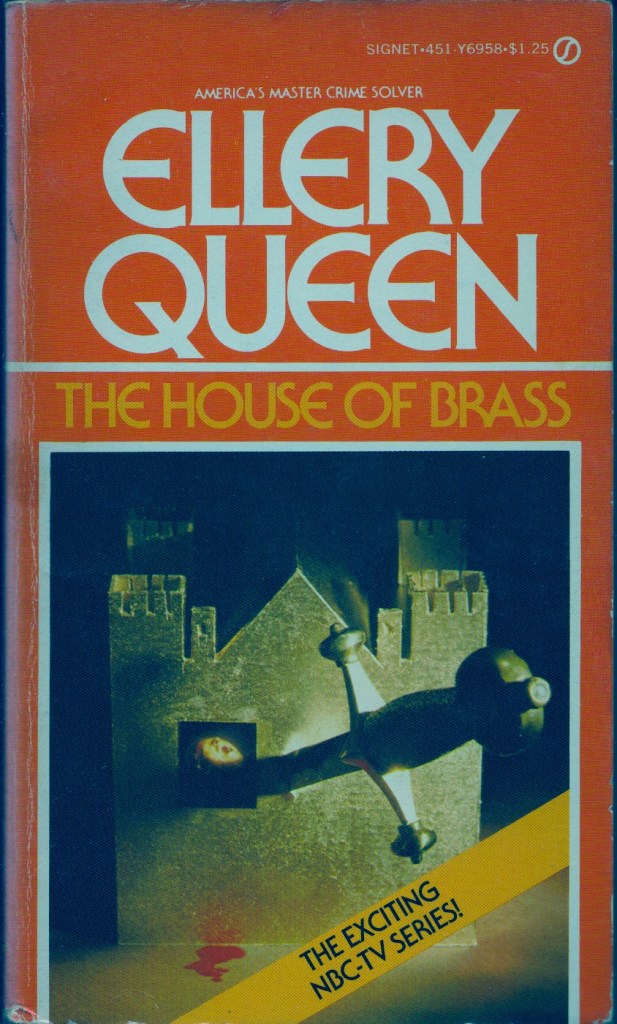
There’s a beautiful moment in the life of any reading child when he or she transitions from reading primarily children’s books to reading grown-up books. For me that switch came when I was about ten years old. I arrived one morning at school to find one of my classmates reading a paperback copy of The House of Brass by Ellery Queen. My first thought was, “Oh, so they make books about him, too?”

The fall of 1975 was the year I was in sixth grade. Every Thursday night, I had grown accustomed to watching actor Jim Hutton play Ellery Queen on TV. That short-lived series was just the sort of TV fare a family could watch together. The content was safe, the characters endearing. I loved that moment near the end of every episode when Ellery broke the fourth wall, telling us that we were now in possession of all the clues. Did we know whodunit? Watching from the comfort of our wood-paneled basement in New Jersey, my parents, my brothers, and I took this as our cue to start shouting solutions at the TV.

I loved that show. And although my father had probably mentioned that he used to listen to Ellery Queen on the radio back in the day, I assumed that Ellery was a new creation. That’s why I was so surprised to discover that there was, in fact, an author named Ellery Queen. I asked my friend to loan me his book when he finished, but he couldn’t. He’d promised it to another kid. Apparently everyone was reading Ellery Queen! What kind of friends were these, anyway, not to have mentioned this to me?

No matter. Our school library had a single Queen—a brown-leafed edition of The Siamese Twin Mystery. I read it over the next few days. Oh, it was so good! It was a moderately creepy tale that found Ellery and his father trapped in a country house with conjoined twins, their dead physician father, and numerous suspects. The Ellery in those early books was a little affected, but I don’t recall that bothering me much. Every time I read about Ellery and the inspector, I pictured Jim Hutton and David Wayne.

The local library had more Queen books, but before I borrowed a single one, I found myself struggling with what would develop in my lifetime as a fascination with book cover art and an incorrigible penchant for collecting. The hardcovers in the library were nice, but they were too heavy for my book bag, and the library would expect them back eventually. Plus, I really, really, really loved the look and feel of those shiny paperbacks. Another friend had come to school toting a red-and-pink edition of Face to Face, which I’d instantly coveted.

There was one way out. My brothers and I shared a newspaper route, which entitled me to a third of our profits. To this, my parents kicked in a $1-a-week allowance, which was doled out in most capricious manner, depending on my mother’s mood and our behavior in the previous week.

Suddenly I became the best-behaved, most competent paper boy the world had ever seen. Our local bookstore sold Queen novels for about $1.25. This meant that on my earnings, I could swing one, maybe two books a week. In this way I would satisfy my desire for pristine, colorful paper, and I would supplement my reading with books from the library until the next infusion of cash. Along the way, since this was my first encounter with series fiction, I would pester librarians and the bookseller for some clue as to the chronology of the series.

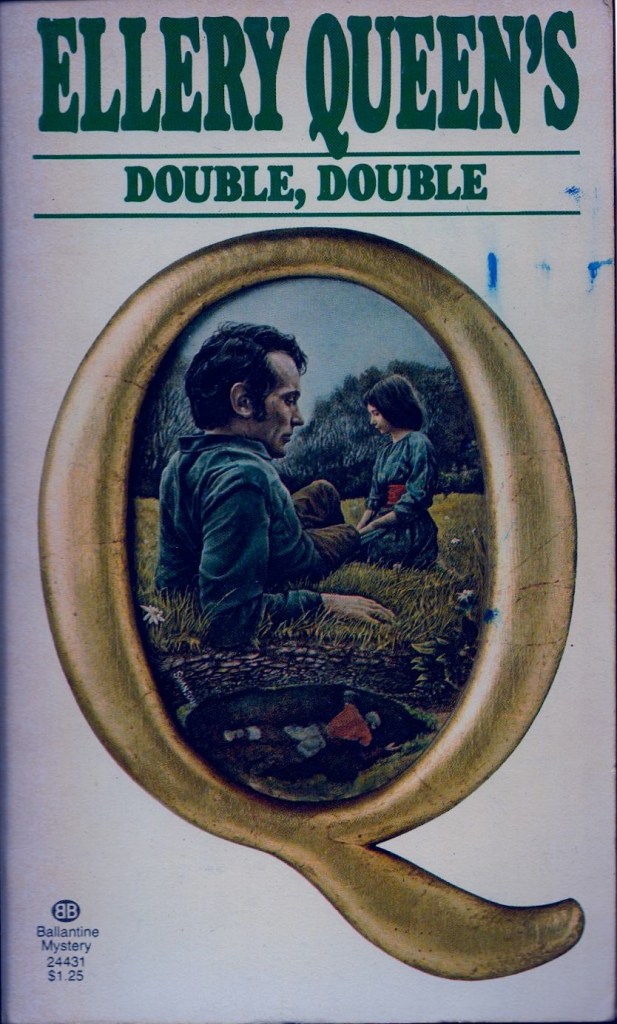
There were two species of Queen paperbacks in those days. The covers of the ones put out by Ballantine featured an original painting, typically of Ellery in a scene from the book. I liked that Ellery; he seemed like a soulful fellow. He wasn’t Jim Hutton, but he would do. The books published by Signet/NAL featured stylized photography.

At some point in the following year my bookseller informed me that I had read nearly everything she could order for me. The remaining Queens were out of print, a phrase I could not comprehend. If I had managed to lift my head out of my obsession, I would have read the writing on the wall. The TV show was dead in the water. My classmates had moved on to other diversions. It looked like I alone was still committed to Ellery.

With hindsight I can say that I liked the books for various reasons, some immature, some not. Ellery lived with his dad. I lived with my parents. He solved crimes with his dad. Hadn’t I attempted to solve crimes with my parents on those nights in front of the TV?

I came to cherish the Queen hallmarks. The dying clues. The anagrams. The visits to quaint Wrightsville. The scrupulous, fair-play logic. And most of all, the technique of revealing a provably false solution, followed shortly after by a far more diabolical (and correct) solution.

Beyond that, those books offered a compelling yet safe view of the adult world. Specifically, a safe view of Manhattan, the real-life city just across the river from where my family lived, and which would terrify me for years to come. Ellery’s solving of the murder in each book was an attempt to solve a puzzle, but wasn’t it also an act of profound decency? Without knowing it, I was unconsciously absorbing the code of traditional mysteries. As a nervous little kid, I must have found that message comforting.

It would be many years before I realized how strongly those books shaped my own writing. The narrative prose was conversational, detailed, engaging. Queen the writer was unafraid to break the very rules of grammar my teachers were trying to instill in me at the time. There’s one such broken rule in the opening lines of Cat of Many Tails. Which I loved.

The strangling of Archibald Dudley Abernethy was the first scene in a nine-act tragedy whose locale was the City of New York.

Which misbehaved.

But I soon found it increasingly difficult to complete my set of Queens, which pushed me to ridiculous lengths. In the back of the Signet/NAL paperbacks were order forms for titles that I could order directly from something called the New American Library, located in Bergenfield, New Jersey—only a few miles down the road!

I cobbled my money together, cajoled my father into writing a check, and sent my order off. It bounced back to me in a matter of days. A terse note said that they were unable to fulfill my order.

One afternoon when my parents and brothers weren’t around, I dug out my parents’ phonebook, looked up the number, and rang them up. I described my problem to the woman who answered. Why had they not sent me my books?

“We just don’t have them in stock anymore,” she said.

“Where are you located? Can I come visit your store?”

“We’re not a store. We’re a warehouse.”

This threw me. Their name was confusing enough. First, they were a library claiming to sell books. Now, they weren’t a store at all. I hung up, bewildered.

For a couple of years, I’d walk into bookstores, go directly to the mystery section, search the Q’s, and walk away dejected. I’d prowl flea markets and used book sales in search of those missing Q’s. Years later I would read how the dearth of Queen novels had lasted for decades, and has only recently been corrected by the issuing of e-books of the old titles. But this is how that long malaise felt to me, a fan on the ground. I was trapped in an analog world without the power of the Internet to broaden my search, and I lacked the savvy (and deeper pockets) to enlist the help of a rare book dealer.

One day I was seized by a highly original thought: This was crazy, but I could try reading one of those other books in the mystery section, couldn’t I? By then I was in high school, studying both Latin and Italian. I’d begun noticing a series of books whose covers almost cried out to be translated with my newfound skills in those languages. Let’s see, I thought. Rex means King, and Stout means fat. Nero means black, and . . .

Let’s just see what this kingly, fat, black wolf book was all about.

Posted in Books, Ellery Queen, Fiction, Genre, History, Novels | Tagged , , , , , , , , , | 8 Comments

“Playful Ghoulishness of a Crime Queen: The Short Fiction of P.D. James” (by R.T. Raichev)

R.T. Raichev is a lifelong fan of English crime fiction, even writing his university dissertation on the subject. His own fiction, which includes nine books in a classical whodunit series starring crime writer Antonia Darcy and her husband Major Payne, has received wide critical praise and comparisons to Evelyn Waugh, P.G. Wodehouse, and P.D. James. R.T. (Raicho) grew up in Bulgaria but has lived in London since 1989. He debuts in EQMM in our current issue (February 2016) and we have another of his stories coming up. Readers also won’t want to miss the latest Darcy/Payne novel, The Killing of Olga Klimt.—Janet Hutchings
R. T. Raichev; photo courtesy of the author

R. T. Raichev; photo courtesy of the author

The journalist Barbara C. Sealcock from the Chicago Tribune tells a story about interviewing P.D. James back in March 1985. As the two women were leaving James’s Boston apartment after tea, the famous author paused in the vestibule at a large black carved chest, lifted the lid and peered in. “This,” she said, “is where the bodies would be found.” Sealcock describes the moment as “pure Hitchcockian.”

I quote this mildly amusing anecdote because it suggests a kind of ghoulish playfulness on the part of Baroness James, of the kind not often found in her novels. Indeed British journalist Polly Toynbee has described James’s oeuvre as “sombre and scientific.” James—who died in November 2014—wrote twenty distinguished novels, an account of a Victorian real-life murder case, a play, a memoir, and an incisive analysis of the detective story. She has earned special praise for her psychological acuity, for transcending the limitations of the pure detective puzzle and moving into the realm of the novel proper, for being a serious writer worthy of a Booker nomination. She has been hailed as the mistress of the moral conundrum. But James also wrote a dozen short stories, all of which demonstrate a “lighter” side—a delight in experimentation, grotesquery and a mischievous penchant for bamboozling as well as shocking the reader.

I personally prefer James lite to the novels, most of which tend to be too “baroque” for my taste. The short stories James wrote between 1967 and 2006 manage to be at once sparklingly clever and darkly entertaining while the prose is what aficionados and cognoscenti have come to expect from her novels: extremely sophisticated, evocative, and inventive. I can’t resist giving an example of the latter. This is how a seemingly nondescript woman manages to startle the narrator of A Very Desirable Residence: “She gave me a swift elliptical glance . . . as astonishing as turning over an amateurish Victorian oil and discovering a Corot.”

What follows is an annotated list with my own very personal ratings of all of James’s 11 available short stories. There is a twelfth, “The Death of Memories,” published in something called The Red Book, which I haven’t been able to track down.

“Moment of Power” 1968, in EQMM

James’s first published short story, six years after her debut novel Cover Her Face. It won the 1st prize of the CWA contest sponsored by EQMM. An elderly man, “seedy . . . with his air of spurious gentility . . . neither a pilgrim nor a penitent”, revisits the place of a terrible event “under some compulsion he hadn’t even bothered to analyse.” If this description brings to mind Graham Greene—a writer whom James greatly admired—what follows is pure Hitchcock. (Think Rear Window crossed with Norman Bates watching Janet Leigh through a hole in the wall in Psycho.) The event in question is a murder that took place 16 years earlier. The elderly man is called Ernest Gabriel (“an odd name, half common, half fancy”) and it turns out he had been playing Peeping Tom, spying from his window on a couple in the building opposite. James offers a fascinating exploration of the murkier and more chilling instincts of the human mind. 5/5

“The Victim” 1973, in Winter’s Crime 5, London, Macmillan (first U.S. publication EQMM, 1984)

An “inverted” detective tale, as pioneered by Francis Iles, and the first of two stories of obsession and revenge. (“I couldn’t go on living in a world where he breathed the same air. My mind fed voraciously on the thought of his death, savoured it, began systematically and with dreadful pleasure to plan it . . . . Once a week as a special treat I would sharpen the knife to an even keener edge.”) The killer, a librarian by profession, is a strange and disturbing blend of the banal and the outlandish. In loving detail he informs the reader exactly how he set about killing the man who stole his bewitchingly beautiful wife from him. (Born a mere Elsie Bowman she later becomes Princess Ilsa Mancelli.) After the murder the wronged husband feels “drained of thought and energy . . . as if I had just made love.” One can’t help remembering Hitchcock’s words, “I shoot murder scenes as if they are love scenes and love scenes as if they are murder scenes.” The Victim would have made a good Hitchcock film. 4/5

“Murder 1986” 1975, in Ellery Queen’s Masters of Mystery, New York, Davis

A standalone and something of a curiosity as it is set in the bleakest of futures. It bears a number of similarities to James’s 1992 dystopian novel The Children of Men. (Both story and novel end with a tense confrontation between two men each pointing a gun at the other. This predates Tarantino.) The story was clearly inspired by Orwell (a Big-Brother-like “Leader” has a regular slot on TV) and Huxley (an embittered character spits out the words “brave new world”). In James’s 1986, society is divided into two groups: the superior Normals and Ipdics, carriers of the deadly “Disease,” which has destroyed most of the world’s population. The Ipdics are “inferior, unorganised, easily cowed.” When it comes to the murder of the title, its unravelling is pleasingly old-fashioned, made possible by Sergeant Dolby’s acute observational skills and the power of his grey cells. And there is a final devastating revelation in the very last paragraph of the story. NB Practically all the other of James’s short stories are about murder in the past. 4/5

“A Very Desirable Residence” 1977, Winter’s Crimes 8, Macmillan, London (first U.S. publication EQMM, 1991)

Murder of a schoolmaster—‘a middle-aged, disagreeable and not very happy pedant”—or what amounts to murder—to disclose more would be to spoil the surprise of the rather Machiavellian murder scheme. Shades of Roger Ackroyd—and another darkly ironic ending, in some ways similar to the one of The Victim, reinforcing the idea of the female of the species being deadlier than the male. The motive for the crime is in the title and it is not so dissimilar to the killer’s motive in Agatha Christie’s After the Funeral. NB While admiring Christie’s “conjuror’s art” James was far from enthusiastic about her writing skills. 4/5

“Great Aunt Allie’s Fly-Papers” 1979, in Verdict of 13, A Detection Club Anthology, London, Collins (first U.S. publication EQMM, 1991, retitled “The Boxdale Inheritance”)

A historical whodunit, the only short story to feature James’s regular detective Commander Adam Dalgliesh, my own favourite and one of the very best. Dalgliesh, like Josephine Tey’s Inspector Grant, investigates a murder in the distant past (pre-1914). The murder method is arsenic from fly papers soaked and used as beauty treatment (possibly inspired by the Madeleine Smith case). The interaction between the characters and the intricate plot show James at her most masterly and adroit. Dalgliesh manages to formulate a theory as to what happened at that fatal Edwardian Christmas party—but then he discovers there is a survivor—one of the participants is still alive, albeit very, very old, very ill, and in hospital. (“Here in the silence of the aseptic corridor Dalgliesh could smell death.”) The actual solution is completely unexpected as the killer turns out to be “the one person nobody considered.” And there is a last rather wonderful twist when a linen handkerchief is produced, “still stiff and stained with brown”, and placed in the Commander’s hand. 5/5

“The Murder of Santa Claus” 1983, in Great Detectives, New York, Pantheon Books

The first of two stylish takes on the Golden Age of Detective Fiction. A house-party murder that takes place in 1939, in the first months of the phony war. A villainous host (a bully, a cad, and a blackmailer) is stabbed on Christmas Eve while wearing a Father Christmas costume after receiving a threatening rhyme in a Christmas cracker. It is tempting to mention that 1939 was the year Agatha Christie’s Hercule Poirot’s Christmas was published. James’s story also brings to mind not only Ngaio Marsh’s 1961 Tied Up in Tinsel, in which the murder victim (a Colonel’s valet) was also dressed up as Santa Claus, but several other Marsh novels, in which a series of malicious pranks are a prelude to murder. The narrator is a crime writer remembering the time he had witnessed a real-life killing. Atmospheric and scrupulously clued, the story could easily have been expanded into a full-length novel, had Baroness James put her mind to it. Contains several post-modern and slightly parodic self-references—at one point the narrator says, “I was not an H.R.F.Keating nor a Dick Francis, not even a P.D.James . . .” NB By setting five of her stories when capital punishment was still practiced in Britain, James manages to ratchet up extra suspense and tension. 5/5

“The Girl Who Loved Graveyards” 1983, Winter’s Crimes 15, London, Macmillan (first U.S. publication EQMM, 1991)

As creepily Gothic as the necrophiliac title suggests, though there is an extremely interesting and entirely plausible reason for the main character’s obsession with graveyards. (“She made the cemetery her own . . . it was to remain a place of delight and mystery, her habitation and her solace.”) A disturbing event back in 1956 has caused “the girl” (we never learn her name) to suffer loss of memory and develop a morbid taste for “the earthy tang . . . as if the dead were breathing the flower-scented air and exuding their own mysterious miasma.” In later life she goes on a quest to find out what exactly happened. Did her father and “toad-like” grandmother really die of flu? The story has some affinity with Hitchcock’s Spellbound in which an amnesiac adult also seeks obsessively for what lies behind his fear of sharp objects. But the ending of James’s story is infinitely more shocking than that of Hitchcock’s film! Watch out for the cat Sambo and its role in the gruesome event. 5/5

“The Mistletoe Murder” 1991, in The Spectator magazine, London

Another whodunit set at Christmas and the narrator is again a crime writer—a female one this time, a young widow who, one suspects, has something of P.D. James about her. The year this time is 1940 and the War is very much on. (Blackout window curtains are important to the plot.) A small house party at Turville Manor in Hampshire ends in murder. The victim is again—in the best Golden Age tradition—highly unsympathetic, a greedy and ruthless blackmailer. The snowbound country estate, a uniformed cousin and references to battles raging off stage bring to mind Ngaio Marsh’s 1942 Death and the Dancing Footman. The solution is contained in the very last sentence. (Shades of Christianna Brand.) NB It is interesting that four of James’s murders take place during the season of cheer and goodwill. Perhaps Poirot is right when he says in Hercule Poirot’s Christmas, that it is a time when “. . . there will occur a great deal of strain . . . great pressure . . . to appear amiable . . . under these conditions it is highly probable that dislikes and disagreements that were trivial suddenly assume a more serious character . . .” 5/5

“The Man Who Was Eighty” 1992, The Man Who . . . , London, Macmillan (first U.S. publication EQMM, 1993)

The story was written for a celebratory collection on the occasion of Julian Symons’s 80th birthday. (Symons, at the time the doyen critic-cum-commentator of English detective fiction, had written several novels with The Man Who . . . in the title.) Here we see James at her most surprisingly skittish. The title of another Symons novel The Criminal Comedy of the Contented Couple could easily be given to this James story—though here the contented couple are not a husband and wife but a prosperous brother and sister who enjoy a Daimler-and-Poulilly-Fusse lifestyle. During a visit to their father at his luxurious nursing home, the impossible old man—who had driven away ‘a succession of housekeepers, except those who had been alcoholic, mad or kleptomaniac’—now confesses to murder. His name is Augustus Maybrick and he claims to have used arsenic to poison his brother—which suggests another post-modern joke. (Mrs. Maybrick was the notorious Victorian poisoner.) In Bloody Murder, his history of the detective genre, Symons says of James, “She would have been a distinguished representative of the Golden Age, to set beside Marsh and Allingham. It is the pressures of the times that has made her a modern.” 3/5

“Hearing Ghote” 2005, in The Verdict of Us All, London, A&B

James wrote this story for another tribute collection, commemorating fellow crime writer and critic H.R.F. Keating’s 80th birthday this time. It is Christmastime and an unpopular prep school master (a Mr. Michaelmas) is pushed off a cliff. The murder is witnessed by the pupil whom the master was accompanying on his journey to the manor belonging to the boy’s grandmother. The boy is the narrator and he is reading an Inspector Ghote mystery—one of H.R.F. Keating’s offerings—and decides not to give away the killer—whose action seems justified. Does Ghote stand for making controversial moral choices and erring on the side of kindness? For those unfamiliar with the Indian detective, that seems to be the implication. I personally thought Ghote’s formative influence on the boy—who grows up to be not only a detective story writer but a man of compassion as well—somewhat forced. Surely the story would have had a broader appeal without the boy “hearing Ghote”? NB This is the third James story in which a crime writer tells the reader of journalists asking him whether he has ever witnessed a murder at first hand. 3/5 (3 Minus)

“The Part-time Job” 2006, in The Detection Collection, London, Orion

One must mention the remarkable fact that what is surely James’s short story masterpiece was written when she was in her 85th year. (Compare to Christie’s sadly muddled last short story “The Harlequin Tea-set” written when Dame Agatha was 80.) “The Part-time Job” starts with the tantalising line, “By the time you read this I shall be dead.” What follows is an unsettling account of obsession and long-drawn-out revenge (a favourite theme with James, it would seem) told once more in the first person, by the killer. The narrator makes up his mind to commit this particular murder when he is 12 and he never changes his decision over the next 25 years. (This one puts you in mind of Poe’s “The Cask of Amontillado.”) It is the 1950s and the victim is the man who bullied the narrator at school, though the actual lethal revenge is not quite what you might think. Even when we believe we know what is going to happen, even after we have seen it happen, James delivers a staggering coup. The clue is in the title. The nature of the part-time job is revealed in the final paragraph. (So simple, so subtle, so chilling.) Baroness James’s last story, like her first, was deservedly awarded the CWA’s first prize—one can imagine James approving of the full circle, of the symmetry, of the neatness of the pattern. NB Given that she was a devout Anglican, a Conservative peer, and for a time a Magistrate in Middlesex and London, it is curious that ten out of her eleven murderers are, for various reasons, allowed to remain unpunished by the Law. 5/5 (Alpha Plus)

It seems incredible that her short stories haven’t been yet collected and published in one volume.

Actually, Baroness James did have a dead body discovered in a freezer—which comes very close to a chest—in her 2008 novel The Private Patient.

Posted in Characters, Fiction, Genre, Guest, History, Story, Writers | Tagged , , , , , , , , , | 8 Comments

MYSTERY ART

I spent part of this week looking over comments on the Readers Award ballots EQMM received for the 2015 awards. One reader suggested that we institute an award for artwork—covers, interiors, or both. In general, I think honoring artists is a wonderful idea, although currently the terms of an award would be difficult to craft, since we have been shifting back and forth between photographs and paintings for our covers, and even the paintings we use nowadays (in this era of internet-available stock art) often are not original to our magazine. That said, we greatly value the contributions of our artists and photographers, and I want to devote this post to some reflections about mystery art/illustration.

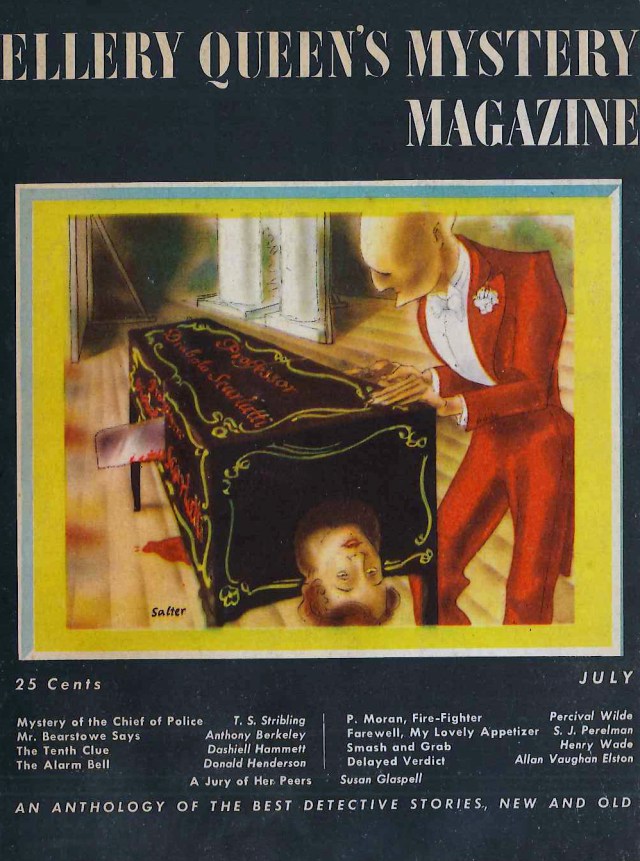
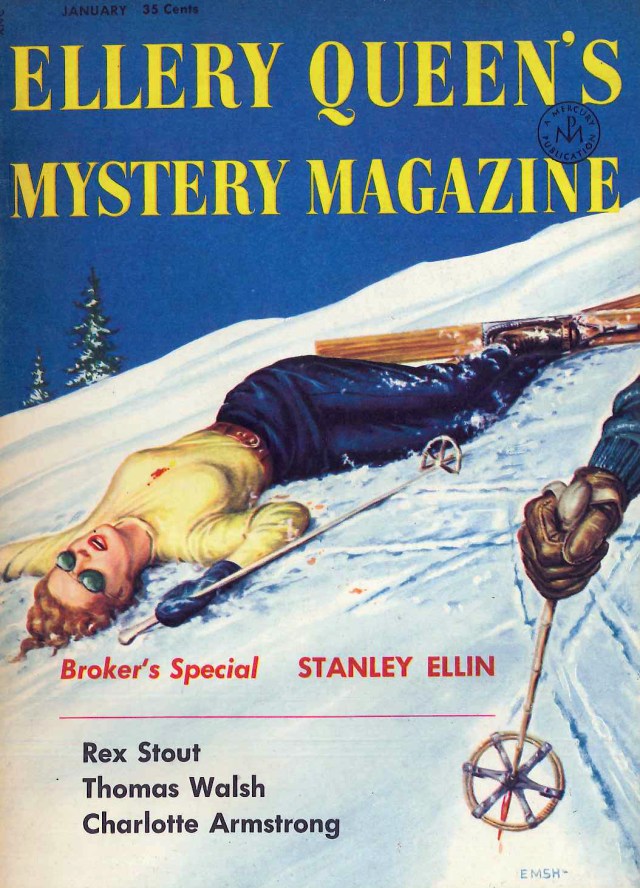
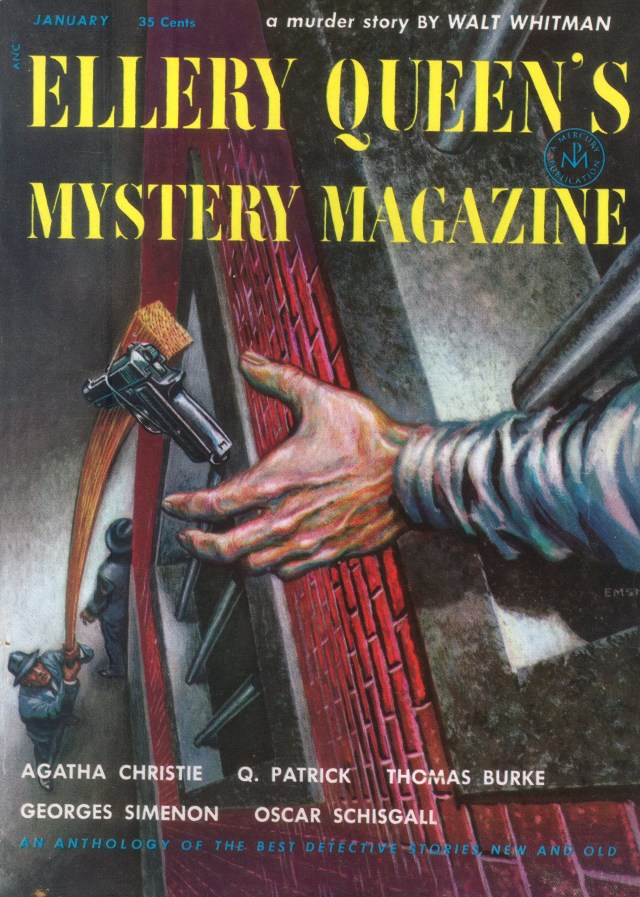
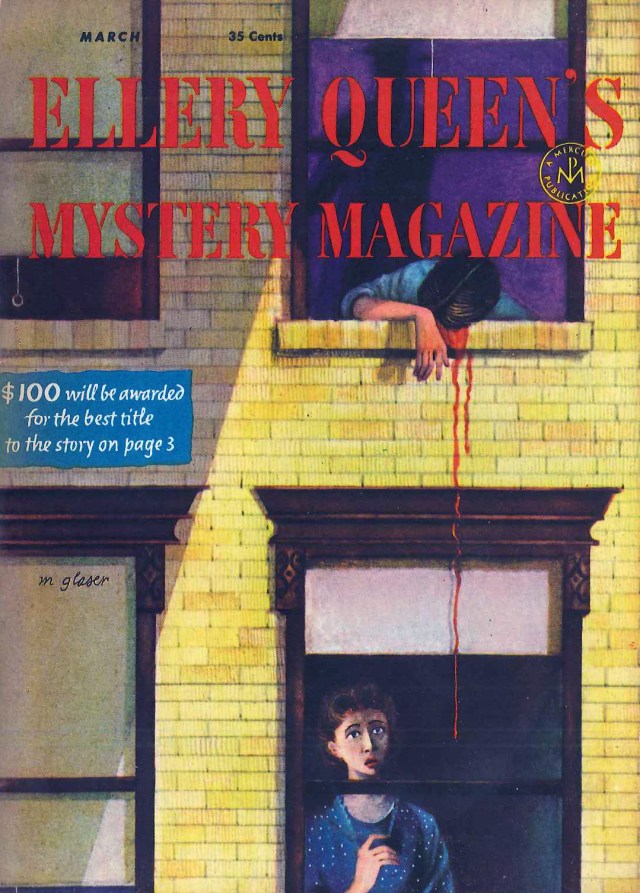
EQMM’s earliest cover artist, and art director, George Salter, was one of his generation’s most distinguished illustrators and book designers. When his own original work wasn’t featured on our covers of the 1940s and ’50s, he brought in other top names in the field, people like Ed Emshwiller, who is probably best known in the world of science fiction, but who also did work for mystery publications. In 1954, Milton Glaser, an artist who would become one of this country’s most famous designers, debuted as a published artist with a cover for EQMM. In celebration of EQMM’s 75th anniversary there will be an exhibit at Columbia University’s Butler Library (mid September through mid November 2016), which will include some of this art. And our September/October 2016 cover will feature entirely new art by Milton Glaser.

Given that mystery magazines and books once used many of the same illustrators who worked in the science fiction field, it’s interesting that over time art appears to have become less important in the mystery field while maintaining its status in science fiction. One piece of evidence for the prestige artists enjoy within the science fiction fan community is that the Hugo Awards include not one but two art categories: Best Professional Artist and Best Fan Artist. Science fiction also has the Chesley Awards and the Spectrum Awards (winners of the latter published in a yearly art anthology). Mystery’s Anthony Awards, by contrast, include an art category only intermittently: By my count, just seven times in the history of the awards have Best Cover Art nominations been sought (the last time in 2009). Left Coast Crime, one of the smaller mystery conventions, instituted the Arty, a Best Cover Art award, in 2003, but I have not seen it listed as a category recently. There’s no question, I think, that mystery falls short of science fiction in its acknowledgement of the work of its visual artists.

Notice too that those Hugo Awards are given to the artist, rather than for a particular piece of art. I wonder how many mystery fans could even name an artist currently working in our field. Authors may know the names of the artists who worked on their own book covers, but there don’t seem to be many artist names that are generally known in our field anymore—certainly not in the way they were known in EQMM’s early days.

It’s good to be reminded that art was once more central to the mystery. A 2003 show at the Brooklyn Museum gathered a number of the few hundred paintings that survive from the pulp cover art of the 1930s, 40s, and 50s—a lot of it in the mystery field. Though most of the artists of that period were paid little for their work, painting over their own canvases once a cover had been shot to save the price of a new canvas, many enjoyed large reputations. Artists like Raphael DeSoto, who did many mystery covers, had their work booked a year or more in advance. EQMM’s George Salter had an international reputation and did book covers for a number of famous authors. I hope there will be another major show of that sort before long, so that a new generation will be made aware of the work of these classic genre artists.

For a number of years (roughly from 2003 to 2010) EQMM used reprints of classic pulp and early digest-magazine art for its covers. For a time, readers responded well, and we received an exceptionally large number of letters thanking us for bringing the work back. But in time, we began to get requests for a change, and I had to agree that it was due. In search of a new and distinctive look we transitioned largely to noir-style photographs inset in a solid background with type. And most recently, with the beginning of 2016, we have returned to full-cover art—mostly paintings—with a wider range of subject matter in the images than is typically found in pulp art.

It is tempting to think that mystery art reached a peak during those pulp and early digest-magazine years that it hasn’t been able to equal since. My guess is that it’s the themes and subject matter of that period that would come to most people’s minds if they were asked what typifies a mystery illustration. But there are many very talented artists working in the field today, and their work deserves wider recognition. One reason they often get overlooked may be that there isn’t a specific “look” that can be identified with the present day that also proclaims itself to be about mystery—not in the way that a dame in a bar, smoke rising from her cigarette, could do that on a pulp cover, anyway. You don’t even need the props of a gun or knife or poison once that classic scene is set.

I’d very much like to know what our readers’ views are about cover art, and which styles of art our readers like best. Please don’t hesitate to give us some feedback about our new cover look, and about what you find most evocative in a mystery cover. You’ll find a few examples here of EQMM covers from different periods of our history, and also some samples of the work of the artists who do interior illustration for us. Please weigh in!—Janet Hutchings

salter

Cover art by George Salter, 1940s.

emsh

Cover art by Ed Emshwiller, 1950s.

emsh22-EQ0154

Cover art by Ed Emshwiller, 1950s.

Cover art by Milton Glaser.

Cover art by Milton Glaser, 1950s.

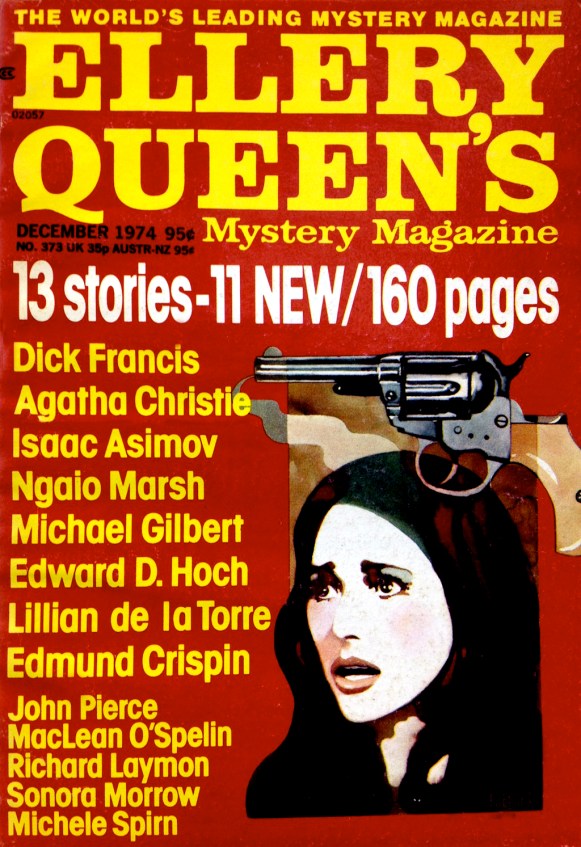
Cover art, 1974.

Cover art, 1974.

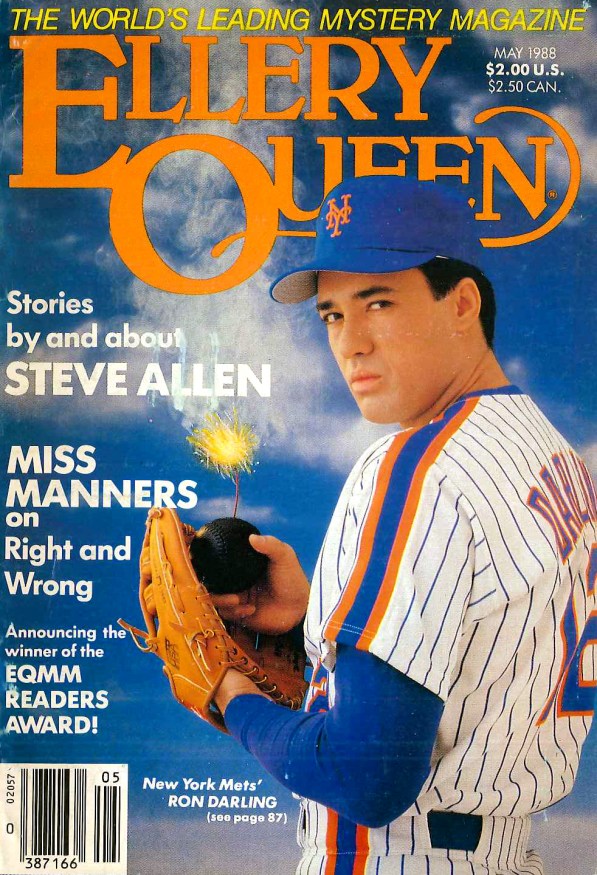
Celebrity cover, 1980s.

Celebrity cover, 1980s.

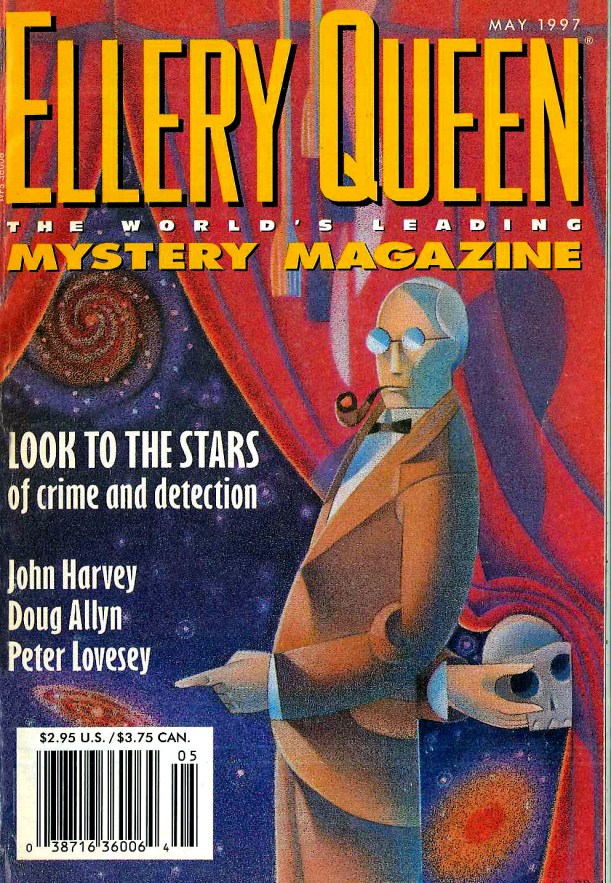
Cover art, 1997.

Cover art, 1997.

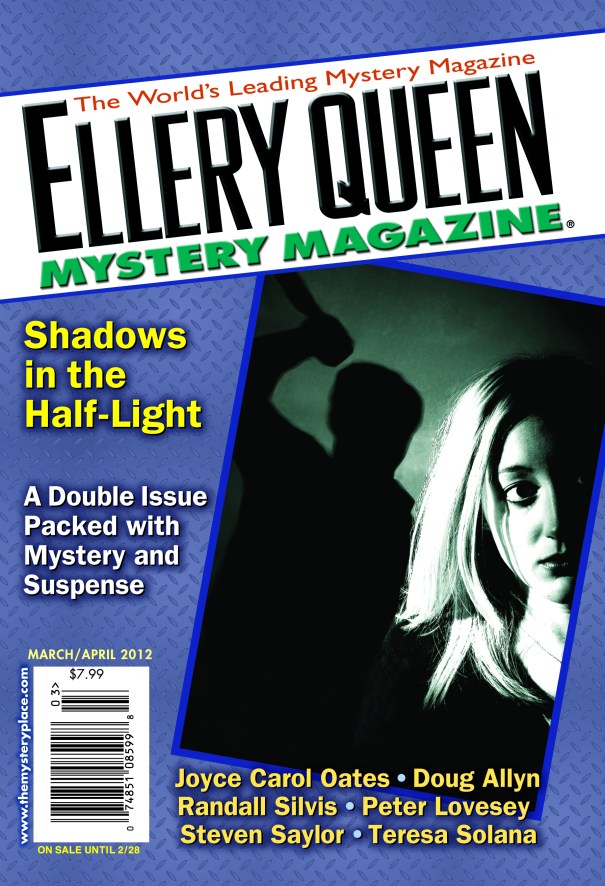
Cover with photo inset.

Cover design with photo inset, 2012.

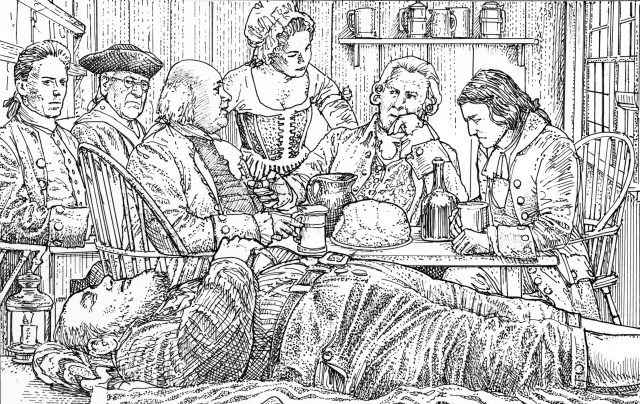
Interior art by Allen Davis, December 2015.

Interior art by Allen Davis, December 2015.

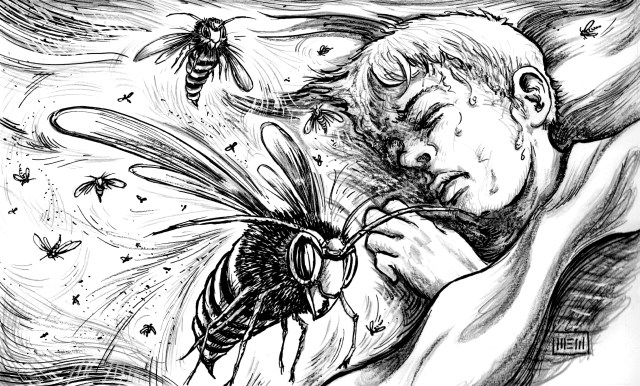
Interior art by Mark Evan Walker, August 2014.

Interior art by Mark Evan Walker, August 2014.


Posted in Awards, Business, Ellery Queen, Genre, History, Illustration, Magazine | Tagged , , , , , , , , , , | 5 Comments

“What I Know” (by Steven Gore)

Steven Gore last posted on this site on July 8, 2015, just as the EQMM issue that contained his story “Black Rock” was going on sale. The private investigator turned author of short stories and seven novels (the latest of which is White Ghost, from William Morrow, March 2016) returns today with some reflections about “the emperor of all maladies” and how it has entered into his crime fiction.—Janet Hutchings

The great crime novelist Ross MacDonald wrote about his protagonist, “I wasn’t Archer, exactly, but Archer was me.” So it is with Graham Gage, the protagonist of White Ghost (William Morrow, March 2016). Not only do Gage and I share the same sense of the world and walk the same moral landscape, but he knows the rough ground of crime and the hard people who make it so only because I traveled there and learned it all before him. And he knows how to live in the shadow of death only because that shadow fell over me first.

As I approached my seventh novel, it seemed to me it was time to display at least some aspects of what that life is like. And not for my sake, but for others who live, have lived or will live, or who will die, in that shadow. And what I learned over the last fifteen years of biopsies and chemotherapy, of examining rooms and hospitals, of radiology labs and infusion centers is that contrary to the mythology of panic and terror, of collapse and paralysis that surrounds cancer, we carry on. Except for those who have been inflicted with forms that are too disabling or who survive only weeks or months—we carry on: Mothers mother. Fathers father. Workers work. Sellers sell. Writers write. Doctors doctor. Liars lie. Cheaters cheat. Predators prey.

We are who we are and do what we do.

Regardless of what our initial reaction to the diagnosis might have been—rage, fear, resignation, self-estrangement, or self-pity—it fades.

Regardless of the promises we might have made to ourselves—to be kind or generous or Zen-like in our equanimity—we return to whoever we’ve always been.

Regardless of the ways in which we might have viewed ourselves—as patients, victims, sufferers, warriors, or survivors—in the end we rediscover who we’ve always been.

Regardless of the ways we think the world has been changed and remade—brighter or dimmer, engaging or indifferent—in the end we find it is the same world and we are the same in it—

And we carry on.

All this should be obvious. And it certainly is, inside infusion rooms and radiation oncology departments and in all the other places where patients are diagnosed and treated. But outside, in fiction and in memoir, on talk shows and in films, and in the cottage industry of self-help and popular psychology, the mythology lives on. And White Ghost is partly an attempt to combat it.

The adversity Gage faces in the novel is more urgent than mine, a chronic and often treatable, but ultimately incurable form of lymphoma. The oncologist’s original prognosis of my time from diagnosis through treatments to death turned out to be overly conservative and I rode, am still riding, the prognostic bell curve, first traveling up and then down the sweeping arcs, and now along the thinning tail. Indeed, I worked for another nine years in scores of places around the globe before I reached the sort of moment in Gage’s life when the story begins.

But by then I was transitioning from investigator to writer and whatever discomforts I underwent in treatment were compensated for by my undergoing them in the company of my wife and in the comfort of my home. My commute was no longer to my office downtown, but only to a converted bottom-floor bedroom. My lunch, just a short climb up the stairs. A nap, just one more flight.

While there is never a good time to undergo cancer treatment, my two years began during a busy period. I was performing the final edits of the first Gage book, finishing and editing the second one, and writing the second Harlan Donnally novel. It also occurred while I was investigating a homicide that occurred ten years earlier, one of my last cases.

According to the local police department, a young man in his twenties, found dead in a basement, had been beaten by drug dealers a few weeks earlier and had died of his untreated injuries. During the intervening decade, no one had been arrested, no suspects even identified. The case was old, cold, and closed.

It had been many years since I’d worked in the tough parts of the Bay Area. My practice had developed into one that found me working more often in London, Kiev, or Chennai than in San Francisco, Oakland, or San Jose, and investigating this death meant for me, as for Gage in White Ghost, going to once familiar places and relying on people from the past to catch up to the present.

In searching the housing projects, skid-row motels, and drug corners for witnesses, I found myself surrounded by death, and not only because of the reminders provided by my continuing visits to the Stanford Cancer Center. Driving around those streets was like walking through a cemetery, one not made up of headstones and crypts, but of sidewalks and corners, streets and alleys, front steps and backyards, empty lots and abandoned houses, each a reminder that many of those in the generation I once knew and on whom I had once relied to get me to the facts behind the tales were dead.

As I was talking to an old-timer outside the liquor store at Eighth and Campbell in West Oakland, I thought of Stymie Taylor, a damaged man who’d spent much of his life in prison, but who many times knew someone or something that helped me get to the truth. I stopped in to visit his mother, who had been at his bedside when he died. By then she’d outlived four of her children. She told me Sunday dinners had become a time of empty chairs.

Driving past a drug-dealing spot in East Oakland, I thought of Henry Scott, a cunning man who’d done a lot of bad in his life. I saw him last when he dropped by my office about a dozen years ago. I’m not sure why he came to see me and I’m not sure he knew why either. I was long out of his world, but by his walk and his talk, I understood the place he still held in it. I told him if he stayed in the Bay Area, he’d be a dead man; and a couple of months later he was, shot down outside a bayside nightclub.

And there were many more. Way too many more.

I passed the corner flower shop near the Sixty-Fifth Avenue housing project, within gunshot distance of hundreds of murders in the previous thirty years, and I remembered a sign I’d seen in the window in 1986: Funeral Sale. There are so many things wrong with that phrase, so disturbing anyone would even think it, I’ll just let the image of that storefront speak the thousand words for itself.

I drove through the once infamous intersection of Ninety-Eighth and Edes where in 1989 I had been trapped as men shot at each other from opposite corners. At least I’d had my car’s sheet metal around me. The people running and ducking didn’t. Six rounds were exchanged in seconds, the gunfight was over, and the shooters fled, leaving nothing behind but lead and a memory.

Hairless, fatigued, pale, infused with chemotherapy drugs, and on the hunt for witnesses, I walked into the courtyard of an apartment building where I had been told one was living. It was also where years earlier a drug dealer had me at gunpoint. It struck me that if he’d pulled the trigger I wouldn’t have lived to die of cancer. I saw where I’d been standing and where he’d been standing, a dead strip of concrete on which there had occurred a live moment. I remembered his hand coming up out of his pocket and the look in his eyes.

They say cancer is the emperor of all maladies. At least on that day, it wasn’t. It was a man with a gun.

In the end, it had turned out to be just another day in the life. He went his way. And I went mine.

Ultimately, I located witnesses who told me that the men who had beaten the victim and inflicted the injuries that led to his death weren’t drug dealers at all: They were undercover police officers, and the homicide detective assigned to the investigation had known it almost from the start.

Based on the testimony of these witnesses and admissions by some of the officers involved, a federal judge later ruled that the department had engaged in a decade-long cover-up. In truth, the injustice went far beyond the death and the conspiracy. Not only did the detective remain in the homicide unit even after his role in the case became known inside the police department, but upon his retirement, the district attorney, the chief law enforcement officer in the county, hired him to work as an inspector in her office. And the lieutenant who supervised the officers, who was present at the time of the assault and who engaged in what the department admitted was an attempt to influence officers’ reports of the beating, was assigned to head the internal affairs unit and promoted to the rank of captain.*

I considered using the death of this young man as the basis of a Harlan Donnally novel, but unlike the mayors, city council members, judges, prosecutors, police chiefs, and city managers who served during these years, no reader of fiction would tolerate this kind of ending. And many of these endings have there been. The recent unjustified police killing of Laquan McDonald in Chicago is another. It, too, was followed by an attempt to conceal the truth. Not only the officer who did the shooting, now charged with murder, but five other officers on the scene claimed in their reports that McDonald “was aggressively swinging his knife and was moving toward the police” at the time he was shot. The video, to the contrary, shows he was walking away.**

The readers of my Harlan Donnally series understand my view of how law enforcement and political structures can develop in which these immoral and criminal practices become institutionalized, so I won’t repeat that here. But the issue does raise the question of the role of crime fiction in public discourse and returns us to the point of White Ghost.

I certainly had mixed feelings about taking it upon myself to try to demythologize cancer. A writer reflecting on his own illness in print, even in fiction and by way of a character, is uncomfortably like those politicians, sports figures, and celebrities who rush to afternoon talk shows the day after receiving their cancer diagnosis to exploit the mythology in order to prompt and then accept the public’s sympathy. I think that’s why I waited fifteen years and seven books before I decided to take this on. I finally concluded that I should make the attempt because, simply put, the argument was worth making and it was probably a good idea for someone with a little experience to make it. The bad news about having cancer for fifteen years is that you’ve had cancer for fifteen years. The good news is that you have time to learn a few things. And one of those things you learn is that those with cancer—whether investigators, plumbers, parents, programmers, or politicians, sports figures, and celebrities—carry on: We are who we are and do what we do.

Some of Gage’s thoughts in White Ghost are ones I had as I searched for witnesses, and they are at least some of the thoughts all cancer patients have as we carry on. Among other things, it meant thinking about time and what is worth spending it on and a reminder that the young man whose death I was investigating died at about the same time as I was first diagnosed. His life was stolen, beaten out of him by fist and boot, but mine remained—it still remains—my own to spend. And at least some of that time I chose to spend walking Graham Gage and Harlan Donnally, and their readers, through the landscape on which I have lived much of my life.

In the end, the decision to publish White Ghost was driven by the recognition that the connection between Gage and me in illness is not much different than the connection between Gage and me as private investigators: both inform my fiction, just as both have informed my life.

Writers are told to write what we know, and this is what I know.

* The death is well documented in court rulings and news reports: Northern District of California, Docket No. C 09-01019 WHA, The Estate of Jerry A. Amaro III; Geraldine Montoya; Stephanie Montoya, Plaintiffs, v. City of Oakland; E. Karsseboom; R. Holmgren; S. Nowak; M. Battle; C. Bunn; M. Patterson; T. Pena; Edward Poulson; Richard Word, Defendants. United States Court of Appeals, Ninth Circuit, Docket No. 10–16152, The Estate of Jerry A. Amaro III; Geraldine Montoya; Stephanie Montoya, Plaintiffs–Appellees, v. City of Oakland; E. Karsseboom; R. Holmgren; S. Nowak; M. Battle; C. Bunn; M. Patterson; T. Pena; Edward Poulson; Richard Word, Defendants–Appellants. “Court-Oakland Cops Stonewalled Beaten Man’s Mom,” San Francisco Chronicle, July 28, 2011.
**  http://www.nytimes.com/2015/12/06/us/officers-statements-differ-from-video-in-death-of-laquan-mcdonald.html: “At least five other officers on the scene that night corroborated a version of events similar to the one Officer Van Dyke, now charged with murder in the shooting, gave his supervisors: that Mr. McDonald was aggressively swinging his knife and was moving toward the police, giving Officer Van Dyke no choice but to start shooting.”
Posted in Books, Characters, Fiction, Genre, Guest, Thrillers, Writers, Writing | Tagged , , , , , , , | 3 Comments

“Report from Baker Street” (by Steve Steinbock)

Steve Steinbock is well known to EQMM readers. He has been the magazine’s regular book reviewer since 2011 (relieved twice a year by longtime EQMM reviewer Jon L. Breen). In EQMM’s March/April 2010 double issue he debuted as a fiction writer with the story “Cleaning Up.” Most of his literary output to date, however, has been in the critical field. In addition to his regular EQMM column, he has written a variety of articles and conducted several interviews for our magazine. Steve is also an editor of note. His latest project is the recently released The Future is Ours: 31 Tales of the Fantastic by Edward D. Hoch (Wildside Press, TPB $14.99, HC $29.95), which contains science fiction, horror, and alternate history stories by one of the most important contributors in EQMM’s history. Steve’s introduction to the book completes a volume all Ed Hoch fans will want to have.—Janet Hutchings

I was in New York last week for the annual Baker Street Irregulars Dinner. I was invited on behalf of EQMM. For years, EQMM’s February issue has been a celebration of Sherlock Holmes, and each year, for the Baker Street Irregulars (BSI) dinner, we have provided copies of that issue for all attendees. The invitation came from Mike Whelan, the president of BSI, who said the organization wanted to show their appreciation to EQMM for our support of the organization and our enthusiasm for Sherlock Holmes.

I’m getting ahead of myself. There may be some readers unfamiliar with the BSI.

In Conan Doyle’s original stories, there was a band of street urchins, led by a boy named Wiggins, whom Sherlock Holmes would enlist to help in his search for clues. Holmes referred to the kids as the “Baker Street Irregulars.” In 1934, essayist/journalist Christopher Morley gathered a dozen or so men Holmes aficionados, including novelist Vincent Starrett and actor/playwright William Gillette, for a dinner in New York to celebrate the “Great Detective.” And the BSI, one of the world’s preeminent literary societies, was born.

Membership to the BSI is rather elite. Each year a few new members are admitted based on their scholarship, participation in smaller “Scion” societies, and dedication to all things Sherlockiana. Each new member is given a title or nickname taken from the Conan Doyle canon. This process is called “Investiture.” The BSI did not admit women as members until 1991.

It was quite an honor to be invited to the dinner, and so I was excited to attend.

I took a “red-eye” flight from the West Coast on Tuesday night. I’m one of those people who can only fall asleep in a bed, so the likelihood of getting any rest on the way to New York was slim. One of the challenges of arriving for an event so early in the morning is that hotels rooms are usually not available for checking in until the afternoon. In this particular case, very late in the afternoon. So I was terribly tired by the time I got into my hotel room. As I unpacked I discovered that the socks and underwear I’d set out for myself were probably in my closet back home, since they were nowhere to be found in my luggage. I also realized that my tuxedo trousers were probably in same closet, still on their hanger, and not with the rest of the tuxedo in New York.

I would have to do some shopping.

The Sherlockian weekend got off to a start with the Distinguished Speaker Lecture on Thursday night. This year’s speaker was playwright and screenwriter Jeffrey Hatcher, author of the stage plays Dr. Jekyll and Mr. Hyde and Sherlock Holmes and the Adventure of the Suicide Club, as well as the screenplay for the 2015 film Mr. Holmes starring Ian McKellen. Hatcher gave a thoroughly entertaining talk about the various castings of Sherlock Holmes on stage, film, radio, and television. He told various personal anecdotes, including experiences working with Ian McKellen, and a time when the playwright had to step in and play the role of Holmes in one of his plays when the lead actor, for medical reasons, was unable to perform.

When I arrived, I was at first lost in a sea of unfamiliar faces. Peggy Purdue, curator of the Arthur Conan Doyle Collection at the Toronto Reference Library, whom I’d met and worked with several times in the past, helped me out by making a few introductions. But soon I spotted a number of old friends, including Terence Faherty, S.J. Rozan, Jan Burke, and Dana Cameron, all of whom should be familiar to EQMM readers for their short stories. Leslie Klinger, the attorney responsible for the “Free Sherlock” Supreme Court case was there, as was novelist Lyndsay Faye and Sherlockian scholar Peter Blau.

Friday evening I dressed up in my tux. My pair of black chino slacks went well with the rest of the tuxedo. I prayed that the lighting would be dark enough that no one would notice.

At the dinner itself, I found myself assigned to a table directly in front of the stage, seated with an impressive array of tablemates, including BSI President Mike Whelan, BSI Board members Tom Francis and Bill Vande Water, Jeffrey Hatcher who was the distinguished speaker from the previous evening, novelist/screenwriter Nicholas Meyer, and Pulitzer Prize winning Washington Post writer Michael Dirda.

To my left sat Bert Coules, a BBC playwright/producer who had adapted the entire Sherlock Holmes canon for BBC Radio. Coules’ credits also include radio adaptations of work by Val McDermid, Ian Rankin, G.K. Chesterton, and Ellis Peters.

The Program consisted of various rituals, songs, and speeches. Bert Coules spoke about Edith Meiser, an actress and maverick radio writer/producer who brought Sherlock Holmes to radio in the 1930s and 40s.

Since this year marks twenty-five years since women were fist admitted into the Baker Street Irregulars, there were several entertaining presentations celebrating women’s roles in the organization.

It was also during the dinner that I was invited to the lectern where I was given a plaque. It reads:

A Tip of the Deerstalker
to
Ellery Queen
Mystery Magazine
For many decades our friends at EQMM have
published a special Sherlock Holmes issue early
each year and donated large numbers of copies for those
attending The Baker Street Irregulars Weekend. How
prescient they have been in recognizing the truly
amazing longevity of literature’s most enduring and
popular character. Also, we fully appreciate EQMM’s
reviews of our Baker Street Irregulars Press titles.
with gratitude
The Baker Street Irregulars
January 15, 2016

My voyage home turned out to be as venturesome as my trip there. A light snow fell on New York City on Sunday morning. It wasn’t a lot, but it was enough to delay my departure from JFK by two hours. Six hours after that, I arrived at Seattle-Tacoma International Airport just in time to miss my connecting flight. And so I spent the night at SeaTac, wandering the empty terminals, pausing to read, work, and sip coffee. It gave me plenty of time to consider my takeaway from the BSI Weekend.

I was struck by the membership’s intellectual demography. This was a group that consisted largely of academics, attorneys, business executives, and other professionals, all of whom possessed a playfulness as well as a strong attraction to the workings of the mind, as demonstrated in the Sherlock Holmes stories.

The attendees also demonstrated a profound dedication to the literature of Sherlock Holmes and to Sir Arthur Conan Doyle. This was a very literary group, to be sure. But their focus was Doyle and Holmes, the stories, the characters, and the world of a London lit by gas street lamps and echoing with the clap-clap of hansom cabs.

My final observation about this group and their organization was attention to history. I don’t mean the history of late-Victorian and Edwardian England, although that is certainly something that the attendees appreciated. I mean to the sense of history of their organization. The entire event was punctuated by rituals, songs, and retrospection. One of the major activities of the Baker Street Irregulars is archiving their own history, and they do this with joy through oral histories, photographs, and preservation of documents. I had the impression that the BSI’s exclusion of women members for its first 57 years was for reasons of sexism or male chauvinism—not entirely, anyway—rather it was out of respect for tradition. This respect for tradition even came through as various speakers talked about their own defiance of tradition in 1991 that led to the change in the BSI’s membership policy.

I hope to return to some future BSI event. I also plan to explore local Sherlockian gatherings. Most importantly, I’ll look back to my first BSI dinner with fond memories of warmth, mental cogitation, and a love of a very specific history.

Posted in Awards, Books, Characters, Conventions, Fiction, Genre, Guest, History, Holmesian | Tagged , , , , , , , , , , , | 4 Comments

“Drunks on Character” (by Suzanne Berube Rorhus)

Suzanne Rorhus got her start as a writer in EQMM’s Department of First Stories in May 2013. Since then, her work has appeared in several anthologies, including Memphis Noir. Her next EQMM story, “Cletus Vanderbilt and the Theft of Lord Ashbury,” scheduled for March/April 2016, is very different in style and mood from her earlier piece for us; it’s a humorous tale, set in her native South.  Suzanne is an alumna of the Squaw Valley Community of Writers. In this post she deals inventively with several topics of interest to writers—and to readers as well.—Janet Hutchings

Charles Dickens, Aristotle, and Elmore Leonard walked into a bar. Charles removed his top hat and ran a hand through his white hair. “What weather!” he said. “I could use a drink.”

Rollo, the joint’s bartender for the last thirty years, hailed them. “Well, look who the wind swept in! You three look like the setup to a lousy joke.”

“Go polish some glasses, Rollo,” Charles said. “Are you going to serve us or not?”

“Sure, sure, just sit anywhere. No need to get snippy.” Rollo turned his back on the group and focused his attention on the football game displayed on the small television mounted over the bar.

“That Rollo. He’s such a character,” Aristotle said, seating himself at a small, battered wooden table in the corner.

“He never changes,” Elmore said. “Such a card.” After sitting, he reached for a cocktail napkin from the dispenser on the table and used it to wrap up the wad of gum he’d been chewing.

“Is that your definition of a character?” Charles said. He removed his pocket handkerchief and rubbed a spot on his chair. “That he be unique and never change?”

“Well, that’s a useful definition for a stock character like a bartender,” Elmore said. “He needs to be drawn in a few quick strokes. He needs to be real enough, even though he isn’t worth more than a line or two to the story.”

“Who are you calling worthless?” Rollo said. He approached the table bearing a tray laden with their usual drinks; beer for Elmore, ale for Charles, and wine for Aristotle. He passed out the drinks, sloshing each one.

“No one says you’re worthless,” Elmore said. He wiped up the spilled beer with a handful of napkins and tossed the sodden mess onto the center of the table.

“Though in fact you are,” Dickens amended.

“But your part in the story’s drama is so minor as to be nonexistent,” Elmore said. “A flat character like a bartender, unless the story is about a bartender, is more comparable to a piece of furniture than a person. Similar to a hat rack, he is worth describing but not worth dwelling on.”

Rollo wiped a tear with the back of a massive paw. “That’s kind of harsh, don’t you think? Calling me a hat rack? I have a mother, you know. I have friends. I won third prize in the science fair in fifth grade. I’m a person, not a hat rack.” He sniffled then snorted up the phlegm that threatened to leak from his nose.

“I’m sure you are an interesting person once we get to know you,” Charles said. “And maybe, just maybe, you could be the protagonist of your own story someday. But in our story, you’re just background noise. The purpose in sketching you lightly is to give the impression of “person-ness” without wasting a great deal of space. Like the tip of an iceberg, see?”

“So I’m a waste of space and a huge hunk of ice? In addition to being a hat rack? I hope you gentlemen weren’t planning on ordering a second drink. Your custom isn’t welcome here.” Rollo stalked off, leaving the three men staring at his back.

“Well, you’ve done it now, Charles. You’re a regular Scrooge. Why’d you have to go and hurt his feelings?” Elmore took a long pull on his drink.

“You’ll need to apologize,” Aristotle said. “I wanted to order appetizers.”

After further urging, the two men persuaded Charles to follow Rollo to apologize and to place their order for hot wings, a soft pretzel with honey mustard, and mozzarella-cheese sticks.

Once Charles was out of earshot, Aristotle turned to Elmore. “Is it me or is Charles becoming crankier with age?”

“Not just you. His character arc is diving right into the toilet.”

“I guess that makes him the protagonist,” Aristotle said. “If you are saying that he is the one who most changes during this narrative.”

“Hogwash,” Elmore said. He scooped up a handful of peanuts and shoved them into his mouth. “I’m the hero of my own story.”

Aristotle selected a nut. “We are all the center of our own universes, are we not? Even Rollo believes that the stars and planets revolve around himself.”

Charles lowered his considerable bulk onto his chair. “Happy now? He hugged me, can you believe that?”

“Did you catch The Big Bang Theory?” Elmore asked, eager to change the subject. “I’ve been watching reruns. Last night I watched the episode where Sheldon Cooper waxes poetic about the value of science.”

“Ooh, I missed that one,” Aristotle said.

“It’s a classic. Sheldon said science ‘tears off the mask of nature and stares at the face of God.’”

They paused their conversation while Rollo tossed the baskets of food onto the table. A chicken wing flew out and bounced off Aristotle’s knee, leaving a smear of wing sauce on his toga.

“Isn’t Sheldon an atheist?” Charles asked. He pulled a hunk of pretzel from the napkin-lined basket and dunked it in the mustard before shoving it into his mouth.

“I like the statement” Aristotle said, “but as much as Sheldon hates the humanities, I could argue that it applies to literature as well. Science looks at the face of God as it smiles on the physical world, but literature shows the face of God as reflected within the heart of man.”

“But as an atheist, Sheldon would deny that man is created in God’s image,” Charles said. He waved a second piece of soft pretzel, showering himself and his companions with drops of mustard.

“Which begs the question,” Aristotle said, rubbing his face with a napkin, “do writers create characters using a mirror or a lamp? Is a created character a secondhand reflection of reality or a revealed aspect of reality?” Aristotle chose a mozzarella stick and carefully dipped its tip into the marinara sauce.

“That’s pretty deep, Aristotle,” Charles said. “The mirror or the lamp? I’m going to need another ale.” He waved at Rollo, who studiously ignored him.

“I go for the reflected reality method myself,” Elmore said. “My characters represent real people I’ve met. Each character is an amalgamation of several different people who exist in the real world. I watch people carefully and observe how they react to various situations. My characters are real because they reflect real people.”

I’m not sure I agree, my dear boy,” Charles said. “My characters aren’t based on real people. They resonate with readers because they ARE real people, illuminated on the pages by me, granted, but existing in their own right. Take Miss Havisham, for instance. Do you really know anyone who has sat for years in her wedding dress because she was jilted at the altar? Come on, think about it. Day and night, for years? Does she put that filthy thing back on after she bathes? Does she sleep in it? Miss Havisham is unique, as are we all. She isn’t an amalgamation of anything. She is a person, flawed in her own way but given life by her creator. Me.”

“So you’re God, in other words?” Elmore asked. “I never visualized God as having mustard stains on his suit jacket.”

Charles brushed at the stain in question. “Writers are like gods, no heresy intended. We create people, worlds, entire universes from nothing. Writers not only write about what is, but also about what could be.”

“True,” Elmore conceded. “And like God, we are responsible for the internal logic of our universes. Characters must have internal logic as well. You said so yourself, Aristotle.”

“That characters must be consistently inconsistent? Yes, I believe that, whether the characters come from the mirror or the lamp. They need to be ‘true’ to themselves.” Aristotle waved a thin finger in Rollo’s direction.

“Yes, sir?” Rollo asked.

“Another round, please,” Aristotle said. He sipped the last of his wine.

“Coming right up, sir.”

“The aim of art, though, is to represent not the outward appearance of things but their inward significance.” Aristotle gestured, trying to demonstrate. “What matters is how things should be or could be, not how they are.”

“Wasn’t that Plato’s big beef with literature?” Elmore asked. “He said it was a poor imitation of reality, which is itself an imitation of how things really are, which is something only the gods can know.”

“Plato, dear Plato,” Aristotle said, shaking his head. “With all due respect for my teacher, he got some things wrong. Literature helps us understand real life by imitating it. Just as the child learns to be an adult by imitating adults, so do we learn about human nature by studying imitations of other humans. Characters, in other words.”

“Remind me to tell Plato you said that the next time I see him,” Charles said, drinking a healthy swallow from his second beer. “He’ll write you up in one of his dialogues and beat you to death with it.”

“Exactly my point. His dialogues were themselves an imitation of reality. Where does he get off knocking literature?”

Elmore stroked his chin thoughtfully. Finding a spot of mustard there, he licked his finger. “Plato taught history and stuff. Doesn’t history teach us about human nature? Some of my favorite crime stories have that ‘ripped from the headlines’ quality to them.”

“History is merely a mirror, reflecting what has occurred. Fiction, on the other hand, sheds light on the significance of what has occurred. It is only through fictional characters that we can spend time in another person’s mind. How bleak and desolate a world it would be if we were confined only to our own heads!” Aristotle tapped his brow. “Literature allows us access to the mind of the writer and the minds of his characters. Art can take the events described in history, filter them through the writer’s consciousness, then display them through characters to give them deeper meaning. The reader sees the ‘why’ and the ‘to whom,’ not just the ‘what happened.’”

“You can’t just flop a character down on the page,” Elmore said. “One of my writing rules is to avoid detailed descriptions of characters. Or of places and things, actually. You’ve got to leave out all the parts that sound like fancy writing, because readers tend to skip them anyway.”

“You need some description,” Charles said. “Otherwise you have people just talking inside a black box.” He snaked a hand inside his vest and scratched an armpit. “Anyway, a good description should tell you something about the character.”

“Meaning only ugly people can be criminals?” Elmore said. “That’s stupid. Plenty of attractive crooks in prison.”

“Take Tiny Tim,” Charles said. “He is, well, tiny, and he’s disabled to boot. Those aspects of his description represent his vulnerability. Scrooge wouldn’t worry as much about Bob Cratchit’s strapping teenage son. The story would be different if Tiny Tim were a barrel-chested youth dashing about the countryside filled with youth and vigor.”

Elmore held up his hands placatingly. “Easy, pal. No need to get your knickers in a twist. I’m not one of those critics who think your characters are one-dimensional.”

Charles jumped to his feet and roared, “One-dimensional? How dare you, sir?”

Elmore laughed. “Come on, you have to admit that Scrooge had no hobbies other than being a miser. He didn’t collect stamps, for example. At least the miser in Silas Marner got to play with his gold coins. Scrooge just had entries in a ledger book.”

Charles slapped his hat onto his head. “You are such a connoisseur of misers? I’ll leave you with the check then. Good day!” He stomped out, slamming the door behind him.

“Such a hot temper,” Aristotle said. “But you do him a disservice, you know. His characters are created with great care.  Each is realistic, meaning each acts while wearing the mask he must wear to comply with what society expects. Their natures are revealed to the reader through their speech and actions.”

“We’ll have to agree to disagree on that, my friend,” Elmore said. He tossed a few bills onto the table and drained the last of his beer. “I have to go. It was good catching up with you. We’ll have to do this again sometime.”

He left Aristotle sitting alone, sipping his wine and watching the game on TV.

Posted in Books, Characters, Editing, Fiction, Genre, Guest, History, Story, Writers, Writing | Tagged , , , , , , , , , , | Leave a comment

“Faster, Miss Marple! Kill! Kill!” (by Catherine Robson)

Catherine Robson’s accomplished debut fiction, the short story “Just Desserts,” appears in EQMM’s January 2016 issue, in the Department of First Stories. The Southern California native is a lifelong fan of the mystery in all of its forms, as is evident from the following post. She also has a longstanding interest in classic cinema, and once worked in the film industry. Her current novel-in-progress, set during the time of the Hollywood blacklist, draws on her knowledge of both. —Janet Hutchings

When I was eleven, my brother took me to a Russ Meyer film, unbeknownst to my parents, of course. It was Faster, Pussycat! Kill! Kill! That evening ranks in my memory with seeing 2001: A Space Odyssey, and Women in Love, as moments of awakening that were at once disturbing and ecstatic. There was a huge world out there beyond my very conservative and rather repressed family, and I wanted to explore it. Decades later, I came upon an article about Meyer and it started me wondering just what his outré films might have in common with my favorite genre and with authors like Agatha Christie.

The theories about why we love mysteries are legion. My own reasons have always had something to do with the comfort of having resolution and some measure of justice, for a few hours at least, in contrast to real life where we have precious little of either. But now that I’ve lived a bit and have reached “a certain age” there’s a deeper allure in the pages of mysteries: the chimeric nature of the characters that inhabit them, the revelations of secret motivations and misunderstood actions, the characters we hate whose hidden virtues are revealed, Snape-like, in their final moments, and the heroes who turn out to be false.

The noir incarnations of the mystery are, not surprisingly, just my cup of tea, or acid. As I write my mystery set during that very noir era in our recent past, the Red Scare and the blacklist, the similarity between political delusion and self-deception was always on my mind, and deception and illusion are the heart and soul of mystery.

Perhaps I love this aspect of the mystery because I’m such an incompetent judge of character. I remember taking a personality test decades ago and rating a zero on the judgment scale. It was not a mistake. Being analytic to a fault combined with an overweening imagination has meant that I am skilled at seeing both sides of an issue, and also at fabricating a myriad of excuses for a friend’s lies or a lover’s betrayal. It also makes it hard to decide what color to paint the bathroom. While some project their shameful, shadow selves onto others unjustly, I’ve tended to do the opposite, assuming that most people share my better qualities and can be trusted to act accordingly, a prescription for disaster. Calling a lout a lout is not easy for me. In that respect I’m the perfect mystery reader, always ready to nibble at each red herring and gasp at each revelation of truth.

Mysteries are an apologia for the confusing and illusory nature of human beings, and for that reason I find great comfort in them. Unlike other species who are remarkably dependable as a whole, humans are unpredictable, whimsical and inconsistent. When I pick up a good mystery, I know I’ll find a kindred spirit, either in the narrator, the protagonist, or another character, because they will share my questions, ambiguity and confusion.

Of course, talking in general about mysteries is a bit absurd, so varied and unruly are its incarnations. From Hammett, Cain, and Chandler, to Christie and P.D. James, I’ve been an omnivorous consumer. If there is a common denominator it may be that, more often than not, there is a body. Even people like me who are dedicated pacifists, animal and human-rights advocates who take every spider outside and donate indefatigably to charities, seem drawn to a genre filled with corpses and violent offenders. In terms of depth psychology, this makes perfect sense, of course. Our shadow selves want a voice lest they wreak real-world havoc, another benefit of fiction in general. As a writer, I’ve discovered that no matter how quaint or innocuous my initial ideas are, every short story or novel seems to gain a body along the way. For this reason, I will probably never become a children’s book author. It’s for the best.

As for Russ Meyer, king of the sexploitation film who, as far as I know, never wrote a cozy, and Agatha Christie, whose Miss Marple nevertheless dealt with similar themes of sex and violence, their settings, styles and effects on their audiences couldn’t be more different. My taste lies firmly with the latter, but then I prefer 1940s peplum suits and a strong cup of tea to leather pants and whiskey.

Yet, Russ Meyer with his Amazonian lasses, and Agatha Christie with her decorous and tasteful protagonists, have both brought us victims who rise triumphant from oppression and wreak the kind of vengeance about which we may fantasize but which we, quite rightly, do not allow ourselves to seek. So, Faster, Miss Marple! Deduce! Deduce!

Posted in Characters, Genre, Guest, Noir, Pop Culture, Readers, Writers | Tagged , , , , , , , , | 6 Comments

HAPPY NEW YEAR FROM EQMM

Cover of EQMM, January 1985

Cover of EQMM, January 1985

Cover of EQMM, January 1987

Cover of EQMM, January 1987

Posted in Ellery Queen, Magazine | Tagged , , , , | Leave a comment

HAPPY HOLIDAYS FROM EQMM

Festive Wall Street

Festive Wall Street

The New York Stock Exchange

The New York Stock Exchange

Posted in Uncategorized | Tagged , , , , , , , , | 1 Comment