
“1962: The Savoy Party Photo” (by R.T.Raichev)

R.T. (Raicho) Raichev’s previous post for this site examined the short stories of P.D. James. Raicho is a lifelong fan of English crime fiction and wrote his university dissertation on the subject. In this new post he examines and compares some of the work of two stars of mystery’s Golden Age, Agatha Christie and Ngaio Marsh. Two new stories in Raicho’s critically acclaimed Antonia Darcy and Major Payne mystery series are coming up in EQMM soon; the latest novel in that series is The Killing of Olga Klimt. This post goes up on its author’s birthday. From all of us at EQMM, Raicho, happy birthday!!—Janet Hutchings

Solutions revealed: Agatha Christie’s The Mirror Crack’d, Endless Night

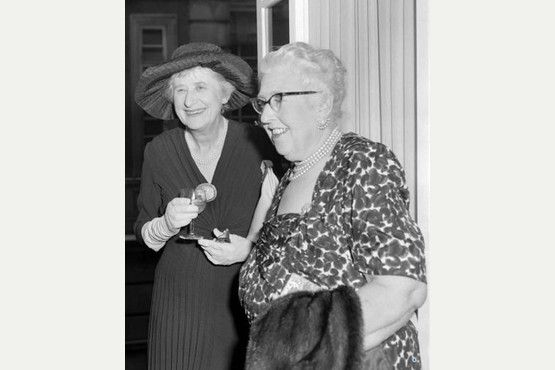
At a party at London’s Savoy Hotel two ladies are chatting amiably. One is in her late sixties, tall and hawk-nosed, wearing an elegant black dress and broad-brimmed black hat, elbow-length satin gloves, a chunky cameo brooch, and a single row of pearls. She brings to mind a stage duchess. Her companion is seventy-two, large and jolly, her white hair in a bun; she is clad in a dress of floral design and carries a mink stole across her left arm. She sports three strings of pearls and glasses in frames of the Cat-Eye variety (recently made fashionable by Marilyn Monroe and Audrey Hepburn). The two ladies couldn’t have been anything but English. Indeed, they might have come out of a novel by Agatha Christie or Ngaio Marsh. One thinks of Lady Selina Hazy in At Bertram’s Hotel and Lady Angkatell from The Hollow—or of Miss Prentice and Miss Campanula, both rivals for the attention of the Pen Cuckoo vicar, in An Overture to Death. (No, that would be unkind.)

But appearances can be deceptive—as aficionados of the formal detective story know only too well. It is highly doubtful whether Miss Campanula or Lady Selina would have been able to write the books in which they appear—they wouldn’t have had the ingenuity, the devilish plotting skills, the unorthodox ideas, narrative drive, or, for that matter, the stamina of their middle-aged creators. The perception of Englishness in not quite right either: the lady in the eccentric Cat-Eye glasses has an American father whereas her be-hatted companion is in fact an Anglo-centric New Zealander.

It is to the civilised exploration of the most uncivilised act, murder, that Agatha Christie and Ngaio Marsh had devoted their creative lives and in 1962 they were at the height of their fame. They had already been dubbed, respectively, “The Queen of Crime” (The Observer) and “The Empress of Crime” (The Sun). The Savoy Party which both attended had been organised by the CWA and the meeting between Christie and Marsh was captured for posterity in a black-and-white photograph. They had met once before, in 1937, but that encounter doesn’t seem to count as there is no record of any exchanges between the two, certainly no photos. The occasion then had been A.C.Bentley’s initiation as a member of the Detection Club and the only interesting detail of that event is that Agatha Christie arrived late, which might have been on purpose, to avoid the invited speaker, an Inspector Kennard, who had been associated with her traumatic disappearance in 1926.

Even though in 1962 Agatha Christie’s play The Mousetrap was celebrating its ten-year anniversary and her floruit period was to continue till 1973, her Golden Age was all but over. The paradox is that the shakier and more rambling Christie’s novels became, the more her celebrity grew: according to a Unesco report published at the time she was the most widely read British author in the world, with Shakespeare coming a poor second. However, the only truly original and most accomplished novel she wrote in that decade was The Pale Horse (1961). Genuinely mystifying and unsettling, it concerns a sinister Murder Inc. organisation which specialises in “human removals.” (A similar idea was used by Dorothy Sayers in a short story called The Leopard Lady, published in 1939.) Other critics of the genre consider the 1967 Endless Night her best—”splendid late flowering” (Robert Barnard)—”final triumph” (John Curran). Christie certainly manages to performs a superb ventriloquist act when she assumes the voice of a working-class young man as her unreliable narrator, but her recycling of a famous trick from a much earlier novel, is not, in my opinion, entirely convincing. And the excess of homicide at the end tends to irritate rather than terrify.

In contrast, the advent of old age didn’t seem to have caused Ngaio Marsh any diminution of her creative powers—quite the contrary. In the period between 1962 and 1972 she produced some of her most sophisticated and entertaining murder mysteries, among them some of my own personal favourites: Clutch of Constables, When in Rome and Tied Up in Tinsel. In Clutch of Constables (published in 1968), Marsh experiments with narrative form by introducing each chapter with a section in which Alleyn is telling the story of the hunt for a highly dangerous international criminal called “the Jampot” to a class of police cadets—the chapters themselves follow the chronological order of the events in which Alleyn’s wife Troy, completely by accident, had become involved with “the Jampot” while on a canal cruise in an Arcadian part of England known as “Constable” country. (The book’s alliterative title is in fact a clever pun.) Each portion of Alleyn’s account ends with an enigmatic statement or a cliff-hanger and this creates a good deal of suspense and tension, thus making the novel compulsively readable. Marsh was seventy-three at the time. And she was well into her eighties when she wrote the unusual thriller-cum-whodunit Black as He’s Painted (1974) and the intricately plotted Grave Mistake (1978), set in an archetypal English village.

But how did the two First Ladies of Fictional Felony fare in the year of the Savoy party? Coming across the photo made me take another look at Christie’s The Mirror Crack’d and Marsh’s Hand in Glove, both published in 1962.

If you are familiar with Peril at End House (1932) and A Murder is Announced (1950) you can’t fail to rumble the killer in The Mirror Crack’d. Not only is the murder conundrum easy to crack, but Miss Marple, despite her passion for intrigue and unholy curiosity, plays a disappointingly sedentary, almost peripheral, part in the unravelling. (Very much like Poirot in The Clocks.) It is only in the last chapter that she meets some of the suspects. Still, the novel is worth reading as it has a number of interesting and unusual features. It is the last of Agatha Christie’s mysteries to be set entirely in an English village. It brings Hollywood to St. Mary Mead. The murder takes place at Gossington Hall, which is also the crime scene in the 1942 Body in the Library. It is one of two Christies inspired by real-life tragedies involving children (actress Gene Tierney’s giving birth to a mentally disabled daughter after a fan had infected her with rubella—the Lindbergh kidnapping in Murder on the Orient Express). And last but not least, it has a fascinating, truly fantastic central idea: The murder is committed on the spur of the moment, with lighting speed, as a result of the killer’s sudden realisation that one of her party guests, a complete stranger, is in fact the person who deprived her, albeit unknowingly, of her chances of happy motherhood. . . .

We are never told what exactly goes on in the killer’s mind, yet we can’t help speculating about the dreadful darkness inside it, about the torment and despair the celebrated actress must have been living with for most of her life. Where Christie succeeds is in suggesting disturbing psychological depths, which can be as effective as any detailed psychological analysis. (She uses the same method in the thoroughly satisfying Murder is Easy and Towards Zero).

Apart from the killer, the one other character in Mirror the reader will remember long after finishing the novel is Marina Gregg’s film director husband Jason Rudd whose striking appearance hints at unconventionality and unpredictability:

He had interesting eyes. They were . . . more deeply sunk in his head than any eyes she had seen. Deep quiet pools, said Mrs Bantry to herself. . . . The rest of his face was distinctly craggy, almost ludicrously out of proportion. His nose jutted upwards and a little red paint would have transformed it into the nose of a clown. . . . He had too, a clown’s big sad mouth. Whether he was at the moment in a furious temper or whether he always looked as though he were in a furious temper she did not quite know. His voice when he spoke was unexpectedly pleasant.

So much for Agatha Christie not being able to ‘do’ character.

Like Christie’s The Mirror Crack’d, Ngaio Marsh’s Hand in Glove is set at an archetypal English village—the quaintly named Little Coddling, “decorous and rather pretty in the spring sunshine.” In both novels parties figure prominently—a garden party to meet a famous Hollywood actress in Mirror, a Treasure Hunt, complete with “amusing clues” in Glove. In an odd way the murder motive in Glove resembles that in Mirror in that it is linked to a woman’s thwarted maternal instinct. But this is where the similarities end. Christie is a conceptual artist, Marsh is the better stylist and, generally, the much better writer. Marsh’s dialogue sparkles with lively wit and drollery, her various descriptions of places and people remind us that she was a gifted painter as well. And her mastery to mislead, mystify, and bamboozle rivals Christie’s. All the characters in Hand in Glove are interesting and memorable. Nobody is a caricature or a stereotype, yet everybody is full of quirks. Snobbish but endearing Mr. Percival Pyke Period harbouring a dark yet ultimately ridiculous secret (aggrandising himself with a bogus ancestral lineage), much-married Desiree Lady Bantling with her “ravaged face with its extravagant make-up, and her mop of orange hair,” Connie Cartell, “large, tweedy, middle-aged . . . with a red face, a squashed hat and a walking stick,” who shouts rather than speaks and laughs too often in a braying manner . . .

Every scene in Glove is choreographed with the kind of theatrical virtuosity Marsh displays in all her novels (we mustn’t forget that she got her DBE for her contribution to the Theatre). For me the best part of the story is the comedy-of-manners lead-up to the discovery of the body and Chief Inspector Alleyn’s subsequent appearance (on page 99). Marsh has been accused of snobbery but she has always displayed an acute sense of the absurd when dealing with her upper-class characters. She makes them say some very funny things. Here is Mr. Period in a flap talking to an outrageously amused Lady Bantling:

“It’s plain to be seen that this frightful person, the Leiss, is an out-and-out bad ’un. And indeed, for your ear alone, we most strongly suspect—” Mr Period looked about him as if the boudoir concealed microphones and began to whisper the story of the cigarette-case.

“Oh, no!” Desiree said with relish. “Actually a burglar! And is Moppet his con-girl, do you suppose?”

And this is Alleyn interviewing “society secretary” Nicola Maitland-Maine:

“Leonard really is a monster.”

“What sort? Beatnik? Smart Alec? Bounder? Straight-out cad? Or just plain nasty!”

“All except the beatnik. He’s as clean as a whistle and smells dreadfully of lilies.”

The actual killer, as it happens, turns out to be outside the circle of murder suspects which we have been persuaded to consider—it is someone presented so cleverly as a comic figure that the reader never suspects them properly. Marsh employs psychology as a strategy of deception—while giving us all the material clues we need. The investigation in Glove is also a much lighter and more palatable affair compared to Alleyn’s interminable questioning of suspects with its emphasis on who-was-where-and-when in earlier novels.

One last note—the respective ages of Miss Marple and Alleyn are bound to cause some readers’ eyebrows to rise and lips to purse. In 1962 Miss Marple—who started as an “elderly lady” in 1927 in the short story The Tuesday Club published in the Royal Magazine—must be at least a hundred. Gentleman sleuth Alleyn, on the other hand, is precisely 67 (his creator-age—he was said to be 40 in Marsh’s first novel, A Man Lay Dead, published in 1934). Yet in Mirror, Miss Marple gives the impression of being no more than a sprightly seventy-five, her almost supernatural intuition undiminished, her deductive skills very much in evidence—and she walks unaided. Alleyn doesn’t display any signs of senescence either—he will continue to be referred to as “handsome Alleyn” by a series of impressionable society ladies till his very last investigative triumph in Light Thickens (1981).
Posted in Books, Characters, Classic Mystery, Fiction, Genre, Guest, History, Writers, Writing | Tagged , , , , , , | 6 Comments

“Love Your Characters Before You Kill Them, and Other Strategies for Fledgling Crime Writers” (by Katia Lief)

Katia Lief’s most recent story for EQMM, “The Orchid Grower” (November 2015), was a finalist for the Short Mystery Fiction Society’s Derringer Award for best long story.  The Brooklyn author has also been recognized for her novel-length fiction, with nominations for the Mary Higgins Clark Award and the RT Reviewers Choice Award. Her latest novel is The Money Kill (HarperCollins 2013). She shares her experience writing both short and long fiction with students at classes she teaches at The New School—online in the fall and in the classroom in the spring. In this post she provides a few important tips for aspiring writers.—Janet Hutchings

Have you ever started reading or watching something that opens with a chase scene and found yourself muttering, “What the @#*% is going on?” The next sound, for me, is always a plunk (book being put down) or click (channel switching). Opening a story in any form with a scene of action before the audience knows what’s at stake and for whom is a bit like when your friend takes a bite of something, makes a face and says, “This is terrible, want some?” Why would you?

Along with being a writer, an avid reader, and a consumer of movies and television, I’ve also taught fiction writing for more than two decades. About five years ago, it made sense to me to add a new focus to my long-running fiction workshop with a course that specializes in writing suspense. I say “add a new focus” because when you set out to write mysteries and thrillers your goal is to integrate new tools to a skillset that already needs to be multi-faceted and strong—or none of it will work. (Plunk. Click.) There is no such thing as powerful crime fiction that isn’t woven into a bedrock of good, solid fiction writing. So in my classes we study the elements of fiction first and suspense second, with the goal of twining both into a knockout story or novel.

I always start by asking my students, “Why are you here?” In other words, what are their goals in committing time and money to participating in a fiction workshop. The reasons are always varied. Sometimes it’s because they need other-imposed deadlines. Or they’re struggling with how to write beginnings, or maybe it’s endings that bedevil them. Or they’re stumped by how to get a character up and off the page. Or building and controlling a plot eludes them. Or the meaning of voice is a total mystery. Sometimes it’s an overall sense that they have no idea how to get started at all . . . how fiction works . . . what it is that makes a story addictive.

So I lay out how we’re going to crack it: by investigating craft, one element at a time. As for art—talent, the rhythms of language, gorgeous imagery that pops a scene to life—they’ll have to discover that on their own by experimenting and by paying close attention when they read the work of writers they admire. But as for what forms the bedrock of a potentially excellent story or novel, there are some basics that every writer needs to master.

We begin with what I call “First Pages,” in which each writer is tasked with establishing character (who), context (where) and conflict (what) all within a single page. For some, this will be an exercise to get them jump-started; for others, it will turn out to be the beginning of a longer piece. For me, the goal is to demonstrate that it requires consciousness and care to win a commitment from your readers to accompany you on the journey you propose to take them on, and that in today’s world of short attention spans you’ve got to learn to do it quickly.

After that, the real work begins.

When I started this blog post I thought: I’m going to lay it all out here, explain point by point what we cover in a fifteen-week semester. Then I realized that that idea is about as sharp as starting with a chase scene. And so, instead, I am going to leave you with a few bullet points that cover the basics:

Character: Every character is as deep and nuanced as you are; she carries with her an enormous, complex universe. But when she walks into the room, don’t tell me everything about her; show her to me with selective brushstrokes of visual detail that make her come alive in my (the reader’s) mind.

Context: Show me where she is so that I can get my bearings. I don’t need every detail laid out, but I do want to know whether she’s on a train or in a field or on the moon.

Conflict: Give me a sense of what matters to her, what she wants. If there’s a nickel in her pocket that will play into the story later, let me feel it with her fingertips so that I can experience that nickel and its particular value along with her. Or, if someone’s just broken into her house in the middle of the night (as in my story “The Orchid Grower,” EQMM November 2015) she might hear a sound that puts her on alert.

Dialogue: When she speaks, let me hear her voice, and make sure that she tells me something I don’t already know; in other words, she shouldn’t repeat something you’ve already expressed in the narrative.

Point of View: Decide who is narrating the story and how. If it’s being told from within the depths of the protagonist’s mind, then you may want to choose a first person “I” narrative voice. If you want more distance and the ability to switch between different characters’ voices, try third person “he/she.” If you really know what you’re doing and you want a ton of flexibility and narrative power, the omniscient voice allows you to weave in and out of every character’s mind and viewpoint and also to know the past and the future—heady stuff. (In mysteries and thrillers omniscient narrators are tricky because their very nature is an argument against the necessary parsing of information that makes those genres so suspenseful.)

Tense: It’s essential to decide whether past or present tense best suits your story. Past-tense allows for more narrative insight. Present-tense lends itself to building suspense as the action unfolds in what feels like real time. Either way, commit to one and stay with it.

Voice: The quality of language, the feel of it, as expressed through the narrative point of view. This is the glue that sticks all the parts together and makes it fluid and flexible and strong.

And one more thing. For writers who are just starting out, I highly recommend (and if you’re my student, I require) the following books:

  1. Self-Editing for Fiction Writers, second edition, Renni Browne and Dave King
  2. How to Write Killer Fiction: The Funhouse of Mystery & the Roller Coaster of Suspense, Carolyn Wheat
  3. Now Write! Mysteries, edited by Sherry Ellis & Laurie Lamson
  4. The Collector, John Fowles

Read them and you’ll see what I mean.

If you’ve reached the end of this post and you’re thinking that you already know all that but you haven’t yet read the fourth book on the list, then get your hands on John Fowles’ The Collector. It’s not a new novel, but it demonstrates how it’s done when a master pulls you right in, holds you close, and scares the pants off you.

Posted in Books, Editing, Fiction, Genre, Guest, Writers, Writing | Tagged , , , , , , , , , , , | Leave a comment

“The Hawthornden Castle Fellowship Experience” (by William Burton McCormick)

William Burton McCormick’s fiction has appeared in Ellery Queen Mystery Magazine, Alfred Hitchcock’s Mystery MagazineThe Saturday Evening PostSherlock Holmes Mystery Magazine, and elsewhere. A four-time Derringer Award finalist for the year’s best short mystery fiction, he is also a novelist whose historical work set in the Baltic States, Lenin’s Harem, was published in both English and Latvian and became the first work of fiction ever added to the permanent library at the Latvian War Museum in Rīga. William’s first story for EQMM, the Derringer-nominated “Pompo’s Disguise,” appeared in March/April 2015. It starred the ancient Roman thief Quintus the Clever. Quintus appears again in his new EQMM story “Voices in the Cistern,” coming up in August of this year. He is also cowriting the financial thriller KGB Banker with businessman and author John Christmas. A native of Nevada, William has lived in seven countries including Latvia, Estonia, Russia, and Ukraine. As you will see, he was elected a Hawthornden Writing Fellow in Scotland in 2013.—Janet Hutchings
Hawthornden from the River. All photos courtesy of William Burton McCormick.

Hawthornden from the River. All photos courtesy of William Burton McCormick.

Imagine if you will six strangers, all professional writers in one sense or another, assembling in a medieval castle in rural Scotland. They are to live in this wild, eternal place for a full month at no cost to themselves, their every need met by the castle’s charming and obedient staff, their only task to work on their various literary projects within the keep’s silent stony walls. But as the days pass, the guests become more adventurous, leaving their writing desks and slipping out of their cozy, fire-lit rooms to explore. They discover great halls, haunted libraries, twisted dungeons, and a beautiful, mysterious dining room overlooking the river gorge which passes just beneath the castle. These strangers, becoming friends, have the run of the entire estate, except, of course, for one ever-locked room kept for their unseen, unmet benefactor.

Dining Room  Drawing Room

All goes well for a time. But on the last night a crime occurs.

Is this the plot of some Agatha Christie novel? A classic British drawing-room mystery? Or perhaps something more sinister? A slasher film where the authors are mowed down one by one Ten Little Indians style?

No, this is a real place and real events. It happened to me. And, if you wish, it could happen to you too. I would highly recommend it. (Though you might want to skip the “crime” part, but we’ll get to that in the end.)

But let’s back up a bit. How did I come to spend a month writing in a Scottish castle with five strangers? As an American living in eastern Ukraine at the time, I already had quite enough adventure in my daily life, no need for further travel or expectations of living in castles. One fateful night, however, I was reading an Ian Rankin short story collection and discovered in the author biography that he had been “elected a Hawthornden Fellow.” I didn’t know what this was, but given the many distinguished accomplishments of Mr. Rankin over his career, the fact that he (or his publicist) thought it worth mentioning in his official bio piqued my interest. As a crime writer you could do far worse than adopt the motto “Do what Rankin does,” and after a little research I discovered a postal address associated with the fellowship. I wrote to the director and requested further information.

I’ll save the details for an addendum at the end of this article, but in short the Hawthornden Fellowship is an award for professional writers of all types which consists of a month’s full room and board in a castle in Lasswade, Scotland about eight miles outside of Edinburgh. The writers must pay their own way to Edinburgh but after that everything is covered by the fellowship. The only thing asked in return is a small acknowledgement of Hawthornden in any work produced during the stay. Everything written during the fellowship remains the author’s own.

As someone who perhaps played too much Dungeons and Dragons in his youth, I was captivated at the idea of living and writing in a castle, and, if I’m honest, the price was certainly right. The application was simple enough, the key parts being publication credits, letters of reference, and a writing sample. For the last of these I submitted a thriller short story called “Blue Amber” which had been published in AHMM and had been a finalist that year for a Derringer Award. A few months later I received an acceptance, my designated slot was mid-February to mid-March. I found a roundtrip flight from Kharkov (via Kiev and London) to Edinburgh for less than $200 and I was off.

I arrived a day or two early as Edinburgh is one of my favorite cities in the world and I love to walk around and soak up the atmosphere, historic, literary and otherwise. On the first day of my fellowship the castle’s director, a man named Hamish, was kind enough to pick me up from my hotel in Edinburgh and transport me out to Hawthornden. Hamish is a busy guy during the first days of a new sextet of authors, driving about the city to the airport, train station, and various hotels to assemble the latest group. In my particular ride was historical suspense novelist Lucretia Grindle, author of The Nightspinners and Villa Triste among several other excellent books. I was quite glad to see another MWA writer among the guests. I’d harbored a slight fear that my fellows might be strictly literary-fiction types, looking down upon those of us who spend our days imagining murder for fun and profit. As it turns out, this was not the case. Everyone was wonderful.

So, Lucretia, Hamish, and I set out to Hawthornden. Though only a short distance from Edinburgh it feels like another world. The large buildings of the city disappear, replaced by little towns, open fields filled with horses, sheep and cattle, and quaint little roadside pubs and groceries. The castle itself is invisible from the main road, hidden back on a large estate behind a gated entrance and screens of ancient trees. You arrive at the back of the castle, its size initially seeming much smaller than it will from all other angles (especially the river gorge below). Hamish introduced us to a staff consisting of several maids, a gardener, and a professional chef, then showed us to our rooms before setting off to pick up more arriving fellows.

Hawthornden from the Road

I should say at this point something about the history of Hawthornden and how it came to be a writers retreat. The original castle dates from the Middle Ages with additions being made in the fifteenth and eighteenth centuries. Under the castle and elsewhere nearby are caves that are said to have been dug by the Picts, and later to have hidden William Wallace, Robert the Bruce, and Bonnie Prince Charlie. Queen Victoria visited both the castle and the caves in 1842. A picture commemorating this event now hangs in the Scottish National Portrait Gallery. Renowned cavalier poet William Drummond of Hawthornden (1585 to 1649) composed his poetry here and entertained Ben Johnson and other literary figures of the age at the castle. At some point, I believe in the twentieth century, the castle was purchased by the Heinz family (of ketchup production fame) and it was under them, honoring the creative spirit and goodwill of William Drummond, that the castle began to invite writers to compose their works here. The idea is to provide refuge free from the distractions and duties of daily life where authors can concentrate wholeheartedly on their writing. Four months a year, the Heinz family maintains Hawthornden as a residence, the other eight it functions solely as a writers retreat.

Hawthornden Day Time

By the evening all the authors have assembled. Besides Lucretia and myself, there was an English poetess, a Scottish short story writer, an American playwright from California, and an American poetess who specialized in work in French translation. In all, four women and two men ranging in ages from early twenties to (I think) mid fifties.

We had very comfy private bedrooms each with a writing desk, fireplace, and open window view over the estate. Painted on the doors of the bedrooms were the names of authors who had stayed in the rooms previously. (Note: To get yourself listed on the door you had to a) have published what you composed in Hawthornden; b) acknowledged the fellowship in the work; and c) sent a copy back to be added to one of the castle’s three libraries. Still, what small price to pay for Scottish castle immortality?!)

The first night we dined together with Hamish in the large dining room which was heated by a roaring fire and decorated with paintings and drawings of various Scottish lords and clans on the walls. The first meal was haggis (the only time we had it), though all later dinners would include a wide range of excellent cuisines. During the meal Hamish welcomed us and explained the rules. Breakfast was served in the smaller dining room and afterwards there was no talking permitted in the castle until dinner. No internet, no cell phones, nothing to disturb the writing of your fellows. The staff prepared lunch from a menu provided to the writers at breakfast, and delivered in to the authors’ rooms in charming wicker baskets between twelve and one. We had the run of the entire estate, the libraries, the gardens, the paths down by the river (where the castle looks both foreboding and impressive), everywhere except the locked rooms of the absent Heinz family. At six the silence was lifted and dinner served. (It should be noted this rule of silence was only strictly enforced in the main building—on the grounds I had plenty of conversations during the day.)

Hawthornden is, quite simply, the perfect environment to compose creative works. I found the castle atmosphere conducive to any sort of writing (though historical fiction and horror fiction came naturally to me here. I kept thinking of The Turn of the Screw . . .) The fellowship’s staff provided everything needed to eliminate distractions and get work done. In addition to the three meals, there was a food station on the authors’ floor with a ready supply of coffee, tea, and biscuits (cookies) twenty-four hours a day and a printer available to produce hardcopy of your drafts. The maids cleaned your rooms and did your laundry. As William Drummond might have imagined it five hundred years ago, modern Hawthornden is a haven for creativity

The long hours of silence, however, meant the six of us were glad to speak when the daily moratorium ended. After elegant multiple course dinners, the writers and Hamish retired to the castle’s main drawing room, a comfortable place with large cushioned chairs, an endless variety of British literary magazines, all overseen by life-size paintings of George Plimpton and Truman Capote. Here, over wine or sherry, the authors would discuss everything under the sun into late in the evening (and sometimes morning). Hamish also proved to have a wry sense of humor, passing on amusing or adventurous tales of the castle, Lasswade, or previous fellows.

Over thirty days we didn’t exclusively stay focused on our writing, of course. There were occasional trips into Edinburgh or the local villages. Explorations through the gorge below the castle and along the river North Esk were common. One evening prior to dinner, Hamish took us down into the tunnels below Hawthornden. Here in the twisting, turning passageways we found, among other things, a series of pens where carrier pigeons had been kept centuries ago. Used for communication in those olden days, these birds were also seen as a food source reserved for when the castle fell under siege. (Fortunately, it never did according to our host).

My time in Hawthornden was productive. (Among many other works, I drafted the opening scenes of my first EQMM story “Pompo’s Disguise” on a stone bench carved out of a boulder down near the river.) I spent most of my time writing in the new library which rests on a hillside near the castle’s main entrance. There are two older libraries, one off the drawing room, where the books of past fellows are kept, and another, still older one in a separate stone structure that hearkens back to the castle’s original medieval foundations. This later library, snug, dark, with a thin staircase winding up to a tiny attic, is the perfect atmosphere for those who want to compose anything with a Gothic or horror flavor. But the most mysterious event happened to me in the new library.

Let me preface this to say I know there is a scientific explanation for what I am about to describe. I am an Ivy League educated man. Both my parents were mathematics majors who instilled their logical thinking into me from birth. I am not superstitious. I do not believe in the supernatural. Yet, that afternoon as I worked alone on “Pompo’s Disguise,” the door to the new library slowly opened. There was no one in the doorframe and no discernible gusts of wind or drafts present to push it open. A moment later the light bulb above me burst, raining glass down on the floor at my feet. Then that door slowly closed. Again, no breeze. A rational twenty-first-century mind knows the cause to be a change in atmospheric pressure which opened and closed the door and destroyed a flawed light bulb unable to contain its expanding gas. Yet, I can only tell you my impression at that moment sitting in the library alone. It felt very much like something had entered, found me in its favorite spot, angrily destroyed my lamp, and left in a huff.

Silly me.

I spent the rest of the fellowship writing in my room.

On the last evening our crime occurred. In anticipation of the authors’ final gathering in the drawing room, Lucretia had bought two bottles of very fine champagne. As we didn’t have access to the kitchen, she had placed them in the cool of the garden under some hedges until after dinner. It seemed a safe enough place. Alas, two trespassers crossing over Hawthornden grounds stole the champagne that afternoon. When Lucretia went to retrieve the bottles for our final banquet they were long since gone. The authors, bless them, had to make do with sherry and wine their final night.

Forgive me if the crime is a bit anticlimactic but I had to draw you in with the classic mystery analogy. The journey is always better than the destination isn’t it?

No, not in the case of Hawthornden. The destination is fabulous. If you’re a writer, go. If you’re not a writer, become one. Get your name on that door. I want to see it when I go again. Fellowship rules say an author can reapply after five years have passed if they have published the work written at the castle and given appropriate acknowledgment to Hawthornden.

The publication is easy, acknowledgment easier. Only two more years to wait. I may try writing in the new library again.

And bring a spare bulb this time.

*

If you are interested in applying for the Hawthornden Fellowship please write:

Hawthornden Castle
International Retreat for Writers
Lasswade
Midlothian
EH18 1EG
United Kingdom

They do not accept correspondence via e-mail. They may accept a request for information by fax at +44 131 440 1989

The retreat is open to any published writer whether short story authors, novelists, poets, screenwriters, playwrights, nonfiction writers, journalists, etc. At the time of my application in 2012 the admission committee strongly preferred traditional publication credits to self-publishing and print-on-demand. As previously mentioned, references, writing samples, and award credits were also factors in admission.

Posted in Fiction, Gothic, Guest, History, International, Setting, Story, Writers, Writing | Tagged , , , , , , , , | 24 Comments

“Last Minute Thoughts on Millennials, Acronyms, and Bullets” (by Carl Robinette)

Carl Robinette made his professional fiction debut with “The Hard Rise,” in the Department of First Stories of EQMM’s September/October 2014 issue.  Since then, several more of his short stories have been published in print and online and he has recently sold another story to EQMM. He tells us he is currently putting together a collection of his short fiction, while continuing to work in local community news. He’s a contributing reporter for the Star News in Chula Vista and several other publications in San Diego County. His predicament as a multitasking Millennial is the subject of his first post for us.—Janet Hutchings

Monday (2:00 P.M.) Time for some high-velocity writing for EQMM’s blog. I’m starting at the last minute due to procrastination on my part and plenty of it. Real high-test putting-offery for nearly a month.

But like the wise woman says, “If you wait until the last minute, it only takes a minute.” This happens to be one of my guiding principles because in all honesty there’s no helping it. The last minute is my sweet spot as a reporter (such as I am), as an author (agree to disagree), and as a Millennial (only grudgingly so).

I’m thirty-four but I was a minor in the new millennium for sixteen days before I turned eighteen in January 2000. This apparently qualifies me as a Millennial by about two weeks.

As the youngest of four siblings, with my brothers and sisters all Generation X’ers, I don’t really know what it means to be a Millennial, but it seems to have a lot to do with short attention spans, The Cloud, acronyms like DIY, and a general abstinence from the printed word.

So how do you write for people who don’t like to read more than 160 characters at a time?

Hell if I know. What I do know is that a picture is worth a thousand words, video is worth about fifteen to twenty pictures per second, and a meme is worthless.

But enough about Millennials. My short attention span is telling me it would be cooler to write something about the rigors of being a working author with a day job or two.

Monday (3:30 P.M.) I’ve just done some quick online research and discovered that having a bunch of different jobs is pretty common among Millennials. Go figure.

It seems that as a generation we’ve turned our backs on the trades and instead pushed the total U.S. student-loan debt above a trillion bucks.

Funny thing about debt; it doesn’t pay itself back. Funny thing about jobs; there are not enough good ones to go around for all the unskilled young people with state-sponsored degrees in the humanities. (I love the smell of debt bubbles in the morning.)

But we refuse to be discouraged. As Millennials we believe in social welfare, being environmentally responsible, eating goji berries, and paying back our debts. So we get jobs in lieu of careers. We ride bicycles to those jobs. We cook weird food and form heartfelt and short-lived social movements.

Truth is, we don’t have time for books. We barely have time for e-books. Sorry, David Foster Wallace, but it looks like infinite brevity is the hot ticket for this generation.

Monday (5:30 P.M.) I’ve now taken to calling Millennials “Millies” (four-syllable words are so twentieth century).

One of my gigs is doing marketing part-time for an IT firm in Del Mar, California. I can tell you that the tech industry is all about shortening words and creating sloppy acronyms that didn’t need to be created. OS, SEO, SaaS, IaaS, CIO. Heck, the industry calls itself “IT” which used to stand for information technology. Now it doesn’t stand for anything but IT.

Likewise, cops tend to use a lot of alphabet soup in their day-to-day work. B&E, DOA, RHD, SWAT. I must go now and exploit the succinctness of police jargon for my own literary gain.

Monday (10:30 P.M.) When writing for a generation of socially conscious people with heavy Dadaistic tendencies, it’s hard not to question the relevance of crime, gunplay, and straight-ahead violence in literature. But I think I’ve got it figured out.

You can get away with the hardest of hardcore violence so long as you make it silly, utterly tragic, justified, or use it to make a statement about social inequalities. You have to murder your characters with a purpose, a purpose that goes deeper than plot or character development. Otherwise you run the risk of offending the manic sensibilities of the Millies.

Tuesday (11:45 A.M.) I’ve put off writing this blog post yet again and I’d like to wrap it up with a salient point, but I’ve just received an e-mail from Janet Hutchings, editor at EQMM, asking for this here post.

So I’ll leave it at this: It is easy to LOL at Millennials, because there is a real shift happening—a generational gap in thinking as stark as anything we saw in the 1960s or even the 20s (so I say). We may be dumbing down the written word, bastardizing tradesmanship, and running amuck with meta-everything, but the reality is that we’re experiencing what James Ellroy might call a half-assed renaissance.

We are the generation that will decriminalize marijuana, put a human being on Mars, and cure cancer. So that’s all pretty cool, I guess.

As for me?

I’m not quite Gen-X and not quite a Millie. I won’t be curing cancer, going to the moon, or advocating legalized grass. All I can do is eat bullets for breakfast and spew them out as words that will hopefully take a chunk out of my readers . . . both of them.

Now if you’ll excuse me, I’ve got to go finish writing a socially responsible and hyper-violent short story that I’ve been meaning to get to for a while.

Posted in Business, Fiction, Guest, Publishing, Readers, Writers, Writing | Tagged , , , , , , , , , , | Leave a comment

“Of Bradshaws and Bonafides: Building a Better Pastiche” (by Keith Hann)

Keith Hann debuted in EQMM’s Department of First Stories (in this year’s February issue) with a Sherlock Holmes pastiche that turns on some real historical events. The Canadian author is currently a Ph.D. student at the University of Calgary, studying military and diplomatic history. He tells EQMM that it was his interest in Sherlock Holmes that prompted him to try his hand at fiction-writing. He has other interests in the mystery field too, having discovered, in copies of old pulp magazines, the work of writers such as Cornell Woolrich and John D. MacDonald.—Janet Hutchings

What makes a compelling Sherlock Holmes story? Not an easy question to answer—really, not a question that possibly can be answered with any authority. Why? Because we’re dealing with two separate elements:

  1. The needs of a “proper” Holmes story
  2. The needs of a good Holmes story

What makes a “proper” Holmes story is a matter of the fiercest contention, and the one more usually tackled. Should Holmes ever find love? Can we introduce elements of the genuinely supernatural? How valid is the appearance of the real-life special guest star? Can we place Holmes and Watson in a different time? Should gender remain a fixed point in a changing age? (I would like to pause for a moment of silence here over the many lives lost in the great “is Sherlock / Elementary a proper take on the canon” flame wars).

However, for all the passion it engenders, I can’t say I find arguing over what makes a proper Holmes tale very interesting: It usually just feels like two sets of subjectivities, bashing at each other like a pair of bighorn sheep. As such, today I’d like to talk instead about what makes a good pastiche—a structurally sound example of the Doyle-style traditional Sherlock Holmes tale. I’m not talking about the basics required by any bit of fiction, such as scintillating prose (though there is a bit of crossover). Nor am I referring to non-traditional Holmes tales (such as those with a supernatural bent): These can be as engaging as any traditional one, but the very strength of the non-traditional tale—the ability to dodge convention—makes it much harder to talk about the ways in which such stories should be constructed. So, without meaning any disparagement, I’m going to focus on how the best stories specifically modelled on the classic Holmes are fashioned.

I’m not claiming to be any great authority on the Holmes pastiche. This merely comes, like so many of you, from having read the canon a few times, with many pastiches in between, and developing my own particular prejudices. When first sitting down to write my own traditional-style stories, I thought about what my favourite tales—canonical and not—have in common. To me, these are the six structural elements featured in most (but not all) of the finest:

  1. A proper problem
  2. A plausible plot
  3. A good reason for Holmes to be confused
  4. A good reason for Watson to remain in the dark
  5. Judicious use of canonical elements
  6. Judicious use of period elements

1) A proper problem

. . . which, at least, presents those unusual and outré features which are as dear to you as they are to me.

To Holmes, regular crime was boring: He wouldn’t investigate everyday pickpockets or jaywalkers unless every last other criminal was in jail and the cocaine had run completely dry. He preferred problems involving the likes of coded messages, spectral hounds, and men walking into houses and never being seen again. One in six of the canonical cases actually have no crime committed at all: That they were merely unusual was enough for Holmes. On the other hand, 37 of the 60 stories feature murder or attempted murder. But even then, murder is not always the central feature of the case. The best of them play with this, so that the murder is but a gateway to a more perplexing matter.

What I’m getting at is that the central premise around which one constructs their story is the problem and that, in many Holmes pastiches, the problem is pedestrian. The plans/painting/famous jewel-encrusted Dingus McGuffin has been stolen. Someone straightforwardly has been murdered, and Scotland Yard can’t figure out who did it. Someone straightforwardly has been murdered, and Scotland Yard has the (falsely accused) suspect in hand. I think I’ve just described a good three-quarters of all pastiches ever written. Most of these are dull.

Let’s take a quick look at Doyle’s most beloved Sherlock tales. I’ll use the 1999 Baker Street Irregulars Top Twelve short stories list as the sample group, ranked from highest to lowest:

  1. The Speckled Band
  2. The Red-Headed League
  3. A Scandal in Bohemia
  4. Silver Blaze
  5. The Blue Carbuncle
  6. The Musgrave Ritual
  7. The Final Problem
  8. The Empty House
  9. The Dancing Men
  10. The Six Napoleons
  11. The Bruce-Partington Plans
  12. The Man with the Twisted Lip

What makes The Final Problem and The Empty House truly great is in many ways beyond the pastiche writer, as these stories achieve much of their power through manipulation of the canon, and only Doyle truly had that ability. There is a lively subgenre of Holmes end-of-life stories dealing with the last days of Holmes, Watson, or both, but I would argue that a pastiche, even if written just as well as those two—no mean feat!—could not connect with the reader in the same way, because we know that the story never “really” happened. Scandal uses a bit of that power, too, in proclaiming Irene Adler the woman. At the same time, none of these three wholly relies on this power; each has an entertaining problem at the root of things and Professor Moriarty would be a memorable character in any tale.

Of the remaining nine, only one—The Bruce-Partington Plans, coming in near the bottom of the list—is centred around one of those generic plot elements that drives so many pastiches. Instead of the attempt to recover a jewel, The Blue Carbuncle hands one over at the start, and the puzzle is how in the blazes it wound up in a Christmas goose, not merely who stole it. Silver Blaze features an apparent murder, but dresses it up with an additional, unusual theft (and ultimately it’s not really murder). The Speckled Band gives us a death to start, but we don’t know what caused it, and it happened two years prior to the story’s opening. The Musgrave Ritual ultimately might have a murder, but we never do know for sure, and it certainly doesn’t drive the story.

Note that when I say a good Holmes tale needs “a proper problem” that I don’t literally mean a mystery in need of cracking. Instead, I simply refer to anything that confronts Holmes with appreciable difficulties. A Scandal in Bohemia, one of the most beloved canon tales, has no mystery element in it, other than perhaps us attempting to discover just what Holmes has planned. It is more of an adventure story; Doyle wrote before the “rules” of detective fiction were codified, which meant that he had more flexibility than later authors, who often pigeonholed themselves into tight genre boundaries. Similarly, pastiche writers today should feel free to tell a crackling suspense or adventure tale featuring Holmes, even if there is no mystery, just as Doyle did. That does not mean the stakes need be high; all too often today we see Holmes faced with threats to the monarchy, Britain, or civilization itself. Doyle largely avoided such and did just fine.

I am also absolutely not saying that a murder or theft plot is automatically a bad one, or even incapable of producing a great tale. Three of the tales on the list feature a Scotland Yard detective with an apparent murder, after all, though I think it’s telling that most would probably not frame those stories—Silver Blaze, The Six Napoleons, and The Bruce-Partington Plans—in such a fashion. Doyle does a superb job draping these pedestrian elements in colourful fabric. Too many others do not.

2) A plausible plot

Conan Doyle made mistakes which completely invalidated some of his stories, but he was a pioneer. . . .

Conan Doyle and Poe were primitives in this art and stand in relation to the best modern writers as Giotto does to da Vinci. They did things which are no longer permissible and exposed ignorances that are no longer tolerated. Also, police art, itself, was rudimentary in their time.

The above comments by Raymond Chandler made some sixty-five years ago are of vital importance to the pastiche writer. It’s bad enough that Doyle was a better writer than most of us; we’re also held to a far higher standard than he ever was. Up here on the shoulder of giants it’s just a given that we will see farther, and the price of having the sum of human knowledge at one’s fingertips via the internet is that, sadly, we are expected to use it. You’ll note that The Speckled Band is ranked as number one on the 1999 list of the twelve stories most beloved by members of the BSI (and has been since its polls began back in 1944). If it was to be published today, it would be consigned to the ash heap as a well-told bit of utter implausibility, for snakes don’t really hear and don’t like milk and don’t climb ropes and aren’t especially trainable and— But it’s Doyle, and it’s damn good aside from those logical impossibilities, so we exalt it. Modern writers will never enjoy the same luxury.

3) A good reason for Holmes to be confused

Holmes shook his head like a man who is far from being satisfied.

“These are very deep waters,” said he; “pray go on with your narrative.”

This is closely related to the first point. Some might ask, “well, isn’t it the same?” No: Something might be a proper problem to us, but that doesn’t mean Holmes would necessarily have any trouble solving it. If a proper problem is the frame on which a good story is constructed, why Holmes doesn’t immediately figure it out is why we keep reading as it’s built out. It is very easy to squander a good dilemma with a pedestrian investigation of it.

That a good story generally needs something that actually challenges Holmes doesn’t mean that it only requires some simple bit of investigation, either. Holmes has access to vast resources in the form of his index, his Irregulars, his brother Mycroft, people like Shinwell Johnson and Langdale Pike, Watson’s medical and military expertise, and his own broad base of knowledge. If the problem only requires Holmes to go to the scene and have a look around, or ask the right people the right questions in the right order, before bringing that enormous arsenal of information to bear to crack it, then the tale will again lack tension. There needs to be pushback: people who argue with or fight him, all manner of coloured herrings and other aquatic life, and seeming impossibilities that must be puzzled out by Holmes, not his network (which at best should only assist), and we need to see this. The police, if involved (and sometimes Scotland Yard can have the day off), should be baffled for a good reason—the excuse of incompetence is another bit of luxury Doyle enjoyed that the modern pastiche writer does not.

Finally, having Holmes confused, the best stories avoid solving a perplexing problem by simply plopping the solution in his lap at the end. This is in part just a matter of embracing that detective story notion of the rules of Fair Play, the idea that you can’t just have the solution show up at the finale with absolutely no way for the reader to have known about it. Doyle did not always abide by this because, again, he wrote before these “rules” were codified, and so a Holmes pastiche has a bit more leeway here than other forms of detective story (to its advantage). However, I’ve definitely noticed a tendency for writers to abuse this. I’ve seen a great number of Holmes tales unnecessarily resolve the matter at hand via some bit of deus ex machina info delivery, a source the reader would never have expected and could never have known about, and which absolves Holmes (and the writer) of the need to do any deep thinking on the matter. One of the major rewards of a Holmes tale comes from watching that amazing mind do the work.

As an aside, oddly enough I’ve seen several pastiches fail by having it unapologetically obvious who the villain is and then the story primarily being about how Holmes brings about their downfall. Seeing as how this is Holmes we’re discussing (Irenes and Norburys aside), this tends to be painfully anti-climactic, as without a challenge there’s only the mechanical process of inevitable entrapment.

4) A good reason for Watson to remain in the dark

“A telegram for you, Mr. Holmes,” said he.

“Ha! It is the answer!” He tore it open, glanced his eyes over it, and crumpled it into his pocket.

“That’s all right,” said he.

“Have you found out anything?”

“I have found out everything!”

Almost inevitably, Holmes will eventually piece together what has occurred. However, at some point Watson (and thus us) needs to learn this as well, and as any reader of the canon knows, this often does not happen simultaneously. Long before the end of the story, Holmes regularly has a solid suspicion as to what has occurred, or even certitude, and only requires formal legal proof. Watson is essential to the success of the canon in many ways, but most significant is how he provides a filter through which we may be distanced from Holmes’ process of deduction, keeping us in the dark in the reasonable way that a good mystery requires. But this is easy to handle poorly. The staple of Holmes announcing that he merely prefers not to discuss things until all is perfectly ready can work on occasion, but is somewhat unsatisfying at best, ham-fisted at worst, and painfully overused regardless. When Holmes obviously knows what’s going on but is refusing to let Watson in on it, for apparently arbitrary means and for any significant length of time, the reader becomes removed from the story—dangerously passive and unengaged. Being along for the ride is fun, whereas if we can only watch on the sidelines as things pass us by then we’re liable to get bored.

Many authors have found better ways. In some cases the final reveal happens naturally near the end, with both Holmes and Watson learning the truth together in an organic fashion. Other tales might have the knowledge arrive somewhat sooner, but have the pacing of the story so tight that Holmes simply does not have the opportunity to announce to Watson what is happening until the very end; an attempt to introduce a lengthy explanatory scene in the middle of things would actually feel wrong (“There’s no time for this, Watson! Even now the hideous red leech races towards its final victim!”). Still others might have Holmes run off on some vital (and often time-sensitive) side quest, though while this removes his ability to spoil the story, it also threatens to derail it by separating our two main protagonists and having us feel we are viewing some unimportant sideshow.

Even if a story paces the reveal correctly, a common failing (in my mind, at least) is creating an inappropriate parlour scene for Holmes to deliver it, that time-honoured trope of detective fiction wherein all relevant parties are called to the parlour or other convenient place of assembly so that the detective can lay out his brilliance and publically expose the culprit. While sometimes the method makes sense to employ, there are two problems with it: one, it was last fresh when the Austro-Hungarian Empire was a going concern, and two, it’s a staple not of the Holmes stories but of the Golden Age of Detective Fiction, largely post-dating Doyle (The Bruce-Partington Plans and The Golden Pince-Nez have something similar, but there are twists, the results I think are more interesting than is usually the case, and the stories are the exception rather than the rule in the canon besides).

I’m not saying to avoid anything that any other writer has ever done (for God’s sake, we’re writing Holmes knockoffs here). However, employing the tropes of other detectives and sub-genres introduces a strong “meta” element into your story, risking you inadvertently pulling the well-read reader out of your tale and all the while not really giving you anything new to work with: you’re merely opening up a new box of clichés. The risk of making Holmes look like a poor-man’s Poirot or Dr. Fell rarely outweighs the reward.

5) Judicious use of canonical elements

“It was elementary, Watson,” said he, brushing past Mrs. Hudson, “for as I attempted to persuade Inspector Lestrade here, any analysis of the tobacco ash present at the scene of the crime would have told the examiner the same.” He fetched his deerstalker and pipe. “But now we face a singular matter; these are deep waters indeed. Come, gentlemen. Summon the Irregulars! Cocaine for everyone!   The game is afoot!”

I didn’t have to think at all in writing the above paragraph and, I suspect, neither would most readers, were they called upon to create the same. Some of the power of the Holmes stories lies in those familiar elements in the canon we have come to cherish: poor, put-upon Mrs. Hudson; sallow, perennially unobservant Lestrade; Wiggins and his fellow scamps; Moriarty cackling from the shadows. Unfortunately, many writers wield these elements not as a scalpel but as a club.

It is easy to see how this happens. At times the writer is looking to make their tale more authentic, and one of the best ways to do that is to bring in those elements that that Doyle himself fashioned. Other times, the writer, carried away by their love for the canon, simply cannot resist the opportunity to play with such storied elements.

However, overdoing this risks a pastiche straying from loving tribute to unintentional parody. Almost all of us know about the deerstalker and pipe; I won’t bother going into those here. The canon uses some form of the phrase “the game is afoot” exactly twice; Holmes says it but once, but you’d be forgiven for thinking it was his favourite. Most of us are aware of how one can use “elementary” improperly, but it is not required to use it at all. The Irregulars only appear in three stories, and are only prominent in the two earliest. Mycroft is busy, lazy, and a creature of habit; Moriarty plans, rather than executes—pastiche writers have both lofty figures directly involve themselves in Holmes’ life and the business of everyday crime with amazing regularity. Holmes’ deductions in Baker Street at the beginning of a tale are more central, but still, they do not appear in every tale and are not required either.

I suspect this will prove controversial, but I feel the introductory deduction scene in particular has lost any power it might have had. Any author can do it, given enough time to think one out, and oh so many have, but it is fundamentally a flavour or show-off piece that does nothing to really help your story. The advanced version, as seen in The Cardboard Box/The Resident Patient, is trickier to pull off and thus more impressive, but ultimately fails for the same reasons. If we’re reading a pastiche, we know who Holmes is and what he can do; the time spent on a deduction intro would be better spent thickening your plot or giving your characters some life. There are so many other elements that can establish one’s Holmesian bonafides in much shorter a fashion, and as far as deduction scenes go, one that winds up placing the criminal in the docket is much more useful.

6) Judicious use of period elements

Every Holmesian pastiche writer knows of the challenge of capturing the flavour of an increasingly bygone age, a time not just of Empire but of gasogenes, pince-nezs, the bimetallic question, and other bits of antiquity. There’s little to say on this, for a writer knows that anachronisms are to be avoided and makes the best effort they can. Whether or not one fails is not objective, but a determination made separately by each individual reader, based on their own individual base of knowledge.

A less considered problem is overfaithfullness to the period, an excess of fidelity. This is a problem common to genre fiction as a whole, where authors perform a pile of research to ensure they get the details of their fantasy setting, sci-fi story, or detective piece right, and then cannot resist the temptation to show their work. But any bit of info that doesn’t assist your story should be excised, no matter how fascinating you personally think it is. For one, it’s often not as interesting as the author believes. For another, for every story where I found the pointed use of period detail smooth and of some interest, there have been twenty more where it just sat like a lump of lead, even when fascinating still interrupting the story’s flow. In particular, I have never seen a single pastiche improved by a digression on authentic period train times. What does it matter if Holmes and Watson catch the 2:15 or the 2:30 at the satellite station in Lesser East Ludenshire-on-the-Moor? All I think when a story has Holmes break out his Bradshaw is that the author managed to track down a copy, and thus felt compelled to use it. Characters should move at the speed of plot, bound only by reasonable limits, and without exception any space spent on an incidental exploration of train timetables would have been better used fleshing out the plot or characters instead.

****

Again, I don’t claim this to be the one true path to the perfect Holmes pastiche; it’s more of a what-not-to-do, rather than a how-to-do-it. Just because something is structurally sound doesn’t mean it can’t flounder in a host of other ways. For instance, even if it passes muster as a sound story, you might feel it fails as a proper one. And of course a sound story might still suffer from leaden prose or any number of other basic blunders. Lastly, there’s always the exception that proves the rule, that superb story built out of the most basic or even hackneyed plots, archetypes, and the like.

In closing, I’d be particularly interested in hearing from any reader out there of Holmes stories that in your mind stumble over one (or better yet, several) of my points above and yet still wind up being wonderful. I would start the game off by suggesting J.R. Campbell’s “Lord Garnett’s Skulls,” as found in volume II of The MX Book of New Sherlock Holmes Stories. There’s been a theft, and a Scotland Yard investigator has told us of it: rather basic stuff. But the pacing is excellent, the missing materials out of the ordinary, we have a kidnapping quickly ladled on top, and the solution is provided in a fresh and delightfully ghoulish way. What comes to mind for you?

Posted in Adventure, Books, Characters, Fiction, Genre, Guest, Historicals, Holmesian, Writers, Writing | Tagged , , , , , , , , , , | 2 Comments

ONE WORLD

“The outstanding development of last year’s Prize Contest,” wrote EQMM editor Frederic Dannay in his introduction to our magazine’s August 1948 “All Nations” issue, “was the unexpectedly large number of stories sent in from foreign countries and their remarkable range of geographical representation. Manuscripts were submitted from Canada, Mexico, Dominican Republic, Brazil, Argentina, China, Japan, the Philippines, Australia, Union of South Africa, Algeria, Southern Rhodesia, England, Ireland, France, Germany, Italy, Netherlands, and Portugal. This united effort on the part of detective-story writers proved that while we still have a long way to go politically, the planet Earth is truly One World detective-storywise.”

Yesterday, EQMM’s second All Nations issue, May 2016—containing stories from twelve different countries and six continents—went on sale. Lamentably, sixty-eight years after our first All Nations issue, the world continues to have “a long way to go politically” before it truly becomes one in the sense editor Dannay envisioned. The recent terror attacks in Belgium brought that home to us as little else could, for seven of the authors EQMM has recently published in translation (Bob Van Laerhoven, Bram Dehouck, Hilde Vandermeeren, Herbert DePaepe, Els Depuydt, Bavo Dhooge, and Pieter Aspe) live in the midst of that terror.

EQMM’s first All Nations issue was conceived just two years after the first meeting of the United Nations General Assembly, a time when many had hopes of achieving unprecedented international harmony. But it was also born under the shadow of a recently ended, devastating world war. In my From the Editor’s Desk piece in this new All Nations issue, I allude to a comment made by one of the contributors to the first All Nations issue in 1948, H.T. Alfon. “Your magazine,” he said, “finds many readers even as far as here, Manila—EQMM has grown known that fast, that far.” Although EQMM’s quickly extended worldwide reach surely had much to do with the quality of the publication, I think it probably also has to be explained as part of a more general outward flow of American culture all over the globe at the end of the war—and, as a result of the magazine having been shipped to troops all over the world throughout the war.

EQMM is a publication born during war, just weeks before the entrance of the United States into the conflict. As well as allowing the magazine to travel, circumstances of the war shaped EQMM by providing an influx of talent. As critic Marvin Lachman points out in an article for EQMM’s upcoming July issue, a number of the new writers EQMM published in the early years “date their ambition to be published to . . . their spare time when in military service. In the 1940s and 1950s, writers of EQMM first stories were often World War II veterans taking advantage of the G.I. Bill of Rights.” Persecution by the Nazis of creators of what they called “degenerate art” also brought new talent to the U.S.’s shores, and one of the most notable of those refugees was EQMM’s first cover artist and art director, George Salter. Widely considered one of the most important book designers of the 20th century, Salter had a distinctive “modernist” style that made him much sought after for the covers of books by the greatest writers of the time in the U.S. That EQMM was launched under his art direction was one of the magazine’s significant early advantages. It’s interesting to note, in this connection, that one of the stories contained in our new All Nations issue is by a Japanese author, Ōsaka Keikichi, who had to give up writing detective stories in the late 1930s due to state censorship. He was killed in the war, but his output of detective stories was not altogether lost. We publish in English, for the first time, in this May issue, his 1936 classic “The Cold Night’s Clearing.”

Sadly, in many parts of the world today, writers and artists continue to have their ideas and artistic aims suppressed. But at least the “global village” we now live in makes their plight better known than would have been the case in previous generations. If there’s one thing our new All Nations issue brings out, it’s how small and closely connected our world has become. Absorption of elements of various cultures into one another has become so ubiquitous that by pure coincidence this issue’s two independently commissioned stories from Asia both turn on the holiday of Christmas. The geographical merging of peoples from vastly different cultures through displacement is another reality of our time that, for many, reinforces the sense of our world having become small and village-like, at least in the sense that we all share the consequences of actions taken in any part of it. Swiss writer Petra Ivanov explores the plight of the refugees of conflict in her contribution to the issue; it’s a story written before the major migration to Europe of refugees from the war in Syria, but it might as easily have been their story.

It’s thanks partly to the communications aspects of our modern global village—especially the easy electronic flow of information—that some of the best traditions in our genre have survived, and that’s illustrated by this issue’s selections. Three of the stories, none of them American, are impossible-crime tales. This classical form of the mystery, which reached its height under American masters such as John Dickson Carr but which infrequently finds favor with American authors nowadays, has endured primarily through its assimilation into other cultures. The case is quite different for the detective story-writing traditions of Latin America, where the great classical authors of the form continue to be emulated by writers of today. Our 2016 All Nations issue begins with a story from our archives by Argentina’s Jorge Luis Borges, and is followed by a story that pays direct homage to him from two of his modern-day compatriots. In a speech last week in Argentina, President Obama said, “. . . in the spirit of renewed friendship, partnership and engagement, I’d like to close with the words of one of Argentina’s great gifts to the world, Jorge Luis Borges, who once said, ‘And now, I think that in this country we have a certain right to hope.’”

As people around the world display the Belgian flag and pledge to stand with Belgium, and any other country similarly attacked, I think that in this global village of ours we have a certain right to hope too. Our All Nations issue gives me that feeling: Though differences in perception separate our various nations, you’ll find these pages full of humor and intelligence and many commonalities of mind and heart.—Janet Hutchings

Posted in Classic Mystery, Ellery Queen, Fiction, History, International, Magazine, Passport, Translation | Tagged , , , , , , , , , , | 3 Comments

“How to Write Killer Flash Fiction” (by Tara Laskowski)

Tara Laskowski is the author of the short story collections Bystanders and Modern Manners For Your Inner Demons. She has been the editor of SmokeLong Quarterly since 2010, and her flash fiction has been featured in the Norton anthology Flash Fiction International and many other publications. Her story “Ladies Night” won first place in the KYSO Flash fiction-writing challenge. Tara will make her EQMM debut in our special “All Nations” issue (May 2016), on sale next week; in it, she represents the United States with a haunting flash fiction tale that illustrates well the points she makes about writing flash fiction in this post.—Janet Hutchings

Great crime flash fiction is hard to come by. It’s tough to write a satisfying story in 1,000 words or less. It’s even harder to incorporate a compelling crime or mystery.

I have been the editor of SmokeLong Quarterly, an online flash-fiction literary magazine, for six years now. During that time, I’ve read more than ten thousand submissions (we get an average of 90-100 stories each week). The majority of what we publish is not crime fiction—we tend more toward general fiction or experimental flash—but we do occasionally publish crime fiction, and we’ve seen a lot of it come our way in the submission queue.

So what makes for a good one? That is a more elusive question. Each time you say not to do something, someone comes around and shows you how that rule can be broken. But I do think there are guidelines you can follow to make your flash fiction more compelling. Here are a few.

1. Don’t try to do too much. Flash fiction works best when it’s focused. This doesn’t mean it has to be simplistic, but it should be streamlined. Don’t worry about trying to fit in the plotting of a crime, the execution, and the aftermath, all while trying to juggle a love interest. Focus on one small thing and tease it out, play with it, have fun.

2. Cut, omit, skip, delete. Some of the best flash writers are the ones who know when to omit details, how to say the most in the least amount of space. Flash is an art in economy—economy of language—and that brevity makes everything else seem fuller and richer. “The Drive” by Gabrielle Sierra in Issue 44 of SmokeLong Quarterly, for example, focuses on the moments after something brutal has happened. We don’t ever learn what the crime is, and it doesn’t matter, because what this story is interested in is how these two characters are going to survive what comes next.

3. Stay away from surprise or punch-line endings. Your story’s only purpose should not be a surprise reveal at the end. That leaves the reader feeling cheated. I once read a submission that detailed a person methodically killing someone in a bathtub. There were grim descriptions of blood and gore and how the murderer was feeling while they were killing, and a lot of it was done well. But then at the end, you discover that the “person” in the bathtub was really a chicken.

Don’t get me wrong—chicken is delicious. But that story would’ve been much more effective as an exploration of a killer’s feelings rather than an elaborate set-up for the writer to jump out from behind that shower curtain and say, “Gotcha!”

This is not to say that you can’t have interesting twists or reveals at the end of flash fiction. When it does work, it’s brilliant—but the story cannot weigh entirely on it or it will collapse. The best stories are the ones in which that twist is inevitable, in which, when you read it, you realize that the writer was taking you purposefully on this journey. It’s a satisfying and inevitable turn, not an out-of-the-blue trick that the writer purposefully hid from you.

Here are two examples. Annabel Banks does a fabulous job of building up tension in the story “Payment to the Universe,” published by matchbook last year. We follow a maid, seemingly going through an ordinary night of cleaning an office building. But the odd details about the place make you realize that something’s not quite right. The mood of the piece sets you up for the ending, so that when it happens, it creeps you right to the bone. It stays with you because the story prepared you for it, not because of a weak plot trick.

The same rings true for Art Taylor’s recent flash “The Blanketing Snow” published at Shotgun Honey. If you’ve read any of Art’s longer stories published in EQMM, you know he’s a master of traditional storytelling. He takes his time. Usually this might not work well with a form like flash, but it does in this story because Art focuses so closely on one moment. He’s also retelling a well-known fairy tale, which helps with subtext. But what works best about the chilling ending—which I won’t spoil for you—is that, like Annabel, Art has already woven it carefully into the narrative. The loss, the burdens, the chill in these characters sinks in thoroughly and completely.

4. Pay attention to language. This one’s a little squishier. At SmokeLong, one of our biggest critiques about stories is that they don’t feel like flash. They are more like short stories that happen to be…well, short. Or they feel like scenes from a longer piece.

Flash has what I like to call a magic rhythm to it. They can be like songs, with a unique melody, and when they start, the good ones are pushing you along, daring you to stop reading them. They have a purpose and an urgency.

At SmokeLong, the flash we publish—whether crime or fantasy or literary—tends to have an attention to language and description that makes it rise above the plot. Check out “The Final Problem“ in our latest issue, as an example.

Very short fiction needs to have some action going on at the sentence level. It needs to be beautiful, even if it’s about ugly things. I believe that’s what makes brilliant flash fiction. The story might be short—but if it’s done correctly it won’t be the crime on the page you remember so much as the way the story cut you to the bone, shred your heart into a million pieces, and punched you in the gut. That’s the kind of brutality I’m looking for.

Posted in Fiction, Genre, Magazine, Publishing, Readers, Story, Writers, Writing | Tagged , , , , , , , , | 7 Comments

“Seventy-two Years and Counting” (by Donald A. Yates)

On the 29th of this month, EQMM’s special “All Nations” issue, a tribute to the original All Nations issue of August 1948, will go on sale. It opens with a story EQMM has always been proud of having been the first to publish (in August 1948), “The Garden of Forking Paths,” the first work in English translation of the great Argentine writer Jorge Luis Borges. All of the other stories in the issue—which represents twelve countries and all continents except Antarctica—will be new to English-language readers, and one of them is the result of the collaborative effort of EQMM’s highly valued veteran translator Donald A. Yates. Don is Professor Emeritus at Michigan State University. In recent years he has provided EQMM with translations from Cuba and Italy as well as from Argentina, the country with which his work as a mystery-fiction translator began. His own short story “A Study in Scarlatti” appeared in EQMM in February 2011, and he has also contributed many poems to the magazine over the years.—Janet Hutchings

Looking back now at my collection of correspondence with Ellery Queen’s Mystery Magazine, I see that my first exchange was with Mildred Falk, then the managing editor, who wrote me on January 12, 1944, to reply to my question about one of the Queen novels that I sent to the magazine, not knowing where else to look for an answer. I had discovered the early nationality-keyed Queen stories in 1943 and had been genuinely disturbed by a footnote that appeared at the foot of page thirty-one of the 1935 first edition of The Spanish Cape Mystery. It referred to a “peculiarly baffling murder case” that Ellery had failed to solve and was considerably “annoyed by his failure.”

In no time at all, Ellery had become a true hero of mine and it distressed me that there had actually been a case that he had not been able to crack. In response to my query, Mildred Falk, taking dictation, do doubt, from editor Ellery Queen wrote:

“Yes, ‘The Case of the Wounded Tyrolean’ is the only case which has baffled the great man. So you will understand, we know, when you learn that the case doesn’t exist.

“Seriously, it was a tongue-in-cheek little game we played while writing The Spanish Cape Mystery. Doyle, you know, did it often in the Sherlock Holmes stories—referring to Holmes cases which thereafter sent Sherlockians screaming into the night hunting for the reference source and finding only a ghostly chuckle.

“Forgive us. There is no such case, and therefore no clues and no facts. Might be a good idea to build one some time at that!”

I was quite flattered that my question had elicited such a friendly response. I was only thirteen years old at the time.

Three years later, with a suitcase filled with my lovingly accumulated first editions of Queen books, I left from my parents’ home in Ayer, Massachusetts, and took a bus to New York City where on one glorious afternoon I got Ellery Queen, in the person of Frederic Dannay, to sign and inscribe every one of them. But that is another story, which I have described in detail elsewhere.

In the years following, Fred Danny and I enjoyed an uninterrupted friendship that lasted until his death in 1982 and that in time took on the character of a father and son relationship. In 1947 I graduated from high school in Ann Arbor, Michigan and in 1951 I finished my B.A. degree with a major in Spanish at the University of Michigan. That was followed by a two-year stint in the U.S. Army. My correspondence with Fred during these years consisted mainly of my offering him books that I thought he would want for his extensive collection of detective short stories—and trying repeatedly to write a story for him that he would accept for EQMM.

With some free time on my hands during the months I spent at Fort Custer, Michigan, I remembered Mildred Falk’s observation that it would be interesting to try to fashion a short story that could carry the title “The Wounded Tyrolean” and be so perplexing that even Ellery himself had not been able to solve it. I decided to take on the challenge and thought that the classic “locked-room murder” problem would serve my purposes and that I would do my best to come up with a new solution that had never been devised before. By the time I had ended my military service and returned to the University of Michigan in 1953—now with the support of the G.I. Bill—for a graduate-school degree in Spanish, I had finished the job. Fred didn’t think it was right for EQMM.

One of the professors I studied with in Ann Arbor was the Argentine critic and author Enrique Anderson Imbert, who I soon found out was as interested in mystery fiction as I was and had himself written and published detective stories in Argentina. Eventually, we determined that the topic of my doctoral dissertation would be the Argentine detective story. While gathering material for the thesis, I found a recent collection of ten Argentine detective stories, edited and published in Buenos Aires by Rodolfo Jorge Walsh. I wrote to Walsh and found him to be very knowledgeable on the subject and eager to help me in documenting my study. I sent him my “Wounded Tyrolean” and he liked it. He translated it and it appeared in the Argentine magazine Leoplán in July of 1955.

I started translating some of the stories in his anthology and the first of these began appearing in The Saint Detective Magazine in the mid 1950s. The Argentine author whom Walsh never ceased to praise was Jorge Luis Borges and I considered that a writer of his stature deserved to appear in EQMM. Fred agreed and the short piece titled “The Two Kings and the Two Labyrinths” appeared in the April 1962 number. Actually, a Borges short story had already appeared in EQMM, in the April 1948, “All Nations” issue, in the translation of Anthony Boucher, for many years the crime-fiction reviewer for the New York Times, and the first person to write about crime fiction in Spanish America. His essay “It’s Murder, Amigos” appeared in the April 19, 1947 issue of Publisher’s Weekly. Borges, little known and less read in Argentina at that time, eventually became a celebrated literary innovator and a long-time candidate for the Nobel Prize in the literature category. The Boucher translation was the first instance of a Borges English translation appearing in a wide-circulation U.S. publication. (I have a copy of that issue, in which Fred has written “So this is the story that has made me famous!” And Borges later signed it for me, too.)

I had become intensely interested in Borges’s fiction while studying with Anderson Imbert and signed a contract with New Directions in 1960 to bring out a selection of his writings in English translation. A fellow graduate student at Michigan, James E. Irby, had also become interested in Borges’s writings and had been translating some of his essays into English for the purpose, he told me, of getting a feel for his literary style. He showed me some of them and I thought they were excellent. I invited him to join me in preparing the anthology, which appeared in 1962 with the title Labyrinths: Selected Writings of Jorge Luis Borges.

Looking back again, since 1962 I have contributed nearly a score of translations to EQMM, accepted first by Fred, then by Eleanor Sullivan who succeeded him as the magazine’s editor, and most recently by Janet Hutchings, who can be credited with having established the monthly feature titled “Passport to Crime,” which introduces new translations into English of crime stories from many foreign countries.

For the May 2016 number, which is soon to appear, I thought it might be interesting to try something different, a first of sorts in the line of translations. During a 2007 visit to Buenos Aires, I had invited my Argentine friend Fernando Sorrentino, whose fiction has been translated into a dozen foreign languages, to write an original crime story for the pages of EQMM. He agreed and said he had something unusual in mind. What he sent me was a story written in collaboration with his friend Cristián Mitelman. The idea, he said, was to honor the collaboration that produced the Ellery Queen novels and also the literary collaboration—not at all common among authors in general—of Borges and his fellow Argentine writer Adolfo Bioy Casares, who together in 1942 published a volume of stories titled Six Problems for Don Isidro Parodi, which satirically featured a detective who was strictly limited in the amount of traveling about that he could do while solving the crimes brought to him: Don Isidro was locked up in cell 273 of the Buenos Aires penitentiary! Their story was titled “The Center of the Web” and it appeared in the June 2008 issue of EQMM under the pseudonym of Christián X. Ferdinandus. When they sent me another story, titled “For Strictly Literary Reasons,” I thought I’d join the party and do the translation in a collaboration with an old friend from U. of M. graduate days, John B. Dalbor, now retired as Professor Emeritus at Penn Sate University. Our first collaborative project had been a second-year, college-level Spanish reading text, Imagination and Fantasy: Stories from Spanish America, published by Holt, Rinehart & Winston in 1960. We very much enjoyed working together again.

So there you have it—something new under the sun, featuring a tetralogy of literary collaborations.

A closing note. Persistence paid off. Finally, fifty-seven years after appearing in Spanish in Buenos Aires, my “Wounded Tyrolean” appeared in its original English version in the Fall 2012 issue of the Michigan Quarterly Review, published in Ann Arbor, the very setting where the action of the baffling locked-room murder had been situated.

Posted in Books, Characters, Ellery Queen, Fiction, Genre, Guest, History, International, Passport, Translation, Writers | Tagged , , , , , , , , , , | 6 Comments

“And Not Forgetting, ‘Wow!’ ” (by Mat Coward)

Mat Coward is an extraordinarily versatile writer. He’s the author of many excellent mystery short stories and novels, and has also been widely published in the field of science fiction and fantasy. He has written children’s books, humor, even a long-running gardening column for a daily newspaper. His post today concerns his recent nomination for the Edgar Allan Poe Award for best short story, for “On Borrowed Time” (EQMM June 2015). The winner will be announced at the Mystery Writers of America’s Edgar Awards banquet on April 28 of this year. This isn’t the first time Mat has received such an honor: His January 2000 EQMM story “Twelve of the Little Buggers” was also a nominee for the coveted Edgar. New stories by the British author are coming up soon in both EQMM and Crimewave.—Janet Hutchings

Nine things that went through my mind after I heard that I’d been nominated for the Edgar.

1. I wonder if anyone has ever refused an Edgar? Probably not—it doesn’t seem like that sort of award—but lots of people have turned down lots of honours over the years. The artist L.S. Lowry is thought to be the all-time British record-holder, having declined an OBE (in 1955), a CBE (1961), a knighthood (1968), and a Companion of Honour (1972 and 1976).

The socialist writer and broadcaster J.B. Priestley said no to a Life Peerage in 1965—but accepted Pipe Smoker of the Year in 1979. Every man has his own special vanities, after all.

2. And then I remembered the story I was told years ago about a bibulous novelist who arrived home drunk one night to find a letter awaiting him from Buckingham Palace, informing him that he was to be knighted. He immediately scrawled an intemperate reply on the back of the original, explaining that as a lifelong proponent of republicanism he could not imagine any greater insult, and went straight out to post it. When he awoke sober the next morning he immediately remembered that, far from being a republican, he was in fact an enthusiastic supporter of the monarchy. But by then it was too late.

3. It occurred to me that I don’t know exactly how the Edgar committee arrives at its selection, but I do know how the FBI fills a vacancy on its Ten Most Wanted Fugitives list. First of all you have to be nominated by the local field office. Those nominations are then scrutinised by a panel at FBI headquarters, before the winning candidate is submitted to the deputy director, and ultimately the director, for final approval. It’s a very slow process. You can’t help feeling that the FBI should take a tip from the MWA and hold a banquet for nominees; just see who turns up, you never know your luck.

4. I realised that I am still furious about the second place my Jack Russell terrier, Dot, received in the “Dog With the Most Beautiful Eyes” category at a village fete in Kent in 1970. Most days I can deal with the anger, it’s not as if I’m going looking for the judges all these years later, but all I’m saying is: That dog had very nice eyes. If you want to think there was, genuinely, a dog with nicer eyes in that competition, that’s fine. That’s your business. That’s up to you. I happen to know you’re mistaken; we’ll leave it at that.

5. I did that thing that I’m sure you’ve done at some time or another in your life. I waited for a few hours before telling anyone about the nomination, just in case I got a follow-up email saying “OMG, look, this is so embarrassing! Turns out I was reading from the wrong piece of paper! You’re actually on the list for ‘Dullest Short Story of the Entire Year, No Kidding,’ which is really just a bit of fun we were having here in the office when we were snowed in one weekend and it was never really intended for public consumption. Lol! Hope you don’t mind!”

Even then, when I finally posted about the nomination online, I was careful to write, “I have apparently been nominated for an Edgar,” so that if it still turned out not to be true, I wouldn’t look such an idiot. “Yeah, right, you’re like the 100th person to tell me that! Duh! I already knew—I mean, which part of ‘apparently’ don’t you understand?”

6. I wished I’d come up with a less dull title for my story. More meaningful, more original, cleverer, more insightful, more memorable. Though, to be honest, I have such a struggle with titles these days that, as it is, it took me only slightly longer to write the story than it did the title. For my next EQMM story, I came up with the title first, and then built a story to fit it. That’s a much better system: get the difficult bit out of the way before you start.

7. “Nomination” isn’t that easy a word to drop into conversation casually. “Oh, actually, you know what? You talking about nominations reminded me, I’d almost forgotten, I had an email this morning . . .” People just don’t use that word very often. In the end, I had to resort to mishearing. “Abominations? Oh, sorry, I thought you said nominations! I’m an idiot, forgive me. All I was going to say was, nothing very interesting, just that I had an email this morning, while we’re on the subject of denominations, and . . .”

8. I wonder what this news will do to my number of Twitter followers? Well, that was soon answered: The number dropped by several dozen. I think there are three hypotheses that might explain this. Firstly, it was part of an organised protest against the criteria, qualifications, morality, and general common sense of the nominating panel.

Second possibility: A lot of people saw the message and thought, “I wonder who this guy is and why I’m following him?” and took the opportunity to stop following me. It’s very easy to follow people you have no interest in on Twitter, but set against that is the considerable satisfaction gained by unfollowing them sometime later. Not in a hostile way; just for the small burst of satisfaction which follows any successfully completed housekeeping task.

And thirdly, it may just be because I almost never tweet anything, and when I do it’s almost always late at night, and what I tweet is almost certain to cause lasting offence on grounds of political or sporting allegiance to roughly thirty percent of those who see it, whilst being of actual interest to around five percent. I have often noticed that when I don’t tweet anything at all for weeks on end my number of followers grows steadily. And every time I do tweet something (anything) the number starts falling. You can only admire the brains that came up with this brilliant model of twenty-first-century communication.

9. I reminded myself to be pleased. Short-story writing brings very few days of joy: the day the story is accepted, the day the cheque arrives, the day you finally come up with a title, especially if this isn’t eight months after the story was published; that’s about it. So it’s important to notice them when they happen.

Which is why, as I fell asleep on the day I found out my name was on the list of Edgar nominees, I was thinking about the Olympic gold medal winner whose name does not appear on any lists.

The Netherlands team, in the Coxed Pairs rowing event at the 1900 Olympic Games in Paris, made it through the semis, but feared that their cox was too heavy for them to triumph in the final. So they kicked him out and replaced him with a child, a little French boy, picked at random from amongst the spectators. They won, in a tense, tight finish with the French. But to this day, nobody has ever been able to discover that child’s name.

And the thing is, he quite probably didn’t care: He’d had a nice time watching the boats, and then to top it all he’d even had a ride in one of the boats. I’ll bet that was a great day out, and I’ll bet he remembered it from time to time all his life, and I hope he had many more. I hope we all do.


Posted in Awards, Guest, Story, Writers, Writing | Tagged , , , , , , , , | 6 Comments

“The Juggling Act of Writing Novels and Short Stories” (by Brendan DuBois)

Brendan DuBois’s fiction-writing career began in 1986 in EQMM’s Department of First Stories. As he mentions in this post, he’s had more than 150 short stories published since then, all while also pursuing a successful career as a novelist. Brendan’s considerable and distinguished output spans more than the mystery field. 2016 will see three new DuBois novels added to his body of work. Dark Victory, published in January, is his first science-fiction novel (Baen Books). This month, Midnight Ink released his standalone thriller Night Road, and in November, Storm Cell, the eleventh novel in his mystery series starring Lewis Cole, is due from Pegasus. Brendan is the recipient of many honors for his fiction, including two Shamus awards from the Private Eye Writers of America. Most recently, he tied for second-place for the 2015 EQMM Readers Award, for his story “The Lake Tenant” (EQMM November 2015).—Janet Hutchings 

So you’re a writer.

Yep.

Have I ever read anything you’ve written?

(Pause) Next question, please.

Okay, then. What have you written?

At this particular point in time, I’ve written twenty novels and more than 150 short stories. Most of my fiction has been mysteries and thrillers, although I’ve decided to go play in the world of science fiction as well.

Wow! That’s an impressive output.

I guess. When you grow up in New England with its Puritan background, combine that with a Catholic school education and working as a journalist, when a deadline means a deadline, working constantly and diligently is something that comes naturally to me.

But why so much?

So much what?

So many novels, so many short stories. Why don’t you just focus on writing your books? Wouldn’t that make sense?

But I enjoy doing both. Why should I give it up?

But there has to be a real problem in going from a novel to a short story. I mean, isn’t there a difference in writing a short story and writing a novel?

That’s right, about three hundred pages difference.

Please.

Sorry, couldn’t help myself. There’s a world of difference between writing a novel and a short story, but there’s also a world of misunderstanding.

Like what?

It’s pretty clear to everyone that when you write a short story, space is at a premium, and so every piece of dialogue, every description, every piece of the plot has to make a difference, has to count. But that doesn’t mean that when you start working on a novel, you’re given free rein to go on and on and on… just padding the story with excessive description and scenes that don’t propel the story but make the author feel good.

Are you sure about that?

Pretty sure.

But there are lots of authors who are known for padding their novels, for making their books hundreds of pages longer than need be. You know, authors like [redacted], [redacted] and especially [redacted].

Well, that’s when I have to bring my mom in to render an opinion. “Just because your friends are going to jump off a cliff, does that mean you have to?” And just because some authors get away with padding their novels doesn’t mean you have to follow their lead.

Your mom sounds like a pretty smart lady.

Well, she did bring up six sons without any of us being arrested or burning the house down, so yeah, I’d say you’re right.

So what you’re saying is that short stories are a good way to prepare for writing a novel.

In some ways, yes. In a short story, you should be able to crisply and cleanly tell a story in a limited amount of space. And when it comes time to start your Great American Novel (or perhaps your Somewhat More Than Adequate American Novel), use what you’ve learned in the short story field to your advantage. Don’t think that you’re in the midst of telling a sprawling tale that’s going to run hundreds of pages and go up to 100,000 words. Look at each chapter like it is its own self-contained short story. You’ll find you’ll write better, and that each chapter will have a clear and succinct impact.

Okay… but it seems like even with twenty novels under your belt, you’re still writing short stories, am I right?

That’s right.

But why? What do you have to prove?

I don’t have to prove a thing. Writing a short story is like taking the afternoon off to drive to Boston. Writing a novel is like driving from Boston to Los Angeles. Different experiences, different formats, different types of enjoyment. I just love the style of the short story, the possibility of exploring new things, for experimenting with style and other parts of writing.

But wait a minute… on a purely financial basis, aren’t writing novels more profitable? I mean, take what you put into a short story, compare the payout to what you’d get if you spent that time working on a novel.

You’re probably right.

So why don’t you stop writing short stories?

(Pause) What makes you think I have a choice?

Posted in Books, Business, Characters, Fiction, Genre, Guest, Novels, Story, Writers, Writing | Tagged , , , , , , , , , | Leave a comment