“The Thanksgiving Chicken” by Edward D. Hoch

Perhaps the only Grand Master of the Mystery Writers of America who was known almost exclusively as a short-story writer, Edward D. Hoch nearly single-handedly kept the classical whodunit alive at short-story length through the last decades of the twentieth century and the first years of the twenty-first. It’s not widely known, but Ed also wrote many short stories that would not be considered whodunits, including his most widely distributed story, “Zoo” (a work still taught in many classrooms). He also wrote at most lengths that fall under the short-story umbrella, from the minute mystery (or flash fiction) to what the Short Mystery Fiction Society classifies a “novelette.” In celebration of the Thanksgiving holiday, we present here one of Ed’s minute mysteries, a story originally published in the Mid-December 1995 EQMM as part of a set of holiday stories with a common sleuth, under the title “The Killdeer Chronicles.” Patricia Hoch has kindly given us permission to post the story, which is copyrighted by the estate of Edward D. Hoch. We hope longtime Hoch fans and new readers alike will look for the excellent collections of his work that continue to be put out by Crippen & Landru Publishers. The latest of these is 2017’s All But Impossible: The Impossible Files of Dr. Sam Hawthorne.  A Happy Thanksgiving to all!—Janet Hutchings

It was a Wednesday, the day before Thanksgiving, and the autumn weather had turned chilly. Jonas Killdeer was at home in his big stone house, thankful he had no reason to go out, when Sergeant Bennett phoned him from police headquarters.

“Sorry to bother you, but we’ve had an incident down at the courthouse. Someone suggested you might help.”

“A murder?” Jonas asked. Since his retirement from an acting career on Broadway he’d helped the police on a few murder cases, with surprisingly good results.

“Well, not a human sort of murder,” the detective told him.

Jonas smiled into the telephone. “You know how to tempt me. Are you at the courthouse now?”

“I’ll send a car for you. I’ll be just inside the front door, before you go through the metal detector.”

Jonas had never needed a car when he lived in Manhattan. Up in Westchester it was different, and he’d come to depend—like Blanche DuBois—on the kindness of strangers. The sergeant often picked him up or sent a police car when his help was desired.

Thirty minutes later he entered the courthouse and met Sergeant Bennett, a balding middle-aged man who had made police work a personal crusade. “Glad you could come, Jonas,” he said, using the retired actor’s given name in a rare instance of comradeship. “We’ve got a weird one up on the third floor.”

Jonas followed him into the elevator. The third floor was divided into courtrooms, jury rooms, judges’ chambers, and waiting areas for families and witnesses. At one in the afternoon the trials were on lunch break, but a number of people were milling about. One corridor had been blocked off with yellow police tape. Bennett led him to it and raised the tape so Jonas could duck beneath it.

The old actor stared at the scorched marble floor and the charred remains of some sort of large bird. “Any idea what it is?”

Bennett shrugged. “A bailiff spotted the fire around eleven o’clock and put it out with an extinguisher. He called the bomb squad. That’s the first thing everyone thinks of these days. They were going to remove it but I wanted you to see it first. Someone joked it must be a small turkey since tomorrow is Thanksgiving, but it looks more like a chicken to me.”

Jonas poked at it with a pencil. “It is a chicken. It’s been sacrificed.”

“What?”

“Could you get me a list of the trials in session today, especially on this floor?”

“Sure. There are only four courtrooms.” He went off and returned in less than five minutes with a copy of the trail docket.

“This one,” Jonas said at once, pointing to The People v. Ramon Sanchez.

“An eighteen-year-old kid accused of grand theft auto.”

“Joy-riding?”

“More than that,” Sergeant Bennett said. “He hijacked a carload of cocaine from some dealers. We couldn’t prove he knew the drugs were in the car, so all we charged him with was the car theft. Why’d you pick him?”

“The chicken was probably sacrificed as part of a voodoo rite.”

“In a courthouse?”

“It happens frequently in Miami, where they have a large population of immigrants from the West Indies.”

“But how could someone get a chicken into the courthouse past security?”

Jonas smiled. “No metal parts.”

Ramon Sanchez had been living with his aunt and uncle when he was arrested. Court records showed that both of them had come from the Dominican Republic. Their names were Nunzio and Maria Macoris, and Maria was the sister of Ramon’s mother.

“Is there voodoo in the Dominican Republic?” Bennett asked.

“Some, certainly. The country shares an island with Haiti, where voodoo is widely practiced.”

“We’d better talk to the aunt and uncle.”

Nunzio was a rough-looking man of about forty who used an aluminum cane because of a knee injury he’d suffered working on the docks of Santo Domingo. It was then, he told Jonas and Sergeant Bennett, that he and Maria had come to New York and later to Westchester. When Maria’s sister fell ill, Ramon had been sent to live with them. “He’s a good boy,” Nunzio insisted. “This business with the car is a terrible mistake.”

“Did you sacrifice a chicken so the jury would free him?” Bennett asked.

“We are good Catholics. We practice no voodoo.”

“What about Ramon? He’s free on bail. Where is he right now?”

“Over there.” He pointed at a young man whom they hadn’t noticed, probably because with his moustache and slicked-down hair he looked more like twenty-five than eighteen.

When his uncle pointed, Ramon Sanchez walked over to join them. “What’s this?” he asked. “More lawyers?”

“Police,” Bennett identified himself. “We’re investigating the fire a couple of hours ago. Know anything about it?”

“I was in the courtroom. The judge and everyone else will tell you that.”

“They take a morning break.”

“The fire came after the break. My lawyer had to stop the testimony till we found out what the trouble was.”

“What’s your lawyer’s name?” Jonas asked.

“Ralph Schindler. You want to ask him? He’s coming back now.”

Schindler was a well-dressed attorney who’d obviously instructed Sanchez how to dress for his court appearance. “You’re holding up good in there,” he told the defendant, patting his shoulder. “Mr. Macoris, I expect we’ll be calling you and your wife this afternoon. I’d really like to wind up our case before the long holiday weekend.”

“Where is Maria?” her husband asked.

“I thought she was here with you. Did she go out for something to eat?”

The courtroom doors were standing open and Ramon peered inside. “Here she is, taking a nap!”

Nunzio started for courtroom, leaning on his cane. “She shouldn’t be in there,” the lawyer said. “She hasn’t testified yet.”

Jonas was at the courtroom door as Ramon Sanchez reached his aunt. He saw the young man gasp and turn away. “What is it?” he asked, but then he saw the handle of the ice pick protruding from just under her left breast.

Jonas Killdeer had planned to spend Thanksgiving Day alone, as he usually did since his retirement. His closest theater friends were working, and his sister was visiting her husband’s family. He certainly hadn’t expected to dine with Sergeant Bennett—Matt Bennett—and his wife Kelly.

It wasn’t until Kelly was serving the pumpkin pie that Bennett asked, “Have you had long enough to think about it?”

“I suppose so,” Jonas answered.

“The feeling is that the kid killed her because she wasn’t going to back his alibi.”

“So he stabs her with an ice pick in the courtroom during lunch hour? Be reasonable, Sergeant.”

“Call me Matt, Jonas.”

“All right, Matt. Tell me what you’ve found so far. What about the chicken?”

“It was a sacrifice, just like you said. The lab found traces of various spices and herbs that were added to the bird before the fire. It’s all part of the voodoo formula.”

Kelly Bennett, who took none of it seriously, commented, “I wonder if that recipe would have worked on my turkey.”

“It worked on the judge. After the murder in his courtroom he declared a mistrial. Schindler claimed he couldn’t continue with the defense with his star alibi witness dead, and the judge agreed.”

“What about the chicken?”

“That much we’ve solved,” Bennett confirmed. “Maria Macoris brought it to the courthouse and sacrificed it. In her large purse we found the plastic bag she carried it in, together with the various spices and herbs. And matches. But that doesn’t tell us who killed her.”

Jonas smiled at Kelly. “This pie is delicious, Mrs. Bennett.”

“I’m glad you like it.”

He turned back to her husband. “I suppose the voodoo was the last straw for him. He must have detested what she was doing, and he used the ice pick he always carried with him.”

“Who, for God’s sake?”

“Nunzio, of course. He’s the only one who could have killed his wife. An ice pick is a metal implement. How do you think it got through the metal detectors at the entrance? Not in the bag with the sacrificial chicken, not in the lawyer’s briefcase. It got through the metal detector in Nunzio’s hollow aluminum cane.”
Posted in Fiction, Story | Tagged , , , , , , , , | 2 Comments

MORE BOUCHERCON MEMORIES

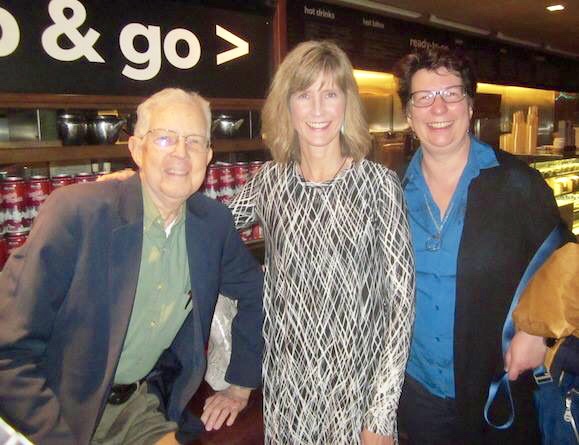
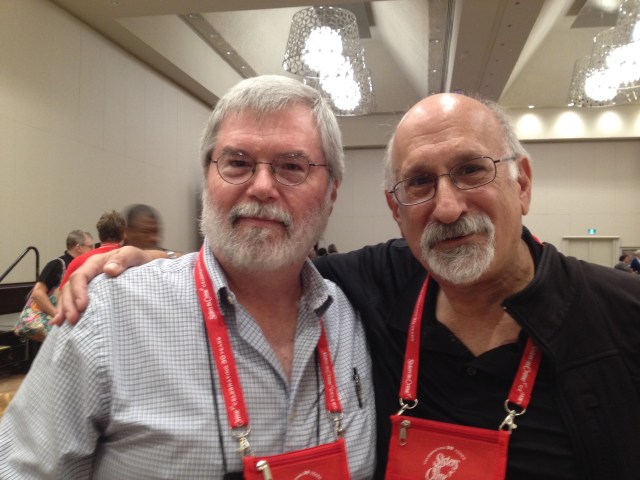
Here’s Michael Bracken and Josh Pachter, photo courtesy of Temple Walker. In case you missed it, our full Bouchercon recap can be found here.

Posted in Conventions | Tagged , , , | Leave a comment

“The Big Idea” (by David Dean)

David Dean blogged for this site just last month. We are delighted to have him back with a post that displays a side of him readers of his fiction dont often see. His dark, sometimes chilling fiction has earned an EQMM Readers Award, an Edgar nomination, and other honors. But those of us whove had the pleasure of meeting David know that his mood can be as light as it comes across here, frequently leavened with wit.—Janet Hutchings

When Janet asked me to write a blog I offered two suggestions for possible subjects. The first she pointed out had been done before . . . by her. So, that was out. The second, though I started it in good faith, just didn’t want to gel into a coherent piece. It needed a coherent writer.

I lay in bed that night tossing and turning, racking my grey matter for ideas . . . something . . . anything to write about. That’s when it hit me—ideas! That’s what I’ll write about, the search for story ideas—how the process comes about, the results, the triumphs, the failures. After all, this is where it all begins in writing fiction . . . any fiction . . . an idea.

The following day, Robin, (my wife of lo these many years) and I, were taking our usual morning walk when I told her of my idea to write about ideas. She Who Walks In Beauty barely slowed her graceful step at this exciting news.

“Ideas . . . where they come from,” she mused in her muse-like way. “You mean like when I give you ideas sometimes?”

“You give me ideas all the time, baby,” I responded.

She Who Walks did slow her steps at that. “I meant story ideas. Remember how I gave you that idea about the dog and the little boy?”

“Of course, I do. That turned out to be one of the best stories I’ve ever written!”

“And remember my ideas about a series for the Hallmark Mystery Channel?”

I nodded in a cautious manner.

“You never wrote that.”

I was beginning to feel a little uncomfortable with the direction our conversation was taking.

“I’m still letting that one simmer . . . mature, as it were,” I stalled. “But the blog will definitely mention the dog/boy idea.”

“Where else do you get your ideas?” she asked.

“From everywhere, I guess—our walks, memories, dreams, past experiences, the news, random things I see.”

“What kind of past experiences?”

“My years as a police officer, for one . . .”

“And what else . . . ?”

“Well, people I’ve known . . . relationships . . . you know, that sort of thing.”

“What kind of relationships . . . exactly . . . ?”

“Look—a scarlet tanager!”

Well, it sure looked like one to me.

When I got back to the house after a nice quiet drive home, I went to my story idea binder. This contains proof of my having a history of ideas. Within the binder lay four yellowing sheets of lined paper, every line freighted with a possible, or now written, story.

Here are a few examples of some that grew up and got published (the as-yet-to-be-published ones are too potentially valuable, or embarrassing, for me to share): Old girlfriend at airport (“Jenny’s Ghost” EQMM, June 2012), water tower suicides (“Don’t Fear the Reaper” EQMM, January 1994), man prods another to murder him (“Mr. Kill-Me” EQMM, August 2015). You get the picture—concise, evocative nuggets that only need a little polishing to reveal their inner worth.

I started this list way back in 1990, shortly after my first story was published in EQMM. After that wonderful event, I felt that every random idea that walked or crawled out of my subconscious was a possible literary gem and must be preserved. I was much younger then.

In any event, here were one hundred and fifty-six ideas for short stories and novels. Running a finger down each page, I found that sixty-seven had actually been developed and written. That does not mean that all those were published. But many were . . . very, very many . . . a whole lot, but let us not dwell on petty details.

Yet, as I walk down memory lane with the yet-to-be-written tales, I sometimes find myself in the company of strangers. Oh, I mostly remember the notion that I had jotted down, but I find that there are a number that still don’t resonate with me. These uncut stones are growing moss. Another discovery I make is that several of the ideas have actually yielded more than one story.

Yet, even with the odds being less than half that an idea will become a story, I continue this arcane practice in the hopes that each of them will someday grow into something I really want to write. Wanting to write the tale is pretty important. This may explain why I haven’t taken up a few ideas offered me pro gratis over the years.

Many, many people, I have discovered, have some great (and not-so-great) ideas for books, stories, and screenplays, only they don’t have the time to write them. But since I’m a writer, they figure I’ve got all the time in the world to do just that. That seemed to be true once; not so much anymore, I’m afraid. The clock is ticking, and I can hear it.

Many of these good people are even willing to dictate what I should write down. My job would be to write it real good. Oh, and the deal is usually a fifty-fifty split of the huge profit we’ll make on this joint venture. Fifty-fifty because my potential partner has already done the hard part coming up with the award-winning idea.

So, back to ideas—what’s really confounding is when I raise one of my own fantastic ideas like gleaming Excalibur only to find it’s become a rotting branch already crumbling in my hands. It’s just not going to happen. Whether it’s a result of my limitations as a writer, or the idea itself is not fully developed enough in my imagination (which I guess is kind of the same thing), I don’t know, I just know, it’s a no-go . . . at least for now.

For me, at least, the litmus test for gold quality is ye olde outline. If I can’t put together some structure containing a beginning, middle, and end, I’m out of it; Mister Idea takes a bus back to Cleveland. I know . . . I know . . . I should just let myself go and write . . . take a chance . . . be truly creative. I have tried it, of course, and more than once. But, I found I was only successful one time. It’s just not me.

After having spent most of my life as a soldier, police officer, and a Catholic (probably the most structured, hierarchical faith in the world), I must have my outline! If there were a writer’s uniform I would probably wear it each day as I reported to my desk.

Now that being said, I don’t have to stick to the outline, I just need it to launch. Once airborne, I can ignore the flight plan and just fly that bad boy . . . or not. It all depends on how the writing is going. Some ideas are just easier than others to write, some so easy I feel guilty when I’ve finished. Where was the required suffering?

That’s usually waiting around the corner with the next story, the one based on a surefire idea that can’t go wrong; that should practically write itself, the one that morphs into the giant octopus that snags the hero-diver just as he’s running out of breath. You pay now, or you pay later . . . but you pay.

And there’s no equity with ideas either. The simple ones can result in great stories, the complex ones into tales better left unread, and the opposite may happen, as well. These humble beginnings demand a lot to bear fruit—experience, imagination, craft, and not a little patience.

So, ideas . . . yeah, I got ’em. Will they all become stories? Time will tell. In putting together this post, I was struck by how many ideas that had lain fallow for ages did eventually grow into stories. So maybe they all will someday. But I doubt it, and here’s why—Cloned sheep, yep, that’s one of the entries on the list. What did I mean by that? Does anyone know? I sure don’t. So, if you want to use it, knock yourself out. We’ll split the profits fifty-fifty. I’m sure it’ll be a bestseller.

Posted in Books, Editing, Fiction, Genre, Guest, Writers, Writing | Tagged , , , , , , , , , , | 6 Comments

ONE FOR OUR HIGHLIGHTS LIST

The 2017 Bouchercon World Mystery Convention, in Toronto, Canada, concluded more than three weeks ago. Normally, we post photos soon after a convention, but this year the whole experience of Bouchercon was so powerful that I felt unable to post about it until now.

As a guest of honor at this year’s events, Ellery Queen’s Mystery Magazine was invited to a dinner hosted by convention co-chairs Helen Nelson and Janet Costello on Wednesday, prior to the official start of programming. There I had the pleasure of meeting, or reconnecting with, not only Bouchercon 2017’s special guest authors but some of the incredible volunteers who make Bouchercon possible. It was a delightful evening.

Then, on Thursday afternoon, came a dedicated EQMM hour. After a short interview with me by Art Taylor, fifteen of our authors each spoke for a couple of minutes about the magazine and their connection to it. This was something I’ll never forget. A mix of old friends, longtime contributors, and new authors (a couple of whom I’d never met before), their recollections—some going back a half century!—were moving and illuminating. With seventy-six years of continuous publication behind it, EQMM is one of America’s longest-running periodicals. That kind of longevity is only possible through the work of many talented contributors and a loyal and discerning readership. But what impressed me most forcefully at this event was the role love has played in sustaining our magazine. In one way or another, it shone from what each person said. I feel immeasurably grateful for my own connection to the magazine and to the “family” that has grown up around it. We have not yet been able to gather photos of all of those who participated in this celebration, but we’ll put them up as we get them. Warmest thanks to all!

Janet Hutchings and Art Taylor at the event honoring Ellery Queen’s Mystery Magazine for Distinguished Contribution to the Genre. Photo courtesy of Josh Pachter.

Brendan DuBois presents at the event honoring EQMM. Photo courtesy of Josh Pachter.

Martin Edwards presents at the event honoring EQMM. Photo courtesy of Josh Pachter.


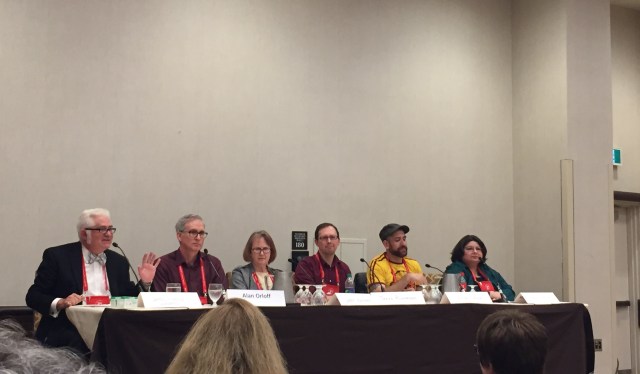
Bouchercon Friday found me on a panel moderated by James Lincoln Warren about the art of short-story writing. Anyone who’s attended the short-story panels of previous Bouchercons knows that attendance is often sparse. With his ingenious idea of devoting the hour almost entirely to audience questions, Jim managed to pack the house, with standing room only. I learned a lot from my fellow panelists, as we talked about everything from flash fiction to the novella.

“5-Minute Misdemeanors: Constructing the Short Story” panel. L to R: James Lincoln Warren (moderator), Alan Orloff, Janet Hutchings, Travis Richardson, Angel Luis Colón, Barb Goffman. Photo courtesy of Jackie Sherbow.

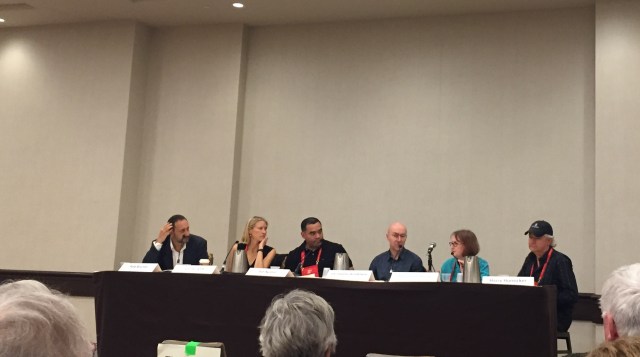
Saturday found me on another panel, this one devoted to noir fiction—a place granted to EQMM due to our Black Mask department (Black Mask Magazine being, arguably, where the noir movement in fiction began). The other panelists included International Guest of Honor Christopher Brookmyre, who made my day by expressing—far better than I ever could—a reservation similar to that I have regarding the use of sexual violence (especially related to children) in entertainment fiction. Kudos to moderator Rob Brunet for guiding us so skillfully through the extensive terrain that these days falls under the heading “noir.”

“Noir is the Beat Up Black” panel. L to R: Rob Brunet (moderator), Lili Wright, Ed Aymar, Christopher Brookmyre, Janet Hutchings, Harry Hunsicker. Photo courtesy of Jackie Sherbow.

As anyone who’s ever attended a Bouchercon knows, eating and drinking with friends, authors, and colleagues is as important as any of the formal events. I did a lot of that this time, and had the extra pleasure of being joined by EQMM and AHMM’s associate editor Jackie Sherbow. Out of those conversations came the inspiration for a couple of new social-media ventures for EQMM and AHMM. As of last week, both magazines launched Twitter and Instagram accounts. You can find us here: @eqmm (Twitter) and @elleryqueenmm (Instagram).

L to R:  Bill Crider, Angela Crider Neary, and Dana Cameron. Photo courtesy of Dana Cameron.

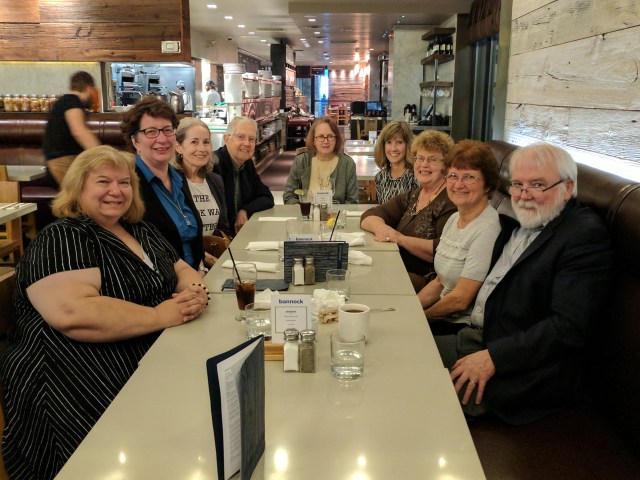
Clockwise from L to R: Toni L.P. Kelner, Dana Cameron, G.M. Malliet, Bill Crider, Janet Hutchings, Angela Crider Neary, Charlaine Harris, Paula Woldan, Brendan DuBois. Photo courtesy of Dana Cameron.

Clockwise from L to R: Richard Helms, Twist Phelan, Martin Edwards, Art Taylor, Elaine Helms, Christine Poulson, and Janet Hutchings. Photo courtesy of Twist Phelan.

Clockwise, L to R: Jane Cleland, Linda Landrigan, John Landrigan, Melodie Campbell, Jackie Sherbow. Photo courtesy of Brendan DuBois.

I’ve been to Toronto a couple of times before, once for an earlier Bouchercon. This time, I was too busy to see much of the city, but I was impressed, as on previous occasions, by the civility and kindness with which we were met everywhere we went. No one exemplifies those qualities more than convention co-chairs Helen Nelson and Janet Costello. Thank you, Helen and Janet, on behalf of both EQMM and myself, for an absolutely marvelous time! Last year, for our 75th anniversary, we created a “highlights list” of our past three quarters of a century. When the next list gets made, this Bouchercon is going to have a big star next to it. —Janet Hutchings

Posted in Awards, Conventions, Ellery Queen, International, Magazine, Readers, Writers | Tagged , , , , , , , | 1 Comment

“Rock ’n Rail: Take the Quiz, or, The Peak Hour Commute Seen Through the Eyes of a Mystery Writer” (by V.S. Kemanis)

V.S. Kemanis has had a varied career in the law and the arts. As an attorney, she has been a criminal prosecutor, a civil litigator, and the supervising editor of decisions for an appellate court. Her short fiction has appeared in EQMM and elsewhere and was collected most recently in 2017’s highly praised Love and Crime: Stories. She is also the author of the Dana Hargrove legal mysteries, a series described by reviewer Jon L. Breen as “a law buff’s delight.” Recently retired from the practice of law, the author expects to have more time for her fiction, and has a new Hargrove novel due for release in January. But as we see in this post, the daily grind of commuting to a day job is never entirely unproductive time for a writer.—Janet Hutchings

“All aboard!” bellows the Tom Hanks–handsome conductor as he swings out from the door. With a whooshing release of steam, the train chugs out of the station. You relax into a spacious window seat, mesmerized by the beautiful rush of hill and dale, letting the gentle rock and clack-clack of the rails lull you into day-dreamland.

Not quite. Were it only so. Having recently retired from my legal career at an appellate court, I’m inspired to reveal the painful details of my years of peak-hour commuting (read that “working”) on Metro-North Railroad, a.k.a. my second office for reading and editing appellate decisions. Now that I’m blissfully free of that pressure, I take the train to NYC for purely pleasurable activities and enjoy the latest issue of EQMM on the way!

If you’re a fiction writer with a day job, you know that every spare minute presents the potential for a writer’s exercise or story idea. Let me offer a few here. Take the quiz! All choices marked (a) (b) and (c) are taken from true life experiences. You’ll find the answers to the quiz at the end. (If I knew how, I’d print the answers upside-down).

Monday, 5:30 a.m.: In your suburban bedroom, the radio alarm, set to a local station at maximum volume, blasts you awake.

I. Which is the worst? (a) “Cake by the Ocean”; (b) Dr. Z___’s commercial on the duodenal switch procedure; (c) transit report of a thirty-minute delay on Metro-North due to police activity at the Harlem-125th Street station.

Story idea: Manhunt for the killer of a suburban gastroenterological surgeon ends with the arrest of a disgruntled bariatric patient (eating cake on a Metro-North train), as he alights at the station to make a second surgical consult in NYC.

6:30 a.m.: You’re out the door to catch the 6:46, Cortlandt to Grand Central, counting on a full hour of work on the way to work in the Quiet Car®.

Ridiculously small sign that has no chance in hell of alerting anyone to the rules of the Quiet Car®

II. Which is the worst? (a) a clueless passenger yelling repeatedly into his cell phone “I’m on the train!”; (b) the creepy, red-faced maniac who stands up and yells into the clueless passenger’s face, “THIS IS THE QUIET CAR!”; (c) your realization that it wasn’t so lucky after all to grab the last available aisle seat because your seatmate is a twitchy, heavy snorer who placed a full cup of coffee on the empty spot between you before falling asleep.

Story idea: Horrified wife, on the other end of the call, overhears her husband being assaulted before his Smartphone gets thrown across the aisle and doused with coffee; the assailant flees at the Harlem-125th Street station but is later apprehended based on the wife’s positive voice identification of her ex-husband.

7:48 a.m.: The train arrives at GCT, as usual, 5 minutes and 59 seconds late. Scratch that. It arrives “on time,” as defined by the “national industry standard” [read national industry standards here]

One of my usual tracks, 34.

7:52 a.m.: Time for a pit stop before getting on the subway.

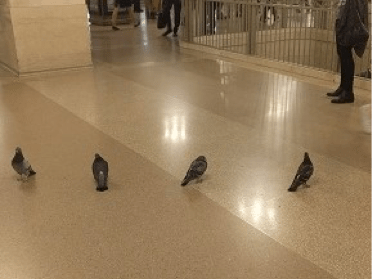
A few of the local residents at GCT

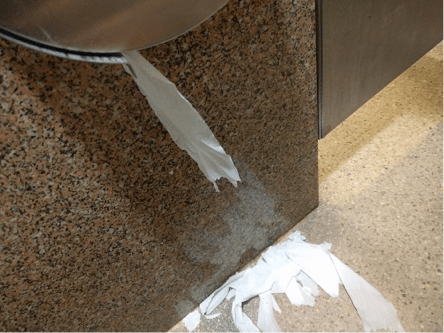
III. Which is the worst? (a) tiptoeing around the pigeons and their droppings on the way to the facilities; (b) being scolded by the bathroom attendant [“this a public bathroom, honey, it ain’t your home”] when you balk at entering the only available, less-than-desirable stall; (c) wasting five minutes and a-full-tree-branch-worth of little bits on the floor trying to get sufficient paper from a ten-pound roll of single-ply tissue designed by a tree-hugger of low intelligence.

Story idea: In the wee hours of the morning, the bleeding victim of a mugging regains consciousness inside a locked, “out of order” toilet stall in the bowels of Grand Central and sends an SOS message on a tissue tidbit tucked into the wing of a carrier pigeon, reaching the bathroom attendant as she starts her shift, saving the victim’s life.

Paper for possible use in SOS

8:01 a.m.: Catch the shuttle to Times Square.

IV. Who/which is the best (click on links to watch videos)? (a) Trumpeter Eganam Segbefia; (b) Trombonist Benny D; (c) Robert Anderson Jazz Band.

Eganam Segbefia

Story idea: Just a reminder to use music in your next short story to set the mood.

8:06 a.m.: Catch the 2 or 3 from Times Square to Clark Street, Brooklyn.

V. Which is the best writer’s exercise to undertake in a crowded subway car for improving your descriptions and characterization? (a) study the placement of features and the sizes and shapes of heads, eyes, ears, noses, and mouths of the people around you (or the thighs and knees of the people standing in front of you if you are sitting); (b) observe the characteristics and behavior of mentally ill people; (c) memorize the techniques and pitches of panhandlers.

Jot your idea for a writer’s exercise here:


8:35 a.m.: Arrive at work, feeling as though you’ve already put in a full day.

Then you do a full day, and it’s time to go home.

5:10 p.m.: Leave NOW if there is any chance of catching the 5:53 from GCT to Cortlandt.

VI. Which is the worst? (a) tripping on a pothole and falling in a Brooklyn street next to the subway entrance and manning up for the full two-hour commute home in horrible pain as your left wrist swells to mammoth size because you’ve broken it despite telling yourself, “I’m OK”; (b) being stuck in the tunnel under the East River for twenty minutes due to “sick passenger at 14th Street” knowing you will miss the 5:53; (c) arriving at the GCT subway stop with five minutes until train time, which is completely doable if you have a straight shot up the two flights of stairs and across the concourse to track 34, but a wall of bodies inhibits your progress, and the train pulls out as you step onto the platform, the smiling conductor leaning out the window.

Story idea: Murder suspect, on the run, sick with guilt and fear, gets off at GCT station, and in his haste up the stairs, pushes a woman who falls and breaks her wrist; the crowded concourse inhibits his progress, and the woman points him out to the police, who arrest him for assault, not aware that they’ve fortuitously caught a murderer. [I used this scene in my novel Homicide Chart]

On the 5:53 (or 6:15, depending on VI): Slightly headachy and nauseated from stress and fatigue, you look for a seat in the Quiet Car® for an hour of work on the way home. The rules of the Quiet Car®, however, do not include a rule against eating or drinking.

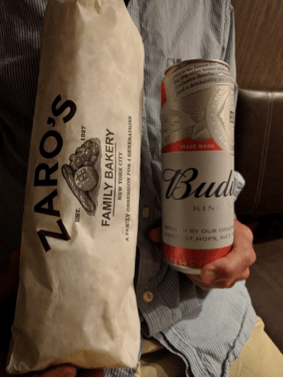
VII. Which type of food stinks up the Quiet Car® the most? (a) McDonald’s French Fries; (b) Chinese beef with broccoli; (c) a 25-ounce beer and humongous bag of Zaro’s popcorn.

Stay away from this man to avoid an hour of noisy, odoriferous commuting

Story idea: A person who is hypersensitive to smell meets a person who is hypersensitive to taste, with suspenseful and magical results [This is a theme in “Rosemary and Reuben” in my collection Love and Crime: Stories—the hypersensitive smell person avoids trains whenever possible]

7:15 p.m.: Home sweet home! A quick dinner, and two or three hours remain to work on the current novel before bedtime.

And so, there you have it, fun and productivity from pain. Feel free to steal the unused story ideas—I was too busy at the Court to develop them, and now I’m immersed in the final chapters of my current WIP, the fourth Dana Hargrove legal thriller. It’s a whole new world, retirement from the day job—I’m in writer’s paradise.


Answers to quiz questions I – VII: All of the above.

Posted in Fiction, Guest, Writers, Writing | Tagged , , , , , | 2 Comments

“Open Letter to Queen Fans” (by Francis M. Nevins)

Francis M. Nevins has distinguished himself in every area of the field of mystery and crime fiction. Hes the author of six novels and forty short stories and has won the Edgar Allan Poe Award twice for his critical work. He is widely considered one of the leading authorities on the life and work of Ellery Queen, and he authored the influential works Royal Bloodline: Ellery Queen, Author and Detective (1974) and Ellery Queen: The Art of Detection (2013). In early 2018 his first published fiction, an Ellery Queen pastiche, will be reprinted in the anthology The Misadventures of Ellery Queen, edited by Josh Pachter and Dale Andrews (from Perfect Crime Books). It is the hope of all of us at EQMM that the collection will generate new interest in the novels of Ellery Queen, most of which are available in new e-editions from Mysterious Press/Open Road.—Janet Hutchings 

I discovered mystery fiction when I was twelve or thirteen and was first allowed access to the grown-up section of the public library in Roselle Park, New Jersey. Chance, fate, or what have you guided my footsteps to the mystery shelves where I found and checked out a large volume of Sherlock Holmes stories and The Celebrated Cases Of Charlie Chan, an omnibus consisting of five of the six Chan novels. That was more than sixty years ago, and I still read mysteries today. It’s just as the philosopher Walter Kaufmann said: “The loves of childhood and of adolescence cannot be subtracted from us; they have become part of us. . . . It is as if they had entered our bloodstream.”

Exactly when I discovered Ellery Queen I can’t recall, but it must have been soon after my introduction to detective fiction. I have a vivid memory of sitting in a rocking chair in front of my grandmother’s house during the stifling hot summer of 1957, entranced as I wandered with Ellery through the labyrinths of The Greek Coffin Mystery. How could I have guessed that less than a dozen years later I’d be sitting in the living room of one of Ellery’s creators?

I had had some correspondence with Fred Dannay but we hadn’t met until the day in 1968 when I stepped off a commuter train out of Grand Central Station at Larchmont, about 45 minutes from midtown Manhattan, and was shaking hands for the first time with Fred Dannay and his then wife Hilda and riding in their car to the Dannay home in Byron Lane. In the fall of 1941, when I was studying to be a fetus, Fred had founded Ellery Queen’s Mystery Magazine, which he continued to edit actively until shortly before his death. One of Fred’s abiding concerns was bringing new blood into the genre, and each monthly issue of EQMM contained at least one short story by an author who had never published a mystery before. He must have encouraged almost everyone he met to try writing for him, but in any event after we had come to know each other a bit better he certainly encouraged me. I slaved over a story for two months and finally mailed it to him. Its inspiration was a line from one of my favorite Queen novels, Ten Days’ Wonder (1948), and I was sure he’d like it.

A few weeks later he invited me to Larchmont again. We had dinner at a lovely old seafood restaurant and returned to Byron Lane and sipped brandy in his living room as he ripped that story of mine apart with a surgical precision that I soon came to realize was more than justified by the sheer unadulterated silliness of what I’d written. Then we began to build the story up again. He taught me what I should have done not in so many words but indirectly, by emphasizing the wrong steps I’d taken and leaving it to me to make them right. I spent the next couple of months rethinking and rewriting that story from first word to last. Finally in fear and trembling I sent him the revised version, and in turn he sent me a contract. “Open Letter to Survivors” was published in EQMM for May 1972. During the month that issue was on the nation’s newsstands, every time I entered a store and saw my name on that blue-and-white cover along with the names of all the other contributors it was all I could do to restrain myself from shouting “HEY!! THAT’S ME!!!” to everyone within earshot.

That was more than 45 years ago. Ellery Queen was still a household name back then, and many readers of the time would have spotted most of the countless Queenian motifs with which the tale was studded. Today I’m afraid very few without the specialized interest of this blog’s followers would recognize the origins of the X-Y-Z theme, the dying message clue, the Iagoesque manipulations, the Alice in Wonderland-like will (Lewis Carroll was always a favorite of Fred’s), and so many more. How many 21st-century readers will catch the oblique references to Queen’s masterpiece Cat Of Many Tails (1949), or the attempt to replicate the intellectual excitement of a Queen climax? Without the giveaway in the opening quotation, how many could even name my nameless detective?

We may soon find out: the story is being reprinted in Josh Pachter and Dale Andrews’ forthcoming anthology The Misadventures Of Ellery Queen.

In case you are among the anthology’s readers, I should mention that the biology in the story also owes something to Alice in Wonderland. Today (though not necessarily in 1948) there’s a scientific consensus that both heredity and environment contribute to one’s fingerprints, from which it follows that the prints of monozygotic siblings are similar but not identical. But which of us hasn’t made a mistake? Who can forget the story (not by Queen) that opens with a St. Patrick’s Day parade on which the April sun is shining down?

I can’t believe I’ve lived to see one (or, if you include Fred’s cousin and collaborator Manfred B. Lee, two) of the most important authors of my formative years fall into obscurity. Will the Pachter and Andrews anthology help return to Ellery the prestige he deserves? Will e-books or some other high-tech medium we haven’t yet dreamed of restore the author(s) and character to the central position they enjoyed for years before I was born and for much of my lifetime? Many of us are trying to achieve that goal. I see the forthcoming book as a step in the right direction.

Posted in Anthologies, Books, Characters, Editing, Ellery Queen, Guest, Magazine, Writers, Writing | Tagged , , , , , , , , , | 3 Comments

“Bayou City Breakdown” (by Susan Perry Benson)

Susan Perry Benson debuted in EQMM’s Department of First Stories in July 2013. A native Houstonian and a frequent contributor to the Houston Chronicle and Texas Magazine, she had already moved to North Carolina by the time she turned her pen to fiction, but she continues to have close ties to Houston. In this post she shares some thoughts about Hurricane Harvey, which made landfall near Houston on August 25, 2017. EQMM salutes all of those who have weathered this season’s hurricanes and are bravely rebuilding their cities and towns. And we thank Susan for letting us see the catastrophe from the perspective of someone to whom it is deeply personal. The author’s next story for EQMM will appear in our March/April 2018 issue.—Janet Hutchings

I’d been on a celestial high from viewing the solar eclipse earlier in the week, plummeting back to earth when I saw that Hurricane Harvey had been upgraded to a Category 4, with landfall expected somewhere around Corpus Christi, Texas. It wasn’t until the next morning, as I sat in front of the TV screen with my first cup of coffee, that the horror set in. Harvey, after making landfall in Rockport, had moved farther east, siphoning copious amounts of water from the Gulf and dumping it on Houston until the city of my raising looked as alien to me as a scene from Waterworld. With Buffalo Bayou on a bull rise, the skyline looked like a modern-day Atlantis.

Houston is called the Bayou City for a reason, and in his bestseller, Blood and Money, the late Thomas Thompson said it so well: “There was no real reason for Houston even to exist. Of all the major cities in the world, Houston held the slimmest natural promise. She sat fifty miles inland from the Gulf of Mexico, on a relentlessly flat swamp, threaded by muddy bayous on whose banks sunned water moccasins.” But grow and prosper she did, thanks to oil and a ship channel dredged from Buffalo Bayou to Galveston Bay to form the Port of Houston. Add to that list air conditioning to stave off the steamy subtropical heat and you have a city that knew no boundaries. In a city that’s never had any zoning restrictions, growth isn’t a doctrine, it’s a proverb.

I’d haunted all the neighborhoods now under water. And the list kept growing as I watched the news feeds: A family stranded at a grocery store in Meyerland. Anybody have a boat? . . . A pregnant evacuee scheduled for a C-section wondering if her home would still be there . . . a young man electrocuted in Bear Creek while trying to rescue his sister’s cat.

Houston’s network of bayous flood with alarming regularity any time a tropical storm barrels through, but what cosmic algorithm dumps thirty-three trillion gallons of water on a metro the size of New Jersey? This used to be my town, and I felt like every sad song I’ve ever heard, on the edge of my proverbial seat as I checked social media; phoning, texting and emailing family and friends. My cousin, Pam was fine. She lives in the Heights, the highest elevation in the city, hence the name. Cousin Lauran marked herself safe on Facebook. My two nephews were okay. My brother in LaGrange, about two hours west of town, said he’d received twenty-six inches of rain by late Saturday. The ranch house sits on a big hill, and though people along the Colorado River were being urged to evacuate, he said he wasn’t worried. My aunt Peggy in Pearland, at the age of eighty-eight, was taking a wait-and-see attitude, saying the neighbors looked after her. By Sunday, I had not heard from my friend, Kay. After two days of texting and phoning mutual friends, I imagined the worst.

Despite taking on some water, Murder by the Book, which more aptly could have been called “murder by the brook,” managed to stay open over that fateful weekend, offering free coffee, charging stations and a shelter to those in need; a prime example of how Houstonians pitch in during a crisis.

One hurricane always brings memories of those past, Hurricane Carla, a category 5, my first experience in 1961. While our neighbors were fleeing to shelters, I questioned my father’s judgement about riding it out in our house; the eye destined for the heart of Houston. But that was a long time ago, and we came through it fine, more of an adventure than a disaster. Twenty-some-odd years later, I rode out Hurricane Alicia with my cocker spaniel for company, the winds battering the house with a deafening roar as Blondie paced and whined throughout that long ordeal, water lapping at my doorstep before it ended. Never again!!

I’d since moved to North Carolina when a tropical storm called Allison wreaked havoc in Houston, dropping forty inches of rain and taking close to forty lives. My editor at the Houston Chronicle made it through by the skin of his teeth, taking refuge in a hospital at the Texas Medical Center on his way home from work.

In August of 2005, my brother and I rented a charter boat for my dad’s eighty-fifth birthday. Dad had long since retired from Amoco, the better part of his life spent positioning offshore rigs in the Gulf. Fishing had been one of his favorite pastimes, and as we motored some thirty miles out, heading for the snapper banks, the water felt unusually warm, almost hot to the touch, the perfect fuel for another high-seas hell-broth we call a hurricane. Weeks later, Katrina plowed into New Orleans, Rita heading for Houston on the heels of that disaster, inciting a mass exodus and the worst traffic jam Houston has ever known.

I’d about forgotten what day it was when my phone chirped with a long text from Kay: A tornado just missed the house but tore down all her banana trees. Lucky break! Kay and her husband planned to spend the night with a neighbor as rising water threatened the house. They were busy setting the furniture up on bricks. I took pause wondering if bricks would be enough, a hare’s breath behind them wondering how they’d manage that massive entertainment center.

By Labor Day weekend, Houston had received fifty inches of rain and the death toll had reached fifty; one soul for every inch of water. The Harris County Morgue had run out of room for the bodies, and at some point Mayor Sylvester Turner, a man I admire hugely, said, and I quote: “People won’t evaluate us on how we started, but on how we ended this.”

Through it all, I kept seeing the parallels to my writing life.    I sit down to write a story with no more than an idea, letting the story and the characters take shape, writing blindly for the most part as they lead the way, no idea how it might end, and sometimes they end badly. People ask on occasion where my ideas come from. I have to laugh a little because there are more ideas out there than I’ll ever have time to pursue. Three scenes from Harvey I can’t seem to shake, scenes that I might use in the future are as follows: 1) A school of exotic fish swimming in the lobby of the Omni Hotel. 2) A woman on the Buffalo Bayou Bridge scooping up bats with a fish net; Mexican free-tails flushed from their roost below. 3) A blond-headed woman standing beside her splintered mobile home after riding out the storm in Rockport. When she told a reporter she thought she was going to die, he asked her why she didn’t evacuate. “We didn’t have the money,” she replied in disdain. I’ve been there: Single mom. Stony broke. No car. But I always had family to fall back on. I wondered what would become of her. Would FEMA make her life whole again, or would desperate times lead to desperate measures?

Although the sun had come out over Labor Day, nineteen Texas rivers were still at flood stage, and three hundred roads were still under water. Both the Colorado and Brazos Rivers were out of their banks, forcing mandatory evacuations in LaGrange and Richmond respectively. I sent a text to my brother. Riveted to the news he replied. Be safe! I wrote.

As I watched evacuees slogging through a living stew of snakes, fire ants, alligators and E. coli, I learned that first responders can’t force you from your home if you choose to stay. I’ve never been in that situation, but can only imagine how awful it must feel to leave all your worldly possessions behind. You can’t push the river, and you can only push a story so far. What may start out with loads of promise could also hit a brick wall halfway in. Again and again, you will be tested. And sometimes you just have to walk away.

Some four weeks later, while all eyes were on Irma, bodies are still turning up. A senior with dementia who strayed from home was found in a sandpit many miles away. Two seniors in west Houston near the Barker Reservoir drowned in their homes, their deaths blamed on a dam release that came in the middle of the night while the city slept. Apparently the Corps of Engineers advised city officials that the controlled release would not cause anything more than street flooding, and both entities have been mum about a possible communication breakdown. Those who did manage to flee said they had no warning. Already, lawsuits are flying faster than a flock of wild geese to a rice field.

During a recent city-council meeting tempers flared over clean-up efforts. It seems that Mayor Turner had a dustup with a councilman who’d complained about the slow pace of debris removal in his district. Harvey took no prisoners and showed no favorites, flooding modest homes as well as upscale neighborhoods. A Disaster Distress Helpline has been set up, along with free counseling for those feeling overwhelmed in the aftermath. Houston is still an open wound, and the healing process will be ongoing, a roman a clef in the making, a story that shows no sign of ending any time soon.

Posted in Writers, Writing | Tagged , , , , , | Leave a comment

“Edgar Allan” (by David Dean)

David Dean, an EQMM Readers Award winner and an Edgar nominee, has blogged for this site a couple of times before (See “The Human Condition” and “A Day in the Life of the Creative Writer”), and his evocative stories have been featured regularly in EQMM for more than twenty-five years. With Halloween in the offing, he has Poe on his mind. Our next Dean story will appear in the March/April 2018 issue.—Janet Hutchings

Edgar Allan . . . Anybody that enjoys reading knows what comes after. Poe has that kind of star power in the literary world. Few people who are serious about writing (or reading, for that matter) have not read at least some of his works and are familiar with many more. I’ve been a Poe boy since I was a child, which is a time receding so quickly into the past that I begin to wonder if Edgar and I might not have been on the same Little League team.

Mystery writers know him as the father of their genre, and go about coveting the tiny bust of his woeful countenance that is annually awarded to a fortunate few by the Mystery Writers of America, while horror authors claim him as master of their dark arts. He strides his two worlds like a pale, unsteady colossus.

Crime fiction is normally the neighborhood I live in, but I do, occasionally, cross the tracks into Horrorville. I find the line of demarcation hard to see in the darkness. My most recent foray was inspired by Poe himself, or more accurately, by a mysterious man obsessed with the long-dead author—the “Poe Toaster” as he came to be known. In my story I attempt to answer the question of why the three roses and an open bottle of cognac were left on Poe’s grave each year for over seventy years, and why it came to an abrupt end on his 200th birthday in 2009. It seemed the least I could do for the tired-looking genius that spawned the careers of so many writers around the world. It is my little tribute.

Sometimes my crime fiction contains elements of horror, my horror fiction elements of the mystery genre. My novel, “The Thirteenth Child” is most certainly a horror story, but its protagonist is a police chief pursuing investigative leads into the disappearances of three children. His antagonist is a Rumpelstiltskin-like vampire (though the chief goes through nearly the whole novel without knowing this), a character not often found in police line-ups.

On the other hand, a number of my crime-fiction stories that have appeared in Ellery Queen Mystery Magazine have contained a touch of horror. In “The Walking Path” (July 2015) my main character plods along with an ever-growing sense of dread, while unaware that his daily walk will end in a very unexpected, and terrifying, death. In “Spooky” (Sept/Oct. 2002) a rescued dog drives his lonely owner to distraction by his nightly ritual of barking at a certain hour, unable to be calmed. After he is returned to the pound, his former owner discovers, too late, what all the barking was about moments before he is killed. Certainly, Joyce Carol Oates’ story, “Big Momma” (EQMM Mar/April 2016) is as horrifying a tale as I’ve read in recent years, though it features no supernatural beings. It does, however, feature a family and their pet snake that are not soon to be forgotten, though you may want to.

But neither of us was breaking new ground with these stories, in which crime flirts with horror; Poe was there long before us. His renowned “The Murders in the Rue Morgue” is generally considered the earliest story of criminal detection in fiction, and what a case the hero has on his hands—a razor wielding orangutan! The description of the crime scene and the murdered girl in the chimney has to be one of the most chilling in literature.

Yet, many of his horror tales were built around criminal acts. In “The Tell-Take Heart,” long considered a classic in that genre, we are treated to the murderer’s narration of his heinous crime and its reasons, in what is also an early experiment in the marriage of psychology and fiction. Our killer is haunted by the beating of his dead victim’s heart, a heart that grows ever-louder in his ears, yet the policemen cannot hear it! In the end he is forced to reveal his crime and the dismembered body that lies beneath the floorboards the officers stand upon.

One of my favorites, “The Cask of Amontillado”, begins not with a fait accompli but a crime in progress. While nursing a long-held, yet never revealed, grievance, the killer-to-be lures his victim ever deeper into his family catacombs, an underground cemetery that serves double duty as a wine cellar. Promised a glass of a rare and splendid Amontillado his drunken victim stumbles along in his path, oblivious to the warning signs that this will be his final tasting. When they arrive, at last, he finds a tomb prepared by his convivial host awaiting him, and begins to comprehend what is about to happen. His pleas for mercy fall on deaf ears, as the narrator buries him alive within the dank walls of the cellar.

Horror . . . ? Crime fiction . . . ? Yes, to all of these.

For writers like me, who walk between sunshine and shadow (which accounts for most of us, I suspect), Poe remains an inspiration, as his stories, too, often blurred the lines between mystery and horror, crime and terror. Though he could be a purist when he chose; stories like “The Mystery of Marie Roget” and “The Purloined Letter” were tales that required no terror. Horror stories such as “The Fall of the House of Usher” and “Hop Frog” required no detectives, no prosecution. Poe did what he always did whatever story he was writing, he focused on the denouement, that penultimate moment when it all had to pay off for the reader, and he did whatever it took. Blurring lines would have been no accident, I think, for Edgar Allan.

This time of year, I always find myself thinking about Poe and his stories and poems. October is his month in my mind—what with Halloween capping it off, and days of ruminative beauty leading up to the ghostly celebration; winter hidden, but sometimes felt in the breeze, the rustling of the dying leaves. I wonder how he felt about autumn. It wasn’t as easy to stay warm in his time as now, and his feelings about that might have made him more jaded than me. As for Halloween, it wasn’t celebrated in quite the same way in the first half of the 19th century as today. In fact many folks didn’t recognize it at all, and I have no idea what Poe might have thought of it, or if he did. But, I’d like to think that if we had been on the same Little League team as kids, we would have gone trick-or-treating together on All Hallows Eve.

He would have loved it.

Posted in Characters, Fiction, Gothic, Guest, History, horror, Memorial, Readers, Story, Supernatural, Writers | Tagged , , , , , , , , , , | 8 Comments

“A Shadow of Lead” (by Lou Manfredo)

Lou Manfredo has been a regular contributor to EQMM since 2006. He is best known for his series of novels featuring Brooklyn cop Joe Rizzo, a character Kirkus Reviews called “the most authentic cop in contemporary crime fiction.” That authenticity probably derives from the twenty-five years Lou spent working in the Brooklyn criminal-justice system. Fans of Rizzo can see him again in “Rizzo’s Monkey Store,” in EQMM’s next issue, November/December 2017 (on sale October 24). Lou’s post today is timely, as violence and disasters seem to be making our world an ever more dangerous place. . . . —Janet Hutchings

Some years back, my first EQMM story appeared. Set in a NYC speakeasy, circa 1928, the story was followed by a series of others occurring in a small Long Island farming community in the early 1960s. At roughly the same time, I produced three novels set in present day Brooklyn, New York. I guess it was a form of literary schizophrenia; here today, yesterday tomorrow. Or something.

My latest publications in EQMM feature that present-day novel character, NYPD Detective Joe Rizzo. But something odd has begun to happen: A close reading of each story presents a vagueness of time frame. Hints abound—public telephones, for instance, enclosed in actual full booths and sitting on random street corners. I seem to subtly be crossing from present to past. My initial reaction to this realization was pragmatic. Crime detection today in our tech savvy world differs from the struggles of Holmes, Spade, or Wolfe. Security cameras, cell towers, DNA—the list goes on. So, I believed, my slipping back in time must be a creative tool, a writer’s sleight of hand to facilitate moving the mystery along smoothly.

But—and it seems a rather significant “but”—that doesn’t fully explain the fact that I’ve written two novels of late (unrepresented and thus unsold, I should add) both of which are set in the past: one in 1980 NYC, the other in the deep south of 1960. I began to wonder: Was my subconscious at work here? Was the present simply inconvenient from a creative point of view, or perhaps was something else going on? Something less comprehensible?

Suddenly I recalled a rainy afternoon nearly four years ago.

Sitting on the double recliner in my den watching, for the tenth time, an episode of Curious George. Cuddled beside me was my grandson Robert, a battered, metal, two-tone green toy pickup truck clutched in his hands, the very same truck I myself played with as a child on the linoleum-clad kitchen floor in a Brooklyn apartment, passing time as my mother prepared a meal, an activity which usually consumed, in my memory, most of her day.

Just as George began to bury a bunch of full-grown carrots in Chef Pisghetti’s rooftop garden in an ill-conceived attempt to help the man with an emergency vegetable situation, Robert raised the metal truck to his mouth. He decided—because he was a three-year-old boy seeking illogical adventures—to lick it. I blanched.

Lead paint. The truck, always representative of a romanticized memory of an illogically happy childhood, suddenly morphed into a debilitating, perhaps deadly, weapon of antiquity. I over-reacted.

“Robert! No!”

My grandson froze then turned his head to stare at me, his Windex-blue eyes carrying puzzlement and a hint of offense. No? they ask. Pardon? Are you actually shouting at me? This, Grandpop, is unacceptable.

We resolved the matter and returned to our individual realities—Robert mesmerized by George’s antics, me silently imagining myself as The Man in the Yellow Hat. And why not? What could be better than living in a Utopian version of Manhattan Island, nestled in that wonderful apartment, driving a cool convertible to a pastoral country home. And not a single lead-paint peril in sight.

It then occurred to me that despite almost daily contact with that toy, more than a few occasions most certainly involving a lick or two, I have somehow survived. And surely Robert will, too. I relaxed a bit.

“This is my truck, Grandpop,” Robert announced with authority.

“No, little buddy, actually, it’s my truck,” I say. Just as annual bouts of blistering sunburns, multiple daily doses of sugary soda, periodic passings of drifting radioactive nuclear test clouds, and the rolling death machines we knew as automobiles were once mine, not to mention the fascinating x-ray machine at the local shoe store I slid my feet into on a regular basis.

And yet, there I was.

As Curious George proceeded to once again whip things into well-intentioned but unfortunate chaos, something else occurred to me.

What will my grandson be facing? Genetically engineered foods, climate change, terrorist lunatics, and despicable politicians posing as patriots? The list of such horrors, when contemplated, grows endless.

How sad.

But sadder than the Baby Boomer blues? Crawling under our school desks where, ludicrously, we were told we’d find safety from falling Soviet atomic bombs; waking to reports of yet another assassination; watching once great cities burn against the cacophonic roar of war in Vietnam?

So—if in fact the present day has me a bit shaky in my boots and slipping my fiction to days gone by, perhaps a close examination of the good old days is advisable. Maybe my retreat to days past—conscious or not—is nothing more than idealized escapism just as it has probably always been whenever grandparents contemplate the futures of their grandchildren. Each generation lies beneath a unique shadow of its own leaden toys, irrational nationalistic or theological insanity, disease, hatred, stupidity.

I guess Robert will be all right. It’ll all work out. He’ll grow up, gather an education, work, perhaps share his life with a loving mate, see some success, retire, and grow old. He may even become predictable enough to squire grandchildren of his own around town in a Cadillac or, as my grandson had dubbed mine, a “Cal-a-lack.”

Probably.

But as I sat that day with young Robert before the flat-screen, the magic of Curious George’s world beginning to lose its hold on me, I wondered. Why does it seem so different this time, so much harsher?

And I wonder still, am I simply facing reality or being overly pessimistic? After all, we’re not enmeshed in a Civil War or crushed by a worldwide depression. We are not being assaulted by Nazis or ravished by polio or the plague.

It was much worse for our parents and grandparents, right? We can deal with our problems just as they did. Right?

I wonder exactly what I am trying to say. I guess I’m not sure. There is comfort in the past, I guess because—hey—we got through it. The present, exactly as the future, is unsure. A phone booth just seems so much safer than a smartphone. So I’ll probably continue to write with each foot in a different era. What could it hurt?

And as to our current situation, we’ll deal with it. Of course we will. Right?

Posted in Uncategorized | 2 Comments

“Thoughts on Noir and Story” (Robert Rivers)

Pseudonymous new writer Robert Rivers appears in the Department of First Stories of EQMM’s current issue, September/October 2017. By day the Bostonian works for a Danish company that makes health-care products, making time to write in the early morning and on weekends. He earned an MFA from the writing program at Pine Manor College that was founded by Dennis Lehane, and he is well read in the field of crime fiction. His debut story, “Femme Fatale,” could be classified as “noir” fiction, and in this post he offers his thoughts on the defining qualities of that category. He tells EQMM he is currently working on a collection of stories. —Janet Hutchings

Otto Penzler and James Ellroy provide detailed and enlightening definitions of noir in the first pages of the book Best American Noir of the Century. In a nutshell, noir (the word for black in French) features dark tales of soulless individuals who inhabit and live outside the boundaries of society and the law, and are doomed to failure in the pursuit of their heists, frauds, scams, cons, scores, hunches—and above all their hopeless, unrealistic dreams. There is usually a femme fatale, some tough criminals, a cop or private eye, an urban setting, lots of dark places: alleys, bars, seedy hotels and nightclubs. Ellroy’s description of the noir world and its women, who have “the unique power to seduce and destroy,” is particularly enticing. He writes, “A six-week chronology from first kiss to gas chamber is common in noir.” Gotta love that one.

In Manhattan Noir, Lawrence Block gives noir a broader perspective, noting that noir is more “a way of looking at the world.” Hmmm. I’m more comfortable, as a writer, with that definition as far as my own work is concerned. I hate to think the characters I write about are hopeless and doomed forever, even if they are. I want to think they have a chance, however dismal their situation, and whatever trouble they happen to have put themselves in. . .a chance for change, and the opportunity, however slim, to turn themselves around, to arrive at some kind of redemption.

At some intersection along the road of my writing history, I became attracted to writing about this type of character. These were people living on the edge in some way, emotionally, spiritually, physically. They were sometimes desperate, other times arrogant, but they seemed always to be involved in crime, or on the verge of crime, or having crime lurking just around the corner. In their world the possibility of easy money and the sure thing, was something guaranteed, something owed to them, something they considered their birthright. Breaking the law was nothing to sweat about; it was central to a way of life. The best of them, or worst, depending on whose side you were on, would drag with them, sometimes screaming and kicking, sometimes not, someone not quite as shady as they were (a woman); someone who could put a little light into all the darkness, and make things more human, at least more interesting, and maybe sharpen the conflict.

In my mind, their stories needed to be told. I was, and still am, drawn to these characters, maybe wanting to find out what makes them tick, wanting to share in their excitement, wanting to get to know them better.

Of course there is much more to a story in the larger sense than just characters (setting, plot, tone, for instance), but if we can stay with the idea of character for a moment, the question then becomes why are some drawn to noir characters instead of more mainstream characters?

The writer James Dickey once advised, “If your life gets boring, risk it!” Risking it implies putting yourself out of your element, out of your comfort zone; that is, putting yourself at risk, to get the adrenaline flowing, as an antidote for boredom. But how many of us are willing or capable of doing that? Not many, I think. Maybe that’s why we read fiction in general and noir in particular, and why writers write it. The characters in the story always put themselves at risk! It’s their nature. One risk follows another. They make a habit of living on the edge.

And this character I’m talking about, at least the one I prefer, often has inner conflicts. Should she steal those diamonds, or not? She’s tempted. There they are. All she has to do is pick them up, stash them in her purse. Should this guy switch the dice at the craps table, for the loaded dice he’s palming? The table is there for the taking. The dealers will never catch it. After all, this guy’s a pro, he’s polished this act for years, he could do it in his sleep. Why would he hesitate?

That is to say, I like to think some characters, the better ones perhaps, have several competing selves within. The Moll says, “Honey, just be yourself.” The Mack says, “Which one?”

In the broader sense, I think of noir as a spectrum of shades, maybe going from very dark (the Penzler/Ellroy version) to shades of gray. At any rate, from one end to the other and all points in between, a reader can pick her/his poison among the huge and welcome variety that can be found in the landscape of noir fiction.

As a writer trying to get the story of these characters down on paper, I picture myself somewhere in the background, typing away on my laptop, recording the story, in the same way an observer might, which is probably a good spot for me to be in considering Elmore Leonard’s advice to an author: Don’t get in the way of the story. Since I’m not a criminal, I can only watch what these characters do, and take notes, and speculate as to their motives. Another reason to write about them: it’s fun. I learn about these people as I go along. I get interested in their backgrounds. Where did they come from? What made them the people they are? It’s a process of discovery.

Michelangelo said he was simply freeing the sculpture that already existed within the huge block of fresh cut, dusty marble. I think of that image of the hard working sculptor, hammer in hand, as parallel to the image of a writer in the creation of a story—getting the story to emerge out of whatever substance stories are carved.

In the current issue of EQMM, in my story “Femme Fatale,” I tried to follow the characters where they seemed to be heading, like a reporter trying to catch up with someone he thinks he knows. But do I really know them? I think I’m trying to. Does the reader know them better? That could be the goal, I think.

A friend of mine, on hearing the title of the story, asked me “Is it noir?” Yes? No? I didn’t know what to say. I suppose it is one of those shades of noir. But I’m not sure which one.

Posted in Characters, Fiction, Guest, Noir, Writers, Writing | Tagged , , , , , , , | 2 Comments