“Rock ’n Rail: Take the Quiz, or, The Peak Hour Commute Seen Through the Eyes of a Mystery Writer” (by V.S. Kemanis)

V.S. Kemanis has had a varied career in the law and the arts. As an attorney, she has been a criminal prosecutor, a civil litigator, and the supervising editor of decisions for an appellate court. Her short fiction has appeared in EQMM and elsewhere and was collected most recently in 2017’s highly praised Love and Crime: Stories. She is also the author of the Dana Hargrove legal mysteries, a series described by reviewer Jon L. Breen as “a law buff’s delight.” Recently retired from the practice of law, the author expects to have more time for her fiction, and has a new Hargrove novel due for release in January. But as we see in this post, the daily grind of commuting to a day job is never entirely unproductive time for a writer.—Janet Hutchings

“All aboard!” bellows the Tom Hanks–handsome conductor as he swings out from the door. With a whooshing release of steam, the train chugs out of the station. You relax into a spacious window seat, mesmerized by the beautiful rush of hill and dale, letting the gentle rock and clack-clack of the rails lull you into day-dreamland.

Not quite. Were it only so. Having recently retired from my legal career at an appellate court, I’m inspired to reveal the painful details of my years of peak-hour commuting (read that “working”) on Metro-North Railroad, a.k.a. my second office for reading and editing appellate decisions. Now that I’m blissfully free of that pressure, I take the train to NYC for purely pleasurable activities and enjoy the latest issue of EQMM on the way!

If you’re a fiction writer with a day job, you know that every spare minute presents the potential for a writer’s exercise or story idea. Let me offer a few here. Take the quiz! All choices marked (a) (b) and (c) are taken from true life experiences. You’ll find the answers to the quiz at the end. (If I knew how, I’d print the answers upside-down).

Monday, 5:30 a.m.: In your suburban bedroom, the radio alarm, set to a local station at maximum volume, blasts you awake.

I. Which is the worst? (a) “Cake by the Ocean”; (b) Dr. Z___’s commercial on the duodenal switch procedure; (c) transit report of a thirty-minute delay on Metro-North due to police activity at the Harlem-125th Street station.

Story idea: Manhunt for the killer of a suburban gastroenterological surgeon ends with the arrest of a disgruntled bariatric patient (eating cake on a Metro-North train), as he alights at the station to make a second surgical consult in NYC.

6:30 a.m.: You’re out the door to catch the 6:46, Cortlandt to Grand Central, counting on a full hour of work on the way to work in the Quiet Car®.

Ridiculously small sign that has no chance in hell of alerting anyone to the rules of the Quiet Car®

II. Which is the worst? (a) a clueless passenger yelling repeatedly into his cell phone “I’m on the train!”; (b) the creepy, red-faced maniac who stands up and yells into the clueless passenger’s face, “THIS IS THE QUIET CAR!”; (c) your realization that it wasn’t so lucky after all to grab the last available aisle seat because your seatmate is a twitchy, heavy snorer who placed a full cup of coffee on the empty spot between you before falling asleep.

Story idea: Horrified wife, on the other end of the call, overhears her husband being assaulted before his Smartphone gets thrown across the aisle and doused with coffee; the assailant flees at the Harlem-125th Street station but is later apprehended based on the wife’s positive voice identification of her ex-husband.

7:48 a.m.: The train arrives at GCT, as usual, 5 minutes and 59 seconds late. Scratch that. It arrives “on time,” as defined by the “national industry standard” [read national industry standards here]

One of my usual tracks, 34.

7:52 a.m.: Time for a pit stop before getting on the subway.

A few of the local residents at GCT

III. Which is the worst? (a) tiptoeing around the pigeons and their droppings on the way to the facilities; (b) being scolded by the bathroom attendant [“this a public bathroom, honey, it ain’t your home”] when you balk at entering the only available, less-than-desirable stall; (c) wasting five minutes and a-full-tree-branch-worth of little bits on the floor trying to get sufficient paper from a ten-pound roll of single-ply tissue designed by a tree-hugger of low intelligence.

Story idea: In the wee hours of the morning, the bleeding victim of a mugging regains consciousness inside a locked, “out of order” toilet stall in the bowels of Grand Central and sends an SOS message on a tissue tidbit tucked into the wing of a carrier pigeon, reaching the bathroom attendant as she starts her shift, saving the victim’s life.

Paper for possible use in SOS

8:01 a.m.: Catch the shuttle to Times Square.

IV. Who/which is the best (click on links to watch videos)? (a) Trumpeter Eganam Segbefia; (b) Trombonist Benny D; (c) Robert Anderson Jazz Band.

Eganam Segbefia

Story idea: Just a reminder to use music in your next short story to set the mood.

8:06 a.m.: Catch the 2 or 3 from Times Square to Clark Street, Brooklyn.

V. Which is the best writer’s exercise to undertake in a crowded subway car for improving your descriptions and characterization? (a) study the placement of features and the sizes and shapes of heads, eyes, ears, noses, and mouths of the people around you (or the thighs and knees of the people standing in front of you if you are sitting); (b) observe the characteristics and behavior of mentally ill people; (c) memorize the techniques and pitches of panhandlers.

Jot your idea for a writer’s exercise here:


8:35 a.m.: Arrive at work, feeling as though you’ve already put in a full day.

Then you do a full day, and it’s time to go home.

5:10 p.m.: Leave NOW if there is any chance of catching the 5:53 from GCT to Cortlandt.

VI. Which is the worst? (a) tripping on a pothole and falling in a Brooklyn street next to the subway entrance and manning up for the full two-hour commute home in horrible pain as your left wrist swells to mammoth size because you’ve broken it despite telling yourself, “I’m OK”; (b) being stuck in the tunnel under the East River for twenty minutes due to “sick passenger at 14th Street” knowing you will miss the 5:53; (c) arriving at the GCT subway stop with five minutes until train time, which is completely doable if you have a straight shot up the two flights of stairs and across the concourse to track 34, but a wall of bodies inhibits your progress, and the train pulls out as you step onto the platform, the smiling conductor leaning out the window.

Story idea: Murder suspect, on the run, sick with guilt and fear, gets off at GCT station, and in his haste up the stairs, pushes a woman who falls and breaks her wrist; the crowded concourse inhibits his progress, and the woman points him out to the police, who arrest him for assault, not aware that they’ve fortuitously caught a murderer. [I used this scene in my novel Homicide Chart]

On the 5:53 (or 6:15, depending on VI): Slightly headachy and nauseated from stress and fatigue, you look for a seat in the Quiet Car® for an hour of work on the way home. The rules of the Quiet Car®, however, do not include a rule against eating or drinking.

VII. Which type of food stinks up the Quiet Car® the most? (a) McDonald’s French Fries; (b) Chinese beef with broccoli; (c) a 25-ounce beer and humongous bag of Zaro’s popcorn.
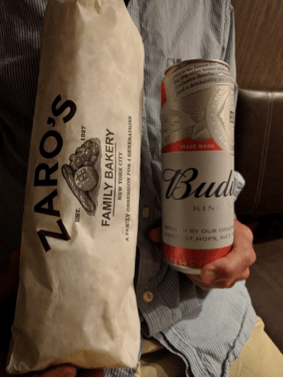
Stay away from this man to avoid an hour of noisy, odoriferous commuting

Story idea: A person who is hypersensitive to smell meets a person who is hypersensitive to taste, with suspenseful and magical results [This is a theme in “Rosemary and Reuben” in my collection Love and Crime: Stories—the hypersensitive smell person avoids trains whenever possible]

7:15 p.m.: Home sweet home! A quick dinner, and two or three hours remain to work on the current novel before bedtime.

And so, there you have it, fun and productivity from pain. Feel free to steal the unused story ideas—I was too busy at the Court to develop them, and now I’m immersed in the final chapters of my current WIP, the fourth Dana Hargrove legal thriller. It’s a whole new world, retirement from the day job—I’m in writer’s paradise.


Answers to quiz questions I – VII: All of the above.
Posted in Fiction, Guest, Writers, Writing | Tagged , , , , , | 2 Comments

“Open Letter to Queen Fans” (by Francis M. Nevins)

Francis M. Nevins has distinguished himself in every area of the field of mystery and crime fiction. Hes the author of six novels and forty short stories and has won the Edgar Allan Poe Award twice for his critical work. He is widely considered one of the leading authorities on the life and work of Ellery Queen, and he authored the influential works Royal Bloodline: Ellery Queen, Author and Detective (1974) and Ellery Queen: The Art of Detection (2013). In early 2018 his first published fiction, an Ellery Queen pastiche, will be reprinted in the anthology The Misadventures of Ellery Queen, edited by Josh Pachter and Dale Andrews (from Perfect Crime Books). It is the hope of all of us at EQMM that the collection will generate new interest in the novels of Ellery Queen, most of which are available in new e-editions from Mysterious Press/Open Road.—Janet Hutchings 

I discovered mystery fiction when I was twelve or thirteen and was first allowed access to the grown-up section of the public library in Roselle Park, New Jersey. Chance, fate, or what have you guided my footsteps to the mystery shelves where I found and checked out a large volume of Sherlock Holmes stories and The Celebrated Cases Of Charlie Chan, an omnibus consisting of five of the six Chan novels. That was more than sixty years ago, and I still read mysteries today. It’s just as the philosopher Walter Kaufmann said: “The loves of childhood and of adolescence cannot be subtracted from us; they have become part of us. . . . It is as if they had entered our bloodstream.”

Exactly when I discovered Ellery Queen I can’t recall, but it must have been soon after my introduction to detective fiction. I have a vivid memory of sitting in a rocking chair in front of my grandmother’s house during the stifling hot summer of 1957, entranced as I wandered with Ellery through the labyrinths of The Greek Coffin Mystery. How could I have guessed that less than a dozen years later I’d be sitting in the living room of one of Ellery’s creators?

I had had some correspondence with Fred Dannay but we hadn’t met until the day in 1968 when I stepped off a commuter train out of Grand Central Station at Larchmont, about 45 minutes from midtown Manhattan, and was shaking hands for the first time with Fred Dannay and his then wife Hilda and riding in their car to the Dannay home in Byron Lane. In the fall of 1941, when I was studying to be a fetus, Fred had founded Ellery Queen’s Mystery Magazine, which he continued to edit actively until shortly before his death. One of Fred’s abiding concerns was bringing new blood into the genre, and each monthly issue of EQMM contained at least one short story by an author who had never published a mystery before. He must have encouraged almost everyone he met to try writing for him, but in any event after we had come to know each other a bit better he certainly encouraged me. I slaved over a story for two months and finally mailed it to him. Its inspiration was a line from one of my favorite Queen novels, Ten Days’ Wonder (1948), and I was sure he’d like it.

A few weeks later he invited me to Larchmont again. We had dinner at a lovely old seafood restaurant and returned to Byron Lane and sipped brandy in his living room as he ripped that story of mine apart with a surgical precision that I soon came to realize was more than justified by the sheer unadulterated silliness of what I’d written. Then we began to build the story up again. He taught me what I should have done not in so many words but indirectly, by emphasizing the wrong steps I’d taken and leaving it to me to make them right. I spent the next couple of months rethinking and rewriting that story from first word to last. Finally in fear and trembling I sent him the revised version, and in turn he sent me a contract. “Open Letter to Survivors” was published in EQMM for May 1972. During the month that issue was on the nation’s newsstands, every time I entered a store and saw my name on that blue-and-white cover along with the names of all the other contributors it was all I could do to restrain myself from shouting “HEY!! THAT’S ME!!!” to everyone within earshot.

That was more than 45 years ago. Ellery Queen was still a household name back then, and many readers of the time would have spotted most of the countless Queenian motifs with which the tale was studded. Today I’m afraid very few without the specialized interest of this blog’s followers would recognize the origins of the X-Y-Z theme, the dying message clue, the Iagoesque manipulations, the Alice in Wonderland-like will (Lewis Carroll was always a favorite of Fred’s), and so many more. How many 21st-century readers will catch the oblique references to Queen’s masterpiece Cat Of Many Tails (1949), or the attempt to replicate the intellectual excitement of a Queen climax? Without the giveaway in the opening quotation, how many could even name my nameless detective?

We may soon find out: the story is being reprinted in Josh Pachter and Dale Andrews’ forthcoming anthology The Misadventures Of Ellery Queen.

In case you are among the anthology’s readers, I should mention that the biology in the story also owes something to Alice in Wonderland. Today (though not necessarily in 1948) there’s a scientific consensus that both heredity and environment contribute to one’s fingerprints, from which it follows that the prints of monozygotic siblings are similar but not identical. But which of us hasn’t made a mistake? Who can forget the story (not by Queen) that opens with a St. Patrick’s Day parade on which the April sun is shining down?

I can’t believe I’ve lived to see one (or, if you include Fred’s cousin and collaborator Manfred B. Lee, two) of the most important authors of my formative years fall into obscurity. Will the Pachter and Andrews anthology help return to Ellery the prestige he deserves? Will e-books or some other high-tech medium we haven’t yet dreamed of restore the author(s) and character to the central position they enjoyed for years before I was born and for much of my lifetime? Many of us are trying to achieve that goal. I see the forthcoming book as a step in the right direction.

Posted in Anthologies, Books, Characters, Editing, Ellery Queen, Guest, Magazine, Writers, Writing | Tagged , , , , , , , , , | 3 Comments

“Bayou City Breakdown” (by Susan Perry Benson)

Susan Perry Benson debuted in EQMM’s Department of First Stories in July 2013. A native Houstonian and a frequent contributor to the Houston Chronicle and Texas Magazine, she had already moved to North Carolina by the time she turned her pen to fiction, but she continues to have close ties to Houston. In this post she shares some thoughts about Hurricane Harvey, which made landfall near Houston on August 25, 2017. EQMM salutes all of those who have weathered this season’s hurricanes and are bravely rebuilding their cities and towns. And we thank Susan for letting us see the catastrophe from the perspective of someone to whom it is deeply personal. The author’s next story for EQMM will appear in our March/April 2018 issue.—Janet Hutchings

I’d been on a celestial high from viewing the solar eclipse earlier in the week, plummeting back to earth when I saw that Hurricane Harvey had been upgraded to a Category 4, with landfall expected somewhere around Corpus Christi, Texas. It wasn’t until the next morning, as I sat in front of the TV screen with my first cup of coffee, that the horror set in. Harvey, after making landfall in Rockport, had moved farther east, siphoning copious amounts of water from the Gulf and dumping it on Houston until the city of my raising looked as alien to me as a scene from Waterworld. With Buffalo Bayou on a bull rise, the skyline looked like a modern-day Atlantis.

Houston is called the Bayou City for a reason, and in his bestseller, Blood and Money, the late Thomas Thompson said it so well: “There was no real reason for Houston even to exist. Of all the major cities in the world, Houston held the slimmest natural promise. She sat fifty miles inland from the Gulf of Mexico, on a relentlessly flat swamp, threaded by muddy bayous on whose banks sunned water moccasins.” But grow and prosper she did, thanks to oil and a ship channel dredged from Buffalo Bayou to Galveston Bay to form the Port of Houston. Add to that list air conditioning to stave off the steamy subtropical heat and you have a city that knew no boundaries. In a city that’s never had any zoning restrictions, growth isn’t a doctrine, it’s a proverb.

I’d haunted all the neighborhoods now under water. And the list kept growing as I watched the news feeds: A family stranded at a grocery store in Meyerland. Anybody have a boat? . . . A pregnant evacuee scheduled for a C-section wondering if her home would still be there . . . a young man electrocuted in Bear Creek while trying to rescue his sister’s cat.

Houston’s network of bayous flood with alarming regularity any time a tropical storm barrels through, but what cosmic algorithm dumps thirty-three trillion gallons of water on a metro the size of New Jersey? This used to be my town, and I felt like every sad song I’ve ever heard, on the edge of my proverbial seat as I checked social media; phoning, texting and emailing family and friends. My cousin, Pam was fine. She lives in the Heights, the highest elevation in the city, hence the name. Cousin Lauran marked herself safe on Facebook. My two nephews were okay. My brother in LaGrange, about two hours west of town, said he’d received twenty-six inches of rain by late Saturday. The ranch house sits on a big hill, and though people along the Colorado River were being urged to evacuate, he said he wasn’t worried. My aunt Peggy in Pearland, at the age of eighty-eight, was taking a wait-and-see attitude, saying the neighbors looked after her. By Sunday, I had not heard from my friend, Kay. After two days of texting and phoning mutual friends, I imagined the worst.

Despite taking on some water, Murder by the Book, which more aptly could have been called “murder by the brook,” managed to stay open over that fateful weekend, offering free coffee, charging stations and a shelter to those in need; a prime example of how Houstonians pitch in during a crisis.

One hurricane always brings memories of those past, Hurricane Carla, a category 5, my first experience in 1961. While our neighbors were fleeing to shelters, I questioned my father’s judgement about riding it out in our house; the eye destined for the heart of Houston. But that was a long time ago, and we came through it fine, more of an adventure than a disaster. Twenty-some-odd years later, I rode out Hurricane Alicia with my cocker spaniel for company, the winds battering the house with a deafening roar as Blondie paced and whined throughout that long ordeal, water lapping at my doorstep before it ended. Never again!!

I’d since moved to North Carolina when a tropical storm called Allison wreaked havoc in Houston, dropping forty inches of rain and taking close to forty lives. My editor at the Houston Chronicle made it through by the skin of his teeth, taking refuge in a hospital at the Texas Medical Center on his way home from work.

In August of 2005, my brother and I rented a charter boat for my dad’s eighty-fifth birthday. Dad had long since retired from Amoco, the better part of his life spent positioning offshore rigs in the Gulf. Fishing had been one of his favorite pastimes, and as we motored some thirty miles out, heading for the snapper banks, the water felt unusually warm, almost hot to the touch, the perfect fuel for another high-seas hell-broth we call a hurricane. Weeks later, Katrina plowed into New Orleans, Rita heading for Houston on the heels of that disaster, inciting a mass exodus and the worst traffic jam Houston has ever known.

I’d about forgotten what day it was when my phone chirped with a long text from Kay: A tornado just missed the house but tore down all her banana trees. Lucky break! Kay and her husband planned to spend the night with a neighbor as rising water threatened the house. They were busy setting the furniture up on bricks. I took pause wondering if bricks would be enough, a hare’s breath behind them wondering how they’d manage that massive entertainment center.

By Labor Day weekend, Houston had received fifty inches of rain and the death toll had reached fifty; one soul for every inch of water. The Harris County Morgue had run out of room for the bodies, and at some point Mayor Sylvester Turner, a man I admire hugely, said, and I quote: “People won’t evaluate us on how we started, but on how we ended this.”

Through it all, I kept seeing the parallels to my writing life.    I sit down to write a story with no more than an idea, letting the story and the characters take shape, writing blindly for the most part as they lead the way, no idea how it might end, and sometimes they end badly. People ask on occasion where my ideas come from. I have to laugh a little because there are more ideas out there than I’ll ever have time to pursue. Three scenes from Harvey I can’t seem to shake, scenes that I might use in the future are as follows: 1) A school of exotic fish swimming in the lobby of the Omni Hotel. 2) A woman on the Buffalo Bayou Bridge scooping up bats with a fish net; Mexican free-tails flushed from their roost below. 3) A blond-headed woman standing beside her splintered mobile home after riding out the storm in Rockport. When she told a reporter she thought she was going to die, he asked her why she didn’t evacuate. “We didn’t have the money,” she replied in disdain. I’ve been there: Single mom. Stony broke. No car. But I always had family to fall back on. I wondered what would become of her. Would FEMA make her life whole again, or would desperate times lead to desperate measures?

Although the sun had come out over Labor Day, nineteen Texas rivers were still at flood stage, and three hundred roads were still under water. Both the Colorado and Brazos Rivers were out of their banks, forcing mandatory evacuations in LaGrange and Richmond respectively. I sent a text to my brother. Riveted to the news he replied. Be safe! I wrote.

As I watched evacuees slogging through a living stew of snakes, fire ants, alligators and E. coli, I learned that first responders can’t force you from your home if you choose to stay. I’ve never been in that situation, but can only imagine how awful it must feel to leave all your worldly possessions behind. You can’t push the river, and you can only push a story so far. What may start out with loads of promise could also hit a brick wall halfway in. Again and again, you will be tested. And sometimes you just have to walk away.

Some four weeks later, while all eyes were on Irma, bodies are still turning up. A senior with dementia who strayed from home was found in a sandpit many miles away. Two seniors in west Houston near the Barker Reservoir drowned in their homes, their deaths blamed on a dam release that came in the middle of the night while the city slept. Apparently the Corps of Engineers advised city officials that the controlled release would not cause anything more than street flooding, and both entities have been mum about a possible communication breakdown. Those who did manage to flee said they had no warning. Already, lawsuits are flying faster than a flock of wild geese to a rice field.

During a recent city-council meeting tempers flared over clean-up efforts. It seems that Mayor Turner had a dustup with a councilman who’d complained about the slow pace of debris removal in his district. Harvey took no prisoners and showed no favorites, flooding modest homes as well as upscale neighborhoods. A Disaster Distress Helpline has been set up, along with free counseling for those feeling overwhelmed in the aftermath. Houston is still an open wound, and the healing process will be ongoing, a roman a clef in the making, a story that shows no sign of ending any time soon.

Posted in Writers, Writing | Tagged , , , , , | Leave a comment

“Edgar Allan” (by David Dean)

David Dean, an EQMM Readers Award winner and an Edgar nominee, has blogged for this site a couple of times before (See “The Human Condition” and “A Day in the Life of the Creative Writer”), and his evocative stories have been featured regularly in EQMM for more than twenty-five years. With Halloween in the offing, he has Poe on his mind. Our next Dean story will appear in the March/April 2018 issue.—Janet Hutchings

Edgar Allan . . . Anybody that enjoys reading knows what comes after. Poe has that kind of star power in the literary world. Few people who are serious about writing (or reading, for that matter) have not read at least some of his works and are familiar with many more. I’ve been a Poe boy since I was a child, which is a time receding so quickly into the past that I begin to wonder if Edgar and I might not have been on the same Little League team.

Mystery writers know him as the father of their genre, and go about coveting the tiny bust of his woeful countenance that is annually awarded to a fortunate few by the Mystery Writers of America, while horror authors claim him as master of their dark arts. He strides his two worlds like a pale, unsteady colossus.

Crime fiction is normally the neighborhood I live in, but I do, occasionally, cross the tracks into Horrorville. I find the line of demarcation hard to see in the darkness. My most recent foray was inspired by Poe himself, or more accurately, by a mysterious man obsessed with the long-dead author—the “Poe Toaster” as he came to be known. In my story I attempt to answer the question of why the three roses and an open bottle of cognac were left on Poe’s grave each year for over seventy years, and why it came to an abrupt end on his 200th birthday in 2009. It seemed the least I could do for the tired-looking genius that spawned the careers of so many writers around the world. It is my little tribute.

Sometimes my crime fiction contains elements of horror, my horror fiction elements of the mystery genre. My novel, “The Thirteenth Child” is most certainly a horror story, but its protagonist is a police chief pursuing investigative leads into the disappearances of three children. His antagonist is a Rumpelstiltskin-like vampire (though the chief goes through nearly the whole novel without knowing this), a character not often found in police line-ups.

On the other hand, a number of my crime-fiction stories that have appeared in Ellery Queen Mystery Magazine have contained a touch of horror. In “The Walking Path” (July 2015) my main character plods along with an ever-growing sense of dread, while unaware that his daily walk will end in a very unexpected, and terrifying, death. In “Spooky” (Sept/Oct. 2002) a rescued dog drives his lonely owner to distraction by his nightly ritual of barking at a certain hour, unable to be calmed. After he is returned to the pound, his former owner discovers, too late, what all the barking was about moments before he is killed. Certainly, Joyce Carol Oates’ story, “Big Momma” (EQMM Mar/April 2016) is as horrifying a tale as I’ve read in recent years, though it features no supernatural beings. It does, however, feature a family and their pet snake that are not soon to be forgotten, though you may want to.

But neither of us was breaking new ground with these stories, in which crime flirts with horror; Poe was there long before us. His renowned “The Murders in the Rue Morgue” is generally considered the earliest story of criminal detection in fiction, and what a case the hero has on his hands—a razor wielding orangutan! The description of the crime scene and the murdered girl in the chimney has to be one of the most chilling in literature.

Yet, many of his horror tales were built around criminal acts. In “The Tell-Take Heart,” long considered a classic in that genre, we are treated to the murderer’s narration of his heinous crime and its reasons, in what is also an early experiment in the marriage of psychology and fiction. Our killer is haunted by the beating of his dead victim’s heart, a heart that grows ever-louder in his ears, yet the policemen cannot hear it! In the end he is forced to reveal his crime and the dismembered body that lies beneath the floorboards the officers stand upon.

One of my favorites, “The Cask of Amontillado”, begins not with a fait accompli but a crime in progress. While nursing a long-held, yet never revealed, grievance, the killer-to-be lures his victim ever deeper into his family catacombs, an underground cemetery that serves double duty as a wine cellar. Promised a glass of a rare and splendid Amontillado his drunken victim stumbles along in his path, oblivious to the warning signs that this will be his final tasting. When they arrive, at last, he finds a tomb prepared by his convivial host awaiting him, and begins to comprehend what is about to happen. His pleas for mercy fall on deaf ears, as the narrator buries him alive within the dank walls of the cellar.

Horror . . . ? Crime fiction . . . ? Yes, to all of these.

For writers like me, who walk between sunshine and shadow (which accounts for most of us, I suspect), Poe remains an inspiration, as his stories, too, often blurred the lines between mystery and horror, crime and terror. Though he could be a purist when he chose; stories like “The Mystery of Marie Roget” and “The Purloined Letter” were tales that required no terror. Horror stories such as “The Fall of the House of Usher” and “Hop Frog” required no detectives, no prosecution. Poe did what he always did whatever story he was writing, he focused on the denouement, that penultimate moment when it all had to pay off for the reader, and he did whatever it took. Blurring lines would have been no accident, I think, for Edgar Allan.

This time of year, I always find myself thinking about Poe and his stories and poems. October is his month in my mind—what with Halloween capping it off, and days of ruminative beauty leading up to the ghostly celebration; winter hidden, but sometimes felt in the breeze, the rustling of the dying leaves. I wonder how he felt about autumn. It wasn’t as easy to stay warm in his time as now, and his feelings about that might have made him more jaded than me. As for Halloween, it wasn’t celebrated in quite the same way in the first half of the 19th century as today. In fact many folks didn’t recognize it at all, and I have no idea what Poe might have thought of it, or if he did. But, I’d like to think that if we had been on the same Little League team as kids, we would have gone trick-or-treating together on All Hallows Eve.

He would have loved it.

Posted in Characters, Fiction, Gothic, Guest, History, horror, Memorial, Readers, Story, Supernatural, Writers | Tagged , , , , , , , , , , | 8 Comments

“A Shadow of Lead” (by Lou Manfredo)

Lou Manfredo has been a regular contributor to EQMM since 2006. He is best known for his series of novels featuring Brooklyn cop Joe Rizzo, a character Kirkus Reviews called “the most authentic cop in contemporary crime fiction.” That authenticity probably derives from the twenty-five years Lou spent working in the Brooklyn criminal-justice system. Fans of Rizzo can see him again in “Rizzo’s Monkey Store,” in EQMM’s next issue, November/December 2017 (on sale October 24). Lou’s post today is timely, as violence and disasters seem to be making our world an ever more dangerous place. . . . —Janet Hutchings

Some years back, my first EQMM story appeared. Set in a NYC speakeasy, circa 1928, the story was followed by a series of others occurring in a small Long Island farming community in the early 1960s. At roughly the same time, I produced three novels set in present day Brooklyn, New York. I guess it was a form of literary schizophrenia; here today, yesterday tomorrow. Or something.

My latest publications in EQMM feature that present-day novel character, NYPD Detective Joe Rizzo. But something odd has begun to happen: A close reading of each story presents a vagueness of time frame. Hints abound—public telephones, for instance, enclosed in actual full booths and sitting on random street corners. I seem to subtly be crossing from present to past. My initial reaction to this realization was pragmatic. Crime detection today in our tech savvy world differs from the struggles of Holmes, Spade, or Wolfe. Security cameras, cell towers, DNA—the list goes on. So, I believed, my slipping back in time must be a creative tool, a writer’s sleight of hand to facilitate moving the mystery along smoothly.

But—and it seems a rather significant “but”—that doesn’t fully explain the fact that I’ve written two novels of late (unrepresented and thus unsold, I should add) both of which are set in the past: one in 1980 NYC, the other in the deep south of 1960. I began to wonder: Was my subconscious at work here? Was the present simply inconvenient from a creative point of view, or perhaps was something else going on? Something less comprehensible?

Suddenly I recalled a rainy afternoon nearly four years ago.

Sitting on the double recliner in my den watching, for the tenth time, an episode of Curious George. Cuddled beside me was my grandson Robert, a battered, metal, two-tone green toy pickup truck clutched in his hands, the very same truck I myself played with as a child on the linoleum-clad kitchen floor in a Brooklyn apartment, passing time as my mother prepared a meal, an activity which usually consumed, in my memory, most of her day.

Just as George began to bury a bunch of full-grown carrots in Chef Pisghetti’s rooftop garden in an ill-conceived attempt to help the man with an emergency vegetable situation, Robert raised the metal truck to his mouth. He decided—because he was a three-year-old boy seeking illogical adventures—to lick it. I blanched.

Lead paint. The truck, always representative of a romanticized memory of an illogically happy childhood, suddenly morphed into a debilitating, perhaps deadly, weapon of antiquity. I over-reacted.

“Robert! No!”

My grandson froze then turned his head to stare at me, his Windex-blue eyes carrying puzzlement and a hint of offense. No? they ask. Pardon? Are you actually shouting at me? This, Grandpop, is unacceptable.

We resolved the matter and returned to our individual realities—Robert mesmerized by George’s antics, me silently imagining myself as The Man in the Yellow Hat. And why not? What could be better than living in a Utopian version of Manhattan Island, nestled in that wonderful apartment, driving a cool convertible to a pastoral country home. And not a single lead-paint peril in sight.

It then occurred to me that despite almost daily contact with that toy, more than a few occasions most certainly involving a lick or two, I have somehow survived. And surely Robert will, too. I relaxed a bit.

“This is my truck, Grandpop,” Robert announced with authority.

“No, little buddy, actually, it’s my truck,” I say. Just as annual bouts of blistering sunburns, multiple daily doses of sugary soda, periodic passings of drifting radioactive nuclear test clouds, and the rolling death machines we knew as automobiles were once mine, not to mention the fascinating x-ray machine at the local shoe store I slid my feet into on a regular basis.

And yet, there I was.

As Curious George proceeded to once again whip things into well-intentioned but unfortunate chaos, something else occurred to me.

What will my grandson be facing? Genetically engineered foods, climate change, terrorist lunatics, and despicable politicians posing as patriots? The list of such horrors, when contemplated, grows endless.

How sad.

But sadder than the Baby Boomer blues? Crawling under our school desks where, ludicrously, we were told we’d find safety from falling Soviet atomic bombs; waking to reports of yet another assassination; watching once great cities burn against the cacophonic roar of war in Vietnam?

So—if in fact the present day has me a bit shaky in my boots and slipping my fiction to days gone by, perhaps a close examination of the good old days is advisable. Maybe my retreat to days past—conscious or not—is nothing more than idealized escapism just as it has probably always been whenever grandparents contemplate the futures of their grandchildren. Each generation lies beneath a unique shadow of its own leaden toys, irrational nationalistic or theological insanity, disease, hatred, stupidity.

I guess Robert will be all right. It’ll all work out. He’ll grow up, gather an education, work, perhaps share his life with a loving mate, see some success, retire, and grow old. He may even become predictable enough to squire grandchildren of his own around town in a Cadillac or, as my grandson had dubbed mine, a “Cal-a-lack.”

Probably.

But as I sat that day with young Robert before the flat-screen, the magic of Curious George’s world beginning to lose its hold on me, I wondered. Why does it seem so different this time, so much harsher?

And I wonder still, am I simply facing reality or being overly pessimistic? After all, we’re not enmeshed in a Civil War or crushed by a worldwide depression. We are not being assaulted by Nazis or ravished by polio or the plague.

It was much worse for our parents and grandparents, right? We can deal with our problems just as they did. Right?

I wonder exactly what I am trying to say. I guess I’m not sure. There is comfort in the past, I guess because—hey—we got through it. The present, exactly as the future, is unsure. A phone booth just seems so much safer than a smartphone. So I’ll probably continue to write with each foot in a different era. What could it hurt?

And as to our current situation, we’ll deal with it. Of course we will. Right?

Posted in Uncategorized | 2 Comments

“Thoughts on Noir and Story” (Robert Rivers)

Pseudonymous new writer Robert Rivers appears in the Department of First Stories of EQMM’s current issue, September/October 2017. By day the Bostonian works for a Danish company that makes health-care products, making time to write in the early morning and on weekends. He earned an MFA from the writing program at Pine Manor College that was founded by Dennis Lehane, and he is well read in the field of crime fiction. His debut story, “Femme Fatale,” could be classified as “noir” fiction, and in this post he offers his thoughts on the defining qualities of that category. He tells EQMM he is currently working on a collection of stories. —Janet Hutchings

Otto Penzler and James Ellroy provide detailed and enlightening definitions of noir in the first pages of the book Best American Noir of the Century. In a nutshell, noir (the word for black in French) features dark tales of soulless individuals who inhabit and live outside the boundaries of society and the law, and are doomed to failure in the pursuit of their heists, frauds, scams, cons, scores, hunches—and above all their hopeless, unrealistic dreams. There is usually a femme fatale, some tough criminals, a cop or private eye, an urban setting, lots of dark places: alleys, bars, seedy hotels and nightclubs. Ellroy’s description of the noir world and its women, who have “the unique power to seduce and destroy,” is particularly enticing. He writes, “A six-week chronology from first kiss to gas chamber is common in noir.” Gotta love that one.

In Manhattan Noir, Lawrence Block gives noir a broader perspective, noting that noir is more “a way of looking at the world.” Hmmm. I’m more comfortable, as a writer, with that definition as far as my own work is concerned. I hate to think the characters I write about are hopeless and doomed forever, even if they are. I want to think they have a chance, however dismal their situation, and whatever trouble they happen to have put themselves in. . .a chance for change, and the opportunity, however slim, to turn themselves around, to arrive at some kind of redemption.

At some intersection along the road of my writing history, I became attracted to writing about this type of character. These were people living on the edge in some way, emotionally, spiritually, physically. They were sometimes desperate, other times arrogant, but they seemed always to be involved in crime, or on the verge of crime, or having crime lurking just around the corner. In their world the possibility of easy money and the sure thing, was something guaranteed, something owed to them, something they considered their birthright. Breaking the law was nothing to sweat about; it was central to a way of life. The best of them, or worst, depending on whose side you were on, would drag with them, sometimes screaming and kicking, sometimes not, someone not quite as shady as they were (a woman); someone who could put a little light into all the darkness, and make things more human, at least more interesting, and maybe sharpen the conflict.

In my mind, their stories needed to be told. I was, and still am, drawn to these characters, maybe wanting to find out what makes them tick, wanting to share in their excitement, wanting to get to know them better.

Of course there is much more to a story in the larger sense than just characters (setting, plot, tone, for instance), but if we can stay with the idea of character for a moment, the question then becomes why are some drawn to noir characters instead of more mainstream characters?

The writer James Dickey once advised, “If your life gets boring, risk it!” Risking it implies putting yourself out of your element, out of your comfort zone; that is, putting yourself at risk, to get the adrenaline flowing, as an antidote for boredom. But how many of us are willing or capable of doing that? Not many, I think. Maybe that’s why we read fiction in general and noir in particular, and why writers write it. The characters in the story always put themselves at risk! It’s their nature. One risk follows another. They make a habit of living on the edge.

And this character I’m talking about, at least the one I prefer, often has inner conflicts. Should she steal those diamonds, or not? She’s tempted. There they are. All she has to do is pick them up, stash them in her purse. Should this guy switch the dice at the craps table, for the loaded dice he’s palming? The table is there for the taking. The dealers will never catch it. After all, this guy’s a pro, he’s polished this act for years, he could do it in his sleep. Why would he hesitate?

That is to say, I like to think some characters, the better ones perhaps, have several competing selves within. The Moll says, “Honey, just be yourself.” The Mack says, “Which one?”

In the broader sense, I think of noir as a spectrum of shades, maybe going from very dark (the Penzler/Ellroy version) to shades of gray. At any rate, from one end to the other and all points in between, a reader can pick her/his poison among the huge and welcome variety that can be found in the landscape of noir fiction.

As a writer trying to get the story of these characters down on paper, I picture myself somewhere in the background, typing away on my laptop, recording the story, in the same way an observer might, which is probably a good spot for me to be in considering Elmore Leonard’s advice to an author: Don’t get in the way of the story. Since I’m not a criminal, I can only watch what these characters do, and take notes, and speculate as to their motives. Another reason to write about them: it’s fun. I learn about these people as I go along. I get interested in their backgrounds. Where did they come from? What made them the people they are? It’s a process of discovery.

Michelangelo said he was simply freeing the sculpture that already existed within the huge block of fresh cut, dusty marble. I think of that image of the hard working sculptor, hammer in hand, as parallel to the image of a writer in the creation of a story—getting the story to emerge out of whatever substance stories are carved.

In the current issue of EQMM, in my story “Femme Fatale,” I tried to follow the characters where they seemed to be heading, like a reporter trying to catch up with someone he thinks he knows. But do I really know them? I think I’m trying to. Does the reader know them better? That could be the goal, I think.

A friend of mine, on hearing the title of the story, asked me “Is it noir?” Yes? No? I didn’t know what to say. I suppose it is one of those shades of noir. But I’m not sure which one.

Posted in Characters, Fiction, Guest, Noir, Writers, Writing | Tagged , , , , , , , | 2 Comments

“Three Lessons of Shimon Litvak” (by John Gastineau)

When EQMM’s November/December 2017 issue goes on sale next month, readers will be introduced to a new writer, John Gastineau. With his debut in our Department of First Stories, the former newspaper reporter, photographer, and book editor returns to his first love, writing, after many years as a full-time lawyer. It’s clear from the following post that he has long had an interest in crime fiction (and particularly spy fiction), and his analysis of some of the work of John le Carré is timely, with le Carré’s latest book, A Legacy of Spies, currently number three on the New York Times bestseller list. Readers who have not yet read the 1983 novel The Little Drummer Girl by John le Carré  may want to do so before reading this post, which discusses the book in detail.—Janet Hutchings

In case you haven’t heard, John le Carré has a new novel out, A Legacy of Spies. For those of us who love the unblinkered and frequently irascible le Carré and admire his rich prose, it’s a reason to celebrate.

The occasion’s also likely to spark debate again about which of le Carré’s novels is the best. Le Carré is a productive 85 years old. For the past 20 years or so, each of his new novels has triggered such conversations because we can’t say whether it will be the last and some want to get the morbid jump on summing up.

The debate usually boils down to Tinker, Tailor, Soldier, Spy (1974) or the earlier The Spy Who Came in from the Cold (1963), to which A Legacy of Spies is variously labeled as a prequel or sequel, 54 years later. Frequently the odd man out, I pick The Little Drummer Girl.

My reasons are partially sentimental. I received a hardcover, first edition of Drummer Girl as a birthday gift in 1983, the year it was published. I asked for it because I didn’t have the money to buy it for myself. At the time, I was writing the first draft of my first novel, and like most everyone else who aspires to write, I read the masters to figure out how to do it.

Besides providing a slow, pleasurable read, Drummer Girl did what I hoped it would do; it delivered lessons. Three particularly come to mind in the way le Carré described and developed the character Shimon Litvak.

(The statute of limitations period on spoilers surely lapsed sometime during the 34 years since le Carré published Drummer Girl. The presumption becomes operational now.)

In Drummer Girl, a small group of Israeli agents find and stop a Palestinian bomb maker who terrorizes Germany in the late 1970s-early 1980s. That thumbnail could lead the uninitiated to think the Israelis are the heroes and the Palestinians are the villains, but le Carré never draws bright moral lines.

What le Carré does in 430 pages is turn on their heads the sympathies and certainties the reader may entertain about the Israeli-Palestinian conflict that, of course, continues today. He begins by giving us many reasons to root for the Israelis. They are smart, engrossingly rich and diverse in background and personality, devoted to and effective in their work, and historically righteous in their thoughts and acts, all qualities to be admired. By the end, however, we see that, in equal measure, so are the Palestinians, and the consequences of the sides’ equally righteous thoughts and acts leave us ambivalent about and sorry for both.

To pull off this feat, le Carré uses Charlie, an English actress recruited by Marty Kurtz, director of the Israeli spies, to penetrate the terrorist cell and lead him to its mastermind, Khalil, the bomb maker. In her recruitment and training, Kurtz and Gadi Becker, the reluctant, conflicted agent runner, take Charlie’s rudimentary revolutionary ideals and facile notions about Palestinians and Israelis and distill them into a deeper, nuanced understanding of both groups. They then send her off to witness and feel the effects of Israel’s attitudes, policies, practices on Palestinians, much as the reader has seen and felt the effects of Palestinian beliefs and acts on Israelis from the first page of the book.

Shimon Litvak aids Kurtz throughout the operation. In a book rife with them, he stands atop the fascinating secondary-character pile.

As befits a novel about spying and acting, Litvak plays in many roles. At first, he is “the sidekick,” perceived by other characters and readers merely as Kurtz’s personal assistant. He sees that Kurtz has a room to himself. He feeds Kurtz radical revolutionary literature “from his shabby briefcase.” He drives Kurtz to and from his first meeting with Becker. He acts as the recording secretary for Charlie’s “audition” for her role in the “theater of the real.”

As the novel progresses, Litvak, along with Kurtz, plays a Hollywood producer to interview Charlie’s theatrical agent about her. He investigates a bombing in Leyden. He successfully commands teams of field agents who kidnap Yanuka, Khalil’s brother, surveil and follow a car containing explosives, and assassinate Yanuka and another cell member who are no longer useful to the operation.

Litvak’s essential role, however, is to stand in contrast to both Kurtz and Becker to tell us things about them all. Kurtz is a child of the Diaspora and one of that generation of European Jews who survived the Holocaust and sailed east in crowded, decrepit ships to resist British occupation and create Israel. Becker is of the next generation who protected the young country from its Arab neighbors overtly during the Six-Day War and covertly in other ways.

Litvak is the product of a third generation, a “sabra” or Israeli-born Jew and “an apparatchik trained to his fingertips.” In the way le Carré depicts Litvak beyond those two facts, le Carré tells us much not only about Kurtz, Becker, and Litvak, but also about how to draw a character.

Physical descriptions need not be precise or thorough. Age, height, weight, and the colors of hair and eyes don’t matter that much in describing a character. The most we ever find out about Litvak is that he is half Kurtz’s nebulous age, perhaps 24 years old, and remarkably thin. That’s because le Carré cares little about the rap-sheet details of his character’s appearance. He is concerned with Litvak’s personality, his mental or emotional states, and finally his soul.

There must be enough description early enough to make the character’s later thoughts and actions plausible. By the time we’ve read 10 percent of the book, le Carré has told us enough about Litvak that nothing he does later is surprising.

On page 17 of my nearly broken edition, Litvak is “very thin” and “emaciated” and has “skeletal hands.” By page 39, we know he “hated inefficiency almost as much as he hated the enemy who was guilty of it.” By page 41, we know that he reveres Kurtz and that he is jealous of Becker’s place in Kurtz’s heart and suspicious of Becker’s apparent lack of zeal.

And then, on the same page, where Kurtz laughed until he wept in relief and exhaustion and Litvak joined him and “felt his envy disappear,” le Carré serves up the following paragraphs:

These sudden, rather crazy weather changes were deep in Litvak’s nature, where many irreconcilable factors played their part. . . . How did he see himself? One day as a twenty-four-year-old kibbutz orphan without a known relation alive, another as the adopted child of an American Orthodox foundation and the Israeli special forces. On another again, as God’s devoted policeman, cleaning the world up.

He played the piano beautifully.

That last sentence is both a descriptive summary compressed to diamond-hard clarity and a prism the reader may use to unlock the wide, colorful range of Litvak’s emotions and actions later.

Descriptions need not make a character likeable, just understandable. Litvak is fascinating but unlikeable. For all his proficiencies employed in devotion to his home, he is cold to the touch and often grating. He lacks the life experiences that fostered Kurtz’s emotional intelligence and Becker’s empathy, tempered their zeal, and nudged them along the moral spectrum toward literary heroism.

Kurtz respects Litvak but finds him hard to take. Kurtz secretly believes that the young members of the Israeli spy service among whom Litvak moves easily are “stiff and embarrassing to handle.” When Litvak leaves a room at Kurtz’s suggestion, “Kurtz gave a grateful sigh of relief.”

Even Litvak’s body rebels against his nature. Litvak’s hatred of those who have harmed Israel and those who promise but fail to protect it make him ill. In the presence of a British counterterrorism officer and former colonial occupant, “[h]e looked pale and might have been in pain.” During a meeting with a German official whose feet grow cold when he must dip his toes deeper into the bloodier aspects of Kurtz’s operation, Litvak turns “his eyes away, perhaps to conceal their fire,” under an expression that le Carré says is “white and sickly.”

Charlie has the last word about Litvak near the end of the book. To her, he is Mike, no more than Kurtz’s assistant, but someone she “had always, as she now realized, suspected of an unhealthy nature.”

Charlie sees Becker burst through a safe-house door to rescue her by unloading a gun into Khalil. She watches as Litvak followed, “knelt down and put a last precise shot into the back of Khalil’s neck, which must have been unnecessary.”

By depicting a person of an unhealthy nature carry out a gratuitously violent act after a heroic predecessor has done the essential, morally costly work, le Carré snaps into focus his opinion of the then-contemporary generation of Israelis engaged in the conflict. We may not share the opinion or like the character who represents it, but thanks to le Carré’s careful, sophisticated, and entertaining character description and development, we certainly understand them.

Posted in Books, Characters, Guest, Story, Writers, Writing | Tagged , , , , , , , , , | Leave a comment

“Disasters and Inspirations” by O’Neil De Noux

A contributor to EQMM for nearly a quarter of a century, O’Neil De Noux writes primarily in the crime-fiction genre but sometimes ventures into other genres such as science fiction. He is a winner of the Derringer and Shamus Awards, the author of twenty-three novels and several story collections, and an active member of the mystery community, having held offices in organizations such as the Private Eye Writers of America. O’Neil hails from New Orleans and knows the havoc hurricanes can wreak firsthand. At a time when our hearts go out to all of those affected by Hurricanes Harvey and Irma, his reflections on the earlier tragedy of Katrina seem appropriate. —Janet Hutchings

As Hurricane Irma approached Florida and the east coast, our friends in Texas continued to live through a catastrophic event, much like our friends in the northeast did in 2012 with Hurricane Sandy and our friends in Florida and south Louisiana did in 1992 with Hurricane Andrew and we did here in Louisiana and the Mississippi Gulf Coast in 2005 with Hurricanes Katrina and Rita. As y’all know—New Orleans was devastated by Katrina, flooded for weeks, its population run out of town and we don’t know the how many died. The New Orleans Times-Picayune newspaper puts the number at 1,833.

New Orleans is not the same city after that catastrophe. Twelve years and we’re still recovering. But she thrives, an eternal city that cannot be destroyed by floods or fire (twice) or yellow fever epidemics, not by British or Yankee invader, not by the unforgiving wrath of Mother Nature.

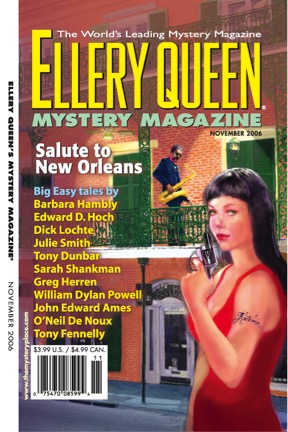
Part of the recovery for some of us artists and writers came a year after Katrina when Ellery Queen’s Mystery Magazine put together my favorite issue of its long run, the November 2006 Issue—Salute to New Orleans.

It featured eleven stories portraying the city in various time periods. It also featured original art by New Orleans artists. Jenny Kahn painted an unforgettable cover. Herbert Kearney illustrated two stories while David Sullivan illustrated another two.

Also included is the haunting poem “Eternal Return” by James Sallis. To the city of New Orleans “where even the land beneath our feet is a lie.”

The stories include:

  • “Libre” by Barbara Hambly, art by David Sullivan
    Set before the Civil War, a libre is missing. Libre was a Spanish term for free people of color. Sometime-sleuth Benjamin January investigates in this uniquely Creole New Orleans mystery.
  • “The Sugar Train” by Edward D. Hoch
    In 1901, gunfighter Ben Snow is hired to protect the train hauling sugarcane along the private Sugar Belt Railroad.
  • “The Death of Big Daddy” by Dick Lochte
    Circa 1970 and a revival of Cat on a Hot Tin Roof draws Tennessee Williams and French Quarter bookshop owner Harold LeBlanc into a cozy murder mystery.
  • “Dead Men’s Shirts” by Julie Smith, art by Herbert Kearney
    Instead of a dirge, the brass band played party music at the funeral of a killer. His posse wore the killer’s Dead Man shirt with his picture and his birthday printed under “Thug-in” and date of his death printed under “Thug-out.” Thugs glorifying violence in the late 1990s. A heart wrenching story of one man’s stand against incessant violence.
  • “Monday at the Pie Pie Club” by Tony Dunbar
    A couple of strong-arm extortionists come to the Pie Pie Club to seek advice from owner Max Moran in a dispute over who should collect protection money from a French Quarter florist shop whose owner recently died. How? He was found floating in the Mississippi.
  • “No Neutral Ground” by Sarah Shankman
    University intrigue, streetcar rides and jealousy lead to a classic case of love and murder.
  • “Acts of Contrition” by Greg Herren, art by Herbert Kearney
    A serial killer stalks the French Quarter as a defrocked priest tries to help girls living on the street.
  • “Evening Gold” by William Dylan Powell (Department of First Stories)
    An offbeat story with a financially strapped writer, a dead skydiver carrying a satchel full of money, a house full of explosives, a state trooper who may or may not be the real thing, and a curious silky terrier.
  • “Sneaky Pete from Bourbon Street” by John Edward Ames
    Days before Katrina, Private Eye Reno Sloan investigates the murder of a kind soul known as Sneaky Pete who wrote novels in purple ink in cheap composition books.
  • “When the Levees Break” by O’Neil De Noux, art by David Sullivan
    Katrina’s destruction seen through the eyes of the decimated New Orleans Police Department where one officer learns nothing will be the same again.
  • “The Code on the Door” by Tony Fennelly
    Is there a way to conceal a murder in the middle of a natural disaster? Five months after Katrina, the water is gone and there is no electricity and codes painted on doors by the National Guard to indicate if anyone survived or died in a house are still there. Could the key to solving a crime be in one of those codes?

The Jury Box by Jon L. Breen reviewed recent New Orleans books: Soul Kitchen by Poppy Z. Brite, Tubby Meets Katrina by Tony Dunbar, Rampart Street by David Fulmer, New Orleans Confidential by O’Neil De Noux, Pegasus Descending by James Lee Burke, Married to the Mop by Barbara Colley, Motif for Murder by Laura Childs, and Twisted by Jay Bonansinga.

Advertisement in the issue came from institutions assisting in the rebuilding and supporting the displaced, restitutions of libraries and cultural institutions—such as Covenant House, Save the Children, Contemporary Arts Center in New Orleans, Hurricane Katrina Book Drive Reader to Reader, Inc., Bridge House, Volunteers of America, and Habitat for Humanity.

EQMM editor Janet Hutchings, in her A Word From the Editor, asked, “Will the New Orleans that emerges after Katrina be as inspiring to musicians, artists, and writers as NOLA before the storm?”

An emphatic YES is our answer. Maybe even more inspiring.

Posted in Fiction, Genre, Guest, Historicals, History, Illustration, Magazine, Memorial, Noir, Police Procedurals, Private Eye, review, Setting, Story, Thrillers | Tagged , , , , , , , , , , , , , | 3 Comments

SOLVING THE PUZZLE

I’ve been watching Endeavour on Masterpiece this summer. For those who haven’t ever tuned in to the series, which is now in its fourth season, the title character is Colin Dexter’s Inspector Morse, depicted in the early years of his career, in the 1960s. Sadly, the mystery world lost Colin Dexter this year; he passed away on March 17. As anyone who has read his Inspector Morse novels (or seen any of the TV series based on them) knows, Colin Dexter was a crossword-puzzle aficionado. Both Morse, and, in the Endeavour TV series, his younger self, are found working crosswords in the course of solving cases, and often the crosswords’ clues trigger reasoning that leads to the solution of the murder investigation. Dexter was a well-known constructor of crossword-puzzle clues even before he began to write the Morse novels. In his piece for The Guardian in memory of the beloved writer, Alan Connor said: “The Morse novels are a celebration of thinking like a crossword solver: it’s a hobby that makes you more sceptical, more nimble, and—at least in the case of Morse—one that saves lives.”

Despite all the whodunit or “puzzle” mysteries I’ve enjoyed and edited over the years, I had never, until a few years ago, been a crossword solver. It all really started for me when my mother, an ardent solver, began losing her vision and could only work her puzzles if someone read her the clues. That someone was usually me, and over the course of time I became a partner in working the puzzles rather than just a reader, gaining a hobby that had never really appealed to me before. Now that I’ve entered that world (even in my very amateurish capacity), it’s a wonder to me that my long-established interest in mysteries didn’t spill over to crosswords earlier.

The crosswords I work are strictly of the straightforward American variety, in which the clues are generally derived from definitions, synonyms, or descriptions, and are sometimes simply fill-in-the-blanks. The British-style crosswords that Morse works are “cryptic,” involving word play—anagrams, rebuses, and so forth—and solving the meaning of the clue is a big part of the challenge. Perhaps solving such puzzles has closer parallels to solving a mystery-fiction puzzle than the American crossword does. Certainly many well-known mystery writers before and after Colin Dexter have incorporated clues in their mysteries that turn on deciphering a name that’s an anagram, or a dying message whose words have a cryptic meaning. But even American crosswords frequently incorporate clues that are not intended to be taken straightforwardly (they’re usually flagged with a question mark) and they sometimes have overall themes that can be tricky to identify too. It seems to me, therefore, that it’s impossible to work crosswords of any sort without learning to think laterally.

Edward D. Hoch, probably the greatest writer ever of the classical puzzle mystery at short-story length, often employed cryptic dying messages in his stories, but in all the years I knew him, Ed never once mentioned an interest in crosswords. That now puzzles me a bit. The Dell mystery magazines are part of a company that specializes in crossword puzzles, so the question whether readers of classical mysteries are also, in significant numbers, crossword-puzzle solvers comes up periodically in discussions of opportunities for cross-promotion. Mysteriously, the few cross-promotions we’ve done don’t appear to reveal much synchronicity of interest. I have no idea why.

One of the surprising things I discovered when I started working crosswords was that the puzzles started to go faster the more familiar I was with a particular constructor. In fact, if I’m tired, I’ll never choose a puzzle by a constructor new to me. There’s a parallel there, for me, with reading a “fair-play” mystery by an author whose work I know well—a fair-play mystery being one in which the author provides clues that allow a sharp reader to solve the crime before the author does it for him. I edited nearly 200 of Edward D. Hoch’s clever mysteries over the years we worked together and over time I got better and better at seeing where he was going—at beating him at his game, so to speak. I’m not able to say, in either the case of a mystery writer or a puzzle constructor, precisely why familiarity makes it easier. Maybe it’s just a matter of sensing what kinds of associations a particular constructor or author is likely to make—getting onto their wavelength, so to speak. That sort of thing is obviously greatly aided by long familiarity, something a good writer of classical puzzle mysteries needs to take into account, always finding new ways to keep longstanding readers from reading his or her mind.

I’m told that many crosswords today are constructed by computers. The ones I work are not, and I think I’d miss the element of authorial personality that comes through in a crossword just as it does in a story. John Dickson Carr called writing the classical puzzle mystery “the grandest game in the world,” one in which the author’s intellect is pitted against that of intelligent readers. I have that same sense of playing a game with the puzzle constructors whose puzzles I enjoy. Where would be the fun in playing that game with a computer?

A final parallel I’ve discovered between puzzle mysteries and the classical whodunit is the sense of satisfaction one gets at the end when, in the case of the mystery, all the questions are answered or, in the case of the crossword, the last empty box is filled.

I know of one mystery writer besides Colin Dexter who has a series sleuth who’s inextricably linked to crossword puzzles, and that’s Parnell Hall, creator of the Puzzle Lady mysteries. If you know of others, please let me know.—Janet Hutchings

Posted in Characters, Classic Mystery, Editing, Writers, Writing | Tagged , , , , , , , | 7 Comments

“A Tribute to James Yaffe” (by Jeffrey Marks)

James Yaffe is a name to conjure with at EQMM even to this day, decades after his last story for us was published. I regret never having had the opportunity to meet the man who was, and remains, EQMM’s youngest debut author—a writer who went on to do the magazine credit through his long and stellar career as a novel and short-story writer, a playwright and screenwriter, and a general man of letters. James Yaffe passed away earlier this summer and we invited Jeffrey Marks, award-winning biographer and previous contributor to this site, to provide us with a post in his memory.—Janet Hutchings

James Yaffe passed away on June 4, 2017. He is survived by his wife, Elaine, three children, and three grandchildren. He was 90 years old.

Within the mystery community, Yaffe is best known for being the youngest author ever to publish a short story in Ellery Queen’s Mystery Magazine. Yaffe was only 15 when his story “Department of Impossible Crimes” was purchased by the magazine, and it appeared in the July 1943 edition. The story featured Paul Dawn and the titular Department of Impossible Crimes. That series would run for six stories in the magazine. Later in life, Yaffe would say that the end of the series marked the height of his ingeniousness as a plotter, stating that “. . . it’s been downhill ever since.”

However, he didn’t rest of those laurels. Following a stint in the Navy, Yaffe graduated from Yale, summa cum laude and Phi Beta Kappa. For 26 years, he was a professor of English at Colorado College in Colorado Springs.

After his early writings for EQMM, Yaffe went on to write a short-story collection, Poor Cousin Evelyn, published in 1951. He also wrote original works for the small screen, including some for Alfred Hitchcock Presents.

Beyond his love of mystery and scholarship, Yaffe was involved in theater. His adaptation of Friedrich Durrenmatt’s short work The Deadly Game ran on Broadway in 1960, off-Broadway six years later, and was reimagined for television in 1982. One of his own works, Cliffhanger, appeared off-Broadway for a short time in 1985.

Through all of this, Yaffe continued to write mysteries, creating a series of books and short stories about “Mom,” a Jewish mother who solved her son’s cases based on her experience and knowledge of human nature, similar in manner to Miss Marple and her English village parallels. Yaffe used humor in the stereotype of the Jewish mother to make the series endearing in the early works, deepening the character as the series progressed. Dave, a New York policeman, and his wife Shirley visit Dave’s Mom every Friday night and the conversation always seems to come around to the cases that Dave is currently trying to solve. Mom posits a few questions, and when Dave provides the answers, she solves the case. The original short stories were published in EQMM from 1952 until 1968. Yaffe revived the series in 1988, writing four novels based on Mom, moving Dave to Colorado after the death of his wife.

The Mom stories can also be seen as works based on his Jewish faith. Yaffe was known for his writings on Judaism, and incorporated his own insights into the Jewish experience of the middle years of the 20th century in his fiction. In 1966, Yaffe published The American Jews, his perspective on his community. In one interview, he said, “From my own experience, of course—mostly from my experience of the world I was born and brought up in, the world of middle-class, second-and third-generation Jews living in New York, Chicago, Los Angeles, I have chosen to write about this world because I know it instinctively and subliminally, because it was part of me before I was old enough to doubt my perceptions.”

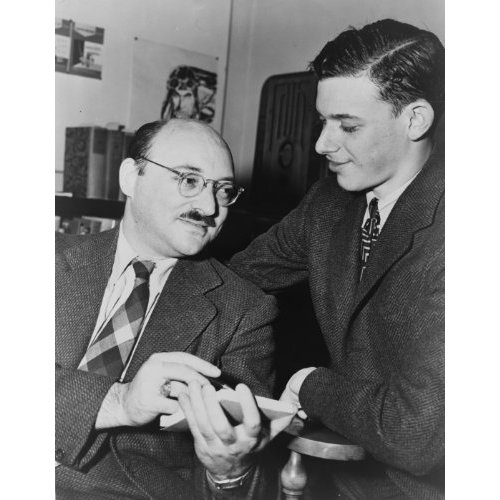
I had the good fortune to work twice with James Yaffe during the last few months of his life. I’m currently working on a biography of Frederic Dannay and Manfred B. Lee, and I’ve been reaching out to the remaining people who knew the two men in life. Through his wife, Elaine, he answered a number of questions about EQMM, working with Fred Dannay, and his experiences and anecdotes about those times. He shared how he had first approached Dannay with his first mystery short story, telling the editor that he’d written the piece “in class,” so that he could convey that he was younger than the normal contributor to the magazine. Dannay published the story and had a photographer from the World-Telegram come out and take the now-iconic photo of man and boy discussing the magazine.

Frederic Dannay and James Yaffe, 1943. Photo by Al Aumuller, New York World-Telegram and Sun. Image file courtesy of Gideon Yaffe.

Crippen & Landru also published a complete volume of Yaffe’s Mom stories a few months before the author’s death. (For those of you who don’t know, I’ll be taking over day-to-day operations for Doug Greene at the end of this year. He will remain the senior editor with Crippen & Landru.)

In 1997, Crippen & Landru had produced My Mother, the Detective, a volume of all the Mom stories to that point in time. In 2002, Crippen & Landru commissioned a new Mom story, “Mom Lights a Candle,” which appeared as a limited-edition pamphlet for series subscribers for the holiday season. These short booklets are extremely rare today, and in 2017, the commissioned story was added to an updated version of the book. The revised collection was a well-deserved coda to James Yaffe’s long and well-received career.

Jeffrey Marks is an award-winning crime-fiction biographer. His first book-length work, Who Was That Lady?, appeared in 2001, chronicling the life of mystery writer Craig Rice. It was followed by Atomic Renaissance: Women Mystery Writers of the 1940s and 1950s. More recent works include the Anthony Award winning Anthony Boucher, his 2013 biography of Erle Stanley Gardner, and his work-in-progress, a biography of Ellery Queen.

Posted in Guest, History, Magazine, Memorial, Writers | Tagged , , , , , , , , | 3 Comments