Maine writer Travis Kennedy‘s work has been recognized by Best American Mystery Stories and featured in McSweeney’s, Level Best Books’ Best New England Crime Stories anthologies, and Suspense Magazine (forthcoming). He is the author of the novel Booty, and his gritty tale “Duel of the Aces” appears in our current issue‘s Black Mask department. Here he discusses what got him into crime-writing: a societal duality that can be seen clearly in that story.—Janet Hutchings
Underworld: c. 1600, “the lower world, Hades, place of departed souls,” also “the earth, the world below the skies,” as distinguished from heaven. Similar formation in German unterwelt, Dutch onderwereld, Danish underverden. Meaning “lower level of society” is first recorded 1890; “criminals and organized crime collectively” is attested from 1900. (etymonline.com)
About fifteen years ago, I was in Pittsburgh for a friend’s wedding.
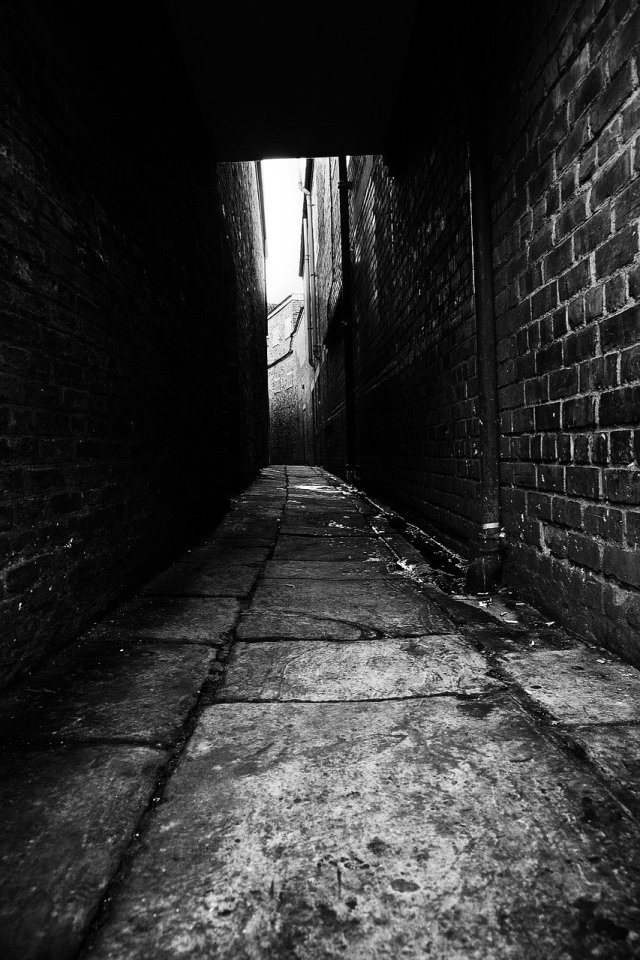
The day before the ceremony, a group of us were walking through the city, looking for a place to grab lunch. We were on a quiet road that ran alongside a row of tall, dilapidated warehouses. A steel door swung open with a loud bang down an alley and a guy came strolling out, wearing a crooked Steelers hat and sunglasses. He was around my age and height, and he even kind of looked like me. He popped a cigarette in his mouth and grinned like the whole game was rigged in his favor, and he strode off triumphantly in some other direction.
It only took me those three seconds to decide, with complete certainty, that he was UP TO SOMETHING. But I was also pretty confident that I’d never find out what it was. Whatever kind of extralegal shenanigans were in store for that young Pittsburgher, they would play out completely separate from me—even though we were both hanging out on the same city block.
This was a seemingly pointless instance. We didn’t interact. I don’t know if anyone else in my group even saw him. It was the kind of thing that could happen ten times in a single day on a busy city street. But as strange as it may sound, I think that was the very moment that I became a crime writer. Or at least, it was the moment when my philosophy for writing crime fiction clicked into focus.
Maybe it was the way the guy was grinning, like some master plan was about to go into motion. Maybe it was his confident swagger, like he was the king of this strange little part of the city that was completely foreign to me. Maybe it was because we were kind of bizarro mirror-images of each other, and I was seeing a version of myself from another dimension, our paths crossing by accident for a mere few seconds like the two Doc Browns in Back to the Future. Whatever it was, he was clearly deep in the middle of his own adventure—and I only got a glimpse of it for the briefest moment.
And since I like to believe that I have a rich and complex backstory that’s populated with fully realized characters and diverse settings, then this dude must have one, too. There were two separate worlds in that neighborhood—a rule-follower looking for lunch, and a Steelers fan looking for criminal mischief—that were running directly alongside each other, but rarely intersecting. So I started to wonder, what is that other world like? The one that I don’t see?
And a crime writer was born.
It’s that idea of an “underworld” that motivates my crime writing—a parallel world that has its own factions and societies and rules and dialect and leaders and followers, and has no interest in whatever the rest of us are up to. We’re sharing the same physical space with these scoundrels—but for the most part we agree to leave each other alone, with each side only occasionally noticing that the other one is there, and reacting with a mutual sense of mild disgust.
Since that day in Pittsburgh, I’ve been captivated by the idea that a complex underworld could be churning away right under our noses, and it’s populated by fascinating people that we don’t typically notice. That deals are made and broken and capers are planned and enemies are plotting against each other, maybe even scheming their misdeeds on the same park bench that I sat on an hour earlier on my lunch break. Or they’re planning a dangerous caper in that empty storefront that my wife and I walked past on our way to dinner.
We don’t notice them. They don’t care about us. And since we’ve agreed to stay out of each other’s way, telling their stories can be fun instead of tragic. Because when they exist on a whole different plane, we can feel a little less guilty about enjoying their antics. Or getting a sense of thrill from walking in their shoes. Or rooting for them, and even liking them quite a bit.
In the real world, of course, there are innocent victims. But by establishing a self-contained underworld, we don’t have to think about them too much. It’s why we grin through the adventures of Jack Foley or Mac and McCorkle. Why we root for that wily outlaw Omar on the Wire, who lives by a code that only allows him to steal from other criminals. It’s why John Wick’s insane body count is thrilling instead of horrifying. And why Travis McGee and Jack Reacher can break as many limbs as they want, with our cheering approval.
More often than not in an underworld, the victims have invited themselves into the Devil’s orbit. Someone has taken a loan from Tony Soprano, and then gambled it away. Someone has asked Don Corleone for a favor. If they had stayed on their own side of the line, they would have been just fine—but they chose to cross into that other world, and they paid for it. Greed and revenge serve as the portal between our space and theirs. But cross it at your own risk; because once you open that door, you might never be able to close it.
Whenever I’m out walking around in public, I l find myself daydreaming about the underworld that operates on a different frequency all around me—whether it’s an underground casino in an old warehouse, a bootlegging operation in the woods of rural Maine, or a dark alley in Pittsburgh. The stories just pour in, and we can all revel in spending some time there . . . through the pages of a book, from our side of the line.










 SOMETHING IS GOING TO HAPPEN