
William Bankier is EQMM’s second-most prolific writer, appearing in our pages over 160 times! Learn more about the late author in this retrospective post by Josh Pachter, who co-wrote his last EQMM story, appearing in our Sept/Oct issue!

From 1977 through the end of the ’80s, William Bankier was the second-most-frequent contributor to Ellery Queen’s Mystery Magazine; only Edward D. Hoch appeared more regularly in EQMM’s pages. In fact, from June ’84 through November ’86, Bill’s byline showed up in thirty-two consecutive issues—twice in March ’86—which means that, during that stretch of time, he actually published more fiction in the magazine than Ed did (especially if you consider that the June ’85 issue did not contain a story by E.D. Hoch, though it did have one credited to “R.L. Stevens,” one of Hoch’s occasional pseudonyms).
William John Bankier was born in Belleville, Canada, on July 3, 1928. He worked as a bellhop at a local hotel and a disc jockey at the local radio station, and eventually turned to writing fiction.
His first published short stories, however, were not crime stories. The first of them, “The Wrong Impression,” was a humorous tale of an accountant more interested in jazz than in behaving appropriately when he meets a prospective client; it appeared in The Saturday Evening Post’s issue of August 8, 1952. After that, he didn’t ring up another sale for almost three years, and when he did, “Hawk in the Dust” was a Kafkaesque piece that was published in The Magazine of Fantasy and Science Fiction’s May 1962 issue.
It was two months later, in July ’62, that he broke into EQMM with his third story and first mystery, “What Happened in Act One,” which editor Frederic Dannay introduced as having “a touch of the supernatural”—although its supernatural element turned out to have a perfectly natural, and criminal, explanation. After that, Bankier experimented with yet another different genre, and his fourth publication was a horror story, “Unholy Hybrid” (MFSF, September 1963), but he then bounced back to EQMM with “The Gag of the Century” in February 1965, having apparently decided that crime fiction was where he felt most comfortable.
Following what would turn out to be the longest dry spell of his career—twenty-nine months—he placed eleven stories in EQMM between September 1967 and August 1975 with only a single sale to any other market (and that a short and very clever nonmystery that showed up in Ladies’ Home Journal, of all places, in January 1968). In February ’76, he made his first appearance in Alfred Hitchcock’s Mystery Magazine, and over the next five years he published thirty-nine more stories there, while only contributing twenty-two to EQMM. After “Brother, Can You Square a Crime?” appeared in the September 16, 1981, issue of Hitchcock’s, though, he never again published there but continued to sell regularly to Queen’s through the ’80s, which by the end of the decade had run eighty-one more of his stories (including several in volumes of the twice-yearly Ellery Queen’s Anthology series between ’83 and ’87). His production tapered off after that, with thirty-seven stories in the ’90s and twelve in the ’00s, and then one final appearance, “Seven Miles from Santa Barbara,” in the August 2010 issue. Along the way, he also sold four stories to the Canadian Cold Blood anthology series edited by Peter Sellers—no, not that Peter Sellers—and one to a one-off Canadian anthology titled Criminal Shorts.
That adds up to a total of two hundred and fifteen stories published between 1959 and 2010: two in The Magazine of Fantasy and Science Fiction, one apiece in The Saturday Evening Post and Ladies’ Home Journal, five in Canadian anthologies, forty in AHMM, and an astonishing one hundred and sixty-six in EQMM and EQA. Sixteen of them were collected in a 1995 volume titled Fear Is a Killer and another five in a 2014 collection titled Songs in the Key of Death. (There also seems to have been something called The Last Act Was Deadly and Other Stories, which may or may not have been released in print in the early 1990s and came out on audio cassette, read by Saul Rubinek, in ’96.)
Bankier was nominated for an Edgar in 1981 (for “The Choirboy,” published in the December 15, 1980, AHMM), was a three-time nominee for the Crime Writers of Canada’s Arthur Ellis Award, and received the CWC’s Derrick Murdock Award for Lifetime Achievement in 1992. Twice married, once a widower, the father of two daughters, he died in West Hollywood, California, on January 10, 2014, and is survived by his widow, Felice Nelson-Bankier.
Now fast forward to August 2025.
Actually, let’s first pause for a moment in 2021. During the dark days of COVID, when writers’ conferences like Bouchercon and Malice Domestic were happening virtually or not at all, a small group of short-crime-fiction authors began meeting once a month via Zoom to enjoy some kind of social contact and shop talk. The original members of the group, if memory serves, were Michael Bracken, David Dean, Stacy Woodson, John Floyd, and me. Eventually, we invited Barb Goffman, Rob Lopresti, Joe Walker, and, after her retirement, Janet Hutchings to join us . . . and then we were nine, lined up once a month on our computer screens like the Hollywood Squares.
Okay, now skip ahead to August 2025. At that month’s get-together, Janet mentioned that, not long after Bill Bankier died in 2014, she received an envelope in the mail from Felice, his widow. Apparently she had been cleaning out Bill’s office, and she’d found the envelope in his desk, with instructions to send it to Janet after his passing. Inside was a handprinted note and an eight-page typescript.
Here’s the note:
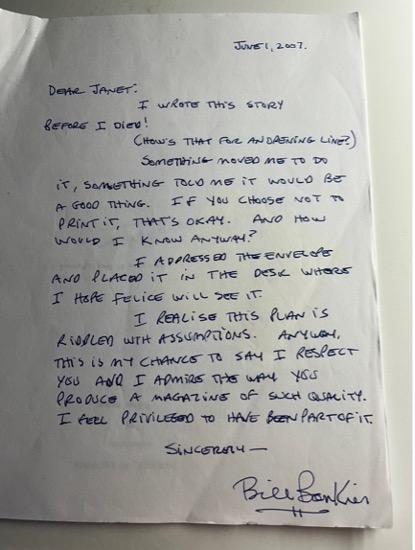
So Bill wrote a story seven years before he died, with the intention of its eventually being his final published story, similar to Agatha Christie’s having written Curtain and Sleeping Murder during World War II, intending them to be published after her death as the final Hercule Poirot and Miss Marple novels, respectively.
Wait a second. Before we get to that eight-page typescript, written in 2007, what about “The Tumbril,” which appeared in the September/October 2009 issue of EQMM, and “Seven Miles from Santa Barbara” in the August 2010 issue? I asked Janet about those, and she told me she “had a lot of inventory back in the early 2000s, so I am sure we would have had the two you mention before Bill wrote his farewell story.”
Okay, now back to the typescript. The story was titled “Farewell to Baytown,” and—like some two dozen of Bankier’s earlier stories—it was set in a fictional Canadian town based closely on his hometown of Belleville.
And here’s where this story takes on a Bankieresque (if that’s a word) sort of twist: back in 2014, when Janet received the story from Bill’s widow Felice, she decided not to publish it. Why not? As she explained it to the members of our Zoom group, she just didn’t think that it was up to Bill’s usual standard, and she didn’t feel it would be right to put it in front of EQMM’s readers as his final piece of fiction.
Knowing that I’ve had a number of collaborative stories published in the magazine, though—written with Ed Hoch, Stanley Cohen, Jon L. Breen, René Appel, and my daughter Rebecca K. Jones (plus a dozen other collaborations with other writers, published in other places)—she wondered if I might like to take a look at “Farewell to Baytown,” with an eye to possibly turning it into a posthumous collaboration that would be good enough to publish.
I jumped at the chance, and Janet sent me a scan of Bill’s note and eight typed pages. When I read the story, I liked its basic idea, but I thought it had two fundamental problems—though I didn’t know whether or not they were the same problems Janet had keyed in on, eleven years earlier:
First, Bill’s opening scene ran about six hundred words and didn’t really have much to do with the actual plot of the story. Because it provided some background information that later on turned out to help establish a motive for the crime, it wouldn’t work to cut it altogether, so my solution was to condense it to about two hundred words and turn it into a flashback.
Second, the final scene as originally written was lighthearted, almost comic, and to me that fell flat, robbing the story of what I felt could be a powerful final twist. So I decided to alter its tone from light to serious.
In addition to those two structural changes, I also did some tightening along the way, but that was more editorial tinkering than collaboration. What justified putting my own name up there with Bill’s as a co-author, I think, was the work I did on the beginning and ending of the story.
(Speaking of the ending, let me tell you about an Easter egg you wouldn’t spot unless you’ve either heard me speak about the beginning of my own career as a writer or have read and happen to remember this post, which I contributed to “Something Is Going to Happen” way back in 2012. In Bill’s original draft of the story, the notation Lola finds at the bottom of her poem reads “You write well, Lola. Why not try crime stories?” As I worked with the story, I couldn’t resist changing that to “Have you ever considered writing a crime story? Seems to me, Lola, if I may, you should.” Why that wording? Simple. Except for Lola’s name, it is—word for word—the last two sentences of the handwritten letter I received from Frederic Dannay in 1967, the letter that motivated me to write my own first story and launched me on a path I continue to travel to this day, almost sixty years later. . . .)
When I finished with “Farewell to Baytown,” I sent it to Felice, and she called me and told me she cried when she read it and would be happy to have me submit it to EQMM with both Bill’s and my names on it. I did, editor Jackie Sherbow bought it, and it appears in the September/October 2026 anniversary issue of the magazine.
So now I’ve got a couple of new pieces of Bankier trivia to add to my collection:
• The longest “dry spell” of Bill’s career is no longer twenty-nine months. It’s now sixteen years, from August 2010 to September/October 2026.
• He now becomes only the third person to have published new fiction in EQMM in seven consecutive decades. (The first, ahem, was me, and the second was Jon L. Breen.)
• And he’s also one of the small number of writers to have sold stories to all four of the magazine’s editors: Fred Dannay, Eleanor Sullivan, Janet, and Jackie. (I’m in that club, too, and so is Bill Pronzini. There might be one or two others, but I’m not sure. If anyone who reads this knows, I hope you’ll speak up in the comments. And think of it: only four editors-in-chief across a span of eighty-five years!…)
Long-time EQMM readers will surely remember Bill Bankier’s always fascinating fiction. If you’re a newer reader, though, and either “Farewell to Baytown” or this blog post motivates you to want to read more of his work, I’m happy to let you know that Crippen & Landru has asked me to edit a two-volume collection of a sampling of his stories. Volume 1 will include all twenty-seven of his tales of Baytown and should be out by the end of this year, and Volume 2 will feature two dozen of his best non-series stories and will hopefully come out sometime in 2027 or ’28. If you’re not already a Crippen & Landru subscriber, you’re missing out on some of the best single-author collections on the market, many of them by long-time EQMM contributors, such as Ed Hoch, William Brittain, Art Taylor, and more. You can check them out at crippen-and-landru.myshopify.com/.
Oh, and speaking of Art Taylor: since Janet Hutchings brought up Bill Bankier’s final story during our August 2025 session, he has joined our merry band of monthly Zoomers, so our computer screens have grown a bit more crowded, and our shop talk has become even more spirited than it already was. (Two more members, and we’ll have achieved what we might just have to call a Queen’s Quorum!) Art runs a fascinating weekly blog called “The First Two Pages” at arttaylorwriter.com/the-first-two-pages/, and you can read the original first two pages of “Farewell to Baytown” there on August 18.


Great post, Josh. I was a big fan of Bankier and it’s wonderful to see his name in print again. Thanks to everyone involved for calling more attention to his work.
fascinating backstory Josh – I’m looking forward to your story (and your essay) when I get my issue! They’re running a bit slowly, as you know.
Anna Scotti