Lawrence Ong provide an in-depth analysis of G.K Chesterton’s mysteries and presents a case for their immense influence on the mystery genre!

Every mystery fan has surely encountered the “whodunit.” They have likely encountered the “howcatchem” (the inverted mystery in which the killer is known in advance, exemplified by the TV series Columbo). Fans of the classics have also encountered the “howdunit” (including impossible crimes, such as locked-room mysteries). Rarer than these, however, is the “whydunit.” Merriam-Webster defines this as “a mystery having as its primary interest the motivation rather than the identity of the criminal.” The label is most often applied when one seeks motivation for murder. But there is another sub-genre of whydunit in which the “why” is asked of some bizarre action (or set of actions) that is proximate to the crime but not the crime itself.
Of course, seeds of this already appear in Arthur Conan Doyle’s Sherlock Holmes stories, with the most obvious example being “The Red-Headed League” (1891), in which the central mystery is why a pawnshop owner has been hired by the title organization to copy out the Encyclopedia Britannica. But the true early master of this genre—the one who cemented what would become its central tropes—is G.K. Chesterton. His first Father Brown collection, The Innocence of Father Brown (1911), comprises twelve mystery stories published in the Saturday Evening Post from 1910 through 1911. Of these twelve, at least four can be understood as whydunits; they are (in order) “The Queer Feet,” “The Honour of Israel Gow,” “The Wrong Shape,” and “The Sign of the Broken Sword.”
Three of those four (all except for “The Honour of Israel Gow”) additionally explore a concept also used in “The Secret Garden,” “The Invisible Man,” and “The Sins of Prince Saradine”: camouflage. Chesterton’s belief that the deepest truths can best be expressed in pithy, counterintuitive epigrams earned him the moniker “the prince of paradox.” His use of camouflage as a plot device is in keeping with his love of the counterintuitive, as the particular facet of camouflage he was most interested in elucidating was how context causes us to miss or misinterpret the truth.
Of the stories in The Innocence of Father Brown, “The Invisible Man” has the solution that is discussed most often. But in this post, I’d like to analyze a story whose premise and solution may have been even more influential, albeit mostly indirectly (as people do not trace the trope back to it). This is “The Sign of the Broken Sword.” My analysis will necessarily spoil the plot of the story. But if you haven’t read it before, never fear. It is in the public domain and may be found here: https://www.gutenberg.org/ebooks/204
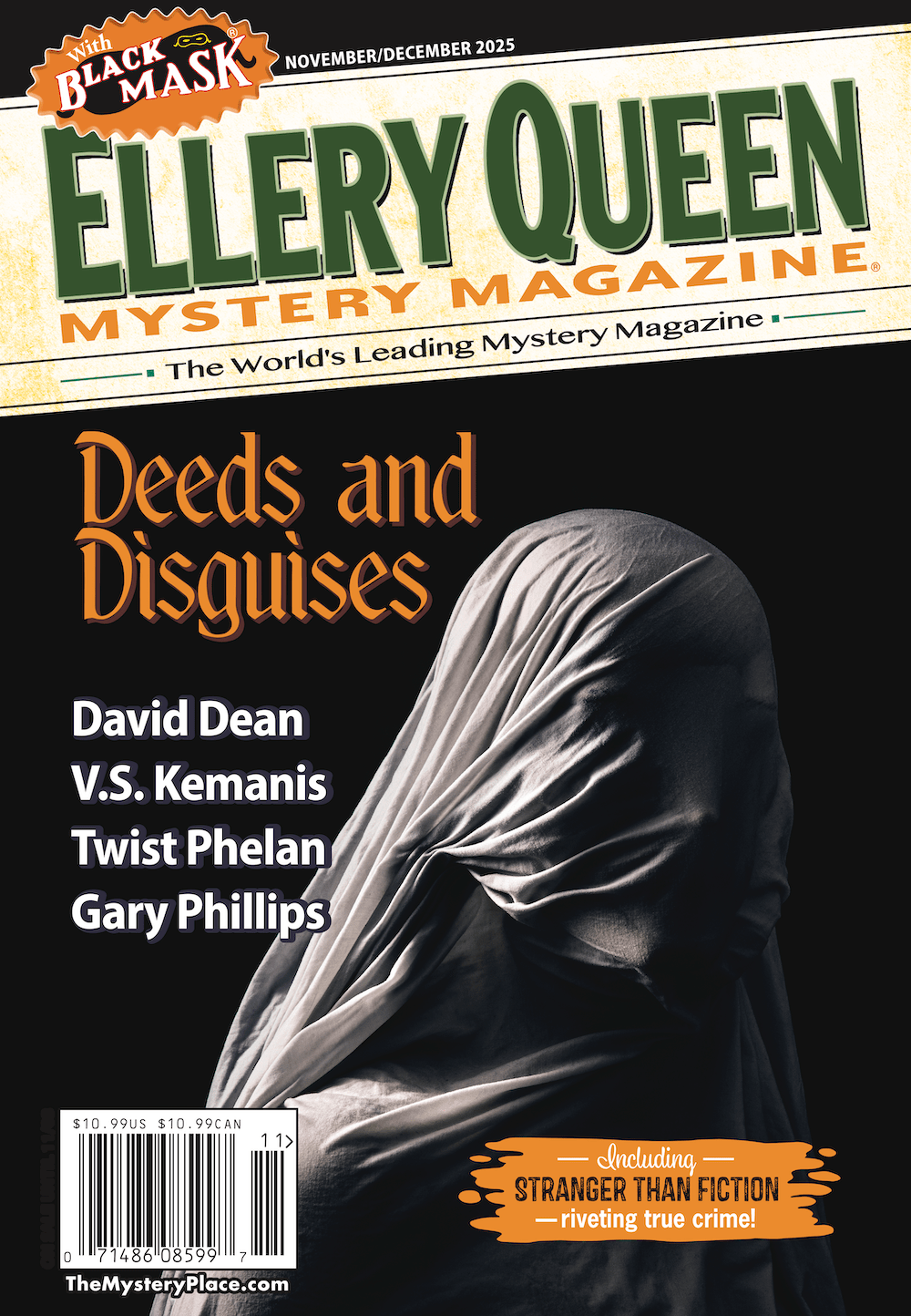
The occasion for my analyzing Chesterton’s story is the publication of my own story “Murder on Pins and Needles” in the most recent issue (July/August 2026) of Ellery Queen’s Mystery Magazine. This is my second story featuring medical examiner Hank Lau. And, like my previous story (“Murder under Sedation”—March/April 2024)—and (I hope) all future stories starring Lau—it is a fair-play puzzle-plot whodunit in the Golden Age style. But this one is also a whydunit, in which the detective must ask, “Why did the murderer stick dozens of acupuncture needles into the victim after killing him?” Although I will not provide the answer here (because I hope you’ll read my story!), I can say that the plot mechanic is based on a trope I date back to “The Sign of the Broken Sword.” Thus, in whichever order you might choose to read them, Chesterton can shed light on what I did in my story, and my story (plus this analysis) can hopefully shed light on what Chesterton did.
“The Sign of the Broken Sword” differs greatly from the other stories in The Innocence of Father Brown in its basic setup. Whereas in the others, Father Brown witnesses a crime and/or aids in catching a criminal on the loose, “The Sign of the Broken Sword” concerns a crime that happened in the past. (We are not told the exact date, but it is more than twenty years before the time in which the story is set.) The whydunit concerns the highly uncharacteristic actions taken by two fictional historical figures—the English general Arthur St. Clare and the Brazilian president and general Olivier—during an Anglo-Brazilian war of Chesterton’s invention. Here is Father Brown’s summary of the crucial events, as understood by the public:
The public knows that Arthur St. Clare was a great and successful English general. It knows that after splendid yet careful campaigns both in India and Africa he was in command against Brazil when the great Brazilian patriot Olivier issued his ultimatum. It knows that on that occasion St. Clare with a very small force attacked Olivier with a very large one, and was captured after heroic resistance. And it knows that after his capture, and to the abhorrence of the civilised world, St. Clare was hanged on the nearest tree. He was found swinging there after the Brazilians had retired, with his broken sword hung round his neck.
The twin difficulties are first, that St. Clare was “a prudent commander, particularly indignant at any needless waste of soldiers” and yet attempted a reckless attack that was sure to fail; and second, that Olivier was “magnanimous to the point of knight errantry” and “[a]lmost every other prisoner he had ever captured had been set free or even loaded with benefits.” Thus, as Father Brown says, this story is “a mystery of two psychologies”: the first mystery is “what had become of the English general’s head?” and the second is “what had become of the Brazilian general’s heart?”. These are the whydunit components.
To solve this, Father Brown puts together information from four quite varied sources: the memoirs of St. Clare’s eventual son-in-law (Captain Keith), dispatches sent by President Olivier, a remark by one of St. Clare’s colonels that Father Brown heard secondhand, and an English soldier’s diary that Father Brown obtained while attending to a dying former Brazilian official. Over the course of the story, Father Brown recounts what he learned from each of these sources to his longtime companion, Flambeau, leading eventually to the revelation of what really happened.
The conversation between the two men takes place in a forest surrounding a funerary monument to St. Clare. This is not the story’s only forest. In addition to the literal one that they are traversing, there is a metaphorical one at the heart of the parable Father Brown uses to explain the solution. Let us attend, in the remainder of this post, to how Chesterton uses the literal and metaphorical forests—and tree imagery in general—to create the story’s effects.
First, the story’s opening lines:
The thousand arms of the forest were grey, and its million fingers silver. In a sky of dark green-blue-like slate the stars were bleak and brilliant like splintered ice. All that thickly wooded and sparsely tenanted countryside was stiff with a bitter and brittle frost. The black hollows between the trunks of the trees looked like bottomless, black caverns of that Scandinavian hell, a hell of incalculable cold.
The first line immediately establishes an analogy between trees and human bodies—what will become the story’s central metaphor. The third sentence imagines a cold hell rather than a hot hell. If the reader does not immediately think of the circle of ice in Dante’s Inferno, they will later when Father Brown explicitly makes the connection.
This forest houses a church. We are told that “It rose abruptly out of the ashen wastes of forest in a sort of hump or shoulder of green turf that looked grey in the starlight.” The opening lines forged the connection between trees and human bodies, but they did not specify whether the bodies are living or dead. This sentence, by mentioning “ashen wastes,” makes it clear that the trees symbolize corpses—an image further enhanced by the graves surrounding the church, which are mentioned in the next sentence.
Following this paragraph, Father Brown and Flambeau have their first exchange, which reads as follows:
“Where does a wise man hide a pebble?”
And the tall man answered in a low voice: “On the beach.”
The small man nodded, and after a short silence said: “Where does a wise man hide a leaf?”
And the other answered: “In the forest.”
There was another stillness, and then the tall man resumed: “Do you mean that when a wise man has to hide a real diamond he has been known to hide it among sham ones?”
“No, no,” said the little man with a laugh, “we will let bygones be bygones.”
Flambeau correctly understands that Father Brown is introducing the idea of camouflage, but misunderstands the specific kind of camouflage that the latter has in mind. Flambeau leaps to the idea of hiding a real object among sham lookalikes. But Father Brown’s examples all involve hiding an object among other equally real objects of the same kind. (This, of course, turns out to be the solution first of the story’s two whydunits: why St. Clare launched his ill-fated attack.)
The next mention of trees is of a specific one: the one St. Clare was found hanged from. This establishes yet another connection between trees and corpses. This is reinforced a few sentences later, when Father Brown and Flambeau pass “many hundreds of grey and ghostly trees.” As the two men walk farther, the landscape around them shifts:
[T]he road swept downwards across a clear, moonlit valley, till it dived again like a rabbit into the wall of another wood. The entrance to the farther forest looked small and round, like the black hole of a remote railway tunnel.
The trees of the next forest do not shelter the rabbit. They form a wall—a dead end. And the entrance to the forest is a black hole, like the black holes in the opening paragraph of the story, which were likened to the entrance to hell (which could be interpreted as another Dante reference). Lest the reader be unsure that the black hole is meant to serve as death imagery, Chesterton soon describes Flambeau staring “firmly at the grey façade of forest in front of him, with the one black gap in it, like the mouth of the grave, into which their path plunged.” This description directly follows Flambeau’s first guess at the solution: that St. Clare’s maneuver was his way of committing suicide by the sword of his enemies. Father Brown tells Flambeau that this scenario is nowhere near so horrid as the truth. Chesterton writes:
“Yours is a clean story,” cried Father Brown, deeply moved. “A sweet, pure, honest story, as open and white as that moon. Madness and despair are innocent enough. There are worse things, Flambeau.”
Flambeau looked up wildly at the moon thus invoked; and from where he stood one black tree-bough curved across it exactly like a devil’s horn.
St. Clare will soon be unmasked as precisely the sort of horned devil that this bough evokes.
The literal and metaphorical forests merge in the next passage:
[T]hey plunged into the black cloister of the woodland, which ran by them in a dim tapestry of trunks, like one of the dark corridors in a dream.
They were soon in the most secret entrails of the wood, and felt close about them foliage that they could not see, when the priest said again:
“Where does a wise man hide a leaf? In the forest. But what does he do if there is no forest?”
“Well, well,” cried Flambeau irritably, “what does he do?”
“He grows a forest to hide it in,” said the priest in an obscure voice. “A fearful sin.”
The religious imagery has turned from evil to good (“black cloister of the woodland”) even as the bodily metaphor remains (“entrails of the wood”). The positive religious turn is linked to Father Brown and Flambeau’s journey out of the forest. As Father Brown unfurls the solution, we are told that the “path through the woodland began to go upward,” as they escape this metaphorical hell. As their pursuit continues, we are told that “they felt as if they were ascending a winding staircase. The priest’s voice came from above out of the darkness.” They are moving into the light as the truth becomes clear.
However, it is the continuation of Father Brown’s parable that is what has resonated throughout mystery fiction: the idea of growing a forest to hide a leaf. As we soon learn, St. Clare was a traitor and thus (Father Brown reminds us) among those whom Dante condemned to the frozen Ninth Circle of Hell. (The meaning of the story’s ice imagery now becomes clear.) Major Murray confronted St. Clare with this fact. So, the latter brought the former out of view of the other soldiers—to what is first described as “behind a clump of trees” and later described as “the fringe of tropic trees by the bridge” (trees again!)—and killed him, accidentally breaking off the tip of his sword in the process. This spurred St. Clare to make the momentous decision to grow a forest to hide the leaf:
St. Clare was a hell-hound, but he was a hound of breed. Never, I’ll swear, was he so lucid and so strong as when poor Murray lay a cold lump at his feet. Never in all his triumphs, as Captain Keith said truly, was the great man so great as he was in this last world-despised defeat. He looked coolly at his weapon to wipe off the blood; he saw the point he had planted between his victim’s shoulders had broken off in the body. He saw quite calmly, as through a club windowpane, all that must follow. He saw that men must find the unaccountable corpse; must extract the unaccountable sword-point; must notice the unaccountable broken sword–or absence of sword. He had killed, but not silenced. But his imperious intellect rose against the facer; there was one way yet. He could make the corpse less unaccountable. He could create a hill of corpses to cover this one. In twenty minutes eight hundred English soldiers were marching down to their death.
Father Brown then reveals his proposed solution to the second of the story’s two psychological mysteries—why Olivier showed no mercy. The premise is false. Olivier was merciful, after all. It was St. Clare’s own men—who had discovered his treachery—who hanged him.
This concludes my review of the story itself. But what of its impact on future stories, which I have alluded to repeatedly? The forest of bodies in Chesterton’s story are corpses in a battlefield. But mystery fiction soon came to consider a different way in which corpses quickly accumulate: when a serial killer is on the loose. Serial killers have afforded authors a chance to use two variants of Chesterton’s forest. The first variant matches the initial setup of the parable: hiding a leaf in an already extant forest. In such mysteries, there is more than one killer: the serial killer and a single-victim killer who takes advantage of the former’s existence. The single-victim killer murders a target of their own choosing, in a manner consistent with the serial killer’s modus operandi, thus camouflaging the death as just one in an actually unrelated series. The second (more directly related) variant conforms to what St. Clare did: the perpetrator becomes a mass murderer themselves, rather than glomming on to the murders of another person, but only one of their targets matters; the others are just for camouflage. The modus operandi is a ruse.
Apart from these variants of the forest, there is a trope related to the broken sword instead. St. Clare instigated the massacre not merely to hide Major Murray’s body, but also to account for how his sword was broken. Killers in later mysteries often leave a mark that would give them away—an injury to themselves, damage to an object that cannot be jettisoned, etc. They then need to do some bizarre action to account for that mark, such as staging an accident that they will claim as the source of their injury. Stories that do this tend to lean heavily on the “whydunit” aspect.
What later mysteries am I referring to? Ah, well to reveal their names would spoil them for those who haven’t read them! To find out which ones I’m talking about, please go to my blog (https://encluesiast.blog/) where I analyze mysteries in the same fashion as I have in this essay, also using a Spoiler Index that allows you to see connections to only the mysteries you’ve read. My next two posts will be follow-ups to this one: the first traces the idea of camouflage through the other stories in The Innocence of Father Brown and the second shows how these ideas appear in seven episodes (!) of the TV series Monk.