
Contributions from the Classics

2012 has seen celebrations around the world of the bicentenary of the birth of Charles Dickens (February 7, 1812—June 9, 1870). It had been my intention to blog about Dickens this week. He’s one of the great writers in history who influenced what would eventually become the crime and mystery genre—after all, he created one of the most memorable criminals in fiction, the receiver of stolen goods, Fagin (in Oliver Twist), and one of the first fictional detectives, Inspector Bucket of Bleak House.  Before I had finished gathering my own thoughts about Dickens, however, I happened on a blog by EQMM contributor Terrie Farley Moran that I think puts the case for Dickens being a precursor to modern crime writers better than I could. See Charles Dickens, Crime Writer at Criminal Element. EQMM will be marking the Dickens bicentenary in its November issue (on sale at the end of August) with a mystery by W. Edward Blain set in London’s Dickens House museum.

Dickens wasn’t the only classic European writer of the mid nineteenth century who contributed to the emergence of crime and mystery fiction. Born ten years earlier, on July 24, 1802, Alexandre Dumas, père created works with elements that can be found in both modern thrillers and the puzzle mysteries of our genre’s Golden Age. Dumas’s most famous novels—especially The Three Musketeers and its sequels Twenty Years After and The Vicomte of Bragelonne: Ten Years Later—are commonly described as historical romances, but if they had been written today, they would, I think, most often be shelved with “Thrillers.” This week, in New York City, the International Thriller Writers organization is holding its annual convention, which will include an awards banquet for the best work in the genre. A couple of years ago, I asked one of ITW’s members, EQMM writer Twist Phelan, one of the best modern practitioners of thriller writing, to define “thriller” so that we could determine which EQMM stories should be submitted for the awards. Most of her criteria could have come from an analysis of Dumas, they match his work so closely.  Here are a few of the characteristics she identified:

1) The hero is a member of a slightly superior social class or is otherwise distinguished from the common man.

2) The basic story is somewhat implausible; putting in a lot of facts about side issues makes the main plot seem more realistic.

3) There is danger to the hero, but also a danger to something greater than the hero; there’s always a higher cause (for example, preventing invasion of England, preventing an assassination that will have a worldwide effect).

4) The story is set in an interesting world (fancy lifestyle, foreign countries).

5) The hero must deal with authorities—there’s always a scene where the hero is contacted by someone in power (for example, the president, the prime minister, the head of the World Bank).

6) The villain is known early on; why he does what he does is disclosed over the course of the book (providing a psychological element).

And here are some of the ways these modern criteria apply to Dumas’s d’Artagnan Romances, as the books, collectively, are called.

1) D’Artagnan, hero of the series, is a nobleman by birth, but impoverished and forced to travel to Paris to make his way. His distinction from the common man is twofold: To his superior birth is added the uncommon intelligence and character required to succeed without the privileges of his class.

2) All of the d’Artagnan books are filled with implausibilities made palatable by a garnish of facts and realistic detail. Often the implausibility consists of characters coming together at improbable times and in unlikely places. D’Artagnan’s reunion with his former servant Planchet in Twenty Years After, for instance, comes when Planchet crashes through d’Artagnan’s window as part of the sequence of his escape from the soldiers of Cardinal Mazarin. But we are distracted from the near-impossibility of Planchet happening upon d’Artagnan’s window (of all the windows in Paris; the two had lost touch years before) by the relation of facts about the political situation in France at the time—the unrest of the aristocrats at the first minister’s attempt to limit their power and the populace’s near-revolt over taxes levied; the inability of the authorities to respond to a serious revolt; and details of the manipulation of the child king Louis XIV.

3) There is always danger to d’Artagnan: In The Three Musketeers, he’s pursued relentlessly by Cardinal Richelieu’s men.  But there is also danger to something (in that instance someone) greater than himself—the queen, who has given her jewels to her lover, the Duke of Buckingham, and will face exposure unless they are returned before Richelieu can prove her indiscretion to the king.  Overriding all of this is the greater cause of preventing Richelieu from starting a war with England.

4) The stories are set in an interesting world: a period of French history with colorful and important characters such as Cardinal Richelieu and Louis XIV.

5) The hero is contacted by someone in power: Perhaps the most memorable scene in which the hero of a d’Artagnan romance is enlisted by a powerful person is that in Twenty Years After in which Cardinal Mazarin, also the first minister of France, lures D’Artagnan to his cause, amidst an atmosphere of universal suspicion of his motives.

6) A classic case of the villain being clear from the beginning and his motives revealed over the course of the novel is that of Richelieu in The Three Musketeers (even if Dumas’s depiction of him as evil may not seem to everyone entirely justified by history).

In all of these respects, Dumas was creating books akin to modern thrillers. Yet I have not heard him spoken of in connection with the history of the thriller. I suspect that’s because the books, while they are vigorous fun, lack the most crucial element of all to earn classification as a thriller, and that is the prevalence of fear. As Twist Phelan put it in her answer to my question: “The predominant emotion of the characters in the [thriller] story is fear, and the predominant emotion in the reader is anxiety.”  Speaking for myself, the Dumas books are anything but anxiety inducing. For me, they are too much fun to be scary—romances in the old sense—escapades combined with interesting history and political intrigue. Nevertheless, Dumas must have influenced many subsequent writers who helped shape the thriller genre, for in him we find an early use of so many of the thriller’s key elements.

The same could be said of Dumas’s influence on the classical mystery. Earlier this year I received from EQMM translator John Pugmire two chapters from Dumas’s 1854 novel The Mohicans of Paris, in which a locked-room mystery is presented and solved. I did a little research and discovered that these chapters comprise one of the first locked-room mysteries to appear in literature (at least since ancient times), which should be enough in itself to make Dumas an important figure in the history of our genre, even if the solving of a mystery never took center stage in his books. (EQMM will be featuring those chapters from The Mohicans of Paris, by the way, in Passport to Crime early in 2013.)

Not only did Dumas create one of the first locked-room mysteries, in the last of the d’Artagnan novels, The Vicomte of Bragelonne, one scene has his hero acting in a very detective-like way.  See what you think: King Louis XIV has sent d’Artagnan to the Rond-point du Bois-Rochin, telling him only that a man has been wounded there and a horse is lying dead. D’Artagnan is to observe and report to the king his opinion on the matter.

On d’Artagnan’s return, this is the first part of their exchange:

“Well, monsieur,” he said, “do you bring me any news?”

“Yes, sire.”

“What have you seen?”

“As far as probability goes, sire—“ D’Artagnan began to reply.

“It was certainty I requested of you.”

“I will approach it as near as I possibly can. The weather was very well adapted for investigations of the character I have just made; it has been raining this evening, and the roads were wet and muddy—“

“Well, the result, M. d’Artagnan?”

 “Sire, your majesty told me that there was a horse lying dead in the cross-road of the Bois-Rochin, and I began, therefore, by studying the roads. I say the roads, because the center of the cross-road is reached by four separate roads. The one that I myself took was the only one that presented any fresh traces. Two horses had followed it side by side; their eight feet were marked very distinctly in the clay. One of the riders was more impatient than the other, for the footprints of the one were invariably in advance of the other about half a horse’s length.”

“Are you quite sure they were traveling together?” said the king.

 “Yes, sire. The horses are two rather large animals of equal pace—horses well used to maneuvers of all kinds, for they wheeled round the barrier of the Rond-point together.”

“Well—and after?”

“The two cavaliers paused there for a minute, no doubt to arrange the conditions of the engagement; the horses grew restless and impatient. One of the riders spoke, while the other listened and seemed to have contented himself by simply answering. His horse pawed the ground, which proves that his attention was so taken up by listening that he let the bridle fall from his hand.”

“A hostile meeting did take place then?”

 “Undoubtedly.”

“Continue; you are a very accurate observer.”

 “One of the two cavaliers remained where he was standing, the one, in fact, who had been listening; the other crossed the open space, and at the first placed himself directly opposite to his adversary. The one who had remained stationary traversed the Rond-point at a gallop, about two-thirds of its length, thinking that by this means he would gain upon his opponent; but the latter had followed the circumference of the wood.”

“You are ignorant of their names, I suppose?”

“Completely so, sire. Only he who followed the circumference of the wood was mounted on a black horse.”

“How do you know that?”

“I found a few hairs of his tail among the brambles which bordered the sides of the ditch.”

“Go on.”

“As for the other horse, there can be no trouble in describing him, since he was left dead on the field of battle.”

“What was the cause of his death?”

“A ball which had passed through his brain.”

“Was the ball that of a pistol or a gun?”

“It was a pistol-bullet, sire. Besides, the manner in which the horse was wounded explained to me the tactics of the man who had killed it.  He had followed the circumference of the wood in order to take his adversary in flank. Moreover, I followed his foot-tracks on the grass.”

“The tracks of the black horse, do you mean?”

“Yes, sire.”

“Go on, Monsieur d’Artagnan.”

“As your majesty now perceives the position of the two adversaries, I will, for a moment, leave the cavalier who had remained stationary for the one who started off at a gallop.”

“Do so.”

“The horse of the cavalier who rode at full speed was killed on the spot.”

“How do you know that?”

“The cavalier had not time even to throw himself off his horse, and so fell with it. I observed the impression of his leg, which, with a great effort, he was able to extricate from under the horse. The spur, pressed down by the weight of the animal, had plowed up the ground.”

 “Very good; and what did he do as soon as he rose up again?”

 “He walked straight up to his adversary.”

“Who still remained upon the verge of the forest?”

“Yes, sire. Then, having reached a favorable distance, he stopped firmly, for the impression of both his heels are left in the ground quite close to each other, fired, and missed his adversary.”

“How do you know he did not hit him?”

“I found a hat with a ball through it.”

“Ah, a proof, then!” exclaimed the king.

“Insufficient, sire,” replied d’Artagnan, coldly; “it is a hat without any letters indicating its ownership; without arms; a red feather as all hats have; the lace, even had nothing particular in it.”

“Did the man with the hat through which the bullet had passed fire a second time?”

“Oh, sire, he had already fired twice.”

“How did you ascertain that?”

“I found the waddings of the pistol.”

“And what became of the bullet which did not kill the horse?”

 “It cut in two the feather of the hat belonging to him against whom it was directed, and broke a small birch at the other end of the open glade.”

“In that case, then, the man on the black horse was disarmed, whilst his adversary had still one more shot to fire?”

“Sire, while the dismounted rider was extricating himself from his horse, the other was reloading his pistol. Only, he was much agitated while he was loading it, and his hand trembled greatly.”

“How do you know that?”

 “Half the charge fell to the ground, and he threw the ramrod aside, not having time to replace it in the pistol.”

 “Monsieur d’Artagnan, this is marvelous you tell me.”

“It is only close observation, sire, and the commonest highwayman could tell as much.”

There are several more pages in which d’Artagnan displays his detective skills in this episode, but I think that should suffice to convey what Dumas was doing.  And this was penned less than a decade after the first true detective story, by Poe, was published. Dumas is said to have been familiar with Poe’s work, but even so, this is, I think, a remarkable early example of detective writing.

When the International Thriller Writers announce the winners of the short story award this Saturday night, I’ll be thinking of EQMM’s two nominees—Tim L. Williams for the March/April 2011 EQMM story “Half-Lives” and Dave Zeltserman for the September/October 2011 EQMM story “A Hostage Situation.” I’ll also be thinking of Dumas, who contributed so much to what would become thriller writing—and to the detective story as well.

—Janet Hutchings
Posted in Fiction | Tagged , , , , , , , , , , , , | 1 Comment

IN CASE YOU HAVEN’T FOUND THEM YET

For nearly two years, EQMM has been producing monthly podcasts of stories from the magazine’s archives. Most often, they are readings by the authors; sometimes full or partial dramatizations are featured. A couple of authors have composed and performed music for the series, and there are some author interviews in the mix. The podcasts can be found here.

Last year EQMM launched a series of e-anthologies. First in the lineup is The Crooked Road: Ellery Queen Presents Stories of Grifters, Gangsters, Hit Men, and Other Career Crooks (volume one). A second volume will follow shortly. More information about the books is available at Amazon.com.

Last month, our sister publicaton, Alfred Hitchcock’s Mystery Magazine, joined us in the blogosphere.  You can find their blog, called Trace Evidence, at www.trace-evidence.net.

Posted in Magazine, Welcome | Tagged , , , , , , | 1 Comment

“Location, Location, Location” (by Marilyn Todd)

In my June 6th post “Taking Us There” I discussed settings from the standpoint of the character-like role they can play in a story. Marilyn Todd comes at the subject from a different angle—seeing setting as a source of inspiration. The author of books and stories set everywhere from Ancient Greece and Rome to America’s Wild West to Britain in the fifties and sixties—not to mention current-day stories set in France, England, and the U.S.—she is as versatile as anyone you can name when it comes to conveying place in fiction.  For an overview of her range, check out her website (www.marilyntodd.com).—Janet Hutchings

They say, hard work never killed anyone. I say, why take the risk? Because if, as The Troggs say, love is all around, then so is inspiration—and writing is a tough enough road without having to lay it yourself. Luckily, inspiration can strike from anywhere. A face, a gesture, a piece in the paper. A photo, a building, a song. Indeed, Charlie Daniels’ “The Devil Went Down to Georgia” kick-started my story “ 667, Evil and Then Some” (EQMM May 09). But some of my greatest sources of inspiration, and the ones that stayed with me, have come from places I’ve visited.

Take Jerome. Jerome, Arizona. One mile up and what feels a million miles from anywhere, it was a thriving mining town. Thriving as in three million pounds of copper a month coming out of those hills—and that’s not counting the gold, silver, and zinc. The eye of the gold-rush hurricane, Jerome promised riches, a fresh start, and perhaps most importantly freedom. But. And there’s always a but. For every miner digging out a fortune, there were a dozen or more looking to lift the financial burden from his shoulders. And this is where the balance of control suddenly shifts.

One minute, you’re mooching round a ghost town, taking pictures, bumping into another English couple who live not far from you in France, and moaning about it being ninety-eight degrees. The next, the damn place has your ankle in a vice, and you know it won’t let you go until you write its story.

And what a story, eh? Short on churches, long on bordellos, Jerome was chockablock with card sharps, saloons, and opium dens, quickly earning it the reputation of being “ The Wickedest Town in the West” (the title of one of my upcoming stories in EQMM).

Unlike the old-timers, you don’t have to dig deep for the action these days. Take the night Billy the Kid relieved Wyatt Earp of his famous peacemaker. Same night Nora “ Butter” Brown opened her brothel and gave Wyatt peace of a somewhat different kind. Booze was cheap, life was cheaper. Butter was killed by her own husband not long afterwards. Throwing acid in a girl’s face was almost de rigeur. The murder of Sammie Dean, one of Jerome’s hundred or so “ soiled doves” remains unsolved to this day.

And if that’s not enough, spare a thought for poor old Headless Charlie, still haunting the abandoned mineshafts. The ghosts of the Kiowa are rumoured to talk to anyone who walks the fields outside of town. And who knew the love of Jelly Roll Morton’s life was one of Jerome’s most famous prostitutes? Or, blush blush, what Jelly Roll was slang for…??

For those of you who haven’t dashed off to find out—and don’t worry, we all know you’re going to Google it later—another place that will stick like chewing gum to the sole of your shoe is Sicily. Not simply because of Mount Etna. Though it did spew out some spectacular lava fountains a couple of months back. Not even because of that deliciously light Limoncello liqueur, made from fat, juicy Sicilian lemons.

For an island smaller than Vermont, it packs one hell of a picturesque punch. Rugged mountains. Sun- drenched plains. Rocky coves. And oh, those infinite, golden, sandy beaches. (Research is tough, but someone has to do it.) As always, though, the brighter the sun, the darker the shadows.

When did Sicily ever belong to the Sicilians? First, the Greeks, then the Romans. For a hundred years, it served as a Muslim emirate, before the Normans effectively kick-started the Crusades by invading the island and restoring Christianity. By the 15th century, Sicily had fallen into the hands of the Spanish, who treated the islanders so badly they formed a separate society of their own, which eventually morphed into the Mafia.

All this while being rocked by earthquakes, decimated by the Black Death, showered with volcanic eruptions, and attacked by pirates from the Barbary Coast!

Then there are the myths. Possibly the most famous is that of Scylla and Charybdis. Monsters, cannibals, and just an arrow shot apart, if Charybdis didn’t suck your ship down, then six-headed Scylla was on standby to snatch sailors from the deck, crack their bones, and swallow them. Jason and his Argonauts tangled with this pair of lovelies and lived to tell the tale. Odysseus encountered them on his way home from Troy, only he was not so lucky. Scylla seized six of his men, one in each mouth. Six more job vacancies open.

Were they monsters? Of course not. Were they monstrous? I’ll say. The Strait of Messina, separating Sicily from mainland Italy, is less than two miles wide. In a tempest, strong currents would be deadly for lightweight, wooden ships, while storm-force winds could dash them against the jagged rocks in an instant. For those early seafarers, “ Watch out for the undertow and mind the rock shoals” might well be good advice. But when you’re captain of a trading mission that runs into several months, and you have to put ashore each night, in often hostile territory, certain pointers can get overlooked. “ Beware the whirlpool and six-headed she-monster” is a warning you’ll never forget.

Which is what I find so fascinating about these myths. Not just their origins, but how they evolved and were perceived.

That Mount Etna was believed to be the Gateway to Hell during the Middle Ages is understandable. On the other hand, the legend that says any flower thrown into a certain river in Greece will wash up five hundred miles away in a Syracusan spring is stretching it a bit. Or is it? When you’re a Greek settler, far from a homeland and family you know you’ll never see again, what’s wrong with thinking the flowers that grow beside the spring are from the same plant as those in your native country? Or that the river god, who causes the flow to disappear underground in Greece, doesn’t surface here, to unite with his one true love? The nymph of this lovely spring?

Such is the pull of the Sicilian landscape and its legends that I’ve written about it twice. First, in Virgin Territory (in the Claudia Seferius series set in Ancient Rome). I ha read how the Greeks and Romans used to staunch minor cuts with spiders’ webs. So who actually collected these, I wondered? How did they preserve them? All of which led to my recluse of a huntsman up in the hills. The man who collects spiders’ webs.

The second time was Blind Eye (in the High Priestess Iliona Ancient Greek mystery series), which centres on another Sicilian myth. That of the giant, one-eyed cannibal, the Cyclops. Like my huntsman, here was another lonely, misunderstood outsider, feared and reviled thanks to the “ eye” in the middle of his forehead. A tattoo of concentric circles that was the mark of the smith in Ancient Thrace. A mark which set this big, shambling man apart from society, and made him what he was.

But then I like loners. And blood. And myths. Put them together, and I’m like a kid in a sweet shop. Throw in some romance, and I’m as close to heaven as it gets. And I always, always throw in some romance!

Which brings us to the challenge. Such is the intricate balance between character, plot, and setting, that it’s often hard to decide which comes first, the chicken or the egg. Now and then, though—rare, but not unheard of—they come together at the same time.

There’s a lake in southwest France, not far from where I live, which is close to the Atlantic Ocean, but at the same time sheltered by the pine forests for which the area is famous. One still, warm summer’s evening, I was sitting on the hotel balcony with my husband, drinking wine and watching the water turn blood red in the setting sun. Wondering how it must have been for people growing up in this isolated spot, before tourists, telephones, and TV transformed their lives. From such musings, a Peeping Tom was born. Georges, in “Dead and Breakfast” (EQMM March 09). A simple man in every sense—slow learning, unassuming, harmless—but so real in my mind that I shot the second deadlock on the door that night.

And the lesson to pass on from all of this?

Don’t drink wine so bloody late at night.

The latest story in the High Priestess Iliona series mentioned in Marilyn’s blog will appear in the November 2012 EQMM (on sale at the end of July).

Posted in Fiction, Guest, Setting | Tagged , , , , , , , , , , , , , , , , , , , | 1 Comment

“You Are What You Read” (by Jonathan Santlofer)

A bestselling crime novelist and winner of the Nero Wolfe Award, Jonathan Santlofer only turned to writing fiction after he’d become well known as a painter. He has been the recipient of two National Endowment for the Arts painting grants and his work is part of the collections of a number of museums, including the Metropolitan Museum of Art, the Art Institute of Chicago, and Tokyo’s Institute of Contemporary Art.  He talks today about what led him to start writing crime fiction, and eventually to co-found Crime Fiction Academy.—Janet Hutchings

More and more the short story has become an important part of my writing life.

The other day I was thinking about the old Alfred Hitchcock TV show, one in particular where the housewife kills her husband with a frozen leg of lamb then serves it to the police who come to investigate, and another about a restaurant where human flesh was the specialty of the house, and The Twilight Zone and Mr. & Mrs. North and Dragnet and Hawaiian Eye and Surfside Six and The Mod Squad, all of them running together in my brain, commingling with the detective and mystery stories I read as a boy, the Hardy Boys my favorite series, along with horror comics like Tales From the Crypt, and Classic Comics like Dr. Jekyll and Mr. Hyde, which I had no idea came from an actual book until a wise teacher pointed it out and suggested I might also like Edgar Allan Poe, and that was it, I was hooked.

Poe taught me to love short stories: The Fall of the House of Usher, which I must have read under the covers a dozen times and again recently and liked it just as much with a deeper understanding of familial love gone very wrong—or the terror/torture of The Pit and the Pendulum—and possibly the first detective story I ever read, The Murders in the Rue Morgue —and the opium-drenched ghost story, Ligeia—and, of course, the unparalleled crime and guilt story, The Tell-Tale Heart, which I still have my writing students read for its structure and pitch-perfect voice.

I don’t remember exactly when I started reading stories by Chandler, Hammett and Woolrich, the latter perhaps the least elegant prose writer of the three but his particular brand of darkness appealed to my teenage brain and still does. Even as a kid I loved noir stories where things do not work out for the best or twist and turn in such a way that the bad guys and gals get what’s coming to them—the lurid has always held me in thrall.

The thing is, I never planned to be a writer. I started as an artist and continue to paint, but a twist of fate—a gallery fire that obliterated six years of my artwork—knocked me for a loop and the next thing I knew I was writing, then having published, a crime-fiction novel, The Death Artist, successful enough to get me a contract to write more and I just kept going. Perhaps all those mysteries I’d read as a kid were just waiting for something to come along and give me the needed kick in the pants to write my own.

It took me a while to write a short story—something about the form scared me—but as soon as I did I realized it was the place a writer honed his or her craft (like drawing is to painting for visual artists), an arena in which to stretch, try new voices and POVs you haven’t tried before or don’t think you can sustain in a longer form. I (almost) always have fun writing a story, something I can’t say about a novel.

I can write a short story in a few sittings, particularly when I get an “assignment”: say, Nelson DeMille asking me to contribute to the MWA anthology The Rich and the Dead, or Joyce Carol Oates requesting a story set in the Garden State for Akashic’s New Jersey Noir, which is both flattering and intimidating because you don’t want to disappoint them.

There are times I write a story, put it aside, then come back to it months, even years later and realize what needs to be done, which is exactly what happened with a story called “The Muse,” which will be in the September/October issue of Ellery Queen, a story inspired by a tabloid headline that haunted me for well over a year before I started to write it.

A few years ago I put together an anthology, The Dark End of the Street, with my good friend, the crime-fiction writer, S.J. Rozan, in which we brought together crime-fiction and literary authors all writing crime stories. Editing anthologies can be one of the more gratifying experiences a writer can have—asking all sorts of wonderful writers to create a short story just for you!

Last year, I was asked to put together a collection of original noir stories to accompany the debut of Rockstar’s gorgeous narrative video game LA Noire. I invited a stellar group—Megan Abbott, Lawrence Block, Francine Prose, Joe Lansdale, Joyce Carol Oates, Duane Swierczynski, Andrew Vachss—to write stories set in 1947 Los Angeles (and Hard Case Crime’s Charles Ardai provided an introduction, and yes, I wrote a story too) all of us under the pressure of an eight-week deadline, but everyone came through with thrilling stories, which you can still download from Amazon for only 99 cents, a very good deal no matter how you look at it.

Ideas about writing crime fiction are often discussed at mystery writers’ conferences and conventions, and though some have seminars in the craft there is no place that deals with the subject in an ongoing way, which is how the Crime Fiction Academy came into being. It had been percolating in the back of my brain for some time but it took Noreen Tomassi, the daring and forward-thinking director of the Center for Fiction, to press me into becoming the Program Director and to actually create it. Noreen and I met over a period of months, putting our collective heads together as to what such a program should be, who it would be aimed at, and eventually we figured out what we wanted—a program devoted exclusively to crime fiction in all its glorious forms where people could finish the novel they had been trying and unable to finish, a place for unpublished writers who would become what we hoped would be the next generation of great published crime writers. Last month concluded our inaugural session—a twelve-week program that included a weekly three-hour writing workshop, a monthly historical reading seminar, a once-a-month “Master Class” with writers like Elmore Leonard, Lee Child, Joyce Carol Oates, and Harlan Coben, and evening events with leading editors and agents in the field—and it was a rousing success.

In twelve weeks I saw students learn how to self-edit and revise their novels, write brand-new heart-stopping, heart-breaking short stories, sit side-by-side with Lee Child, Elmore Leonard, and Joyce Carol Oates and talk about craft and career, and chat with editors and agents about the best way to get published (one of our students has already had a story published that was written in CFA and there are more to come).

The students came from all over, young and old and bright and determined. Many of them told me it was the most incredible writing experience they’ve ever had and it was incredible for me too. We’re starting up again in September with Dennis Lehane, Lawrence Block, Susan Isaacs, and more, and I can’t wait.

So, other than the fact that Crime Fiction Academy is sort of my baby, why am I telling you this? Because at the end of the season my CFA students surprised me with a gift, a first-edition copy of a rare Cornell Woolrich novel, and I swear I never told them that I loved Woolrich or how much his stories had meant to me or helped form the basis of my general love for crime fiction, but somehow they intuited it.

It’s funny, isn’t it, how it all comes around? I think of all those novels and stories I read as a boy—the Hardy Boys, Agatha Christie, the incomparable Edgar Allan Poe, then Hammett and Chandler and Woolrich, and I wonder who I might have been or what I might have done if I hadn’t read them. But then, I did, and they are part of me, so perhaps I never had a choice.

Posted in Guest | Tagged , , , , , , , , , , , , , , , , , , | 3 Comments

“A Story Is a Story Is a Story” (by Tom Tolnay)

Tom Tolnay’s short fiction has appeared in a variety of national consumer magazines, in literary magazines, and in magazines in the mystery and fantasy fields such as EQMM and AHMM. This week he talks about the recurring attempt to separate what is “literary” from “genre” fiction.  In addition to writing both literary and genre fiction, the New York author is a book publisher (www.birchbrookpress.info) who specializes in poetry collections, short-fiction anthologies, and books relating to aspects of popular culture. All of which gives him an especially broad perspective on this issue. . . . —Janet Hutchings

Just when we were beginning to think that “top-gun” literary critics of the English-speaking world had succeeded—once again—in burying the fantastic notion that there isn’t nearly as much of a disparity between “serious” literary fiction and “superficial” genre fiction as we’ve been led to believe, yet another commentator has unearthed this issue. This time the disinterment was performed by “critic-at-large” Arthur Krystal in the May 28, 2012 issue of The New Yorker, that weekly standard-bearer of scrutiny into all things “serious”—art, dance, film, music, poetry, sculpture, theatre and, certainly not least, fiction.

As is often the case when this perspective resurfaces, Krystal proffers examples of “important” (read: literary) writers who have confessed that, in the privacy of their quarters, they have been known to delve into what he characterizes as “guilty pleasures.” That is, these compound, extended sentence-makers shamefacedly read works by the likes of Agatha Christie, Raymond Chandler, John D. MacDonald, Robert Heinlein, Elmore Leonard, H.P. Lovecraft, Edgar Rice Burroughs, or, may God forgive them, Stephen King! (And who can say which other of these “popular” authors are being read surreptitiously by profound scribblers who have not come out of the closet in this regard?)

Digging back into the history of this argument, Krystal quotes accomplished Milton scholar Marjorie Nicolson (who, in 1929, was commenting on behalf of her intellectual colleagues) as being “weary unto death of introspective and psychological literature.” Nicolson maintained that many of her fellow intellects “befriended” characters like Sherlock Holmes, Tarzan, Father Brown, Dracula and company essentially because even deep thinkers apparently yearn for a good yarn. By this day and age, the best writing in the mystery, science fiction, thriller, and fantasy fields routinely incorporates sophisticated introspection and psychological depth as a detective closes in on the suspected murderer, or the double-agent’s life hangs by that well-known thread. In addition to introspection and psychology, moreover, contemporary readers of mystery and science fiction and other so-called genres can usually count on being treated to a traceable story line, though not necessarily in the traditional order of beginning, middle, end.

Writing in the same magazine as Krystal, in 1944, Edmund Wilson, chief literary guru of that period, attempted to drive a stake into the heart of the unwilling-to-expire hypothesis (that genre and literary fiction are much closer than is acknowledged) by trashing the works of contemporary mystery authors. He contended that Dorothy L. Sayers’s The Nine Tailors was “the dullest book I have ever encountered in any field,” and that Margery Allingham’s Flowers for the Judge was “completely unreadable.” True, Wilson grudgingly offered nods of tolerance in the direction of John Dickson Carr and Raymond Chandler. Ultimately, however, Wilson concluded that reading mysteries “is a kind of vice that, for silliness and minor harmfulness, ranks somewhere between crossword puzzles and smoking.” (Of course we have since learned that smoking is not a “minor harmfulness.”) More recently in this ongoing duel, a preeminent literary critic of our times, Harold Bloom, picked up the broad sword to slash National Book Foundation judges for honoring Stephen King for “distinguished contributions to American letters.”

Krystal’s essay cites a review of an unnamed book in the NY Times Book Review last year, attributed to Terrence Rafferty, which expressed “Disappointment with a novel that tried and failed to transcend the limitations of its genre.” In Rafferty’s view the book demonstrated the difficulty of finding “an expressive equilibrium between literary fiction and genre fiction.” Serious fiction, Rafferty asserted, “allows itself to dawdle, to linger on stray beauties even at the risk of losing its way.” These comments inspired a quick response from the accomplished science fiction/mystery/literary author Ursula K. Le Guin, who wrote that this widely accepted notion had never been particularly useful, and was, by this time, “worse than useless.” In The New Yorker of June 4-11, 2012, Le Guin tossed these thoughts into the swordfight: “Science fiction can be imaginatively demanding and intellectually complex, but academic prejudice left readers untaught in how to read it.”

It could be argued that literary fiction is simply another genre, with its own objectives, parameters and, especially relevant in this context, fashions. Good readers have been noticing for many, many years that the most rewarding components of all well-written fiction regularly extend beyond the borders of their respective, narrowly defined disciplines. So frequently does this spilling over occur that these riches of language often go uncommented upon in “popular” fiction for the simple reason that they’re expected. Such gems may appear in the form of vivid descriptive passages, in enlightening insights into human idiosyncrasies, in speculations that turn out to be future truths, in the establishment of moods which foreshadow what is going to happen.

Among the habitually cited differences between the categories of literary and so-called “genre” fiction is the presence of a discernable story as opposed to a narrative which “allows itself to dawdle”—or, often, to jump about in time, place, situation, and with characters who, because of having been jerked about, are sometimes rendered less than plausible. And disjointed tales of this strain are frequently framed within the minds of their narrators. This latter tendency has been acknowledged as a negative by at least one prominent, currently published literary fiction magazine, Glimmer Train: the sisters-editors, Susan Burmeister-Brown and Linda B. Swanson-Davies, advise authors submitting fiction to Glimmer Train to avoid internalized mental acrobatics, reflecting their ongoing commitment to unearth stories in which something actually happens.

Perhaps the first tales conveyed by mankind are connected to the images found scratched or painted onto the walls of caves. The need to relate these “stories,” if I may take the liberty of characterizing them as such, surfaced among individuals within primitive societies without, I daresay, benefit of creative art or writing courses, and it would seem that today’s assortment of Homo sapiens have yet to outgrow the need to impart and to receive stories in a straightforward way, whether in print, on screen, in a personal diary, or verbally over a beer in a tavern. Krystal reminds us that so-called literary writers, like so-called genre writers, have a story to tell, too—or at least something to say. Nevertheless, in the fiction one comes across in literary periodicals being published these days, that essential human need for story frequently goes unfulfilled. It’s as if it has become fashionable to think that story, per se, is gratuitous in a sophisticated “modern” piece of fiction.

Fashions in fiction sometimes emerge as an outgrowth of university writing programs, reflecting the styles of the better-known members of their respective writing faculties, and not infrequently these patterns become reinforced by the publications which are produced under the auspices these institutions. Too often, or so it seems from the vantage point of a writer who has published fiction in several of these divergent fields, “serious writers” seem to be engaging in wordy high-wire acts to a great extent for the sake of “experimentation,” without regard to what everyday readers may be seeking: a solid story, depth of character, engaging circumstances and, why not, a soupcon of emotional substance. For a writer to satisfy his/her own needs before the needs of readers is, it seems to me, a kind of self-indulgence that’s comparable to the way jazz trumpeter Miles Davis used to turn his back on audiences while playing a concert.

Many have suggested this distancing of the literary from the needs of the general reader may be part of the reason short fiction has fallen into disfavor with editors at most of the largest circulation magazines in America, including high-brow monthlies like The Atlantic, where short stories used to appear unfailingly every month. Today stories show up in print in that publication only a few times a year, and especially if those “fictions,” as they are called in the literary industry, relate to some non-fiction, newsy issue; the post-9/11 story published in The Atlantic many months ago is an example of this approach. Even at Esquire, one of the prime outlets for exceptional fiction for the past several decades, the editors have let it be known they prefer fiction that is almost indistinguishable from non-fiction reporting! A noteworthy exception to this pattern is The New Yorker, which publishes at least one short story every week, regardless of theme or style. (In its June 4-11, 2012 issue, there are four short stories, along with a section of commentaries by half a dozen science-fiction writers, including Ray Bradbury, Ursula Le Guin, William Gibson.)

When the publication of short fiction was commonplace at the most widely read magazines in America, preposterous as it may sound to writers today, it was actually possible to earn a good living writing short stories. (F. Scott Fitzgerald became relatively wealthy by publishing short stories in magazines like The Saturday Evening Post, Ladies Home Companion, Colliers, Redbook, Hearst’s International. Even specialty magazines such as Sports Illustrated were publishing fiction by John O’Hara and other “serious” writers.) It would seem that neither writers nor readers have benefited much from the attempt to codify what does and does not belong in the different categories of fiction.

Among the many reasons for the decline of short fiction in mass circulation magazines is the contemporary fascination with the “factual.” But if we take a closer look, just underneath this apparent social demand I think we’ll also find that pervasive American desire to boost profits. Non-fiction articles in commercial magazines on, let’s say, trendy sneakers or youth-enhancing cosmetics, are ready-made to plug directly into advertising sales. A short story can’t be exploited in this way because it’s a gateway for readers to experience how people deal with what arises as they move from birth to death; fictional stories have nothing to do with the brand of sneakers or lipstick a character might wear. Such stories have to do with what it means to be human.

Less than a century after Chekhov permitted pivotal characters to wander off without sewing up loose ends in a few of his stories, subsequent crops of literary writers seem to have adopted a strategy of eschewing that which might too closely resemble conclusiveness in their stories. In an interview in the Spring, 2011 issue of The Paris Review, among our most prestigious and longest-lived literary quarterlies, Ann Beattie said: “Stories don’t really have conclusions…. For most of my stories, intellectually I could contrive a superior ending, but I try to resist that temptation.”

Today’s readers are expected to intuit endings. A kind of literary puzzle. Fair enough. For as Art Taylor commented in this blog space recently, elusive endings can serve to engage readers, who, by participating in the process, become in effect an integral part of the story. At the same time, I think it’s fair to say that, instinctively, human beings desire a sense of completion in all that we do and, therefore, in much of what we read. We want not only to know how something ended but that it did indeed end, just as our lives do indeed end.

If those images scraped into the walls of prehistoric caves were in fact an early form of graphic storytelling, we might see, for example, a hunter, with spear in hand, standing over a wild beast he has slain: the story of what our earliest ancestors needed to do, and did do, to survive. Such cave pictures might well have reflected the needs, desires, fears, and visions for the future of these primitive peoples, while leaving behind, in the process, the story of how they had lived.

For all the experimentation we see in modern fiction, and for all the multiplicity of genres of storytelling, when it comes down to it, a story is a story is a story.

Posted in Fiction, Guest | Tagged , , , , , , , , , , , , , , , | 6 Comments

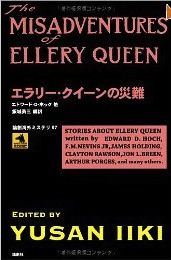
“The Misadventures of Ellery Queen” (by Dale C. Andrews)

Dale Andrews (along with his co-author Kurt Sercu) has the distinction of having received an award for his first published work. “The Book Case” (May 2007) received a second-place scroll in the EQMM Readers Award competition, finishing only one point out of first place. It also received a nomination for that year’s Barry Award. The story is an Ellery Queen pastiche, and the life-long Queen fan followed up his remarkable debut with a second Queen pastiche written entirely on his own steam (“The Mad Hatter’s Riddle” 2009). Anyone who enjoys pastiches will find Dale Andrews’ comments on the form well worth reading. . . . —Janet Hutchings

On May 25 a new anthology of Ellery Queen stories was published. Before stalwart Queen fans, especially those in the English- speaking world, set their hopes too high, this volume, The Misadventures of Ellery Queen, published by Ronso-Sya, has been released in Japan and contains stories that have been translated into Japanese.

It is worth a pause, here at the beginning, to reflect on how popular the works of Ellery Queen remain in Japan. Iiki Yusan, the editor of the new anthology, is the president of the Ellery Queen fan club in Japan and has also authored book-length Japanese critiques of the works of Ellery Queen, including Ellery Queen, The Perfect Guide (2004) and Reviews of Ellery Queen (2010). Unlike in the United States, where it is virtually impossible to find a newly published Ellery Queen novel or anthology, in Japan the entire Ellery Queen library is readily available in current editions.

The Misadventures of Ellery Queen also contains no stories by the creators of Queen, Frederic Dannay and Manfred B. Lee. Rather, it is comprised of Ellery Queen pastiches, that is, mysteries that have been written by other authors, myself included, who have attempted to emulate the Queen style and formula in new stories featuring Ellery.

It is not unusual to find popular detectives re-born in stories penned by authors other than the original creator of the character. The classic example is Sherlock Holmes, who has lived on over the years under the supervision of a host of authors other than Arthur Conan Doyle. Indeed, in 1944, The Misadventures of Sherlock Holmes, edited by none other than Ellery Queen, collected in one volume various Holmes pastiches. While we still do not have a definitive English-language companion collection of Ellery Queen pastiches, if is fitting that notable Ellery Queen pastiches have at least now been collected in Japan, where there is a devoted following.

Let’s pause again here to reflect on what a pastiche is, and what it is not. If you Google “pastiche” looking for a definition, one of the first you will find is this: “a work of art that intentionally imitates other works, often to ridicule or satire.” As seems true of a lot of Internet research, to my mind the definition comes close but ultimately misses the mark. Not surprisingly, the definition I prefer is one penned originally by Frederic Dannay, writing as Ellery Queen. According to Dannay, “a pastiche is a serious and sincere imitation in the exact manner of the original author.” The readily apparent distinction between these two definitions is that the former includes the parody—since it invites “ridicule or satire.” In the latter, Dannay correctly excludes both.  Nothing against parodies—by all accounts Frederic Dannay and Manfred B. Lee liked these as well, and many Ellery Queen parodies have appeared in EQMM over the years. But while the parody can easily bring forth a laugh, it is the pastiche that has the potential to tug at the heart by offering up new life to beloved literary characters who we feared were lost to us forever.

The pastiche, then, consistent with Frederic Dannay’s definition, requires a more structured approach than does the parody. My own rule for constructing a pastiche is also the cardinal principle of the medical profession—“first, do no harm.” If you are writing new stories carrying forth someone else’s character, that character should be recognizable and ring true throughout the story.

Frederic Dannay was a huge fan of the pastiche and did much to popularize the form. It should therefore surprise no one that Ellery Queen’s Mystery Magazine has a long history of publishing pastiches, including salutes to Sherlock in EQMM’s annual Sherlock Holmes issue. Equally unsurprising is the fact that EQMM, over the years, has provided a continued life to Ellery himself in a variety of pastiches that offer new adventures featuring the magazine’s namesake. This has provided the opportunity for a number of noted mystery writers to step up to the plate.

Francis M. Nevins, who knew Frederic Dannay well (and has, in fact, described him as the grandfather that he never had) contributed one of the earliest Ellery Queen pastiches, the classic Open Letter to Survivors (EQMM May, 1972). In Nevins’ story the entire plot derives from the following obscure sentence that appears in the 1948 Ellery Queen novel Ten Days’ Wonder: “There was the case of Adelina Monquieux, [Ellery’s] remarkable solution of which cannot be revealed before 1972 by agreement with that curious lady’s executors.” In Nevins’ pastiche, which plausibly spins out the story hinted at in Ten Days’ Wonder, the young detective is never identified by name. But it is evident that Nevins’ hero is Ellery.  Jon L. Breen has authored both parodies of Ellery Queen—his The Lithuanian Eraser Mystery(EQMM March, 1969), featuring E. Larry Cune is an example—but has also penned true Queen pastiches, such as the Gilbert and Sullivan Clue (EQMM September, 1999), where Ellery uses his intellect to outsmart a murderer while at sea. That same issue of EQMM, celebrating the 70th anniversary of the publication of the first Ellery Queen novel, The Roman Hat Mystery, also offers an Ellery Queen pastiche by Edward D. Hoch, The Circle of Ink, which features Ellery and the inspector confronted with a murder in a university setting. In his final Ellery Queen pastiche, Edward D. Hoch revisited one of Elley’s favorite locales in The Wrightsville Carnival (EQMM September/October 2005), a story offered as part of the magazine’s celebreation of the centenary of the births of Dannay and Lee. In each of these stories Ellery rings true: We encounter him as we would an old friend. To the reader, he is the same character created by Dannay and Lee.

It has been one of the great joys of my life that I have had the privilege to meet and visit with Mike Nevins, Jon Breen, and Ed Hoch. In knowing them, I feel that I have met Ellery.

As to my own involvement in the quest to keep Ellery alive, The Book Case (EQMM May, 2007), written in collaboration with my good friend Kurt Sercu, proprietor of Ellery Queen, a Website on Deduction, features an elderly Ellery solving one last case involving many characters from earlier Queen novels, including principally the 1967 mystery Face to Face. My other contribution to the Queen pastiche library, The Mad Hatter’s Riddle (EQMM September/October, 2009), finds characters from the 1938 Queen novel The Four of Hearts reunited, along with Ellery, for the filming of an episode of the 1975 NBC Ellery Queen television series.

With the exception of The Mad Hatter’s Riddle (which is premised, in part, on a poem that would lose a lot in the translation) all of the foregoing Ellery Queen adventures (and more) are now available together in hardcover, at least in the Japanese market. The rest of us just have to continue to wait and hope!

What do each of the stories have in common, and what separates them, as pastiches, from parodies or satires?  The answer has already been suggested. Further hints can be gleaned by examining some of the synonyms commonly used for the word “pastiche.” James Lincoln Warren, who has also authored pastiches, in his now-retired Criminal Brief blog often referred to this genre of fiction as “tributes.” Another commonly used synonym for “pastiche” is “homage.” These words, I think, help to add the requisite heart to the matter. We who have chosen to write Ellery Queen pastiches are not parodying the Queen formula. Perish the thought! In fact, what we do is reverential—we are striving to emulate Queen, and thereby keep Ellery and the inspector around for just a little while longer. Those of us who labor trying to bring back Ellery, or Sherlock, or Nero for new adventures do so because we simply can’t stand a world without them. We are, after all, still in love.

Dale Andrews is a former attorney for the United States Department of Transportation. He continues to write fiction, and EQMM should have another of his Queen pastiches for readers soon.

Although there are no new print editions out of Ellery Queen novels in English, the following Ellery Queen titles are available in e-book format: House of Darkness (by Wonder Publishing Group); The Roman Hat Mystery and Calamity Town (by Mysterious Press); Halfway House,The Door Between, and The Devil to Pay (by Langtail Press).

Posted in Guest, Translation | Tagged , , , , , , , , , | 5 Comments

Taking Us There

Many of my own happy memories of Ed Hoch resurfaced with Doug Greene’s post about the much-missed author on this blog last week. Ed and I spoke almost every week over the seventeen years we worked together as writer and editor, and it was an eagerly anticipated event when Ed and his wife Pat (another dear friend) would drive down from their home in Rochester for a weekend of walks, shopping, food, and conversation. That’s a long way of saying that I knew and treasured Ed the person as well as I knew and treasured Ed the writer. But curiously, I think Ed’s fiction gave me at least as much insight into his personality as the times we all spent together. There were things about Ed you’d just never guess if you’d met him but not read his fiction—things that seemed almost a contradiction if you had. One of those apparent contradictions relates to his fictional settings—and that, in turn, connects to a topic that has interested me for a long time: writers and their use of land- and cityscapes.

Ed Hoch’s ability to devise one clever and convincing puzzle plot after another became so legendary over the course of his career that it overshadowed, I think, another extraordinary, and to me equally remarkable, talent. Ed had eleven different series running in EQMM at the time of his death. Of those, seven regularly employed settings that were foreign, exotic, or historical: the Michael Vlado stories were set in a gypsy stronghold in Romania; the Rand spy cases in places like Egypt and Pakistan; the Susan Holt stories in Japan and other business destinations; the Stanton and Ives tales anywhere in the world a courier might go; the Ben Snow Westerns throughout the American Southwest; the Alexander Swift historicals in Revolutionary War New York and Philadelphia; and the Dr. Sam Hawthorne stories in early twentieth-century New England.

Ed’s readers, as we know from correspondence received over the years, assumed he was a traveler. He was anything but. Ed rarely ventured out of New York State unless it was to go to a mystery convention in the U.S. or Toronto. He did tour England and Ireland, but never set foot in a non-English-speaking country. In his life, Ed was the quintessential creature of habit, happy with the routines (especially foods) he was familiar with, unlikely to seek the unusual. But in his fiction, another side of his personality emerged. Those exotic settings weren’t painted in as paper backdrops for his plots; you felt you were there—and you would always enjoy the trip. I won’t say that Ed’s settings were “evocative” in the sense in which that term is most often applied to fiction (I’ll get to that later), but they were entirely believable. And how he managed that with no personal experience of the places he visited remains, for me, a mystery. It would be easier to understand if he’d concentrated on a particular foreign or historical setting, as H.R.F. Keating did with his series set in India or Barbara Nadel in her books set in Turkey: Over time, it might be expected that the research and writing would coalesce into a solid sense of place. For Ed, a new unknown location found its way into his fiction every few months. The only stories he wrote set consistently on his most familiar ground were the Captain Leopold procedurals, based in a city modeled on Rochester, and although it was a story from that series for which he won the Edgar Allan Poe Award, I personally do not count the Leopold series with my favorites, precisely because I never found its setting as well developed as those employed in his foreign or historical stories.

In the work of a fiction writer you catch glimpses of the person behind the work that would never be granted to you in any other way; in Ed’s stories I see someone who had a secret sense of adventure, even if he visited his many destinations only through research and the power of his own imagination. I suppose some will see Ed’s interest in exotic locations as fueled by the need to come up with new and unusual elements for the whodunit plots he had to construct every month for his EQMM stories. I think that was probably part of it, but I doubt that he could have conveyed his locations so convincingly if he didn’t have a genuine sense of the romance of the distant and unfamiliar.

The role of place in fiction, however, often goes beyond providing a realistic and believable backdrop for the story; landscapes and cityscapes can also have a strong emotional impact on the reader, and I think that’s what’s usually meant when an author’s settings are described as evocative. I’m drawn to stories that have this dimension and interested in what it is about physical settings that can move us in the context of a story. In a 2007 interview for Arch Literary Journal, Joyce Carol Oates said: “I find landscape to have a spiritual, or psychological, or emotional value in the text, and that becomes like a character. . . . My apprehension of, say, the city of Detroit, would probably not be somebody else’s . . . a landscape or a cityscape is basically an entity that has no animation in itself . . . we’re bringing to it . . . projecting onto it. . . . I get very excited when I read a text that evokes a place, because to me, it has, as I say, this kind of shimmering spiritual value. It’s not just inert and dead . . . .”

When I think of the stories I’ve read whose evocation of place has struck me profoundly, most of them do seem to involve the projection of something personal onto the landscape—not in the sense that one could say, I see this, that, or the other about the author in the way this place is depicted, but in the reader’s experiencing a reaction to the landscape, through the work, that must ultimately come from the author’s very subjective experience of it. It’s not coincidental, I think, that the authors whose landscapes have affected me most write of their home places; places where they grew up, often; places, as Joyce Carol Oates wrote in the 2010 Smithsonian article “Going Home Again,” “where you find yourself in your most haunting dreams. . . . the dreams most embedded in memory, thus encoded deep in the brain: the first memories to be retained and the last memories to be surrendered.”

If any proof were needed of the power of landscape in fiction, one could point, I think, to Joyce Carol Oates’s own work; her novel The Falls and her EQMM stories “Happiness” and “Honor Code” come to mind, all set near her native Lockport, New York.

In mystery fiction, no name is more closely associated for me with evocative settings than Doug Allyn, nine-time winner of EQMM’s Readers Award. Doug Allyn’s most memorable stories, for me, are those set in the North Michigan woods where he spent his boyhood, and in the Missouri hills brought to life for him through family stories. Landscapes, in other words, with which he has an intimate personal connection. Who can forget “Icewater Mansions” or “The Scent of Lilacs,” to name just two of the many Allyn stories in which setting is transcendent—where it’s as important as the characters or action of the story.

Reviews of Southern writers often comment on the importance of place. My reading of Southern fiction isn’t extensive, but I’ve found that landscape has an important role in the stories of several of EQMM’s contributors with Southern roots. In 2006, in the aftermath of Hurricane Katrina, we published an issue devoted to New Orleans and Hurricane-relief organizations, with all of the issue’s stories set in New Orleans. Some writers chose for their setting historical New Orleans, some the modern city prior to the storm, some the city at the heart of the hurricane’s fury, some the ravaged remains of New Orleans immediately after Katrina. In nearly all of the stories, the city of New Orleans is infused with what I think is appropriately called (to use Joyce Carol Oates’s words) a “spiritual value”—though it is a different such value for each author. O’Neil De Noux’s story “When the Levees Break”     will always be for me the picture burned into consciousness of New Orleans post-Katrina, and not because of the accuracy of his descriptions of the effects of the storm but because of the sense he somehow manages to create of a city struggling with its wounds like a single living organism.

I’ve been able to take only a few small stabs at quite a large subject here. But if you find the role of landscape in fiction as interesting as I do, I hope you’ll join the conversation. —Janet Hutchings

Posted in Fiction | Tagged , , , , , , , , , , , , , , , | 5 Comments

“Memories of Ed” (by Doug Greene)

There are many ways in which individuals can make contributions to the field of mystery and suspense fiction other than by writing the stories and novels we love to read. In recent years, conventions such as Bouchercon and Malice Domestic have included among their honorees fan guests of honor, in recognition of the important role committed readers play in generating enthusiasm for the genre and spreading the word about books. If you didn’t already know who Doug Greene was, you might get the impression from this week’s blog that he’s that kind of fan—especially of the work of Edward D. Hoch. And that’s true, but the recently retired college professor is also the founder and owner of Crippen and Landru, the country’s premier publisher of mystery short story collections.  For his work at Crippen and Landru (which he ran for many years while also holding a full-time professorship) Doug Greene has received both the Ellery Queen Award from the Mystery Writers of America and the Poirot Award from the Malice Domestic Convention. He is also the author of the Edgar-nominated biography, John Dickson Carr: The Man Who Explained Miracles. This week Doug joins us to talk about the work of an author who will be remembered for the hand of friendship he extended to so many, and read for the nearly unique talent he displayed (at least in his generation) for creating brilliant classical whodunits at short-story length.Janet Hutchings

It was during the early 1970s that I first started reading Ellery Queen’s Mystery Magazine regularly. Copies were always for sale at grocery checkout counters for 75 cents—this was, after all, forty years ago. I would turn first to stories by Edward D. Hoch. They were always well told, they had interesting characters and settings, and they were usually fairplay detective stories with all the clues given to the reader. During 1971 the issues also contained stories written by the pseudonymous “Mr. X.” Under the series title “The Will-o’- the-Wisp-Mystery,” each of the six stories was complete in itself but each ended in a cliffhanger leading to the next story. This, I said to myself, was the way a mystery story should be told. It was only later that I learned the “Mr. X’ was actually Edward D. Hoch, and the idea behind the series was the brainchild of Ellery Queen himself.

Later that year, I found on a newsstand a paperback book, in the same format as Ellery Queen’s Mystery Magazine, with the title The Spy and the Thief, and its author was (I was delighted to discover) Edward D. Hoch. The book featured two of Hoch’s series characters, Jeffrey Rand and Nick Velvet, and the introduction was by Ellery Queen. The introduction mentioned in passing that Hoch had written another short story collection—one that I had never heard of (The Judges of Hades) about a character about whom I was also unfamiliar (Simon Ark). I looked and looked but couldn’t find a copy anywhere—this was long before the Internet.

With some trepidation, I decided to screw my courage to the sticking post (whatever Shakespeare might have meant by that phrase) and wrote to Hoch himself in care of the magazine. A short while later, a parcel arrived from the author enclosing not only a copy of the book (warmly inscribed) but also a second Simon Ark collection, City of Brass. All of which is a long way of saying that I discovered that Ed Hoch was not only a wonderful writer but a heck of a nice guy as well.

Ed Hoch was a rare writer, probably a unique one, in that he made a living as the author of short stories. Decades ago, in the heyday of the pulp magazines (like Black Mask and Dime Detective) and the mass market “slicks” (like The Saturday Evening Post and Collier’s), a writer could be a short-story specialist, but today’s market doesn’t allow such specialization —unless you happen to be Ed Hoch. He eventually wrote about 950 short stories in various genres—science fiction, Westerns, historicals, young adult, and several very fine ghost stories, but he quickly emphasized mysteries and detective stories. He tried writing novels. One, The Shattered Raven, featured the Mystery Writers of America. He also wrote a series of three novels, beginning with The Transvection Machine, about the Computer Cops investigating future crimes. He even became a ghost writer for one of the paperback original novels that was credited to “Ellery Queen” —The Blue Movie Murders. But he said a week or two after he started on a novel, he wanted to work on other ideas that were always bubbling up inside his brain.

And in many ways that was the key to Ed’s genius. An idea would come to him—a way of murdering someone in a locked room, a crime committed in a cabin surrounded by unmarked snow, a person who jumps from a window and vanishes—and it would percolate in his head; he would ponder it, manipulate it, come up with an original way of handling it, and a compact story would emerge. Ed loved a challenge. Friends would dare him to come up with a solution to an ingenious situation—and almost nothing would stump him for long, When he was challenged to devise a murder within the rotating door of a department store, he, of course, solved it. I was with him when he began to think about a plot device as he got on an escalator and would have it worked out by the time he got off. I suggested that he write a story based on a famous plot device, the “Paris Exposition” story, a late-19th, early 20th century legend of a mother and son who arrive at a hotel at the Paris Exposition in 1889. The lad leaves the hotel for an hour or two, but when he returns his mother has vanished and the hotel denies that she was ever there. In some versions, even the room in the hotel has vanished. Mystery writers from Anna Katharine Green to Cornell Woolrich to John Dickson Carr adapted various parts of this story, and such movies as Bunny Lake Is Missing and the television series Monk also used it. Ed, of course, had little trouble devising an original variant in “The Problem of the Leather Man,” and he slyly used my name in it for a character who, in fact, doesn’t actually appear.

Ed’s first published story was “Village of the Dead” about Simon Ark; it was published in 1955 in Famous Detective, one of the last of the pulp magazines. Ark was Hoch’s tribute to the long tradition of detectives who investigate the occult. Ark spoke an ancient Coptic tongue and he implied that he had been alive for 2000 years. The cases he solved had to do with weird religious rituals and witchcraft and vampires. Soon Hoch was inventing series character after series character: Father David Noone, who combined Catholic theology with crime solving; Captain Jules Leopold of a city very much like Hoch’s hometown of Rochestesr, New York; Ben Snow, a cowboy detective in the old West who is often confused with Billy the Kid. In 1962, he broke into Ellery Queen’s Mystery Magazine and Alfred Hitchcock’s Mystery Magazine, then as now the two premier magazines in the field. By the time I was a regular reader of EQMM in 1971, he was in almost every issue, and beginning in May 1973 he began an unbroken record of being in every issue for the next thirty-five years. Eventually, he was pictured six times on the cover of EQMM, a record surpassed only by Sherlock Holmes.

And he continued to devise series characters, some of the most imaginative ever to come from the pen of a mystery monger. Nick Velvet became a perennial favorite—a choosy crook who would steal only something that was considered worthless—a bald man’s comb, water from a swimming pool, a birthday cake, a cigar, a balloon, a cobweb. The mystery was why anyone would pay to steal such items, and often Nick would also have to solve a crime along the way in order to avoid being arrested. Another favorite was Jeffrey Rand, who began during the height of the James Bond spy craze as an expert on “concealed communications,” and whose adventures continued to involve international intrigue. And Michael Vlado, a Gypsy King who solves crimes mainly in eastern Europe during the collapse of the Soviet empire. And con man Ulysses S. Bird. And spy for George Washington, Alexander Swift, in an evocative historical series. Unlike many male authors, whose attempts to see matters through the eyes of women were, at best, embarrassing, Hoch created several persuasive female sleuths, including policewoman

Annie Sears and department-store buyer Susan Holt, whose business life took her around the world. Hoch also created a youthful pair of crime-solving couriers, Juliet Ives and Walt Stanton.

For many readers—myself included—Hoch’s finest creation was Dr. Sam Hawthorne, a New England country doctor from the first half of the last century who is faced with a series of impossible crimes—a wagon that enters a covered bridge and vanishes, a man murdered in a voting booth, a child who disappears from a swing, another child who vanishes from a bicycle, even one that seems to re-create Charlotte Perkins Gilman’s famous tale of the yellow wallpaper as an impossible crime.

As wonderful as these stories are in their ingenuity and superb storytelling, I remember Ed Hoch mainly for himself. After he sent me those two books in 1971, Ed and I corresponded and spoke on the phone frequently until we met in person in 1986 at a Bouchercon in Baltimore. From then on, we saw each other at every Bouchercon and almost every Malice Domestic convention. Joined by our close friend Steve Steinbock—who now writes the book review column for EQMM—Ed and Ed’s wife Pat and I would have dinner together and debate whose turn it was to be the host. Ed would always order the same dinner—filet mignon cooked well-done (to the consistency of a hockey puck) and french fries, with vanilla ice cream for dessert—except at the Bouchercon in Denver in 2000 when we went to a Western restaurant which not only had a young woman in tights and a feather boa on a trapeze overhead but also Western meats on the menu. I can’t recall whether we persuaded him to have buffalo or elk, but it was one or the other. He survived.

Ed had an encyclopedic knowledge of mystery and detective fiction, and he knew everyone worth knowing in the field. It is often said of people that he or she “never had a bad word to say about anyone,” and then someone will smirk knowingly and (wink, wink, nudge, nudge) recall when he or she did in fact have some bad words—but that was never true about Ed. I cannot recall when he ever said anything unkind or ungenerous.

Like Anthony Boucher before him, Ed was a devout Roman Catholic with a strong concern for social justice. Often we would talk about religion. On one occasion at a Bouchercon, Steve Steinbock and I were at a bar (where else?) discussing some point or other about religious doctrine, he from a Jewish viewpoint, I from a Christian (Episcopalian) perspective, when we saw Ed coming down the stairs across the lobby. Steve and I remember differently which one of us yelled, “Ed! Come here; we need a Catholic!” Ed, of course, came over. I am sure we never resolved anything, but friends don’t need to.

On January 18, 2008, Janet Hutchings called me to say that Ed had died suddenly that morning. I was in shock. The mystery community had lost a great writer; the world had lost a great and good human being; but personally—and this was uppermost in my mind, and still is—I had lost a close friend.

A number of Edward D. Hoch short story collections are available through Crippen and Landru at http://www.crippenlandru.com. EQMM will also be reprinting a Hoch short story in this year’s December issue.


Posted in Guest, Memorial | Tagged , , , , , , , , , , , , , , , , , , , , | 10 Comments

“In Good Company” (by Carolyn Hart)

It’s only rarely that bestselling author Carolyn Hart writes a short story. She’s a prolific novelist, with more than four dozen titles in print, most of them mysteries. EQMM is fortunate to have been able to present two of those rare Hart short stories to its readers over the years. This week the Oklahoma author has some thoughts about the nature of the mystery/suspense field that should be of interest to all fans of the genre. (Discussion is welcome!)—Janet Hutchings

Mysteries fascinate millions of readers. What attracts readers to mysteries and why do I write mysteries?

Do you remember reading the Hardy Boys and Nancy Drew? Why did we love those books?  What did  we find in those books?

We found independence, a battle for justice, and a puzzle. Girls reading Nancy Drew found a heroine who delighted and inspired them. Nancy Drew was—and  is—brave, honorable, fun, and gloriously  independent. Boys and girls found the same qualities in Frank and Joe Hardy. I know you remember them well, serious, thoughtful Frank, fun-loving, eager Joe. They too exemplified independence, a status children are thrilled to envision for themselves.  We weren’t as brave and independent as they  but we wanted to follow their lead. What an example they  set  as  they  battled injustice, dishonesty, cruelty, and corruption. They faced bewildering challenges but persevered until the mystery was solved, the criminal captured.

Independence,  a battle for justice, and a puzzle.

These are still prime attributes of  the mystery. But the mystery offers more. The moral worth of the mystery should be evident in that it has drawn to it writers devoted to the religious life. Dorothy L. Sayers was a foremost theologian of her time. Philosopher Ralph McInerny wrote the Father Dowling mysteries. Agatha Christie was a staunch member of the Church of England. Among other books where the mystery’s link to the religious life is made explicit are the charming books by Sister Carol Anne O’Marie.

I have always said and not really in jest that if I were to be marooned on a desert island, I would choose mystery readers and writers as my fellow castaways. They would follow the rules and one of them would be smart enough to get us off the island.

So what are these books that offer so much to readers?

There are two sharply different kinds of mysteries, the crime novel and the traditional mystery. The crime novel features heroes such as private eyes Sam Spade or V. I. Warshawski and police officers such as Barbara D’Amato’s Suze Figueroa or Ed McBain’s officers of the 87th Precinct. The traditional mystery features the amateur sleuth, such as Agatha Christie’s Miss Marple, G.K. Chesterton’s Father Brown, Joan Hess’s Claire Malloy, or my own Annie Darling.

The crime novel is the story of an honorable woman—or man—who tries to remain uncorrupted in a corrupt world. The crime novel is the story of the protagonist, not the story of the murder that is solved within those pages. The private eye – whether we are talking about Sue Grafton’s Kinsey Millhone or Dashiell Hammett’s Sam Spade – is the white knight who will never betray her or his code of honor. These books explore society’s ills and attempt to right  society’s  wrongs. These books are about the quest for honor. Although crime novels are often described as books about the mean streets and indeed they often look at the underbelly of society, these books are very romantic in intent. They celebrate heroes and heroines who are willing to fight corruption, dishonesty, and fraud.

My own particular love is the traditional mystery. These books were once pejoratively described as “cozies” by those who admire books about the mean streets.  The inference was that mean street  books are “real” and “cozies” are about drawing room crimes in little villages that could never happen.

But as Agatha Christie brilliantly demonstrated, the traditional mystery is at the heart of our lives. In her Miss Marple Books, Christie made the very point that life in a village is a microcosm of life everywhere. One does not have to live in a huge city and wander the alleyways to be acquainted with anger, jealousy, greed, and despair.

Christie once compared the mystery to the medieval morality play. It is a fascinating analogy. In the medieval morality play, the tradesfair audiences saw a graphic presentation of what happens to lives dominated by lust, gluttony, sloth, and all the deadly sins. This is precisely what readers of today’s mysteries are offered in a more sophisticated guise.

The opening segments of the Agatha Christie television mysteries capture the essence of the traditional mystery.

If you recall, the TV presentation opens with a figure peering out of a window into the street and two women with sly faces in close conversation. There is an air of secrecy, covertness, and, most of all, intimacy. Neighbors watch.  Friends—and enemies—gossip. There are lies and deceptions, misunderstandings and misapprehensions, passion and pain, fear and fury.

The traditional mystery offers readers a primer in relationships. The distant mother creates a child who cannot love. A tyrannical boss engenders hatred and frustration. Slyness evokes distrust. A man who cheats on his wife or a woman who cheats on her husband cannot be trusted in any relationship. If this, dear reader, is how you live . . .

Readers who do not understand the dynamic of the traditional mystery will inquire, “Why do you want to write about murder?”

The answer is simple.

Murder is not the focus of either the crime novel or the traditional mystery.

In the crime novel, V. I. Warshawski explores how society has been warped and strained by those who flout laws and conventions.

In the traditional mystery, Miss Marple is discovering what went wrong in the lives of those living in the village. The focus of the traditional mystery is fractured relationships. In trying to solve the crime, the detective searches out the reasons for murder by exploring the relationships between the victim and those around the victim.  The detective is trying to find out what caused the turmoil in these lives. What fractured the relationships among these people?

Readers, being the intelligent creatures that they are, extrapolate the lessons observed in fiction for their own use, their own lives.

When readers observe the lives around them, they can see the torment of an abused wife or husband (and abuse can quite often be mental and verbal rather than physical), the despair of an unloved child, the anger of a betrayed spouse, the jealousy of a less-favored child, the hatred of a spurned lover.

Usually these emotional dramas do not end in murder. In fact, they do not end.  The violent emotions created by fractured relationships corrode the lives of every person involved. Often forever. This is what the traditional mystery is all about. The traditional mystery focuses on the intimate, destructive, frightening secrets hidden beneath what seems to be a placid surface.  And often, the traditional mystery affords humor as well as insights.

Once again, Agatha Christie comes to mind.  No one ever captured the destructive power of greed any better than she did in The Murder of Roger Ackroyd.  But equally, in book after book, she punctures pretension and wryly observes the human drama.  In The Body in the Library, Christie notes with humor the stuffiness and class consciousness of Col. Bantry, but she also observes with compassion how a suspicion of wrongdoing, if not resolved, could destroy his life.

It is no accident that Christie has outsold every writer, living or dead. It is because her people are real. Readers recognize them at once. Oh yes, that’s just like that fellow in my office. Or yes, that’s just like Aunt Alice. Or the woman across the street. Or me.

Truth to tell (and fortunately), most readers do not spend every waking moment trying to escape from a serial killer. Yes, serial killer books have enjoyed enormous popularity. They are a very visible example of the randomness of violence today and of the ultimate separation of a human being from society. These books respond to a definitive reality of our times. Readers want to try and contain this kind of evil. One way to contain its horror is to read about the vanquishment of a serial killer.

But readers are also deeply concerned about the expressions of dissension and violence far short of murder that occur in their own lives. Readers spend much of their lives in moments of stress and confrontation with those around them. They know the jealous mother, the miserly uncle, the impossible boss, the woman who confuses sex with love, the selfish sister. These are the realities of life with which they must cope.

This is why Christie’s mysteries and all traditional mysteries are so popular.
What could be more everyday, more humdrum than life in a remote English village?

Miss Marple can tell you.

I’ve always been amused by those who dismiss traditional mysteries by saying, “Oh, how absurd.  All those bodies in a little village.  Isn’t that silly?”

No.

It is reality.

There may not be a body in the library, but there will always be heartbreak and passion, fear and denial, jealousy and revenge in every society everywhere.
It is how these emotions destroy lives that fascinates the writer and reader of traditional mysteries.

Mysteries mirror the realities of our lives, personal and social.  But perhaps the greatest gift we take from the mystery is a continuing reassurance that goodness matters.

Readers read mysteries because we live in an unjust world.

That’s why I write mysteries.

In life, evil can triumph as Americans were reminded most painfully on 9/11. We still want the world to be good, we want the world to be just, we want the world to be fair so we can go together, you and I, to a magic place where goodness will always triumph, where justice is served, where wrongs are righted.  We can read a mystery. —Carolyn Hart

Among many other honors, Carolyn Hart has won three Agatha Awards for best novel and was nominated for the Pulitzer Prize for her novel Letter from Home. Recently, a complete, uncut version of her WWII suspense novel Escape From Paris was published to rave reviews; the latest book in her popular Death on Demand series, Death Comes Silently, was released last month. http://www.carolynhart.com/

Posted in Guest | Tagged , , , , , , , , , | 4 Comments

“The Moment of Decision” — Perched on the Edge of What Happens Next (by Art Taylor)

This week, as promised, we have a post by Art Taylor, a writer whose reviews and critical essays are regularly featured in magazines and newspapers. The authors whose work he discusses here are some of my favorites (and I hope yours too), including the late, great Stanley Ellin. — Janet Hutchings

My wife and I have recently been working our way through the bulk of Stanley Ellin’s contributions to Ellery Queen’s Mystery Magazine, courtesy of The Specialty of the House & Other Stories: The Complete Mystery Tales 1948-78. I read the stories aloud, giving us the chance to savor the sound of Ellin’s style, but as much as we admire that finely honed prose, what has given Ellin such lasting renown in the pantheon of short story writers is surely the precision of his plotting: the clockwork accuracy by which each element of a given tale contributes subtly, effortlessly, inexorably toward some crushing plot turn or crisp final image. Reflecting in the collection’s introduction on the short story writers who influenced him, Ellin himself praised how De Maupassant “reduced stories to their absolute essence” and how his endings, “however unpredictable,” ultimately seemed “as inevitable as doom”—qualities which Ellin emulated and perfected in his own work.

For many reasons, Ellin’s short fiction also calls to mind John Updike’s often-quoted criteria for judging a short story’s success: “I want stories to startle and engage me within the first few sentences,” Updike said, “and in their middle to widen or deepen or sharpen my knowledge of human activity, and to end by giving me a sensation of completed statement.” Ellin’s finest stories seem to succeed on these terms as well: drawing readers in quickly, turning a clear eye on some aspect of human nature (often the darker recesses of it, admittedly), and regularly bringing a perfect sense of closure to his tales—often with cruel little twists, as in “The Orderly World of Mr. Appleby,” “The Best of Everything,” or “The Betrayers,” for example.

But as I think more about Updike’s criteria and about Ellin’s stories, I find myself stumbling a little over that “completed statement” phrase. While I too feel the sense of rightness about a ultra-tidy, ultra-unified resolution, I can’t help but notice that several of Ellin’s best-known and best-loved works end somewhere shy of telling the full story, instead leaving the reader him- or herself to fill in some of the blanks. “The Specialty of the House,” for example, lays out all the clues behind the culinary masterpieces at Sbirro’s but we readers have to figure out exactly what’s going on back in that kitchen. At the end of “The House Party,” Ellin provides glimpses of the true nature of the festivities but then leaves us uneasily sorting through the larger ramifications. And in that much-reprinted masterpiece “The Moment of Decision,” Ellin brilliantly tightens, tightens, tightens the suspense until an ending where we…. Well, I won’t spoil that ending here, but suffice it to say (to draw on the title of our new blog here) that “Something Is Going To Happen” is both a good definition of how the mystery and suspense story works and perhaps also a good place to end such a story, just on the edge of the something else, something new that might happen next. As EQMM editor Janet Hutchings herself wrote in the inaugural post for this blog, “Usually that important ‘something’ will occur within the pages of the story, though in some cases the story may build toward it and stop before the critical moment, leaving the rest to the reader’s imagination.”

Open-ended stories like “The Moment of Decision” can be found across various genres: Ray Bradbury’s “All Summer in a Day” is a frequently taught example from the annals of science fiction; Raymond Carver’s “The Bath” fits the bill (though not the alternate (original) version of that same storyline, “A Small, Good Thing”); and each time I’ve taught Joyce Carol Oates’ tautly suspenseful “Where Are You Going, Where Have You Been?” my students have left their reading with more questions than answers—but profitably so, I should stress. The unresolved ending isn’t necessarily restricted to short fiction either; one of my favorite novels of recent years, Tana French’s In The Woods, continues to provoke controversy for what’s not explained by the book’s close. (And when I put out a call on Facebook for suggestions of more such stories, I discovered some new ones I haven’t yet read: Frank Stockton’s “The Lady, or the Tiger?” and Italo Calvino’s interlinked story collection If on a Winter’s Night a Traveler. Perhaps readers here could suggest others as well?)

As the few examples above might suggest, darker stories (whatever the genre) perhaps lend themselves more readily to such endings — the pervasive sense of unease in noir, for example, setting the stage for a persistent lack of resolution. And as if in confirmation of that idea, a story I read just a few nights ago, Ed Gorman’s “Out There in the Darkness” from The Best American Noir of the Century, ended with a brilliant and brooding sense of anticipation about what still lies ahead for the narrator:

I look at the empty chairs and think back to summer.
I look at the empty chairs and wait for the phone to ring.
I wait for the phone to ring.

In a similar vein, Daniel Woodrell’s recent short story collection, The Outlaw Album—excerpts of which I just finished teaching for a class on American Noir—offers a couple of examples of how such endings can both resist resolution (or even explanation) and yet still seem complete and satisfying. In “Floriane,” a father struggles to come to terms with his daughter’s disappearance, but while the story offers suspects aplenty, what happened to the girl is never revealed—the narrator’s lingering, inescapable state of suspicion and distrust becoming the point of the story, in fact. And in “Night Stand,” a Vietnam vet named Pelham defends himself and his wife against an intruder who appears at the foot of the couple’s bed in the middle of the night, naked and growling—a man who turns out to have been a vet as well (Gulf War) and the son of one of Pelham’s oldest friends. At story’s end, Pelham himself strips off his own clothes and stands at the back deck, growling toward the perimeter of his own yard—a perfect circle of sorts for the story’s imagery, a fresh balance it seems, except for the fact that Pelham’s actions may likely prove as inexplicable to the reader as they are to his wife, standing just inside the door, watching him. (And yet despite what my students seemed to think, that final scene shouldn’t be inexplicable for an engaged reader, and at least one of the questions the wife asks Pelham toward the story’s close should help point the way toward unraveling what’s going on.)

Coming back again to EQMM: One of my favorite authors among the magazine’s regular contributors is David Dean (a widespread assessment apparently, given his frequent appearances on EQMM’s annual readers’ polls), and a couple of Dean’s best stories also come to mind as I’m writing this—both because each of them stops short of the climax and because each echoes with some part of Woodrell’s “Night Stand.” In the very short and very chilling “Awake” (July 2009), the middle of the night becomes a time for memories and menacing sounds and perhaps more. And in “Ibrahim’s Eyes” (June 2007), as crisply structured a story as I know, an ex-Marine working the night shift at the Quik and EZ Mart reflects on his troubled stint in Beirut as he preps to defend the convenience store against a rash of late-night robberies; what happens just beyond the final lines of the story is surely inevitable—as inevitable as doom—and yet I’d argue that the ending is so provocative and so moving precisely because it stops just short of the “what happens next,” requiring us to finish out that last bit of the story ourselves, fill that blank space just beyond the final sentence with our own imagination, our own emotions. (Incidentally, each of these stories has been included as part of EQMM’s podcast series—easy access for interested readers/listeners.)

Finishing the story ourselves—that’s basically how these open endings work. These and other writers don’t just tell us what happened but instead force us to become an active part of the storytelling, at the very least puzzling out the “Why?” and “What if?” and “But suppose…” possibilities, or trying to tie up the loose ends left purposefully dangling, or supplying the emotional responses underplayed by the author, or at the further extreme, having some hefty moral quandaries laid at our doorsteps, as Ellin’s “The Moment of Decision” so expertly does.

In that tale and others mentioned here, the “sensation of completed statement” that Updike praises isn’t necessarily something that’s “given” to us readers. Instead, it’s something that we earn, both along the way and well past the time we turn the final page. — Art Taylor

Art Taylor’s short stories have appeared frequently in Ellery Queen’s Mystery Magazine, and two of his EQMM stories have won Derringer Awards: “Rearview Mirror” in 2011 and “A Drowning at Snow’s Cut” in 2012. In addition to his short fiction, he is a professor of English at George Mason University, a frequent reviewer of mysteries and thrillers for the Washington Post, and a regular contributor to Mystery Scene. For more information, visit www.arttaylorwriter.com.

Posted in Guest | Tagged , , , , , , , , , , , , | 5 Comments