
MYSTERY’S BUSIEST WEEK

Last week the Mystery Writers of America held its annual Edgar Allan Poe Awards banquet in Manhattan. Each year, writers come from all across the country to attend this formal dinner and the many parties, signings, and panel discussions that revolve around it. Mystery editors, agents, and publishers spend much of the week entertaining their out-of-town authors, and as soon as the New York events are over, it’s on to Washington D.C. for one of the most popular mystery conventions, Malice Domestic, always held the weekend following the Edgars.

My hands are pretty slow on the keyboard after so many days of nonstop conversation, so I’m only going to hit the highlights of that terrific week and let photos of a few of the parties, ceremonies, and gatherings do most of the talking.

It was a week of reconnecting with old friends in the business—too many to mention individually—and the photos we’re including here were donated by others, so there are inevitably a lot of people closely connected with the magazines who don’t appear.

photo courtesy Dale Andrews

photo courtesy Dale Andrews

For the Dell Mystery Magazines (EQMM and AHMM), the biggest event of the week is not the Edgar Awards banquet itself but the pre-Edgars cocktail party we host just prior to the banquet.  We had some special guests with us this year. MWA’s new president, Charlaine Harris, and her husband, Hal Schulz, were in town for the festivities and made it to the Dell party before Charlaine was due to take up her MWA duties. And this year’s MWA Grand Master Award cowinner, Margaret Maron, and her husband, Joe, were back in New York and at the Dell party prior to Margaret’s investiture.
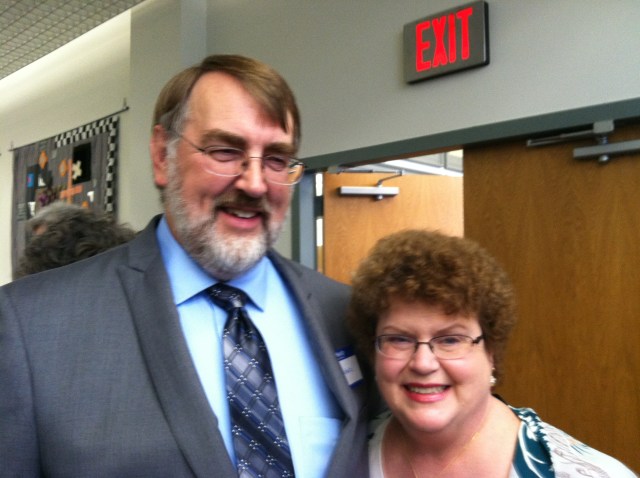
Charlaine & Hal Shulz. Photo courtesy of Abby Browning

Hal Schulz & Charlaine Harris Schulz. (Photo courtesy of Abby Browning.)

050213-3

Chris Begley, Vice President for Editorial at Dell Magazines, accepts Lia Matera’s EQMM Readers Award for “Champawat.”

The purpose of the Dell pre-Edgars party is to honor writers of the mystery short story, including our Edgar nominees, and to present the EQMM Readers Awards. It’s a rare year when all of our Edgar nominees and all of the Readers Award winners can make it to New York. This year we were sorry not to have either Tom Piccirilli, author of the Edgar-nominated story “The Void It Often Brings With It” (EQMM 11/12) or Lia Matera, author of the third-place Readers Award-winning story “Champawat” (EQMM 9-10/12) with us. But Doug and Eve Allyn and David and Robin Dean were on hand, David accepting the second-place Readers Award for his story “Mariel” (EQMM 12/12) and Doug accepting the first-place award for “Wood-Smoke Boys” (EQMM 3-4/12).  Also present, having come all the way from the Catalan city of Barcelona, were author Teresa Solana and her husband and translator, Peter Bush. Teresa’s Edgar nomination for her March/April 2012 EQMM story “Still Life No. 41” together with the recent publication of her third novel in English translation, The Sound of One Hand Killing, inspired the long journey—perhaps the greatest distance any Dell Magazines nominee has ever traveled for the Edgars. I speak for everyone at the magazines when I say we enjoyed welcoming them into the Dell fold.

050213_4

David Dean accepts his EQMM Readers Award for “Mariel.” (Photo courtesy of Robin Dean.)

Doug Allyn accepts his EQMM Readers Award for "Wood-Smoke Boys." (Photo courtesy of Eve Allyn.)

Doug Allyn accepts his EQMM Readers Award for “Wood-Smoke Boys.” (Photo courtesy of Eve Allyn.)

Peter Bush and Teresa Solana. (Photo courtesy of Abby Browning.)

Peter Bush and Teresa Solana. (Photo courtesy of Abby Browning.)

After a late-night trip home following the Edgars banquet, it was time for me to start packing for the Malice Convention. This was a special year for Malice, its 25th anniversary, and since I was one of the attendees of the original convention all those years ago—a small gathering in a hotel in Silver Spring, Maryland—I didn’t want to miss it.  A canceled flight and a late arrival notwithstanding, I particularly enjoyed this year’s convention, which featured, among other remembrances, the release of the nearly 500-page volume Not Everyone’s Cup of Tea: An Interesting and Entertaining History of Malice Domestic’s First 25 Years (Wildside Press), in which dozens of authors and others in the business (including me and my colleague Linda Landrigan) share experiences of Malice camaraderie and fun.

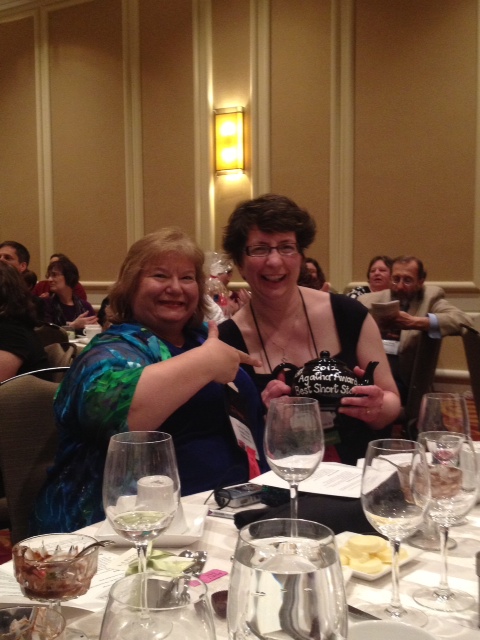
EQMM and AHMM each had a nominee in the field of five stories up for the Malice Domestic Convention’s Agatha Award: B.K. Stevens for her AHMM story “Thea’s First Husband” and Dana Cameron for her EQMM story “Mischief in Mesopotamia.” Dana was the winner, taking home her third Malice teapot in the short-story category. (Below, there’s a picture of her holding it at the table she graciously hosted at the banquet.)

Another Edgars and another Malice have come and gone, leaving us all tired, but happy to have reconnected with old comrades in the mystery community—and glad to have made some new friends too!—Janet Hutchings
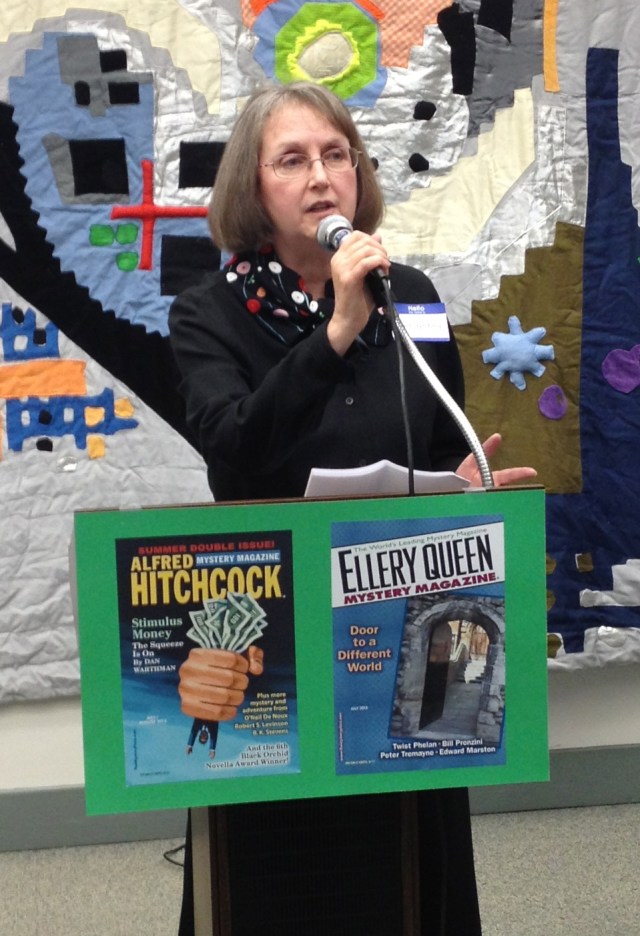
Janet Hutchings, editor of EQMM, presents the 2012 EQMM Readers Awards. (Photo courtesy of Deb Lacy.)
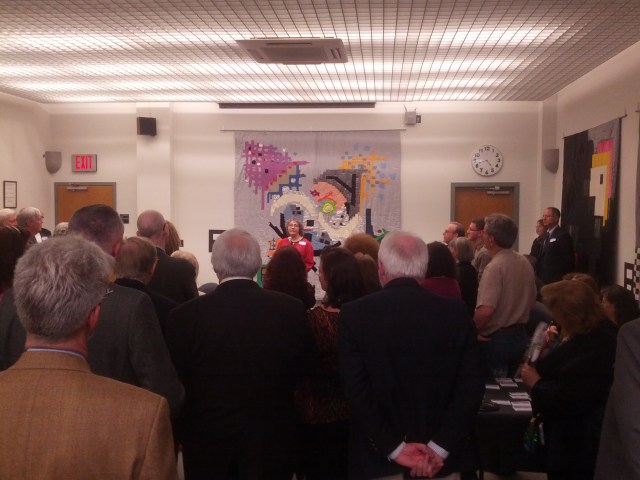
Janet Hutchings, editor of EQMM, presents the 2012 EQMM Readers Awards. (Photo courtesy of Deb Lacy.)

The crowd listens as Linda Landrigan, editor of AHMM, congratulates our Edgar and Agatha nominees, and EQMM Readers Award Winners. (Photo courtesy of Dale Andrews.)

The crowd listens as Linda Landrigan, editor of AHMM, congratulates our Edgar and Agatha nominees and EQMM Readers Award Winners. (Photo courtesy of Dale Andrews.)

David and Robin Dean at the Dell pre-Edgars cocktail party. (Photo courtesy of Dale Andrews.)

David and Robin Dean at the Dell pre-Edgars cocktail party. (Photo courtesy of Dale Andrews.)

Peter Kanter, President and Publisher of Dell Magazines/Penny Publications, at the Dell pre-Edgars cocktail party. (Photo courtesy of Abby Browning.)
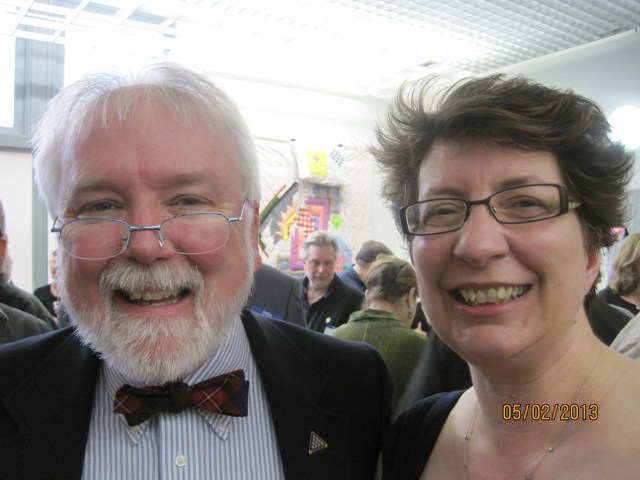
Peter Kanter, President and Publisher of Dell Magazines/Penny Publications, at the Dell pre-Edgars cocktail party. (Photo courtesy of Abby Browning.)

Brendan DuBois and Dana Cameron at the Dell pre-Edgars cocktail party. (Photo courtesy of Toni LP Kelner.)
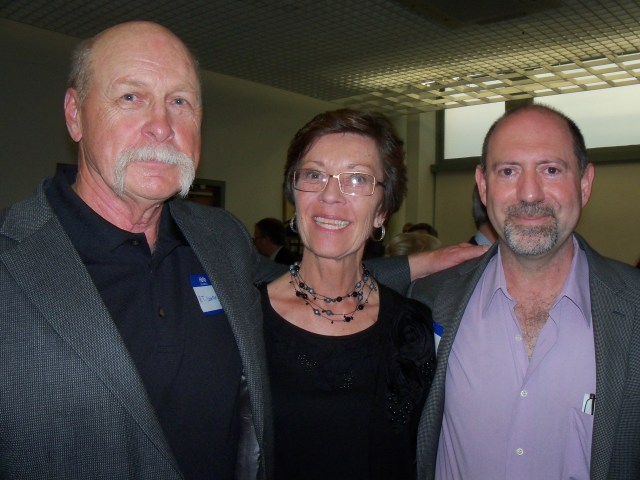
Brendan DuBois and Dana Cameron at the Dell pre-Edgars cocktail party. (Photo courtesy of Toni LP Kelner.)

R.T. Lawton, Kiti Lawton, and Steve Steinbock at the Dell pre-Edgars cocktail party. (Photo courtesy of Steve Steinbock.)

R.T. Lawton, Kiti Lawton, and Steve Steinbock at the Dell pre-Edgars cocktail party. (Photo courtesy of Steve Steinbock.)

Carol Demont and Jackie Sherbow at the Dell pre-Edgars cocktail party. (Photo courtesy of Abby Browning.)

Carol Demont, Dell Subsidiary Rights & Licensing Manager, and Jackie Sherbow, Assistant Editor of EQMM & AHMM, at the Dell pre-Edgars cocktail party. (Photo courtesy of Abby Browning.)
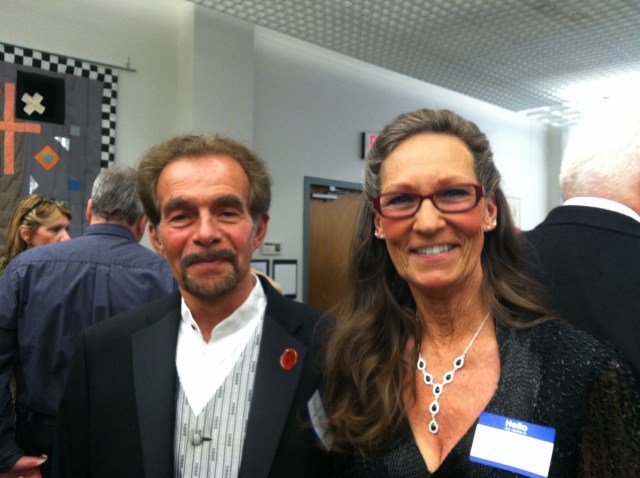
Doug and Eve Allyn at the Dell pre-Edgars cocktail party. (Photo courtesy of Abby Browning.)
Doug and Eve Allyn at the Dell pre-Edgars cocktail party. (Photo courtesy of Abby Browning.)

050213-15

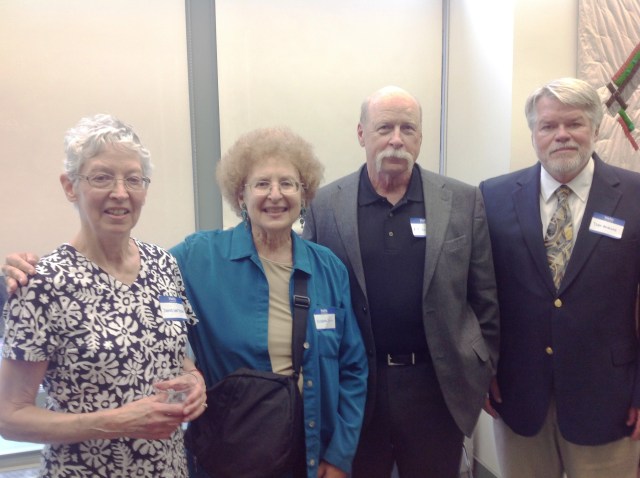
SleuthSayers blogmates Janice Law Trecker, Liz Zelvin, R.T. Lawton, and Dale Andrews at the Dell pre-Edgars cocktail party. (Photo courtesy of Liz Zelvin.)

050213-17

Teresa Solana at the Dell pre-Edgars cocktail party. (Photo courtesy of Abby Browning.)

Janet Hutchings, Steve Steinbock, and Linda Landrigan during Edgar week. (Photo courtesy of R.T. and Kiti Lawton.)
Janet Hutchings, Steve Steinbock, and Linda Landrigan during Edgar week. (Photo courtesy of R.T. and Kiti Lawton.)

Toni LP Kelner and Dana Cameron celebrate Dana's Agatha win at Malice Domestic in Bethesda. (Photo courtesy of Dan Hale.)

Toni LP Kelner and Dana Cameron celebrate Dana’s Agatha win for Best Short Story at Malice Domestic in Bethesda. (Photo courtesy of Dan Hale.)

Posted in Awards, Business, Conventions, Writers | Tagged , , , , , , , , , | 2 Comments

“You Do WHAT With Your Short Stories?” (by Brendan DuBois)

EQMM has published many prolific short-story writers over the years, most notably Edward D. Hoch, who, in the course of his lifetime, sold more than 900 short stories. A tenth of that number would be a lot by just about anyone’s standards. Among those contributing to EQMM who have hit or passed the hundred mark are the late Donald Olson and, more recently, Brendan DuBois, whose fiction debut was in EQMM’s Department of First Stories in 1986. The latter is also a successful novelist, but one who clearly never lost his love for the short form. His latest EQMM story, “Breaking the Box,” will appear in our September/October double issue. An e-book collection of his stories is currently available through Amazon: See Tales from the Dark Snow. —Janet Hutchings

Gosh, how I do love libraries.

I grew up in Dover, a mill town near the seacoast of New Hampshire, which was fortunate to have a Carnegie library. It was one of those old-style Victorian buildings with lots of brick and stone and turrets, and I literally could spend hours in there, examining the shelves of books and magazines, some of which went back nearly a century. I remember to this day the sweet joy when I first got my adult library card, so I could go upstairs and away from the cluttered children’s room in the basement and enter Adult Land.

To this day, I still love libraries, and one of the things I truly love about libraries now is going out to speak to their patrons.  I’ve talked to as many as fifty people at a library, and sometimes only five, but I always find the talks fun and engaging, since the audience is always made up of dedicated readers.

One recurrent theme, however, has been the magnitude of my short story output since I started getting published as a professional. I’m often asked, “So, how many short stories have you had published?” and when I run the number through my head and come up with the current count—which is now nearing 130—I often see shocked expressions on the faces of the audience, like I’ve been caught going through the collection box for overdue fines.

There are two follow-up questions when I toss out that number, the first one always being, “But why so many?”

And I often like to bounce that right back to them: “What makes you think I have a choice?”

Some laughter always results from that snarky reply, but here’s my explanation:

I love to write. Oh, there have been periods where the writing hasn’t gone particularly well, and a few idle times when my fingers feel fat and clumsy on the keyboard, and don’t get me started on the horrors of rewriting for the third —or fourth! or fifth!—time a lengthy novel that I thought was completed.

Yet most days, I’m eager to sit at my desk and get to work. Maybe I’m an outlier in the writing field, maybe not.

But once I started getting my short stories published in Ellery Queen’s Mystery Magazine, and then it’s cross-office rival, Alfred Hitchcock’s Mystery Magazine, a revelation came to me, like a midnight lightning strike illuminating a landscape.

With short stories, practically anything is possible.

Anything!

And that’s when my patient library audience looks at me like I’m one of those kooky and addled writers that they’ve always been warned about.

But let me explain.

When the outline, planning, and research is completed for a novel, and you start Page One, Chapter One, there’s a faint click out there as shackles are delicately snapped about your ankles and wrists. For better or for worse, you are chained for the next six months, eight months, a year, or even more, to that novel.  Your point of view, the genre—hardboiled, suspense, thriller, soft-boiled, cozy, random vampires—and everything else, well, that’s been settled. You’re off on a long, long trip, and hopefully, you’ve packed enough grammar and energy to complete the journey.

But short stories . . . ah, such a difference.

I soon learned after getting published that I could let my imagination slip free. I could write from a first-person point of view, or third-person. My narrator could be eight years old. Or eighty. I could write from the perspective of a cop, or a criminal. Heck, after a while—and after growing up one of six boys in a nearly all-male household—I even wrote from a woman’s first-person viewpoint.

It was fun!

It was exciting!

And most importantly . . . it was short!

Meaning that I didn’t have that lengthy and bone-weary commitment that comes from writing a novel. Writing short stories allowed me to experiment, to try different voices and different styles, and write about all sorts of things. And after selling mystery short stories hither and yon—not too sure where yon is, but I’m sure I got a rejection slip from them at one point—I branched out and started selling science fiction, fantasy, and, on one memorable occasion, a Western, complete with horses, revolvers, and a dusty town in late 1890s Texas.

But I always returned to mysteries, for I found that experimenting—and succeeding—in a variety of voices, styles, and types of mysteries, gave me the confidence and knowledge to do the same when it came time to write that novel.

Currently my schedule has me working on a novel in the morning, and a short story in the afternoon. Again, I’m sure I’m an outlier, but I find that when I’m working on that lengthy beast that’s turning into a book, it’s fun and reassuring to step into the world of short stories, and to know that okay, Project A won’t be finished until winter, but at least Project B will be completed next week, and then I can start working on Project B2 (the story, not the vitamin).

So many times I’ve explained this to my eager listeners at libraries throughout my little state, which leads to the second question that gets thrown out there, after I explain my love and addiction to short fiction.

“But where do you get your ideas?”

Oh my, the number of times I’ve been asked that. It’s probably right up there in popularity with, “How can I get an agent?” and “Have you written anything I’ve read?”

But ideas . . . the ideas for novels, and for short stories, and for anything else, are right out there.

If you know how to look. And how to listen.

Quick example.

There’s a railroad that cuts through my town of Exeter, right near the downtown. It used to belong to the old Boston & Maine railroad, and now it belongs to Pan Am Railways. Many times I’ve been out running errands, picking up the mail, or taking our dog Spencer out for a romp, when the crossbars come down and the lights come on, and there comes that deep bellow of a train whistle, warning everyone of its coming approach.

Just the other day, as I sat idly watching the train clatter by, checking out the old boxcars and reading the even older faded names—Maine Central, Southern Serves the South!, Berlin Mills Railway—and scratching my dog’s head, I saw a couple of cars that were marked by graffiti. I’m definitely not a fan of graffiti or tagging or street art or whatever it’s being called these days, but something about the intricate lettering and images just struck me.

I watched.

Thought.

Scratched my dog’s head.

I looked at the passing graffiti-covered train cars, saw them as something more than just vandalized objects. I thought of them like an emissary from some urban landscape, where young men and women scrambled about dirty and dangerous rail yards to paint and mark the cars, only to see them disappear as they went all about the country.

And I thought of a young man, or a young woman, stuck in a rural town in upstate Maine, or out in Ohio or North Dakota, a young person with a hunger that they can’t quite identify, and then they see these marked rail cars going by, telling of a different world out there, inviting, dangerous, and seductive . . .

Then the train passed, the bars lifted, and I went on my way.

The idea stuck with me that morning, and when I got home, I just typed a couple of sentences in my Ideas file, and left it for now.

But there’s a story there. I just know it.

A novel? Doubtful. There’s a lot more that would have to be considered and dug out and outlined before I would even consider a novel based on that idea.

But a short story . . .

Why not?

Because with short stories, anything is possible.

Anything.

Even if the sweet people in the libraries don’t quite believe you.

Posted in Ellery Queen, Fiction, Guest, Writers | Tagged , , , , , , | 3 Comments

“On Location in Paradise” (by Hayford Peirce)

EQMMs August issue, which mails to print subscribers a few weeks from now, contains a story set in French Polynesia—often said to be the most beautiful region in the world. Entitled “The Lethal Leeteg,” the story forms part of a series of police and private eye tales that author Hayford Peirce has been writing for EQMM for nearly twenty years.  The series’ two continuing protagonists, Commissaire Tama and private eye Joe Caneili, are unforgettably distinctive creations—as notable as the stories’ exotic location. Hayford Peirce also writes science fiction, with work appearing in our sister publication Analog Science Fiction and Fact since 1975.  It may be of interest that this master of conveying a real exotic locale is known in the science fiction field for his well-imagined settings. His latest novel is Dinosaur Park (Wildside 2010).—Janet Hutchings

“Write what you know” is probably the hoariest piece of advice given to aspiring authors in English classes and writer’s workshops. But for every writer, or teacher, who apparently believes this, there seems to be an equal number who find one reason or another for pooh-poohing the notion.

In my own case, I’d always vaguely wanted to be a writer—a published writer—first of mystery stories in the grand manner of Ellery Queen and John Dickson Carr, which I discovered at about age ten, and then, after coming across science fiction at fourteen, science fiction novels or stories like those of Robert A. Heinlein. A few years after that, I was enthralled by Evelyn Waugh, the great English satirist, and by Raymond Chandler, the master of hardboiled prose. All of these writers would inspire me to sit down at a typewriter and to pound out a page or two of reasonably decent prose. But, of course, as a teenager, I didn’t know anything about the world.

So what could I write about? I would think of an opening paragraph, maybe, or a character, and that was about the extent of it. Even for modest short stories that I grandiosely envisioned at EQMM or Astounding Science Fiction, two or three pages were the most I could ever manage. I had a beginning but no middle and no end.

So I finished prep school, and then college, and then was fortunate enough to be able to move to Tahiti, commonly thought of as being “paradise,” in 1964, when I was twenty-two. Ten years passed. I amassed thousands of mystery and science-fiction novels, which I read avidly. Then one day, when I was thirty-two, all of a sudden I did think of something to write about. It had nothing to do with life in Tahiti, being a whimsical science-fiction story, but it did contain elements of things I knew about, wine and tea and European politics. I wrote it quickly, sent it off, and soon got a check in the mail. So now I was an official published writer!

But thinking of ideas for stories still was difficult. Even though I was living in Tahiti, where preposterous “only-in-Tahiti” type things were happening all around me on a daily basis, I could never quite put together all the elements needed to tell a complete story. Just knowing about Tahiti wasn’t quite enough. Then one day I caught a brief glimpse of a television show about an April Fool’s joke of someone claiming he was finding gold nuggets in the stomachs of fish caught in the nearby lagoon. With a little difficulty, I managed to plot an entire story, a rather grim one actually, beginning with that as the kernel. And, since I did have Tahiti all around me, I decided that I would try to be as evocative of its lush and exotic surroundings as possible—this was back in the mid 1980s, when Polynesia was still mostly an idealized notion to most Americans. So this is how I began the story:

“Easter Sunday in Tahiti: hot, dry, and clear. A light breeze stirred the leaves of the trees that towered over the blacktop road that wound through the district of Tiarei: mangos and breadfruits, ironwood and mahogany, an occasional avocado or chestnut, and everywhere the graceful arc of the coconut palm. A pitiless sun in a cobalt sky lanced through the foliage to dapple the road, and with it the Tahitian families on their way to church in long white dresses and dark blue serge suits with double-breasted lapels handed down from their grandfathers. Hedges of bougainvillea and hibiscus lined the road, often hastily-cut fence posts that had taken root and flowered in the impossibly fertile soil, their gaudy flowers lilac and orange, pale rose, deep red, creamy white, flaming yellow. Ginger, opui, frangipani, a dozen kinds of banana trees struggled for sunlight and survival. Even at nine in the morning heat waves shimmered on the road ahead, and over everything lay the scent of coffee beans and vanilla, mixed with the cloying odor of drying copra.”

Overdone, probably, but I sold the story, and it set the tone for all the others I’ve laid in Tahiti over the following twenty-eight years. Stories about Commissaire Tama, the Chief of Police, are written in the third person, and I can indulge my descriptive fancies as much as I want to evoke the exoticism of the Islands. Stories narrated by Joe Caneili, my American ex-Foreign Legionnaire, now a private eye, are somewhat more restrained on the lit’ry side. But even here, inspired by Raymond Chandler and all his myriad of imitators, I try to flesh out the story with word pictures of the world Caneili lives in:

“The lunchtime traffic had gridlocked at the intersection in front of the cathedral, so I skipped deftly through it and walked the short block down to the waterfront. This was a four-lane road that ran along the U-shaped harbor of Papeete. Cool-looking shade trees were planted down the middle, arching over on either side. There were shops and travel agencies and restaurants on one side, a parking lot, and the oily water of the harbor on the other.

I could feel my brains sizzling in the heat as I walked across the unshaded asphalt pavement of the parking lot down to where half a dozen small fishing boats were tied up. Across the harbor a big black Russian cruise ship was docked in front of the long, low customs sheds, and a gray destroyer of the French navy was cleaving through the harbor waters on its way to the pass and the open ocean. Hung across the horizon behind all this activity was the jagged silhouette of distant Moorea, looking like Hollywood’s notion of what a tropical island backdrop should be.”

But more important to my stories, I think, than exotic settings and colorful vegetation are the exotic people and colorful activities they get up to. Some of these activities, of course, probably do happen in the United States from time to time—but are seldom noteworthy enough to make the newspapers. In Tahiti they’re all just part of the daily routine that people laugh and gossip about.

One of my stories, for example, revolves around an incident that I first heard about around 1962, when I hadn’t yet moved to Tahiti but was there on school break. A well-known American of the forties or fifties, the story goes, the honorary American consul even, fell deathly ill one day and was rushed to the hospital. Miraculously, he recovered and eventually returned home. Some weeks later a Chinese carpenter knocked on his door—with a wooden coffin by his side. “Who,” said the carpenter politely, “is going to pay me for this coffin that I was told to make for your funeral?” At which point the horrified consul clutches his heart and falls down dead.

A great story. True? Parts of it, I think. But certainly enough to get me started on a story of my own.

Another one involved someone who lived out in the countryside with various family members buried in his/her own little graveyard. Dire events caused the person in question to believe that a recently buried grandfather was causing the trouble—so he/she dug up the coffin to chastise the angry spirit by hiding it elsewhere.

Another Caneili story begins when he returns home for lunch and discovers that his modest bamboo rental house has burned to the ground. His landlady, who lives in the house right next door, has set fire to her own house—because she was mad at her husband over some trifling matter. Tahitians really did set fire to their own cars or houses when they got mad at things. . . .

Interesting people have lived in Tahiti, or visited, over the years: Marlon Brando; the restaurateur Don the Beachcomber; Edgar Leeteg, the black-velvet artist; James Norman Hall, author of Mutiny on the Bounty—all of these and many more are part of the local lore. And ripe to have stories in some sense crafted around them.

Even now, nearly forty years after selling my first story, it still isn’t easy to conjure up new ones—but at least I have a background, the “old” Tahiti of, say, the timeless 1980s, in which to set them. . . . Because, just as the advisors say: I am writing about what I know.

Posted in Characters, Fiction, Guest, Historicals, History, Police Procedurals, Setting, Writers | Tagged , , , , , , , , , | Leave a comment

THE SCIENCE OF CRIME?

I spent the week before last doing jury service on a medical malpractice case. After decades immersed in fictional recreations of trials and courtrooms (what mystery editor hasn’t encountered barrelsful of successors to Perry Mason), it was enlightening to see how a real trial is conducted. Although this was not a criminal case, it brought to mind, for me, some recent developments in criminal law.

Back in 2010, when my AHMM counterpart and I were blogging on our website, I did a post about discoveries in neuroscience and speculated on how they might eventually affect the concept of personal responsibility for criminal acts. I decided to revisit that post and see what new information on the subject has become available over the past couple of years.

According to a November 2012 article in U.S. News and World Report, a survey from Duke University shows that “the number of cases in which judges have mentioned neuroscience evidence in their opinions increased from 112 in 2007 to 1,500 in 2011.” And defense attorneys are increasingly bringing medical evidence such as brain scans into court in cases ranging from murder to sex crimes. Having spent the better part of a week in a courtroom looking at medical diagrams, X-rays, charts, and records, I feel I might have experienced something of what the criminal trial of the future will look like. But the extent to which such medical evidence will—or ought to—affect jury verdicts in criminal cases will probably be a hotly debated subject for a long time to come.

When I posted on this subject in 2010, I had just seen a segment of an ABC Nightline Prime series called Secrets of Your Mind, in which evidence for a “murder gene”—actually several “murder genes”—was examined. According to one of the neuroscientists interviewed, James Fallon, scientific opinion is closing in on three factors that may be determinative of whether someone ends up becoming a violent criminal: 1) the existence of a brain defect in which the orbital cortex, the area of the brain now known to be the center for conscience, is “turned off”; 2) the presence of one or more of the ten genes known to put someone at high risk for violence; and 3) a childhood environment of abuse.

The first two of these factors—the biological ones—are the most controversial, but scientist Fallon was confronted with an unexpected confirmation of his research in his own family history. After discovering brain defects and the various genes associated with violence in a number of incarcerated murderers, Fallon learned—to his shock, I’d imagine—that he was descended from generations of murderers, including the notorious Lizzie Borden. And, perhaps more disturbing, a scan of his brain revealed the very same “turned off” orbital cortex that he had found in prison subjects, which, given his family history, certainly seems to lend credence to the theory that biological factors play a significant role in whether someone will commit violent acts.

On the other hand, Fallon himself is not a criminal, despite having the crucial brain defect and the genes associated with violence, so it might be tempting to think that in the end nothing can be made of this “hard” science in predicting how someone will in fact behave or, more importantly for our legal system, in relieving anyone of responsibility for criminal behavior. Many will still want to argue that what it all comes down to in the end is free will; that it may be harder for someone with such a condition of the brain, or for someone born with certain genes, to live a life without violence, but that they are, nevertheless, able to choose one path or the other.

I’m certainly not going to try to come down one way or the other on that question, but the very fact that more defense attorneys are bringing physiological evidence of a predisposition to violence into court should tell us that public opinion on this subject is changing. Lawyers choose their evidence according to what they think will convince a jury. One thing that impressed me at the end of the trial I just participated in was how interested the attorneys were in finding out why we members of the jury voted as we did, even down to details such as whether we liked it when one of the expert witnesses turned to face us as he testified. They were thinking ahead to other trials, keeping a finger on the pulse of the kind of people who will be deciding their future cases.

But enough about real trials; what interests me as a mystery editor is how crime and mystery writers will come to terms with what could turn out to be a profound change in the way we assign responsibility for crimes. It seems to me that a fundamental assumption behind the traditional mystery is that everyone has it in them to become a murderer. The fact that some commit such acts and others don’t—the way that “evil” enters into or is resisted in a life—is what the whole business of mystery writing seems to me to touch on in one way or another. And yet new scientific discoveries seem to be pointing in a different direction, telling us that we do not all start out alike. That some are born with brains that heavily predispose them to commit heinous crimes, and conversely that others are unlikely to commit such crimes no matter what circumstances confront them—and no matter what qualities they do or don’t cultivate in themselves.

Of course, deterministic theories of human behavior are nothing new, and free will is one of those concepts it’s probably impossible for a society to do entirely without. But I’d guess that at the very least, if the science connecting violent crime to certain brain defects holds up, there will be changes in how we view many of the perpetrators of violent acts. Perhaps we’ll punish less harshly those who were predisposed to crime by their physiology—even if we allow that they had a measure of choice.

Fiction is sometimes ahead of far-reaching changes in a society’s attitudes, but I haven’t encountered many mystery or crime stories that wrestle with this new science. Have you?—Janet Hutchings

Posted in Courtroom Mysteries, Editing, Fiction | Tagged , , , , , , | 3 Comments

“A Post to Burn on the IRS Fire to Warm Mystery Writers and Those Who Plan to Be” (by Jim Weikart)

With the U.S. tax filing deadline just days away, what could be more opportune than some advice to writers from former tax accountant turned full-time mystery writer Jim Weikart? In the early 1990s, it was my privilege to acquire and edit two novels by the New York author, books written while his other occupation was still in full swing. Kirkus Reviews praised the books, calling the stories “richly engaging” and their tax-accountant sleuth “a truly novel hero.” If tax season has put you in the mood for some deadly tax puzzles, the novels are still available on Amazon (see Casualty Loss and Harry’s Last Tax Cut). The author has also produced a number of short stories, which have appeared in both EQMM and AHMM. Look for the latest of them, “The Samsa File,” in the September AHMM.—Janet Hutchings

The Writer’s Wife

The IRS auditor asked the writer’s wife if what the writer did was his hobby.

My heart was in my throat: This was the key as to whether the $15,000 writing loss would be allowed on the tax return. I would defend his position as a professional writer, but I hadn’t prepared the wife for this brazen direct attack and I had to sit silently hoping she wouldn’t destroy our case with one word: “Yes.” (The writer was missing, unable to face the emotional rigors of a tax audit.)

“A hobby is something you have fun doing, right?” she asked.

The IRS auditor conceded the point.

“Then, no, it’s not a hobby,” the wife said, following the comment with an ironic laugh.

The $15,000 loss was allowed, no further defense was needed from me.

Share the Pain, Share the Gain

Since something like only 4% of writers actually make money writing that leaves a lot of us out there not making a profit. Yes, “profit” is the key word to “being in business.” OMG did I just say that! Oops, wrong, bad, like an urban legend. The truth is that, “intending to make a profit” is the key phrase to “being in business.” Profit motive, not profit. Get the difference?

So there you have it: 96% of writers who, if they only choose to conduct themselves as a business, could deduct their writing failures against their day job income. Like the writer whose wife said, “No, it’s not a hobby” established the loss for her writing husband.

It’s one of the only ways to get government support for a struggling writer in America. Think of it as applying for a grant through tax loss.

Okay, maybe you do enjoy writing. The IRS rules specifically say enjoying what you are doing doesn’t disqualify it from being a business. Besides, once you’ve “enjoyed” figuring out the opening paragraph that’s going to make everybody read to the last page, which you’ve also written, isn’t there going to be a dark maze along the middle way where maybe you think of shooting yourself?

Whether you enjoy it 200% of the time (yeah, yeah), or are driven by demons who force you to write, as long as you have an intent to make a profit and conduct yourself as a business the IRS is compelled to allow your business losses.

Do you think the IRS is going to tax you when that mystery sells like a Lee Child? You bet. You’ll be paying a couple hundred grand for some nut holding the rotors on a military helicopter somewhere. So why not choose to conduct yourself as a business before your Lee Child-like book comes out? Why not make the IRS share the pain too?

Proud to be in the 96%

I retired from my New York tax firm (which served a lot of writers) recently to live in Asheville, NC, and develop my own “intent to make a profit” writing business. Editors may apply for the mystery I’m circulating, Tax Dead, so that I can establish my profit motive with their rejection letters. And I will soon have a second mystery, Lost Souls, ready for the rejection circuit.

Paying Taxes

Some years ago at a Malice Domestic, I had lunch with a fellow writer who had suffered a paralyzing spinal injury and was confined to a wheelchair. I blathered on about the business of writing as a way to save on taxes. She listened to me with a great deal of patience. When I finally shut up she looked me right in the eye and said, “Jim, there’s nothing in this world that I’d rather do than make enough money to pay taxes.”

I’ve spent much of my life advising writers on how to live less taxing lives. But in the end, that writer in a wheelchair was right. Paying more tax is a measure of your economic success. Okay, I leave you with that.

You can set up your mystery writing business correctly by searching for “IRS Definition of Profit Motive.” You’ll find ten factors beyond profit that will help you make your mystery writing a business.

Posted in Business, Guest, Writers | Tagged , , , , , , , , | 2 Comments

“For Love of Gothic: When Home is the Most Mysterious Place of All” (by Laura Benedict)

Laura Benedict’s first fiction publication was in EQMM in May of 2001. Since then, she has become a successful novelist with two dark suspense novels (Isabella Moon and Calling Mr. Lonely Hearts) to her credit, and, most recently, a modern Frankenstein novel, Devil’s Oven. Her favorite area of the genre is one we haven’t covered much before on this blog—the Gothic. The truth, however, is that this author is a creative and knowledgeable contributor to many areas of fiction. She originated and edited the Surreal South Anthology of Short Fiction series with her husband, author Pinckney Benedict, and together they have started their own publishing company, Gallowstree Press.  Some of Laura’s choices for the best in Gothic fiction coincide with my own. We hope others will jump into the conversation with their favorites.—Janet Hutchings

I’m a homebody. What a lovely, old-fashioned word that is for someone who has little ambition for leaving her own doorstep. In astrological terms, I’m a Cancer. We’re known for being moody and in need of constant reassurance and intimacy. We’re suckers for security, which can make our worlds sometimes very small.

My favorite kind of fiction is dark and intimate. But I’m old enough that I had early twentieth century adventure stories pressed on me in the form of big anthologies and gift sets. From them I read Robert Louis Stevenson’s Kidnapped, Jack London’s Call of the Wild, Robinson Crusoe, The Three Musketeers, et al. (Sometimes I think my relatives were disappointed that I wasn’t a boy. No one ever gave me Anne of Green Gables.) They were stories of wanderlust, honor, and testosterone. Finally, a very clever person gave me a set of Edgar Allan Poe, a huge anthology of Sherlock Holmes stories, and a pile of Nancy Drew books. It felt like such a relief after all that tromping about the world looking for treasure.

Classic mysteries operated on a scale I could appreciate. They were stories that always felt within an arm’s reach, and required of me more thoughtfulness than dangerous action. It makes sense that I should prefer them, given my personality. Stevenson’s Treasure Island was fine, but I much preferred his The Strange Case of Dr. Jekyll and Mr. Hyde, and stories like The Story of the Young Man with the Cream Tarts, which takes place primarily inside a gentlemen’s club.

Then I discovered Gothic novels and I knew I was where I belonged. I confess that—unlike many girls—I wasn’t primarily drawn to novels like Jane Eyre, Wuthering Heights, and Du Maurier’s Rebeccca for the romance. Sure their bold heroes were attractive to a preteen girl, but it was the architecture that seduced me. For the most part, they took place in elaborate, soaring houses that had stood as unchanging witnesses to centuries of human (and sometimes superhuman) drama. They were full of hidden rooms and passages and secrets to be discovered. I chased through them with the often-timid heroines, wondering at strange lights in distant windows and the sounds from ostensibly abandoned rooms. I saw ghostly faces in mirrors, and listened to the threatening sea crash against the rocks, as faithful servants told me of dreadful shipwrecks. (Okay, Wuthering Heights was nowhere near the sea, but you get the idea.) Every Gothic house had at least one deep, mysterious secret, and it was my sworn job to help the hero or heroine find out what it was.

Rebecca is a twentieth-century novel, but I’d almost put it in a class with earlier Victorian and pre-Victorian Gothics. The naïveté of the narrator gives it a rather antique feel, despite the lurid nature of some of the discoveries she makes. For me, it serves as a kind of bridge to more modern Gothic novels.

Enter Freud.

I once described a dream in which my house was on fire to a friend who has an interest in dream analysis. “Oh, that’s easy,” she said. “You’re the house, and the fire is your sexuality.” Reader, I was mortified! While that was the last time I volunteered any of my dreams for analysis, I found Freud’s image of the house as one’s inner psyche compelling. And it works as a very powerful symbol for the human in fiction.

It’s easy to imagine a house (or even a very tiny community) as a conduit for human desires. There’s a theory of literary criticism that describes something called Female Gothic, which gets very deep (and messily) into the way nineteenth-century Gothic novels helped express the common fears, frustrations, and awakening sensuality of women through architectural symbolism. I get it. But I’m just a writer who approaches her work as a craft, as well as a reader, and not a grad student in English Lit, so I’m not going to belabor the symbolism stuff because I’ll just get myself into trouble.

Shirley Jackson is a favorite of the symbolism crowd. Coincidentally, she is a favorite of mine. We Have Always Lived in the Castle is a chilling narration by a selfish young madwoman who essentially imprisons the few remaining members of her family in their ancestral home. “Merricat” Blackwood (whose family name could be homage to the fantasy/horror writer Algernon Blackwood) brings ruin on everyone around her, and the house itself is burned so that the remains of it resemble a castle. The Haunting of Hill House appears to be a straightforward ghost story, until one looks closely at the character of Eleanor Vance. She not only falls in love with the house, but she actually wants to become a living—well, dead actually—part of it.

(Now, this may sound a little strange, but I can imagine becoming part of a house. One night, as I lay trying to sleep in my house all alone, I had a kind of out-of-body experience in which I could see every room of the house at once, could see outside from any window, and could hear the tiniest movements of the creatures living in the walls. I felt such an amazing sense of control. Of power.)

Joyce Carol Oates is a contemporary writer who writes—among myriad other genres—astonishing Gothic stories. Her collection, Mysteries of Winterthurn, is one I turn to again and again, particularly the tale, The Virgin in the Rose Bower. In it, the grand historic house, Glen Mawr—complete with attic, dungeon, and an ironically named Honeymoon Room—abets the brutal acts of murder and deceit perpetrated by its inhabitants. (There is a hint of the supernatural, but a human could easily have committed any of the crimes.) “The Virgin in the Rose Bower” is also the title of the trompe l’oeil mural in The Honeymoon Room. With its devilish putti, strange taloned creatures, and leering androgynous angel, it is quite possibly the most plot-affecting piece of fictional art since the portrait of Dorian Gray.

I love that. It’s a single mural, on a single wall. The house’s inhabitants might see it, touch it every day. It can’t go anywhere. It doesn’t threaten hundreds of thousands of people. No war is ever likely to begin over it. Yet it is absolutely central to the high drama of a few people’s lives. With that painting as a clue, the young detective Xavier Kilgarvan is able to unlock the terrifying, altogether human mystery at the heart of Glen Mawr, and the discovery informs the rest of his life and career.

It’s not surprising that Gothic stories set in great houses seem like an artifact of literary history. Fortunately, they pop up from time to time in both novels and film (I’m thinking of The Others and, more recently, The Woman in Black, from Susan Hill’s novel.) but are often set in the past, for good reason. Our American culture has become much less home-centric over the past half-century. The world stage is constantly on our television and computer monitors. It’s enormous and ever-changing, refocusing. Our attention is always elsewhere. My own son’s life is filled with activities that take him away from home at least five days a week, for most of the hours in a day. My husband spends most of his week on campus, teaching. While I was raised by a mother who didn’t work outside of the home, most of my friends were not, and almost none of the parents of my children’s friends are home during the day. I am an anomaly, doing a job that allows me to be in my house, cognizant of every dog bark, cat sneeze, and attic creak. My life is decidedly undramatic, unromantic, and certainly not mysterious, which is why I spend a lot of time reading and writing about situations that are far more stimulating. But I am deliriously content.

For a homebody like me (no, let’s not even think about the word agoraphobe), my job is perfect. My current project is a big Gothic story about a single historic Virginia house that has seen far more than its share of devastating crime. I’m excited about the prospect of moving back in time with each volume of the story, deepening its intensity and sharpening the drama through new and recurring characters. It’s like being able to explore endless universes from a single, cozy vantage point.

My chair.

Posted in Books, Characters, Fiction, Gothic, Guest, Historicals, Setting, Supernatural, Thrillers | Tagged , , , , , , , , | 9 Comments

“History Mystery” (by Amy Myers)

Ellery Queen thought the historical mystery the hardest of all to write. But he must have been drawn to the form, because he produced some of our genre’s most memorable stories involving history, such as “The President’s Half Disme,” and included many historical crime stories by others in EQMM.  Since the 1990s, Amy Myers has been one of our best and most frequent contributors of historicals. She mentions several of her EQMM stories in the following post. At least one of them can be found in an e-book (“Murder of a Distressed Gentleman” is in the collection That’s the Way He Did It); and at least eight of the historical novels involving her most famous sleuth, Auguste Didier, whom she talks about here, are soon to be released in e-book format by Headline.—Janet Hutchings

What do a late-Victorian master chef, an eighteenth-century country parson, and a mid-Victorian chimney sweep have in common? Answer: Auguste Didier, Tom Wasp, and Parson Pennywick are the sleuths in my historical mystery stories, which I’m very proud to have had published in Ellery Queen’s Mystery Magazine over the years. I also write in the contemporary field, but the historicals have a special place in my heart.

Why? I think it’s because history itself is a mystery. When I carry out research I feel I’m burrowing into the exciting but mysterious unknown, so when (like Alice in Wonderland down her rabbit hole) I arrive in this strange place I first have to get to know my way around and then people its landscape with my characters. That sets the stage for curtain up. Then, in the words of the immortal Ellery Queen himself in The Roman Hat Mystery, “are introduced a theatre audience and a corpse,” the latter being my contribution, the readers’ the former. At least I hope there’ll be readers! Quite a few of my stories haven’t made it past rehearsal stage. I once burrowed deep for a story based on Cleopatra’s Needle and even deeper for one on whether Shakespeare was Shakespeare, but the curtain never rose on them.

That’s another thing about history. If you try too hard to seek out its mysteries it sometimes becomes coy and refuses to “work” for you. Luckily, the research can be so rewarding that it becomes an enjoyable end in itself. If I had never burrowed into the great Shakespeare debate I would never had discovered the theory about the 17th Earl of Oxford. Personally, I see no reason why Shakespeare couldn’t just have been Shakespeare, but it was fascinating nevertheless.

Like Ellery Queen in his novels, historical settings set a challenge. His challenge is to the reader and mine is to me, the author. Will history prove friend or foe today? I wonder when I’m working on a story. Will my plot work amicably with the historical facts or will they fight each other every inch of the way?

Once, on a bad day, I discovered that King Edward VII couldn’t possibly have been in Kent as my story demanded, because having consulted the court circular column in The Times for that day I found he was opening something or other in the North of England. Oh, bother! Should I ignore it? No, I’d never look at the story again without feeling guilty. On a good day, however, history can decide to smile on you and produce a few ideas of its own that actually enhance your plot or take it in a new exciting direction. For two days on which I required His Majesty to be in Paris, I discovered that not only had he indeed been there, but his movements, as The Times recorded rather crossly, were unknown to the press. Suited me down to the ground. I knew exactly where he was.

I do my best to play fair by history. I try my hardest to check every detail that the reader could assume is historical fact and if I can’t get to the bottom of one of them, I omit, avoid, or write an author’s note about it. After all, history plays fair by me, as my favourite ideas have sprung from historical oddities that have stuck in my mind from various sources. They don’t always demand to be used right away; some prefer to lodge peaceably within me until I summon them forth to spin a web around them.

In this way Auguste Didier met the Distressed Gentleman in the Strand (“Murder of a Distressed Gentleman,” EQMM May 2008) and the Rightful King of England (“The Rightful King of England,” (EQMM November 2002); there really was a rumbustious Judge and Jury Club in a London pub of the 1860s (“A Case for Judge and Jury,” EQMM September/October 2002); and I couldn’t resist a recipe in a nineteenth-century cookbook for the King of Oudh’s Curry (“The King of Oudh’s Curry,” EQMM July 2011).  As for “The Pilgrim,” (EQMM July 2005), the original Becket’s tomb in Canterbury Cathedral did indeed display a huge ruby called the Regale of France, which was appropriated by King Henry VIII during the period of the dissolution of the monasteries, given to his daughter Mary to wear round her neck, and was then never heard of again. It didn’t seem too far-fetched to write a story in which the ruby’s history covered several centuries after that.

As many other writers used to writing novels, I was at first very nervous about writing short stories, particularly when I read all the well-meant advice on how to do it. Write a twist in the tail? Me? Panic. How does one do that? Answer: I still don’t know. I’m never sure when I write a story that I’ll get a punchy ending, but somehow the pen (and yes, I still use that historical utensil for the early stages of my work) usually writes it for me, once I get going.

Or perhaps that’s just history again playing fair to see I make a reasonable stab at presenting it to the public? I’ll never know about punchy endings, but what I do know is how much I like happy ones—by which I mean seeing them in the great Ellery Queen’s Mystery Magazine.

Posted in Characters, Fiction, Guest, Historicals, History, Setting, Writers | Tagged , , , , , , , , , | Leave a comment

“Truth or Point of View?” (by V.S. Kemanis)

I read a lot of unsolicited manuscripts and it sometimes seems to me as if everyone who ever earned a law degree at some point tries to write a mystery. The reasons are obvious: The law is meant to serve justice and those who work in the legal system know firsthand the ways in which it succeeds and the ways in which it fails. Besides, a lot of lawyers work directly with criminals and have opportunities the rest of us don’t have of observing the criminal mind. When I find in our submissions a lawyer-writer who can both write riveting, literate prose and weave a convincing story out of the material of the law, I’m always delighted. The ins and outs of the law really are fascinating, and I have found that stories by lawyers are often informed by an appealing irony. In the September/October issue, EQMM will publish “Collector’s Find” by V.S. Kemanis. Discovering this one on our submissions server was truly a pleasure. The Colorado lawyer turned author has several books of short stories to her credit, and her first novel, the legal thriller Thursday’s List, was called “a true page-turner” by Kirkus Reviews.  After reading her post for us today I thought I’d like to hear more of her lawyer stories—either in one of those fabled bars where lawyers congregate, or on the page.—Janet Hutchings

Q: How many lawyer jokes are there?

A: Only three. The rest are true stories.

I’ve heard them all. We’ve been called sharks, ambulance chasers, hired guns, shysters, and, at the other extreme, bookish nerds. But for every “true” story you hear about a lawyer, a litigator will have a great tale to tell. The courtroom is a place of high drama, and our legal system supplies the contradictions that so intrigue me as an attorney and fiction writer. My two favorites: instinct versus rule of law, and truth versus point of view.

Early on, I knew I was destined for the criminal arena. Corporations, contracts, tax—bo-ring. The dream went something like this: I would be a champion of the innocent, the next Perry Mason. The framed and unfairly maligned would flock to the law practice of Ms. Periwinkle Mason, Esq., mistress of the art of cross-examination. Lashed by her cutting inquisition, every lying accuser would crumble on the witness stand, inspiring that emotional outburst from the real murderer at the back of the courtroom.

Improbable endings aside, here’s what really happened.

First year law, I enthusiastically applied for a summer internship with the Public Defender. The young man who interviewed me couldn’t have been more than five years my senior. He started out with a hypothetical. We lawyers love hypotheticals.

“Your client, Mr. X, is charged with rape and murder. The prosecutor has an airtight case against him. Here’s the evidence. [INSERT: gory details, enough to make a naïve 23-year-old blanch and tug at the hem of her recently purchased interview suit.] Tell me, Ms. Kemanis, what is your objective in that case?”

Of course, I had the perfect answer. I had just gotten an “A” in Criminal Procedure. “Our Constitution guarantees everyone a fair trial, and it would be my job to uphold his rights.” Even the lowest worm has rights, don’t you know.

“Sorry,” he said. My face fell. “Your objective is to walk him. Get him out on the street!”

Really?

Perhaps he saw the disillusionment in my eyes. “If you want truth and justice, go to the D.A.’s office.”

Well, I like truth and justice. I went to the D.A.’s office.

Fast-forward five years. Alone with a handgun in a private ladies’ room of the Manhattan D.A.’s office, I blinked away tears, peering through a grimy window. A pair of pigeons on the stained ledge outside stared back. I had just suffered a felony acquittal of a really bad guy.

Don’t get nervous. The gun wasn’t loaded but encased in a clear plastic evidence bag, the bullets jingling loosely inside. And I hadn’t “walked him.” (Wasn’t that the other lawyer’s job?) The bad guy was on his way to New Jersey where he faced multiple felony charges. None of this made me feel any better. My gun possession case was supposed to be a slam dunk. But my defeat proved to be a lesson in instinct versus rule of law, truth versus point of view.

Just before his arrest, this defendant was driving a dented vehicle with New Jersey plates, attracting the attention of city police officers on radio motor patrol. Loping along behind, they called in the plate number and came up with a hit—the car was registered to a paroled felon wanted for recent crimes, including attempted murder. The officers figured that, even if the information didn’t pan out, they had him on a busted taillight.

Siren and flashing lights didn’t encourage the wanted felon to stop, but a traffic jam conveniently put up a roadblock—nowhere to run. The two officers alighted, coming up behind on either side with their service revolvers unholstered, pressed against thighs.

The situation required caution and guts. Inside the car—not good. Our felon in the driver’s seat was fumbling with something at waist level, ignoring commands to exit the vehicle until . . . he cracked the door. The partners reacted, tugging the doors open on either side, pushing, pulling, and shoving the man to the ground, cheek to grit. A loaded semiautomatic clunked onto the asphalt beside him.

Having gone to such trouble, we decided to give the defendant a New York record before sending him home to New Jersey. Felony weapons possession. Easy shmeezy.

The truth and just a bit of instinct assured a guilty verdict. The gun was on the ground but, of course, the defendant “possessed” it under the penal code—he was trying to hide the weapon and possibly thinking of using it when the officers came upon him. Here, however, is where the rule of law stepped in. I was precluded from introducing any evidence about the radio run. The jury would not learn what the officers knew about the defendant before they approached the vehicle. Why? We just can’t trust the jurors to ignore their nasty instinct that past behavior defines a person, or at least, makes it more likely that he committed another crime.

Oh, I put up a good fight, and a different judge might have allowed the jury to know that the officers received some sort of communication. But this judge gaveled away truth and instinct with the rule of law, leaving in their stead merely point of view, the tunnel through which this jury was allowed to see the arrest. And it looked pretty bad: gratuitous police brutality—for a mere traffic infraction! Add in a little personality problem and I was cooked. My testifying police officer was no Sergeant Joe Friday. There was just something about him—that little bit of surliness and slouch, a mildly suggestive evasiveness in his eyes. “You say that loaded gun just fell out of the car?” Defense counsel winked at the jury. A likely story.

Fast-forward an undisclosed number of years, and I’d rather be writing stories. There’s always something interesting to dig up in the nuances of the law, the personalities in the courtroom, the psychology of the battle. Exclusionary rules, inadmissible evidence, and the code of professional ethics are just so downright counterintuitive and fun! Okay, maybe that’s the bookish nerd talking.

Lawyers don’t have a monopoly on this stuff. You don’t have to be Fairstein or Turow to use a courtroom scene or gritty legal dilemma in your story. For the ring of authenticity, just ask one of your friends at the bar for some legal advice. There certainly are enough of us around—some would say a few too many.

Drunks to be sure, but I’m talking about lawyers.

Posted in Characters, Courtroom Mysteries, Fiction, Guest, Setting | Tagged , , , , , , , , , | 3 Comments

“Tips and Other Compensations” (by Terence Faherty)

Terence Faherty’s fiction has earned a number of honors, including multiple Shamus Awards from the Private Eye Writers of America. He writes both contemporary and historical mysteries for EQMM, mostly in two series, those featuring Owen Keane and Scott Elliott. Both series also have a number of novel-length entries, the latest of which is a case for Elliott, Dancing in the Dark. Recently, the New Jersey-born author, who is known for the highly reflective nature of his prose, has been producing Sherlock Holmes parodies, one of which appeared in our February 2013 issue. Another will follow late this year and a third in early 2014. He’s in a reflective mood again in this fascinating essay on one of the rewards of the writer’s life.—Janet Hutchings

Some time back I was asked to do a one-day writing program at an Indiana library for a group called the Midwest Writers. I showed up at the right place at the right time with my part of the program (there were two other writers on the bill) prepared and perhaps even over-prepared. I’d noticed on the schedule I’d been sent that there was to be an introduction, and I’d thought it would consist of giving name, rank, and serial number, smiling throughout. But when I was seated on the dais, I learned that I was expected to speak for ten minutes on some aspect of a writing career.

Luckily, I didn’t go first. The writer who preceded me mentioned the financial compensations of writing (no doubt disparagingly), and that inspired me to talk about the less tangible compensations of the writing life. As I’m a mystery writer, the compensation that came to mind was the chance to occasionally solve a mystery in one’s own life.

I told the group about a mystery concerning my father, who had been diagnosed with an inoperable brain tumor and subjected to radiation treatments. This was back in the 1970s, when those treatments were less precisely focused and very intense. When my father was released from the hospital, he wasn’t himself for a time. Early one morning, about two, he got up, dressed, and announced that he was going to the hardware store. No amount of argument or pointing to the clock would convince him to go back to bed. He wouldn’t say what he wanted, beyond wanting to go to the hardware store.

My sister, who was still living at home, dutifully drove him the three or four blocks to Cryer’s Hardware, which was locked up tighter than Jack Benny’s vault, as a ’40s P.I. might put it. Nevertheless, my father got out of the car to peer in the store’s windows and rattle its front door. While he was at this, the police showed up. My sister explained the situation to them, and they persuaded my father to go home and come back when the store opened at nine.

He did go home, but at nine he had no interest in hardware stores. He wouldn’t say what he’d been after at Cryer’s at two. He never did say, if, in fact, he knew himself.

The question stayed with me for years. To try to answer it, I wrote a story called “A Sense of Link.” The title was from a remark made by my wife, who, tired of some complaint I was lodging against teenagers, blurted out that I lacked a “sense of link” with other people. We laughed about her phrasing, but it was a serious charge to make against a would-be writer, as I then was, on the order of accusing a would-be composer of tone deafness.

I based the protagonist of “A Sense of Link” on myself, gave him a perceptive wife like mine and a six-year-old daughter, based on one of my nieces. (I have eleven and can’t imagine making do with fewer.) I set the story on a Saturday morning on which the protagonist and first-person narrator announces he’s going to a hardware store. He has a specific purchase in mind, but his perceptive wife knows that he’s also hoping to get away from his Saturday-morning duties for a time. So she sends the daughter along to keep an eye on him.

The pair make several stops and eventually land at Central Hardware. There the protagonist falls into thinking about his cancer-victim father, who had once made a two-in-the-morning hardware run, like mine, and wondering what his father had been after. It occurs to him that anything he sees on any shelf he passes might be his father’s holy grail.

Eventually, the narrator accidentally stumbles upon what he himself came after, ending the getaway. As they’re pulling into their driveway, the daughter thanks her father very formally for a nice time. The narrator realizes that he’s had a nice time too. It was a simple, ordinary morning spent with his daughter, but he’s enjoyed it. In that realization, he has the answer to his father’s mysterious hardware-store trip, and I had mine.

What the father had been after was a simple, ordinary, throwaway day, something you have by the hundreds and even thousands prior to a diagnosis of inoperable cancer but can never have afterward.

Was that the actual answer to my father’s mystery? I’ll never know. I know it satisfied me as a writer in a way no provable answer could. It gave me the kind of moment that is the true compensation of the writing life.

Posted in Characters, Fiction, Guest, Writers | Tagged , , , , , , | 8 Comments

ON FANS

Since my last post, the nominees for this year’s Agatha Awards have been announced and EQMM wishes to congratulate all of the nominees in the short story category, but especially regular EQMM contributors Dana Cameron and Art Taylor. Dana earned her nomination for her November 2012 EQMM story “Mischief in Mesopotamia” and Art received his for “When Duty Calls,” from the anthology Chesapeake Crimes: This Job Is Murder. Other nominees include “Thea’s First Husand” by AHMM author B.K. Stevens. Altogether, it’s an impressive lineup, and the Cameron and Stevens stories are now available for reading online at our website.

The Agatha Awards are a highlight of one of our genre’s most important fan events, the Malice Domestic Convention, held each year near Washington, D. C.

Of all the mystery conventions I’ve attended, this is the one at which members most openly express their love for the great authors the field has produced and for their fictional creations. And I use the word “love” here advisedly.

The first time I attended a Malice Convention fancy-dress tea and saw dozens of fans not only in period costume (some inspired by mystery’s iconic sleuths) but in outlandish hats (which I soon learned were to be judged for a prize), I confess that I thought it all really over the top. But I had the seriousness then of someone not long out of the academic world, where writers with devoted followings inspire “societies” not “fan” clubs or conventions, the former word somehow suggesting an intellectual basis for the association. It was a revelation to me that so many readers would find it natural to express their passion for a writer’s work through exaggerated display, rather than by means of a journal article or discussion group. But it was all a lot more fun than plodding through scholarly analyses. And these people knew their stuff as well as any academic lecturing in the then newly forming curricula of popular fiction.

In the course of my editorship at EQMM, I’ve met many die-hard fans of mystery’s various authors, characters, and forms. I’ve observed many ways of paying homage, from the writing of pastiches to the creation of special Web sites to collecting or dramatizing an author’s work, to engaging in the kind of game familiar to most Sherlockians of offering theories to fill in gaps in the lives of fictional characters. For me, one of the most memorable events of my time at EQMM is the 2005 Ellery Queen Centenary Symposium, held at Columbia University, where, thirty-four years after the publication of the last Queen novel, fans gathered to celebrate two men whose writings under that byline were still a vital part of their lives. That day’s most surprising visitor, because of the distance he traveled, was Belgium’s Kurt Sercu, founder of the world’s largest Ellery Queen site, Ellery Queen: A Website on Deduction.

Regular EQMM readers already know the story of how that symposium turned out for Kurt and the friend he met there in person for the first time, Dale Andrews. On a train taking them from the symposium to Washington, D.C., the two of them, both previously unpublished in fiction, plotted out an Ellery Queen pastiche that subsequently appeared in EQMM. Dale posted an article about pastiche writing and its significance on this site on June 13, 2012. I will leave you to read Dale’s own account of the form’s relationship to fandom, saying only that his conclusion that the pastiche writer—the ultimate fan—is “in love” hits on a truth that most of us can recognize as applicable to our own experiences as readers, at least in some form.

If “in love” seems like poetic excess, take this case revived by the Associated Press this year on January 19th, Edgar Allan Poe’s birthday. Many will already know something of this story, but I at least had not been aware of many of the details. Poe’s grave in Baltimore had, for seventy years, a mysterious night visitor each January 19th, a man in concealing hat and scarf who left three roses and a partly consumed bottle of cognac on the grave. This is not an apocryphal story, at least, not unless all of the witnesses, over a period of decades, are lying. The mysterious commemoration began sometime in the 1930s and continued until the mid 1990s, when a note was left that said that the “Poe Toaster,” as he’d come to be known in the media, had died. But even then, the Toaster, who was never identified, apparently exacted a promise from his sons that they would carry on the tradition. And they—or someone, anyway—did, up until four years ago, when the practice suddenly stopped. If that kind of “fan,” braving inclement weather and the vicissitudes of sixty-plus years to faithfully pay homage, isn’t in some way “in love” with the object of his devotion, then what is he? His dedication was played out with the constancy of the mourner in Poe’s own “Annabel Lee.”

Extreme, and even bizarre, as this case is, it brings out the essentially selfless nature of most fandom—which is, I think, why the report in an English newspaper a couple of years ago of an Agatha Christie fan’s discovery of Agatha Christie’s mother’s lost jewels in a battered old chest she bought at auction for a hundred pounds struck a chord with so many people. The locked chest was purchased entirely for its connection to Christie and sat in the Christie fan’s house for several years as a subject for conversation, until she decided to have the locks forced and discovered a strongbox inside with jewelry said to be worth possibly a hundred thousand pounds.

That collector appears to have received an astonishing return on an investment made solely out of admiration, but most fans, of course, get only the return of a sense of connection with the object of their veneration. And there sometimes seems to be no length to which a true fan will not go to experience such a connection. At a gathering of Sherlockians in Toronto a few years ago, a séance to conjure Conan Doyle was included in the slate of activities. But given that Doyle is known to have had connections to the spiritualist movement of his day, that may not be so different from Chandler fans drinking gimlets on their idol’s birthday. And since we’ve finally brought a hardboiled writer into this conversation, it should be pointed out that however gritty and true-to-life that area of our genre is claimed to be, its followers are not above a little dressing up for the sake of tribute either. It has been reported, for example, that the guide of San Francisco’s well-known Hammett tour dons a trench coat to set the mood.

Certain of these examples may only serve as proof to some people that genre fandom exists at the fringes of the mainstream. After all, isn’t it abnormal to be so absorbed in fictional creations, or to celebrate their creators in such obsessive ways? I’ve come to think not. If there are extremes in fandom, they are usually not unhealthy extremes. And are there any avid fiction readers out there who haven’t at some time or other come across an author whose work spoke to them, or lifted them out of the commonplace, in a way that seemed to demand further reading? I think we’ve all had the experience of coming across a book that inspires us to search out everything else its author has written.

I was giving blood once when I noticed on the table beside the nurse who was drawing it a series romance novel—the kind with a formulaic plot and characters devised by the publisher. Somehow we got talking about it, and it turned out the woman was an insatiable reader of these books; they were, she said, the chief pleasure in her life—the thing that had gotten her through a lot of grief and loss within her family. I have reflected since that she was very fortunate to find the kind of books that could take her to a happier place, if only in imagination. And I never again looked down my nose at a “formulaic” romance.

There are so many ways in which a work of fiction can touch, elevate, even change its readers, so many faculties both intellectual and emotional that may be involved in the reading experience in any given case that it may seem wrong to lump all the different types of fiction “fans” (or “literary society” members) together. “Serious” fiction is, by definition, meant to reveal something about reality to its readers; the various genres of fiction are meant primarily to entertain, but in doing so may work on the emotions (as in romance), stimulate the puzzle-solving intellect or widen social consciousness (as in mystery), or broaden readers’ sense of possibility (as in science fiction). But when you think about it, all of those widely varying effects have something in common: they can be transformative for the reader. Whether it’s through seeing aspects of reality more clearly, or finding new challenges for the mind, or experiencing a new range of emotions, readers often are transformed by fiction. And when they are—when the fiction writer has done something significant for them—the gratitude readers feel often gets expressed through fandom, which is, I think, a kind of love.—Janet Hutchings

Posted in Books, Characters, Conventions, Fiction, History | Tagged , , , , , , , , | 1 Comment