FROM THE EDITOR’S DESK

At the Malice Domestice Convention this year, I met Wildside Press publisher John Betancourt in the book room and received from him a gift of his 1993 anthology Swashbuckling Editor Stories. In John’s introduction, after noting that editors are “underpaid, overworked, their labor usually unacknowledged . . ., [and are] risking eyestrain and blindness . . . , stress-induced strokes from sales conferences, and heart attacks from constant pressure . . . ,” he says that nevertheless “eager young would-be editors flood the streets of Publisher’s Row by the thousands.”

I have no idea whether it’s still true today—twenty years after John’s book went to press—that new college English graduates are pounding the pavements looking for entry-level editorial positions. We have too little turnover at the Dell fiction magazines to gauge how many such job seekers there are out there. But one thing is certain: If publishing retains its romantic aura for new graduates, this is the season (university terms just ended) that they’ll be out there in their swarms. So I thought I’d devote this week to offering a few reflections that may help—or maybe even give pause to—some of those young editors in the making.

Not long after I started in publishing I received an irate letter from an author whose novel I’d rejected that denounced the insularity of New York editors, who were, he claimed, disconnected from the rest of the country. As a Midwesterner who was proud to come from “flyover country,” I found his assertion ridiculous—never mind that just about everyone else I’d met in publishing was also from some other part of the country. The writer was clearly off base thinking there’s a bias in New York publishing against manuscripts from beyond the boundaries of the city’s boroughs. But in a strange way, his complaint came close to hitting on a truth.

Coming to New York to work is almost like passing into another country—and it’s one from which, more often than not, newcomers don’t return. It’s been said many times before in one way or another, but it’s probably worth restating: New York has a gravity that isn’t easily resisted. I’ve known many people who came to New York publishing from elsewhere; I’ve known few who’ve ever left the city’s orbit, within a few hours’ ground travel away. It’s hard to turn away from this city’s powerful energy. So beware, new graduates: You might not want to start on this journey unless you envision a life in or near the Big Apple. Technology is changing somewhat the need for a geographical center for publishing, but a newcomer’s best bet is still to be at the center of things, and for publishing, that’s still New York.

For those who decide life in the big city is for them, the next thing to consider is what kind of preparation is required to land an entry-level job. I came to EQMM midway through the magazine’s 50th anniversary year— a time of celebration that included a Bouchercon Convention panel devoted entirely to EQMM and its history. It was held in a large room, which, astonishingly, was packed full of readers, many of whom had come equipped with file cards—I kid you not— full of questions they intended to ask about stories published two, three, four, five decades past. I may have been EQMM’s editor, but I spent the first forty minutes of that panel swiveling my head back and forth between the experts around me, and thanking my luck that they could answer the questions. It was only in the last few minutes of the session that a question was addressed to me that could not be deflected to my more knowledgeable co-panelists. ‘This may be off topic,’ the member of the audience said—and here I paraphrase, ‘but I want to ask you, as a writer whose work you rejected both when you were a book editor and, more recently, at the magazine: What qualifications do you bring to the job?’

If you’ve ever suffered from nerves over public speaking, try that one on as a surprise question. Did this young writer want my resume? Would it give him satisfaction to know that I only got my first job because someone in Doubleday’s personnel department took pity on me after I’d failed the mandatory typing test twice and set the egg timer for more than the stipulated minutes?

I can’t remember how I answered my questioner on that occasion, but I know how I’d reply now.  Students come out of colleges expecting that employers are going to be assessing the knowledge they’ve accumulated or their intellectual abilities and talents. In fact, the step in the door is rarely taken that way: before computers, expert typing was essential (for man or woman) and often a successful proofreading test. At our magazines, the latter is still entry-level job criteria number one. But it’s once the would-be editor is in the door that the real determination of qualifications begins. Experienced editors assign new editorial assistants manuscripts to report on. The decision whether an assistant will make the cut when opportunities for promotion open up is generally based in large part on those manuscript reports.

But it isn’t just literary judgment that’s in question: the market also speaks. The first editorial meetings I attended, as an assistant, were large affairs headed by an editor-in-chief who one day asked whether there was anyone in the room who didn’t have a TV. She didn’t want anyone (like me) who didn’t have a TV reading manuscripts, she said.  She explained her requirement by challenging us to say how we could know what people were going to want to read—what books they’d buy—if we weren’t aware of what was attracting them in other cultural mediums. I’ve never been without a TV since, and I’ve never forgotten her point. It’s the editors who can pick the books or stories people want to read who find a place in the business.

An editor doesn’t just acquire books or stories, however. Much of the job involves interaction with authors and that, I guess, is what publishing’s reputation as a “glamour” business derives from.  Some of those authors are bound either to be famous or to become so—and isn’t it a movie cliché that intimate editorial discussions with authors are held in exclusive restaurants over three-martini lunches? The cocktails part—way too many—is the one remnant of that old-time publishing picture that still survived when I started out, but even that’s mostly gone now. And even if it weren’t, no one who’s attracted to the business primarily by the opportunity to hobnob is going to last long. Most of an editor’s job is quiet, solitary, and taxing both mentally and emotionally.

It’s mentally taxing because of the wide range of subjects an editor has either to know something about or be willing to delve into enough to check facts; it’s emotionally taxing because the decisions that have to be made affect other people’s dreams.  One of our magazines once received a submission from a prison chaplain on behalf of a prisoner on death row. The story came with a note imploring that a reply be sent quickly, because the prisoner didn’t have long to live. I think the absurdity of it would have made more of our staff laugh than did if it hadn’t been for the pitiable nature of that last hope—but it isn’t only the desperate to whom an editor’s decisions matter. I was at a conference once where I heard a very well published author state that she had felt more pleasure over the publication of her first novel than she did over the births of any of her children. Perhaps there was an element of narcissism in that, but it’s also possible that the author was simply expressing how powerful the urge for creative expression was in her.

An editor who doesn’t understand the force of that need to make a creative connection to the world, or who fails to understand how vulnerable a writer becomes in offering the products of his or her imagination to the world, is probably not going to gather to him- or herself a productive circle of authors.  Empathy for the writer laboring over a creative work—no matter what level of quality is achieved—is, in my opinion, an essential qualification for this career.  Certainly there is no point in encouraging false hopes in those who clearly don’t have the talent for publication; nevertheless, there’s an urge behind almost all fiction writing, good or bad, that deserves respect.

In John’s tongue-in-cheek introduction to Swashbuckling Editor Stories, he hits on some genuine hazards to the editorial profession. But worse than any of those commonly acknowledged downsides, in my view, is the necessity the job places upon one to dash hopes. On days when I’m writing rejecting letters—hands down my worst days—I’m almost always in a dark mood. Somewhere I read—perhaps on a writers’ forum, I can’t remember—the comment that editors are always looking for reasons to send a story back.

Nothing could be further from the truth. Who in their right mind would go into a profession with all the disadvantages John describes but for the thrill of discovery it simultaneously affords. To come across a great novel, a wonderful story, or a new writer with a distinctive voice, and then to have the happiness of bringing that as yet undiscovered treasure to others—that’s what it’s all about.

I was thinking that just the other day as I was reading submissions and chanced on several stories in a row that took me completely out of myself.  I’d have paid, gladly, to read each one of those stories, and instead, someone was paying me to read them. When it comes to careers, it’s hard to beat that. If you think so too, new graduates, it’s time to get out there and knock on some doors.—Janet Hutchings

Posted in Anthologies, Books, Business, Editing, Fiction, Publishing, Writers | Tagged , , , , , , , , | 3 Comments

Free Advice from James Lincoln Warren

On this site posts seldom involve explicit advice to writers, but James Lincoln Warren wrote an engaging piece for Criminal Brief, a blog site he founded, several years ago that we thought readers as well as writers would enjoy. He has updated and revised the column for us. Unfortunately, Criminal Brief, a site devoted to short stories, has closed, but some of its contributors are now posting regularly on SleuthSayers. James Lincoln Warren is one of those rare writers (much valued by the Dell fiction magazines) who specialize in the short story. He is a winner of the Black Orchid Novella Award, given jointly by AHMM and the Wolfe Pack (a society devoted to all things related to the immortal Rex Stout character Nero Wolfe). —Janet Hutchings

Here, completely free, is some advice for aspiring short story writers of crime fiction. These are all little things, but then again, a fatal bullet is a little thing, too. Yeah, I know that free advice is worth exactly what one pays for it, especially as I will not pay you for following my advice, unlike an actual editor who may send you a check for following her advice. So I appeal to you in my capacity as a devoted reader rather than as a professional writer, by letting you know what makes my eyes roll. (And who wants a reader’s eyes ever leave the page?)

Don’t let your research show.

Sometimes the most fun I have in writing a story is doing research for it. I’ll always find much more than I need, and being of a somewhat curious nature, by which I mean inquisitive rather than eccentric, although the latter sense is pretty accurate, too—anyway, being of a somewhat curious nature, I am frequently deeply fascinated by what I find, and feel the strong temptation to share all my new-found and riveting knowledge. But I restrain myself. Usually.

It’s a cardinal rule of writing short stories that only those things essential to the tale should be told. What makes this particularly true of research is that research is like a brassiere. Its purpose is to give support to the story, but you don’t want the straps showing. When it’s really standing up on the job, it’s invisible. Otherwise, it’s distracting as hell.

Gratuitous sex and violence are, well, gratuitous.

I’m not saying that a story should never have any sex or violence in it, but I promise you that explicit violence in a story won’t affect you as strongly as real violence will, and explicit sex in a story is never as much fun as the real thing, although the author is very likely to lie about how it is. But a good short story doesn’t have room for anything gratuitous.

What’s interesting about visceral experiences in story-telling isn’t the effect on the reader, but rather the effect on the characters, since it’s the characters that actually affect the reader. Gratuitous sex and violence do not develop character.

Bloated exposition and description are also gratuitous, although they’re less controversial because they’re dull, which is rarely the case with sex and violence. But when something is present only to titillate, we usually call that pornography.

If you use a thesaurus to find a synonym, look up the synonym in the dictionary before you use it.

The sad truth is that synonyms are rarely 100% interchangeable. I once read a story where the author used the word consanguinity in lieu of relationship to describe the confluence of a number of factors in determining an outcome. This is a misusage.

Consanguinity is a type of relationship, but in its literal sense it means a relationship by blood. Metaphorically, it means a relationship by way of descent from a common origin, the relationship between things that share similar characteristics, rather than the relationship between things that interact. You and your cousin may be friends, but being cousins and being friends are two different kinds of relationship—only the former is consanguineal. The author could have used marriage to describe different factors working together, and gotten away with it, but in the context used, consanguinity made no sense.

Not only is it not necessary to have a twist ending, usually it’s a bad idea.

A story should stand on its own merits. The most frequent problem with twist endings is that the vast majority of the time, the reader can see it coming. He will be thinking, “Surely the ending won’t be that obvious, will it?” and then be irritated that he wasted his time slogging through the whole story to get there when it is.

Unless you are Jeffery Deaver, O. Henry, or a few others I can think of, you should not attempt this at home without professional supervision. Most really good short stories don’t have surprise endings. Name me one Sherlock Holmes story that does.

Stories about the commission of a crime, instead of how it is solved, are rarely as interesting as you think they are.

It’s a lot easier to commit a crime than to solve one. By extension, it’s a lot easier to write about committing a crime than solving one. Taking the easy way out usually shows. I make an exception for capers, which are engaging because the crime must be so fiendishly clever. Yes, admittedly there are lots of great straight crime stories out there, especially if you are James M. Cain or Lawrence Block, but those guys happen to be James M. Cain and Lawrence Block.

I particularly dislike most revenge stories—revenge as a motive is often obsessively monotonous. Every good revenge story I can think of actually hangs its hat on some other quality of the story than its protagonist’s motive.

And last but not least . . .

Don’t ever begin your story with, “It was a dark and stormy night …”

It is not clever, even if it’s supposed to be funny. It is categorically impossible to write a good story that begins with that phrase unless you are Snoopy, Edward Bulwer-Lytton, or Madeleine L’Engle.

Clichés at any time are bad, but to use one to introduce yourself to your reader is like having eye-watering B.O. when you meet someone for your first date. No matter how charming, witty, brilliant, and beautiful you are the rest of the evening, there is nothing that can rescue you from that devastating first impression.

Look, I don’t care if your story actually begins with a dark and stormy night or not, Elmore Leonard’s famous dictum to never begin a story with the weather notwithstanding, but if it does, make your point some other way. Write “Lightning flashed, limning the horizon against the black sky,” if you want. Or maybe “Rain pelted the roof, and looked like it would keep coming until morning.” Anything but those Deadly Seven Words. Please.

Posted in Business, Editing, Fiction, Genre, Guest, Setting, Writers | Tagged , , , , , , , , , | 6 Comments

“The Storied South” (by Brenda Witchger, aka Brynn Bonner)

Brenda Witchger debuted in EQMMs Department of First Stories in 1998 (under the pseudonym Brynn Bonner) with the story “Clarity,” a tale that went on to win that year’s Robert L. Fish Award for best short story by a new writer. She has since had many more stories in EQMM, and has become a well-reviewed novelist, with Library Journal naming the first in her “family history mystery” series, Paging the Dead, its Mystery Debut of the Month for March of this year. Brenda is a Southern writer, and as she points out in this post about some of the things that distinguish Southern writing, one’s place in relation to “kith and kin” is a vital element in most stories from the South. Her family history series, which features a pair of genealogists, is right in line with that tradition. The second book in the series, Photos and Foul Play, will be released early next year.—Janet Hutchings

The scene: Three friends wait at a restaurant for a fourth friend to arrive before ordering lunch. Friend four is late and upon arrival greets everyone with apologies and how-are-yous. That’s how the scene is likely to play out—anywhere except in the South. Here friend four is more likely to rush to the table with: “Y’all are not gonna be-lieve this!” Thence a story will unfold. It might be a big story about a grizzly eight-car pile-up on the expressway, or it could be a tiny tale about a kid who’d taught himself to drink from a straw—up his nose. Doesn’t matter. It just needs to be a good story.

Here we expect stories from one another. Some say this expectation formed back in the days before air-conditioning in the climate-hammered South. In those days, people were forced out onto their porches or lawns at night to catch whatever small breeze might offer a moment’s respite from the heat and humidity. Long, languid hours needed to be filled, and ofttimes they were filled with stories, with each raconteur trying to outdo the last.

So what goes into a story that would please a Southerner? Pretty much the same elements that make up any good story, except, well, more so. The five Ws I learned in journalism school get a vigorous workout in Southern yarns.

First off, there’s the WHO. We crave interesting, complex characters. Characters formed by a strange amalgam of rugged individualism and an abiding allegiance to kith and kin. Get into a conversation with a Southerner and it doesn’t take long for inquiries about “your people” to commence. WHO you came from and where you fit into your clan is important information. Maybe that’s why there aren’t so many loners in the literature of the South. Familial links inform in Southern stories, sometimes overtly and sometimes subliminally.

And we appreciate a bit of quirkiness in our characters. And by that I do not mean the kind of slow-talking, dim-witted wingnut hicks that show up in bad sitcoms. There are people in the South from every economic, educational, and social bracket. But across the board our favorite characters are those who refuse to bow to convention, or who find a clever way to skirt it; those who view rules as suggestions. Who when offered a choice between A and B will invariably offer up a C that no one had thought of before. Characters like my friend’s Aunt Luanne who, professing a fear of evil spirits put up a dozen bottle trees in her backyard to keep them at bay. When she was in danger of running out of yard she finally admitted that consuming the spirits inside the bottles was her real motivation. Or another friend’s Uncle Talbert, who prayed every evening at supper for the grace to forgive a store owner who had offended him, and every morning at breakfast for the offender’s total destruction, all the while continuing to trade at the man’s store and swap gossip amiably.

WHY would they act this way? Well, Aunt Lula grew up in a family of strict teetotalers. She needed a handy excuse to enjoy a tipple, so she developed a fear of evil spirits to require her to empty those colorful bottles. Uncle Talbert was raised by a vindictive daddy and a sweet-natured mama. He took after both of them. There’s usually logic to our characters’ motivations, however convoluted.

When it comes to the WHERE we need a fine point on the nib. This may come as news to some of those sitcom writers, but the South is a big, diverse place. A gothic tale may drip with southern moss. A fun frolic may take place among the sea oats and ocean waves of the Outer Banks. A ghost story may unwind high up in the Smoky Mountains, a crime story may erupt from the alleyways of Atlanta, Birmingham, or Charlotte. And in each of those places there will be highly localized folk customs, music, food, and physical landscapes.

As for WHAT happens in the story? I’ll be the first to admit that Southerners seem drawn to oddities and exaggerations. When I was young my mother used to say I was “beguiled by calamity,” and I confess she was right. There was a treacherous curve in the road near our house and many accidents occurred there over the years, leading to many unfortunate deaths and injuries. I was endlessly curious about the victims. (Lest you think me a hopelessly callow child, the locals all knew to take the curve slowly so I almost never knew the victims personally.) In my mind it seemed the least I could do for them was give them a story, even if it only lived in my head. Where were they going? In my imaginings they were never simply going to the store for bread or milk. They were driving fast toward an assignation with a long lost lover or headed for a secret meeting of spies. A son was trying desperately to make it home before his father died so he could talk him out of disinheriting him, or a young mother was on her way to rescue her small daughter who was being mistreated by her cruel grandfather. And if any of them had a premonition, had seen a ghost, or were dressed like a pirate, in a ball gown, or naked as a jaybird at the time of their demise, all the better.

And finally, in addition to the Ws, we want to know HOW. We like our stories sprinkled with colorful language, albeit with a deft hand. A pinch too much and the story’s over-seasoned. We’re fond of figures of speech and if they bring forth a visual that’s a bonus. Kathy Lee, who got overcharged by her mechanic isn’t just mad, she’s tail up and stinger out? Maggie thinks the girl her son is dating has designs on his bank account; she’s itching for something she’s not willing to scratch for. Old Harlan, who keeps to himself, is so mean he wouldn’t spit in your ear if your brain was on fire. And old Judge Culbert was so crooked when he died they had to bury him with a corkscrew. But our adages and idioms should come with a warning label. When not handled carefully they go cornpone. They’re most effective when they’re coming out of the mouth of an appropriately colorful character.

And what story has friend four brought to the table? The synopsis: Her two-lane road had been blocked by a pickup truck stopped cattywumpus in the middle of the road. The horse trailer it was pulling had its ramp down and a man was chasing an escaped llama down the ditch bank. The chase went on for a while. Friend four supplied every vivid detail of the ordeal. The angry man finally caught the beast and dragged it back into the trailer and as he turned to go down the ramp the llama bit him on the fanny. Then the critter looked toward friend four who was watching from her car and as she tells it, “y’all are not gonna believe this but I swear that llama was grinning!”

It was a good story. Tardiness excused.

Posted in Characters, Fiction, Genre, Guest, Setting | Tagged , , , , , , , , , , , | Leave a comment

“The Wonderful, Terrible, Mysterious West” (by Susan Salzer)

When Susan Salzer’s March/April 2012 story “The Saint of Pox Island” was named a finalist for the Western Writers of America’s Spur Award this spring, we did a search of EQMM’s 72-year-long awards list (which you can find here, on our Web site) and discovered that this was the first story from the magazine to receive a nomination for that distinguished award. As the author shows so clearly in today’s post, the Western and Mystery genres have so many points of overlap that it’s a surprise it’s taken so long for us to make this connection. Susan, an award-winning novelist and short-story writer in the Western genre, will be giving the keynote address at the Women Writing the West conference in Kansas City on October 12, where she’ll be talking about the subject of today’s post: Western Noir. She will also be at the WWA conference in Las Vegas on June 25-29 (and there’s still time to get tickets!). The Spur Awards are part of the Las Vegas conference, and EQMM congratulates Susan on her nomination!—Janet Hutchings

Maybe you’re like me. I don’t know how common this is, but I have the strongest feeling that I was born out of time. I don’t belong in this tech-saturated, hyper-plugged-in, twenty-first century global village. No, I should have been born 150 years ago on the Western plains. The Old West. That’s where my heart is.

Call me a poseur. After all, I grew up in Michigan and Missouri, but this passion feels genuine. It has lasted through the years, ever since I was a five-year-old girl clomping around in cowboy boots and a fringe skirt. It was there in spades when I quit my day job to work from home. Ugh. That was tough. But when the pressures of that routine—the boring-but-demanding freelance jobs, the angst that comes with teenaged sons—got me down, I retreated to another time and place. I was along with George Custer and the 7th Cav as they rode to their doom, I was a fly on the wall when William Tecumseh Sherman and Libbie Custer took a train trip through Kansas in 1867 (a journey that actually happened, though I doubt the conversation I described took place), I was present in the summer of 1864 when sixteen-year-old Jesse James first joined Bloody Bill Anderson’s Missouri bushwhackers. These adventures resulted in published stories, one novel (Up From Thunder), and a Spur Award from Western Writers of America.

But lately, when I sit down to write, something strange is happening. Midway through a story my characters turn on me. They reveal themselves to be creepy criminal types I had not intended; my plots take dark and unexpected turns. Consider The Saint of Pox Island (EQMM March/April 2012). This came to me when I was researching frontier medicine for my second (as yet unpublished) novel. My protagonist here is a fine, upstanding physician with no mal intent, but hmmm . . . couldn’t those wicked-looking medical instruments that were his tools of trade be turned to a less friendly purpose? (The tenaculum, “a long-handled device with a sharp claw like a witch’s curled fingers at its business end,” was a particularly nasty piece of work.) Thus the unnamed surgeon with the sweet, womanish features was born! My last published story (unfortunately not by EQMM) deals with a handsome Wyoming sheriff and devoted father who, to say the least, is not what he appears to be and certainly not what I intended when I sat down to write.

This is fun. Recently I told a friend I seem to be turning into Patricia Highsmith, minus (I hope) the famously disagreeable personality, ambiguous sexuality and, alas, prodigious talent. No one writes a great creepy character like Highsmith. Though completely amoral, her characters are motivated by impulses we can all identity with. Somehow, you find yourself pulling for the awful fellow. Ripley, of course, is the prime example. But why has my writing taken this noirish turn?

My friend suggests it’s my subconscious at work, trying to resolve some personal issue. Could be, but I think not. I suspect I am simply yielding to a force that I’ve always felt while researching my Western yarns. Despite the beauty of the shortgrass prairies, the rocky canyons, aspen forests, and sagebrush plains, there is malevolence here as well. You’ll find it in the violence of the weather, in the life-sapping aridity of the deserts, the strange and sometimes frightening rituals of the natives. It is, to quote Wallace Stegner, one of my favorite Western (or any) writers, “a country not noticeably friendly to human occupation.”

And the people drawn to it, again in Stegner’s words, trying to “escape into freedom” are often shady characters not worthy of friendliness. Often they are men and women on the make, seeking to reinvent themselves in a place where there’s no one around to doubt their new act. Consider the Earp brothers, Doc Holliday, Wild Bill Hickok, George Custer. Iconic figures all, courageous, capable of heroic action, but are these “good” men? Eh? Would you want your daughter to marry one of these guys?

Yes, when you think about it, the Old West is a natural fit for a mystery/crime writer. Just ask Bill Pronzini, a prolific California author who enjoys success in both genres. He told me: “That’s one of the main reasons I write contemporary mystery/suspense fiction, and also why I write (and edit) Western fiction. Most of my Western stories—as is the case with much Western fiction in general, past and present—are either detective tales in historical settings or otherwise concern various crimes: murder, robbery, cattle rustling, con games, etc.” Crime and the lawless West go together like Butch and Sundance, Wyatt and Doc, Jesse and Frank.

A strong sense of place is essential in this kind of writing. In Western fiction, nonfiction too, the land is a character in itself. For my money, no one understood this better than the late, great Tony Hillerman. What setting could be more evocative than the moonlit Anasazi ruins he gives us in Thief of Time? How could anyone forget Navajo detectives Joe Leaphorn and Jim Chee, who first teamed up in Hillerman’s 1986 novel Skinwalkers, or imagine them anywhere other than the harshly beautiful Southwest country they police?

We baby boomers grew up on stories of the American West. I once heard Kevin Costner refer to Westerns as “America’s Shakespeare.” I like this. These stories and characters are uniquely American. They are the story of us. We cut our teeth on Rawhide, Bonanza, Gunsmoke. Men of a certain age have an idea of what a real man should be based—at least in part—on Gil Favor, Rowdy Yates, and Matt Dillon. Women of my generation have a special place in their hearts for Clint Eastwood.

And though these images are still part of us, things change.

“Gil Favor is dead and Rowdy Yates talks to empty chairs,” says acclaimed Western novelist Thomas Cobb, author of Crazy Heart and the Spur-winning novels, Shavetail and With Blood In Their Eyes. “The Western needs saving, and one way to do that is to marry it into new forms, the mystery, the detective story, the psychological novel. Those of us who write Western fiction need to think of ourselves as adapters, not nostalgists.”

And there’s so much to adapt! Even the most cursory reading of history presents a topography and cast of characters that is much richer, more complex, and far more interesting than the mythical ones. The people who settled the West were up against it; survival was at stake. And in those days there weren’t many folks in uniform around telling you what you could and couldn’t do. Basically, it boiled down to this: What do I have to do to get by and how can I get away with it?

Editor Janet Hutchings tells me “The Saint of Pox Island” is the first EQMM story to place in WWA’s annual Spur competition. This surprises me! Fellow writers, the Old West is a gold mine. At the risk of blogging myself out of the competition, I urge you to take a look. You’ll see.

Posted in Adventure, Awards, Characters, Conventions, Fiction, Genre, Guest, Historicals, Noir, Western | Tagged , , , , , , , , | 2 Comments

MEMORIAL DAY WEEKEND DIGITAL-EDITION SALE

Are you starting to put together your summer-reading list? If you have an e-reader, you’ll find it easy to download and enjoy EQMM while traveling. And to gear up, Magzter is running a Memorial Day Weekend sale for our title. If you haven’t subscribed already, now’s the time! Click here to get 70% off a yearly subscription from now until May 29th, 2013.
Posted in Ellery Queen, Fiction, Magazine | 1 Comment

“Writing to the Edge” (by Sandi Ault)

Adventure is a mystery-crossover category that we haven’t discussed much yet on this blog, but we’re correcting that today. Sandi Ault’s series of novels featuring Jamaica Wild, a Bureau of Land Management agent, are chock full of adventure, as EQMM readers will discover in our August issue (mailing to subscribers in just a few days). It contains the series sleuth’s short-story-length case “Wild Justice,” and provides a good introduction to the novels, which have won both the Mary Higgins Clark Award and the WILLA Literary Award (presented by Women Writing the West). But Sandi Ault doesn’t just write adventure; she lives it. She and her husband live high in the northern Rockies of Colorado with a wolf “companion” and a Missouri wildcat. And that’s not all, as you’ll see . . . —Janet Hutchings

I don’t remember too many times in my life when I wasn’t sporting a fresh cut, scrape, bandage, cast, crutch, sling, splint, or barely-healed-but-still-visible wound. I am the only person I know who can claim six—yes, six!—head injuries (two in childhood and four in so-called adulthood) and still survived with the ability to count that high. This would all make sense if I were Evel Knievel or a member of Seal Team Six, a participant in the X Games, or possibly even in the cast of Cirque de Soleil. But no . . . I am an author. And one would think it would be hard to do all that damage while sitting at a desk typing, right?

I swear it: The writing has definitely contributed to my variety of badly healed bones, crooked digits, and scars. It is not so much the occasional rough dismount from the keyboard or the lifting of tons of books to shelve and un-shelve them in search of the one with that elusive but wonderful quote. Rather, it’s the research portion of my work that I blame. Because the WILD Mystery Series crosses over from mystery fiction into adventure, I tend to do the bulk of my research in the great outdoors. In the wild, to be specific.

Like the proverbial dilemma about the egg, I am not sure which came first: the adventurous research or the writing. I have pretty much done both ever since I was able. But I do know that when an idea for a story seizes me, it usually comes out of an adventure I have experienced firsthand, or one I am (hopefully not) dying to experience but will seek out as soon as possible—and lay it on the fact that I have a really cool idea for a book.

I often wonder how much this same thing is true of all of my comrades in the crime-fiction genre? Or is it just those of us who write adventure that have a broken bone, lost tooth or toenail, or big gnarly scar for every book and short story we’ve written? I know some of my pals who write police mysteries have done a lot more than the occasional ride-along. But do all those cozy writers sample poisons disguised by flavored teas (in safe doses, we hope) or try stabbing a pork roast with a knitting needle to see what the wound would look like? Just how far do we have to take this research thing to write credibly?

In my case, I have been accused of taking it too far, indeed. Right—or, perhaps better said: write—to the edge. But there again, which idea came first: the one for the adventure or the one for the adventure-based mystery? Or is a deadline just an excuse for another daring exploit, another trip to the back country, another risky mission out amongst the elements?

Alas, I can’t say. I don’t know the answer. What I do know is that I love to write about my adventures chasing hard-to-find petroglyphs and discovering ruins in almost-impossible-to-get-to places. And I love to have an idea for a plot and then go on an adventure to experience the setup firsthand. Even if I did crack my skull on the left side of my frontal lobe and pass out dangling from a rope ninety miles from anywhere, I was thrilled to discover the pristine ancient cliff dwelling I rappelled to in a remote and desolate canyon. And my close encounters with mountain lions, bears, and especially wolves in the wild have given me more joy than any Christmas could give any child. And when I chose to set Wild Inferno on a wild-land fire, and draw upon an exciting time in my life when I was a wild-land firefighter, all the firefighters I interviewed for that book echoed my reason for doing that dangerous job: When you are right on the edge, when you are staring death in the face, you are more alive than at any other time in your life. And so it goes with the job of researching for the WILD Mystery Series.

Not that I don’t pore over books and wear out my welcome with librarians too. What writer doesn’t? But a paper cut hardly rivals the time I shot out of the raft on the San Juan River in roiling whitewater. Or got chased out of a remote New Mexican mountain village by a mob of angry Hispanic Penitentes who didn’t like a white girl investigating their secret, sacred places of worship and burial. Or the encounters with rattlesnakes, scorpions, deadly heat, cold, snow, and horses that fall lame in the middle of miles of dry arroyos in the high desert with only enough water for one of us to make it—me, or the horse. Or the threats to me and my family for being a white girl in the middle of a culture-rich but closed-and-stricture-bound Native American tribe, trying to write as fast as I can before the People and all their cultural richness vanish amidst our cell phones and fast cars and 3D televisions. This is writing to the edge. To the edge of the knife of change, which cuts through all permanence and makes ribbons of that which it severs—ribbons that fly and fray in the wind and are worn to wisps of memory for a time, and then finally forgotten. Forgotten, but for the books written and the stories told. Only they remain.

I think for the whole time I have been writing adventure-based mystery fiction, I have actually had an ulterior motive: I have been hurrying as fast as I can to write about that which is so precious to me and is so rapidly vanishing. The Tiwa culture. Wolves. Mountain lions. Bears. Ruins, petroglyphs, the wild. To experience any or all of these, to savor them, to be humbled by them or to bask in them even for a moment is an indescribably precious gift to me, even if it might cost me my life one of these times when I am not so incredibly lucky as I have been up until now. And so I write right to the edge. Out on the rim of the cliff that holds the memories of the earth and its original people, the crude but amazing dwellings of the first Americans, the four-leggeds, two-leggeds, winged and crawling things, the swimmers and slitherers to whom this world once belonged. Out beyond the safety of four walls and a digital thermostat where violent weather, harsh elements, scarcity, and unpredictability can suddenly change the landscape and make your survival a questionable commodity. To the edge of desolation where I might not see another human being for weeks at a time, suffer the lack of comforts and amenities, but discover something within myself and about life that rivals all the riches of civilization.

To the edge where a line is crossed and I know that I can never come back the same—where I start to feel more at home among the wolves and the cougars and the bears and the rocks and the trees and the land, and I cannot fathom living anyplace where I can’t see for at least a hundred miles. Only then am I changed enough to come back in like a spy from the cold, back to civilization’s strangeness where I write about my experience. Only then can I write . . . to the edge.

Of course, there’s a cost to all this: Time works on me like all those other vanishing things. Lately, I am noticing aging joints that creak and ache and dull throbbing pains from old injuries. A slight hearing loss from shooting way too many firearms and being on the line during roaring wildfires. Recurring dreams peopled by speaking stones and singing trees that feel more real than the furniture in my living room. The occasional odd sensation that I am navigating the river when I am driving. No more can I wear summer clothing without a scar or two in plain sight. But in the light of my adventures, this is a cost I would gladly pay all over again.

Posted in Adventure, Characters, Fiction, Genre, Guest, Setting, Writers | Tagged , , , , , , , , , , , , | 21 Comments

“Collecting Detective Fiction” (by Martin Edwards)

The Ellery Queen Collection of Mystery and Detective Fiction, housed at the University of Texas’s Harry Ransom Center, derives from the personal libraries of Frederic Dannay and Manfred B. Lee (though primarily from the rare-book collection of the former). It contains first editions of works by Edgar Allan Poe, Arthur Conan Doyle, and Mark Twain, and includes many detective short stories—possibly the largest collection of short detective fiction ever assembled. Our post this week is by another award-winning fiction writer, editor, and rare-book collector, Martin Edwards. The Liverpool author has long been known as one of the field’s most important anthologists as well as being the creator of two popular mystery series, one featuring Liverpool lawyer Harry Devlin and the other crimes set in England’s Lake District (see the just published novel The Frozen Shroud).  Martin is also the archivist of both the British Crime Writers’ Association and the famed Detection Club.  In view of all that, his having a collection of our genre’s rarest books seems fitting. . . . —Janet Hutchings

I’m an enthusiastic reader of crime fiction, as well as a writer, and for many years my approach to collecting mysteries was simply a matter of acquiring as many good books as I could—and reading them. I couldn’t really understand why some people were bothered about the condition of a book, or its scarcity. What mattered to me was the story.

But things changed, and collecting detective fiction now fascinates me. The turning point came some years ago, when colleagues at work generously gave me a present to mark my having spent twenty-one years with the same firm. The present was a first edition of Agatha Christie’s Poirot Investigates. No dust jacket, admittedly, but still a rare book, and a lovely thing to have. I’m afraid that from that moment on, I was hooked.

Eventually I managed to track down one or two more rare and early Christie titles—including a couple that she had inscribed. In my copy of Sad Cypress, published in the very dark days of 1940, she wrote: “Wars may come and wars may go, but MURDER goes on forever.” Quite true, of course, and to my mind a rather neat way of expressing what was in her mind at a very testing time.

This find prompted a fascination with author inscriptions, as well as deepening my interest in the history and collectability of older crime novels. I decided to reflect this in my fiction when I started writing my series of mysteries set in England’s Lake District. The continuing “soap opera” aspect of the books is the slowly developing relationship between DCI Hannah Scarlett and historian Daniel Kind, and in the first book, The Coffin Trail, they are both in other relationships when they meet each other. I decided to make Hannah’s partner a secondhand bookseller.

I’ve much enjoyed writing about Marc Amos, although I’m sorry to say that Hannah’s life with him has not gone at all well, and I hasten to add that he’s not based on any book dealer I’ve ever met! Their relationship reaches a nadir in The Serpent Pool before taking a fresh turn in my latest Lake District Mystery, The Frozen Shroud.

Almost every novel in the series features a scene set in Amos Books, a sort of fantasy about my ideal kind of secondhand bookshop. As part of my research, I’ve enjoyed talking to secondhand booksellers who specialize in crime fiction and learning a good deal about how they go about their business. It’s hugely enjoyable, seeking to integrate snippets about the rare-book trade with plot elements that keep moving the story forward.

One of the key points to bear in mind if you are interested in becoming a serious collector is that the more popular the book, the more copies are likely to exist, and therefore the more commonplace it will be—and thus, often, of little value in the collector’s market. The exceptions tend to be books which unexpectedly turn out to be bestsellers—for instance, the debut novels of the likes of Stieg Larsson or J.K. Rowling. Christie’s early books were published in modest numbers, which makes them especially sought after. The same is true of first editions of early books by Dorothy L. Sayers. Intriguingly, though, obscure and even indifferent books written by much less well-known authors of the past, for instance Freeman Wills Crofts and John Rhode, also command high prices, provided they are first editions in dust jackets that are in good shape. The lack of a dust jacket can reduce the value of a first edition in some cases by as much as 90%. Even minor flaws in the quality of a dust jacket of a rare book can knock a good deal of money off the sale price. “Ex-library” or book-club editions are seldom of interest to the serious collector.

There’s a great deal of pleasure to be had, as I’ve discovered, in hunting for rare detective novels. Some take the view that a book that is simply signed by the author, rather than personally inscribed to a named recipient, are more collectible, but some of those inscriptions tell a fascinating story, and are surely much more appealing than an unadorned signature. Ultimately, though, it’s a matter of personal taste.

Odd bits of memorabilia—a printed letter card from that wackiest of writers, Harry Stephen Keeler, for instance— can be extremely interesting. And one day I was lucky enough to meet a crime fan who wanted to swap books, and finished up with the very first issue of EQMM in my possession! Since then, I’ve added a rare Ellery Queen anthology, The Misadventures of Sherlock Holmes and Queen’s own copy of The Mysterious Affair at Styles, signed both as Ellery Queen and Barnaby Ross; the latter lacks a dust jacket, needless to say, but it’s still a cornerstone of my collection. And as I’ll never be able to afford a jacketed copy, I’ve wrapped the book in a facsimile of the original. Whatever their detractors say, facsimile jackets do at least help a book to look good on the shelf.

The snag is that finding rarities is far from easy. Yet once the collecting bug bites, it is difficult to shake off. Buying rare books can be a very good investment, but this has to be regarded as a gamble, best suited to those who can afford to lose money. The global reach of the Internet has made scarce titles at last available (although at a price) to enthusiasts who might never have stumbled across them in a lifetime of scanning stock in secondhand bookshops. Even so, one truth endures. For genuine crime-fiction fans, the quality of the story will always matter more than the state of the jacket wrapped around it.

Posted in Anthologies, Books, Bookshops, Fiction, Guest, History | Tagged , , , , , , , , , | 2 Comments

MYSTERY’S BUSIEST WEEK

Last week the Mystery Writers of America held its annual Edgar Allan Poe Awards banquet in Manhattan. Each year, writers come from all across the country to attend this formal dinner and the many parties, signings, and panel discussions that revolve around it. Mystery editors, agents, and publishers spend much of the week entertaining their out-of-town authors, and as soon as the New York events are over, it’s on to Washington D.C. for one of the most popular mystery conventions, Malice Domestic, always held the weekend following the Edgars.

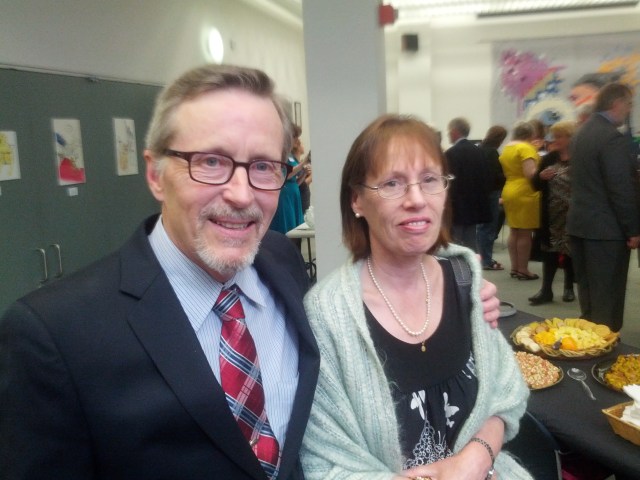
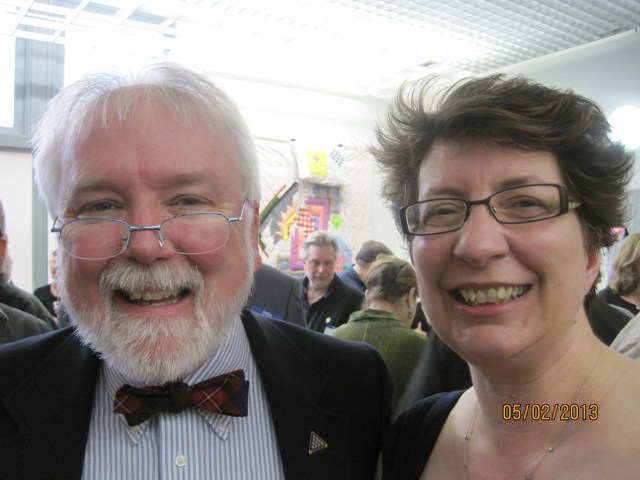
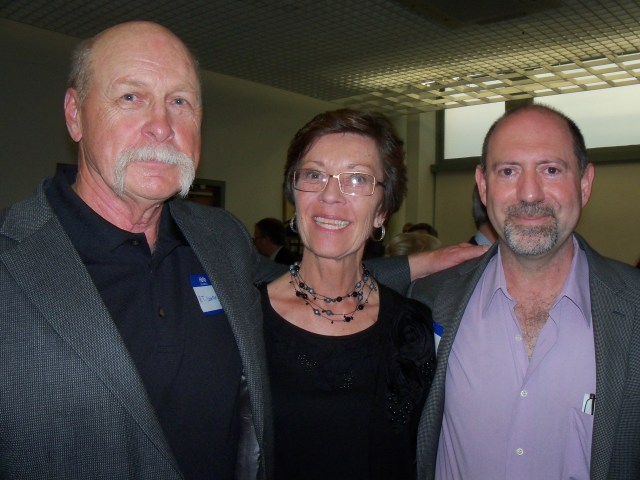
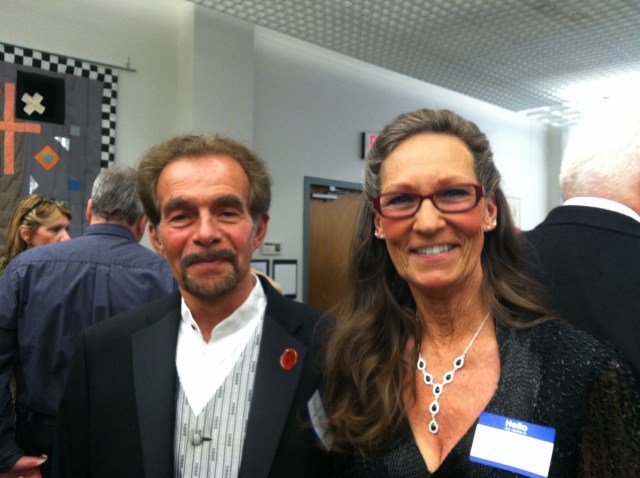
My hands are pretty slow on the keyboard after so many days of nonstop conversation, so I’m only going to hit the highlights of that terrific week and let photos of a few of the parties, ceremonies, and gatherings do most of the talking.

It was a week of reconnecting with old friends in the business—too many to mention individually—and the photos we’re including here were donated by others, so there are inevitably a lot of people closely connected with the magazines who don’t appear.

photo courtesy Dale Andrews

photo courtesy Dale Andrews

For the Dell Mystery Magazines (EQMM and AHMM), the biggest event of the week is not the Edgar Awards banquet itself but the pre-Edgars cocktail party we host just prior to the banquet.  We had some special guests with us this year. MWA’s new president, Charlaine Harris, and her husband, Hal Schulz, were in town for the festivities and made it to the Dell party before Charlaine was due to take up her MWA duties. And this year’s MWA Grand Master Award cowinner, Margaret Maron, and her husband, Joe, were back in New York and at the Dell party prior to Margaret’s investiture.

Charlaine & Hal Shulz. Photo courtesy of Abby Browning

Hal Schulz & Charlaine Harris Schulz. (Photo courtesy of Abby Browning.)

050213-3

Chris Begley, Vice President for Editorial at Dell Magazines, accepts Lia Matera’s EQMM Readers Award for “Champawat.”

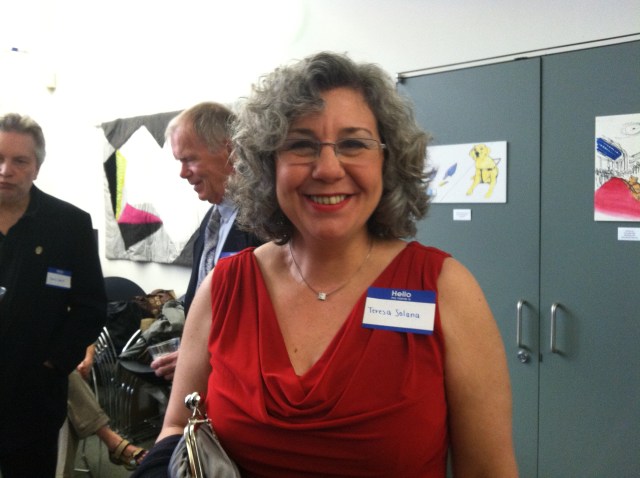
The purpose of the Dell pre-Edgars party is to honor writers of the mystery short story, including our Edgar nominees, and to present the EQMM Readers Awards. It’s a rare year when all of our Edgar nominees and all of the Readers Award winners can make it to New York. This year we were sorry not to have either Tom Piccirilli, author of the Edgar-nominated story “The Void It Often Brings With It” (EQMM 11/12) or Lia Matera, author of the third-place Readers Award-winning story “Champawat” (EQMM 9-10/12) with us. But Doug and Eve Allyn and David and Robin Dean were on hand, David accepting the second-place Readers Award for his story “Mariel” (EQMM 12/12) and Doug accepting the first-place award for “Wood-Smoke Boys” (EQMM 3-4/12).  Also present, having come all the way from the Catalan city of Barcelona, were author Teresa Solana and her husband and translator, Peter Bush. Teresa’s Edgar nomination for her March/April 2012 EQMM story “Still Life No. 41” together with the recent publication of her third novel in English translation, The Sound of One Hand Killing, inspired the long journey—perhaps the greatest distance any Dell Magazines nominee has ever traveled for the Edgars. I speak for everyone at the magazines when I say we enjoyed welcoming them into the Dell fold.

050213_4

David Dean accepts his EQMM Readers Award for “Mariel.” (Photo courtesy of Robin Dean.)

Doug Allyn accepts his EQMM Readers Award for "Wood-Smoke Boys." (Photo courtesy of Eve Allyn.)

Doug Allyn accepts his EQMM Readers Award for “Wood-Smoke Boys.” (Photo courtesy of Eve Allyn.)

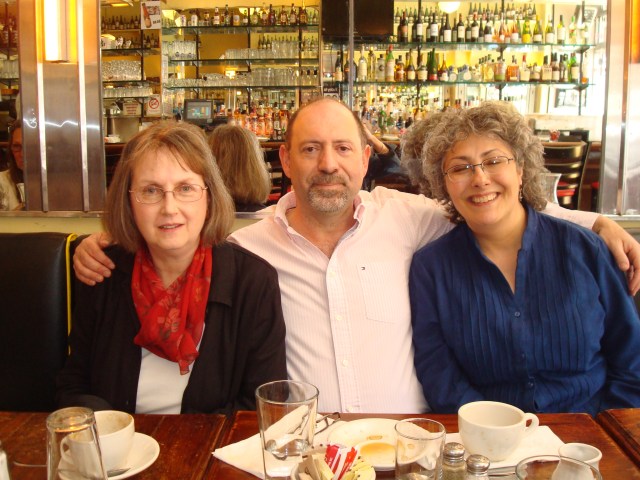
Peter Bush and Teresa Solana. (Photo courtesy of Abby Browning.)

Peter Bush and Teresa Solana. (Photo courtesy of Abby Browning.)

After a late-night trip home following the Edgars banquet, it was time for me to start packing for the Malice Convention. This was a special year for Malice, its 25th anniversary, and since I was one of the attendees of the original convention all those years ago—a small gathering in a hotel in Silver Spring, Maryland—I didn’t want to miss it.  A canceled flight and a late arrival notwithstanding, I particularly enjoyed this year’s convention, which featured, among other remembrances, the release of the nearly 500-page volume Not Everyone’s Cup of Tea: An Interesting and Entertaining History of Malice Domestic’s First 25 Years (Wildside Press), in which dozens of authors and others in the business (including me and my colleague Linda Landrigan) share experiences of Malice camaraderie and fun.

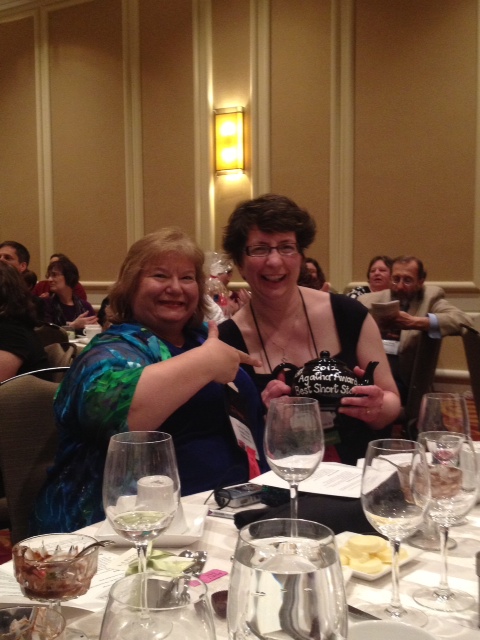
EQMM and AHMM each had a nominee in the field of five stories up for the Malice Domestic Convention’s Agatha Award: B.K. Stevens for her AHMM story “Thea’s First Husband” and Dana Cameron for her EQMM story “Mischief in Mesopotamia.” Dana was the winner, taking home her third Malice teapot in the short-story category. (Below, there’s a picture of her holding it at the table she graciously hosted at the banquet.)

Another Edgars and another Malice have come and gone, leaving us all tired, but happy to have reconnected with old comrades in the mystery community—and glad to have made some new friends too!—Janet Hutchings

Janet Hutchings, editor of EQMM, presents the 2012 EQMM Readers Awards. (Photo courtesy of Deb Lacy.)

Janet Hutchings, editor of EQMM, presents the 2012 EQMM Readers Awards. (Photo courtesy of Deb Lacy.)

The crowd listens as Linda Landrigan, editor of AHMM, congratulates our Edgar and Agatha nominees, and EQMM Readers Award Winners. (Photo courtesy of Dale Andrews.)

The crowd listens as Linda Landrigan, editor of AHMM, congratulates our Edgar and Agatha nominees and EQMM Readers Award Winners. (Photo courtesy of Dale Andrews.)

David and Robin Dean at the Dell pre-Edgars cocktail party. (Photo courtesy of Dale Andrews.)

David and Robin Dean at the Dell pre-Edgars cocktail party. (Photo courtesy of Dale Andrews.)

Peter Kanter, President and Publisher of Dell Magazines/Penny Publications, at the Dell pre-Edgars cocktail party. (Photo courtesy of Abby Browning.)

Peter Kanter, President and Publisher of Dell Magazines/Penny Publications, at the Dell pre-Edgars cocktail party. (Photo courtesy of Abby Browning.)

Brendan DuBois and Dana Cameron at the Dell pre-Edgars cocktail party. (Photo courtesy of Toni LP Kelner.)

Brendan DuBois and Dana Cameron at the Dell pre-Edgars cocktail party. (Photo courtesy of Toni LP Kelner.)

R.T. Lawton, Kiti Lawton, and Steve Steinbock at the Dell pre-Edgars cocktail party. (Photo courtesy of Steve Steinbock.)

R.T. Lawton, Kiti Lawton, and Steve Steinbock at the Dell pre-Edgars cocktail party. (Photo courtesy of Steve Steinbock.)

Carol Demont and Jackie Sherbow at the Dell pre-Edgars cocktail party. (Photo courtesy of Abby Browning.)

Carol Demont, Dell Subsidiary Rights & Licensing Manager, and Jackie Sherbow, Assistant Editor of EQMM & AHMM, at the Dell pre-Edgars cocktail party. (Photo courtesy of Abby Browning.)

Doug and Eve Allyn at the Dell pre-Edgars cocktail party. (Photo courtesy of Abby Browning.)

Doug and Eve Allyn at the Dell pre-Edgars cocktail party. (Photo courtesy of Abby Browning.)

050213-15

SleuthSayers blogmates Janice Law Trecker, Liz Zelvin, R.T. Lawton, and Dale Andrews at the Dell pre-Edgars cocktail party. (Photo courtesy of Liz Zelvin.)

050213-17

Teresa Solana at the Dell pre-Edgars cocktail party. (Photo courtesy of Abby Browning.)

Janet Hutchings, Steve Steinbock, and Linda Landrigan during Edgar week. (Photo courtesy of R.T. and Kiti Lawton.)

Janet Hutchings, Steve Steinbock, and Linda Landrigan during Edgar week. (Photo courtesy of R.T. and Kiti Lawton.)

Toni LP Kelner and Dana Cameron celebrate Dana's Agatha win at Malice Domestic in Bethesda. (Photo courtesy of Dan Hale.)

Toni LP Kelner and Dana Cameron celebrate Dana’s Agatha win for Best Short Story at Malice Domestic in Bethesda. (Photo courtesy of Dan Hale.)

Posted in Awards, Business, Conventions, Writers | Tagged , , , , , , , , , | 2 Comments

“You Do WHAT With Your Short Stories?” (by Brendan DuBois)

EQMM has published many prolific short-story writers over the years, most notably Edward D. Hoch, who, in the course of his lifetime, sold more than 900 short stories. A tenth of that number would be a lot by just about anyone’s standards. Among those contributing to EQMM who have hit or passed the hundred mark are the late Donald Olson and, more recently, Brendan DuBois, whose fiction debut was in EQMM’s Department of First Stories in 1986. The latter is also a successful novelist, but one who clearly never lost his love for the short form. His latest EQMM story, “Breaking the Box,” will appear in our September/October double issue. An e-book collection of his stories is currently available through Amazon: See Tales from the Dark Snow. —Janet Hutchings

Gosh, how I do love libraries.

I grew up in Dover, a mill town near the seacoast of New Hampshire, which was fortunate to have a Carnegie library. It was one of those old-style Victorian buildings with lots of brick and stone and turrets, and I literally could spend hours in there, examining the shelves of books and magazines, some of which went back nearly a century. I remember to this day the sweet joy when I first got my adult library card, so I could go upstairs and away from the cluttered children’s room in the basement and enter Adult Land.

To this day, I still love libraries, and one of the things I truly love about libraries now is going out to speak to their patrons.  I’ve talked to as many as fifty people at a library, and sometimes only five, but I always find the talks fun and engaging, since the audience is always made up of dedicated readers.

One recurrent theme, however, has been the magnitude of my short story output since I started getting published as a professional. I’m often asked, “So, how many short stories have you had published?” and when I run the number through my head and come up with the current count—which is now nearing 130—I often see shocked expressions on the faces of the audience, like I’ve been caught going through the collection box for overdue fines.

There are two follow-up questions when I toss out that number, the first one always being, “But why so many?”

And I often like to bounce that right back to them: “What makes you think I have a choice?”

Some laughter always results from that snarky reply, but here’s my explanation:

I love to write. Oh, there have been periods where the writing hasn’t gone particularly well, and a few idle times when my fingers feel fat and clumsy on the keyboard, and don’t get me started on the horrors of rewriting for the third —or fourth! or fifth!—time a lengthy novel that I thought was completed.

Yet most days, I’m eager to sit at my desk and get to work. Maybe I’m an outlier in the writing field, maybe not.

But once I started getting my short stories published in Ellery Queen’s Mystery Magazine, and then it’s cross-office rival, Alfred Hitchcock’s Mystery Magazine, a revelation came to me, like a midnight lightning strike illuminating a landscape.

With short stories, practically anything is possible.

Anything!

And that’s when my patient library audience looks at me like I’m one of those kooky and addled writers that they’ve always been warned about.

But let me explain.

When the outline, planning, and research is completed for a novel, and you start Page One, Chapter One, there’s a faint click out there as shackles are delicately snapped about your ankles and wrists. For better or for worse, you are chained for the next six months, eight months, a year, or even more, to that novel.  Your point of view, the genre—hardboiled, suspense, thriller, soft-boiled, cozy, random vampires—and everything else, well, that’s been settled. You’re off on a long, long trip, and hopefully, you’ve packed enough grammar and energy to complete the journey.

But short stories . . . ah, such a difference.

I soon learned after getting published that I could let my imagination slip free. I could write from a first-person point of view, or third-person. My narrator could be eight years old. Or eighty. I could write from the perspective of a cop, or a criminal. Heck, after a while—and after growing up one of six boys in a nearly all-male household—I even wrote from a woman’s first-person viewpoint.

It was fun!

It was exciting!

And most importantly . . . it was short!

Meaning that I didn’t have that lengthy and bone-weary commitment that comes from writing a novel. Writing short stories allowed me to experiment, to try different voices and different styles, and write about all sorts of things. And after selling mystery short stories hither and yon—not too sure where yon is, but I’m sure I got a rejection slip from them at one point—I branched out and started selling science fiction, fantasy, and, on one memorable occasion, a Western, complete with horses, revolvers, and a dusty town in late 1890s Texas.

But I always returned to mysteries, for I found that experimenting—and succeeding—in a variety of voices, styles, and types of mysteries, gave me the confidence and knowledge to do the same when it came time to write that novel.

Currently my schedule has me working on a novel in the morning, and a short story in the afternoon. Again, I’m sure I’m an outlier, but I find that when I’m working on that lengthy beast that’s turning into a book, it’s fun and reassuring to step into the world of short stories, and to know that okay, Project A won’t be finished until winter, but at least Project B will be completed next week, and then I can start working on Project B2 (the story, not the vitamin).

So many times I’ve explained this to my eager listeners at libraries throughout my little state, which leads to the second question that gets thrown out there, after I explain my love and addiction to short fiction.

“But where do you get your ideas?”

Oh my, the number of times I’ve been asked that. It’s probably right up there in popularity with, “How can I get an agent?” and “Have you written anything I’ve read?”

But ideas . . . the ideas for novels, and for short stories, and for anything else, are right out there.

If you know how to look. And how to listen.

Quick example.

There’s a railroad that cuts through my town of Exeter, right near the downtown. It used to belong to the old Boston & Maine railroad, and now it belongs to Pan Am Railways. Many times I’ve been out running errands, picking up the mail, or taking our dog Spencer out for a romp, when the crossbars come down and the lights come on, and there comes that deep bellow of a train whistle, warning everyone of its coming approach.

Just the other day, as I sat idly watching the train clatter by, checking out the old boxcars and reading the even older faded names—Maine Central, Southern Serves the South!, Berlin Mills Railway—and scratching my dog’s head, I saw a couple of cars that were marked by graffiti. I’m definitely not a fan of graffiti or tagging or street art or whatever it’s being called these days, but something about the intricate lettering and images just struck me.

I watched.

Thought.

Scratched my dog’s head.

I looked at the passing graffiti-covered train cars, saw them as something more than just vandalized objects. I thought of them like an emissary from some urban landscape, where young men and women scrambled about dirty and dangerous rail yards to paint and mark the cars, only to see them disappear as they went all about the country.

And I thought of a young man, or a young woman, stuck in a rural town in upstate Maine, or out in Ohio or North Dakota, a young person with a hunger that they can’t quite identify, and then they see these marked rail cars going by, telling of a different world out there, inviting, dangerous, and seductive . . .

Then the train passed, the bars lifted, and I went on my way.

The idea stuck with me that morning, and when I got home, I just typed a couple of sentences in my Ideas file, and left it for now.

But there’s a story there. I just know it.

A novel? Doubtful. There’s a lot more that would have to be considered and dug out and outlined before I would even consider a novel based on that idea.

But a short story . . .

Why not?

Because with short stories, anything is possible.

Anything.

Even if the sweet people in the libraries don’t quite believe you.

Posted in Ellery Queen, Fiction, Guest, Writers | Tagged , , , , , , | 3 Comments

“On Location in Paradise” (by Hayford Peirce)

EQMMs August issue, which mails to print subscribers a few weeks from now, contains a story set in French Polynesia—often said to be the most beautiful region in the world. Entitled “The Lethal Leeteg,” the story forms part of a series of police and private eye tales that author Hayford Peirce has been writing for EQMM for nearly twenty years.  The series’ two continuing protagonists, Commissaire Tama and private eye Joe Caneili, are unforgettably distinctive creations—as notable as the stories’ exotic location. Hayford Peirce also writes science fiction, with work appearing in our sister publication Analog Science Fiction and Fact since 1975.  It may be of interest that this master of conveying a real exotic locale is known in the science fiction field for his well-imagined settings. His latest novel is Dinosaur Park (Wildside 2010).—Janet Hutchings

“Write what you know” is probably the hoariest piece of advice given to aspiring authors in English classes and writer’s workshops. But for every writer, or teacher, who apparently believes this, there seems to be an equal number who find one reason or another for pooh-poohing the notion.

In my own case, I’d always vaguely wanted to be a writer—a published writer—first of mystery stories in the grand manner of Ellery Queen and John Dickson Carr, which I discovered at about age ten, and then, after coming across science fiction at fourteen, science fiction novels or stories like those of Robert A. Heinlein. A few years after that, I was enthralled by Evelyn Waugh, the great English satirist, and by Raymond Chandler, the master of hardboiled prose. All of these writers would inspire me to sit down at a typewriter and to pound out a page or two of reasonably decent prose. But, of course, as a teenager, I didn’t know anything about the world.

So what could I write about? I would think of an opening paragraph, maybe, or a character, and that was about the extent of it. Even for modest short stories that I grandiosely envisioned at EQMM or Astounding Science Fiction, two or three pages were the most I could ever manage. I had a beginning but no middle and no end.

So I finished prep school, and then college, and then was fortunate enough to be able to move to Tahiti, commonly thought of as being “paradise,” in 1964, when I was twenty-two. Ten years passed. I amassed thousands of mystery and science-fiction novels, which I read avidly. Then one day, when I was thirty-two, all of a sudden I did think of something to write about. It had nothing to do with life in Tahiti, being a whimsical science-fiction story, but it did contain elements of things I knew about, wine and tea and European politics. I wrote it quickly, sent it off, and soon got a check in the mail. So now I was an official published writer!

But thinking of ideas for stories still was difficult. Even though I was living in Tahiti, where preposterous “only-in-Tahiti” type things were happening all around me on a daily basis, I could never quite put together all the elements needed to tell a complete story. Just knowing about Tahiti wasn’t quite enough. Then one day I caught a brief glimpse of a television show about an April Fool’s joke of someone claiming he was finding gold nuggets in the stomachs of fish caught in the nearby lagoon. With a little difficulty, I managed to plot an entire story, a rather grim one actually, beginning with that as the kernel. And, since I did have Tahiti all around me, I decided that I would try to be as evocative of its lush and exotic surroundings as possible—this was back in the mid 1980s, when Polynesia was still mostly an idealized notion to most Americans. So this is how I began the story:

“Easter Sunday in Tahiti: hot, dry, and clear. A light breeze stirred the leaves of the trees that towered over the blacktop road that wound through the district of Tiarei: mangos and breadfruits, ironwood and mahogany, an occasional avocado or chestnut, and everywhere the graceful arc of the coconut palm. A pitiless sun in a cobalt sky lanced through the foliage to dapple the road, and with it the Tahitian families on their way to church in long white dresses and dark blue serge suits with double-breasted lapels handed down from their grandfathers. Hedges of bougainvillea and hibiscus lined the road, often hastily-cut fence posts that had taken root and flowered in the impossibly fertile soil, their gaudy flowers lilac and orange, pale rose, deep red, creamy white, flaming yellow. Ginger, opui, frangipani, a dozen kinds of banana trees struggled for sunlight and survival. Even at nine in the morning heat waves shimmered on the road ahead, and over everything lay the scent of coffee beans and vanilla, mixed with the cloying odor of drying copra.”

Overdone, probably, but I sold the story, and it set the tone for all the others I’ve laid in Tahiti over the following twenty-eight years. Stories about Commissaire Tama, the Chief of Police, are written in the third person, and I can indulge my descriptive fancies as much as I want to evoke the exoticism of the Islands. Stories narrated by Joe Caneili, my American ex-Foreign Legionnaire, now a private eye, are somewhat more restrained on the lit’ry side. But even here, inspired by Raymond Chandler and all his myriad of imitators, I try to flesh out the story with word pictures of the world Caneili lives in:

“The lunchtime traffic had gridlocked at the intersection in front of the cathedral, so I skipped deftly through it and walked the short block down to the waterfront. This was a four-lane road that ran along the U-shaped harbor of Papeete. Cool-looking shade trees were planted down the middle, arching over on either side. There were shops and travel agencies and restaurants on one side, a parking lot, and the oily water of the harbor on the other.

I could feel my brains sizzling in the heat as I walked across the unshaded asphalt pavement of the parking lot down to where half a dozen small fishing boats were tied up. Across the harbor a big black Russian cruise ship was docked in front of the long, low customs sheds, and a gray destroyer of the French navy was cleaving through the harbor waters on its way to the pass and the open ocean. Hung across the horizon behind all this activity was the jagged silhouette of distant Moorea, looking like Hollywood’s notion of what a tropical island backdrop should be.”

But more important to my stories, I think, than exotic settings and colorful vegetation are the exotic people and colorful activities they get up to. Some of these activities, of course, probably do happen in the United States from time to time—but are seldom noteworthy enough to make the newspapers. In Tahiti they’re all just part of the daily routine that people laugh and gossip about.

One of my stories, for example, revolves around an incident that I first heard about around 1962, when I hadn’t yet moved to Tahiti but was there on school break. A well-known American of the forties or fifties, the story goes, the honorary American consul even, fell deathly ill one day and was rushed to the hospital. Miraculously, he recovered and eventually returned home. Some weeks later a Chinese carpenter knocked on his door—with a wooden coffin by his side. “Who,” said the carpenter politely, “is going to pay me for this coffin that I was told to make for your funeral?” At which point the horrified consul clutches his heart and falls down dead.

A great story. True? Parts of it, I think. But certainly enough to get me started on a story of my own.

Another one involved someone who lived out in the countryside with various family members buried in his/her own little graveyard. Dire events caused the person in question to believe that a recently buried grandfather was causing the trouble—so he/she dug up the coffin to chastise the angry spirit by hiding it elsewhere.

Another Caneili story begins when he returns home for lunch and discovers that his modest bamboo rental house has burned to the ground. His landlady, who lives in the house right next door, has set fire to her own house—because she was mad at her husband over some trifling matter. Tahitians really did set fire to their own cars or houses when they got mad at things. . . .

Interesting people have lived in Tahiti, or visited, over the years: Marlon Brando; the restaurateur Don the Beachcomber; Edgar Leeteg, the black-velvet artist; James Norman Hall, author of Mutiny on the Bounty—all of these and many more are part of the local lore. And ripe to have stories in some sense crafted around them.

Even now, nearly forty years after selling my first story, it still isn’t easy to conjure up new ones—but at least I have a background, the “old” Tahiti of, say, the timeless 1980s, in which to set them. . . . Because, just as the advisors say: I am writing about what I know.

Posted in Characters, Fiction, Guest, Historicals, History, Police Procedurals, Setting, Writers | Tagged , , , , , , , , , | Leave a comment