“Jane Austen and Me” (by Judith Cutler)

Judith Cutler is the author of seven long-running and highly acclaimed series of mystery novels and stories, several of which have historical settings. Her most recent books available in the U.S. are Drawing the Line, starring Lina Townend, apprenticed antiques dealer, and Cheating the Hangman, featuring Parson Tobias Campion. Both novels (published by Allison & Busby) are from series that include short stories for EQMM. We have two new Cutler stories scheduled for upcoming issues. Here, the U.K. author shares some thoughts about writing through a look at the life of a literary genius.—Janet Hutchings

To my shame, although I read all the Jane Austen novels when I was still in my teens, it’s taken me till I’m seventy to make my first pilgrimage to Chawton.

What moved me the most in the famous cottage in a tiny Hampshire village?

The tiny table she used as a desk?

Her father’s bookcase, still holding some of the books she would have read as a young person?

The topaz cross her brother gave her, reminding us of the amber cross William gave his beloved Fanny?

All of these made the heart constrict. But the things that I lingered by longest, in a mixture of admiration, amusement, and fury, were examples of her handiwork. What was one of the greatest English novelists doing, wasting her time making stoles or lace collars or a patchwork quilt?

Jane Austen was being a conventional woman of her period, that’s what. For good and for bad. In many, many ways, for bad.

Take her childhood. Unlike many girls, she actually went to school, but her education ceased at the time when a young mind is at its most receptive. Her family wouldn’t have stopped a son’s schooling at the age of ten. At least Jane Austen’s education didn’t stop then—though Love and Freindship suggests she didn’t master the i before e except after c spelling rule—because she read her way through her father’s apparently uncensored extensive library, the remains of which are still housed in his bookshelf. So although she might not have learned of the ways of the world first hand, there is little in Clarissa left to the imagination. History; religion; philosophy: they must all have been there, because we can see their influence in her own writing. There was her own History of England—not exactly Simon Schama, but more fun. She wrote elegant but clearly heartfelt prayers. And her own characters were advised to undertake “improving reading” to console them and sustain them in times of difficulty, like Captain Benwick’s in Persuasion. But then, to fund her family’s sudden exodus from her beloved Steventon Rectory to lodgings in Bath, most of the books disappeared, sold to strangers.

Bath, you’ll recall, was the elegant spa town beloved of hypochondriacs to which Jane Austen was taken, willy-nilly, when her father chose to retire. There was no family discussion—you can imagine the arguments would have been lively. Just a parental decision, prompting Jane to faint with shock. Had Mr. Austen survived, the move might have been beneficial, in the world’s eyes at least. The Austen sisters might have moved in society, made friends and even found rich husbands—the ultimate goal for a woman of that period. But he died very soon after the move. He left his family impoverished and without a man to give them respectability they could go nowhere, taste none of the delights—theatre, balls, assemblies—that were dancing tantalisingly just out of reach.

Money and respectability: You could not live without them.

Not if you were a woman. Because there was no respectable occupation, apart from being a governess, that a woman could undertake. At Steventon, as a girl, like Catherine Morland, Jane Austen probably played baseball and cricket; as a young woman, she walked for miles about the neighbourhood, probably, like Lizzie Bennett, causing scandal by being unchaperoned. As a spinster in her thirties—as one of four women living in the Chawton cottage—she would have been unwilling to risk gossip, so when she was not writing, she had to occupy herself with traditionally feminine skills. The women weren’t exactly cooped up together—the building is more spacious than today’s notion of a cottage. But they couldn’t afford to live in anything approaching the style of her brother Edward, who allowed them the cottage rent free. Yes, we walked up to his pad, Chawton House, now The Centre for the Study of Early Women’s Writing. Despite its rather plain exterior, inside it’s just the sort of place any family would love to live in, with elegance where the cottage has respectability, and space where the cottage has cosy corners.

I wonder if Jane ever felt understandably bitter. There’s plenty of evidence in her novels after all that she really did not like people with a bob on themselves—people who think that having money and land makes them superior, even if they don’t have the brains, manners or morals to match.

Meanwhile, of course, she was beginning to be a professional writer, publishing novels as a Lady. She wrote not at an executive desk but at a tiny, tiny twelve-sided table, ready to cover her work when a creaking door warned her that visitors were approaching. Her treasured writing slope isn’t on show, but you can find that at the British Library. No ergonomic office chair for her, but a rush-seated one meant for the dining table.

So if writing wasn’t the sort of thing the neighbours could know about, how could she officially pass the time? Music was a vital accomplishment for a young woman, preferably played on the harp, and failing that, the piano. We know Jane Austen was an accomplished pianist, practising before breakfast each day, and there in the corner of the dining room is a Clementi square piano—not her own, sadly, but at least one of the same period. We know that while Cassandra was skilled in watercolours, another necessary skill, there seems to be no record of her sister attempting them. However, she was an amazing needlewoman—not just respectable white work to be distributed to the local deserving poor, but exquisite lace. Some of her lace joins two pieces of muslin to form an enviable evening stole; the best piece is a detachable lace collar. Did she spend hours and valuable eyesight on work like this for pleasure? Or because she couldn’t afford to buy it? Perhaps a mixture of the two. And remember every stitch set after dark would be done in dim candlelight, not in bright light with a magnifying glass or spotlight to help.

And then there’s the patchwork quilt. Technically speaking, since while the piece is backed, it has no wadding, it’s not a quilt, but a coverlet. Mrs. Austen, Jane, and Cassandra all worked on it. Together? How did they divide the tasks? Did one cut, another sew, and the third read aloud while they worked? We know that at one point Cassandra was asked to collect ‘peices [sic—that i before e problem!] for the Patchwork.’ Altogether they used 64 different fabrics, cut into dozens of diamonds and rhomboids of various sizes. There’s a big central panel showing a basket of flowers, and landscapes and flowers in more diamonds round the edges. Quilters will be able to give an expert assessment; all I can do is marvel at the hours Jane Austen spent on it: by hand, remember—sewing machines were inventions of the future. Was she plotting the next novel as she worked? Working out a piece of dialogue? Wondering if the names she’d chosen fitted a character—Mrs. Elton, for instance? Did she worry about the financial deal her brother was making for Sense and Sensibility? Did she break off from time to time to jot down an idea, cursing when she got ink on her fingers?

Suddenly, as I looked at it, I realised that we had something in common, the great genius of the written word and me, a journeywoman mid-lister. I too have to do mundane, prosaic things: preparing supper, mowing the lawn, giving my teddy bear a new fur coat. Actually, I need to. Nonthinking activities give my head down-time, so the creative part of my brain can get to work without any interference. The Austen quilt was probably a vital part of her brain’s re-creation—the hyphen is deliberate! But while my teddy looks very fine, even he will admit that he is not, like the quilt, a work of art, any more than any of my novels would hold a candle to one of hers.
Posted in Books, Characters, Guest, History, International, Writers | Tagged , , , , , , , , | Leave a comment

IT’S ALL HAPPENING

Back in December of last year (how long ago the busy months intervening have already made that seem!), my post for this site gave a preview of the special issues and events coming up in celebration of EQMM’s 75th anniversary. We’re now more than halfway through release of the year’s special issues, and all of the remaining issues are in some stage of production. July 2016, composed entirely of stories by authors who got their start in EQMM’s Department of First Stories, is on sale now, and on the nineteenth of this month, our August issue, a tribute to EQMM’s former editors, brings back from our archives Eleanor Sullivan’s Edgar-nominated story “Ted Bundy’s Father” and a new story by Edgar-winning playwright Joseph Goodrich in which Frederic Dannay and Dashiell Hammett take center stage.

Our designated anniversary issue, September/October, will bring together new stories by four Grand Masters of the MWA, six EQMM Readers Award winners, several Edgar Award winners, and a number of authors whose books regularly appear on the New York Times best-seller list. Authors include Joyce Carol Oates, Jeffery Deaver, Linda Barnes, Peter Lovesey, Bill Pronzini, Marcia Muller, Charlaine Harris, Peter Robinson, Margaret Maron, Jon L. Breen, David Dean, Tim L. Williams, Doug Allyn, and Dave Zeltserman. Also featured in the fiction lineup are one of the most famous mystery short stories of all time, Stanley Ellin’s “The Specialty of the House” (from our archives) and, of course, a new entry for our Department of First Stories. Special nonfiction articles describe both the literary world and the wider world into which EQMM was born and reveal hitherto unknown details of the original publisher-editor negotiations concerning the magazine. All of this rich content, plus our monthly review columns, is packed behind a stunning cover designed by one of America’s most influential graphic designers, Milton Glaser—who got his start, back in 1954, with a cover for EQMM.

Also not to be missed is November 2016, which celebrates the magazine’s long critical tradition with articles by award-winning reviewer Jon L. Breen and mystery scholar Martin Edwards, and fiction from our archives by one of EQMM’s early reviewers, Anthony Boucher. In December 2016, we’ll tie it all together with a final classic reprint from our archives and a look to the future, as I present a few of my own thoughts about what a magazine such as EQMM has to contribute to the literary scene going forward.

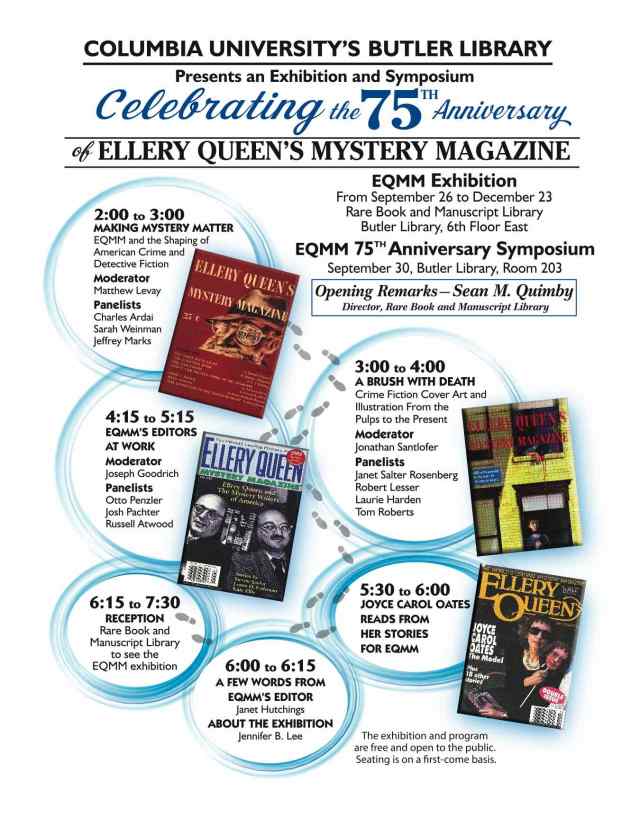
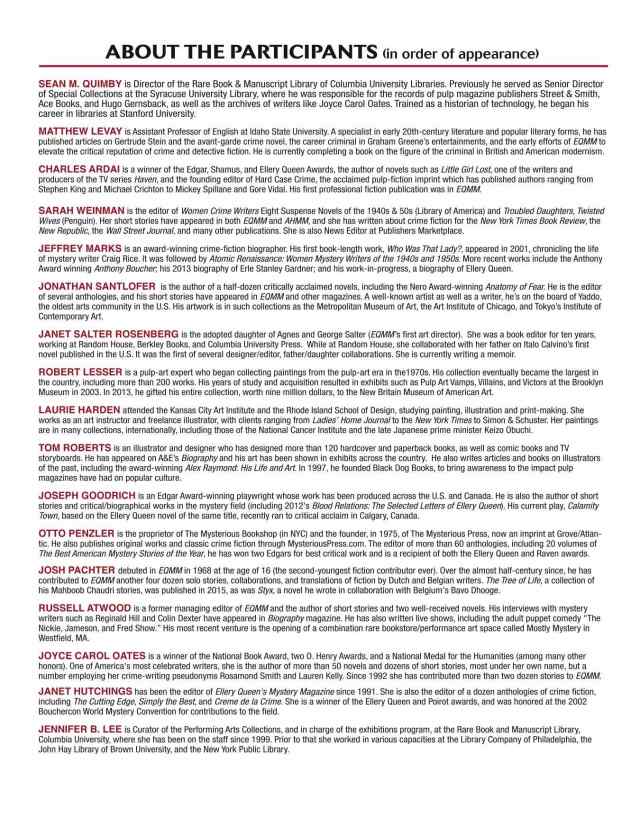
We hope you have enjoyed all of the special issues already in print, and will look forward to those to come. But special issues are only a part of this year’s celebration. As previously announced, Columbia University will be presenting a two-month EQMM exhibition and an afternoon symposium in honor of the EQMM anniversary. Details of those events are on the two-page flier we are attaching below. Please come and join us for what promises to be a lively, colorful afternoon at the symposium and an exhibition that will include founding editor Frederic Dannay’s correspondence with some of the most important mystery writers of the twentieth century, as well as some of the manuscripts he edited and original drawings for EQMM’s early covers.

Looking forward to seeing many of you on September 30!—Janet Hutchings

EQM75TH-SYMP-BACK

Posted in Uncategorized | 2 Comments

“The Story Is the Thing” (by Rand B. Lee)

Rand B. Lee is a freelance writer living in Santa Fe, New Mexico. His short stories can be found in many science-fiction anthologies, in periodicals such as The Magazine of Fantasy and Science Fiction, and in the 2013 collection The Green Man and Other Short Stories (Curiosity Quills Press). He is the youngest surviving child of Manfred B. Lee, coauthor of the Ellery Queen detective novels and short stories. Occasionally, Rand’s stories too venture into the realm of detective fiction. And he has helped us celebrate EQMM’s 75th anniversary by contributing an article about his father to our August 2016 issue (on sale July 19).—Janet Hutchings

Every couple of months or so I receive in the mail a box from JABberwocky, the New York literary agency that represents so ably before the world the Ellery Queen literary properties. While the contents of the boxes JABberwocky sends me vary, they usually include recently printed foreign-language editions of Ellery Queen works. Many of these editions are in Japanese; others are in Chinese, Danish, Italian, French, Spanish, or Polish (to name just a few); recently, I received a batch of Queen novels in Korean.

Being linguistically challenged—my repertoire of foreign-language phrases pretty much boils down to “My fat dog” in Spanish, “That’s all” in Danish, and “A dog who knows his duty” in German—my spine tingles when I leaf through these books. They feel magical to me, and what a compliment (I think) that people in other countries want to read my father and cousin’s stories! And since, in my other life, I am a science-fiction writer, I naturally wonder what Calamity Town would sound like in an entirely alien extraterrestrial language, like Vulcan, or Klingon, or Mánafu/túrru.

Mánafu/túrru is the language of the Damánakíppith/fü, a nongendered alien race that appears in some of my stories. I’ve spent endless hours putting together a glossary of this language (writers are always coming up with tangential projects in an effort to avoid the horror of actually sitting down and working!).

In Mánafu/túrru, Ellery Queen is “Élri Kwínik”, literally, “Ellery of the Queen.” Inspector Queen becomes Kréghporrlyeyéstu Kwínik, literally, the “Wary One of the Queen.”

Calamity Town becomes Máha Te’Shíssakik, literally, The Pseudowomb of Troubles. The Finishing Stroke becomes Te’Bvísten Márrushénik, literally, The Strike of the Act of Finishing.

And Ellery Queen’s Mystery Magazine becomes Te’Vévrelljójodstan Kupréssahá’ik Kwínik—The Written Record of the Hidden Things of the Queen.

This nonsense may be more germane to EQ than you might at first suppose, for my father was a rabid science-fiction fan from way back. In fact, he was one of the circle that dreamed up the idea for the periodical now known as The Magazine of Fantasy and Science Fiction. Anthony Boucher, F&SF‘s first editor-in-chief, was a family friend of ours, and godfather of my oldest brother, Tony, who was named after him. I don’t know how much of an SF (I refuse to use the neologism “sci fi”) fan Fred Dannay was, but I know my father felt about science fiction as he and Cousin Fred felt about mysteries: that genre fiction deserves to be taken as seriously as mainstream fiction is.

In a 1968 address thanking a distinguished writers’ conference for awarding Queen a prize, my father wrote:

What makes your award so memorable to us is that this sort of recognition . . . transcends the personal and becomes a sort of symbolic victory in the battle we have been waging for forty years, to pull the detective story out of its second-class citizenship. I wish I could say that we’ve won the war. We haven’t. Detective stories are still reviewed in gross lots, as if they were so many potatoes. A great many are never reviewed at all. With the exception of a few old war horses . . . the books of most of us get little or no advertising or promotion. Yet the shoddiest of so-called ‘straight’ novels, the most pretentious put-ons, the wettest-lipped wallowings in sex, the dreariest non-fiction, get columns of learned attention and full pages of puff-advertising.

We have never asked for blanket endorsement. There are many very bad detective stories. But we submit that there are also . . . many very bad “serious” books which are regularly asked into the parlor and treated, if not always as welcome guests, at least as ladies and gentlemen. We don’t see why we must always use the tradesmen’s entrance.

My father may have been sensitive to mysteries’ second-class citizenship in part because, as a first-generation child of Russian Jewish immigrants, he had firsthand experience of marginalization. In the 1920s, when Dad applied to New York University as Emanuel Benjamin Lepofsky, he discovered that Jewish students were among the ethnic groups barred from attending the main NYU campus. Later, when he was about to graduate from the Greenwich Village campus of NYU with a summa cum laude degree in English, Dad told a faculty friend of his dream of becoming a college English professor at his alma mater. The “friend” replied, “Oh, Manny, no Jew will ever get tenure in the NYU system—you are all so much smarter than we Gentiles, it wouldn’t be fair to the rest of us.” This prompted my father to abandon his professorship dreams, and change his name from Emanuel Lepofsky to Manfred Lee. (Eventually, Dad’s father and sisters adopted “Lee” as their surnames; and Dad’s cousin and future writing partner changed his name from Daniel Nathan to Frederic Dannay.)

The cousins never gave up their commitment to seeing the mystery genre taken seriously. In the aforementioned talk, my father said: “. . . There are astonishing numbers of detective, mystery, suspense, spy—and the other kinds of stories lumped loosely in our field—that are of high quality: in the imaginative scope of their plots, in their writing, even in what some of us try to convey above and beyond story-telling. But the story is the thing [italics mine], and we are naive enough to believe that the story-teller will always find an honored place at the fireside.”

And thanks in great part to the editors, staff, and readers of Ellery Queen’s Mystery Magazine both here and abroad, well-written mysteries are increasingly granted just such pride of place.

Posted in Books, Characters, Ellery Queen, Fiction, Genre, Guest, International | Tagged , , , , , , | 5 Comments

THE EQMM FAMILY

For a number of EQMM’s contributors, writing for our magazine has become a family business, so to speak, stretching as far, in at least one case, as three generations. We’ve had husbands and wives, fathers and daughters, mothers and daughters, fathers and sons, even a father-daughter-granddaughter in a single family all providing us with top-notch stories over the years. Lovesey is a name we always think of in this regard, for Peter Lovesey is a winner of the EQMM Readers Award and his son Phil began his career as a published writer in our Department of First Stories, giving them each a special place in the EQMM family of writers.

Peter Lovesey is, of course, one of the most celebrated of contemporary crime writers. His novels and stories have won innumerable awards, including Gold and Silver Daggers from the U.K. Crime Writers’ Association, and he is a recipient of the Cartier Diamond Dagger for Lifetime Achievement. Phil Lovesey is the author of seven novels, four of them crime fiction, and many short stories, one of which, first published in EQMM, won the U.K. Crime Writers’ Association’s best-short-story Dagger.

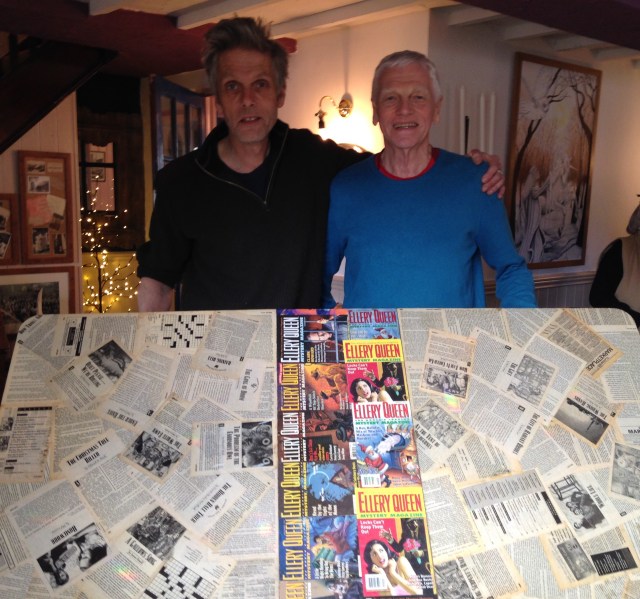
It has been one of our goals in this year marking EQMM’s 75th anniversary to pay tribute to the many fine writers whose work has enriched our pages. We never expected two of those writers to celebrate EQMM in the extraordinarily original way the Loveseys have. Apparently, when the family sits down to dinner in Phil Lovesey’s house these days, it is at a table whose surface is a laminated collage of pages from EQMM. I was speechless when I saw this, and I cannot think of anything that better encapsulates the spirit we’re trying to convey in this anniversary year. EQMM has survived and thrived because of the love and loyalty of its readers and writers. In that sense, we truly are a family, and from our hearts we thank the Lovesey family for sharing with us this photo of their table (tipped up so that the camera could better capture its surface).—Janet Hutchings

Phil and Peter Lovesey (L to R)

Phil and Peter Lovesey (L to R)

Posted in Ellery Queen, Magazine, Writers | Tagged , , , , , , | 3 Comments

“The Role of Place in Creating Suspense” (by Sheila Kohler)

Sheila Kohler is the author of fourteen books, and the winner of the Willa Cather Award and two O. Henry Prizes for her fiction. Born and raised in South Africa, she has lived in the U.S. for many years and teaches at Princeton University. She has been contributing stories characterized by a strong evocation of place to EQMM for nearly a decade; readers will find the most recent of them, “Nothing Matters but Matter,” in the upcoming December issue. Those who’d like to see more of Sheila’s blog postings should visit Psychology Todays Dreaming for Freud, where her pieces appear regularly.—Janet Hutchings

We have just arrived in St. Petersburg, Russia: my daughter Cybele, my granddaughter Masha, and I. I have not seen Cybele, who lives in Berlin, or Masha, who is at university in England, for a year, and was very fearful of missing them at the airport in St. Petersburg. I had to fly from New York to Paris to change planes there, and I was afraid of delays, strikes, or simply summer crowds on my end or theirs from Berlin. When I stood in the hall of the airport in St. Petersburg looking around at the crowd and saw neither one of them or even the man who was supposed to pick us up, I was in an extreme state of anxiety. With what joy I heard a glad cry, “Gogo!”, the name my granddaughter calls me, and saw a beautiful girl with pink cheeks and brown curls come flying through the crowd. Soon we were all embracing happily.

There was a fourth person present, however, at our reunion, the ghost of Dostoevsky. I am here thanks to the university where I teach with the intention of walking in Dostoevsky’s footsteps. I am in the process of writing a book much inspired by his Crime and Punishment. (I don’t want to give too much away, so I won’t tell you more than that.) We are even staying at the Sonya Radisson hotel. You will remember the saintly prostitute in Dostoevsky’s Crime and Punishment, Sonya Marmeladov, who will save Raskolnikov, the murderer, with her love. There is a quote from one of Dostoevsky’s books up outside of every room in the hotel.

The three of us—or should I say the four, will take a train from St. Petersburg to Moscow and on from Moscow to Omsk in Siberia where Dostoevsky was imprisoned, after his mock execution in 1849.

On December 22, the members of what was known as the Petrashevsky Circle, a Russian intellectual literary group, were taken from their cells in the fortress of Saint Peter and Paul and sent to Semyonov Square. With the soldiers lined up and pointing their rifles, fingers resting on the trigger, the first three prisoners were tied to a stake, black hoods over their heads. They waited for imminent death. When a messenger rode up waving a white flag, they were told that in a “show of mercy,” Tsar Nicholas I had supposedly spared the men. This was actually a means of fostering terror, and gratitude, something Dostoevsky would use in various ways in his subsequent great novels, including Crime and Punishment. He would always remember that moment of terror and how precious life suddenly seemed to him.

What struck me, though, on arriving here, after the first moment of great elation at the airport—is how different the city seems to me from Dostoevsky’s dark description in Crime and Punishment.

I will admit we have only been in this city built by Peter the Great in the eighteen century for less than a week, and all has been colored by our joyous reunion and exceptional sunshine. Together we have taken a boat on the canals, admired the great works of art in the Hermitage, and visited the fortress where Dostoevsky was imprisoned. We have seen the houses where he lived and the one Raskolnikov was supposed to inhabit and the place where he was to murder the pawnbroker.

Obviously, St. Petersburg has changed much since 1866 when Dostoevsky wrote his famous book. It was then, as he describes it, flooded with the newly freed serfs who flocked here in search of work in the factories and the budding industries of the great city. Yet, the wide boulevards, the orderly layout of the city, and the baroque buildings which line the Neva, as well as many of the churches with their glittering onion-shaped domes, date from the eighteen century, and must have looked much as they do today, and surely the weather has not changed that much.

Still, in the book, which starts in the summer like our visit, the city is dusty, filled with dank odors which rise from the polluted water of the canals; drunkards, who stagger down the sweltering narrow streets, or youthful prostitutes who wander precariously, half-clad in the summer heat followed by dangerous predators. Dostoevsky writes, “It was terribly hot out and moreover it was close, crowded, lime scaffolding and bricks, dust everywhere and that special summer stench known so well to every Petersburger who cannot afford to rent a summer house.”

Here, on the contrary, on my arrival from a scorching New York city, I have found cool, breezy boulevards with gaily painted eighteenth-century baroque buildings which must have existed in 1866 though they have surely been repainted and renovated.

“I have never seen such a clean building,” my granddaughter said remarking on the bright yellow and white of the Russian Museum which looks as if it were painted yesterday. The well-dressed population strides past us with confident step, the little girls with their blond hair neatly braided down their backs, the mothers pushing prams purposefully dressed in high heels and silky skirts; the dowagers in smart suits. We have lingered in the leafy gardens with the scent of lilac in the air; or sat out in shaded terraces for a delicious dish of borscht with a dollop of sour cream.

Obviously, like the history portrayed in the fortress of Saint Peter and Paul, where Dostoevsky was imprisoned, the city can be seen in many different guises and disguises, and the way it is appears in Crime and Punishment serves the author’s purpose. He uses the place so skillfully to echo and evoke concretely the emotions of his troubled and conflicted hero as well as to provide motivation for his crime, and ultimately to create suspense.

Though our hotel room is certainly not palatial it has large deep windows, and the sun continues to stream in until late at night. I am writing this at eight-thirty without one light lit in the room. The enamel basin and bath shine with cleanliness, and the towels are fluffy and white, whereas poor Raskolnikov, Dostoevsky’s murderer, in Crime and Punishment lingers on in a stifling closet of a room that Dostoevsky likens to a “coffin.” It has yellowing wall paper (all the rooms seem to have yellowing wallpaper) and an accumulation of dust on the books which he can no longer bring himself to read, sunk so deeply in the lethargy of his depression.

It is at least partly this dire poverty which drives Raskolnikov to stumble down the stairs and slink surreptitiously past his landlady’s quarters (he owes the rent) and out into the stifling streets in the first pages of the novel in a sort of “rehearsal” of the crime he will ultimately commit.

In the streets he will come across the young girl who seems destined to prostitution in her drunken and disorderly state. Someone, Raskolnikov fears, has taken advantage of an innocent girl and a predator who follows her will bring about her ruin. This chance encounter in the streets of the city will again echo Raskolnikov’s inner dilemma: his own loving sister Dunya who is contemplating a disastrous marriage with a pompous and dastardly man, Luzhin, in order to obtain the money her brother needs for his education—surely, a prostitution of a respectable kind.

Dostoevsky gives us precise details which serve the author’s purposes exactly. The reader sees, tastes, and smells this concrete world and feels, with increasing terror, for this young man with his generous impulses to help the Marmeladov family, as well as to rise above the circumstances of his life. We fear he will commit murder, and then we tremble that he may confess and be caught. We are brought by the verisimilitude of the descriptions of place to believe this young student could kill the old, avaricious, and cruel pawnbroker brutally with an axe and steal her money. The reader both understands rationally and also feels emotionally that this young man with his impulses to both give away all he has and to grasp what is not rightfully his own might actually strike not only a defenseless elderly woman with an axe but her innocent step-sister who happens to walk in on the crime.

The place, here, St. Petersburg with its crowded and claustrophobic atmosphere, its courtyards and dank back staircases, the police office which smells mysteriously of new paint, all of this drives the murderer onward first to commit his absurd and senseless crime and finally, thanks to Sonya Marmeladov’s love and devotion and the detective Porfiry’s skillful questioning, to confess to what he has done, and ultimately to redemption. The inner conflict, the split in his mind—the reasonable thoughts about his family, his relationship with Sonya, and the irrational desire to rise above the law—is echoed by the world outside of him: good and evil abounds around him. In this place where I have come to find my darling daughter and my dearest granddaughter, a place so filled with light and, it seems, love, I have found a new understanding of Dostoevsky’s art and mind.

Posted in Books, Characters, Editing, Fiction, Genre, Guest, History, International, Setting, Story, Suspense, Writers, Writing | Tagged , , , , , , , , , , | Leave a comment

“Sisters in Crime and ‘A Currency of Generosity’” (by Leslie Budewitz)

It’s been several years since Leslie Budewitz’s fiction has appeared in EQMM. In the intervening time she’s had stories published elsewhere, including in our sister magazine, AHMM, and she has two novel-length series running.  She tells EQMM that she “blends her passion for food, great mysteries, and the Northwest in the Seattle Spice Shop Mysteries and the Food Lovers’ Village Mysteries, set in Jewel Bay, Montana.” Leslie has also written nonfiction in the genre; she is a practicing lawyer and her book Books, Crooks and Counselors: How to Write Accurately About Criminal Law and Courtroom Procedure was a critical success, winning an Agatha Award in 2011. In fact, Leslie is the first author to win Agatha Awards for both fiction and nonfiction. She has recently taken on yet another role in the mystery field as president of Sisters in Crime—the subject of today’s post. If, after reading her tribute to this ground-breaking organization you’d like to learn how to join, visit www.SistersinCrime.org.—Janet Hutchings

Writers new to the mystery community are often amazed at the generosity they experience, unable to explain how people who kill on the page give so much so readily to other writers, no matter their level of craft and accomplishment. Nowhere have I seen this more than in Sisters in Crime. Since becoming president of SinC in October 2015, it’s been an almost daily experience, and I think I finally know why.

This observation from Amy Wheeler, Executive Director of Hedgebrook, the amazing writing community in western Washington, nails it: “Here’s the beautiful thing about creating a currency of generosity as a community’s economy: Everybody who receives wants to give back.”

“A currency of generosity.” That’s it. That’s what Sisters in Crime has been to me since the day I first read about the organization and sent in my dues, nearly twenty years ago.

That’s the spirit that led SinC to start a new campaign this spring, We Love Short Stories. It’s a sibling to our long-running program, We Love Libraries, which every month gives a library a $1,000 grant to buy books, and our year-old baby, We Love Bookstores, which every month gives an independent bookstore a $250 grant for promotion.

Many SinC members, including me, got our first publishing credits with short mysteries. They remain a tremendous avenue for new writers to break in; for published authors, they provide an opportunity to tell stories that would not support a novel or to hold reader interest between books. Other authors simply prefer the form. They’re fun to write, and fun to read.

Starting this month, InSinC Quarterly is publishing articles on the craft of writing short stories, finding markets, promotion, and creating anthologies. We’re interviewing short story publishers and editors, starting with the best—Ellery Queen’s Janet Hutchings.

We also believe that writing well in a form requires reading it. SinC members now receive healthy discounts to Ellery Queen, Alfred Hitchcock, Mystery Scene, and the Strand. Other publishers are stepping up to join the program. Thanks to Deborah Lacy, Debra H. Goldstein, and Art Taylor for doing the hard work.

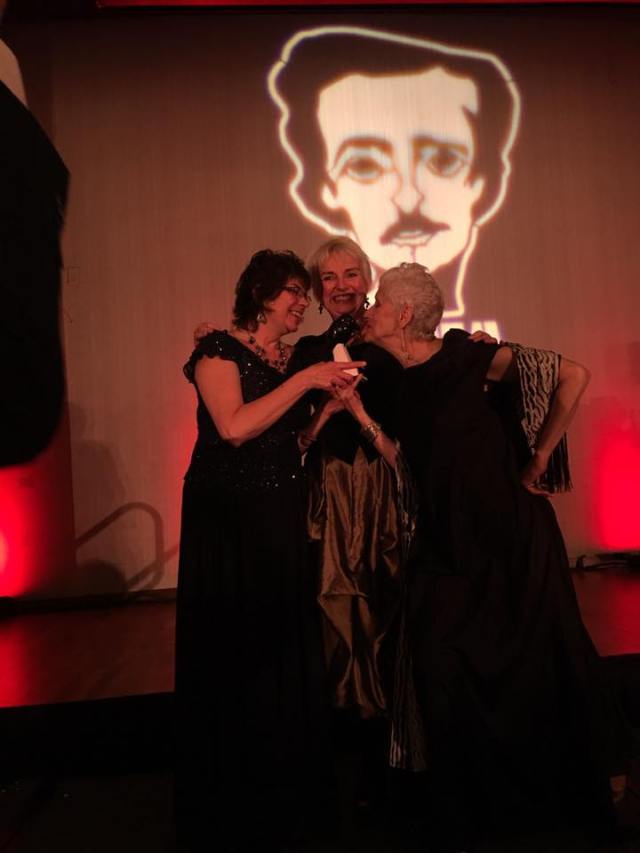
That spirit of generosity was celebrated in May when Sisters in Crime received MWA’s Raven Award, given for “outstanding achievement in the mystery field outside the realm of creative writing.” Nearly thirty years ago, our founding mothers, led by Sara Paretsky, envisioned an organization that would advocate for women crime writers. Over the years, we’ve monitored the number of reviews given books by women, and helped prompt a notable increase, reaching parity in many publications. We’ve advocated for better placement on panels and in the leadership of other organizations. We’ve worked late into the night, sharing shameless tips for self-promotion and advice on breaking and entering. Sisters—including many brothers—have worked together to form chapters, giving members support and opportunities for education and promotion. We’ve created one of the best regular publications for writers, regardless of genre, in InSinC, and a multiple-award winning anthology of inspiration and advice, Writes of Passage.

Malice 2016: The Raven Award.

MWA’s The Raven Award.

MWA 2016: Leslie Budewitz with Catriona McPherson and Sara Paretsky (L to R)

The Edgars 2016: Leslie Budewitz with Catriona McPherson and Sara Paretsky (L to R)

We have, as our mission statement says, promoted “the advancement, recognition, and professional development of women crime writers.”

Our vision is even broader: “To be the voice of excellence and diversity in crime fiction.” Many writers face additional obstacles to publication because they are writers of color, are LGBTQ, or have disabilities. The 2017 edition of our annual Publishing Summit report, to be published later this summer, will look at those obstacles, advise the mystery community on possible changes, and note the changes we’ve begun in our own house. Our annual SinC into Great Writing Workshop will focus on the craft aspects of working with the amazing diversity in our world, in setting, plot, character, and dialogue. “Writing Our Differences—Doing Diversity Right,” with keynote speaker, Walter Mosley, will be held September 14, 2016, in New Orleans, the day before Bouchercon begins.

Not all SinC members are writers. We welcome readers. I can almost guarantee that anyone who walks into a chapter meeting and identifies herself as “just a reader” will instantly be the most popular person in the room! Seriously, brothers can be Sisters, and so can readers.

It’s an old maxim that you get what you give. Never before joining SinC—and nowhere since—have I been part of a community that so made me want to contribute, as thanks for what I’ve received. And every project I’ve been involved with has given me back even more than I’ve put in.

It’s that “currency of generosity,” and it multiplies with every act of kindness to another writer, no matter how small the act, no matter who the writer is or where they are on their own writing journey.

It’s the spirit of Sisters in Crime. And we’d love to share it with you.

Posted in Fiction, Guest, Publishing, Readers, Writers | Tagged , , , , , , , , , , , | 10 Comments

“In Defense of Dan Brown and Bad Sentences” (by Michael Noll)

Michael Noll debuted in EQMM in the July 2015 issue with “The Tank Yard,” a story that was subsequently selected for the 2016 volume of Best American Mystery Stories. He is the program director at the Writers’ League of Texas and the editor of the craft-of-writing blog Read to Write Stories. His short fiction has also appeared or is forthcoming in American Short Fiction, Chattahoochee Review, Indiana Review, and The New Territory. His book In the Beginning, Middle, and End: A Field Guide for Writing Fiction is due out next year. In this post he takes a critical look at the work of one of the most popular thriller writers of our time and shares some of the advice he gives his writing students.—Janet Hutchings

Dan Brown hasn’t published a book since Inferno in 2013, but Facebook apparently has a grudge against him. Recently, an old review of Inferno from England’s The Telegraph showed up on my news feed, and it tears into Brown in order to make a succinct argument: Dan Brown can’t write a sentence.

In my writing community, most people would probably agree with this assessment, but I found myself wondering if it’s actually true.

As evidence of Brown’s lack of skill, the review offers this sentence: “His eyes went white, like a shark about to attack.” Of course, almost any book can be ransacked for poorly worded sentences, and so it might be tempting to think this example was cherry picked. But this review is part of a longer history. Another review by Clive James highlighted the particular horror of other sentences: “Sienna changed tacks” and “Pandora is out of her box.” James’ retort: “Dan, she was never in it.”

This is comically bad prose, like something Yogi Berra might have said. After all, is “Pandora is out of her box” really so different than “When you come to a fork in the road, take it”? Neither makes logical sense—and yet we know exactly what both statements mean. The same is true of “His eyes went white, like a shark about to attack.” Sharks aren’t white—or, if they are, they start that way and don’t change color (though how cool would that be?). Even if you grant Brown a zoological waiver, there isn’t much logic to be found. If sharks did change color, wouldn’t it be to disguise their attack? Or perhaps to frighten their prey? Surely we can agree that a shark would not change color out of fear while attacking.

Yet such writing doesn’t mean Brown’s books aren’t any good. I read The Da Vinci Code while in college, studying Creative Writing and Journalism. Like writing students everywhere, I disguised my lack of skill by trashing the weaknesses of other writers, and so I was primed to detest a book that everyone around me adored. But I didn’t. I devoured it the same as I consume Pringles potato chips, figuring I’m not going to be capable of thinking of anything else so I might as well finish the whole thing. The day after I started The Da Vinci Code, I drove home to visit my parents and hid away in a bedroom at their house where no one would bother me as I raced to the thrilling conclusion.

The Da Vinci Code is undeniably entertaining. But is it well written? The fact that I even ask the question will bother some readers. After all, how can a book be badly written if so many people enjoy it? It’s like saying that Pringles are badly designed because they achieve the exact effect they’re aiming for: You can’t eat just one. And yet the question is important for writers to consider: Why is the novel so good when its writing is so demonstrably bad?

One answer can be found on the opening page:

Louvre Museum, Paris

10:46 P.M.

Renowned curator Jacques Saunière staggered through the vaulted archway of the museum’s Grand Gallery. He lunged for the nearest painting he could see, a Caravaggio. Grabbing the gilded frame, the seventy-six-year-old man heaved the masterpiece toward himself until it tore from the wall and Saunière collapsed backward in a heap beneath the canvas.

Skip down the page, and this happens:

He crawled out from under the canvas and scanned the cavernous space for someplace to hide.

A voice spoke, chillingly close. “Do not move.”

On his hands and knees, the curator froze, turning his head slowly.

Only fifteen feet away, outside the sealed gate, the mountainous silhouette of his attacker stared through the iron bars.

That’s a lot of logical and spatial incoherence. The gallery is cavernous, but Saunière somehow doesn’t see the “mountainous silhouette” that is “chillingly close.” And, for Brown, “chillingly close” is a matter of interpretation; would everyone define it as fifteen feet away, beyond a gate? The novel goes on to describe the attacker, down to the color of his eyes—which ought to be impossible. Saunière saw the man’s silhouette. Silhouettes are outlines or general shapes and, by definition, not detailed.

So, yes, the prose has some problems. It’s also captivating. Why?

The question has implications for writers of every genre, not just mystery thrillers. I once wrote a novel that received many effusive rejections from editors, all with the same judgment: Beautiful prose, but I’m afraid I have to pass. When I asked my agent what lesson I should draw from this experience, he thought for a moment and then said, “Story matters.”

The British writer Hanif Kureishi said something similar at a literary festival a couple of years ago: “A lot of my students just can’t tell a story. They can write sentences but they don’t know how to make a story go from there all the way through to the end without people dying of boredom in between.”

So, let’s examine the story of The Da Vinci Code. A man is tearing paintings off the walls of the most famous museum in the world—not standard behavior. It’s natural to ask, “What has possessed him to do it?” Someone is trying to kill him. Again, we want to know why. Brown gets readers wondering these things in a single page, in part because of his sentences.

Take the first five words of the novel: “Renowned curator Jacques Saunière staggered . . .” Renowned and staggered aren’t often found together, and this incongruous pairing is an example of what Friedrich Nietzsche talked about in his essay “On Truth and Lies in a Nonmoral Sense.” We structure language in order to create meaning, he argued. Imagine a monument: on top are words like love and God, and on the bottom are words like tapeworm and gutter and every naughty word for a body part or bodily function. As children, we quickly learn that these words occupy different parts of the monument and supposed to be kept apart. As a result, if someone were to say, “I love tapeworms,” we’d be disgusted. How can anyone love something so horrible?

This is where writers can’t be like regular people. No one besides scientists loves tapeworms. But, for writers, the question “How can you love a tapeworm?” invites a story, just as “Renowned curator Jacques Saunière staggered” causes us to wonder, “Why? What’s going on?” Renowned and curator exist together on the Nietzsche’s monument. Staggered does not, just as love and tapeworm do not. A basic rule of language, and therefore our understanding of the world, has been broken. Our interest is piqued.

But what about that shark sentence? Surely it’s indefensible. Well, maybe not.

On one hand, it makes no literal sense. Eyes can’t go white. They can, perhaps, go wide, or, at least, that is a cliché most of us recognize. White and wide aren’t the same, but it’s a distinction that most readers might not notice. Plus, white echoes the famous words of the Bunker Hill colonel who told his troops, “Don’t fire until you see the whites of their eyes.” As a result, “eyes went white” begins to resemble common but incorrect phrases like “stock and trade” and “on tender hooks.” The flubbed versions are used so often that we understand what they mean, even when, to a literalist, they mean nothing.

None of this has anything to do with sharks, but the pairing of white eyes and shark does make a kind of archetypal sense—the sort that happens all the time in a writer’s subconscious. They’re all located in the same part of Nietzsche’s monument of language, and so the reader, moving quickly to find out what happens next, focuses on the concrete words in the sentence (eyes, white, shark, attack), barely sees other words that hold everything together, and intuitively grasps the meaning: the character is terrified.

The entire first page of the book ignores the literal definitions of the words it uses but still creates meaning because, on a sentence level, it’s conveying the characters’ emotions and the mystery to be solved. Nothing else is as important to a storyteller. Even Homer himself might agree. His Iliad (as translated by Robert Fagles) begins this way:

            Rage—Goddess, sing the rage of Peleus’ son Achilles,
            murderous, doomed, that cost the Achaens countless losses,
            hurling down to the House of Death so many sturdy souls,
            great fighters’ souls, but made their bodies carrion . . .

Homer’s tools are the same as those wielded by Brown: clear emotion, strong verbs, and incongruous pairings (“great fighters’ souls” and “carrion”). Will Dan Brown’s novels last as long as the work of the man whose stories were so good that Plato wanted him barred from the city? Doubtful. But they’re entertaining for the same reason: the sentences tell a story.

Hook the readers, Homer and Brown might say, and worry about the finer points later.

Posted in Editing, Fiction, Genre, Guest, Story, Writers, Writing | Tagged , , , , , , , , , , | 3 Comments

“Fleshing Out Mysteries” by Sharon Hunt

Sharon Hunt’s short stories had already appeared in a variety of literary magazines before her EQMM debut in August 2015 with “The Water Was Rising.” That story is currently nominated in the best-short-story category for Canada’s most prestigious award for crime writing, the Arthur Ellis, and for an International Thriller Award. In this post the talented Ontario author lets us in on how her interest in mystery and suspense was born.—Janet Hutchings

A woman sits alone in the dark.

Who is she?

Where is she?

Why is she there?

What will happen next?

The first sentence generates the germ of a story while answering the questions that follow flesh it out into something memorable (at least, for me).

My mother loved a good scare. She loved suspense and mystery, delighted in working with gumshoes or the upper crust, uncovering clues, making deductions, bringing the guilty to justice.

As Sherlock Holmes played his violin to help him think and Philip Marlowe plied people with liquor to get them to talk, my mother had her rituals, too. She sat in our rec room with the lights out and the blinds drawn. Once a movie began there were no interruptions, unless someone had severed a limb or the house was burning down. There was no talking. I think she would have made notes had that not seemed foolish to her.

Besides, she didn’t need notes since she never forgot anything—a less than enviable trait in a mother when you become her teenage daughter, but a longed for one later, when you are a writer—and never missed a thing, including every Hitchcock cameo.

In place of more traditional detecting garb—fedoras and trench coats or deerstalkers and tweed jackets—she wore a nightgown, robe and slippers but, despite this, when the mystery unfolded, she was all business.

Some nights she watched just one movie and was in bed before midnight but other nights she watched two or three and didn’t come upstairs until the witching hour had passed.

At dinner she would warn my sister and me to stay in bed and not sneak downstairs to try to watch things that were inappropriate for us. My sister was usually “dead to the world” by ten, along with my father, but I was a night owl and curious like my mother and the warning was really directed at me.

In addition to not wanting me to watch movies I shouldn’t, she didn’t want to be interrupted because she might miss a valuable clue (this was before VCRs or DVDs were common).

She hated not being able to figure out who was guilty. When this happened, it was either because a scriptwriter or director had tried to be too clever or thrown in “ridiculous” coincidences that infuriated her or because she had to shoo me back upstairs from my hiding place (never very good because I was always seen).

It was a mystery why she loved these movies. As a girl, she had been scared of the dark and avoided conflict and menace, shielded from much of it by her twin sister, but yet there she was, my mother, alone in the night, relishing murder.

She watched any movie that sounded good, but those by Alfred Hitchcock were favorites. She loved Rear Window not only because of Jimmy Stewart (who could do no wrong) but also because of how his character, initially watching his neighbors because he’s broken his leg and is bored, becomes convinced that one of them has committed murder. The slow-simmering suspicion complemented the sultry courtyard setting.

In Vertigo, she suspected beautiful Madeleine (Kim Novack) from the beginning because perfection was always a mask and felt Scottie (Stewart, again) should have been more suspicious, too, while North by Northwest’s simple premise of “wrong place, wrong time” worked into a story so satisfying she never tired of watching it. Hitchcock might have missed the bus in that cameo, but he didn’t miss anything else, she thought.

Psycho left her shaken but less over the shower scene than when Mrs. Bates runs out and attacks the private investigator at the top of the stairs, confirming something my mother believed; the unexpected can work when it’s done right.

The Maltese Falcon also confirmed that in Humphrey Bogart’s hands, Sam Spade would sort things out, while the cursed beast in The Hound of the Baskervilles was no match for the deductive powers of Basil Rathbone and Nigel Bruce, the quintessential Holmes and Watson (the modern, high-functioning sociopath and his blogging sidekick would have paled for her next to the Rathbone and Bruce duo, but she would have loved the pure, glorious evil of Andrew Scott’s Moriarty since without great villains, great mysteries fall apart).

The mysteries did fall apart a bit the summer I was eight. We had moved to a gloomy two-storey house in the country while my parents looked for a suburban bungalow. The attic was home to creatures my mother refused to name, although she feared she knew what they were, the staircase creaked unless you hugged the loose, right banister and crept down, and the lights flickered on and off as if possessed.

Still, her movie rituals continued, although in the living room as that basement was too frightening, even for her. The movies she watched that summer didn’t wrap up as neatly as she liked but were suspenseful just the same.

Alfred Hitchcock put in an appearance with The Birds and their unexplained attacks and then Bette Davis came along, first as an actress tormenting her crippled sister in Whatever Happened to Baby Jane, and then as a southern belle with a lover whose hand and head are cut off.

Hush Hush Sweet Charlotte was definitely not for children, my mother warned and so, of course, hugging the loose, right banister in the dark, I crept down the stairs until I could see the television in the living room, right at the moment the cleaver fell.

I ran back up to my room, not caring about the creaking, and the next morning, my mother suggested I wait until I was a bit older for “good scares like that.”

I did and a few years later, joined her in the rec room of the house we now owned. Although most of the rituals stayed the same—dressed for a bed that would have to wait and eagerness to put things right—one thing changed. When the two of us were together, we talked while the movie played, trading information and conferring, our own version of Holmes and Watson.

It wasn’t until after she died and I started writing mysteries that I realized how much those movie nights influenced my writing. It wasn’t the plot or the characters or the settings of any particular movie, it was what she said about them that mattered. She was a reader, too, like me, but she didn’t analyse books the way she did movies.

With them, she instinctively knew why a story lagged and where an unexpected event would help. If she figured out the killer’s identity too quickly or too easily, that was a problem. If the killer ended up being the last person either of us would have thought, that was a bigger problem because it wasn’t fair.

She saw cardboard characters for what they were, window dressing, and quickly ignored them. It didn’t matter, though, if characters were bad, as long as they were real.

“Why would he do that? It doesn’t make sense,” she complained if someone acted out of character.

“That setting doesn’t work. She wouldn’t be there.”

I still hear the things she said and although I didn’t realize it then, I was making notes.

A woman sits alone in the dark. A girl joins her.

The germs of so many stories were being fleshed out for later.

Posted in Fiction, Genre, Guest, Noir, Setting, Story, Suspense, Thrillers, Writers, Writing | Tagged , , , , , , , , , , | 1 Comment

“Ballet, Law, and Mystery” (by V.S. Kemanis)

V.S. Kemanis’s first story for EQMM appeared in our September/October 2013 issue. At that time she was already the author of many published short stories and the first novel in her Dana Hargrove legal-mystery series had appeared to strong reviews. Her third Hargrove novel, Forsaken Oath, was released this past spring. The series was inspired by her own career as a lawyer. She is also a ballet dancer en pointe, however, and she drew upon her dance experience for her upcoming EQMM story, “Journal Entry, Franklin DeWitt,” which will appear in the August 2016 issue. For this new post, she has creatively fused her experiences as writer, lawyer, and dancer.—Janet Hutchings

Before writing fiction, I was a dancer and a lawyer. Still am, both. Oxymoron? You’d be surprised how many attorneys I meet in ballet class. Maybe it’s because law books and toe shoes are both hard—dancing attorneys are gluttons for punishment. On a positive note, ballet and the law share many nicer attributes. An idealized world, perfectionism, intellectual puzzles, exacting discipline, technical precision, and personal expression. The expressive medium of ballet is the more artistic, you might say, but I could debate the point (sounding like a lawyer here, even if we swap “point” for “pointe”).

My experience in the courtroom informs my fiction more often than my experience in the dance studio (although the protagonist in my novels, prosecutor Dana Hargrove, does take a weekly dance class with her sister Cheryl, a Broadway performer). With pleasure, I dove into the world of professional ballet in writing “Journal Entry, Franklin DeWitt,” for EQMM. Memories from the time I owned a dancewear shop came in handy for this story. It could take hours fitting those potential instruments of torture, pointe shoes, on the feet of persnickety ballerinas—always a Cinderella-esque exercise in frustration.

As for this blog piece, I thank Janet Hutchings for humoring my obsession and allowing this small offering, a short-short mystery. The style is not my usual, but like every word buff, I look for any excuse to have fun with language—here, the beautiful language of ballet. Consider, for example, this direction for a lovely petit allegro enchaînement: “Glissade précipitée en avant, temps levé, tombé, saut de chat.” If the ballet instructor were to say it like this—“Quick steps forward, hop, fall, and leap like a cat”—I might just walk out of class.

You will find, at the end of the story, a glossary of the less obvious ballet terms.

Doctor Coppélius Meets an Untimely Death at the Opera House

As the only child of two physicians, Sylvia Musette was destined for a future in the healing arts. So it seemed, until destiny took a detour on the occasion of her eighth birthday, when she was treated to a matinee at the National Ballet. From that moment, every step she took was a chassé toward her dream.

At seventeen, she signs with the company. Passion is no guarantee of talent, and Sylvia’s passion falls short of artistic distinction, her grand jeté an inch below soaring, her port de bras heartfelt but uninspiring. Ever hopeful, she languishes in the corps, one of many cygnettes, sylphs, and Wilis.

In her fifth spring season, the light of good fortune shines upon her. Ballet master Stanislav Gliadilev, towering over the diminutive Sylvia, twirls a waxed end of his mustache and declares: “Friend!” She fights to remain à terre. It’s her first supporting role! One of Swanilda’s six Friends in the comic ballet Coppélia. Her heart nearly sautés from her leotard before the impresario qualifies the offer: “Understudy!” Sylvia wilts.

An exhausting rehearsal schedule fails to wilt Les Amies, who remain remarkably healthy and uninjured while Sylvia shadows them, unnoticed, a fly on the studio mirror. With too much time on her hands, she is, quite unintentionally, on a gradual pas de bourrée couru toward her true calling in life. Nothing escapes her eye.

She studies the principals: prima ballerina Peony Torne in the role of Swanilda, Enrique Dagloose as her fiancé Franz, and Morton Avunculario as Doctor Coppélius. Peony is known for the delicacy of her petite batterie, Enrique for his ballon, and Morton for his danse de caractère. What is the secret of their success? They’re strong and beautiful, Morton the most powerful, a favorite of Gliadilev who always gives him what he wants. Fifteen years older than the others, Morton is made to look 85 on stage with a painted face and a wig of scraggly gray hair, stooped and teetering with the aid of a cane.

Hmm, Sylvia thinks, did this help Peony make it to the top? Perhaps if I cozy up to Morton the way she does, gazing droopingly at him while Enrique scowls with glints of daggers in his slitty eyes . . . ? The whole thing is backward from the story in the ballet. Swanilda isn’t attracted to that crotchety, diabolical inventor, Doctor Coppélius, a disturbing figure with a toyshop full of spooky, life-size mechanical dolls. And Swanilda is the jealous one, not the faithless Franz. He’s duped and smitten by the lifelike doll Coppélia, sitting on the balcony of the toyshop, reading a book.

On the eve of opening night, an hour before full dress, company class is held on stage with portable barres. Peony, Morton, and Enrique plié center stage, and the others fan out from center, the Friends, the Dolls, the townspeople, and finally the understudies, lining the dark edges. Sylvia is a useless appendage, she feels. At least she would like to observe the greats, but they’re barely visible behind all the bodies executing les exercices à la barre: tendus, dégagés, ronds de jambe and finally, battements en cloche.

A small commotion erupts. Rats! What’s happening over there? Enrique mutters something to Morton, who gives an audible harrumph and stumbles away in the hunched posture of Doctor Coppélius, hand at the back of his neck. The dancers disperse to dressing rooms, wishing each other “merde.” The maître de ballet spies the understudies and shrieks: “Get off the stage!” In the midst of chaos, Sylvia slithers behind a wing, unnoticed.

Second act, it’s the dead of night, and something is astir, a menace of unknown origin. Swanilda and Friends break into the toyshop, setting the mechanical dolls to life. The Troubadour executes a stiff tour en l’air, the Spanish Doll a sharp coupé fouetté raccourci, the Scottish Doll a nervous pas emboîté en tournant. The Doctor bursts in! Friends scatter, Swanilda hides, Franz sneaks in through a window and is caught! Intending mockery, Doctor Coppélius produces two tankards, and they drink heartily to Franz’s love for Coppélia.

Franz is passed out when Swanilda appears, impersonating the mechanical doll Coppélia. But the Doctor is not quite himself. Deathly pale, he staggers off stage, totters and collapses behind the façade of the toyshop. With a brisk brisé volé, Swanilda runs to him. The music stops. “Morton, darling!” She cradles the gray-wigged head in her lap and looks up, searching blindly. “Please, somebody, help!” The Doctor needs a doctor. The maître drops to her knees, frantically feeling for a pulse. It appears that Morton est mort.

From center stage, Gliadilev quiets the crowd. “Remain calm! I’ve called for an ambulance.” From behind the curtain, Sylvia discerns, in the tensing of muscle, the pain that the impresario feels for the loss of his friend. Or maybe he’s remembering the inferior quality of Morton’s understudy. Opening night will be a disaster.

“How can this be?” The tear-stained Peony stands, bras croisé, mindlessly stabbing piqués en croix with her right foot. “There!” She points to the tankards. “He’s been poisoned!” She whirls in renversé. “He did it!” Enrique is fingered. But Peony pirouettes anew, unable to make up her mind. “No . . . it has to be him!” She points at the mousy little props man, scratching his head in confusion.

“Wait! You’re wrong.” Sylvia chaînés swiftly out from the wing. Quickly, before Gliadilev can banish her, she grabs the tankards, one at a time, and drinks from each. “It’s water.” She licks her lips. “Maybe a bit of iron oxide.”

Dumbfounded, the company awaits Sylvia’s next move. Like magic, a path to the body is cleared. Sylvia kneels, removes the wig, and palpates gently. “Basilar skull fracture, occipital bone, subdural hematoma likely. Suffered a blow with a blunt instrument. He’s been dying slowly before our eyes.”

There’s a communal gasp amid darting, wary glances. Was it the Troubadour’s lute, the Scottish Doll’s bagpipes, the Spanish Doll’s fan, or that little hardcover book Coppélia was reading? Maybe the assailant used the Doctor’s own cane, or a dismantled section of the barre? Sylvia examines the shape of the injury, mentally calculating height and velocity. She stands to face Enrique, his head drooping en bas. For weeks now she’s been studying him, getting to know every habit and quirk of technique. “You were standing behind Morton at the barre. It was your battement en cloche, wasn’t it? Directed straight to that nice little groove between neck and skull.”

“But,” Enrique protests, “I didn’t mean for him to die!” The suspect attempts an échappé sauté, but Gliadilev seizes him before he can run.

Intentional, reckless or negligent? A question for another day, a question for a jury. With a joyfully sissone fermé, the case, for now, is closed. Sylvia is arisen from the corps.

A Literally Figurative Glossary of Ballet Terms

ballon: lightness, the ability to remain suspended in the air.

battements en cloche: beats like a bell. Basically, you swing your leg front and back, very high, like the clapper of a bell; it’s fun and relaxing.

bras croisé: arms crossed.

brisé volé: broken, flying. A beautiful light step with a small beat of the legs.

chaînés: chains, links. These are fast turns in a line, spotting your destination. Really fun to do and a good way to get dizzy if not done properly.

chassé: chase. Slide forward, one foot chasing the other.

coupé fouetté raccourci: literally cut, whip, and shorten. Does this give you any sense of what it looks like? Too difficult to explain.

échappé sauté: escape leap. As you jump, the feet “escape” from fifth position into second.

merde: I don’t need to tell you what this really means. It’s a dancer’s “good luck” wish.

pas de bourrée couru: a series of tiny rapid steps on pointe. When ballerinas look like they’re floating across the stage, this is what they’re doing.

pas emboîté en tournant: a springy, boxed-in step in a circle.

petite batterie: small battery in the sense of beating. There’s a lot of beating in ballet terminology, although it’s far from a violent art form.

piqués en croix: sharp piercing taps with the toe, front, side, back, in the shape of a cross.

renversé: reversed. You wouldn’t think this word is enough to describe the actual movement. It’s a turn with a pitched body and a high, circling leg.

sissone fermé: a leap from two feet into a split, landing on two feet in a closed position.

tour en l’air: turn in the air. Jump straight up, do a full revolution like a pencil, and land. Harder than it looks.

Posted in Characters, Fiction, Genre, Guest, Setting, Story, Writers, Writing | Tagged , , , , , , , , , , | 2 Comments

2016 EDGARS/MALICE PHOTO GALLERY

It’s hard to believe that another awards season has come and gone. As always, the five days that encompassed the Edgar Allan Poe Awards in New York City and the Malice Domestic Convention in Bethesda, Maryland were jam-packed. It all began for us on Wednesday, April 27, when EQMM’s Robert L. Fish Award winner Russell W. Johnson and his wife Michelle stopped in at our offices on Wall Street to record a podcast of Russell’s winning story, “Chung Ling Soo’s Greatest Trick,” which you can listen to through a link on our website beginning June 1.

The EQMM Readers Awards are given each year on the same day as the MWA’s Edgar Allan Poe Awards, at a Dell Magazines cocktail party preceding the Edgars banquet. The Dell party was at a new venue this year, the beautiful, historic library of the General Society of Mechanics and Tradesmen. Our guests included three of our 2015 Readers Award winners, all of whom we congratulate: Margaret Maron (1st place for “We on the Train”), Brendan DuBois (tied for 2nd place for “The Lake Tenant”), and Lou Manfredo (3rd place for “Rizzo’s Good Cop”). William Hallstead (who tied for 2nd place for “No Cabs After Midnight”) was unable to make the trip from Florida, but the longtime EQMM contributor’s many decades of contributions to our field (starting with his penning of the 31st book in the Hardy Boys series!) were remembered in his absence.

In a surprise twist for your editors and the rest of the EQMM staff, EQMM itself received an award at this year’s cocktail party. We knew that EQMM’s book review columnist, Steve Steinbock, had accepted an award on the magazine’s behalf from the Baker Street Irregulars (the world’s oldest Sherlockian organization) at their annual banquet this past January. But as the honor was, at least in part, for the reviewing of books of Sherlockiana, we thought the award had found its proper home with Steve. When he crossed the country with it at the end of last month to present it for permanent housing at our offices we were truly touched. Our thanks go to both the BSI and Steve; the plaque will have pride of place in EQMM’s space.

This year’s Edgar Allan Poe Awards banquet marked the 70th anniversary of the presentation of the awards in Poe’s name. It was not, however, the 70th year in which the coveted busts of Poe that we’re all so familiar with were given. That small treasure, designed by Peter Williams, didn’t appear until 1948, the third year of the awards. This year’s best short story Edgar went to Stephen King, for “Obits,” from Bazaar of Bad Dreams; we want to give a big shout out to him and also to Mat Coward, whose EQMM story “On Borrowed Time” was one of five stories (out of 600 or more submitted) to receive an Edgar nomination.

No sooner were the Edgar Awards festivities over (for some in the wee hours of the morning) than it was time to get ready to board trains for Washington, D.C. to join the annual Malice Domestic Convention in Bethesda. One of the most welcoming and relaxed of all the events on the mystery calendar, Malice this year was a great way to conclude several days of reconnecting with friends in the mystery community. At the Agatha Awards banquet, EQMM’s latest Readers Award winner, Margaret Maron, took home the Agatha Award teapot for best novel for the last book in her very popular and long-running Judge Deborah Knott series, Long Upon the Land. Two other authors with strong ties to EQMM took home awards this season that I want to mention. One is the current president of the U.K.’s Detection Club, Martin Edwards. A writer who got his start in EQMM’s Department of First Stories, Martin has become not only a leading fiction writer but a noted scholar in our field. His book The Golden Age of Murder claimed both the Edgar and the Agatha in the best critical category. Taking home the Agatha Award for best first novel was EQMM’s frequent contributor Art Taylor. Art also got his start in our Department of First Stories, and his winning book, On the Road With Del and Louise, is actually a “novel in stories,” including a couple of stories that first saw publication in EQMM.

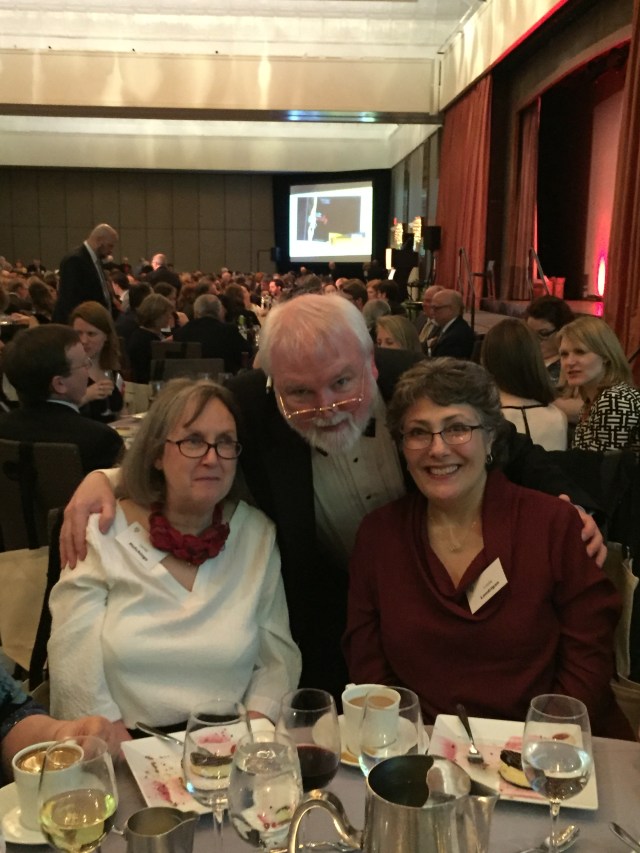
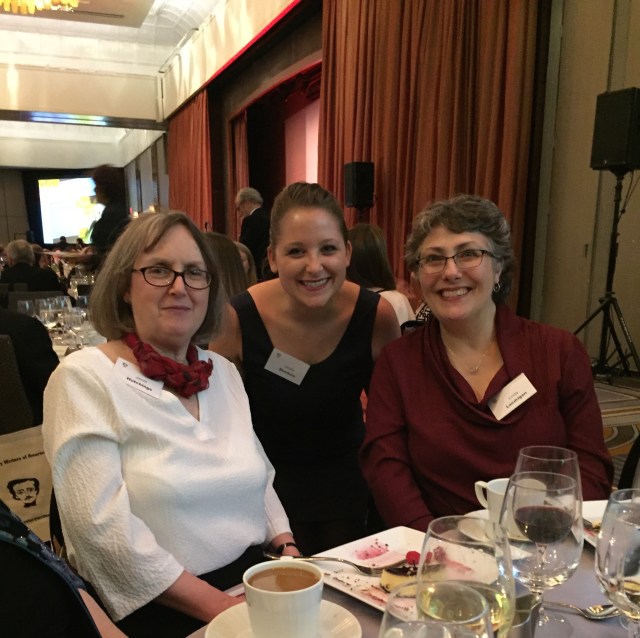
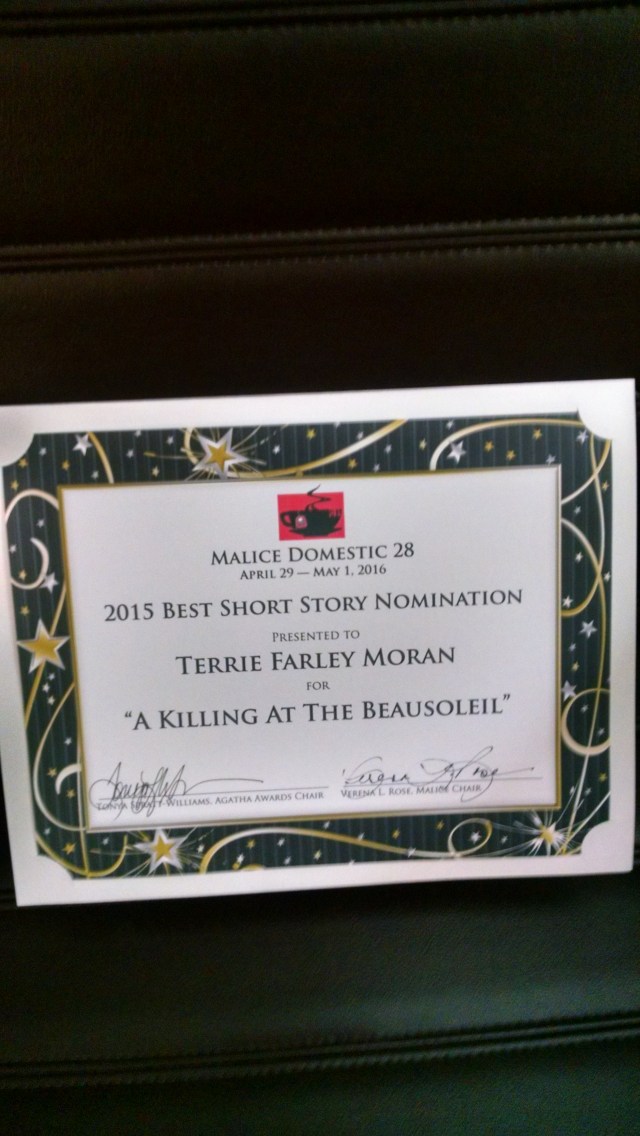
At the Agatha Awards banquet I had the privilege of sitting at a table hosted by this year’s Lifetime Achievement Award winner Katherine Hall Page. There I had the pleasure of catching up with Terrie Farley Moran, EQMM’s nominee for the Agatha Award, for her November 2015 story “A Killing at the Beausoleil.” The short-story Agatha went to Barb Goffman for her AHMM story “A Year Without Santa Claus?”—congratulations, Barb and AHMM!—but an enthusiastic hats off is also due to Terrie for a story that reflects the best in the classical tradition!

Finally, the winner this year of the Malice Domestic Convention’s Amelia Award, for contributions to the field, was Douglas Greene, the founder and owner of Crippen & Landru Publishers, the genre’s most distinguished line of single-author short-story collections. Doug has been a stalwart friend of our magazine, and many of his collections have been drawn largely from EQMM. Doug’s wife Sandi, who worked side by side with him at Crippen & Landru for many years, was with him to enjoy the celebration of Doug’s achievements, which include his definitive biography of John Dickson Carr.

Credits are given for all of the pictures in this season’s photo gallery, but a special thanks is due to one of the photographers, EQMM and AHMM’s wonderful senior assistant editor, Jackie Sherbow. —Janet Hutchings

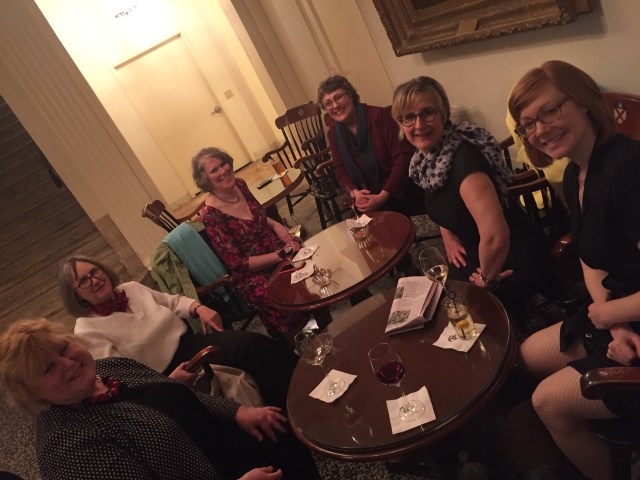
The crowd at the Dell Magazines Pre-Edgars Party at the General Society of Mechanics and Tradesmen, NYC. (Photo courtesy of Jackie Sherbow)

Dell Magazines' Peter Kanter presents Lou Manfredo with EQMM Readers Award certificate

Dell Magazines’ Peter Kanter presents Lou Manfredo with EQMM Readers Award certificate (photo courtesy of Jackie Sherbow)

Brendan DuBois accepts his Readers Award (photo courtesy of Jackie Sherbow)

Margaret Maron accepts her Readers Award. (Photo courtesy of Jackie Sherbow)

Steve Steinbock presents EQMM with the Baker Street Irregulars' Tip of the Deerstalker Award. (Photo courtesy of Jackie Sherbow)

Steve Steinbock presents EQMM with the Baker Street Irregulars’ Tip of the Deerstalker Award. (Photo courtesy of Jackie Sherbow)

Dell Magazines staff relaxes at the Yale Club between the Dell Pre-Edgars party and the Edgars banquet. (Carol Demont, Janet Hutchings, Christine Begley, Linda Landrigan, Abigail Browning, Emily Hockaday. Photo courtesy of Jackie Sherbow)

Janet Hutchings, Brendan DuBois, Linda Landrigan at the Edgars. (Photo courtesy of Jackie Sherbow)

Janet Hutchings, Jackie Sherbow, Linda Landrigan. (Photo by Michelle Johnson)

At the Edgars: Russell Johnson, Michelle Johnson, Dorothy Cannell, Margaret Maron, Janet Hutchings, Linda Landrigan, Carol Demont, Abigail Browning, Lou Manfredo, Joanne Manfredo, Brendan DuBois. (Photo courtesy of Jackie Sherbow)

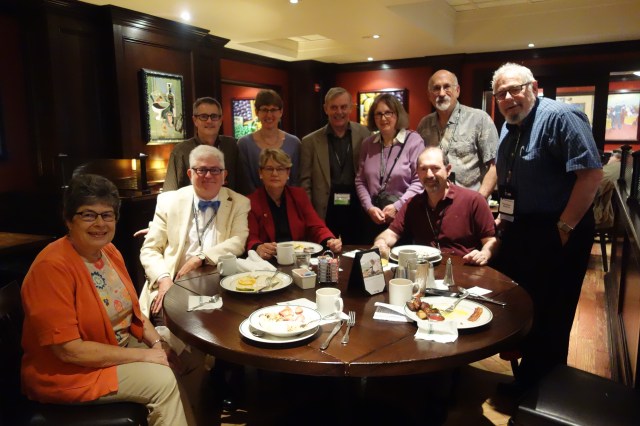
Breakfast during Malice: First row L to R: Sandi Greene, James Lincoln Warren, Margaret Warren, Steve Steinbock. Second row, L to R: Art Taylor, Laurie Pachter, Martin Edwards, Janet Hutchings, Josh Pachter, Doug Greene. (Photo courtesy of Josh Pachter)

Agatha nomination certificate. (Photo courtesy Terrie Farley Moran)

Agatha nomination certificate for “A Killing at the Beausoleil.” (Photo courtesy of Terrie Farley Moran)

Art Taylor and Terrie Farley Moran. (photo courtesy of Terrie Farley Moran)

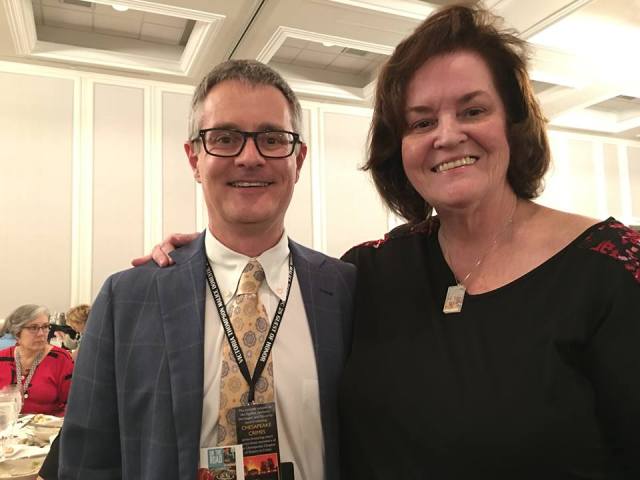
IMG_2347

Martin Edwards and his Agatha Award. (Photo courtesy of Terrie Farley Moran)

Posted in Awards, Ellery Queen, Genre, Writers | Tagged , , , , , , , , , , | 3 Comments