A New True-Crime Department for EQMM and Some Reflections on Converging Fields

Yesterday, Ellery Queen’s Mystery Magazine’s new web-only column Stranger Than Fiction went live on our website. Written by award-winning Canadian author and journalist Dean Jobb, the new department explores the true-crime field through reviews of true-crime books and occasional articles about real-world crimes and criminals. It’s available—for free—on our website.

Columnist Dean Jobb is a true-crime specialist with more than a half-dozen titles in print, including one of 2015’s most notable true-crime works, Empire of Deception. The story of a master swindler in 1920s Chicago, the book won both the Crime Writers of Canada and Chicago Writers Association awards, and earned rave reviews. The New York Times Book Review called it “intoxicating and impressively researched.” In addition to pursuing literary and journalistic careers, Dean Jobb teaches in the Master of Fine Arts in Creative Nonfiction program at the University of King’s College in Halifax, Nova Scotia.

Stranger Than Fiction debuted with Dean’s roundup of choices for the best true-crime books of 2017, and that column will remain current until the beginning of February, after which it, like all future columns, will be archived on the site and remain accessible to readers. Going forward, each issue of EQMM will contain a preview of what’s coming up in Stranger Than Fiction, with the full text available only on our website. Readers of digital editions of the magazine will be able to click straight through from the previews to the full columns.

Here’s your peek at what’s coming up: February’s Stranger Than Fiction, entitled “I Hear of Sherlock Everywhere,” explores, through reviews of new critical works, the creation and enduring popularity—130 years after he first appeared in print—of Arthur Conan Doyle’s iconic detective. A tie-in to EQMM’s annual Holmes tribute (celebrated in our January/February issue), the installment complements the special Holmes reviews provided in the magazine by Jury Box columnist Steve Steinbock.

In March, Dean takes a look at the latest books on the history of Chicago crime: a gambling king, a century-old miscarriage of justice, Al Capone’s rivals, and the murderous rampage of the White City “Devil.”

We are all so excited about this new department that I have to remind myself why EQMM waited so long to cover a segment of crime literature that has been recognized by the Mystery Writers of America through the Edgar Allan Poe Award category Best Fact Crime since 1948. The truth is that up until the early 1990s, it was almost an axiom in publishing that the readership for crime fiction had little overlap with the readership for true crime. That was, of course, before Patricia Cornwell came on the scene in a big way with the debut of her medical-examiner detective Dr. Kay Scarpetta, a series informed by the six years Cornwell spent working in the office of the chief medical examiner of Virginia. The series inspired TV shows like CSI in the fiction realm, and true-crime shows such as Cold Case, and it’s been argued that CSI’s lasting legacy is that jurors in real criminal cases have, ever since, expected conclusive forensic evidence. Conversely, fact appears to be influencing fiction in more profound ways nowadays, as writers draw upon real investigative techniques, police procedures, and even notorious crime cases in ever more detail to aid in the fashioning of their stories. There ought, therefore, to be a natural crossover of interest between modern mystery/crime fiction and true crime.

I think one reason publishers were sceptical of such crossover in the past is that their paradigm for mystery fiction was the classical whodunit, in which the puzzle was supreme and gritty details of the sort found in real crime cases seldom featured. But I suspect that readers who prefer the classical cozy are no more immune than any other crime-fiction fan to the lure of a good real-life puzzle, and if we look back to the early days of mystery fiction, we can see that even some highly artificial mystery stories exerted an influence upon the detection of crime in the real world. It has long been noted that fingerprint and footprint evidence appeared in the Sherlock Holmes stories before being commonly used by real police forces, and recently I came across an interesting article in Smithsonian about the psychiatrist who pioneered criminal profiling, James A. Brussel. What struck me most strongly was this paragraph:

Brussel called his approach reverse psychology. Today we call it criminal profiling. Whatever the term, it was still a virtually untested concept in the 1950s. Brussel’s role models at the time were fictional investigators, most notably C. Auguste Dupin, the reclusive amateur detective invented by Edgar Allan Poe in the 1840s. Dupin was the original profiler, a master channeler of the psychotic mind and the forebear of Sherlock Holmes and Hercule Poirot.

How incredible to think that more than a hundred years after Poe constructed his complex fictional cases for Dupin, a real criminologist began to form a new science based on his sleuth’s methods. The truth seems to be that there has always been a two-way street between crime fiction and fact crime, and we’re very pleased (finally!) to present our readers with a column that represents the fact side of that street.

Have a look and let us know what you think!—Janet Hutchings
Posted in Ellery Queen, Magazine, Police Procedurals, Real Crime, Stranger Than Fiction | Tagged , , , , , , | 3 Comments

Edwin Hill on Writing

Edwin Hill makes his fiction debut in the Department of First Stories of EQMM’s current issue (January/February 2018). The tale, entitled “White Tights and Mary Janes,” was inspired, in part, by a short stint he did at a for-profit college. Currently, he is vice president and editorial director for Bedford/St. Martin’s, a division of Macmillan. At the end of August 2018, Edwin’s first novel, Little Comfort, will be published by Kensington Books (with a second book already contracted). As he explains in this post, his story for EQMM began life as part of an earlier draft of that book. EQMM is trying something a little different today; we’re posting a podcast of “White Tights and Mary Janes,” Edwin’s debut story, this afternoon, to coordinate with this post and the print version of the story currently on sale.—Janet Hutchings

I’ve worked as an editor for most of my professional career, including my current stint as the vice president and editorial director at Bedford/St. Martin’s, which is a division of Macmillan Learning. I cherish the collaborative nature of writing and book making, especially the type of detailed development work that we do in academic publishing. And by now, I’m comfortable with both the editorial process and the recursive nature of writing. Still, I hadn’t had my own writing put to the test until an agent agreed to try to sell my first novel, Little Comfort, in the summer of 2014.

Below are five lessons learned during the three and a half years since that day.

  1. Rejection letters are the key to success.

The first time my agent submitted Little Comfort to publishers, it was rejected practically everywhere, and, I won’t lie to you, it was terrible. Most of the passes were polite and short, purposefully noncommittal. As an editor, I know how important it is not to give authors false hope. If a manuscript isn’t for you, it’s important to say that so that the writer can move on to someone who can support the project.

However, there was a bright spot in this process. In academic publishing, we use peer reviews all the time to help shape a manuscript. Academics will write detailed, and often very polite, reviews, and a good editor is able to synthesize the views of many different academics so that the author can shape the material to better fit the audience.

I read the rejection letters in the same way that I would read reviews to see what trends I could pull from them. One trend I started to see was that many editors mentioned that there was too much story in the manuscript. One editor—in a single gold mine of a sentence—went as far to say that the manuscript read like two novels mashed together. And that gave me enough to work with as I began an extensive revision process.

  1. Don’t kill your darlings, part one—recycle them.

Little Comfort began as three intertwined stories: Hester Thursby, a librarian who uses her research skills to find missing people; Sam Blaine, a charming grifter who reinvents himself to gain the trust of the wealthy and powerful; and Maxine Pawlikowski, the embattled leader of a for-profit college under federal investigation for fraud. I quickly realized that one of the stories had to go, so I spent about six months excising poor Maxine from the story. What resulted was a stronger novel—more focused, with a commitment to a single protagonist who could support a series.

I also wound up with the short story, “White Tights and Mary Janes,” which focuses on Maxine. To read more, visit here.

  1. Don’t kill your darlings, part two—you may need them.

Like many first-time novelists, I read, and continue to read advice from other writers, including very good tips for cutting as much backstory as possible from a polished manuscript. Backstory really can slow down the forward momentum of the novel and, worst of all, it can be boring.

As an editor, I know that many writers need to warm up to get into a manuscript, especially a first draft. I use backstory to get to the meat of the story, so trimming it away from the finished product is almost always a good idea. As I prepped Little Comfort for submission #2, I combed the manuscript for backstory and cut nearly all of it.

After I sold the novel to Kensington, and my editor sent his development notes, it turned out that most of his questions were about what had happened to get my main characters where they were, i.e. backstory. Thankfully I’d kept every single draft of the manuscript and was able to piece together a solid—and brief—backstory for each of the characters that answered my editor’s queries.

  1. Time away from a manuscript is a good thing.

Copyediting happens late in the writing and editing process. Good copy editors do much more than correct grammar. They find problems in your manuscript around logic and continuity, as well as structure, word choice, and repetition. And yes, they correct your grammar. A great copy editor will help you put the finishing polish on your manuscript and make you a much better writer in the process.

When I got the copyedits on my manuscript, I was deep into writing a new novel and hadn’t looked at Little Comfort in months. The nice thing about seeing the copyedits was that it made me think about my writing in a different way, and helped me catch some bad habits. I always believed I was a pretty clean writer, but it’s never too late to learn! For more on my own copyediting process, click here.

  1. Be mindful of names

Avoid naming terrible, terrible characters after real people, especially ones with whom you may have a conflicted relationship! Also, don’t name rifles after friends who are anti-gun. And if you choose to name a character after someone’s dog, ask. Especially if that character is a serial killer.

But, that’s what Find and Replace is for, and that’s why the editorial process has many steps and can sometimes be maddeningly slow. We all want to get it right. That takes time, and a great team.

Posted in Characters, Guest, Publishing, Story, Writers, Writing | Tagged , , , , , , , | 4 Comments

HAPPY NEW YEAR FROM EQMM

Happy New Year from EQMM, and best wishes for 2018. What are your reading resolutions for the year?

Posted in Uncategorized | 4 Comments

“Great God! This is an awful place.” (by Christine Poulson)

Setting always features interestingly in Christine Poulson’s fiction, whether it is Cambridge and the surrounding Fens as depicted in her Cassandra James mystery series; Sweden, Hong Kong, and Devon in her novel Invisible; or the cathedral of her upcoming EQMM story “Faceless Killer” (March/April 2018). Her settings are almost always places she has visited, but in her novel Cold, Cold Heart, due to be released in the U.S. next month, she employs a setting that only research could provide access to: the Antarctic plateau. It’s evident from this post that research—and imagination!— has worked its magic for her in bringing the place to life.—Janet Hutchings

Martin Cruz Smith visited Moscow for only two weeks on a tourist visa before setting his best-seller, Gorky Park, there. Harry Keating went one better. He had never visited India when he began his series of Inspector Ghote novels set in Mumbai.

A few years ago I wrote a guest post for EQMM, “A Sense of Place,” in which I explained that I admired these writers and their chutzpah, but that I could never write about a place that I didn’t know. And now—having well and truly nailed my colours to the mast—I’ve gone and set the greater part of a novel somewhere that I’ve never visited, and never will.

Think of this: a place where each night lasts for months and so does each day. The mean annual temperature is −57 °C. It’s a place where money isn’t important because there’s nothing to buy. There are no children or old people or land mammals and only one species of insect. There are no trees or shrubs or flowers, no fresh fruit or vegetables or meat or milk or eggs.

These are only some of the things you’ll miss along with your family and friends when you fly in to spend the winter on a remote research base on the Antarctic plateau. This was the place I planned to send my series character, scientist Katie Flanagan.

There were however things that she’d have plenty of. Silence. Space. Ice. Time. There’d be a strange, bleak beauty to the landscape and on starry nights the breath-taking aurora australis, the Southern lights, would ripple across the sky. Another plus: she wouldn’t catch a cold or flu, because there’ll be no-one bringing in viruses from the outside world. But just as no-one would be coming in, nor would anyone be going out. Once the last plane left at the end of February the base would be completely cut-off until late October, because it would be cold enough to gelatinise engine oil. It is easier to get back from the International Space Station than from the Antarctic plateau in mid winter. Wintering over in Antarctica has much in common with long duration deep space missions, and serves as a valuable substitute for research into the physiological and psychological effects of extreme isolation and confinement.

Whatever happens on the base has to be dealt with on the base. The commander is sworn in as a magistrate before the winter begins. As for medical emergencies: There was a famous occasion in the early sixties when a Russian doctor on a Soviet base removed his own appendix under a local anesthetic while a driver and a meteorologist stood by, holding a mirror and handing him instruments.

On my fictional research base, only ten would winter over (a nod to Agatha Christie’s And Then There None). There would be a doctor, a couple of astronomers, a meteorologist, a chef (yes, they do have their own chef!), an electrical engineer, a plumbing and heating engineer, a mechanic, a computer and communications guy—and Katie as medical researcher.

And one of these would vanish from the base. . . .

Once I’d had this idea, how could I resist? There was no going back for me either. But a research trip was out of the question and not only because of the distance and the expense. No-one gets out to the most remote bases without having a very good reason and it is only a very select few who can spend the winter there.

Luckily those who have wintered over often feel compelled to record their experiences, and there is an abundance of memoirs and biographies going back to the early days of Antarctic exploration. Apsley Cherry-Garrard’s classic, The Worst Journey in the World (1922) tells the story of an expedition to collect the eggs of the Emperor penguin, from which he and two others were lucky to return alive, and this is followed by an account of Scott’s ill-fated attempt to be first to reach the South Pole. It was Scott who wrote “Great God! This is an awful place” in the journal that was discovered with his frozen body and those of his companions.

Another stand-out account is Richard E. Byrd’s Alone (1958) which tells the story of his attempt in 1934 to spend the winter alone a hundred miles inland, and it is as gripping as any thriller. But of all the early polar explorers the one I came most to revere was Shackleton. He never lost a single man under his command. He was within a hundred miles of being the first to reach the South Pole and called a halt because there was not enough food to get his men back alive. “Better a living donkey than a dead lion,” he explained.

Coming up to the present day, Gavin Francis’s Empire Antarctica: Ice, Silence & Emperor Penguins (2012), and Alex Gough’s Solid Sea and Southern Skies: Two Years in Antarctica (2010) are fascinating contemporary accounts. I immersed myself in these and in everything I could get hold of. I followed blog posts from Antarctica and watched documentaries and films, including the highly entertaining South of Sanity, a horror film scripted by, shot by, and starring a team wintering over one year at Rothera, a British Antarctic Survey base.

Yet informative as all this was, it wasn’t enough. I needed to talk to someone who had actually wintered over in Antarctica. Ideally this would be a young woman and a medic—someone like my character, Katie. What were the odds that I would find such a person living fifteen minutes drive from me? But that is exactly what happened. I found Rose, now working at a local hospital, via the blog she had written while she was in Antarctica. Over a couple of long lunches I learned about all the little traditions and rituals that make up life on the ice, about the danger posed by fire or loss of power, about what it was like to be on night duty, the only person awake on the silent base, and much, much more. Later, she read a draft of my novel (Cold, Cold Heart, published in the U.K. in November and due to be released in the U.S. in January) and picked up the things I hadn’t got quite right. It was a privilege and a pleasure to meet her.

Cherry-Garrard commented that “Polar exploration is at once the cleanest and most isolated way of having a bad time which has been devised.” That has changed. These days there are few deaths in Antarctica. The bases are well-stocked and (relatively) comfortable, especially the newer ones. But still this remains one of the most hostile environments on the planet, where no aspect of survival can be taken for granted. It is also one of the most fascinating and awe-inspiring and I have loved visiting it, if only in my imagination.

Posted in Adventure, Books, Characters, Setting, Writers, Writing | Tagged , , , , , , , | 7 Comments

“Murder, Mayhem and Mistletoe” (by Elizabeth Elwood)

With Christmas less than two weeks away, Elizabeth Elwood is about to debut in EQMM with her story “Ghosts of Christmas Past” (January/February 2018—on sale December 19). Although she is new to EQMM, she is not new to mystery writing, having authored five books in the Beary series, the most recent of which is The Devil Gets His Due and Other Mystery Stories. Before turning to mystery writing, the British-born Canadian author spent many years performing with music and theater groups and singing in the Vancouver Opera chorus. She is also the creator of twenty marionette musicals for Elwoodettes Marionettes and a playwright with four plays produced in the U.S. and Canada, the most recent, Body and Soul, the winner of two Community Theatre Coalition awards and the recipient of two additional nominations. As you’ll see from this post, she is also a great reader, with some excellent suggestions for your holiday reading!—Janet Hutchings

Why is it that crime writers love to combine the Season of Peace and Goodwill with a juicy murder mystery? Incongruous themes? Not really, when you consider how psychologists expound on the subjects of anxiety, tension, and depression at Christmas. The web abounds with sites that offer tips on how to avoid stress during the festive season. It’s the time of year when families come together, whether the individual members like each other or not. There is an expectation that the feuds be buried, or at least suspended, no matter how much resentment might be simmering under the surface. One is conscious of obligations to others, whether or not the will is there to follow through. There are gifts to be purchased, which stretch budgets that may already be out of control. People who are alone feel lonelier; those who are inundated with relatives feel overwhelmed and exhausted. Such a lot of smoldering emotions for a crime writer to plunder.

As if the turbulence of family relations was not sufficient to tempt a mystery writer, Christmas also provides a wealth of opportunity for atmospheric settings. What could be more ‘cozy’ than firelight flickering in the hearth and snow falling outside the window? What can be more chilling than a black winter night with only the soft beam from a streetlamp lighting footsteps in the snow? What possibilities for sinister disguise lie in the cross-dressing of a Christmas pantomime? What great opportunities for the evil-minded are presented at those parties and dinners where food abounds and glasses and plates are often left unattended. No wonder mystery writers can’t resist creating a Christmas dilemma for their detectives to solve!

Christmas mysteries have been around for a long time. Charles Dickens certainly knew how to wring drama out of the Christmas season, and what a trend he began. Sherlock Holmes solved the puzzle of a goose that provided a lot more than Christmas dinner; G.K. Chesterton’s Father Brown recovered “The Flying Stars,” diamonds that disappeared at a Christmas party; Hercule Poirot’s Christmas included a body in a locked room; Ngaio Marsh produced a corpse that was Tied up in Tinsel; Jessica Fletcher indulged in A Little Yuletide Murder; and Rumpole has a whole book of Christmas stories. Even PD James fans received an unexpected present last year when four of her seasonal stories were published after her death under the title The Mistletoe Murder. There are many anthologies too, such as Christmas Stalkings or Murder Under the Mistletoe, books that feature a host of stories by writers such as Margery Allingham, Peter Lovesey, Reginald Hill, Charlotte MacLeod, Patricia Moyes, and Sir Arthur Conan Doyle.

Current authors continue the trend. The detectives in Deborah Crombie’s compelling novel, And Justice There is None, mingle Christmas shopping with the investigation of a particularly brutal pair of murders; Peter Robinson’s Inspector Banks suffers through a Blue Christmas; and Anne Perry has written an entire series of Christmas novellas, as have M.C. Beaton and Vicky Delany. Mary Higgins Clark, with her daughter, Carol, has also produced a set of seasonal mysteries and Charles Todd took a break from the Inspector Rutledge series to publish a holiday tale called The Walnut Tree. The list goes on and on.

Giving books as Christmas gifts has always been an important part of our family tradition. The other tradition that we love revolves around theatre and children’s entertainment. For more than twenty years, my husband and I worked our way through December performing marionette shows at New Westminster’s Bernie Legge Theatre and the Burnaby Village Museum, but finally, this year, we are taking a well-deserved break. So what am I going to do with all this extra time at Christmas? Our holiday season will include a visit to the Vagabond Players pantomime, a trip to historic Fort Langley to enjoy their holiday displays; leisurely shopping excursions in downtown Vancouver instead of rushed dashes to the mall; and much more time for visiting with friends and family. Last, but definitely not least, I am going to enjoy a relaxing time sitting by the Christmas tree and reading the deliciously cozy mystery stories that I put on my Christmas wish list—firelight flickering, snow drifting down outside the window, and the mysteries only within the pages of my book. A Merry Christmas indeed.

Posted in Anthologies, Books, Christmas, Fiction, Genre, Guest, Readers, Writers, Writing | Tagged , , , , , , , , , , , , | 2 Comments

“Librarians as Mystery Writers” by Robert Lopresti

Any devoted reader of short stories in the mystery genre knows the name Robert Lopresti. He’s been writing for forty years—mostly short stories—and his story oeuvre now includes more than seventy tales. He has received multiple award nominations and has twice won the Short Mystery Fiction Society’s Derringer Award. Two of Rob’s stories have appeared in EQMM and we have a third coming up later this year. Though his ventures with novel writing are few, the Washington author’s 2015 novel Greenfellas was called one of the best books of that year by Kings River Life Magazine. Parallel to his work as a writer is Rob’s long career as a librarian—something he talks about here!—Janet Hutchings

Sometimes when I tell someone what I do for a living that person will get a dreamy look. “I’d love to be a librarian. Sitting around reading books all day!”

I tend to back away from such people with a fake grin, the same way I react when someone tells me the Martians have been stealing their buttermilk.

(Come to think of it, dealing with Martianphobes is one of the many things librarians sometimes have to do when they aren’t sitting around reading.)

A lot of people have equally unrealistic ideas about writers, assuming we divide their day between attending TV talk shows and literary cocktail parties.

Having a foot in both camps I would like to talk a bit about those two jobs, and specifically how they overlap.

There have been plenty of other librarian/mystery writers, of course. Jon L. Breen, for one, besides reviewing mysteries for Ellery Queen’s Mystery Magazine for many years, has also published many short stories in EQMM, and two of his novels have been nominated for awards. You can find a no doubt incomplete list of others of the type here, and some of them set their tales of murder and deceit within the walls of the humble booklender.

But how has my work in the stacks (which is library jargon for bookcases) boosted my writing?

I started my career working with government publications in New Jersey. In one of those documents I discovered an obscure fact: In the south end of the Garden State there is a small community named Mauricetown, and its name is pronounced the same as Morristown, a big city upstate.

Hmm. I had already written several short stories about an Atlantic City private eye named Marty Crow. That coincidence was exactly the sort of thing he would know. The resulting tale, “The Federal Case,” marked Marty’s first appearance in Alfred Hitchcock’s Mystery Magazine.

One day I was looking for something in the reference stacks and came upon the Encyclopedia of American Race Riots. Instantly I knew I was going to write a short story about the riot my family had experienced in the 1960s. When Alfred Hitchcock’s Mystery Magazine published “Shooting at Firemen,” the story began with my protagonist in a public library discovering the same book that inspired me.

While I adamantly deny that we librarians sit around reading all day I will admit that at coffee break there is plenty of interesting material to peruse. For instance, in close succession I read columns in two British magazines, one about a con game, and one about a cunning method for dealing with negative reviews. I put the two together and came up with “Shanks on Misdirection,” set in the good old U.S.A. Hitchcock’s published it in 2009.

Early in my career I had to drive to Newark in the evening to take some courses related to my library job. Most afternoons I would see a young teenager sitting on a sidewalk banging out complex rhythms on an improvised drum set consisting of plastic buckets, cardboard boxes, and quite possibly the kitchen sink. I don’t know if I got much else out of those night courses, but “The Shanty Drummer” marked my first appearance in Ellery Queen’s Mystery Magazine.

Of course, when I need to do research for my fiction I have both the skills and resources to do so. The most extreme case was when I was writing Greenfellas, a comic novel about a Mafiosi who, upon becoming a grandfather, decides to save the environment by any means necessary. He starts out by inviting an ecology professor to dinner and asking: What needs fixing most?

To find out what the professor should reply I contacted three professors at the university where I work. I explained the situation and asked them to put themselves in the shoes of my imaginary source: You are talking to a smart guy with no knowledge of the field, but high motivation to learn about ecological problems. What do you tell him?

Much better to hear it from the experts, than for me to try to dig it out by myself.

Which reminds me: Do you know the definition of a librarian? A person who may not know something, but knows how to find out. 

There’s one more point I want to address: Why are librarians attracted to mysteries? Well, for one subset—the reference librarians, myself included—the chase is very much the thing. We love helping a user dig up obscure facts, tracking down a book someone encountered in decades past (“I don’t remember the author or title, but the cover was green,”), and turning vague clues into solid facts. Does that sound like anyone in a mystery novel?

But it’s not just the reference librarians’ side of the family. Consider this true story.

A decade ago there was a guy who stole books from more than 100 libraries in the U.S. Because of a very alert staff member at the library where I work we wound up being the ones who tracked him down. After his conviction the FBI returned most of the 800+ stolen books they had found on his property to the libraries that had lost them. But there were about 200 volumes whose owners’ labels had been removed by the thief, and the Feds could not figure out who owned them. A judge decided to gift our library with them, since we had been responsible for their recovery.

And one of our catalog librarians got intrigued. Through what I can only call forensic cataloging she tracked down the owners of three of those orphaned volumes.

That’s right. A librarian solved three cases that stumped the FBI. And that’s one for the books.

Posted in Books, Genre, Guest, History, Readers | Tagged , , , , , , , , , | 7 Comments

“Bonner Krimi Archiv Sekundärliteratur—BOKAS—Bonn Archives of Secondary Literature on Crime & Mystery Fiction: A Self Portrait” by Thomas Przybilka

Thomas Przybilka is a key figure in German crime fiction, beginning his career in the genre working as a bookseller, then establishing the archives he discusses in this post, the Bonner Krimi Archiv Sekundärliteratur” (BoKAS) (Archive of Secondary Literature on Crime and Mystery Fiction). He is a leading scholar of crime and mystery fiction and has had numerous publications about crime fiction in Germany and abroad. Since 1991 he has been a member of DAS SYNDIKAT (German Crime Writers’ Association), since 1994 a member of the British Crime Writers’ Association (CWA). He has served as the Vice President for Western Europe of the International Association of Crime Writers (AIEP/IACW) and is the editor of the two “Krimi-Tipp” series of newsletters discussed in his post (crime fiction as primary literature and secondary literature on crime fiction). In 2012, he received the Friedrich Glauser Award Ehrenglauser” (lifetime achievement award) from DAS SYNDIKAT. His list of achievements should not leave out his own short fiction. In December 2006, his coauthored story “The Copyist” appeared in EQMM. A “relay” story in which each of six authors wrote a scene and passed the tale on to the next, it was Thomas Przybilka’s brainchild, the idea forming as he served on an awards jury with those he invited to join him in writing the story.  His next fiction for EQMM, coauthored with Gitta List, will appear in our March/April 2018 issue. (Both Przybilka stories for EQMM were translated by Mary Tannert.)—Janet Hutchings

In 2009, on the occasion of the twentieth anniversary of BoKAS (Bonn Archives of Secondary Literature on Crime & Mystery Fiction), authors of crime novels and representatives of universities from Germany as well as from European and overseas countries expressed their congratulations.

For the occasion, a radio program of the West German Broadcasting Corporation (WDR) featured an interview about BoKAS, and WDR television produced a feature film titled Murder and Homicide, to be aired in the state of Northrhine-Westfalia specifically, but throughout Germany as well.

It all started in 1989, when an assistant professor at Hamburg University asked me to recommend critical literature on crime thrillers written by female authors (Frauenkrimi). My answer: “No problem! There isn’t much. I’ll provide a reading list for you,” was probably rather rash and presumptuous. After doing some research, I realized that so much more material had been added to my list that a first bibliography of secondary literature on the subject could be compiled. In the course of time, further and considerably more comprehensive bibliographies of secondary literature on various topics and authors related to crime fiction followed, and I created BoKAS, on the second floor of my flat, to house the works included on these lists, as well as other critical writings. This was all done without financial support from the town of Bonn, or from of any other cultural institution. In getting word out about the new archives, however, I was kindly supported by my colleague Reinhard Jahn (BKA—Bochum Crime & Mystery Archives) and my late colleague Wolfgang Mittmann (Krimi Archiv Ost—Crime & Mystery Fiction Archives East Germany), both of whom provided press material.

During the first few years of the archives’ existence, articles and interviews in university publications and magazines devoted to crime fiction made the archive popular. Additionally, BoKAS established communication with German and foreign authors of crime and detective fiction and close connections were set up with the two most important European archives of crime fiction: BILIPO (Bibliothèque des Littérature Policière, Paris/France) and the Svenska Deckarbiblioteket (Eskilstuna stads—och länsbiblioteke, Eskilstuna/Sweden). I am also grateful for the more or less regular support of colleagues belonging to SYNDIKAT, the German Crime Writers’ Association, many of whom have helped by providing the archives with excerpts from newspapers and magazines.

Soon after BoKAS was founded, a large number of requests both from Germany and abroad were being made for materials to be used for the acquisition of various university degrees and for the theses of people doing their doctorates. For example, graduate students studying for a doctorate from Great Britain, Austria, the Czech Republic, New Zealand, France, the United States, and Finland have all been able to do their respective research in the archives.

The archives currently contain more than 90,000 press-publication excerpts (articles, reviews, critiques, interviews) dealing with crime and mystery literature in general or with specific authors, all of which are organized in topic or author files. In addition, there are more than 2,000 books of secondary literature in the genre, copies of hundreds of MA and/or doctoral theses, numerous international crime-thriller magazines, and the internal newsletters of various international associations of crime writers. Apart from the collection of international secondary literature, the archives contain a collection of more than 30,000 crime-thriller novels. Due to structural constraints of the apartment building where the archives are kept, and because of lack of further storage capacity, a first, large part of the fiction collection was transferred to the “Kriminalhaus” in the nearby town of Hillesheim/Eifel (www.Kriminalhaus.de). Further parts of the crime-thriller collection are now transferred there on an annual basis, enabling the “Kriminalhaus” to establish an extremely comprehensive reference library both for fans of crime thrillers and for research in this field.

In addition to the bibliographies mentioned above, BoKAS publishes an internationally popular, very successful review-newsletter called “Krimi-Tipp Sekundärliteratur.” On account of its scope—between 50 and 100 pages, sometimes more!—this newsletter is currently published only twice a year (as opposed to the five to seven editions of previous years). The “Krimi-Tipp” (KT) is also released in an e-mailed electronic edition (more than 600 subscriptions), and is, as yet, still free of charge; it is made available online on the homepage of the archives (www.bokas.de) about two weeks after publication. It has been clicked on by visitors around the world.

BoKAS also publishes “Krimi-Tipp Primärliteratur” (Tips on Crime & Mystery Novels), a monthly newsletter of information on crime novels provided by publishers. This second KT newsletter, however, is only available as an e-mail version! Both newsletters can be subscribed to free of charge via crimepy@t-online.de.

Posted in Books, Fiction, Genre, Guest, History, International | Leave a comment

“The Thanksgiving Chicken” by Edward D. Hoch

Perhaps the only Grand Master of the Mystery Writers of America who was known almost exclusively as a short-story writer, Edward D. Hoch nearly single-handedly kept the classical whodunit alive at short-story length through the last decades of the twentieth century and the first years of the twenty-first. It’s not widely known, but Ed also wrote many short stories that would not be considered whodunits, including his most widely distributed story, “Zoo” (a work still taught in many classrooms). He also wrote at most lengths that fall under the short-story umbrella, from the minute mystery (or flash fiction) to what the Short Mystery Fiction Society classifies a “novelette.” In celebration of the Thanksgiving holiday, we present here one of Ed’s minute mysteries, a story originally published in the Mid-December 1995 EQMM as part of a set of holiday stories with a common sleuth, under the title “The Killdeer Chronicles.” Patricia Hoch has kindly given us permission to post the story, which is copyrighted by the estate of Edward D. Hoch. We hope longtime Hoch fans and new readers alike will look for the excellent collections of his work that continue to be put out by Crippen & Landru Publishers. The latest of these is 2017’s All But Impossible: The Impossible Files of Dr. Sam Hawthorne.  A Happy Thanksgiving to all!—Janet Hutchings

It was a Wednesday, the day before Thanksgiving, and the autumn weather had turned chilly. Jonas Killdeer was at home in his big stone house, thankful he had no reason to go out, when Sergeant Bennett phoned him from police headquarters.

“Sorry to bother you, but we’ve had an incident down at the courthouse. Someone suggested you might help.”

“A murder?” Jonas asked. Since his retirement from an acting career on Broadway he’d helped the police on a few murder cases, with surprisingly good results.

“Well, not a human sort of murder,” the detective told him.

Jonas smiled into the telephone. “You know how to tempt me. Are you at the courthouse now?”

“I’ll send a car for you. I’ll be just inside the front door, before you go through the metal detector.”

Jonas had never needed a car when he lived in Manhattan. Up in Westchester it was different, and he’d come to depend—like Blanche DuBois—on the kindness of strangers. The sergeant often picked him up or sent a police car when his help was desired.

Thirty minutes later he entered the courthouse and met Sergeant Bennett, a balding middle-aged man who had made police work a personal crusade. “Glad you could come, Jonas,” he said, using the retired actor’s given name in a rare instance of comradeship. “We’ve got a weird one up on the third floor.”

Jonas followed him into the elevator. The third floor was divided into courtrooms, jury rooms, judges’ chambers, and waiting areas for families and witnesses. At one in the afternoon the trials were on lunch break, but a number of people were milling about. One corridor had been blocked off with yellow police tape. Bennett led him to it and raised the tape so Jonas could duck beneath it.

The old actor stared at the scorched marble floor and the charred remains of some sort of large bird. “Any idea what it is?”

Bennett shrugged. “A bailiff spotted the fire around eleven o’clock and put it out with an extinguisher. He called the bomb squad. That’s the first thing everyone thinks of these days. They were going to remove it but I wanted you to see it first. Someone joked it must be a small turkey since tomorrow is Thanksgiving, but it looks more like a chicken to me.”

Jonas poked at it with a pencil. “It is a chicken. It’s been sacrificed.”

“What?”

“Could you get me a list of the trials in session today, especially on this floor?”

“Sure. There are only four courtrooms.” He went off and returned in less than five minutes with a copy of the trail docket.

“This one,” Jonas said at once, pointing to The People v. Ramon Sanchez.

“An eighteen-year-old kid accused of grand theft auto.”

“Joy-riding?”

“More than that,” Sergeant Bennett said. “He hijacked a carload of cocaine from some dealers. We couldn’t prove he knew the drugs were in the car, so all we charged him with was the car theft. Why’d you pick him?”

“The chicken was probably sacrificed as part of a voodoo rite.”

“In a courthouse?”

“It happens frequently in Miami, where they have a large population of immigrants from the West Indies.”

“But how could someone get a chicken into the courthouse past security?”

Jonas smiled. “No metal parts.”

Ramon Sanchez had been living with his aunt and uncle when he was arrested. Court records showed that both of them had come from the Dominican Republic. Their names were Nunzio and Maria Macoris, and Maria was the sister of Ramon’s mother.

“Is there voodoo in the Dominican Republic?” Bennett asked.

“Some, certainly. The country shares an island with Haiti, where voodoo is widely practiced.”

“We’d better talk to the aunt and uncle.”

Nunzio was a rough-looking man of about forty who used an aluminum cane because of a knee injury he’d suffered working on the docks of Santo Domingo. It was then, he told Jonas and Sergeant Bennett, that he and Maria had come to New York and later to Westchester. When Maria’s sister fell ill, Ramon had been sent to live with them. “He’s a good boy,” Nunzio insisted. “This business with the car is a terrible mistake.”

“Did you sacrifice a chicken so the jury would free him?” Bennett asked.

“We are good Catholics. We practice no voodoo.”

“What about Ramon? He’s free on bail. Where is he right now?”

“Over there.” He pointed at a young man whom they hadn’t noticed, probably because with his moustache and slicked-down hair he looked more like twenty-five than eighteen.

When his uncle pointed, Ramon Sanchez walked over to join them. “What’s this?” he asked. “More lawyers?”

“Police,” Bennett identified himself. “We’re investigating the fire a couple of hours ago. Know anything about it?”

“I was in the courtroom. The judge and everyone else will tell you that.”

“They take a morning break.”

“The fire came after the break. My lawyer had to stop the testimony till we found out what the trouble was.”

“What’s your lawyer’s name?” Jonas asked.

“Ralph Schindler. You want to ask him? He’s coming back now.”

Schindler was a well-dressed attorney who’d obviously instructed Sanchez how to dress for his court appearance. “You’re holding up good in there,” he told the defendant, patting his shoulder. “Mr. Macoris, I expect we’ll be calling you and your wife this afternoon. I’d really like to wind up our case before the long holiday weekend.”

“Where is Maria?” her husband asked.

“I thought she was here with you. Did she go out for something to eat?”

The courtroom doors were standing open and Ramon peered inside. “Here she is, taking a nap!”

Nunzio started for courtroom, leaning on his cane. “She shouldn’t be in there,” the lawyer said. “She hasn’t testified yet.”

Jonas was at the courtroom door as Ramon Sanchez reached his aunt. He saw the young man gasp and turn away. “What is it?” he asked, but then he saw the handle of the ice pick protruding from just under her left breast.

Jonas Killdeer had planned to spend Thanksgiving Day alone, as he usually did since his retirement. His closest theater friends were working, and his sister was visiting her husband’s family. He certainly hadn’t expected to dine with Sergeant Bennett—Matt Bennett—and his wife Kelly.

It wasn’t until Kelly was serving the pumpkin pie that Bennett asked, “Have you had long enough to think about it?”

“I suppose so,” Jonas answered.

“The feeling is that the kid killed her because she wasn’t going to back his alibi.”

“So he stabs her with an ice pick in the courtroom during lunch hour? Be reasonable, Sergeant.”

“Call me Matt, Jonas.”

“All right, Matt. Tell me what you’ve found so far. What about the chicken?”

“It was a sacrifice, just like you said. The lab found traces of various spices and herbs that were added to the bird before the fire. It’s all part of the voodoo formula.”

Kelly Bennett, who took none of it seriously, commented, “I wonder if that recipe would have worked on my turkey.”

“It worked on the judge. After the murder in his courtroom he declared a mistrial. Schindler claimed he couldn’t continue with the defense with his star alibi witness dead, and the judge agreed.”

“What about the chicken?”

“That much we’ve solved,” Bennett confirmed. “Maria Macoris brought it to the courthouse and sacrificed it. In her large purse we found the plastic bag she carried it in, together with the various spices and herbs. And matches. But that doesn’t tell us who killed her.”

Jonas smiled at Kelly. “This pie is delicious, Mrs. Bennett.”

“I’m glad you like it.”

He turned back to her husband. “I suppose the voodoo was the last straw for him. He must have detested what she was doing, and he used the ice pick he always carried with him.”

“Who, for God’s sake?”

“Nunzio, of course. He’s the only one who could have killed his wife. An ice pick is a metal implement. How do you think it got through the metal detectors at the entrance? Not in the bag with the sacrificial chicken, not in the lawyer’s briefcase. It got through the metal detector in Nunzio’s hollow aluminum cane.”

Posted in Fiction, Story | Tagged , , , , , , , , | 2 Comments

MORE BOUCHERCON MEMORIES

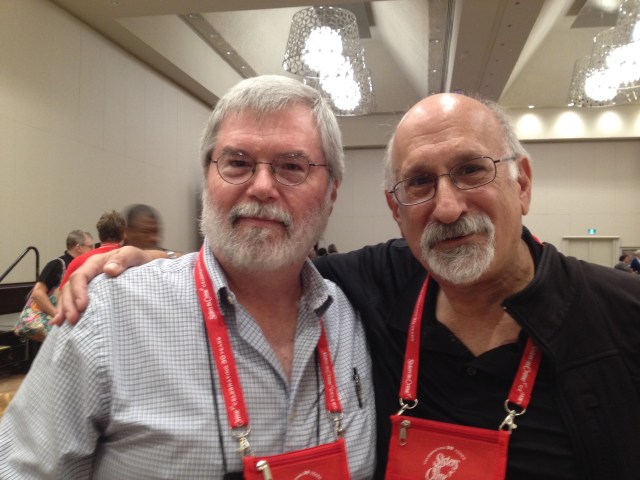
Here’s Michael Bracken and Josh Pachter, photo courtesy of Temple Walker. In case you missed it, our full Bouchercon recap can be found here.

Posted in Conventions | Tagged , , , | Leave a comment

“The Big Idea” (by David Dean)

David Dean blogged for this site just last month. We are delighted to have him back with a post that displays a side of him readers of his fiction dont often see. His dark, sometimes chilling fiction has earned an EQMM Readers Award, an Edgar nomination, and other honors. But those of us whove had the pleasure of meeting David know that his mood can be as light as it comes across here, frequently leavened with wit.—Janet Hutchings

When Janet asked me to write a blog I offered two suggestions for possible subjects. The first she pointed out had been done before . . . by her. So, that was out. The second, though I started it in good faith, just didn’t want to gel into a coherent piece. It needed a coherent writer.

I lay in bed that night tossing and turning, racking my grey matter for ideas . . . something . . . anything to write about. That’s when it hit me—ideas! That’s what I’ll write about, the search for story ideas—how the process comes about, the results, the triumphs, the failures. After all, this is where it all begins in writing fiction . . . any fiction . . . an idea.

The following day, Robin, (my wife of lo these many years) and I, were taking our usual morning walk when I told her of my idea to write about ideas. She Who Walks In Beauty barely slowed her graceful step at this exciting news.

“Ideas . . . where they come from,” she mused in her muse-like way. “You mean like when I give you ideas sometimes?”

“You give me ideas all the time, baby,” I responded.

She Who Walks did slow her steps at that. “I meant story ideas. Remember how I gave you that idea about the dog and the little boy?”

“Of course, I do. That turned out to be one of the best stories I’ve ever written!”

“And remember my ideas about a series for the Hallmark Mystery Channel?”

I nodded in a cautious manner.

“You never wrote that.”

I was beginning to feel a little uncomfortable with the direction our conversation was taking.

“I’m still letting that one simmer . . . mature, as it were,” I stalled. “But the blog will definitely mention the dog/boy idea.”

“Where else do you get your ideas?” she asked.

“From everywhere, I guess—our walks, memories, dreams, past experiences, the news, random things I see.”

“What kind of past experiences?”

“My years as a police officer, for one . . .”

“And what else . . . ?”

“Well, people I’ve known . . . relationships . . . you know, that sort of thing.”

“What kind of relationships . . . exactly . . . ?”

“Look—a scarlet tanager!”

Well, it sure looked like one to me.

When I got back to the house after a nice quiet drive home, I went to my story idea binder. This contains proof of my having a history of ideas. Within the binder lay four yellowing sheets of lined paper, every line freighted with a possible, or now written, story.

Here are a few examples of some that grew up and got published (the as-yet-to-be-published ones are too potentially valuable, or embarrassing, for me to share): Old girlfriend at airport (“Jenny’s Ghost” EQMM, June 2012), water tower suicides (“Don’t Fear the Reaper” EQMM, January 1994), man prods another to murder him (“Mr. Kill-Me” EQMM, August 2015). You get the picture—concise, evocative nuggets that only need a little polishing to reveal their inner worth.

I started this list way back in 1990, shortly after my first story was published in EQMM. After that wonderful event, I felt that every random idea that walked or crawled out of my subconscious was a possible literary gem and must be preserved. I was much younger then.

In any event, here were one hundred and fifty-six ideas for short stories and novels. Running a finger down each page, I found that sixty-seven had actually been developed and written. That does not mean that all those were published. But many were . . . very, very many . . . a whole lot, but let us not dwell on petty details.

Yet, as I walk down memory lane with the yet-to-be-written tales, I sometimes find myself in the company of strangers. Oh, I mostly remember the notion that I had jotted down, but I find that there are a number that still don’t resonate with me. These uncut stones are growing moss. Another discovery I make is that several of the ideas have actually yielded more than one story.

Yet, even with the odds being less than half that an idea will become a story, I continue this arcane practice in the hopes that each of them will someday grow into something I really want to write. Wanting to write the tale is pretty important. This may explain why I haven’t taken up a few ideas offered me pro gratis over the years.

Many, many people, I have discovered, have some great (and not-so-great) ideas for books, stories, and screenplays, only they don’t have the time to write them. But since I’m a writer, they figure I’ve got all the time in the world to do just that. That seemed to be true once; not so much anymore, I’m afraid. The clock is ticking, and I can hear it.

Many of these good people are even willing to dictate what I should write down. My job would be to write it real good. Oh, and the deal is usually a fifty-fifty split of the huge profit we’ll make on this joint venture. Fifty-fifty because my potential partner has already done the hard part coming up with the award-winning idea.

So, back to ideas—what’s really confounding is when I raise one of my own fantastic ideas like gleaming Excalibur only to find it’s become a rotting branch already crumbling in my hands. It’s just not going to happen. Whether it’s a result of my limitations as a writer, or the idea itself is not fully developed enough in my imagination (which I guess is kind of the same thing), I don’t know, I just know, it’s a no-go . . . at least for now.

For me, at least, the litmus test for gold quality is ye olde outline. If I can’t put together some structure containing a beginning, middle, and end, I’m out of it; Mister Idea takes a bus back to Cleveland. I know . . . I know . . . I should just let myself go and write . . . take a chance . . . be truly creative. I have tried it, of course, and more than once. But, I found I was only successful one time. It’s just not me.

After having spent most of my life as a soldier, police officer, and a Catholic (probably the most structured, hierarchical faith in the world), I must have my outline! If there were a writer’s uniform I would probably wear it each day as I reported to my desk.

Now that being said, I don’t have to stick to the outline, I just need it to launch. Once airborne, I can ignore the flight plan and just fly that bad boy . . . or not. It all depends on how the writing is going. Some ideas are just easier than others to write, some so easy I feel guilty when I’ve finished. Where was the required suffering?

That’s usually waiting around the corner with the next story, the one based on a surefire idea that can’t go wrong; that should practically write itself, the one that morphs into the giant octopus that snags the hero-diver just as he’s running out of breath. You pay now, or you pay later . . . but you pay.

And there’s no equity with ideas either. The simple ones can result in great stories, the complex ones into tales better left unread, and the opposite may happen, as well. These humble beginnings demand a lot to bear fruit—experience, imagination, craft, and not a little patience.

So, ideas . . . yeah, I got ’em. Will they all become stories? Time will tell. In putting together this post, I was struck by how many ideas that had lain fallow for ages did eventually grow into stories. So maybe they all will someday. But I doubt it, and here’s why—Cloned sheep, yep, that’s one of the entries on the list. What did I mean by that? Does anyone know? I sure don’t. So, if you want to use it, knock yourself out. We’ll split the profits fifty-fifty. I’m sure it’ll be a bestseller.

Posted in Books, Editing, Fiction, Genre, Guest, Writers, Writing | Tagged , , , , , , , , , , | 6 Comments