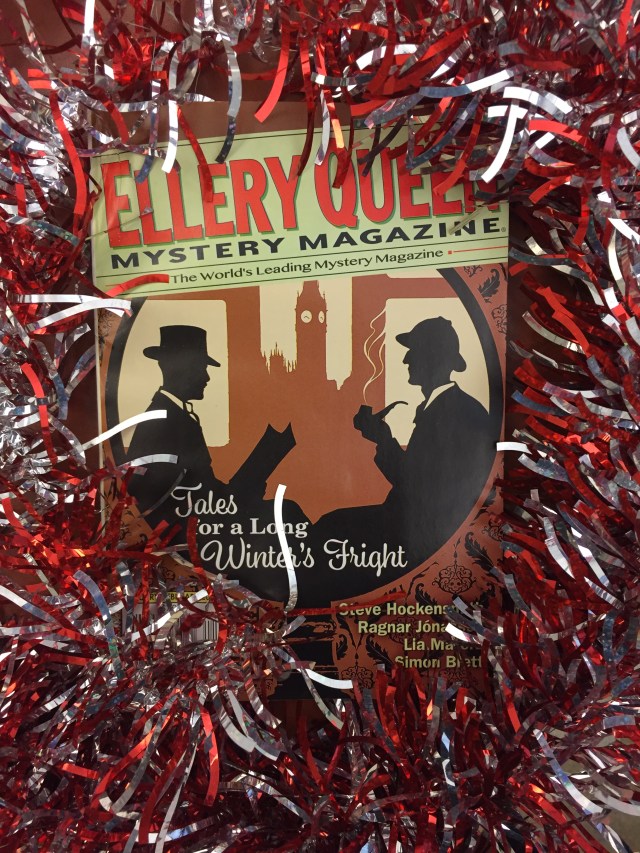
With all our gratitude to our readers, authors, and friends: Here’s to a fantastic year of crime fiction, and to a 2019 full of mystery.
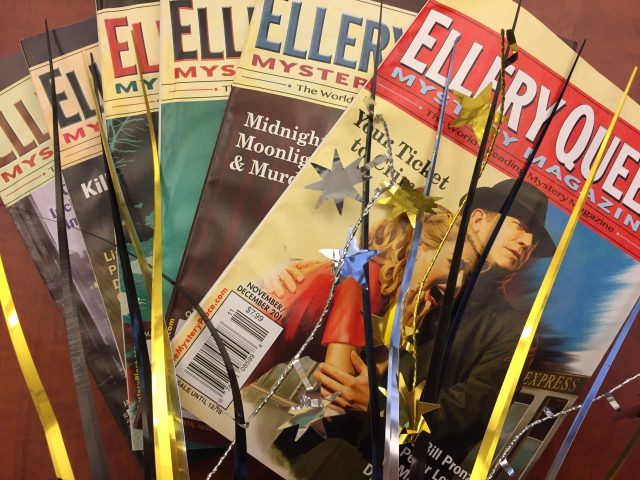
With all our gratitude to our readers, authors, and friends: Here’s to a fantastic year of crime fiction, and to a 2019 full of mystery.
Wishing you the warmest of holiday happiness this year, from your friends at Ellery Queen’s Mystery Magazine.
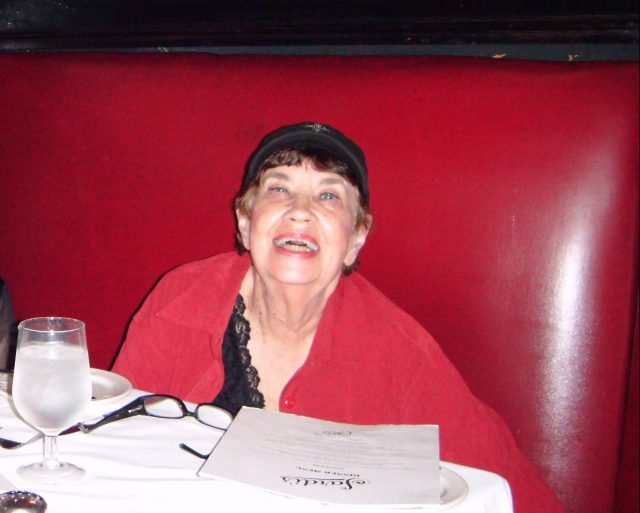
Mary Frisque. Photo courtesy of Linda Kerslake.
On November 26, Mary Frisque, Executive Director of the International Association of Crime Writers, North America, died after a brief illness. My friendship with Mary goes back a couple of decades. I met her through Edward D. Hoch and his wife Patricia. As any regular reader of EQMM will know, Ed, a Grand Master of the MWA, was EQMM’s most prolific contributor, with a story in every issue of the magazine for over thirty years. Whenever Ed and Pat came to New York City from Rochester (as they did several times each year), they’d take me out to dinner. Mary was often another guest at those splendid meals, and soon Mary and I began meeting for dinner on other occasions, often at an Irish pub, or at Uncle Nick’s, near Penn Station. It saddens me that our last Uncle Nick’s dinner was nearly two years ago now. We hadn’t lost touch—it was just that something always came up that got in the way. And then, suddenly, Mary was gone.
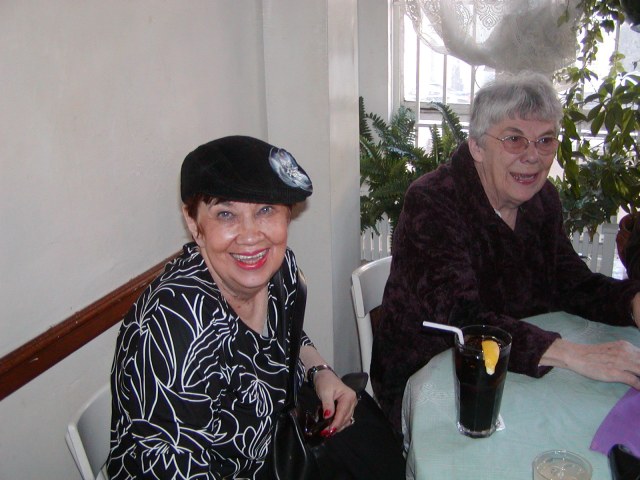
Mary Frisque (L) and Pat Hoch (R). Photo courtesy of Steve Steinbock.
It doesn’t surprise me that Mary didn’t want people to know she was in hospital. I only learned of it through short-story writer Linda Kerslake, a relative of Mary’s by marriage. (An only child, Mary had no other relatives.) Mary was a true woman of mystery, in so many ways. She was brilliant and very well educated, but never tooted her own horn; as a result, she often didn’t get the notice she deserved. The International Association of Crime Writers was the perfect place for her; she had a graduate degree in Russian language and literature, and already knew a great deal about the literature of many parts of the world, but especially Russia and Eastern Europe. I’m not sure what piqued her interest in crime fiction. It could have been that when she first came to New York from her native Washington State, she found a job running the office of the Mystery Writers of America. That was in the late seventies or early eighties.
By the time I met Mary, she seemed to know just about everyone in the mystery community—which is one of the unfathomable things about her. She was essentially a loner, and abhorred parties or gatherings larger than a few close friends, but she managed to connect with everyone in some way, often by letter or card, later by e-mail. She loved jazz and she was a very good dancer. One of my best memories of Mary is the afternoon during one Edgars week when she lured me and John and Barbara Lutz and several other authors from out of town to the Roseland Ballroom to trip the light fantastic. It was a blast! Mary’s friend and fellow IACW member, Jim Weikart, reminded me of another of Mary’s hobbies. “She also liked to gamble,” he said, “a hobby (not an addiction) that we shared. I remember her telling me about a trip she and Doris Cassiday made up to Connecticut, I think to Foxwoods, and how much fun it was. I once knew someone who won Quartermania at a casino and Mary always joked about finding venues for our IACW meeting that would have Quartermania. At one Bouchercon, maybe Colorado, we skipped out for an afternoon and drove to a local casino where she played slots and I blackjack. She thought it was a hoot. I don’t think either of us came away winners. But it was a good time.”
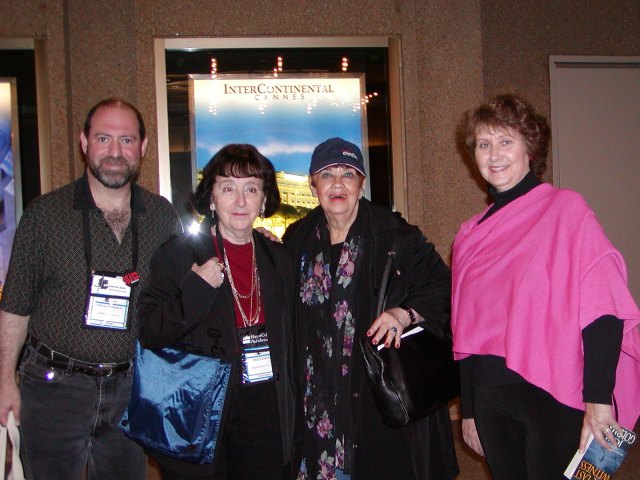
L to R: Steve Steinbock, Deen Kogan, Mary Frisque, Linda Kerslake. Photo courtesy of Steve Steinbock.
Mary had a serious side too. Any job she undertook, she did well. She was an indefatigable and invaluable resource to EQMM. I can’t count the number of times she contacted me to let me know about something important that was going on in our field or to tell me about a wonderful new author she’d just read. I often followed up on her suggestions, especially when it came to writers from overseas. Mary was incredibly well read; I can’t recall ever mentioning an author whose work she didn’t know. And she had very distinct opinions about them all! I doubt that the launch of the Passport to Crime department in EQMM, in which we publish a story in translation every issue, would have been as successful as it was without Mary’s generous outpouring of help. It was she who put us in touch with her friend Mary Tannert, a translator from German who has worked with EQMM for years now, bringing us English versions of the yearly winners of Germany’s prestigious Glauser Prize.
I am not the only one in the mystery world who found Mary’s knowledge and dedication both inspiring and a great asset. An officer of the International Association of Crime Writers, Jim Weikart tells me, “Mary was the heart and soul of IACW and we are scrambling to replace her.”
Despite all that Mary contributed to our field, quietly and unobtrusively, she never had the kind of high-profile job in crime fiction that generally leads to receipt of the field’s top awards for publishing professionals. Nevertheless, I wish she would receive some kind of award, posthumously, in order to ensure that her contribution to the field is not forgotten.
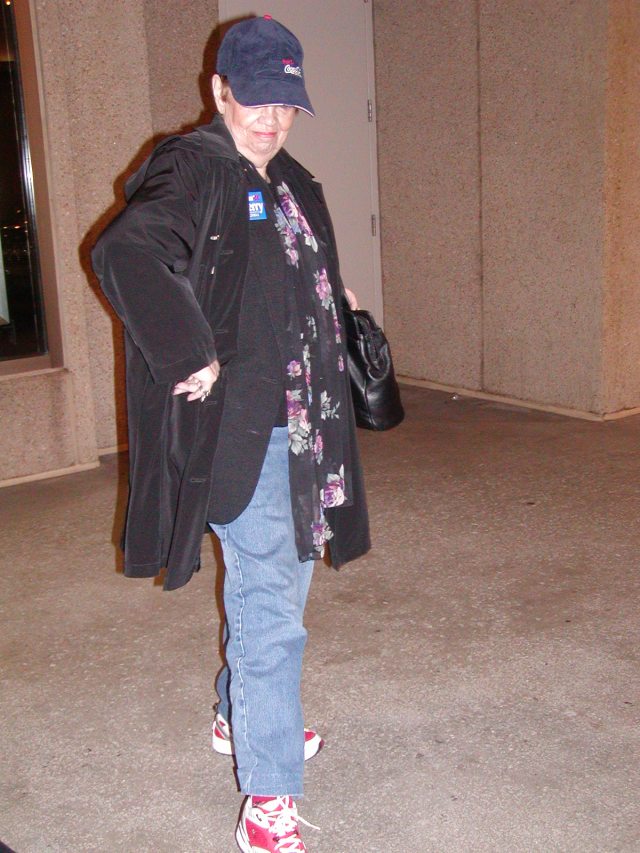
Mary Frisque. Photo courtesy of Steve Steinbock.
This will be my last post until the new year. We lost some good friends of the magazine in 2018. I will be raising a glass in their memory at the new year. But I also want to reflect about the fabulous community of authors, readers, and people in the business with which we are still surrounded. Happy holidays to you all.—Janet Hutchings

I recently found myself lying in a recovery room, exhausted after extensive surgery. Even worse, my body was wracked by hiccups, the uncontrollable sort that turn the simple task of breathing into Sisyphean torture. These disabling hiccups lasted for (get this) three weeks! Naturally, my thoughts turned to appropriating this interminable misery for my writing.
What’s the point of suffering if you can’t put it to use? Isn’t writing about transforming pain, pleasure, fear, love, hate, dreams, defeat, ecstasy, tragedy, doom and so on into a story? And so I took a deep dive into hiccups. The medical term for these involuntary spasms of the diaphragm is singultus, from the Latin word for “gasp” or “sob.” I considered this etymology ad infinitum—gasp-sob after gasp-sob after gasp-sob—as my hiccups waged a brutal, bitter attack on my equilibrium. I called them my diatribes of the diaphragm and became obsessed with translating them into a meaningful metaphor for this blog.
My first thought was to compare hiccups to plot holes. Hiccups, like plot holes, become increasingly problematic as their frequency grows. But then what? Cure plot holes by breathing into a paper bag or guzzling a glass of water? The plot holes analogy seemed to be leading me down a cul de sac. I tried “cliches” on for size. One can be forgivable, even amusing. Two or three (assuming they’re not clustered) become annoying. More than three are deadly. As with plot holes, cliches didn’t seem to offer much substance beyond the initial concept, like a one-joke comedy sketch. I tried adverbs, grammatical errors, and typos. All for naught. As Jack London once wrote, “You can’t wait for inspiration, you have to go after it with a club.” I was flailing for that club.
Upon reflection, it became clear that I’d fallen victim to a rookie mistake: the lure of a shiny object. In this case, it was a metaphor that didn’t deliver on its promise. The hiccups were a square peg that I was determined to pound into a round hole. I had fallen in love with a flawed idea and was trying to stretch and manipulate it to succeed where it was destined to fail. After forty years of writing, you’d think I’d know better. But this happens to me all the time. I never get the message until I’ve wasted inordinate chunks of time. It’s embarrassingly common for me to come up with what seems to be an original, clever, and apt metaphor, simile or analogy, and I spend hours trying out dozens of sentence variations in a vain attempt to make it work. In my defense, I’ve yet to meet a writer who doesn’t suffer the same curse.
This all cycles back to the old saw: “murder your darlings” or “kill your babies.” This sage advice has been attributed to a variety of esteemed authors over the decades, most notably William Faulkner, Oscar Wilde, Eudora Welty, G.K. Chesterton, and Anton Chekov. Stephen King wrote a memorable variation on the theme: “kill your darlings, kill your darlings, even when it breaks your egocentric little scribbler’s heart, kill your darlings.” The irony is, in this case, “darlings” is a metaphor that works.

Arthur Quiller-Couch (public domain)
The true origin of the phrase, as is so often the case, comes from a lesser-known writer. The first-known adaptation of the metaphor arose from Sir Arthur Quiller-Couch, a Cornish writer at the beginning of the twentieth century who wrote under the pseudonym “Q.” In 1913-1914 he delivered a series of lectures at Cambridge entitled “On the Art of Writing.” In one of these lectures—“On Style”—he ranted about “extraneous ornament.” In his words, “If you here require a practical rule of me, I will present you with this: Whenever you feel an impulse to perpetrate a piece of exceptionally fine writing, obey it—whole-heartedly—and delete it before sending your manuscript to press. Murder your darlings.”
The fact that this phrase, or some variation thereof, has survived for more than a century and been attributed to so many great writers, bespeaks its wisdom and insight. And so, I took it to heart. It was with great sadness, and not a little regret, that I consigned my respiratory agony to my compost heap of misguided ideas. Those three weeks may have loomed large in my medical history, but in my literary journey, they turned out to be little more than a minor hiccup.
“What’s in a name?” Shakespeare’s famous quote tells us that a name doesn’t matter—a rose by any other name would smell just as sweet. And, of course, love transcends the differences between the names of the Montagues and Capulets.
This concept may not be so true, however, for story-writing purposes. After all, a name is a unique identifier that sets a character apart from the ordinary, displays his or her personality, or offers a glimpse into the character’s . . . well, character. A character name in a series of books can become iconic and act as the descriptor for the series. For example, Michael Connelly’s Hieronymus “Harry” Bosch is a familiar name to many mystery lovers, with books in the series referred to as “Harry Bosch novels.”
A crucial part of any story is the names of the characters. Naming a character or characters is likely one of the first things many writers do when formulating a story. It would be cumbersome, as well as devoid of personalization, to begin writing a tale with something like, “Character 1 made her way through the dark tunnel, pistol drawn. She saw a movement in the corner of her eye, pointed the gun in that direction, and fired. She shone a flashlight at the fallen body and was startled to discover she was looking into the face of Character 2.” The writer must relate to the characters in order to make them come alive on the page. Character names, however, are subject to change during the writing process where characters often take on a life of their own and may eventually suggest a more suitable name.
A name makes a character more human. Names can put the reader in the proper mindset, affect what the reader feels and thinks about the characters, and even set the tone of the story. Which brings to mind the question, how does a writer go about naming characters? Setting, geography, time period, religion, and culture, are just a few examples of factors that might play a part in what characters are named. A character’s name can also shape a character’s personality, actions, and even fate (think, a boy named Sue).
There are a myriad of ways that work to name characters in different circumstances, and the process is unique to the writer and the situation. A writer might pull a simple name out of thin air to name a character. But even then, the writer may have some angle in mind, be it conscious or subconscious. Further, a plain name might have more complex implications or indicate irony.
A writer might even use his or her friends’ names as characters, have a contest where a character is named after the winner, or offer to name a character after the name of the highest bidder at a charitable auction. My father, Bill Crider, named a character in his Sheriff Dan Rhodes series after a good friend. An interesting twist was that the character took on the characteristics of that particular friend.
I have heard of some who use online character-name generators—enter a brief description of the character and voilà!—instant character name. Some writers say that their characters tell them their names. Another good fallback is names of relatives—especially old-fashioned ones if a writer is naming older or eccentric characters. And, of course, naming a villain or murder victim after an ex-spouse/boyfriend/girlfriend can be quite satisfying, at least that’s what I’ve heard. Another option a writer might choose is to use a descriptive name for a character. Mr. Gradgrind from Dickens’ Hard Times comes to mind, whose name referenced his physically rigid appearance as well as his utilitarian nature.
Some writers draw their characters’ names from famous literature and art. The aforementioned Detective Hieronymus “Harry” Bosch is named after a fifteenth-century Dutch painter whose depictions of hell, debauchery, and the temptations of evil often parallel what Harry has seen in his life as the orphan of a murdered prostitute and his work as a detective in Los Angeles. It is said that Raymond Chandler named his character Philip Marlowe after Marlowe House at Dulwich College where Chandler was educated and which was named after Christopher Marlowe, an Elizabethan writer. I followed this pattern, myself, in my whimsical Li’l Tom and the Pussyfoot Detective Bureau books, an example of which is a cat named Purrsby, whose name was inspired by Thursby in The Maltese Falcon.
There are also pitfalls to avoid in naming characters. It trips me up when I’m reading a book and there are a couple of characters with similar names, like Aubrey and Audrey, or Stan and Dan. Also, if a character’s name doesn’t fit the character’s personality, it can be distracting, unless there is some core reason for the disparity.
So how important is a character’s name? Maybe Shakespeare was right. If a character has enough personality and depth, their name may be irrelevant. How did he name his star-crossed lovers, and did it really matter what they were named? In retrospect, it did matter, because where would we be without Romeo and Juliet? And would Sam Spade by any other name be Sam Spade? Sometimes, only time can tell.

An early snowfall out the window at 44 Wall Street.
We’re grateful for you, our readers, authors, and friends!

Janet Hutchings: EQMM always takes pleasure in following the careers of writers who got their start in our Department of First Stories, but it isn’t often that we have the opportunity to look back on a fifty-year run of top-notch work from one of our own. In 2012, Josh, you blogged on this site about your long connection to EQMM. I’m thinking of the post entitled “Looking Back on a Half-Century Love Affair with EQMM.” Back then, however, you hadn’t quite reached the half-century milestone. Now you’re truly there.
Josh Pachter: Yeah, I lied. At that time I had in fact been reading EQMM for forty-six years and publishing in its pages for forty-four, and, no matter how you slice it, half a century is fifty years and not a year less. So the love affair I’ve had with EQMM as a reader celebrated its golden anniversary in 2016, not 2012 . . . and my love affair with EQMM as a writer celebrates its half-century mark now, today, as we near the end of 2018.
JH: Your contributions to EQMM extend well beyond your output as an individual short story writer. In addition to solo stories, you’ve done collaborations and translations. But let’s start with your solo fiction. It’s worth mentioning that your Department of First Stories tale was an homage to Ellery Queen.
JP: Yes, as I described in my “Looking Back” post, my first appearance in print—not just in EQMM but anywhere—was a story titled “E.Q. Griffen Earns His Name,” which I wrote at the age of sixteen and which Frederic Dannay, half of the Ellery Queen writing team and the magazine’s founding editor, bought for the December 1968 issue. My character was, of course, named after Ellery Queen. During the first half of the ’70s, I followed it up with half a dozen more stories: another two about the Griffen kids, a spoof of several of Ed Hoch’s series characters, and a couple of one-offs.
JH: After that, we didn’t hear from you for a while. What happened?
JP: At the ripe old age of twenty-one, I “retired” from writing fiction. Then, in 1982-83, I spent a year teaching for the University of Maryland on a US Navy base in Bahrain. There wasn’t much to do in Bahrain, so I went back to my typewriter and began a series about Mahboob Chaudri, a Pakistani cop on the emirate’s national police force. Eleanor Sullivan, who was Fred Dannay’s successor as EQMM’s editor-in-chief, bought six of those stories, and several others appeared in AHMM and other magazines. In 2015, Wildside Press published The Tree of Life, a collection of all ten of the Chaudri stories, and I blogged on this site about the series and the book as “A Long Time Ago in an Emirate Far Far Away.”
JH: For some years after the Chaudri series, we mostly saw your byline on stories coauthored with a variety of other writers. How did you end up working with so many different writing partners?
JP: In the mid-1980s, before anyone other than the military had access to the Internet, I was living in what was then Western Germany and came up with the idea of writing a series of collaborative stories that could be published individually in EQMM and other places and then collected in a book. I blogged about the project on this site in 2015, as “Partners in Crime.” The book never happened—it hasn’t happened yet, anyway—but most of the stories were individually published, several in EQMM: one was written with Ed Hoch (“The Spy and the Suicide Club,” January 1985), one with Stan Cohen (“Annika Andersson,” February 1993), and one with Jon Breen (“The German Cologne Mystery,” September/October 2005). In more recent years, I’ve written a couple of new collaborations for EQMM, including one with my Dutch friend René Appel (“A Woman’s Place,” September/October 2017) and—in what has been perhaps the proudest moment of my entire “career”—one with my daughter Becca (“History on the Bedroom Wall,” September/October 2009).
JH: That story with Rebecca Jones was your second appearance in EQMM’s Department of First Stories—and you’re the only person whose name has ever appeared there twice! Since Rebecca was a first-time author, we felt we could stretch the rules and publish your collaboration with her under the First Stories banner.
The topic of collaboration segues nicely into that of translation, since translation is, after all, a form of collaboration. You’ve been prolific as a translator in our field. What was your first translation?
JP: A short story by Dutch author Janwillem van de Wetering. He generally wrote his Grijpstra and de Gier novels in English and then translated them into his native Dutch, but he wrote his short stories in Dutch and translated them into English. In 1984, though, he was up against a deadline on a new novel, and his Dutch publisher asked me to translate two of his short stories for EQMM. “There Goes Ravelaar!” was published in the January 1985 issue, and “Houseful of Mussels” three months later—and “There Goes Ravelaar!” was a finalist for the Best Short Story Edgar in 1986. Fast-forward twenty years, and in the early 2000s you came up with the idea of including a translated story in every issue of the magazine. Knowing that I’d done some work for van de Wetering, you asked me to find a story by another Dutch author for the new Passport to Crime feature. I was happy to oblige, and between then and now I’ve provided the magazine with about twenty stories by Dutch and Belgian crime writers (something I blogged about in 2013, in a piece called “Translating is Gezellig.”)
JH: It’s not only from Dutch and Flemish that you translate, though. Recently you’ve worked on translations from several other languages.
JP: Yes, I’m always up for a new challenge. This year I translated stories from the Spanish (Luciano Sívori’s “The Final Analysis,” January/February 2018) and the Afrikaans (François Bloemhof’s “Proof,” September/October 2018), and I’m eager to tackle another new language sometime soon, possibly Turkish.
JH: When I first asked you to contribute to Passport to Crime, in 2003, you weren’t writing much fiction of your own. Why was that?
JP: When my daughter Becca was born in 1986, I got so involved in being a full-time dad that I went into writing hibernation again, this time until she went off to college. But right around the same time you invited me to begin translating for Passport to Crime, Becca told me she thought it was a shame that I couldn’t write publishable fiction of my own anymore. “I could if I wanted to,” I told her, “but I just don’t want to.” She shook her head sadly and said, “Sure, Dad, I’m sure you could.” Well, I couldn’t ignore such a blatant dare, and ever since then I’ve been contributing new stories to EQMM with some regularity.
JH: So far we’ve been talking only about the ways in which you’ve enhanced EQMM’s fiction offerings over the years. But you’ve been a contributor to EQMM in a variety of other ways. This blog site, which you’ve provided with six posts, is one example. Let’s talk about some of the other ways in which you’ve lent your talents to EQMM.
JP: Well, I’ve read two of my own stories and three of my translations for the monthly podcast. On September 30, 2016, I was on a panel (with Otto Penzler and Russell Atwood, moderated by Joseph Goodrich) at EQMM’s 75th Anniversary Symposium at Columbia University. I was the first speaker at the salute to EQMM at the 2017 Bouchercon in Toronto, and I was on an EQMM panel (with Sarah Weinman, Brendan Dubois, and David Dean, moderated by Dale Andrews) at the 2018 Bouchercon in St. Petersburg.
JH: As you reflect on the last fifty years, what milestones stand out in your memory?
JP: I’ve already mentioned my collaboration with Becca, which was an amazing high point. Other than that, probably the most memorable milestone for me is that I was in 1968 and remain today the second-youngest person ever to publish in the magazine. (The youngest was James Yaffe, who was only fifteen when he wrote “Department of Impossible Crimes,” which was in the Department of First Stories in the July 1943 issue.) Something else I’m proud of is being the only person who ever collaborated on a piece of fiction with EQMM Grand Master Edward D. Hoch, the most prolific of all EQMM contributors. And I’m also one of the small handful of people who’s published new work in the pages of EQMM in six consecutive decades: the ’60s, ’70s, ’80s, ’90s, ’00s, and ’10s.
JH: And that brings us to today. To celebrate your half-century as an EQMM contributor, EQMM has just published a new story of yours entitled “50,” in which we see E.Q. Griffen, the protagonist of your first story, fifty years older. Was it hard to reimagine this character after so many years?
JP: I already knew where my Ellery would wind up as an adult, since Becca and I put an Easter-egg reference to him into “History on the Bedroom Wall.” That story is told in the first person by a student at Middlebury College in Vermont, and the narrator refers to a “Professor Griffen” who teaches English lit there. So “50” begins with sixty-six-year-old Professor E.Q. Griffen sitting in his faculty office at Midd, preparing a lecture on Robert Frost—and the professor then gets to match wits with his teenaged self and tackle a dying-message murder both he and his police-inspector father failed to solve back in 1968.
JH: That story is in our current issue (November/December 2018), exactly fifty years after your debut in December 1968. Readers who’d like to read or listen to the original story, can find it in text form on EQMM’s website, or listen to your reading of it in this month’s EQMM podcast. So, having come this far, Josh, what’s next?
JP: Well, you’ve recently bought two new stories from me. One is a standalone, “The Secret Lagoon,” which is set in Iceland, and the other one is what I hope will be the first entry in a five-part series. It’s called “A Study in Scarlett!,” and it’s my first-ever straightforward pastiche—a fond and hopefully authentic imitation of (who else?) Ellery Queen.
Back in the 1960s, Dannay and Lee wrote six stories about a group called the Puzzle Club, a precursor of Isaac Asimov’s later “Black Widowers” series. My plan is to write five new Puzzle Club stories for EQMM in the style and spirit of the original five, and then hopefully release all ten stories as a collection “by Ellery Queen and Josh Pachter.” I’m hoping that one of them might appear in a 2020 issue, which would make me the first person to publish a new story in the magazine in seven consecutive decades!
Will I make it to eight? I hope so, and not just because that would grant me another ten years on the planet but because it will mean that Ellery Queen’s Mystery Magazine, which has been an integral part of my life for more than half a century, now, will remain a part of my life—and, I hope and trust, the lives of all of its fans and readers—for at least another decade.
JH: That’s our wish too, Josh. Happy Anniversary!
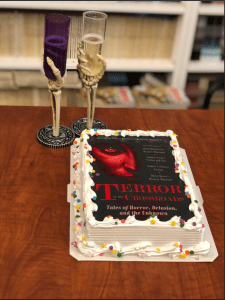
I’m someone who doesn’t mind working in a cubicle. Within the small enclosure, under the circle of a reading lamp in an otherwise dimly lit office, quietly working, I’ve been known to be so engrossed that a colleague approaching to talk to me has elicited a shout of surprise.
The potential of dread in someplace as mundane as an office cubicle aside, how is this related to the digital anthology recently released from Dell Magazines via our imprint Eris Press? Well, my colleague Emily Hockaday, the associate editor of Analog and Asimov’s, sits in the cube next to mine. Over the years, we’ve passed stories from the four magazines right over the wall—and often these have been the creepier tales that cross our desks. We both enjoy the horror genre, and we realized that while the mystery magazines do publish some science-fictional mysteries and the science fiction magazines some mysterious science fiction, the types of tales that met somewhere in the center frequently tread into the horror realm. This is the setting from which grew the idea to put horror stories from all four titles into one anthology volume.
To get started, my coeditor and I began considering the “center,” the crossroads where dark themes from EQMM, AHMM, Asimov’s, and Analog gathered: those of delusion, metamorphosis, obsession, and the unknown. The characters we encountered solve puzzles (from “Whodunit?” to “What now?”), meet challenges (whether it’s how to protect a community from a mysterious creature in the woods, or how to counter a postapocalyptic future), face their past (when their misdeeds catch up with them—or their memories are entirely erased), battle with ambition (regardless of who pays the price), and grapple with familial and interpersonal relationships (to very mixed results). As in science fiction and mystery, horror tests its characters in the most extreme conditions and makes the reader ask, about so many mortal dangers and moral conundrums, What would I do?
We then had to explore if—and why—this would appeal to readers. The horror genre certainly evokes a personal and visceral reaction, and it is experiencing what some are calling a renaissance. The New York Times Magazine dubbed 2017 The Year of Horror. In 2018, Jordan Peele’s Get Out garnered four Oscar nominations, which was unusual for a movie released so early in the year, unfortunately very unusual for a movie with a Black writer and director, and unusual for the genre category. (Only a small handful of other horror films have ever been nominated for Best Picture, and only one has ever won.) With an influx of classic novel adaptations and even the development of terror-tinged teen shows and comedies, we see this on TV as well. And, of course, we see it on contemporary bookshelves. As Parul Sehgal said in a recent article, “Literature—the top-shelf, award-winning stuff—is positively ectoplasmic these days, crawling with hauntings, haints and wraiths of every stripe and disposition.” (One of my favorite books from last year, The Changeling by Victor Lavalle, recently won the August Derleth Award for Best Horror Novel.)
I’m not surprised that the genre is presently striking a note with audiences and readers. Most literature offers an escape, but while fantasy, romance, or adventure might take you to your loftiest dreams, horror takes you to your darkest ones. The reader puts down a book and emerges out of a dungeon. Immersing in a scary story is a thrill, yes, but it’s also a relief to feel horrified, eagerly, by excellent prose—before someone or something else does it for you. Fiction offers a way to control fear, a feeling that is so often engendered by others, enforced by systemic oppression, heralded by nature, or instilled by trauma or illness, notably depression and anxiety. I may jump when you sneak up behind me at my desk, but I love to be alarmed—as long as it’s by my own choosing, and I have since I was very young. Any other fan of horror fiction (or roller-coasters, or suspense, thrillers, and mystery fiction) knows the feeling. Even while others in our lives look at us aslant, themselves hating the feeling of being uncomfortable, we continue to seek out this feeling.
I went to one of those haunted houses where you have to sign a waiver, go in alone, and be open to however the actors want to interact with you. As I confessed to my sceptical friends afterward, it wasn’t even that scary. What was most distressing, though, was the part where they simply leave you in a pitch-black room by yourself. Because what’s more frightening than I am, the world I inhabit, and the creatures that inhabit it with me? What’s more terrifying than the responsibility of moving through this world, and what specters cause more harm than the ones in our own history and nature?
During a time of political unrest or any other instability, this comes to the surface. Readers and viewers want to jump right in. Successful horror fiction mirrors society and environment; the monsters can just as easily be real as they can be a metaphor, and vice versa. Stephen King, in his introduction to the 2011 edition of The Shining, talks about bringing the characters of his story into “I-hope-this-is-only-a-dream territory[,] where the merely scary becomes outright horrifying.” What compels the deeds of his characters? “Is it undead people, or undead memories?” While King came to one conclusion and Stanley Kubrick to another while directing the 1980 film from the book, the author allows that “perhaps those different conclusions are, in fact, the same. For aren’t memories the true ghosts of our lives?” Are the monsters “real”? Either way, we end up in the same place. Furthermore, horror fiction wants to grapple over the misdeeds and unfinished business of a human life, a family, a community, and a country. To quote again Parul Sehgal, “ghost stories are never just reflections. They are social critiques camouflaged with cobwebs; the past clamoring for redress.”
Mystery and science fiction portray and examine the world in their own ways too, with their list of questions about human nature and our personal and collective past, present, and future. They also bring their own aspects (like puzzle solving, legal inquiry, speculation, and science) and atmosphere (like that of a traditional mystery, noir, or thriller). These genres—on top of their other timely and timeless appeal—are powerfully, and simply, entertaining. We thought, wouldn’t it be great to put all of this together?
And so we felt we would find in our audience (and, hopefully, beyond) those who would relish a fearsome anthology taken from the pages of EQMM, AHMM, Analog, and Asimov’s. Who better to keep you company than characters like those in Terror at the Crossroads, searching for meaning, success, romance, and passion; fumbling through marriage, parenthood, friendships, and work; experiencing all the same doubts and late-night worries that you do, while offering the types of mystery and SF stories you enjoy?
We ran the idea by Janet as well as Linda Landrigan, Sheila Williams, and Trevor Quachri (the editors of AHMM, Asimov’s, and Analog) and Chris Begley, (Dell’s VP of Editorial). Everyone was willing to hop aboard our spooky train. Then we began the fun part, selecting stories for the book. We tried to choose a group of tales with a variety of styles and viewpoints from the last ten years of the magazines. Many of our contributing authors are fans of the horror genre—and a number do write it in it often—but some were pleased to see their story in a new way, or to have a story they took a chance on see a new publication. Meanwhile, we approached the people who made this anthology possible: our subrights and digital-marketing team. Carol Demont, Joy Brienza, and Abby Browning have our gratitude, as does the typesetting team, headed by Sue Lemke and Jayne Keiser. It was my and Emily’s first time putting together a digital anthology, and they walked us through the process and handled the enormous amount of work involved with preparing a book for different digital outlets. Of course, I should also thank my coeditor Emily, for all her work and skill. Dell’s editorial assistant Deanna McLafferty helped us with proofreading and administrative tasks, and Joy designed the fantastic cover. Darcy Bearman helped us with social media and came up with the idea for our digital launch party, which took place last week. We are so lucky to have had a group of enthusiastic and generous authors who gave us their time and participation; you can see some of the highlights here.
The book is full of chills, but it’s the mystery and science fiction you’ve come to love through the pages of the Dell fiction titles. There’s no gratuitous violence or gore, and we tried to run the widest gamut of tales we could, including historical, humor, and straight narrative; epistolary, visual, and experimental forms; novellas and shorts. The tales have garnered EQMM Readers Awards and Edgar Award nominations, and offer a chance to experience horror through the lens of the magazines you may already know.
After all the requisite planning and preparation since we began this project in December of last year, the book is now ready (on Amazon and Barnes and Noble, and soon to come on other platforms), and we are so excited to share it with you.
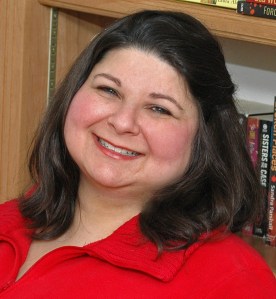
I planned to write today’s column about the role of love in mysteries. Tackling love might be more appropriate on Valentine’s Day instead of Halloween, but it felt appropriate since the Hallmark Channel and Hallmark Movies and Mysteries have already begun airing their Christmas movies. For the next two months, it will be all romance all the time on those channels, one movie after another showing true love being found in two hours. (Wouldn’t that be nice?)
But the events of the last few days have led me to a lot of thinking about the other side of the coin. Instead of love, I’ve been contemplating hate.
So often these days, crime fiction is based on hate. It makes sense. If a character is murdered, the detective—whether a police officer, a P.I., or an amateur sleuth—typically will start out the investigation checking if someone had a beef with the victim. Who hated him? Was the victim a blackmailer? Had he killed someone’s cat? Was he sleeping with another man’s wife?
When the victim is someone who did a horrible thing, or someone accused of doing a horrible thing, it gives the sleuth a means to find the killer. You start with who had motive—who hated the victim—and then consider who had the opportunity and what proof can be found of the killer’s guilt. That’s a solid foundation for solving a mystery, and thus it’s a solid way to plot out writing one.
Hate serves another good role in mysteries. It can make readers feel more secure. This might seem counterintuitive, but think about it. If a character did something horrible, or is accused of it, and then that character is murdered, a reader may take some comfort in that. The reader needn’t worry she’ll face a similar fate in real life because of course she isn’t a horrible person. She’s done nothing to bring murder on. She’s safe.
This is why after a murder you often will hear the police trying to assure the community that this was an isolated incident, a matter of domestic violence, perhaps. The implication is, don’t worry; you’re safe. No one is coming for you. In contrast, if the victim were Little Mary Sunshine and the murderer were a sociopath killing at will, that would be unsettling, both to everyone in the fictional victim’s community as well as to the reader. If random murders could happen on paper, the reader may think, it could happen here, too. Better lock the windows. Keep the children inside.
Of course anyone who has read the newspaper in the last week knows that random murders and attempted murders do happen. They happen for reasons having nothing to do with the victim, but because the perpetrator is full of hate—hate that isn’t predicated on the victim’s actions. There are sociopaths who kill for no good reason (even if a deluded person thinks he has a valid reason). And since crime fiction so often reflects the types of crimes occurring in real life—helping the authors and readers confront the awful things going on in our world and perhaps encouraging them to find ways in real life to better the world—crime fiction often will reflect the hate of extremists.
So there you have it. At bottom, crime fiction largely is about hate. Even if portrayed in a lighthearted cozy murder mystery, the underling story is one of hate. Hate of a specific person because of something she did or something someone thought she did. Or if we’re talking a noir novel or thriller, it could be a story about hate of a group of people, often for reasons having nothing to do with those actual victims. If the book goes into the perpetrator’s point of view, it will be one that subjects the reader to that hate, to the darkness that can exist in a person’s mind, to the pain or fear or just plain evil that drives the killer. Just thinking about it is depressing. And if that’s all there were to crime fiction, I might leave the computer right now and crawl up into a ball and never read or write again. Thankfully, it’s not. For while crime fiction might, at bottom, usually be about hate, it also is often about the very thing I originally planned to write about today. Love.
Why do amateur sleuths put themselves on the line? Sometimes it’s to save themselves, and sometimes it’s because they’re nosy. But often it’s to save someone they care for. They do it for love.
Why do police officers and police detectives (fictional and real) risk their lives? Some might be in it for the power or the adrenaline rush, but many do it to make the world safer, to try to provide justice. They risk their lives to make things better for others. And isn’t that a type of love?
When a thriller hero puts his life on the line, trying to save a victim, often the motivator in those stories is love, too.
And here’s something I didn’t mention above: sometimes criminals, even killers, act out of love. People who would never succumb to crime because of hatred may very well do so because of love. In Les Misérables, Jean Valjean stole bread for a starving child. In the NBC TV show Good Girls, a mother’s love for her dying child was behind a robbery that netted enough money to get the girl treatment, and then led to a series of worse and worse crimes done partly to cover up the first one.
Love also can play a role in crime novels other than motivating a killer or a sleuth. Love can lead people to act against their self-interest, taking blame that isn’t theirs, covering up crimes of others. Maybe even helping bury bodies. In this way, love can make crime fiction so interesting because it addresses how far an average person might go when his back is against the wall. You might feel strongly you’d never kill another person out of hatred. But what if someone stood between you and the medicine your dying child needed? That’s an interesting question, and it’s less depressing than considering murder based solely on irrational hatred.
So while it’s true that there is much hate in this world, and mystery novels often are predicated on hate, it’s important to remember that so much of what occurs in the world and in fiction—even crime fiction—also happens because of love. It’s what keeps books from being too depressing. It’s the light that gives people hope—even at the end of horrible weeks like this one—and it’s what makes readers want to keep turning pages. So, crime fiction authors, don’t get too bogged down in hatred when you write. In the end, the Beatles had it right. All you need is love.
I served in Army Special Operations units, deployed in support of Operation Iraqi Freedom, and survived the Pentagon (which is a combat tour of another kind). It’s been years since I hung up my uniform and transitioned to the private sector, but it’s still the military voices I hear when I write. I’m sure my background is part of the reason. Most of my life I’ve been surrounded by the military—as a soldier, in my job as a civilian, as a military spouse. These experiences have shaped my worldview, and this is my comfort zone. But there is also a part of me that believes there exists a depth and a richness to post-9/11 veteran characters that hasn’t been fully explored in crime fiction.
Female Characters
The post 9/11 generation has a perspective on war that’s different from others. Our country has been fighting for almost two decades, and there are more female combat veterans than in any other conflict. Women have deployed with Special Forces units, flown combat missions, patrolled the streets of Iraq and Afghanistan. And for the first time since World War II, two women are Silver Star Medal recipients—the third highest combat decoration for valor.
Arduous military schools, once exclusive to men, are now open to women. Ranger School, a combat leadership course on small-unit tactics—notorious for their high attrition rate—recently had its first group of female graduates.
Both Army Special Forces and Navy Sea, Air, and Land teams (SEALs) have opened billets to women. And combat branches, once closed to women, are open to all qualified service members.
Now, more than ever, there is space in crime fiction for female characters with warrior skill sets traditionally seen in male characters.
But what’s even more interesting to explore is how experiences like these shape a female character’s point of view—how they see their environment, relate to their family and friends, process love and loss. And how they bring their unique skill set and perspective to postmilitary occupations in law enforcement, in the private sector, or as criminals.
Criminals
Transition to the civilian world affects veterans differently. Many are able to assimilate, find civilian jobs, and move forward with their lives in a productive and meaningful way. For others, it’s more difficult. Substance abuse, unemployment, and mental-health issues often lead to petty crimes and other criminal activities. Unfortunately, domestic violence can also be a byproduct of war. And still others choose to use skills they attained in the military for criminal endeavors. Sadly for our veterans, the news is filled with examples. But for crime-fiction writers these examples also provide some interesting character studies.
Like the four Army Rangers who robbed a Bank of America in Tacoma, Washington. One intended to use money from the bank robberies to start an outlaw motorcycle gang and take over control of drug trafficking in his area.
Or the three former U.S. Army soldiers who were convicted in a contract killing ordered by an international crime boss.
And then there was the disgruntled soldier separated from his family who wanted to leave the Army and tried to fake his own death by slashing the throat of a man who looked like him and setting his house on fire.
What drives veterans to make these decisions? Is it disillusionment, despair, greed? Any and all of these reasons may apply. I’m sure there are others, too. Crime fiction offers a platform to explore these choices and mindsets through flawed and complex characters.
Victims
Veterans are prey for criminals as well, their benefits often a favorite target.
Veterans, especially the disabled, rely on their benefits as a large portion of their income, and con artists target veterans for bank-account information. The criminal pretends to represent a veteran’s organization and claims the victim’s benefit deposit must be “re-verified” following suspicious activity. The veteran provides the information. The criminal steals the veteran’s identity, changes the direct deposit information, and redirects money.
Data breaches of organizations that hold veteran information are prevalent as well. Recently, the Pentagon had a breach that compromised travel records of civilian and military staff—this included personal information and credit-card data. Data like this is often sold on the black market and used by criminals to make transactions and create fake identities.
On a larger scale, the Office of Personnel Management (OPM), the human resource arm of the federal government, was hacked—a breach that had massive counterintelligence consequences. Security-clearance files for current, former, and prospective federal employees—many military veterans—were compromised. Information included interviews with a subject’s neighbors, employers, educators, references, and spouses. Record checks with local law enforcement and vulnerability assessments for foreign influence and exploitation were also included.
Crime fiction gives us a platform to explore these issues and vulnerabilities.
More than darkness
More exists in veterans’ lives than the dark trappings of war. There are lighter moments, too. When I’m asked about my military service, the deployments, the military training aren’t what immediately come to mind. It’s the lifelong friendships I’ve forged along the way, and the wacky moments we’ve experienced together.
Like the night a fellow Army officer and I returned from her baby shower and realized we both could field strip an M16 rifle, but assembling a bassinet wasn’t in our wheelhouse.
Or the practical jokes, like one that was played on a soldier in my unit. He was notorious for falling asleep in his car before formation. One morning, his platoon members saran-wrapped the car doors shut, trapping him inside.
And the Halloween deployment to Egypt when one of my soldiers wrapped himself in toilet paper and worked his shift dressed as a mummy.
Stories like these go beyond the trigger-pulling, door-kicking military characters that we often see. They offer insightful (and sometimes humorous) resting moments in crime-fiction stories that may otherwise be dark.
The post 9/11 generation of veterans is diverse—some may argue the most diverse in history. People with different backgrounds, nationalities, education levels, and skill sets have served our country. Their experiences and worldview are unique and pave the way for some interesting fictional characters. I look forward to seeing more post 9/11 veterans in crime-fiction stories.
 SOMETHING IS GOING TO HAPPEN