“What True Crime Podcasts Can Teach Us About Writing Mysteries” (by Matt Coleman)

Matt Coleman is a writer of mystery and comedy who makes his Ellery Queen’s Mystery Magazine debut in our current issue (November/December 2019) with the story “Stray Dogs.” He is not a newcomer to the mystery scene, however.  His debut novel, Juggling Kittens, was recently optioned for a feature film, and he has followed that book up with two more well-received crime novels. In this post he addresses a subject that has not been touched upon much on this blog site: the relationship between true crime and crime-fiction writing. It’s a timely topic for EQMM. Due to all the great feedback we’ve had to our web-only true crime column “Stranger Than Fiction,” we’ve decided to bring the feature into the magazine. Starting next spring you’ll be able to find original true crime articles from Dean Jobb in our pages, and we’ll continue to bring you all of the columns on our website, including six true crime, web-only book review columns per year. Don’t miss it! And if you’re a podcast listener, stay tuned for the true crime podcast that EQMM will soon be launching in tandem with Alfred Hitchcock’s Mystery Magazine.—Janet Hutchings  

The secret to a good magic trick is never how the magician pulls the proverbial rabbit out of their hat. The real trick is getting the audience to look at anything other than the hat. The distractions. You know, I assume. Truth is, I have no earthly idea. I have never successfully completed a magic trick. Nor do I make a habit out of messing around with rabbits. I do, however, know a thing or two about teaching and a little bit about writing mysteries.

Teaching isn’t much different from magic. We spend most of our time attempting to trick kids into learning. And most of our tricks come from the world outside of school. The best teachers divine their inspiration from the “real world.” And, I would argue, mystery writers are no different. Tricks of the craft—tropes like the red herring or the MacGuffin or the mystery box—are utilized in mysteries not simply because they are convenient to a plot. They have become tropes of mystery fiction because they exist in real mysteries.

While many of us may not see these elements in real-life mysteries, that is not because they are not there. Much more likely, we don’t see them because they get weeded out in the telling. Newspapers and other media outlets are often charged with relaying the facts, filtering out the more confusing elements that, at one point, turned a tale of crime into a mystery. But one outlet preserves the narrative form of true crime. And that outlet is the true crime podcast. Like many of the best true crime books, the true crime podcast is all about the telling of the story. Which means, they are filled with all the elements of a good mystery.

Take, for instance, the MacGuffin. The MacGuffin, just to review, is a term made famous by Alfred Hitchcock. In simplest terms, it an object, person, or event in a story that exists (within the story) merely to ignite the plot. The best example in fiction is The Maltese Falcon. The “stuff dreams are made of.” The bird from the book/movie to which it provides the title is really irrelevant. But a story erupts around it and because of it.

One of the best podcast examples of a MacGuffin occurs in Bear Brook. From New Hampshire Public Radio, the podcast begins with four bodies discovered in two barrels in the woods of Bear Brook State Park. Most mystery readers/writers would never suspect the actual bodies in a murder mystery to, themselves, turn out to be a MacGuffin. But, in the case of Bear Brook, that is exactly what happens.

Between amateur sleuths and geologists and genetic genealogy and even a hot-air balloon, the story of searching for a killer becomes far more fascinating than the decades-old killing itself. And while it may sound dismissive to call human beings MacGuffins, their case led to the science used to capture the Golden State Killer. So as heartbreaking as it is to hear [SPOILER] that some of the bodies are never identified, the investigation is riveting and very, very important.

Another clear-cut MacGuffin used in a podcast shows up in the opening minutes of S-Town. Created by the producers of Serial and This American Life, S-Town follows Brian Reed’s investigation of a murder in Woodstock, Alabama. What Reed almost immediately learns, however, is that this murder is nothing more than a MacGuffin. And S-Town is no murder mystery. But what it becomes is an exploration of a true life mystery box.

As J.J. Abrams famously discussed in his TED Talk, the mystery box is that element of the unknown which, never fully opened, offers limitless potential suspense and wonder. So, in a case like the TV show Lost, the mystery box of the island only reveals a handful of its heavily guarded secrets. The real story becomes the people on the island, and their juxtaposition to the infinite suspense of that unopened mystery box allows the viewers to delve deeper and deeper into their characterization.

S-Town shows us what this looks like in real life. The town of Woodstock, and more importantly, the central character of John B. McLemore become mystery boxes. And [NO REAL SPOILER HERE] we never find out all of their secrets. But something about the endless possibilities make the journey feel like a mystery, even after we have left the murder MacGuffin way back in our rearview.

Which brings us to the hallmark of any good mystery: the red herring. The red herring is the clue meant to distract us. Best personified by the character, Red Herring, in A Pup Named Scooby-Doo, the red herring leads us down the wrong path. Just as Fred Jones always suspects Red of the crime, what the reader/viewer discovers, along with the Scooby Gang, is that Red was nothing more than a distraction. The sleight of hand meant to take our focus off the hat.

One of the classic examples of red herrings galore in a podcast is during the first season of Up and Vanished. Famous for the fact that host Payne Lindsey actually helped solve the case in question, Up and Vanished investigates the case of Tara Grinstead. While the attention Lindsey brought to the case finally helped solicit a confession, the early episodes of the podcast are rife with red herrings. A business card was left in Tara’s door, a medical glove was dropped in her front yard, and cadaver dogs hit on remains down a local trail called Snapdragon Road. These are all salacious leads, taking Payne Lindsey and his listeners down rabbit hole after rabbit hole. None of which lead to the real culprit.

An even better example may come from the second season of Catherine Townsend’s podcast Hell and Gone. Both seasons are wonderful, but the second season’s focus on the mysterious death of Janie Ward at a party gives us a textbook example of how to utilize red herrings. [MAJOR SPOILERS] Very early in the podcast, Townsend drops hints and mentions at what appears to be the actual cause of death: rubbing-alcohol poisoning. At the party, a punch was made with fruit soaked in rubbing alcohol. Janie Ward was said to have been eating some fruit. And rubbing alcohol poisoning turns out to be a highly likely and interesting explanation. But what Townsend does in her telling is cloud our vision of one interesting explanation with multiple red herrings. And, take note, each is a little more extravagant than the last, all serving to distract us from the truth. We get tales of high-school drama, a possible town cover-up conspiracy, and even conflicting autopsy reports. The red herrings are used masterfully to keep our attention, before the curtain gets ripped back and there was our culprit all along.

So while the best place to look for a clinic on writing mysteries will always be the best mystery fiction, the lessons I find myself using over and over again in my own writing often come from true crime podcasts. My recent story in Ellery Queen Mystery Magazine, “Stray Dogs,” pulls heavily from a local unsolved mystery and multiple bits and pieces from podcasts. I am obviously going to make you read it to look for evidence of that fact. You know, if it’s even a fact, at all. Look at anything other than the hat, and all.

Posted in Books, crime, Fiction, Genre, Guest, History, Real Crime, Stranger Than Fiction, Writers, Writing | Tagged , , , , , , , , | 1 Comment

“A Conversation With Indie Anthology and Magazine Publishers” (by Angelique Fawns)

EQMM‘s Department of First Stories in the current issue (November/December 2019) contains a story by Angelique Fawns, a producer and writer for Global TV in Toronto. Although she only started writing fiction last summer, Angelique’s stories have appeared online and in several small-press magazines. In past decades, whether someone qualified for EQMM’s Department of First Stories was usually easily determined. It is more complicated today, with so many small, nonpaying markets for stories available. Often, these days, a judgment call is required. Some of the things we consider are how frequently an author has been published in small journals or online and how wide the circulation of those publications is. What is most crucial is whether the previous appearances were what the industry considers “paid professional publications.” Small journals often pay nominal amounts or nothing at all. EQMM will usually accept an author for the Department of First Stories if his or her previous publications fall into that payment category. But another factor is whether the Mystery Writers of America has approved the publisher for award consideration; any previous publication in a magazine or journal approved by MWA disqualifies the author from appearing in EQMM’s Department of First Stories. As complicated as the appearance of so many new, small markets for mystery and crime fiction has made our job, I think this proliferation of markets is a good thing. As Angelique explains in this post about her own experience with small presses, they give many talented authors a start while also providing personal attention and encouragement. Perhaps what she has to say will point some new writers in a promising direction.—Janet Hutchings

It is an exciting time to be a writer in this brave new world of self-publishing and expanding markets. With the advent of several online platforms, including Amazon, Kindle Direct Publishing, Kobo, iBooks, and Smashwords, authors no longer need to rely on traditional publishers to get their work out into the world.

A good place for new (and even established) authors to get their work printed and do some networking is through small independent publishers and their anthology or magazine projects. Who are the individuals taking the time to create these books? What motivates them, and is there any profit margin? Where do they see the future taking them? In order to get a sense of the people behind the anthology and indie-magazine covers, I asked a few publishers these very questions.

Azzurra Nox is the force behind Twisted Wings Productions, and she has a short story horror anthology coming out in February 2020 called Strange Girls in Horror. She launched her company in 2015, with her first Women in Horror anthology My American Nightmare printed in 2017.

Nox says, “I work as a graphic designer for my day job. Which I guess helps with being able to have an eye to choose the most appealing book covers for the anthologies I put out.”

As with most of the publishers I interviewed, her ventures are more of a labor of love.

Nox explains, “By far, My American Nightmare: Women in Horror Anthology has been the most successful I’ve printed, but all profits made were used to invest in the second anthology that I’ll be printing. All money made gets invested back into new projects that will showcase a whole new slew of women writers.”

When asked why she does what she does, she says, “I look forward to putting together more Women in Horror anthologies in the future! By far, those have been the most fun to do, because writing is a solitary task—but when you work with other authors then you’re able to forge new friendships, and I think it’s important for writers to have friends that are writers too, because they will be able to understand many of your struggles that your nonwriter friends may not comprehend.”

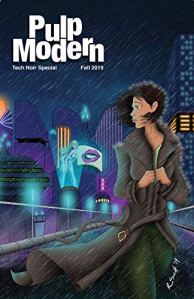
Alec Cizak is the brainchild behind Pulp Modern, a fiction journal that publishes crime, fantasy, sci-fi, horror, and even delves into topics that are typically taboo. Though he wishes he was born in the era where pulp fiction was a profitable venture, he teaches literature and composition to pay the bills. The current issue of Pulp Modern features futuristic crime stories. To date, he’s published fifteen issues of the magazine.

Cizak says, “I started publishing Pulp Modern because I didn’t see any journals at the time that brought the major genres together. I also didn’t see any big-time publications publishing riskier stories, so I felt there was a need for a market that could take chances since no advertising dollars were on the line. As time went on, I decided to continue publishing Pulp Modern because it provided a place for new writers to get their work in print. I suppose it’s like a farm team in baseball. Writers get their work in Pulp Modern and then move on to get agents and contracts with the Big Five and all that good stuff.”

When asked about profitability, he says, “This is, financially, a losing venture. The recent Tech Noir issue cost about six hundred dollars to produce. It’s generated about fifty dollars in sales, and I doubt that number will even double. This is a labor of love. The independent pulp-fiction community has had lags over the last ten years or so, moments where there were almost no markets for new writers, and I’ve gone through periods where I thought I would quit, but enough people would write to me and insist I keep Pulp Modern going that I gave in every time and got back to it. There are many, many writers out there. Some of them are really good, and they don’t have connections in the publishing world. A journal like Pulp Modern is there to make sure those unheard voices are heard.”

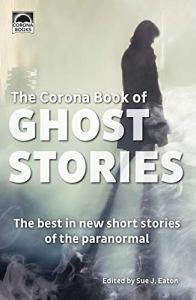
Lewis Williams works full time in the industry, saying “books, editing, and writing are my day job.” He is the founder of Corona Books UK, and claims he can’t take all the credit because he has friends, family, and business partners who help quite a bit. Corona Books UK was started in 2015, and have published The Corona Book of Ghost StoriesThe Corona Book of Science Fiction, and three volumes of The Corona Book of Horror Stories.
He started his small press as, “a desire to seek out, celebrate, and give a voice to some of the writing talent out there that mainstream publishers are apt to ignore. Genuinely, there’s so much writing talent out there in fields like horror and science fiction. For our last horror anthology we received over 800 short-story submissions, and whilst it’s true not all of them were of the standard we’d want to publish, there were still far more stories we’d have been very pleased to publish than there were room for in one book.”

As for profitability?

Williams says, “It’s true to say we’re doing this more for art’s sake than for profit, at least at this stage, and if you genuinely counted all the hours that went into producing something like The Third Corona Book of Horror Stories from 800 submissions, profit would just be a distant spot on the horizon!”

Future plans include “The Fourth Corona Book of Horror Stories for 2020 and, as long as my heart’s still beating, a horror anthology every year after that! We also plan to do more with science fiction and other genres—and will be announcing plans soon.”

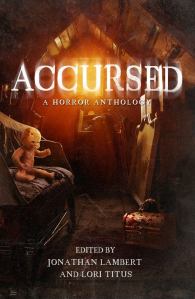
Jonathan Lambert is the founder and editor of Jolly Horror Press, with a new anthology Accursed available December 10, 2019, and Betwixt the Dark & Light and Don’t Cry to Mama now available on Amazon. He works as a senior executive at a U.S. Federal Government Agency, and spends his weekends working on his writing and anthologies.  His press specializes in comedy/horror.
Lambert says, “after a few years of experience selling short stories to anthologies, I just decided I could do a better job. Provide better customer service, and be more author friendly. I could also create a press dedicated to horror/comedy. Finally, these stories could have a home. I just needed the name, and one day Jolly Horror Press just popped in my head. The rest is history.”

Lambert explains, “I use the words ‘labor of love,’ and that’s true. I don’t care if our books are profitable. I’d love it, of course, but it’s not going to stop us from producing quality anthologies. I do have that day job, you know?”

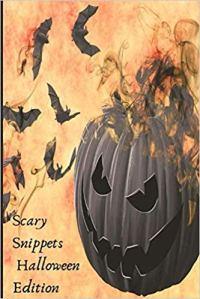
Natalie Brown just recently released the Scary Snippets Halloween Anthology, and is a stay-at-home mom with three small boys. She opened Suicide House Publishing on July 28, 2019. Scary Snippets Halloween was its second debut publication; with the first being Calls From The Brighter Futures Suicide Hotline (hence the company name) released on September 19th.
Brown says, “I became a member of the online horror-writing community in February of this year. During that time, I have had so many ideas for future collaborations and anthology topics. Since then, I have been offered so many amazing opportunities as an author; I really wanted to pay it forward. It means a lot to help other people’s dreams come true like others did for me.”

Suicide House currently has a call out for Christmas microfiction, and Brown says, “one plan we have is to create a market for people to take their microfiction holiday pieces. We plan to have collections for every holiday, with Christmas well underway currently. Also our insect-horror anthology Death and Butterflies will have two installments released in early 2020, with the first being set to release January 1st.”

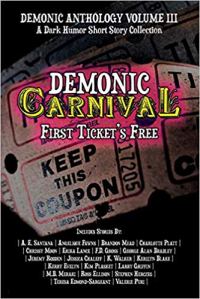
Valerie Willis works as the lead typesetter for Salem Author Services serving under the main imprints of Xulon Press and Mill City Press and also runs Battle Goddess Productions.  She has been hosting the Demonic Anthology since 2017, and currently has three Demonic books in print.

Willis says, “I wanted to traditionally publish in the beginning. It was through conversation with several literary agents that I discovered some very important things about myself and my writing. First off, I blend and mix so many genres that my work can be difficult to market and target the right audience. Secondly, they gave me resources and advice and set the expectation that my story was good, but if I wanted to self-publish, I would have to become a small press or entity that wasn’t afraid to push out the same quality look and feel of the big publishers. With all of the good advice, I moved forward with the reassurance that this had been my fate. Learning so much, and after much practice, I eventually opened up Battle Goddess Productions so that I may publish, push, and help other authors like so many had done for me.”

Willis says her anthologies are different because, “we are an unexpected blend, with paperback books that are a little more decorated inside than the average book. Authors are encouraged to blend and mix genres and we do our best to let the readers know what to expect.”

As for profit, “right now, it’s a tight fit. Most of the profit earned is rolled right back into the business to maintain sites, pay for subcontractors, and mostly into the advertisement and marketing. We are not pushing out to our full potential, considering I am technically still a one-man-army raising a family with a day job. Still, we sell books constantly and steadily even when we are not pushing for all our titles at once.”

Willis has no plans to slow down, saying, “it would be wonderful if in the future I could even provide several imprints to include genres outside the speculative-fiction focus that we currently have built. If you need something dark, fantasy, or even off the beaten path, know that you will definitely find it here at Battle Goddess Productions.”

As an author with stories in all of these anthologies, I personally appreciate the efforts of the individuals behind the pages and the time and attention they pay to their passion. It truly is an exciting time to be a short-story writer!

Posted in Anthologies, Books, Magazine, Noir, Supernatural, Writers, Writing | 4 Comments

“Ordinary, Run-of-the-Mill People” (by A.M. Porter)

A.M. Porter has traveled the world writing articles and nonfiction books, and as you’ll see in this post, she’s also had some interesting jobs closer to home, in her native Canada. More recently, she has turned her hand to writing mystery fiction, and her first published story, “The Drawings,” appears in the Department of First Stories in our current issue, November/December 2019. The first book in a series she is working on, set in the 1950s in a fictionalized version of her hometown, Stratford, Ontario, was long-listed for the CWA Debut Dagger Award in 2017. We’re pleased to welcome this talented newcomer to EQMM! —Janet Hutchings

A couple of years ago I was lucky enough to be hired for what I consider a mystery buff’s dream job: doing research on true crimes for a television series. I was essentially getting paid to find and read all about murders, how they were committed, and how they were investigated. Working from home, I spent hours combing through online newspaper archives and doing Google searches on my computer. (The words ‘‘police’’ and ‘‘baffled’’ proved to be the best search terms for the latter activity.)

I found a surprising number of grisly stories: a man out for a walk killed by crossbow, a woman dismembered and stored in the attic of a Northern Ontario cottage, a couple murdered by their troubled son, who threw the bodies into the family truck before driving to a restaurant called Moxie’s and consuming a 10-ounce steak dinner along with five Blue Zen martinis.

But one of the most interesting cases I looked at was the killing of Maria Wong.

Originally from Hong Kong, Ms. Wong, 44, was well known in Toronto’s Chinese community, and well liked. Part owner of a popular Chinatown restaurant, she was described by everyone who knew her as chatty and always smiling. She not only donated to charities but was also the kind of woman who would bring treats to the English classes she attended at the local library.

On the afternoon of February 11, 1999, she could have had no idea that she was being followed home from her English class, then again when she went out later to buy a take-out meal for the family dinner. Inside the car was a motley crew of four, a man named James Pierce, his girlfriend, a former prostitute named Lisa Bateman, and a pair of teenagers, Chris Ortiz and Norman Figueroa.

No sooner had Ms. Wong pulled into the garage of her suburban house for the second time than she was attacked. With Figueroa acting as lookout, Ortiz stabbed her several times in the neck and throat, frustrated by how long it took her to die. The pair then drove off in Ms. Wong’s car, a dark green CRV, leaving it a few minutes later at a nearby strip mall.

Ms. Wong’s elderly father-in-law was the only person at home that evening, but he heard nothing. Her husband of twenty-four years, Shu Kwan ‘‘Johnny’’ Wong, was at work at Champion’s Off-Track Betting, a business he co-owned. A seventeen-year-old niece, visiting from Hong Kong, was at night school. Offered a lift home by a fellow classmate, it was the two of them who discovered Maria Wong’s lifeless body in the garage several hours later. The classmate, Jason Yu, called Johnny Wong first. He returned to the house right away, and was visibly distraught at the sight of his dead wife. Then the young man called York Region Police.

Johnny Wong was openly and immediately cooperative with the police, signing consent forms that allowed detectives go through his cell phone and financial records. But as the weeks passed, they had little to go on.

Ms. Wong’s murder in a quiet suburban neighbourhood seemed random and inexplicable. If the motive was simply robbery, why hadn’t the attackers gone into the house to search for valuables? And why had the stolen car been so quickly abandoned so close by? The handful of leads that came through Crime Stoppers tips proved to be dead ends; all of the suspects had alibis. Four months after the murder, headlines described the slaying as ‘‘still puzzling’’ the police. By then, Johnny Wong had sold the family house and his car and moved back to Hong Kong.

The only real clue the detectives in charge of the case, Les Young and Bill Sadler, had were the recollection of various neighbours, who said they had noticed two “swarthy” men on the street that night, talking on cell phones.

That left Sadler with the unenviable task of combing through 30,000 cell-phone calls, while his colleagues carried on with the mostly fruitless legwork. Working late each night and over the weekend, Sadler went through the list, checking each number, one by one. What finally caught his attention was an absence: several phone calls back and forth from Johnny Wong to a particular number, which suddenly stopped after the 11th of February. That number belonged to a man named Andre Jones, who worked as a bouncer at Champions, and was the first real clue that Ms. Wong’s death may not have been as random as it initially seemed.

In many classic murder mysteries, the co-conspirators agree not to see each other for a while to avoid suspicion. In this case, it looked odd.

More cross-referencing led Sadler and Young to calls made by Jones to Pierce. Cell-tower records showed that not only was he in the area on the day of the murder, but was busy making calls to Jones, Ortiz and Figueroa. Pierce happened to be facing charges for assaulting Bateman, which led to led the police to her. She wasn’t very good at cooking up any kind of innocent explanation, which left the detectives even more curious about her. They got a warrant to tap her phone.

But a real motive was to be found in Johnny Wong’s financial history. He clearly liked to gamble, and usually lost. Deeply in debt, it was notable that his wife’s $600,000 life-insurance policy would easily take care of all his problems and leave a big chunk left over for him to start a new life.

What really brought the story together was Bateman’s penchant for boasting. She was recorded telling a friend that she planned to write a movie script based on her involvement in the killing, and hoped it would make her famous.

It turned out that Wong had originally hired Andre Jones to kill his wife for him—he had even gone shopping at Walmart for a red tracksuit that wouldn’t show blood spatters—but he lost his nerve and got his friend, Pierce, to do it instead. Pierce hired Ortiz and Figueroa with the promise of a $2,000 payout. He also got rid of the murder weapon and the bloody clothes. Wong was eventually extradited from Hong Kong, tried, and sentenced to life. Pierce got sixteen years for conspiracy, Jones and the two younger men, life with the possibility of parole after 14 years.

Case closed.

What I found fascinating about this terrible tale, a tale of the ultimate betrayal of an average, middle-aged woman, was that simple mistake on the part of Johnny Wong. The other thing was the character of Lisa Bateman. She agreed to testify for the prosecution in return for being put in a Witness Protection Program and wasn’t charged. But she kept telling people she was in the program so got kicked out.

The television series never did get off the ground, but I held on to my notes with the idea that someday I might write a story about it, a story about the killing of an innocent woman from someone like Bateman’s point of view.

There was something about her involvement that underlined the fact that most murders are committed by ordinary, run-of-the-mill people, people who make mistakes, who aren’t very smart, who dream of being famous. People who somehow combine within themselves the human and the monstrous. It may not be the stuff of the kind of police procedural you can’t put down, but in real life, it’s them who kill.

Posted in Characters, crime, Genre, Guest, Real Crime, Story, Writers | Tagged , , , , | 2 Comments

TO HAUNT OR NOT TO HAUNT?

With Halloween just hours away, I thought I’d try to answer a couple of questions that sometimes come up at the writers’ conferences and conventions we attend: 1) Does EQMM publish stories involving the supernatural? And 2) If not, why not?

The answer to the first question is simple: Yes, but only very infrequently.

The answer to the second question—which seems to be demanded by the rarity of our excursions into supernatural terrain—is complicated. It begins with tradition. EQMM was launched with the aim of bringing together between common covers a wide variety of different types of crime and mystery fiction. Founding editor Frederic Dannay boasted about this in his first issue, announcing that readers would find stories of the “hardboiled” school, the “modern English school,” the “modern American school,” and even stories fusing humor and mystery. He was right to point to the variety of the new magazine’s content as one of its pivotal features, for he would break new ground by publishing gritty, realistic stories alongside classical mysteries and other fare. It’s my view that in bringing a number of  different subgenres together in EQMM, Dannay played a crucial role in weaving mystery and crime fiction together into the overarching genre we have come to celebrate today (at events such as Bouchercon, which turns 50 tomorrow, on Halloween, as the 2019 convention begins in Dallas!). But the supernatural crime story, which has become so popular on today’s mystery scene, was only sparely represented in EQMM in Dannay’s day, despite his goal of covering the whole genre. And this may go back to Ronald Knox and his famous “Ten Commandments of Detective Fiction,” published in 1929, number two of which was: “All supernatural or preternatural agencies are ruled out as a matter of course.”

A writer of detective stories himself, Knox was an important influence on Britain’s Golden Age of Detective Fiction, and Frederic Dannay and Manfred B. Lee, writing as Ellery Queen, saw the publication of their first novel, The Roman Hat Mystery, in the very year that Knox formulated his commandments for the detective story or  “fair play” mystery. Although they gave a distinctly American twist to the Golden Age story, Dannay and Lee were writing very much in the tradition Knox encapsulated—a tradition in which the model for the mystery story was a game (the “grandest game in the world,” according to John Dickson Carr) in which the reader could play along and attempt to solve the crime, given all relevant clues by the author (thus the term “fair play”). When EQMM was sent out into the world more than a decade later, it contained many stories that could not be considered detective stories in Knox’s sense at all—in fact, Raymond Chandler, whose work would eventually appear in EQMM’s pages, formulated his own ten commandments for the detective novel, and they provided a model for a very different type of story. It is worth noting, however, that although Chandler’s commandments nowhere include the word “supernatural,” commandment number three—“It must be realistic in character, setting and atmosphere. It must be about real people in a real world.”—does, in effect, seem to exclude all supernatural elements. So stories involving the supernatural were not considered by either major school of mystery writing—the classical or the hardboiled—to be part of the genre in EQMM’s early years, though for reasons specific to each. By taking a quick look at those reasons, I think we’ll be able to see some ways in which the supernatural tale was able to open doors into the contemporary mystery genre.

For the Golden Age writer, the objection to the introduction of supernatural agency to a detective story was, essentially, that it would be unfair to the reader. For if some force affecting events but operating outside of the laws of nature (or human nature) were to turn out to be at the heart of the puzzle, readers would be unable to solve the problem from clues dropped by the author—they would have nothing to go on, it being impossible to know just what to expect from a supernatural agent. It’s tempting to think, therefore, that a fair-play mystery requires realism, but in fact, I think what’s requried has little to do with realism in the sense in which that term is usually applied to literature. One of the criticisms leveled at writers of the Golden Age school by hardboiled writers was that their stories were artificial constructs, without credible characters or motivation, focusing too exclusively on a complex puzzle. They urged “realism” as an antidote to Golden Age artificiality. What a fair-play puzzle mystery does require, I think, is not realism but a rational framework—a framework in which things take place according to patterns the reader can understand and have a chance to predict, rather than coming entirely out of left field. But I think this need not necessarily exclude the supernatural.

An example that comes to my mind in this regard is the story “Normal” by Donna Andrews, from the May 2011 issue of EQMM, in which the characters almost all have some supernatural powers, but what those powers are, and the limits to them, is made known to the reader early in the tale. So there are rules, and the rules allow for predictability and deduction. I suspect that even Ronald Knox would have considered such a story to be in the Golden Age tradition, even though the characters are supernatural.

But what about the objection to supernatural agency made by the hardboiled school—that a detective story should be about real people in a real world? Many have argued that Chandler’s own beloved character Philip Marlowe is far from “real”—that he is an idealized hero, unrealistic in his incorruptibility. But Chandler felt Marlowe must be so in order for his books to have moral weight, and his objection to the artificiality of the Golden Age mystery was, I suspect, primarily that they treated crime and its solution as a game, rather than striving at the same time to address its moral dimensions. And if that is at the heart of his commandment that the story should be about real people in a real world—that it should relate to genuine and profound moral concerns—I think that stories involving the supernatural need not necessarily be ruled out, for some of the most notable recent examples of such cross-genre mysteries are clearly intended to address moral issues. The several supernatural series of Charlaine Harris (the author who opens our current issue—November/December 2019) seem to me to belong to that category; some of the stories can be seen as allegories, addressing social and moral dilemmas that could not be as easily conveyed to readers using human characters.

For the reasons just mentioned, I think it makes no sense to attempt to exclude the supernatural from our genre—and our genre would be poorer if we did. But there is a reason—and I think a good one—for supernatural tales to remain rather rare and special inclusions for EQMM. We’ve noted that writers can sometimes achieve similar ends to what is achieved with more conventional crime stories using supernatural agency, but surely a tale involving the supernatural is meant to do something in addition to that. It seems to me that it is precisely the “spooky” element—that is, the element of the inexplicable—that attracts readers to such tales and provides the frisson of fear they seek. In a mystery story, what had been inexplicable is generally explained by the end and some moral resolution or at least redemption is attained. But is it not true that in tales of the supernatural, even if the murder itself is solved by rational means, something inexplicable must remain? Some sense of what we cannot fathom—that otherworldly presence? That makes for a different kind of reading experience, and it may draw a different type of audience from the mystery, and so, although there is clearly some crossover between the mystery and the supernatural story (and their respective readerships), the latter will probably never be EQMM’s bread and butter, but instead, a spice.

Happy Halloween to all, and congratulations and good luck to authors and readers enjoying it at the special 50th anniversary Bouchercon, especially our best-short-story nominees: Barb Goffman and Art Taylor for the Anthony and Macavity; Twist Phelan and S. J. Rozan for the Shamus; Craig Faustus Buck for the Macavity—as well as Doug Allyn for winning the Edward D. Hoch Memorial Golden Derringer for Lifetime Achievement and Peter Lovesey for being Bouchercon’s Guest of Honor for Lifetime Achievement!—Janet Hutchings

Posted in Books, Ellery Queen, Fiction, Genre, Magazine, Supernatural | Tagged , , , , , , | 6 Comments

“My Father Made Me a Crime Writer!” (by Richie Narvaez)

Yesterday, EQMM’s final issue of the year, November/December 2019, went on sale. It contains Richie Narvaez’s first story for EQMM, “None of This Is on the Map.” The New York City teacher and writer is the author of the collection Roachkiller and Other Stories, which received both the 2013 Spinetingler Award for Best Anthology/Short Story Collection and the 2013 International Latino Book Award for Best eBook Fiction. His debut novel, Hipster Death Rattle, appeared earlier this year. Although he is already becoming known in the wider world of crime fiction, Richie’s work may be new to many EQMM readers, so his topic for this post—what drew him to crime fiction—was of particular interest to us.—Janet Hutchings

“What drew you to write crime fiction?”

That’s a question that gets tossed at a lot of crime-fiction writers. It’s a good softball query that usually gets answers such as “Oh, I’ve always loved reading mystery stories, so . . .” or “Nancy Drew” or “I didn’t even know I was writing crime fiction!”

But some crime-fiction scribes answer the question the way I would. They say crime was or had been a part of their lives, and so they had a familiarity with, some might even say a fascination for, things beyond the strictly legal. For me, I grew up around crime. This was mostly because my father—a handsome man who resembled Guy Williams and loved bawdy jokes and afternoon drinks—was a criminal.

That’s a tough sentence to write. It sounds judgmental, negative, a flat label. I never thought of Pop as a criminal and I still don’t. But, by the letter of the law, yeah, he was a lawbreaker.

Oh, nothing crazy, nothing true crime podcast-worthy, like a hitman or bank robber. Sorry if that’s what you were expecting. If it were anything like that, don’t you think I would have done a true crime memoir by now?

No, Pop was a numbers runner.

This was back in Williamsburg, Brooklyn, in the ’60s and ’70s. I was a child at the time. My father didn’t live with us. My parents had never married, but they had decided on an arrangement—that Pop would be at our apartment every afternoon while my mother was still at work, so my sister, my brother, and I would not be latchkey kids.

My father would make us lunch—he was a master of grilled-cheese sandwiches—but the kitchen was also his office. There, he’d sip grapefruit juice and gin or have a few beers. We kept a glass for him in the freezer. He had a set chair at the kitchen table, right by the phone, and nearby in the cupboard was a pleather folder with all his papers, paper clips, his fancy metal pen.

And every day, at about two o’clock, the phone would start ringing.

For the uninitiated, the numbers racket is similar to the lottery, just, um, unregulated, therefore, untaxed. To play the game, you call in your three-digit numbers to a bookie, placing bets on each number, indicating whether you wanted to be on the number straight (261) or combination (all the six variations of the numbers 2, 6, and 1, thereby increasing your chance of winning but lowering your winnings).

As a bookie, my father had a set amount of people he called “customers.” He’d take down their numbers and write them into neat columns. His handwriting was neat, confident, efficient. He used onion-thin paper, folded in half with a carbon paper in between. To this day, the scent of carbon paper, of ink always reminds me of my father.

In case you’re interested—and if you’re a crime fiction writer (or reader), I bet you are—the number winner for the day was determined by using the last three digits of the track handle at the local racetrack. The handle is the total amount of money wagered in a day, inevitably a six- or seven-digit number, and this was conveniently printed in the back section of the Daily News.

The numbers ran every day. But on Saturdays, my father took one or all of us for a drive. He drove a black van with no air conditioner and a custom-installed horn that played the theme from The Godfather. La da da di da dum dum dum dum dum.

We thought it was fun to hang out with Pop, because that usually meant getting pizza on Grand Street or hot dogs at the cart next to the BQE. On these drives my father always made stops. Most times he’d tell us to wait in the car, to sit still, and he’d run into buildings for a few minutes and come right back out.

In time I realized that on these stops my father was either picking up money owed him or dropping off winnings. He got a small percentage of anyone’s winnings. and years later he told me that his numbers earnings had gotten him through many hard times.

When I was a bit older, in high school probably, my father took me on one of these drives, and after he came out of one place, he tossed a brick of money on to my lap. He said, “You ever see $10,000 at one time before?”

What do you think my answer was? Exactly. And not since either.

Back then, every once in a while, Pop took us to what he called “the clubhouse,” the headquarters for the local bank. This is where the bookies hung out, dropped off bettings, picked up cash. There were arcade games upstairs, but sometimes we would go downstairs and in the basement there were shelves and shelves of empty cages that Pop told me was once used for cockfighting. At the clubhouse, I got to meet many of my father’s let’s say cohorts, who seemed like regular people to me. Although later I did find out there were men there who would kill people for as little as a six pack.

With all this exposure to crime, it was certain that when I first picked up a typewriter I would turn out . . . it was a horror story about dinosaurs that take over the world, actually. Michael Crichton’s people still owe me a residual check for that. But that was in third grade. Later, in high school, without realizing it, every story I turned in to my creative-writing class was about crime.

And now while I write in genres literary, horror, and speculative fiction, I maintain a special affinity for crime fiction. I don’t mean to romanticize the criminal world, by the way. I understand that laws are laws, and there is an ugly side to all crime. It is just that for me that world is not alien. It is almost comfortable.

What draws any writer to a particular genre anyway? Perhaps many horror writers did see ghosts as children. Perhaps spec fic writers were stung by radioactive scientists. For me, I guess something of my father’s lifestyle, something of that past stuck. Perhaps—not to get too Freudian—crime fiction is my way of maintaining a connection to my father, who while he was a charming rogue, was also distant and hard to know.

Years later, after he had retired to Florida, my father told me that he was still taking numbers and calling them up to a bank in New York. It supplemented his Social Security. And even though doctors had warned him against it, he told me he was still having his drinks every afternoon.

Posted in Characters, crime, Fiction, Genre, Guest, Story, Writers, Writing | Tagged , , , , , , , , | 1 Comment

“Crimehampton: Myth and Reality” (by Elizabeth Zelvin)

Elizabeth Zelvin’s latest short story, “The Island,” appears in EQMM’s November/December issue, which goes on sale next week (though many subscribers already have copies!). The New York City author, recently the editor of the anthology Me Too Short Stories, has received several award nominations for her short stories, and she is also a novelist known for her Bruce Kohler series and for historicals set in the time of Columbus. In this post, she talks about the place that inspired “The Island,” a place she knows well, if from a different perspective than that of most tourists.—Janet Hutchings

Everyone’s heard of the Hamptons. It’s a glamorous outpost of New York City, playground of the rich and famous, surrounded by beaches and bursting with designer summer homes, glittering nightlife, artists and writers, and money. Not untrue, any of it. But it’s only part of the story.

The Hamptons are not exactly an “it.” They’re a cluster of villages and hamlets on the South Fork of the two-pronged eastern tip of Long Island. They’re also a state of mind, a matter of style. They’re lobster, not hot dogs; wine, not beer.

For the beautiful people, the glamor, and the sets of Woody Allen movies, look “south of the highway.” That’s Montauk Highway, better known nowadays as Route 27. North of the highway is where the ordinary people live, both locals and city folk like me who love the peace and quiet, the clean air, the birds and flowers, and the ocean. We have an 800 square foot ranch house—that’s about the size of a subway car. It’s lucky there are no wolves in the Hamptons, because if you huffed and you puffed . . . We try to avoid the phrases “house in the Hamptons” and “East Hampton” because they give people the wrong idea. Instead, we say, “the East End of Long Island.”

It’s true about the artists and writers. East Hampton in particular, like other famed seaside artist colonies, has that magical quality of light that attracts visual artists. What draws the writers? James Fenimore Cooper started the trend two hundred years ago, followed by Steinbeck, James Jones, Kurt Vonnegut, Truman Capote, Joseph Heller, Mario Puzo, E.L. Doctorow, and Thomas Harris. As a setting for fiction in general and especially for crime, the Hamptons have it all: sophisticated arena where old money and brash celebrity mingle; political hatchery; close-knit fishing community; farmland and seascape; vineyards and horse farms, marinas and wildlife preserves.

The most highly publicized real-life murder in the Hamptons was fueled by greed: multimillionaire investment banker husband killed by electrician boyfriend of crazy divorcing wife; real victims, the couple’s two young children. Real life doesn’t need much of a twist.

The fictional murders are less straightforward. Alafair Burke, James Patterson, Nelson DeMille, and Susan Isaacs, among others, have all set novels there. South of the highway, the Hamptons is an upstairs-downstairs with flimsy twenty-first century boundaries: the rich and powerful who open their luxurious houses for the summer and the locals who clean those houses, maintain their gardens, and sell them fish and corn and fresh tomatoes. The novelists put that conflict in play as well as the north of the highway version, which is more like town and gown: the ordinary summer people and the local year-rounders.

I’ve set two of my own works in the Hamptons. My third novel in the Bruce Kohler series, Death Will Extend Your Vacation, takes place in an imaginary Hampton I call Deadhampton—Dedhampton on maps and town documents—in which Bruce and his friends take shares in a clean and sober group house and find a body on the beach at the end of Chapter One.

My short story, “The Island,” in the November/December 2019 issue of EQMM, refictionalizes an experience I had while researching Vacation: a day out fishing on Gardiners Bay with a neighbor who welcomed me onto his boat, taught me to cast for blues, took me around the back of the biggest privately owned island in America, and told me the story of the capture of Captain Kidd, a South Fork legend. You can find all of that in the novel. Then I added ongoing Hamptons rumors about what happens if you try to set foot on the island. This was more or less borne out by the experience of my next-door neighbor’s teenage son, who canoed over there when he was supposed to be lifeguarding the bay beach and got repelled. But that was a prank, not an emergency. Anyhow, these elements got thrown into the pot and stirred into a story.

My latest publication, not counting “The Island,” is the anthology Me Too Short Stories. I didn’t set my story in that book in the Hamptons, but I could have. It’s easy to think of crimes against women—not only harassment and intimidation, but also abuse and assault—to which a Hamptons beach community lends itself. Lots of bars. Lots of relatively powerless women in subservient positions, trying to make a living as cleaners, nannies, waitresses, or salesgirls. Bare skin on the beach, always subject to misinterpretation. The atmosphere is informal, literally unbuttoned, and the vacationers have plenty of time. Anything can happen.

In Vacation, there’s partying, drug dealing, bullying by charisma and machismo, corruption of the young, blackmail, compulsive eating, compulsive gambling, love gone haywire, and a whole houseful of people who aren’t drinking or doing drugs but keep finding bodies. In “The Island,” there’s an eccentric so rich he owns his own island. There’s history and legend. There’s a day on the water and a chance to get away from it all—not a bad setup for crime.

What else? There are deer. Did I mention that although the Hamptons are an outpost of the city, they’re also “the country”? Ah, the Hamptons! Custom cannot stale its infinite variety. And if it withers, you get out the garden hose. Or put on your bathing suit and jump into the ocean.

Posted in crime, Fiction, Guest, research, Setting | Tagged , , , , , , , , | 1 Comment

“A Literary Obesity Problem” (by Kevin Mims)

When I am asked to speak about short stories at fan conferences, I often bring up as one of the pleasures of short fiction that it can be read in a single sitting. This week’s blog post has reminded me that it used to be possible to read most novels in our genre if not in one sitting, then at least in one day or long winter’s evening. It’s a pleasure I had nearly forgotten—the shutting out of all else for an entire day while in the thrall of the unputdownable novel. Such books do still exist: James Patterson has authored a whole series of them in concert with other writers, and they usually come in at around 144 pages. The books in Twist Phelan’s Finn Teller series are of a similar length. But they are the exceptions to what has become the new rule for thrillers—as essayist and short story writer Kevin Mims documents in this post.—Janet Hutchings

At the risk of sounding like a bad Andy Rooney impersonator, I’d like to ask: What ever happened to the skinny thriller novel? During my formative years as a reader, back in the 1970s, bookstores and bestseller lists were full of pop fictions that could be read in three or four hours. James Grady’s 1974 thriller Six Days of the Condor ran 192 pages in hardback. It could easily be consumed over the course of a single lazy weekend (Sydney Pollack and Robert Redford made it even shorter when they converted it into the film Three Days of the Condor). Ira Levin’s 1972 thriller The Stepford Wives ran 145 pages, a veritable sliver of a book (curiously, Levin later wrote a novel called Sliver, which weighed in at a slightly less svelte 190 pages). Rosemary’s Baby was massive for a Levin novel—245 pages—but that’s not a lot of pages when you consider the size of its cultural impact. My 1974 paperback edition of William Goldman’s Marathon Man is a zippy 268 pages long. That’s more of a sprint than a marathon. What’s more, his thrillers Magic (243 pages) and Heat (244) were even zippier (Goldman managed to name two novels after Florida NBA teams even before those franchises existed!). David Morrell’s 1972 thriller, First Blood, a book that inspired the five-film Rambo franchise as well as an animated TV series, was 252 pages in hardback. According to Morrell, First Blood was partially inspired by Geoffrey Household’s Rogue Male, a classic thriller from 1939 that runs well under 200 pages in most editions. Alistair MacLean’s thriller, Puppet on a Chain, made the very first New York Times bestseller list of the 1970s and spent a total of 17 weeks there, holding its own with the likes of The Godfather, Love Story, and The French Lieutenant’s Woman. It runs 224 pages in paperback, which was a fairly typical length for MacLean, one of the mid twentieth century’s best-known thriller writers. A page count of 224 was fairly typical for another great twentieth-century writer also. The last Agatha Christie novel published during her lifetime (1975’s Curtain) and her posthumously published Sleeping Murder (published in 1976) both ran to 224 pages in hardback. That’s consistency for you. Jack Finney’s 1955 thriller TheBody Snatchers was so slim at 191 pages that Hollywood decided to fatten it up by adding two words to its title for the 1956 and 1978 film versions. Fail-Safe, a 1962 thriller by Eugene Burdick and Harvey Wheeler, ran 286 pages in hardback. Both The Body Snatchersand Fail-Safe were originally serialized in magazines (Colliers and The Saturday Evening Post, respectively). Today’s thriller writers seem more interested in spawning 18-part HBO adaptations than three-part magazine serials. Michael Crichton’s novel The Terminal Man was serialized in three issues of Playboy magazine back in 1972. The hardback novel spent 19 weeks on the bestseller list that year. The book ran a mere 247 pages. And speaking of medical thrillers written by Harvard-educated medical doctors, Robin Cook’s 1977 bestseller Coma weighed in at a slender 280 pages. James Dickey’s 1970 novel Deliverance, which arrived on the bestseller list on the same week that Puppet on a Chain fell off it, packed its numerous thrills into a lean and mean 278 pages. Peter Benchley’s Jaws, arguably the most famous thriller of the 1970s, had less fat on it than a shark, also running a lean and mean 278 pages in the original hardback. I recall my mother reading it in its entirety over the course of a single Saturday. I read it in its entirety the very next day. Mary Higgins Clark’s 1975 bestseller Where Are the Children? is one of the most successful thrillers of all time, having been through at least 75 reprints. In hardback it ran 290 pages. For both me and my thriller-loving mother, it was another one-day read. Nicholas Meyer’s The Seven-Per-Cent Solution was the ninth bestselling book of 1974. A clever Sherlock Holmes pastiche, it delivered its many thrills in a mere 244 pages. Its two sequels, The Canary Trainer (224 pages) and The West End Horror (222) were even slimmer.

It wasn’t just thrillers that were thinner back in the day. The bestseller lists of the 1970s included slender romances (Love Story, 131 pages), inspirational novels (I Heard the Owl Call My Name, 159 pages), and weird fictional meditations on the lives of shorebirds (Jonathan Livingston Seagull, 127 pages including photographs and a lot of white space).

To be sure, plenty of doorstops hit the bookstores and bestseller lists back then also. But often these were novels exploring a topic that demanded a big canvas, such as the birth of a nation (Exodus by Leon Uris), the birth of an island chain (Hawaii by James Michener), an entire industry (Wheels, The Moneychangers, Overload, and other books by Arthur Hailey), a world war (The Winds of War and War and Remembrance, by Herman Wouk), an entire mythological realm (Shardik and Maia, by Richard Adams), or an actual historical realm (Shogun, by James Clavel).

Alas, the read-it-in-one-sitting thriller seems to be a thing of the past. Stephen King, whose first novel was the rapidly-paced Carrie (199 pages in hardback) now produces novels like 11/22/63 (880 pages in paperback), Under the Dome (1074 pages), and Sleeping Beauties (720 pages and cowritten by his son Owen). Elizabeth George’s books were always pretty hefty. Her debut novel, 1988’s A Great Deliverance, ran to 432 pages. But her more recent novels are behemoths. They include The Punishment She Deserves (704 pages), Just One Evil Act (736), This Body of Death (692), and A Traitor to Memory (722).

And don’t even get me started on Greg Iles. Natchez Burning is 816 pages long and it’s only the first book in a trilogy! The publisher describes the three-volume work as a single “mesmerizing thriller.” I’m sorry, but there’s no such thing as a 2,480-page thriller. It’s as unthinkable as a 2,480-line sonnet. Other Iles novels that have been described as thrillers include Spandau Phoenix (704 pages) and its prequel Black Cross (656). Whatever else they might be—historical dramas, crime dramas, adventure novels—Iles’s books are not thrillers in the traditional sense. Both Robin Cook and Greg Iles have published novels titled Mortal Fear. According to Amazon.com, one hardback weighs in at 217 pages and 9.6 ounces, and the other at 576 pages and 2.05 lbs. I’ll let you guess which is which.

The most generous explanation of why would-be thrillers (and novels in general) have gotten so fat is, well, generosity itself. You could argue that these novelists are trying to give their readers more bang for the buck. And that may sometimes be true.

Technology may also account for the thickening of the thriller. Word processors make writing and editing a lot easier than they were back in the mid twentieth century. In 1970, an author who had just typed up a 300-page manuscript was probably loath to want to go back into it and add a few extra details here and there. It would mean typing up a whole new clean copy. Nowadays, an author can tinker with a manuscript endlessly, adding and subtracting things (usually the former, alas) almost up until the hour it goes to the printer. And the internet makes research a lot easier as well. A novelist in 1975 might mention that his hero’s plane landed in the Frankfurt airport at 8:05 Saturday evening, and from there our hero caught a cab to his hotel. A contemporary writer, even if he’s never been out of Dubuque, IA, can go online and find a wealth of photos and information about the Frankfurt airport and then insert a lot of specific details about it into his description. Details are good, but too many of them can gum up the works.

The thing about thrillers is that they are supposed to be literary roller coasters: fast-paced, filled with ups and downs and hairpin turns and dramatic reversals, and then—bam!—over almost before you know it. If it takes you a week (or longer) to read a thriller, it probably wasn’t that thrilling. Marathon Man, The Body Snatchers, Jaws, The Stepford Wives, The Terminal Man, Six Days of the Condor—these books all have their flaws. William Goldman was no William Shakespeare. James Grady is no James Joyce. Ira Levin was no Leo Tolstoy. But whatever their shortcomings might be, all of those books roll along like runaway trains. They build momentum quickly. The tension in those books is constantly being ratcheted up. The authors of pacy thrillers often skimp a bit on character development (though not as much as you might think—the characters in Jaws the novel have much more depth and complexity than the characters in Jaws the movie). Likewise, they often confine a book’s action to a single small locale: the Bramford apartment building in Rosemary’s Baby, a small island off the New York coast in Jaws, Mill Valley, CA, in The Body Snatchers, a futuristic housing development in The Stepford Wives. They sacrifice large casts of characters and vast geographical canvases in order to focus on small, tightly choreographed dramas. John Farris’s When Michael Calls, published in the same year as Rosemary’s Baby, unfolds over just a few days in a sparsely populated town, but I have read its 256 pages twice, both times in a single sitting. I’ve lost track of how many times I’ve read the 215 pages of True Grit in a single sitting (the novel may be a Western and a black comedy, but it is most definitely a thriller as well—and, unlike the other books discussed here, flawless). Thriller writing was an art form much like sonnet writing. There is still a tiny handful of contemporary writers (Timothy Steele and A.E. Stallings come to mind) who can write sonnets as well as Christina Rossetti and Edna St. Vincent Millay did, but for the most part it seems to be a dying art form. The same thing seems to be true of the classic thriller.

You could argue that fat thrillers are a good thing, a sign that even pop-fiction junkies have longer attention spans than they used to. But I think just the opposite is true. Jaws, The Stepford Wives, even The Day of the Jackal (a superthriller despite its relatively hefty 380 pages) were written for people who had the ability to sit still for the three or four hours it would take to read them in their entirety. In the 1970s, people didn’t listen to these books on tape while they commuted to work or exercised on a NordicTrac Fitness Pro 2000. And most people didn’t read them in ten-page installments each evening before bed. They sat down in a comfortable chair and they ignored the phone and the television for several hours while giving these thrillers the attention they deserved. Roller coasters aren’t designed to be ridden in stages. You don’t get off the ride after the loop-de-loop and come back later to experience the corkscrew. No, you strap yourself in and hold on for dear life until the ride is over. Ira Levin understood this on a cellular level. If only it were possible to clone a whole bunch of him.

Posted in Uncategorized | 9 Comments

“Frederic Dannay Revisited” (by Francis M. Nevins)

Earlier this year, on this site, Laird Blackwell talked about the inspiration for his latest scholarly work, Frederic Dannay, Ellery Queen’s Mystery Magazine and the Art of the Detective Short Story. This week, mystery-fiction scholar Francis M. Nevins reviews the book. The author of six mystery novels and about forty published short stories, Francis M. Nevins (whom we know as “Mike”) has won two Edgars for his critical work in our field (Royal Bloodline: Ellery Queen, Author and Detective and Cornell Woolrich: First You Dream, Then You Die). He knew Frederic Dannay personally and has approached Laird Blackwell’s work focused on the magazine Dannay founded from the viewpoint of a devoted fan.—Janet Hutchings

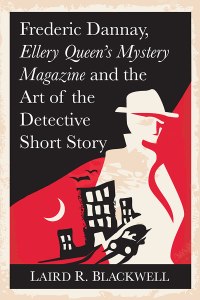
In recent years—no, make that recent decades—it seems that I’ve either written or edited or had some connection with just about every book having to do with Ellery Queen. This is no longer the case, thanks to Laird R. Blackwell’s Frederic Dannay, Ellery Queen’s Mystery Magazine and the Art of the Detective Short Story (McFarland, 2019), a title so unwieldy it won’t all fit on the book’s spine, which omits THE ART OF. Blackwell aims to encompass in a relatively short book “the true impact of Ellery Queen on the detective-crime short-story genre.” By Ellery Queen of course he means Frederic Dannay, the scholarly-bibliophilic-editorial half of the Queen partnership, who as founding editor of EQMM labored feverishly, between the magazine’s birth late in 1941 and shortly before his death in 1982, both to revive the best short stories of the distant and recent past and to encourage the creation of equally fine stories in the present and future. Blackwell knows the 40-odd Dannay years of EQMM backward and forward and writes insightfully of the milestone authors and stories that Fred had a hand in developing or preserving. We traverse the entire range of the genre from Poe through Conan Doyle and Chesterton to then-newcomers like Stanley Ellin and Edward D. Hoch (who wound up having more than 500 stories published in the magazine) to a few like Jon L. Breen and Josh Pachter and myself who began appearing in EQMM when we were young and Fred was well along in his editorial career and who carry on today like old warhorses continuing, perhaps more gently, to smite the earth.

If I had had a hand in the book I would have pushed for Blackwell to include the birth and death years of the dozens of authors he covers, giving readers a more vivid sense of the scope and flow of detective-crime fiction in its short form. But I would have fought much more loudly for the removal of the superabundant typos which pockmark the book. So many authors’ names are given incorrectly, including luminaries like “Cornel” Woolrich and “George” Simenon and even that old standby Edgar “Allen” Poe. So many story titles get the same treatment, such as “The Adventure of the Blue Carbunkle” which will lift every Sherlockian’s eyebrows to the sky. Book titles fare no better, as witness 101 Midnights, which eliminates a whopping 900 witching hours. A number of significant dates are also off, for example the death of Ed Hoch, which occurred in 2008, not 2018. (If only Ed had enjoyed the extra ten years of life with which Blackwell gifts him!) And more than one protagonist of a single story is listed as a series character. But all these gaffes—which, if I had a magic wand, I’d erase forever—don’t seriously detract from what Blackwell has accomplished in this book. With these reservations, I recommend it.

Posted in Books, Ellery Queen, Genre, Guest, History, review | Tagged , , , , , | 2 Comments

“Shared Death” (by R.T. Raichev)

Raicho Raichev is not only a fan of Golden Age Mysteries, hes a scholar of the genre. He’s written previous articles for this site about some of the key figures in the field. This time he focuses on the murder method in many Golden Age whodunits: poison. Raicho is one of the best current writers of the classical mystery. His series starring mystery writer Antonia Darcy and her husband, Major Payne, has more than half a dozen critically acclaimed novel-length entries as well as many short story cases, most of them published in EQMM. We have a new Antonia Darcy story coming up early next year.—Janet Hutchings

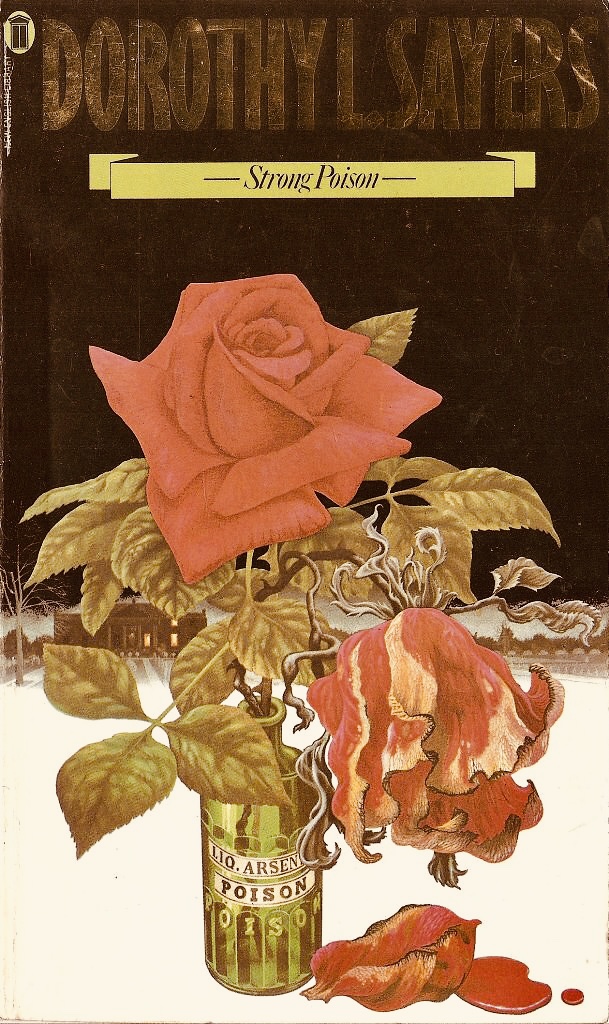
P.D. James, in her Introduction to the 1998 Folio edition of Dorothy L. Sayers’s Strong Poison, writes that the novel has “a particularly original and ingenious method of murder and one, which, as far as I remember, has never been used by another crime writer.” The method in question involves the introduction of arsenic (via a tiny funnel) into a deliberately cracked egg that is subsequently used for the making of a sweet omelette which is shared by the killer with his victim. The reason the killer remains unaffected is that he has been carefully building up his own immunity to arsenic by taking small doses over a period of time. As murderous modi operandi go, this one is so elaborate, dangerous, and risky as to be wildly improbable, though of course it is typical of the Golden Age (of the English detective story) during which the book was written. In fact the shared-death method might have been devised by the novel’s heroine Harriet Vane herself—a detective story writer and, as is widely assumed, an idealized self-portrait of Dorothy L. Sayers. In an entertaining metafictional touch Harriet—who stands accused of the murder of her lover—tells Lord Peter that it all feels like one of her own novels, “. . . in which I invented such a perfectly watertight crime that I couldn’t devise any way for my detective to prove it . . .”

Strong Poison was published in 1930 and is the fourth in the series featuring Sayers’s sleuth Lord Peter Wimsey. For most Sayers aficionados* the novel’s real distinction lies in the extraordinary transformation—some may call it “humanization”—of Lord Peter who, beneath his Bertie-Wooster exterior and silly-ass manner, is revealed as harboring passions worthy of a Mr Darcy. One cannot imagine a less auspicious occasion for a man to succumb to a coup de foudre than a murder trial, but that is what happens to Lord Peter Wimsey. He falls in love with the woman in the dock while listening to the judge sum up the damning evidence against her. He is convinced—absolutely, unshakably, unconditionally—that Harriet Vane is innocent. At that point Lord Peter hasn’t any proof that that might be so, apart from what his heart tells him and the fact that his mother, the Duchess of Denver, agrees—as he informs Harriet at their first meeting. (“Oh my mother’s the only one that counts, and she likes you very much from what she’s seen of you.”) We learn that when Harriet “smiled at him, his heart turned to water.”  Henceforward he devotes all his time and energy—as well as every advantage his status as a peer of the realm affords him—to saving her from the hangman’s noose. In the course of his investigation he offers her marriage.

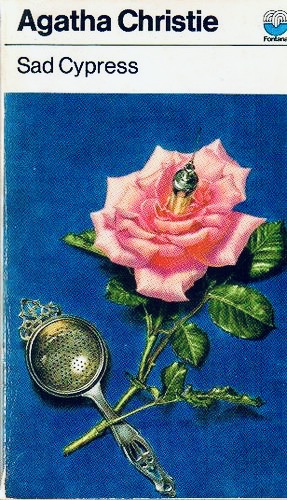
But Baroness James seemed to have remembered wrongly. Ten years after Sayers, another crime writer—Agatha Christie, no less—employed the shared-death method in her novel Sad Cypress. Although a meticulously clued Poirot case, this 1940 offering is not a typical Christie. For one thing, the identity of the killer is fairly obvious at an early stage, which for an Agatha Christie novel written in her floruit period is very unusual. Crime critic Robert Barnard describes Sad Cypress as “elegiac, more emotionally involving than is usual in Christie.” The killer—Nurse Hopkins—puts morphine into a pot of freshly brewed tea which she then shares  with her victim. Her way of staying alive is by means of an apomorphine injection she gives herself moments after imbibing the poison. (Apomorphine is a powerful emetic and it causes her to vomit the morphine.)

Apart from the murder method, there are a number of other striking similarities between Strong Poisonand Sad Cypress. Both novels open with a tense courtroom scene. Both feature an attractive, sympathetically presented woman who is wrongly accused of murder. The murder motive in both novels is money though the murderer’s right to inheritance is carefully veiled. Both Sayers and Christie use the very first impression their murderers make in such a way as to prepare the reader for the eventual revelation of their guilt. Norman Urquhart’s face strikes Lord Peter as “pale and curiously clear”—the denouement reveals that luminous clarity is characteristic of the skin of a habitual arsenic eater. Nurse Hopkins is introduced through the eyes of her scapegoat, a delirious Elinor Carlisle, who sees Hopkins as “smug—smug and implacable”—note the cunning repetition of “smug”—Agatha Christie as good as tells the reader, this is a woman who believes she’s got away with murder. Both murderers are easy to spot since the circle of suspects in the two novels is so very narrow, therefore the question that tantalizes the reader is How?** rather than Who?

Did Agatha Christie appropriate some of Dorothy Sayers’s ideas after reading Strong Poison? Or was it a case of what is known as “parallel thinking”? While extraordinary coincidences are known to happen there is one singular detail in Sad Cypress which suggests that Christie was not only familiar with that particular Sayers but that she might be paying some kind of droll homage to her sister in crime. In Strong Poison, it is Lord Peter who gets the girl in the end, or rather starts romancing Harriet Vane.*** In Sad Cypress, the young man who is paired off with Elinor Carlisle after her release is a friend of Hercule Poirot called—now pay close attention—Peter Lord.

Or was Agatha Christie’s subconscious playing her tricks?


* Most but not all. Apparently there are GA purists who regard Harriet Vane as a Wallis Simpson kind of figure who lured Lord Peter away from the path of pure detection.

** Sayers much more often than Christie devised bizarre, if not exactly practicable, murder methods. In her Busman’s Honeymoon the killer sets a booby trap with a weighted cactus pot on a chain, which is triggered by the victim’s opening a radio cabinet; the murder in Unnatural Death is brought about by the injecting of a lethal air-bubble into the victim’s vein, etc.

*** Lord Peter’s proposal is finally accepted by Harriet Vane in Gaudy Night (1935) and in Busman’s Honeymoon (1937) we see them married.


Posted in Books, Characters, Guest, Writers | Tagged , , , , , , , | Leave a comment

“The Secret Lagoon” (by Josh Pachter)

Josh Pachter’s story “The Secret Lagoon” appears in EQMM’s current issue (September/October 2019). Readers are often curious not only about where authors get their ideas but about how a story comes together. In this post, we get a look at how Josh’s new story formed in his mind. The name Josh Pachter will be very familiar to most of our readers. He is the author of about a hundred published short stories, many of them in EQMM, and has been translating for EQMM, from several languages, for many years. Last year he celebrated his fiftieth anniversary as a published writer, and it all began in the pages of EQMM.—Janet Hutchings

All photos courtesy of Josh Pachter.

The Secret Lagoon is a real place.

When we booked a trip to Holland and Belgium in May of 2017, my wife Laurie and I decided to take advantage of our airline’s offer of a free stopover in Iceland, a country neither of us had previously visited. Laurie is the family researcher, and she created a fabulous itinerary for us: the geysers at Gullfoss, Thingvellir National Park, the Skógafoss waterfall, the bright-blue glaciers and “diamond beach” at Jökulsárlón, the list goes on. One of the things we both wanted to experience was a geothermal lagoon, of which Iceland has many, most famously the Blue Lagoon, which is not far from the Keflavík International Airport. From its website and its TripAdvisor reviews, though, it looked to us like the Blue Lagoon would probably be mobbed, and neither of us is comfortable in crowds, especially at times that are by their very nature intended to be relaxing.

So I did a little poking around of my own and discovered Gamla Laugín, the Secret Lagoon, a natural hot spring in the village of Flúðir, about a two-hour drive east of Keflavík, and I booked us a visit for the morning of our arrival.

Our Icelandair flight landed at 6:30 AM local time, and we cleared through customs and picked up our rental car. Exhausted from the overnight travel and jetlagged from the six-hour time change, we endured the drive to Flúðir, stopping briefly in Selfoss to revive ourselves with coffee and pastries.

The Secret Lagoon is as I describe it in my story, down to the “wedding concierge” in his bushy beard and waxed mustache, incongruous tam o’shanter cap, and red bowtie. (I didn’t catch his name, but later selected Þorri from an Icelandic baby book I found on the Internet.)

Laurie and I had the place almost to ourselves that day. I don’t know what she was thinking as she let the geothermal heat soak away the fatigue of our long plane ride, but I remember what was going through my mind:

This would be a perfect setting for a crime story, I thought, floating in the hundred-degree water, my neck and feet supported by long fluorescent pool noodles.

But what would be the crime?

After a while, I found myself remembering a game I used to play with my friends and siblings, many years ago, a sort of you-be-the-detective game in which one of us would tell the bare bones of a puzzling story and the others, by asking a series of yes/no questions, would have to figure out the answer to the story’s riddle.

Here’s an example of the type of thing I’m talking about:

Billy is found dead, an apparent suicide, in the dining room of his small apartment. There is a carved wooden figure of a dog and a set of woodworking tools on the table, and one of the wooden chairs is tipped over. There is sawdust on the floor. Why did Billy kill himself?

Then the questioning would go like this:

Did Billy really commit suicide? Yes. Did he shoot himself? No. Did he take poison? No. Did he hang himself? Yes. Is his profession relevant? Yes. Was he a professional woodworker? No.

And so on. Ultimately, the questioners would either have to give up or figure out that Billy worked in the circus, where he was billed as “The Smallest Man in the World,” and the second smallest man, jealous of Billy’s—ahem—stature, was sneaking into his apartment every night and sanding down the legs of Billy’s dining-room table. Billy, terrified that he was growing taller, couldn’t stand the thought of losing his job and finally hanged himself.

You’ll have to trust me on this, but the game was more fun to play than it is to read about, and we had a great time playing it.

SPOILER ALERT: If you haven’t yet read “The Secret Lagoon” in the September/October issue, you should stop reading this blog post now and not return until you’ve finished the story.

Okay, you’re back? And you’ve read “The Secret Lagoon”? Fine, I’ll take your word for it.

One of my favorite puzzles from this childhood game involved three main characters: Father Frank, Mayor Mike, and Officer Owen. It’s twenty years since Father Frank took over as the parish priest, and his congregation throws him a big party to celebrate the anniversary. A hundred of them gather at the church at the appointed day and time, but Father Frank is at the local hospital administering last rites to a dying parishioner and is delayed. To pass the time while they wait for the guest of honor to show up, Mayor Mike stands and improvises a speech. Finally, Father Frank arrives to great applause and launches into a speech of his own. A minute later, Officer Owen, who is one of the many people sitting in the pews, jumps to his feet, unholsters his gun, and fires a single bullet, which strikes and instantly kills . . . Mayor Mike.

And the question the listener needs to answer is this: Why did Officer Owen kill Mayor Mike?

The answer—you’re positive you’ve read “The Secret Lagoon,” right?—would take the uninitiated a long time to figure out, but is in retrospect pretty simple. When Mayor Mike got up to speak, he began by saying that it was logical for him to be the person speaking, not because he’s the mayor, but because, twenty years ago, on Father Frank’s first day in the parish, he—Mayor Mike—was the very first person to ask the new priest to take his confession. Then, when Father Frank arrives and launches into his own speech, he begins by saying that it’s certainly been an eventful twenty years. In fact, he says, his time in the parish got off to an unusual start when the very first confession he ever heard was a confession of murder.

Mayor Mike was married to Officer Owen’s sister, see, and Officer Owen’s sister was murdered long ago, apparently having surprised a burglar in the act of robbing her house. The murder was never solved, but now, two decades later, Owen puts two and two together and realizes at long last that it was his brother-in-law, not a burglar, who killed his sister, and he takes his long-delayed revenge.

That old puzzle became the jumping-off point for my Iceland story, in which a cocky killer revisits the scene of his long-ago crime, only to find that murder—which Chaucer warned us will out—does out, in this case with equally fatal consequences.

At the end of “The Secret Lagoon,” Emily Norton checks into the Hotel Skógar, within sight of the majestic Skógafoss waterfall. Laurie and I spent our own first night in Iceland there, although our room was on the other side of the building, so we didn’t get to see the falls until the following morning:

Unlike Emily, Laurie and I did go on to stay in Kirkjubæjarklaustur and Hveragerði, to walk on the black sand at Vík and marvel at the beauty of the Jökulsárlón glacial lagoon and its diamond beach.

Oh, speaking of my story’s main character, I should mention that I often like to slip an Easter egg or two into my stories, and that there’s one built into her name.

In my day job, I teach communication studies and film appreciation at Northern Virginia Community College, and my film class focuses on Orson Welles’s classic Citizen Kane. In that film, Kane’s first wife—played by the lovely Ruth Warrick, who later spent thirty-five years as the obnoxious Phoebe Tyler Wallingford on the daytime soap All My Children— is Emily Monroe Norton, the niece of a former US president. And the protagonist of “The Secret Lagoon” is Emily Norton, nee Emily Monroe. I’ve been looking for a way to slip a Kane reference into one of my stories, and at last I found one!

I’m happy, too, to have found a way to set a story in Iceland, one of the most book-friendly countries in the world, where every December the citizenry celebrates Jolabokaflod,the “Christmas Book Flood.” On Christmas Eve, families give each other gaily-wrapped hard-covered books, then curl up in comfortable chairs and spend the rest of the evening reading.

Now that’s a tradition I can wholeheartedly endorse.

Gleðilegt lestur, allir!

Happy reading, one and all!

Posted in Characters, Fiction, Guest, International, Thrillers | Tagged , , , , , , , , , | Leave a comment