
“Looking Back on a Half-Century Love Affair with EQMM” (by Josh Pachter)

Josh Pachter falls into an unofficial group connected to EQMM that he doesn’t mention in the following post: most valued friends of the magazine.  He started out in the category we treasure most of all: devoted EQMM reader. From there, by the trail of events he describes, he became an accomplished short-story writer and contributor to the magazine. (Although he has had little time for fiction-writing over the years, he has produced at least four dozen published—and often reprinted—short stories!)  His work as a scout and translator for EQMM’s “Passport to Crime” feature has greatly enriched that department.  Few others have contributed to EQMM on so many levels or for so long.  We’re counting on him to be with us as we move into the future; it’s having people like Josh on board that makes EQMM  the magazine it is.—Janet Hutchings

We are a fairly exclusive club, I suppose, and our membership grows oxymoronically and sadly smaller every year.

Depending on whether or not you count Clayton Rawson, EQMM has had either three or four editors since its 1941 debut. Officially, Frederic Dannay (who, with his cousin Manfred B. Lee, wrote as Ellery Queen) served as the magazine’s editor-in-chief from its inaugural issue through 1981, long-time managing editor Eleanor Sullivan was editor-in-chief from 1982 until 1991, and Janet Hutchings, who took over the editor-in-chief’s chair in 1991, remains there today. Clayton Rawson was listed on the masthead as EQMM’s managing editor, never editor-in-chief, but he ran the day-to-day operations of the magazine from 1963 until his death in 1971.

And the club I mentioned above has as its membership those of us who’ve had the opportunity to get to know all four of them face-to-face. There can’t be all that many of us left.

In the spring of 1966, Fred Dannay was sixty-one years old, EQMM was twenty-four, and I was fourteen. One day, Mary Ryan, my ninth-grade English teacher, handed me a copy of the June ’66 issue of EQMM and told me she thought I might like it. I have no idea what it was about me—or about her—that caused her to single me out. Sure, I’d read a couple of the Sherlock Holmes stories, but they were really my only exposure to crime fiction up to then—and I don’t remember having found them especially interesting.
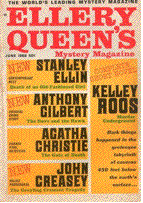
 EQMM June 1966

I took Miss Ryan’s gift home with me, though, and a whole new world opened up to me as I devoured Agatha Christie’s “The Gate of Death,” Stanley Ellin’s “Death of an Old-Fashioned Girl,” Kelley Roos’s “Murder Underground,” John Creasey’s “The Greyling Crescent Tragedy,” and the rest of the slim 159-page magazine’s contents.

Immediately, a new monthly ritual became the long walk up Jerusalem Avenue to the candy shop at the top of the hill, where I plunked down my fifty cents for the latest issue of the first magazine I’d truly enjoyed since Highlights for Children and Boy’s Life and MAD. Margery Allingham, Robert Bloch, John Dickson Carr, Celia Fremlin, Edward D. Hoch, Talmadge Powell, Joan Richter, Frank Sisk, Nedra Tyre, James Yaffe—and of course Ellery Queen himself—all new to me, all mysterious and brilliant and as addictive as crack.
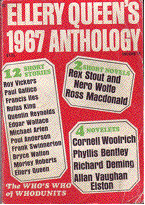
EQMM 1967 AnthologyIn addition to its regular monthly issues, EQMM began publishing an annual anthology of reprints in 1960. In 1963, these anthologies started appearing twice a year instead of once, and, early in 1967, I paid the candy-store proprietor $1.25 for a copy of Ellery Queen’s 1967 Anthology, which was #13 in the series—and which contained a reprint of Richard Deming’s “Open File,” a novelet which had originally appeared in the December 1953 EQMM. The story was a police procedural in which the investigating officers fail to solve a crime—a murder, if memory serves. When I finished reading the story, though, I thought—in my fifteen-year-old wisdom—that the cops had botched their investigation, that there was in fact sufficient evidence presented in the story to pin the crime on a specific one of its characters.

For reasons I won’t pretend to remember, I actually wrote a new ending to Deming’s story and sent it off to EQMM—and, in due course, I received a handwritten letter on EQMM stationery from Frederic Dannay himself!

For many years, that letter was one of my prize possessions. Sadly, I lost it when, after a dozen years in Holland and Germany, I moved back to the US in 1991. I can still remember, word for word, the way it ended, though: “Have you ever considered writing a detective story yourself? Seems to me, Josh, if I may, you should!”

So of course I did. I mean, duh.

I came up with the idea of a cop who loved mystery stories so much that he named all eleven of his kids—apparently Inspector Ross Griffen of the Tyson County Police Force was a Catholic—after famous fictional detectives: Albert Campion, Gideon Fell, Sherlock Holmes, John Jericho, Jane Marple, Perry Mason, Parker Pyne, Augustus Van Dusen, Peter Wimsey, Nero Wolfe—and, of course, Ellery Queen. In my story, sixteen-year-old Ellery “earned his name” by solving in a Queensian manner a jewel theft which was baffling his father . . . while simultaneously botching his investigation of a neighborhood mystery, the theft of three apple pies destined for a church bazaar.

I typed the story up on my little nonelectric typewriter and sent it off to Fred Dannay’s home in Larchmont, New York. A month or so later, I was in my bedroom one afternoon when the phone rang and my mother yelled up the stairs, “Josh! It’s for you!”

“Who is it?” I yelled back.

“It’s Frederic Dannay!”

Furious, I clomped downstairs to the kitchen, snatched up the receiver, and barked, “Dad, this isn’t funny.”

It wasn’t my father trying to be funny, though. It was Fred Dannay, telling me he liked my story and wanted to publish it.
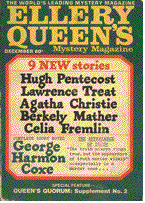
EQMM December 1968Fred wanted some changes, I gladly made them, and “E.Q. Griffen Earns His Name” appeared in the December 1968 issue of EQMM, #325 in the magazine’s “Department of First Stories.” I was sixteen when I wrote the story, seventeen by the time it was published, making me the second youngest writer ever to appear in the pages of EQMM. (The youngest was James Yaffee, whose first story was written at the age of fifteen and published in 1943.)

As a professionally published author, I was eligible for membership in the Mystery Writers of America. I applied, was accepted, and at seventeen became the youngest active member in the history of the organization. This got me an invitation to the MWA’s annual Edgar Allan Poe Awards banquet, where I had the opportunity to meet both Fred Dannay and Manny Lee face-to-face. Manny was polite, but Fred was absolutely effusive, and he led me around and introduced me to many of the writers I’d grown to idolize, treating me—as did almost everyone I met—as not just a punk kid but a colleague. Ed and Pat Hoch, John and Barbara Lutz, and Stan and Marilyn Cohen were especially kind to me, and over the years Dorothy Salisbury Davis, Patricia McGerr, Lawrence Treat, Bob Fish, Don Westlake, Joyce Harrington, Ed Wellen, Dan Marlowe, Morris Herschman, Chris Steinbrunner, Warren Murphy, and many others were also much nicer to me than I can possibly have deserved. I saw Mr. Dannay again at several subsequent Edgar banquets, and he always took the time to talk with me—and always left me feeling that our conversations mattered every bit as much to him as they did to me.

Since my family lived on Long Island, it was easy for me to take the train into Manhattan, and I would often go in during the day to visit the EQMM editorial offices at 229 Park Avenue South, then stick around for the monthly cocktail party in the MWA’s cramped offices in the Seville Hotel on East 29th Street. Fred worked from home in Larchmont, but managing editor Clayton Rawson was always in his office at 229 Park when I dropped by, and he always welcomed me, always made time to spend an hour with me. A professional magician himself, Clayton used the world of stage magic as the backdrop for most of his fiction—his four novels, all written in the late ’30s and early ’40s, and many of his short stories featured as their detective “The Great Merlini.” Whenever I would visit Clayton in his office, he would entertain me with sleight of hand, and he was good at it, certainly the best close-up magician I’ve ever seen. During one visit, Clayton handed me a copy of the April 1951 EQMM and told me to select any story in the issue, add up the digits of the page number of the story’s first page, and count to the that-manyeth word of the story. I did so—and he announced that the word was “problems,” which was correct. Although magicians traditionally don’t reveal the secrets of their tricks, he explained to me that Fred Dannay had edited the beginning of every story in the issue as a favor to magician Richard Himber, so that, no matter which story was selected, the word that appeared in the position corresponding to the sum of the digits of its first page would be “problems.” (Mike Nevins wrote about the April 1951 EQMM in his article “The Dannay Years,” which appeared in the magazine’s November 2011 issue.)
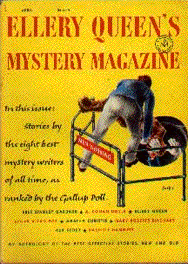
 EQMM April 1951

My most vivid memory of Clayton Rawson was the day when he handed me a book of matches and insisted that I light them, one at a time, and throw them, blazing merrily, into his open mouth. I’m not sure that technically qualifies as magic, but it was certainly magical to me.

After Clayton’s death, Eleanor Sullivan became EQMM’s managing editor, and she and I grew to be fast friends. Always smiling (though always a little harried and mussed), she, like Clayton before her, welcomed my visits, first to 229 Park and then, after the magazine’s editorial offices moved about twenty-two blocks uptown, to the new space at 380 Lexington. We’d often go out to lunch together, and when I visited her during the colder months, she always insisted on trying on the weird furry winter coat I’d bought at Barney’s Boys Town on 17th Street.

By the time Fred Dannay died, in 1981, he’d bought seven of my stories for EQMM—three about the Griffen family, another a spoof of two of Ed Hoch’s series characters (“The Theft of the Spy Who,” September 1972), and a couple of one-offs. I was married to a Dutch woman by then and living in Amsterdam, teaching for the University of Maryland’s European Division on US military bases in Holland, Germany, England, and Greece—and no longer writing fiction. Why did I stop? That’s complicated—it’s probably easiest to say that my focus had shifted from writing to teaching and leave it at that.

In 1982, as Eleanor Sullivan moved up from managing editor to editor-in-chief after the death of Fred Dannay, the University of Maryland sent me for four months to Bahrain, in the Persian Gulf, to teach at a little Navy base in Manama, the tiny island emirate’s capital (and only) city.

Bahrain fascinated me, and I wound up staying for eight months instead of four and returning to the writing of crime fiction with “The Dilmun Exchange,” the first of what would ultimately be a dozen stories about Mahboob Chaudri, a Pakistani detective on the Bahraini Public Security Force. Eleanor bought it for the July 1984 EQMM, and the last half of the ’eighties were far and away my most prolific period in the mystery-fiction bidnis.

In addition to the Chaudri stories, I also conceived the idea for a project I planned to call Partners in Crime. My idea was that the book would consist of a dozen or so short stories, each written by two authors working together—and, in each case, one of the two authors would be me. Although the book never happened, about fifteen stories wound up being written, and most of them were published individually. EQMM ran my collaborations with Ed Hoch (“The Spy and the Suicide Club,” January 1985), Stanley Cohen (“Annika Andersson,” February 1993) and Jon L. Breen (“The German Cologne Mystery,” September/October 2005), and I also sold Partners in Crime stories written with Edward Wellen (“Stork Trek,” Alfred Hitchcock’s Mystery Magazine, July 1985), Michael Avallone (“Better Safe Than Sorry,” Hardboiled, Summer/Fall 1987), Joe L. Hensley (“All That Mattered,” Robak’s Firm, 1987), John Lutz (“DDS 10752 Libra,” An Eye For Justice, 1988), Dan J. Marlowe (“The Seven-Year Bitch,” Hardboiled, 1990), and Francis M. Nevins (“The Leo’s Den Affair,” Dick Tracy: The Secret Files, 1990).

During this same period, I edited a series of “Author’s Choice” anthologies, beginning with Top Crime: The Author’s Choice (St. Martin’s Press, 1984) and continuing with Top Science Fiction, Top Fantasy and Top Horror (all of which were published in various European countries, but not in the US), and translated a couple of Janwillem van de Wetering’s Grijpstra and de Gier stories from Dutch into English for EQMM.

Meanwhile, my marriage didn’t survive my time in Bahrain, and I wound up living in Germany from 1983 to 1991, still teaching for the University of Maryland on American Army and Air Force bases.

And in ’91, right around the same time that Eleanor Sullivan passed away, I moved back to the US and settled in Cleveland, Ohio.

I haven’t done all that much in the mystery field since my return, although I’ve translated stories by Theo Capel, Rene Appel, Carla Vermaat and Tessa de Loo from Dutch into English and by Bavo Dhooge from Flemish into English for EQMM’s “Passport to Crime” series, which has given me the opportunity to get to know Janet Hutchings, who took over as editor-in-chief after Eleanor died and has now served in that position for over twenty years.

A couple of years ago, Janet bought a story called “History on the Bedroom Wall” and ran it in the “Department of First Stories” in EQMM’s September/October 2009 issue, which I believe makes me the only person who’s ever appeared in the DFS twice—first as a teenager in 1968 and again aged 58 in 2009.

How could such a thing happen? Well, although it wasn’t written as a part of my Partners in Crime project, “History on the Bedroom Wall” was written collaboratively, and the story was published as “by Rebecca K. Jones and Josh Pachter.” Rebecca K. Jones is my daughter Becca, who was born in Germany in 1986. In 2009, she was twenty-three and a second-year law student at the University of Arizona, and writing a story with her was unquestionably the high point of my “career” as a writer.

Today, Becca is a deputy county attorney in Phoenix, and my wife Laurie and I live in Virginia, where I teach communication and film-appreciation classes at Northern Virginia Community College. I continue to do translations for “Passport to Crime” from time to time, and every once in a while I write a new story of my own. When Janet published my “iMurder” in the July 2011 EQMM, that made me a member of another pretty exclusive club—there aren’t many of us who’ve published new fiction in the pages of Ellery Queen’s Mystery Magazine in six consecutive decades, but I’ve now been in there in the ’60s, ’70s, ’80s, ’90s, ’00s and ’10s. If I can hang on a few more years, perhaps I’ll show up in the ’20s, too, and I’m not sure if anyone has yet hit EQMM in seven consecutive decades.

When I moved from Germany back to the US in 1991, I lost not only my original 1967 letter from Fred Dannay but almost everything else I owned—looong story; I’ll spare you—including treasured photos of me with Fred, Clayton, and Eleanor.

In October of this year, though, Laurie and I drove to Cleveland the weekend of Bouchercon to visit with my dear old friend Les Roberts (who writes the Milan Jacovich novels and was B’con’s “Special Cleveland Guest”) and his lovely girlfriend Holly Albin. We also had the opportunity to spend some time with my even older friend John Lutz and his lovely wife Barbara, and Janet very graciously took time out of her busy schedule to have a drink with Laurie and me.

So I’ve at least got one photo of me with an EQMM editor, and I’m happy to share it with you here. (Janet’s the pretty one. I’m the other one.)
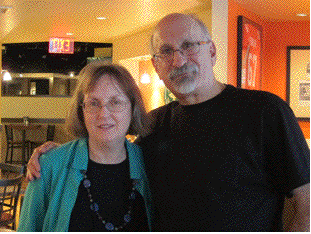
EQMM5

Fred, Clayton, Eleanor, and Janet: It’s actually kind of amazing to think that EQMM has only gone through three (or four, if you count Clayton) editors in over seventy years.

But I consider myself honored and blessed to have had the opportunity to have known all four (I darned well count Clayton, whether you do or not!) of them. They—and EQMM itself—have been a very important part of my life for almost half a century now, and I look forward to continuing my relationship with the magazine and its leadership till death do us part!

Posted in Conventions, Editing, Guest, History, Magazine, Writers | Tagged , , , , , , , , , , , , , , | 16 Comments

“Going Postal: The Particular Pleasures of Workplace Murders” (by Meredith Anthony)

When it comes to different lines of work, Meredith Anthony has known more than most people. She’s a humorist whose work has appeared in MAD Magazine and Hysteria; she’s done stand-up comedy; she was the writer and partner for the Spilled Milk collection of greeting cards; she’s a reviewer of theater and film; she has co-authored and produced a play and an award-winning short film; and she has written several feature-length screenplays. And that is not even to mention her primary career as copywriter for a major New York ad agency. Or her fiction writing, which includes novels and several stories for EQMM. Her most recent novel, Ladykiller (Oceanview 2010), was co-written with her husband, Lawrence Light.—Janet Hutchings

So a guy goes to his office and greets all his variously annoying colleagues. There is the usual variety of flirtations, animosities, eccentricities. He toils at meaningless paperwork all morning, unappreciated, underpaid, unhappy. At lunchtime, it’s his turn to go out to the deli. He takes everyone’s orders. When he comes back with a large, leaking paper bag, he finds the office strangely quiet. A quick inspection reveals that every single person at his workplace has been shot to death.

This, of course, is the beginning of James Grady’s great thriller Six Days of the Condor. I once asked Jim Grady about the enormous success of the book and the subsequent film, Three Days of the Condor, and he laughed and told me that he thought it struck a chord with every working stiff. Everyone at the office is dead. Haven’t we all secretly wished for that to happen?

I have always loved mysteries set in a workplace. I like the insider’s view of a profession I know nothing about, the chance to watch employees work, learn some of their jargon, be privy to the office politics, catch the rhythm of their days. I like to immerse myself in the world of this new profession. And when murder strikes, I like to watch how the workplace does or doesn’t go on in the wake of the shocking event. Do the employees dab their streaming eyes and carry on with working? Does the place shut down while the police investigate? Do colleagues begin to look at one another with distrust and suspicion?

I leave out books set in cop shops, detective agencies, and those about medical examiners, military police, and government spies. Procedurals certainly have their appeal, but I’m talking about books set in a workplace that typically does not deal with violence professionally.

Many professions have their exemplars. Robin Cook and Michael Crichton wrote medical thrillers that invited us into hospitals. More recently, Michael Palmer, Douglas Lyle, and CJ Lyons have mixed medicine and murder. John Grisham, Scott Turow, and others bring us inside the lawyer’s office and the courtroom. Steve Frey and Christopher Reich offer a glimpse into Wall Street. Journalism is the setting explored by Scotland’s Denise Mina and (full disclosure, he’s my husband!) the wonderful Larry Light.

For corporate America, Joseph Finder excels. His Killer Instinct, for instance, is set in a Boston electronics giant where an ambitious, but not very successful, young executive is unwittingly assisted by a security guy he befriends. The security man starts helpfully eliminating anyone who gets in the way of the hero’s upward mobility. The hero is, of course, aghast, but isn’t this every thwarted working person’s wish fulfillment? Don’t we all secretly want that bitch in the corner office to die?

Having worked in advertising for some years, I always wanted to find a mystery set in a big-city ad agency. My experience is that although ad agencies are high-pressure businesses with a typical corporate pyramid structure and a profit and loss statement, in fact they differ significantly from most white-collar office settings. Ad agencies are businesses where a great many of the employees are hired specifically for their imagination and artistic talents. Highly paid and skilled copywriters and art directors are not ordinary office drones. They pride themselves on their quirks and most agencies give them a lot of leeway in work habits, office décor, and dress. Cubicle walls may be covered in bananas, skulls, or fish. Christmas lights, black lights, or no lights are common. Clothes may be chosen to show off piercings and tattoos. Pets, unicycles, and mini-refrigerators full of booze are not uncommon. In fact, it occurs to me that these “creatives,” as they are called, frequently get away with murder. I decided to take that notion a step further. I was delighted to have a chance to explore this setting in a short story, “Murder at an Ad Agency,” which will appear in the March/April 2013 issue of EQMM.

Facing a rack at Barnes and Noble, or listing on Amazon.com, we all have our ways of choosing a new book to read. Some of us choose to read mysteries by subgenre—cozies, police procedurals, amateur sleuths, thrillers, noir. Others choose by setting—big cities, foreign settings, historicals, Westerns. Some look for a certain type of protagonist—strong women, damaged cops, cats. Some readers look only for favorite authors, series, or standalones. Me? I look for a new workplace—Jane Cleland’s antiques business, Hank Phillippi Ryan’s TV station, Julia Spencer-Fleming’s Episcopal church, Barry Eisler’s freelance assassin, Christa Faust’s porn star, to name just a few.

One of my all-time favorite office mysteries is a noir thriller by the amazing Duane Swierczynski. Severance Package is the perfect update on James Grady’s Condor classic. Here’s the set-up. The boss has asked seven employees to come in to work at 9 a.m. on a Saturday for a special meeting. Irritable and suspicious, they all comply. He locks them in and announces that he’s going to have to kill them all. Seriously? On a Saturday at 9 a.m.? Now, if that isn’t the beginning of a really bad day at the office, I don’t know what is.

Posted in Fiction, Guest, Setting, Writers | Tagged , , , , , , , , , | 17 Comments

“From Noir to Julius” (by Dave Zeltserman)

 Dave Zeltserman’s crime-noir novels Small Crimes and Pariah were both selected by The Washington Post as best books of the year. His short story “Julius Katz” won the Private Eye Writers of America’s Shamus Award for best P.I. story, and a second story in that series, “Archie’s Been Framed,” won EQMM’s Readers Award. His most recent book, Monster: A Novel of Frankenstein is neither noir nor mystery, but horror. You can see from the extensive range of his books and stories that he’s particularly well qualified to talk about the challenges of writing in a variety of forms. Here he discusses his experiences in going from noir to puzzle murder mysteries. . . . —Janet Hutchings

When my story “Julius Katz” (EQMM September/October 2009) was published, it must’ve surprised my readers. Up till then, most readers knew me from my dark and violent noir novels and stories. “Julius Katz” is very different from my noir writing in its gentle humor and endearing characters, and is mostly a bloodless story where the murders take place off screen. My Julius Katz stories are somewhere between pastiche and homage to Nero Wolfe—a mix of hardboiled and traditional mystery where a brilliant but incredibly lazy detective has all the evidence gathered, questions the witnesses, and then points out the guilty party. The hardboiled element in both Rex Stout’s Nero Wolfe and my Julius Katz stories is represented by a wisecracking assistant who narrates the stories. With Nero Wolfe the assistant is Archie Goodwin. In my Julius Katz stories, the assistant is also named Archie, but there the similarities with Archie Goodwin end, as my Archie is a computer device the size of a tie pin, but with the heart and soul of a hardboiled PI. And with his self-adapting neuron network, my Archie wants nothing more than to learn enough by observing Julius so that he can beat him to the punch in solving a case.

So why go from writing noir to Julius Katz stories? Well, my reading has always been diverse, and as much as I love hardboiled and noir literature, I’ve always also loved the Nero Wolfe books. Next to Hammett, Rex Stout is probably my favorite crime/mystery author. The reasons for reading noir and Nero Wolfe are very different. A noir story will grip you as it drags you along with its protagonist on a one-way ticket to hell. These stories tend to be violent and can be psychologically fascinating, as well as provide insights into the human condition that few other mystery and crime stories are capable of. Nero Wolfe books are read for enjoyment and entertainment, as well as Rex Stout’s wonderful writing. At the heart of every Nero Wolfe book is the murder mystery, but what really drives these books is the relationship between Nero and Archie and the humor that comes out of it. You enjoy spending time with both characters. While there can also be humor in noir, it tends to be brutally dark humor, and while the characters in noir fiction can be fascinating, these aren’t really characters you want to spend much time with—at least, no more than the time to read a single book. When I made the decision to write my first Julius Katz story (and it was an intimidating decision, given how much in awe I am of Rex Stout’s writing and his books), I decided that what was going to drive these stories was the relationship between Julius and my Archie, and particularly the humor that would come out of their relationship. Even though my Archie is a piece of computer technology, he appears very human and endearing because he’s such an innocent.

The following excerpt is taken from my full-length novel Julius Katz and Archie and has Archie very annoyed with Julius for agreeing to what he considers a humiliating publicity stunt for the sake of a rare bottle of wine.

“I thought your dignity and reputation weren’t for sale?” I asked.

A wry smile pulled up the edges of Julius’s lips. “I don’t believe I ever said anything about my reputation being priceless,” he said.

“Okay, your dignity then.”

More of his wry smile. “Technically, Archie, I don’t believe I as much sold my dignity as bartered it away.”

It was a clever joke, but I wasn’t much up to joking then. More of that excess heat began to burn in me. “For a lousy bottle of wine! That’s what you did it for!”

“I hardly think you can call a ’78 Montrachet a lousy bottle of wine.” Julius’s smile faded as he sat straighter in his chair and rubbed his thumb along the knuckles of his right hand. With others, Julius kept his emotions and thoughts impenetrable, with me he didn’t bother. Right now he was showing his annoyance, but I didn’t care. “The man is a philistine,” Julius continued. “He was going to mix soda water with a ’78 Montrachet to make a wine spritzer. It would’ve been a crime to let that happen.”

“So you were just saving humanity from an outrage?”

“Precisely.”

“Okay,” I said. “I understand. For a bottle of wine, you’ve agreed to play a stooge.”

Julius stopped rubbing his knuckles. He took in a slow breath and with a forced attempt at humor, said, “And of course, twenty-five thousand dollars.”

“Of course, we can’t forget the twenty-five thousand dollars. So for that money and the Montrachet, you’ll be looking like a dunce to the world.”

“Again, Archie, things are not always what they appear.”

“Yeah, well, as far as the TV and newspaper reporters are going to be concerned, Kenneth J. Kingston will be trumping you at your own game. Should I be ordering you a dunce cap now for the occasion? I might be able to find a good deal.”

Julius slowly began rubbing his knuckles again. “Enough of this, Archie.”

I should’ve taken the hint, but I couldn’t help myself. “Sure, of course,” I said. “I understand. But boss, should I get a jump on updating your biography to reference that you’re no longer Boston’s most brilliant detective, but have slipped to the second-most? Or should I wait until after Kingston plays you for a chump? Now that I think of it, after that happens I’m not even sure you could legitimately claim that title, since every other working private investigator in Boston would probably be able to prove themselves intellectually superior to Kingston, so by the transitive property, that would, in effect, make you Boston’s least brilliant detective. Not as compelling a title for you to hold, but I guess we’ll have to deal with it. If you want I can order stationery now to that effect, or I can wait until—”

I had pushed him too far. Julius cut me off, saying, “Goodnight, Archie.” And blast it! My world went black as he turned me off!

I’d like to talk a little about the different challenges of writing noir and Julius Katz stories, particularly how plotting and outlining each are so very different. While some writers like to have only a general idea of the beginning and end and let the writing be an adventure, others, like myself, like to have a detailed outline before starting a story or novel. Usually my novels will take detours from my outlines, and sometimes, major characters that I hadn’t previously thought of will force their way into the book, but without an outline for a roadmap, I feel lost.

When plotting noir, I tend to first come up with my flawed protagonist and the scenario that is going to send him on his noir journey, while also at this point usually seeing my protagonist’s ultimate fate. Then it’s a matter of coming up with increasingly dire situations for my protagonist to find himself in once he crosses that moral line that can’t be uncrossed, until in the end he has no choice but to tumble into the abyss. Using my novel Small Crimes as an example, I first developed my protagonist, Joe Denton, as a corrupt ex-cop who wants desperately to believe he’s not a bad guy and can go through life without causing any more damage. Except, it’s all self-deception. The scenario I came up with for Joe was that nine years earlier he had broken into the district attorney’s office to destroy evidence that would’ve sent him to prison, and when the DA walked in on him, he ended up brutally maiming the man. The novel starts with Joe being released from county jail and finding that nobody wants him around anymore—not his parents, his ex-wife, or anyone who ever knew him, and further, the DA is out for blood, wanting badly to find a way to send Joe to prison for the rest of his life. The no-win situation Joe finds himself in is that the mob boss he used to do jobs for is dying of cancer, and the DA is doing everything he can to coerce a deathbed confession from him. From there, I put Joe in increasingly worse situations as he tries to keep the mob boss from talking, as well as keeping others in the town who have deep-seated grudges against him from killing him.

When I plot a Julius Katz story, it’s all about the puzzle, yet in all of the stories outside of the first one, the stories still sprang out of an initial idea that had nothing to do with the eventual murder mystery. The first story, “Julius Katz,” is also different from the others in that it’s really about solving two puzzles—the murder mystery, and, for Archie, figuring out why Julius has been acting “unusually” with regard to Lily Rosten. With “Archie’s Been Framed” (the EQMM Readers Award winner in 2010), the story started with the idea of Archie dating a woman through the Internet who is going to end up murdered, leaving Archie as the chief suspect. The why and how of the murder was figured out later as part of the puzzle. With my full-length ebook, Julius Katz and Archie, the idea that triggered the novel was a mystery writer hiring Julius to figure out who is trying to kill him as part of an elaborate publicity stunt— only to end up actually murdered. Again, the puzzle was put together later. With “One Angry Julius Katz and Eleven Befuddled Jurors,” the idea leading to the story was having a petulant Julius stuck on a jury with a once-in-a-lifetime gourmet dinner approaching. With my upcoming “Archie Solves the Case,” the idea that triggered the story was to be able to have Archie claim that he was equally responsible for solving the murder, even if his logic could be considered a little fuzzy.

When working out the puzzles for these stories, I have several murder suspects, all with legitimates reasons to want to commit the murder, but the clues planted in the story will lead Julius and the reader to the solution if they look carefully enough.

I’ll wrap this up by mentioning that just as reading noir fiction can be both exhilarating and draining, the same is true with writing noir. I guess it comes down to this: Plumbing the human depths can be an exhausting experience. And just as reading Nero Wolfe books was always a fun and enjoyable experience for me, the same is true of writing Julius Katz. I doubt I’ll ever find a more enjoyable character to write about and spend time with than Archie. So I guess that answers why I take breaks from writing noir and crime fiction to spend time in Julius’s and Archie’s world—I need the respite those characters give me!

Posted in Characters, Guest, Noir, Writers | Tagged , , , , , , , , , | 1 Comment

“Where Does It Happen?” (by Terrie Farley Moran)

Terrie Farley Moran is a short-story writer published in EQMM, AHMM, and a number of mystery anthologies. In 2009, one of her stories earned a place on the Best American Mystery Stories Distinguished Mysteries list. She is not only a writer of short stories, however; she is also one of the field’s most avid readers of them. She even wore the editor’s hat in 2011 for an anthology of original short stories, the second book from the Tri-State Chapter of Sisters in Crime, Murder New York Style: Fresh Slices. She’s obviously someone who has thought a lot about the storyteller’s art and she’s here to offer her view of where it often all begins. . . . —Janet Hutchings

Most fiction writers will tell you that plot, character, and setting are the underpinnings of the sturdy three-legged stool that supports a well-told yarn.

And as much as we all agree to the general premise, I find it amusing that arguing about the relative importance of each leg is a full-time parlor game among writers. Someone will suggest that a mind-bending plot is all that matters. Another writer counters that characters are the most important story element. Whether a character is empathetic or offensive doesn’t matter as long as the reader cares about the character’s plight. Then there are folks convinced that an exotic setting will draw the reader into a tale so that they can “live” in the unique environment for a while.

And where do I stand on all this? Well, I come down firmly on the side of setting. Nope. I’m not kidding. Think about it. Would the story of Beauty and the Beast be as powerful if the Beast lived in a two-bedroom apartment nestled over a tea shop, rather than a huge and forbidding castle in a dense and dark forest? I don’t think so.

It’s not that I’m committed to using only story times and places that are out of the ordinary. On the contrary, I often find a local setting that intrigues me and I develop a story to show it off. A while ago I wrote “Fontaine House” (EQMM, August 2012). It came about because I had rented a small place for a couple of months on the banks of the Caloosahatchee River in southwest Florida. I quickly became enamored of the river and day after day I spent time communing with its majesty. It didn’t take long for me to realize that the Caloosahatchee had a story to tell and it wanted me to tell it. So I created a family who resided about twenty miles down river on an island in the Gulf of Mexico, and then I invented a historical house a few miles up river. Finally I tied the geography and the people together with one present-day murder and one Civil War-era murder. In my heart, the river remains the moving force of the entire tale.

Setting is the inspiration for much of my writing, particularly for stories that take place in my native New York City. Times Square sounds one way. Battery Park sounds another. Once I hear the voices, the story comes together.

I am the first to admit that my love of setting is not a requirement for a great read. There are wonderful stories that could have been written in nearly any generic setting, but in some stories the setting defines the characters and intensifies the plot. As an example, I suggest you read “Misprision of Felony” by O’Neil De Noux, available in the December 2012 issue of Ellery Queen’s Mystery Magazine. The story has powerful characters and a fascinating plot, but I contend that it is the setting of post-Katrina New Orleans that gives the story its most potent emotional impact. Take a look and tell me if you agree.

Posted in Fiction, Guest, Magazine, Setting | Tagged , , , , , , , , , , | 12 Comments

ONE OF MY FAVORITE SERIES

In my last post I said I wished there was more talk of the work of classic authors in the field at mystery conventions. One writer who ought to be considered a luminary of the genre, and worthy of such discussion, is Edward D. Hoch.  Ed’s talents and overall accomplishments have been talked about on this site before, but in this post I want to focus on one of his series in particular and how I see it as a fan.

Over the seventeen years I worked with Ed at Ellery Queen’s Mystery Magazine, I had the pleasure of editing twelve of his long-running series. The nearly 200 stories that emerged from those series during that time comprised less than half of his output for EQMM, where he had a thirty-four-year unbroken streak of publication in every monthly issue of the magazine.

My favorite of all of these excellent series was that starring Dr. Sam Hawthorne. Many fans of this series, which began in 1974, cite its locked-room and impossible-crime puzzles as what chiefly attracts them to the stories. In the Hawthorne tales one finds some of the best Hoch plots, perhaps because he liked to save the most difficult kind of puzzle, that of the locked-room, for his country doctor.

As brilliant as the plots of the Hawthorne stories are, however, they are only a part of the magic the series has for me. Ed Hoch had many exceptional talents beyond plotting. One of them was the ability to create a milieu that readers could look forward to returning to again and again. Set in the New England town of Northmont in the 1920s through ’40s, the Hawthorne stories have a certain parallel to the Miss Marple stories and novels of Agatha Christie, whose early cases were set in roughly the same period of time, in the English village of St. Mary Mead. The settings of both series are relatively self-contained; both create ambiances in which the occurrence of crime should be an anomaly; and both include some returning supporting characters. But Northmont has always felt to me a more real and vital place than St. Mary Mead, and I think that may be partly because, unlike Miss Marple, Dr. Sam Hawthorne is not primarily an observer of his town—he’s an active participant in all that goes on.

As a young, single doctor, Dr. Sam is involved in all sorts of relationships—personal, professional, and civic—with characters who turn out to be suspects, victims, and witnesses. He has a stake in what happens that goes beyond achieving justice, and his supporting characters become more important, as the series progresses, than they ever could be were his primary role that of observer.  The supporting characters of Northmont are part of Dr. Sam’s personal story, a story that, spun out over some seventy adventures, provides as compelling a reason to continue reading the stories, for many readers—myself included—as are the astonishingly clever puzzles each story contains.

If you followed the adventures of Dr. Sam in EQMM over the years, or have read any of the collections of the stories by Crippen and Landru Publishers, you’ll know that the good doctor doesn’t remain the same over time.  This is one fictional series that progresses in something like real time. Hawthorne moves on, and so do the times. With each case told as a reminiscence, we’re guided by an elderly Dr. Sam through the decades of his youth, with all of the attendant changes to Northmont, the country, and the world. Part of the pleasant expectation with which I used to open the manuscript of a new Hawthorne story was that of seeing how the milieu, and the characters, had changed.  And Ed Hoch always delivered. One of the things being his editor for so many years proved to me is that he was a scrupulous researcher. Using primarily his own extensive personal library, he brought to bear the kind of detail that made his settings places I felt I could walk right into. And I can honestly say that I never detected a historical error in any of his stories.

If you haven’t yet made Hawthorne’s acquaintance, I recommend you try one of the collections. There’s a respect in which I envy newcomers to the series: You don’t know yet how Sam’s life turned out. Although his creator died suddenly and unexpectedly in 2008, he had revealed, only a few years earlier, answers to two of the key questions that had kept readers going over the decades: Did Northmont’s most eligible bachelor ever marry? And how old is the retired Dr. Sam who narrates the tales?

I won’t chance spoiling your reading by answering those questions for you. I think the author himself had some reservations about resolving all of that. For although he believed that Nick Velvet—an eccentric and endearing thief who became the subject of a French television series—was his most popular sleuth, he too seems to have believed that Hawthorne was one of his most important creations.

One of the Dr. Sam stories that has stayed in my mind over the years is 2001’s “The Problem of the Yellow Wallpaper.” In it, we see several facets of this fictional character that remind me of qualities his author also had. There’s the clever puzzle solver; that’s a given. But there’s also the compassionate doctor who provides a job for his former nurse, April, when her husband is called up for reserve duty in the Navy just prior to America’s entry into WWII, and who protests the ill treatment of an apparently mentally disturbed patient. In this story, too, we see the author’s knowledge of the literature preceding him; the story involves direct references to Charlotte Perkins Gilman’s classic horror story “The Yellow Wallpaper.”  And if that doesn’t demonstrate that knowing something about the history of a form is relevant to writing well—and, as a reader, to understanding what is currently being written—I’m not sure what would.—Janet Hutchings

Posted in Characters, Conventions, Fiction, History, Magazine, Setting, Writers | Tagged , , , , , , , | 4 Comments

“Living with the Ghosts of Halloween” (by Toni L. P. Kelner)

Agatha Award winning author Toni L. P. Kelner has written several stories for EQMM, including two pirate tales. How appropriate, then, that she’s blogging for us on Halloween, when many of the costumed villains appearing at your doors will, no doubt, be of that swashbuckling variety. These days the Boston area author mostly writes about “ghoulies and ghosties.” She is the co-editor, with New York Times bestselling author Charlaine Harris, of a series of paranormal anthologies, the fourth of which, An Apple for the Creature, came out in September. Under her pseudonym Leigh Perry, she’s started a new “Family Skeleton” series with Berkley Prime Crime, the first book in which will be The Skeleton in the Armoire (September 2013).  Who better to start off a mysterious Halloween for us?Janet Hutchings

I adore Halloween, and always have. I love it when the decorations show up, the costume stores appear like magic, and spooky music fills the malls. Of course, Halloween these days is big business. The holiday I remember mumblety-mumble years ago, when I was a young goblin, was much simpler. Still, my witch’s brew had certain key ingredients:

1.     Dressing up

What’s Halloween without pretending to be someone or something you’re not? Now, my childhood costumes were not overly elaborate. One year I was a princess in a chintzy costume-in-a-box with a stiff plastic face mask, and other years I wore my big  sisters’ ballet costumes from past recitals. (I wore the red satin gypsy costume two years in a row because two of my sisters had danced in the same outfit, giving me a smaller size and a larger size.) Some years I recycled my own ballet costumes—one memorable getup was a pink fur bunny costume from my bravura performance at our dance studio’s Easter fashion show. Plus there were the usual handmade creations—a pirate with cut-off shorts and an itchy mustache my mother painted on with mascara, a witch with a construction-paper hat and another sister’s Puritan costume, and so on.

Still, no matter how modest the costume, I happily imagined myself in a different life for the evening.

2.     The Halloween Carnival

My elementary school had a wonderful carnival every year, with each class’s parents adding to the festivities. There was a haunted house (which wasn’t all that frightening even when I was in third grade); a ventriloquist act (the ventriloquist dummy was considerably more creepy than the haunted house); various games with darts, rings, and ducks (everybody won a prize, and other than the glory year I won a shiny red baton, I always got white plastic bears, which fortunately I liked); a costume contest (I won second place wearing that pink fur bunny costume), and cake walks (the best part of which was that everybody who played got a cupcake). In later years they added a moon bounce, and it was well worth the damage to my costume to go in that thing.

3.     Trick-or-treating

Dressing up, wandering in the dark, getting candy. What’s not to love?

As the youngest of four girls, I was always accompanied by one or more sisters while my parents stayed home to give candy to other kids. The best parts of this were being out at night without the aforementioned parents, getting to play with the flashlight without worrying about saving the batteries in case of an emergency, and going to those special houses that had spooky decorations.

I even loved trick-or-treating the year it rained all night. My mother dressed us kids up in old coats and hats instead of costumes so we stayed somewhat warm, if not particularly dry. That was also the year someone gave my sister a rock wrapped in tin foil, just like in the Charlie Brown Halloween show, and we all got a huge kick out of that. I also remember one family who refused to give us candy, saying that the city had moved Halloween to the next night. My sisters and I weren’t the tricking type, but those guys sure deserved a trick for that. (Yes, I do hold grudges.)

4.     Candy

That’s another no-brainer. I mean, candy!

And it wasn’t just eating the sweets, though that was certainly enjoyable. I had enormous fun counting how much I’d gotten, sorting it by categories and quality (miniature candy bars were the gold standard—Bit-O-Honey was the one nobody wanted), gloating over it, and hoarding it until my mother threw away those last three Bits-O-Honey around Christmas time.

As time has gone on, my Halloween traditions have changed, of course. Some years I still dress up, but mostly I confine myself to festive pins, though this year I do have a set of Halloween Mickey Mouse ears I’m dying to try out. The Halloween carnival morphed into a bland fall festival run by professional fund-raisers rather than by parents giving kids a good time, and I don’t think they’ve given out white plastic bears in years. As for the candy, I’m a giver of treats now, instead of a receiver, but that’s fun in a different way. (We always give out good candy, by the way—never Bit-O-Honey.)

In looking back, I think the reasons I enjoyed that version of the holiday are the same reasons I enjoy the writing life.

Start with the dressing up. Though I may not sew up the costumes, I definitely put myself into different lives in order to write about them. Sometimes those characters are more mundane—regular people in today’s world—but sometime I pull out the funky costumes, and write about vampires and werewolves and zombie raisers. My current work-in-progress features an ambulatory skeleton named Sid, which has forced me to get under the skin of a character who doesn’t actually have any skin.

Then there’s my analog to going to the Halloween carnival: attending conventions. What’s a convention but bunches of people all gathered together to have fun? True, they don’t usually have moon bounces, but there are costume contests and party buffets that sometimes include cupcakes. I’ve even brought home prizes ranging from free books to writing awards. Plus I’ve never seen a ventriloquist at Bouchercon or Malice Domestic, which gives conventions the edge.

I’ve got to stretch my metaphor just a bit to fit in trick-or-treating, but it’s not unlike book promotion events. I put on my author costume, go out among strangers trying to look cute, and hope to come back with goodies. The goodies these days are monetary, but no less sweet to me. Nobody has ever tried to pay for a book with a rock wrapped in tin foil—I’m not sure if that’s a good thing or disappointing.

And you remember that grudge I still have against the family that wouldn’t give my sisters and me any candy one rainy Halloween night? Back then, I had no way of exacting revenge, but now I have the perfect trick to play. I can plop them into a book and beat them up, arrest them, even murder them! Like Halloween pleasures, that never gets old.

Then there’s my somewhat obsessive behavior with Halloween candy. If we let the candy represent money, or perhaps sales figures, my candy hoarding now turns into careful accounting, sales tracking, and income projection. Just think what I could have done with a spreadsheet back then. I could have mapped out the houses that distributed Bit-O-Honey and avoided them forever.

So here I am at my desk, with the skeletal rubber duck, zombie statue, three sparkly skeletons, windup skeletons, vampire finger puppet, and Lego witch—all of which are everyday decorations, not just for October 31.

Happy Halloween to the rest of you, but as for me, I enjoy Halloween every day.

Posted in Characters, Conventions, Guest, Noir, Supernatural, Thrillers, Writers | Tagged , , , , , , , | Leave a comment

“Engaging an Audience: Components of the Thriller Writer’s Art” (by Mike Cooper)

Joining us this week is Mike Cooper, one of our 2012 Barry Award nominees, for the short story “Whiz Bang” (EQMM Sept/Oct 2011). That stellar story is a locked-room mystery, but its author is better known as a thriller writer. Mike Cooper is the pseudonym of a former jack-of-all-trades. Under a different name (which he used for his previous EQMM stories) his work has received wide recognition, including a Shamus Award, a Thriller nomination, and inclusion in Best American Mystery Stories. The sequel to his novel Clawback will be published by Viking in 2013. Mike lives outside Boston with his family. He spends a lot of time with his kids—as you’d guess from his post!—Janet Hutchings

At Bouchercon earlier this month, I sat on a panel discussing thrillers. That’s the sort of novel I write, but talking about one’s own work isn’t all that interesting. Instead, I prepared by reviewing some of the great writers in the genre. Eventually I chose one author, whose bestsellers are among the most widely read books in America, and whose writing exemplifies several aspects of the thriller. Based on an informal survey of the audience, he may also be one of those rare authors that everyone has actually read (besides Lee Child, naturally).

Of course I’m talking about Dav Pilkey, author of the phenomenal Captain Underpants series.

For readers of a certain age, few superheroes match the exuberant heroics of Captain Underpants. Disdained by grade-school teachers and librarians everywhere, not to mention parents who’ve had to read the books over and over to their preliterate offspring, The Adventures of Captain Underpants and its sequels are a riot of absurd action, gross-out humor, and potty jokes.

But the stories also demonstrate numerous components of the thriller writer’s art. Before transcending reader expectations, a good thriller, like any genre novel, must first fulfill them. Breaking down the structural elements of Pilkey’s stories can help us learn how it’s done.

Ordinary Heroes

Setting aside military and spy plots for a moment, a key element of many thrillers is their everyday, ordinary-Joe protagonist. A regular guy (or woman) is yanked out of his mundane routine, forced to run for his life, confront dangers and terrors he barely knew existed, find resources deep within himself, and defeat powerful enemies.

George and Harold fit the bill exactly. Fourth graders, they do well enough at school but chafe at the rules, find their classes uninspiring, and feud with the humorless disciplinarian Principal Krupp. Their primary amusements are silly pranks—itching powder in the football team’s uniforms, for example—and drawing comic books.

Not Superman, in other words, but Everyman.

Supremely Powerful Enemies

A thriller’s tension can only be ratcheted as high as the strength of the opposition, and Captain Underpants faces down villains of typically planet-wrecking capability. Dr. Diaper, for instance:

“In exactly twenty minutes, this laser beam will blow up the moon and send huge chunks of it crashing down upon every major city in the world!” laughed Dr. Diaper. “Then, I will rise from the rubble and take over the planet!”

Or Wicked Wedge Woman, with unstoppable bionic superpowers. Bionic Booger Boy, the Radioactive Robo-Boxers, and more . . . the list of supervillains appears limited only by Pilkey’s publishing schedule.

Educational Elements

Part of the appeal of a good thriller, perhaps ironically for a genre considered escapist, is the chance to learn something new. A foreign locale, espionage techniques, unusual skills—or simply the jargon and activities of unfamiliar professions. Among all the fart jokes and fighting robots, Captain Underpants occasionally slips in improving snippets.

For example, the boys’ repeated prank of rearranging letters on outdoor signs. “Joe’s Furniture—Come In And See Our Pretty Armchairs” becomes “Come See Our Hairy Armpits!” At school, “See Our Big Football Game Today” becomes “Boy Our Feet Smell Bad!” Who knows, perhaps our son’s current Scrabble enthusiasm stems in part from Captain Underpants word games.

Often the inside information has to do with our next topic . . .

Cutting-Edge Technology

Many thrillers include the newest, deadliest, coolest gadgetry—and in this sphere above all, Captain Underpants cannot be beat. From the Laser-Matic 2000 to the Robo Plunger (powered by Photo-Atomic Trans-Somgobulatory Yectofantriplutoniczanziptic energy), villains and heroes alike are armed with the most advanced machines science has to offer.

And really, did James Bond ever have to face down an army of sentient, steel-toothed Talking Toilets?

Complicated, Well-Developed Characters

If you’re in the small group of people who’ve never read Captain Underpants, the depth of Pilkey’s characterization might surprise you. Some of the action is cartoonish, sure, and the plots are absurd. But even his villains can have emotionally resonant backstories. Professor Poopypants, for example, is a brilliant scientist but teased for his name; when he becomes a science teacher at George and Harold’s school, it is unrelenting mockery from the students that finally drives him to a maddened attempt to take over the world.

Or take Dr. Diaper, who is defeated not by violence but by embarrassment (carefully placed rubber dog-doo convinces the doctor that he’s had an accident, and he flees in shame).

Even some of Pilkey’s asides are tellingly insightful:

It’s been said that adults spend the first two years of their children’s lives trying to make them walk and talk . . . and the next sixteen years trying to get them to sit down and shut up.

It’s the same way with potty training: Most adults spend the first few years of a child’s life cheerfully discussing pee and poopies, and how important it is to learn to put your pee-pee and poo-poo in the potty like big people do.

But once children have mastered the art of toilet training, they are immediately forbidden to ever talk about poop, pee, toilets, and other bathroom-related subjects again.

One day you’re a superstar because you pooped in the toilet like a big boy, and the next day you’re sitting in the principal’s office because you said the word “poopy” in class.

His conclusion—“adults are totally bonkers”—seems valid.

I suppose I’m not being entirely serious. Although I have read every word of Pilkey’s oeuvre I can’t say they’re truly classics, destined for generations of young-adult attention and lit-crit analysis. But that’s not the point. Many children, especially boys, really really love Captain Underpants. They read the books over and over and talk about them with their friends. They get excited to know a new one is coming next month. Heck, they write fanfic!—by making up their own comics in Captain Underpants style.

As a writer engaging an audience, Dav Pilkey has more than succeeded. It’s worth paying attention to how he’s done so.

Posted in Characters, Fiction, Guest, Thrillers | Tagged , , , , , , , | 1 Comment

Are you an iPad user?

If so, you may be able to take advantage of a special offer good only through Sunday, October 28. By special arrangement with Zinio Newsstand, all new subscribers can get a three-month trial subscription to Ellery Queen’s Mystery Magazine at 25% off the regular price. You’ll find the offer here. —Janet Hutchings

Posted in Magazine | Tagged , , , , | 1 Comment

“The American Regional Mystery” (by Marvin Lachman)

Last week’s post inspired some discussion on the role of fans within the mystery community.  This week’s guest post is by one of our genre’s most distinguished fans, Marvin Lachman. In addition to the work he mentions in his post, Marv has written reviews of mystery short stories, collections, and anthologies; he regularly assists in the selection of nominees for the Barry Awards (which requires reading virtually every mystery short story published each year); and he produced the sequel to John Nieminski’s index of EQMM, which he updates yearly.
In his reply to last week’s post, J.F. Norris said: “People have no idea what kind of exciting discussions can take place if they would take the time to pay homage to those who came before the current crop of writers.”  Anyone who’s ever had a chance to talk mysteries with Marv Lachman will know how true that is. . . . Janet Hutchings

Though my book, The American Regional Mystery, was published in 2000, I still receive questions about regional mysteries. Someone even labeled me “Mr. Regional Mystery.”

Now, virtually every American mystery novel has a regional component, with considerable space devoted to the geography, speech, climate, and environmental problems that are peculiar to the book’s setting. That wasn’t the case in 1969, when puzzle and plot predominated. That year, in The Mystery Lover’s Newsletter, I began a series on regional mysteries with an article on New England. I continued my series there until they ceased publication in 1973, and then I finished the series in The Armchair Detective through 1977.

Many years went by. I retired from my “day job,” allowing me to read and process the many regional mysteries published in the 1980s and 1990s. Finally, I finished my book, which managed to win the Macavity Award and an Agatha nomination for 2000. Ironically, by that time I began to have some reservations about regional mysteries.

I began to believe that overlong regional mystery descriptions were increasingly becoming a substitute for strong plotting and puzzle, the elements so prominent in the work of Ellery Queen. Their mysteries attracted me to this genre way back in 1943. Though I decried some regional mysteries, I was well aware that the best mysteries combine detection and local atmosphere. Examples include Queen’s Cat of Many Tails (1949) and their Wrightsville series about New England.

Among the many other regional mysteries I recommend are the following:

NEW ENGLAND—Jane Langton’s The Transcendental Murder (1964; reprinted as The Minuteman Murder, 1976), a book combining history and detection).

BOSTON—Robert B. Parker: Most of his Spenser series, especially Ceremony (1982), and his non-series book All Our Yesterdays (1994).

NEW YORK CITY—Annette Meyers’s The Big Killing (1989), with its accurate picture of Wall Street, and most of the books of Linda Fairstein, beginning with Final Jeopardy (1996).

ALBANY—For the site of next year’s Bouchercon, try Richard Stevenson’s mysteries, beginning with Ice Blues (1986). They emphasize the politics of New York’s capital.

WASHINGTON, D.C.—Though their books may have been ghostwritten, the mysteries of two Presidential offspring, Margaret Truman and Elliott Roosevelt, contain much good regional material.

VIRGINIA—Leslie Ford’s The Town Cried Murder (1939), regarding colonial Williamsburg, and Rita Mae Brown’s Murder at Monticello (1994).

FLORIDA—Almost anything by John D. MacDonald, especially A Flash of Green(1962), probably the first ecological crime novel.

CLEVELAND—Those who attended the 2012 Bouchercon were probably introduced to the work of Les Roberts, whose The Cleveland Connection (1993) refers to the time when the city had so much pollution that its Cuyahoga River “caught fire” when sparks ignited debris there.

MICHIGAN—Until now I have only mentioned novels. The short stories of Doug Allyn contain much regional description (plus superior plotting) of its Upper Peninsula. An example is his “Icewater Mansions” (EQMM January 1992, set along Lake Huron. In 1995 it was expanded into a novel with the same name).

DETROIT—Recently, Loren D. Estleman has been writing short stories about Hollywood and old films, but his series about private eye Amos Walker contains some of the best descriptions of Detroit. He has also written five novels, beginning with Whiskey River (1990), about sixty years of Detroit’s crime history.

TEXAS—Full disclosure: Bill Crider is a friend and has been for over thirty years. I can’t allow that to keep me from recommending his many series, especially the one about Sheriff Dan Rhodes of rural “Blacklin” County.

NEW MEXICO—When I first read Tony Hillerman, I lived in New York and didn’t fully appreciate until I moved to New Mexico what a good job Hillerman did on capturing the three cultures (Hispanic, American Indian, and Anglo) in that state. Start by reading the first, The Blessing Way (1970), and go on from there. For other pictures of New Mexico, try Walter Satterthwait’s The Hanged Man (1993) on Santa Fe style and any of the books of Michael McGarrity.

LAS VEGAS—Writing of that city, Don Winslow, in While Drowning in the Desert (1996), calls it “a combination of unlimited space and unlimited money unconstrained by common sense or good taste.”

UTAH—Though his religion has not become a major issue, Mitt Romney’s presidential campaign has made people somewhat more aware of the Mormon faith.  Robert Irvine’s mysteries, such as Baptism for the Dead (1988), emphasize that “Life in present-day Utah continues to be inextricably intertwined with Mormonism.”

LOS ANGELES—The lifestyle of that city is largely based on the automobile. Charlotte Armstrong’s short story “The Case for Miss Peacock” (EQMM February 1965) involves a retiree, newly moved there, who is questioned by the police because she is walking and cannot produce a driver’s license for identification. They are not impressed when she offers to show them her library card. Of course, Raymond Chandler was perhaps the first great regional writer, and his books depict Los Angeles during the 1930s and 1940s. Many decades later, it is Michael Connelly who is the great L.A. writer.

SAN FRANCISCO—Dashiell Hammett’s Sam Spade and that city are closely connected, so much so that someone once spray-painted “Miles Archer was shot here,” on a sidewalk in reference to Spade’s partner in The Maltese Falcon (1930). Anthony Boucher, for whom Bouchercon was named, lived in Berkeley, on San Francisco’s East Bay. Best known for his mystery criticism, he also wrote fiction, and his first novel, The Case of the Seven of Calvary (1937), depicts the University of California campus there.

WASHINGTON—Mysteries about Portland, Oregon, and Seattle depict their abundant rainfall. In her Until Proven Guilty (1985), J.A. Jance says, “Seattle is used to the kind of gentle drizzle that lets people walk in the rain for blocks without an umbrella and without getting wet.” However, in Payment in Kind (1991), she places her series character J. P. Beaumont in a drenching downpour.

Posted in Fiction, Guest, History, Setting | Tagged , , , , , , , , , , , , | 1 Comment

Bouchercon XLIII

Last week I was in Cleveland for the forty-third Anthony Boucher Memorial World Mystery Convention, or (as everyone knows it) Bouchercon.  I imagine most readers of this blog are already familiar with Bouchercon, the yearly gathering of mystery fans, writers, publishers, and critics, each time in a different host city; but many will not know that Anthony Boucher, born William Anthony Parker White, had several important connections to Ellery Queen and Ellery Queen’s Mystery Magazine.

Boucher had already written several short stories that appeared in early issues of EQMM before he was asked, in 1945, to take over the plotting for The Adventures of Ellery Queen radio series. In the partnership that was Ellery Queen, Frederic Dannay had always been responsible for the plotting and his cousin Manfred B. Lee for the writing of the novels, stories, and scripts they produced under the Queen byline. But in 1945, Fred Dannay was unable to keep up with the workload of weekly scripts together with his many other commitments. Boucher stepped in and plotted close to 100 scripts for the series.

During that same period of time Boucher was reviewing mysteries for the San Francisco Chronicle. Later, he became an important reviewer for the New York Times, and, yes, for EQMM.

Boucher’s many other talents included editing, and he was at least as influential in the science fiction field, where he co-founded The Magazine of Fantasy and Science Fiction, as he was in mystery. But where he shone perhaps most brightly for EQMM was as a translator.  It was Boucher who submitted to Fred Dannay the first English translation of the work of the great Argentine writer Jorge Luis Borges, whose story “The Garden of Forking Paths,” as translated by Boucher, appeared in the August 1948 issue of EQMM. That first appearance in English of a major figure in world literature remains one of the milestones in EQMM’s history of which we are most proud.

I attended my first Bouchercon in 1989, before I was editor of EQMM, and before I knew anything about Boucher’s connections to the magazine or Ellery Queen.  Anthony Boucher’s widow, Phyllis White, was sometimes at the conventions in those days, and I wish now that I’d known enough to ask her about her husband and his work for Ellery Queen.

Bouchercons today are larger than they were when I started going, and it seems to me that there are fewer fans and more writers and aspiring writers than there used to be. That’s an impression, not something I could document, but one validated for me at this year’s short story panel, where the audience was asked how many were attending because they were readers of short stories and how many because they wanted to write them. Almost every hand went up at the call for the latter.

This is not necessarily a bad thing, of course. Conventions are ideally suited to helping new writers learn things they’ll need to know to become successful, and to allowing established writers to connect with each other and their publishers and other business people. But I will admit to feeling a little disappointed that at our short story panel, no one from the audience either commented about or brought up the work of any of our genre’s classic short story writers. A convention should also be, I believe, a place to remember, celebrate, and discuss the work of those who’ve achieved the highest standards in the genre, and maybe that requires more “fan” panels.  (My thinking on that also derives from the surprisingly good turnout for this year’s panel devoted to Rex Stout, which was opposite panels with a couple of bestselling contemporary authors on them.)

Overall, the Cleveland Bouchercon was a high-energy affair, starting with the opening ceremonies Thursday at the Rock and Roll Hall of Fame, where toastmaster John Connolly rocked the crowd with his humor and moved the awards presentations along at a pace that pleased everyone. It was a good night for the Dell mystery magazines, with Jeffrey Cohen claiming the Barry Award for his story in AHMM, “The Gun Also Rises,” and Dana Cameron winning the Macavity for her EQMM story “Disarming” (available for reading on our Web site). Two Derringer Awards went to stories from EQMM:  “A Drowning at Snow’s Cut” by Art Taylor and “Brea’s Tale” by Karen Pullen.

The congratulations of everyone at Dell Magazines go to all of the winners and also to those contributors who were nominated for Thursday evening’s awards. From EQMM, they are: Mike Cooper for “Whiz Bang,” (for the Barry); Trina Cory for “Facts Exhibiting Wantonness” (for the Barry and the Macavity); James Powell for “Last Laugh in Floogle Park” (for the Barry); Peter Turnbull for “The Man Who Took His Hat Off to the Driver of the Train” (for the Macavity). From AHMM, they are: Doug Allyn for “Thicker Than Blood” and Eric Rutter for “Purge.”

A Friday of podcasting and panels wound up for me and my colleague from AHMM, Linda Landrigan, with a river and lake dinner cruise on the Nautica Queen with the Private Eye Writers of America, who presented the Shamus Awards onboard.  EQMM had four nominees for the Shamus: Terence Faherty for “A Bullet From Yesterday,” Lee Goldberg for “Mr. Monk and the Sunday Paper,” Michael Haskins for “Vampire Slayer Murdered in Key West,” and Michael Z. Lewin for “Who I Am.”  L.A. Wilson, Jr. completed the line-up of nominees with his AHMM story “Dancer in a Storm.” The Shamus went to Michael Z. Lewin. Hearty congrautlations to him, and to all of the other nominees!

I wish I’d had time to tour more of Cleveland during the weekend but a full schedule, rain, and wind all conspired against it. Many people did seem to get out and see the sights, though, and thanks to the scouting of EQMM contributor Marilyn Todd and her husband Kevin I managed to see a little of Cleveland’s East Fourth Street neighborhood and dine with them at one of its restaurants on Saturday night—after seeing Dana Cameron win the Anthony Award for her EQMM story “Disarming.” Congratulations are certainly due to Dana: The Anthony is the third award her story has received!

Bouchercons, when it comes down to it, are about conversations, and I was fortunate in having the opportunity this time to sit down with a number of EQMM’s authors, including Charlaine Harris, Toni Kelner, Dana Cameron, Jack Fredrickson, Terry Faherty and his wife Jan, Dave Zeltserman, Mike Cooper, Karen Pullen, Mary Jane Maffini, Terrie Farley Moran, new writer Suzanne Rorhus, and Josh Pachter and his wife Laurie. I’m leaving out many other EQMM writers whom I had a chance to see only briefly, but check out the websites of these few. If you’ve never been to a Bouchercon, it will give you an idea of the range of types of authors who attend this large and seemingly ever-growing convention. Who knows, maybe we’ll see you there next time. . . .

Janet Hutchings

Posted in Awards, Conventions, Fiction, History, Writers | Tagged , , , , , , , , , | 9 Comments