“A Tribute to James Yaffe” (by Jeffrey Marks)

James Yaffe is a name to conjure with at EQMM even to this day, decades after his last story for us was published. I regret never having had the opportunity to meet the man who was, and remains, EQMM’s youngest debut author—a writer who went on to do the magazine credit through his long and stellar career as a novel and short-story writer, a playwright and screenwriter, and a general man of letters. James Yaffe passed away earlier this summer and we invited Jeffrey Marks, award-winning biographer and previous contributor to this site, to provide us with a post in his memory.—Janet Hutchings

James Yaffe passed away on June 4, 2017. He is survived by his wife, Elaine, three children, and three grandchildren. He was 90 years old.

Within the mystery community, Yaffe is best known for being the youngest author ever to publish a short story in Ellery Queen’s Mystery Magazine. Yaffe was only 15 when his story “Department of Impossible Crimes” was purchased by the magazine, and it appeared in the July 1943 edition. The story featured Paul Dawn and the titular Department of Impossible Crimes. That series would run for six stories in the magazine. Later in life, Yaffe would say that the end of the series marked the height of his ingeniousness as a plotter, stating that “. . . it’s been downhill ever since.”

However, he didn’t rest of those laurels. Following a stint in the Navy, Yaffe graduated from Yale, summa cum laude and Phi Beta Kappa. For 26 years, he was a professor of English at Colorado College in Colorado Springs.

After his early writings for EQMM, Yaffe went on to write a short-story collection, Poor Cousin Evelyn, published in 1951. He also wrote original works for the small screen, including some for Alfred Hitchcock Presents.

Beyond his love of mystery and scholarship, Yaffe was involved in theater. His adaptation of Friedrich Durrenmatt’s short work The Deadly Game ran on Broadway in 1960, off-Broadway six years later, and was reimagined for television in 1982. One of his own works, Cliffhanger, appeared off-Broadway for a short time in 1985.

Through all of this, Yaffe continued to write mysteries, creating a series of books and short stories about “Mom,” a Jewish mother who solved her son’s cases based on her experience and knowledge of human nature, similar in manner to Miss Marple and her English village parallels. Yaffe used humor in the stereotype of the Jewish mother to make the series endearing in the early works, deepening the character as the series progressed. Dave, a New York policeman, and his wife Shirley visit Dave’s Mom every Friday night and the conversation always seems to come around to the cases that Dave is currently trying to solve. Mom posits a few questions, and when Dave provides the answers, she solves the case. The original short stories were published in EQMM from 1952 until 1968. Yaffe revived the series in 1988, writing four novels based on Mom, moving Dave to Colorado after the death of his wife.

The Mom stories can also be seen as works based on his Jewish faith. Yaffe was known for his writings on Judaism, and incorporated his own insights into the Jewish experience of the middle years of the 20th century in his fiction. In 1966, Yaffe published The American Jews, his perspective on his community. In one interview, he said, “From my own experience, of course—mostly from my experience of the world I was born and brought up in, the world of middle-class, second-and third-generation Jews living in New York, Chicago, Los Angeles, I have chosen to write about this world because I know it instinctively and subliminally, because it was part of me before I was old enough to doubt my perceptions.”

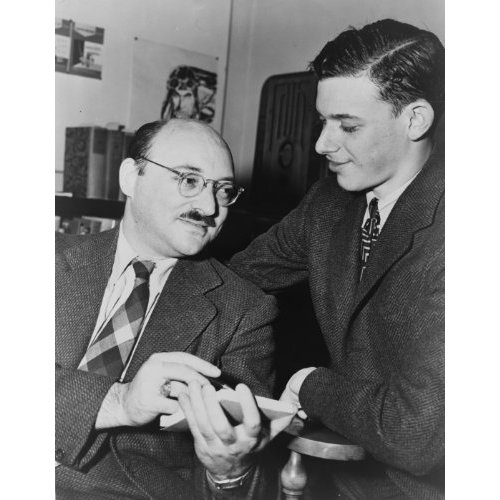
I had the good fortune to work twice with James Yaffe during the last few months of his life. I’m currently working on a biography of Frederic Dannay and Manfred B. Lee, and I’ve been reaching out to the remaining people who knew the two men in life. Through his wife, Elaine, he answered a number of questions about EQMM, working with Fred Dannay, and his experiences and anecdotes about those times. He shared how he had first approached Dannay with his first mystery short story, telling the editor that he’d written the piece “in class,” so that he could convey that he was younger than the normal contributor to the magazine. Dannay published the story and had a photographer from the World-Telegram come out and take the now-iconic photo of man and boy discussing the magazine.

Frederic Dannay and James Yaffe, 1943. Photo by Al Aumuller, New York World-Telegram and Sun. Image file courtesy of Gideon Yaffe.

Crippen & Landru also published a complete volume of Yaffe’s Mom stories a few months before the author’s death. (For those of you who don’t know, I’ll be taking over day-to-day operations for Doug Greene at the end of this year. He will remain the senior editor with Crippen & Landru.)

In 1997, Crippen & Landru had produced My Mother, the Detective, a volume of all the Mom stories to that point in time. In 2002, Crippen & Landru commissioned a new Mom story, “Mom Lights a Candle,” which appeared as a limited-edition pamphlet for series subscribers for the holiday season. These short booklets are extremely rare today, and in 2017, the commissioned story was added to an updated version of the book. The revised collection was a well-deserved coda to James Yaffe’s long and well-received career.

Jeffrey Marks is an award-winning crime-fiction biographer. His first book-length work, Who Was That Lady?, appeared in 2001, chronicling the life of mystery writer Craig Rice. It was followed by Atomic Renaissance: Women Mystery Writers of the 1940s and 1950s. More recent works include the Anthony Award winning Anthony Boucher, his 2013 biography of Erle Stanley Gardner, and his work-in-progress, a biography of Ellery Queen.

Posted in Guest, History, Magazine, Memorial, Writers | Tagged , , , , , , , , | 3 Comments

“Doing the Twist” (by Laura Pigott)

With our September/October issue just on sale, this morning we introduce a writer whose Department of First Stories debut appears in that issue. Laura Pigott works in the field of corporate communications, but she has been interested in mysteries since childhood. She has won the Golden Pen Award for best writer from UnitedHealth Group twice, and now she has turned her hand to fiction writing. Were anticipating that her debut story, Therapy Dog, will soon be followed by other published fiction, as she tells EQMM she is working on a collection of short stories. In the following post, she shares some insights into the type of short story she favors.—Janet Hutchings

One of the reasons I became an avid mystery fan early on is the delicious possibility in mysteries of thinking things will turn out one way only to have them switch up at the last minute. As a child, life often seems depressingly linear: you do something wrong, your parents find out, and you’re punished. How many times do you wish, and if you’re young enough even believe, that it was someone else who done it?

I became a graduate student in English lit at a time when genre fiction—mysteries, sci fi, romances, westerns—were just beginning to be accepted as worthy of critical consideration. Narrative linearity was no longer a requirement in literature, and since the writing of James Joyce and his cohorts, no longer cool. I was still wedded, however, to the concept of a plot, where events unfolded logically. But I wanted a little something extra, a development that would make me do a double-take, think “Hang on a minute, what just happened?”

Enter O. Henry. His stories were plot-driven and easily accessible, although burdened by what would now be considered authorial conceits and flourishes. Their subject was human experience, and he had a tender eye for the hopes and foibles of the common man or woman. Best of all, many of his stories featured a twist, where the reader’s expectations are foiled at the last minute. Taking readers off guard drove home the story’s message, whether a condemnation of the world’s cruelties or a call for compassion.

In one of O. Henry’s most famous tales, “The Gift of the Magi,” an impoverished couple sells their only treasures to buy a Christmas gift for each other. She sells her beautiful hair to buy him a fob for his heirloom watch; he sells his watch to buy combs for her hair. The moment when they present their cherished gifts and learn of each other’s sacrifice still takes my breath away.

Henry’s brand of short fiction has mostly gone out of fashion, except in one genre: mysteries. The mystery stories that stay with me are the ones where the writer leads me down the path to a conclusion, then pulls the rug out from under my preconceptions. The use of “red herrings” to mislead the reader along the way is an established practice and can be an entertaining way to delay the final revelation. What I find most compelling, though, are twists rooted in a protagonist’s complex psychology.

News stories about serial killers, lurid scandals, and domestic intrigues fascinate us because we want to know what caused their subjects to go off the rails. We question if it could happen to us or to the people we know. The mystery is an effective platform for exploring the consequences when something simmering below the surface in everyday lives erupts in unexpected ways.

All of us have experiences where presumptions about a person’s motives — loved ones, friends, colleagues, or even strangers — foster misunderstandings and premature judgments. Suddenly we find ourselves second-guessing our perceptions, wondering where our initial assessments went wrong. In a political climate polarized by rigid positions, could the twist in mystery stories also act as a cautionary tale about jumping to conclusions — train us to suspend not disbelief but belief, at least long enough to get all the facts?

Posted in Books, Fiction, Genre, Guest, Readers, Story, Suspense, Writers, Writing | Tagged , , , , , , , , | Leave a comment

ON ENDINGS

Recently I was asked to serve on a short-story panel at the Bouchercon World Mystery Convention in Toronto (October 12-15) that will attempt to provide advice to new writers on various aspects of craft. The panel’s moderator, frequent EQMM and AHMM contributor James Lincoln Warren, asked each panelist to provide a list of topics for discussion. That got me thinking about endings.

This type of panel is untried ground for me. I am not a teacher of creative writing, nor have I ever so much as attended a class or workshop on creative writing. Anything I know about the short story comes from reading, and from working one-on-one with authors for more than a quarter century. When it comes to reading, however, I have an abundance of experience. EQMM receives about 2,000 submissions per year, and I have always at least check-read every one of them. That’s about 52,000 short stories consumed (though, admittedly, not all get read all the way through!), and it does not include the many stories I read solely for pleasure.

I can’t help thinking I’ve absorbed a few things from all that reading (anyone would) and although I’ve never liked offering general advice to new writers, it would be impossible not to have formed some ideas over the years. Today I thought I’d share a few regarding endings.

Countless books have been written about various aspects of the craft of writing. I’ve sampled a few, but it’s only Edgar Allan Poe’s famous essays that I’ve returned to repeatedly over the years. In “The Philosophy of Composition,” Poe says: “Nothing is more clear than that every plot, worth the name, must be elaborated to its dénouement before anything be attempted with the pen. It is only with the dénouement constantly in view that we can give a plot its indispensable air of consequence, or causation, by making the incidents, and especially the tone at all points, tend to the development of the intention.” Like all general rules about writing that I’ve ever encountered, this one is violated, at least from a procedural standpoint, daily by many successful writers. For many, the germ of a short story is an opening line, and the story may grow directly from there, in the writing of it, without any real sense at the outset of where it’s going. But there’s a truth to what Poe says that goes deeper than the different methods individual writers may employ in producing a story. I think author Elizabeth Bowen captures that truth in her Notes on Writing a Novel when she says, “Story involves action. Action towards an end not to be foreseen (by the reader) but also towards an end which, having been reached, must be seen to have been from the start inevitable.”

Embedded in both Poe’s and Bowen’s remarks is the notion that the story as a whole only works if everything in the story drives towards the particular ending it has—and no other. For Poe, this is connected to the plot having an “indispensable air of consequence, or causation.”

For me, this encapsulates a central element of most of the stories we find in the mystery and crime-fiction genre, though it is especially true of surprise-ending (sometimes called “twist-in-the-tail”) stories. There, as veteran writer James Powell once put it in a letter to EQMM, the ending is like the punch line to a joke—by which I do not think he meant that the endings to such stories are necessarily contrived (a common criticism of the twist-in-the-tail story). I think he meant instead that a short story is such a closely interconnected whole that you either nail it perfectly with the ending or it all falls flat.

As an editor, I’ll sometimes turn down stories with the comment that the ending isn’t satisfying to me. But only very rarely will I ever suggest a specific change to an ending, and that’s because it’s been my experience that a change to an ending usually requires significant change elsewhere in the story—a fairly comprehensive rewrite that can only be done by the author.

I’ve found that many new writers are excessively focused on the openings to their stories. I’ve been approached a number of times, at mystery events, by novices who seek to interest me in a story by touting its great opening line. And yet openings (if not specifically opening lines) much more often fall under my editorial pen than endings—mainly because they are far easier to edit. Nine times out of ten, the problem with openings to stories is that too much information is given up front—there’s too much setup. It’s relatively easy to pare some of that off so that the reader can get directly into the story. Edit an ending, by contrast, and you’ll probably soon see that you’ve knocked something off kilter elsewhere.

Edward D. Hoch, with whom I worked for seventeen years, editing approximately two hundred of his stories, seemed to think so. He was extremely amenable to almost any editorial change. There was only one exception: Just don’t change the ending, he’d always say. Ed worked with all three of EQMM’s editors and though I never knew my predecessors, I’ve heard enough about them to know they each had different approaches from mine and from each other’s. Founding editor Frederic Dannay was famous, I’m told, for changing endings, but Fred, in his role as the writer Ellery Queen, was a master plotter, and also one of the world’s most famous literary collaborators. I wonder, therefore, if the work he did on some of those EQMM stories was closer to that of cowriter than to that of the typical editor—and whether he actually changed a great deal more than the endings!

It may also be that Fred was more often editing classical whodunits than we are today—since so few cross our desks. For it seems to me that with a whodunit there is often less inevitability to the conclusion. I’m reminded in this regard of the Rupert Holmes musical The Mystery of Edwin Drood, from Charles Dickens’s unfinished novel. In it, audience vote determined which among multiple endings would be performed on a given night. This was all great fun, but of course, in a theatrical setting of that sort one doesn’t have the same expectations one has of a short story. And readers would be deprived of the sense of being fooled by a whodunit—that “Oh, I should have seen that!” moment—if it appeared there were any number of ways it all could have turned out. There is often a bit more latitude in the determination of the ending to a whodunit than to a twist-in-the-tail or suspense story; nevertheless, I think that latitude is always limited. In a very tightly plotted whodunit, there really is only one possible solution, and even when there’s room for more than one, the plausibility of the possibilities is tied to much else in the story, especially to the way the story’s characters have been developed.

I’ve posted about the intimate relationship I see between characterization and endings on this site before, with regard specifically to whodunit confession scenes (“Wrapping It Up,” July 2013), so I’ll refer you there if you’re interested in a few more thoughts on this subject. I’ll just add that if we wanted to measure how effective a confession scene is in a given case, we could once more bring in Poe, who said that every element in a story should tend toward bringing about a “single effect.” I think what he said can be adapted to fit many types of stories. From a plot standpoint, the single effect a whodunit aims for is presumably giving the reader a sense of being fooled, or inspiring a sort of awe at the cleverness of the puzzle and its solution. But I’d argue that when a writer pulls out of his hat a solution that isn’t convincing given the way the characters in the story have been drawn, readers are left not with a pleasurable realization that they’ve been legitimately fooled, but with a sense of having been cheated. That’s why endings to whodunits, as to any type of story, are so difficult, and why Poe thought they had to come first in the process of construction. The ending is the point at which the writer either delivers the effect the whole story has been driving at, as Poe put it, or falls fatally short.

Posted in Editing, Fiction, Genre, Story, Writers, Writing | Tagged , , , , , , , , , , | 11 Comments

“The Trials of Writing at 65 MPH” (by M.C. Lee)

Fiction writers come from all walks of life, as this post demonstrates. And those who really have it in them to write will often endure many difficulties, even hardships, to make it possible. I’ve known writers who composed all their early works on trains while commuting to and from work, many others who got up in the wee hours of the morning or burned candles late at night in order to fit their writing in around full-time jobs, child-rearing, and other commitments. I’ve known a traveling salesman who wrote in his car while stopped at convenience stores between appointments, but never before have I met someone who wrote while in the driver’s seat of a vehicle moving at 65 mph. Mike Lee’s first published work of fiction, “Angel Face,” appeared in EQMM’s May/June 2017 issue under the name M.C. Lee. I think it’s a fine debut. I’ll let him tell the rest of his story himself. . . . —Janet Hutchings

 

Finishing has always been the hard part for me.

Without boring readers with self-advertising details, I’m here to say I have written three book-length manuscripts in my forty-five-year lifespan, and each was written in an entirely different set of circumstances from the others.

It started with a futuristic men’s adventure, The Cross. I was seventeen years old and writing on a Tandy 1000 SL desktop computer, and saving my work to 5 ¼ inch floppy discs at the end of each session. This was done on the side porch of our house in Cape May, New Jersey, which my mother used as an office. It took me roughly a year to complete. I finished just after I graduated high school and the manuscript totaled ninety-five thousand words. Things would never be this straightforward again.

My horror/thriller Too Low for Zero was next. It was three years later that I began writing it in an empty forward berthing compartment on deck three of the aircraft carrier USS Kitty Hawk (CV-63), which was on sea trials off the California Coast. This time I used a Smith Corona PWP word processor, which had a five-line screen and saved to double-sided “quick” disks. This manuscript followed me out of the Navy and back to New Jersey, where I finished it (or got to 150,000 words, anyway) while working as a dealer at Sands Hotel and Casino in Atlantic City. I made several attempts to revise TLFZ later, but it remains, to this day, in the dead-letter file.

John Lennon once said that “life is what happens while you’re busy making other plans.” Well, for the next twelve years, I made a lot of other plans. Unfortunately, except for a handful of terrible screenplays, I didn’t do a lot of writing. Through various career decisions, none of which I’m proud of (I’ve attended five different trade schools and even held a California real-estate license for three years), I ended up as an independent truck driver.

In 2009, while driving a dedicated route between Salina, Kansas, Reading, Pennsylvania, and Bristol, Tennessee, I was once again bitten by the writing bug. The environmental circumstances, however, were much different this time. Professional truck driving is a very time-consuming and stressful profession. OTR (over the road) drivers often work twelve to fourteen hours a day, thirty days at a stretch (as they’re exempt from Federal overtime rules), with as little as ten hours off between driving shifts. The environment is loud and the lifestyle unhealthy, which leads to an unusually high industrywide turnover rate of almost 96% per year. I also gained fifty pounds.

For me, doing any kind of meaningful writing after an eleven-hour, seven-hundred-mile driving day is completely out of the question—my brain is just too fried. Luckily, by channeling the spirit of pulp novelist Erle Stanley Gardner, I found my answer.

I knew from a documentary about Gardner that many of his later Perry Mason stories were dictated and then transcribed by his secretaries. He wasn’t the first person to take this approach; it is almost universally accepted that John Milton’s Paradise Lost was a dictated work—popular artwork often portrays Milton’s daughters doing the transcribing. It’s a little unclear if Gardner actually recorded the stories to tape or dictated them live, but in his prime, he was producing more than one million words per year.

A Man with a Plan

I decided that the only way the new novel was going to be written (a political mystery/thriller this time) was to utilize my long driving shifts for something other than listening to audio books and eating Doritos. I started recording How to Kill Two Presidents in late April 2009 using my old Sony mini-tape recorder and filling four ninety-minute cassettes before the recorder died peacefully in its sleep. I then switched to a Sony digital recorder, although not one that allowed me to easily transfer files to my computer. In fact, the only way to get the files from the recorder to my computer (I was still three years from getting my first smartphone, which would have made this job much easier), was to use an external microphone on my computer to rerecord the audio directly off the Sony’s speakers. I had to turn off the engine of my truck for forty-five minutes at a time to do this, which, in the middle of the summer, could be brutal.

Writing by recording while driving an eighty-thousand-pound semi-truck down the road isn’t all it’s cracked up to be. I was only comfortable enough to record when I was in light traffic on relatively straight roads. It was almost impossible to do while driving through places like Missouri, western Pennsylvania, or the Shenandoah Valley, areas I dreaded. Wind turned out to be another problem; my truck, a 2006 Kenworth T-2000, had poor door seals. A north/south wind, which is very common in the Midwest, can drown out the sound of a five-hundred-horsepower engine. The volume of the my recordings was decent enough on playback, but with a twenty-mile-per-hour crosswind and poor door seals, it became too loud to think, let alone produce good dictation. One time (I know this because I often added notes to the recordings) I went sixteen days without being able to record a single word just because of the wind.

The first draft of HTKTP was completed at 1:16 A.M. (EST) on June 7, 2010, on Interstate 81, mile post 38, just north of Greenville, Tennessee (birthplace of Davy Crockett). I didn’t make such a precise marker when I began the draft in April the previous year, although I believe I was on Interstate 70, somewhere between Salina and Topeka, Kansas. I recorded almost thirty-five hours of audio (approx 358,000 words) in forty-seven forty-five-minute-long files. I decided to keep recording in these forty-five-minute segments, which was the length of each side of the tapes I began with.

OMG—I still need to type all this out, don’t I?

I became quite proficient at typing with two fingers on my first book. I learned to type properly in the United States Navy, but devolved back to two-finger typing by the time I started my second manuscript. Suddenly, the process of transcribing thirty-five hours of audio ran into the same problem that led me to dictate the novel in the first place: time. Early transcription was so slow that I decided I needed to learn to type again, but then I discovered voice reorganization software. I procured a copy of Dragon Naturally Speaking but still managed to be time plagued by my driving duties. (To date, I’ve driven over two million miles or approximately ten light seconds.)

At first, I tried to repeat the process I’d used with the original transcription, this time listening to the recordings on my iPod while wearing ear buds beneath a USB microphone headset and repeating the story out loud, while my laptop, which was sitting with its screen closed on the floor of the truck, transcribed my writing using Dragon. The results were hit and miss. The noise inside the truck affected the transcription process, although it was surprisingly more accurate than most would imagine. The real problem with this process (aside from severe wind days, which made it impossible) was that with the laptop closed and out of my reach, I would have no idea if it was even transcribing without stopping to check. Furthermore, there were several words, especially in such a loud environment, that could trigger command functions in Dragon that would stop the transcription process cold. Since I couldn’t see this, I could go on transcribing and not discover until later that the process had stopped several hours earlier.

Another problem was the sheer size of the novel: My recorded audio usually comes in at about a thousand words for every five minutes of recording, and I had thirty five hours to deal with without much free time. The two or three days I was off and at home each month was the optimal time to do it, but in all honesty, I just wasn’t up to it. There was also the issue that what sounded great didn’t always look as good on paper, so I also had to do a lot of editing.

Then I had another idea.

A second draft by making new recordings of my old recordings

It took me five years and one month to get my first hard copy of HTKTP. After four years had passed, I only had about two hundred and fifty pages transcribed out of, potentially, seven hundred. The heavy revisions on almost everything I transcribed were still afflicting me. For the most part, only dialogue escaped untouched. I wanted to finish, but I couldn’t unless I came up with another process. I decided to go back to the beginning: This time, instead of recording fresh material while I drove, I listened to my original recordings and then made new recordings, which were basically a second, cleaner draft. I then used Dragon Naturally Speaking after each driving shift—and even when I was home—to transcribe these new recordings. It took six more months, but on July 1st, 2015, I had my first hard copy. The word count was 325,000.

Interlude

By this point, some of you are probably wondering how I ended up publishing in EQMM or being asked to write for this blog. At the beginning of December, 2015, my daughter Halle (who is an English major at Missouri Southern State University) asked if the two of us could each write a story for the NeoVerse short story competition. I’d been tinkering with the idea of writing a detective story ever since I listened to several Travis McGee novels and Black Mask audio complications from Audible.com. Coincidently, two nights earlier, I had spoken to a friend of mine, who is a Kansas City police detective, and asked him about evidence processing and police procedure. Then, almost as if it were ordained, I was laid over at the Norfolk Southern Rail yard in Detroit Michigan on December 8, and wrote a forty-four hundred word first draft of “Angel Face” (using two fingers, not recoding) in the sleeper compartment of my truck. I thought what I wrote was pretty good, and although there were cash prizes, I hoped to place in the top twenty-five of the contest. It would make a good addition to my eventual query letter for HTKTP if I did. I did several more drafts and submitted it to NeoVerse just before Christmas, 2015. Then I went home.

In April, NeoVerse announced their top twenty finalists. I was not among them. I know that every writer thinks the same thing, but I thought I had written a good story. I didn’t want “Angel Face” to end up in the dead-letter file next to all my other unfinished work, so I decided to submit it to a magazine. Around the same time I wrote “Angel Face,” I listened to the Stephen King short story, “Secret Window, Secret Garden,” which features EQMM prominently, and so I decided to try them. EQMM contacted me in April 2016 and told me that they wanted to buy “Angel Face.” I signed the contract in July, just as I was entering the last phase of work on my novel. I used some of the profits to treat myself to a box of Mark Twain Memoir cigars.

Don’t worry, I’m almost done

There were no more tricks left. Once I had the hard copy of my novel, my recording days were over. Everything from here on out needed to be done the old-fashioned way, and despite making a few renewed efforts to work on HTKTP during my off hours, very little progress was made until November 2015. That’s when I discovered that the company I was leased to would be downsizing and closing eighty percent of its terminals. My options were to work locally, by running auto parts to the Ford Assemble plant in Kansas City, or lease my truck to a new company and continue to stay on the road. In a fantastic bit of luck, I was offered the same pay to go local as I would make on the road. I would never be more than seventy-four miles from home, which wouldn’t allow me to go home every night, but I would have the weekends off. Best of all, I would only be working seven or eight hours a night, which, after fourteen years of fourteen-hour days, was amazing.

The final leg of my journey to finish HTKTP began on January 4, 2016, after the Ford Assemble Plant’s Christmas shut down. My base of operations was Pour Boys Truck Stop on HWY-210 in Kansas City, Missouri, which was only four miles from the rail yard I worked out of. I preferred the very corner spot in the truck-parking isle, since it offered the most privacy, but also because I only had to deal with a single truck beside me at a time. (I even customized this spot, creating

my own check-in location on Facebook called Mike’s Corner Parking Spot. It’s still there.) I woke up every morning at 11 AM, made coffee in my microwave, and ate a small Atkins friendly breakfast (using the Atkins diet to lose that fifty pounds I mentioned earlier). Then I got to work in the driver’s seat. If I reversed the steering wheel, it made a nice nook to rest the laptop on, and a portable, folding wooden tray from home held the mouse pad. I worked, most days, from 11:30 A.M. to 5 P.M, then drove to the Norfolk Southern Rail yard and pulled auto parts to the Ford plant until 1 or 2 A.M. I would drive back to the truck stop and repeat the process Sunday through Friday, spending Saturdays at home.

Working at the truck stop wasn’t without its difficulties: For example, there was sun glare, which often forced me change parking spots several times throughout the day. Anytime a truck with a white trailer would park right next to me on a sunny day, the glare was so bad I’d have to move again. Eventually, I learned to just keep my front window curtain closed while I worked. During the relatively mild winter of 2016, I was able to keep the engine off for hours at a time, but I needed to run the engine for the air-conditioner once spring rolled around. I wasn’t using voice recognition anymore, but the noise was still terribly distracting.

On Friday, August 19, 2016, six years after I finished my first recorded draft, I finished HTKTP. The word count was 186,000.

Final Polish

My wife did the first proofread of HTKTP, and in mid-September I sent the manuscript to a professional editing service. The editor added a note at the end saying it was one of the three best manuscripts she had edited that year. In October, I began looking for an agent. NOTE: I suspect a few of my readers believe that 180,000 words is way too long for a first-time novelist . . . and they’re right. After many months without a request even to read it, a sympathetic agent advised me that the manuscript was almost twice the acceptable length for a thriller. This was good advice and I spent a month (this time at home) reducing the novel to 89,000 words, which I believe has made the story better. I hope I created something that other people will eventually enjoy, but I am aware that just because HTKTP was created under unique circumstances, that doesn’t necessarily mean it’s good. I hope it is.

All photos courtesy of M.C. Lee.

Posted in Books, Business, Editing, Fiction, Genre, Guest, Publishing, Suspense, Thrillers, Writers, Writing | Tagged , , , , , , , , , | Leave a comment

“The Story I’m About to Tell You Is (Mostly) a Lie” (by Con Lehane)

Con Lehane’s first short story for EQMM will appear in the Black Mask department of our September/October 2017 issue (on sale August 22). The author is a well-reviewed crime novelist whose work includes a series starring bartender sleuth Brian McNulty and another set at New York’s 42nd Street Library. The latest in the latter series is Murder in the Manuscript Room (Minotaur, November 2017). The author has also written short stories for our sister publication, Alfred Hitchcock’s Mystery Magazine, and he teaches fiction writing and mystery writing at the Bethesda Writer’s Center. Today’s post gives us a look at how he came up with elements of his upcoming EQMM story, and provides his answer to a perennial question asked of writers.—Janet Hutchings

Readers often ask writers where the ideas for their books come from. Some writers don’t like the question or they find it silly. One of my writer friends tells people he gets his ideas from a post office box in Albany. I think writers shy away from the question because ideas for your stories have to come from you. Knowing where I get my ideas, or what those ideas are, isn’t going to help you. Neither is you telling me the idea you have for a story I might write going to help you or me.

Despite this, I’ve discovered in my fiction writing and mystery writing classes (at the Bethesda Writer’s Center) that a lot of beginning writers aren’t sure where ideas for stories come from or how they should find their own ideas. Because of this, I usually do a couple of exercises that have to do with hooking up incidents from one’s memory with imagined incidents to make a story. I won’t go into the mechanics of the exercise here. But I’ll give an example.

In an interview in The Writer’s Chapbook, novelist John Irving (The World According to Garp and many others) says, “I begin by telling the truth, by remembering real people, relatives, and friends. The landscape detail is pretty good, but the people aren’t quite interesting enough—they don’t have quite enough to do with one another; of course, what unsettles me and bores me is the absence of plot. . . . And so I find a little something that I exaggerate a little; gradually, I have an autobiography on its way to becoming a lie. The lie, of course, is more interesting. I become more interested in the part of the story I’m making up, in the ‘relative’ I never had. And then I begin to think of a novel.”

Now, John Irving isn’t a crime fiction writer. But I’m one of those people who doesn’t see crime fiction as a lesser breed of literature. I don’t think of it as inferior and I do think of it, or much of it, as not so different in how it is imagined and written as any other fiction. Doesn’t it all come from the same place—memory and imagination?

My upcoming EQMM story “Come Back Paddy Reilly” didn’t come about in quite the way John Irving describes, but there are similarities. I wrote the initial version of the story a long time ago. It got its start with a girl I knew when I was a teenager. Despite the setting of the story, and the setting of all of my novels, I didn’t grow up in New York City. I grew up in a couple of different towns in Connecticut. The girl who inspired the “Paddy Reilly” story, I met when I was thirteen, and that meeting took place against the backdrop of my father’s weekly pinochle game in Stamford, Connecticut, not the Bronx where those scenes are set in the story. Stamford is in large part a wealthy suburb of New York, but the part of Stamford I knew growing up was an Irish working-class town. Almost all of my parents friends were from Ireland; they worked in factories, drove buses, or were gardeners, like my father, or worked as domestics, like my mother. Most of the kids I knew had Irish parents.

The girl who inspired Nancy in real life wasn’t of Irish descent. I don’t remember what nationality she was. Still, a lot of the young love loved-and-lost part of the story was pretty much from my memory, except that none of it took place in the Bronx. How the Bronx got into the story has to do with another memory.

The Kingsbridge section of the Bronx in the far northern reaches of the city, below Riverdale and bordering Yonkers, was an Irish neighborhood when I was in my late teens. There were a dozen or more Irish bars along Broadway under the el and hundreds, if not thousands, of immigrant Irish families in the apartment buildings on either side of Broadway. Near the end of the el, the Broadway local, there was Gaelic Park, at one time named Croke Park after the Irish football and hurling stadium in Dublin. For a number of reasons, I spent almost every weekend as a young man in that area, going to the football and hurling matches in Gaelic Park and drinking beer afterward with many of the players in the bars along Broadway.

A good friend from those days, a few years older than me, lived with his wife and kids in an apartment building on Naples Terrace. I visited him often and was always fascinated by the stairs that led from the end of Naples Terrace down to Broadway. Why this hooked up with the young girl from Connecticut in my memory and became a central part of the setting of the story I have no idea.

The next piece of memory was when I tended bar on the Upper West Side of Manhattan at 108th Street, also on Broadway but a different Broadway indeed from the Kingsbridge section 130 blocks or so north. The bar at 108th Street was a true neighborhood bar, the kind that stayed open until 4:00 a.m., and often, with the lights turned down, quite a bit later. Among the patrons, there were “lots of sad faces and lots of bad cases of folks with their backs to the wall,” as George Jones has sung. It was that kind of joint.

One night, two guys came in pretty late, both broad shouldered, streetwise, and tough looking; one guy was white, the other guy black. I knew as soon as they came through the door they were undercover cops. They came up to the bar. The white guy ordered a double shot of vodka and another double after that. They weren’t his first of the night. The guy beside him shook his head when I asked if he wanted anything. He watched his partner drink with the pained expression of a man watching his wife dance much too closely with another man. They came back, just like that, four or five time over the next week or two. No conversation, the same double vodkas, sometimes two, sometimes three, the same pained expression on the partner’s face. Then they were gone. I never saw either of them again. Never knew what went on with the guy drinking the vodka. But, like his partner, I knew he was in big trouble.

There were other times and places in the story that came from my memory. The Dublin House—I think still on 79th Street, though probably spruced up a bit—served as a setting for the final scene with Nancy and Paddy Reilly. There was a cafe—and another woman and another time—where I sat across the street from Lincoln Center, on a still different stretch of Broadway, in awe of the stunningly beautiful Chagall murals hanging in the lobby of the Metropolitan Opera House. That was it for memory. Pretty much everything else that happened in the story would be what John Irving would call “the lie.”

The first version of the story had some of the elements of the version coming up in Ellery Queen’s Mystery Magazine. But not the crime and not the cop. I took another shot at it not so long ago. By then, I knew I was writing crime fiction. I think knowing that helped me understand what the story was really about and tie it together.

Posted in Characters, Fiction, Genre, Guest, Writers, Writing | Tagged , , , , , , , , , , | Leave a comment

What Makes Mystery Writers Ante Up for Poker? (by Peter Hochstein)

Peter Hochstein is a former newspaper reporter and advertising copywriter and the author of a number of paperback original novels, most under various pseudonyms. A few years ago he began writing a series at short-story length starring P.I. Rich Hovanec. The first entry appeared in the anthology Dark City Lights, edited by Lawrence Block. The second in the series, “The Client, the Cat, the Wife, and the Autopsy,” was published in EQMM’s January/February 2017 issue and was subsequently recorded for our podcast series. In our next issue, September/October 2017, on sale August 22, Hovanec appears again, in a characteristically offbeat case. EQMM only recently learned that Peter was one of the early (and ongoing) players in the legendary poker games that include several of mystery’s best-known writers. Thanks to him, we’ve discovered how it all started—and what the appeal of the game is for mystery writers.—Janet Hutchings

One evening in New York, back in 1960, two college students, three struggling young writers, and a just-starting-out literary agent decided to pass an evening playing poker. None of them was wealthy enough to own a set of poker chips at the time, but the stakes were so low that they could play with the loose nickels, dimes, and quarters in their pockets.

One of the writers was named Lawrence Block. Yes, that Lawrence Block. Another was the late Donald E. Westlake. Yes, that Donald E. Westlake. The third writer, Hal Dresner, landed in Hollywood a few years later, earning screen credits, according to the IMDb database, that ranged from Zorro: The Gay Blade, to the screenplay of Catch-22, to various episodes of M*A*S*H and Husbands, Wives & Lovers.

The literary agent was Henry Morrison, who now is perhaps best known as the agent who discovered the late Robert Ludlum and who, to this day, represents the Ludlum estate.

The players enjoyed the game so much that they decided to play at regular intervals. Fifty-seven years later, the game is still a ritual. Westlake has since passed away, and Block currently prefers to join the players just for the pregame dinner, but the list of players who have been dealt into the game over the years or who currently play in it reads like a Who’s Who of authors, editors, and agents who have serious muscle in the mystery world.

Morrison is still there. Otto Penzler, founder of the Mysterious Press, the Mysterious Book Club and to this day operator of The Mysterious Bookshop, played in the game for about 20 years. Robert Ludlum sometimes joined the game when he was alive and not too busy chronicling the adventures of Jason Bourne.

I was invited to join I think after the third game back in 1960, and have cycled in and out of it ever since. With the exception of one or two mere dabblers in the crime-fiction business like me, the current roster of players is still formidably impressive.

One of them is Jim Fusilli, mystery writer and Wall Street Journal music critic. In addition to his eight mystery and crime novels, Three Rooms Press recently published his Crime Plus Music, Fusilli’s anthology of twenty mystery stories by 19 other authors and himself.

Justin Scott, the author of the Ben Abbott series of mystery novels set in small-town Connecticut is another player. So is Parnell Hall, author of the Puzzle Lady series of mystery novels beloved by crossword puzzle fans, and the Stanley Hastings series. In the last few years, a new mystery author, Ira Berkowitz has joined the game. He is author of the Jackson Steeg novels, set in New York’s Hell’s Kitchen, a made-for-noir neighborhood. His most recent book is Sinners’ Ball.

But the group is not exclusively male. S.J. Rozan, a Shamus and Anthony Award-winning author who writes under her own name and several others, often deals herself in when she isn’t in Asia gathering material for her next work of fiction.

Over the years, I’ve listened to their talk and noticed something remarkable about this group. When they find themselves on the road with other mystery authors—typically at an out-of-town Bouchercon conference—what they tend to do at night, just about every night, is play poker. Lots of poker. And when they come back and play poker in New York, they’re still talking about the poker at Bouchercon.

They might have been in New Orleans where the jazz runs both hot and cool, but were they at the Fountain Room or the Saturn Bar or the Maison soaking up trumpet riffs? No way. They were back at the hotel, playing seven-card stud until 3 a.m. In fact, no matter where the conferences are held, you’re more likely before and after the day’s proceedings to find many mystery writers holed up in a hotel room shuffling a poker deck than you are to find them shuffling around town, checking out the nightlife, the bar scene, or simply seeking locations for a juicy murder in their next novel.

So what’s up with that? Why do crime writers have so much affinity for poker?

I put the word out that I was interested in hearing from mystery writers who could explain the phenomenon. And sure enough, I got an earful.

For example, here’s Thomas Pluck, author of Bad Boy Boogie, which he tells me is “the first in the Jay Desmarteaux crime series.” Pluck writes in an e-mail:

“A game of poker, high stakes or not, is a tale of intrigue in itself. There’s a balance of chance and skill, where your bluff is as important as the cards in your hand . . . or up your sleeve.”

Up your sleeve? For a moment there, I wondered if I could ever dare sit down at a card table with him. But then Pluck then continued and effectively revealed that he’s merely waxing poetic. Or dramatic. Or dramatically poetic. He waxes on:

“There’s a morbid cachet to it, with the Dead Man’s Hand held by Wild Bill Hickok when he was murdered, though ideally, it’s a duel of wits, without blood. But whether there’s cash at stake or it’s a ‘gentleman’s game’ where your dignity and standing are all that’s wagered, no one gets out unscathed.”

Among those who have failed to leave unscathed is Gary Phillips, editor of the anthology The Obama Inheritance: 15 Stories of Conspiracy Noir, scheduled for October publication.

Referring to the professional hit man in a Don Winslow novel, Phillips writes,

“Every time I sit down to a game I imagine myself as the card savvy Frankie Machine. But by game’s end, reality has set in and I’m Elmer Fudd again, coming up bust.”

By contrast, Ira Berkowitz was as brutally staccato and to the point as any narration in one of his Jackson Steeg novels. “Okay,” he wrote. “Couple of things, and none of them is about money. The camaraderie. Betting on myself. Pitting my skill against the other players. Does that work?”

Yeah, it works—and please, Ira, don’t shoot me.

For any out-of-town mystery fan who comes to New York, an almost obligatory pilgrimage would have to be Otto Penzler’s Mysterious Book Shop on Warren Street in the Tribeca neighborhood. Open the door, decorated with a sign that invites you to “come in and snoop around,” and you’ll find yourself surrounded by what is perhaps the world’s largest collection of for-sale crime fiction. With decades of analyzing mystery stories under his belt, I was certain Penzler would have something analytical to say about why crime writers love poker. And I wasn’t disappointed.

“Poker is about the cards your dealt,” Penzler wrote, “but it’s also about trying to deduce what the adversaries at the table are up to, what they’re hiding, and what secrets they want to keep from you—much like the guilty party in a detective novel. Trying to make sense of a betting pattern, observing the cards played and the bets made, and attempting to bring coherence to those clues, is not unlike the task of a detective as he follows clues. It’s an intellectual chess match.”

Penzler adds: “The poker mysteries in Dead Man’s Hand, a book I edited for Harcourt in 2007, touched on some of this in stories by Michael Connelly, Jeffrey Deaver, Joyce Carol Oates, and many others.”

S.J. Rozan, author of the Lydia Chin/Bill Smith mystery series, had a strong pair of thoughts about poker. First, she mused, “While not quite criminal, it’s a game that requires reading other people and a willingness to take risks. These are the skills we use when we write crime.” And then she added, “It’s also a way to hang out with other agreeable people, which as writers, isolated at our desks, is in itself a great gift.”

Rozan may be on to something big when she talks about authors and isolation. If you’re a mystery writer full time, your workday social life consists of just you and a cold keyboard. There’s no group to shmooze with at the water cooler. And there’s no next cubicle, whose occupant you can go out to lunch with, much less bounce ideas off. Jim Fusilli also commented about this.

“I’ve always thought of the poker games among writers as a way to foster community, however briefly, among people whose careers are conducted in solitude,” he said. And that reminded him of something. “There are people I’ve played poker with at Boucheron that I’ve never spoken to at any other time. I once told a writer that I had never seen the right side of his face: For consecutive years, he sat to my right at the poker table.”

Posted in Genre, Guest, History, Publishing, Writers, Writing | Tagged , , , , , , , , , | 5 Comments

“When Terror Australis Meets Dingo Noir” (by Aoife Clifford)

Australian writer Aoife Clifford has won Australia’s two premier crime short-story awards (the Ned Kelly and the Scarlet Stiletto) as well as earning an additional nomination for each. When her first novel, All These Perfect Strangers, was published (in Australia and the U.K. by Simon & Schuster and in the U.S. by Penguin Random House) she was named an Amazon Rising Star of 2016. In her first post for this site she gives us an intriguing overview of the world of Australian crime fiction. Her latest EQMM story will appear in our September/October issue, on sale in August.—Janet Hutchings

Every so often writers and publishers try to come up with a snappy identifier for Australian crime fiction similar to the ever popular “Nordic Noir” or Scotland’s “Tartan.” Recently, I tried to convince others on Twitter of the merits of “sunburnt noir” but plenty of alternatives were posted in reply: “gum leaf,” “kangaroo,” and the tongue-in-cheek suggestion of “dingo noir”—designed for books with bite. My current favourite is courtesy of author Sulari Gentill, “Terror Australis.”

Perhaps it is only right that we struggle to sum up Australian crime fiction with a neat geographical catch-all phrase, given that almost one hundred Scotlands could fit inside our island borders. However, Australian crime fiction is thriving and should enjoy its own place in bookshelves around the world.

With over a quarter of Australia’s population born overseas it isn’t surprising that some of our best known international authors set their books in international locations. You could be reading Australian authors and not even know it. Michael Robotham’s psychological thrillers have been published in more than 50 countries and he won the Gold Dagger, UK’s top crime prize, with Life or Death, set in Texas. Adrian McKinty grew up in Northern Ireland and is now based in Melbourne. His highly entertaining Sean Duffy series, following an insubordinate Belfast cop, has won and been nominated for crime awards on three different continents with Rain Dogs receiving an Edgar Award earlier this year. Picking up James Patterson’s recent book, Never Never, you might have noticed the name Candice Fox also on the cover. An accomplished Australian author, Candice has co-authored three books with Patterson, in between writing her own award-winning best-sellers. Check out her serial killer Hades series and her new standalone Crimson Lake coming out March 2018. Sarah Schmidt’s See What I Have Done is an evocative retelling of Lizzie Borden’s life that has dazzled Australian audiences and is about to be released in the U.S.

If you are more interested in titles that have the land down under as a location, don’t worry. Australia has a rich history of crime fiction, which given that the white settlement of Australia began as a penal colony, shouldn’t be surprising. In fact the biggest selling detective novel of the 19th century was Fergus Hume’s The Mystery of a Hansom Cab set in both the slums and finest houses of Gold Rush Melbourne. Published in 1886 it was more popular than Sherlock Holmes at the time and has rarely been out of print.

If characters in period costume appeal, then Kerry Greenwood’s beloved Phryne Fisher will delight. Sixteen novels in the series so far, it features the best-dressed detective of all time (see the Netflix TV series for proof). Also no slouch in the sartorial stakes is the debonair Rowland Sinclair by Sulari Gentill. Three “Roly” books are already available in the US, with a fourth Paving the New Road out early next year. Sulari also has written a literary crime fiction novel Crossing the Lines, which has been described by Jeffery Deaver as a “brilliant blend of mystery, gut-wrenching psychological suspense and literary story-telling,” and is one I can’t wait to read.

The Australian equivalent of the Edgars are the Ned Kelly Awards. Named after the infamous outlaw bushranger, they are awarded annually and their shortlists are a great place to start. Their winners include Peter Temple, whose last book Truth, won the Miles Franklin, Australia’s most prestigious literary prize. It is the first and only crime fiction book to be so recognised. Temple’s other books include international award winning and my personal favourite, The Broken Shore, as well as his ever popular Jack Irish series.

Multiple “Neddie” recipient and Australian crime writing royalty, Garry Disher, has published over fifty books. Currently, he is writing two separate crime series. The first centres on Wyatt, a captivating and enigmatic anti-hero not averse to organising a heist or two. The second is based on two police officers, Hal & Destry, working on the Mornington Peninsula, south of Melbourne. My favourite standalone of his is Hell To Pay where a cop whistleblower has to deal with the consequences of his brave stand. If heist fiction is your cup of tea, you might also want to check out Andrew Nette’s Gunshine State, which is a thriller set in Queensland, Melbourne and Thailand.

American crime writing has had a big influence on Australian writers. The most influential I’d argue is Sara Paretsky and it’s not just for her character V.I. Warhawski. Back in 1991, a few enterprising Aussie dames got together and, inspired by the American Sisters in Crime, founded by Paretsky, started up the Australian equivalent with the aim of encouraging women crime writers. For short-story lovers, the Sisters run an annual short-story award, the Scarlet Stiletto, with several anthologies of winners available. Their annual prizes for best crime novels written by a woman are The Davitts, named after Ellen Davitt who wrote Australia’s first mystery novel, Force and Fraud, in 1865. At the first Davitt Awards there were only seven novels in contention. Sixteen years later there are almost one hundred.

It’s rare that someone pulls off the Neddie–Davitt’s double in one year, but in 2016 Emma Viskic’s Resurrection Bay did it. Centred on Caleb Zelic, a deaf detective, this beautifully written book swept both competitions. It will be out in the U.S. early next year, with the second in the series close behind.

When international readers think of Australian crime fiction it often conjures up bush settings, small towns, and hot dry weather. Jane Harper’s The Dry is the perfect embodiment of drought drama. Already appearing on international bestseller lists, it was awarded the Australian Book of the Year for 2016.

However, urban settings are just as popular, with my own hometown of Melbourne putting in a convincing bid for Australia’s crime-fiction capital. It’s the setting for a wide array of crime-related books. Anything from the true crime best-selling Underbelly series by journalists John Silvester and Andrew Rule based on the recent gangland war, to Ellie Marney’s YA retake on Sherlock Holmes, beginning with the rollercoaster Every Breath. Another of my favourite Melbourne books is the hilarious Murray Whelan series by Shane Maloney. Last published in 1998, it is well worth hunting out.

Prefer more sun and warmer weather? Then head to Australia’s “Emerald City” Sydney via works as diverse as that of Peter Corris, known as the Godfather of Australian crime fiction to Dorothy Porter’s incredible verse novel The Monkey’s Mask featuring a lesbian detective and killer poetry. From there you can keep working your way around the country courtesy of crime fiction.

One of the best things about reading a book is the ability to take a trip somewhere entirely different without leaving your armchair, so why not save the air fare and curl up with a pile of great Australian crime writing instead.

Posted in Books, International, Novels, Passport, Readers, Writers | Tagged , , , , , , , , , | 2 Comments

“Ten Days’ Wonder” (1948) by Ellery Queen (review by Arthur Vidro)

As I mentioned when he last blogged for this site, in January of this year, in addition to being a freelance editor and a writer of short stories (two can be found on EQMM’s website and blog), Arthur Vidro is an expert on the subject of classical detective fiction, and especially on the work of Ellery Queen. In this new post he analyzes one of my own favorite novels by Ellery Queen, Ten Days Wonder. The book is available again in a new e-edition from Mysterious Press/Open Road and in audio format from Audible. Spoiler Alert: Readers who have never read this wonderful mystery should know that the following post discusses all aspects of the book—though it does not reveal the details of the solution. Arthur’s post will make thoughtful reading for those who already know the book, or who want a full introduction before reading it. Janet Hutchings

(Note: In the following article, “Queen” refers to the real-life author; whereas “Ellery” refers to the case-solving sleuth.)

Ten Days’ Wonder, paradoxically, is both Queen’s greatest triumph and Ellery’s worst failure.

Ten Days’ Wonder could easily be subtitled “A Study into Blackmail and Other Forms of Manipulation.” It opens in September when sculptor Howard Van Horn, a slight friend from Ellery’s prewar past, looks up the Great Detective out of fear. What might Howard be doing during his periodic blackouts that can last for weeks and span hundreds of miles?

Ellery agrees to investigate, and just as Howard is leaving they remember that Ellery still needs Howard’s address; Howard rips a page from a notebook in his pocket, jots the address, hands it to Ellery, and leaves. When Ellery scans the note, he is stunned. Howard lives in Wrightsville, the site of two previous Ellery adventures, Calamity Town (1942) and The Murderer Is a Fox (1945). In both those cases, Ellery reached difficult and unpleasant solutions that were never shared with the general public. So for the third but far from final time, Ellery tackles a mystery in Wrightsville.

Wrightsville is a fictional small town in New England, lovingly created by Queen as a physical and spiritual refuge for big-city Ellery (and perhaps for the authors themselves). The main square of town is a circle, from which five streets radiate, like spokes from a wheel, leading into the various shopping and industrial areas. Farther out are the residences, with the fanciest ones up on The Hill. Some characters reappear from one Wrightsville case to the next. Others move away, retire, or die. Ellery has worked closely before with Doc Willoughby and Police Chief Dakin.

To the Van Horn estate arrives Ellery, ostensibly to work on his latest book, and there he meets: Howard’s father, Diedrich, a self-made millionaire and civic philanthropist who has read all of Ellery’s books and keeps them on the shelf; Diedrich’s unlovely brother and shrewd but nasty business partner, Wolfert; and Diedrich’s endearing though young-enough-to-be-his-daughter wife, Sally. Those three plus Howard and Ellery are the five main characters, an unusually small cast for Queen, but one which allows him to explore and focus on the characters more deeply than in any Queen book before or since. Also in the household are Diedrich’s and Wolfert’s nonerian and more than slightly senile mother, Christine; plus some hired help; but they are not meant to be suspects or major players.

Soon after Ellery arrives he learns that somewhere behind the scenes, out in Wrightsville, is a blackmailer—or is the blackmailer inside the house?

During his stay Ellery, quartered in the Van Horn guest cottage, works on his novel, battles the unseen blackmailer, and tries to make sense of Howard’s increasingly baffling behavior. One day Ellery runs through Wrightsville trying to track down the blackmailer; that night he follows a sleepwalking Howard to a particular cemetery grave, where Ellery’s skill at anagrams provides a vital clue.

But two idiots in love refuse to follow Ellery’s advice to let the truth come out and to refuse to submit to the blackmail. Thus they play into the blackmailer’s hand, using Ellery as a reluctant go-between, first as a bagman, delivering a cash payment. But, as Ellery had predicted, the blackmailer’s demands get larger, and eventually a $100,000 (more than $1 million in today’s money) diamond necklace is taken from the household safe. A disgusted Ellery, proclaiming this his final participation in the blackmail business, pawns the jewelry for $25,000 and again serves as bagman to pay off the blackmailer.

Then everything falls apart.

The necklace is discovered missing, the police are called in, the pawnbroker steps forward to return the necklace, and Ellery is left holding the bag—that is, identified as having pawned the item, but having no way to prove that he himself is not the thief. Only Diedrich’s willingness to dismiss the incident without pressing charges, and to repay the pawnbroker for the $25,000 shelled out, keeps Chief Dakin from making a reluctant arrest of Ellery, who waits in vain for the blackmail victims to explain how he came into possession of the jewels; but they more or less whistle and look away, more concerned with obeying the blackmailer than with coming to Ellery’s aid. Ellery, meanwhile, keeps his promise of silence about the blackmail but then immediately exits Wrightsville, knowing the blackmail victims no longer deserve his help and washing his hands of all the Van Horns.

But on the drive back to New York a minor detail triggers the Ellery mind. Suddenly he sees the motif, the pattern for all the crimes that have been occurring. He counts the crimes. No, not all the crimes, for one crime is missing. Let’s see, which one is it? And then it hits him. The one crime that hasn’t happened, but must happen, is murder. Only then did this reader, so caught up in the blackmail, realize that there was no murder yet.

Ellery makes an emergency phone call to warn the Van Horns and races back—but too late. One of the Van Horns has been murdered horribly. Ellery discovers the body on page 185 (of the 265-page first-edition printing), already feeling guiltily responsible.

Then Ellery explains to the surviving Van Horns and to Chief Dakin and other assorted officials exactly what had been happening with the blackmail and the thefts and the other crimes, how he had discovered the pattern behind all the crimes, and how this pattern led him—alas! slightly too late—to the knowledge of the impending murder. He also identifies the murderer, but not the blackmailer, for the blackmailer has masterfully outwitted Ellery at every turn, and Ellery still knows not who the blackmailer is. And this reader clapped his head in amazement, for not having seen the now-obvious pattern behind these crimes of unparalleled magnitude; and with praiseful, worshipful admiration for the sheer audacity of Queen to use this as a crime motif.

The named murderer denies nothing but, before being led away, commits suicide.

This time, unlike on his previous Wrightsville trips, Ellery’s full solution is published in all the papers and he is proclaimed a genius. One paper even dubs him with a nickname I won’t divulge (it would reveal the crime motif), but it simply must be the greatest pun in the annals of detective fiction.

And thus concludes Ellery’s nine days on the Van Horn case; and if Ellery was a mere nine-days’-wonder detective, or if Queen was a mere nine-days’-wonder author, that would be the end of the book, on page 205. And it would have been a darned great book.

But then the fun truly begins.

Ellery’s great success on the Van Horn case starts a barrage of cases being brought his way, and the all-conquering hero quickly has the busiest eleven months of his life, filled with non-stop success and glory. But then Ellery decides to write again, puts on his old smoking jacket, unworn in eleven months, and there in his pocket is the piece of paper from Howard Van Horn. Only now does Ellery realize that this paper with the Van Horn address contains writing on the reverse side. It’s a page from Howard’s journal. And it changes Ellery’s life completely.

Ellery painstakingly applies his best logic to the piece of paper, but the only conclusion possible is that the Van Horn murderer could not have had a certain skill needed to plan one of the many committed crimes. And if the murderer had not committed that one crime, then maybe the murderer had not committed some of the other crimes either. As Ellery unravels his whole prior glorious solution, he belatedly makes some phone calls to follow up on information given to him eleven months earlier, scrambling desperately to confirm what he’d been told but in the end refuting it. And then his grand impeccable solution is gone; it never was; he had been all wrong; and totally deflated, he returns to Wrightsville, knowing that the suicide is blood on his hands, for it never would have occurred without his “brilliant” solution, and the first death also would not have occurred but for Ellery’s manipulated participation.

He does some more snooping in stealth, revealing his presence to no one but Doc Willoughby. And then Ellery heads to the Van Horn mansion for a showdown with the murderer, the blackmailer, the manipulator, the one person who had engaged Ellery in a duel of ratiocinative wits and had scored a knockout victory. For the murderer’s plan to succeed had required Ellery to reach and pronounce the very solution he’d trumpeted—and Ellery, blind fool, had obliged the killer; the result: two deaths on Ellery’s hands. In the end, there’s a third death as Ellery coerces the killer into committing suicide, but not before somberly making his own confession to the killer: “I helped you commit these crimes; and we’ve both, in our fashion, got to pay the penalty. . . . You’ve destroyed my belief in myself. How can I ever again play little tin god? I can’t. I wouldn’t dare. . . . It’s not in me . . . to gamble with the lives of human beings. In the kind of avocation I’ve chosen to pursue there’s often a life at stake, or if not a life then a career, or a man’s or woman’s happiness. You’ve made it impossible for me to go on. I’m finished. I can never take another case.”

And Ellery exits Wrightsville unseen, the truth of the Van Horn case never to be made public.

I give Ten Days’ Wonder five stars in a five-star system. (I’d give it ten stars in a ten-star system.) The only quibble you can give it is the reader needs to suspend some disbelief to allow for the basic premise of the criminal’s manipulating Ellery so thoroughly at every step, and needing to do so for the complicated plan not to fail. After all, if mere blackmail or murder were the goal, why not do it before Ellery comes to town? Or why not wait until after he leaves? No, the culprit’s plan was much vaster, almost that of an immortal.

Still, because of the deep but narrow focus on the few characters, and the flawless execution of the criminal and of Queen the writer, it’s my favorite of all the Queen books.

Posted in Books, Characters, Criticism, Ellery Queen, Fiction, Guest, review | Tagged , , , , , , | 1 Comment

HAPPY INDEPENDENCE DAY FROM EQMM!

Posted in Ellery Queen, Magazine | Tagged , , , , , , | Leave a comment

“When Location Prompts a Staycation” (by Pat H. Broeske)

A California native, Pat Broeske has worked as a producer on reality-based, true-crime TV shows. She is also a veteran journalist and has coauthored two book-length biographies: the best-selling Howard Hughes: The Untold Story and Down at the End of Lonely Street: The Life and Death of Elvis Presley. The current issue of EQMM (July/August 2017) contains Pat’s fiction debut, “The Fast and the Furriest.”  It’s clear from this post, however, that she has long been a fan of crime fiction!—Janet Hutchings

Southern California . . . with an assist from Hollywood, it all seems so perfect. But for mystery authors, the dreamscape is fraught with shadows and dark doings. (Photo by James L. Broeske)

I’ve always enjoyed literature that transports me to locations around the world I’ve never visited. The mysterious moors of Daphne du Maurier’s intricate gothic suspense. A thirties-era trip along the Orient Express with a certain Belgian detective. Laos, in the mid-seventies, with an assist from Colin Cotterill’s Dr. Siri Paiboun, the country’s crime-solving national coroner.

But given the choice, I’ll often opt for a trip closer to home, the better to revisit a familiar setting, or even one of my own, personal stamping grounds.

In Southern California—where I’ve lived my entire life—realtors chant like a mantra the well-known phrase, “location, location, location,” while tempting would-be buyers with ocean views that will literally cost millions. To them, it’s all about the real-estate value.

Interestingly, the film and TV industry has its own notions about location. To offset what’s known as runaway production, the California Film Commission offers cuts through red tape, and financial incentives, so that productions will shoot locally. A spate of Los Angeles’s signature sites—Griffith Observatory, Union Station, the Ennis House, the Formosa Café, among them—have received more close-ups than many a starlet. They’ve also shown up on plenty of pages of So Cal–set crime novels. My staycations.

For fictional sleuths, location can be as revealing as crime-solving techniques, or the weapon of choice. Figure, Harry Bosch lives in a house in Los Angeles that sits on stilts on Woodrow Wilson Drive, off twisty, turny Mulholland—with views of canyons, mountains, and the iconic Hollywood Sign. For Elvis Cole, home is a classic A-frame, cantilevered above Los Angeles’s Laurel Canyon. These are fitting sites for men whose actual lives seem ever on the edge. To those of us don’t dwell up high—maybe we don’t have the dough to do it; maybe we don’t want our cats to wind up coyote food—there’s a catharsis in reading about people who do, and asking ourselves, “What if . . .”

Along with mountains and canyons, So Cal has its famous coastline, and beaches, and desert communities that range from oasislike Palm Springs (nowadays touted as a mecca for modernism), to disquieting Death Valley (the hottest place on earth, and the driest in the nation). And we can’t forget now-hip Coachella, and its loud, rowdy music-lovers. And what about all those Indian casinos? Can you feel the plot thicken? On top of which there are cool bars and hangouts—and some of them are actually historic.

Rich in geographic diversity, So Cal also affords plenty of . . . characters. Hollywood helps, in that regard. But don’t think of all our residents as just another pretty face, and cosmetically-enhanced bod. The (many) crime novel protagonists who live and work in So Cal must deal with folks given to despair and heartbreak and dark doings—along with the usual Seismic activity—beneath the seemingly perfect surface.

Of course, the notion of the investigator who saunters down the streets of L.A. owes everything to Raymond Chandler, who famously described the city as “lost and beaten and full of emptiness.” Chandler’s hardboiled creation, Phillip Marlowe, prowled so many actual L.A. sites—bumping into assorted lowlifes and hubba-hubba dames—that you can take a virtual tour of his haunts via fan-created websites. You can also book an actual bus ride with other aficionados, or buy a fold-up map devoted solely to Chandler’s L.A.

When tourist-pals ask me to compile a “things to see and do” list I often include a Chandler site at Hollywood and Cahuenga, explaining that the historic six-story building used to be the tallest in the neighborhood. And that “Marlowe’s office was on the sixth floor.” That’s another draw of sun-streaked noir: the genre can act as a guidebook.

Michael Connelly’s Bosch and Mickey Haller books deliver a nifty tour of So Cal, with settings ranging from Mariachi Plaza to the Hollywood Reservoir. L.A.’s iconic (but seldom operational) funicular railway, Angels Flight, even got to be a book title. (Okay, here and there Connelly takes artistic license—or, perhaps they’re just goofs. He put L.A.’s Central Library at an intersection where it isn’t.) The series even provides tips on where to dine: Bosch likes Du-Par’s and Philippe’s, and has been spotted at the Musso & Frank Grill, which happened to be a real life favorite of Chandler’s.

Angels Flight. The historic L.A. railway has a starring role in Michael Connelly’s 1999 book with the
eponymous title. (Photo by James L. Broeske)


Philippe’s, where Harry Bosch has been known to dine. (Photo by James L. Broeske)

So Cal is known as a place where people reinvent themselves, where nothing is what it seems. Heck, the palm trees aren’t even native. Because truth is often stranger than fiction, writers love digging through archives to fictionalize true-crime cases. That leads to evocative locations by way of the facts of the respective incidents. Walter Mosley’s Little Scarlet took us to South Central Los Angeles, and the Watts riots of 1965. In Rule of Capture, Ona Russell mined a myriad downtown L.A. and Hollywood locales, and even the celebrity-favored Tijuana getaway Agua Caliente, as she flashed back to 1928 and L.A.’s Julian Petroleum Corp. case, an early and notorious Ponzi scheme that defrauded 40,000 California investors.

L.A.’s most shocking and still-confounding case—the vicious 1947 murder of Elizabeth Short, nicknamed the Black Dahlia—was fictionalized by James Ellroy and, earlier, John Gregory Dunne. There have been film versions of both Ellroy’s The Black Dahlia and Dunne’s True Confessions. Should you want to raise a glass to Short’s memory, visit L.A.’s Biltmore Hotel—the last place Short was seen alive—where you can get a Black Dahlia cocktail. A wicked mix of vodka, Chambord black raspberry liqueur and Kahlua it’s served in the Gallery Bar and Cognac Room. Another great location.

South of L.A., by about forty miles, is Orange County. For a long time it was T. Jefferson Parker terrain. (He’s great at capturing those beach communities.) But others have discovered that there’s more to the area’s regional highlights than Disneyland. Jill Amadio has a series about an amateur sleuth that gets up close and cozy with Newport and Balboa Island (the latter disguised as Isabel Island); if you don’t know the town of Placentia, you will after reading Gayle Carline’s books about a former housecleaner turned investigator.

Go north of L.A., some ninety miles, to get to Santa Barbara. A fictionalized version of this gorgeous coastal community serves as the hometown of Kinsey Milhone. Only Sue Grafton calls it Santa Teresa, an homage to genre giant Ross Macdonald, who’d earlier written about Santa Barbara as the thinly-veiled Santa Teresa.

My love of familiar, richly expressive locations is interwoven with my love of Santa Barbara, which I visit often, to see family. It was there, many years ago—I wasn’t yet a teenager—that I bought a series of paperback novels at a used bookstore. At the time, I’d never heard of Macdonald, but I loved the titles . . . The Zebra-Striped Hearse, The Doomsters, The Chill . . . The covers were so lurid that I hid them from my mother. But, I couldn’t resist slumping down in the backseat of the car, to begin reading them during the drive back home.

It would be some time before I would come to understand Macdonald’s ambitious Freudian themes, and the internal struggles of his detective, Lew Archer, but I wasn’t tricked by Santa Teresa. Right off, I recognized the place as Santa Barbara. As we drove back home, along the coast, I alternately read and took in the views. I was reading about the very places we were driving past!

It was an exhilarating discovery.

I was hooked.

Posted in Adventure, Books, Characters, Fiction, Guest, Private Eye, Setting, Story, Writers, Writing | Tagged , , , , , , , | 2 Comments