“Summer Reading: Intro to Shakespeare and Agatha Christie” (by Roger Vaccaro)

Roger Vaccaro’s professional fiction debut, the story “Satan’s Circle,” appears in EQMM’s current issue (May/June 2021). The author is a professor of English at St. Johns River State College in St. Augustine, Florida, where, as he mentions in the following post, his teaching includes courses on Shakespeare and nineteenth-century American literature. But it isn’t all about the classics for this teacher and writer; he’s been a fan of mystery fiction since childhood, and his novel-in-progress is a mystery. We think you’ll be interested in what he has to say about the intersections of literature and popular fiction.—Janet Hutchings

“A classic is something that everybody wants to have read and nobody wants to read.”

—Mark Twain

One advantage of never leaving school is that I’ve always been able to associate summer with freedom, relaxing, and taking a good book to the beach. My reading list this summer is dominated by the two all-time best-selling authors in the English language—one I’ll be teaching for the next seven weeks and the other I will be studying.

I sympathize with my students who, similar to Twain, dread the “classics,” and I long secretly shared their resistance to assigned reading. My usual answer as to why we never read “fun” books is that popular fiction doesn’t need to be studied. I profess my love of mystery novels but concede that once I find out whodunit I feel little need to read them again. (The Murder of Roger Ackroyd was a definite exception!)

One of the happiest moments in my life occurred in ninth-grade English when I realized how much I enjoyed reading Romeo and Juliet, but it still took me a long time to consciously link reading for pleasure and the classroom.

I eventually found that I could actually make a living (including health insurance and a pension!) talking about make-believe stories, plays, poetry, and even movies. Until recently, however, I always kept a wall between school and my lifetime love.

I discovered my passion for mysteries lying on the living room floor Saturday mornings watching Scooby-Doo and the gang conquer their and my fears as they revealed a logical explanation for even the most bizarre crimes.

I moved from the Mystery Machine to the Hardy Boys, my older sisters’ Nancy Drew books, and especially Jupiter Jones. The wonderful introductions by “Alfred Hitchcock” soon had me staying up late watching reruns of his TV show on Channel 5.  

In high school my mom bought me subscriptions to EQMM, AHMM, and eventually a mystery book club that introduced me to so many of the classic detective series. In eleventh grade, I wrote a paper about Poe’s “The Murders in the Rue Morgue.” I remember the teacher being impressed that I combined two Aristotle quotes, defining humans as “rational animals with a desire to know.” (There was no Google back then, so my best guess is that I had recently been reading Dorothy Sayers!) My thesis was about how Poe’s tale of ratiocination both invented and mocked the locked room mystery. The brilliant Dupin had matched wits not with a Professor Moriarty but rather an angry “Ourang-Outang.”   

My voracious appetite for reading impressed my family and friends and no doubt enhanced my scores on the verbal section of the SAT, but when I became an English major I quickly discovered that I had massive black holes of ignorance when it came to serious literature. Other than a few Reader’s Digest Condensed Classics on my dad’s bookshelves, I had read little but mysteries, Shakespeare (luckily!), and The Lord of the Rings. 

I sat nervously day after day as professors and classmates name-dropped classics that I silently added to my ever-lengthening must-read list. For many summers I stopped bringing as many mysteries with me to the beach.

Graduate school was better for me because the University of Florida English Department was obsessed with Theory at the time, and everyone seemed to share my confusion. I did get to write about Poe’s “The Purloined Letter,” but my paper was based on a critical dispute between Derrida and Lacan. I had fun playing with deconstruction and psychoanalysis, but that was definitely not how and why I wanted to read detective stories. 

One reason I enjoy teaching nineteenth-century literature is that I now truly appreciate many of the “classics” I had once neglected, and I like the challenge of trying to inspire a similar pleasure in initially reluctant readers. I prefer Hawthorne and Melville, but Poe is the clear favorite among my students, who, unfortunately, are drawn to offering psychological assessments of the famous author based on his popular tales of madness.

I continually stress not confusing fiction writers with their narrators and selfishly try to steer students toward Poe’s detective stories, but I inevitably receive papers that diagnose Poe as “insane” based on “The Tell-Tale Heart” and “The Black Cat.”  

Despite the above complaints, I often learn a great deal from my students. One of the many papers that impressed me last month involved an analysis of Hawthorne’s “The Birth-Mark,” a wonderful allegory about a famous scientist who becomes obsessed with removing the one flaw in his otherwise ideal wife. Unlike many readers, I think Aylmer deeply loves Georgiana but is terrified by her mortality. I teach the story as a warning about hubris and a reminder to humbly appreciate and cherish what we love, even more so because time is inevitably too short. One student surprised me by seeing it as a murder story and suggesting that Aylmer was going to have a difficult time explaining to homicide detectives why he had poisoned his perfectly healthy wife.

Last week as I planned my Shakespeare course for Summer A, I also worked on writing my first novel. I have an abundance of notes, scenes, and ideas but want to make sure I have a strong plot.  I decided to reread Agatha Christie for the first time in years, not to find out what happens but to focus on how she tells her stories. Since I was still commuting to work, I cheated by checking out an audiobook on Hoopla.

I started with Death on the Nile because I heard Branagh was adapting it for a movie, and although I was a bit disappointed by his previous portrayal of Poirot, I am a big fan of his work in general. I loved him as Hamlet, Benedick, and Professor Gilderoy Lockhart.

Years ago, I read an article where the author suggested that one of the few benefits of growing old was that he could again enjoy the great mystery classics because he had forgotten the solutions. I thought he was joking at the time. However, I became so immersed in my return to Death, I totally neglected to “take notes” concerning structure.

Christie is sometimes dismissed as a clever writer with tricky plots, but I found myself repeatedly impressed by telling details and profound insights. As I drove down I-95 each day, I started mentally dog-earing pages and underlining quotations:

POIROT: “Do not open your heart to evil . . . because if you do—if you do—evil will come. . . Yes, very surely evil will come. It will enter in and make its home within you, and after a little while it will no longer be possible to drive it out.”                                                                                            

POIROT, warning against pursuing revenge: “I speak as a friend. Bury your dead! . . . Give up the past! . . . What is done is done. Bitterness will not undo it . . . I am not thinking of her at the moment. I am thinking of you. You have suffered—yes—but what you are doing will only prolong the suffering.”

The KILLER, understanding why Poirot insists on exacting justice despite feeling tempted to show mercy: “It’s so dreadfully easy—killing people . . . and you begin to feel that it doesn’t matter . . . that it’s only you that matters! It’s dangerous—that.” 

Christie’s take on murder and retribution seems influenced by Shakespeare and definitely enriches my understanding of his plays. Poirot is typically more concerned with clearing the innocent than punishing the guilty; he says in Death that people often forget that “life and death are the affair of the good God.”  

Based partly on my recent return visit with Poirot, I revised one of my prompts for the final essay in Introduction to Shakespeare:

“Life isn’t fair” is a lesson every child must learn. Revenge stories have long been popular at least partly because they address a common human hunger for justice. Shakespeare deepens the complexity of this familiar plot by making his avenging hero in Hamlet both a Christian and a deep thinker who rigorously scrutinizes his own reluctance to act. In one of Hamlet’s many great quotations, he offers sound advice that unfortunately he doesn’t follow himself: “Use every man after his desert and who should ‘scape whipping? Use them after your own honor and dignity. The less they deserve, the more merit in your bounty.” Prospero, in The Tempest, battles against his fury aimed at his evil brother and seems content with his realization: “The rarer action is in virtue than in vengeance.”  Compare / contrast Hamlet and Prospero in regards to their coming to terms with their righteous anger. 

The next book (I have an actual paperback this time) on my summer reading list is And Then There Were None. I can remember where I was when I first read it (on the black and white checkered couch in the basement of my childhood home in Maryland), but I forget how the story goes. I seem to recall that, similar to The Tempest, the setting is an island where a powerful man has lured several guilty people in need of judgment. Even if reading it doesn’t directly help me write my book, I feel confident it will bring me pleasure this summer and improve the way I read and teach Shakespeare in the future.

Posted in Books, Characters, Classic Mystery, Readers | Tagged , , , , , , , , | 4 Comments

“Keep the Door Open, Check the Bathroom” (by Linda Stansberry)

Eureka, California resident Linda Stansberry is an award-winning journalist who has recently been devoting more of her time to fiction writing. Her EQMM debut, “The Hidden Places,” appears in our current issue (May/June 2021). She’s had one previous professional fiction publication, in The Saturday Evening Post, and is currently at work polishing two novels for submission. In this moving post, she talks about what got her hooked on reading and mysteries—and about a remarkable person from whom she learned so much. —Janet Hutchings

I learned about murder from Mom. She always kept a stack of creased paperbacks with lurid cover illustrations on her nightstand, and at the tender age of eight I began sneaking them into the back pocket of my jeans to read under the covers with a flashlight. By the time I was thirteen I knew all about crimes of passion, crimes of greed, lone assassins, double jeopardy, triple homicides, arsenic, formaldehyde, chloroform, ballistics, forensics, rigor mortis, and murderous clowns. I credit my desire to write fiction to the joy we got as a family from reading and any success I’ve had as a writer to the lessons absorbed from reading lots of good books. Paramount among them is this rule: A well-written mystery is one that’s fair in a way that life is not. 

Mom liked to recount the story of the only book she’s ever burned, the story of a Wyoming frontiersman who searches for his kidnapped family for the entire novel, only to remember at the end that he’d once told them to hide in the cellar if their cabin were attacked. In the final chapter he moves a heavy chest off of the cellar door and finds their skeletons below. 

“I was so mad,” Mom said, “I threw that book in the fireplace. That’s the only time I’ve ever done that.”

No fictional murder has ever shocked me the way the image of my mom throwing a novel away did; books were respected in our household. But her point was made. It may be clever to take your reader on an odyssey across nineteenth-century Wyoming only to reveal at the end that the thing they were searching for was never really missing, but is it fair? No, I don’t think so. 

A good mystery is like a good chess game. The reader should be able to see all the pieces and know the rules, to perhaps spot some strategies that could result in a checkmate. This doesn’t make the game less challenging; it just makes it fair. In chess, you don’t move a bishop and reveal a cellar door no one knew was part of the game. A friend once lent me a book in which it turned out the murderer was the narrator, suffering from amnesia. I was left wondering what I’d done to offend her. 

I’m thinking about all of this as I leave Mom’s hospital room and drive, nerves jangling, to my motel. No author would write a story this quotidian and cruel—weeks of increasing, mysterious pain, a CT scan that shows gathering shadows on the lungs, a midnight flight to a city four hours away to be treated for a pulmonary embolism, all in the midst of a global pandemic. When I leave her side, Mom is sleeping, her fine brown hair stuck to her salty forehead. If this was a movie the doctor would be at our side with a diagnosis, a lifespan, a solution. But this is life, and it will be weeks before we know precisely what is wrong, weeks in which the tumors will grow quickly and persistently, the way bruise-colored storm clouds tumble and swell to cover the sky.

I have never not had a mom.  Now I see the thousand tiny corrections, lessons, stories, examples that have left their design on my life. She is the reason I tenderize venison with the back of a knife; the reason I know how to write in cursive and play poker. She is the reason I write about murder.

The motel is dirty, loud. A child’s tricycle sits tipped on its side in the courtyard. I get my key from the indifferent clerk and carry Mom’s walker to my room. I leave the door open, walk inside and look in the closet, pull the shower curtain aside and make sure I’m alone. When this is done I can close the door, sit down on the bed and rub my eyes, waiting for the storm to break.

This is something she taught me—leave the door open, check the bathroom. A woman traveling alone can’t be too safe. Always carry cab fare in your purse. When you go out to eat with a man, watch how he treats the waitress. Someday you, too, might be the last thing on his mind. 

My mom endured an oversized amount of tragedy over her lifetime, stuff that would send some people to the bottle or the grave, stuff I won’t betray her privacy by discussing. She came out the other side a tough, witty, shrewd woman who found escape in fictional murder. I think about this often, how she and I and so many others can only fully relax when reading about hacksaws and blue-tinged fingernails. You would think that with everything we have to fear from real life, whether it’s cancer or divorce or the very real possibility that a stranger will attack us in a cheap hotel room, we would want something with softer edges. But we want murder, and I think it’s because murder mysteries have all of the truth, and none of the unfairness, of real life. The truth is that life is dangerous, and we’re all going to die someday. The unfairness is that more often than not there’s no beauty or justice in how we go. 

For most of my life, my mom tried to equip me with the tools I needed to survive, knowing even as she did so that it was all a crapshoot, that it was never going to work out clean the way it does in the books we read. But she did a good job, and that’s what I told her as I pushed the hair back from her forehead and said goodnight.

“It’s not like I’m dying tomorrow,” she replied, a half-smile on her lips.

“No, of course not,” I replied. “I just wanted to let you know, as soon as I could.”

She smiled and went back to sleep. 

Valerie Stansberry was born on January 24, 1948. She died on May 5, 2021. She fought until the very end. 

Posted in Books, crime, Fiction, Genre, Guest, Memorial, Novels, Readers, Story | Tagged , , , , , , , | 2 Comments

The Puerto Rican Mystery: Steven Torres Interviews Cina Pelayo and Richie Narvaez

Once in a while we have the privilege of bringing readers an interview on this blog. In this one, Steven Torres talks to Cina Pelayo and Richie Narvaez. Currently a resident of Connecticut, Steven Torres is a Derringer Award winning short-story writer and the author of the Precinct Puerto Rico novels. He makes his EQMM debut in our current issue (May/June 2021) with “The Case of the Strangled Man”—a locked-room mystery! Cynthia (Cina) Pelayo is a novelist and poet and a nominee for the International Latino Book Award, multiple Bram Stoker Awards, and an Elgin Award. Richie Narvaez is the author of the collection Roachkiller and Other Stories, which received the 2013 Spinetingler Award for Best Anthology/Short Story Collection and the 2013 International Latino Book Award for Best eBook Fiction. His debut novel, Hipster Death Rattle, appeared in 2019. —Janet Hutchings

Scottish writers like Ian Rankin and Russel McLean have staked out a territory in the mystery world that some call Tartan Noir. There’s also an Icelandic Noir. I know Puerto Rican writers who write mysteries. I’m one of them. I asked Richie Narvaez, author of Hipster Death Rattle and Cina Pelayo, author of Children of Chicago to consider whether “The Puerto Rican Mystery” is a thing. 

ST: Do you write Puerto Rican mysteries? Puerto Rican-American mysteries? Or just mysteries? Or maybe the multiple voices allowed/required lead to writing in one voice for one story and a different voice for another?

CP: I’m a Puerto Rican–born writer. I write genre-bending works that typically have some grounding in the mystery genre. My protagonist for my most recent novel, Children of Chicago, is Puerto Rican

RN: I write mysteries with Puerto Rican characters, and I am Puerto Rican, or, if I have to label myself, I am more accurately Nuyorican, that is, a New Yorker of Puerto Rican descent. It’s an important distinction because my culture and my concerns are different than those of someone born on the island.

CP: Right. I think Puerto Ricans in Chicago are different from Puerto Ricans on the island or Puerto Ricans in New York or any other community. I have been shaped by Chicago’s history and cultural backgrounds. I was born in Puerto Rico but raised in Chicago where I still live. My identity is very much connected to being both Puerto Rican and a Chicagoan, and really a Midwesterner. 

The Puerto Rican story, or a Puerto Rican living on the mainland story, for me will always involve the cultural identity of being Puerto Rican, and of being a Chicagoan because that is what I am and that is what I enjoy writing about. 

ST: So, you have a “double identity” – Puerto Rican and Chicagoan.

CP: Ultimately, my stories are Puerto Rican stories, because I am a Puerto Rican and I am a Chicagoan, and I identify with both, and this Midwestern identity. I’m a city person and an island person and a person from the Midwestern region. 

RN: It’s also important to note that Puerto Rico is part of the United States, so when Puerto Ricans come here, they are migrants, not immigrants, although the struggles are often similar. 

ST: Do you focus on those struggles?

RN: I generally start a story with characters before plot, and so I’ll consciously make someone Puerto Rican or not. And that can add deeper meaning to the plot, an engagement with issues relevant to the community maybe, or sometimes it’s just interesting window dressing—although it’s window dressing with unavoidable subtext.

ST: Your first novel, Hipster Death Rattle, had the issue of gentrification—important to Puerto Ricans in the States and on the island.

ST: What is distinctive about the Puerto Rican mystery? How is it different from any other novel or story set in Chicago or Brooklyn?

CP: It’s complicated. I love Puerto Rican food and music, for example, but I also love a hot dog and beer at Wrigley Field or Sox Park while watching a baseball game. Puerto Rican history is also important to me, just as the history of Chicago and understanding how the histories of both locations have shaped their places and people.

RN: Let me put it this way: If I write about a Puerto Rican named Diaz in Brooklyn solving a crime, certainly that is different than if I wrote about a guy named Blonski or Jackson or Romano in Brooklyn solving a crime. Even if the mystery plot is schematically the same, the flourishes would be different. One story might feature empanadas, the other pierogis. And the subtext changes: Each character, while he might act similarly or even the same as the other, would bring different lingo, histories, perspectives, and class and skin-color issues to the story. Certainly, if I make Diaz darker skinned or a woman, that changes things. If I move Diaz to Chicago, geography and local politics add their own subtexts. I could try to make Diaz a generic character in a generic city, but his name would still resonate things that are not on the page.

ST: Do you ever write lines that you know are basically for the uninitiated? I mean, if you say “mofongo” that would seem to need a gloss, no? Not just what it is, but how it could be thought of as a delicacy or a comfort food.

RN: All the time.I don’t mind writing for the uninitiated, as long as it doesn’t disrupt the flow of the story. The people who don’t understand a reference may wrinkle their brows or frown, but the tiny audience who does understand will smile widely. Listen, if T.S. Eliot can throw in French, German, Latin, and Greek, I can throw in a reference to cuchifritos and not have to explain it. Readers can Google if they really want to know. And anyway, if you give something good context, a conscious reader should be able get the idea, if not the exact meaning, of any non-English word or phrase. If I write that “cuchifritos” are delicious and greasy and crunchy and comforting, I don’t need to add a food history and a full recipe. There’s a murder mystery we have to get back to. 

CP: Speaking of comfort food, I write a lot about coffee. I’m from Adjuntas, a mountain town in Puerto Rico, and coffee and coffee production are important to that community’s history. Coffee production was impacted greatly by Hurricane Maria, and even going back, the influence of US investment—or disinvestment—in farm communities in Puerto Rico impacted coffee production. My grandfather was a coffee farmer, so you will see the mention of coffee highlighted throughout my work, not because of what we think of it as today, a drink dominated by American consumerism, but because it is a drink that is important to Puerto Rican culture and my identity. 


ST: If we were looking for another Puerto Rican author of crime/mystery, who would you recommend?

RN: I recommend Edwin Torres, who gets forgotten today. He wrote the two Carlito’s Way books and also Q&A, all of which evoke the realism and brutality of ’70s and ’80s New York City. I also always mention Jerry Rodriguez, who wrote two crime fiction novels, The Devil’s Mambo and Revenge Tango, before he passed away too young. Had he lived and continued writing, he would have found the huge audience he deserved today. I also recommend the legal thrillers with prosecutor Melanie Vargas that Michele Martinez wrote early in her career. Her new books, written as Michele Campbell, are non-series thrillers, and they’re pretty good, too.

CP:I would recommend:Angel Luis Colónauthor of Hell Chose Me; Ann Dávila Cardinal who wrote Five Midnights, and Gabino Iglesias who wrote Coyote Songs.

Posted in Characters, Fiction, Genre, Guest, Interview, Setting, Writers | Tagged , , , , , , , , , , | 4 Comments

DELL MYSTERY MAGAZINES SPRING 2021 AWARDS CELEBRATION

In the spring of most of the years we’ve had this blog, we’ve done photo posts about the Dell Magazines Edgars/Readers Awards party, the Edgars banquet, and the Malice Domestic Convention. This is the second year in which we’ve had to hold our annual Readers Award party virtually, so we will have no photos to show. Instead, you can watch our 2021 awards video above or on YouTube.

The past year has, obviously, taken a toll on everyone, but it has reinforced for me something I learned many years ago when I went to give blood and the nurse doing the draw, on learning that I worked in publishing, starting talking about her addiction to romance novels and how they’d helped her through some terrible times. Romance has never been my genre, but after talking to that reader, I never again denigrated “bodice busters.” I saw that if the writers this reader followed really had the power to transport an audience from a sometimes cruel reality to another sphere entirely, then no matter what the genre, they were doing something both remarkable and useful.

During the worst months of COVID, I did not want to see submissions in which the virus played a role. COVID, and the need it has created for masking, is surely tempting subject matter for crime writers. Even so, the majority of our authors must have felt as I did about mining the subject for entertainment while in the thick of it; we saw very few submissions that mentioned the virus at all. It’s only now, when the worst appears to be past, that writers submitting to us are beginning to venture into this territory. 

Some of the comments we received on this year’s Readers Award ballots expressed appreciation for the solace the stories in our issues provided during a troubled time. Although we (the editors) were thanked for it, credit really goes to the writers who soldiered on and continued to submit stories—in the instance of one of our most popular authors while also battling COVID. There are many people in other departments of Dell Magazines who also played heroic roles in keeping the whole enterprise going—none more so than our warehouse staff, who could not do their work remotely, and without whose courage we would not have been able to ship issues and fulfill subscriptions. Although this has been a hard year, it’s been one in which our company—and, I think, the mystery community generally—displayed unparalleled cooperation and concern for the greater good. 

Normally, this yearly awards post includes the titles of nominated stories and their authors. This time, rather than name them, I’m going to ask you to join our party on YouTube, where you’ll not only hear the names of the winners and nominees, you’ll see some of them! 

We appear to be coming out of this crisis and we believe we won’t have to party virtually next year, but until then, be careful and keep well.—Janet Hutchings

Posted in Awards | Tagged , , , , , | 7 Comments

“What Does the Word Genre Mean Anyway?” (by Chris Knopf)

A winner of the Benjamin Franklin and Nero awards and a nominee for a Derringer Award, Chris Knopf is the author of seventeen mystery and thriller novels. His work has been widely reviewed, in newspapers such as the New York Times and the Boston Globe and in journals such as PW and Booklist, where he’s received starred reviews. His first story for EQMM, “The Best Is Yet to Come,” appears in our March/April 2021 issue. In this post, he takes up a topic I think may claim the interest of many of our writers. Readers too. —Janet Hutchings

Reed Farrel Coleman, a friend of mine in the mystery-writing business, once answered a question from a conference attendee, “How would you define literary fiction?”  He said, “Books without plots.”

He’s a very funny man, but also very literate, so I took his point.  Mystery writers have a sacred obligation above all else to write books and stories that have plots.  This is not an easy task, as most literary writers know, even though they, and their editors, often hide behind virtuosic prose, eccentric characters and angst-ridden descriptions of consuming a latte in a Brooklyn coffee shop to justify the absence of a satisfying narrative arc.

My goal here isn’t to belittle literary works, being a devoted English student, but rather to address the artificiality of genre classifications.  I once wrote a fictionalized memoir that leaned dangerously into the realm of general fiction, but being known as a mystery/thriller writer, my publishers didn’t know how to market it.  So I asked a mystery/thriller reviewer if she’d take a look.  

“Does it have a gun?” she asked.

“Yes.”

“Does somebody get shot?”

“Yes.”

“Then it’s a thriller.”

By this definition, The Great Gatsby is a thriller, and I’m fine with that.  

I also think Presumed Innocent, Mystic River, and Gone Girl are brilliant works of literature.  They just happen to have crimes at the center of the story, and are infused with teeth-grinding suspense, but also some of the most beautiful, lyrical and trenchant prose you’ll find anywhere in the literary canon. 

It’s been explained to me that genre classifications are very important to the marketing and sales of books, and I get that.  Physical bookstores have to label their shelves, and cater to shoppers’ particular enthusiasms. What’s unfortunate to me are readers who will only read books, or magazines, that fit within their genre preferences.  I think that’s a shame, because they’re missing out on works they’d surely enjoy if they only gave them a chance.  

The mystery genre is my neighborhood, and I’d never want to live anywhere else.  But that doesn’t mean I don’t like taking a spin into other locales.  The best mystery writers I know feel the same way. And if you ever sit down with any of them to talk about writing, you won’t know you aren’t in a postgraduate English lit discussion group. Sometimes French, Spanish, Russian and Asian lit thrown in as a bargain.  

I’ve read at least as much science fiction as mystery, and I can assure you there are many dazzling works of art contained within those genre walls.  Although the novella that inspired the movie Blade Runner, Philip K. Dick’s “Do Androids Dream of Electric Sheep?”, bears little resemblance to the film, it demonstrated the potential of mashing up sci-fi with hard-boiled/noir. 

I think Edgar Allan Poe would be interested to learn that some of his greatest stories would today be slotted into the mystery genre.  Or more precisely, detective fiction.  He might concede that his stories made good use of suspense to propel the narrative. But so did those of Charles Dickens. Acceding to the demands of serializations, he knew his readers would buy the next edition of the periodical only if they had to know what happens next.   Did he see this as being trapped by commercial exigencies, or was it simply good storytelling that any respectable author should aspire to?

Jazz began life in the African-American neighborhoods of New Orleans in the late nineteenth, early twentieth century.  In no way would any music connoisseur of the time have considered it a respectable form.  The accomplishments of Duke Ellington, Miles Davis, and Wynton Marsalis tells us where that ended up.  By the same token, the earliest pulp magazines were unabashedly meant to be popular entertainments, with no pretense toward literary achievement, except perhaps by the writers themselves, mostly in secret.  

Of these, the exemplar was Dashiell Hammett. As with Dickens, his stock in trade were periodicals, in particular the pulp magazine Black Mask, where he published dozens of stories, some as serialized novels.  As Raymond Chandler pointed out in “The Simple Art of Murder,” Hammett was heavily influenced by Ernest Hemingway.  Though I also agree with Chandler that Hemingway was fully aware of Hammett’s contributions to twentieth-century literature, from which he took his own inspiration.  Hemingway might have explored the revolutionary concept, at the time, of the American antihero, though the sensibilities of a character like Jake Barnes, manly and cynical for sure, was also drenched in existential confusion of the sort you can only acquire through an exhaustive and eclectic reading list and lots of time in stuffy parlors with people like Gertrude Stein.  

What Hammett wrought was the pure form.  Sam Spade was a man of seemingly moral ambivalence, coldly pessimistic about human nature, yet at the end of the book, clear-eyed about the distinctions between right and wrong, villainy and virtue.

Jake Barnes and Sam Spade endure inside nearly every subsequent American hero spawned by genre and literary fiction alike, but I feel that Spade ultimately had the upper hand.  With this sort of influence on letters as a whole, what makes the distinctions of genre important?

Since genres are inevitable, maybe we should celebrate the mystery thriller world for being positively bursting with subgenres. Private eye, hardboiled, noir, police procedural, amateur sleuth (where the amateur could be anything from a chef to an antiques dealer to a bipolar circus clown with a drinking problem), cozy (with cats/without cats), historic, erotic, espionage, occult, cyberspace, young adult, etc., etc.  With such a proliferation of forms,  do we need to define the overall phylum as being merely different from some other major genres, say Romance? (Oh yeah, I forgot about romantic mysteries.)

Despite the seeming polemics, I’m not advocating for the abolition of genre classifications.  In fact, there are manifold reasons to have guideposts for book buyers trying to navigate all the possibilities.  I’d hate to crack open what I thought was a beach-read thriller only to find an anthology of fourteenth-century epic poetry.  What I resist are all the biases that accompanying people’s devotion to particular types of reading.  

What I say is to read everything.  To delight in how each reinforces the other and builds a larger universe of creativity and craft.  

There is no hierarchy.  Thriller snobs are no better than literary snobs, and vice versa. They both have closed their minds to the dazzling wealth of the written word, and the endlessly involving paths to satisfying storytelling.  To say nothing of the sheer joy of well-crafted prose, in any form.

Posted in Books, Genre | Tagged , , , , , , | Leave a comment

“Chaos and Community at a Family Seder” (by Elizabeth Zelvin)

Several weeks ago, I contacted Elizabeth Zelvin, one of our genre’s most celebrated short-story writers, and asked for a post in time for Passover. The timing seemed important, because Liz’s story in our current issue (March/April 2021) is set at a Passover Seder. How wonderful, I thought, if readers could learn what inspired the story during the period in which the holiday was actually being celebrated. Liz sent the post right away, a week before Passover began, and I postponed it for a week so that it would fall during the holiday. As to what happened next, I can only plead “pandemic brain” (which scientists say is real!). When the 31st rolled around, I had it in mind that I’d already sent Liz’s piece in for posting, and went on to the next post on the schedule. It was only when Liz reminded me last week that she hadn’t yet seen her post that I scrolled back and realized that it had never been posted. So here it is: some terrific reflections on the background to a great story. And the issue in which it appears is still on sale, so you can still read and enjoy it. Liz’s latest book is one she edited: the anthology Me Too Short Stories. She is best known as a novelist for her Bruce Kohler mysteries.  —Janet Hutchings

When I wrote “Who Stole the Afikomen?” (EQMM March/April 2021), I was “writing what I know” in a spirit of love and nostalgia for the Passover celebrations of my childhood in a family of secular Ashkenazic Jewish Americans in New York. The family in my story differs in some ways from my own. We were less numerous, more intellectual, and not a jeweler or king’s mistress in the lot. While I still host a Seder every year, its traditions have attenuated and evolved over the years, adapting to the loss of family members who read Hebrew, the impatience of the guests for dinner to be served, and the composition of my family itself from all Jewish to multicultural, with Jewish DNA in the minority.

I wanted the story to convey my kind of Jewishness, which is very important to me but is not what comes to most people’s minds when I say I’m Jewish. It’s not about dietary laws or religion or Israel. It’s about belonging to a people—a smart, argumentative, indomitable people who have managed to hang onto our ethnic identity, culture, and remarkable ethical principles, along with  our sense of humor, for 5,781 years in the face of persistent, repeated persecution.  

That’s the story we tell at Passover every spring, the season of renewal. Jewish families all over the world come together to feast, sing, and read the Haggadah, the traditional manual for the festival. We were slaves in Egypt for four hundred years. Then a leader, Moses, arose to speak for us. Let my people go! he told Pharaoh. You know the story. We need to tell it every year because we can’t afford to forget. It keeps happening. The Inquisition. The Holocaust. Bombs in synagogues in today’s America. But we’re going to eat gefilte fish and pot roast and celebrate life while we remember.

Readers of “Who Stole the Afikomen?” who have attended Seders tell me they felt a spark of recognition, even if they’re not Jewish. It’s not just the food. It’s the sense of family, of community. The warmth, the liveliness. The sheer noise. Ashkenazic, ie Eastern European Jews, all talk at once. It’s a cultural trait. Like my fictional protagonist Andy, my non-Jewish husband was overwhelmed by the cacophony at his first family Seder forty years ago. I explained we interrupt out of enthusiasm, because we’re so interested in what’s being said. 

Secular Jewish families like mine have always been unruly and irreverent. We always took liberties with the ritual. When my son was little, we deleted what he called “the boring part”—all the rabbinical exigesis—from the text and gradually made other revisions. Since the enslaved Jews were unpaid workers, we sing, “Bread and Roses,” the anthem of the 1912 Massachusetts mill strike. When we explain the sacrificial shank bone on the Seder plate, we add a paragraph for vegetarians. We display the orange that symbolizes the full participation of the previously marginalized in Jewish life, ie women and LGBTQ Jews. So it’s not so very out of line that in my story, Uncle Jules decides to add a little sparkle to the hunt for the afikomen by hiding a diamond with the ritual piece of matzoh.

Posted in History, Setting, Writers, Writing | Tagged , , , , , , , | 2 Comments

“I Thought Up This Title in the Bath” (by Mat Coward)

Mat Coward’s latest short story for EQMM, “Yeah, I Meant to Do That,” appears in our current issue (March/April 2021). The British author’s novels span the genres of crime, fantasy, and science fiction, but he’s particularly distinguished in the mystery field for his short stories, which have twice earned Edgar nominations. He has a unique voice—but not in the way he laments here! If you haven’t tried his fiction yet, do. You’ll find it compelling. —Janet Hutchings

If you want an illustration of the unfairness of it all, just think how insomnia makes an exception for nightmares. 

When I first started writing short stories, I used to produce two kinds—funny and not-funny—and it was a while before I realised that I was the only one who knew there was a difference.

The writer doesn’t decide what a story’s about. Readers decide what a story’s about, and it follows that they’re also the ones who decide whether it’s funny or serious. And if it has jokes in it, they will decide that it’s funny, which is well-known to be the opposite of serious.

The important thing is to remember that it doesn’t matter. I’m not saying it doesn’t matter, because it really does, I’m saying the important thing is to remember that it doesn’t matter. 

Other writers have a much easier life than me. I know this, as every writer knows it; as every writer who’s ever been has known it. I picture all the other writers in their smart, clean, tidy offices, writing rooms, their writing spaces, fragrant and organised, everything in its place, where they can lay their hands on anything in a minute as opposed to, say, a month or a lifetime. 

Their plots mirror their working lives: neat, unholed, flowing. In fact, in point of fact, I happen to know they use flowcharts to marshal the smooth blossoming of their plots. I don’t know what a flowchart is but I do know that it wouldn’t work for me, in the sense of cooperate with me, even if I knew what it was. Actually, I might be thinking of spreadsheets, but since I don’t know what those are either it’s not important. 

Other writers don’t constantly get their timing wrong, always, every time they write anything. This is true of all other writers, as all other writers know. A decade ago I wrote a near-future police procedural novel in which people avoid shaking hands for fear of infection with epidemic germs. Imagine if that had come out a month before the COVID? I’d be a millionaire by now. I’d be retired. They’d ask me to write a blog post for Ellery Queen and I’d say, “I’m sorry I can’t I’m going to be spending the next three weeks choosing a pair of carpet slippers.” My uniquely bad timing cost me that. 

(That wasn’t the whole plot by the way, the not shaking hands, that was just an incidental detail. Because that would have been a bit low-concept even by my standards.)

Other writers, all other writers, are able to write in their heads. I’ve heard them boasting about it, about how they get stuck on a story and how they go for a walk—or they go for a jog, the really boasty ones—and by the time they get home they’ve solved the problem. I’ve never been able to do that. The other day I had a twenty-minute walk to the doctor’s and I determined to use it fruitfully, working out how the detective inspector knew that the giant sausage was hollow. Because from the outside it looked solid. In the event, I spent the whole trip to the surgery trying to remember the name of a guy who played for Middlesex County Cricket Club in the mid-1980s. Then I spent the whole trip back trying to remember why I’d been trying to remember his name. Middlesex isn’t even my team! I never did remember his name, anyway, so at least there’s that.

I can’t write except by writing, unlike all other writers. I never have been able to. And when I say writing, I mean typing: a pen and paper are no help, I have to be sat at the keyboard for every single word. The way I plot is by brute force. Brutish force. “He was a leading, and the sole, practitioner of what came to be known as the British Brutish style, due to the sheer inelegance of its construction.”

I type “Maybe the husband killed the wife because she wouldn’t agree to a divorce.” But that’s too obvious, so I actually, physically, type on the next line “But that’s too obvious.” Then I go down a line and type “OK so perhaps he killed her because she would give him a divorce. For some reason yet to be established that meant he had to kill her.” On the next line I’ll type “But that’s only one degree of twist; think we need two degrees here—three, if no twist in final paragraph.” Then I go for a walk, which doesn’t help at all, and when I come back I go down another line and type “Possibly he didn’t kill her, possibly the burglar killed her, because she wouldn’t give the burglar a divorce,” and then under that I type “Is that too ridiculous though?” and under that I put “Yes, obviously it is.” And this’ll go on for weeks, while all the other writers are picking their kids up from school and returning home with entire trilogies in their mental notebooks.

I have a real, legitimate phobia about starting story titles with “A” or “The” and I have no idea why, except possibly it’s because I used to work in a public library where one of my jobs was typing up index cards for new stock and you’d write the title as “Case of the hairy heiress, The,” and I developed a horror of seeing my own as-yet unwritten titles ruined by inversion. Whatever the cause, I really envy other writers because none of them suffer from irrationality in their writing habits. 

All other writers, their fingers nimbler or at least more easily reprogrammed than mine, can type the word “them” without it coming out as “therm,” which is just my luck because it’s a real word, so the spellcheck doesn’t highlight it. If I could only train myself to type “threm” instead there’d be no problem. All the other writers in the world type threm, I just know they do. 

What I don’t know, and what I often find myself wondering about, especially when I’m taking a walk, is whether all the other writers in the world realise how lucky they are. 

Posted in Writers, Writing | Tagged , , , , , , , | 6 Comments

“The Importance of Titles” (by Josh Pachter)

Josh Pachter is a frequent contributor to EQMM as both a writer and translator. In both of those capacities he’s found titles an inspiration, as he explains in this post. He’s also a prolific anthologist whose most recent books include The Great Filling Station Holdup: Crime Fiction Inspired by the Songs of Jimmy Buffett and Only the Good Die Young: Crime Fiction Inspired by the Songs of Billy Joel. —Janet Hutchings

At pretty much every mystery convention I’ve ever attended, at every library panel and online symposium, writers are asked about their “process.” Some say they begin a new piece of fiction by dreaming up a plot, some by imagining a character or characters, some with the selection of a setting or settings.

But I’m the only person I know whose stories—nine times out of ten—begin with a title

In my day job, I teach—among other subjects—public speaking, and one of the basic principles in my field is what we call the “Law of Primacy,” which suggests that audiences will remember second-best whatever they see and hear first. Since the first thing most readers will see is a story’s title, it follows that the title is the second-most-important element in the telling of the tale.

(What, you may ask, is the most important element? That question is answered by the “Law of Recency,” which says that audiences will remember best whatever they see and hear last, suggesting that the most important element of a story is its final paragraph. But that’s a whole ‘nother blog post. . . .)

So, where do the titles I begin with come from?

In most cases, I’ll see a phrase in a newspaper article or read one in a book or hear one (or overhear one) in a conversation and think, Huh, now that’sa story title. Then, once I have a title, all that’s left to do is come up with a plot, some characters, and a setting, and—wallah!—I’ve got a story!

A couple of years ago, for example, my wife Laurie and I went to Paris over my school’s winter term break. I’m used to hearing Paris referred to as “the city of lights,” but Rino, the desk clerk at our hotel, used the phrase “the city of light” as he was checking us in. I asked him about it, and he explained that, though Americans usually pluralize the word “light” when referring to his city, Parisians use the singular. “The City of Light,” I thought, now that’s a story title. (In my story, by the way, the main character stays at the same hotel Laurie and I stayed at—the Hôtel Université in the Rue de l’Université—and the desk clerk who checks her in is named Rino. This is what I believe the French would call un œuf de Pâques.)

“The [Noun] of [Noun]” is a title construction that for some reason resonates with me, and I’ve used it quite a few times. I called two of the Mahboob Chaudri stories I wrote for EQMM during the 1980s “The Tree of Life” (Mid-December 1985) and “The Night of Power” (September 1986), and a third one appeared in Maxim Jakubowski’s The Mammoth Book of Best International Crime as “The Sword of God.” I’ve also done stories titled “The Defenstration of Prague” (for the long-extinctEspionage Magazine), “The Stopwatch of Death” (for a 2020 issue of Black Cat Mystery Magazine), and “The Illusion of Control” (forthcoming in Mystery Weekly).

This pattern goes all the way back to ancient Mesapotamia (The Book of Gilgamesh), and it has been used by the Bible (The Book of Genesis), by Shakespeare (The Tragedy of Hamlet), by patron saint of crime fiction Edgar Allan Poe (“The Cask of Amontillado”), by classic mainstream authors such as John Steinbeck (The Grapes of Wrath), and even by our own Ellery Queen, who used it often (The Four of Hearts, The Origin of Evil, The House of Brass, The Lamp of God, and, as Drury Lane, The Tragedy of X, The Tragedy of Y, and The Tragedy of Z).

It’s also possible to vary the pattern slightly, turning it into “The [Adjective] [Noun] of [Noun]” or “The [Noun] of [Adjective] [Noun].” The current issue of EQMM, for example, in addition to my Paris story, also includes Peter Turnbull’s “The Dark Underbelly of Commerce” and William Dylan Powell’s “The Eyes of the Alcalde,” while the current AHMM features Michael Nethcott’s “The Soul of Peg O’Dwyer” and James Tipton’s “The Beast of Easdale Tarn.” My own variants include “The Cremains of the Day” (which was in the 2019 Malice Domestic anthology, Murder Most Edible), “The Supreme Art of War” (from the Chesapeake Chapter of Sisters in Crime’s Fur, Feathers, and Felonies), “The Beat of Black Wings” (which was in my Joni Mitchell inspired anthology of the same name last year), and “The Yellow Rose of Texas” (from Michael Bracken’s—wait for it!—The Eyes of Texas).

I also think a lot about titles when I translate fiction for EQMM’s Passport to Crime department. Sometimes a straight translation is fine. In the upcoming May/June issue, for example, you’ll find a story by Flemish author Herbert De Paepe. Herbert’s Flemish-language title was “De Bunker,” and the story will be published as, simply, “The Bunker.” Sometimes, though, the original title is cumbersome or not particularly interesting, and I have—always with the original author’s permission—taken some liberties. The February 2015 issue, for example, includes a story by another Flemish author, Bram Dehouck. Bram’s original title was “De Redder en de Dood,” which literally translates into “The Savior and the Death,” or, colloquially, “The Savior and Death.” That seemed ponderous to me, and, given the plot of the story, I suggested borrowing the title of Arthur Miller’s 1964 play, After the Fall. According to American copyright law, titles can’t be copyrighted, so it was perfectly legal for us to “borrow” Marilyn Monroe’s husband’s title for Dorothee Dehouck’s husband’s story, and that’s what we did. 

(Remember the 1971 board game Othello? When it came out, I wrote to the company that manufactured it and asked for permission to write a strategy guide. I didn’t really want to write a strategy guide, but I loved the idea of people walking into bookstores and asking for a copy of Othello. “Oh,” the clerk would say, “you mean Shakespeare?” And “No,” the customer would say, “I mean Pachter.” Sadly, they’d already hired somebody else to write the guidebook, so somebody else got all the glory. . . .)

The current EQMM also contains one of my translations—one of the few times I’ve had both a story of my own and a translation in the same issue. The original title of the story, which was written by Romanian author Bogdan Hrib, was “Crimă de Cartier,” which literally translates as the bland “Neighborhood Murder.” Again, I didn’t think the title did the story justice, and, since the story is set in Bucharest and ends with the capture of a killer, I came up with what I thought —and think!—is a funny and punny alternative: “A Bucharest Arrest.” 

I enjoy a good pun, and I’ve used pun titles for my own fiction, too—see “The Cremains of the Day,” mentioned above, and “Police Navidad,” from the January 2015 EQMM — as well as for other translated stories (such as Fei Wu’s Christmas tale in the January/February 2020 issue, which was originally titled “One Night in Beijing” and which I retitled “Beijingle All the Way”).

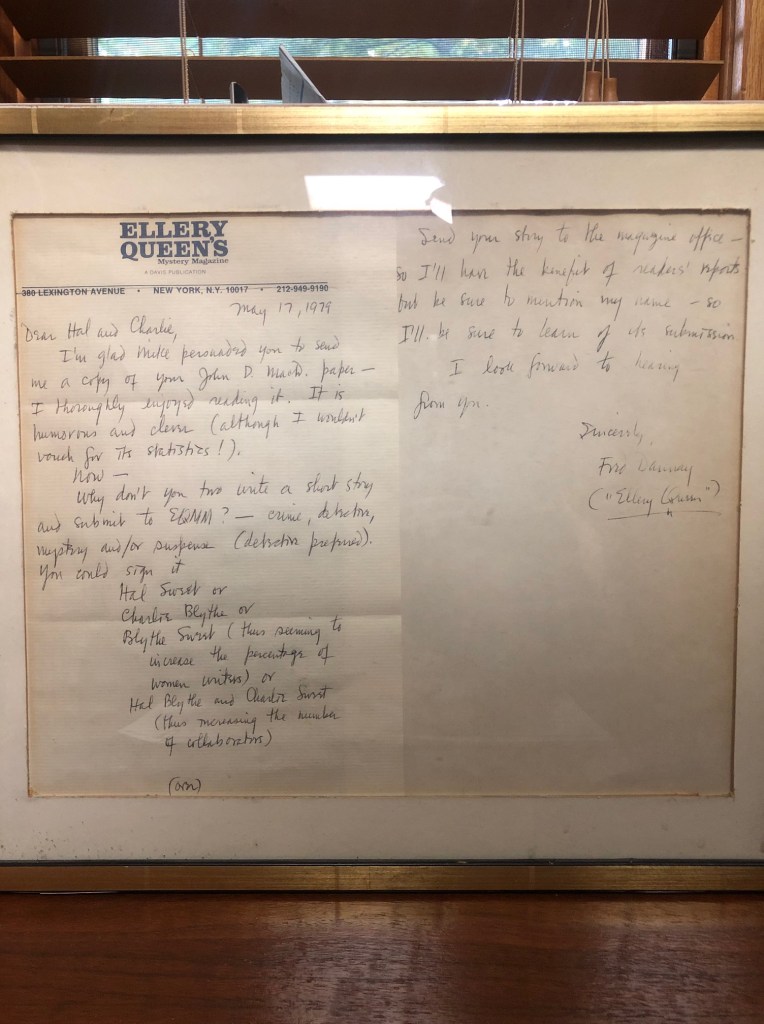
While we’re on the subject of changing titles, I really have to bring up Frederic Dannay, who was one half of the Ellery Queen writing team and from its first issue in 1941 until his death in 1982 the guiding force behind EQMM. Mr. Dannay was notorious for changing the titles of stories he bought for the magazine, often without the author’s permission. After he bought my first story, “E.Q. Griffen Earns His Name,” in 1968, Ed Hoch and other frequent contributors—all of whom rightly sang his praises and had enormous respect for his editorial insight—warned me that, if I were to continue to write for EQMM, I’d better get used to the idea that some of my stories would come out with titles I hadn’t given them.

It took me about a year—and about a dozen monthly rejections—to come up with a second story Mr. Dannay liked. Given the existence of an Ellery Queen novel titled Inspector Queen’s Own Case, I thought that a perfect title for E.Q. Griffen’s second case would be—no surprise here—“E.Q. Griffen’s Second Case.” Worried that Mr. Dannay would change that, though, I gambled and submitted the story under a different title. And, sure enough, when it appeared in the May 1970 issue, its forgettable title (which I have myself long since forgotten) had been changed . . . to “E.Q. Griffen’s Second Case”! 

That was the only time I ever put one over on Mr. Dannay, but it wasn’t the only time he changed one of my titles. In 1972, I called a story “S.O.S.” I was really proud of that one, since —at least in my opinion—it subtly foreshadowed an important twist near the end of the story. Mr. Dannay, however, felt that “S.O.S.” didn’t just foreshadow the twist but gave it away, and he renamed the story “The Tip-Off.” I usually agreed with his title changes, but this one time I still think he got it wrong.

After Mr. Dannay passed on and Eleanor Sullivan took over the reins at EQMM, she generally respected contributors’ titles. The one time she changed one of mine was on the fifth Chaudri story she bought from me. It was set in Morocco, on the central square of the city of Marrakesh, and I called it “Jemaa el Fna,” which is the name of the square. I thought that was a wonderful title: evocative, mysterious, almost sensuous. What reader could see that double a in “Jemaa” and the unusual Fn combination in “Fna” and not be immediately swept into the story’s exotic world? When I received my contributor’s copies of the June 1986 issue, though, I saw that Eleanor had changed the title to the boring “The Exchange.” And it’s not just that “The Exchange” was boring, by the way. My first Chaudri story, which had appeared less than two years earlier (in the July ’84 issue), was titled “The Dilmun Exchange.” So the series included both “The Dilmun Exchange” and “The Exchange”—and, honestly, I would have exchanged that second title for just about anything else.

In 1991, Janet Hutchings became only the third editor-in-chief in EQMM’s now eighty-year existence, and in her three decades of helming the magazine she’s never changed any of my titles. As I was preparing this blog post, I asked her if she ever changes any titles. “I have,” she told me, “most often because of their length. One difference between me and Fred in this regard is that I always consult with the author in such a case. But I’ve always been glad I did not ask for a change of title for ‘The Man Who Took His Hat Off to the Driver of the Train’ by Peter Turnbull, which won the Edgar, or ‘Of Course You Know That Chocolate Is a Vegetable’ by Barb D’Amato, which won both the Agatha and Anthony awards. I can’t help feeling those good titles helped gain the attention of judges and award voters.”

I agree with Janet that long titles—if used sparingly—can be particularly interesting. I remember almost nothing from the plot of the movie Oh Dad, Poor Dad, Mamma’s Hung You in the Closet and I’m Feelin’ So Sad—except for the fact that some wealthy woman totes her dead husband’s corpse around the world with her—but by gosh I remember that title, word for word! 

My own longest title—so far!—clocks in at a paltry nine words: “When You Sue, You Begin With Do, Ray, Me,” which appeared in the 2019 Bouchercon anthology Denim, Diamonds and Death. My longest EQMM title to date was one word shorter: “The Adventure of the Black-and-Blue Carbuncle,” which came out just a few issues ago, in November/December 2020.

And my shortest title up to now has been only two characters long: “50,” which was in the November/December 2018 issue and finished second in that year’s Reader Award balloting.

Hmm, maybe shorter is better.

If you’ll excuse me, I think I need to go write a story titled “.”

Not to put too fine a point on it. . . .

Posted in Fiction, Guest, Passport, Writers, Writing | Tagged , , , , , , | 6 Comments

“Owl’s World” (by David Dean)

Although he’s written several novels, David Dean is primarily a short-story writer. After debuting in EQMM’s Department of First Stories more than thirty years ago, he’s continued to produce a number of stories for us each year, while also contributing tales to anthologies. I’ve found that people sometimes don’t realize how wide the fictional range of an author who specializes in short fiction can be. David Dean exemplifies the diversity that can be found in short tales by a single author. He’s probably best known for his series starring policeman Julian Hall, and we’ll have another first-rate entry in that series in our September/October 2021 issue, but he’s written a large number of nonseries stories too, including his Readers Award winning “Ibrahim’s Eyes” and his Edgar-nominated “Tomorrow’s Dead.” He’s also become one of our best historical crime fiction writers. His best work in that subgenre of the mystery includes the Readers Award winning “The Duelist.” In this post, David relates his inspiration for a series that not only takes readers back in time but across cultural lines. The latest in that series, “Stone Coat,” is in our current issue (March/April 2021).—Janet Hutchings

In the January/February 2019 issue of Ellery Queen Mystery Magazine I introduced the Native American character, Owl, in a story titled, “Snow Boy”.  The events that transpire in both that tale and his return in “Stone Coat,” in the current March/April issue are, of course, fictional, though I like to think that they could’ve happened.  Owl is a shaman of the Lenape Nation living in what is now southern New Jersey.  Many readers may be more familiar with them as the Delaware, a name the English settlers would award them in honor of the great Lord De La Warr who had been granted the earth beneath the Lenape’s feet by the English monarch.  No doubt, the Lenape were puzzled at being renamed for a man whom they would never meet, yet whose name would grace rivers, bays, counties, towns, and even a future state within the Lenapehoking, which was their own name for their homeland.  Though I don’t pin the stories down to a particular year, there is reference in “Snow Boy” to the Zwannendael massacre which had happened some three decades prior, so roughly 1663.

If you happen to wonder at my choice of subject, time, and locale, I can offer several explanations, the first being that I have long been fascinated by Native American history.  This love began when I had my tonsils removed at nine years old.  Knowing that I was already promised ice cream when I awoke from the procedure (that was a given), I felt emboldened to demand more—I wanted a book on the French and Indian Wars (as to what I imagined my bargaining chip to be, I can’t recall, nor do I remember what had sparked my interest in that particular subject).

Puzzled, no doubt, my parents did their best, but were only able to come up with a book on the Revolutionary War that contained a few references to the role of the Indians in the War of Independence.  In the end, it didn’t matter—I read it voraciously and kept going from there.

The thing that prompted me to write of the Lenape in particular was locale, both theirs and mine.  I live in southern New Jersey where they also once lived, hunted, and farmed. Arrowheads and spear points can still be found along the Delaware Bay not five minutes from my home. A nearby street, Indian Trail Road, is so named due to having been built on an ancient path blazed by the Lenape connecting the Delaware Bay to the Atlantic Ocean. Large tracts of maritime forest, salt marshes, and coastlines make it easy to imagine that earlier time, especially in the off-season when a deep quiet descends upon the land after the tourists have departed.

Lastly, as a writer, I enjoy incorporating my love of Native American history into my fiction. I don’t dumb anything down. Life during this era was as challenging and demanding as any other in history, and a pivotal time for the Lenape.

“Snow Boy” touches on the political situation not only with the white settlers, but also with that of their Native American neighbors.  “Stone Coat” reveals the full complexity of those relationships as they were developing at that time. The Lenape, and Owl as their shaman, are increasingly pressed on several fronts, not the least of which is the growing Iroquois Confederacy known as The Five Nations. These consisted of the Mohawk, Oneida, Cayuga, Onondaga, and Seneca tribes—all Iroquois speakers.

It would be wrong, however, to think that with the coming of Europeans that all Native Americans coalesced into a single entity, or that they had ever recognized themselves as unified peoples. They were as diverse as the continental landscape they dwelt upon. They spoke different languages, had different cultures, and were varied in their tribal structures. Rivalries, feuds, and longstanding enmity between various nations and neighbors had also existed long before the arrival of the white man. So too had ancient alliances, affinities, and trade agreements. Their situation, just as that of the European invaders, was complex and fluid.

The Lenapehoking encompassed what is now southeastern New York, all of New Jersey, southeastern Pennsylvania, and eastern Delaware.  Yet the Lenape were never a populous nation. They existed as a loosely knit group of bands organized under a matrilineal clan system. Men married outside their own clans and their children were raised in the mother’s by her family.  This custom had the advantage of discouraging in-breeding, but was confusing to the Dutch, English, and Swedes that encountered it during the colonial era. Women also enjoyed an equality of status that was mostly foreign to Europeans, being able to own property and have a voice in the affairs of their households and villages.

So this then is the stage upon which my stories are set.  All that is left are for their characters to appear.  And that is the hard part.  It would be ridiculous for me to claim that I have any knowledge of how a Native American living in the 1600s might actually think.  The Lenape (Algonquian-speakers) did not have a written language at that time, so that is not a resource I could turn to. There are, however, some accounts by early white settlers (mostly missionaries and some government officials) that do detail the words of a few Lenape chiefs and leaders of the day. One is able to get a feel for their speech and cadence in the better written of these, and the sense they impart—to me, at least—is one of careful deliberation of thought and an earnestness of purpose.  They are both proud and realistic.

It is also possible to know something of their customs and beliefs thanks to the lifelong efforts of such people as historian C.A. Weslager, and anthropologist Herbert C. Kraft, both of whom made the study of the Lenape their life’s work. Some of these customs and rituals are practiced today by the descendants of those early Lenape now living in Oklahoma and other places.

With these things in mind I set about creating the characters of Owl, Shingas, Wolf Paw, Poushe, Snow Boy, and others. Owl, the main character, being the shaman for his band, has duties touching on matters both natural and supernatural. He is a person of great discernment and a keen student of human nature. Wolf Paw, as chief, relies on Owl as an advisor, healer, and, when necessary, a sorcerer. Though having grown old, Wolf Paw has not grown jaded.  He enjoys conversation, especially when he is the one speaking, and has a subtle sense of humor, mostly at the expense of others.  Shingas, the village’s lead hunter and fiercest warrior, serves as Owl’s reluctant bodyguard and vigilant companion.  His tendency to violence is both fueled and controlled by his sense of duty to his people. These three form the triumvirate of my tales.

In many ways, both “Snow Boy” and Stone Coat” are as much tales of adventure, as they are of mystery.  Perhaps their inspiration hearkens back to my nine-year-old self lying in a hospital bed in what also seems like a different historical period. Of course, in the end, Owl, and his companions are fictional, and a product of my imagination. They are my responsibility.  It is also my responsibility to entertain, which I hope that I have done with these two stories. If not, I have failed on two fronts, and can only plead that I have done my best to honor both the subject and the reader to the best of my ability.

Posted in Adventure, Characters, Historicals, History | Tagged , , , , , , | 7 Comments

“The Most Versatile of All Genres?” (by Mike Adamson)

Mike Adamson made his EQMM debut in our January/February 2021 issue with the story “The Shadow of the New.” Previously, most of his stories were in the field of speculative fiction, where he’s received nominations for the Hugo and Aurealis awards. He’s a big Sherlock Holmes fan, so it’s not surprising that his first EQMM story was a Holmes pastiche.  In this post he takes a look at how mystery is incorporated into many other genres.—Janet Hutchings  

When Janet invited me to contribute a guest post to the EQMM blog, I was both flattered and challenged—flattered because I’ve rarely had the chance to pen the proverbial op-ed, and challenged because mystery is the field to which I have come most recently. I’ve been a writer of one sort or other most of my life, but have engaged with mystery late, and found it rather fun.

All genres have their formula, but the uncovering of facts deliberately obscured, in a duel of wits, is endemic to all of human endeavour. Thus mystery is one of the most flexible of all genres, pairing, as it does with pretty much any other. One might have a mystery element in almost any context—a Western, for instance, a historical by definition, yet interpreted loosely and according to long-established internal criteria, with a range of hues from adventure to romance, yet the solving of a crime is endemic to many of those stories. What would a Western be without a law man after a wrong-doer? While this model skewed naturally to adventure at the hands of early Hollywood, it might also by assigned to mystery at a purely theoretical level. Deleting the daring-do aspect that has so characterised the Western genre, it would be interesting to set a pure mystery against the background of late nineteenth-century America. In essence this is what Conan Doyle was doing with his American motivational origins for the crimes in both A Study in Scarlet and The Valley of Fear, though pursued somewhat unconventionally by the narrative providing the solution before revealing the backstory in each case.

Mystery suits any era or approach, and the historical context has offered great possibilities. As an emerging Holmesian writer I have found the Victorian era a most fascinating context in which to pursue the vagaries of human nature. It also offers a world bereft of the technology which cuts corners in the modern world, making the storyteller think, flex the muscles of both plotting and research. The same would be true of any pretechnological context, of course, and mystery in ancient times can be every bit as riveting as modern—think Robert van Gulik’s adventures of the historical Judge Dee in the golden age of Tang Dynasty China. Futuristic detective stories occupy the other end of the spectrum, dealing as they can with wider issues than the contravention of the law per se—think Philip K. Dick’s seminal Do Androids Dream of Electric Sheep? and its modern realisation as Blade Runner. Ridley Scott’s take was a thorough-going tribute to the classic detective movies of the forties and fifties, pure film noir, complete with smokey rooms, hard-bitten, embittered characters, high stakes, and violent confrontation. It notably included such visual metaphors of the genre as light through Venetian blinds, a staple seen in almost every detective movie of the old school.

The mystery formula can raise its head in unusual places—Isaac Asimov’s classic Space Ranger novels, for instance. Written between 1952 and 1958, they are six compact outings following a strict sixteen-chapter layout, set in various places throughout the solar system, and each features a mystery of some sort.

One may not consider oneself expressly a mystery fan to be well-acquainted with the genre, though today that is more likely to mean visual entertainment than literary. I can look back on at least four productions of The Hound of the Baskervilles over the decades, which may be viewed quite independently of the rest of the Holmesian canon. I have fond memories of Agatha Christie dramatisations, such as the four classic Margaret Rutherford Miss Marple outings from the early 1960s, or Peter Ustinov’s delightful Poirot collection. When it comes to the “police procedural” subgenre, could there be greater opposites than, say, the contemporary British Midsomer Murders, which follows a classic formula of last-scene reveal, or the unique Columbo formula from the 1970s, in which, in the first act, the viewer observed the commission of the crime in every detail, including the identity of the killer, then delighted in the logic-train by which the culprit was undone?

For the mystery purist, solving the crime is surely the heart and soul of the genre, all else is window-dressing, yet dressing contributes intimately to mood. Crime, through the aspect of engendered fear, blends so nicely with horror! Much body-horror derives from the terror of entirely mortal crime, the slashers and serial killers, cannibals and head-hunters, and assorted other ghoulish and deranged perpetrators, yet there is a fine line between the insane and the supernatural. Beyond this point, the “occult detective” subgenre comes into its own, where the investigation of crime blurs into that of the paranormal when such has left tangible evidence. From there it departs into vampire hunting, keeping the dead in their graves—Kolchak, the Night Stalker is perhaps the purest definition of this,  the investigator who alone believes in the bizarre and can thus bring the murders to an end. But even this tangential interpretation of mystery can also embrace the traditional graduations, from cosy to hardboiled.

The future offers wide scope to the mystery writer, whether blending with romance or thriller, for though one might be forgiven for thinking that every permutation of every crime has been done (Conan Doyle, via Holmes, remarked on the limited variations possible in any scenario, well over a hundred years ago) new technology offers its own corruption into an instrument of murder or other crime. The first time someone rigs a matter-transmitter to disintegrate the traveler rather than transport him or her to another destination, the technology will have been perverted to the basest of human callings, demanding some smart deductive reasoning to sort out. This is the danger of new tech: it can always be perverted. As the saying goes, “nothing we create is good or evil, merely the ends to which it is put.” I wrote a story once about nanotech being used to cure cancer, but ever after the patient felt marginally unwell. His doctor was programming the nano in his body to keep him that way—nothing serious, just enough to ensure he came back for endless prescriptions of over-the-counter medicines, paid for by government subsidy, while the manufacturers paid a kick-back to the doctors involved for keeping demand high. That’s pure future crime in a context not very far removed from the present day.

I look forward to further exploring the genre in both past and future contexts, and to developing the muscles of plotting to one day deliver a case at novel length. But that’s a long way off, and for the moment, Victorian England calls—in short-story format!

Posted in Adventure, Characters, Classic Mystery, Genre, Guest, hardboiled, Historicals, History, Holmesian, Pop Culture, Writers, Writing | Tagged , , , , , , , , | Leave a comment