“The Last Great Crime Novel of 1975?: Once Upon a Time in Hollywood by Quentin Tarantino” (by Kevin Mims)

In a follow-on to his March 10 post for this site entitled “The Greatest Year in the History of Crime Fiction” (1975),  essayist and short story writer Kevin Mims reviews one of 2021’s new books as if it were a release from that earlier era. . . .—Janet Hutchings

I recently read Quentin Tarantino’s book Once Upon a Time in Hollywood, a novelization of his 2019 film Once Upon a Time . . . in Hollywood. I can’t tell you how it ranks against other crime novels of 2021 because I haven’t read enough yet. But on March 10 of this year, I contributed a post to this blog arguing that 1975 was the greatest year ever for crime fiction. And I believe that Tarantino intends for us to treat his novel as though it were an artifact from the 1970s. Why? Let’s look at the clues.

The book, like the film, concerns itself, in part, with the murderous “family” of Charles Manson. Since the book provides us with an alternate history of Manson’s clan and their killing spree, it naturally had to be written sometime after 1969, when the murders occurred. But Tarantino’s book, which was released as a paperback original, doesn’t present itself as a contemporary paperback. In the back pages of the book, we find full-page advertisements for a variety of popular 1970s books: Erich Segal’s Oliver’s Story (published in 1977), Elmore Leonard’s The Switch (1978), and Peter Maas’s Serpico (1973). Anyone familiar with mass-market paperbacks of the era knows that those books usually carried advertisements in their back pages for other recent titles from the same publisher. Usually they were for books of the same vintage and in the same genre. Which makes the back-page material in Tarantino’s novel seem inauthentic. Tarantino and his publisher (Harper Perennial Paperbacks) seem to be trying to make this novelization look like a relic from an earlier age. Because it carries an ad for a novel (The Switch) published in 1978, we have to assume the illusion they want to create is that this paperback was published no earlier than that. 

The Manson Family story gained new cultural currency in 1974 with the publication of Vincent Bugliosi and Curt Gentry’s Helter Skelter, a nonfiction account of the murders. The book was a bestseller and won the 1975 Edgar Award for Best True Crime Book. If Tarantino’s novel had in fact been published in the 1970s, 1975 would have been the ideal year for the hardcover to appear. The book is perfectly in tune with the zeitgeist of that year. As noted in my earlier essay, many of the most successful crime novels of 1975 were, like Tarantino’s, inspired by real-life crime stories. These include E.L. Doctorow’s Ragtime (the year’s best-selling novel), Judith Rossner’s Looking for Mr. Goodbar (the year’s fourth best-selling novel), and Michael Crichton’s The Great Train Robbery (the eighth best-selling novel of the year). 

Following the illusion, the publisher seems to be trying to create of 1970s publication for Tarantino’s book, let’s suppose that there had also been a hardback and that it had appeared in 1975.  Viewed as a 1975 crime novel, how well does Once Upon a Time in Hollywood stack up against the rest of the Class of ’75? Could it have stood out in a year so rich in masterpieces? In my opinion, the answer is a resounding yes.

Though literary purists might object, I believe Tarantino’s novel compares favorably with Doctorow’s masterpiece Ragtime. Doctorow’s novel is loosely tied to the real-life murder of famed architect Stanford White, who was killed in 1906 by Harry Thaw, the deranged husband of legendary beauty Evelyn Nesbit, whom White had allegedly sexually assaulted when she was still a teenager. Though Thaw and his crimes are mentioned in Ragtime, Doctorow seems much more interested in exploring a particular time (the turn of the twentieth century) and place (New York City and its environs). And he seems most interested in interweaving the real-life stories of various celebrities of the era with the fictional stories of his own invented characters. This is pretty much what Tarantino does in his book. He explores a particular time (late 1960s) and place (Hollywood and environs) and weaves together the real-life stories of various celebrities (Sharon Tate, Roman Polanski, Bruce Lee, James Stacey, and others) and the stories of his own invented characters. Doctorow is the more careful prose stylist, but there’s something endearing and addictive in Tarantino’s more conversational, expletive-laden, narrative style. It’s like he’s sitting in the room with you, telling a compelling story but interrupting it often to interject equally compelling commentary on movies, music, pop fiction, etc. 

Younger readers may look at an old hardback copy of Doctorow’s Ragtime—with its ornate lettering and unillustrated cover; the flap copy describing a book set in a long-gone era—and come away with the notion that this was a fairly sedate historical novel. But they’d be wrong. Ragtime is filled with horrific violence, most of it race-related, and it is probably just as relevant to our present-day predicament in America as it was in 1975. The well-mannered prose belies an angry, incendiary story about a Black man who retaliates against a racist society by trying to violently overthrow its government. The prose works in counterpoint to the ill-mannered behavior of many of Doctorow’s characters.

Tarantino, on the other hand, doesn’t try to keep any kind of distance between the narrator and his characters. Tarantino is, for all intents and purposes, a character in his own book, perhaps the main character. His expositional asides about such things as the films of Akira Kurosawa are as full of foul language as the rants of the characters are. But Tarantino’s prose is appropriate to the historical setting of Once Upon a Time in Hollywood. What’s more, Tarantino’s prose isn’t at all bad. 

The book is full of gripping scenes. One of the most memorable scenes in the film is the one in which Hollywood stuntman Cliff Booth (Brad Pitt) picks a fight with legendary martial artist Bruce Lee (Mike Moh) on the set of the TV series The Green Hornet. The same scene appears in the book, but here Tarantino slows it down and gives us the thoughts of both Booth and Lee. The men have decided to have a contest. The first one to knock the other on his ass twice wins. In the book we hear Cliff’s strategy running through his head. He decides to let Lee knock him down easily in their first clash. If it happens easily, Cliff figures Lee will get lazy and try the exact same assault tactic the second time around. But once Cliff knows the tactic, he’ll be able to anticipate it and knock Lee on his ass. In the book (unlike the film) we learn that Cliff is a World War II vet who killed more Japanese soldiers in up-close combat (with his hands and a knife, usually) than any other American. He isn’t even slightly fearful of Lee. But Lee doesn’t know this at first. He attacks and easily knocks Cliff on his ass. And, as expected, he comes back with an identical second assault, but this time Cliff easily defends himself, throwing Lee up against a car and causing injury to the martial artist. Suddenly Bruce understands exactly what has happened. 

Bruce also quickly recognizes that, while Cliff wasn’t anywhere near as skilled as the opponents he fought in any of his martial-arts tournaments, he was something they weren’t. In the film it is strongly suggested that Cliff might have murdered his wife. The book leaves no doubt about it. Cliff cut his wife in half with a spear gun meant to kill sharks. And she’s not the only person Cliff has killed since the end of the war. 

The book also abounds with gripping scenes that aren’t in the movie at all. One such scene takes place between two and three in the morning at an upscale home in Pasadena. Manson has brought some of his acolytes with him to watch as they put the youngest member of the family, a teenager named Debra Jo “Pussycat” Hillhouse (a fictional character probably based on Leslie Van Houten, played by Margaret Qualley in the film) through an initiation ritual they call “the kreepy krawl.” This involves breaking into a home at night and wandering through it, possibly even interacting with the occupants if they are awake. As the rest of the family stand outside, Pussycat goes around back, jimmies open the sliding door, and enters the dark and silent residence. The next several pages are very tense. Tarantino does a fine job of demonstrating how thoroughly Manson is able to colonize the minds of his followers. Though “Charlie” remains outside, Tarantino writes, ominously, “She [Pussycat] can hear Charlie’s grin in her brain.”

Just as there are scenes in the book that aren’t in the movie, there are scenes in the movie that aren’t really in the book, including perhaps the biggest scene of the film. In fact, this is Tarantino’s gutsiest move. The film’s climax is a scene in which fictional TV star Rick Dalton, Cliff Booth, and Booth’s dog Brandy violently dispatch with several Manson Family members who have broken into Rick’s home. We get a brief mention of that episode early in the book but it isn’t dramatized and never comes up again. The book arrives at an ending that employs something rarely seen in a Tarantino film: subtlety. The book’s ending is soft, moving, and sweet.

Although I loved Once Upon a Time in Hollywood, much of my enjoyment derived from the many cameos involving celebrities from my youth, people such as Robert Conrad (star of The Wild Wild West), Otto Preminger (first known to me as Mr. Freeze on Batman), Dennis Wilson (drummer for The Beach Boys), and many others. The book is also filled with references to Elmore Leonard, T.V. Olson, Marvin H. Albert, and other pop-fiction writers whose works I devoured back in the day. As a teenager I felt guilty about enjoying the music of The Monkees more than the music of The Beatles, but Tarantino convinced me (through his loving portrait of Sharon Tate) that this wasn’t uncommon. Will a twenty-five-year-old reader who has never heard of the pop group Paul Revere and the Raiders enjoy Tarantino’s book as much as I did? Hard to say. I read Ragtime back in 1976. I found it a chore to get through. I re-read it last year, while researching my essay about the crime fiction of 1975, and found it brilliant. In 1976, I’d never heard of the Stanford White murder or most of the other people and events referenced in the book. Over the subsequent forty-five years I’ve learned much about American history that I was never taught in school. And so, naturally, I derived much more enjoyment from Doctorow’s novel. When Ragtime was published, the events it depicted were sixty-nine years in the past. The events depicted in Tarantino’s book are now fifty-two years in the past—pretty much ancient history from the perspective of a millennial. But because much of the cultural material described in Tarantino’s book is preserved on film or audiotape and is easy to access, it might not seem quite as remote to today’s twenty-somethings as the trial of Harry Thaw seemed to me in 1976.

But how might Tarantino’s novel have fared had it been published in 1975, crime- fiction’s annus mirabilus? Well, a lot would have depended on how it was presented to the public. If it had been given plenty of promotion—just as Ragtime, Mr. Goodbar, and The Choirboys were—I’m convinced it would have been a sensation. Readers whose minds had been blown in 1974 by the incredible forensic detail of Helter Skelter might have been in need of a good alternative history, a book that posits what might have happened if an alcoholic, has-been TV star and his stunt double had somehow managed to kill off a few of the Manson family before the group could wreak the havoc for which they became notorious. 

I can’t say that Tarantino is as good a novelist as he is a filmmaker, but that’s only because he is an excellent filmmaker. But as a writer of film novelizations? Well, with his very first effort he may have just established himself as the greatest of all time.


Posted in Books, Criticism, Guest | Tagged , , , , , , , , | 1 Comment

“How to Create a Successful Villain” (by Sheila Kohler)

An award-winning author of novels and short stories, with two O.Henry Awards to her credit, Sheila Kohler writes crime fiction as well as literary fiction. Her most recent novel is the thriller Open Secrets, published by Penguin in 2020. Publishers Weekly said of the book: “The plot moves swiftly amid luxurious settings to a closing twist . . .” One of Sheila’s recent short stories, “Miss Martin,” was selected for the 2020 volume of Best American Mystery Stories. She draws on her experience as a writer, reader, and teacher of literature in this post about a type of character central to crime fiction.—Janet Hutchings

It is often useful in a story or novel to create a villain. Villains, let’s face it, immediately increase the suspense in a story, create conflict between good and bad—one we would like to believe exists—and  make the reader fear for the hero or heroine who is put in danger. If we look at the fairytales of our youth, those we have loved, there is often this clear dichotomy between good and evil: the wicked stepmother in Cinderella; the wicked witch in Hansel and Gretel for example. The more evil the villain the more there is at stake (poor Cinderella reduced to sweeping up the ashes and Hansel and Gretel in danger of being consumed by the witch).  

At the same time, in a story for adults it is obviously necessary to make the reader believe in the reality of the evil villain and perhaps for them even to engage the reader’s interest. We like to follow characters we can identify with to some extent. This can be difficult to do as in life, though of course evil people certainly exist, they rarely admit to their nefarious doings, or are even conscious of their faults. So often they come to us, and perhaps even to themselves, disguised behind a show of pious words, good intentions, and apparent rectitude. 

So how to make a villain credible and even sympathetic on the page? It is perhaps useful to look at the great villains portrayed in literature, those who have lasted, as examples. We can study by what means they engage our interest, hide their evildoings behind a certain facade, and convince us to follow their exploits and at moments even identify with them.  

If we take Shakespeare’s Richard III, surely one of the earliest antiheroes, we notice from the start of the play how Richard engages a certain sympathy and interest: He is after all presented as a crippled man who cannot use the ordinary means to seduce or gain success. He is reduced to cunning and dark deeds by the shape nature has thrust upon him.  

Richard tells us:

“I, that am rudely stamp’d, and want love’s majesty

To strut before a wanton ambling nymph;

I, that am curtail’d of this fair proportion,

Cheated of feature by dissembling nature,

Deformed, unfinish’d, sent before my time

Into this breathing world, scarce half made up,

And that so lamely and unfashionable

That dogs bark at me as I halt by them;”

In other words, it is not his fault if he is driven to crime; it is the fault of fate; it is his destiny.  

From the start of the play he speaks directly to the audience, confides in us, makes us—as we follow his exploits with fascination—complicit to some extent in his ambition and ultimately his crimes: “Now is the winter of our discontent / Made glorious summer by this sun of York; / And all the clouds that lour’d upon our house / In the deep bosom of the ocean buried,” he tells us with such apparent sincerity. We are immediately drawn in, interested. Questions arise in our minds. Early on in the play Richard admits to his ambition, his diabolical plans, and with his wit and sincerity wins at least our interest and a certain fascination in his outrageous acts.

In the scene with Lady Anne as she follows the bier of her dead father-in-law, Richard dares to appear. He who, you will remember, has killed not only her husband but her father-in-law, manages to seduce her (and perhaps his audience, too) even at this moment and even in her great grief. He appeals to her Christian forgiveness and begs her to have pity on him. He uses flattery and provokes her guilt at the same time, telling her that these deaths are her fault, she is responsible. If he has killed, it is because of her beauty and his great love for her: “Your beauty was the cause of that effect— / Your beauty, that did haunt me in my sleep / To undertake the death of all the world, / So I might live one hour in your sweet bosom.” 

Then he offers to die himself, giving her his sword.  He wins her and for a moment at least his audience by the use of such outrageous behavior. 

If we take a more recent example of a villain like Tom Ripley in The Talented Mr. Ripley, we see how Patricia Highsmith, like Shakespeare, presents her antihero from the start as an underdog. He, too, though not misshapen  has suffered in his childhood. He is an orphan, has lost his parents and been forced to live with his disapproving aunt who calls him a “sissy.” He gains our sympathy immediately in a scene where his aunt makes him run desperately beside the car while she drives ahead, for example. We are moved because he is hardworking and ambitious despite these setbacks, and because of his starry-eyed admiration for his friend Dickie Greenleaf who has everything Tom lacks: money, a boat, class, arrogance, freedom. 

We begin to root for him, though we are already aware he is not what he presents himself to be, when Dickie’s father sends him to Italy to bring his errant son home to his dying mother.  We even begin to wish him success, watching him with fascination as he dresses up in Dickie’s clothes and stands before the mirror. Here, surely, we identify to some extent with his desire to be like the friend he admires so much.  

Despite the fact that this sentiment leads him to actually take Dickie Greenleaf’s place in a scene of struggle on the water and that he goes on from there to kill again (the very unlikeable Freddie), we don’t really want the law to catch with up with him. By the end of the book, despite his crimes, we are delighted when he tells the taxi driver to take him to his hotel in the town where he appears to have escaped the law. “A donda, a donda?”  the driver asks, wanting to know to which hotel he wishes to go. And Ripley who now has all—the money, the clothes, perhaps even the class—replies to our satisfaction: “Il meglio! Il meglio!”, the best.  

These examples show us how we tend to root for, or at least be sufficiently interested in the exploits of, a character born or fallen into unfortunate circumstances that might explain their actions and gain our sympathy, particularly if the character shows wit and determination in their fight for success. If the villain charms us in the fight for what they consider their right, we too are taken in—or at least amused by the skillful use of flattery and apparent self- deprecating sincerity, a confession of sins: “I’ve always been a narcissist, I know.”  And how easily others can be made to feel guilty for the sins of the villain, as Richard III makes Lady Anne, blaming her beauty which has inspired his great love and his terrible crimes. 

 All of this, when in the hands of a skillful writer, can be used to gain our interest, our suspension of disbelief, and even at times our recognition of the darker sides of our own humanity.

Posted in Characters | Tagged , , , , , | Leave a comment

“This Location Screams for a Murder” (by Elvie Simons)

A Canadian currently residing in the Pacific Northwest, Elvie Simons has had stories in a variety of publications, including The Dark City Mystery Magazine, The Prairie Journal, and Island Writer Magazine. She debuts with EQMM in our current issue (July/August 2021) with the story “Not So Fast, Dr. Quick,” a classical mystery solved by the local doctor. Setting is key to the story, and in this post the author reflects about location as the source for story ideas. —Janet Hutchings

Photo by Elvie Simons

The welcome cool after a day spent baking in the heat. The quiet lull as guests trickle past to change for dinner. Before the sun has even tucked beneath the horizon, I think about murder. 

There’s something about a spectacular location that sends me to a dark place. As the sun sets at a posh resort, I look around and wonder: who here has a motive to commit that most heinous crime? Over the rolling waves and the musician’s sound check, I can almost hear the shriek of a grim beachside discovery. I see waiters in starched white uniforms rushing up from the beach, grave lines on their faces. My sunset bevvy is still half full when the characters start to form: an investor hellbent on expanding the resort, a local farmer, the plight of the monarch butterflies. It’s all here, waiting to be written, and all because of the location.

As a writer of mysteries, this is how many story ideas come to me. Writing instructors say it should happen the other way around, that characters come first. It’s true, the hard work begins when the characters develop. They need full, complicated lives or the story will be flat. But mystery is a unique genre. Often, the location itself is the main character, the thing we remember years after we’ve put the book down.

My favorite mystery location is no doubt shared with many readers of this blog. That titular train made even more famous by Agatha Christie. Mid-pandemic, I found myself clicking adverts for excursions on the Orient Express, considering unlikely dates and pricing. For a few delightful minutes, I imagined myself as a passenger in that beloved mystery, hurtling down the tracks, trapped within a conspiracy. I didn’t imagine Poirot checked into a nearby cabin. It was the train. It was always the train.

The Orient Express wasn’t my first murder-mystery train. That was the Canadian. For decades, this less famous silver locomotive has made the 4,500 km trip across Canada from Toronto to Vancouver. Eric Wilson, the writer of middle-grade mysteries, introduced countless young readers to the genre and gave me that train. Published 42 years after Christie’s novel, Murder on the Canadian was no doubt an homage to the more famous work. Were I not afraid to make my own tribute, I’d plot a tale inspired by my travels on that train: a young woman in economy class, a prairie snowstorm, a broken-down train. The perfect closed circle.

Another dreamy location is the seafaring vessel. Having worked for years myself on famous Tallships, including replicas of the Bluenose and H.M. Bark Endeavour, I’m still stumped about how to turn one of them into fiction. I read instead of the cruise ship in Christie’s Death on the Nile, the luxury ship in Ruth Ware’s The Woman in Cabin 10. Small and exclusive, both provide beautiful intimate settings for mystery.

Lately, I’ve started seeing ads again in the local newspaper for European river cruises. I imagine a suave mystery set aboard one of these boutique boats putting along the Seine or the Danube. Is this mystery out there, already written? I can only hope. For the boats and trains of crime novels are places I feel I’ve been, and I remember these stories today because of the setting.

The July/August 2021 issue of EQMM provides a delicious feast of mystery settings, both traditional and innovative. The issue is joyfully bookended by mysteries in libraries. As readers, we’re already inclined to love a mystery in a library, but the uniqueness of these libraries provides playful twists to the crimes. With Joyce Carol Oates’ Bone Marrow Donor, we enter an operating room along with the patient and get a haunting, new take on the mystery location. A comic convention from Barbara Allan, the fireworks store from Michael Grimala—these venues make my daydreams of a beach resort murder, of a river cruise mystery, feel flat and overdone. They satisfy my need as a reader for something new, a mystery in a place I’ve never seen before, never even considered as the setting for a crime.

The creativity of place goes one step further in the issue’s short piece The Concert by Ragnar Jónasson and Víkingur Ólafsson. In real time, the story takes place in a grand auditorium, but I read the location differently. Occurring entirely during the performance of a rarely heard vocal piece, the ‘location’ here was really a piece of music. What a refreshing idea!

Of course, sometimes we want a familiar location. We love the classics. My mother, her nose in a mystery book for much of my childhood, has a strong influence on my tastes. She insists her favorite stories are set in Cornwall. Not just the UK, not England, but specifically Cornwall. Something about the cliffs, she says, and the sea, heightens the tension for her. I see with delight that fellow issue contributor G.M. Malliet has a novel coming out entitled Death in Cornwall. I know what we’ll be reading in my house come October!

Christie herself wrote stacks of books set in villages. Small towns, be they British, American, or Canadian like my own story’s Boucher Island, are delightful playgrounds for crime fiction. The limited number of suspects, the way everyone meddles in each other’s business? They’re ideal setups for the mystery writer. The police procedural may love a bustling city full of organized crime, but my favorite mystery novels choose a setting that’s close and intimate. A train, a boat, maybe even a library.

So, while I devour and daydream of distant murder locations, most of my mystery writing is true to the small-town crimes I was raised on. My own Dr. Quick, a semi-retired doctor/detective, was herself inspired by a commuter cottage island in the St. Lawrence River. With no cars and less than 200 residents, who could picture that island and not immediately think about possibilities for murder? 

I named it Boucher Island. It means butcher and it sounds better with a French accent. I’m busy plotting the next crime that will trouble the island residents. I also dream of travel for Dr. Quick: a safari, the aforementioned river cruise. Dr. Quick lives in a world free of travel restrictions and has the odd luck of finding mysteries wherever she goes. 

But the unexpected locations in this issue of EQMM have me thinking. Maybe she doesn’t need to take a safari to stumble upon an exotic murder. I’m surrounded by locations full of potential for a new spin on an old crime. 

Still, it’s fun to dream, especially as I’ve yet to break the pandemic travel bubble. Maybe I’ll voyage with words back to that posh Mexican resort, to a murder discovered just before dinner. Maybe Dr. Quick took a granddaughter along for the ride. 

The mystery writer’s brain sees opportunity in every venue. Like a puzzle that must be solved, we’re never free to simply enjoy the scenery. It’s all the setting for another crime. Some locations just scream for a murder.

Posted in Adventure, Classic Mystery, mystery fiction, Setting | Tagged , , , , , , , , , | 2 Comments

Make the Familiar Familiar (by Smita Harish Jain)

A writer who grew up in Mumbai, India and currently lives in suburban Virginia, Smita Harish Jain has had a number of crime short stories published, including one in the recent MWA anthology, When a Stranger Comes to Town. Her first story for EQMM, “The Fraud of Dionysus,” appears in our current issue (July/August 2021), and if that whets your appetite for more of her work, don’t miss her stories in Malice Domestic’s Mystery Most Diabolical or the next volumes from the Chesapeake and Central Virginia chapters of Sisters in Crime. In this post, she talks about the process of finding her voice in fiction. —Janet Hutchings

“Art makes the familiar strange so that it can be freshly perceived. To do this it presents its material in unexpected, even outlandish ways: the shock of the new.”

The first time I heard this Viktor Shklovsky quote, I was sitting, not in an art class, but in a sociology class in college. The professor was telling us about Margaret Mead’s landmark work, Coming of Age in Samoa, to show us both the application of this quote and its evolution into its more commonly known variation, “Make the familiar strange and the strange familiar.”

For her research, Mead traveled to Samoa to study adolescent girls and their attitudes about sexuality. She compared their experiences with those of their counterparts in the United States and found that the female adolescent experience in Samoa was a far cry from the anxious and confusing time girls in the United States faced. Teenage girls on the island nation engaged in socially sanctioned casual sex, which both reduced the incidences of rape and increased the ease with which they faced sexual encounters as adults. In making the familiar strange, Mead changed the way people thought about female sexuality and urged a reconsideration of the American female’s sexual upbringing, as well as of how sex education was taught in schools. Her seminal work on the subject made Mead one of the most respected anthropologists in the country.

Years later, Shklovsky’s words came up again, this time in a graduate school management class, in which the professor used Henry Ford’s much-lauded assembly-line method for car manufacturing, to demonstrate the other facet of this quote, make the strange familiar.

During a tour of a meat-packing facility, Ford was struck by the idea that workers did not have to move around the warehouse to do their jobs. Instead, large slabs of beef and pork were brought to them on overhead conveyor belts, and each worker cut a part of the animal for processing and packaging. Ford saw the possibilities for auto manufacturing and adopted a similar system in his own plants. His workers no longer dragged bins filled with tools and car parts from car to car, adding their part to the work in progress. Instead, Ford brought each car under construction to them, on an assembly line, forever revolutionizing the way cars are made – adding specialization, increasing efficiency, and lowering costs – as manufacturers the world over copied his process.

The third time I came across this quote was when I was working on my first novel, a suburban mystery set in Rockville, Maryland. When it was done, I was convinced that I had written a winner. After all, it had everything a cozy mystery required: an amateur sleuth, a small community, and no violence on stage. It had twists, humor, and content everyone would be familiar with. So pleased was I with the finished product that, for the first time ever, I shared my writing with someone else—an avid reader, who knew a good story when she ­read it.

I sent her the manuscript, and we arranged to meet the following week to discuss it. While I waited, I thought often about one of my favorite New Yorker cartoons, the one where the man hands his wife his manuscript and says, “Here it is—my novel. I’ll be interested to hear your compliments.”

Suffice it to say, I heard few compliments. Of course, she was kind, knowing it was my first time showing my writing to anyone, and said all the encouraging things a friend says. It was clear, though, that she was building up to a big “but.”

“Where are you in this story?” she finally asked.

I knew she didn’t mean for me to write a story starring me. What she meant was, “Whose voice is this?” I had decided that in order to keep readers interested, I would have to write about the things they knew, not the things that were part of my experience, even though this was where my voice was strongest. As a result, the story was flat and dull.

The next thing of mine that she read was a short story – my first published work – about superstition and cosmic justice, set in Mumbai, India, where I grew up.

“There it is,” she said. “There’s your voice! Why don’t you write more stories like this one?”

I thought, but didn’t say, that I didn’t think most readers would understand my references, since they didn’t live them, and that I couldn’t possibly make them relatable.

She persisted, and I relented, and the writing became easier. The next several short stories I wrote were based on my childhood in India, my life as an academic, my experience as an immigrant, my hobbies, my interests, my passions. Not all of them, but enough of them to see a difference in my ability to tell a story and to enjoy telling it. With each new work, I tried to make my familiar my readers’ familiar; to find an element of truth, maybe even universality, in my uncommon events, set in unusual places, about unknown people, and make them about anyone.

I’ve written about dowry deaths and ritual castrations, honor killings and snake charmers. I’ve also written about astrology and wine and the small Virginia city in which I live. So, what is familiar about castration to the “any reader”—a sense of community and belonging; dowry deaths—greed and climbing the social ladder; snake charmers—a need to believe in magic. It’s not about writing what you know or writing what the market demands. It’s about finding the common threads that connect all of us and weaving a story out of them.

I am a relative newcomer to mystery writing, so my view is still a bit from the outside looking in. The biggest lesson I’ve learned, however, is my stories can be many people’s stories, if I look beyond the surface happenings to the core elements. Readers want to see themselves in what they read, and if they can see a similarity in people completely new and different from them, so much the better. For me and my writing, the quote had morphed yet again, this time to “make the familiar [to me] familiar [to them].”

That Rockville suburban mystery is permanently relegated to the bottom of a deep drawer, likely never to see the light of day again. As for my story in the current Ellery Queen Mystery Magazine (July/August), a story involving a lot of wine drinking, my friend never asked me, “Where are you in this?”

Posted in Uncategorized | 6 Comments

Locked Room vs. Closed Circle Mysteries – What’s the difference between these traditional mystery sub-genres? (by Gigi Pandian)

EQMM’s July/August issue, on sale now, is dedicated to the traditional mystery. Leading it off, with “The Locked Room Library,”  is Gigi Pandian, the author of ten traditional mystery novels (the Jaya Jones Treasure Hunt mysteries and Accidental Alchemist mysteries) and more than a dozen impossible-crime short stories. Her short fiction has won Agatha and Derringer awards, and if you enjoy “The Locked Room Library” (as we’re sure you will!) and want to visit that setting again, it’s featured in Gigi’s forthcoming locked-room mystery novel, Under Lock and Skeleton Key (St. Martin’s Minotaur/March 2022). Meanwhile, here are some helpful clarifications, from an expert, of what an impossible-crime story, a closed-circle mystery, and a locked-room mystery are. —Janet Hutchings


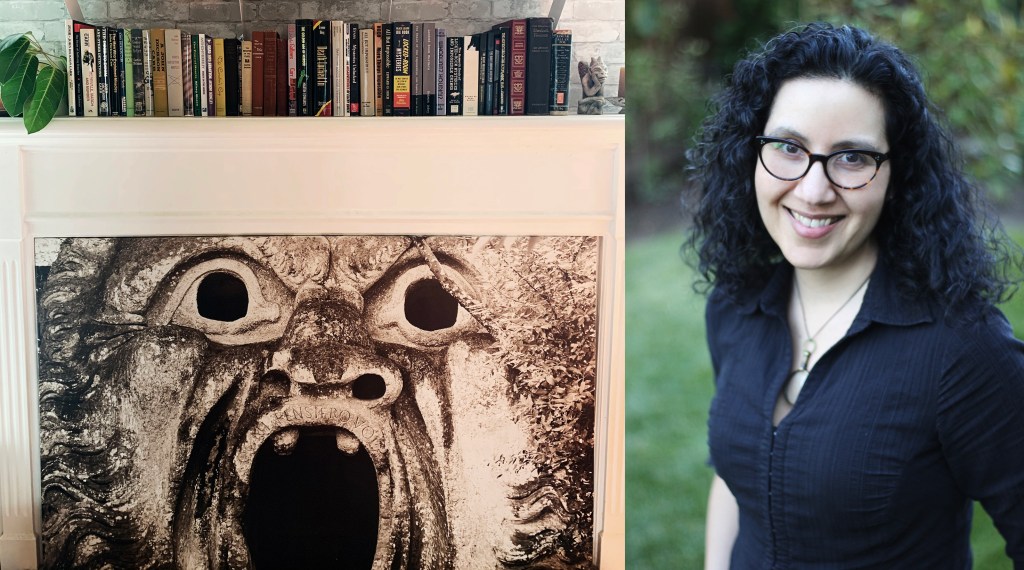
Gigi Pandian with one of her many bookshelves of locked-room mysteries. The fireplace screen is from a photo she took of a stone carving at the Park of Monsters in Bomarzo, Italy.

I’m thrilled to see traditional puzzle plot mysteries regaining popularity in recent years. They’ve always been my favorite type of mystery, because in addition to whatever other wonderful literary elements are present in a book or short story, the reader knows they also have a deviously clued mystery to solve.

With so many new readers warming to the genre, I’ve noticed a bit of confusion regarding terms used to discuss these mysteries. Most mystery readers have heard the term locked room mystery, but what exactly does it mean?

Closed circle mystery. A small number of people are isolated when a crime occurs in their midst. There’s no way for them to leave or be rescued, so there’s an oppressive feeling because the characters know that someone in their midst is a killer.

An example is an island with no boats or a country house during a snowstorm. An image of many Agatha Christie novels no doubt comes to mind. This plot set-up is often conflated with being a locked room mystery. It’s true many mysteries feature both a closed circle and a locked room puzzle, but the two aren’t the same thing. So what is a locked room mystery then?

Locked room mystery. A crime has been committed in a room or other impenetrable location where it appears impossible for the crime to have been committed. The key is that the situation appears truly impossible, not simply that a small group of characters are cut off from the world.

An example is a dead man found inside a windowless room that’s been sealed from the inside, dead from a gunshot wound that people outside the room heard fired, yet inside the room there’s no gun and no way for the culprit to have escaped; there’s no rational way for the crime to have been committed, so the character might wonder if it was the family ghost seen roaming the mansion’s hallways. Ellery Queen and John Dickson Carr are two authors who excelled at coming up with ingenious solutions to these seemingly impossible puzzles.

Impossible crime. The umbrella term under which locked room mysteries fall. It covers any seemingly impossible situation, such as a priceless jewel vanishing in front of everyone’s eyes. In practice, an impossible crime mystery serves as a synonym for a locked room mystery. It’s a more accurate description of what readers think of as a locked room mystery, though the term never caught on as widely.

Miracle problem. The term for impossible crime stories preferred by mystery fiction historian Douglas G. Greene. The idea of a miracle problem captures the spirit of why impossible crimes are so tantalizing—because it appears the crime could only have been committed through a miracle, because there’s no logical, earthly way for it to have occurred.

No matter what you call it, these are the elements included

Fair play detective story. Readers should have all the clues they need to solve the crime—all the pieces of the puzzle—given the same information as the detective. Authors like Ellery Queen took this to an extreme, pausing from the narrative to directly address the reader, challenging us to solve the crime before the detective. After all, we’ve already been given all the clues we need.

Supernatural explanations are not allowed. Even though it appears that nobody could have committed the crime, the solution has to be logically viable. No miracles allowed.  

No secret passageways. Yes, secret passageways are wonderful in literature! I love them so much they’re a central element in my new Secret Staircase mystery series. But they have no place as the solution to a true locked room mystery. Their presence means a room wasn’t truly sealed, so the same logical puzzle isn’t there to be solved.

Also frequently included, but not required:

Stage magicians. Because of the seemingly impossible nature of the illusions created by stage magicians through misdirection, magicians are often used as detectives in locked room mystery stories. Their skills at creating seemingly impossible tricks are called upon by the police to use their skills in the opposite direction, seeing through what’s essentially a trick created by a criminal to deceive, rather than illusion thought up by a performer to entertain.

During the Golden Age of detective fiction, Clayton Rawson created one of my favorite sleuths, stage magician The Great Merlini. In the present day, Andrew Mayne’s character Jessica Blackwood is a former magician who brilliantly sees through impossible situations. I created Sanjay Rai, who performs magic as The Hindi Houdini, as a side character in my debut novel. I quickly realized he was the perfect character to solve seemingly impossible crimes, so he accidentally became the character featured in the vast majority of my locked room mystery stories.

Gothic atmosphere. In style, many locked room mysteries are similar to Gothic novels, because with no logical explanation, a supernatural explanation appears to be the only possible solution. Supposed hauntings are common, with ghost stories abounding. A ghost, after all, can be a helpful cover for a living murderer. John Dickson Carr excelled at creating misdirection through a ghostly atmosphere.

Whatever terms you use to describe these mysteries, I hope you’re having a marvelous time reading them.

Posted in Uncategorized | 1 Comment

“July Fifth in Worcester, Mass.” (by Michael Grimala)

Michael Grimala moved to Nevada in 2012 to take a job as a reporter for the Las Vegas Sun, but he’s a native of Massachusetts, where he set his debut short story, “A Trunk Full of Illegal Fireworks.” As you may have imagined, it’s a Fourth of July story. We’re pleased to present it in our current issue (July/August 2021), in the Department of First Stories.  We hope the story and this post related to it will add spice to your Fourth of July weekend. Happy Independence Day!  —Janet Hutchings

I asked my older brother why the police were in the front yard, talking to our father. Brad waved me off, which annoyed me. I remember that distinctly. He was twelve, only two years older than me, but at that age I assumed he knew and was keeping it from me.

The two uniformed officers stood straight, their pants creased with no bend in the knee, one of them holding a piece of wood. Dad leaned back in his stance, a tall, thin hanger for frayed blue jeans and a faded golf shirt. Brad and I watched from around the corner of the front stoop, crouched next to a hedge bush. I can still picture the exact angle from which we observed that scene; past the police, across the street from our tiny house in Worcester, Mass., sat a large, vacant lot. The empty parcel took up the entire length of the block.

And that, of course, was the reason for the police visit. They gestured toward the lot, and the still-smoldering remnants of the previous night’s bonfire. In our neighborhood, it was tradition: The week leading up to the Fourth of July, everyone dragged their scrap wood, discarded furniture, and other assorted flammables into a big pile in the vacant lot on Riley Street. On the Fourth, amid a smattering of civilian fireworks displays, the pyre was lit.

It burned all night. Everyone came out to watch that year, like every year. It was a celebration, the best Worcester could offer.

But the police weren’t concerned with working-class good times. Building a fifteen-foot-high bonfire was against the law, and so they dutifully walked up and down the streets the next day, asking questions. That eventually brought them to our house. They knew dad was a carpenter because everyone knew that. They knew he had a stack of collected lumber in the backyard, too.

The police found a four-by-four post that had escaped the bonfire without much damage. It had been left on the perimeter of the pyre and looked no worse for wear.

It also, after a quick inspection, matched some other posts dad had stored in the yard.

Being Worcester, and being our neighborhood, the police talked it over with Dad right there in the front yard. When the conversation ended, Dad marched through the front door. Brad and I snuck around to the back of the house and looked through the screen door as Dad made a few phone calls, trying to scrounge up a helping hand.

I guess no one answered, or they were too busy to come, because for the rest of the day my father worked in that lot, by himself, clearing away the entire bonfire. The cops kept watch from their car as he ran a hose across the street and sprayed the whole thing for an hour, then put on his heavy work gloves and pulled every charred scrap out of that pile. 

A dumpster arrived—the only person that picked up when Dad called—and parked on the side of the street. Dad trudged every single piece of burnt debris across the lot and tossed it into the dumpster. Couch frames, mattresses, plywood, everything. When the area finally lay clear, he raked the ashes around and hosed the ground again. It was dark by the time he finished. He made the burdened walk across the street—empty, where dozens of people had lined the sidewalk the night before—and back into the house.

I don’t recall exactly what happened next, but he probably sat down to dinner with us, turned on the baseball game, helped us with our homework, etc. Regular Dad stuff. 

I had completely forgotten about that incident until EQMM asked me to write a blog post as a sort-of companion piece to my Department of First Stories entry in the July/August issue. That story is set against the backdrop of the Fourth and deals with a father making a hard decision to protect his family, and I never made any connection until now.

Dad never talked about the day the cops made him clean up the lot. I think that’s just how life is, from his perspective—rarely easy. 

He never asked me or Brad about it, either. If he had, we would have been no match for his deductive powers; we would have readily admitted we had gone into his lumber days before and hauled some pieces across the street to the bonfire, like our friends were doing. Like the entire neighborhood did.

Thinking back on it now, I’m positive he knew. It couldn’t have been a very difficult mystery to solve. 

Anyway, Dad read my EQMM story shortly after the issue hit newsstands. He’s a great father and a voracious reader (mostly legal thrillers) and he phoned to say he enjoyed it very much, though he questioned why it ended “just when it was getting good.” I called him out on the backhanded compliment and we laughed about it.

I think next time we talk, I’ll have to come clean. He’ll probably laugh it off. “Hey, at least you got a story out of it,” he’ll say.

Posted in Department of First Stories, Guest, Story, Writers | Tagged , , , , , | 3 Comments

“Who’s Ready for Another Roaring Twenties?” (by Tehra Peace)

Portland, Oregon author Tehra Peace is a marketing copywriter by day. To say that she is a fan of mystery fiction would be to understate her interest; her passion for our genre is evident in the webzine she cofounded, Mystery and Suspense, a fan publication featuring reviews, interviews, and feature articles. In this post she takes a look at the classical mystery and offers some thoughts on where it may be headed. You won’t want to miss her debut as a published fiction writer in our current issue (July/August 2021) either: See “When the Dust Settles.” —Janet Hutchings

Welcome to the 2020s. 

Wait. Is it safe to say that now? I mean, this decade hasn’t been a party so far. This time last year, I was stockpiling dried garbanzo beans (I still have all of them) and playing a panic-inducing game called “Allergies or COVID?” Workwear devolved into jeans, then leggings, then sweatpants. My house, once my refuge, was suddenly a drywalled cage, the four of us locked into three bedrooms and one finished basement all day, every day. A rare trip to the grocery store was my only portal to the outside world, one that did not appreciate me loitering.

Thank goodness it’s starting to look like things are getting back to normal. Bars are reopening! Live music is coming back! People are getting haircuts and dressing up and going out and the stock market is booming and . . .

Hey, that sounds kind of familiar. Didn’t all this happen before? Recovering from a pandemic—check. Political and social change—check. The shoeshine boy telling you which meme stocks to buy—well, something like that.

We just might be in for another Roaring Twenties. Like our great-great-grandparents a century ago, we’re ready to take a break from the hard stuff and get wild. But let’s say that a speakeasy isn’t your scene. Maybe you’d prefer to go to a cafe or the beach with a great book. Nothing too heavy. Something intellectually challenging and fun to read. A puzzle that keeps you turning the pages until you think you have it all figured out, only to discover you’ve been misled in a brilliant way.

Amid the flappers and jazz, the 1920s kicked off the Golden Age of Detective Fiction. This era was bookended by Agatha Christie’s The Mysterious Affair at Styles, her first novel featuring detective Hercule Poirot, in 1920 and Ellery Queen’s debut, The Roman Hat Mystery, in 1929, without which we would not be here. With these books in hand, readers could consume their crime in a safe place instead of at the club, where one sideways look at the wrong gangster could bring you a little too close to the action.

While the Golden Age ended with World War II, it never really died. If history does rhyme, we could see a fantastic revival in certain flavors of detective, crime, and other mystery fiction. This time, it will look a little different. But it’ll pack all the right punches just the same.

The return of the “whodunnit”

A hundred years ago, Agatha Christie, Dorothy L. Sayers, and their brethren led the fiction market with whodunnits. Here, plot was king. Stories usually began with a dead body and a list of suspects, some of them shady, some of them guilty, not always both at once. The iconic settings—a country house or an old-fashioned hotel—kept these characters in place long enough for the reader to guess at who might be to blame for the murder of the wealthy widower, the train passenger, the island guests. Clues were sprinkled like breadcrumbs as the chapters progressed. The grand reveal always made sense in hindsight, even if the reader didn’t quite crack the case before the cover closed.

Modern whodunnits follow a similar spirit. Quite a few Christie-inspired titles have topped the bestseller lists in recent years. Lucy Foley has had hits with The Guest List and The Hunting Party, both of which toss a dead body in amongst a cast of characters who are either stuck on a remote island or snowed in at a hunting lodge. Louise Penny has seen incredible success with her Chief Inspector Armand Gamache series, which is now seventeen books long. Anthony Horowitz’s The Magpie Murders takes it a step further as something of an homage to Christie and Sayers. Whodunnits have also made their way to the screen with the delightful Knives Out and, if we’re expanding the category a bit, this year’s smash hit Mare of Easttown.

So, what can we expect for the future of whodunnits? Maybe we’ll see new and interesting “locked room” settings. Think about the kind of mischief that might happen in a space shuttle en route to Mars. The usual suspects might not even be human. Say, what’s that robot been up to? Maybe artificial intelligence wasn’t such a great idea after all. Clues might come in the form of Instagram likes or YouTube comments. Just as interesting as who did it might be how.

New and diverse voices

The 1920s packed in a lot of social change, from Prohibition to women’s suffrage. Maybe it’s because the decade launched with women winning the vote that society was more willing to embrace them as credible storytellers. The queens of crime fiction absolutely dominated the market. It’s worth noting, however, that their protagonists were very often men.

Today, we’re hungry for new, diverse voices in mystery fiction, especially those with a female perspective. Take, for example, Rachel Howzell Hall, who places African-American women at the helm of her award-nominated crime novels—a private investigator in And Now She’s Gone and a police detective in her Elouise Norton series. Silvia Moreno-Garcia’s Mexican Gothic centers on a fashionable, strong-willed amateur sleuth who sets about revealing family secrets in the Mexican countryside.

The mystery and detective genres are ripe for stories that explore the impact of the Black Lives Matter movement. What’s it like to serve on the police force as a person of color today? Stories are waiting to be told from new lenses, including LGBTQ and neurodivergent perspectives. Differences are no longer plot devices; they’re opportunities to see the world through new and way more interesting eyes.

Mysteries as instant classics

A mysterious neighbor. A criminal cover-up. Multiple dead bodies. That sounds like a detective novel, right? Actually, it was the 1925 classic The Great Gatsby by F. Scott Fitzgerald, a member of the artsy and angsty Lost Generation.

A good mystery can make for a blockbuster crossover, as seen with the Edgar Award nominee Where the Crawdads Sing by Delia Owens. When literary meets mystery, there’s potential for an instant classic: a story that holds both intrigue and insight. Books like these are worthy of the most prime real estate on your bookshelf.

As the decade moves forward, it’s exciting to think of how the next generation of mystery fiction will put the latest trends and technologies to good use. How about a detective chasing down nefarious transactions on the dark web? A missing person posting coded messages on social media? An out-of-control algorithm causing chaos in a laboratory? As the world roars back to life, it’s safe to say that some of our best storytelling is yet to come.

Posted in Classic Mystery, History | Tagged , , , , , , , , , | Leave a comment

A Move and a Mystery

Of the many changes COVID-19 has wrought in our lives, one of the most wide ranging has been the change from a physical to a virtual workplace. A year after the pandemic began, a majority of Americans were still working from home, according to U.S. News and World Report. The question on most teleworkers’ minds as the pandemic began to loosen its grip was whether there would eventually be a return to the “bricks and mortar” office. This past weekend, with the removal of the last of the files, archives, machinery, and furniture from our New York City office, that question was definitively answered for Dell Magazines. We’ve gone permanently virtual, although any staff who wish to work in a traditional office can commute to the company’s main office in Connecticut, where our files and archives will henceforth be housed (and where all mail should now be sent—address below).

Given the smoothness with which the entire editorial staff of all of the nearly four dozen Dell magazines (fiction and puzzles) handled the transition to at-home work during the pandemic, one cannot but agree with the decision to close the common workplace. Why continue to hold onto premises that are unlikely ever again to be occupied by a full workforce? And yet, I will confess to some sadness as managing editor Jackie Sherbow and I culled files for the move, then left the office for the last time, knowing that, after thirty years, it was the last time I’d ever set foot in an EQMM office. 

The closing of the office required some decisions I never expected to make. With space limited where our archives are going, there was the question of what to do with nearly forty years of early bound issues of the magazine and a nearly-full extra run of EQMM in individual issues. Since my personal collection of EQMMs began with my tenure as editor in 1991, I decided to have the incomplete set of bound issues from the 1940s through 1979 shipped to my home, reasoning that bound issues are easy to house. But then it seemed only logical to complete my set by having the extra single issues from 1980 through 1990 join them. With neither of us wanting to see the remaining issues thrown away, Jackie took quite a number of the other early issues, and places were eventually found to which we could donate the rest.  Problem solved.

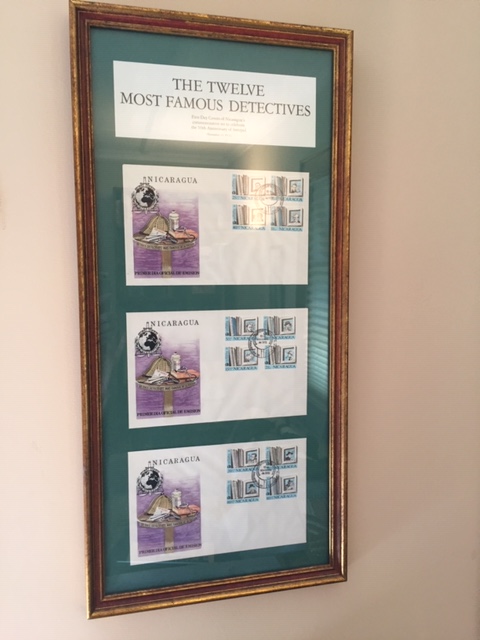
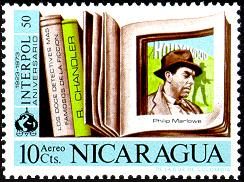
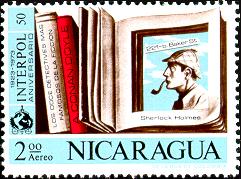
There is one item, however, that has found a home with me whose source I’d like some help determining. It’s a set of first-day covers of Nicaragua’s commemorative stamps to celebrate the 50th anniversary of INTERPOL. The stamps feature “the twelve most famous fictional detectives”—Peter Wimsey, Philip Marlowe, Sam Spade, Perry Mason, Nero Wolfe, Auguste Dupin, Ellery Queen, Father Brown, Charlie Chan, Inspector Maigret, Hercule Poirot, and Sherlock Holmes. The date is November 13, 1972. This framed set was on the wall of the office I inherited from my predecessor, Eleanor Sullivan, and no doubt hung in every EQMM office from 1972 through Eleanor’s time. It traveled with us in all our subsequent moves, and I did not want to see it end its days boxed up in a storeroom. 

It’s always been my understanding that this wall hanging was a gift to founding editor Frederic Dannay. But from whom? Someone out there must know. If it was sent by someone in Nicaragua, did Fred have it framed—or did it arrive that way? I should have tried to get answers to these questions years ago, when more of the writers from Fred’s day were still with us. My brief recent research has left me unable to identify any mystery writers from Nicaragua of that time who might have had a link to EQMM. In fact, I’m a little mystified by something else: There were, apparently, several countries that issued a single stamp in honor of INTERPOL’s 50th anniversary, but only Nicaragua issued an extensive set. And only Nicaragua pictured fictional detectives on the stamps; the others mainly depicted INTERPOL’s logo or its headquarters. Was the reason for this that Nicaragua was, at that time, a center of mystery-fiction fandom? Everyone knows that several South American countries (especially Argentina and Brazil) have a long tradition of mystery writing and readership, and Mexico does as well. But Central American countries are unknown to me as a source of mystery fiction, and from what I’ve been able to determine, the first translation of a Nicaraguan novel into English occurred in this century. So, if Nicaragua has always been a center of mystery writing and fandom, there must be a wealth of Nicaraguan mystery fiction waiting to be discovered by the English-speaking world. 

This one rescued item from our office has, thus, opened my mind to some new thoughts. In addition to causing me to do a little research into Central American literature, it’s gotten me interested in INTERPOL. Although I’d worked under framed documentation of its 50th anniversary for decades, I had never really considered how amazing it is that an international police organization has been in place now for nearly a hundred years (ceasing its intended function only during the years when it was taken over by the Nazis)! INTERPOL’s website says this of its roots: “Our story began in 1914 when police and lawyers from 24 countries first got together to discuss identification techniques and catching fugitives.” Regarding its official inception, they say: “We began as the International Criminal Police Commission, created in 1923, and became the International Criminal Police Organization-INTERPOL in 1956.” So, their 50th anniversary, it seems, was actually in 1973, although the first-day covers for the Nicaraguan stamps were from November 13, 1972.

Can any of you (our readers) tell us more about the commemorative first-day stamps pictured here—or about Nicaraguan mystery fiction? It will be a nice coda to our move if you can!

Any by the way, I’m missing these bound volumes of early EQMMs, if anyone would like to sell them at a reasonable price:  volumes 1-5, volumes 9-13, volume 17, volume 49, and volume 52.

All EQMM submissions are now virtual (see our submissions server). But if you need to send us material other than submissions, please use this address:

Dell Magazines/EQMM
6 Prowitt Street
Norwalk, CT 06855

—Janet Hutchings

Posted in Classic Mystery, Ellery Queen, Fiction, Genre, History, Magazine, mystery fiction | Tagged , , , , , , | 9 Comments

“If It Weren’t for Ellery Queen” (by Hal Charles)

Hal Blythe and Charlie Sweet have been writing together for more than forty-five years. Together, as Hal Charles, they are the authors of more than 200 short stories, one of which is “Nothing Good Happens After Midnight,” in our current issue. Here, they talk about breaking into the mystery-writing market and the influence of our magazine’s founding, eponymous editor.—Janet Hutchings

In the late 1970s, the two of us were struggling mystery writers who still subscribed to many mystery magazines as well as Erskine Caldwell’s pronouncement that “Publication of early work is what a writer needs most in life.”  And a little cash for our prose efforts wouldn’t have hurt.  After receiving five or ten dollars for a story from Skullduggery and Black Cat Mystery Magazine, we realized the truth that “Crime writing doesn’t pay . . . enough.”  Desperate to break into the higher-paying markets like EQMM, we couldn’t figure out how.

As teachers of literature and creative writing, we knew we wrote well, and we had long passed the so-called Hemingway Limit of first writing a million words. Taking our cue from the first writer of detective stories, Edgar Allan Poe, we decided to try his approach to getting published as demonstrated in his famous parodic essay “How to Write a Blackwood Article” (Blackwood’s Edinburgh Magazine was famous for its tales of sensation).

Poe’s effort is actually an excellent example of the market analysis, a technique we taught our creative-writing classes.  Like its business counterpart, literary market analysis examines character, plot, method of narration, and theme in detail. We decided to examine EQMM and found in the year of our study, for instance, that though 80% of the magazine’s readers were feminine, 85% of the stories’ major characters were male, and 10% were private investigators (as an aside, these figures are time-specific and no longer accurate).

We wrote up our study in a Poesque parodic manner, and under the title of “Ask Mr. Mystery,” we submitted it as a presentation at an annual conference held in Sarasota to honor John D. MacDonald.  The presentation was accepted, and afterward two people talked to us.  One was Mike Nevins, a frequent contributor to EQMM, whom we had met previously at a pop-culture convention in St. Louis. Mike encouraged us to submit “Ask Mr. Mystery” to the editor at EQMM, Fred Dannay.  John D. MacDonald chimed in, agreeing with Mike’s direction (aside #2:  “Ask Mr. Mystery” was subsequently published in JDM Bibliophile27 [January 1981, pp. 12-15]). 

Should we send it to Mr. Dannay? One of our guiding lights was a quote we saw attributed to Robert Frost (aside #3: when the Internet occurred, we could never substantiate the claim):  “It’s hard to hate someone up close.” Once, while attending a conference in Nashville, we walked to the office of a popular magazine, and interestingly, because it was the lunch hour, the editor was the only one there. He talked to us for an hour about the type of fiction he was looking for, invited us to submit, and helped us sell several stories to his publication.

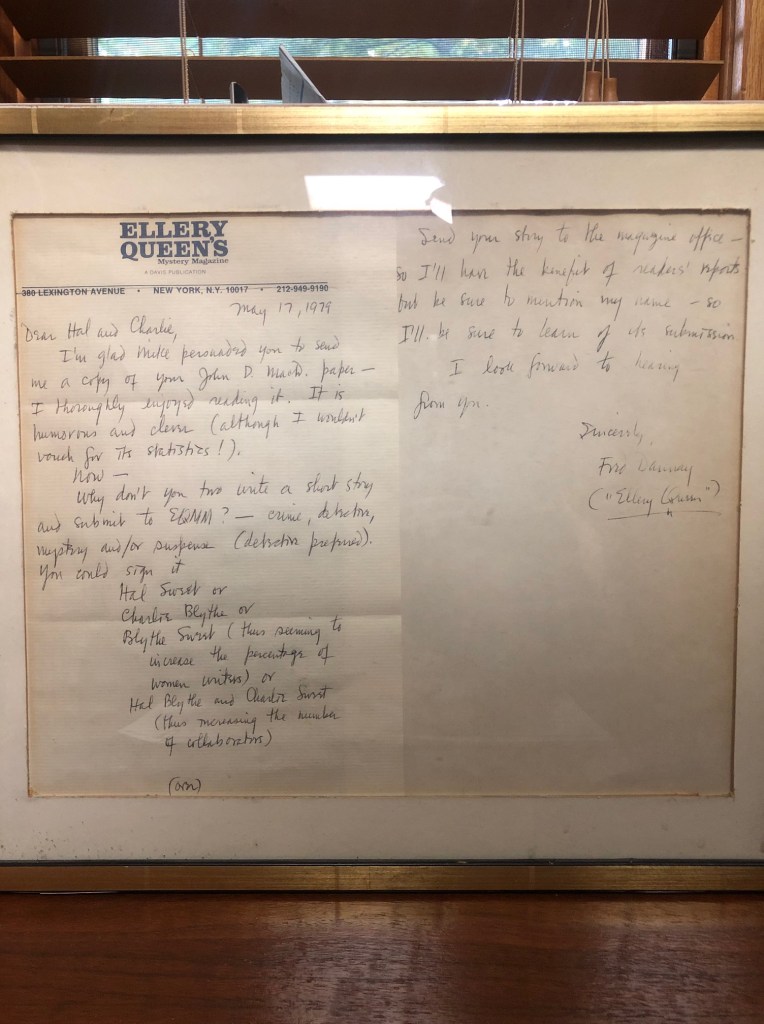
So we sent “Ask Mr. Mystery” to Fred Dannay, not expecting much but realizing we had nothing to lose but our poverty.  Unbelievably, we received a letter from Fred that we framed and hung in our offices for 39 years:

  •                                                                         May 17, 1979
  • Dear Hal and Charlie,
  •                                   I’m glad Mike persuaded you to send
  •                         me a copy of your John D. MacD. paper—
  •                         I thoroughly enjoyed reading it.  It is
  •                         humorous and clever (although I wouldn’t
  •                         vouch for the statistics!).
  •                                   Now—
  •                                   Why don’t you two write a short story
  •                         and submit it to EQMM?—crime, detective,
  •                         mystery and/or suspense (detective preferred).
  •                         You could sign it
  •                                   Hal Sweet or
  •                                   Charlie Blythe or
  •                                   Blythe Sweet (thus seeming to
  •                                             increase the percentage of
  •                                            women writers) or
  •                                   Hal Blythe and Charlie Sweet
  •                                           (thus increasing the number
  •                                           Of collaboration).
  •                                   Send your story to the magazine office—
  •                         so I’ll have the benefit of readers’ reports—
  •                         but be sure to mention my name—so
  •                         I’ll be sure to learn of its submission.
  •                                  I look forward to hearing
  •                         from you.
  •                                                             Sincerely,
  •                                                             Fred Dannay
  •                                                             (“Ellery Queen”)

Previously, we had been used to receiving with our stories (and letters to editors) simple, small, white rejection slips that all played on the theme of “This does not suit our needs.”  We received so many we actually started papering our office walls with them, so you can imagine our surprise at opening an envelope from EQMM with an actual letter.  Moreover, the letter wasn’t from some anonymous slush-pile reader, but the editor-in-chief of the magazine himself, Fred Dannay.

Look at all the actual aid he provided:

  • – Psychological encouragement for us to persist
  • – Praise for our article (though with his usual humor he added he wouldn’t “vouch for the statistics”)
  • – An RSVP invitation to submit a mystery story
  • – A clue to a successful EQMM tale “detective preferred”
  • – The range of stories EQMM favors: “crime, detection, mystery and/or suspense”
  • – Advice on a nom de plume.  Clearly Fred was showing that the industry preferred one writer rather than a team, so drawing on his own experience with Manny Lee, he suggested various reductive names that would imply a single author (Hal Sweet, Charlie Blythe, Blythe Sweet).  Ultimately, we used his advice to come up with Hal Charles.
  • – The mechanics for increasing the chances for a successful submission (“send your story to the magazine office,” “be sure to mention my name”)
  • – Final encouragement (“I look forward to hearing from you”).

In seven years of “collabowriting,” we had performed market analysis, read and taught hundreds of mysteries, and submitted dozens of stories, but we had never received such help.  Of course, we took Fred’s advice and set to work on crafting a new mystery tailored to EQMM’s specs. That product, “Sudden Death,” was submitted, revised by Fred Dannay himself, and finally appeared in EQMM’s Department of First Stories, its 547th “first story” the blurb on p. 75 of the April 7, 1980 issue noted.  The prestory blurb also labeled our effort “a dying-message story (oh, Ellery, what hath thou wrought?).” 

As Fred/Ellery had suggested to us, “Sudden Death” focused on a detective sports agent trying to fathom the significance of the dying clue BLITZ left by a dying quarterback. The mystery followed the familiar pattern of showing how the dying clue might point to a number of suspects, but in the end indicated only one. And the story was submitted under our combo-pseudonym, Hal Charles.

The blurb also iterated another mystery, one we never solved.  According to the editorial blurb, our “first submission to EQMM was the most unusual we have ever received. The story was acted out as a drama and sent to us on a cassette.” Here’s the problem. We had sent Fred a paper version of our MacDonald conference presentation, not a taped version. We always guessed it was either John D. himself or, more likely, old friend Mike Nevins who had gone to the trouble to help us (aside #4:  Mike offered to read several of our early mysteries and provided excellent critiques of our fiction).

Our next EQMM publication was “The Talk-Show Murder” (July 23, 1980), then ”Human Interest Angle” (December 1, 1980), which was followed by a Sherlock Holmes pastiche, “The Adventure of the Hare Apparent” (January 1981).

“Sudden Death” provided us with an important springboard.  From that point on, whenever we submitted a mystery, we always pointed out in paragraph two that key credential:  we had published in “The World’s Leading Mystery Magazine” (to quote EQMM’s masthead).  

One publication in particular started accepting a lot of our stories, Mike Shayne Mystery Magazine. At first we received encouraging notes on rejections from then assistant editor Chuck Fritch, but when we started following his advice, our stories were accepted. Once we mailed him five manuscripts in a single envelope, and Chuck took three of the stories. And when the previous Brett Halliday ghost writer (Davis Dresser had long since stopped writing Shayne) stepped down to cowrite romances with his wife, we were offered the chief ghost position. At first Chuck demanded we send him outlines of our stories for pre-approval. No sooner did he begin to trust our ability so that outlines were no longer de rigeur than Chuck had a new condition.  He sent us Polaroids of covers commissioned for the Girl from U.N.C.L.E. magazine but not used, and we were supposed to write stories and submit them with the appropriate cover photo.  Unfortunately, Noel Harrison, the girl from U.N.C.L.E.’s partner, was blond and Mike Shayne was always “the raw-boned redhead,” but no one seemed to care about this discrepancy.

Over the years as its editors changed, we have continued to publish in EQMM, but usually in spurts when we are not doing novels. Around the turn of the century, we published with Janet Hutching’s expert guidance (she literally had us cut “Ghost Cat” in half) some of our more literary mysteries—“Sharper Than a Serpent’s Tooth” (June 1999), “Slave Wall” (July 2000), “Moody’s Blues” (November 2002), “Draw Play” (May 2003), and “The Death of Doc Virgo” (September/October 2004).  Then, after writing ten novels in our Clement County Saga, we returned to our own paracosm, Clement County, with “Ghost Cat” (March/April 2020), “Nothing Good Happens after Midnight” (May/June 2021), “The Reawakening” (TBA), and “Sound Moral Character” (TBA).

If it weren’t for the gracious intervention of Fred Dannay, our writing would probably have been mostly marked by academic books and articles—in other words, oblivion.

Posted in Ellery Queen, Guest, History, Magazine, Publishing, Writers, Writing | Tagged , , , , , | 3 Comments

“The Secret of Las Vegas” (by Melissa Yi)

Melissa Yi is a Canadian ER doctor who writes medical thriller novels starring doctor-sleuth Hope Sze. One of the books in the series, Stockholm Syndrome, was named one of the best crime novels of its season by CBC Radio’s The Next Chapter. Melissa is also the author of many short stories, for which she has received Arthur Ellis and Derringer nominations. Her story in EQMM’s current issue (May/June 2021), entitled “Flamingo Flamenco,” features series sleuth Hope Sze, but takes a step back in time, to before Hope had qualified as a doctor. Location is a critical element in the crafting of a short story and in this post we get a detailed look at how a colorful location inspired a plot. —Janet Hutchings

Melissa Yi in Las Vegas (courtesy of the author)
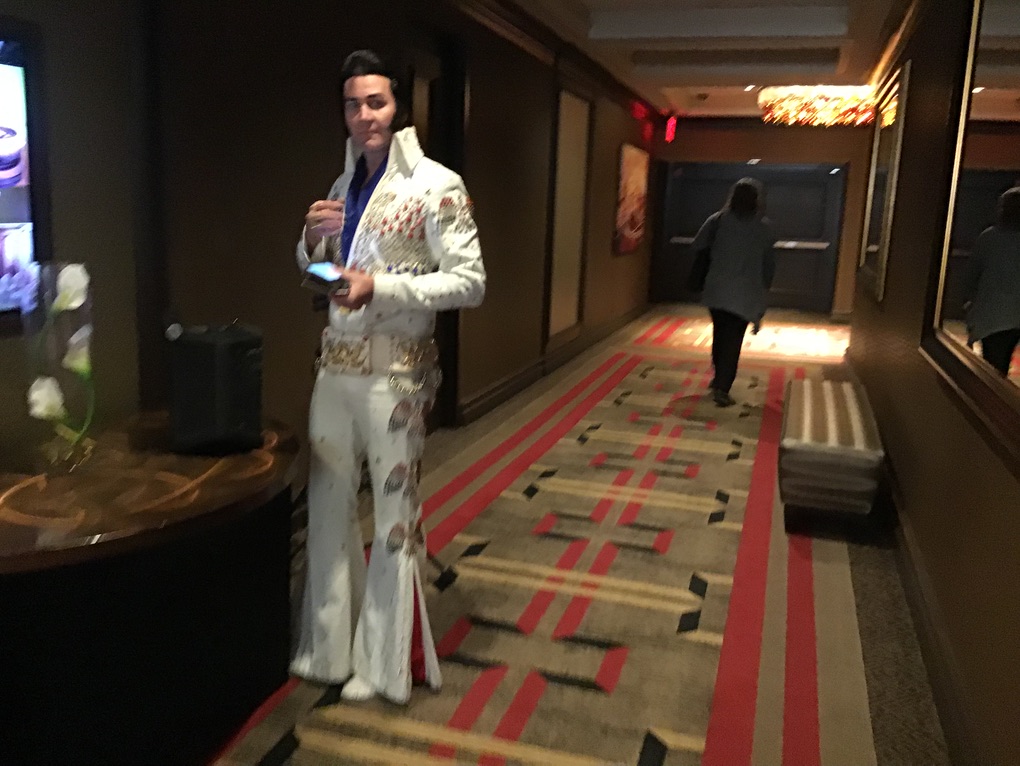
A Las Vegas Elvis impersonator (photo courtesy of Melissa Yi)

When I landed at the Las Vegas airport in September 2019, I expected the slot machines flashing at me.

I also expected the all-you-can-eat buffet and the Elvis impersonator checking his phone outside the in-hotel chapel.

But one aspect blew me away.

I’d come to Las Vegas for a romance-writing workshop with Kristine Kathryn Rusch. Halfway through, she brought us to the Springs Preserve and told us to write a short story that had to be inspired by the setting. She said that writing is “150 percent” about setting.

I wandered through the area, and what really struck me was the original Big Spring. Did you know that Las Vegas was originally the site of sacred springs? Me neither.

I considered Las Vegas a desert town with gambling and crooners. But for more than 15,000 years, springs bubbled through the desert floor, providing water to the people, animals, and vegetation. Grassy meadows formed, and Mexican explorers later called the meadows “las vegas.”

I stood quietly at the site where Native Americans had once made annual pilgrimages. They would swim in the springs. It was considered a holy place. Even now, I could see the remains of the waterhouse that once shielded the spring, while the birds tweeted above me. I hadn’t noticed nature anywhere else in the city, but here, I could feel it. It still felt spiritual to me.

The “settlers” came, drove out the indigenous people, and drilled. They’d leave the water exploding into the air, laughing at the water spurting out of the desert.

Of course the giant spring ran dry. Water conservation became a serious issue. They’ve had to drill a lower channel into the aquifer, and the whole region is at risk of future drought.

What should I write for my workshop story? I wanted to know more about the indigenous people—the Pueblo Peoples, the Nuwuvi (Southern Paiutes), and Patayan (ancestors fo the Yuman tribes), but I couldn’t find much information on them.

Okay. Refocus. My story had to be inspired by the Springs Preserve. What about my character?

I wanted to centre around Dr. Hope Sze, my main crime series’ protagonist. But when would Hope go to Las Vegas? She doesn’t have time to sleep properly during her family-medicine residency, let alone party in Vegas.

And how could she fall in love while solving a mystery inspired by the Springs Preserve?

I researched the water supply in Vegas and around the world. There is ample opportunity for crime. “Water is the new oil,” as one of my travel companions pointed out as we travelled together in Egypt.

However, governments and private water companies don’t exactly advertise vulnerabilities in their systems. It’s not something they want to encourage terrorists to target. Plus, I only had a few precious days to write the story while also attending lectures and reading other people’s work. I couldn’t spend all my time on research.

How was I going to make sure everything was entertaining, as well as geographically, legally, and scientifically accurate, solve a crime in 3,000 to 7,000 words, and get Hope a man?

Easy!

I spun Hope back in time. High-school graduation, to be precise, although I later ended up having to advance that another 2 years to be consistent with her universe.

Hope makes me laugh. Just the way she thinks and talks, and her mother’s fanny pack and father’s chitchat. As writer Kari Kilgore pointed out after reading my story, it’s so hard to be cool when your family is UNcool. So writing Hope was tremendous fun, as well as the romance (Sigh. Love.) and the humour.

Everything was grist for the mill. I wore a black dress to the preserve and was feeling cute, but my friend and author Sean Young greeted me by saying, “I can see sunscreen, especially there.” He pointed at my hairline.

Well, that’s the sort of thing that happens to me. I’m perpetually in a rush, and I mostly make sure that I eat, write, and exercise on top of working as a doctor and trying not to neglect my family . . . but that means I don’t look in the mirror much. Once, I ran out of the ER to eat lunch and bolted back, and a nurse told me I had cheese on my mouth.

Again, no problem! I gave Hope some potential blobs of sunscreen near her hairline too.

But what crime would she solve?

I switched from researching water to the twittering birds in Las Vegas. They exist. I saw and heard them. Someone else must love birds here.

First I found “the hummingbird lady,” Marion Brady-Hamilton. I liked hummingbirds, but no crime story formed in my mind. Her only conflict seemed to be with wildlife regulations. 

Then I discovered the story of Turk, a fourteen-year-old helmeted guinea fowl in the wildlife preserve at a resort-casino on the Strip. Three drunken law students were captured on security camera chasing Turk around a corner. I won’t describe what they did to him, but there were witnesses.

Wow. I’d just found my bad guys. I hate people who abuse defenceless creatures.

Writing at a feverish pitch, I also penned the title. “Flamingo Flamenco” popped in my head, so I had to slide in a dance reference between Hope and her love interest, Ryan.

I’m so happy that “Flamingo Flamenco” appears in EQMM. During the pandemic, I’ve reread it a few times, partly to cheer myself up and remind myself of brighter times. We all need love and justice and peace right now.

In real life, I can’t control what happened to Turk, or the minimal repercussions for the law students. I can’t bring back the sacred springs and the grassy meadows.

However, my fiction is my safe zone. Drunken law students may enter, but they will never win.

In “Flamingo Flamenco,” justice prevails. Buck, my fictional helmeted guinea fowl—and Hope and Rya—receive a much happier ending.

After I finished writing, I celebrated by taking the hotel water slide through the shark tank. I’m so myopic, I could barely see the fish and sharks without my glasses.

I slid through the shark tank anyway. Six times.

Viva Las Vegas.

Posted in Fiction, Guest, History, romance, Setting, Writers, Writing | Tagged , , , , , , , , , | 21 Comments