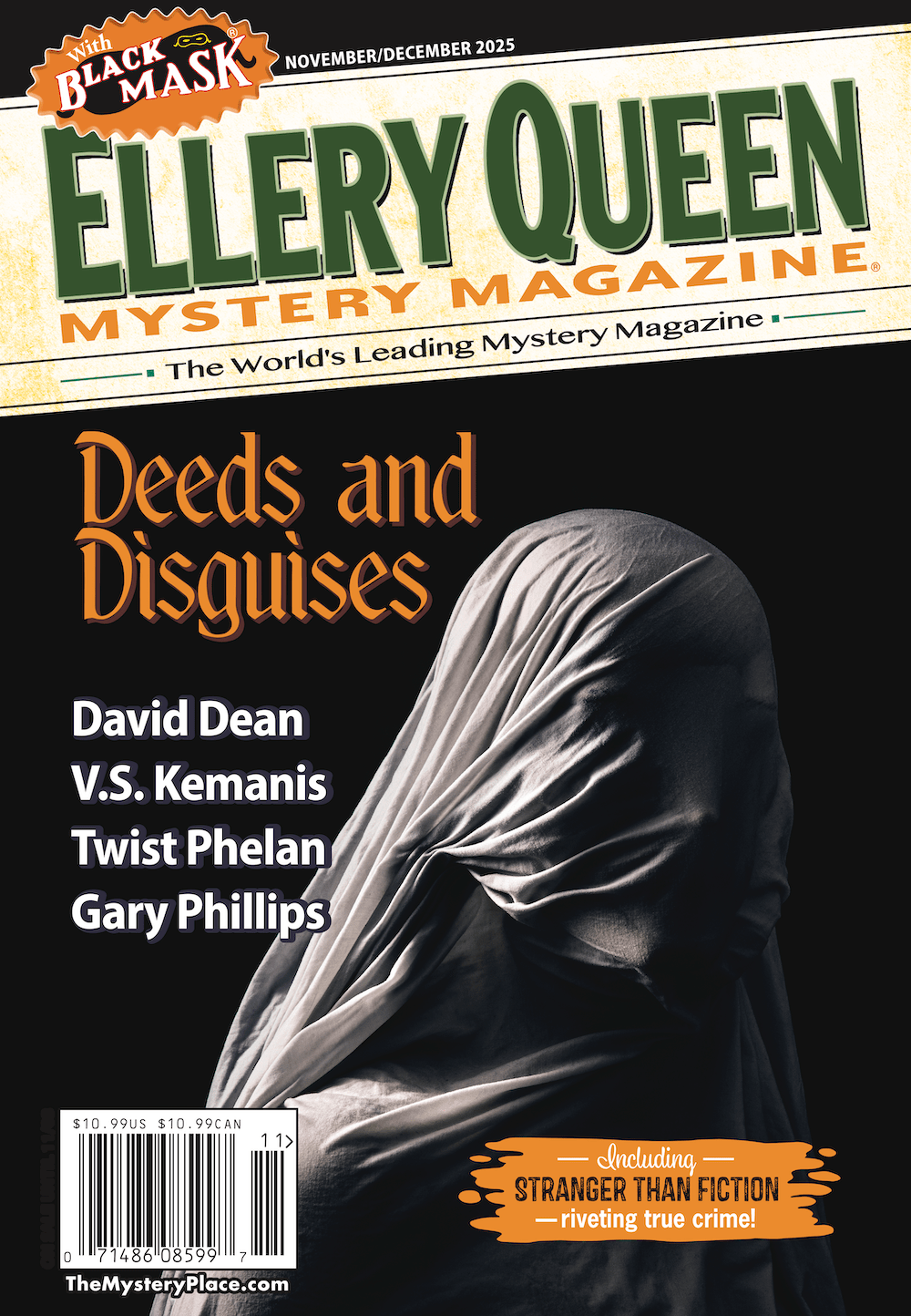
U.K. crime writer Sarah Hilary makes her EQMM debut in our current issue, September/October 2024, with the unforgettable story “Knock-Knock.” She is, of course, no newcomer to the crime scene. Her debut novel, Someone Else’s Skin, won the 2015 Theakston Crime Novel of the Year Award and was a Silver Falchion and Macavity Award finalist in the U.S. She’s the author of eight novels to date. The latest, Black Thorn, was described by The Guardian as “A creepy and atmospheric tale, beautifully and sensitively written.” Speaking of creepy and atmospheric, in this post the author takes up the question of whether mystery should be blended with the occult. Once you’ve read her EQMM story, or this post, I think you’ll welcome more such genre blending. —Janet Hutchings

Should you ever find yourself lost for words when among crime writers, simply utter the statement, ‘Dracula is a great detective novel,’ and wait for the conversation to become heated.
There are those who will feel compelled to tell you Dracula is not a detective novel, great or otherwise, for the simple reason it concerns itself with the supernatural and the supernatural has no place in mystery novels. But there will usually be at least one crime writer willing to put up a spirited (you’ll see what I did there) defence of the idea Dracula is, at its heart, a detective novel. Its many clues take the form of documents and mapped locations, there is a protracted chase, hunters and prey – all the classic ingredients. Moreover, there is strong evidence to suggest Bram Stoker originally intended it as a mystery, with his earliest notes citing a detective called Cotford and an investigator called Singleton.
Should the heated conversation require extra fuel, you can usefully throw out a few references to Arthur Conan Doyle’s abiding belief in the supernatural (most famously fairies), Wilkie Collins’ The Moonstone (widely accepted as an early example of crime fiction) and perhaps most compelling of all, Edgar Allan Poe’s stories about C. Auguste Dupin, his reclusive detective who modelled pipes for Sherlock Holmes and poems for Adam Dalgliesh.
Poe is often credited with being the father of the detective novel, but is of course far more famous for his tales of mystery and imagination involving hearts that beat under floorboards and live cats bricked inside walls (a trick few crime writers would dare attempt, since the harming of animals is all too often the portent of a doomed career). Poe even inspired a Japanese writer who adopted the pen name Edogawa Ranpo (a Japanese rendering of ‘Edgar Allan Poe’). Ranpo created a detective of his own, Akechi Kogorō, inspired by Sherlock Holmes. Like Poe, Ranpo is best-remembered for his tales of ero guro nansensu (erotic, grotesque, nonsensical), the most disturbing of which, “The Human Chair,” would give even his hero Edgar Allan a sleepless night.
Assuming the conversation gathers pace, you might like to mention that in Ireland in 1872, Sheridan Le Fanu published a short story collection, In a Glass Darkly, featuring his occult detective, Dr. Hesselius. Back then, no one was greatly concerned with staking out forbidden ground between mystery and occult. Great detectives could believe in what they liked, as long as they got the job done.
Scintillating conversation aside, why should any of this matter? Well, it doesn’t. Unless you feel strongly that the mysteries at the heart of mystery novels should never stray across the line between the natural and supernatural worlds. But isn’t it the job of the crime writer to unsettle, intrigue, baffle and disturb our readers? In which case it seems a shame to cut ourselves off from the many excellent ways in which the supernatural can aid us in that quest.
John Connelly has written in praise of just such a quest while the French writer, Fred Vargas, offers an excellent contemporary lesson in how blending elements of the occult with a rational denouement can deliver a richly satisfying read. One of my favourite short stories of recent years is “All the Livelong Day” by Mick Herron (you can read it in his Dolphin Junction collection). The story positively vibrates with brooding menace, and has more corvids than even Edgar Allan Poe could shake a stick at.
All the signs are that ‘blended genre’ is about to be big in crime fiction. My advice this fall is to let a little darkness into your mystery reading. Embrace the night, switch off the lights and listen for those heartbeats under the floor.
 SOMETHING IS GOING TO HAPPEN
more thoughtful items such as this, please.