In several previous years I’ve posted on this site about my experiences at the Bouchercon World Mystery Convention. That gathering of mystery fans, writers, and others in the business takes place in a different city each autumn. This year, neither I nor my colleague at Alfred Hitchcock’s Mystery Magazine, Linda Landrigan, attended Bouchercon; instead, the senior managing editor for both magazines, Jackie Sherbow, represented our publications. I was as interested to read of Jackie’s adventures at Bouchercon and the subsequent C3 conference as I think you will be. For those who don’t already know Jackie, she’s not only an excellent editor, she’s a published poet and a mystery writer whose work has appeared in Mystery Magazine and in the anthology The Beat of Black Wings. —Janet Hutchings
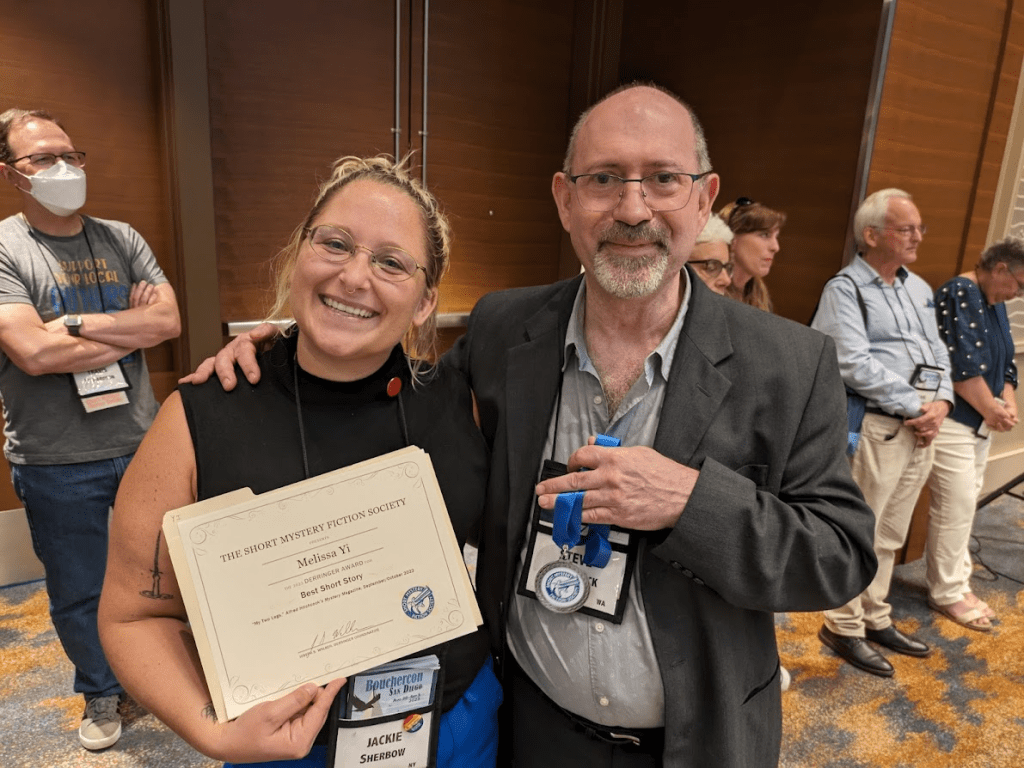
Jackie Sherbow, left, and Steve Steinbock accept Derringer award for Melissa Yi. Photo courtesy Steve Steinbock.
September has been a busy time for EQMM and AHMM! The first weekend of the month, I traveled to San Diego for the fifty-third year of Bouchercon (the World Mystery Convention). It was a delight to experience a city I know very well transformed into a gathering-place for all my friends and colleagues in the mystery-fiction (and nonfiction) world. I have been able to attend two past Bouchercons (Albany and Toronto), but this was my first time staying in the convention hotel for the entire weekend.
During Thursday night’s opening ceremonies, Steve Steinbock (author, translator, and EQMM The Jury Box book reviewer) and I accepted the Short Mystery Fiction Society’s Derringer award on behalf of Melissa Yi (who won in the Short Story category for “My Two-Legs,” which appeared in AHMM). Martin Edwards (historian and author) was honored with the Edward D. Hoch Memorial Golden Derringer for Lifetime Achievement; later in the weekend, he won the Anthony Award for Best Nonfiction for his book The Life of Crime: Detecting the History of Mysteries and Their Creators. We’re proud to say that Martin’s first work of fiction appeared in EQMM’s Department of First Stories!
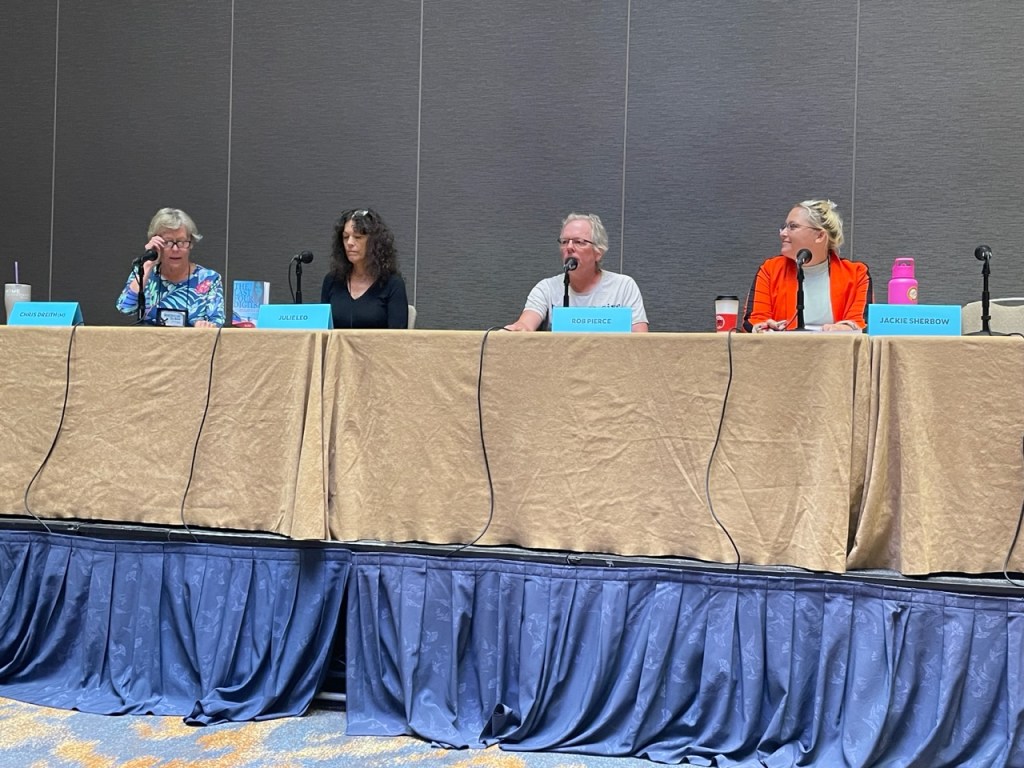
Friday night, I was honored to give one of the several traditional toasts at the Nero Wolfe Banquet (put on each year by The Wolfe Pack). Saturday evening before the Agatha Awards banquet and presentation, authors and friends of the Dell mystery magazines met poolside for a toast and get-together, which was a treat. And on Sunday Chris Dreith, Rob Pierce, Julie Leo, and I closed out the conference with a panel about writing at different lengths (“The Long and Short of It”) in the very last programming slot.
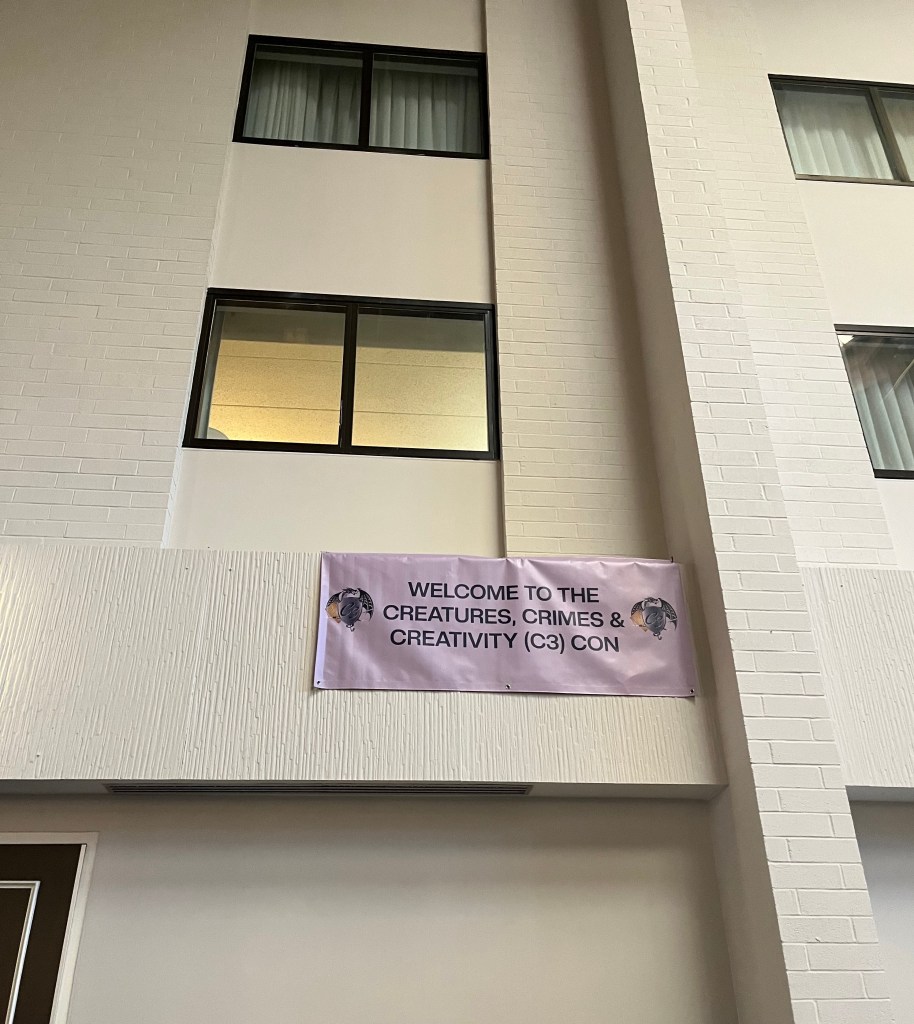
The following weekend, after a few days home in NYC, I took the train to Baltimore and from there went on to Columbia, MD to attend the Creatures, Crimes, and Creativity Con (C3), where I was the Publishing Industry Guest. Although EQMM and AHMM have sent magazines to the conference for years, it was my first time attending, and I was so lucky to have been invited by founders and organizers Austin and Denise Camacho.
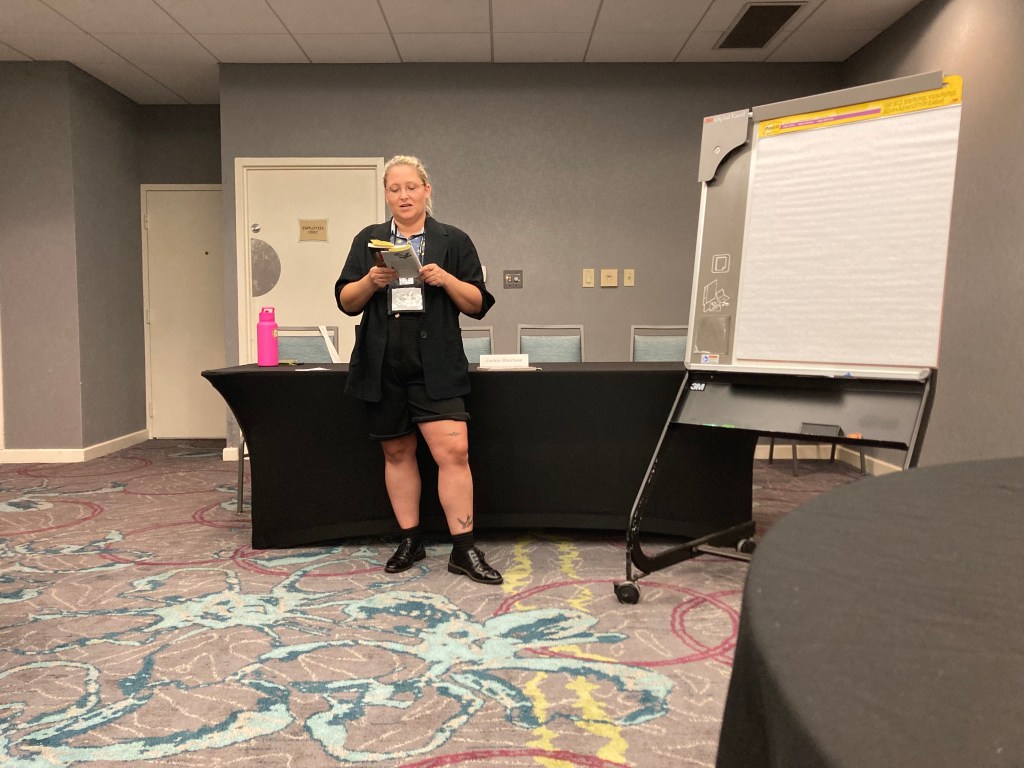
On Friday, I gave a talk about my job, the history of the magazines, and writing and submitting short stories. Throughout the weekend, I was on several panels—in one, I shared the panelists’ table with Josh Pachter (author, editor, and translator), with whom I spent much of the weekend, along with Laurie Pachter (also a writer). Ed Aymar was in attendance, as was Jeffery Deaver, who served as one of the keynote speakers. Attendees could enjoy talks and interviews during mealtimes as well, and Noir at the Bar on Friday night. C3 is a small, unique conference—a “boutique” conference, as Austin told me he’d heard it called; I had never been to a convention quite like it before, and the connection and mutual inspiration amongst attendees was palpable.
Below, you’ll find a photo gallery that I hope gives you a little taste of the experience. By mid-September, I was fresh off time well spent with old friends and new ones, enlightening programming, and a tremendous amount of fun. I’m happy to say I’ll be back to both conventions next year! Hope to see you there.
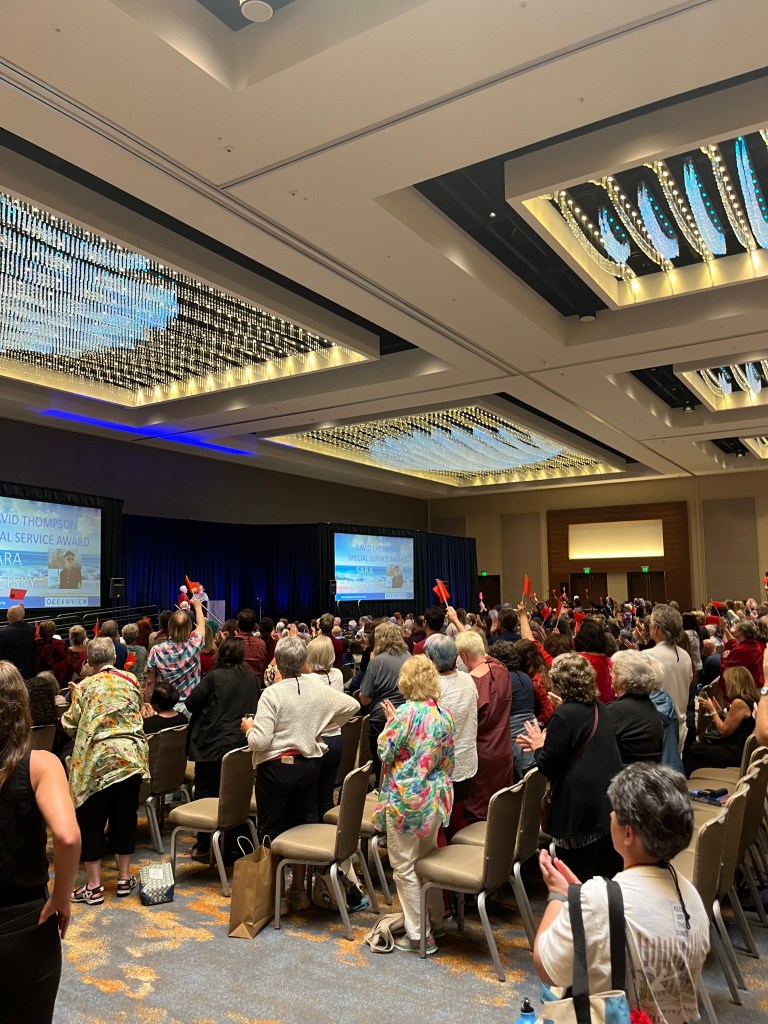
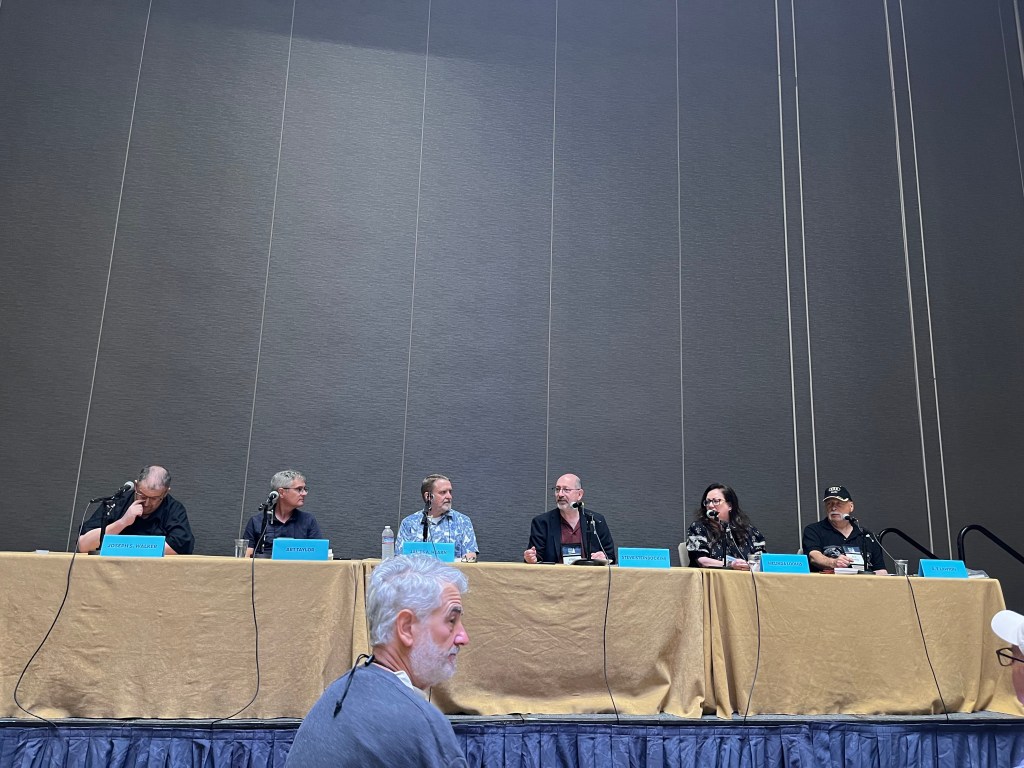
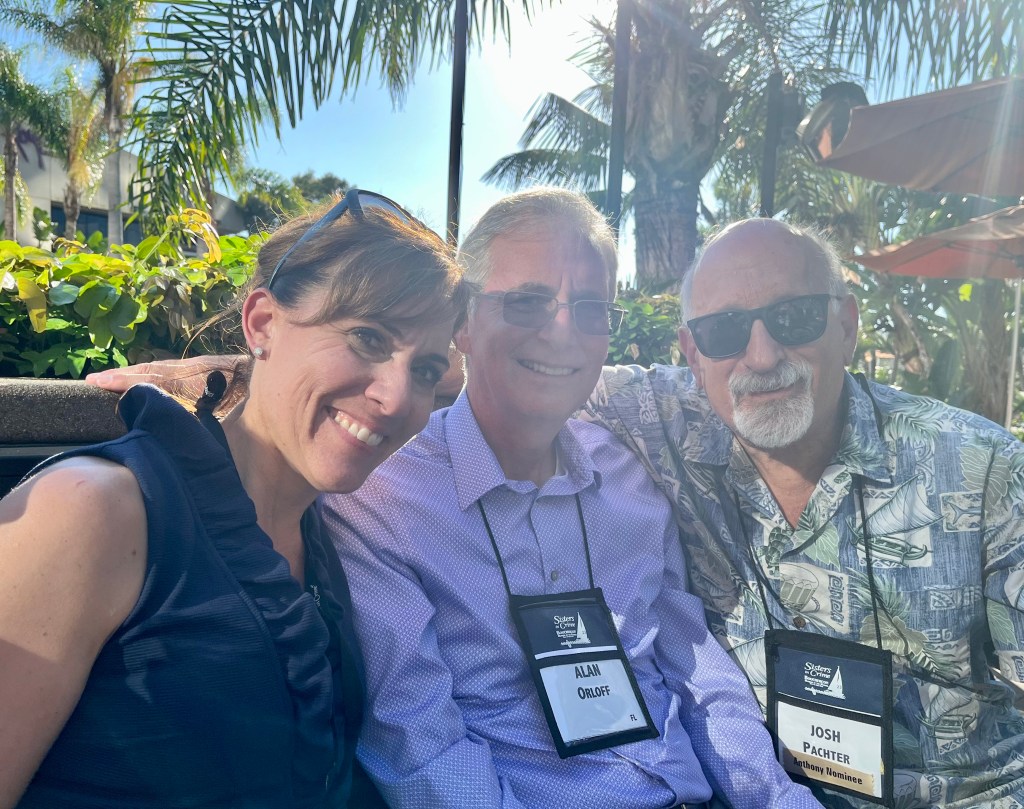
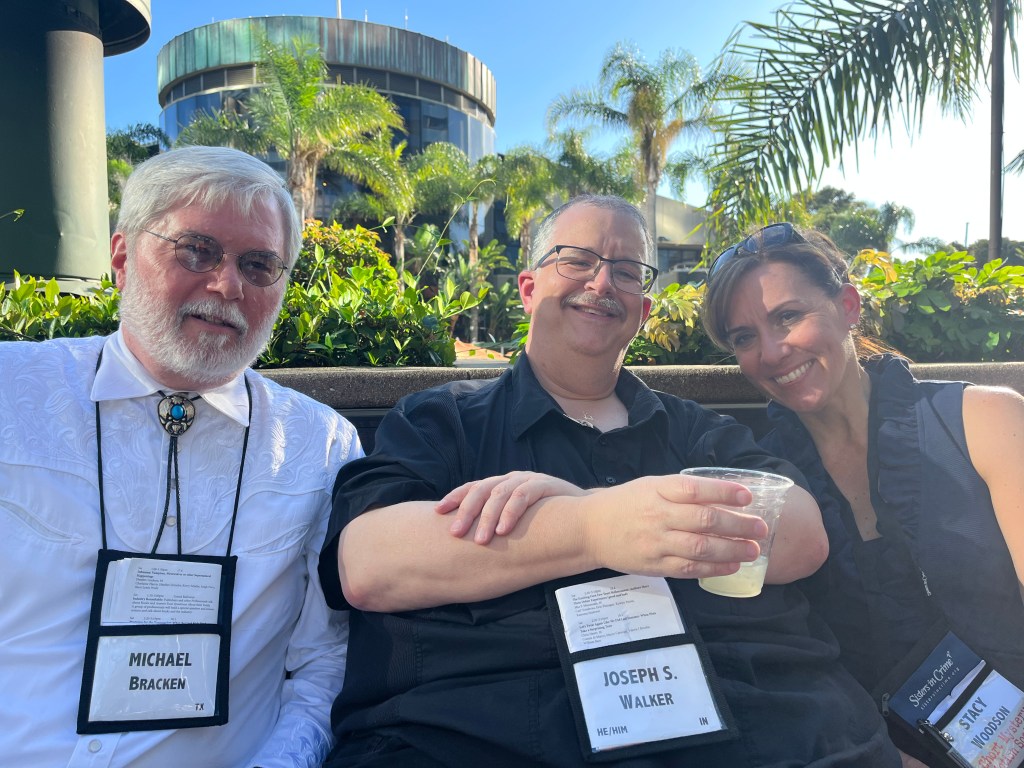
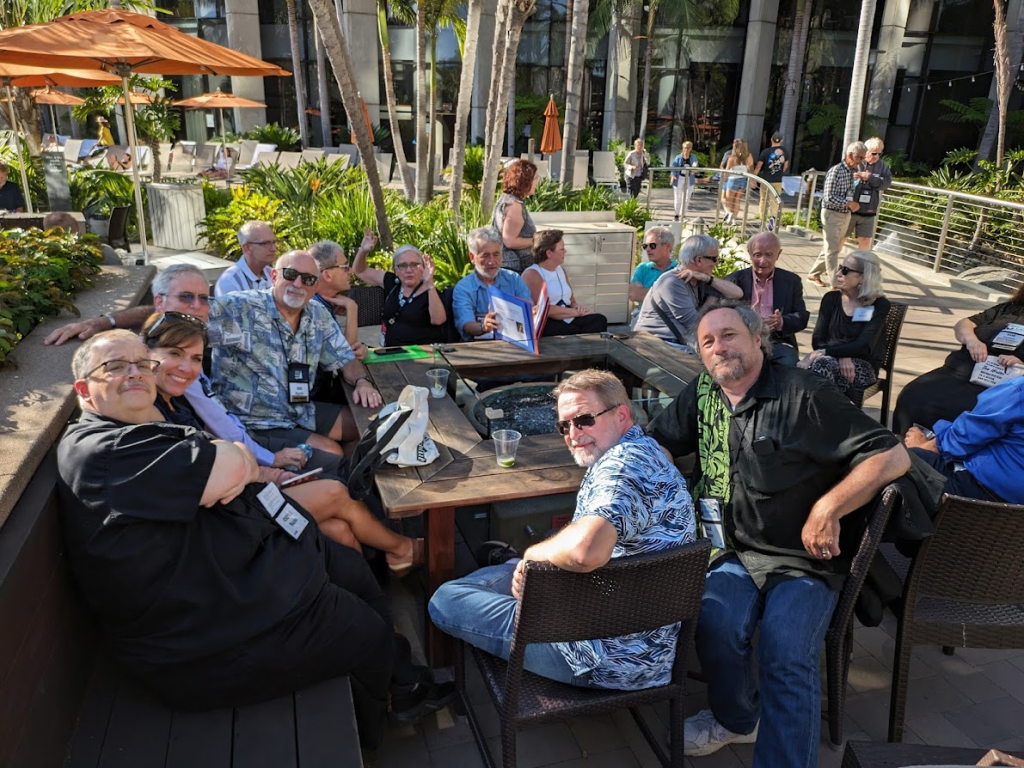
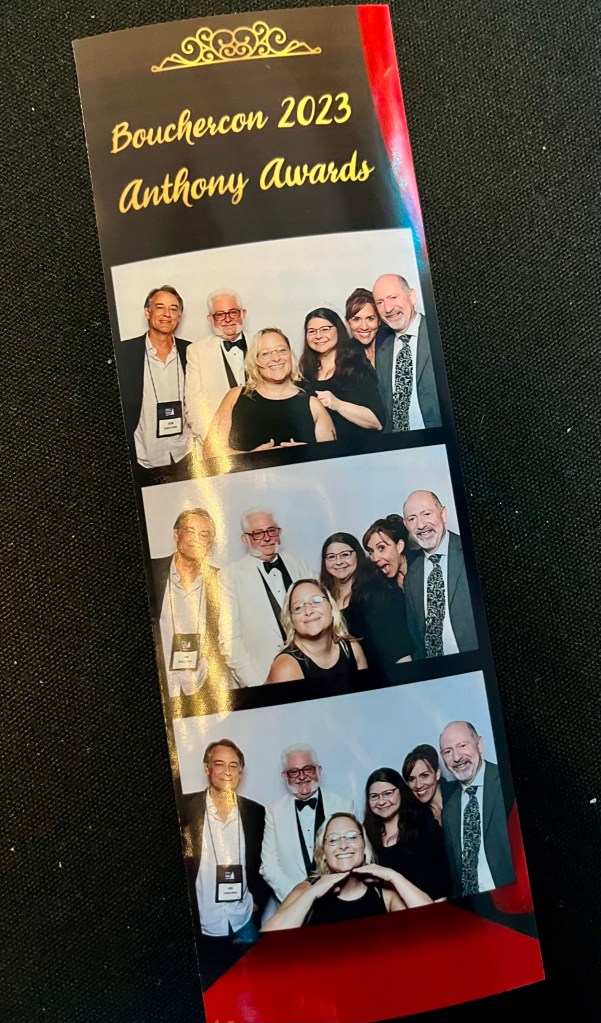
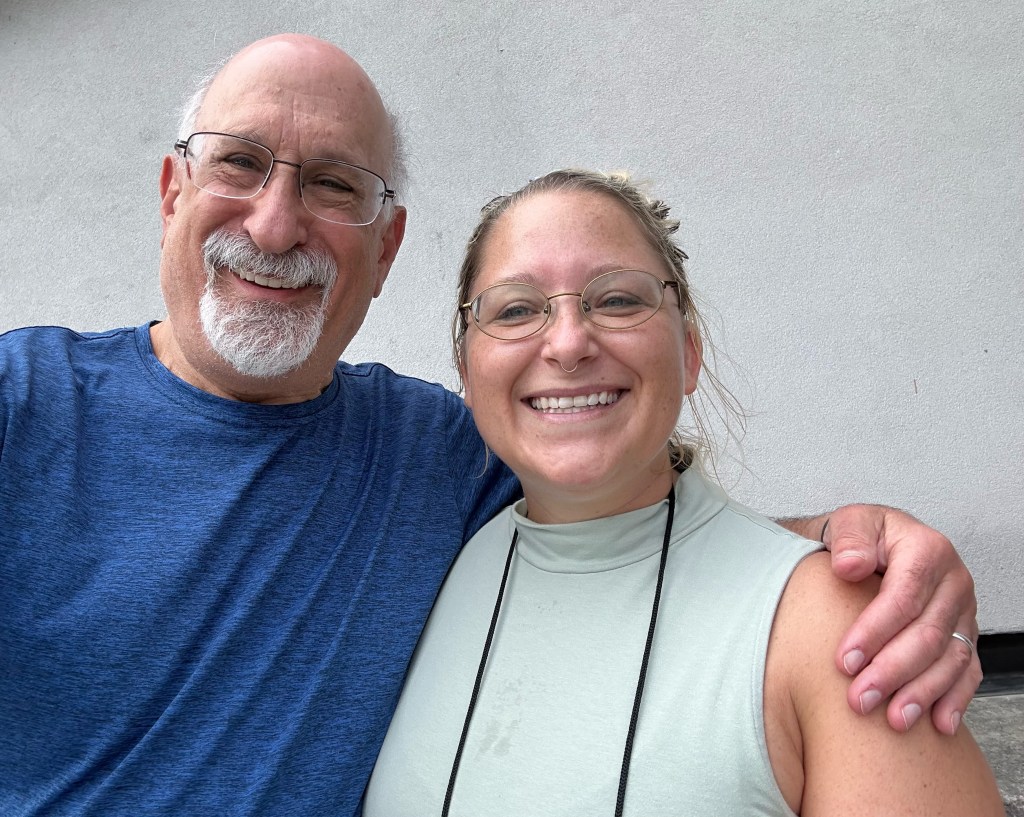
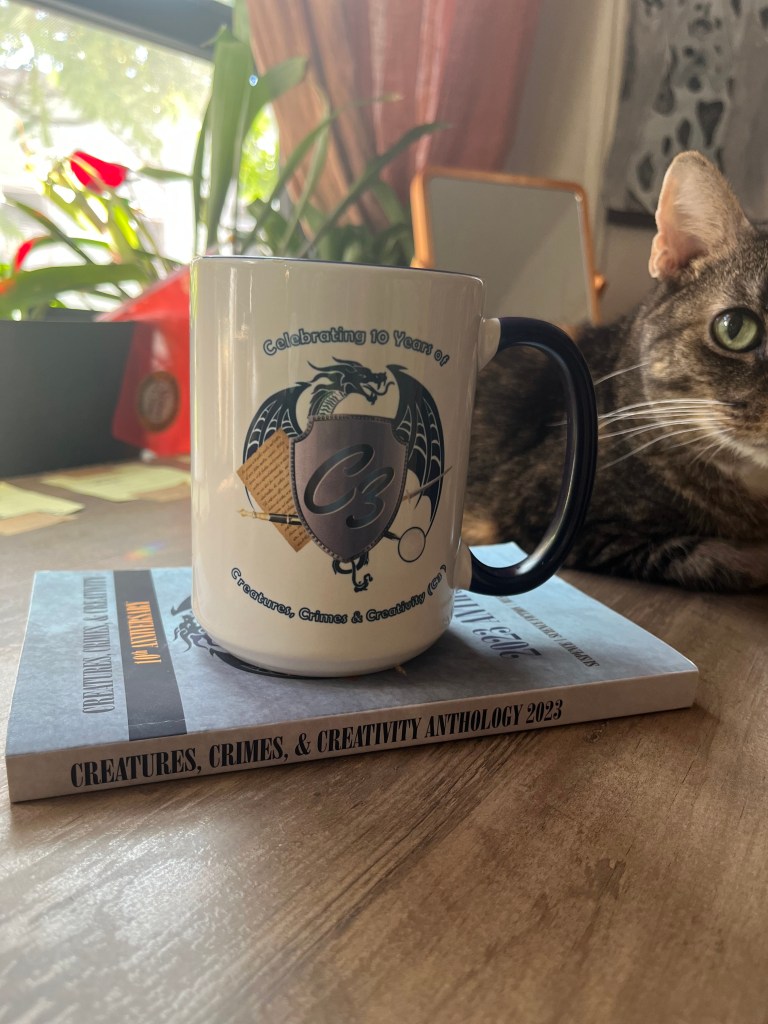
Bouchercon hotel atmosphere. Photo by Jackie Sherbow.Sisters in Crime showing support at Bouchercon opening ceremony. Photo by Jackie Sherbow.From left: Josh Pachter, Brendan DuBois, Stacy Woodson, Temple Bracken, Michael Bracken, Barb Goffman, and Jackie Sherbow. Photo by Josh Pachter.Bouchercon Short Story panel. From left: Joseph Walker, Art Taylor, James A. Hearn, Steve Steinbock, Melinda Loomis, R.T. Lawton, and timekeeper Robert Lopresti in foreground. Photo by Jackie Sherbow.At the Dell Bouchercon gathering. Photo by Stacy Woodson (left).At the Dell Bouchercon gathering. Photo by Stacy Woodson.At the Dell Bouchercon gathering. Clockwise from left: Stacy Woodson, Alan Orloff, Josh Pachter, Rob Osler, Kenneth Wishnia, Edith Maxwell, Robert Lopresti, Art Taylor, Martin Edwards, G.M. Malliet and husband, Dale Berry, and James A. Hearn. Photo by Steve Steinbock.Dell authors and editor. From right: Steve Steinbock, Stacy Woodson, Barb Goffman, Jackie Sherbow, James Lincoln Warren.Josh Pachter, left, and Jackie Sherbow. Photo by Josh Pachter.The Long and Short of It Panel at Bouchercon. From left: Chris Dreith, Julie Leo, Rob Pierce, Jackie Sherbow. Photo by Toni L.P. Kelner.Photo by Jackie Sherbow.Jackie Sherbow with magazine during talk. Photo by Kathryn Prater Bomey.C3 merch and 10th Anniversary Convention Anthology (featuring Dottie the cat).
Andrew McAleer is the author of 101 Habits of Highly Successful Novelists and co-editor, with Gay Toltl Kinman, of the mystery anthology Edgar & Shamus Go Golden. He recently completed a volume of short mystery stories featuring his father John McAleer’s Golden Age detective, Henry von Stray, and he’s now at work, with Gay Toltl Kinman, on two mystery anthologies: Shamus & Anthony Commit Capers (Level Best Books) and Agatha & Derringer Get Cozy (Down & Out Books). Andrew has contributed two previous posts to this site (one on a poem by Edward D. Hoch, the other about Rex Stout); this time he shares selections from his father’s interviews with James M. Cain. —Janet Hutchings
Left: Transcribed Cain interviews held at his home in Maryland; Center: Packed & Loaded; Right: McAleer’s questions for Cain
Some time in the early 1970s, not long after Rex Stout authorized my father, John McAleer to write his biography, another major American writer in the field of crime literature asked my father if he would also write his biography. My father readily agreed. After all, this was James M. Cain asking—and the truth is: the postman don’t always ring twice. Hence, while putting the finishing touches on Rex Stout: A Biography, my father seized every available opportunity to interview Cain on his life, craft, and peers. The Cain biography, however, never came to be.
With the completion of Stout, my father was ready to take on Cain full time when a letter arrived from fellow biographer Roy Hoopes. Hoopes expressed concern that he’d heard my father was writing Cain’s biography because Cain commissioned him as well. As my father later wrote, “To spare Cain his blushes I yielded ground to Hoopes . . .” As a result, my father’s interviews and Cain correspondence were filed away and remained so for a quarter century.
While assisting my father with some research in or around 2001, I happened upon the Cain file and helped him compile the “lost” gems into manuscript form. These remarkable interviews were published under the title: Packed and Loaded: Conversations with James M. Cain. (Nimble Books, 2010) In addition to an Afterword by Shamus winner Jeremiah Healy, I obtained original epigraphs about Cain from Elmore Leonard, Sue Grafton, Robert B. Parker, Dennis Lehane, Peter Lovesey, Phil Lovesey, Edward D. Hoch, Katherine Hall Page, Robin Moore, and William G. Tapply. The interviews are as impressive and important to crime fiction as the foregoing list of authors.
As my father tells it in his Foreword to Packed and Loaded,
These reflections reveal Cain as he wanted to be remembered. There never was a time when Cain was not forthright in utterance, but in his octogenarian interviews age sanctioned an awareness remote from the restraints wariness might have imposed on a lesser mortal, a decade earlier. At eighty-five he dared to give free expression to an estimate of his fellow man with an integrity, which even those less engaged in reality would scorn to rebuke.
In this critical, tell-it-like-it-is study, Cain reveals his thoughts on Hemingway, Fitzgerald, Arthur Miller, Hammett, Chandler, Marilyn Monroe, and in his eighty-fifth year, his plans for the future. (Cain died on October 27, 1977–two years to the day after Rex Stout.)
The following selected Q&A and epigraph’s from Packed & Loaded make their first online appearance anywhere exclusively for EQMM’s “Something is Going to Happen” followers.
Cain correspondence to McAleer dated August 23, 1976, with Cain’s hand-written marginalia.
* * *
McAleer: Do you write more than one draft when writing a book?
Cain: I rewrite so much I lose track of how many drafts it takes to finish a book. At least four or five—sometimes more. I’ve cut down the number in recent years by outlining, not only of story, but of characters, etc., before I start the text. This sidesteps a lot of false starts I used to make.
James M. Cain’s novels were my introduction to noir fiction. There have been many writers since with a flair for the Dark Side of human nature, but none with the same deft touch. —Sue Grafton
McAleer: Do you think that your experience as a journalist helped you with writing fiction?
JMC: I don’t think it helped much. I don’t think they have much relationship. . . . In my novels, I don’t write the way I write for a newspaper at all. . . . To write a novel, I have to pretend to be somebody else. I have to be, pretend to be, the character telling his story.
McAleer: Some of your novels are in the third person, however.
JMC: I wrote three books in the third person: Mildred Pierce, Love’s Lovely Counterfeit, and The Magician’s Wife. And, it tells a story, I seem to be able to get away with it but not with any such impact and conviction and circumstantial background, as I get when I have the character tell the story. . . . In the first person it seemed as though it really happened. . . . In the third person, I don’t care how good you are, or even if you’re Sinclair Lewis, there come times when it seems as though you’re making it up as you go along. To that extent, first-personal narration must be respected.
What I gained from reading Cain is an appreciation of the antagonist’s point of view: that bad guys are more fun to write about than good guys, their attitude and they way they talk always more entertaining. —Elmore Leonard
McAleer: Do you think the reading audience has changed much? When I read Serenade and The Postman Always Rings Twice, the narrators were characters who were very American and had definite ethnic prejudices. Do you think today’s readers might be too sensitive about such a narrator?
JMC: I don’t think so, because it doesn’t say that I have any ethnic prejudice, it says the character does. I think in this personal book [The Postman Always Rings Twice] he kept talking about the Greek, as though, “How could you marry this Greek?” He asked her as though a Greek wasn’t much to be married to. . . . And he knew that she was kind of sensitive about it, but if she was sensitive about it she was ethnically prejudiced, and so was he. But it seemed to me that the reader would simply accept that’s how they were and not particularly think I had to be—or assume that I had no right to mention it.
McAleer: Do some episodes in your books please you or stand out more than others?
JMC: Once the book is written, I never think about the goddamn book anymore. I get on with the next book.
McAleer: When you’re writing do you consciously set limits on what a writer should say or could say in a book?
JMC: That has no meaning for me. I don’t set any limits. I never heard of a writer that sets limits on what a writer can say.
In many ways James M. Cain set the standard for pacing, tightness of plot, and psychological suspense. The Postman Always Rings Twice, The Butterfly, Double Indemnity—to name just a few of his novels—rank foremost in the field of crime literature. —Robin Moore
McAleer: How would you rank Hammet and Chandler as hard-boiled authors?
JMC: I’ve been accused of writing like Hammet. But I never read anything by Hammet . . . I got a copy of The Glass Key and I would pick it up and try to read it . . . But by the end of four or five weeks I’d only read twenty pages of this book. I think to myself, “For Christ’s sake, you can’t like it too well.” And I met him one time, over at the Edward G. Robinson’s. This somewhat wild-looking character with white hair he had, came charging up to shake my hand, and tell me how much he admired my writing and so on. Said he was Dash Hammett. And I wrung his hand, and I said what an honor it was, how glad I was to know him. And then I got away from this guy but quick, ’cause I had not read anything by him . . . I’ve never read one word of Chandler . . . I used to run into him at parties: “Why hello, how’ve you been?” But outside of that. . .this one afternoon when Billy Wilder had me over to talk about this Double Indemnity thing that he was working on at the time. I had no discussions with Chandler at all. I scarcely knew him.
James M. Cain was a master of less is more. Reading him is a pleasure; re-reading is sheer joy. —Katherine Hall Page
McAleer: You don’t think F. Scott Fitzgerald was good at evoking character development through dialogue. Who do you think was good?
JMC: I’ll tell you who’s good: Arthur Miller, Sinclair Lewis. Arthur Miller was a genius at it. He was the one married to Marilyn Monroe. . . . Marilyn was what’s called a triangle girl. They’re girls that lived in that triangle between Hollywood Boulevard, Highland Avenue, Sunset. Makes a triangle. The Hollywood Bowl goes off one angle—Pepper Tree Lane they call it. It’s off the Highland angle of this triangle. The Hollywood bowl Lane of maybe two to three hundred yards of trees and at the end of the Lane is the Hollywood Bowl that’s off the triangle. But in this triangle a dozen apartment houses of one and two room apartments lived girls like Marilyn. They have one nice dress and one pretty good dress. They’re known as party girls . . . They had a way of talking. That peculiar lingo; it’s different from anything I’ve ever heard. I’ve heard it a few times, after all, you live in Hollywood you meet some triangle girls at the party.
Cain made it seem easy, but only if you’ve tried it yourself do you realize how difficult it is to master the genre as skillfully as he did. —Edward D. Hoch
McAleer: What book do you think is your best work?
Cain: My best book is the one which sold the most copies, so far as I’m concerned, and by that test, my Postman leads the list, with so many editions I’ve completely lost track. I’m quite vain of the fact that it’s still in print, and still making me a living.
* * *
We remain deeply indebted to James M. Cain’s original and historical contributions to literature. As historian Robin W. Winks reminds in his Edgar Award-winning, Mystery & Suspense Writers: the Literature of Crime, Detection, and Espionage, “The birth of crime noir can be traced to the 1930s and grew out of the Great Depression . . . In many ways James M. Cain’s work serves to define crime noir writing and represents the form at its most typical.” (PP. 1012-1013)
More than 20 years have passed since I worked on Packed & Loaded with my father. Fond memories. I sometimes wonder what would have become of these historical documents if I didn’t happen to pull open that file drawer at that particular moment in history while my father was still around to discuss them. It’s best not to worry about such things and just be thankful the postman rang twice.
Joseph Koenig’s first novel, Floater (1986), was nominated for an Edgar Allan Poe Award. His fiction has also brought him nominations for the Shamus and Macavity awards, and his novel Brides of Blood (1993) was named a New York Times Notable Book. The New York author has a very original new story, “High Diver,” in EQMM’s current issue (September/October 2023). It’s a return to EQMM after a long absence; his work previously appeared in our pages in 1992. In this post he mentions his occupation prior to becoming a full-time fiction writer—what he refers to as “degenerate journalism”! —Janet Hutchings
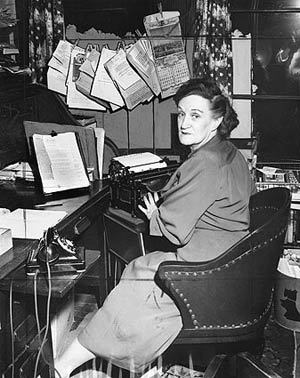
When she was starting out at the Salt Lake City Tribune in the early 1920s, Florabel Muir fought to cover the execution by firing squad of a condemned murderer at the Utah penitentiary. Because she was a woman and young, although hardly dainty—she never was accused of that—her editor assigned a male reporter as a sort of relief pitcher in case her nerves failed, and she couldn’t complete the assignment. It was her backup who revealed weak knees. Muir was awarded the byline and praise from the editor, who admitted that she was not the reporter who vomited.
Over half a century Muir built the reputation of a newshound who always went the extra mile—even when it was someone else’s last mile—to get the story. If she returned to the city room to write it spattered in their blood, she had carte blanche to put the dry cleaning on her expense account. In 1950, close to 60 and still very active, she summed up her career in the tell-all Headline Happy. Here is the first part of Kirkus’s review:
Sex and sadism, gals and gangsters, were molded into the author’s news stories for New York and Los Angeles tabloids, and Miss Muir licks the dish with reminiscent gusto in her autobiography. All the savoring of the lurid and sensational that made the stories is intensified here paced by Miss Muir’s counting o’er her successes wringing stories from reluctant celebrities, manufacturing stories from celebrated silences and keyhole interviews. There is the Charlie Chaplin-Joan Barry scoop in which the little mother is treated tenderly; the story of boyish Errol Flynn’s endearing escapes; the carryings on of Mickey Cohen and Bugsy Siegel; and the famous diary of Mary Astor which Miss Muir procured (she does not tell how) for $300. Through all the author takes pride in relating how she swept down on her prey—just and unjust—(she seems to admire the unjust more)—with one object in mind—the story.
It’s said that everyone on earth is connected to everyone else by no more than six degrees of separation. As unlikely as this seems, it works for me. Through an old girlfriend who doesn’t deny turning down an offer of marriage from a future adviser to Presidents Bill Clinton and Donald Trump I am linked to every major Democrat and Republican politico, with degrees to spare. A teammate from my college football days went on to become a top NFL exec, my portal to the world of professional sports. I knew Salvador Dali as he approached old age. If anyone prominent in the arts was a stranger to him, I can’t imagine who it might have been. I am three degrees of separation removed from Florabel Muir.
My Uncle Murray’s best friend was Neddie Herbert, a gunsel. I have no idea of what he did before becoming a gangster, or how he came to be tight with my father’s younger brother. I never asked Uncle Murray, who considered such questions tasteless. I do know that by the late 1940s, Neddie had left Brooklyn for fresh pasture in the west, gone to L. A. to work for Mickey Cohen, who was Ben Siegel’s trusted lieutenant and successor. After Bugsy was executed because of his alleged finagling of expenditures at the new Flamingo hotel in Las Vegas, Cohen filled his chair in the councils of the mob.
Cohen was no Bugsy, who some thought handsome and charming. He was short, stubby, and lacking any pretense of savoir faire. While Siegel didn’t employ bodyguards, trusting to the good nature of his underworld compadres, Cohen was never seen without several. Chief among them was Uncle Murray’s friend, Neddie.
On the morning of July 20, 1949, Mickey, Neddie, and their entourage stopped for a bite at Sherry’s, an all-night eatery on Sunset Strip. Among the entourage was Florabel Muir. As she would explain, Jack Dragna, a mobster competing for Bugsy Siegel’s vacated turf, had announced that he was gunning for Mickey, and she wanted to be around should Mickey get it. Cohen was not visibly concerned. A hard man, a former pro fighter in the bantamweight division, he could take care of himself with his fists. Neddie Herbert was there to handle business that might escalate into gunplay.
As the Cohen party was leaving Sherry’s at 3:55 a.m., shotgunners opened fire from their blind beneath a billboard across the street. Mickey was hit in the shoulder, but not seriously injured. A larger load of shot was absorbed by Neddie. A pellet ricocheting off the sidewalk or perhaps a bone inside Neddie caught Florabel Muir in what she described as her derrière. Cohen, who was being tutored in the finer usages of language by the writer and her husband, referred elegantly to the site of her wound as her tuchas.
Neddie still was breathing as he kissed the curb. A news photo shows ghouls clustered around him while a passerby tries to stanch the hemorrhaging from his guts. In another picture shot through a forest of legs a garment of some sort is clenched in Neddie’s teeth. There is blood all around. He seems accepting that he is a gone goose, apprehensive about what would come next.
Absent from the rotogravure is Florabel Muir. Ignoring directives from her husband to, “Get down, get down,” she ran from the gunfire, not out of fear, but in search of a phone to call in her greatest scoop, a first person account of the failed attempt on Mickey Cohen’s life, and incidental murder of Neddie Herbert.
Cohen subsequently appointed a new bodyguard, and fended off more assassination attempts by Dragna and his goons. Not one to take chances, the notorious germaphobe and compulsive hand-washer purchased a new Cadillac Coupe de Ville, and outfitted it with two-inch thick glass, and armor cladding.The Caddy was too ponderous for getaways, but impervious, and served its owner well until he traded it in two years later because it wasn’t street legal.
Florabel Muir’s piece in the New York Daily News, her flagship at the time, was syndicated throughout the country, cementing her place as America’s ace legman. Dripping with Adrenalin, the writing did not match this contemplative bit from Headline Happy, in which she describes entering the scene where another luckless yegg had eaten lead.
Perfume pervaded the room from the night-blooming jasmine clustered outside the window through which the deadly shots had been fired. The Los Angeles Times was lying across his knees, and on it was stamped: Good night. Sleep peacefully with compliments of Jack’s. Bloody sections of his shattered brain partially blotted out the eight column headline telling of another fatal shooting in the poorer section of Los Angeles. As I moved the newspaper to see what he had been reading, blood dripped on my satin evening slippers.
The Kirkus review concludes somewhat predictably:
Miss Muir for our money should have stood in the twenties when this type of degenerate journalism splattered on a public not yet surfeited with horrors.
I have no gripe with degenerate journalism. For many years I was also a practitioner, largely at Front Page Detective and Inside Detective magazines, nurseries for degenerate fiction writing, my current practice.
Florabel Muir died of a heart attack at 80 in 1970. Her New York Times obituary quoted her as confiding to intimates, “I was having a talk with my croaker the other day, and he said, ‘Florabel, your ticker ain’t worth a pot in hell. You take it easy.’ So I guess I will.”
Her brand was strong, but she wanted to be Damon Runyon, I suppose.
Paul O’Connor has written comics, and for decades he developed video games, most recently as game director for Amazon’s Lord of the Rings. He makes his fiction debut in EQMM’s current issue (September/October 2023) with the story “Teddy’s Favorite Thing,” in which he manages to imbue a take-your-child-to-work day with chilling suspense. Here he revisits an incident from his own childhood that helped to inspire the story. —Janet Hutchings
The woman on the bed was nude, and framed from the waist-up. Three black bullet holes snaked a dotted line up her chest.
“Here’s a bride they killed on her wedding night,” the detective said, grinning as he showed me the photo.
I don’t think I’d ever seen a naked woman before. I’m sure I’d never seen a dead one.
I was thirteen years old.
It was the middle 1970s and I was on a ride-along with my brother, a policeman. He was a dozen years my senior, and I worshiped him, eagerly jumping at the chance to join him on patrol.
We were the baby boom sons of a middle-class Southern California family. We grew up in a house on a peaceful street in the San Fernando Valley, with walnut trees in the front yard, and a swimming pool out back. Our father had been with the U.S. Marshals Service in the ’50s. Later he sold real estate, and owned his own dry cleaning business. My mom managed the home despite her chronic arthritis. When I wasn’t reading comic books or cheering for the Dodgers, I’d join the family to watch Adam-12, especially after my brother’s instructors at the LAPD Academy praised the TV show’s demonstration of correct police procedure.
We didn’t think in terms of privilege but we certainly benefited from it, white and middle class and American. My life was idyllic and sheltered, and free from violence. I had no experience with dead bodies, and was still capable of being shocked by them.
Except I wasn’t shocked.
When the detective showed me that photo—breaking who-knows-how-many laws and rules of evidence—a magical thing happened.
It was a rite of passage. It put me proudly in the cop club, where the darkest things could be shared with little boys for a laugh. And I knew—somehow and without being told—that my new club demanded stoicism and silence.
So I kept my mouth shut and my eyes open.
Our morning was a snooze after that early detective encounter at the station. There were no car chases or wacky slice-of-life comic relief cases, like officers Reed and Malloy had on Adam-12. Instead we drove endlessly around the city, incomprehensible codes and cross-chatter coming over the radio. My brother’s eyes were always roving, noticing things I did not, mostly minor traffic violations that didn’t warrant a stop. People looked at me, probably wondering why a kid was sitting in the front seat of a police car. I felt pride that I was there, but also shame that people might think I had done something wrong.
After lunch a 211 call came over the radio. I’d heard that one a bunch of times on TV—”One Adam 12, One Adam 12, 211 in progress; One Adam 12, handle code 3.” Armed robbery!
But whether I was in the club or not, that radio call was as close as I got to the action. My brother put me out on the curb at a random intersection and roared off, lights and siren going. He cared about me and wasn’t going to risk his little brother catching a bullet during a stickup.
I stood on the street for an hour, wondering if I should be afraid. When my brother picked me up, he said it had been a false alarm or the guy had run off. No big deal.
No big deal that my brother drove away without me, maybe to kill or get killed.
No big deal seeing a dead woman.
It was my new normal, and it happened in a blink. Now it was my idyllic childhood home that seemed to have happened on TV, and Adam-12 which was real. I had no notion how close I was to disaster. It felt like a game.
I drew on that feeling for my story in the current issue of Ellery Queen’s Mystery Magazine. Through the eyes of a seven-year-old-boy, “Teddy’s Favorite Thing” tells the story of a bring-your-kid-to-work-day that goes violently wrong. Warning signs mean nothing to Teddy. He’s just a little kid who wants to be a grownup for the day, hanging out with his dad in the cave of wonders that is his father’s workplace.
And then he sees and does things children should not see or do.
Kids trust that authorities—police, their dad, their brother—know what they are doing. Adults do, too, blithely ignoring the chaos lapping around the edges of our lives. Protests, riots, coups—these are things that happen to other people on TV. Until they happen to you.
I won’t spoil the end of Teddy’s story, but mine came out fine. The rest of our shift passed without incident. I grew up, developed more nuanced views of police than the ones I got from Adam-12, and became estranged from my brother. (Still love him, though). Like a lot of boomers, and thanks to the accident of my birth, I skated through life invisible to the authorities, enjoying an inside lane to chase the American Dream. Memories and little quasi-traumas from my ride-along got pushed down deep into the loamy place where writers get their stories. Everybody won.
Everybody except the woman in the picture.
I’d mostly forgotten about her, until I was invited to write this blog. I thought of her as I always had, as a thing that had happened to me. She was a prop in my story, the same way she’d been to that detective. I was still following the rules of the cop club, whether I knew it or not.
Only now do I recognize her as a person, with a story more important than my own. Who was she, why was she killed? How would the people who loved her feel, learning photos of her nude corpse had been shared around a police station as a gag?
What was her name?
It’s gone now, all of it. Those cops are long retired or dead, and the woman’s case was solved or not, for all the good it did her. My membership in the cop club has long expired, and my life has taken a different path than my establishment roots might have dictated.
But I like to think I still understand the police, at least a little bit. The experience and job of policing has changed greatly since the 1970s, but I suspect the police themselves are the same. Many cops—most cops, I choose to believe—are like my brother, honest people trying their best to do a tough job. Others are like that detective, desensitized or reckless, showing off like a fool to a little kid.
Good or bad, they wear the same uniform, see people at their worst, and face danger together. It can’t help but set them apart. Because of that, they have more in common with each other than the people they serve. They’re all in the same club.
The rest of us are not.
Especially that dead woman on the bed. And the little kid who needed a lifetime to understand that club wasn’t so cool after all.
After a long absence, David Knadler has returned to EQMM’s pages with the story “Five-Hat Minimum” (September/October 2023). The tale stars series character John Ennis, who came to life twenty years ago in a story for our magazine. Ennis was in law enforcement in all of David Knadler’s first seven stories for EQMM. In “Five-Hat Minimum” he’s retired, but gets drawn into trouble caused by miscreants familiar from his time wearing a badge. In this post, David talks about how vast the mystery genre has become and how varied the inspirations for a mystery can be. —Janet Hutchings
Out on Broad Street a cold wind was blowing trash down the sidewalk. It was long past midnight. I’d just finished another shift at the Philadelphia Inquirer.
And here’s all this damned litter. You get accustomed to that in a major city, but still: There was a trash can right there. I was annoyed. I bent to retrieve some of the paper scuttling by. That’s when I realized it was money.
Not just a few dollar bills. Quite a lot of money, actually: fives, tens and twenties fleeing the scene like rodents. I kept looking around as I scooped up the bills, sure some angry drug dealer would be bearing down. But it was just me, and the bleak bus shelter, and a heedless northbound cab.
By the time I’d collected all the U.S. currency in the immediate vicinity, it came to just under three hundred bucks. Hardly a McGuffin amount–that would require at least four more zeroes–but alone on that darkened street it felt like a portent. It felt like the beginning of a story. Not an entirely pleasant one. Nothing in this world is free, the wind seemed to whisper. Something is going to happen.
That’s an apt title for the blog, isn’t it? It captures the essence of short stories in general and mystery stories in particular. Something is going to happen. Or, something has happened. In either case, it’s rarely something nice. And a character’s life is forever altered.
I used to wonder if “mystery” wasn’t too small a word for the wide breadth of stories and styles it’s associated with. People unfamiliar with the genre might well assume that every story is like a round of Clue: who killed whom with what weapon. Heavy on plot and light on character. All Agatha Christie and no Raymond Carver.
The rest of us know better. Flannery O’Connor probably didn’t have a mystery in mind when she wrote “A Good Man is Hard to Find.” Yet that story–really, almost any of her stories – would be right at home here. William Faulkner’s “A Rose for Emily” wouldn’t seem out of place either. Is there any publication in the world that wouldn’t love to have printed Shirley Jackson’s “The Lottery” for the first time? None of those could be strictly described as mysteries, but all explore the same treacherous terrain: the dark and labyrinthine canyons of the human heart.
Which is not to dismiss the old-school whodunits, the locked-room mysteries, the hard-boiled heist yarns. I grew up with those kinds of stories, and still love them. They are exactly the sort of thing I tried to write as a young man. I soon learned, as a young person will, that it’s much harder than it looks. Crafting even a mundane, formulaic tale takes more skill and discipline than most young people possess. Including me. Which is why, after a few failed forays, I took the next couple of decades off. You know, to compose my thoughts.
I greatly admire those who don’t take time off. I salute the ones who don’t throw up their hands, who stick with it, who slog their way through waist-deep mud to eventually reach that higher ground of a coherent story that someone else might want to read. They’re the ones who keep this mystery genre alive and, we hope, unpredictable. And thus keep loyal readers coming back for more.
That money I found blowing down Broad Street? Of course it didn’t portend anything, beyond a dinner out with the wife and a new pair of running shoes. It didn’t plunge me face-first into Philly’s seamy underworld. It didn’t set in motion a sordid tale of sex-trafficking and murder. That’s not how real life usually works, thank God. If it were, we wouldn’t need mysteries. Anyway, it was less than three hundred bucks. A story about losing that much might be more interesting than a story about finding it.
And yet. That moment on a dark city street–chasing unearned cash and wary of the price I might have to pay for it–was the mystery genre in microcosm. At the time it even seemed a little supernatural. Maybe it jarred my jaded newsroom brain, got me thinking again about the age-old questions that give rise to all fiction great and small: What if this isn’t what it seems? What happens next?
Not too long after that, I attempted another short mystery. That one I actually finished, and actually sold. Over the years I’ve sold a few more. (So far only one has involved finding a lot of cash.) Not saying there’s some connection between my very modest windfall in Philly and my very modest success since. But I’m not saying there isn’t. Anybody who wants to write mysteries for a living–or even a hobby–has to keep an open mind.
The guy who wrote Ecclesiastes had it right: There’s nothing new under the sun. Our job as writers is to take all that old old thread–the found money, the locked room, the mistaken identity, the perversity of desire–and weave it into new cloth that’s colorful and original enough to make a cool shirt.
Pretty good selection in EQMM. Here’s hoping you find something that fits.
Gabriela Stiteler’s first published fiction, “Two Hours West of Nothing,” appears in EQMM’s current issue (September/October), in the Department of First Stories. A writer and educator based in Portland, Maine, Gabriela grew up in Northwestern Pennsylvania. She came to love classic detective fiction through a steady diet of paperbacks from Mystery’s Golden Age. She also came to love searching out old copies of pulp magazines and early issues of digest-sized magazines such as EQMM—something she continues to do to this day, as you’ll see in this post. —Janet Hutchings
Maybe you’re driving up the rocky coast of Maine because you’re on vacation or you live here or maybe you did at one point and you thought you’d come back because it’s the end of the summer and you’re feeling nostalgic and have time to kill. Maybe you’re listening to one of the local true crime podcasts like Murder, She Told or Dark Downeast or maybe you’ve got the windows down and you’re not listening to much of anything. You might be thinking about those distant sailboats, white pin pricks against a sea of blue, or the vacant gas station that used to sell lobsters according to a faded, hand drawn sign. Maybe you’re thinking it looks like it might rain even though the forecast promised clear skies.
Maybe you know better than to trust a coastal forecast.
Odds are solid you’ll see a thrift store or flea market or antique mall on the side of the road. The odds are slimmer that it’s open. But, if it is, do yourself a favor and stop.
Search out the tables or booths or sellers with the old magazines and pulps, sometimes in plastic wrapping, sometimes naked. You might find a copy of Suspense Magazine from 1951 with a short story by Ray Bradbury called Small Assassin, the byline of which reads, “Woman’s womb or woman’s mind, which had spawned this monster?” If you do, buy it and read the story. Think about parenting, about the two children you spawned who are mostly good kids.
You may find an old Ellery Queen from the ‘30s with The Vulture Woman by Agatha Christie or The House on Turk Street by Dashiell Hammett. It might remind you of your Abuelita in Pittsburgh who, at ninety-five, was around for the original publication. Who, when she found out about your forthcoming story, was suitably impressed, insisting mysteries are in your blood.
Interpret that how you will.
Buy those, too.
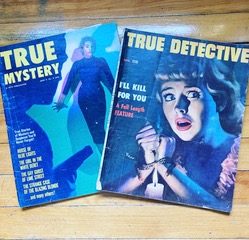
If you’re in the mood for something more sensational, search out copies of True Mystery and True Detective from the ‘50s. Maybe the guy selling them is tall and skinny and bearded from Eastport and with a tattoo of a sardine on his forearm. He’ll probably tell you he picked them up earlier that week at an estate sale and he’s not entirely sure if he’s ready to let them go because he also happens to listen to the Dark Downeast and Murder, She Told.
True Crime, he might insist, is very hot right now.
Take a minute to study the covers that have a woman in a fitted dress or almost naked or tied up or maybe, against reason, all three. Look at the advertisements on the back for Spektoscopes, which can be used for either the opera or field work, or Camel Turkish and Domestic Blend cigarettes or crossbow arrows from Sportsman’s Paradise.
Buy those from the reluctant vendor, too.
He will sell them because there are always other things men like him have their eye on.
Then, take them home or to the room you are renting or to your campsite and forget about them until it’s a Sunday and raining. Get yourself a cup of coffee or something harder if you are so inclined and it’s that time of day and you have it on hand, and sit in that chair you have by the open window. Take your magazines out of their plastic covers if they are so wrapped and spend a minute smelling them. Dusty, sour, and faintly like those old cigarettes.
It might remind you vaguely of being a kid and going through your great-grandma’s attic with your older sister who now lives in LA and is a federal prosecutor and who has always been a bit more level-headed. It might remind you of those stacks of old Life magazines in that attic on that day. Take a minute and think about the old dairy farm that was bisected by the highway system and might have been torn down. Think about your great grandma, who is long dead, and how she liked to play checkers but didn’t talk much.
When you’re firmly placed in that time of Spektoscopes and Camels and crossbow arrows, skim the titles. The Girl with the White Beret. The Strange Case of the Blazing Blonde. Hostess to Death. Lady on the Loose.
Pick one to start with and read a little more. Armed robbery is the red hot red-heads favorite sport. Or, A man may conceal illicit love but murder refuses to hide. Or, The extraordinary story of the cheerful corpse that would not stay buried.
Read the article in full. Do not be surprised when the victim is a beautiful young wife, daughter, mother, neighbor, aspiring actress, girlfriend, student, or nurse. Do not be surprised when it was the husband, boyfriend, lover, father, teacher, neighbor who did the stabbing, poisoning, suffocating, shooting, beating, or strangling.
Except in the instance of The Girl with the White Beret, in which case it was a ring of European jewel smugglers or in the one-pager about the red-headed Lady on the Loose, who was in fact the villain and confessed to twenty-five armed robberies.
Think a little about how the stories are predictable in their brutality and how at the end there is a vague sense of justice in a rather bleak world. Then finish your coffee, or whatever you decided to pour and put the magazines back in their plastic sleeves until the next time it rains.
Amita Murray is the author of two series of mystery novels: Her Arya Winters series, begun in 2021, has been optioned for TV, and her historical series featuring the Marleigh sisters just debuted this year with the novel Unladylike Lessons in Love (Avon/Harper Collins). The London-based author is a winner of the Exeter Prize and received a Leverhulme grant from University College London. Her first short story for EQMM, “A Heist in Three Acts,” appears in our current issue (September/October 2023). It stars a diverse cast of characters, whose conception Amita discusses in this post. —Janet Hutchings
My fiction, contemporary and historical, is full of what we call “diverse” characters.
In my short story, “A Heist in Three Acts,” three women, one British Indian, another British Korean and the third African American, plan to pull a heist on their boss, who is not only casually racist and a misogynist, but also has terrible judgement when it comes to designing environmentally-sound policies for his clothing empire.
Similarly, in my Regency novel, Unladylike Lessons in Love (Avon/Harper Collins, 2023), the main character, Lila Marleigh, is the daughter of an English earl from the East India Company and his Indian mistress. Lila’s best friend is gay, a hanging offence in nineteenth-century England. Her old friend, Maisie, is the daughter of a nanny from the Caribbean. We also meet Sunil, a lascar from colonised India, and various other ‘diverse’ characters. Lila’s love interest, Ivor, is white-British, and comes from a troubled and scarred family background.
A previous novel series, Arya Winters (Agora, 2021), doesn’t only have diversity based on race and sexuality, but the main character, Arya, is neurodivergent and mixed-race.
I don’t write these characters to satisfy some kind of political or moral stance. Or, I should say, I don’t only write these characters to satisfy some kind of political and moral stance. Of course, I have a political stance. Any writer who says they don’t have one is either lying or hasn’t made it a conscious act. We all have a politics. It might be big, world politics: what government you want, what your views and actions are on the climate crisis, what you think of space travel, your stance on police brutality. Or it may be everyday politics: how you treat disabled people, how you talk to servers in a restaurant, what your relationships with men and women look like. But we all have a politics.
Writing fiction can give us the chance not only to draw the world we know, a believable world based on our real world, but it also gives us a drawing board to carve out a world we imagine and want, where things are a little bit closer to our politics, where women have space to fight for justice, where people of colour don’t have to battle for every role and position of power, where our characters can create magic or reimagine society. Even when things don’t end well for our characters, the spaces and imaginations we create have some element of politics in them.
But, back to my previous point. I don’t write these characters only as a political act, only to fill a gap that has existed in fiction for a very long time and that many writers (R.F. Kuang, Sara Collins, S.A. Chakraborty, Tomi Adeyemi, Stella Oni to name only a few) are trying to fill. I write these characters because they are who I know.
I’ve lived in London, Delhi and California, and I call London, England home. I’m surrounded by people that define themselves in all sorts of ways. The best thing about London is that people don’t stare at you because you look different. You get into a carriage in the tube and no two people look and sound the same. You hear languages and accents from all around the world. When you say your job is that you paint a little, you knit doll shoes for Barbie, feed llamas in your free time, after you’ve done your three-hour trapeze class and learnt ancient Valyrian, no one even blinks. I can’t write anything but diverse and interesting characters, doing diverse and interesting things. I can’t not try to fill the blinding gaps in fiction that have existed forever, where class, race, sexuality, disability are white-washed out. I have no choice.
But if I imagine that in writing these characters, I can stay in a safe zone, I’m woefully wrong. If my characters can’t remain the same-old, neither can my stories. If I write Regency England, I must write about the lascars from India, the nannies from the Caribbean, the mixed-raced daughters of English earls and their Indian mistresses and about white characters, straight and gay, with or without disabilities. I must write about how these characters ended up in London in the first place. What are their backstories? How did the mixed-race daughter of an English earl and his Indian mistress end up living with her father’s first (and in fact, only) wife? How did her younger sister, Anya, land a gig playing the sitar in Queen Charlotte’s court? What on earth are some of these characters doing going to a rat pit in Covent Garden one fine old evening?
I write romance and mystery. As someone who grew up reading Austen and Heyer, Dickens and the Bronte sisters, Christie and Sayers, my tropes for romance and mystery remain very recognisable. That’s my literary schooling. Those are the authors I used to turn to, when in need of escape and comfort, when feeling lonely and in need of companionship. My narrative arcs haven’t necessarily changed too drastically. But the stories within these arcs absolutely have. I can’t write a mixed-race British Indian woman or an African American woman and not talk about race. And no, this isn’t because I’m compelled to forever talk about race. The truth is I’d rather do almost anything than to talk about race. I hate talking about race. But I can’t write these characters and not talk about race. Because to imagine that you can be British Asian or African American or gay or disabled or any minoritized community and not have your experiences coloured by those characteristics is to live in denial. Not all our experiences will be affected by those characteristics, absolutely. But some will be.
As a fiction writer, I have choices. I can write contemporary fiction and look at minoritized characters in as realistic a way as possible. I can write historical fiction and try my best to fill the gaps that exist in writings about my chosen era, through research and imagination. Or I can write futuristic, speculative fantasy where I create worlds that mimic our own but that allow me freedom from some of the politics and constraints of our world. Where I can fight the fight but I can fight it not exactly as people fight it in our world. All those choices are open to me. But to pretend that I can be a writer in today’s world and not have to make these choices is denying reality.
I write diverse characters not as types but as people. They are people with rounded experiences and full back stories and names. I think of people I know. I think of what I understand about people. I draw on my experiences and those of my friends. I write fiction, but maybe a fiction that has more kernels of truth in it than truth itself does.
Thomas K. Carpenter has been contributing stories featuring Magistrate Ovid, from Ancient Alexandria, to EQMM and AHMM since 2015. In our September/October issue (on sale now) Ovid’s most complex case comes to life in the novella “Death and Omens in the Great Library.” It’s my personal favorite of the Magistrate Ovid stories. Today’s post is about a real-life figure who appears in that story, the inventor Heron. Heron is the central character in the author’s seven-book Alexandrian Saga, which started appearing in 2013. In commemoration of the tenth anniversary of the series, all seven books have been reissued with entirely new covers. If you’re intrigued by Tom’s new Magistrate Ovid story, in which Heron appears in a secondary role, you’ll likely want to see him take center stage in the books. —Janet Hutchings
As a fiction writer I have the opportunity to make up just about anything I want in pursuit of story. The excess of choice can be a hindrance at times, because too many options can be paralyzing. But that’s one of the fun things about historical fiction. The known history gives a starting point and the loose confines of what kind of tale you might tell, and sometimes the truth is stranger than your imagination.
In my latest EQMM story, “Death and Omens in the Great Library,” I give readers a taste of what it might have been like in the most famous of ancient libraries as they follow Magistrate Ovid through a tale of superstition and intrigue in Alexandria. The ancient city of Alexandria is a place of rich history with countless venues for story.
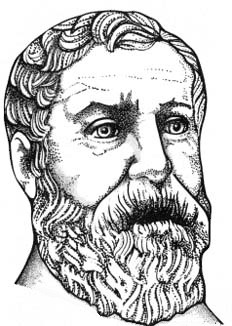
Today I want to talk about an aspect of that ancient city that is usually overlooked—the temples. Temples existed across the ancient world in every city. But the temples in Alexandria were unique because of their proximity to the Great Library, and more importantly, because of the inventor Heron, who features in my story. There were lots of inventors and scholars at this time, but Heron is one of the most prolific and forward-looking, creating inventions that wouldn’t be seen again for thousands of years. He was Leonardo da Vinci in 40 AD, inventing mind-blowing technologies like the primitive steam engine, wind operated automatons, self-contained hydrostatic fountains, or vending machines for holy water, amongst other things.
You might ask yourself why you’ve never heard of Heron of Alexandria or that a primitive steam engine was invented around the same time as the birth of Catholicism. The reason why most people have never heard of Heron or his inventions is because he was using these new technologies to create “miracles” in the temples. Competition for temple followers was fierce in the cosmopolitan city of Alexandria. Modern magicians would find these temple shows quite familiar as inventors like Heron created illusions of statues lifting, or doors opening automatically, mechanical horses being sawed in half yet maintaining their heads, or oracles providing proof to potential followers that these were the gods they should follow—and to whom, more importantly, they should offer their coin.
Not all of Heron’s inventions made their way to the temples. He created a mechanical play nearly ten minutes in length, powered by ropes, knots, and simple machines. In Automatopiotca, the inventor wrote about his design of automatic machines that were essentially programmable computers made from gears and knotted ropes. He also made a highly effective fire engine that would be a huge boon for any city that had access to it (too bad this wasn’t around a hundred years prior when Caesar inadvertently set part of the Great Library on fire!). Heron would have felt quite at ease any time after the industrial revolution, but he made all these inventions two-thousand years ago.
His output was even more remarkable when you consider that the Great Library at this time was well past its prime. While the early centuries of operation produced some of the great thinkers of history like Archimedes, Strabo, or Eratosthenes, in the later centuries the library became a place of literary critique rather than original thought. Heron wasn’t surrounded by other scholars leading the way in their disciplines as would have been the case in the early years. On the other hand, he had access to the greatest writings in the history of the world at that time and some of his ideas can be directly traced to those earlier concepts.
But it wasn’t just Heron’s ideas, but how he put them into practice. It’s one thing to sketch out ideas, but it’s another level of difficulty to turn those ideas into physical constructions, and then sell them to the temples or wealthy benefactors who wished to enjoy a glimpse of the future. I have to wonder what it would have been like at that time to witness his inventions, which had to seem otherworldly—something I tried to bring out in my story. Heron was lucky to have been born in a city that celebrated such inventive thought. In other areas of the world, or times, he might have come to an unfortunate end at the hands of superstitious folk when they saw a musical organ playing without a person at the keys, powered by the wind itself. He truly was a miracle worker.
One of Heron’s best-known tricks was a device described in his writings as “A Vessel from which Wine or Water may be made to flow separately or mixed.” It was a jug that, using ingenious internal compartments and plumbing—much as a magician would do, could alternate between pouring wine or water, depending on its use. His description of the device was: “A jar can be made . . . in such a way that, when water and wine are poured into it, it shall discharge at one time pure water, at another time unmixed wine, and again, a mixture of the two. We may pour wine for some, and wine and water for others, and mere water for those whom we wish to jest with.” I think you’ll find this description familiar and reminiscent of a contemporary of Heron’s and leave it at that.
Heron of Alexandria was so known for his inventions that he was called the Michanikos, or “Machine Man.” He was possibly the greatest engineer of Antiquity, and a great example of the scientific tradition of Hellenistic society, and this despite the fact that the majority of his writings and designs were lost. Who knows what else lurked inside this great mind?
Rob Osler made his fiction debut in the Department of First Stories of EQMM’s January/February 2021 issue with the story “Analogue,” which went on to win the Robert L. Fish Award for best short story by a new American author. His debut novel, Devil’s Chew Toy, published the following year, was a nominee for the Anthony, Macavity, Agatha, and Lefty Awards. A sequel to Devil’s Chew Toy, entitled Cirque du Slay, is due out early next year. In the meantime, don’t miss Rob’s latest short story, “Miss Direction,” in our September/October 2023 issue (on sale next week!). In this post he addresses a question that most writers probably wrestle with at one time or another, and he has some interesting insights. —Janet Hutchings
Did you know that some of the most successful gay romance writers are not gay? It’s true. Many are straight women. When I first learned of this, I was dismayed. What could a straight woman possibly know about gay men’s romantic lives? Why coopt our stories? Hearing my gripe, my partner, Brian, asked, “Have you read any of their books?” My answer: “Well, no . . . but.” The simplicity of his question continues to shape my thinking about the types of characters an author has license to write. Spoiler alert: I provide no hard-and-fast answer because I don’t believe there is one. Instead, I offer a few thoughts and considerations that I hope are useful to the debate.
As a gay man, I am comfortable writing a story with a gay main character. I’m guessing you didn’t gasp reading that. Your reaction is likely the same knowing that gifted author and Black lesbian Cheryl A. Head’s series main character, Charlene “Charlie” Mack, is also a Black lesbian. Nor is anyone likely to question why the main character in Raquel V. Reyes’ marvelous Caribbean Kitchen Series is Miriam Quiñones or that author and trans lawyer Robyn Gigl’s terrific legal thrillers feature trans lawyer Erin McCabe. The reason for our acceptance is simple: we don’t doubt these authors’ credibility, legitimacy, or interest in writing those characters. We trust them to get right their characters’ interior selves. But that is not always the case when an author decides to “step out of their lane” to write a character who is in some way essentially different from themself. That readers and the writing community might ask questions is expected. Despite an author’s best intentions, the work might be viewed with skepticism, at worst, disparaged. But wait. Isn’t this fiction? Shouldn’t an author be free to write whatever interests and inspires them? Shouldn’t a work be judged solely on its merits? Or are there limits—unwritten as they may be—that put constraints on one’s creative license?
To explore this, let’s return to my statement that as a gay man I have no reservations about writing a gay main character. I also feel the same way about writing a straight main character. Thoughts? If you’re like most people, you’re not too bothered, if at all, by this. I have lived my entire life in a culture and community centered on straight people. I don’t need to conduct ethnographic research on what it’s like to be a straight person in today’s America. I need only to go about my day with open eyes. This is, of course, how most authors conceive of and bring many of their characters to life—by making artful use of what they observe around them. Writers commonly tap into the familiar; “Write what you know” is a common refrain for a reason. But what about when an author chooses to write about characters beyond their lived experience?
To dig into this, let’s explore a hypothetical: what if the straight character I intend to put in my story is also Black? Oh, did I mention she is my single main character? Now what do you think? I’m guessing you’re not fence-sitting. Let me take a stab at articulating some likely questions. First and foremost, Why? Why is a gay white man choosing to write a straight Black woman protagonist? What makes him think he can pull off developing and presenting her as an authentic individual? Is he nuts? If those are not your questions, I’ve tipped my hand: they are mine. If I ever make such a choice, I’ll have to contend with the inescapable reality that every individual’s identity is deeply personal and can be sensitive, especially if perceived as misappropriated. When an author doesn’t share essential aspects of another’s life experience and writes about that person’s people, places, and culture anyway, that is bound to raise questions. But does that mean an author should never do it?
By way of example, I wouldn’t intentionally write a story centered on a Black main character who is a hairdresser at a women’s salon in a Southern town. Among the myriad reasons why I wouldn’t do that, knowing absolutely nothing about that experience figures high on the list. But I will not say that no other white person could or should write that story featuring that character in that setting. Aghast? I get it. I do. But hear me out. What if I told you that the white author had spent the past twenty years as a hairdresser at a women’s salon in a multi-racial community in Alabama, and half of her clientele were Black? Does that change your opinion? Is there a certain percentage of Black clients or a minimum number of years required that she work at the salon to prove herself a legitimate teller of that character’s story? Try this: what if the author had volunteered and apprenticed in an intensive two-week stint at the salon as part of research for the story? Enough or never enough?
Another take on this is offered by Trysh Travis, Associate Professor in the Center for Women’s Studies and Gender Research at the University of Florida, in a post for Blackpast.org titled, Is The Help Realistic? It Depends.* Professor Travis asserts that a novel’s intended audience is a significant factor in judging its authenticity—or, as she refers to it, reality. To paraphrase, in the case of Kathryn Stockett’s mega-seller, The Help, Travis argues that it should be expected that a fictionalized tale of race relations told from the perspective of a white female employer, written by a contemporary white female author for a mostly white female audience, didn’t fully withstand critical examination by historical scholars. Why? Because the novel (stressing fiction) was shaped by the reality the contemporary author shares with her readers, which is bound to be different from one that hews only to the historical record (stressing non-fiction). Travis concludes her thought-provoking article by saying, “Reasonable people may differ over which realism is most . . . realistic.” Chew on that!
Here’s what I wonder (and I do wonder!): When are universally shared human traits—ambitions and aspirations, vulnerabilities and insecurities, and all the rest—not enough to satisfy insight into a character different from the author? Might the right answer be not an unequivocal one but a thoughtful consideration calibrated by how deeply a character’s unshared experiences are explored on the page? For me, if a straight author were to write a story that includes a gay character (presuming no tired clichés), it’s one thing for that character to appear now and then versus a story told from his perspective that delves into his emotional struggle with coming out to evangelical parents in a conservative rural community. Although we can probably agree that even a secondary character should be drawn as true to life as possible, the author might get away without having a deep knowledge of a secondary character’s psychology and world from the inside out. In contrast, the latter storyline would seem to demand it. If an author chooses the deeper route, to quote RuPaul, “You better work!”
The scenarios above beg two questions: (1) why would a white or straight author choose to write a Black or gay main character, respectively, and (2) how do they hope to pull it off with supreme authenticity? As to the reason for choosing to do so, I think it is up to the author to explain—or not. I don’t think fiction can accommodate an edict for the types of characters an author—by virtue of their identity—should be allowed to write. It’s too nuanced and situational to establish a one-size-fits-all rule. No matter who we are, our life experience is specific to each of us. However, unless you’re writing sci-fi, isn’t authenticity always the goal? Should an author decide to go for it, they must accept that some readers might view their work with greater scrutiny and apply a higher bar for getting even minor details right. Still, other readers—whether their concerns are legitimate or not—might reject the project out of hand.
If an author is passionate about a character and story, is up for the challenge, and accepts the risks, as a reader, I will try, hard as it may sometimes be, to judge the work on its merits and not make a premature judgment based on the name, photo, and bio on the back jacket flap. I’ll try to be guided by my partner’s simple question: Have you read it?
*Thanks to my author pal, Raquel V. Reyes, for pointing me to this insightful article. You can find it here: https://www.blackpast.org/african-american-history/help-realistic-it-depends/Historical fiction brings up a materially different set of considerations—no one living today can hope to get a historical story right by reflecting upon life experience alone. This subject deserves a separate, longer discussion.
A popular novelist with two series (the Finn Teller spy novels and the Pinnacle Peak mysteries) to her credit, Twist Phelan is also a prolific contributor to EQMM. Her EQMM stories have won two ITW Awards and Canada’s Arthur Ellis Award, and they’ve received numerous additional nominations for these and other awards. In 2022, her EQMM story “The Bridge” (May/June 2022) was long-listed (amongst only a dozen stories!) for the Irish Book Awards Short Story of the Year. A new Twist Phelan story, “Soon It’ll Be Over,” is included in our September/October issue, which goes on sale August 15, and if you’ve got young readers in your family, don’t miss Twist’s first middle-grade mystery, Snowed (2022). In this post she reflects on a very timely subject—the AI revolution. —Janet Hutchings
It’s easy to understand the allure of the AI program ChatGPT among aspiring writers. The seemingly miraculous ability to craft eloquent prose with the prompt of a mere few sentences and the press of a button is akin to wielding a superpower. (Don’t believe me? Type, “Compose a sonnet in the spirit of Shakespeare for my beloved husband on our decade of wedded bliss, incorporating our shared passions for [insert interests], his stellar performance as a [insert profession], and his distinguishing [insert physical attributes]” into ChatGPT. You’ll never buy another Hallmark card again.) People are discovering a creative capacity that they may have long abandoned or never even considered. Finally, they can “write” something that appears to be a bona fide story.
Alas, generating writing via the push of a button disregards a simple but crucial truth—a compelling story encompasses more than words arranged on a page.
When people talk about the artistry of quality fiction, they delve into the choices made by the writer—decisions concerning character development and plot construction, stylistic choices and thematic explorations, the nuances of language and the architecture of the narrative. They ponder the author’s background, speculating about the influences and inspirations that have shaped her literary endeavors. They contemplate how a particular book or story fits into the author’s body of work, whether it’s an integral part of or a deviation from her artistic canon.
Each of these elements serves as a portal into the writer’s psyche. In and of themselves, they constitute the very essence of writing. A story transcends its textual embodiment; it encompasses the thoughts and emotions that occupied the writer’s mind during its creation. What distinguishes exceptional writers is not their ability to string together a dozen words into a sentence but rather how those twelve words reflect an author’s innermost being, as channeled through the story and experienced by the reader. When we immerse ourselves in a work of fiction, we partake in the author’s vision—we become conduits for the emotions they seek to evoke, we delve into the intricate and nuanced layers of themes woven into the fabric of the narrative.
Writing isn’t just an act of output; it encompasses the entire creative process. While AI technology currently democratizes the act of writing itself, it has yet to capture the essence of the creative process in its entirety. AI-generated writing provides not much beyond its superficial appearance—that is, what meets the eye on the page. Great writing is measured by its depth of observation and discernment, its ability to reflect the heart and mind of its creator. The difference between the two is akin to the distinction between buying an assembly-line-produced vase from IKEA, indistinguishable among thousands of identical counterparts, and acquiring a unique receptacle from an artisan who painstakingly carved familial icons into the artifact, employing techniques passed down by generations of skilled craftsmen. One is a generic container, while the other is an artistic masterpiece that reveals something new with every contemplation.
Throughout history, writing has withstood the advent of the printing press, the photograph, the motion picture, the photocopier, and the computer. It will survive our newfound ability to produce deceptively convincing replicas of human effort. Yes, just as there’s a market for mass-produced hotel art, there will be (if there isn’t already) a market for books presented “in the style of” featuring shallow renditions of plots and characters previously encountered countless times. (For the record, my husband liked his sonnet!) But there will also always be a market for writing suffused with the human essence—works that arise from perseverance, deliberation, and imagination, experiences interpreted through the lens of a human rather than a machine. Writing that not only reflects the final product but also embodies the intricate process behind it.
Perhaps someday AI technology will replicate the ineffable magic that is central to exceptional writing, the indelible human element that is the basis for all great literary works. For now, though, I’d worry only about the market for Hallmark cards.











 SOMETHING IS GOING TO HAPPEN