Jiro Kimura is involved in almost everything related to mysteries as an English-into-Japanese translator, fiction writer, columnist/essayist, book reviewer, current managing editor of The Maltese Falcon Flyer (the official newsletter of The Maltese Falcon Society, Japan), and the webmaster of one of the most important mystery-fiction sites on the Internet. He has translated Edward D. Hoch, Donald E. Westlake, and Joe Gores among others. He presently lives in Japan. The address for his marvelous website, The Gumshoe Site, is: <http://www.nsknet.or.jp/~jkimura/>. The Edgar Allan Poe Awards were given in New York on Wednesday evening and you will be able to find full results soon on Jiro’s site. It’s a resource for all who are interested in mysteries. —Janet Hutchings
I have been dubbed “one of the longest-running mystery bloggers, who started his blog before the word ‘blog’ was coined.” Yes, I am talking about The Gumshoe Site. I, as its webmaster, call it the best mystery website on my short block. I will tell you the shortest version of how easy it is to launch a mystery website but how hard it is to keep it up to date.
In the 1980s, I was an editorial advisor for EQ, the Japanese edition (1978-1999) of Ellery Queen’s Mystery Magazine, while writing a monthly mystery column and translating mystery short stories for Hayakawa’s Mystery Magazine, EQ’s rival magazine. I was contentedly using an old-fashioned word processor for writing these columns and translating mystery fiction, without any interest in computer technology.
In the 1990s, there was some kind of a new fad called the Internet. At my wife’s urging, I decided to sign up a local Internet provider and join a local Internet club as a newbie to learn this mysterious monster baby. As a result, I got very curious about a few mystery-oriented websites on the Net, such as The Mysterious HomePage (now defunct) and ClueLass HomePage (now closed). I was fascinated with their work and bought a book about how to open a website. Those days, you connected your computers to slow-speed phone lines, and if you had surfed from website to website for a long time everyday, your monthly phone bills would be surprisingly high.
Anyway, in January 1996, I finally opened my own ad-free website named The Gumshoe Site, which consisted of a few webpages about its webmaster (that’s me), mystery news, award nominees and winners, mystery links, obituaries and other subjects I got interested in. These days, you can easily create webpages with some applications but in those days you had to write up webpages in “html” language manually. But even a computer-illiterate like me could launch a website. I decided to write my site’s webpages mostly in English, since the Internet is international and I thought my English-written webpages would attract visitors from all over the world. I also subscribed to several mailing lists such as DorothyL (specializing in the whole mystery genre, and still running) and sent them a post of the launching of The Gumshoe Site.
At first, I tried to update my site every month. And in November of the same year, I wrote a book titled The Mystery of the Internet English (not about the mystery of Internet English, as the title suggests, but about how to browse and use English-language mystery websites and sometimes shop at them. This publisher’s title was meant to grab attention from would-be Japanese readers). I also started a regular column about mystery websites for Hayakawa’s Mystery Magazine. I attended several mystery gatherings in the United States, took many photos of writers and uploaded them (photos, not writers) onto my site. I received a number of e-mails from mystery writers I had not met. By then the webmastering had become kind of a fun hobby.
As my professional life changed, my schedule changed. Every time my residential address changes, my priorities change. In the 2010s, I updated my site less frequently—maybe bimonthly. Now I am about to start updating the site quarterly. Since I have been managing the site for more than a quarter century, I can find justifiable excuses to be “lazy.”
As many people say, to launch a website is fairly easy, but to keep updating it is pretty hard. Almost everybody’s life has ups and downs, and so does any website’s life. In the future, I might make over The Gumshoe Site or take a hiatus or fold it for good. I myself don’t know what my future will bring. Nobody knows.
Andrew McAleer is the author of 101 Habits of Highly Successful Novelists and co-editor (with Gay Toltl Kinman) of the mystery anthology Edgar & Shamus Go Golden. He tells us that he recently completed two books featuring his father John McAleer’s Golden Age detective Henry von Stray. See A Casebook of Crime (Volumes 1 and 2),forthcoming from Level Best Books. He is also at work with Gay Toltl Kinman on two mystery anthologies: Shamus & Anthony Commit Capers (Level Best Books) and Agatha & Derringer Get Cozy (Down & Out Books). Previously Andrew has contributed posts to this site about Edward D. Hoch (May 2023), Rex Stout (July 2023), James M. Cain (September 2023), and tips from a variety of famous mystery writers (January 2024). Here he shares his interview and some of his correspondence with Mystery Writers of America Grand Master and Columbo cocreator William Link. William Link and his longtime coauthor Richard Levinson made their fiction debut in EQMM when they were still teenagers, so we’re sure EQMM readers will be interested in William Link’s reflections on a stellar writing career.—Janet Hutchings
Original copy of William Link’s Interview with McAleer
The Ellery Queen Award-winning writing duo of William “Bill” Link and Richard “Dick” Levinson remains perhaps the most successful television and crime- writing team of all time. As crime fiction scholar William L. DeAndrea noted in his Edgar-winning Encyclopedia Mysteriosa, “Levinson and Link parlayed mutual passions for mysteries, magic, and writing into the most honored and productive collaboration in TV history.”
A few of the Levinson-Link blockbuster television creations include: Murder, She Wrote, Columbo, and Ellery Queen. Okay I better mention their eight-season running private eye series, Mannix and their script writing for Alfred Hitchcock Presents, Honey West, and The Fugitive. Major literary awards include multiple Edgars, Emmys, Golden Globes, and Peabody awards.
After Levinson’s death in 1987, Link showed no signs of slowing down. He continued to produce, write, attend Malice Domestic and International Thriller Writers events, produce plays, serve as president of the Mystery Writers of America (MWA), and still found time to grow tomatoes with his wife Margery. In 2010, he received Malice Domestic’s Agatha Christie Poirot Award and, in 2018, he was honored by the MWA with its prestigious Grand Master title along with fellow mystery writing greats Jane Langton and Peter Lovesey.
In 2007, I wrote Link and asked if he would consent to an interview; he graciously agreed. The interview was released in the Fall 2007, Volume 9, No. 2 issue of Crimestalker Casebook and appeared under the title “Ten Questions for William Link.” Here, the future Grand Master of Mystery discussed, among other things, his early days with friend Dick Levinson, a luncheon with the master of suspense Alfred Hitchcock, and novel writing versus screenwriting.
Only a handful of issues containing the William Link interview were printed and fewer distributed. His responses are too good and important to hide from history. Now, thanks to EQMM’s “Something is Going to Happen,” its readers get a rare glimpse into the brilliant mind and career of one of crime fiction’s most ingenious and kindest creators.
* * *
McAleer: You were friends with fellow writing companion and Columbo co-creator Dick Levinson since junior high school. Do you recall your first writing idea with Dick?
Link: Dick and I met in 1946 and started collaborating almost immediately. Much sand has gone through the hourglass since then, but I believe our first writing project was a parody of the then quite popular radio show, “Dragnet.”
McAleer: I read in a biography of Columbo star Peter Falk in the 1963 Celebrity Register, where Falk says that he failed out of Hamilton College because he did most of his studying in the poolroom. I noted in some of the Columbo films how Falk shoots a nice game of pool. Was this Falk taking some license here or did you and Dick give Columbo this talent?
Link: Peter is an excellent pool player. He and John Cassavetes had their own Rat Pack, playing pool around town at night. We never had to fake Peter’s playing on the show. He’s also an excellent charcoal artist. (Author’s Notes: Falk’s right eye was surgically removed when he was three. Cassavetes guest starred in the Columbo episode “Étude in Black,” 1972.)
McAleer: What do you imagine Dick might think of modern mystery novels that seem to contain more romance than mystery?
Link: I don’t think Dick would have condemned mixing romance with mystery if it was done with style, good writing, and cleverness. Romance overwhelming the mystery element is another matter.
McAleer: Dick and yourself also worked on the Ellery Queen TV series staring Jim Hutton as Ellery Queen, and one of the more interesting contributors to the show was a great actor named David Wayne (who, among many other roles, played the Mad Hatter villain on Batman). Did you ever get a chance to meet Wayne?
Link: Dick and I produced the Ellery Queen series, so we knew David Wayne in our working relationship. He was lovely, charming guy, a total pro.
McAleer: When you and Dick brought Mannix to the scene did you have Mike Connors in mind for the role of Joe Mannix?
Link: We sold the Mannix concept to Desilu, wrote the pilot, and didn’t hang around. Paramount TV cast Mike Connors. Never met him on the show, but bumped into him years later at Chasens. (Then an excellent L.A. restaurant). We were mutually complimentary. (Author’s Note: In a 2013 email from Bill he told me Mannix was his and Dick’s first big hit and occupies a special place in his heart.)
McAleer: Your new play “Columbo Takes a Rap” stars Chicago-based actor Norm Boucher and the New York Post tells us that it is already playing to sold-out houses. Can we expect to see Columbo on Broadway or perhaps even abroad?
Link: My new Columbo play was a hit at the International Mystery Festival in June. At the present time the producer is thinking of opening it in London or possibly here in L.A.
McAleer: Do you create differently when writing a novel as opposed to a screenplay?
Link: Writing a novel is a totally different experience than writing a screenplay. In movies, we have directors, music composers, editors, etc. to flesh out our vision. The really difficult thing in writing screenplays is that everything has to be externalized, unlike novels where you can get inside people’s heads, especially in your protagonist’s if you are writing a first-person narrative. Usually novelists are lousy screenwriters because it requires a different set of muscles. You cannot stretch out in a screenplay; everything needs a careful and creative concision.
McAleer: You once had lunch with Alfred Hitchcock. Can you scoop us on any details here like who picked up the tab?
Link: We once had a three-hour lunch with the Master of Suspense in his bungalow at Universal. He was then approaching eighty and so obese it was hard for him to get up from the sofa. Writing-wise, he said that when you use coincidence it must occur early in the script and never again. Always go for the big, important scenes even if they defy logic. That was the basis for his “Refrigerator” theory. While the movie-goer is making a sandwich at midnight after having seen his new thriller, he realizes the big wheat field scene with Cary Grant in “North by Northwest” makes absolutely no sense. Doesn’t matter, Hitch told us—by then I have the man’s money! The lunch was ordered by Hitchcock, the same for him and us: salad, steak, ice cream, black coffee. If you were a smoker you had one of his favorite cigars, a Cuban H. Upmann. Whether you smoked or not, you couldn’t refuse Mr. Hitchcock. Of course, no check.

McAleer: What is your assessment of Georges Simenon’s Maigret stories?
Link: Simenon is one of my favorite authors and I have read over two hundred of his books in translation. I enjoy the Maigrets, but much prefer his stand-alone, psychological novels. Simenon described the Maigrets as pencil drawings and the other as oil paintings. Very accurate analogy. Gide and Sartre considered Simenon France’s greatest existentialist. I concur. For new readers I recommend “Dirty Snow,” which is out in a new translation in paperback. In my opinion this is maybe his best novel. He wrote over five hundred books in a half-century of intense writing. A typical Maigret was written in a three-day stint!
McAleer: What do you have cooking on the literary burner now?
Link: I just sold three short stories to the Hitchcock and Ellery Queen Mystery Magazines and have finished my fourteenth stage play, “Candidate for Murder.” The later is a very subversive whodunit set in Washington. It doesn’t play politics, but hopefully dances on the nerves and the deductive acumen of its audiences.
Post Script
Bill ended the interview this way, “Andy—I hope this suffices. I could go on and on, especially about Hitchcock and how we found the novel for his last movie, “Family Plot,” but that’s another story.” (Author’s Note: Why I never took out a page from Columbo’s book with “Just one more question” on what promised to be an amazing behind-the-scenes look into Hitchcock’s last film remains a mystery.)
* * *
William Link passed away on December 27, 2020 at the age of 87. When learning of Bill’s death his friend Steven Spielberg, who directed the first Columbo episode “Murder by the Book,” paid tribute to “Bill’s good nature” and for Dick and Bill giving him a “huge break” as a “young and inexperienced director.” (Variety)
Bill’s kindness didn’t end with season one of Columbo; it was a constant in my book. When I told him I was coediting my first crime-fiction anthology Coast to Coast: Murder from Sea to Shining Sea with my own literary partner Paul D. Marks, Bill readily agreed to contribute a short story, “Murder Medium Rare”—one of his favorite EQMM contributions, he told me. And when I asked him to contribute writing tips to my book the 101 Habits of Highly Successful Novelists, he agreed without hesitation. I even received a nice note from Bill (who also served in the Army) while I was deployed in Afghanistan wishing me safe passage. I received another welcoming note after my return.
On Sunday nights while Columbo aired across the nation Bill and I would occasionally exchange emails about this week’s exciting Hollywood-legend guest star such as: Jack Cassidy, James Gregory, Richard Anderson, or Dick van Dyke. I’d always receive a fun response from him or even a, “We are watching it now!” (With wife Margery.)
Looking back, the notion that I could email back and forth with a cocreator of Columbo while episodes of the iconic detective aired prime-time seems surreal. Considering Bill’s thoroughly good nature, however, it really shouldn’t. If he were here today, I’d like to tell him just one more thing, “We’re all still watching prime-time, Bill. . . .”
Pat Gaudet was born and raised in south Louisiana, and she’s worked a number of different jobs, including owning a shrimp boat. She makes her debut as a fiction writer in the Department of First Stories of our current issue, May/June 2024, with the story “The Legend of Penny and the Luck of the Draw Casino.” Her choice to write in the mystery genre comes from a long-standing love of mysteries that she tells us came partly from reading the novels of Ellery Queen. In this post she examines one source of the allure of mysteries.—Janet Hutchings
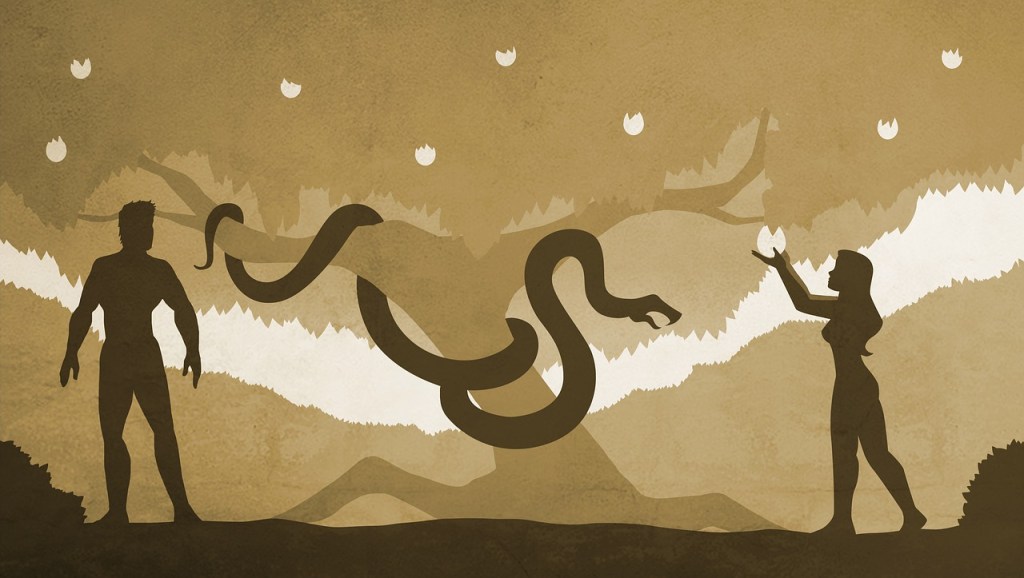
Murder mystery narratives have been with us from the time of Creation. (Even if you’re a Big Banger, stick with me here. The narrative is the point, not the theology.) Take Adam and Eve, for instance. Such a sweet couple. Not a lick of fashion sense, but hey, you don’t know what you don’t know, right? Turns out that’s not always a bad thing. Still, they were healthy, happy newlyweds. No alcohol or drug abuse problems. Totally faithful to each other. No criminal records, anger issues, or financial concerns. Just two ordinary people living their best life in Paradise (literally): no air pollution, ozone depletion, carbon footprints, nuclear waste (you get the picture), all thanks to their benevolent creator and benefactor, Yahweh. Nothing to make you think they’d ever betray Yahweh, turn on one another, or compromise their perfect existence and doom their progeny to certain death. Why would they?
And then the serpent, aka Satan, slithers on to the scene with an arsenal of lies and all hell breaks loose. Satan hates Yahweh and envies the young couple. Especially their legal right to rule Paradise. That right can never be his as long as they’re alive. So he convinces them Yahweh’s warning (that certain death will follow if they eat the fruit of a particular tree) is bogus. Just a ploy to keep them from reaching their full potential. They step out of their safe zone, eat the fruit, and death follows.
All the elements of a killer murder mystery are present in the story. We have the innocent victims in the wrong place at the wrong time. The cold-blooded murderer disguised as a mild mannered life coach who gains their trust. Then comes the con. The entrapment. The murder. And voila, Adam and Eve, first victims of the ultimate bioweapon serial killer, Satan. A psychological thriller. Real page-turner. Classic noir. Personally I find the sequel more satisfying: Yahweh’s son, J.C., uses his own blood to provide the antidote for death, brings Satan to justice, and makes sure the jerk gets to spend eternity doing hard time in a maximum security prison.
So what is it about a good mystery that gets our attention, hooks us, keeps us moving from paragraph to paragraph, page to page, clue to clue, until we reach that aha moment? Is it a complex plot? A haunting sense of place? The ability to peep like shameless voyeurs into the internal mechanisms of the mind? Is it the skill of the writer to turn a phrase? To throw out a red herring, or two, or twenty (too many for me)?
All of the above, please. But in the end, it’s the why element I’m holding out for. When the story ends, I’m never satisfied just knowing who committed the crime, or even how. I have an insatiable curiosity about human behavior. Something in me longs to understand why people do what they do. Without the why, the read is like sitting down to a big bowl of homemade chicken and sausage gumbo (side of creamy potato salad, please), only to discover the hearty chunks of spicy smoked sausage didn’t make it to the party. I hate it when that happens.
For me, the why is as much a part of a murder mystery as the who and how. It’s my need to discover the protagonist’s why that pulls me all the way into a story and compels me to stay with it to the end. It’s what challenges me to look into the depth of my soul. To re-evaluate my perception of right and wrong. Good and evil. How far would I go to right a wrong? Catch a killer? Would I be willing to bring the sympathetic criminal and the psychopathic killer to justice with the same relentless zeal?
I guess my obsession with the why began when I was first introduced to classic mysteries.
Back in the eighties, while living in England, I spent many a cold night reading about fluffy Miss Marple from St. Mary Mead who wore tweed skirts, knitted pretty pink sweaters, and ushered villains—who dared to underestimate her exceptional intelligence and observational skills—to swift justice. I was already taking such delight in immersing myself in the rural English culture, when I encountered Miss Marple on the page. Just an innocent looking old spinster, skeins of wool resting in her lap, mind working out the mystery to the click of knitting needles. But her instincts and the logic she used to figure out who done it—and most importantly, why—mesmerized me. Her superpower was her ability to connect past incidents, and the predictable pattern of people’s behavior she’d observed over the years, to solve the present crime.
Of course, Miss Marple was easily dismissed by the “real detectives” as just another old busybody (ageism, before the term was coined). Right up until her dithery, circuitous way of arriving at the truth exposed a scalpel-sharp mind, well versed in the goodness and depravity of human nature. How matter-of-factly Miss Marple laid bare the who and why of the villain as if even a child should have seen it coming. Oh how I wanted to be like her when I grew old. Knitting needles and all.
I read Christie’s Hercule Poirot novels too. Poirot was staid, the opposite of Miss Marple. He used “the little grey cells” to get to the bottom of things. But there was something about his methodology that appealed to me too. No doubt part of the appeal was his implied backstory: a damaged, displaced person from another country coping by obsessive neatness and control of his personal environment. A man who depended on a cerebral existence to fill his waking hours. I could certainly see the why in his actions. And before everything was said and done, Poirot never failed to expose the killer’s why too. Perhaps I felt that by knowing why a person committed a crime I too could somehow see those predispositions in others. Confront evil in my own way before it was too late.
A few years later I was back in the States, living in Florida and working at Cypress Gardens theme park (which closed down in 2009) when the resident glass blower turned me on to Black Cherry Blues by James Lee Burke. I’d never read anything like it. There was mystery, suspense, action, and a Cajun detective named Dave Robicheaux, another displaced person driven by a tragic past and a need to right the wrongs of this world. At first I was afraid to get too immersed in Robicheaux’s head because of his dark introspection and the struggle with alcohol addiction that plagued him.
But in the end, I couldn’t resist the deep dive because of his innate goodness, his reverence for God (despite all the blue talk), and the raw sense of justice Mr. Robicheaux wore like a mantle handed down to him by Elija himself. On top of that, there was Robicheaux’s sidekick, Clete Pursel, who’s porkpie hat and little-boy innocence captures your heart then breaks it when he goes all rogue and savagely tears into his enemies in an attempt to right a wrong, purge his own ghosts, or fulfill a perceived obligation to protect his podna, Dave.
Burke captured the sense of place and culture with undeniable accuracy—its beauty and brutality. This too became part of Robicheaux’s why. Like Miss Marple, his understanding of the people and culture he grew up with gave him an edge in uncovering the truth and bringing justice to the privileged and marginalized alike. Burke masterfully creates Robicheaux’s world and takes the reader not just into the setting, but into the character’s mind with such eloquent prose. Is it a mystery or mainstream literary fiction? For me, it’s the perfect blend of both. After reading Black Cherry Blues, I realized you don’t have to choose between writing one genre or the other. You can write both. At the same time!
Once I abandoned the genre lines, I began to write the stories so inherent in me, with reckless abandon. And my own writing style and voice emerged stronger. Surer. I began to see why I feel compelled to write the stories that come to me in the night and will not let me go until they’re brought to life on the page. And why secrets and mystery elements must be allowed free rein if I am to tell those stories with authenticity.
Without the why, then the who, what, where, when and how are like dissonant chords begging for a resolution. You can be sure that if one of my story endings leaves the reader hanging, it won’t be the why that’s left unresolved.
So why did Adam and Eve fall for the serpent’s con? Miss Marple would probably say, “Oh my. Well . . . greed and ambition, I should think. So tempting for young people, you see. So why wouldn’t they?”
Larry Sweazy, whose work was last featured in our pages more than a decade ago, returns to EQMM in our current issue (May/June 2024) with the memorable and moving story “The Low Waters,” in the Black Mask Department. The author is one of several EQMM contributors who are best known in the field of Western fiction. Larry won the Western Writers of America’s Spur award for Best Short Fiction in 2005 and for Best Paperback Original Novel in 2013. But he is also a mystery writer who has earned recognition with inclusion in year’s best anthologies and with a nomination for a Derringer Award in 2007. In this post, he considers the overlap of Western and crime fiction—something to be found in most of his fiction, including “The Low Waters,” which includes a setting much associated with Western fiction, the rodeo. —Janet Hutchings
Deep into research about an ex-Civil War spy, I walked to my mailbox and found a brown envelope that contained Donald Hamilton’s first Matt Helm novel, Death of a Citizen. I had told Loren D. Estleman that I had not read any of the Matt Helm novels, that I had only seen the cheesy and fun Bond-knockoff Dean Martin movies of the 1960s. Loren assured me that the books were different, much better than the Matt Helm movies, and sent me a copy. Of course, Loren, a writing legend in the Western and mystery field, was right.
Published in 1960, Death of a Citizen chronicles the rebirth of a World War Two assassin, reactivated by the government after a former colleague goes rogue. The writing is tight and shows off Hamilton’s years of experience as a serious craftsman. At the center of the book, I found the Cowboy Code fully embodied in Matt Helm’s actions. That shouldn’t have been much of a surprise since Donald Hamilton had previously published paperback Westerns alongside his better-known spy novels and novels of suspense; his first novel, Date with Darkness, was published in 1947. I quickly read all the Matt Helm books. Move the Helm books back in time seventy-five years, put Matt on a four-legged mustang instead of behind the wheel of an automobile and all the Matt Helm novels would work as a Western. That could be said for a lot of mysteries and crime novels.
The Cowboy Code is a relatively simple set of ethics. There are several versions written by singing cowboy star Gene Autry, the National Day of the Cowboy, the state of Wyoming and more. The Code goes like this: “The cowboy must never shoot first, hit a smaller man, or take unfair advantage; He must never go back on his word, or a trust confided in him; He must always tell the truth; He must be kind to children, the elderly, and animals…” and continues with more commandments that demand decency and a Do Unto Others mindset. In other words, the Good Guy should be good until someone pulls out a gun. Then all bets are off.
Erle Stanley Gardner, author of the Perry Mason novels, said, “The modern detective story and the modern Western have a great deal in common. In essence both kinds of stories are American products, like corn on the cob and blueberry pie.” Sometimes that commonality is overlooked or looked down upon. Genre fiction is an easy target. Both genres are generally considered the literary equivalent of jazz, but I’ll leave that debate for the academics.
It’s not that difficult to witness the intersection of Westerns, mysteries, and the inclusion of the modern version of the Cowboy Code in both genres. Justified, the television show based on Elmore Leonard’s short story, “Fire in the Hole,” featuring U.S. Deputy Marshal Raylan Givens. Givens, played masterfully by Timothy Olyphant, with a perfect white Stetson, a Gary Cooper limp, and humble aw-shucks charm, is an obvious example of the modern mystery-Western hybrid. Raylan is a walking, talking reflection of the Cowboy Code (even though he breaks some of the rules). Which shouldn’t come as a surprise since Leonard started out writing Western short stories, then moved to writing Western novels. With his crime novels, Leonard catapulted his characters forward in time and brought the best parts of their Western backbone and character with him. If you’ve never read Valdez is Coming or Last Stand at SaberRiver, I would encourage you to search them out. Leonard was a master of dialogue early on, but he was also a master of character. Desperation brings out the best and worst of people no matter the time-period, setting, or genre. Human emotion is boundless, only constrained at times, by value and morals like the Cowboy Code which can be found, I would argue, in all of Elmore Leonard’s books and short stories (See also “3:10 to Yuma”).
Texas writer Bill Crider (author of the excellent Sheriff Dan Rhodes novels) once theorized that the intersection of Western and mystery novels could be found in perfect form at the beginning of modern storytelling. In a JanuaryMagazine article, Crider said, “I could go into a long digression here, expounding one of my pet theories, which is that both the Western and the mystery — at least in the form of the private eye novel — can be traced back a long way together, back to Homer’s Iliad and Odyssey. Then I’d track them forward through Beowulf to Malory’s account of Arthur’s Round Table and on to James Fenimore Cooper’s Leatherstocking Tales. It’s my contention that the so-called ‘Code of the West’ originated with Natty Bumppo, and that from there it developed the unwritten rules followed by The Virginian and by private eyes from Philip Marlowe to Spenser.”
I would extend Bill Crider’s list to Jack Reacher and, of course, to Raylan Givens in print and on the television screen, and add that most, if not all, private eye protagonists, male and female, are Cowboy Code card-carrying members of that original club.
How could the Western and the mystery not continually keep bumping into each other? There is usually a law enforcement entity of some kind involved in both genres: U.S. Deputy Marshal, Texas Ranger, local sheriff, Pinkerton agent, detective, etc. More variations than I can list here. Deputy U.S. Marshal Rooster Cogburn was hired by a fourteen-year-old girl to go after the outlaw who killed her father in True Grit. In the movie Wild Horses, a detective opens a fifteen-year-old missing persons case, and in Craig Johnson’s Walt Longmire books, the local sheriff of Wyoming’s Absaroka County, is one of the best-known crime solvers of the Twenty-First century. Add to the list the stranger that comes to town to clean things up and a direct line can be drawn from Lassiter in The Rider’s of the Purple Sage to the Continental Op in Red Harvest to Jack Schaefer’s Shane to Donald Hamilton’s Matt Helm, and on to Lee Child’s Jack Reacher. Along with the law enforcement aspect, the Cowboy Code exists in each of the characters I’ve noted here. The Code continues to show itself no matter how far away we get from the “Golden Age” of Westerns.
My own introduction to the Western genre came as a kid growing up the 1960s. I have black and white memories of that time since we didn’t have a color television until I was eleven years old. The clarion call of The Lone Ranger or Bonanza meant we’d better be ready to sit down and watch TV or we’d miss the show until the next rerun—which could be months or years. With only three channels there was little choice and Westerns dominated the TV screen. There was no mistaking the Cowboy Code in the Audie Murphy movies that aired on Saturday afternoons (after cartoons), or in Gunsmoke, The Wild, Wild West, or Have Gun, Will Travel or Mannix. It was important to me growing up in a fatherless household to see how men behaved. Tough. Sensitive. Honest. Trustworthy. The good guys were good, and the bad guys were bad—most of the time. I didn’t know anything about the Cowboy Code until I was much older, but I can see now how I was influenced by it and the Westerns that I watched as a kid. When it came time for me to write my own stories, it was probably a given that Westerns would somehow be a foundation for my own novels and short stories, regardless of the era or the genre they were assigned to.
Reading Death of a Citizen by Donald Hamilton was a great gift. One that I would always be grateful to Loren D. Estleman for. That book demonstrated to me how a modern-day character in a spy novel could carry the Cowboy Code and Western DNA into the present and still be true to the mystery/crime/spy genre it was intended for.
The Cowboy Code endures at the intersection of Western and mysteries because both genres touch the same chord of life: restoring order; good prevailing over evil; justice is served; right always wins over wrong. The difference in genre might only be a horse and a car, a different period in time, but the good guys all have the same heart. It is my hope that the Cowboy Code will be standing at the intersection of mysteries and Westerns for a long time to come.
****
For further reading, please check out books written by these authors: Alistair MacLean; Bill Crider; Bill Pronzini; C.J. Box; Craig Johnson; Dashiell Hammett; Davis Dresser (Brett Halliday); Donald Hamilton; Ed Gorman; Elizabeth Crook; Elmore Leonard; Frank Gruber; Harry Whittington; Jack Schaefer; J.A. Jance; James Lee Burke; James M. Reasoner; Joe Gores; John D. MacDonald; Keith McCafferty; L.J. Washburn; Loren D. Estleman; Marcia Muller; Melissa Lenhardt; Max Allan Collins; Richard Jessup; Robert B. Parker; Robert J. Randisi; William L. DeAndrea.
H. Hodgkins has taught English Literature at the University of North Carolina at Greensboro for many years and is the author of Style and the Single Girl: How Modern Women Re-Dressed the Novel, 1922-1977. Her professional fiction debut, the story “When Baptists Go Bad,” appears in the Department of First Stories of our May/June 2024 issue, on sale April 9th. In this post, she suggests some interesting challenges for mystery writers, derived from her knowledge of literature. —Janet Hutchings
I doubt most mystery writers have difficulty thinking up ideas. A picture, a news story, or a brilliant phrase will do it: my newbie story in Ellery Queen was prompted when my husband and I passed a little church with one of those trying-to-be-funny-and-also-deep signs. He chuckled, remarking, “When Baptists go bad!” And there I had it, title + plot + twist all in one.
But a grabby theme doesn’t ensure a full plot. I’m always seeking not-too-shopworn narrative models adaptable to nefarious settings. Fortunately, after thirty years of teaching college English, certain classic texts are burnt into my brain. Heck, if it worked for Tolstoy or for Joyce, why not for you or me?
Donning my literature professor cap, I proffer some literary works whose structures I’d love to use, or see cleverly used by someone, in short mysteries. Spoilers included.
First, a disclaimer.
You hear it said, “All literature is mystery.” But fictions entice in various ways. We study Shakespeare for his virtuosic poetry, read Dickens for humor, sentiment, and satisfyingly predictable outcomes. For those who insist on Dickens as a mystery author: Honestly, don’t you know who shot Mr Tulkinghorn in Bleak House? Or, for that matter, what happened to Edwin Drood? For genuine Victorian mystery, see Wilkie Collins, whose Moonstone and Woman in White still stymie and entice readers.
Also, we read a few brilliant writers, such as P. G. Wodehouse, for their wit. We little care, or long remember, who got Bertie’s girl or tumbled from the country-house window. But Wodehouse’s immortal lines light up our lives: “Many men in Packy’s position would have shrunk from diving in to the rescue, fully clad. Packy was one of them” (Hot Water, 1932).
Certainly one can do this in mystery writing: see Mick Herron, whose Slough House thrillers I’d read for their sentence-by-sentence wit alone. His latest, The Secret Hours, opens with “The worst smell in the world is dead badger,” limns a bucolic walk and possibilities for disposing of a dead animal, to conclude the paragraph thus: “Which is why he wasn’t sure the badger would be there a couple of nights later, when he was running for his life.”
Herron like Wodehouse practices a quite British structural deprecation, in which a phrase, or a paragraph’s final sentence, undercuts all that’s gone before.
And speaking of structure, consider the following exemplars, most available through our friend Google.
Naive narrator: In Henry James’s novel What Maisie Knew, a poor little rich girl is kicked back and forth between narcissistic divorced parents. Maisie observes and learns—but always from a place of innocence. When (in James’s crazy fictional tidiness) her parents’ exes get together, and Maisie must choose which “parent” to live with, she picks her impoverished but devoted governess—a choice that condemns an entire decadent culture.
The fascinating possibilities for mystery lie in the ways Maisie is morally educated, by faulty people, in a way that nonetheless directs her to the best solution. Has this been done, in our postmodern cynical world? Some mystery novels (Alan Bradley’s Flavia de Luce series; Joanna Cannon’s Trouble with Goats and Sheep, 2016) employ charming young sleuths. We’ve also seen experiments with neurodivergent and/or genius children: Mark Haddon’s 2003 The Curious Incident of the Dog in the Night-Time and Muriel Barbery’s 2006 TheElegance of the Hedgehog, successful one-offs that seem perilous to imitate.
How about a short story in which the amateur sleuth is a bright but ordinary, decently observant child? “What _____ Knew”—or “Didn’t Know”; or “How ___ Solved the Mystery.”
Beginning with the ending: In Leo Tolstoy’s “Death of Ivan Ilyich” (1886), the title character—guess what—dies. In fact the story starts with his funeral, then scrolls back to examine Ivan Ilych’s life. We trace his climb up the career ladder, then follow, in excruciating detail, his terminal illness. (Supposedly this story inspired Elisabeth Kűbler-Ross to undertake her famous study on the stages of grief.) Yet Tolstoy’s 40+ miserable pages conclude in a totally unexpected affirmation as Ivan Ilych breathes his last. Only an unrelieved grimness could keep this transcendant deathbed from sentimentality, and take our breaths, too.
Likewise, in Eudora Welty’s “Death of a Traveling Salesman” (1941), the salesman Bowman will die. Ill, with his car broken down in the Mississippi countryside, he’s forced to seek help from poor people in a run-down cabin. In his last moments Bowman realizes the shoddiness of his materialism—and that these simple folk possess a contentment which he should have aimed at.
Both stories purchase an affirmative epiphany through near-unrelieved grimness—until the final twist. Elementary in process, but a Class A challenge for a noir narrative: conclude with a shocking, happy ending. Try “Murder of _____,” or “Death Comes for _____” (à la Willa Cather’s “Death Comes for the Archbishop”).
The title IS the solution: For a special refinement of the above, see Elizabeth Bowen’s 1941 “Love” (available in her Collected Stories.) A discontented, not-too-bright shopgirl takes a holiday at the seaside. Bored and tired, she and her friend come across an old resort hotel with a crooked sign reading “Teas.” An odd-looking lady on the terrace tries to wave them away, but they approach and knock at the ramshackle building until a young man opens. He serves them tea, making them promise to tell no one that they’ve seen “Miss Meena,” whose family would commit her to an asylum. Miss Meena’s self-styled protector explains that, now financially and mentally ruined, twenty years ago she was the belle of the resort, while he was the small, adoring son of the manager. As the girls depart, they avoid discussing the subject, because “what can you think when a thing doesn’t make sense?”
The sense is, of course, in the title—a word which never appears in the story itself.
It’s a stunt—but a good one. Why not construct a mystery story where the answer stares the reader in the face all the while? Distractions, red herrings, and a limited point of view (whether first or third person) would be essential to keep the reader from noticing that the solution is right there in the title.
The doomscroll: I’m repurposing the neologism “doomscroll,” which is far too good a word to waste on media addictions. Flannery O’Connor’s “A Good Man Is Hard to Find” (1953) obviously is a crime story: a Southern family on a road trip ends up stuck in the woods when their car breaks down. Unfortunately the psychopathic Misfit and his cronies are stuck in the same woods. They dispatch mother, father, two bratty children and finally the grandmother. But how does this unfortunate convergence occur?
O’Connor puts responsibility full on the grandmother, whose small dishonesties—she sneaks the cat into the car; she lies about an old plantation house she wants to visit—culminate in the death of her entire family. We watch with fascination as small sins, little mistakes, and general familial grumpiness suggest the vacation from hell. But these comedic bits obscure our view: the vacation unrolls into tragedy—complicated by the Misfit’s jaded philosophical pronouncements, and (because it’s O’Connor) the grandmother’s awakened sympathy for her killer at the very moment she dies.
Why not a mystery doomscroll? Comedy starts in a low, unhappy state, then raises its characters to happiness; the tragic hero begins on top of the world but ends crushed, for his or her sins, under the wheel of fortune. You don’t have to be O’Connor to mix the two, setting your reader off-balance through funny small everydayness (see Mick Herron). Not that doom doesn’t loom from the start, with an opening reference to the Misfit “aloose from the Federal Pen.” Still, O’Connor’s tone and structure suggest he’s only regional color—rather than that gun in the first act.
A comedic mystery doomscroll would—opposite to Tolstoy and Welty—obscure a coming terror through humor, and petty characters who don’t seem deep or important enough for tragedy. O’Connor’s genius means that the grandmother’s compassion for her killer gives uscompassion for her—for the first time—and raises the story above the Misfit’s “no pleasure but meanness.” Why shouldn’t a mystery story do this?
The non-conclusive conclusion. Humans like answers, but we don’t always get them in real life (see Stacey Pearson on irresolvable cold cases: https://www.donnellannbell.com/our-fascination-with-cold-cases/). Thus some would argue that mystery fiction caters to OCD types who want everything tidily wrapped up.
How about a conclusion that balances on a fulcrum regarding the outcome? Think of Michael Caine’s plight at the end of the delightful 1969 film TheItalian Job: a literal cliffhanger, with no definitive answer.
For literary prototypes, see James Joyce and Vladimir Nabokov. Each novelist is notorious for challenging fiction; but each also possessed a chameleon-like wordpower, seemingly able to write anything, from any perspective—including heart-tugging short fictions that conclude by dropping a dilemma into the reader’s lap.
In Joyce’s “Eveline” (1904), a middle-class Irishwoman keeps house for her drunken father. But not for much longer! The sailor Frank, after a whirlwind courtship, has promised to take Eveline away on the evening steamer. Still, Eveline has doubts: “to go away, to leave her home. Was that wise?” Frank is “very kind, manly, open-hearted,” and has a house waiting in Buenos Aires. But at the last minute Eveline can’t bring herself to do it. As the story ends she stands paralyzed on the dock while her lover hurries aboard, calling her to follow. Has Eveline ruined her chance for love and happiness? Or is Frank, as her father insists, a charlatan? (Buenos Aires was famous for sex trafficking.) Eveline—and we—will never know.
Likewise, in Nabokov’s “Signs and Symbols” (1948) an elderly Russian couple traverses New York to visit their only son in a mental institution. Once there, they learn he’s attempted suicide again. Late that night in their tenement they can’t sleep, for worrying over their son. Then the phone rings, a rare occurrence. It’s a wrong number. It rings again: the same mistaken caller. They’re drinking tea, and starting to relax, when the phone rings once more: story’s end.
We’re left to guess—another wrong number? Or the institution calling, with bad news? Over the years my classes have been evenly divided. About half insist that, realistically, the concluding phone call is a random wrong number. The other half say, No, since the ringing phone concludes the story we know that, of course, it means the son has harmed himself. Both are correct: we’re confronted with our deep human longing for answers and how—Nabokov’s point—we ourselves read signs and symbols in literature as the delusional son reads each detail of his world, finding clues in every leaf and grass blade.
Both Joyce’s and Nabokov’s stories suck us in through sympathy: we hope for better things for Eveline and the elderly immigrant parents. Then we’re left to decide.
Might a mystery story do this, set up signs and clues to a puzzle and leave us to conclude? Is it mystery readers alone who insist on conclusions—or do writers feel impelled to provide solutions? Only you, dear reader/writer, can answer that one.
A winner of the Edward D. Hoch Memorial Golden Derringer for Lifetime Achievement from the Short Mystery Fiction Society and many other honors, Michael Bracken is one of the most prolific and popular short-story writers (he’s also a novelist!) in our genre. You can find a new story by him, “Bermuda Triangle,” in our upcoming May/June 2024 issue (on sale April 9th). He’s here to tell us about an important new venture that every fan of short crime fiction, as well as every writer, will likely be interested in.—Janet Hutchings
Novelists soak up attention at mystery conferences and conventions, dominating the guest of honor lists and most of the panels. If writers of short crime fiction are lucky, a multi-track three- or four-day convention may have two panels—sometimes three!—devoted to short fiction, and a writing conference dedicated to crime fiction may not have any presentations specifically for short-story writers. This frustrates me.
I’ve had a long career writing short fiction, placing more than twelve hundred of the little buggers in various publications across multiple genres. As an editor, I’ve shepherded several hundred stories by other writers through to publication. And no matter how far afield I travel in my literary endeavors, I always come home to crime fiction. That’s why it bothers me that our genre doesn’t respect the short form the way other genres do.
I’m not the only writer of short crime fiction who feels this way. Put two or more of us together and we will inevitably try to out-Rodney Dangerfield one other by listing all the ways we “don’t get no respect.”
What we don’t often do is turn kvetching into action.
Prior to the pandemic, my wife Temple and I discussed how we might change this dynamic, and we had a few ideas. Then, well, the pandemic. Everything shut down. Conferences and conventions were either cancelled or went online. We were more concerned with surviving than thriving, and our grand ideas were pushed aside while we stockpiled toilet paper.
As the worst of the pandemic passed, things returned to near-normal. In-person conferences and conventions resumed, and we were back where we started. This time, though, we didn’t just talk to each other about our grand ideas. We mentioned them to other writers, to publishers, to academics, and to conference organizers. My own opportunities to write, to edit, and to speak about short crime fiction increased. More importantly, though, others provided ideas, suggestions, and connections, that, combined with the ideas we already had, could lead to greater recognition of short crime fiction and increased opportunities for short crime fiction writers to pay it forward.
Many of the projects are in various formative stages, some are under consideration by organizations that could make changes to provide greater recognition for short fiction, and some are still a dream away from ever happening.
But the one idea Temple and I had pre-pandemic took the first steps toward reality at Bouchercon San Diego. From conversations begun there and continuing regularly ever since, Stacy Woodson, Shawn Reilly Simmons, Verena Rose, and I created ShortCon—an immersive, one-day event to learn how to write short crime fiction, get stories published, and develop and sustain a long-term career writing short—which takes place Saturday, June 22, 2024, at Elaine’s Restaurant in Old Town Alexandria, Virginia.
The day includes:
Three hours of in-depth instruction on how to craft short crime fiction from New York Times bestselling novelistand multiple-award-winning short-fiction author Brendan DuBois.
Insider-look at the world’s leading mystery magazines by Alfred Hitchcock’s and Ellery Queen’s Senior Managing Editor Jackie Sherbow.
Career lessons from the author of more than twelve-hundred short stories—Michael Bracken.
Wrap-up discussion led by short crime fiction rising star Stacy Woodson.
Our hope is to expand this one-day conference into a multi-day, multi-track convention next year, with an entire track devoted exclusively to short fiction, and with a short story writer as a guest of honor in addition to a novelist guest of honor.
And maybe someday, several years from now, if we do this right and if the other projects underway come to fruition, crime fiction novelists will kvetch about short-story writers getting all the attention.
Sophia Lynch made her fiction debut with the story “Rendering,” in the Department of First Stories of EQMM’s January/February 2024 issue. The story turns around a life model who agrees to a private session at an artist’s home—a situation with inherent potential for sinister developments and suspense. The author herself has worked as a life model and studio assistant. She’s currently immersed in her first novel, while also producing a handful of new short stories which she describes as “about strange people doing appalling things.” In this post she discusses her interest, as a crime-fiction writer, in finding the relatable within the criminal. —Janet Hutchings
I remember the first time I encountered the phrase madwoman in the attic. I was fourteen, watching the pilot episode of the crime series Cracker, conveniently titled “The Mad Woman in the Attic.”For those who know the show, fourteen may seem a tad young to be exposed to its central themes of violence, addiction and adultery, not to mention the grim dealings of the Greater Manchester Police in the nineties, and I can’t argue with that. But the house rule in those days was that if a TV series or film was a little . . . rough, but also well-written and acted I could watch it under parental supervision. In other words, as long as it was British I was all set.
Cracker appealed to my state of mind at fourteen (Anglophilic and cynical). There was something glorious about those thick Northern accents and all the bad perms and stone-washed jeans against a backdrop of industrial decay, but most of all the razor-sharp and unexpectedly compassionate intelligence of its psychologist protagonist, Dr. Edward “Fitz” Fitzgerald, portrayed by the late Robbie Coltrane. Others of my generation will invariably remember Coltrane as Hagrid, the friendly, half-giant groundskeeper from the Harry Potter movies, but to me he will always be the abrasive, half-in-the-bag, Glaswegian Fitz.
At that point I hadn’t really thought about being a professional writer, but I was positive that I would become a forensic psychologist. Criminal psychology fascinated me. Where it originates, what it hides, what it allows, the stories that it writes. Episodes of Cracker appealed to me especially because they are not “whodunits” but “whydunits,” many of which relate to prior experiences of psychological trauma. Within the first twenty minutes of almost every episode the audience is provided with a clear picture of who commits the crime and how they do it, but what we’re really here for is the criminal’s story. This waits for us on the other side of a locked door that cannot be brutalized or bullied open. The key to it is understanding.
When we are introduced to Fitz’s methods in the first episode of the series, he references this locked door directly as he attempts to extract a confession from a suspect claiming to have amnesia. “Nobody ever loses their memory,” the psychologist says to his subject. “It gets locked away like a mad woman in the attic. Occasionally you hear her scream, but you don’t unlock the door and have a look. Right?”
Like a mad woman in the attic. The use of simile seemed to imply that madwomen might be commonplace in attics, that every house might have one stashed away up there. At the time I had no knowledge of the similarly titled 1979 work of feminist literary criticism by Sandra Gilbert and Susan Gubar, nor had I read the fictional inspiration of Gilbert and Gubar’s examination, Charlotte Bronte’s 1847 novel Jane Eyre. But my ear caught and cradled the disturbing phrase all the same, because it echoed the imagery of another mystery story that had always frightened and fascinated me: The Adventure of the Copper Beeches by Sir Arthur Conan Doyle, which first appeared in print in 1892.
While there are many of the original Sherlock Holmes stories that I am fond of and whose cleverness and Victorian oddity delights me, The Copper Beeches is one that I find genuinely chilling. It evolves from the “strange experience” of Violet Hunter, a governess who accepts a position at a rural estate working for the Rucastles, a family that can at best be described as eccentric (father is weirdly fixated on her hair, mother is pale and unsmiling, son comes across like a young Jeffry Dahmer). She is not subjected to any “actual ill-treatment” at the hands of her employers, until she ventures upstairs into a seemingly uninhabited wing of the house and encounters a barricaded door, behind which she senses someone moving around. In relating the details of her experience to Holmes, Violet mentions hearing footsteps and seeing a shadow beneath the “sinister door”. There is nothing inherently horrific about these details—they aren’t a witchy laugh or the sound of scratching. Yet they are carefully chosen by Doyle, and disturbing enough to send Miss Hunter fleeing downstairs with his readers close on her heels. “A mad, unreasoning terror rose up in me at the sight, Mr. Holmes,” she says.
Violet’s terror and ours is, as Fitz would say, understandable. Empty, dark, shut-up rooms are creepy enough, and empty, dark, shut-up rooms that are barricaded from the outside and then turn out not to be empty at all are fight-or-flight territory. What kind of person gets locked behind a “sinister door” anyway? Not a normal person, that’s for sure. Not someone who bathes or brushes their teeth, because you need plumbing for that and most disused wings of old English estates probably don’t have plumbing. Definitely someone hideous, someone harboring a gruesome plot to break out in the middle of the night and murder everyone in their beds. And assuming Violet Turner had read her Bronte, that’s certainly where her mind would have gone when she sensed movement behind that barred door.
Of course, even outside that specific literary context, the thought of a hidden occupant of a barricaded room who moves about in there and offers no explanation for herself is eerie enough (there’s a reason so many people stayed up all night shopping for home security systems after that Netflix series about phrogging aired). It’s all very well for danger to be outside, as we all know it is. But when, as the urban legend puts it, the call is found to be coming from inside the house, the tables are unsettlingly turned.
Had The Adventure of the Copper Beeches been written as a horror story, we might be content to remain unsettled. But it’s a mystery, and we want at the story, the motive, the humanity, the why.So at this point I will repeat my earlier question: What kind of a person gets locked behind a “sinister door,” anyway?
This time I will allow my rational mind rather than my fight-or-flight impulse to answer: In Victorian England, most likely a person who is female. More specifically, a female person whose existence threatens the ability of a male person to hold onto power. In the case of Charlotte Bronte’s antiheroine, Bertha Mason, it is Rochester’s wish to remarry that motivates him to keep his current (unsuitable) wife under lock and key. In the case of Alice Rucastle, the unwilling occupant of the shuttered wing at The Copper Beeches, it is her father’s desire for control over her late mother’s estate that results in her imprisonment. Both suffer from somewhat vague forms of mental illness, although Bertha’s “madness” is reported to predate her confinement, while Alice’s diagnosis of “brain fever” (a common Victorian euphemism for a nervous breakdown) is directly provoked by her father’s abuse. Regardless of the actual threat that these women may or may not pose to the outside world, their custodians’ fear of them is, somewhat ironically, rooted in their own terror of being confined by the laws of society. And it is in attempting to avoid these constraints by reducing their female captives to subhuman pieces of baggage that their own inhumanity is revealed.
It’s tempting to dismiss both Rochester’s and Rucastle’s actions as merely monstrous and therefore unsympathetic. However, my inner Fitz nags at me to dig for the relatable within the criminal. Say we attempt to see these women as their custodians do. What are they representative of to them? Indiscretions. Stories they are reluctant to tell. Sources of ruination, of chaos, of disorder. Uncomfortable feelings. Repressed memories. Most of us harbor multiple examples of of these things at any given moment. Most of us have attempted, at some time or another, to lock them away. And when we do, they go mad. For the determined captors among us this escalation is met only with blind fear and an attempt at increased security (a metal bar across the door, a mastiff set to roam the grounds below). For the investigators, it provokes a test of compassion, the search for what is understandable within that which presents as purely threatening.
For all our attempts at understanding, I can’t imagine an instance in literature or film where a madwoman in the attic will not come across as at least vaguely threatening. After all, unlike skeletons in the closet, madwomen have voices. They have noises to make, tales to tell, tales that might prove sympathetic. They have agendas. Once free, there’s no telling what they might do. They might run off to Southampton to marry their true love. Then again, they might burn the house down. Given what they’ve been through, it could easily go either way. Of course, as with the criminal mind itself, this is what makes them fascinating, what makes us want to let them out and listen to what they have to say, despite how bad their breath might be or what havoc they might wreak. Or perhaps more likely because of that.
“The Mad Woman in the Attic”. Cracker: Season One, written by Jimmy McGovern, directed by Michael Winterbottom, Granada Television, 1993.
Gilbert, Sandra M. and Gubar, Susan. The Madwoman in the Attic: The Woman Writer and the Nineteenth Century Literary Imagination. Yale University Press, 2000.
Bronte, Charlotte. Jane Eyre. Penguin, 2006.
Doyle, Arthur Conan. The Adventures of Sherlock Holmes (Illustrated and Annotated): The Adventure of the Copper Beeches. Solis, 2020.
Edgar Allan Poe Award nominee Janice Law created one of the first fictional female private eyes with her Anna Peters series, launched in 1976. She has continued writing in the crime fiction genre at both novel and short-story length. Her latest book is 2022’s The Falling Man, which is set in the art world—a milieu she knows about, since she is not only an author but a painter. She has an interesting story to tell about her last story for EQMM, “The Knight-Wizard” (July/August 2023), and she’s provided us with some of her art inspired by the story. For those who did not get a chance to read the story when it was published last year, we are posting it here. Enjoy! —Janet Hutchings
(Click here to download a PDF copy of Janice Law’s “The Knight Wizard”)
(Illustration by Janice Law)
“The Knight Wizard” began with a single sentence in Helen Macdonald’s fine Vesper Flights: a note about a little boy in a secretive household who became enthralled with a fantasy novel. A gift from the Muse that took some time to arrive at a story. When it did, the characters, the house, the grounds, the beach all emerged from memories of summers seventy plus years ago.
How strange that memory, which grows increasingly faulty with age, should preserve so much detail from childhood, including the Gilded Age shingled mansion which it was my folks’ job to close up every fall. In those days, a trip to the Cape, where a massive house had to be packed up and readied for winter, was counted as a “holiday” for my parents, at least by their employers.
While Mom and Dad were bundling everything from kitchen supplies to the big white china eagle crucial to the dining room decor, I got a precious week’s reprieve from elementary school. Needless to say, I loved the place with the wraparound porches, the visiting sailors dormitory in the attic, and the living room with the vast fireplace and the interesting library. There was beach access by a track along the neighbor’s spectacular gardens and, by the house itself, an interesting border of sunflowers, cherry tomatoes, and lettuce, destined all those years later, to be Henry’s favorite hiding place.
As soon as young Henry came into mind, I knew that house was his summer home, and having given him an unhappy mother and father, I gifted him with a lovely nanny. Bella is modeled on my mother, a highly intelligent and practical woman with a real genius for both children and pet birds. She had patience, humor, and perception, as well as high standards and genuine sympathy.
(Illustration by Janice Law)
At a different time, she would have made a wonderful children’s doctor or nurse. In Edwardian Scotland, she had to leave school at fifteen to work in a laundry. Domestic service, even strenuous as it was in those days, was probably a smart move. Mother traveled from Scotland to Canada as a nanny. Later, when she found it too painful to leave the young children she had raised, she saw much of the world as a personal maid.
Writing Bella brought back a whole lost world, and I’d like to think Mom would have enjoyed the story and been amused by The Kings of Seaforth and the Knight Wizard’s difficult-to-explain parentage. (Biographical Note: My father served in the Seaforth Highlanders, a genuine Scottish regiment that had no truck with knight wizards in any era.)
Like all my fiction, “The Knight Wizard” is a mix of lucky bits of miscellaneous information, observation, and experience, but it is unusually heavy on personal details. Old age definitely weakens short term and recent recall, often with annoying results. But there is compensation for writers. A great storehouse in the neurons is still waiting to be used, and when it is called upon, the past does return, rich and precious and as mysterious as ever.
R. T. Raichev’s articles related to mystery fiction have appeared on this site frequently. This time, he trains his critical eye on Patricia Highsmith, an author whose short stories appeared in EQMM over several decades. R.T. Raichev is also a novelist and short story writer. “Blind Witness,” a new story in his series starring mystery writer Antonia Darcy, is coming up in our May/June 2024 issue. Don’t miss it! —Janet Hutchings
What kind of book was a nine-year old American girl in 1930 most likely to be seen curled up with? That perennial favorite the Wizard of Oz, never out of print,with doughty Dorothy as a heroine to emulate? Louisa May Alcott’s Little Women? The first Nancy Drew adventure, which had just been published? Or perhaps Karl Menninger’s TheHuman Mind, also fresh from the mint—a collection of case histories of mental aberration and deviant criminal behavior, such as kleptomania, pedophilia and satanism—
No, of course not, not the Menninger. Age inappropriate, taboo topics, too shocking and outlandish and, at any rate, it would be incomprehensible to a child. Well, yes, absolutely. Yet, it was Menninger and not Nancy Drew—or Dorothy—or Jo March—that captured the precocious imagination of a (not very happy) little girl, 9-year-old Pat—the future author Patricia Highsmith. She read and then re-read the Human Mind and got to know it well—having picked it up from her stepfather’s shelf. Later in life Highsmith explained how she had been instantly drawn to Menninger’s agglomerate of anecdotes and analyses of irrational urges which led to violence and self-destruction, that it was indeed The Human Mind which propelled her towards becoming a writer. And not any writer—she became—in the words of author and critic Terry Castle— “one of the greatest, darkest American storytellers since Poe.”
From what various biographies tell us Patricia Highsmith was a strange lady whose preoccupations, fixations and unhealthy obsessions are reflected in her writing. “Murder,” she records in her diary in 1950, “is a kind of making love, a kind of possessing.”* She seemed to be riveted by what most other people found objectionable. “They give me a sort of tranquility,” she said of the snails she kept in a fish tank—and later, in much greater numbers, in her back garden. She condemned the French calling them “cannibals” for consuming gastropods.
While Patricia Highsmith the novelist has been saluted as the doyenne of the psychological thriller, it is titles like the Countess of Outré and Duchess of Weird she deserves for her short stories. It is in them that she gives vent to her murkiest fantasies involving derangement, anarchic disorder and various kinds of unimaginable terror. In that respect her stories resemble Roald Dahl’s Tales of the Unexpected, (think “The Landlady,” “Pig” and “Royal Jelly”) or Shirley Jackson’s stories such as “The Lottery”.
Highsmith’s stories have been seen as merciless indictments of the suburban American dream of the mid-20th century which are likely to leave the reader feeling by turns startled, oppressed and amused. But there are also those who find them too disturbing, off-putting, queasy, even stomach-churning. British publisher Victor Gollanz disliked Highsmith “intensely”—as Julian Symons records in his Bloody Murder. Crime writer Robert Barnard didn’t see the point of Highsmith either.
She wrote nine collections of short stories on subjects that embraced the bizarre, the surreal, the nightmarish and indeed, the taboo. So we get matricide in “The Terrapin,” decaying immortality in “No End in View” (about a woman who has reached the Biblical old age of 190 but simply refuses to die), an unnerving sack-like creature that haunts a lonely housewife (but is not a figment of her imagination) in “Not in This World, Probably in the Next,” a colony of snails crushing the man who breeds them in “The Snail-Watcher” and a giant snail chasing and killing the scientist who not only discovered it but gave it his name (Clavering) in “The Quest for Blank Claveringi”. And in “Woodrow Wilson’s Necktie” we encounter a playful young psychopath who murders all the staff of an Indiana waxworks and substitutes their corpses for the display dummies
Patricia Highsmith also wrote not only one but two stories featuring a severed hand. The first of these—“The Hand”—comes from one of her most unorthodox short-story collections Little Tales of Misogyny**. The book was first published in a German translation in Switzerland in 1975—which somehow adds to its oddity—under the title Kleine Geschichte für Weiberfeinde. In its original English version it saw the light of day in the UK in 1977 under Heinemann’s prestigious imprimatur. Each kleine geschihte—as a German would say—involves a female protagonist who either falls prey to some violent misdemeanor—or is its perpetrator.
Though “The Hand” isonly two pages long Highsmith manages to deliver a shock with the very first sentence:
A young man asked a father for his daughter’s hand and received it in a box—her left hand.
The young man signs a receipt for it and although there has been no official marriage, “on paper, or in the church,” he starts worrying that the girl’s father will hold him responsible for her upkeep. He tries to see the girl but each time is “blocked by tradesmen,” so he buries the hand in his garden. When the police learn of it, they arrest him, he is found criminally insane and locked away in a “State Institution”—while the real madman, the girl’s father, remains at large.
The girl—who hasn’t bled to death—visits the young man—”her stump concealed in a muff”—but now she disgusts him and he refuses to so much as look at her. Consequently he is placed in a “more disagreeable ward” where, deprived of books and company, he goes truly insane. He thinks what a “horrible mistake, crime even, it had been demanding such a barbaric thing as a girl’s hand”. He lies on his bed with his face to the wall—and dies.
The story is written in a simple, brisk, matter-of-fact style. None of the characters is given a name and it is never made clear where or when the action takes place. Should it be taken as a universal warning about the perils of asking for things in ambiguous terms? The moral seems to be that conventions of marriage are barbarous and ruinous for both parties and that marriage should be avoided at all cost. It is up to the reader to decide whether The Hand is a Kafkaesque fable, a skewed satire inspired by Gogol’s “The Nose” (Highsmith did read the great Russians), a macabre but not-to-be-taken-too-seriously cautionary tale—or just a cruel joke. (I can’t help thinking of it as a treatment for a film Luis Bunuel meant to make but never did.)
Highsmith’s other story centering round a severed hand is entitled “Something the Cat Dragged In.” It first appeared in Verdict of 13, A Detection Club Anthology (Faber) in 1979 as one of thirteenshort stories written by members of Britain’s Detection Club under the editorship of the then Club president Julian Symons. Each contributor was asked to submit a story which in one way or another concerns a jury; it didn’t have to be an official jury presiding in a court of law nor did it need to number twelve. The main requirement was that the ‘jury’ should make an important decision about a crime and its perpetrator. (As it happens, the crime in each case is murder.) Among the illustrious contributors were Ngaio Marsh, P.D. James, Christianna Brand, Dick Francis, Michael Innes and Symons himself.
“Something the Cat Dragged In” is completely different from “The Hand” in that it follows a conventional plot-line, contains suspense and has a structure that resembles a three-act play. It opens in an uncharacteristically (for Highsmith) ‘cosy’ fashion at a manor house in the English countryside, at tea-time, with a small, well-bred house party engaged on a game of Scrabble. The family cat, Portland Bill, brings in a peculiar-looking object which is initially taken for a dead pigeon or a goose foot but turns out to be two human fingers, “dead white and puffy…which included a couple of inches of what had been the hand”.***
Host and guests play at detectives. They suspect foul play. They deduce from the short, thick, dirty nails that the victim was a “workman of some kind”. A wedding ring is discovered embedded in one of the fingers; the initials engraved on it provide a clue about the man’s identity. Further investigation leads them to a neighbour named Dickenson who, faced with the prospect of the police getting involved, makes a confession: he killed one of his workers, Bill Reeves. The latter was a truly despicable character, a “creep,” a compulsive harasser of local wives, including Dickenson’s.
The killing itself was unpremeditated, a sudden, spontaneous outburst of lethal violence (a typical Highsmith trope), the result of a serious provocation on Reeves’s part. It all happened in the field. It was in fact Dickenson and another of his farm hands called Peter—with whose wife Reeves had had an affair—who killed Reeves by means of a hammer and an axe. (The sharing/transference of guilt is another recurrent Highsmith motif.) They then buried the body in the field—minus the fingers which they chopped off in order to get rid of the ring—but which they then lost and the fingers were found and carried away by Portland Bill.
Host, hostess and guests act as jury and, after some deliberation, reach the decision that the odious occurrence was justifiable homicide, consequently they do not report Dickenson to the police. They then get rid of the fingers.
It is the story’s ‘Englishness’ that, to my mind, is its most remarkable features—the whole conservative, somewhat comic upper-class ethos!—coming as it does from the pen of Patricia Highsmith. A Colonel Phelps sporting a ‘Kipling-style moustache’ is one of the guests—sang-froid, phlegm and discretion mark the characters’ demeanor as they deal with the tense situation—an effort is made to keep the incident dark from Edna, the housekeeper-cook (pas devant…)—the dead fingers are wrapped in a copy of the Times and then placed inside an empty house-slippers box—the arrival of the tea-tray interrupts the discussion about whether to call the police or not—they keep shooing Portland Bill off the fingers—roses are being dead-headed by a character who then wonders, ‘Why did Americans always think in such violent terms?’ (The Colonel has brought his American niece with him.)****
Class—another very English thing—is one of the story’s themes. We learn that Dickenson is a “gentleman farmer…whose family had owned their land…for generations.” And Dickenson describes the victim as, “Arrogant, you know, so pleased with himself, that the master’s wife had deigned to look at him.” Dickenson is not sure whether it was he or Peter who deliver the fatal blow—but he is prepared, very feudally, to take full responsibility. He tells his host, “You understand, I think. I can talk to you. You are a man like myself.” By which he means both are gentlemen.
The morally ambiguous ending—allowing the killer to go scot-free—is characteristic of Highsmith. It will be remembered that she wrote five novels (of varying quality) starring likable killer Tom Ripley whom she never allowed to be apprehended. And she makes us sympathize with and really care for long-suffering Vic and love-lorn, delusional David, murderous protagonists of, respectively, Deep Water (1957) and This Sweet Sickness (1960). All three of these characters display strong psychopathic traits.
On the last page of “Something the Cat Dragged In” cook-housekeeper Edna, who clearly knows what has been happening, either from accidental over-hearing or eavesdropping, says, “I bet Mr Dickenson wrecks his car on the way home. That’s often the way it is.”
Edna means Fate—or God—intervening and providing either Karma or Holy Punishment. But in a triumphant concluding sentence the author—who once declared the “public passion for justice quite boring and artificial”—makes it absolutely clear that nothing of the sort happens:
Tom Dickenson did not wreck his car.
* A similar sentiment has been expressed by Alfred Hitchcock who is quoted as saying, “Film your murders like love scenes, and your love scenes like murders.”
** Highsmith’s other two collections of highly unorthodox short stories areThe Book of Natural and Unnatural Catastrophes (about bizarre extremes of environmental degradation and various apocalyptic disasters in a demented world) and The Animal Lover’s Book of Beastly Murder, which deals with the murderously competitive desires of a number of animals.
*** Other cats have also played crucial roles in murder mysteries, tho I can only think of cats in English whodunits. In Agatha Christie’s A Murder is Announced (1950) the Vicarage cat Tiglath Pilser shows Miss Marple “how the lights fused,” what in fact the killer did as an essential part of the murder scheme. In Ngaio Marsh’s Scales of Justice (1955) a cat called Thomasina Twitchett eats an important murder clue—the fish bearing the imprint of murderess’s high heel. In Marsh’s Black as He is Painted(1975) a cat named Lucy Locket provides a pointer to one of the mysteries in the story, in the shape of a ceramic medallion fashioned as a fish. Incidentally, Highsmith considered whodunits just “a silly way of teasing people.”
**** Highsmith lived in Sussex, England for a while in the 1960s. Her 1965 novel Suspension of Mercy is also set in the English countryside. The fact that she manages to get a certain rarefied type of Englishness right and make it genuinely amusing defies the notion that she was a predominantly melancholy, gloomy sort of American writer whose sense of humour was of the gallows kind. It is also a testimony to Highsmith’s powers of observation and to her versatility. Pity she didn’t do anything else in an ‘English’ vein.