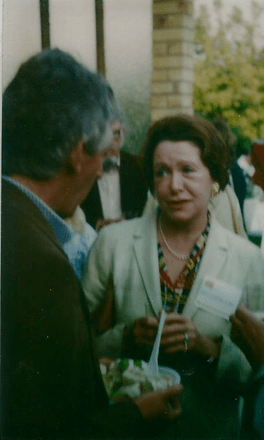
The Power of Place (by Pip Thompson)

Pip Thompson’s first paid fiction publication, “The Ring,” appears in EQMM’s current issue, November/December 2023, in the Department of First Stories. The Virginia author has also completed a novel which is currently on submission to publishers. Her literary career is off to a good start. As you’ll see from this post, she has another long-standing career as an anthropologist.  —Janet Hutchings

In her book Write Away, Elizabeth George promotes the importance of place in mysteries. For George, a book’s setting is a character like any other, because the protagonist’s journey through it reveals her worldview, character, and values. Mystery writers who privilege place thus act as participant observers, keen-eyed outsiders in adopted landscapes.

George lives in Southern California but sets her novels in England. Why? As a Shakespearean scholar and a fan of 1970s British pop culture, she immersed herself in the language and place as a young woman and never looked back. Like George, some authors set their novels in a place where their heart resides. We readers feel that connection profoundly.  To borrow a phrase from anthropologist Mary Douglas, these spaces resonate with purity and danger, which makes for a good mystery. 

Think of Tony Hillerman’s beloved Four Corners. Amid sandy canyons, endless potholed roads, and towering buttes, the abject poverty of the Navajo people contrasts with their rich culture. The startling beauty of the landscape stands for balance and serenity. Outsiders—white people with their strange beliefs and habits—bring discord. The desert light captivated Hillerman, and he used it to reveal both the spiritual and the dangerous: the hush of an abandoned ghost hogan, the dark cave where a rattlesnake hides. Between shadow and sky, peril waits. 

Next, consider Louise Penny’s Three Pines, where Inspector Gamache and a motley crew of friends and colleagues converge on a village redolent of wood smoke and fondue, where children ice skate on a frozen pond. We find a bookstore and bakery but no bank or used car lot. The setting lulls us, trusting as Hansel and Gretel, with offerings of French onion soup and hot chocolate after we’ve trudged through the snow to Gabriel’s bistro. Yet evil slithers in, as unexpected as a copperhead in a picnic basket.  But the we readers come to embrace Three Pines, and we return, ready for a welcome and a shiver.  

So, how did I come to set my mystery series in Italy? In college, my friend returned from her Italian semester transformed: She wore a brown mohair sweater to the thigh, a swinging wool skirt, and a pair of supple leather boots with a pointed toe. I took one look at her and decided I had to go, too. In Rome, I got my own pair of boots and a Bedouin dress and somehow befriended a group of poets.   One of their number, a member of the Roman nobility, stole books for the others. At the Hotel Paradiso, two harridans ran the front desk and glared at us when we came home late. I taught English to businesspeople and modeled for a dowdy fashion house on the Piazza di Spagna. I was neither safe nor sorry.

That winter, I switched schools and became an anthropologist. My professor and I followed an Easter Monday festival, where villagers hoisted their town’s life-size statue of the Madonna onto their shoulders and carried her up a mountainside at dawn. At the summit, the statue met her sister Madonna, who’d come from the village on the other side of the mountain. Pinned-on Lira bills festooned their silk robes, one blue, one red.  I carried the bags and interviewed an old woman who made an olive oil cake to honor my visit. She told me that when no rain fell, they’d parade their statue of Saint Anthony through the streets and upend him into the well in the town square, headfirst. They’d walk by, shouting insults and asking, “How do you like it being wet all the time?”  I became a collector of stories.

Some years later, I traveled to Sicily to join an excavation in the countryside, where I met my archaeologist husband. One day, we went to the farrier, known as a dangerous man. My husband asked, “Would it be possible for you to sharpen this trowel?” The man answered, “It is possible to kill a man in the street in broad daylight,” then sharpened the trowel. The town drunk sat on a bench in the main piazza, stuffing his mouth with peanuts and spitting out the shells. He told rude jokes to anyone who would listen. At the small museum where we cleaned and sorted artifacts, the guards consulted our permit, often interpreting it in ways that stopped the work. Sicilians are great philosophers, and the elegance of one’s argument may trump fairness and even logic. We’d debate them over cups of coffee and biscotti, and mostly kept the work going. I sharpened my Italian and learned the power of things left unsaid.

My first mystery took shape in Venice, at the museum where I worked.  I don’t pretend to rise of the heights of the masters named above.  But my setting is every bit as heartfelt.  That summer, the overseas staff arrived for the Biennale and quickly ran up astronomical bills at the Cipriani. We interns waited at battle stations for their onslaught. I’d splurged on a tuna and artichoke sandwich and placed it on my desk. Before I could eat it, the visiting director barged in, demanding my office and my phone. When I returned, he’d put his cigar out in my sandwich. I vowed revenge. In Blood Oranges, said director steals paintings off his museum walls, replacing them with forgeries and cashing in on the originals. My sleuth, a noble art restorer from outside Catania, solves the crime and punishes the guilty in true Sicilian style.

I write about Italy because I love the people as much as the history, the landscapes, and the food. I love their eloquent and hilarious curses, like “l’anima dei mortacci tua,” damn the souls of your ancestors (go to hell).  “Muso di sorcio,” rat face, is just as good.  Italian proverbs sound earthy and often refer to food, such as: “O mangiare questa minestra, o saltare da questa finestra,” either eat this soup or jump out of the window (take it or leave it). Others draw on farming life: “Chi va al mulino si infarina,” who goes to the miller will be covered in flour (do bad things and you’ll always get caught). “Tanti pampini e poca uva,” lots of leaves but few grapes (someone who promises a lot but has little substance). 

So why set my first mystery short story in Point Loma, my childhood home? I even used my family nickname, Pip, drawn from a favorite book, as my pen name. For years, I came infrequently to San Diego. Having spent my adult life in the South, I find the forced informality of Californians a bit grating. I’m not too fond of the freeways and strip malls and houses built right down to the water. Yet lately, I feel I’d like to reclaim the place: the tide pools and pickleweed, native sage, and waves crashing at night. There is something a little salty about shoes without socks or swimming in the ocean in the middle of the workday. My mother and I walk along a beaten dirt path to the Heron Tree.  Writing The Ring, which I’m now turning into a novel, feels vulnerable and satisfying, like ripping off a scab. Will I find a bloody mess underneath or new skin? It’s just one of life’s many mysteries—you’ll have to see for yourself.

Posted in Uncategorized | Leave a comment

The Hanged Man (by A.F. Bhuyan)

A.F. Bhuyan has been writing short stories for a number of years. His work appeared in Best New Writing in 2008 and was an Editor’s Choice Award selection. He has also had stories in Gargoyle and in our sister publication, Alfred Hitchcock’s Mystery Magazine. His first story for EQMM, “Moldova, 1992,” appears in our current issue, November/December 2023. In this post, he talks about a childhood experience that helped trigger his need to write fiction.  —Janet Hutchings

In the photograph, a young man hangs by the neck from a tree. He is dressed in a long beige shirt and pants. Next to him hangs another, although facing away from the camera, so it is this first man, with his head bent down at an odd angle, who holds my attention.

The hanged man’s features droop. His eyes are closed. Pants ride up from his ankles as his feet dangle above the ground.

I recall seeing this picture and being unable to look away from it. The finality of the image shocked me. At the age of eight or nine, I couldn’t make sense of it. I knew that I had stumbled on something significant and mysterious, and that, aside from the shock and the revulsion, the photograph had provoked other reactions inside me. What they were, I couldn’t then understand.

The photograph was in a book in my grandparents’ library. The book mostly dealt with World War II. It was an old tome, with yellowed pages and a tattered grey cover. Written by a former Field Marshal, it recounted various campaigns, interspersed with photographs and maps. Red attack arrows on those maps were the only splashes of color. I was grateful for that. The scenes of carnage in the photograph inserts shocked me even in black and white.

It was the only book in my grandparents’ library that left such a mark. Across four bookcases, with each row packed two-deep, there were gothic tales, classics, tales of adventure, crime and even early science fiction. People died in those other works. Heads were parted from bodies. Joints and sinews snapped as some poor folk were drawn and quartered. Characters made decisions that led to destruction and murder. But those happenings didn’t faze me. Why was that? Perhaps, I like to think now, it was because I had understood their intent.

Having read through a chunk of my grandparents’ library, it was apparent to me that those stories were designed to entertain. Violence and death, in those books, were easily explicable. It was part of the plot. A death in a story like that only made me turn the pages faster, so that I could find out more of what the book held. It didn’t make me stop and stare at the page. The images didn’t linger.

Death was present in those other books, but it was part of the bigger story and made to make sense. It therefore seemed all right.

Some years later, once in a while, a random snippet of news would startle me. I’d read in the paper of a man in his forties beaten to death at a bus stop for no reason. A cat horrendously mutilated. A child whose innocence had been taken. These stories would haunt me long after I had turned the page or flicked the screen.

The reactions from when I was younger and that I had almost forgotten returned. By then, I was better at discerning something of their nature. There was still shock. There was anger, also. And bewilderment: how could anyone do that?

The books that I had read shed no light on this point. If they did, the explanations they offered didn’t resonate. Perhaps I wasn’t reading the right books, or not reading them in the right way, if such a way exists. But I thought it more likely that the novels I read simply couldn’t get to the place where those reactions lived.

The photograph in that old grey tome and the violence and the cruelty in it belonged to the real world. That was the distinction. It wasn’t fiction, and could never be reconciled with it. While not especially illuminating, this line of thinking was enough for me to move on.

My viewpoint began to shift around the time that I had come across the works by the Belgian writer Georges Simenon. His works played a part in reconciling, for me, the fictional and the real. One of Simenon’s novels specifically comes to mind.

In The Hanged Man of Saint-Pholien, Inspector Maigret investigates the suicide of a shabbily-dressed man who, despite his apparent poverty, mails to himself significant sums of cash. As he delves into the man’s past, Maigret faces increasing danger. The resolution is both elegant, tying together the various strands of the investigation, but also unexpected. At the same time, the emotional climax of the story doesn’t lie in finding out the man’s secret.

The emotional resolution, as it often is for Simenon, lies deeper. While Maigret is portrayed as solid and staid, with eyes “as still and dull as a cow’s,” his visage “blank-faced” and his overall aspect containing “something implacable and inhuman”, this facade belies the depth of his emotional engagement. There is Maigret’s “sense of anguish” over his involvement in the suicide. The recurrent theme of windows, through which characters gaze seeking something beyond–something, with which they are unable to connect. And then there are Maigret’s persistent observations of the characters’ worlds, seemingly tangential to the investigation, like the passing glimpse of a young woman and her “little boy of four . . . having breakfast at a nicely laid table”.

And it is on these tangential moments that the final twist in the story rests, where the private sphere illuminates and pushes forward the decision that Maigret ultimately takes—one that is both at odds with the formal resolution of his investigation and yet, in view of his concerns, the only decision that can be right for Maigret.

Not only a suspenseful page-turner, this and many other Simenon’s novels explore—in action—the motivations, thoughts and feelings of the victims and the perpetrators, as well as those who bring them to justice.

As I read Simenon’s works, I got to explore, alongside the author, some of the same reactions I had first felt when I chanced upon the photograph of the hanged man.

What were those reactions?

I now could name them: the wish to set things right, where possible. A sense of the inexplicable, chaotic cruelty of life. And the paradoxical desire for the world to make sense once more.

Posted in Uncategorized | 1 Comment

The OJ Connection (by Travis Richardson)

Travis Richardson makes his EQMM debut in our current issue (November/December 2023) with the story “Texas-Sized Vanity.” He has previously won a Derringer Award for flash fiction and is a past nominee for the Anthony and Macavity awards for best short story. An L.A. resident, he’s the author of Bloodshot and Bruised: Crime Stories from the South and West. Authors often reflect on novels that have shaped their lives and inspired their fiction on this site; in Travis’s post, he describes how an infamous true crime case affected his life.   —Janet Hutchings

Many people remember where they were during a significant historical event. For my grandparents it was the attack on Pearl Harbor, for my parents it was the Kennedy assassination and the moon landing. For me, some of the historical events include the Oklahoma City bombing, 9/11, and . . . OJ Simpson driving down the 405 freeway. On June 17, 1994, I was working at my father’s summertime business, cleaning swimming pool covers with a crew of college students in a Tulsa, Oklahoma suburb. While scrubbing 8-months of gunk off vinyl covers with deck brushes and high-power carwash hoses under a 100-degree sun, a DJ on an alternative rock radio station let us know that OJ had failed to turn himself in to the police and was a wanted man. Our minds were blown.  

After my shift was over, I delivered cleaned and boxed pool covers back to their owners. The radio stations—all stations—kept giving updates on the OJ situation. Where was he? Did he write suicide letters? Was the man beloved by so many really a killer?  

By the time I was delivering my final covers, the then-Hertz spokesman had been spotted in a white Bronco that was cruising down the 405. The chase was long enough for me to finish the deliveries and come home to watch Al Cowlings pull into OJ’s Brentwood mansion with the police, media, and Angelenos out on the streets in full force.  

Fast forwarding to the trial a year later, I was a student at the University of Oklahoma and I had a dentist appointment in Tulsa the morning before classes. With clean teeth, I drove 2 hours down to Norman for my first class. As I was pulling into the school’s parking lot, the verdict was announced over the radio. These were the pre-cell phone and wireless internet days. When I showed up to my class, nobody knew the outcome. During a discussion, somebody mentioned the trial and I let the class know about the verdict to several surprised gasps. 

I thought that would be it for OJ exposure, but as fate would have it, I moved to Los Angeles a year later hoping to sell a screenplay and it seemed like everybody had an OJ story/connection out there. One of my first jobs was working as a production assistant on a show called “Home and Family” on the Universal lot. Candace Garvey was a bubbly segment host who was known for making multiple arts and crafts with her trusted glue gun. She was also a friend of Nicole Brown Simpson who had spent time with her on the night of the murder and had been a witness at the trial. At one point the show dedicated a segment to Candace discussing her friendship with Nicole, dealing with the tragedy of the murders, and the trial itself. I had a friend in the production office who believed in OJ’s innocence. This was a revelation for me. We debated a few times, but ultimately, we decided that it would be best for us not to discuss the issue.    

My next job in television was on the sitcom Cybill at the CBS Radford Studios. There was a car with a license plate that read “MSNG RON” that I saw every day when I walked between the studio and the Carsey-Werner production office. I was told that Ron Goldman’s sister worked on the lot. 

The wildest OJ connection however was from my job with Korbel Champagne. I worked on a commercial for the California champagne company during a summer hiatus from a UPN show called “Wild Things”. I had planned to return to that show with a promise from the producer that I could use an editing suite on the weekends to edit a short movie I had directed. This was back when digital editing software like Avid cost $100k and an array of hard drives were necessary to store media. After the commercial was finished, the director who happened to be the president of marketing and heir to the Korbel fortune asked if I could work for him full-time. He also had an editing suite and said that I could use it anytime. I jumped at the opportunity.  

My new boss’s fiancée was Faye Resnick. She had gained notoriety for co-writing a tell-all book about her relationship with Nicole just as the trial was revving up and OJ’s dream team had a defense strategy that tried to blame the murders on Faye by saying that she owed drug dealers money and they killed Nicole and Ron to scare her. In the 2ish years that I worked for Korbel, I ended up spending a lot of time with her. The job morphed from an assistant editor position to an executive assistant to something like a personal assistant. (I even had a brief VP of Marketing title.) Often when I traveled with my boss (whose name I am keeping out of this article), she would join us. This included various wineries in Sonoma County, Vegas, and even the Cannes Film Festival among other places. As an interior decorator, she was remodeling my boss’s house and often made suggestions for the Beverly Hills office. Occasionally she would mention Nicole and how the first book was exhausting to write. As I remember from her telling of writing that book, she had traveled to the Hamptons where she sat in a room and told stories about her adventures with Nicole and friends to a team of transcribers for two days straight. The stories were then woven into a narrative within a couple of days and the book (Nicole Brown Simpson: The Private Diary of a Life Interrupted) was published within a month or two.  

At the time, my friends thought I had one of the best jobs in LA (flights on a private plane, meals at fancy restaurants, parties, unlimited access to alcohol, etc.), but the job wore on me. There was constant drama between Faye and my boss that could only happen with either the idle rich or in reality-television plots. Boundaries between work and friendship intertwined, but I was always an employee first. I should note that Faye was never rude to me and even had acts of kindness, like cooking dinner for me and my friends on my birthday. Regardless, I knew I had to leave and even gave something like a five-month notice. I left the job and moved up to Berkeley where nobody cared about OJ and people read books! I also stopped writing screenplays and started writing prose.   

Years later, when I moved back to Los Angeles it seemed like people had forgotten about the OJ trial or at least stashed it away. Faye never married my former boss, but she managed to come back to the public spotlight with appearances on The Real Housewives of Beverly Hills and Keeping Up with the Kardashians.  

When looking back at my first foray in Los Angeles, I get bittersweet feelings of nostalgia. The late 90s seem like such an innocent time compared to today’s environment. I learned a lot and had fun, but I also missed out on some opportunities I wish I had taken. I also should have appreciated things a little more—something that I hope I’m doing today.  

Posted in Uncategorized | 6 Comments

Detecting Female Noir (by Carol Goodman)

A winner of the Hammett Prize for Literary Excellence in Crime Writing as well as two Mary Higgins Clark awards, Carol Goodman is the author of more than two dozen novels. Her debut story for EQMM,  “A Woman in Miniature,” appears in our current issue (November/December 2023).  It stars World War II-era sleuth Peggy Quinn, who also appears in the completed but as-yet-unpublished novel Midnight at the Half Moon. In this post, the author gives us a fascinating look at the predecessors (or lack thereof) in noir fiction to the type of character she’s created in Peggy Quinn.   —Janet Hutchings

When I began writing the character Peggy Quinn, who appears first in my (unpublished) novel Midnight at the Half Moon and now in my story “A Woman in Miniature,” I knew that she would be loosely based on my mother, who was 18 in 1942 and whose life always sounded to me as if it could have been a film noir.  The older sister of four brothers, she quit high school to take care of them when her mother died.  She looked like a forties movie star, had the tough-but-plucky hard knocks girlhood of a Brigid O’Shaughnessy, and had brushed shoulders with Murder Inc’s “Kiss of Death Girl” and Abe Reles in Coney Island.  I wanted Peggy’s story to have the feel of a noir film, so naturally I turned to the hard-boiled books, pulp magazines, and movies of the era looking for her role models.  What I encountered very quickly, though, was the dilemma of creating a female noir hero.  Women in noir are more often the femme fatale bad girl or the sidekick-sister-good girl—not the hero. 

When I looked to the hardboiled novels that would later become the basis for the first noir films, I found the good girl/bad girl dichotomy on full display.  In The Maltese Falcon (book 1930; film 1941) Sam Spade’s secretary Effie Perine is capable and fast-talking but she’s not the primary investigator.  Brigid O’Shaughnessy is alluring and dynamic but ultimately double-crosses Sam Spade and is revealed to be a murderer.  She’s the quintessentially self-aware bad girl spelling it out for us when she admits to Sam “I haven’t lived a good life—I’ve been bad, worse than you could know.”  In Raymond Chandler’s The Big Sleep (book 1939; film 1946) there’s plenty of suggestive banter between Philip Marlowe and the older Rutledge sister Vivien, but even if she’s not as deranged as her younger sister Carmen, she hardly provides a role model for a young woman who might want to solve her own mysteries.  Finding a contemporary role model for Peggy would require more detecting.

Looking at the 1930’s, the Depression era my mother grew up in, the obvious female detectives plying their trade, Nancy Drew and Miss Marple, are both worthy archetypes and ones my mother might have encountered.  In fact, it was my mother’s lifelong love of Agatha Christie that probably inspired me to write mystery.  Neither the teenaged sleuth nor the elderly Miss Marple, though, fit my picture of Peggy Quinn.  For one thing, they were both far better off financially than my Peggy Quinn.    

Better suited as a model, was Torchy Blane, girl reporter.  As Philippa Gates points out in her Detecting Women: Gender and the Hollywood Detective, Torchy Blane came out of a plethora of girl reporters in 1930’s films who “were generally presented as ‘hardboiled’ by their experiences in the Depression-era city . . .”  Played by Glenda Farrell in seven of the nine Torchy Blane movies, Torchy is fast-talking, daring (in one film she chases a train and vaults onto the last car), and she always outwits her male rivals to solve the case.  According to Jessica Pickens in her article “Female Detectives” (Pickens) it was the actress Glenda Farrell who gave the role its dynamic quality.  Farrell said of the other reporters she’d played that “They were caricatures of newspaper women as I knew them. So before I undertook to do the first Torchy, I determined to create a real human being—not an exaggerated comedy type.  I met those newswomen who visited Hollywood and watched them work on visits in New York City. They were generally young, intelligent, refined and attractive . . . By making Torchy true to life, I tried to create a character practically unique in movies.”

Torchy Blane, then, provided a good model for my Peggy Quinn (and I imagined that my mother must have watched at least some of those movies) but the atmosphere of the Torchy Blane films (and many of the films that featured girl reporters in the 1930s) was more comic and antic than what I wanted for Peggy Quinn.  I wanted my story to feel more like a film noir.  Still on the case, one of the models I discovered was in the 1940 film Stranger on the Third Floor directed by Boris Ingster, starring Peter Lorre, John McGuire, and Margaret Tallichet.  As Philippa Gates points out in her book Detecting Women: Gender and the Hollywood Detective, it was one of the first films to be identified by critics as film noir and “offers a shift in tone from the mysteries-comedies of the 1930’s . . .” (Gates, 121).  From the beginning of the film, Jane suspects that something is wrong when her fiancée, newspaper reporter Mike McGuire, testifies as the lead witness in a murder trial.  Jane feels sure that the accused is not guilty but Mike dismisses her hunch as an emotional response.  Only later when Mike witnesses another murder and is then charged with it does he realize that she was right and Jane is left to investigate and clear Mike’s name. 

The woman who is forced into the role of amateur detective to clear a loved one’s name was not uncommon in films and stories, but she’s sometimes dismissed as not qualifying as a true noir hero since her motivation is love.  Philippa Gates disagrees “that such a motivation should negate the agency that such female detectives demonstrate as investigators since several male detectives in noir films—most famously Laura (Preminger, 1944)—are also motivated to investigate out of love/desire.” (Gates, 122).   I agree.  In her first outing, my Peggy becomes involved in a murder investigation when her brother is suspected; in “A Woman in Miniature” she can’t stand by and watch an innocent woman be accused of a theft.  Here, at last, I felt like I had found the combination that could serve as a model for Peggy—the fast-talking girl reporter of the 1930s and the more nuanced justice-seeker of early film noir. 

This combination took me back to the pulps—to another sister proving her brother innocent in the short story “Angel Face” by Cornell Woolrich.  In her introduction to “The Dames” section of The Black Lizard Big Book Pulps, Laura Lippman calls the heroine “an avenging angel” and the “most dynamic female in these stories” (Lippman).   Jerry Wheeler, a smart-talking dame who’s earned her hard-boiled credentials working in a tinseled G-string to keep her brother Chick out of the orphanage and reformatory, tries to save him from the clutches of a mobster’s moll (Woolrich). When the mobster’s moll winds up dead and Chick is tried and convicted for her murder,  Jerry has to prove his innocence by going undercover as the singer “Angel Face” at the mobster’s club.  While she requires a little last-minute saving from a hunky detective, she’s proved her bravery, intelligence, and heart ten times over.  I felt a special connection between her and my mother since my mother had quit high school to keep her brothers out of the orphanage, was a frequent visitor to the police station to talk them out of trouble, and eventually testified for one of her brothers in a murder trial.    

When I recently went back to read “Angel Face,” I noticed that while the story first appeared as “Murder in Wax” in Dime Detective in 1935 it later appeared as “Angel Face” in Ellery Queen’s Mystery Magazine in December 1946.  That Peggy is now making her first appearance in the pages of Ellery Queen,where my mother might have found her own role models in sleuthing, feels like the completion of a circle and the kind of poetic justice any noir heroine could want.


Sources
Gates, Philippa.  Detecting Women: Gender and the Hollywood Detective.  State University of New York Press, 2011.

Lippman, Laura.  Introduction to “The Dames” in The Black Lizard Big Book Pulps (ed. Otto Penzler), Vintage Crime/Black Lizard; Reprint edition, 2007.   

Pickens, Jessica.  “Female Detectives” https://www.tcm.com/articles/Programming%20Article/021713/female-detectives/

Woolrich, Cornell. “Angel Face” in The Black Lizard Big Book Pulps (ed. Otto Penzler), Vintage Crime/Black Lizard; Reprint edition, 2007.  

Posted in Uncategorized | Leave a comment

The Allure of Historicals (by David Krugler)

A professor of history and the author of several nonfiction books, David Krugler has also written two World War II spy thrillers (Pegasus Crime 2016 and 2018): The Dead Don’t Bleed and Rip the Angels from Heaven. Both received starred reviews from Publishers Weekly. The Illinois author’s first short story for EQMM, “Kit’s Pad,” appears in our current issue (November/December 2023), but he has had a number of other stories published, including “Two Sharks Walk Into a Bar,” chosen for Best American Mystery Stories of the Year 2023. In this post, he gives us a historian’s view of how history lends itself to mystery.  —Janet Hutchings

September 1995. I was hours into a long day of research in the reading room at the National Archives in College Park, Maryland. I was writing a dissertation about U.S. radio propaganda during the Cold War and parked next to my desk was a metal cart loaded with grey boxes crammed with historical documents. I needed to get through a few more boxes before I took a break, but my mind was wandering. Instead of finding documents that supported my dissertation’s argument, I was thinking about the memorably named individuals mentioned in memoranda from these State Department files from the late 1940s. Foy Kohler. Haldore Hanson. Howland Sargeant. They sounded like characters from a novel. Although Wikipedia didn’t yet exist, I’d somehow learned Howland Sargeant was married to actress Myrna Loy, star of the Thin Man movies based on the novels of Dashiell Hammett (another fabulous name). What was it like to be married to a movie star? I wondered. What was it like to be in Europe right after World War II, as many of these men were for their work? I was certain they had stories to tell. But I wasn’t there to write their biographies or relate their personal experiences. Their “roles” in my dissertation had to be limited to explaining, well, U.S. radio propaganda during the Cold War. I banished my idle musings and dragged my attention back to the documents.

Eventually, I finished the dissertation and got a job as a history professor, but that curiosity about the personal lives of figures from the past didn’t ebb. If anything, it grew stronger. I thought the curiosity might lead me to write a biography or two, but I just couldn’t get inspired or interested, despite picking some fascinating, real-life subjects in need of full-length biographies. The hesitancy both puzzled and unsettled me. I’m a historian, I reminded myself. Why was I reluctant to get started?

A decade or so ago, I figured out the problem. I didn’t want to write historical biography—I wanted to write historical fiction. Rather than make a return trip to the National Archives to page through dusty old documents, I wanted to create a past that didn’t require citations and populate it with characters from my own imagination. And I wanted my fiction to be mysteries.

Apostasy? I thought so at first. (For a long time I didn’t tell colleagues or professional peers I was writing fiction for fear of ridicule, or worse, bemused indifference.) But the more I wrote fiction, the more I realized history and the mystery genre have a lot more in common than I originally believed.

The past is a rich field for mystery, thrillers, and suspense writers. Just about any subgenre—procedural, noir, cozy, caper—can be transplanted to a historical time and place. For me, writing historicals also means I get to start with a background I already know, which is why a lot of my fiction is set in World War II or the 1970s. I’m familiar with the lay of the land, so to speak, and also many of the elements that make any story, whether set in the past, present, or future, engrossing and believable. How characters talk, what they do for a living, the fads and fashions of the day.

But the allure of writing historicals is much greater than already knowing some facts about a particular era. I find the people of the past more interesting than those of us who call the current times our own. Don’t get me wrong—we live in interesting times, to put it mildly, chockful of colorful characters and plenty of drama. But unlike we the living, the people of the past don’t get second chances, except through what we write about them. The historical writer, in both nonfiction and fiction, gives voice to the dead, just like the homicide detective does. As the character Harry Bosch said to his creator Michael Connelly in a 2002 “interview”: “You speak for the dead, man, because nobody else does.”

For the historian, speaking for the dead must follow strict rules. The facts must be accurate, the claims backed by evidence, the evidence recorded through citations. That means spending countless hours in archives and libraries, paging through reams of records or poring over books. (Or, as is becoming more common, reading scans of said documents on the screen of your choice.) Even after completing their research, historians can rarely tell readers what their subjects were thinking unless they happened to leave behind a diary or some written proof of their interior lives.

Writers of historicals may gleefully discard most of these rules. Maintaining a semblance of factual accuracy is still a good idea (no M-16s for Civil War infantry, please), but imagination, not the documentary record, is the limit of what characters can say, think, and do. An author also doesn’t need an archive or a library to get started. Inspiration for a recent story I wrote came from a single photograph from the 1970s. It depicts an elderly man standing proudly outside his tiny television and radio repair shop located beneath a Chicago elevated rail station. I often walk down this block—there’s a parking lot there now. What happened to that shop and to that nameless man? What were his days like, bent over his workbench, tools in hand, the guts of a television or radio spread out before him, trains rattling overhead every ten minutes? That musing led to a scenario. What if business wasn’t so good? What if he needed to borrow money from a loan shark? What might happen next? Spinning a story from these What-ifs is no attempt to explain what actually happened to that man. Rather, it’s an effort to describe what could have happened and to use a snippet of the past to handle a durable trope in the mystery genre: What happens to decent people when they’re forced to cut deals with the bad guys? Historicals offer writers and readers a way to see anew the familiar.

Another reason I find historicals alluring is because they challenge us to appreciate that the people of the past were complex and conflicted, struggling to live in a world of promise and peril, just as we do today. From the perch of the present, it’s easy to survey the past, especially its abundant instances of wars, exploitation, and violence, and ask, What were they thinking? How could they do these things to other people, and themselves? Philosophers pose a similar question: Why do good people do bad things? The obvious answer to all three questions is that, like us, the people of the past were contradictory human beings, capable of kindness and cruelty, of order and mayhem. It’s a cliché to say those who fail to learn from the past are doomed to repeat it. But how often do we pause to consider how the people of the past learned from their mistakes—and their accomplishments—as they progressed through their lives? Historicals offer authors and readers a vantage to observe characters from another era evolving and wrestling with the consequences of their actions as well as the hazards of their environment. Take Bernie Gunther, Philip Kerr’s indefatigable detective and the ultimate survivor. (Across numerous novels, Gunther outlasts the trench warfare of World War I, the Nazis, and a prisoner-of-war camp in the Soviet Union.) It’s a testament to the late Kerr’s talent as a novelist that he was able to create such a compelling protagonist in the figure of Gunther, who continually compromises with evil without surrendering his morals.

Now I have a confession. Having enthused about the allure of historicals, I must admit my story appearing in EQMM was not written as a historical. The plot of “Kit’s Pad” intertwines two contemporary issues we don’t often, if ever, think about at the same time: homelessness and bitcoin. After years of writing historicals, the challenge of immersing myself in the present was a welcome change. Putting myself in today’s world, plot-wise, was like coming out of a dim archive into a bright summer day. After submitting the story, I wondered if I should take a break from historicals.

Then we went to press. In the time between the story’s acceptance and the publication date, the “present” had changed, as it always will. Janet Hutchings, EQMM’s editor, caught a problem: the value of bitcoin had dropped substantially since I wrote the story. To keep the plot intact, she recommended I revise the value of the bitcoin downward or . . . set the story in the near past.

My choice? All I’ll say is, I don’t think you’ll be surprised.  

Posted in Uncategorized | Leave a comment

Mystery Is in the Eye of the Beholder (by J.D. Frain)

J.D. Frain earned a degree in journalism before opening a small marketing company in St. Louis, Missouri. For a few years now he’s been writing and selling short stories, but his first paid publication at professional rates, “Two Thousand Miles From Vegas,” appears in the Department of First Stories of EQMM’s November/December issue (on sale next week!). In this post he encourages not just writers but everyone to uncover the many mysteries in the world around them. —Janet Hutchings

Kai, at four years old, recently taught me a lesson about mysteries. I know, I know, as the adult here, perhaps I should be teaching him. But remember the guy who walks around with a hammer, and everything looks like a nail? Similarly, when a person opens their mind to the mysteries of life, everything becomes a lesson.

It comes down to perspective. Mystery isn’t an objective reality. It’s a subjective interpretation of reality. Mystery depends on how you relate to the world around you. What is mysterious to one person may not be to the next.

What was a mystery to my grandson was old news to me. We stood by a backyard pond as several toads (mere tadpoles a week ago!) emerged and hopped across the patio. “How do they learn to live on land?” he wanted to know.

The pond is mine, so I knew that answer. “They lose their gills that allow them to breathe in the water and develop lungs so they can breathe on land.” They also grow limbs and absorb their tail, but one lesson at a time.

He quickly spit out a staccato of questions: “Where will they live now . . . How long can they swim . . . How far can they hop . . . Have you ever run over one with your lawnmower?” I tried to keep up, but while trying to supply answers, this is where I learned the lesson from Kai: Mystery is in the eye of the beholder. Therefore, when you adopt the viewpoint of someone else’s eyes, you can enjoy your own mystery. A fun discovery. Now I had to put it to the test.

There’s a requirement for this process of discovery to work. You have to allow yourself to be vulnerable, the same way a four-year-old does when peppering an adult with questions. A kid isn’t embarrassed about the questions they ask; they’re curious about everything and, perhaps without knowing it, they’re willing to accept the burden of vulnerability.

For an adult, there’s a risk involved. You have to expose yourself. Admit that you might not know something, even if it was something taught in fifth grade science. The good news is, to balance the risk, there’s a reward involved as well. You get to solve some mysteries and meet some people. Make a game of it! Here’s how it works.

Every field of human endeavor has experts. Many of them don’t hang out on the internet. And experts love to talk about their expertise. The hard part for many humans is allowing someone else to share their expertise without interrupting to boast about their own alleged knowledge. Rumor has it you learn a lot more by listening than you do by talking. You knew this as a four-year-old. If you’ve forgotten, let this post be your reminder.

So, pick a day to lose yourself. Leave your phone behind. Visit where you’ve never been. You’ll be amazed at what people are willing to teach you about their field of expertise. Ask a truck driver about the worst time to drive. Talk to a cop about her busiest shift. What’s an unbelievable part about being a nurse? When does a third-shift worker sleep? What’s the funniest thing your cashier has witnessed at work?

When you ask the question, when you show some curiosity (and overcome your vulnerability), you can get answers you’d never find doing typical research. Try it yourself. Decide on the mysteries that make you curious. Pretty soon, you’re going to start getting amazing answers.

I used the examples above because I’ve done them all and enjoyed interesting answers. (Surprise from Truck Driver: “The worst time to drive is in the evening after I get home. I have no interest in getting in my car.” Realization from Cop: “Night shift. Soon as that moon comes out, people change. That’s why I work days now. I get to help people instead of arrest people.” Brutal honesty from Nurse: “I hold a sandwich in one hand and catch vomit with the other. Some people find that hard to digest, but it’s second nature to me now.” Thoughtfulness from Third Shifter: “I love being awake when the rest of the world is sleeping.” Humor from Cashier: “Today’s my second day. Nothing has been funny.”)

Notice how they don’t always answer the question you asked. That’s okay. In fact, that’s favorable. So what are you curious about? What mystery would you like to solve? There’s a good chance you can find an expert with a fascinating answer.

For mystery writers, here’s an added benefit. You’ll often receive an anecdote to help immerse yourself in an unfamiliar world. We’ve all heard the old (and sometimes incorrect) adage to “write what you know.” In some cases it’s better to research what you don’t know. Next time you want to observe the world through someone else’s eyes, adopt their perspective. You’ll see things you’d never witness through your own eyes.

By the way, as we were leaving the pond, Kai wanted to know if he would get warts from a toad. His older sister had told him it could happen. I said, “A witch can turn you into a toad and then you’d have warts like every other toad out there. Just avoid witches and you’ll be safe.” Gotta keep some mystery in the eye of this young beholder, right?

Posted in Uncategorized | Leave a comment

September Convention Roundup (by Jackie Sherbow)

In several previous years I’ve posted on this site about my experiences at the Bouchercon World Mystery Convention. That gathering of mystery fans, writers, and others in the business takes place in a different city each autumn. This year, neither I nor my colleague at Alfred Hitchcock’s Mystery Magazine, Linda Landrigan, attended Bouchercon; instead, the senior managing editor for both magazines, Jackie Sherbow, represented our publications. I was as interested to read of Jackie’s adventures at Bouchercon and the subsequent C3 conference as I think you will be. For those who don’t already know Jackie, she’s not only an excellent editor, she’s a published poet and a mystery writer whose work has appeared in Mystery Magazine and in the anthology The Beat of Black Wings. —Janet Hutchings

Jackie Sherbow, left, and Steve Steinbock accept Derringer award for Melissa Yi. Photo courtesy Steve Steinbock.

September has been a busy time for EQMM and AHMM! The first weekend of the month, I traveled to San Diego for the fifty-third year of Bouchercon (the World Mystery Convention). It was a delight to experience a city I know very well transformed into a gathering-place for all my friends and colleagues in the mystery-fiction (and nonfiction) world. I have been able to attend two past Bouchercons (Albany and Toronto), but this was my first time staying in the convention hotel for the entire weekend.

During Thursday night’s opening ceremonies, Steve Steinbock (author, translator, and EQMM The Jury Box book reviewer) and I accepted the Short Mystery Fiction Society’s Derringer award on behalf of Melissa Yi (who won in the Short Story category for “My Two-Legs,” which appeared in AHMM). Martin Edwards (historian and author) was honored with the Edward D. Hoch Memorial Golden Derringer for Lifetime Achievement; later in the weekend, he won the Anthony Award for Best Nonfiction for his book The Life of Crime: Detecting the History of Mysteries and Their Creators. We’re proud to say that Martin’s first work of fiction appeared in EQMM’s Department of First Stories!

Friday night, I was honored to give one of the several traditional toasts at the Nero Wolfe Banquet (put on each year by The Wolfe Pack). Saturday evening before the Agatha Awards banquet and presentation, authors and friends of the Dell mystery magazines met poolside for a toast and get-together, which was a treat. And on Sunday Chris Dreith, Rob Pierce, Julie Leo, and I closed out the conference with a panel about writing at different lengths (“The Long and Short of It”) in the very last programming slot.

The following weekend, after a few days home in NYC, I took the train to Baltimore and from there went on to Columbia, MD to attend the Creatures, Crimes, and Creativity Con (C3), where I was the Publishing Industry Guest. Although EQMM and AHMM have sent magazines to the conference for years, it was my first time attending, and I was so lucky to have been invited by founders and organizers Austin and Denise Camacho.

On Friday, I gave a talk about my job, the history of the magazines, and writing and submitting short stories. Throughout the weekend, I was on several panels—in one, I shared the panelists’ table with Josh Pachter (author, editor, and translator), with whom I spent much of the weekend, along with Laurie Pachter (also a writer). Ed Aymar was in attendance, as was Jeffery Deaver, who served as one of the keynote speakers. Attendees could enjoy talks and interviews during mealtimes as well, and Noir at the Bar on Friday night. C3 is a small, unique conference—a “boutique” conference, as Austin told me he’d heard it called; I had never been to a convention quite like it before, and the connection and mutual inspiration amongst attendees was palpable.

Below, you’ll find a photo gallery that I hope gives you a little taste of the experience. By mid-September, I was fresh off time well spent with old friends and new ones, enlightening programming, and a tremendous amount of fun. I’m happy to say I’ll be back to both conventions next year! Hope to see you there.

Bouchercon hotel atmosphere. Photo by Jackie Sherbow.
Sisters in Crime showing support at Bouchercon opening ceremony. Photo by Jackie Sherbow.
From left: Josh Pachter, Brendan DuBois, Stacy Woodson, Temple Bracken, Michael Bracken, Barb Goffman, and Jackie Sherbow. Photo by Josh Pachter.
Bouchercon Short Story panel. From left: Joseph Walker, Art Taylor, James A. Hearn, Steve Steinbock, Melinda Loomis, R.T. Lawton, and timekeeper Robert Lopresti in foreground. Photo by Jackie Sherbow.
At the Dell Bouchercon gathering. Photo by Stacy Woodson (left).
At the Dell Bouchercon gathering. Photo by Stacy Woodson.
At the Dell Bouchercon gathering. Clockwise from left: Stacy Woodson, Alan Orloff, Josh Pachter, Rob Osler, Kenneth Wishnia, Edith Maxwell, Robert Lopresti, Art Taylor, Martin Edwards, G.M. Malliet and husband, Dale Berry, and James A. Hearn. Photo by Steve Steinbock.
Dell authors and editor. From right: Steve Steinbock, Stacy Woodson, Barb Goffman, Jackie Sherbow, James Lincoln Warren.
Josh Pachter, left, and Jackie Sherbow. Photo by Josh Pachter.
The Long and Short of It Panel at Bouchercon. From left: Chris Dreith, Julie Leo, Rob Pierce, Jackie Sherbow. Photo by Toni L.P. Kelner.
Photo by Jackie Sherbow.
Jackie Sherbow with magazine during talk. Photo by Kathryn Prater Bomey.
C3 merch and 10th Anniversary Convention Anthology (featuring Dottie the cat).
Posted in Uncategorized | 2 Comments

Conversations with James M. Cain and Edgar Winner John McAleer (by Andrew McAleer)

Andrew McAleer is the author of 101 Habits of Highly Successful Novelists and co-editor, with Gay Toltl Kinman, of the mystery anthology Edgar & Shamus Go Golden. He recently completed a volume of short mystery stories featuring his father John McAleer’s Golden Age detective, Henry von Stray, and he’s now at work, with Gay Toltl Kinman, on two mystery anthologies: Shamus & Anthony Commit Capers (Level Best Books) and Agatha & Derringer Get Cozy (Down & Out Books).  Andrew has contributed two previous posts to this site (one on a poem by Edward D. Hoch, the other about Rex Stout); this time he shares selections from his father’s interviews with James M. Cain.  —Janet Hutchings

Left: Transcribed Cain interviews held at his home in Maryland; Center: Packed & Loaded; Right: McAleer’s questions for Cain

Some time in the early 1970s, not long after Rex Stout authorized my father, John McAleer to write his biography, another major American writer in the field of crime literature asked my father if he would also write his biography. My father readily agreed. After all, this was James M. Cain asking—and the truth is: the postman don’t always ring twice. Hence, while putting the finishing touches on Rex Stout: A Biography, my father seized every available opportunity to interview Cain on his life, craft, and peers. The Cain biography, however, never came to be.

With the completion of Stout, my father was ready to take on Cain full time when a letter arrived from fellow biographer Roy Hoopes. Hoopes expressed concern that he’d heard my father was writing Cain’s biography because Cain commissioned him as well. As my father later wrote, “To spare Cain his blushes I yielded ground to Hoopes . . .” As a result, my father’s interviews and Cain correspondence were filed away and remained so for a quarter century.

While assisting my father with some research in or around 2001, I happened upon the Cain file and helped him compile the “lost” gems into manuscript form. These remarkable interviews were published under the title: Packed and Loaded: Conversations with James M. Cain. (Nimble Books, 2010) In addition to an Afterword by Shamus winner Jeremiah Healy, I obtained original epigraphs about Cain from Elmore Leonard, Sue Grafton, Robert B. Parker, Dennis Lehane, Peter Lovesey, Phil Lovesey, Edward D. Hoch, Katherine Hall Page, Robin Moore, and William G. Tapply. The interviews are as impressive and important to crime fiction as the foregoing list of authors. 

As my father tells it in his Foreword to Packed and Loaded

These reflections reveal Cain as he wanted to be remembered.  There never was a time when Cain was not forthright in utterance, but in his octogenarian interviews age sanctioned an awareness remote from the restraints wariness might have imposed on a lesser mortal, a decade earlier.  At eighty-five he dared to give free expression to an estimate of his fellow man with an integrity, which even those less engaged in reality would scorn to rebuke.

In this critical, tell-it-like-it-is study, Cain reveals his thoughts on Hemingway, Fitzgerald, Arthur Miller, Hammett, Chandler, Marilyn Monroe, and in his eighty-fifth year, his plans for the future. (Cain died on October 27, 1977–two years to the day after Rex Stout.)

The following selected Q&A and epigraph’s from Packed & Loaded make their first online appearance anywhere exclusively for EQMM’s “Something is Going to Happen” followers.

Cain correspondence to McAleer dated August 23, 1976, with Cain’s hand-written marginalia.

* * *

McAleer:  Do you write more than one draft when writing a book?

Cain:  I rewrite so much I lose track of how many drafts it takes to finish a book.  At least four or five—sometimes more.  I’ve cut down the number in recent years by outlining, not only of story, but of characters, etc., before I start the text.  This sidesteps a lot of false starts I used to make.

James M. Cain’s novels were my introduction to noir fiction.  There have been many writers since with a flair for the Dark Side of human nature, but none with the same deft touch.  —Sue Grafton

McAleer:  Do you think that your experience as a journalist helped you with writing fiction?

JMC:  I don’t think it helped much.  I don’t think they have much relationship. . . . In my novels, I don’t write the way I write for a newspaper at all. . . . To write a novel, I have to pretend to be somebody else.  I have to be, pretend to be, the character telling his story.

McAleer:  Some of your novels are in the third person, however.

JMC:  I wrote three books in the third person:  Mildred Pierce, Love’s Lovely Counterfeit, and The Magician’s Wife.  And, it tells a story, I seem to be able to get away with it but not with any such impact and conviction and circumstantial background, as I get when I have the character tell the story. . . . In the first person it seemed as though it really happened. . . . In the third person, I don’t care how good you are, or even if you’re Sinclair Lewis, there come times when it seems as though you’re making it up as you go along.  To that extent, first-personal narration must be respected.

What I gained from reading Cain is an appreciation of the antagonist’s point of view:  that bad guys are more fun to write about than good guys, their attitude and they way they talk always more entertaining. —Elmore Leonard


McAleer: Do you think the reading audience has changed much?  When I read Serenade and The Postman Always Rings Twice, the narrators were characters who were very American and had definite ethnic prejudices.  Do you think today’s readers might be too sensitive about such a narrator?

JMC:  I don’t think so, because it doesn’t say that I have any ethnic prejudice, it says the character does.  I think in this personal book [The Postman Always Rings Twice] he kept talking about the Greek, as though, “How could you marry this Greek?”  He asked her as though a Greek wasn’t much to be married to. . . . And he knew that she was kind of sensitive about it, but if she was sensitive about it she was ethnically prejudiced, and so was he.  But it seemed to me that the reader would simply accept that’s how they were and not particularly think I had to be—or assume that I had no right to mention it.

McAleer:  Do some episodes in your books please you or stand out more than others?

JMC:  Once the book is written, I never think about the goddamn book anymore.  I get on with the next book.

McAleer:  When you’re writing do you consciously set limits on what a writer should say or could say in a book?

JMC:  That has no meaning for me.  I don’t set any limits.  I never heard of a writer that sets limits on what a writer can say.

In many ways James M. Cain set the standard for pacing, tightness of plot, and psychological suspense.  The Postman Always Rings Twice, The Butterfly, Double Indemnity—to name just a few of his novels—rank foremost in the field of crime literature.   —Robin Moore

McAleer:  How would you rank Hammet and Chandler as hard-boiled authors?

JMC:  I’ve been accused of writing like Hammet.  But I never read anything by Hammet . . . I got a copy of The Glass Key and I would pick it up and try to read it . . . But by the end of four or five weeks I’d only read twenty pages of this book.  I think to myself, “For Christ’s sake, you can’t like it too well.”  And I met him one time, over at the Edward G. Robinson’s.  This somewhat wild-looking character with white hair he had, came charging up to shake my hand, and tell me how much he admired my writing and so on.  Said he was Dash Hammett.  And I wrung his hand, and I said what an honor it was, how glad I was to know him.  And then I got away from this guy but quick, ’cause I had not read anything by him . . . I’ve never read one word of Chandler . . . I used to run into him at parties:  “Why hello, how’ve you been?”  But outside of that. . .this one afternoon when Billy Wilder had me over to talk about this Double Indemnity thing that he was working on at the time.  I had no discussions with Chandler at all.  I scarcely knew him.

James M. Cain was a master of less is more.  Reading him is a pleasure; re-reading is sheer joy.   —Katherine Hall Page

McAleer:  You don’t think F. Scott Fitzgerald was good at evoking character development through dialogue.  Who do you think was good?

JMC:  I’ll tell you who’s good:  Arthur Miller, Sinclair Lewis.  Arthur Miller was a genius at it.  He was the one married to Marilyn Monroe. . . . Marilyn was what’s called a triangle girl.  They’re girls that lived in that triangle between Hollywood Boulevard, Highland Avenue, Sunset.  Makes a triangle.  The Hollywood Bowl goes off one angle—Pepper Tree Lane they call it.  It’s off the Highland angle of this triangle.  The Hollywood bowl Lane of maybe two to three hundred yards of trees and at the end of the Lane is the Hollywood Bowl that’s off the triangle.  But in this triangle a dozen apartment houses of one and two room apartments lived girls like Marilyn.  They have one nice dress and one pretty good dress.  They’re known as party girls . . . They had a way of talking.  That peculiar lingo; it’s different from anything I’ve ever heard.  I’ve heard it a few times, after all, you live in Hollywood you meet some triangle girls at the party. 

Cain made it seem easy, but only if you’ve tried it yourself do you realize how difficult it is to master the genre as skillfully as he did. —Edward D. Hoch

McAleer:  What book do you think is your best work?

Cain:  My best book is the one which sold the most copies, so far as I’m concerned, and by that test, my Postman leads the list, with so many editions I’ve completely lost track.  I’m quite vain of the fact that it’s still in print, and still making me a living.

* * *

We remain deeply indebted to James M. Cain’s original and historical contributions to literature. As historian Robin W. Winks reminds in his Edgar Award-winning, Mystery & Suspense Writers: the Literature of Crime, Detection, and Espionage, “The birth of crime noir can be traced to the 1930s and grew out of the Great Depression . . . In many ways James M. Cain’s work serves to define crime noir writing and represents the form at its most typical.”  (PP. 1012-1013)

More than 20 years have passed since I worked on Packed & Loaded with my father. Fond memories. I sometimes wonder what would have become of these historical documents if I didn’t happen to pull open that file drawer at that particular moment in history while my father was still around to discuss them. It’s best not to worry about such things and just be thankful the postman rang twice.

Posted in Uncategorized | 4 Comments

Three Degrees of Separation From Florabel Muir (by Joseph Koenig)

Joseph Koenig’s first novel, Floater (1986), was nominated for an Edgar Allan Poe Award. His fiction has also brought him nominations for the Shamus and Macavity awards, and his novel Brides of Blood (1993) was named a New York Times Notable Book. The New York author has a very original new story, “High Diver,” in EQMM’s current issue (September/October 2023). It’s a return to EQMM after a long absence; his work previously appeared in our pages in 1992. In this post he mentions his occupation prior to becoming a full-time fiction writer—what he refers to as “degenerate journalism”!  —Janet Hutchings

When she was starting out at the Salt Lake City Tribune in the early 1920s, Florabel Muir fought to cover the execution by firing squad of a condemned murderer at the Utah penitentiary. Because she was a woman and young, although hardly dainty—she never was accused of that—her editor assigned a male reporter as a sort of relief pitcher in case her nerves failed, and she couldn’t complete the assignment. It was her backup who revealed weak knees. Muir was awarded the byline and praise from the editor, who admitted that she was not the reporter who vomited.

Over half a century Muir built the reputation of a newshound who always  went the extra mile—even when it was someone else’s last mile—to get the story. If she returned to the city room to write it spattered in their blood, she had carte blanche to put the dry cleaning on her expense account. In 1950, close to 60 and still very active, she summed up her career in the tell-all Headline Happy. Here is the first part of Kirkus’s review:

Sex and sadism, gals and gangsters, were molded into the author’s news stories for New York and Los Angeles tabloids, and Miss Muir licks the dish with reminiscent gusto in her autobiography. All the savoring of the lurid and sensational that made the stories is intensified here paced by Miss Muir’s counting o’er her successes wringing stories from reluctant celebrities, manufacturing stories from celebrated silences and keyhole interviews. There is the Charlie Chaplin-Joan Barry scoop in which the little mother is treated tenderly; the story of boyish Errol Flynn’s endearing escapes; the carryings on of Mickey Cohen and Bugsy Siegel; and the famous diary of Mary Astor which Miss Muir procured (she does not tell how) for $300. Through all the author takes pride in relating how she swept down on her prey—just and unjust—(she seems to admire the unjust more)—with one object in mind—the story.

It’s said that everyone on earth is connected to everyone else by no more than six degrees of separation. As unlikely as this seems, it works for me. Through an old girlfriend who doesn’t deny turning down an offer of marriage from a future adviser to Presidents Bill Clinton and Donald Trump I am linked to every major Democrat and Republican politico, with degrees to spare. A teammate from my college football days went on to become a top NFL exec, my portal to the world of professional sports. I knew Salvador Dali as he approached old age. If anyone prominent in the arts was a stranger to him, I can’t imagine who it might have been. I am three degrees of separation removed from Florabel Muir.

My Uncle Murray’s best friend was Neddie Herbert, a gunsel. I have no idea of what he did before becoming a gangster, or how he came to be tight with my father’s younger brother. I never asked Uncle Murray, who considered such questions tasteless. I do know that by the late 1940s, Neddie had left Brooklyn for fresh pasture in the west, gone to L.  A. to work for Mickey Cohen, who was Ben Siegel’s trusted lieutenant and successor. After Bugsy was executed because of his alleged finagling of expenditures at the new Flamingo hotel in Las Vegas, Cohen filled his chair in the councils of the mob.

Cohen was no Bugsy, who some thought handsome and charming. He was short, stubby, and lacking any pretense of savoir faire. While Siegel didn’t employ bodyguards, trusting to the good nature of his underworld compadres, Cohen was never seen without several. Chief among them was Uncle Murray’s friend, Neddie.

On the morning of July 20, 1949, Mickey, Neddie, and their entourage stopped for a bite at Sherry’s, an all-night eatery on Sunset Strip. Among the entourage was Florabel Muir. As she would explain, Jack Dragna, a mobster competing for Bugsy Siegel’s vacated turf, had announced that he was gunning for Mickey, and she wanted to be around should Mickey get it. Cohen was not visibly concerned. A hard man, a former pro fighter in the bantamweight division, he could take care of himself with his fists. Neddie Herbert was there to handle business that might escalate into gunplay.

As the Cohen party was leaving Sherry’s at 3:55 a.m., shotgunners opened fire from their blind beneath a billboard across the street. Mickey was hit in the shoulder, but not seriously injured. A larger load of shot was absorbed by Neddie. A pellet ricocheting off the sidewalk or perhaps a bone inside Neddie caught Florabel Muir in what she described as her derrière. Cohen, who was being tutored in the finer usages of language by the writer and her husband, referred elegantly to the site of her wound as her tuchas.

Neddie still was breathing as he kissed the curb. A news photo shows ghouls clustered around him while a passerby tries to stanch the hemorrhaging from his guts. In another picture shot through a forest of legs a garment of some sort is clenched in Neddie’s teeth. There is blood all around. He seems accepting that he is a gone goose, apprehensive about what would come next.

Absent from the rotogravure is Florabel Muir. Ignoring directives from her husband to, “Get down, get down,” she ran from the gunfire, not out of fear, but in search of a phone to call in her greatest scoop, a first person account of the failed attempt on Mickey Cohen’s life, and incidental murder of Neddie Herbert.

Cohen subsequently appointed a new bodyguard, and fended off more assassination attempts by Dragna and his goons. Not one to take chances, the notorious germaphobe and compulsive hand-washer purchased a new Cadillac Coupe de Ville, and outfitted it with two-inch thick glass, and armor cladding.The Caddy was too ponderous for getaways, but impervious, and served its owner well until he traded it in two years later because it wasn’t street legal.

Florabel Muir’s piece in the New York Daily News, her flagship at the time, was syndicated throughout the country, cementing her place as America’s ace legman. Dripping with Adrenalin, the writing did not match this contemplative bit from Headline Happy, in which she describes entering the scene where another luckless yegg had eaten lead.

Perfume pervaded the room from the night-blooming jasmine clustered outside the window through which the deadly shots had been fired. The Los Angeles Times was lying across his knees, and on it was stamped: Good night. Sleep peacefully with compliments of Jack’s. Bloody sections of his shattered brain partially blotted out the eight column headline telling of another fatal shooting in the poorer section of Los Angeles. As I moved the newspaper to see what he had been reading, blood dripped on my satin evening slippers.

The Kirkus review concludes somewhat predictably:

Miss Muir for our money should have stood in the twenties when this type of degenerate journalism splattered on a public not yet surfeited with horrors.

I have no gripe with degenerate journalism. For many years I was also a practitioner, largely at Front Page Detective and Inside Detective magazines, nurseries for degenerate fiction writing, my current practice.

Florabel Muir died of a heart attack at 80 in 1970. Her New York Times obituary quoted her as confiding to intimates, “I was having a talk with my croaker the other day, and he said, ‘Florabel, your ticker ain’t worth a pot in hell. You take it easy.’ So I guess I will.”

Her brand was strong, but she wanted to be Damon Runyon, I suppose.

Posted in Uncategorized | Leave a comment

Cop Club (by Paul Ryan O’Connor)

Paul O’Connor has written comics, and for decades he developed video games, most recently as game director for Amazon’s Lord of the Rings. He makes his fiction debut in EQMM’s current issue (September/October 2023) with the story “Teddy’s Favorite Thing,” in which he manages to imbue a take-your-child-to-work day with chilling suspense. Here he revisits an incident from his own childhood that helped to inspire the story.  —Janet Hutchings

The woman on the bed was nude, and framed from the waist-up. Three black bullet holes snaked a dotted line up her chest.

“Here’s a bride they killed on her wedding night,” the detective said, grinning as he showed me the photo.

I don’t think I’d ever seen a naked woman before. I’m sure I’d never seen a dead one.

I was thirteen years old.

It was the middle 1970s and I was on a ride-along with my brother, a policeman. He was a dozen years my senior, and I worshiped him, eagerly jumping at the chance to join him on patrol.

We were the baby boom sons of a middle-class Southern California family. We grew up in a house on a peaceful street in the San Fernando Valley, with walnut trees in the front yard, and a swimming pool out back. Our father had been with the U.S. Marshals Service in the ’50s. Later he sold real estate, and owned his own dry cleaning business. My mom managed the home despite her chronic arthritis. When I wasn’t reading comic books or cheering for the Dodgers, I’d join the family to watch Adam-12, especially after my brother’s instructors at the LAPD Academy praised the TV show’s demonstration of correct police procedure.

We didn’t think in terms of privilege but we certainly benefited from it, white and middle class and American. My life was idyllic and sheltered, and free from violence. I had no experience with dead bodies, and was still capable of being shocked by them.

Except I wasn’t shocked.

When the detective showed me that photo—breaking who-knows-how-many laws and rules of evidence—a magical thing happened.

It was a rite of passage. It put me proudly in the cop club, where the darkest things could be shared with little boys for a laugh. And I knew—somehow and without being told—that my new club demanded stoicism and silence.

So I kept my mouth shut and my eyes open.

Our morning was a snooze after that early detective encounter at the station. There were no car chases or wacky slice-of-life comic relief cases, like officers Reed and Malloy had on Adam-12. Instead we drove endlessly around the city, incomprehensible codes and cross-chatter coming over the radio. My brother’s eyes were always roving, noticing things I did not, mostly minor traffic violations that didn’t warrant a stop. People looked at me, probably wondering why a kid was sitting in the front seat of a police car. I felt pride that I was there, but also shame that people might think I had done something wrong.

After lunch a 211 call came over the radio. I’d heard that one a bunch of times on TV—”One Adam 12, One Adam 12, 211 in progress; One Adam 12, handle code 3.” Armed robbery!

But whether I was in the club or not, that radio call was as close as I got to the action. My brother put me out on the curb at a random intersection and roared off, lights and siren going. He cared about me and wasn’t going to risk his little brother catching a bullet during a stickup.

I stood on the street for an hour, wondering if I should be afraid. When my brother picked me up, he said it had been a false alarm or the guy had run off. No big deal.

No big deal that my brother drove away without me, maybe to kill or get killed.

No big deal seeing a dead woman.

It was my new normal, and it happened in a blink. Now it was my idyllic childhood home that seemed to have happened on TV, and Adam-12 which was real. I had no notion how close I was to disaster. It felt like a game.

I drew on that feeling for my story in the current issue of Ellery Queen’s Mystery Magazine. Through the eyes of a seven-year-old-boy, “Teddy’s Favorite Thing” tells the story of a bring-your-kid-to-work-day that goes violently wrong. Warning signs mean nothing to Teddy. He’s just a little kid who wants to be a grownup for the day, hanging out with his dad in the cave of wonders that is his father’s workplace.

And then he sees and does things children should not see or do.

Kids trust that authorities—police, their dad, their brother—know what they are doing. Adults do, too, blithely ignoring the chaos lapping around the edges of our lives. Protests, riots, coups—these are things that happen to other people on TV. Until they happen to you.

I won’t spoil the end of Teddy’s story, but mine came out fine. The rest of our shift passed without incident. I grew up, developed more nuanced views of police than the ones I got from Adam-12, and became estranged from my brother. (Still love him, though). Like a lot of boomers, and thanks to the accident of my birth, I skated through life invisible to the authorities, enjoying an inside lane to chase the American Dream. Memories and little quasi-traumas from my ride-along got pushed down deep into the loamy place where writers get their stories. Everybody won.

Everybody except the woman in the picture.

I’d mostly forgotten about her, until I was invited to write this blog. I thought of her as I always had, as a thing that had happened to me. She was a prop in my story, the same way she’d been to that detective. I was still following the rules of the cop club, whether I knew it or not.

Only now do I recognize her as a person, with a story more important than my own. Who was she, why was she killed? How would the people who loved her feel, learning photos of her nude corpse had been shared around a police station as a gag?

What was her name?

It’s gone now, all of it. Those cops are long retired or dead, and the woman’s case was solved or not, for all the good it did her. My membership in the cop club has long expired, and my life has taken a different path than my establishment roots might have dictated.

But I like to think I still understand the police, at least a little bit. The experience and job of policing has changed greatly since the 1970s, but I suspect the police themselves are the same. Many cops—most cops, I choose to believe—are like my brother, honest people trying their best to do a tough job. Others are like that detective, desensitized or reckless, showing off like a fool to a little kid.

Good or bad, they wear the same uniform, see people at their worst, and face danger together. It can’t help but set them apart. Because of that, they have more in common with each other than the people they serve. They’re all in the same club.

The rest of us are not.

Especially that dead woman on the bed. And the little kid who needed a lifetime to understand that club wasn’t so cool after all.

Posted in Uncategorized | Leave a comment