“Underestimated” (by Joseph Wallace)

Joseph Wallace’s short stories have appeared in a variety of anthologies, including Baltimore Noir, Hardboiled Brooklyn, and Bronx Noir, as well as in EQMM. His work is notable for unusual themes and settings, as well as for clever plotting. In this post, he lets readers in on one of his secrets.  The author also writes novels and in his latest, the thriller Invasive Species (Berkley), he crosses genres to include elements of science fiction.—Janet Hutchings

“Diamond Ruby,” the first of my stories published in EQMM, is set in 1930s Brooklyn and concerns baseball and the Great Depression. “Jaguar,” my second—coming out in next month’s issue—takes place largely in the rainforests of present-day Belize and focuses largely on human trafficking . . . and yes, on jaguars, too.

At first glance, the two stories seem to have almost nothing in common. After all, one’s a noir story set in Brooklyn and featuring Babe Ruth, while the other takes place largely in Belize and includes a cameo by a large jungle animal. But two crucial things tie them together: The protagonist of each is a teenage girl, and both of these tough, strong young women were created by a fifty-plus-year-old man.

My two stories for EQMM are far from the only examples of this direction in my writing. The short story “Diamond Ruby” became a novel—my first—a big historical seen entirely through the eyes of Ruby Thomas, an eighteen-year-old girl. Other stories of mine have also relied on female narrators, probably most notably “Custom Sets,” which first appeared in the Mystery Writers of America’s 2009 anthology The Prosecution Rests and later in The Best American Mystery Stories 2010.

So obviously writing from the POV of women has worked for me. The question is: Why do I do it? And why do I continue returning to it, as I have in “Jaguar”?

Having suggested writing about this topic for this blog, I figured I’d better come up with an answer. (Merely saying, “Because I like to!” wouldn’t be enough.) And then, just like that, I figured it out, or at least where it all began.

It all began with Dick Francis.

Wait, what? The Dick Francis who wrote about horseracing, often from a jockey’s point of view? The Dick Francis who never wrote a single of his forty or so novels from a woman’s perspective? The Dick Francis who always wrote in the first person, when my stories and novels are always third-person?

Yes. That Dick Francis.

I can explain. I began reading Dick Francis as a teenager (back in the early 1970s) and—even though his books nearly all follow the same formula, and even though I’m a fickle reader—I continued to read them for decades. I’ve finally figured out why: I find one essential part of the formula irresistible.

Not the part about horses, though that can be fascinating. Nor the part where each novel provides a different “information bonus” (photography, wine, survivalism, what it’s like to live with a ruined hand).

What kept me coming back to these novels for decades, when my tastes in fiction otherwise changed substantially, was a simple, consistent theme: Everyone always underestimates Francis’s heroes.

That’s the link to my own work, and the inspiration for me. In every Dick Francis novel, the protagonist is a quiet, thoughtful young man, always with little power: jockey (or ex-jockey), stable boy, freelance writer, painter, photographer. Invariably he comes up against villains in positions of far greater influence (horse owners, racetrack stewards, newspaper magnates). Just as invariably, the villains see only each protagonist’s youth, unflashy demeanor, and social status, and miss entirely his intelligence, bravery, and will to win.

And thus, by underestimating their opponent, the villains ensure their own doom.

Dick Francis was far from the first to employ this formula, but he did it better than most. When I started writing fiction, I found myself drawn to similar scenarios . . . but with one crucial twist: If quiet young men in non-influential positions are so easily underestimated, what about quiet young women in similar roles?

I’m the father of an extraordinary daughter now in her twenties, the uncle of a brave and intrepid teenage niece, and a writing mentor to a couple of dozen high-school students (mostly female) over the years. Without exception, these young women are smart, tough, funny, and resourceful. Yet many adults look at them and see only their clothes, their piercings, their smartphones, and, most of all, their gender.

Witnessing such shallow, judgmental reactions again and again in real life, I knew I could employ them in my fiction. In fact, I could exploit such knee-jerk responses in two equally effective ways. The first, of course, was the same way Dick Francis did: By creating likeable underdogs and pitting them against hateable, arrogant, powerful foes, he guaranteed that we’d have a rooting interest in the story’s conclusion.

My own variation on that, however, was to double down: Gauging reader reaction to “Liminal,” my early story featuring Tania, an unworldly Orthodox Jewish girl, I discovered that just as the villainous, controlling photographer in the story underestimated her, so did many readers.

Early on, we know that Dick Francis’s heroes are far stronger and smarter than the villains expect; much of the pleasure comes in seeing the bad guys’ realization set in too late. But my readers tell me that they never see my plot twists coming, because on some level (they confess) they’ve bought into the same expectations that the villains have. They’re surprised because they didn’t think that Tania, Ruby, Ana in “Jaguar,” and the rest of my female protagonists had it in them.

Simply put: This middle-aged man creates a teenage girl or young woman who appears vulnerable, and right away readers accept the characterization without question. And that makes pulling the rug out, defying expectations, both satisfying and fun for me—while simultaneously making the story more surprising and powerful for those same unsuspecting readers.

Posted in Characters, Fiction, Guest, Writers, Writing | Tagged , , , , , , , , | 2 Comments

“The Hardboiled Notary” (by Kevin Mims)

In the following post Kevin Mims talks mostly about some of his occupations other than writing, so it’s worth mentioning a few specifics of his literary career. Kevin’s personal essays have appeared in the Modern Love column of the New York Times, on NPR’s Morning Edition, and elsewhere. His mainstream short stories and poetry have appeared in a range of literary magazines, and his short crime fiction has appeared in both EQMM and our sister publication, AHMM. Kevin is currently nominated for a Thriller Award for best short story for his July 2013 EQMM story “The Gallows-Bird.” —Janet Hutchings

Like a lot of guys my age (55), I grew up idolizing private eyes: Jim Rockford of TV’s The Rockford Files, John D. MacDonald’s beach bum turned freelance crime-solver Travis McGee, and various cinematic incarnations of Philip Marlowe by the likes of Humphrey Bogart, Dick Powell, Robert Montgomery, and Robert Mitchum. I watched hundreds of TV crime shows and explored thousands of mean streets with dozens of recurring fictional detectives. I was less interested in police inspectors and FBI agents than I was in private eyes. Even then, I liked the idea of freelancing better than the idea of regular employment. My ideal was Harry Orwell, the private detective played by David Janssen on the short-lived (1974-76) TV series Harry O. Due to an injury suffered while on duty, Orwell received a monthly disability pension from the San Diego Police Department. The pension meant that he didn’t need to take on any work that didn’t genuinely interest him. He lived in a beach house and spent his days trying to renovate an old wooden sailboat called The Answer. He regularly became romantically entangled with beautiful women portrayed by the likes of Farrah Fawcett and Linda Evans. Except for the bullet in his back, Harry Orwell struck me as having a perfect life.

The TV detectives of the 1970s generally commanded $200 a day for their services. To a kid whose biggest expenses were comic books and pulp paperbacks, $200 a day seemed like a fortune. If you had asked me in 1973 what I wanted to be when I grew up, it’s likely I would have answered, “A freelance detective.”

Forty years have passed since then, and I have never managed to solve a single crime. Nonetheless, I have achieved at least a part of my dream. For much of my adult life I have been a freelancer. I have been a freelance merchant, selling used books and CDs and DVDs on the internet. I have freelanced in antiques, selling vintage collectibles out of a stall at an antiques co-op. I am a longtime freelance writer who sells fiction, nonfiction, and poetry to a wide variety of publications. The nonfiction writing can sometimes be a bit like private detective work. It often requires that I meet with some stranger and interview him about his life and livelihood. Alas, these interviews never result in my being menaced by thugs who threaten to cool me with their .28 caliber roscoes. No moll with great gams ever comes to my rescue by slipping a Mickey Finn to her old man and then lamming it with me to some cozy hideout in the high Sierra. Generally, when I finish interviewing a suspect—I mean, subject—I go home and write up a profile of said person for a local publication. Not exactly The Maltese Falcon.

I do have one freelance occupation, however, that occasionally simulates private-eye work. For fifteen years or so I have worked as a freelance notary public. I drive to houses and workplaces all over the Sacramento, California, area and help people sign legal documents, usually in connection with a home purchase or a refinance. These assignments bring in about $100 each. If I do two of them in a day I can earn what Jim Rockford earned for a day’s detective work (of course, Rockford’s $200 is probably closer to $500 today when adjusted for inflation). Rockford got much of his business via the telephone (each episode began with a different humorous phone message being woven into the opening title sequence). Harry Orwell’s clients often seemed to just wander up the beach to his oceanfront home and begin telling him their woes. Philip Marlowe’s clients tended to show up unannounced at his office on the sixth floor of the Cahuenga Building. My offers of notary work usually arrive via my home computer. If I accept the job, an escrow officer e-mails me the documents. I print them on my desktop printer, toss them into my briefcase, and away I go to my date with destiny. Alas, I drive a ’98 Corolla rather than a ’79 Firebird and I never have to punch my accelerator to the floor in order to elude a thug, jealous husband, or a crime boss who happens to be tailing me. I do, however, acquire a lot of personal information about the clients I deal with. While collecting signatures on documents, I usually learn how much my client paid for his house, what he owes on it, where he works, what he earns, whether or not he’s ever gone bankrupt or been sued, if he has unpaid tax liens or child-support payments or medical bills to deal with. This is all privileged information and—like a private detective, a lawyer, or a priest—I take care not to disclose the details to anyone.

Although you’re never likely to see a program called Kevin Mims: Mobile Notary on prime-time TV, notary work can occasionally be eventful. I once had to drive deep into rural El Dorado County to collect signatures at the home of a pair of survivalists who were refinancing their property. The husband’s name was on none of the official documents. He told me he hated all forms of government and did his best to avoid leaving a paper trail that could be traced through government records. Apparently he didn’t mind if his wife acquired a government paper trail. Everything they owned was in her name. The husband was a serious paranoiac. While I sat at the dining-room table collecting signatures from the wife, the husband sat and watched us like a hawk from a chair in the living room. A handgun lay on a small table beside him. He told me that if I tried to make a move on his wife, he would shoot me dead. I collected the signatures I needed and then hightailed it away.

And then there was The Case of the Dead Woman in the Next Room. This one occurred just a few weeks ago. My client was a 91-year-old man. He and his wife were selling the house they had lived in for most of the sixty-six years they had been married. Unfortunately, the wife was suffering from dementia and had recently been declared mentally incompetent. The husband was now the only one authorized to sign legal documents on behalf of the couple. I arrived at the couple’s house at ten a.m. Despite his advanced age, my client was in excellent condition both physically and mentally. It’s always necessary for a notary to copy information from a client’s driver’s license into the notary book. When this client saw me write the numbers 7-19-17 into my book, he mistakenly thought I was documenting his birth date. He said, “I was born in 1923, not 1917.” I told him, “That’s not your birth date I was copying, it’s the expiration date.” He laughed and said, “Oh, I’m likely to expire long before that.” When I informed him that I would have to collect a thumbprint from him, he joked, “You can try, but I’m so old that my fingerprints have all been rubbed away.” It turned out he was right about that; his thumbprint was mostly just a thumb-shaped black smudge without any whorls in it. “That’s what happens when you get old,” he said, “your identity starts to fade away.” I thought it was a rather poignant comment, considering his wife’s condition.

But it turned out that I was wrong about his wife’s condition. The first document he needed to sign was an addendum to the real-estate contract asserting that the wife was non compos mentis and that her husband would be signing all of the documents on her behalf. After I explained the addendum to him, my client said, “Perhaps we won’t need to sign this document anymore, now that Rose is dead.”

Like a TV detective after being told that his client has skipped bail, I did a double take. “Your wife is dead?” I asked, confused. The escrow officer had assured me just the previous day that the wife was alive but incompetent.

“She died about an hour ago,” he told me, and he pointed towards a doorway at the end of a hallway. The door was open and I could see a body lying on a bed inside the room. “I haven’t called the authorities yet,” he said. “I want to give my daughter a chance to come over and say goodbye to her mother first.”

Suddenly I felt as though I had committed some horrible social gaffe. “I can come back some other time, if you’d like,” I said.

But my client just smiled and shook his head. “It was a very peaceful death,” he said. “Her breathing gradually slowed down until finally it just stopped. Shortly after that her heart quit beating.”

And so we continued with the signing. In a single morning my client was forced to say goodbye to his wife of sixty-six years and to sign away ownership of the house they had shared for most of their married life. Not once did he display any bitterness or self-pity. When a private detective leaves behind a house in which a woman lies dead, he is usually in an unpleasant frame of mind. But I departed the house of this dead woman impressed by the composure and courage of her husband and determined to face the challenges and setbacks of my own life with similar equanimity.

On another occasion, I was supposed to meet a young woman at her house in Sacramento’s north area for a signing that was scheduled to take place at six p.m. The woman worked as a showgirl in Las Vegas but owned a home in Sacramento, which she was refinancing. She called me from the road at five o’clock and told me that she was running late. She was driving in from Vegas and had underestimated her travel time. “No problem,” I told her. “Just call me when you’re a half-hour away, and I’ll meet you at your home.” At ten she called and asked if we could do the signing at my house instead of hers. She thought it would be quicker that way. “Fine,” I told her. I gave her my address and told her I’d wait up for her. She finally showed up at my house at one in the morning. She was still dressed in some kind of showgirl outfit—sequined miniskirt, stiletto heels, scanty top. She carried a large purse with a small dog in it. When I opened my front door, I felt as if I were in a cheap detective novel. I found myself hoping she’d tell me that she had stolen $250,000 from a Vegas mob boss and then ask if she could spend a few days hiding out at my place. Alas, she had no interest in anything but signing her loan papers and hurrying home. I signed her up at my dining room table (her thumbprint had plenty of whorls). My wife was asleep in the next room, so I couldn’t even offer the showgirl a drink, the way Jim Rockford or Harry Orwell surely would have.

Being a notary isn’t as exciting as being a private eye. On the other hand, no mob boss is ever likely to show up at my house looking for his ex-girlfriend and the $250,000 she stole from him. And though it may not be an ideal apprenticeship for a life of crime-writing, being a freelance notary does occasionally prove useful to my crime fiction. Whenever Lew Archer or Philip Marlowe or (my personal-favorite among fictional detectives) Bill Pronzini’s Nameless walks into a stranger’s house, he usually makes a quick assessment of what he sees and then uses that information to try to gauge what kind of person he is about to be dealing with. I’ve learned to use this same skill in my notary work.

Posted in Guest, Noir, Private Eye, Story, Writing | Tagged , , , , , , , | 12 Comments

“The Secret of the Ageless Girl” (by Leigh Lundin)

In a sequel to his post of May 7, award-winning short-story writer and blogger Leigh Lundin revisits another beloved character of the Stratemeyer Syndicate.—Janet Hutchings

“Why are you doing this to me?” Nancy struggled against her bonds. “All these years, I couldn’t figure out why bad men kept tying me up but now I learn you’re behind it. It’s been you all along.”

“Dear, dear, don’t fret. Someone will come by soon to rescue you.”

“How could you do this? I’m kind, helpful, smart, and resourceful. Yet you’re so mean, you . . . you . . . Miss Keene or whatever you call yourself.”

“I’m afraid Carolyn Keene is merely a disguise. My real name’s Mildred, and I don’t always tie you up. I’ve locked you in a closet, trapped you in a barn, run you off the road, lost you in a cave . . .”

“But why? You must really hate me.”

“No, I quite like you, or rather Edward and his daughters like you. Mostly, I like the money they pay. But I do well by you, don’t I, Miss Drew? Police departments vie to consult with you. The University of Iowa celebrates you. Well, actually they honor me, Mildred Wirt Benson, but because of you.”

Nancy struggled against the ropes. “That makes no sense.”

“Of course it does, darling. You’re pretty, you never age. I’ve given you a smart, well-off father, several sports cars, and a fashion wardrobe girls would die for. Did you know old Stratemeyer, Edward himself, persuaded Grosset & Dunlop to hire top fashion illustrators for you? You’re the envy of all the young women. Only the best for you, my dear.”

“I wouldn’t mind cheaper rope,” Nancy grumbled. “And why do I have to chase crooks in high heels? Nobody did this to the Hardy brothers.”

“Yes, well, it’s a girl thing. And I do give you adoring attention. You’re actually quite literate, you know. And fans love you, Nancy Drew. From the beginning, you’ve never been out of print.”

“You say his daughters like me?”

“Especially Harriet. I’m afraid she might replace me one day and then where will you be?”

“Maybe not gagged and bound.”

The woman who called herself Keene looked amused. “So you think. We all do what the Syndicate tells us. Oh, by the way, try to remember wild guesses aren’t always clues.”

“So call it intuition, okay?”

“I’ll make a note of that. I’m good, but I’m no Agatha or Dorothy L.”

“And a boyfriend. Can’t I have a boyfriend?”

Mildred sighed. “I suppose it’s inevitable. Just, you know, act with decorum. Comportment’s everything.”

“What fun’s that?”

“You can’t have too much fun, darling. You’re a role model. And no new Mrs. Drew for your father, either. The Syndicate likes motherless children. It’s a Harry Potter thing.”

“Who?”

“Never mind. You just keep the magic.”

***

Thanks to the genius of Edward Stratemeyer and the willingness of Grosset & Dunlap to invest in the series, Nancy led as a fashion trendsetter, always pictured wearing the latest styles, which didn’t go unnoticed by her young audience. Nancy’s attire was so cleverly chosen that as decades passed, her wardrobe never quite seemed to go out of fashion.

Harriet Stratemeyer Adams took over writing the series in 1955. She also revised and often rewrote the original 34 volumes, in the process changing Nancy from the impulsive, sometimes headstrong girl of Stratemeyer’s and Mildred’s vision, to a milder, more sedate and proper girl—more sugar and less spice.

The real magic and mystery is that whatever the era, Nancy Drew has captivated and influenced young readers for close to a century.

The Nancy Drew Convention runs June 2-8, 2014 in San Diego.

Posted in Adventure, Books, Business, Characters, Fiction, Genre, Guest, History, Novels, Publishing, Writers | Tagged , , , , , , | 7 Comments

The Ethics of Investigations: Real and Fictional

Privacy issues seem often to be in the forefront of the news these days, especially following the leaking of National Security Agency documents by Edward Snowden, and the subsequent revelation in the media of the NSA’s phone surveillance program. People on both sides of this country’s political divide (and people around the world) have, understandably, reacted to these disclosures of what appears to be a governmental intrusion on privacy with alarm.

It isn’t only the government, of course, that has people worried when it comes to privacy. Other concerns have emanated from the growing awareness of social media users that the information they provide on such sites is being banked and sold, along with information about each user’s Internet browsing history, by companies seeking to market products. The resulting profiles have been shown to include a person’s sexual orientation, political opinions, and medical history—it’s hard to imagine a greater erosion of the concept of a personal life than these companies are effecting.

And then there’s the realm of private investigation. Cases of illegitimate or unethical snooping on the part of P.I.’s don’t as often make leading news, but there’s plenty going on—and plenty to think about—if you look for the stories. One important issue is GPS tracking. In October of last year a federal appeals court ruled that the police need a warrant to use a GPS tracker on vehicles. But, interestingly, there is no law preventing a private investigator from using the same device. And some private detectives apparently have no scruples about it. The incentive is easy to understand: following someone on a computer sure must beat long stakeouts. There are, however, many private detectives who have spoken out against this practice, reminding us that despite the unsavory reputation some P.I.’s have earned in recent years, the profession has plenty of ethical practitioners.

Long before NSA’s phone-surveillance program was revealed, back in 2008, private eye to the stars Anthony Pellicano was sent to prison for wire fraud, racketeering, and wire-tapping. Among his other breaches of the law, Pellicano had set up a computer program that worked in conjunction with taps in telephone main switchboards to record calls on a large scale. This didn’t seem to raise the kind of alarm NSA’s program has, even though we probably should be concerned that this was so easy for a P.I. to do.

This raises some questions for me about private-eye fiction, and what fans expect of a fictional P.I. I think most readers accept an investigator stepping outside of the law as long as it’s done in pursuit of some kind of justice. In fact, more of the private detectives I encounter in short fiction than not seem to consider a bit of illegal hacking—into DMV records, for instance—not only acceptable but part of the expertise their clients expect them to employ. But the key here really is the purpose for which it’s done. The famous case of Britain’s News of the World scandal involving private investigator Glenn Mulcaire, who was charged, in 2007, with illegally accessing voice messages to aides to the royal family and certain celebrities highlights where I think many readers would draw the line in fiction. It seemed pretty clear that Mulcaire did exactly what he was hired to do, and he took the fall along with an editor from the newspaper. But despite the convictions in that case, it seemed that the public did not consider the offenses of the newspaper or the P.I. very worrying. They were, after all, only invading the privacy of people who live in the public eye and who many believe should have no expectation of privacy. What made many change their minds was that a few years later it was shown that this probing by the private investigators and the newspaper into personal lives had extended to the teenager Milly Dowler, who’d gone missing several years earlier. When it was revealed that The News of the World had hacked into her phone messages and deleted some of them so that they could listen to new ones, the public was revolted.

I think readers of private-eye fiction expect a fictional P.I. to do at least some things a cop on a police force couldn’t—or wouldn’t—do. Some things, in fact, that are not within the law. But balancing this is the equally strong expectation that the P.I. will act in accordance with some kind of code of honor, and that ordinary people—people without power or privilege—won’t become collateral damage (as, in real life, Milly Dowler’s parents were) to whatever objective is being pursued. I wonder, though, what our readers, and especially the private-eye writers in our audience think about this. I know we have some writers who worked as private detectives before turning to fiction writing. It would be interesting to know what they think about the frequency with which real investigators break the law, and also about whether it’s acceptable for them to do so in fiction.

Also, what position ought a real P.I. take to a privacy-invading practice like GPS tracking? And even though private investigators are currently not restrained by law from using GPS trackers, would their use by a fictional P.I. violate the code of honor that’s so essential to the fictional form?—Janet Hutchings

Posted in Editing, Fiction, Genre, History, Politics, Private Eye, Publishing | Tagged , , , , , , , , , | 2 Comments

A SEASON FOR AWARDS, GARDENS, AND MYSTERIES

Following EQMM’s busiest week of the year—the last week in April/first week in May, when the Mystery Writers of America holds its Edgar Allan Poe Awards banquet in New York, and immediately thereafter the Malice Domestic Convention in Bethesda, Maryland begins—what I most savor is the quiet of my garden. It needs a lot of work by the time I get back, but the silence of it after five days of partying and entertaining is restorative.

Prior to the Edgars each year, Dell Magazines gives a cocktail party at which we present the EQMM Readers Awards and honor our Edgar Allan Poe Award nominees. The celebrations this year were overshadowed a little by the need of two of the authors we’d very much hoped to see—one an Edgar nominee (Trina Corey) and one a Readers Award winner (Doug Allyn)—to cancel their trips to New York. But we had a great time with those who did manage to make it—and that included one of the Readers Award winners, Marilyn Todd, who traveled with her husband Kevin all the way from Cognac, France for the events; Readers Award winner Dave Zeltserman, who was in New York from Boston for a week with his wife Judy; and Edgar Award nominee Tim L. Williams who’d suffered a serious spinal injury just two weeks earlier but still made the trip (in a neck brace) from Kentucky with his wife Sherraine and kids Carson and Madelyn. The old friends we caught up with and the new people we met at the Edgars events are too numerous to name, but there are some photos at the end of this post where you might see some of the authors you know or read.

When I arrived at the Malice convention I discovered that my first appointment was scheduled for the same time Texas pharmacist Luci Zahray, otherwise known as “The Poison Lady,” was giving one of her talks about household and garden poisons suitable for perpetrating the perfect murder—in fiction, of course. This year her talk focused on plants (though she also has extensive knowledge of metals and chemical poisons), which I’m always interested to know about, and I’d certainly have attended had the timing been different.

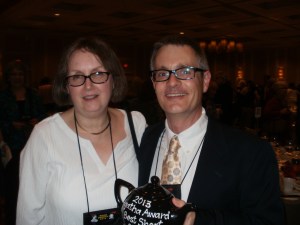
I read in a recent interview of Luci Zahray by Kate Flora that oleander is one of the most toxic of garden plants, all parts of it being deadly, and three leaves enough to kill a man. I had plants on my mind all through the Malice Convention not only because my garden awaited at home, but because Art Taylor’s March/April 2103 EQMM story “The Care and Feeding of Houseplants” was nominated for the convention’s Agatha Award for best short story. And it won! (Congratulations, Art!) The story, as I’m sure everyone can guess from the title, involves plant poisons, but also a lot more, which I’ll get to in a minute.

Due to the extraordinarily long and harsh winter this year, gardening is just getting going in many parts of the country. Normally, daffodils have flowered and gone up where I live by the time Edgar Awards week arrives. This year there are a few still in bloom even now. I imagine this disruption of the season will make its way somehow into this year’s crop of gardening mysteries.

Though I like to garden, I tend not to pick up gardening mysteries at novel-length very often; that’s probably because those I read at short-story length don’t surprise often enough. A freshly turned garden bed is obviously an inviting place for disposal of a corpse, and almost any garden provides the poisonous means of ensuring that there’s a corpse to dispose of in the first place. If you doubt that, just do a little research on the plants in your garden.

A favorite ground cover of mine, lily of the valley, is a highly poisonous plant for humans. If swallowed even in small amounts, all parts of this delicately white-flowered perennial are poisonous, and it can be fatal if consumed in large quantities. According to a source I found, dose yourself (or someone else) with lily of the valley and you’ll suffer abdominal pain, vomiting, and reduced heart rate. On the other hand, this most innocent looking of plants can also be used as an antidote to poison, because of its ability to reduce an accelerated heart rate. I was at a plant sale this past weekend with a friend who picked up a tray of lily of the valley and became alarmed when I mentioned its poisonous qualities—wondering if it could kill a dog. It can, but of course, absent human agency, a dog is extremely unlikely to ingest it.

A multitude of other poisons are to be found in my garden or nearby, so I imagine you’ve got them in your vicinity too: the bulbs of daffodils, and of the hyacinth that bloomed here last month can cause vomiting and diarrhea, and prove fatal. Foxglove, in large amounts, causes dangerously irregular heartbeat and pulse, digestive upset, and mental confusion. All parts of the laurel, rhododendron, and azalea plants are also fatal in the right quantities, producing depression, difficulty breathing, and sometimes coma.

And let’s not forget the cherry tree, of both the wild and cultivated varieties. Even the twigs and foliage of my “Cherry Pie Tree,” apparently, contain “a compound that releases cyanide when eaten”; “. . . gasping, excitement, and prostration” are the common results (according to Aggie Horticulture). Be careful with any rhubarb pies you prepare, too, because consuming that plant’s leaves is known to cause convulsions, coma, and a speedy death.

I could easily go on; it just takes a quick bit of Googling to get this kind of information. But that, in a way, is my point. Someone who comes up with a poison we don’t know about, and an inventive way to use it, is part way to a good mystery. But it’s hard to come up with something little known, and even a truly ingenious method of murder is only part of the trick. A garden mystery, like any other mystery, has also got to provide an interesting motive for murder and intriguing characters. And that’s what makes Art Taylor’s Agatha winning story so good. I honestly can’t remember what plant poison was used in that tale, but I recall vividly all the characters involved and the tensions arising from their interactions, which, of course, provide the motive for murder.

I have crime on my mind at least forty hours of every week, so I’ve no wish to recall the potentially lethal uses of plants when I’m trying to get away from it all in the garden. Still, who doesn’t find such facts about things we cultivate for beauty or nourishment interesting? I think it’s that contrast between the serenity of the activity of gardening and the deadly use to which the knowledge associated with it can sometimes be put that accounts for continuing interest in a genre most of whose murder methods have been used time and again. I’m going to sit out under my cherry tree now, beside the lily of the valley, and try to forget about murder. I hope you’ll check out the picture of Art with his Agatha Award and the assortment of photos from our pre-Edgars party (below).—Janet Hutchings

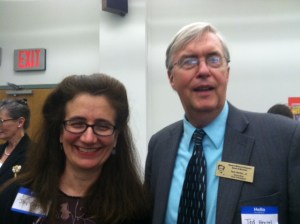
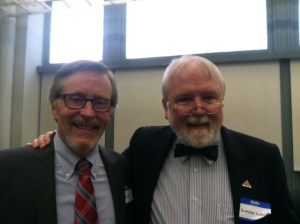
Parnell Hall & Ted Hertel

Parnell Hall & Ted Hertel

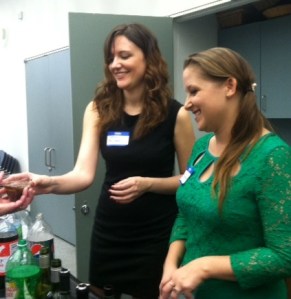
Dell Editor Mark Lagasse setting the scene

Deanna McLafferty and Jackie Sherbow

Deanna McLafferty and Jackie Sherbow

V.J. Kemanis

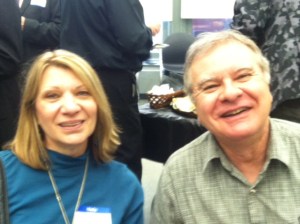
Joanne & Lou Manfredo

Kate Stine and John Pugmire

Kate Stine and John Pugmire

Joshua Bilmes

Joshua Bilmes

Naomi Hirahara

Tom Savage & Linda Landrigan

Tom Savage & Linda Landrigan

Christine Begley & Meredith Anthony

Christine Begley & Meredith Anthony

Joseph Goodrich & Jane Cleland

Joseph Goodrich & Jane Cleland

Jay Carey & Ted Hertel

Jay Carey & Ted Hertel

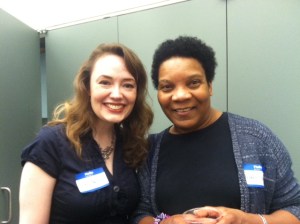
Hilary Davidson & Frankie Y. Bailey

David Dean & Brendan DuBois

David Dean & Brendan DuBois

S. J. Rozan

S.J. Rozan

Gigi Vernon

Gigi Vernon

Carol Demont & Cristina Concepcion

Carol Demont & Cristina Concepcion

Lina Zeldovich

Lina Zeldovich

Steve Steinbock

Steve Steinbock

Carson, Madelyn, and Tim L. Williams

Carson, Madelyn, and Tim L. Williams

Peter Kanter; Charles Ardai, Dorothy & Cormac Flynn

Peter Kanter; Charles Ardai, Dorothy & Cormac Flynn

Janet Hutchings

Janet Hutchings presents the 2013 EQMM Readers Awards

Marilyn Todd

Marilyn Todd accepting her Readers Award

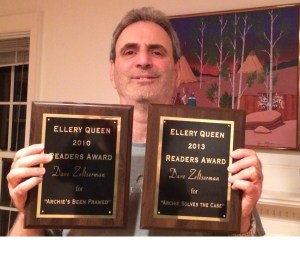
Dave Zeltserman back at home with his EQMM Readers Awards

the Chocolate Edgar

the Chocolate Edgar

Janet Hutchings and Art Taylor

Janet Hutchings and Art Taylor with his Agatha Award. (Photo courtesy of Terrie Farley Moran.)

Posted in Awards, Business, Conventions, Writers | 5 Comments

DIGITAL-EDITION SALE


From now through Monday 5/12, enjoy 50% off a one-year digital subscription to EQMM or AHMM, as part of Magzter‘s Mother’s Day Sale!

Ellery Queen Magzter Mother's Day

Posted in Digital | Tagged , , , | Leave a comment

“The Mystery of the Writer’s Ghost” (by Leigh Lundin)

Writing as L. Leigh, Leigh Lundin appeared in EQMM’s Department of First Stories in August of 2006 with the story “Swamped.” The tale went on to win that year’s EQMM Readers Award—in a competition in which first stories only very rarely place in the top three. Since that debut Leigh’s stories have appeared in both EQMM and AHMM, in the MWA anthology The Prosecution Rests, edited by Linda Fairstein, and in other publications. The Florida resident has recently been spending a lot of his time in South Africa, which has become the inspiration for some of his stories. He is one of the founders of SleuthSayers, the successor to the short-story blog Criminal Brief. Leigh describes SleuthSayers’ site as “bringing together professional crime writers and crime fighters.”—Janet Hutchings

“The syndicate’s behind it,” Frank said.

“Who?” asked Joe.

“The Stratemeyer Syndicate. For seventy years they kept their existence a secret. Our man disappeared into it, the most prolific mystery writer readers never heard of.”

“The guy who carried a Canadian passport and used aliases like Franklin W. Dixon and Carolyn Keene?”

“Pseudonyms, he called them, Joe. Noms de plume. Most people would call him a ghostwriter.”

“You’re talking Charles Leslie McFarlane?”

“Yes, the very one. He later authored mysteries and radio dramas under his own name, but his children’s books have never gone out of print.”

“Really? Like what?”

“Mainly us, the Hardy Boys. Our books continue to sell more than a million copies a year. McFarlane wrote twenty of the initial twenty-six novels. He penned the first sixteen given outlines by old Edward himself.”

“Edward Stratemeyer? The guy who founded the syndicate and brought the world the Bobbsey Twins, Tom Swift, and our brainy, fashionable friend Nancy Drew?”

“The same. His stable of authors mostly comprised newspapermen and women who agreed to write children’s books anonymously. Leslie McFarlane’s role remained a secret into the late nineteen seventies.”

“Wow.”

“He was a bit subversive when it came to authority figures. He once said, ‘Would civilization crumble if kids got the notion that the people who ran the world were sometimes stupid, occasionally wrong, and even corrupt at times?’ ”

“Cool! But that reminds me of Dad. We were forever saving him.”

“Although he worked to provide atmosphere and clarity, McFarlane didn’t like the books. He called them ‘the juveniles’ and considered the plots thin and the prose bad.”

“Really? Aren’t we the good guys?”

“Teachers and librarians disdained the syndicate novels. They complained about characterization.”

“Why? You have dark brown hair and I’m blond. That’s characterization, isn’t it?”

“Adults poked fun at the books’ excessive speech tags, calling them Tom Swifties. Such author intrusion left many people cold,” coolly pontificated Frank. “Robert Lopresti calls them unnecessary stage directions.”

“Hang it all,” responded Joe judiciously. He added heatedly, “That burns me up.”

“Speech tag verbs and adverbs form a slippery slope,” remarked Frank smoothly. “Whew! I’m glad we’re done with those examples.”

“Me too,” Joe repeated. “But the fact remains, Stratemeyer and McFarlane left a remarkable legacy.”

“Ontario named a public school after McFarlane and McMaster University archives his works. Our buddies Dale Andrews, Rob Lopresti, and Leigh Lundin have written about us and Tom Swifties.”

“And Stratemeyer, of course. Wasn’t he a scoundrel? (Hey, ya got to love that word.)”

“I think not. He was a brilliant businessman and entrepreneur. He not only admired Alger stories, he “completed” eleven boys’ novels under Horatio Alger Jr.’s name. That launched Edward into the publishing business and made him realize money could be made through ghostwriters. So began his syndicate, hiring writers like McFarlane, producing thirteen hundred novels in more than a hundred different series.”

“Wow, that’s a super story. Now we’ve got another mystery to solve.”

“What’s that, Joe?”

“How the editor let us get away with an article like this.”

Posted in Adventure, Books, Characters, Editing, Fiction, Genre, Guest, History, Novels, Publishing, Writers | Tagged , , , , , , , , , | 12 Comments

“Legal Mysteries: You Can’t Handle the Truth” (by Ted Hertel)

Milwaukee attorney Ted Hertel is also a fiction writer whose first published story, “My Bonnie Lies” (from The Mammoth Book of Legal Thrillers), won the Robert L. Fish award for best first short story by an American author. He has gone on to sell a number of other stories, receiving an Anthony Award nomination along the way. He is also a historian of the mystery whose articles have appeared in many journals and books, and he frequently reviews mysteries for Deadly Pleasures magazine. One of Ted’s longstanding connections to EQMM derives from his being an expert on the works of Ellery Queen. His essays on the fiction of our magazine’s founders include “Queen’s Gambit: The Life and Times of Ellery Queen” (in The Tragedy of Errors, 1999) and “Ellery Queen: The American Detective Mystery” (in Crime Spree, 2004). He also assisted with the editing of The Adventure of the Murdered Moths (2005), a collection of Ellery Queen radio plays. Once other mystery writers have read this post, however, I suspect that it will be his legal knowledge, not his knowledge of mystery classics, that Ted will be most sought out for. —Janet Hutchings

With almost any occupation, whether it is medicine, private investigation, or the law, the fiction writer must take certain liberties with the way the profession is presented. For example, any story about a private investigator is going to contain a murder or two (or a lot more). But real private investigators do not go around solving murders. Cop Steve Carella, in Ed McBain’s 87th Precinct novel Long Time No See, recalls that “[t]he last time [I] had met a private detective investigating a homicide was never.” Taking this sort of liberty with the facts does not seem to bother readers overly. If what goes on in the day-to-day life of the doctor, the private eye, or the lawyer were accurately presented, it would generally make for a very dull story.

Imagine this real life scenario happening in one of Erle Stanley Gardner’s Perry Mason books: Perry shows up in court for a hearing for one of his clients. He sits around all morning staring at the walls, only to have his case adjourned for two months because of an overcrowded court docket. Della goes off to the Register of Deeds office to record a document, only to have it flung back in her face by an overworked clerk because of some minor technical violation having nothing to do with the substance of the paperwork. Paul Drake sits in his car all night long watching some divorce client’s spouse and then discovers that he does not have a big enough empty soda cup. Situations like this would make for some pretty boring stories, yet these incidents perhaps more closely reflect the day-to-day practice of the law than books like John Grisham’s or Scott Turow’s.

So, there is little that is actually thrilling about real-life legal work. In fact, there is probably little that is actually thrilling (or at least entertaining) about any type of work. Which is probably why it’s called “work.” As a result, a “legal thriller” naturally needs to be pumped up. Writers find that they must juice up the storylines in order to please the reading public. I suppose that there is really nothing wrong with this. If the author cannot sell a book by presenting events the way they occur in real life, then he or she must take steps to see that the story is publishable and entertaining.

I think that certain of these adjustments are perfectly legitimate. For example, the writer can quite properly condense the time frame of the story. Real life trials take much longer to get to final disposition than fictional ones. This is acceptable because the reader wants the story to move along smoothly and quickly. Actual attorneys always have other cases that they are handling at the same time, while fictional attorneys often seem to have only one matter (whether it is civil or criminal) that they must deal with during the course of a book. Again, failing to reflect this does no harm, since the main focus of the author and the reader is on that one big case.

Of course from the perspective of a real-life attorney, this sort of thing is laughable. How many times have we all seen in books or on television where the client walks into the lawyer’s office with a serious medical malpractice case and the lawyer is already in court the next morning arguing motions (or, God forbid, actually trying the case)? This raises a lot of unrealistic expectations in people. I cannot tell you how many of my clients cannot understand why some attorney on television can get her case into court right away (and in New York City, for example, on top of it!) and why it takes me a year or more to get their case to trial. So when I said “this does no harm,” I meant from the readers’ perspective, not from mine as a litigator.

Another real-life difficulty is raised by shows such as CSI. Crimes there are solved by DNA or other forensic evidence. Yet some actual juries have been known to acquit defendants in the face of other solid evidence proving their guilt because there was no DNA testimony presented. Once again, unrealistic expectations have been created.

Other problems can arise when authors throw actual legal procedure out the window and just make up their own to satisfy the demands of the story. Or worse, the author does not even know the correct language to use or the right motion to make. One of the more egregious examples of this was in a book by a very popular author who shall remain nameless, wherein (note use of “genuine” legalism there!) the attorney moved the court to dismiss charges against her client “without prejudice,” which means she was seeking a dismissal that was not on the merits. She should have requested that the dismissal be “with prejudice” (meaning the case against her client could never be brought again). In other words the result of this faulty motion would be that the state could then retry the lawyer’s client for murder. Now unless the attorney was looking for another big fat fee for a second trial, this is a totally incorrect request (not to mention the malpractice suit against her that would be sure to follow in the event the state did make the effort to retry the client). A simple check by the author with any lawyer who does litigation would have caught this error, which simply shows a lack of concern for detail on the part of the writer.

Errors like that creep into many books. I am not just faulting authors of legal mysteries here. I recognize that most readers will not be the least bit concerned with this sort of difficulty. However, there is no advantage to be gained by an author who does not check the facts when it is so easy to do so. Just pick up the phone and call a litigator. All of us would love the ego boost of seeing our names in the acknowledgement section of the book.

By the way, the real criminal almost never stands up in the back of the courtroom and confesses, just in case you Perry Mason fans were wondering.

So, sit back, relax, and enjoy some legal thrillers. Just do not plan to take the bar exam based on anything you read in them.

Posted in Courtroom Mysteries, Editing, Fiction, Guest, Setting, Writing | Tagged , , , , , , , | 7 Comments

“The Mystery Gene” (by Miriam Grace Monfredo)

Former librarian Miriam Grace Monfredo is an award-winning writer of historical crime fiction. Her first novel, Seneca Falls Inheritance, was set against the backdrop of the first women’s rights convention. Since then she has written eight more novels that focus on the civil rights struggles of women and minorities in nineteenth-century America. She’s a notable short-story writer too, with many publications in magazines and anthologies, including two best-of-the-year collections. Some readers will also know her as the co-editor of two historical mystery anthologies, and EQMM is indebted to her for steering some of her students of creative writing our way. We have a new historical short story from Miriam coming up in EQMM soon, but in the meantime, she has some thoughts on what compels human beings to want to solve mysteries that we think you’ll find intriguing.—Janet Hutchings

A few weeks ago, editor Janet Hutchings wrote on this blog that attraction to conspiracy theories seems to be hardwired in the human brain. I think much the same wiring draws us to the mysterious. In that respect, conspiracy theorists are mystery writers’ not-too-distant cousins, the kind of relatives you pray won’t embarrass you at public functions.

Somewhere along the great Evolutionary Highway, an ancient progenitor or two picked up a gene which improves our chances for survival, but more on that later. Its carriers flourished, and what I’ll call the Mystery Gene became indelibly stamped in our DNA, like eye color and a craving for chocolate ice cream. Mystery writers undoubtedly receive a double dose, since if real-life mysteries aren’t at hand, we’re compelled to invent them. There are plenty of others, though, who actively search for mysteries: homicide detectives, forensic scientists, archaeologists, and mystery readers are just some who come to mind. These mystery-gene carriers don’t typically morph into conspiracy theorists. They lack the requisite pathology.

Here are two scenarios: one is an actual current event, the other . . . isn’t.

Our TV blares the synthesized trumpets of CNN’s BREAKING NEWS. We learn that Middle America Airlines flight #123 has crash-landed in a wintry Iowa cornfield. Miraculously the passengers reportedly walk away unharmed. FAA investigators later determine the crash was caused by a flock of dazed hypothermic flamingoes that mistook the winged craft for one of their own and attempted to turn it south. (The primary piece of evidence being the cornfield awash in pink feathers). Ah, yes, we agree; that would certainly do it. And we think little more about it. We’re satisfied with an explanation that fits the known facts and comforted that this is an isolated, if bizarre, event unlikely to occur again. Oh, a few ornithological naysayers will point out that pink feathers are not exclusive to flamingoes, nor do the birds frequent Iowa; a few more will insist the feathers were planted by the CIA to disguise what was a terrorist attack, but these will be dismissed by most as nitpicking and the product of unsound minds.

Then the trumpets sound again. This time we learn that Malaysian Airlines flight #370, originating in Kuala Lampur and bound for Beijing, China, is reported missing. If you carry the mystery gene you already know the meager particulars like the back of your hand.The relevant electrifying moment comes when a CNN commentator tells us to stand by; a panel of distinguished experts will be analyzing the plane’s mysterious disappearance.

When we hear that magnetic word, do we carriers hit the off button and think no more of it? Only if we’re fully anesthetized. We immediately check other channels to see if 1) CNN’s BREAKING NEWS is a mountain turning into a molehill, or 2) the plane has been located, having landed safely in an Iowa cornfield. Absent these explanations, we are left with an irresistible riddle: How could a huge Boeing triple seven, reputed to be among the most reliable of aircraft, literally vanish? This has all the elements of a classic mystery: how, why, where, and what- or whodunit.

Demonstrating the subject gene’s far-flung distribution, the Nielson Company reported that when CNN launched weeks of relentless 24/7 coverage of its headlined The Mystery of Flight 370, its international viewership rose 84 percent!

A CNN commentator’s explanation of that phenomenal number was “. . . interest is high because all of us have some theory as to what might have happened [to it].” Theory as used here is a questionable descriptor. So is CNN’s use of the word analyze to define the activity of its inexhaustible expert panels. Speculate is the more apt word for what these talking heads do for hour upon hour, days upon days. They are undaunted by constantly changing information (clues) when the inept or purposely misleading Malaysian government finally notices the whole world is watching and is not buying the obfuscations it allows to trickle out as fact. While changing clues may not derail CNN experts, they are guaranteed to drive us mystery aficionados right out of our minds. (Without rest and medication, one or two might even morph into the dreaded CTs.)

And now a mystery upon a mystery has been introduced: Why do millions worldwide hang on every word aired about Flight 370’s disappearance? Why, when we confront global climate change, endless religious and territorial wars, and world poverty, all of which receive little or cursory attention from 98 percent of humankind, does a single missing airplane compel the interest of so many?

If you believe the theory of natural selection, is species survival a subconscious reason for the intense effort to solve this mystery? Because we hope that if we find the cause, we can remedy and prevent it from happening again? And that the solution, unlike those of climate change, wars, and poverty, won’t require a wholesale, fundamental shift in human nature. Over which we have no foreseeable control. Then, too, most of us travel by air at some time or another and expect to complete our travel in corporeal form. In the case of the missing plane, unlike the flamingoes’ self-immolation, we are unsatisfied by what we don’t know and discomforted by the possibility of that unknown repeating when we board our next flight. Although by now some among us will have deduced enough to suspect the last plane we should ever get on is one operated by Malaysian Airlines.

There’s also the mystery’s altruistic component. Most of us have loved ones, so we can emphasize with those of Flight 370’s lost passengers and their desperate need for finality. Empathy, so sociologists posit, creates strong bonds beneficial for cooperation and thus contributes to species’ survival.

It’s likely the potent element of curiosity explains a substantial portion of that 84 percent. Instead of calling the plane’s disappearance solely a mystery, we could expand the definition to include thesaurus synonyms: an unknown and a curiosity. Human history teems with the useful items invented when a needy mystery-gene carrier is driven by curiosity. Since I clearly can’t list them all, just a few of our solutions must serve: the wheel, beer, penicillin, Boeing 777s, and pizza.

Curiosity also accounts for another category of mystery-seekers: historians are commonly impelled by not much more than a modest need to know. If history teaches us what it means to be human, there are countless lessons in its mysteries. My own books are set in the maelstrom of mid 19th century America and attempt to fill in some gaps where the historical record is silent. Research into that silence is often sheer grinding detective work. Yet, like Sherlock, I am never happier than when I find an inexplicable incident never satisfactorily resolved. I’ve based short stories on these mysteries, for instance: What caused Amy Robsart Dudley, the young wife of Queen Elizabeth I’s handsome horse master, to fatally tumble down a flight of stairs? What was behind the mysterious disappearance of the Confederate spy Harrison during the battle of Gettysburg? While both these incidents occurred at turning points of history, both stories stemmed from nothing more profound than my own compulsive curiosity.

So, can we confidently say the mystery gene increases our chances for survival? It creates fear and self-interest (our plane disappearing ); inspires empathetic connection with strangers (victims of tragedy); and expands knowledge through curiosity Or is the compelling attraction of mystery something more inscrutable? Something we can’t explain.

I don’t know the answer. To make a point I isolated a single imaginary gene in the vastly complex human genome. But genes don’t act in isolation. I do think, however, our fascination with the mysterious is old and powerful and existed eons before Japanese puzzle boxes. Before Wilkie Collins (The Moonstone) and Dickens (Bleak House), and then Edgar Allan Poe ever set pens to paper. Of one thing, though, we can be certain. If the mystery of Flight 370 remains unsolved, it will inescapably become a target for generations of theorists, conspiracy-minded and otherwise. And to bring this full-circle, at least when we mystery writers take a shot at it, we’ll label our efforts fiction.

Posted in Fiction, Genre, Guest, Historicals, History, Readers, Story, Writers, Writing | Tagged , , , , , , , | 4 Comments

“Bookends” (by Lou Manfredo)

Lou Manfredo’s stories for EQMM include a series of five classical whodunits set in the mid twentieth-century on Long Island (a series we were very sorry to see end!) as well as some of the dark crime tales for which he is perhaps better known. One of his noir stories, “Case Closed,” can be found in a volume to be released next week: The Best of the Best American Mystery Stories: The First Ten Years, edited by Otto Penzler. But the author is also a novelist, with three books out in a series starring Brooklyn cop Joe Rizzo (Rizzo’s War, Rizzo’s Fire, and Rizzo’s Daughter). In a starred review of Rizzo’s Fire, Kirkus Reviews called Rizzo “the most authentic cop in contemporary crime fiction.” After reading Lou’s account of how his own love for reading began, I imagine readers who haven’t discovered his fiction yet will want to do so, and we’ve got a new Manfredo story coming up later this year in EQMM. —Janet Hutchings

I suspect the most impossible of tasks would be to find a writer who had not first been a reader; a voracious one, more than likely.

I’ve recently had occasion to contemplate that while sitting at my writing desk, fiddling with a new ribbon for my Smith-Corona. (Yes, I confess: I write on an electric typewriter. I am a proud and defiant dinosaur). My eyes had fallen upon the bookshelf opposite my desk to what I consider to be my most valuable and cherished possessions: twenty-seven hardcover volumes of original Hardy Boys mysteries and a single hardcover of Follow My Leader by James B. Garfield.

Those books represent my first experiences with the magic of reading, the magic which, years after its discovery, transitioned me from reader to reader-writer. Each glaringly blank sheet of paper I now wind into my Smith-Corona is directly descended from pages of those childhood books and the defining significance of the manner in which they arrived into my life.

Growing up, I didn’t see too much of my dad. He worked two jobs, leaving at about nine-thirty in the morning and returning after midnight. I usually left for school before he woke and went to sleep long before he returned home. But we always made up for it by spending quality time together on weekends, and with the occasional special surprise.

And thus entered the magic when I would periodically awaken to the warm reminder that although I didn’t see him during the week, I did have a very loving father.

Sitting on the night table beside my bed I would find a package tightly wrapped in plain brown paper. My dad had placed it there after midnight. I knew what the package held: One of the very same Hardy Boys mysteries still, all these years later, neatly arranged on my bookshelf, most in their original dustcovers, some with the dollar-twenty-five price stickers still affixed.

The brown paper wrapping, deliberately placed by my dad, had enhanced the thrill of discovery. Which volume lay beneath this time? The Twisted Claw? Footprints Under the Window? While the Clock Ticked? The mystery, you see, began before I had even laid eyes upon the actual book.

Looking back, I eventually realized how much I had learned from those novels: things which remained deep in my psyche to be mined years later when I began writing short stories. I had experienced that tingling, cozy feeling a book, in particular a mystery, could instill in a young boy tucked away in his warm bed on a cold night, a circle of reading light the room’s only illumination. Nothing quite equals that.

I remember once raiding my piggy bank of quarters and dimes and heading to the neighborhood five-and-ten store. There I bought a shiny, thin silver flashlight and two batteries. That night, after my official bedtime, I tented myself under the bedcovers and, using my new flashlight, began reading my latest Hardy Boys treasure. It was a ritual I would repeat many times. Looking back on all my experiences in life—some fraught with actual danger—those early under-the-covers reading adventures remain among the most thrilling. The great rush of secret, warm excitement, so free of impurity or sin. Magic.

And then came Follow My Leader. That book was a gift from a family friend who, like my Dad, was an avid reader, always in the middle of a book, sometimes two simultaneously. Knowing that I was a newly recruited reader, she subtly nudged me to a broader experience. Follow My Leader is the story of a young boy about my age at the time, who is blinded in an accident. The story details his many struggles, failures, and ultimate triumph, culminating in his partnership with a seeing-eye dog he named, “Leader.” It is a sad, melancholy, and yet ultimately reaffirming story. The magic, I learned, could exist between book covers unadorned with exciting characters like Frank and Joe Hardy. My world had expanded beyond my Brooklyn neighborhood, beyond my age, beyond my circumstances. Magic.

And so finally we arrive at the point of this writing. My life has been bookended, you see, by two very special people: my dad with his imaginative delivery system and my beautiful daughter. When I was a boy, my dad conveyed that I was special to him. I was important. As an adult, my daughter managed to do the same.

You see, although I always safeguarded my Hardy Boys novels, circumstances had conspired to cause Follow My Leader to disappear into the foggy quagmire of time. It was simply gone. But apparently I had mentioned it somewhere along the line to my now adult daughter. A few years ago, on Christmas Day, a worn and well-read copy appeared, tightly wrapped in plain brown paper. She had tracked it down on her computer and bought it for me. I have never before, nor will I ever receive a more special or thoughtful gift.

And the irony had not been lost on either of us. My daughter utilized the very technology that I always avoid, to the extent modern demands will allow, in locating and purchasing the book; technology akin to that which now produces e-books. My childhood books sit a mere six feet from my desk, waiting. Occasionally, I slip one from the shelf and peruse it. I have actually reread some Hardy Boys from cover to cover over recent years. And they never fail to get the mysterious power of creativity flowing, and the magic—first experienced so long ago—returns with the familiarity of an old and dear friend.

I often wonder, what will sit on the shelf opposite the writer of the future? Perhaps obsolete, non-working electronic gizmos, their computer chips devoid of memory by the passage of time and inactivity.

But I know of one little boy who will someday have hard-copy books to hold and feel and smell; Hardy Boys and Leaders, Sawyers and Finns, Swifts and Rye Catchers, cowboys and pirates. Yeah, my grandson, just a baby now. I will be his first bookend. He’ll have to find the second on his own. Or, as in my case, someday he may luck out with an insightful, loving child of his own.

Want to do something special? Buy someone a book. A real book. Maybe, ten years from now, twenty years, thirty—they will hold it in their hands and think of you. And they’ll smile.

Posted in Adventure, Books, Guest, Readers, Story, Writers | Tagged , , , , , , , , , | 6 Comments