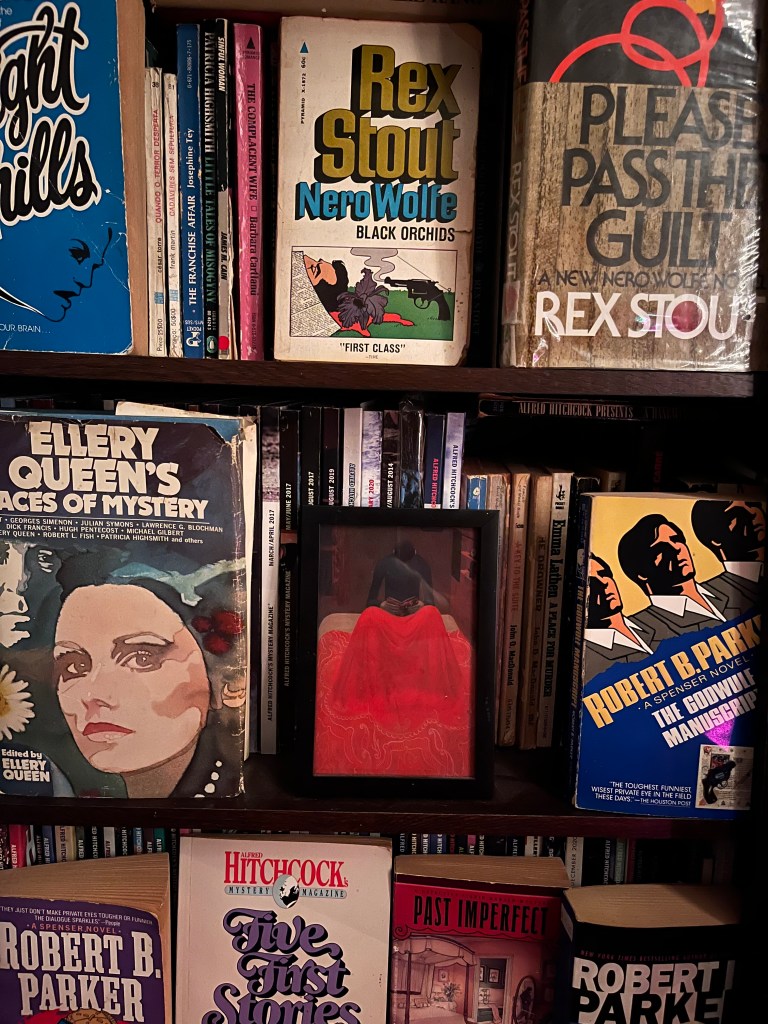
From the editor’s personal collection. Print in frame is of the painting “Murder Mystery” by Margo Hoff (1945).
When the COVID-19 quarantine came into effect in the spring of 2020, we at EQMM already had experience working from home. Our last few offices had space-sharing schedules, and many of the workers in the NYC office lived outside of the city. So when we got the note to stay at home, I packed up my things and headed back to Queens, knowing not much about the situation but knowing one thing for sure: I did not like to work from home.
I was one of the only workers in the office who generally came every day. And now, I was at home with more supplies than ever, along with decades of magazines from both EQMM and AHMM when our office closed fully, and “home” was a twelve by ten foot studio apartment. We knew how to do the work remotely; were well situated for it. But I wasn’t prepared for how the work became harder during the time of crisis, and how stale that 120 square feet would become.
We did eventually get a room in a shared office floor, which was very nice. But after a few years of that, I found myself working from home more and more by choice. I began to think about this transition recently, and it occurred to me that all of the editors of EQMM have worked from home at times or even primarily during their long tenures.
Frederic Dannay lived in Westchester, which is something I think about when I look at his papers and correspondence. It becomes the backdrop, for me, to his writing—and whenever I hear of the towns where he lived, I think of him. Eleanor Sullivan also worked from home, which means that it was hard to track down some of her papers for our 80th anniversary symposium. But it also meant she had a lot of correspondence.
Of course, most likely nobody is going to be looking at the editors’ of today’s email inboxes in the decades to come. But when I started thinking about why I was now thriving, I realized that being at home gave me access to all the things I had brought into my life to help me feel stronger, more diligent, and mostly more creative. I thought of Dannay, who had a large personal library; in fact, the early editions of EQMM contained many reprints from books he had collected. He had an extensive poetry collection, like myself (but mine is NYC apartment sized—it’s still just a one-bedroom, you know). And I bet he stood looking and thinking and plucked a volume from the shelf when feeling stuck.
There’s so much guilt around productivity in our culture. I felt guilty staying home, but once I remembered the through line connection of these figures from the past, I felt like I was continuing a long lineage. And I wasn’t alone.
So, from my luckily warm home to yours, happy holidays and winter solstice ahead, from EQMM.—Jackie Sherbow
If you read EQMM and follow our blog, chances are you’re familiar with Pat Black, the Yorkshire-based journalist who regularly contributes to our magazine. In this special post, Black draws on examples of classic mysteries, from Christie to Allingham, and discusses why Christmas and crime go so well together. Also, be sure to stay tuned for a holiday story by Pat in next year’s winter issue.
When it comes to fiction at Christmas time, ghost stories seem to have it all wrapped up. With A Christmas Carol as a starting point, all the way through to MR James’ chilling adaptations for the BBC from the 1970s all the way to the present day—it is the time for spectres and visitations. When the light is at its thinnest, and the veil between the worlds of the living and the dead is most easily breached.
But there’s another genre that lends itself well to festive reading—crime. Much like the preponderance of ghosties and ghoulies, this is counter-intuitive. Christmas should be a time for feasting and merriment, of warmth and comfort in the company of our fellow humans… So it shouldn’t really make sense for us to cosy in with some grim, sometimes gruesome reading. Maybe it’s to do with the shifting seasons, rather than their associated festivals. Perhaps with the dark in ascendance, there are things to fear in there, reasons for foreboding, our blood chilling as the temperature falls outside.
Winter is no joke in our uncertain times and changing climate—but earlier in human history, proximity to a fire was the difference between life and death. Maybe there’s a yearning for stories that reflect this desperate state, even as we seek communal warmth and closeness in our own way. And maybe that storytelling instinct, the need to entertain each other with tales of darkness and danger, is another link to our need for festive crime.
But there’s another reason—Christmas is a time for gifts, and if you’re anything like me, that means good books. Handsome ones, too. Like the collected Sherlock Holmes. In it, you’ll find a classic Christmas story: The Adventure of The Blue Carbuncle.
If you’re imagining 221B Baker Street with a well-fed fire shooting sparks, maybe some crisp muffins while we’re at it, a good pipe, today’s Times and strong coffee, while snow falls outside on London’s streets, then congratulations—you’re already toasty. The tale concerns the stolen gemstone in the title, as well as a Christmas goose which turns out to be the key to the theft. Not for the last time in these stories, Holmes takes pity on a hapless criminal after exonerating someone framed for theft, betraying a sentimentality which we do not readily ascribe to the great detective. It ends, perfectly, with Holmes and Watson preparing to feast in the warm sanctuary of Baker Street, with all wrongs righted outside.
Dorothy L Sayers wrote a cosy mystery featuring Lord Peter Wimsey—A Necklace Of Pearls. Set in an English country house, dressing for dinner, assembled guests… let’s face it, it really needs a murder. But there’s no body in the snow here; Sayers’ golden age peer looks into the missing pearls in the title, a gift from Sir Septimus Shale for his daughter, with a brand new stone added to the necklace every year. Wimsey sniffs out the thief, and the location of the lost pearls, just in time for Christmas.
Agatha Christie has entire collections filled with seasonal tales, but we’ll allow her dapper little Belgian to represent her this Christmas. Hercule Poirot’s Christmas is the obvious place to go for the classic Christmas golden age murder mystery, but we’ll swerve to one side for The Adventure Of The Christmas Pudding. This one is a riot, which sees Poirot initially engaged to find a ruby stolen from an eastern prince. As part of his investigations, the sleuth is invited to spend Christmas at a fancy house, wherein he is inveigled in a number of plots. One of these involves a “faked” murder which then appears to turn into a real one. A typically clever and twisty plot is unpicked by the Belgian, who ends up with a kiss under the mistletoe as recompense by the end. Along the way the part played by the pudding in the title is revealed and—yes!—there is indeed some blood on the snow.
Margery Allingham’s Albert Campion takes on a mercy mission of sorts in The Man With The Sack. Answering a call from his friend, Mae Turrett, the “universal uncle” heads to the Turretts’ country retreat for Christmas. Long train journeys; home for the holidays; and, as ever, England between the wars is placed under the microscope by Allingham, as the certainties of the aristocracy in the early 20th century are exposed in a tale of theft.
In Rumpole’s Christmas, John Mortimer’s portly, slightly grumpy barrister begins to take on some ancient, pre-Christian characteristics. Apparently no lover of the festive season, Horace is tasked with trying to keep a younger member of the Timson crime clan out of prison, after one of the O’Dowd family is filleted during a dispute. Rumpole has a raging hangover during this story, but it has a nefarious purpose. The “spirit of Christmas” in the title doesn’t refer to anything in Rumpole’s gift, but to a carve-up between his opponents. Win a few, lose a lot, as Rumpole reflects, ruefully.
But there’s something ancient, possibly pre-Christian, about Rumpole and his forays into Pommeroy’s wine bar (to be fair, it doesn’t need to be Christmas for Rumpole to end up there for a snifter or two). Our boozy hero is a bewigged Bacchus—perhaps not the most enthusiastic spectator at the pantomime, but certainly a celebrant at the feast. For lovers of classic crime, maybe the ghost of Christmases past, in his cloak and wreath, wears the face of Leo McKern?
And this cosy sense of celebration takes us to a strange Christmas crime tradition—the classic board game, Cluedo (or Clue, for American readers). The classic whodunnit board game is linked to Christmas, for me, and there’s a tactile memory associated with it, as well as the fun of playing the game with family as a boy. There’s the weapons, for one thing—the frayed ends of the rope, the solid lead piping, the treacherous sheen on the candlestick, the testable point of the dagger and, of course, the wee gun. The cards, sheathed in their holders, concealing the identity of Professor Black’s killer. The pencils, even, whispering across the suspect list sheets. Who can it be? Mustard? Peacock? Scarlet? Plum?
I put Cluedo before Monopoly, any day of the week… it seems less murderous somehow. One day, perhaps very soon, Santa might bring a new edition of Cluedo for my own children to enjoy. I hope so. It’s top of my list this year.
May all your Christmas crimes be confined to the pages of a good book. All the best to you and yours.
“Art is everywhere, except it has to pass through a creative mind.” -Louise Nevelson
I have always been struck by this line from Worstward Ho, Samuel Beckett’s 1983 novella: “Ever tried. Ever failed. No matter. Try again. Fail again. Fail better.”
As a therapist and writer, I believe the wording sums up accurately both the clinician’s and the artist’s experience. It captures the struggles, uncertainty, and much-needed indefatigability of both professions.
Perhaps, more prosaically, this same sentiment was expressed by Albert Einstein. Once, when asked how he worked, he replied, “I grope.”
As I acknowledged in my book, Writing From the Inside Out, “Not an attractive word, grope. Sounds too much like lope, or dope, or mope. As an image, groping has associations with unpleasant activities like stumbling around in the dark, feeling blindly with your fingers, or enduring a series of false starts and wrong turns. It sounds unprofessional, almost haphazard, and too susceptible to the whims of luck and circumstance.”
I have taken the liberty of quoting from a book of mine, as well as from Einstein and Beckett, to preface my discussion of an issue that sometimes confronts clinicians treating a creative patient. Ensnared by anxiety while working on a difficult project, the patient often asks their clinician—sometimes only implicitly—for guidelines or a technique for addressing the new work’s problems, and so quelling the doubts and fears it has birthed. In my experience, such patients are not only looking for pragmatic suggestions for alleviating their concerns but need help coping with the shame they associate with having such difficulties.
In other words, and in the minds of many creative patients, real artists do not grope. They plan, reflect, ponder, conceptualize, synthesize, outline, embellish… create. Their work is the result of craft, inspiration, thought, and insight. To be blunt, a real artist knows what the hell they are doing.
This gnawing belief holds true for many creatives, whether writers, painters, musicians, or designers. It also holds true for many clinicians, whether therapists, psychologists, psychiatrists, or social workers.
In a previous column, I suggested that 1 of the root causes of procrastination is a fear of shameful self-exposure. In my view, a creative patient’s difficulties with a project, and their belief that there is some technique that offers a solution, evokes a similar shame. There must be away to solve these problems, they think, and if I were a true artist, a real professional, I would know what that way is.
So much for, “Try again. Fail again. Fail better.”
I recall a session some years back with a writer patient struggling with the plot details of his first novel. He had published a few essays and a number of short stories, but working out the narrative issues of this complicated novel was seemingly beyond him.
“There must be some technique that every novelist knows,” he said plaintively. “Some rule. I guess I just don’t know what it is.”
Based on what we had explored previously about his childhood experience with a demanding and pedantic father, knowing (and the rules, facts, andexperience this knowledge was built on)was acore value in defining one’s worth—and thus one’s worthiness to be loved. (Reminding me of something I had heard during my years as a Hollywood screenwriter, concerning the actor Steve McQueen’s description of the only type of character he would play: “I’m not the guy that learns; I’m the guy that knows.”)
Given the similar ethos fueling my patient’s shame, my mentioning Einstein’s quote about groping did not do much to allay his concerns. So I tried to elaborate.
“I think what the quote suggests is that a professional person’s view of their work include in it the reality that all artistic effort, in a sense, is a groping toward something.”
“What the hell does that mean?”
“Let me put it this way: A writer like yourself, a real craftsperson, should know that the tools of creative preparation—plot construction, reflection on theme and content, an understanding of how to devise realistic characters—these tools have been developed for one reason only: to enable them to grope.”
I spread my hands, in an attempt to come off as less pedantic myself. “It’s only logical, right? The higher your skill level and experience, the more likely you are to break away from the known way of doing things. That kind of exploration has uncertainty built into it.”
My patient nodded. “That reminds me of something I read. What the cellist Pablo Casals said. ‘Learn the notes and forget about them.’ Are you talking about something like that?”
“Pretty much. It’s only when you reach a high level of competence that you’re finally able to grope. Like where you are with your novel. Given your past experience and talent, a new project like that only gets harder, not easier. You find that you’re demanding even more of yourself.”
“Lucky me.” He gave me a wry grin. “Well, shit, if it was good enough for Einstein…”
Sessions like these reveal how often creative patients fear Beckett’s notion of “failing better,” and yearn for models or guidelines, not merely to quell their anxiety but to counter the shame underlying it. Even veteran artists need the validation that confirms they “know what they are doing,” though the wisest among them know that is not the sole prerequisite for doing good work. That happy outcome requires risk, accident. As an actor patient once explained it to me, “Rehearse like crazy, then wait for the mistakes.”
In my 30+ years of practice, I have come to believe that what is true for my creative patients is true for clinicians. Too often we adhere to conventional dogma when it comes to treating patients, relying too readily on the dictums of diagnostic categories or the claims of personality theory. Knowledge of these things is crucial, of course, but since I feel that therapeutic work is both a science and an art, we have to be careful not to rely so much on the profession’s orthodoxy that we are blinded to the wisdom of our own instincts, the potential for our own unique approach to a patient’s issues. Which inevitably entails risk.
A book that had a profound influence on my thinking in this regard, written many years ago by philosopher William Barrett, was The Illusion of Technique. As the title infers, it is a ringing defense of creativity as a spontaneous reaction against the false sense of security promised by reliance on rigid structures, belief systems, and techniques.
In other words, a closed system of thought is a dead system. Equally true, I believe, for both creative patients and their therapists.
Again, an anecdote from Einstein’s life: when a student complained about his difficulties with math, Einstein replied, “Don’t worry about your troubles with mathematics. I can assure you mine are far worse.”
Another allusion, no doubt, to the reality of struggle, uncertainty—groping, if you will—as the price of any worthy creative endeavor. After all, as my author patient said, if it was good enough for Einstein…
Mr. Palumbo is a licensed psychotherapist and author in Los Angeles. His email address for correspondence is dpalumbo181@aol.com.
(This essay previously appeared on PsychiatricTimes.com)
David L. Wallace is a professor of English at Long Beach State University, and he has published a number of articles about the effects of closeting on queer people. He lives in West Hollywood, CA, where he spends as much time as possible swimming laps, hiking, running, cooking good food, reading mystery novels, and joining friends for happy hour. Here he shares his experience with a series that has captured the hearts of many: the Three Pines mysteries by Louise Penny.
I found best-selling author Louise Penny’s village of Three Pines about fourteen hours after I gave up looking for it. To be honest, the conceit of a village tucked away in a hard-to-find valley between Montreal and Vermont that is not on any map and has no cell service always struck me as a bit fanciful. But I have been willing to suspend disbelief because I like the village Penny created and the quirky characters with which she populates it.
As I drove unpaved back roads in the Eastern Townships to see the sites that inspired the Old Hadley House, Sarah’s Boulangerie, and the abbey of Saint-Gilbert-Entre-Les-Loups I kept losing cell service and hoping the directions stored in my GPS program would get me to the next village on my Three Pines itinerary. The third time my cell status declared itself SOS deep in the Quebec woods, the notion of a quaint village cut off from most of civilization just over the next ridge seemed completely plausible, and I couldn’t help but wish that it would find me worthy of revealing itself to me.
I began to understand how Penny constructed Three Pines at my third stop in the village of Sutton where I sat in a gazebo in the little town square eating a marvelous cheese and raspberry pastry from the local boulangerie. To be frank, each of my stops had been a little disappointing: The Old Hadley house is a pink Airbnb now; the long hallway of the abbey was interesting but lacked the trick of light Penny describes in The Beautiful Mystery, and the store that inspired Sarah’s Boulangerie was more a specialty grocery store with no flakey croissants at three in the afternoon.
As my teeth sunk into the pastry and I fished the Gamache mystery I was currently reading out of my backpack, I began to understand that one of Penny’s many skills as a writer is to glow things up—to take inspiration from a physical place and then add elements either imagined or from other places, making Three Pines the best of everything she has culled from the villages of the Eastern Townships.
I saved Lac Brome/Knowlton for the last stop on my tour as the fan sites identified it as the village in which Penny lives. My GPS found enough bandwidth to direct me to my hotel, and just after 5 pm I started exploring the village, crossing a stream that might be the Riviére Bella Bella, noting that I would have to come back in the morning because the cool bookstore that inspired Myrna’s new and used bookshop had just closed, and spotting a coffee shop for my next-morning writing session.
I hadn’t expected to find three tall pine trees in the square or to see a grizzled old poet walking around with her pet duck, but I had hoped that one of the two bistros in town would be something like the Olivier’s bistro with its two fireplaces and would serve a reasonable facsimile of the amazing food Penny describes in the books.
Both bistros were disappointing; I had mediocre fish and chips at the pub version (although the sangria and the view from the patio were nice). I went for a glass of wine and dessert at the other, and was one of eight customers lost in the large space. As I sipped my wine and ate very disappointing carrot cake, I realized that the aspect of Three Pines I had been hoping for was village life—the sense of familiarity and community that is a constant presence in Penny’s fictional village no matter how many times a murder threatens to tear the community apart.
After my wine, I walked along the little river, noting an abandoned building with a big exhaust fan that I decided could have once been Olivier’s bistro and house nearly overgrown by trees and shrubs that I tried hard to make into Clara Morrow’s cottage. I concluded my walking tour by climbing up a small rise to a bench overlooking the village green and imaging the retired Chief Inspector Gamache sitting there reading his father’s copy of The Balm of Gilead. I turned back toward the green and thought that just maybe I saw Myrna peeking out of a window from her apartment above the bookstore.
I gave up finding Three Pines and went back to my hotel and settled in with The Nature of the Beast, entering the Three Pines in which a nine-year old, tall-tale-telling boy is murdered because no one believes that he saw a gun bigger than a house in the woods with a monster.
I found Three Pines the next morning when I entered the coffee-breakfast-lunch-wine shop and thought immediately, “Oh, Olivier closed his bistro and opened this place.” My café au lait was served (sadly) not in a bowl but a mug, but my raspberry/cheese pastry was every bit as good as the one from the day before.
As I settled at a little table against the wall and set up my laptop to work on a scene from my own fledging murder mystery, I stopped to watch the dozen or so people who had pushed four tables together in the middle of the room. Their conversation was in French so I couldn’t figure out why they were meeting, although they each had a binder from which the flipped pages. Whatever the meeting or activity was, it broke up about twenty minutes later, and I watched as members of the group chatting in twos and threes. And there it was—Three Pines—the kind of neighborly familiarity that Penny uses as the backbone of her fictional village’s society.
An hour later I had finished sketching the scene in which all my suspects are present at a happy hour in a fictional gay bar in Los Angeles and decided it was time to visit the bookstore. As I entered the bookstore, I saw a tall woman with glasses standing to the side of the front counter and wondered, “Could it be?” I wandered through the large inviting space pretending to browse as I stole looks at the tall woman, comparing it to a picture of Penny on a poster, and decided that, indeed, it was her. When the people she had been talking to left, I plucked up my courage and thanked her for the books, and then I found Three Pines for a second time.
Penny was absolutely gracious, introducing herself even though I clearly knew who she was and laughing when I described looking for the big gun in the woods as I walked down the hill to the bookstore. When I mentioned that I was writing a piece in which I used a line of poetry attributed to her character Ruth Zardo, she walked over to a corner of the bookstore and pulled a book by Margaret Atwood off the shelf and flipped to a page so I could read the whole poem. When I mentioned that I had been working on a scene from my own murder mystery at the coffee shop, her eyes lit up and suddenly we were two writers talking about the pleasures of plotting a murder mystery. I was a bit star-struck as I floated out of the bookstore and realized that I had not thought to buy one of her books and ask her to sign it. I turned to go back but changed my mind and continued on to my car because Three Pines had found me for a couple of hours, and I didn’t want to do anything that would spoil its magic.
Dennis Palumbo, M.A., MFT is a writer and licensed psychotherapist in private practice, specializing in creative issues, primarily in the entertainment industry. His award-winning series of mystery thrillers—Mirror Image, Fever Dream,Night Terrors, Phantom Limb,Head Wounds and the latest, Panic Attack—feature psychologist and trauma expert Daniel Rinaldi. He’s also the author of Writing From the Inside Out, as well as a collection of mystery short stories, From Crime to Crime. Recently he served as Consulting Producer on the Hulu limited series The Patient, and here (in an article first published in the journal Capital Psychiatry) he tells us about how the play out of the television crime drama affected his real-life patients.
After seventeen years as a Hollywood screenwriter (the film My Favorite Year; the sitcom Welcome Back, Kotter, etc.), I retired from show business and have been a licensed psychotherapist in private practice for over thirty years. During this time, my writing has been confined to articles and reviews, as well as a series of mystery novels whose protagonist is a psychologist. My point is, it’s been so long since I was a dues-paying member of the Hollywood industry that I was quite surprised to hear from the team of Joel Fields and Joe Weisberg. Writers of the award-winning TV series The Americans, they’d reached out to me to act as advisor on a new show they were developing. Called The Patient, it was about a serial killer who kidnaps and holds hostage a well-known therapist, in hopes that he can “cure” the killer of his homicidal urges.
Apparently, my former career as a script writer and my current one as a therapist prompted them to see me as a reasonable person to act as consultant on the new series. Essentially, what they wanted was for me to vet each episode’s scripts for clinical accuracy and to “make sure the therapist sounded like a therapist”—or as much like one as possible given the bizarre circumstances of the show’s premise.
Over the coming months, I did my best to keep the narrative within the range of plausibility, including suggesting the occasional line of dialogue or therapeutic interpretation. Just as we were finishing the script for the last episode, it was announced that Steve Carell had been cast as the therapist. A wonderful actor, he’d been given a salt-and-pepper beard and glasses. Whether or not it was conscious on the writers’ part, he looked somewhat like me. Which, at the time, I just found amusing.
My working relationship with Fields and Weisberg was one of the most pleasant professional experiences of my life. Moreover, the two writers were very gracious about my contribution when doing PR interviews leading up to the series premiere. During one such interview, when writing up the story for Newsweek, the reporter off-handedly mentioned that Carell’s character looked like me.
It wasn’t until the series began airing on Hulu that the ramifications of this became apparent in my therapy practice. A number of patients who’d begun watching the show pointed out that Carell’s therapist character looked a lot like me, and on occasion even sounded like me. (No surprise, since I’d suggested some of the therapeutic comments the therapist made.) Naturally, I had to process this with these patients, some of whom were quite upset at seeing the therapist chained to a bed, helpless. More than one half-jokingly worried that the series’ premise would give “some crazy person” the idea of kidnapping me. Did I feel I was in danger? they asked. I answered honestly that I didn’t, while privately wondering why I’d never even entertained that idea when working on the show.
Moreover, had I been unforgivably clueless in not anticipating this reaction from my patients? I reminded myself that Steve Carell hadn’t been cast until the series’ scripts were almost finished, that I had no idea he’d be playing the therapist, and certainly no idea how they were going to make him look. Yet I still felt pangs of remorse for the distress the show’s depiction of the therapist was causing for some of my patients.
As the weeks went on, and episode after episode aired, it became obvious that seeing an avatar of their therapist was upsetting to a number of my patients. Of equal interest during sessions was the reaction of those patients who found the whole thing amusing, or at least presented it as such. They even joked with me about the series’ story-telling: why didn’t the therapist try harder to escape? Why didn’t he just refuse to talk to the serial killer? Is this how you would react in this situation, Dennis?
Of course, the narrative choices displayed on-screen were made by the show’s writers, not me. I was merely the consultant. But this didn’t matter. What did matter, and what ended up being of real clinical interest (and value) was what some patients’ transferential connection to the therapist character and the story revealed about both their own core issues and their relationship with me. As Robert Stolorow has reiterated, there is only subjectivity and context; in this unusual situation, there was a patient’s subjective experience of me in the context of our therapeutic relationship, and then a kind of meta-subjectivity/context experience through the narrative of a TV series.
(SPOILER ALERT: I’m going to discuss the series’ final episode)
For a select few of my patients, as I’d expected, it was the series’ final episode that elicited the strongest reaction. Not only does the therapist fail to escape, he’s strangled to death on-screen by the serial-killer patient. This horrible murder is hardly ameliorated by the killer’s decision to send an anonymous letter to the therapist’s family, telling them where they can find the body so it can have a proper funeral. The last time we see the serial killer, he’s the one chained to the bed, his mother holding the key to the chain’s lock. Since she’s known all along about her son’s activities, we’re left to wonder if/when she’ll release him to potentially kill again.
A couple patients revealed that they’d cried at the end, one of them pointing an accusing finger at me and saying, “You better not fucking die!” Again, said half-jokingly. And yet, not. The few others who’d stayed with the show all the way to the end were angry at both the series’ writers and at me. Their reactions ranged from disbelief (“How could they end a show like that? How come the killer gets away with it?”) to frustration (“That’s not fair to the viewers. We deserved a better ending.”) to simple creative criticism (“I hate ambiguous endings.”).
As difficult as the sessions were with these patients over the course of the series’ run (including my own guilt at having put them through it), some of the clinical work that arose from our discussions was quite beneficial. A greater understanding of the contextual nature of our therapist/patient relationship undoubtably occurred. Moreover, we often reached a deeper understanding of the dependency/resentment dynamic at work in the therapeutic dyad. And, in one or two cases, the discussion regarding the show was a springboard to a more energized, proactive engagement on the patient’s part.
Still, I have somewhat mixed feelings about my participation in the series. It was often an exhilarating experience, due primarily to the talent, receptivity and warmth of both Joel Fields and Joe Weisberg. And while I regret the distress that the lead character’s words and looks evoked in a few of my patients, I also felt this similarity led to real forward progress in our work together. A potential disjunction becoming a fruitful conjunction.
That said, if I’m ever asked to consult on another series, my only hope is that the lead character looks like someone else.