“Reader as ‘Murderer?’ Not Really.” (by Claire Ortalda)

A former journalist, editor, and teacher, Claire Ortalda has won various prizes and awards for her fiction, including the Georgia State University Fiction Prize. Her short story “Oglethorpe’s Camera” was included in the 2019 MWA anthology Odd Partners, edited by Anne Perry. The Psychopath Companion, her first novel, was short-listed for the Del Sol First Novel Prize. The California author has also written children’s fiction. With her writing experience (short fiction and long, adult and juvenile) covering so much of our genre, she’s the perfect writer to talk about some of the thorny issues surrounding violence in entertainment fiction. Don’t miss her first story for EQMM, “The Recipe Box,” either; it’s in our current issue, July/August 2020.—Janet Hutchings

We have all, recently, been witness to violent murder in the death of George Floyd. What implications does that tragic event have on our thoughts about one form of entertainment—the murder mystery?  What does it mean for readers and writers to repeatedly, enthusiastically, be “involved” in, to “witness” the violent taking of life?

I first began thinking along these lines months ago, when, for a novel-in-progress, I began research on support groups for families of victims of violence.  The websites for these groups are sobering and sad.  It was astonishing to me to see how many murders are unsolved. It was heart-rending to see the yearbook-style photos of the victims and to read the thumbnail sketches of the circumstances of their death.

Then I happened upon Murder Is Not Entertainment (MINE)SM , a program established in November 1993 by the National Organization of Parents Of Murdered Children, Inc. The tenets of this worthwhile group brought me up short because, indeed, as a mystery writer, I myself was writing about violent crime as entertainment, and as a mystery reader, consuming that kind of entertainment.

Certainly there has been a veritable explosion in the past few decades of reality-based crime shows.  A component in some of these is the participation of the victim’s families, who are, undoubtedly, so desperate for assistance in the apprehension of the murderer of their loved one, that they consent to this invasion of privacy, allowing, as well, a window into their grief.

I have watched many of these programs, putting myself into the detective’s shoes, as intrigued by the very puzzle-like nature of the investigation as I am by a well-crafted fictional mystery.  But is this exploitation?  Do we revel in the violence?  Why isn’t, for instance, a show or story about a clever fraud as fascinating as a murder?

Well, I think it can be, for those of us who like the puzzle aspect of mysteries, who have an unflagging interest in the psychology of the characters involved, who marvel at the confluence of decisions and events that bring people together in situations that become crimes.

Let’s take a typical Agatha Christie-type novel as an example, one with an aging or ailing patriarch or matriarch with sole control of the family money surrounded by potential heirs, all with varying reasons for needing their inheritance now.  Typically, the sequence goes thusly:  a murder is committed, then the sleuth interviews each of the suspects in turn. In these interviews, besides establishment of a real or fabricated alibi, the following may occur:

1) the character of the interviewee is illuminated to both reader and sleuth via the suspect’s appearance, mannerisms, and reactions to certain questions (nervousness, anger, dismissiveness, arrogance, prejudices);

2) the reader is “listening” and evaluating this suspect in light of what previous characters have said about this person (a complex assessment because the previous characters may have lied or been prejudiced against this person);

3) the interviewee may react guiltily or nervously as a result of the interview (immediately be seen calling somebody or leaving the house hurriedly, speaking sharply to someone, not allowing someone to speak, etc.) This usually occurs when the person thinks the sleuth is out of sight or earshot; and/or

4) both reader and sleuth may come to understand that the suspect is hiding another secret, unconnected to the murder, or is protecting someone else.

These are complex psychological analyses, often occurring in just a few pages.  No wonder mysteries are so endlessly compelling to the student of human nature, as so many mystery readers tend to be. Here, in fictional form, by the end of the book, the motivations and passions of the main characters are laid bare, something that very often does not occur in real life.  We are each a mystery to one another which is why this kind of probing and unmasking is so intriguing and, I would argue, the real impetus behind our fascination with murder mysteries. It’s not the blood that enthralls, it’s the mind behind the crime.  It’s the motivations and compulsions of diverse personalities.

I know. You are saying that these are examples of murder mysteries and yet I was arguing that any kind of crime compels interest.  One answer could be that murder, being the most extreme of crimes, serves almost as a metaphor for all crime.  Another answer is Aristotelian: tragedy is cathartic, purging the heart through pity and fear.

And now that we’re referencing the ancient Greeks, if we remember their original definition of comedy and tragedy, technically an Agatha Christie novel, for example, is . . . a comedy.

It’s a comedy by definition because it has a happy ending.   And it qualifies as having a happy ending because the good guy wins.  So despite the body count, truth (knowledge of who the killer is) and justice prevail at the end.  Just listen to the sprightly, upbeat music on the BBC version (Joan Hickson starring) of the Miss Marple books. It’s a cue to the viewer that all will turn out well.

Miss Marple, Hercule Poirot, Sherlock Holmes, and others of their ilk are all examples of what mystery writer David Corbett, in his book The Compass of Character terms “traveling angels,”  which he defines as “A descendent of the knight errant [who] . . . roams from place to place . . . solving problems with a unique skill set, then moving on.”  And it’s another reason why mysteries in which justice is done, no matter how serious the book’s content, are comedies in the Greek sense.  This almost supernatural being, with few personal ties, enters the arena of tragedy, shrewdly untangles the web of deception, and brings that malefactor who would rend the fabric of society (the murderer) to justice, thus mending that society.  The “angel” then rides off into the sunset a là Shane.

In perhaps more realistic mysteries, especially the hardboiled novels of the 1920s and 1930s (more recently exemplified by the movie Chinatown), the traveling angel, the detective for hire, does not win against the forces of wealth and corruption.  But in Golden Age mysteries and most published today, justice is served, society is made whole, and that, I think, mitigates the fact that such a tragic act is consumed as . . . entertainment.

Finally, I don’t think we really have trouble discerning the fictional from the real. George Floyd was real.  And his death rallied the world against real-life problems in an effort to accomplish the same things most fictional mysteries do: make society whole.  And make it just.

Posted in Books, Guest | Tagged , , , , | 2 Comments

“Predicting a Pandemic” (by Kevin Mims)

Last week on this site I expressed the opinion that most readers are not yet ready to read stories about COVID-19 for entertainment. But as Kevin Mims notes in the following essay, a number of publications, including the New York Times, put out reading lists for the lockdown that consisted primarily of fiction turning around plagues of one sort or another. If you are in the mood to read about a pandemic, Kevin has unearthed an old thriller that sounds worth the excavation. Amazon appears to have a couple dozen used copies available, and I imagine there are a few around elsewhere too. Kevin Mims is a frequent contributor to this site who also writers short stories for EQMM and AHMM.—Janet Hutchings

Essays about what to read during this pandemic have proliferated online since COVID-19 seized control of our societies. On March 12, the New York Times published a listicle entitled “Your Quarantine Reader,” which recommended fictions such as Michael Crichton’s The Andromeda Strain, David Koepp’s Cold Storage, Katie M. Flynn’s The Companions, Lawrence Wright’s The End of October, Justin Cronin’s The Passage, Stephen King’s The Stand, and of course Albert Camus’s The Plague. Among the titles recommended by Vulture were Daniel DeFoe’s A Journal of the Plague Year, Katherine Anne Porter’s Pale Horse, Pale Rider, Gabriel García Márquez’s Love in the Time of Cholera, Oryx and Crake by Margaret Atwood, and Station Eleven by Emily St. John Mandel.

Not all of these books parallel the current crisis especially well, but browsing through the titles reminded me of a political thriller/crime novel from 1977 that I did not see mentioned on any of these lists. I first read The Black Death years ago and had forgotten most of it. I picked it up again with the intention of writing a lightly comic essay about how poorly its authors had anticipated the effects of a pandemic on New York City. But I was taken aback by how much the story got right or nearly right. The book is a pot-boiler, of course, not an academic study, and so it is by no means accurate in every respect. For instance, in the novel, many of New York’s essential workers—cops, nurses, firemen, transit workers, sanitation workers—simply stage a sick-out rather than expose themselves to a deadly disease by performing their suddenly-more-dangerous jobs. In the current epidemic, as we know, the members of these professions have performed heroically. Nevertheless, I found it startlingly prescient in a number of important ways.

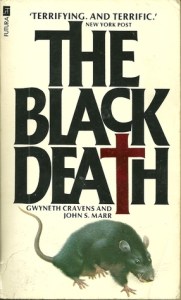
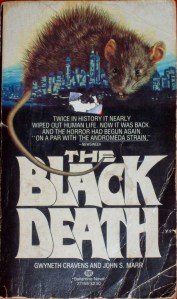
My dogeared copy includes no biographies of the novel’s two coauthors, Gwyneth Cravens and John S. Marr. I have since discovered from an internet search that Cravens is an experienced journalist whose work has appeared in Harpers, the New Yorker, the New York Times, and the Washington Post. In 2007, she wrote a nonfiction book entitled The Power to Save the World advocating the use of nuclear power as a solution to climate change. Dr. Marr, meanwhile, is a Harvard-trained epidemiologist who at one time served as director of the New York City Bureau of Communicable Diseases. In April, he appeared with Dr. Lloyd Novick on the podcast of the Journal of Public Health Management and Practice to discuss the COVID-19 epidemic. So, in retrospect, it is unsurprising that the authors brought a good deal of knowledge and sobriety to their joint literary venture. Alas, the U.S. paperback edition was given one of the more lurid covers of the era, featuring a giant rat baring its teeth and encircling Manhattan with its body and its tail. That artwork almost certainly deterred more serious-minded readers, but it has made the book a cult favorite among geeks like me who love twentieth-century pulp fiction. In any event, Cravens’s and Marr’s novel deserves to be read, not least because it offered an engrossing and well-informed picture of what would befall America (or, at least, New York City) were it to be caught unprepared during a lethal pandemic.

The story opens with young New York hippie Sarah Dobbs returning from a backpacking trip in California and discovering that she suffers from what she thinks at first might be a cold. As breathing becomes more difficult for her, she suspects she might have the flu. In fact, she is in the advanced stages of a pneumonia brought on by an as-yet-unidentified pathogen. The authors describe how the human body responds when it is invaded by a dangerous microorganism such as a virus or a bacterium:

She was already using a great deal of strength just to keep breathing. The air sacs of her lungs were brimming with the organism and the moist residue of her battle. Destroy, destroy, her body said, and tissues harboring the enemy were sloughed off and coughed up. Burn it out, burn it out, her body said, and her fever increased. Block it, seal it off, ordered the body, and capillaries began shutting down. The flow of blood through arteries now slowed, and her blood pressure dropped. She was starving for oxygen, and the tips of her fingers were turning blue.

She sets out from her New York apartment in search of the nearest hospital but falls unconscious in the street. Her doorman, an illegal immigrant named Domingo Ortiz, calls for an ambulance. She never regains consciousness and dies at the hospital. Because she was carrying no identification, and because she was a young hippie with weird scratches on her arms (another manifestation of the disease), she is initially assumed to be a drug addict who suffered an accidental overdose. It is not until the hospital lab returns the results of a sputum test (sputum is a combination of mucus and saliva found in diseased lungs) that the physicians in charge of the dead girl’s case realize that she didn’t die of an overdose but of a disease, and possibly a highly contagious and deadly one. Unlike COVID-19, which apparently originated in bats, the fictional disease that strikes New Yorkers in The BlackDeath originates in rodents (Sarah got it from a California ground squirrel, but rats are carriers too). But it is not the bubonic plague. Rather it is described as a “pneumonic plague,” because, like COVID-19, it attacks the respiratory system of its victims and suffocates them over the course of several days. Shortly after Sarah Dobbs drops dead, so too does a pimp named Flash, who accosted her at the Port Authority Bus Station when she arrived back in New York. Flash thought she might be a runaway and was hoping to enlist her in his stable of prostitutes. But Sarah (who, we eventually discover, is the teenage daughter of wealthy parents who live on Fifth Avenue) just brushes right past Flash, coughing in his face as she does so. Next to die is Domingo Ortiz, and then several of the doctors and nurses who treated Sarah when she was hospitalized. At about this time Dr. David Hart, the director of New York City’s Bureau of Preventable Diseases, takes charge of the investigation into just what it is that is killing off New Yorkers at an alarming rate. At this point the book becomes not just a thriller, but also a crime novel. It turns out that the disease didn’t arise accidentally but was developed by rogue elements in the government during the era of the Cuban Missile crisis. These rogues planned to work with the Mafia in south Florida in order to unleash the plague (Latin name Yersinia pestis) on Cuba in order to destabilize it and oust Fidel Castro. Here’s how one character describes the covert operation:

On November 2, 1963, a Mafia yacht dropped off two Cuban exiles on the Cuban coast near Havana. They were working for Executive Action, part of the AM/LASH CIA base in Florida, and they each carried two specially designed bulbs filled with the organism Yersinia pestis, or plague. They were to be picked up the following night, but they never reappeared. None of our assets in Havana ever learned what happened to them. The venture was known as Operation Visitation, and until tonight I had only heard stories about it—the records were supposedly destroyed. But now I am in a position to confirm that the action did take place and that those responsible are still highly placed in the government.

As you might expect, those highly placed U.S. government officials are eager to avoid being exposed as the original source of the current plague, which apparently made its way to America via Cuban exiles who were once CIA assets. And these officials will stop at nothing—including mass murder on an epic scale—to cover up their crimes.

As the virus spreads, the authors illustrate the ways in which epidemics strike various segments of society differently. The authors acknowledge that minority communities and neighborhoods are likely to be particularly affected because they are disproportionately poor, and that illegal immigrants might be reluctant to seek medical aid due to their undocumented status and fear of deportation. Page 39 of the paperback edition includes a chart of a hypothetical epidemic, which shows that men are more vulnerable than women and that the elderly are more vulnerable than the young, which seems to be the case with COVID-19 as well.

There has been some debate during the COVID-19 pandemic about the effectiveness of face masks and gloves, but the authors of The Black Death knew 43 years ago that those things are vital in fighting off disease. From page 44:

To a morgue attendant who waited in the doorway, Hart said, “Get the body to the Medical Examiner’s and make sure everyone who has anything to do with it wears masks and gloves.”

From page 54:

The two men looked at each other in silence. Then they went to a cabinet against the wall and took out rubber surgical gloves. They changed their masks . . . The attendant came back as they were finishing up. “That was fast, you guys. You usually take an hour.”

“Get the fuck out of here, Jerry,” Chakarian snapped.
. . . Put on a mask and gloves, you stupid bastard, and then come help us.”

Like the epidemiologists fighting COVID-19, the medical experts in The BlackDeath also understand the importance of tracking everyone who may have come in contact with a carrier of the disease. Dolores Rodriguez, an epidemiological nurse, tells her boss (and secret lover) Dr. Hart,

“I’ve been checking around the hospital. Counting the lab technicians exposed to the blood and sputum cultures, the stretcher attendants, the orderlies, the aides, the nurses, and the doctors, fifty-five people were exposed to Jane Doe [at this point Sarah Dobbs’s identity is still unknown] on Sunday. You can figure there were some people who rode up with her in the elevator from the emergency room—say three unidentified exposures there. Of all those exposed, I guess that at least twelve people had close exposure to the patient and thirteen had intimate exposure. On Monday, seventeen more were exposed, one closely and fourteen intimately. And then, after she died, five more had intimate exposure, including the morgue attendants. The grand total is about eighty-two, with seventy-seven identified.”

Hart thinks to himself: If those seventy-seven contacts Delores had identified had each made only one [additional] contact, that was one-hundred-and-fifty-four people exposed. And if each of those had made contacts . . . Oh, God. It spread so fast—in a breath, a touch, a sneeze, a handshake, a curse.

Also prescient was the authors’ understanding that, in an epidemic, ventilators would be in short supply.

Garson followed Hart as he moved swiftly through the corridor. “We don’t have enough personnel to handle all the cases that are coming in! Many of them need respirators and intensive care!”

Later an epidemiology nurse tells Hart, “They’re bringing in respirators from Queens, and they still don’t have enough to manage the intensive-care patients.” (Dictionary.com argues that respirators are face masks worn by medical professionals to protect them from diseases, whereas ventilators are devices that help patients breathe, but in 1977 it appears that “respirator” was the term for devices that help patients breathe—at least that is the term that Cravens and Dr. Marr use in the book.)

But perhaps most impressive is not what Cravens and Marr got right about the medical aspects of a highly infectious respiratory illness, but what they got right about how society—the media, politicians, and citizens—would respond to such a pandemic. At one point, Dr. Hart recalls an outbreak of smallpox back in 1948:

The city government ordered everyone in the five boroughs who had not had a recent immunization to have shots [and] everyone cooperated. President Truman had one before visiting the city. Over six million people vaccinated in two weeks. Now, Hart knew, there would be no return of the miracle of ’48. Decentralization, “community awareness,” an infectious distrust of government, and federal indifference would all work against any “war effort.” And the health department had been much bigger then . . . Now, thanks to successive budget cuts, the money and personnel to fight a major epidemic no longer existed.

Later in the book, Irving Kaprow, head of New York Mayor Syd Weinstein’s Task Force for Emergency Preparedness, tells Dr. Hart, “It’s about that statement of Imminent Peril. The Board of Health met and ratified it and passed it on to the Mayor. But now he’s changed his mind. He doesn’t want to deliver it. He’s afraid that if he asks people to avoid public transportation, there will be bad traffic tie-ups everywhere . . .  And he doesn’t want to say that it’s the plague or that we should be prepared for a serious epidemic. He thinks those are scare tactics.”

Shortly thereafter, Mayor Weinstein himself tells Dr. Hart,

“I don’t understand how this epidemic is a serious threat to the entire city when almost nobody is sick,” a reflexive response echoed in some quarters of social media even now. Weinstein is altogether more concerned about the devastating effects of the pandemic on the economy than its devastating effects on the human body. When Dr. Hart asks him to declare a State of Emergency, the Mayor replies: “I am extremely reluctant to do that on account of the fact that when a State of Emergency is declared, people get very excited. The law is that, in a State of Emergency, all insurance policies are automatically voided. The business community would go into a turmoil, which would have a ripple effect. The threat to property—”

At which point, Dr. Hart interjects:

“Goddamn it, your life is the best personal property you own! And the best way to protect it is to bring in the Guard, and even Army medical personnel, and solicit volunteer nurses and doctors. The resources of the Health Department have been exhausted. We are not sitting on our hands! We’ve been working day and night. The hospitals are barely able to manage, and the cases are still coming in. When I left Metropolitan Hospital a few minutes ago, there were sixty-two cases jammed into a small isolation ward. Many of them require intensive care, and special machinery that we’ll have to bring in from the other boroughs. And outside the hospital there’s a large worried crowd . . . Your Honor, I know that we can stop the epidemic right now, within the next few days, if we’re given enough help and cooperation. Politics has to be put aside; otherwise, more people will die in a mass panic—caused by conflicting reports and terrible rumors . . .”

The authors of The Black Death foresaw that a pandemic might create a rift between government officials and medical authorities and wove it into their plot, more than forty years before the current pandemic.The authors are also prescient about the unreliability of government statistics during the early days of a pandemic as health officials struggle to understand the behavior of this new pathogen. Fictional CIA Director Bryce Marks tells the men gathered at a security briefing:

“It’s difficult to determine true statistics during plague, because systems of reporting differ from country to country, and usually cases are underreported. This is partly because only confirmed cases are reported to the World Health Organization in most countries, and partly because many countries conceal cases for economic and political reasons. So we have no accurate picture of the extent of plague in the world, although WHO estimates that it is more prevalent by a factor of three than the figures show.”

At all levels of government, Cravens and Marr anticipated leadership more interested in restarting a frozen economy than in protecting lives. In one scene, the Secretary of the Treasury says, “I thought we had agreed that a stoppage of the financial and communications structure lasting beyond two weeks was unacceptable, given the economic disruption we’re currently experiencing.” In another scene, General Cosgrove, the President’s National Security Advisor, meets with his team and tells them:

“I have met with the President again today, and he has requested that we formulate specific response options to effect a speedy restoration of the critical financial, port-oriented, and general decision-making activities of New York City. The current disruption of the economy and world trade must end. We’re already under extreme pressure from all the nations in the free world, who are deeply concerned about their gold reserves—a total of eighteen billion dollars in gold bullion—in the Federal Reserve Bank in Manhattan . . . I suggest that we address ourselves to compiling action scenarios to present to the President.”

This excerpt also shows how deftly the authors were able to mimic the self-important jargon that marred so much of business and political communication in the 1970s (for instance, “address ourselves to compiling action scenarios” rather than “come up with a plan”) and which has only worsened in the years since. And just as some contemporary American pundits have insisted, despite a dearth of contrary evidence, that COVID-19 may have been developed as a bioweapon in a Chinese laboratory, the military personnel in The Black Death are determined to lay the blame on foreigners:

“I might add, sir,” Cosgrove went on, “that we can’t rule out the possibility that the New York outbreak represents the use of bacteriological warfare by a hostile power, and that further attacks are being contemplated.”

Later, CIA director Marks wants to play up this possibility in order to distract the public from the administration’s bungled response to the outbreak.

“Can we formulate a believable adversary action to help create an external focus of public outrage?” Marks asked.

“An overt statement on the part of the President suggesting that Cuba was responsible for the plague is a constructive possibility,” Cosgrove replied.

In speculating about how a dangerous epidemic might play out in New York City, Gwyneth Cravens and John S. Marr didn’t get everything right. But their forty-seven-year-old political thriller/crime novel was prescient on many levels. People who look down their noses at popular fictional genres—science fiction, mystery, thrillers, etc.—don’t realize that often times these books contain valuable insights into human nature and the ways that societies work (or fail to work). In times of crisis we’re often encouraged to turn to literary classics for guidance in how to behave and endure. But popular fiction can also fill this role. And sometimes it does so more accurately than even so-called “serious literature” does.

Posted in Books, Characters, Criticism, Fiction, Genre, Guest, History, Suspense, Thrillers | Tagged , , , , , , , , | 1 Comment

READING IN A TIME OF CRISIS

Some years ago, my colleague Linda Landrigan, editor of Alfred Hitchcock’s Mystery Magazine, gave me a copy of Good Poems for Hard Times, edited by Garrison Keillor. That may have been during the Great Recession, because I recall thinking, as I read it, that the collection was just what was needed. With a deadly pandemic, economic collapse, racial injustice playing out with tragic consequences, and violence erupting in cities all over the country, I think no one would quibble with calling this new period in our history among the hardest of times. The question that occurs to me is whether there is a type of reading that can help us through it.

One of the first instincts of writers is to write about what they are experiencing, and already EQMM has received several stories revolving around the pandemic. What some writers are ready to write about and what most readers are ready to read about can be different matters, however, and so far EQMM has not bought a pandemic story. For one thing, it’s my guess (an educated guess, based on many years with the magazine) that most of our readers, bombarded daily with news reports of the pandemic, have little desire to read entertainment fiction that rather than giving them a bit of respite from the situation brings it to mind yet again. Even so, I am reluctant to tell writers not to submit a story that involves the crisis. Years ago, after 9/11, I dreaded the submissions I knew we’d receive about the terrorist attacks. Two years after the towers fell, I was still resistant to reading anything that might trivialize what had happened by using it to support a clever plot or ingenious puzzle or the adventures of a popular series character—as writing entertainment fiction in such close proximity to a horrific event can sometimes do. But then a story came in entitled “A Sunday in Ordinary Time,” a story that I believe remains, all these years later, one of the best that writer Terence Faherty has produced. It depicted a shocked and devastated community in the immediate wake of the events of 9/11, but in a moving and sensitive way—a way that provided catharsis for the reader. I was glad, then, that I hadn’t decided simply to send back stories about the attacks. Now, as then, we will continue to read and give careful consideration to all stories that come in. I’d only advise those who have written about the pandemic and want to submit the work to us that it’s not a likely subject to find favor with EQMM right now.

If readers aren’t ready for stories about the calamities presently facing us, then what do they want to read? Maybe a much earlier upheaval can help answer the question. In James R. Benn’s article “The Crime Novels of WWII”, he notes how few of the big-name mystery and crime writers of the time dealt with the war, citing Agatha Christie as producing only one such book, and that single venture published early in the war;  Raymond Chandler making only a passing reference to the war in The Lady in the Lake and not touching the subject again until years after the war was over; Simenon never mentioning the war at all in his several books published during its course, and Dorothy Sayers essentially ceasing to write fiction after the start of the war.  It’s hard to say whether these writers found it too difficult to write about something they were so fully immersed in, impossible, perhaps, to gain the right perspective—or whether they were responding to a sense that their readers wanted to be taken out of the world of the encompassing conflict and transported to an entirely different place in imagination.  It’s certainly a common belief that readers crave “escapist” fiction during times of crisis, and it would not be a big stretch to suppose that some of the popular writers of the period were catering to what they thought their readership desired.

On the other hand, no writer—no good one, at least—is immune to catastrophes in the world in which he or she lives and works. The clearest example of this may be Ellery Queen. The two cousins who wrote under that pseudonym were as in tune as any writer ever was to the marketing of their work. Yet with the advent of WWII, their work began to transform into what is considered an entirely different phase. The Ellery of the earlier novels—aloof, stiffly intellectual, somewhat affected in mannerisms—began to be noticably humanized in my favorite Queen novel, Calamity Town, published in 1942. It was as if the disaster of war on such a scale, and its atrocities, had unconsciously necessitated the creation by the authors of a more compassionate central character. They didn’t need to write about the war directly in order to reflect the changes it made to virtually everyone.

To come back to the question with which we began—Is there a type of reading that can help us through our current situation?— I incline to two possibilities. One is so-called “escapist” fiction, which doesn’t directly depict the morass we find ourselves in the midst of but may well reflect newly forming attitudes towards life and society as a result of it. The other is fiction—or poetry!—that brings the reader cathartic release from the turmoil of confused emotions we must all currently be experiencing.

I’ve brought in poetry not only because it can serve to convey and release repressed emotion, but because it is usually short enough to be taken in fully during a time when many, myself included, are finding it difficult to focus on longer reading. Recently I said to a good friend, a former editor of both fiction and nonfiction, “I suppose you are using this time in lockdown to do a lot of reading.” She replied, “I’m not reading at all, I’m not able to focus on it now.” My job at EQMM necessitates a great deal of reading, which I have continued to do, but I understood entirely what my friend meant, for with the lockdown having unexpectedly given me a little more free time, I’ve picked up a number of books that I’ve long wanted to read, only to put them down again within minutes. The one thing I have been able to focus on for reading unrelated to work is poetry. Coincidentally, this month’s EQMM podcast is a selection of EQMM poetry—mostly humorous verse, but a few “serious” pieces too. I hope you’ll listen to it.

In closing, I wanted to include here a poem from Garrison Keilor’s Good Poems for Hard Times that struck me as a propos to the circumstance many of us are experiencing in lockdown, where what surround us are not people but things. It turns out that it is not possible to reproduce the poem on this site, as we cannot get the necessary permission in time, but the Poetry Foundation has obtained the rights to present the poem online and you can find it here. It’s entitled “Things” by Lisel Mueller.

What are you reading?

—Janet Hutchings

Posted in Books, History, Story | Tagged , , , , , , , | 12 Comments

“Too Many Answers” (by Toni L.P. Kelner)

Toni L.P. Kelner is a longtime contributor to EQMM whose appearances are not as frequent as we’d like (due, perhaps, to her commitment to multiple series of novels and her editorial work on short-story anthologies!). She is really two authors in one, often writing under a pseudonym. As Leigh Perry, she writes the Family Skeleton Mysteries. The sixth, The Skeleton Stuffs a Stocking, was released in fall 2019. Under her own name, she wrote eight novels in the Laura Fleming mystery series and three “Where Are They Now?” books. She has also coedited seven urban-fantasy anthologies with New York Timesbest-seller Charlaine Harris. Under both names she writes short fiction, including her story in EQMM’s current issue (May/June), “Rage Warehouse—Ire Proof,” and a forthcoming story in Shattering Glass. In this post, the Agatha Award winner focuses on short fiction and gives aspiring short-story writers some advice gained from her own diverse experience. —Janet Hutchings

I’ve got a problem when people ask me how to write short stories. Not only do I get this question from new and aspiring writers, but sometimes it even comes from novelists, because they’ve never written anything shorter than 70,000 words. Since I’ve published thirty-ish short stories, I really ought to have an answer. But I don’t. I have thirty-ish answers because the process is different every time.

Take my most recent two stories.“Now Hiring Nasty Girlz” was in the Jan/Feb issue of EQMM, and “Rage Warehouse—Ire Proof” is in the May/June issue, and the stories behind the stories could not be more different.

“Now Hiring Nasty Girlz” was a sudden-bolt-from-the-blue story. I was actually working on a different story with a similar title, when this one showed up in my head almost completely formed. In less than two weeks, I wrote it, shipped it to my beta readers, rewrote it based on feedback, and sent it toEQMM. Boom.

So I could tell people, “Wait for the muse to hit you upside the head and then write like crazy!” The problem is, that’s not really a good way to build a career.

So what about “Rage Warehouse—Ire Proof”? How long did it take to write? Would you believe twenty-two years? No, actually it was longer. I’d had the title in mind for a while, but it was twenty-two years ago when I actually started writing the story. Not that I worked on it every day of those twenty-two years, mind you, or even every year.

The first version was written for a project that never happened. I was trying to sell a linked collection of short stories, one for each month of the year, and wrote three stories of the fictional year. Unfortunately, the collection didn’t sell. I sold the other two stories elsewhere, but just didn’t feel that “Rage Warehouse—Ire Proof” was ready for prime time. Twenty years later, I gave it a fresh edit that I thought really strengthened it, and submitted it for an anthology. It was accepted, but there were contract issues so I took it back. A few months passed, and I dusted it off again and made more changes before sending it to EQMM. Where it was rejected. But there were suggestions for a rewrite, and since the suggestions were excellent, there was no reason not to try. Once more to the word processor, and after that edit, the story was accepted. And as of this month, published.

So I could tell people, “Never give up on a story even if it takes twenty years or more!” Again, that’s not a sustainable career path. Or maybe the advice would be, “Start with a fun title.”

I have done the fun title idea in other stories. I was coediting the anthology Many Bloody Returns with Charlaine Harris, and part of the deal was that I was to contribute a story, too. The theme was vampires and birthdays and I’d never done anything with vampires, and I had no ideas in mind. But when somebody asked what I was going to write, I popped up with, “How Stella Got Her Grave Back,” because it made me laugh. (Most puns make me laugh.) The rest was just devising a story to go with the title, and designing vampires that didn’t sound like every other writer’s vampires. Plus I threw in a smelly chicken farm, like the one my grandparents owned back in the day.

The advice from that would be, “Be careful what you say in public, because you might actually have to write that story someday.”

Then there’s “Pirate Dave’s Haunted Amusement Park” from Death’s Excellent Vacation, which was another anthology I coedited with Charlaine Harris. I had the whole story worked out in my head. Vampire working as a pirate costumed character at an amusement park realizes the place is under supernatural attack, and when he sniffs out a werewolf, assumes said werewolf is involved. Only the werewolf isn’t any of the guests of the park, but a tiny pocket pooch a guest smuggled in in her pocketbook, and the werewolf has nothing to do with the threat. Hilarity ensues.

I can safely tell you all those details because the story I actually wrote had nothing to do with what I just described. Okay, there’s an amusement park and a pirate and a vampire and a werewolf, but the setup is very different, the viewpoint character shifted, the plot twist changed, and . . . Honestly, it’s just not the same story at all.

The advice would be, “Don’t be afraid to trash everything you’ve got and start over.”

For “A Man Feeling Bad,” I was invited by editor Carolyn Haines to write a noir story about Mississippi Delta blues for the anthology Delta Blues. I knew nothing about the blues or the Mississippi Delta, and in fact had only passed through Mississippi en route to other places. But I did some research, and tried to get dark, and was pretty happy with the story. My other foray into noir and my one foray into horror went the same.

The advice? “Don’t be afraid to try something new.”

I’ve got stories based entirely on titles and where I just liked the name of the main character. I’ve got stories I pitched with no idea what I was going to do, stories based on existing characters, and stories based on events that happened to me. I’ve got stories that were written in a fevered pitch and stories that took decades to write. I’ve got stories that were rejected and sold elsewhere, stories that were sold and then had projects fall part, and stories that sold right away. What lesson could anybody learn from me?

This is all I’ve got. When it comes to writing short stories:

  1. Start with whatever inspires you, whether that be a title, an anthology invite, an odd fact, or a character you love.
  2. Write as long as it takes to write a good story.
  3. Rewrite as often as it takes to make a better story, even if it means starting over.
  4. Don’t give up on a story.
  5. If you’re sure the story is good, keep trying to sell it until it finds the right home.
  6. Listen to your grandparents’ stories—you’ll never know when details about chicken farm will come in handy.
Posted in Business, Editing, Guest, Writers, Writing | Tagged , , , , , , , , | Leave a comment

“Whodunit and Whoateit: A Perfect Pairing” (by Katherine Hall Page)

When it comes to the connection between cooking and mysteries, we can’t think of a more knowledgable author than Katherine Hall Page. She is often cited as one of the foremost writers in the culinary crime genre, and she is the author of twenty-five mystery novels featuring amateur sleuth/caterer Faith Fairchild. That twenty-fifth book in the Fairchild series, The Body in the Wake, is out now. Primarily a novelist, Katherine also writes short stories occasionally, and our current issue contains her first for EQMM, entitled “The End of the Line.”  The New England author’s fiction has been recognized with Agatha Awards for best first novel, best novel, and best short story, and she has been nominated for the Edgar, the Mary Higgins Clark Award, the Macavity, and the Maine Literary Award. Particularly relevant to this post, she also pens a cookbook series, which includes Have Faith in Your Kitchen (2010) and Small Plates (2014). Two things we know about the crisis caused by Covid-19: People under stay-at-home orders are reading a lot of mysteries and they are doing a lot of cooking. Below you’ll find some reading suggestions that will also point you to some recipes!—Janet Hutchings

Reading and food go together. Propping a book up to keep turning the pages while eating is one of life’s great, guilty pleasures—a necessarily solo activity unless those sharing a meal are similarly engaged or uncommonly understanding. Now, during the horror that is the coronavirus both reading and eating have taken on even greater significance. Many are alone in self quarantine or lockdown and are pairing comfort reads with comfort food for company. Mom’s mac ‘n’ cheese recipe along with rereading an old favorite. And maybe a glass of a witty Merlot. According to polls, we are turning to the escape and solace books provide as never before. For great numbers of readers this means mysteries, especially traditional ones with justice-served endings that grant a moment of relief. As P.D. James put it, “These novels are always popular in ages of great anxiety. It’s a very reassuring form. It affirms the hope that we live in a rational and beneficent universe.” Amen.

The history of the mystery goes back to Arthurian legends and Icelandic sagas, among others; but the history of the link between food and crime is more recent, unless we count retellings of accomplished banquet poisoners like Nero or the Borgias. William Makepeace Thackeray (1811-1863) wrote that “Next to eating good dinners, a healthy man with a benevolent turn of mind, must like, I think, to read about them.” If you combine this observation with the Baron De Mareste (1784-1867)’s Le mauvais gout mène au crime— “Bad taste leads to crime” some years prior, we get a sense of why culinary crime novels have been popular since their beginning. But which work marked that start?

Some cite Poe’s “The Casque of Amontillado” (1846) as the first culinary mystery. The narrator, Montresor, lures his already inebriated victim, Fortunato, into the palazzo’s cavernous wine cellars with the promise of tasting a rare vintage sherry. Montresor walls up Fortunato, still alive, in a convenient niche near conveniently stashed bricks. Presumably no Amontillado crossed the doomed man’s lips. The story is not one of detection but horror, and the wine plays a rather minor supporting role. Similarly, a comestible in the form of a Christmas goose assumes a role in Conan Doyle’s 1892 short story, “The Adventure of the Blue Carbuncle.” The jewel is discovered in its craw. The fowl is a fat one and there is an allusion to roasting it, but nothing to whet our appetites save Holmes’s inimitable method of detection.

Excellent as both these stories are, I’d differ and go to Rex Stout (1886-1975) and Charlotte Murray Russell (1899-1992) with Stout’s Nero Wolfe as the somewhat irascible father of culinary crime and Russell’s Jane Amanda Edwards the slightly more amiable mother. Fer-de-Lance, the book that introduced Rex Stout’s corpulent detective and his sidekick Archie Goodwin, was published in 1934; the year before Jane Amada, a self-described “full-fashioned” woman made her 1935 debut in Murder at the Old Stone House. Both Stout and Russell were born in the Midwest. Russell stayed and set the Edwards books in a thinly disguised version of her own hometown of Rock Island, Illinois. Rex Stout left and occupied a much larger stage, although his agoraphobic sleuth Nero Wolfe resided in, and seldom left, his Manhattan brownstone, tending his orchids and ordering meals from his personal chef, Fritz Brenner, of whom Archie said, “He could even make milk toast taste superb.”

Rex Stout’s masterpiece Too Many Cooks stands alone in the annals of culinary crime. Stout, in a rare departure, takes Nero Wolfe out of his NYC comfort zone to a resort in West Virginia, the setting for a gathering of the crème de la crème of international chefs—Les Quinze Maîtres, The 15 Masters.  Wolfe hopes to obtain a much desired, and well-guarded, secret recipe for Saucisse Minuit from one of the chefs. The fun and games prior to the first murder suggest a Food Network challenge. Chefs must identify dishes and ingredients while blindfolded. The plot is a classic locked-room one and is not overwhelmed by the food—no mean feat. When asked what was the best meal in English literature, Nora Ephron replied, “The banquet in Too Many Cooks by Rex Stout.”

The banquet, planned by Nero Wolfe, comes at the end of the book and is his impassioned defense of American cuisine, delivering a hearty slap in the face to the sceptical sophisticated chefs attending. Here are just a few of the delectable dishes, plates no doubt licked clean: Philadelphia Snapper Soup, Terrapin Stewed in Butter, Planked Porterhouse Steak, Boone County Missouri Ham, Creole Tripe, Lobster Newburgh, Beaten Biscuits, Sally Lunn, Pineapple Sherbet, and Sponge Cake. The definitive source for information on both the brilliant detective and his creator is John McAleer’s 1977 Edgar winner, Rex Stout: A Biography. Among Stout’s legion of fans were both Agatha Christie and M.F.K. Fisher.

Rex Stout published forty-seven Nero Wolfe mysteries as well as many short stories (in the pages of this magazine!), other novels, and plays. Charlotte Murray Russell, in contrast, published only twelve in the Edwards series and eight other mysteries. She started crafting the novels during the Depression to put food on the family table and ended her career in 1953 at age fifty-four saying she was tired of writing. She remained very active until her death at ninety-three, working at her Rock Island library and making notes for a memoir.

Russell’s female amateur sleuth was a breakthrough, combining a sharp sense of humor with equally sharp powers of detection and observation. Much more down to earth than Miss Marple, Miss Edwards nevertheless shares an uncanny ability to see through a tissue of lies—she calls herself, “old X-ray Jane”—as well as extrapolate village life to all human behavior.  A forty-something spinster, Jane Amanda is the head of a household consisting of a younger sister and brother. Her brother’s penchant for drink—one glass of wine sends him over the edge—and unsuitable women keeps Jane on her toes, not an easy task given her 180 pounds. And all of them the result of the mouth-watering food described in the series. Like Stout’s, Russell’s books are a celebration of American regional cooking, in this case midwestern comfort food. In books like Cook Up A Crime, the housekeeper Theresa’s chicken and dumplings, lemon meringue pie, fudge cake, and other staples may send readers straight to the fridge and pantry, especially as it contained an occasional recipe. Rue Morgue Press, 87 Lone Tree Lane, Lyons CO 80540, has reissued a number of Charlotte Murray Russell’s books and they more than stand up.

While many meals are consumed, and some described in detail, in Agatha Christie’s work, particularly in the Poirots, it is Dorothy Sayers who first comes to mind when cataloging culinary crime across the pond. The Documents in the Case may put one off mushrooms for life even as it introduces us to the world of fatal fungi. However, it is Sayers 1928 short story, “The Bibulous Business of a Matter of Taste” that showcases her knowledge of food and more especially drink. In vino veritas she notes in the tale, and Peter Wimsey unmasks his imposter by correctly identifying the obscure wines accompanying each course at a chateau in France before repairing to the library for a suitably venerable cognac with his host. Among Sayers’s many UK successors, Janet Laurence, a cookery expert, has created a chef, Darina Lisle, as knowledgeable in the kitchen as she is in detecting. The first in the series of ten books is A Deepe Coffyn (1989). Another favorite is A Tasty Way to Die (1990).

In the US, the culinary-crime pioneer who extensively included recipes in her mysteries was Virginia Rich (1914-1985). Like Rex Stout and Charlotte Murray Russell, her roots were in the Midwest, but after her marriage she went on to live in many places, spending the latter part of her life moving between the family’s working cattle ranch near Tucson, Arizona and the small Maine coastal village of Corea. Both provided settings for her work. She only published three novels: The Cooking School Murders (1982), The Baked Bean Supper Murders (1983), and The Nantucket Diet Murders (1985), but anyone writing in this subgenre owes her a debt. Rich set the bar high. Her amateur sleuth, Eugenia Potter, is a widow in her sixties and, while not a professional chef, more than knows her way around a kitchen. ‘Genia also enjoys a very dry martini, or two.

Virginia Rich’s books were unique not only for the introduction of so many recipes—outlined in the text and in detail on the endpapers—but also for the treatment of character and place. The mysteries are good puzzles, but it is Mrs. Potter herself and Rich’s depiction of her world that has made these books continuing pleasures—great rereads. The Baked Bean Supper Murders is a portrait of Down East life that had all but vanished even before the current pandemic—Grange Hall suppers, lobstering with just a plumb line and a compass, the post office as the main source of news, and Saturday night baked-bean family meals from the bean pot that had been sitting overnight on the wood stove. Rich’s recipes are also a celebration of American regional cuisine: Blueberry Buckle, Sour Cream Cole Slaw, Baked Ham, Molasses Cookies, Steamed Brown Bread, Lobster Pie, and dishes from the Southwest. After Virginia Rich’s death, her family asked renowned mystery writer Nancy Pickard to complete the manuscript for The 27 Ingredient Chili Con Carne Murders (1993). Pickard wrote two more in the series from notes Rich left: The Blue Corn Murders (1998) and The Secret Ingredient Murders (2001), providing readers with a happy total of six Eugenia Potter books.

Continuing the tradition and foreshadowing the plethora of culinary mystery novels that followed is Diane Mott Davidson, the author of seventeen Goldy Schulz culinary mysteries to date. She published the first, Catering to Nobody, in 1990. The book introduced Goldy, a recent divorcee with a young son, trying to make a living as a caterer in a small Colorado town. All Davidson’s books include recipes and like Rich, character and place are well represented at the table.

One of the most enduring nonseries classics in culinary crime is Nan and Ivan Lyons’ Someone is Killing the Great Chefs of Europe (1990). They wrote several others in the genre, but this is the piece de resistance and also quite tasty in the screen version, Who Is Killing the Great Chefs of Europe? (1978), with an outstanding cast—George Segal, Jacqueline Bisset, Philippe Noiret, and especially Robert Morley. One by one the chefs are dispatched in a manner that relates to his signature dish. Readers will never look at a duck press the same way again.

We are all cooking at home now and there are a number of mystery cookbooks that satisfy a wide variety of tastes. A few of my favorites are: Madame Maigret’s Recipes (1975), compiled by the noted French food writer, Robert Courtine, in honor of Simenon’s seventieth birthday; The Lord Peter Wimsey Cookbook (1981), Elizabeth Bond Ryan and William J. Eakins; The Sherlock Holmes Victorian Cookbook (1973), William Bonnell; and The Nancy Drew Cookbook, Clues to Good Cooking (1973), Carolyn Keene—this last notable for the “Dancing Puppet Parfait” recipe, a mix of apricot nectar, marshmallows, and whipped cream. Many contemporary crime writers have turned to the kitchen as well: Donna Leon, Lilian Jackson Braun, Patricia Cornwell, and Alexander McCall Smith.

In a sense, writing a mystery novel is like creating a recipe. Both have “ingredients,” and at the end of the process you hope to have something worth consuming, something done to a turn. Food is a way to define character in books and real life—we are known by what we eat. There’s Kinsey Milhone and her peanut butter and pickle sandwiches, as well as my friend Henry who won’t come within a mile of garlic!

Many nonculinary crime writers have featured food in some manner in their works, as the means to an end (literally) or an expression of their own and their character’s appreciation of the table. Robert B. Parker’s books are filled with descriptions of meals eaten and meals prepared. “When in doubt, cook something and eat it,” Spenser, his memorable P.I., said. I came across the line recently and thought it was an excellent mantra for these frightening days.

We are all in this together— “Living in the Now,” with a book and a plate in hand.

Posted in Books, Characters, Guest, History | Tagged , , , , , , | 1 Comment

“The First and the Last: In the Shadow of the Uncanny” (by R.T. Raichev)

A look at the first published short story by Agatha Christie—and at her last

Raicho Raichev’s story “Rassendyll’s Grave” appears in EQMM’s current issue, May/June 2020. A Golden-Age style mystery of the country-house variety, the story incorporates a fascinating twist to the form in that the house in question has been transported to modern Dubai, where the author currently lives and teaches. Raicho is an expert on Golden Age mysteries. He’s previously written several articles for this site about some of the key figures in the field, including Agatha Christie; this time he elucidates Christie’s short stories—specifically the first and the last. You may want to find copies of these and other Christie stories after reading the post. Also, don’t miss “Rassendyll’s Grave,” which forms part of the author’s series  starring mystery writer Antonia Darcy and her husband, Major Payne. The series includes a number of critically acclaimed novels, and we’ll have another short-story case for the pair later this year.—Janet Hutchings

Out of Agatha Christie’s 150-plus short stories, the very first to see the light of day was “The Affair at the Victory Ball.” It was published in 1923 in The Sketch in the UK and in The Blue Book Magazine in the USA. Fifty-one years later it was included in Hercule Poirot’s Early Cases published in 1974 by Collins in the UK and Dodd Mead and Company in the USA.

The milieu in “The Affair at the Victory Ball” is high-bohemia-meets-the-aristocracy, somewhat off Agatha Christie’s usual beat, while the affair in question is a mysterious stabbing at a costume party where all the attendees are dressed up as characters from the Commedia dell’ Arte. The victim is Lord Cronshow, “fifth viscount, twenty-five years of age, rich . . . very fond of the theatrical world” who is killed while wearing a Harlequin costume. That same evening Lord Cronshow’s fiancée, actress Coco Courtnay, who had been his Columbine, dies of a cocaine overdose—a death which Poirot eventually exposes as another murder in the guise of “an accident cleverly engineered.”*

The central puzzle depends on impersonation, specifically on the ease with which a “glittering Harlequin” costume can be worn under a “loose Pierrot garb.” The killer masquerades as his victim** with the purpose of confusing the time of the murder. It is an ingenious enough ploy and it could be deemed fair-play—so long as readers were able to visualize the commedia dell’ arte regulars and had the perspicacity to tumble to the bamboozling possibilities of their attire. Christie introduces her first least-likely killer by providing him with the kind of alibi that corresponds to the literal meaning of the word—at the time of the murder he appears to have been “elsewhere.”

The story is narrated by Captain Hastings. Whatever criticism may have been leveled at Hastings’s intelligence, he does an excellent job of it. He starts by reminding the reader of the mysterious affair at Styles and Poirot’s triumphant role in bringing it to a successful conclusion. He then presents us with the facts of this new case in a manner that is lucid and methodical. And while wasting no time on irrelevancies, he manages to be entertaining. Reflecting on Inspector Japp’s true motivation for enlisting Poirot’s help, he even rises to sardonic wit:

“. . . I, for my part, considered that the detective’s highest talent lay in the gentle art of seeking favours under the guise of conferring them!”

As part of his denouement Poirot attempts a reconstruction of the murder*** with the help of a set of China commedia dell’ arte figures belonging to one of the suspects. Some readers will be surprised that the killer gives himself away a little too easily, flying into a rage and snarling at Poirot (“Curse you, how did you guess?”) before he is put in handcuffs. The truth is that, apart from a green pompon, there is no material proof of his guilt, certainly nothing that would take him to the gallows. The story concludes with the little Belgian grandiloquently declaring the case “simplicity in itself” and the killer not “as clever as Hercule Poirot.”

The inspiration behind “The Affair at the Victory Ball” is believed to be the set of commedia dell’ arte figures that had been part of the decor at Agatha Christie’s family home Ashfield and which she had later brought to Greenway, her Devon country estate, where they can be seen in a glass-paneled cupboard. The figures also inspired Christie to write a series of poems, A Masque from Italy, a play, The Dead Harlequin, and, most famously, the collection of short stories entitled The Mysterious Mr. Quin, published in 1930.

Mr. Harley Quin (to give him his full name) is an elusive, semisupernatural character who tends to appear at opportune moments as though by magic, and then to disappear just as mysteriously—but not before he has been able to steer his friend, the corporeal Mr. Satterthwaite, towards some emotional problem or a conundrum of a detective interest that needs solving urgently. The stories in The Mysterious Mr. Quin are an effective blend of the rational and the mystical. At least one critic found Mr. Quin “as fascinating as Poirot” while The New York Review of Books recommends the book as “a rare treat for the discriminating reader.”

Sadly, this doesn’t apply to the very last Quin conte, which Agatha Christie wrote more than forty years later. Intriguingly called “The Harlequin Tea-Set,” it is also the last short story Agatha Christie ever wrote.It appears alongside stories by other crime authors in the anthology Winter’s Crimes 3 published by Macmillan in 1971. Agatha Christie was then in her eighties and, on the evidence of the last couple of books she wrote, her plotting powers were in steep decline. As is known from various biographical sources she had been using a dictaphone and that had had a further “loosening” effect on her writing. Not unlike Postern of Fate, the last novel she produced before her death, “The Harlequin Tea-Set” is altogether too muddled, rambling, and repetitious, and it teems with incongruities, irrelevancies and self-indulgences.

A long opening paragraph introduces us to the jaundiced views of the elderly Mr. Satterthwaite**** on the subject of modern cars which “broke down more frequently than they used to.” Quite unnecessarily, Harley Quin is given a little black dog called Hermes, clearly named after the winged herald and messenger of the gods, though one strongly suspects modeled on Agatha Christie’s beloved dog Bingo. A scarecrow called Harley Barley makes an embarrassing appearance and so does the ghost of Lily, the mother of the intended victim, “dressed in some pale mother-of-pearl colouring.” At one point the scarecrow rather dramatically, though for no apparent reason, bursts into flames. The middle-aged and respectable-looking Mrs Gilliatt rides a motorbike—which on one page changes to “bicycle.” Daltonism, or colour blindness, is mentioned early in the story’s ten-page exposition, but when the time comes for this important detail to be slotted into the mystery, the result is something of a damp squib.

There is a happy end of sorts, with Mr. Sattherthwaite managing to avert a murder by poisoning, though exactly how the killer might have hoped to get away with it is unclear. Conveniently the killer—rather, the would-be killer—commits suicide and Mr. Satterthwaite thinks it “best left that way.” He tries to explain why thus: “It’s an old house. And old family. A good family . . . A lot of good people in it . . . One doesn’t want trouble, scandal, everything brought upon it.”

“The Harlequin Tea-Set” is a story which Christie completists will no doubt treasure despite all its flaws, however it would be very wrong to recommend it as an introduction to The Queen of Crime. What the reader can take away from it is the reassuring country-house setting and the very English atmosphere of a particular “cozy” kind, much beloved by aficionados of the genre.

This is Mr Satterthwaite arriving at the house splendidly called Doverton Kingsbourne:

Tea was set out upon the lawn. Steps led out from the French windows in the drawing room and down to where a big copper beech at one side and a cedar of Lebanon on the other made the setting for the afternoon serene . . . two painted and carved white tables and various garden chairs . . . hoods over them to guard you from the sun . . . a soft pinkish-golden sky . . .

*This set-up is not dissimilar to the one in Lord Edgware Dies, which was published ten years later in 1933. Tho the puritanical Lord Cronshow with his “unusually strong views on the subject of dope” couldn’t have been more different from the dissolute and degenerate Edgware.
** Agatha Christie uses the ploy in the novels After the Funeral and Curtain— both Poirot cases, as it happens—and in the short stories “The House in Shiraz” and “The Companion.”
*** This rather theatrical device is employed by Christie to greater effect in the short story “Three Blind Mice” and her most celebrated play The Mousetrap. 
**** In one of the stories in The Mysterious Mr. Quin, Mr Satterthwaite’s age is given as sixty-nine. That was in 1930. Therefore he must be more than 110 as the events of “THQTS” unfold. Though perhaps one mustn’t be too pedantic.
Posted in Books, Classic Mystery, Fiction, Guest, History, Writers | Tagged , , , , , , | 1 Comment

“Shelly Dickson Carr’s Bag of Tricks”

In the current issue of EQMM (May/June 2020) author Shelly Dickson Carr makes a very welcome EQMM debut! Shelly is the author of the novel Ripped, which won three Benjamin Franklin awards, and of a number of short stories, published in our sister magazine, AHMM, and elsewhere. What makes her EQMM debut particularly notable is that she belongs to the third generation of her family to contribute to EQMM. Sons and daughters have followed parents into print in our pages before, but I cannot recall a previous third-generation appearance. Shelly Dickson Carr is the granddaughter of the illustrious John Dickson Carr (dozens of whose tales appeared in EQMM), and the daughter of Julia McNiven, who had a story in EQMM in 1974. In this post she shares some writing tips, some gleaned from her grandfather and from another master of the genre, Colin Dexter, and some learned from personal experience. The writers among our readers should find them all useful.—Janet Hutchings

In this trying time of social distancing and scarcity and isolation and lack of direct contact with our loved ones during the coronavirus pandemic, it seems a bit odd to be talking about a bag-of-tricks. But so many writer friends have been reaching out, needing to stay connected, that when Janet Hutchings asked me to contribute to this blog, I thought I’d dig into my writer’s bag of tricks and share some tips. And because many of us are sheltering in place, here’s hoping this will be a bit of a distraction—it certainly is for me. Thanks, Janet.

As a starter, and because mystery writing is in my DNA, I shall share one of grandfather’s tricks and end with one that Colin Dexter shared with me in Oxford, England over tea at the Randolph Hotel.

 Bag of Tricks # 1—Blood on a Bandage: A John Dickson Carr Trick  

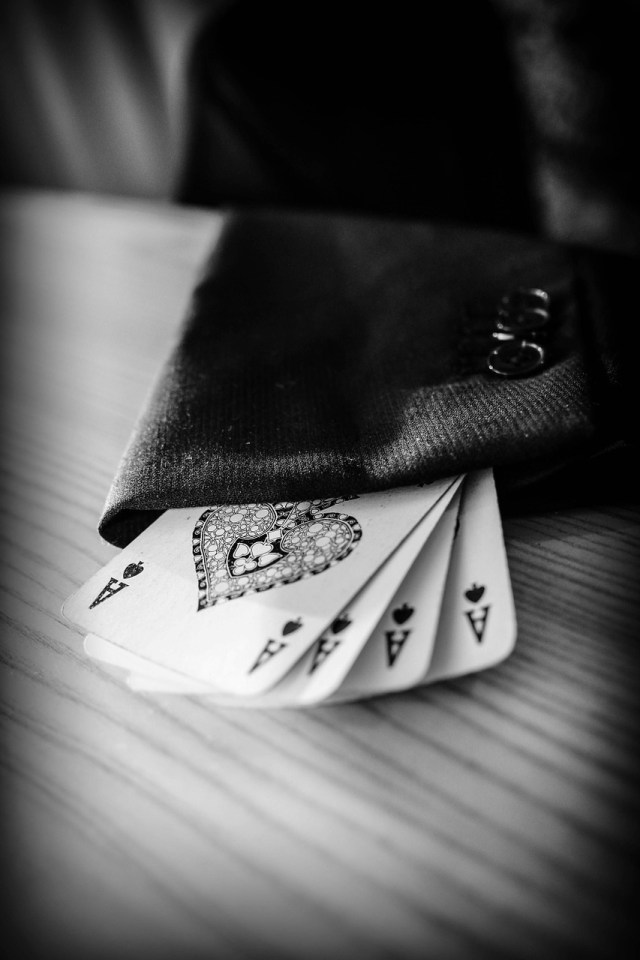
We all know that a detective story has red herrings and clues and must always play fair with the reader—all tropes familiar to crime writers. But have you ever heard of a BOB? A BOB is a trick my grandfather taught me: Blood On A Bandage. Simply put, if you plant a clue, especially an important one, it’s always best to have a visual image such as “red blood on a white bandage” immediately following the all-important clue. A BOB is a metaphor for something graphic or startling that will tug the reader’s mind away from the tip-off that you want the reader to forget. Nine times out of ten, the reader will remember the visual image of red blood splattered on a white gauzy bandage and forget the information proceeding it.

Next time you read a spy thriller, and a sudden bomb or startling explosion goes off,  reread the sentences or paragraphs right before the bomb exploded and you will likely find an important piece of information the author wanted to hide in plain sight.

Setting off a bomb is a wee bit heavy-handed in a short story where a visual but subtle image, given directly after a clue, is the best weapon in one’s arsenal of obfuscation. As an example, I randomly tugged out several old Ellery Queen Mystery Mags off my shelf and, thumbing through the top one, I’ve just found a short story by a favorite writer, Edward D. Hoch—missed by all who knew and loved him.

In Ed Hoch’s short story “The Theft of the Legal Eagle,” it is important that the protagonist/thief, Nick Velvet, remembers later in the story that a beautiful young woman named Silke has had an idyllic childhood, replete with midnight swimming and moonlight treasure hunts. Immediately after we learn about Silke’s treasure hunts, the author gives us: “She tossed her long silken hair, and he (Nick) wondered if her name or the hair had come first.” We are then given a sensual and visual image of Silke’s long, red-gold hair juxtaposed with her name. A subtle image to be sure. But our mind’s eye conjures up this beautiful young woman’s hair (as it relates to her name) and we forget about the treasure hunts of her youth—important to the conclusion of the mystery. Subtle, but in Hoch’s expert hands, pitch perfect.

The BOB trick is nothing more than a conjurer’s obfuscation, the legerdemain of a magician. Stock in trade for card sharks, con artists, and mystery writers everywhere. 

Bag of Tricks #2—Active Verbs

Always, always, always use active verbs. When I finish a manuscript, I check every page and substitute active verbs for inactive verbs. I also hunt out and eliminate every put, got, or was. He got into the car becomes: He climbed into the BMW; He slid behind the wheel of the Ford Truck; He lowered himself onto the front seat of the Jeep. Ditto every put. Sheput the key in the lock, becomes: She shoved the key in the lock; twisted the key in the lock; wriggled the key in the lock. The same goes for was and were. In short fiction, stagnant verbs must go. I keep an “active verb folder” with lists and lists of active verbs for those times when my mind gets stuck.

Settings are important in my stories, almost as important as my characters. If I don’t use active verbs my descriptions will ring flat. We are taught in MFA programs (at least I was) to eliminate or tighten our prose when writing settings because these descriptive paragraphs are what a reader will skip over. But if you read Delia Owens’s Where the Crawdads Sing or anything by Tana French or J.K. Rowling/Robert Galbraith you know how important descriptions are and how place and setting matters. How do these mega-talented writers make their settings jump off the page? A certain lyricism, to be sure, but also by using a plethora of active verbs.

When describing, let’s say, a wall in a room, inactive verbs will make that wall bland and boring, but active verbs will make that wall memorable. The use of active verbs such as: bracketed or wedged against the wall; dangling or expanding from the wall; partitioned by the wall; looping, skirting, anchored into the wall; perched upon a shelf on the wall; balancedfastened, set into, strewn against, flush to the wall. Looming large against the wall . . . stood a grandfather clock . . . or a towering statue of Aphrodite.

And if there are books on a shelf on that wall, make sure to have those books wedged, crammed, resting on the shelf. When a dish in that room falls to the floor, make sure the dish doesn’t just fall, but clatters, smashes or shatters against the floor; skitters across, clunks upon, crashes, thumps on that floor. And if your character puts a coffee mug on a table in that room, instead let him slam the coffee mug on the table or slide it across the table. Anything but put. Writers often feel hesitant about using active verbs, believing their prose will come across as forced, but trust me, the more active the verbs the more memorable the setting.

Bag of Tricks # 3—The Five Senses

This trick or technique is so simple, and yet we all forget to do it. I go over every page to see if I’ve used the five senses on every page. What my characters smell, taste, touch, see and hear grounds the reader in the all-important fictional reality.

The olfactory sense is my favorite because it packs the most punch. I know writers who try to have a sense of smell on every page. It’s difficult to do, but so important. The smell of mildew, laundry detergent, a wet dog, fresh paint, burnt popcorn; the taste of green apples, pumpkin pie, butterscotch toffee, dill pickles places the reader squarely in the fictional world we are building. I’ve had students ask me if I truly want them to go page by page and insert what their characters tasted, smelled, touched, and heard; and I say: yes, yes, and yes. It can’t be arbitrary, it has to be germane and organic to your story, but yes. She staggered into the haunted house and heard . . . a creaky floorboard, the yowl of a cat, the hiss of a radiator; and smelled mildew or cigarette smoke or . . . baby powder? Just remember there must be three out of the five senses on every page and lots of active verbs.

In a scene I was writing set in the nineteenth century, my first-person narrator is sitting on a train. It was a bland scene. However, an important clue needed to be presented in this train scene. I asked the same simple questions I ask my students when workshopping a piece: What is my character smelling? Tasting? Seeing? Touching? And how many inactive verbs can I substitute for active ones? Here’s what I struggled with, but finally came up with:

A sulfurous smell hangs in the air, and there’s a metallic taste in my mouth as if I’ve been sucking on copper pennies. Listening to the melodious chug of the train, feeling the bowstring vibration of its forward movement beneath my seat, the sun outside the train’s window hangs low across the horizon.

At the end of the page (I’ve italicized the active verbs) as my protagonist is glancing out the window: “A watermill flashes into view as the river snakes closer to the train. A deer jumps out of a thicket and scampers away at the blast from the train whistle. And there, swooping close to my window, a hawk hunts its prey in the scrubby brush next to the train.”

Active verbs: hangs, sucking, chug, vibration, flashes, snakes, jumps, scampers, blast, swooping, hunts.

And here’s another example: A student was writing a mystery set in present day amongst the Gilded Age mansions of Newport, Rhode Island. He had his heroine “walk past a statue of Trident in a circular fountain.” The heroine had just had a shock, so simply walking past the fountain in front of Rosecliff Mansion made for a bland scene. What active verbs could this writer enlist? How many of the five senses? We brainstormed the scene and he came up with:

“Bailey’s flipflops crunched over pea-stone gravel as she approached the front courtyard where a statue of Trident rose out of a circular fountain. Water gushed from Trident’s marble head, splashed from his curved fish tail, and shot up in a high arc out of the conch shell he was trumpeting. The roaring, gurgling sounds of water gave Bailey goosebumps, bringing home once again the reality that her best friend had just drowned in the waves off Sashuest Beach.”

Now, admittedly, that may be a bit over the top. But when brainstorming or workshopping a piece, the more over the top the better. You then pull back and weave it into a tighter scene. The point is, Bailey walking past a statue of Trident needs to come alive. We hear the crunch of Bailey’s feet on the gravel; we hear water gush; see it splash; get a sense of Trident’s conch shell trumpeting, and we hear the roar and gurgle of the fountain. We feel Bailey’s goosebumps. The way to make writing come alive is through the use of active verbs and the five senses. Easy peasy. But we as writers often forget those all-important five senses, the ones our fifth-grade teachers drummed into our heads.

I have many trick’s in my writer’s hobo bag. But I’ll end by relaying a bit of sage advice given to me by Colin Dexter who was mentioned in a previous blog post here by Paul Charles.

Before embarking upon a research trip to Oxford, I asked Rebecca Eaton, producer of Masterpiece Mystery, to introduce me to Colin Dexter—one of my favorite writers and the creator of Inspector Morse. This was two years before he passed away. We had tea, along with my brother (also a rabid fan) at the Randolph hotel. The three of us had a delightful afternoon, made especially so as Colin Dexter loved our grandfather’s books and said they had inspired him to write his own. Dexter’s memorable advice to me on writing: “Love your people and then do devilishly nasty things to them.” To which he meant: Take your most beloved characters and throw your worst at them. Be mean to your most cherished characters.

In this unprecedented pandemic when kindness and compassion and empathy are needed most in the world, our outlet for sheltering in place can be this: we can be awful to our protagonists. And then we can be even more devilishly nasty. They and we will come out of it. We shall collectively survive. And just as I am now sending you virtual elbow bumps, you can, in good conscience, send virtual elbow blows to your characters. Be safe and well my friends.

Posted in Characters, Editing, Guest, Writers, Writing | Tagged , , , , , , , , | 21 Comments

“Frogs, Castles and Crime Writers” (by Jim Weikart)

Longtime treasurer of the International Association of Crime Writers, Jim Weikart is as knowledgable as anyone about that organization’s history and function. In this post, he gives us a personal perspective on the organization and what it’s meant to his own writing. A novelist whose books feature a tax accountant (as Jim is himself!) as sleuth, Jim’s short stories have appeared not only in EQMM but in our sister publication, AHMM, and elsewhere. His most recent story, “The Frog,” is featured in our current issue (May/June 2020). After reading the story and this post, perhaps you’ll be inspired to join IACW—a good resource for readers and writers alike.—Janet Hutchings

IACW Prague Congress, October 2000. Jim Weikart is third from left in the second row. Photo courtesy of Jim Weikart.

On a cold, fog-misted night in October of 2000 I found myself with my friend Kristen Bachler—publisher of the Nevada Comstock Chronical—on the Charles Bridge in Prague.  The fog, the cold, the near-midnight hour deterred citizens and tourists alike, and we were alone.  And Prague became magical as time collapsed into the fifteenth century.

Image courtesy of Jim Weikart.

This journey started with the International Association of Crime Writers (IACW, aka Asociacón Internacional de Escritores Policíacos or AIEP) congress in Prague that year—thanks to host Czech mystery writer Jan Cimicky and his colleagues.  The congress was held at a reasonable side-street hotel—a hotel that American expat and mystery writer Robert Eversz described as a good Communist-era experience. As another president, Slobodan Milosevic of Serbia, was being overthrown by street demonstrations in Belgrade, Yugoslavia, we elected American writer Jeremiah Healey the new president of the international IACW. We talked, drank, and visited Prague, a group of mystery-writing co-conspirators.  One night, Eversz led us to a celebratory dinner at the Knights Timplau, a restaurant that goes deep into the earth. So deep you better eat quick before the claustrophobia gets to you. When the congress ended, Kristen and I moved to the Three Ostriches Hotel—another Eversz recommendation—on the river’s castle side. It was from there that we got to the Charles Bridge alone and in the fifteenth century.

Sure, it was a fleeting moment. Remember in the book “Time and Again” when the main character Simon Morley sees the lights of New York’s Natural History Museum from the iconic Dakota apartment building? That tells him he’s moved back in time, because the intervening buildings are missing.  I didn’t have that sure physical tell, but I knew with as much certainty that  I was in the fifteenth century.

Prague’s time covers everything: magical pasts with castles, Kafka’s dead cockroachlike bug, a recent brush with a cold Communist state, an emergence into the modern world with the romanticized Velvet Revolution. How could I not attempt a character, a detective, from all these worlds? Meet Andre Havel—no relation to former Czech President Vaclav Havel—who transitioned from Communist cop to current homicide detective. Growing up during the Communist years, he went along to get along. Lucky for him, he kept his job after the Velvet Revolution toppled the Commies. He balances the cold logic and illogic of murder up against the magic of Prague. Andre is featured in my story “The Frog,” in the EQMM current issue (Does a detective turn into a prince if you kiss him?), and earlier in “The Samsa File,” AHMM, September 2013.

The IACW annual meetings moved on: Vienna, Barcelona, Daum (Germany), Amsterdam, Berlin, Reykjavik, Varna (Bulgaria), Bucharest, Oxford, Oklahoma City, Toronto, Frontenac (France), Frankfurt, Hillesheim (Germany), other places.  Formed in Havana in the eighties, IACW attempted to help crime writers bridge borders in a time of suppression. As the internet prospered, the first reason for being faded and it gradually has become an organization debating a purpose in the internet age. My own view is that an organization of international crime writers debating the purpose of their organization is reason enough. In this age of the decaying value of the written word, difficulties in finding publication in other languages,  the continued lack of recognition of women writers, and the closing of borders, there must be value in such an organization.

Oh, and there’s the other value of these meetings: one might end up on an ancient bridge on a cold, misty night, alone.  I promise you I will go back to the Charles Bridge where, like Simon Morley, I will truly find myself immersed deep in the past. I expect to encounter an aged Lancelot hopelessly questing for the Holy Grail after the death of Arthur and the loss of Guinevere. I also expect to find Detective Andre Havel trying to bring his logical perspective to pushing Lancelot off his horse and back into the past. I’ll keep you posted. Or let me know and I’ll meet you there.

The IACW website is crimewritersna.org.  North American writers, editors,  and journalists in crime writing are welcome to join.

Posted in Adventure, Characters, Guest, History, International | Tagged , , , , , , , , , | Leave a comment

“Emil and the Detectives” (by Wynn Quon)

Making his debut in EQMM’s May/June 2020 issue (on sale yesterday!) with the story “Art in Pieces” is Canadian writer Wynn Quon, whose previous literary credits are for short film and theater. The Ottowa resident’s short stories have won the Audrey Jessup Crime Fiction Short Story Prize and the Wolfe Island Mystery Short Story Prize, but his current EQMM story (in our Department of First Stories) is his first paid professional fiction publication. In this post he pays loving tribute to a writer who inspired him at a very young age.—Janet Hutchings

When I was nine years old my family got on an Air Canada flight and we flew from Cardiff, Wales to Ottawa, Canada.  It was a big move. My father went from being an owner of a laundry to working as a waiter in a Chinese restaurant. We left a ramshackle house on a narrow commercial street (ironically named “Broadway”), for a red-brick low-rise apartment building in what looked like a boring neighborhood.  But I soon found out that the surrounding houses with their wooden verandas and dandelioned lawns were homes to a number of large Italian immigrant families.

Within days of arriving, I was running around with the kids from the block. Making friends is a childhood superpower. There was Nino, a skinny boy of seven with ears that stood out from his head.  Gino, a short urchin with a pudgy face who would punch you on the arm whenever he could. Italo who knew the multiplication table the best. Pina was the only girl; she was older with long brown hair and a high-pitched voice. That summer, our ragtag battalion rode bikes across those patchy lawns and made them even patchier.  We flew paper airplanes.  We set fire to newspapers with a magnifying glass. We yelled at the top of our lungs for no reason.  I loved it.

But then my parents added a tiny sidestep to our family journey.  We moved at the end of that year to another apartment, a mile away. Sadly, it was on a busy four-lane street, a route for commuters and little else.  There were no other children, no lawns to trample, no Italian families. I lost my troops.

One consolation was the public library. No doubt many of you share childhood memories of how magical libraries are.  I went the whole hog. The library was ten minutes away for a fast walker.  I made it in five. I borrowed books by the armfuls. My mother worried for my eyesight.  I smuggled books home under my coat. I read them by the pale light of the streetlamp outside my bedroom window when I was supposed to be sleeping.

It was in that frame of mind that I came across Emil and the Detectives.  The library copy was a worn paperback, with a mysterious canary-yellow cover featuring two boys shadowing an enigmatic man with a funny hat.

The story: Ten-year-old Emil Tischbein is sent to Berlin by train to visit his grandmother. He carries a goodly sum of money as a gift that his widowed mother, a hairdresser, had squirreled away for a year. Onboard, Emil meets a strange man who spins fantastical tales of the city. Emil falls asleep and when he awakens, the man is gone and so is the hard-earned money.  Emil spots the man in the crowd at the train station and follows him into Berlin.  There he recruits a gang of boys and together they ingeniously bring the thief to justice.

You can see why this story resonated with me.  The exciting universe of a new city.  The comforting camaraderie of a motley crew you called your own.  It reminded me of Nino, Gino, and the others. I wanted to be Emil so much, I ached.

Fast forward four decades, past school and university, past a career in technology, past relationships both bountiful and regretful, past all the murmurings and unpredictable upheavals in the world to the year 2018.  In that year I decided out of a middle-aged restlessness to travel. I ended up in Berlin for the first time but Emil was not on my mind at all. Although I remembered the book with great fondness, I had not re-read it in the four decades since.  But while on a guided tour of Bebelplatz, a public square in central Berlin, I came across the name of Erich Kastner.  It rang a bell and I quickly rediscovered that he was Emil Tischbein’s creator.

I did some casual research and was surprised to learn two things.  First, when I had read the book I imagined the author as someone in their twenties (a substantial and mature age from a child’s perspective). It turns out Emil and the Detectives was published in 1929.  It had been in print for nearly fifty years before I had picked it out from the well-stuffed shelves of paperbacks in the Ottawa Public Library.  The second thing was graver. Erich Kastner’s pre-WWII writing reflected a social democratic and pacifist philosophy.  Notable among his adult books was Fabian, a satire on the moral and financial malaise of 1920s Berlin.  It was unpopular with the far-right. On May 10, 1933, copies of Fabian along with twenty thousand other volumes by a score of other German authors were burned in the Bebelplatz square in an infamous rally led by Joseph Goebbels. Kastner was the only one of the authors who attended the burning, describing his books being burned “in dark festive splendor.”  The experience was made more harrowing when a Nazi sympathizer pointed Kastner out to the crowd. Luckily he managed to escape.  Kastner was to survive the war but he suffered interrogation by the Gestapo, and the incineration of his home city of Dresden.

Kastner’s fascinating back story made me want reread Emil and the Detectives. But I was a little nervous.  Would the book still captivate me? One good sign: It was still in print after ninety years and has been translated into sixty-odd languages.  On the other hand a quick quiz of my younger friends was discouraging.  Most hadn’t heard of the book.

I had forgotten all of the book’s plot details.  I remembered only the warm feelings I had on reading it.  I remembered taking the beloved book with me to bed and hiding it under my pillow. I now worried I might end up destroying those shining memories I had of it.  In the end, curiosity won.

The copy I managed to buy had the same delightful cover as the original. Here is how the book starts:

“Now, then,” said Frau Tischbein, “follow me with that pitcher of water.” She herself took up another pitcher and the little blue jug brimful of liquid chamomile soap and walked out of the kitchen into the living-room. Emil clutched hold of his pitcher and ran after his mother.

A woman with her head bent over the white basin sat in the living-room. Her flaxen hair was down and hung from her head like three pounds of wool. Emil’s mother poured the steaming shampoo over the woman’s hair. Then she began to wash this strange head until it foamed with soap-suds.

“Is it too hot?” she asked.

“No, it is all right,” the head answered.

Ah, I was won over right away. As an adult I often use the First Page Test. If a book doesn’t engage me right from the start I’m not going to stay for the finish. Life is short and getting shorter. (My immortal ten-year old self would have laughed at this).  Emil passed the test with ease.

I love the image —the woolly head that talks.  I don’t think I appreciated this on a conscious level when I was ten years old. Children are magnetically attracted to words that bring visuals, sounds, and all the other senses to life. Some among you will recognize this as one of the canonical “how-to-write-well” rules. (To write a classic means to write for the inner child in the reader?).

I ended up reading the book in one sitting. I did not expect to enjoy the book in the same way as I did a child. But I was charmed nevertheless. I especially enjoyed the quirky characters.  The villainous Herr Grundeis gets only one extended speech in the book where he tells Emil a tall tale of life in Berlin:

“. . . if one has no money one can go to a bank, get fifty pounds and leave one’s brain in exchange.  No human being can live longer than two days without a brain, and he can’t get it back from the bank unless he pays sixty pounds.”

The book ends on an uproarious note. The last chapter is entitled “Is there a moral to this story?” Emil and his beloved relatives tell us what they’ve learned.  But instead of the pious moralizing you see in those sad children’s books that try to “teach something,” the lessons they recite are completely off-the-wall and contradict everything that happened.  The real lesson is obvious in the uncompromising good-heartedness of Emil and his buddies. It was that goodheartedness that captured me years ago, when it helped a ten-year-old cope with the grey sadness of losing his playmates.

I am no Kastner, so I can’t avoid ending this little review on a moral note. On that wretched evening on May 10, 1933, when Goebbels raged and the fires consumed thousands of books, when the Nazis were just beginning their spiral downwards into the blackest abyss, they may have burned Fabian, but they did not dare to touch Emil and the Detectives.

I suspect they knew the little book had a heart of goodness that even they could not destroy.

Posted in Books, Characters, Guest, History | Tagged , , , , , , | 7 Comments

“Mysteries and Video Games” (by N.W. Barcus)

EQMM’s May/June 2020 issue, which goes on sale next week, contains the paid professional fiction debut of technical writer N.W. Barcus, whose articles and reviews have appeared in the Seattle Stranger, Seattle Weekly, LA Weekly, the Portland Oregonian, and the Tacoma News Tribune. In this post, the author’s knowledge of video games is combined with an appreciation of the world of mystery fiction to provide some great recommendations for entertainment during this period of social distancing and isolation. Give them a try—and don’t miss “The Workaholic,” N.W. Barcus’s May/June Department of First Stories tale.—Janet Hutchings

I like mysteries. I like video games. Controlling an avatar of Sam Spade or Miss Marple and solving a mystery face to face with suspects sweating and footsteps fading down an alleyway should be wonderful. So why don’t I find mystery video games more satisfying? They’re too slow! Games are all about finding clues and interrogating suspects. Your detective enters a room, and you slowly and meticulously sweep your cursor over every pixel, hoping for a discovery—a piece of mud on the carpet or a key on a desk. It’s like when P.D. James’s Dalgliesh enters a room and three pages cataloging the décor follow. Like that, times ten. And interrogation is worse. People can read twice as fast as they can talk. To interrogate a suspect in a game, you choose a question from a dialogue tree, your character speaks it, the suspect answers, you choose another question, wait for your character to speak it, wait for the suspect to speak and so on. Slow! The immersive element offered by ambient sound and detailed graphics (say, rust on the murder wrench or a bead of sweat on a suspect) do not make up for the slog of scanning a room with a mouse and clicking through dialogue choices. To me, a mystery game is not as satisfying as reading a mystery nor as satisfying as shooting bad guys in an action game.

However, in this time of coronavirus, many of us are doing things we previously scoffed at. People who never do jigsaws have completed three 1000-piece ones, and people who don’t crochet have eight new potholders. People who never had interest in video games might now be willing to give them a try. So, I give you a list of a few cozy, noir, and paranormal mystery games you may love or hate. Mystery games, like mystery books, are a matter of taste. All of the games described here are available for Windows and some are available for Mac. If you want to go full millennial you can even play some on your phone. You won’t have to go out and buy a PlayStation console. Many of them are available as digital downloads.

For cozy mystery fans, a good game choice is one of the thirty-three Nancy Drew games developed by HerInteractive, available on their website or online retailers. Some of the games are loosely based on Nancy Drew novels, but most are original stories. There are no paranormal elements and little violence. The crimes you investigate are motivated by greed and usually involve mild sabotage and chicanery. They are classic point-and-click games where you interrogate suspects and search rooms. Your cursor turns into a magnifying glass when you find a clue. Some clues require you to solve a puzzle, such as reassembling a torn-up note.

The puzzles can be tricky and imaginative, and the mysteries are sensible. These are good games if searching, questioning suspects, and solving puzzles at your own pace appeals to you. However, they are pretty linear, meaning if there’s a clue in the greenhouse you need to find the key to the greenhouse, and you can’t proceed without it. Luckily, there is online help if you tire of searching the same house for that damn key a hundred times. I once got Nancy Drew help from someone who signed herself “Katy Perry Fan in Kentucky” who was probably eleven years old.  Hey, no shame in getting help!

The first Nancy Drew game, Secrets Can Kill, had a murder, but there wasn’t another murder until game #27, The Deadly Device. Though the cartoonish Detective Grimoire: Secret of the Swamp starts with a murder, it proceeds humorously and benignly from there as you search for clues, speak to people, and solve puzzles. Benign and humorous do not describe the games below, which tend toward noir. Murders, disappearances and kidnappings take place in dark and seedy settings amongst corrupt and violent characters. Though they all involve finding clues and interrogation, some require quick responses to onscreen prompts and others require you to fight, so you’ll need both logic and reflexes.

LA Noire– You play as a police detective in 1940s Los Angeles investigating murder and arson while impeded by corrupt officials and businessmen, à la Chinatown. Though mostly hunting clues and interrogation, the game does have fistfights, shootouts, and car chases.

The Wolf Among Us– You play as Bigby Wolf (the Big Bad Wolf), a sheriff, who investigates a murder amongst incognito fairy-tale characters. Grim as well as Grimm, a forced-prostitution ring is at the heart of the story, and there are fights.

Heavy Rain– You play as three different characters tracking a serial child killer. In this dark and unsettling story, you race to save the latest victim before the next rain, using clues meted out by the murderer. There are fights. This is one of the few mystery games where your investigation can fail, the wrong person can be executed and the murderer left free to continue his crimes.

The next three mystery games involve the supernatural. After solving the mystery, you must defeat the evil entity behind it all through otherworldly means, not your usual detective work.

The Vanishing of Ethan Carter– You play as a paranormal investigator looking for a missing boy and uncovering dark secrets about his family. This mystery involves murder, demonic possession, and many puzzles that require detailed observation of your surroundings to solve.

Alan Wake– You play as a crime-story writer whose wife disappears in a small northwestern town where violent and uncanny things start to happen. This game is an action game as much as a mystery. During the daytime you hunt clues, but at night you fight and evade possessed people and inanimate objects.

Murdered: Soul Suspect– You play as a policeman’s ghost, hunting the serial killer who killed you.  Though the supernatural element is pervasive (you are a ghost) and there is some fighting, most of the game involves searching for clues in different locales of modern Salem, Massachusetts, including a witch museum.

The games listed here range from a casual three hours to huge time sinkholes.  Depending on your taste and your leisure time (and thank you to all still working), they could provide a diverting way to stay inside and stay safe.

Posted in Adventure, Characters, Guest, Noir, Pop Culture | Tagged , , , , , , , , , , | 1 Comment