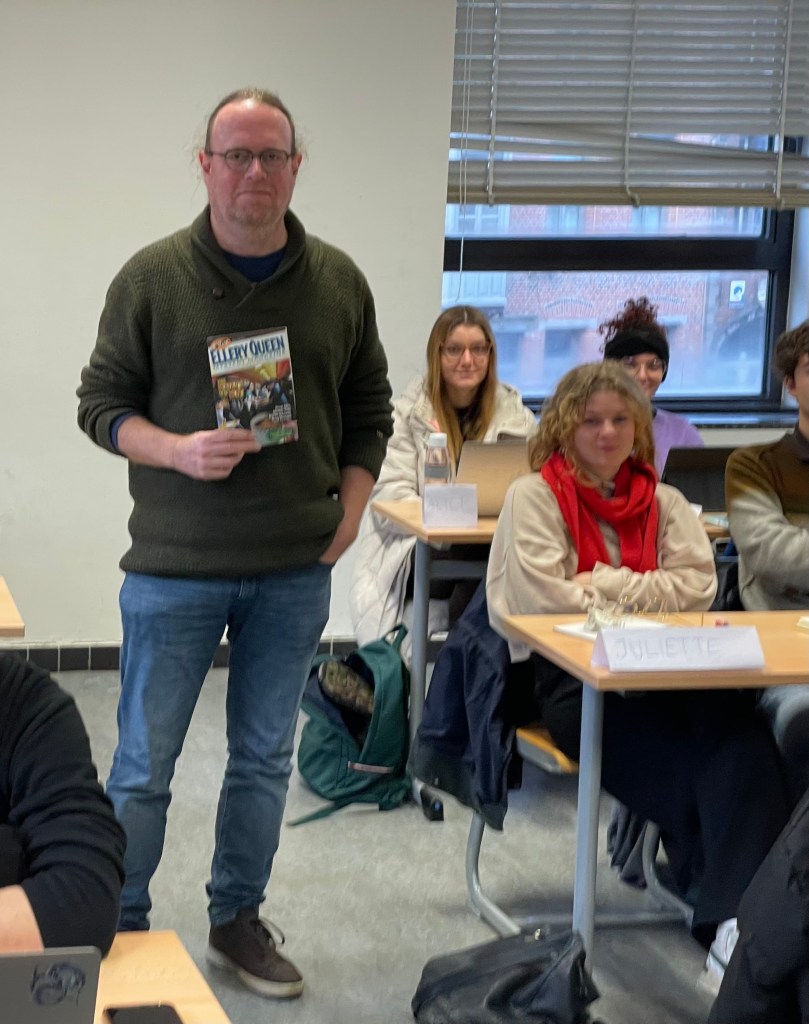
Groundhog’s Day (by Bill Bassman)

Bill Bassman makes his debut as a professional fiction writer with the story “Errand for a Neighbor” in our current issue, January/February 2023 (see the Department of First Stories). He’s a software engineer and a former teacher, and he tells EQMM that he’s a lifelong fan of crime fiction, although the closest he ever came to real detective work was a year as health inspector for the city of Philadelphia. Authors come to fiction writing as a result of varying impetuses; Bill explains one of the things that pushed him in that direction in this post. I hope it brings a smile to readers on this winter day. —Janet Hutchings

Groundhog Day is coming. Are you ready? No need to answer. For most of us the last two years has seemed like an unfunny remake of Groundhog Day, the movie. But, to me Groundhog Day portends another event more pertinent to fiction writers: April Fool’s Day.

At this point a critical reader is probably thinking: I don’t get it. What’s the tie-in?

First, for fiction writers every day is April Fool’s Day, and, on April Fool’s Day almost everyone has at one time or another created fiction.

Now, for the tie-in. Years back, I don’t remember what year, but it was sometime after e-mail came into common use in work environments, I woke up to a clock radio announcing that it was Groundhog Day. At least I think I did, maybe I was just remembering that scene from the movie. (Do fiction writers generally have trouble distinguishing experience from illusion?)

It was a clear cold day, with just about the right amount of fresh overnight snow for a perfect cross country ski through the cemetery down the street, but there was a problem. It was Tuesday and they hadn’t yet declared GHD a national holiday. I donned my ski togs, but stopped off at the laptop on my way out to send the following email to my boss (a Moldovan immigrant with a very austere sense of humor).

To: Vasile

            From: Bill

            Subject: Working from home today

            Hi Vasile,

            I won’t be able to make it into the office today. There’s a mob of Beavers blocking my front door. They’re holding up signs protesting Groundhog Day. I tried reasoning with them. The big brown guy (or girl) at the head of the mob was holding a sign with a crude drawing of a groundhog inside a circle with a slash through it. Under that, in sloppy red crayon, it read: What’s so Great about Groundhogs?

            In response to his placard, and in what I thought was quite a reasonable tone, I said, “Groundhogs can predict the future.”

            He showed me an imposing pair of incisors and replied, “Big f-ing deal. Ever see a groundhog build a decent dam?”

            From the rear of the mob somebody thrust up another sign saying Rodent Equality NOW. Then they all exposed chisel sharp front teeth and started chanting vulgar anti-groundhog epithets. So, I was forced to retreat inside.

            I’ll be working on that multi-threaded algorithm for handling multiple input signals for version 3.1.0.12. Call if you need me.

I hit “Send” and two things occurred to me. First, I had just told an elaborate lie in the form of a story. Second, such a fib would have been more appropriate for April Fool’s Day. Worse than that. How was I going to follow that one up when it actually was April Fool’s Day?

It turned out that last question didn’t need an answer. Vasile, it seemed, had a better sense of humor than I expected. He fired me, which set me on an entirely new path. Telling elaborate lies for a living. (Luckily, I had a good severance package.)

So, where’s the mystery? To me, it could be why the hell I felt compelled to write and, especially, to send that email. On the other hand, life is a mystery that no one has yet solved to my satisfaction.

Hope everyone has a happy new year.

Bill

P.S.

Some of the above is actually true. I think.

Posted in Uncategorized | Leave a comment

Confessions of a Repentant Sesquipedalianist (by Sean McCluskey)

Sean McCluskey makes his fiction debut with the story “The Soiled Dove of Shallow Hollow” in EQMM’s current issue (January/February 2023). He tells EQMM that he is a federal agent on a fugitive task force in New York and that he appeared briefly on a reality show about it, experiences that convinced him he much prefers fictional to real crime. We’re glad he does, because his is a very original new voice in the field. In this post he talks about his struggle to cut unnecessary words—a battle most writers will have had to wage at one time or another.  —Janet Hutchings

I have a problem: I write too much.

I don’t mean prolific. That’s a problem I’d pay cash money to have. I mean literary logorrhea. I mean never using one word when five will do. I don’t want to kill my darlings—I don’t even want to hurt their feelings.

The first step is realizing you have a problem, but I never did. I had it pointed out to me in grade school. In that benighted era, book reports were handwritten, in cursive, on ruled composition paper. Ten lines per side, and you could only write on the front. Two pages long, no more, no less, fill up every line.

My friends hated it. “Two pages? What am I supposed to say about Where the Red Fern Grows for two goddam pages?” We were foulmouthed fourth graders in a Catholic school; God was always on our minds. I hated the page count, too, but for the opposite reason. How in the hell—again, Catholic school—was I supposed to cover The Mystery of Cabin Island in two measly pages? It’s 178 pages long, including illustrations, and like all Hardy Boys books it’s packed with plot twists and character development. Two pages wasn’t even enough for my warm up.

So I cheated. Our composition paper had a horizontal dotted line bisecting each text line, to help distinguish between upper and lower-case letters. I chose to misinterpret this as two separate lines, turning a pair of pages into a quartet. Still a bit cramped, but at least now I had room to dig into some subplots and focus on character traits.  Frank, dark-haired and serious, in stark contrast to the blond, impetuous Joe. Problem solved, thought I.

The nuns didn’t buy it. They’re kind of a rules-oriented bunch, and my masterful exploitation of a loophole didn’t get past them. They knew damn well how much space was on those pages. Every one of them glided around holding a ruler, after all. “If you can’t say it concisely, you don’t really understand it,” as one Bride of Christ advised me. I didn’t think pointing out that the King James Bible isn’t exactly a model of pithiness would cut much ice with her, so, like Cain when questioned by God about the whereabouts of Abel, I reluctantly conceded the point.

But in my heart, the sin still lurked. It was going to take more than a nun to forgive me my trespasses, and lead me into the light of succinct brevity. It was going to take someone a whole lot less holy.

It was going to take a writer. A genre writer.

My personal savior was Keith Thomson. He’s a novelist, non-fiction author, and painter. One of those annoying types who excels at every artistic pursuit he pursues. When I first encountered him he’d just published a spy novel, and to market it, he decided to hold a contest. An espionage-themed short story contest, in which he’d read the entries and pick the best. The winner would get a pen. A spy pen, with a built-in digital audio and video recorder. Brothers and sisters, I wanted to win that pen.

But like all the best spy stories, the contest itself had a twist: the entire entry could be no longer than two hundred words.

Forget it, I thought. That’s barely enough space for the set-up, never mind the payoff. No way I can tell a story in less space than one page of a paperback. A man’s got to know his limitations. Regretfully, I put the thought aside.

But the pen. The spy pen. I wanted it.

More than that—I needed it. For work, I told myself. I wanted to whip it out for an interview. “Don’t worry about taking notes,” I’d tell my partner. “I’ve got this. It records, audio and video.”

My partner would be incredulous. She’d have a question. Not a sensible question, like Why don’t you just record it with your cellphone? No, she’d have an admiring question: Where’d you get that awesome pen? Sharper Image? Amazon? CIA?

“I won it,” I’d say. “Writing contest—no big deal.” But here’s the thing: It would be a big deal.

The only writing is rewriting, Ernest Hemingway said. And he’s the man who—allegedly; apocryphally—wrote a whole story in six words. By that standard, 200 words felt like an expansive canvas. So I started writing. And re-writing. And re-writing the rewrites. Hacking, carving, whittling, contracting, lopping off dialogue tags entirely, and giving my characters dialogue so terse they made Abraham Lincoln (the fella who penned the 271-word Gettysburg Address) look like Edward Everett (the guy who dropped the 13,607-word bloviation that preceded the Gettysburg Address). In fact, no offense to the Great Emancipator, by Keith Thomson standards, Honest Abe was 71 words worth of long-winded. No spy pen for him.

And in the end, after all my labors, I wrestled it down to 200 words on the nose. I polished it up and fired it off. Keith Thomson read them all, rendered his verdict, and on a Wednesday in July, I clicked on an e-mail to learn my fate.

Second place.

My prize was an official KGB identification booklet, a pocket-sized hardback with a red cover, naturally. Looks authentic to me: Cyrillic letters, rough paper, and utilitarian-bordering-on-totalitarian design. Might even come with preferred parking at the Kremlin—I’ll let you know if I ever get there.

But maybe the real prize was what I learned about myself, in the tradition of all those toy commercials disguised as cartoons I wasted my misspent youth on. Maybe it was learning that the power was in me all along, and all I had to do was want something bad enough. Approval, publication, readers, or even a pen that records audio and video. Digitally, no less.

Did it work? Well, by way of example, I was told that this blog post should be 1,000 words long. You can count ‘em if you want to.

PS—Another confession: Janet Hutchings, Ellery Queen’s inimitable editor, actually told me this post could be any length I liked. I heard those words, and I felt the sin uncoil in my heart, just a little bit. But I stood strong, brothers and sisters, yes I did. Hallelujah, amen, and good night.

Posted in Uncategorized | 3 Comments

HAPPY NEW YEAR FROM EQMM!

All best wishes for 2023!

Posted in Uncategorized | 2 Comments

HAPPY HOLIDAYS FROM EQMM!

Warm wishes to you and yours from all of us.

Posted in Uncategorized | Tagged | 2 Comments

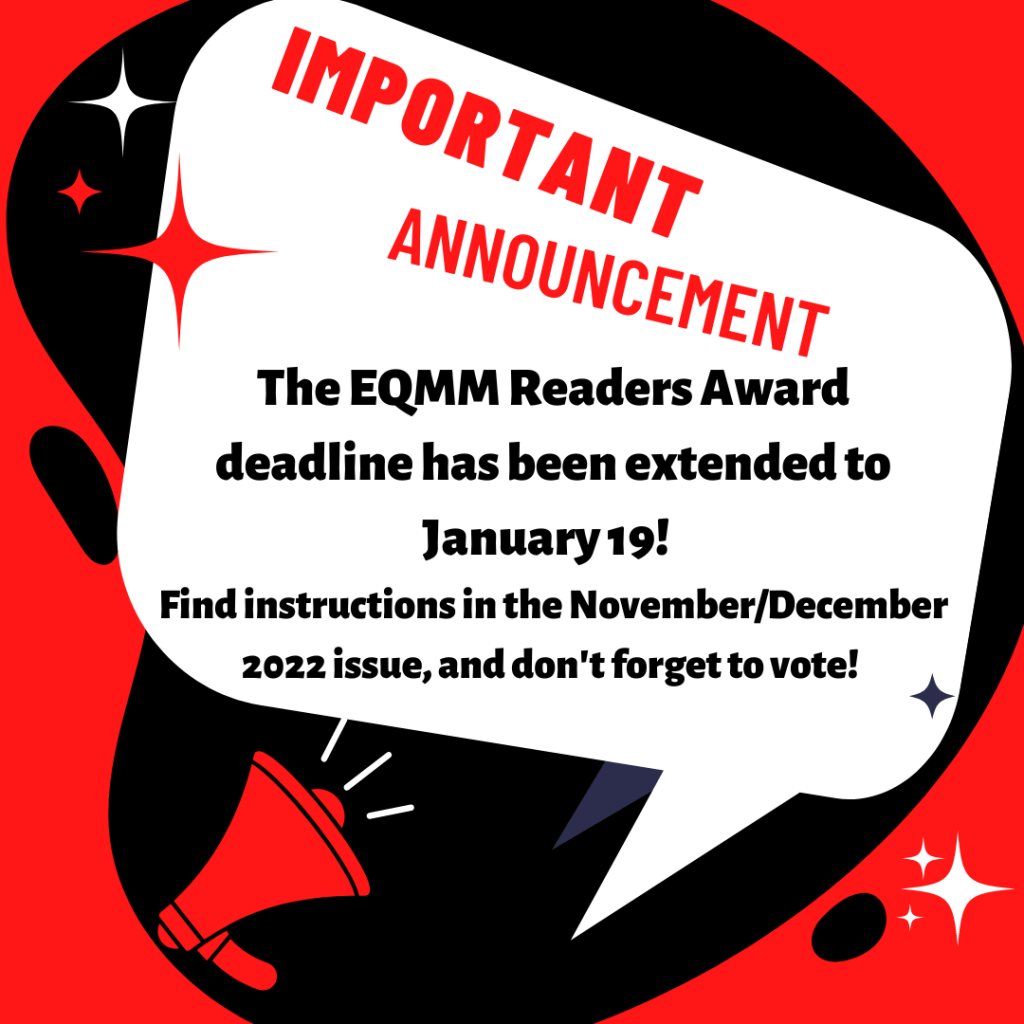
2022 EQMM READERS AWARD BALLOT DEADLINE EXTENDED!

The EQMM Readers Award ballot deadline has been extended to January 19, 2023! Find more information in the November/December 2022 issue. Make your opinion about the year’s issues and next year’s heard!

Posted in Uncategorized | Leave a comment

Travel Ban (by David Dean)

David Dean made his fiction debut in EQMM in 1990 and is a two-time winner of the EQMM Readers Award. His best-known series character is Police Chief Julian Hall.  A new Dean character will debut in EQMM’s March/April 2023 issue: “alienist” Dr. Beckett Marchland. That series is set in England. The author is recently returned from the U.K.—a trip that inspired this post. His reflections on travel and fiction writing complement last week’s post by Josh Pachter, but that is entirely coincidental.  Don’t miss the newly released second collection of David Dean stories from Genius Press: The Wisdom of Serpents and Other Stories of Tragic Misunderstandings. Most of the stories were first published in EQMM and all are outstanding!  —Janet Hutchings

(David Dean at Stonehenge)

In 2020 Americans experienced a ban on international travel, as well as restrictions on the domestic version—the Covid pandemic had put the kibosh on moving freely about the cabin. It was short-lived, but unique to my experience, and I didn’t like it. I certainly understood the why and what-for of it—this was serious business with dire consequences for far too many people—but it chaffed. It made me want to travel. Such is my contrary nature. So, as a substitute, I wrote and read . . . a lot—armchair travel both active and passive.

As I was writing this blog, I went back to check on what I had written during this time and found that three out of the five stories I’d penned took place wholly, or partly, in another country. Almost everything I read was set elsewhere, as well. I didn’t actually start out to do that, it’s just what happened.

Some people love to travel; others most definitely do not. This simple declaration applies, I think, also to writers of crime fiction—some writers love to travel, while others would just as soon stay home even without a travel ban. Readers of crime stories—almost all stories for that matter—enjoy fiction that takes them places they’ve never been or, conversely, they may be familiar with, but get to see through a different lens than that of their own experience. Rather than Istanbul or Paris, it might be Buffalo or Savannah, or any other city you might call home. If you’ve never been there, you might find it a pretty interesting place to visit, if only between the pages of a book or magazine. It’s certainly going to cost a lot less money.

Some writers travel to write, plopping down anywhere that catches their fancy and drawing inspiration from their new surroundings—Hemingway and Michener come to mind. Graham Greene (one of my personal favorites) traveled, at least initially, as a foreign correspondent and later as an MI 6 agent during World War II. In his down time he churned out novels and short stories that spanned the globe. Even Agatha Christie would shake off the dust of her beloved Devonshire from time to time to visit Egypt, Iraq, and other countries wholly different from England.

My own love of travel was inspired by Robert Louis Stevenson’s Treasure Island, a book that contained all the necessary ingredients to fire my childhood imagination—a boy hero, a sea voyage, pirates, treasure, murder and even a fort to defend (boys of my era often built forts of no strategic significance for the sole purpose of defending them). So you can see how the spark was struck with me. The reality I found as an adult was more sobering.

Travel today—especially by aircraft—is not the carefree experience it once was. Airports no longer beckon as gateways to comfortable aircraft, personable attendants, on-time departures and good food. I’ve been alive long enough to recall those halcyon years, if only in a vague, hazy manner, that grows dimmer with each flight I take. Even so, I do love exploring the destinations once I’ve staggered off the plane, which is the point of the journey in most cases. Yet, I don’t travel to write. I just want to go someplace different and I most certainly don’t want to spend time sitting in front of a computer screen while I’m doing it.

That doesn’t mean that I never end up writing stories inspired by impressions of where I visited and the people I observed there. That’s happened quite a bit, though I never set out to derive a story that way. Something would percolate to the surface months, or years, after my return and, unbidden, suggest itself. Hence, I have stories set in Mexico, Belize, Ireland, England, Germany, Bosnia and Michigan (it was foreign to me). The lion’s share, however, take place in New Jersey where I have spent most of my adult years.

One of the challenges of short mystery fiction is locale. The writer isn’t given many pages in which to describe the surroundings. Novelists have huge canvases to splash the setting across, while we short story writers must labor to create a Faberge Egg.

This becomes an advantage, however, when writing about some place that you’ve never been. A little, in this case, is better than too much. I’ve snuck one or two of these through without anyone becoming too annoyed, I think. It’s risky though and takes a lot of research. My story, “A Season of Night,” in the May/June 2021 issue of EQMM took place upon the frozen Arctic Sea of the 1830s. It wasn’t possible for me to travel back in time and I wasn’t going to the Arctic in any event. I love both travel and my craft, but I was stationed in Germany for three and a half years during my army days and that was enough of the cold white stuff for me, thank you very much. Fortunately, there’re tons of books and research on the subject of early polar exploration and even photos of some of the efforts.

Crime fiction is often very dependent on its sense of place and mood to be successful. There are many writers of the short story form that excel at this with their ability to create scenes imbued with ambience and authenticity. So good that we, as readers, never question whether what they’ve depicted is accurate or true. What they’ve done is good enough, probably even better than the location that inspired it. In just a few sentences the setting, the mood, and the time are deftly crafted and the reader snared and on edge.

(Bill McCormick in Iceland)

A domestic example of this is the late Paul D. Marks’ “Bunker Hill” short story series. A gifted writer and frequent contributor to EQMM, he was as adept as Raymond Chandler at establishing an LA Noir ambiance with a few strokes of the keys, often blending the Los Angeles of the forties and the present in his tales. On the international front, VS Kemanis and William Burton McCormick have made the Baltic region of Europe a more familiar place and a fascinating one for short crime fiction readers. Marilyn Todd creates evocative settings for her readers spanning two continents, with stories ranging from Greece and France, to Alaska and Arizona and doing a little time travel while she’s about it.

(V.S. Kemanis in Paris)

(Marilyn Todd in Tennesee)

My friend and fellow writer, Josh Pachter, best known perhaps for his Ellery Queen pastiches, wrote an intriguing series of stories set in Bahrain and featuring Pakistani detective Mahboob Chaudri. Josh has traveled the world teaching communications skills, among other subjects, to Americans stationed abroad and lived for nearly a year in Bahrain in the 1980s. His lodgings in this case were next door to a police barracks. With his own communication skills, and a very outgoing personality, he got to know many of the officers there and from that experience grew the Mahboob Chaudri tales. These stories are delightful, and the setting is as memorable as it is authentic.

(Josh Pachter in Spain)

R.T. Lawton, whose stories of a family involved in the opium trade in the Golden Triangle of Southeast Asia, makes for both fascinating reading and armchair travel. R.T.’s knowledge of the area and its illicit drug trade are informed by his career as a Federal Law Enforcement agent—hard-earned knowledge translated into intriguing stories. He doesn’t stop there, however, but has series set in Paris, Chechnya, and other such exotic places where foreign speech prevails to this day.

(R.T. Lawton in Mexico)

Writers such as I have mentioned here all excel at not only transporting us into the uncertain and unsettling world of short crime fiction, but also to places that we’ve seldom, if ever, visited. They also all happen to write in the English language.

But there are others who do not that can also offer tantalizing glimpses into their own unique world of crime fiction. Through EQMM’s Passport To Crime department we are presented stories from writers who call India, Japan, Belgium, Bulgaria and many other nations home. Josh Pachter—a practitioner of the black art of translation—once again springs to mind. Through his efforts, and those of other literary wizards, I have been introduced to such fine writers as Anne Van Doorn of the Netherlands, the Romanian author Bogdan Hrib, and Rubem Fonseca of Brazil, to name but three who have contributed to EQMM. These writers may be setting their stories in their own familiar homelands, but it’s a brief, thrilling visit to a foreign country for the rest of us, and an introduction to a culture we may never have the chance to experience otherwise.

Travel bans and restrictions may reappear someday, as they have done for various reasons throughout history, but we, as readers and writers, need not be dismayed. So long as writers keep writing, and readers keep reading, there will never be a restriction on where we go, or when we arrive; every flight will be comfortable and on time, our destinations fascinating and peopled with interesting characters. As for the in-flight meal, you can have anything you like.

Posted in Uncategorized | 6 Comments

Passport to Crime Fiction (by Josh Pachter)

Over many decades, Josh Pachter has been an invaluable contributor to EQMM as a writer, anthology editor, translator, go-to person for information on EQMM’s history, and general friend of the magazine. When I heard that he would be traveling and teaching mystery and crime fiction courses in Europe this fall, I asked him to do a post for this site about his classes, his adventures, and the EQMM authors he visited. I’m sure you’ll enjoy this account of his past few weeks and the many photos of people whose work you’ve seen in EQMM.  And I raise my own glass to Josh’s toast at the end. —Janet Hutchings

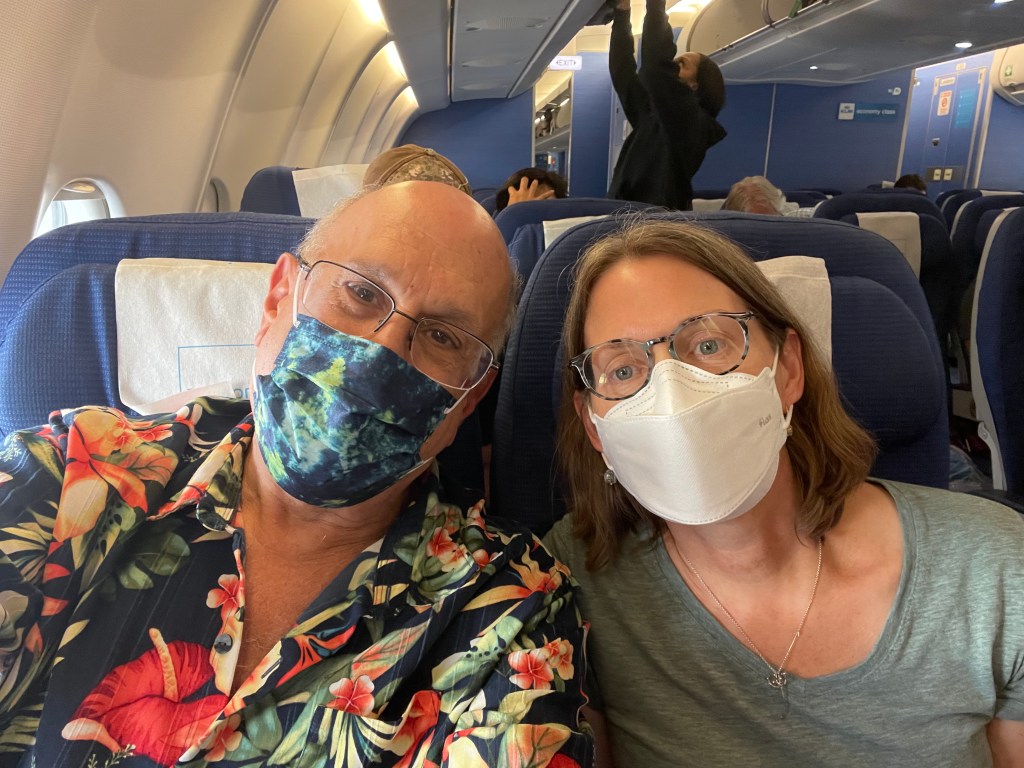
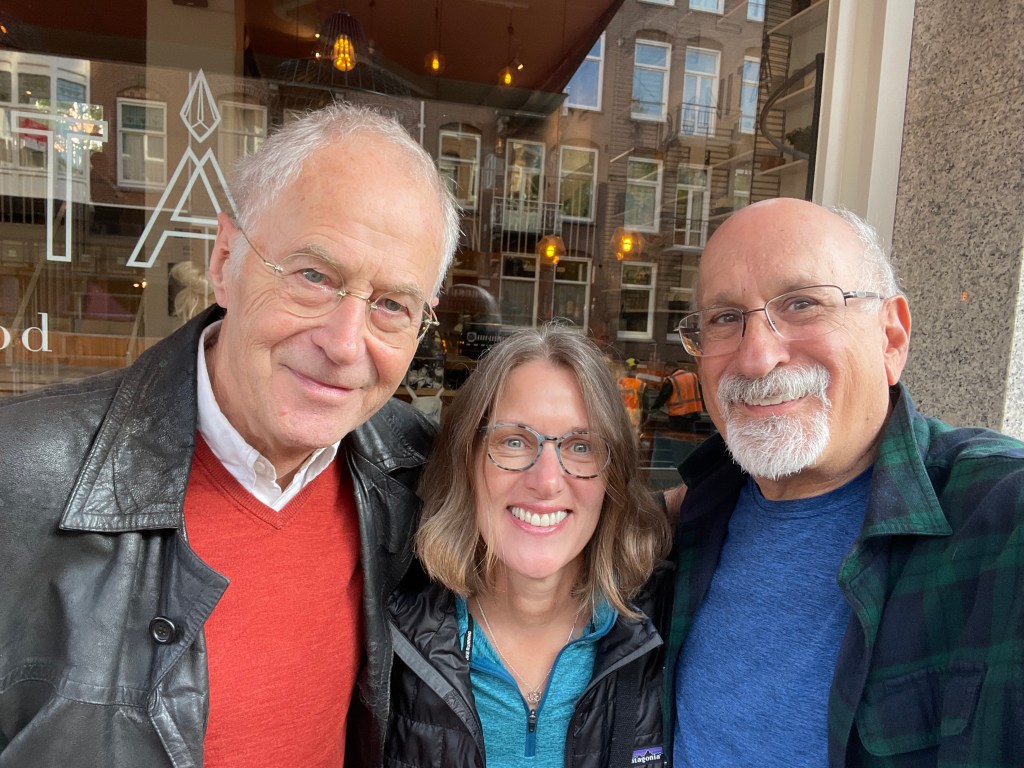
(Laurie and I on the way Amsterdam)

Regular readers of Ellery Queen’s Mystery Magazine and “Something is Going to Happen” may remember that I’m a big fan of golden anniversaries. (If you don’t, see “Looking Back on a Half-Century Love Affair With EQMM” and “Fifty Years After the Fair.”)

Well, this August I completed my fiftieth year in what was when I began the education business but has over time devolved into the education business, and I celebrated by retiring from my faculty position at Northern Virginia Community College’s Loudoun Campus. I was worried about making the transition from full-time teaching to not teaching, though, so I decided to ease into my retirement . . . by looking for a one-semester half-time position somewhere in Dutch-speaking Europe.

In the 1980s, when I lived for several years in Amsterdam, I translated a couple of Janwillem van de Wetering’s Grijpstra and De Gier stories for EQMM. Twenty years later, when Janet Hutchings launched the magazine’s “Passport to Crime” department, she asked me to find and translate more stories by Dutch writers, and I was happy to introduce readers to Theo Capel, René Appel, Carla Vermaat, and Tessa de Loo. In 2011, I decided to branch out a bit and Googled my way to Bavo Dhooge, a Flemish writer who in the first ten years of his career produced over sixty novels—and has since added more than forty more! Flemish and Dutch are not the same language, but they’re very similar—and, since only about two million people can read Flemish while twenty-two million read Dutch, most Flemish authors write in Dutch.

Through Bavo, I met and subsequently translated more of Flanders’ crime writers—Bob Van Laerhoven, Hilde Vandermeeren, Bram Dehouck, De Paepe & Depuydt, Pieter Aspe, Dominique Biebau—and, when Laurie and I visited Bavo in Ghent in 2015, we fell in love with the city, which is almost as charming as the much better known (and therefore much more crowded) Bruges.

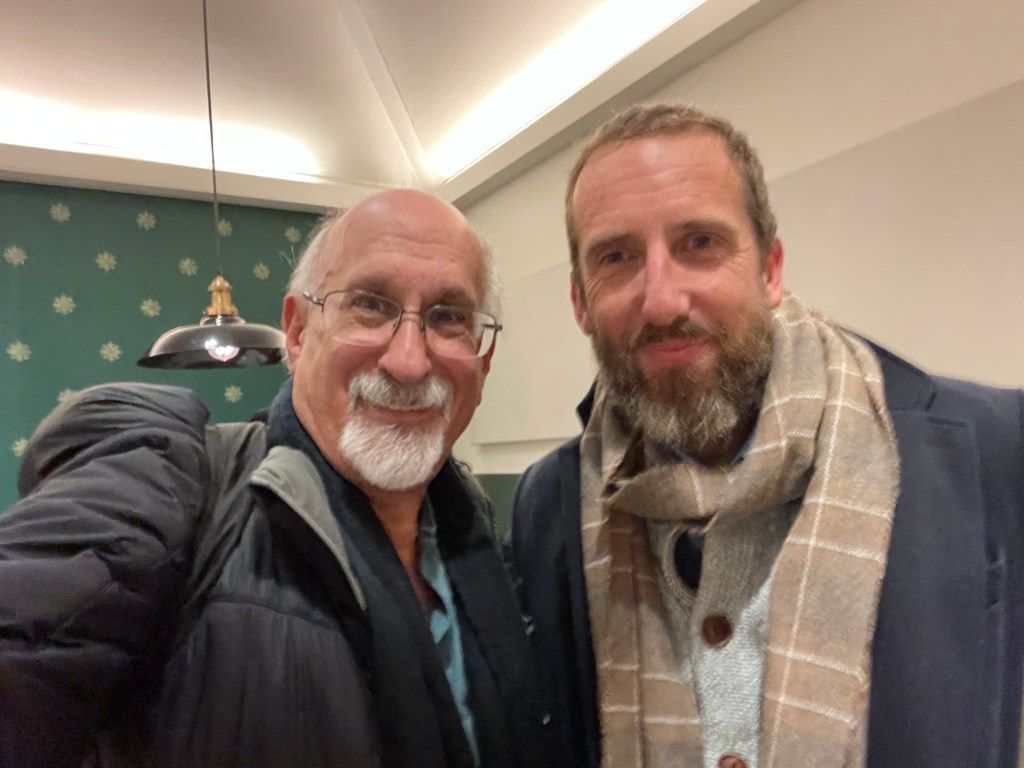
(With Bavo Dhooge in Ghent)

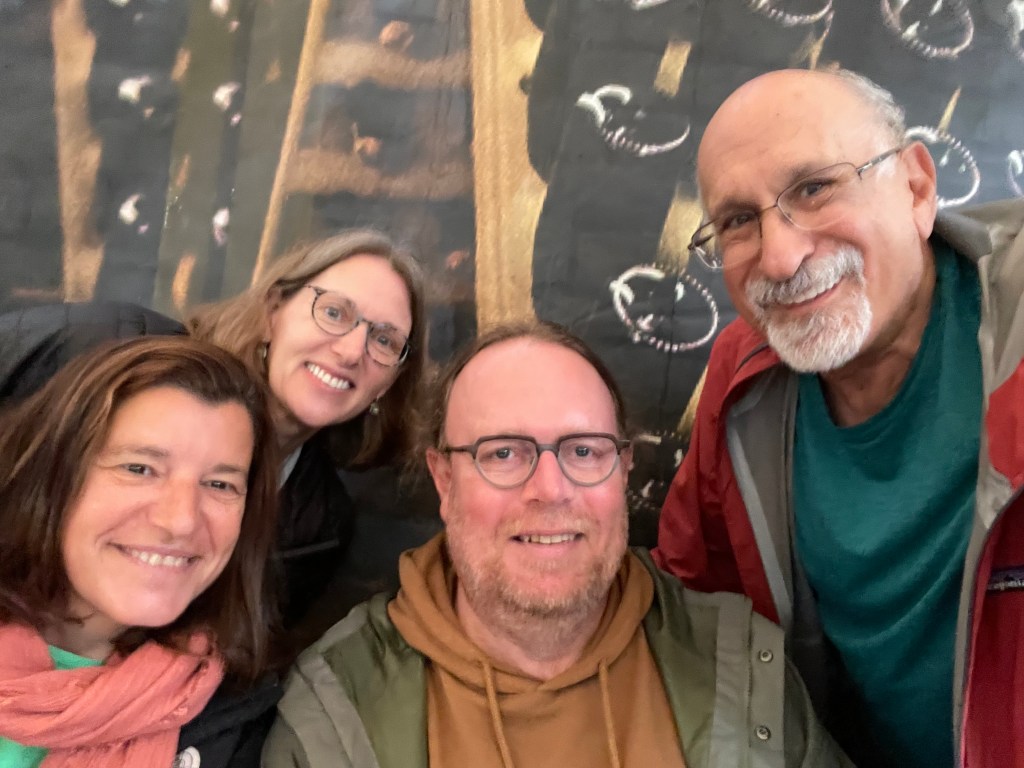
(With Herbert De Paepe and Christa Verspeeten in Ghent)

So when the University of Ghent invited me to spend the fall of this year teaching two courses (as opposed to my usual five), I jumped at the chance. They offered to cover my airfare, give me a furnished visiting-faculty apartment, and pay me enough of an honorarium to keep me in Trappist beer and fine chocolate for the length of my stay. In return for that, I would teach a masters-level course in “Writing Short Crime Fiction” on Monday afternoons and a bachelors-level course in “Reading Short Crime Fiction” on Tuesday mornings, with about twenty students in each group. That meant I’d have a five-and-a-half-day weekend every week, which would give me plenty of time to enjoy traveling around northern Europe.

I don’t usually teach either creative writing or literature. (To be honest, I’m not really sure it’s possible to “teach” creative writing.) For the last fifty years, I’ve taught a range of communication-studies classes, mostly interpersonal communication, public speaking, and film appreciation. So I spent most of the summer figuring out how the heck I might make courses in writing and reading short crime fiction worth my students’ while.

The writing class was the easier one to develop. A couple of years ago, Dutch author René Appel and I co-edited the Amsterdam Noir anthology for Akashic Books’ “City Noir” series. (I have, by the way, translated several of René’s stories for “Passport to Crime” and one for AHMM, and we collaborated on a story called “A Woman’s Place” for EQMM.) When I pitched the idea of a Ghent Noir volume to Johnny Temple, Akashic’s publisher, he agreed that he would in principle be interested in a Ghent addition to the series, so I structured my writing class around the idea that each of my twenty students would spend the semester writing a crime story set somewhere within the Ghent city limits, with the five best stories forming the core of Ghent Noir. And, if there turned out to be more than five worthy stories, I could propose the others to Janet as possibilities for “Passport.”

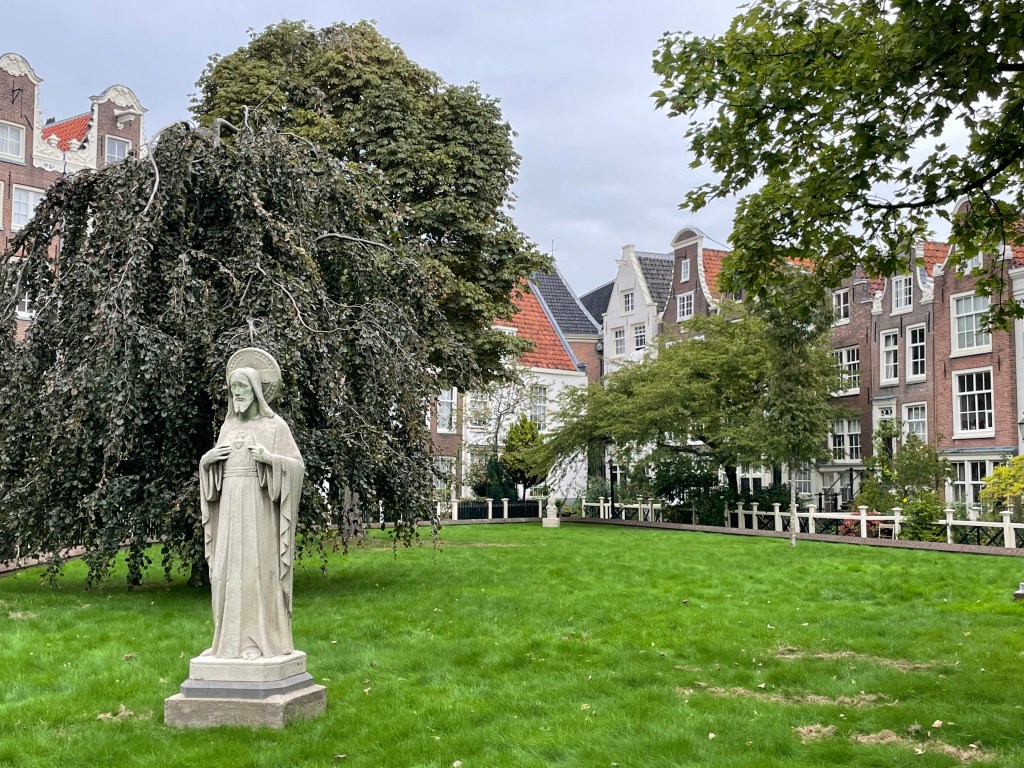
(The Begijnhof, the setting for “A Woman’s Place,” which Rene and I co-wrote [EQMM Sep/Oct 2017)

For the reading class, I put together a PDF file divided into ten chapters, one per week of the semester. Chapter topics included “The Origins of Short Crime Fiction” (Poe, Conan Doyle, Chesterton), “The Golden Age—The Ladies” (Christie, Sayers, Allingham), “The Golden Age—The Gentlemen” (Queen, Carr, Boucher), “Private Eyes” (Hammett, Chandler, Estleman), and so on. Many of the stories I included had to be typed from PDF sources, and I spent long days at my keyboard transcribing them and adding footnotes explaining unfamiliar Americanisms and Britishisms to the file’s more than nine hundred pages.

I should note that many of the authors I included are well known to the readers of EQMM, such as Stanley Ellin, Art Taylor, Brendan Dubois, Barb Goffman, and David Dean. Because the majority of my students would be Flemish, I also included a selection of my “Passport” translations. (I actually speak Dutch and offered to teach my courses in that language, but because UG also welcomes international students, I was asked to teach in English and to limit the readings to English-language material.)

So, Laurie and I flew to Amsterdam on September 8 and spent two weeks visiting some of our favorite places in The Netherlands (where we had breakfast with René Appel) and Belgium (where we met up with Herbert De Paepe, who has contributed two stories he co-wrote with Els Depuydt and one solo story to “Passport to Crime,” and his girlfriend Christina). On the 24th, we returned our rental car, Laurie flew back to the US, and I took a train south to Ghent to begin my fall semester.

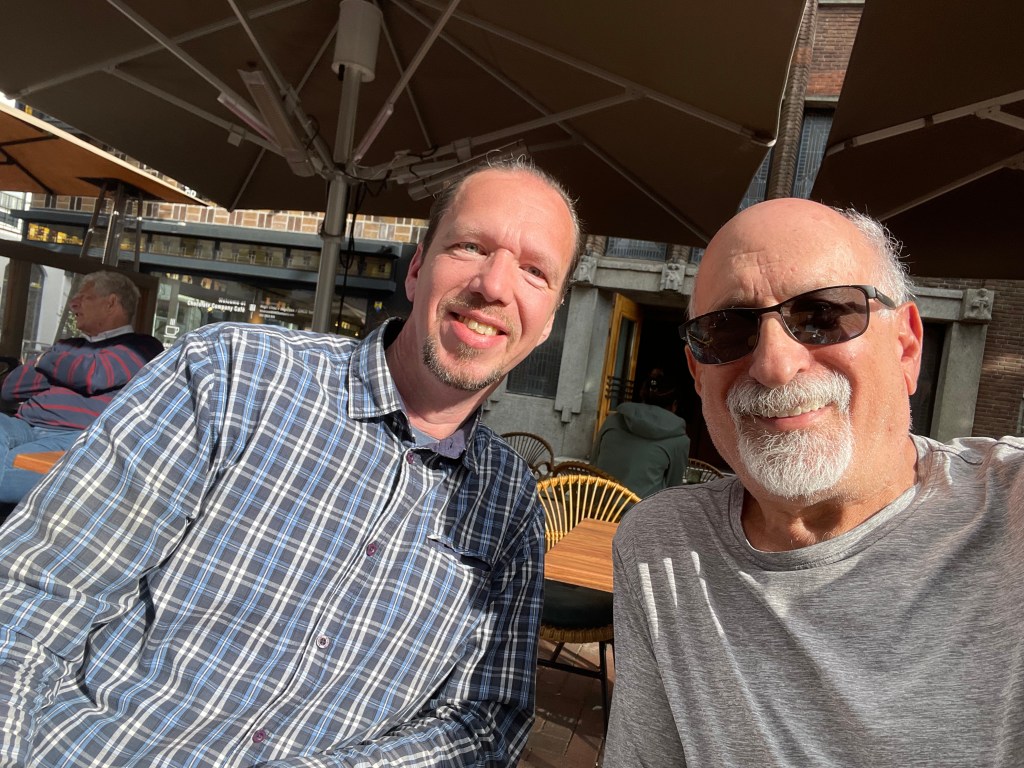
(With René Appel in Amsterdam)

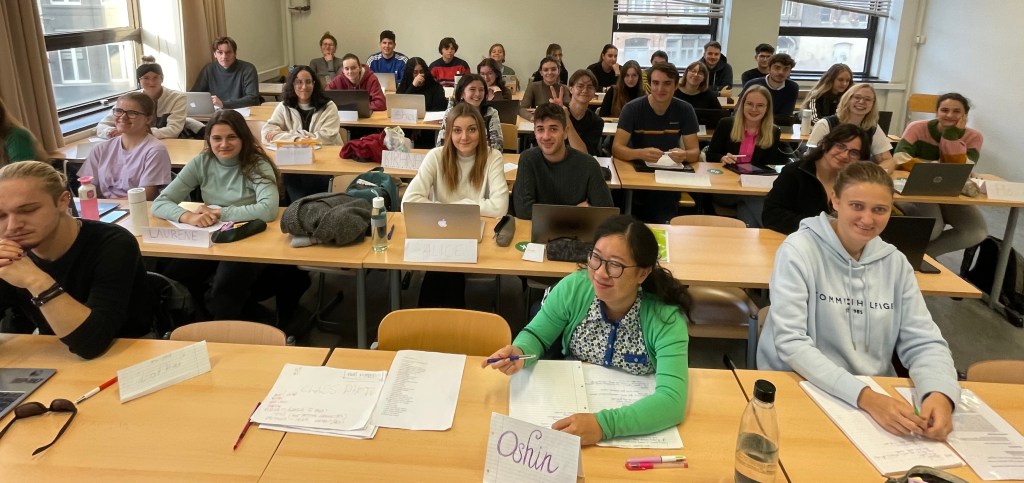
My first class session was on Monday afternoon, September 26, and when I walked into the classroom I found, to my horror, not the twenty creative-writing students I’d been told to expect but fifty-four of them! Then, the next morning, my twenty-student literature class turned out to have forty-four students enrolled.

(My “Writing Short Crime Fiction” class)

(My “Reading Short Crime Fiction” class)

There go my five-day weekends, I realized. Instead of tooling down to Paris and other fun destinations, I was going to be spending a lot more time grading short-story drafts from one enormous group of students and critical reviews from another almost-as-enormous group of students than I’d been led to expect.

I did, however, go back to Amsterdam for my first five-day weekend (since my apartment wasn’t going to be available until early October) and stay with the very talented Christine Otten and her family; Christine hasn’t written a story for “Passport to Crime” yet, but she had a chillingly dark one in Amsterdam Noir. And I was also able to meet two-time EQMM contributor Anne van Doorn for a couple of cappuccinos at a sunny café in Hilversum, a pleasant town half an hour from the city.

(With Christine Otten and her husband Hans Krikke in Amsterdam-North)

(With Anne van Doorn in Hilversum)

Even after the student assignments started coming in, I was able to have some fun during my three months in Belgium. Kurt Sercu (who runs the world’s most extensive website dedicated to Ellery Queen) invited me to spend a weekend at his and his wife Martine’s beautiful home in Sijsele, a village just a few miles from Bruges, and took me on a guided walking tour of that city’s less touristed neighborhoods. Several of my colleagues and I took a “field trip” across the Belgian/Dutch border to the little town of Philippine, which is (deservedly!) famous for its mussels. Laurie came to visit me in Ghent for a couple of days in November, and then the two of us took the Eurostar to London for a long weekend (at the end of which I had a delightful lunch with EQMM contributors Paul Charles and Tom Mead). “Passport to Crime” author Dominique Biebau showed me around the charming city of Leuven. And I did a Memory Lane weekend in Nürnberg, where I lived for eight years during the 1980s and where my daughter Rebecca K. Jones (herself an EQMM contributor and, earlier this year, debut novelist) was born.

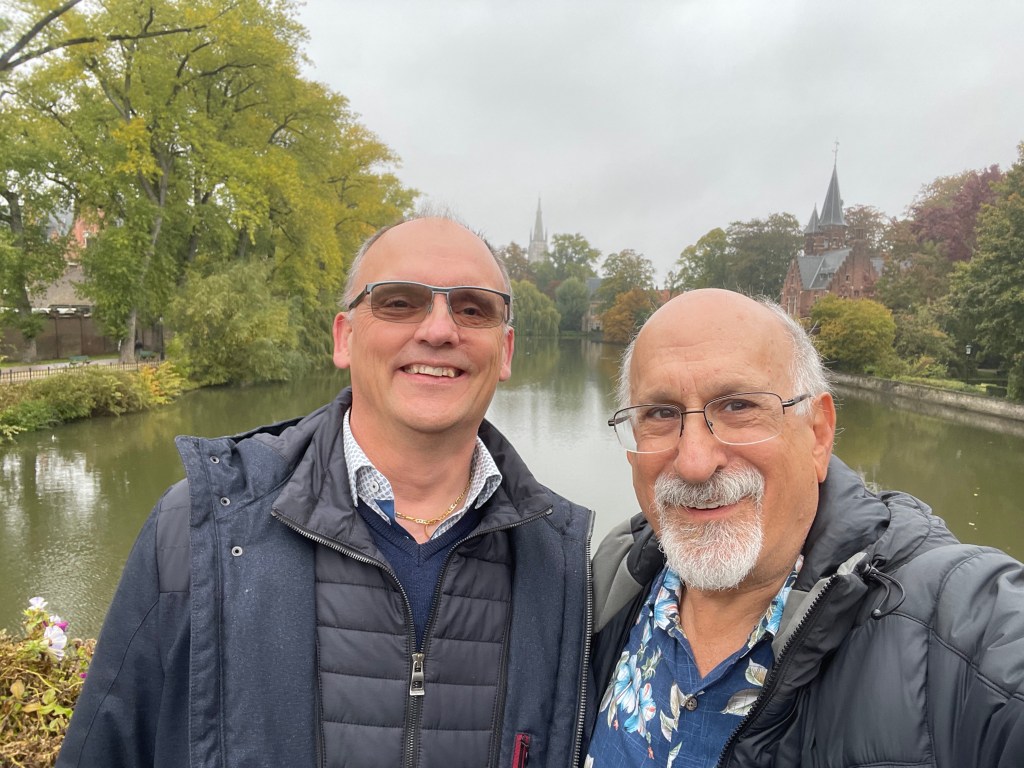
(with Kurt Sercu in Bruges)

(With Kurt and Martine on the Belgian coast)

(By the giant mussel statue in Philippine with colleagues)

(Dominique Biebau in Leuven)

(With Paul Charles and Tom Mead in London)

(With Laurie in London)

Meanwhile, three of the Flemish authors I’ve translated for EQMM guest-lectured in my classes: Els Depuydt talked with my creative-writing students, Herbert De Paepe talked with my literature students, and Bavo Dhooge visited both classes. (And I had very pleasant dinners with each of them.)

(Interviewing Els Depuydt in my writing class)

(Herbert De Paepe talking to my Reading Short Crime Fiction class)

As if all that didn’t add enough EQ flavor to my overseas adventure, it was while I was in Ghent that Crippen & Landru published The Adventures of the Puzzle Club, which collected for the first time all five of Frederic Dannay’s and Manfred B. Lee’s Puzzle Club stories plus all five of the Puzzle Club pastiches I wrote over the past few years for EQMM. The book’s byline, “by Ellery Queen and Josh Pachter,” was a mic-drop moment for me, bringing me at age seventy-one all the way back to the teenager I was in 1966, when Mary Ryan, my ninth-grade English teacher, introduced me to the pleasures of what I have since come to think of as the EQniverse, a universe of which I have been a very happy citizen for fifty-six years . . . and counting!

Speaking of counting: it’s late November as I write this blog post, and I am counting down the days until I finish my semester at the University of Ghent and return to Virginia to begin my delayed retirement.

Although I won’t be teaching for pay any more, I intend to continue offering enrichment courses in crime fiction and film history as a volunteer for the Lifelong Learning Institute of Chesterfield County and the Osher Lifelong Learning Institute at the University of Richmond.

I also intend to continue editing collections of short stories, translating Flemish and Dutch authors for “Passport to Crime,” and writing new stories of my own.

I figure I’ve probably got a few thousand miles left on my tires, and I plan to keep on driving as long as my engine holds out and the scenery remains interesting.

Happy holidays, everyone! If you’ve got a beverage close at hand, I hope you’ll raise a glass and join me in wishing for peace on Earth and good will towards all creatures great and small!

Posted in Uncategorized | 7 Comments

The Big Trouble With Writing Comedy (Michael B. Hock)

Michael Hock’s debut story, “The Artisan-Cheese Incident” appears in EQMM’s current issue, November/December 2022. It’s a comic mystery—a type of story we don’t very often see, although, as the author points out in this post, there are some natural affinities between comedy writing and mystery writing. A recent MFA recipient in fiction at George Mason University, Michael has previously had a few comedy pieces published, so he speaks from experience with regard to both forms of writing. —Janet Hutchings

Comedy is subjective. The idea of subjectiveness and comedy sounds like an undeniable truth, such as “the sky is blue,” “grass is green” or “the rival team to my favorite sports team doesn’t play quite as well as mine, and if they do, they cheat.” These statements themselves have their own paradoxes to them. After all, the sky is blue only a portion of the time; grass, while green, tends to be greener on the other side; and your favorite sports team had a losing record for the past four seasons and it’s probably time to realize that they’re well past their “rebuilding year.” Thus, these statements themselves lend themselves to their own subjectiveness.

Perhaps the only real factual statement might be that comedy comes in threes.  

My first story for Ellery Queen’s Mystery Magazine, “The Artisan-Cheese Incident” is funny. At least it is supposed to be, we’ll get to that in a minute. I’ve always enjoyed making people laugh, whether it’s through a quick joke, a well-intentioned pun—and your puns should always be intentional, folks—or through the written word. It wasn’t until a few years ago I had even thought of combining comedy writing with crime or detective stories. But it makes sense. After all, a mystery is inherently funny. There are misunderstandings. Things that might be puns if you examine them just right. And the success of a mystery story, like the success of a good joke, depends on the cleverness and unexpectedness and even the timing of the ending. But unlike a punchline, there are variations to just how a story might end. It could be comedic, such as the aforementioned misunderstanding, like everyone thought the heiress was killed, but she was merely on vacation. It might be tragicomic, like the heiress was killed while on vacation, but through a series of odd circumstances. Or it might be tragic, such as the heiress goes on vacation without informing anyone and returns safe, and the detective hired to find her killer is not paid.

The preceding paragraph includes three examples, and thus is the very definition of comedy.

The novel that made me realize that crime and comedy could make a winning combination is the 1999 novel Big Trouble, by noted comedy writer and to that point not noted crime novelist Dave Barry. In fact, until that book, he had been known mostly for telling stories about Florida, albeit in ways that are supposed to be funny. Again, we’ll get to all of that in just a minute. The novel involves a mysterious suitcase, some Russian arms dealers, the FBI, some police officers, a shady company, someone who should have known better than to steal from a shady company but did it anyway, some criminals in way over their heads, a toad, some teenagers, and an author surrogate, which every debut novel should include.

While I do realize that there are other comedy crime novels and this is not a new thing, this was the first one that really grabbed me and made me consider just how comedy could work in the crime novel. After all, this book, while taking us through the weird world of Florida crime, still dealt with the issues of “what would happen if a nuclear bomb accidentally fell into the hands of the stupidest people on earth.” Which are pretty heavy issues, not ones that lead to comedy. After all, there’s a bomb, which isn’t very funny, but it’s given to someone who’s very stupid, which is always funny.

The previous sentence only involved two examples, and thus, it’s not clear if that sentence was particularly funny or not.

What grabbed me about Big Trouble was the way it managed to weave the comedy so deftly into the crime itself. One of the more exciting scenes involves an assassination attempt on Arthur Herk, a shady man who does shady work for an even shadier place of employment. The use of shady three times here was an attempt to portray how much shadiness is in this novel, not necessarily an attempt at comedy on its own, but you’re more than welcome to find it funny if you’d like. Regardless, during this assassination attempt, his daughter is about to be “assassinated” herself. Jenny is involved in a game in which teenagers spray each other with water guns as part of a game. This leads to the hilarious misunderstanding in which the real hitmen accidentally run into the fake, teenage “hitmen.”

It’s the blending of the two realities that leads to the comedy, for me. On the one hand you have the very serious idea of this guy who’s about to be killed. He’s unsympathetic, which might make his death hilarious to some, but at that point in the book we’ve only seen that he’s kind of stupid and hasn’t quite reached the full potential of being fully a jerk who might deserve to die. This is largely because at this point he is yet to purchase the possibly nuclear MacGuffin that would draw our many characters together. What works is the heightened reality in which the teenage hitmen . . . hit boys, maybe? . . . work. They are coming from a place just as serious as the other hitmen. After all, teenage popularity might be just as important, if not more so, than skimming money from the shady company that one works for, which was Arthur Herk’s crime. And they are right to be as nervous. They are not only not supposed to be there, but they are very afraid of the same things the other hitmen are worried about, namely that someone in the house is armed (As Barry notes, this is South Florida). Also, one of the boys has developed a crush on his target, Jenny, which makes his “assassination” of her merely awkward teenage flirting. It is not clear at this point if the regular hitmen hate Herk, Florida, or both, but the tension is much more heightened, which only adds to the comedy of the fake hit boys.

What Barry does that works so well is that he treats this moment of comedy extremely seriously, and he uses this particular scene to fully demonstrate why they work together. Both groups are deadly serious—the worlds of shady corporate espionage and high school having their own very high stakes. However, to one group the assassination is a game and to the other it’s a dark moment of real danger. This is a moment that happens very early in the novel—spoilers for an almost twenty-year-old book, I guess—but lays out just how comedy is going to work in this crime novel. Mostly that there will be something serious that happens layered on a similar comedic moment. It works because it takes something that we may not relate to, but then loops it into something we can, and then makes a joke. The real hilarity here coming in the fact that at this point, both groups are wildly unsuccessful. Herk goes on to live, and Jenny remains “unassassinated” by the rules of the game. This is early in the book, so there’s plenty of time to correct both things later. But it’s also comedy in reminding you that these people committing the crimes aren’t exactly the smartest. Barry treats these moments with a clarity that everything is serious, right up until the point that it’s not

Which may be the thing that defines comedy writing more than anything. Not only that it comes in threes, but that most things are serious, right up until the moment that they’re not.

Before I go into my final paragraph, I wanted to point out that I used these interludes that talked about how comedy comes in threes exactly three times before this—which is funny—but here I am pointing it out in a fourth—which means it’s not. Make of that what you will.

That’s where the intersection of comedy and mystery works so well. It’s all serious. The crimes being committed, the detectives figuring it out, the mystery itself being something elusive. Right up until the moment that it’s not, and there’s an absurdity to it that everyone has to admit. In Big Trouble, a very serious moment is broken up by the fact that it’s very unserious people involved in every step. But that’s also where the subjectiveness comes in, and that’s the line that comedy writers have to walk. Sure, it’s funny. But is it funny to everyone? Often times writers spend a lot of time crafting a joke, but once that period hits the page, it turns out to be just a regular sentence. That’s an impossible task, because as mentioned, just like the color of grass or your favorite sports team or the sky being blue, comedy is going to be subjective. What you can do is show audiences just what being funny is by contrasting it with what’s not supposed to be funny. Reminding people of what comedy might be, because the alternative can be too serious.

Of course, sometimes it’s just a good reminder that you have to laugh.

Posted in Uncategorized | 1 Comment

THANK YOU FROM EQMM!

We’re grateful for you!

Posted in Uncategorized | 2 Comments

Me, Myself, Nor I (by Andrew Riconda)

Andrew Riconda’s short fiction has appeared in a variety of literary journals and crime-fiction publications, including The Amherst Review, The William and Mary Review, Crimespree Magazine, Criminal Class Review, and Rio Grande Review. One of his stories was selected for The Best American Mystery Stories 2011. He’s a recipient of a Bronx Council on the Arts BRIO Award for 2021. In this post he discusses the inspiration for his debut story for EQMM, “If I Could Walk My Brother Into the Deep Woods,” which appears in EQMM’s current issue (November/December 2022), as well as other sources of inspiration that writers may want to try tapping. —Janet Hutchings

One of the most famous lines in The Catcher in the Rye is its first, the one about “all that David Copperfield kind of crap,” the personal stuff Holden is not willing to share much of with us because it would give his folks “two hemorrhages a piece” if he did.

My parents would’ve been solidly in the hemorrhaging camp.

Let me give you a little last week, late night autobiography:

On the eve of the publication of my first story for EQMM, I had this dream: I am at a place I used to write at in NYC, The Writers Room, but, of course, it’s not that place; it seems to be an airport hangar. I’m pushing my writer’s desk to a sunny spot on the floor amenable for great wordsmithing, but I push too hard and fast and the desk bumps into another writer’s desk, a pretty librarian type, and knocks the urn containing her father’s ashes to the ground. She’s angry, I apologize, and she says, “Now you’re standing in him!” I sheepishly start to pick up her dead dad’s particles, but then the ashes and the linoleum beneath become quicksand and my left foots begins to sink. I ask the writer if she wants me to continue to collect her dearly departed’s dust (I am often polite to a fault, that’s my way), and she says, “No, I’ll just sue you—and your family,” and points to my right where my late mother has materialized only to remain mute on the entire subject (and that was her way). At that point, the Executive Director of the Writers Room shows up (for the last thirty years, she has been the big sister Mom and Dad refused to give me), and, deus ex machina, proclaims, “She will not sue.” (It would’ve been better, of course, Donna, if you had said, “She shall not sue.”)

The dream should’ve ended there (there was something about me having to drive Diane Lane to her matinee performance of Annie; I assume she was playing Miss Hannigan), and I could’ve jotted off a snotty Thank You note to my psyche for allowing me to so blissfully enjoy publication day.

I do not think I have to invent a therapist of Dr. Melfian proportions to interpret. It goes without saying that I’m proud of the story’s inclusion in this venerated magazine, but I think it’s also clear I have some of the same misgivings about picking the delicate fruit from the family tree—even though Mom and Dad, and the brother and aunt depicted in the story are all deceased. (The aunt, it should be noted, was as quadruple-hemorrhage proponent, for years saying if I ever wrote about her she would haunt me from beyond the grave; this has not come to pass unless you consider me still receiving Verizon FiOS offers in her name the best she can muster from the Beyond.)

So what do you do if you want to (or, dear Lord, have to) borrow from your own life for the fictional ones you create? Well, first, you wait for all your closest relatives who will take issue to pass way. Done? Good!

But wait: Maybe you’re too impatient for that. Then what? Well, there are several approaches that have worked for me, some easier than others.

THE STALE BREAD APPROACH—

Stale bread doesn’t have to be just for the birds, it’s great for stuffing, too. An old anecdote from your father’s childhood, or his mother’s (like the one week she worked at Macy’s in Manhattan and got fired because two men walked right past her and out the door with a canoe they hadn’t paid for), can be a great place to start.  You are such removed from the events, they may be more readily accessed with less fretting than the more personal stuff (like that sonuvabitch McDonald’s manager that made me count ice cubes in the freezer one night). I recently used my grandfather, whom I never had the pleasure to be acquainted with, in such a manner. He was a professional baseball player, and during a game he got into a spiking war with Ty Cobb and they both got kicked out of the game.  

Perhaps getting your feet wet in this manner will allow a progression to it being almost all about you elsewhere:

THE MY BROTHER-IN-LAW IS AN IDIOT APPROACH—

Are you now ready to dip further into the autobio pool? I would suggest starting at the shallow end, the family members you hate. Your brother-in-law, he’s always been a bit of a jerk, right? Maybe he thinks boiled eggs should be broken at the big end rather than at the little end or he thinks Roger Moore was the better James Bond, whatever.

You can set off to capture the absolute scurrilous and contemptible with reckless abandon—enjoy! And perhaps you are secure in the knowledge that your subject is an illiterate and you know there’s no way he or she will ever encounter a New Yorker or Harper’s even in a doctor’s office, let alone some obscure literary journal you’ve warted with their, ah, wartiness.

And you may come out of your righteous rancor surprised. I workshopped a borderline sociopath of a brother-in-law story once, only to find my audience found him more sympathetic than the family he intends to kill over Thanksgiving dinner. That certainly wasn’t my intent; yet, the result was more satisfying. Again, it would seem I wasn’t really making it all about me.

Of course, the closer you get to home, the dicier this all gets. As the poet Hans Gruber said, “Sooner or later I might get to someone you do care about.”

And there are two approaches to try here: Be Honest. Or Lie Like Hell.

 THE LIE LIKE HELL APPROACH—

This one is also called the “I always tell the truth, even when I lie,” per another poet, Tony Montana. Some of my first-draft readers have commented that the fathers I depict are a rather unsavory lot of cheats, liars, and scoundrels and I must’ve had a heck of a home life.

My Bad Dads are indeed based on my father, but in a very different way than conjectured. My dad was a wonderful, kind human being with heart bigger than all outdoors—and much of the indoors, too. (Mom, you were aces too, FYI). So, what do I do when I need an appalling pop on paper? I think what my father would do and say, and then I have the fictional louse do the exact opposite.

THE HONESTY IS THE BEST POLICY (BUT DON’T BEAT IT TO DEATH) APPROACH—

My EQMM story is a “brother’s keeper” story, a fictional distillation of many actual encounters I had with my eldest sibling, who battled with schizophrenia for many, many sad years. I was designated to be my brother’s keeper by my parents’ will (literally), but had been handling those duties for years anyway—it was expected of me from everyone, including myself. I often felt alone in this legal and moral conservatorship. But he was there, too, my brother, and a certain amount of resentfulness festers within the kept as well as the keeper. It’s that tension that I wanted to write about. But it was all so close, and so recent . . . and my brother may be gone, but I’m not. So, I opted for a sort of snatch and grab approach, get in and out, hoping concision wouldn’t derail feeling. Brevity is the soul of wit, but I hoped it could work for the somber stuff, too.

Onward and inward:

THE FUTURE IMPERFECT TENSE ME APPROACH—

I’m in the midst of a Love in the Age of Covid story right now, and the protagonist is a good-looking, witty fella named Andrew Riconda. Well, I thought he was the protagonist. After rereading the latest draft, I’m thinking he’s perhaps the antagonist. And a bit of a worm at that. But we’ll see how it goes: I hope at least his creator tries his best to be an honest worm in his rendering.

Perhaps all of these above were not so much approaches, perhaps they were more rungs of a ladder taking me closer and closer to something. I heard David Duchovny paraphrasing Neil Simon on Real Time with Bill Maher recently: It’s all autobiographical, even the stuff I make up. Maybe so, and maybe when you get to the last rung of the fictional ladder you’re face-to-face with nothing more than a mirror. So, is it ever really me, myself or I? I dunno. In the movies, when they still made movies about people, they used to say, “inspired by true events.” Inspired, that word gives us a lot of leeway for the truths and alt-truths we create about ourselves. So much so, it’s rather inspiring.

Posted in Uncategorized | 5 Comments