Can Any Author Write Any Character, Regardless of Identity Differences? (by Rob Osler)

Rob Osler made his fiction debut in the Department of First Stories of EQMM’s January/February 2021 issue with the story “Analogue,”  which went on to win the Robert L. Fish Award for best short story by a new American author. His debut novel, Devil’s Chew Toy, published the following year, was a nominee for the Anthony, Macavity, Agatha, and Lefty Awards. A sequel to Devil’s Chew Toy, entitled Cirque du Slay, is due out early next year. In the meantime, don’t miss Rob’s latest short story, “Miss Direction,” in our September/October 2023 issue (on sale next week!). In this post he addresses a question that most writers probably wrestle with at one time or another, and he has some interesting insights. —Janet Hutchings

Did you know that some of the most successful gay romance writers are not gay? It’s true. Many are straight women. When I first learned of this, I was dismayed. What could a straight woman possibly know about gay men’s romantic lives? Why coopt our stories? Hearing my gripe, my partner, Brian, asked, “Have you read any of their books?” My answer: “Well, no . . . but.” The simplicity of his question continues to shape my thinking about the types of characters an author has license to write. Spoiler alert: I provide no hard-and-fast answer because I don’t believe there is one. Instead, I offer a few thoughts and considerations that I hope are useful to the debate.

As a gay man, I am comfortable writing a story with a gay main character. I’m guessing you didn’t gasp reading that. Your reaction is likely the same knowing that gifted author and Black lesbian Cheryl A. Head’s series main character, Charlene “Charlie” Mack, is also a Black lesbian. Nor is anyone likely to question why the main character in Raquel V. Reyes’ marvelous Caribbean Kitchen Series is Miriam Quiñones or that author and trans lawyer Robyn Gigl’s terrific legal thrillers feature trans lawyer Erin McCabe. The reason for our acceptance is simple: we don’t doubt these authors’ credibility, legitimacy, or interest in writing those characters. We trust them to get right their characters’ interior selves. But that is not always the case when an author decides to “step out of their lane” to write a character who is in some way essentially different from themself. That readers and the writing community might ask questions is expected. Despite an author’s best intentions, the work might be viewed with skepticism, at worst, disparaged. But wait. Isn’t this fiction? Shouldn’t an author be free to write whatever interests and inspires them? Shouldn’t a work be judged solely on its merits? Or are there limits—unwritten as they may be—that put constraints on one’s creative license?

To explore this, let’s return to my statement that as a gay man I have no reservations about writing a gay main character. I also feel the same way about writing a straight main character. Thoughts? If you’re like most people, you’re not too bothered, if at all, by this. I have lived my entire life in a culture and community centered on straight people. I don’t need to conduct ethnographic research on what it’s like to be a straight person in today’s America. I need only to go about my day with open eyes. This is, of course, how most authors conceive of and bring many of their characters to life—by making artful use of what they observe around them. Writers commonly tap into the familiar; “Write what you know” is a common refrain for a reason. But what about when an author chooses to write about characters beyond their lived experience?  

To dig into this, let’s explore a hypothetical: what if the straight character I intend to put in my story is also Black? Oh, did I mention she is my single main character? Now what do you think? I’m guessing you’re not fence-sitting. Let me take a stab at articulating some likely questions. First and foremost, Why? Why is a gay white man choosing to write a straight Black woman protagonist? What makes him think he can pull off developing and presenting her as an authentic individual? Is he nuts? If those are not your questions, I’ve tipped my hand: they are mine. If I ever make such a choice, I’ll have to contend with the inescapable reality that every individual’s identity is deeply personal and can be sensitive, especially if perceived as misappropriated. When an author doesn’t share essential aspects of another’s life experience and writes about that person’s people, places, and culture anyway, that is bound to raise questions. But does that mean an author should never do it?

By way of example, I wouldn’t intentionally write a story centered on a Black main character who is a hairdresser at a women’s salon in a Southern town. Among the myriad reasons why I wouldn’t do that, knowing absolutely nothing about that experience figures high on the list. But I will not say that no other white person could or should write that story featuring that character in that setting. Aghast? I get it. I do. But hear me out. What if I told you that the white author had spent the past twenty years as a hairdresser at a women’s salon in a multi-racial community in Alabama, and half of her clientele were Black? Does that change your opinion? Is there a certain percentage of Black clients or a minimum number of years required that she work at the salon to prove herself a legitimate teller of that character’s story? Try this: what if the author had volunteered and apprenticed in an intensive two-week stint at the salon as part of research for the story? Enough or never enough?

Another take on this is offered by Trysh Travis, Associate Professor in the Center for Women’s Studies and Gender Research at the University of Florida, in a post for Blackpast.org titled, Is The Help Realistic? It Depends.*  Professor Travis asserts that a novel’s intended audience is a significant factor in judging its authenticity—or, as she refers to it, reality. To paraphrase, in the case of Kathryn Stockett’s mega-seller, The Help, Travis argues that it should be expected that a fictionalized tale of race relations told from the perspective of a white female employer, written by a contemporary white female author for a mostly white female audience, didn’t fully withstand critical examination by historical scholars. Why? Because the novel (stressing fiction) was shaped by the reality the contemporary author shares with her readers, which is bound to be different from one that hews only to the historical record (stressing non-fiction). Travis concludes her thought-provoking article by saying, “Reasonable people may differ over which realism is most . . . realistic.” Chew on that!

Here’s what I wonder (and I do wonder!): When are universally shared human traits—ambitions and aspirations, vulnerabilities and insecurities, and all the rest—not enough to satisfy insight into a character different from the author? Might the right answer be not an unequivocal one but a thoughtful consideration calibrated by how deeply a character’s unshared experiences are explored on the page? For me, if a straight author were to write a story that includes a gay character (presuming no tired clichés), it’s one thing for that character to appear now and then versus a story told from his perspective that delves into his emotional struggle with coming out to evangelical parents in a conservative rural community. Although we can probably agree that even a secondary character should be drawn as true to life as possible, the author might get away without having a deep knowledge of a secondary character’s psychology and world from the inside out. In contrast, the latter storyline would seem to demand it. If an author chooses the deeper route, to quote RuPaul, “You better work!”

The scenarios above beg two questions: (1) why would a white or straight author choose to write a Black or gay main character, respectively, and (2) how do they hope to pull it off with supreme authenticity? As to the reason for choosing to do so, I think it is up to the author to explain—or not. I don’t think fiction can accommodate an edict for the types of characters an author—by virtue of their identity—should be allowed to write. It’s too nuanced and situational to establish a one-size-fits-all rule. No matter who we are, our life experience is specific to each of us. However, unless you’re writing sci-fi, isn’t authenticity always the goal? Should an author decide to go for it, they must accept that some readers might view their work with greater scrutiny and apply a higher bar for getting even minor details right. Still, other readers—whether their concerns are legitimate or not—might reject the project out of hand.

If an author is passionate about a character and story, is up for the challenge, and accepts the risks, as a reader, I will try, hard as it may sometimes be, to judge the work on its merits and not make a premature judgment based on the name, photo, and bio on the back jacket flap. I’ll try to be guided by my partner’s simple question: Have you read it?

*Thanks to my author pal, Raquel V. Reyes, for pointing me to this insightful article. You can find it here: https://www.blackpast.org/african-american-history/help-realistic-it-depends/  Historical fiction brings up a materially different set of considerations—no one living today can hope to get a historical story right by reflecting upon life experience alone. This subject deserves a separate, longer discussion.

Posted in Uncategorized | 6 Comments

Writing Is More than Output: Why Writers Shouldn’t Fear AI (by Twist Phelan)

A popular novelist with two series (the Finn Teller spy novels and the Pinnacle Peak mysteries) to her credit, Twist Phelan is also a prolific contributor to EQMM. Her EQMM stories have won two ITW Awards and Canada’s Arthur Ellis Award, and they’ve received numerous additional nominations for these and other awards. In 2022, her EQMM story “The Bridge” (May/June 2022) was long-listed (amongst only a dozen stories!) for the Irish Book Awards Short Story of the Year. A new Twist Phelan story, “Soon It’ll Be Over,” is included in our September/October issue, which goes on sale August 15, and if you’ve got young readers in your family, don’t miss Twist’s first middle-grade mystery, Snowed (2022).  In this post she reflects on a very timely subject—the AI revolution.  —Janet Hutchings

It’s easy to understand the allure of the AI program ChatGPT among aspiring writers. The seemingly miraculous ability to craft eloquent prose with the prompt of a mere few sentences and the press of a button is akin to wielding a superpower. (Don’t believe me? Type, “Compose a sonnet in the spirit of Shakespeare for my beloved husband on our decade of wedded bliss, incorporating our shared passions for [insert interests], his stellar performance as a [insert profession], and his distinguishing [insert physical attributes]” into ChatGPT. You’ll never buy another Hallmark card again.) People are discovering a creative capacity that they may have long abandoned or never even considered. Finally, they can “write” something that appears to be a bona fide story.

Alas, generating writing via the push of a button disregards a simple but crucial truth—a compelling story encompasses more than words arranged on a page.

When people talk about the artistry of quality fiction, they delve into the choices made by the writer—decisions concerning character development and plot construction, stylistic choices and thematic explorations, the nuances of language and the architecture of the narrative. They ponder the author’s background, speculating about the influences and inspirations that have shaped her literary endeavors. They contemplate how a particular book or story fits into the author’s body of work, whether it’s an integral part of or a deviation from her artistic canon.

Each of these elements serves as a portal into the writer’s psyche. In and of themselves, they constitute the very essence of writing. A story transcends its textual embodiment; it encompasses the thoughts and emotions that occupied the writer’s mind during its creation. What distinguishes exceptional writers is not their ability to string together a dozen words into a sentence but rather how those twelve words reflect an author’s innermost being, as channeled through the story and experienced by the reader. When we immerse ourselves in a work of fiction, we partake in the author’s vision—we become conduits for the emotions they seek to evoke, we delve into the intricate and nuanced layers of themes woven into the fabric of the narrative.

Writing isn’t just an act of output; it encompasses the entire creative process. While AI technology currently democratizes the act of writing itself, it has yet to capture the essence of the creative process in its entirety. AI-generated writing provides not much beyond its superficial appearance—that is, what meets the eye on the page. Great writing is measured by its depth of observation and discernment, its ability to reflect the heart and mind of its creator. The difference between the two is akin to the distinction between buying an assembly-line-produced vase from IKEA, indistinguishable among thousands of identical counterparts, and acquiring a unique receptacle from an artisan who painstakingly carved familial icons into the artifact, employing techniques passed down by generations of skilled craftsmen. One is a generic container, while the other is an artistic masterpiece that reveals something new with every contemplation.

Throughout history, writing has withstood the advent of the printing press, the photograph, the motion picture, the photocopier, and the computer. It will survive our newfound ability to produce deceptively convincing replicas of human effort. Yes, just as there’s a market for mass-produced hotel art, there will be (if there isn’t already) a market for books presented “in the style of” featuring shallow renditions of plots and characters previously encountered countless times. (For the record, my husband liked his sonnet!) But there will also always be a market for writing suffused with the human essence—works that arise from perseverance, deliberation, and imagination, experiences interpreted through the lens of a human rather than a machine. Writing that not only reflects the final product but also embodies the intricate process behind it.

Perhaps someday AI technology will replicate the ineffable magic that is central to exceptional writing, the indelible human element that is the basis for all great literary works. For now, though, I’d worry only about the market for Hallmark cards.

Posted in Uncategorized | 1 Comment

Conversations with Nero Wolfe Creator Rex Stout and Official Biographer John McAleer (by Andrew McAleer)

Andrew McAleer is the author of 101 Habits of Highly Successful Novelists and co-editor (with Gay Toltl Kinman) of the mystery anthology Edgar & Shamus Go Golden, which has received three 2023 Shamus Award nominations from the Private Eye Writers of America. Andrew tells us he recently completed a volume of short mystery stories featuring his father’s Golden Age detective, Henry von Stray.  Previously he’s contributed a post about Edward D. Hoch to this site, and we expect that he’ll be posting sometime later this year about the work of James M. Cain.  —Janet Hutchings

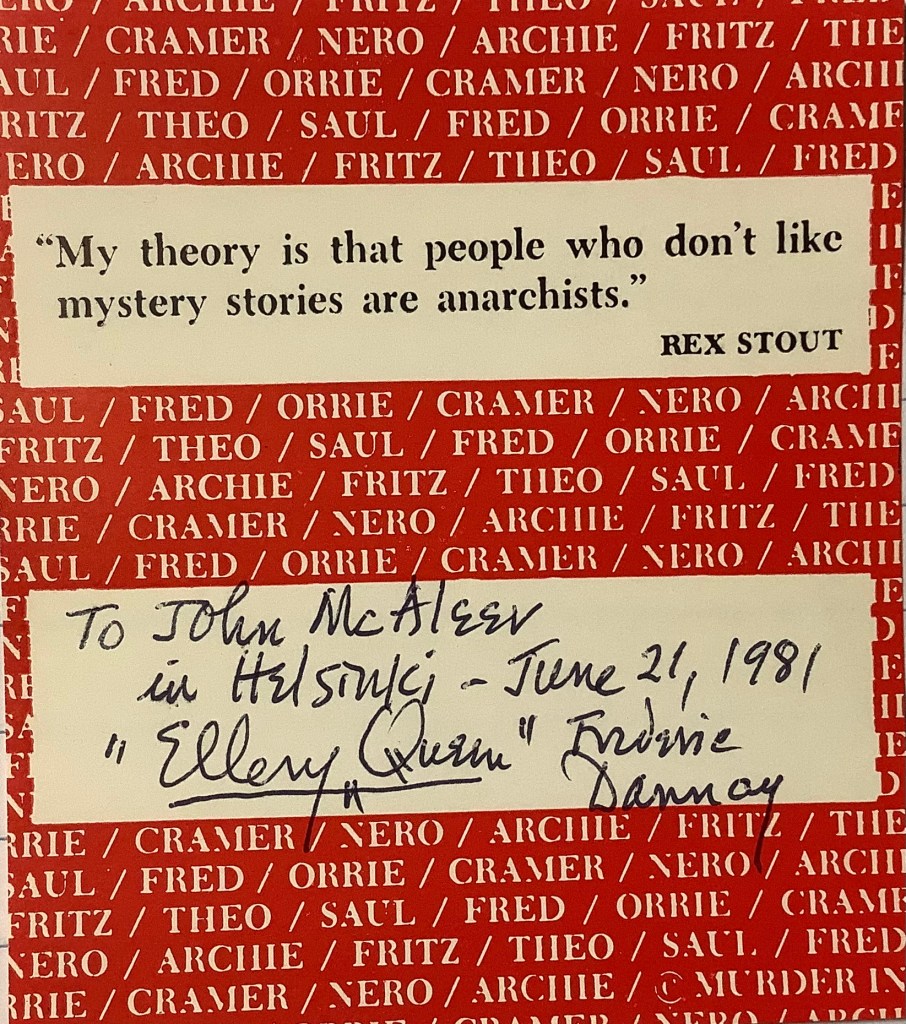
Autograph bookplate to John McAleer from Ellery Queen co-creator Frederic Dannay, Helsinki, June 21, 1981,  following the Crime Writers 3rd International Congress June (15-19), 1981 Stockholm Sweden.

In 1978, my father, John McAleer, won the Edgar Allan Poe Award for Rex Stout:  A Biography.  Although it is the definitive Stout biography, my father had more goodies to share about Rex, Nero, and Archie.  Accordingly, he published a companion to the biography consisting of his most memorable conversations with Rex Stout in a 74-page chapbook, Royal Decree: Conversations with Rex Stout (1983, Pontes Press).

Chapbook cover to Royal Decree (1983, Pontes Press, Maryland). Foreground – 1970s Stout to McAleer correspondence. Background—charcoal sketch of Sherlock Holmes, which hung in Rex Stout’s study where he wrote the Nero Wolfe novels. The sketch was given to McAleer by the Stout family and hung in McAleer’s study until his death in 2003. It now has a home in Andrew McAleer’s study

Their conversations take place at Rex’s New York/Connecticut estate, High Meadow, at various times from June 1972 until August 19, 1975.  While compiling Decree my father set out to answer the questions Stout fans would want answered, “[I]f Rex were alive answering his own mail.” In Decree readers can almost hear Rex’s stentorian voice discussing his craft, his peers, Nero and Archie, and the Wolfe corpus.

A mere 1,000 copies of Decree were printed and only a smattering distributed. Rex’s responses are too good to hoard. The following excerpts from Decree make their first online appearance anywhere exclusively for EQMM’s “Something is Going to Happen” followers. Enjoy!

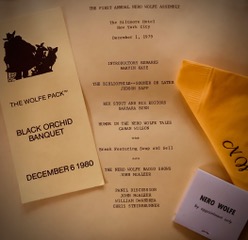
Itinerary of The First Annual Nero Wolfe Assembly held December 1, 1980. Wolfe Pack ephemera.

* * *

McAleer:  Do you have a full grasp of your characters before your start to write?

Stout:  I know pretty much what my main characters are like, but beyond that I just have to wait to see what comes out of my typewriter.  I make up one-third of the things people say and do in the stories I write, but I have nothing to do with the rest.

McAleer:  How many days does it take you to finish a book?

Stout:  Thirty-eight.  The initial draft has always been the only draft, with an original and two carbons. . . . I have never revised . . .

McAleer:  A few critics say you don’t play fair with your readers.  What do you say?

Stout:  Every detective-story writer cheats.  The thing you have to ask yourself is how best to get away with it.  If a Watson tells it, you’re home free.  Your detective stays in the clear, where he belongs.  The most unforgivable thing a writer can do—I hate it—a man reports something to another man, has a conversation or sees something—“Of course there was one little thing that was important and he would keep it in his mind thereafter.”  And of course they don’t tell you.  It’s such a goddamn dirty little trick, and it’s unnecessary because, if you mention it, ninety-nine out of a hundred times you won’t be giving anything away.

McAleer:  Your culprits always capitulate plausibly.  Do you take care to see that they do?

Stout:  Everything in a story should be credible, but one of the hardest things to believe is that anyone will abandon the effort to escape a charge of murder.  Therefore it is extremely important to “suspend disbelief” on that.  If you don’t, the story is spoiled.

McAleer:  Is a novelette easier to write than a novel?

Stout:  In a way, short fiction is harder to write than long.  An unnecessary page in a long novel doesn’t hurt it much, but an unnecessary sentence in a three-thousand-word story spoils it.

McAleer:  What are the advantages of using a first-person narrator to tell the Nero Wolfe stories?

Stout:  The big one, which Poe saw and used.  Since in a detective story the reader must not be inside the detective’s mind, third-person omniscience is impossible, and the best way to avoid it is to have someone else tell it.

McAleer:  What advice would you give a young writer who wants to develop a good prose style?

Stout: Read a lot and write a lot.  No one can develop “a good prose style” if it isn’t in him congenitally.  One of the essential elements of style is an excitement with words as words.  A man who didn’t have that couldn’t possibly have an interesting style.  How the hell could he?  It’s a damned shame they’ve stopped teaching Latin and Greek.  Almost any man who cares about things and words who did not have Greek probably regrets it.  I know I do.  I wish I’d had Greek.

McAleer:  Chesterton said once, “Next to the state of grace the most important thing you can have is a sense of humor.”  Do you agree?

Stout:  Yes, but my “state of grace” is not Chesterton’s.

McAleer: I know you like Jane Austen . . .

Stout: Probably, technically, she was the greatest novelist—Jane Austen. Jane Austen had an incredible, instinctive awareness of how to use words, which words to use, how to organize them . . . She was astonishing.

McAleer:  Do you hold Hammett in high regard?

Stout:  Certainly.  He was better than Chandler, though to read the critics you wouldn’t think so.  In fact, The Glass Key is better than anything Hemingway ever wrote. . .Hemingway never grew out of adolescence. . . .

McAleer: Did James M. Cain have any influence over your work?

Stout: Probably in a way, completely subconsciously, because I think he’s a hell of a good storyteller, a marvelous storyteller. I don’t think you can do it any better than The Postman Always Rings Twice. It can’t be done better than that…. There’s not a word in Cain that does not apply to the story he’s telling you. [Author’s Note: Cain died October 27, 1977, two years to the day after Stout.]

McAleer:  Did you ever meet Charles Laughton?  Do you think he could have portrayed Wolfe successfully?

Stout:  I met Laughton only once, at a party.  Of all the actors I have seen, I think he would have come closest to doing Nero Wolfe perfectly.  A motion picture producer (I forget who) asked him to do a series of Nero Wolfe movies, and he said he would agree to do one but would not commit himself to a series.

McAleer:  What would you have said in nineteen thirty-three if someone told you you had at least seventy more Nero Wolfe stories to write?

Stout:  “Nuts.”

McAleer:  How do you think your own reputation will stand?

Stout:  Obviously the books I’ve written have got something in them that distinguishes them from the ordinary run of books—obviously or there wouldn’t be all these goddamn articles and things, and I wouldn’t get all these letters.  What I don’t know is what the books have in them that lots of books don’t have.   I don’t know whether it’s the characters, or the ingenuity of the stories, or something about my basic attitude toward people and life that comes out in them.  I’m just curious as to what in the hell it is that, in so far as they are, makes them at all distinctive.  I’m very curious about it but I doubt if I’ll ever find out before I die. . . .

* * * Nearly a half-century after Stout’s death and almost a century after Wolfe’s birth, the Wolfe corpus remains “distinguished” and “distinctive.” The Wolfe Pack—the official Nero Wolfe literary society—continues to flourish and Wolfe and Archie are still fighting crime. For almost 40 years—with the full cooperation of Stout’s family—Nero-Award winning author Robert Goldsborough has done a superb job continuing the Wolfe mystery series.  Goldsborough’s latest Wolfe mystery, The Missing Heiress (his seventeenth [Mysterious Press, 2023]), has reached Amazon’s best-seller list in multiple categories. Based on the foregoing alone, even Wolfe would have to admit Stout’s reputation remains—satisfactory.

Posted in Uncategorized | 4 Comments

Who Was the First Baby Boomer Detective in American Fiction? (by Kevin Mims)

Essayist and short story writer Kevin Mims often reviews books from the 1970s, the decade in which many baby boomers came of age. This time he discusses fiction directly targeted at baby boomers, as he tries to determine which fictional character deserves to be considered the first baby boomer detective. Comments are welcome from anyone who can suggest other candidates!  —Janet Hutchings

The baby boomers are usually defined as Americans born between 1946 and 1964. Millions of American men had been mustered out of the armed forces by 1946 and had come home to resume their civilian lives. And one of the things they did in large numbers was sire children. The baby boom produced a great crop of mystery and crime novelists, including such luminaries as Michael Connelly (born 1956), James Ellroy (1948), Patricia Cornwell (1956), John Grisham (1955), Harlan Coben (1962), and Diane Mott Davidson (1949).

I visited the Wikipedia page for the year 1946 and scrolled through the list of prominent births for that year. Surprisingly, I found no famous Americans known primarily for writing crime and mystery fiction. The first famous American born in 1946 who would write a mystery novel was Dolly Parton. But Parton’s debut crime novel wasn’t published until 2022, and it was co-written by James Patterson. She is best known as a great American singer-songwriter. On Christmas Day, 1946, another famous American singer-songwriter was born, Jimmy Buffett. In 1992, Buffett published a novel, Where is Joe Merchant?, that can legitimately be described as a mystery. But no one thinks of Jimmy Buffett as a crime writer. The first American baby boomer I could find who has made a significant contribution to American crime and mystery fiction was Stephen King, born September 21, 1947. King’s first published story, “The Glass Floor,” a mystery tale, was published in the autumn 1967 edition of Startling Mystery Stories. Thus, Stephen King may well have been the first baby boomer to publish a work of crime fiction.

But who was the first fictional baby boomer detective? That’s a more difficult question to answer. You could make a case for Nancy Drew. Although the character first appeared in 1930, the series was given a makeover in 1959 to make the character more relevant to the baby boomers, who were now her primary readers. But this seems a bit of a cheat. If we allow Nancy Drew to enter the competition, she would become the first fictional sleuth for every single American generation since the 1930s, because she’s been in print for nearly a hundred years and has remained a teenager throughout all that time. Also, the 1959 makeover actually made Nancy Drew somewhat less like the typical boomer girl. For example, the makeover made her less of a tomboy, more deferential to men, and more religious than she had been in previous incarnations. Boomer women tended to be less deferential to men and less religious than the women of their parents’ and grandparents’ generations. Nancy Drew may have been a 16-year-old detective in 1959, but she read more like a member of the GI Generation or the Silent Generation than a member of the Boomer Generation.

Since I’m interested more in hardboiled crime fighters rather than underage sleuths, I should probably eliminate all young adult crime novels from consideration. But, in the interest of fairness, I should point out that Donald J. Sobol’s Encyclopedia Brown character, who first appeared in 1963, was ten years old when he made his debut, and thus a baby boomer. Technically, he may be the first fictional baby boomer detective in American literature. Alas, the books he appears in are not really novels. They tend to be collections of very short vignettes, in which Leroy “Encyclopedia” Brown solves a mystery while sitting at the dining-room table and listening to his father, a police chief, explain some vexing crime to him. Encyclopedia Brown rarely does any of the things that fictional detectives are known for. He doesn’t usually confront criminals or engage in fisticuffs or gunplay. He doesn’t conduct stakeouts or bring perps in for questioning. He’s just a preternaturally bright kid with incredible powers of observation.

A strong contender for the title of first baby boomer detective in American fiction is Gregory McDonald’s Irwin Maurice Fletcher, better known simply as Fletch, the protagonist of nine crime novels. The first novel in the series, also simply called Fletch, was published in 1974 but didn’t become a commercial phenomenon until the paperback appeared the following year. In that first book, Fletch claims to be 29 years old, which would mean that he was born in 1945 and, therefore, was not technically a boomer. He’s roughly in the right age range, though, and  throughout the novel other characters react with surprise when they hear his age, having assumed that he was younger. His creator, Gregory McDonald, was born in 1937, and was not a boomer himself. But he nonetheless grew up primarily in post-war America and was raised, like the boomers, on TV, rock-and-roll, and American exceptionalism.

Another contender for the title of first baby boomer detective is Moses Wine, a character who first appeared in Roger L. Simon’s novel The Big Fix, published one year before Fletch, in 1973. In 1972, Simon approached Alan Rinzler, an editor at Straight Arrow Books of San Francisco, with an earlier novel he had written. Rinzler didn’t think it could find a market. Straight Arrow Books was owned by the people who published Rolling Stone magazine, so Rinzler suggested that Simon try writing a novel that would appeal to Rolling Stone’s readers—young people who were into pot, rock-and-roll, anti-war protests, etc. Simon was living in L.A. at the time and reading a lot of Raymond Chandler and Ross Macdonald. He decided to create a private investigator who was young and edgy and long-haired. The result, produced in just six weeks, was The Big Fix, published by Straight Arrow in 1973. Here’s a passage from the opening paragraphs:

The last time I was with Lila Shea we were making love in the back of a 1952 Chrysler hearse parked across the street from the Oakland Induction Center. Teargas was seeping through the floorboards and the crack of police truncheons was in our ears. I could barely hear her little cries over the wail of sirens. That was the fall of ’67 – The October Days of Protest – and just a few minutes after we finished, she bounced off my chest over the Army surplus air mattress, pulled up her cotton panties, and disappeared into the night without so much as a see-you-later.

Simon was six years younger than McDonald and his boomer protagonist seems, at first glance, like more of the real thing than Fletch. So why do I have trouble giving Moses Wine the title of first baby boomer detective? The Big Fix and its first few sequels are very good. But Moses Wine was clearly created as an amalgamation of a bunch of traits popular in media presentations of baby boomers at the time. These traits—campus radical, anti-war, drug-user, etc.—didn’t really define very many boomers of the era (baby boomers, for instance, supported the Vietnam War in greater numbers than their parents did). If you were to create a Millennial private eye and make him addicted to avocado toast and TikTok, and then have him living in his mother’s basement, you’d create a stereotype that probably fits very few actual people. Moses Wine is a fun spoof of baby boomer clichés but Fletch feels more real. Like most boomers, he didn’t dodge the draft (in fact, he earned a Bronze Star for his service in the Vietnam War). He’s not obsessed with rock-and-roll, and he’s more of a drinker than a recreational drug user. The first edition of The Big Fix reproduces a copy of Moses Wine’s application for a private investigator’s license. It shows that Wine was born on November 4, 1941. That’s almost exactly one year before the birth of Joe Biden, our current president and no one’s idea of a baby boomer. The baby boom was a postwar phenomenon and Wine was born pre-war. Of course, back in the 70s, the term “baby boomer” simply meant anyone not old enough to remember the Second World War very well, someone whose childhood included lots of television, and who preferred the music of Elvis Presley to Frank Sinatra. So if you want to argue that Moses Wine was the first baby boomer to headline a series of American crime novels, knock yourself out.

You could also argue that the three members of TV’s The Mod Squad, which ran on ABC-TV from 1968 to 1973, were the first fictional detectives of the baby boom era. That would make the numerous Mod Squad TV tie-in books of the late 60s and early 70s the first series of American crime novels featuring boomer detectives. If you are a literary snob, you may think that TV tie-in books are beneath your consideration. I happen to be a fan of TV tie-in novels, and many of the Mod Squad tie-in books were written by Richard Deming (1915-1983), who was one of the most prolific crime writers of his era. He also wrote a number of EQMM stories and was a prolific contributor to Alfred Hitchcock’s Mystery Magazine.

But were the members of the Mod Squad true boomers? Not exactly. Of the program’s three stars, only Peggy Lipton, born August 30, 1946, was a genuine boomer. The other two were born in 1939 (Clarence Williams III) and 1940 (Michael Cole). By that reckoning, pretty young flower child Julie Barnes (played by Peggy Lipton), a runaway from San Francisco and the daughter of a prostitute, described in the program’s promotional literature as a “canary with a broken wing,” was the first boomer crime fighter both on TV and in American pop fiction. And Richard Deming was the first person to include her in a novel, The Greek God Affair, published in 1968. Considering how many other firsts of the era were awarded to men, I think I’ll vote for Julie Barnes, the canary from Haight-Ashbury, as the first baby boomer detective in American fiction. Sorry, Fletch.

Posted in Uncategorized | Leave a comment

A Writer’s Walk-On Role in a True Crime Story (by Meghan Leigh Paulk)

Meghan Leigh Paulk’s first published fiction, the story “It’s Half Your Fault,” appears in EQMM’s current issue (July/August 2023) in the Department of First Stories. The Texas author has also written a novel entitled Hollywood Down Low, which is currently with her agent. The book  was a finalist in the 2019 Writers’ League of Texas manuscript contest and was also selected for Pitch Wars 2022. In this post Meghan gives us a glimpse of how her interest in and perspective on crime fiction (and crime!) changed through real-life experience. —Janet Hutchings

Would you recognize a killer if you worked for him?

I always wanted to write mysteries. As a kid, I devoured mystery novels the way other kids devoured Doritos. I started with Nancy Drew, moved on to Trixie Belden, graduated to Agatha Christie, then began raiding my parents’ bookshelves for John D. MacDonald’s Travis McGee books. The Westing Game became a particular favorite of mine. I loved the puzzle-solving that mysteries offered. I viewed life through the lens of a mystery novel. When my family visited a lake cabin in the summer, I thought up places to dispose of a body there. When I met someone new, I’d think of ways I’d describe them (suspect or a victim?) in a book.

But I never expected to stumble into a real-life mystery. And I never expected to be so unprepared to encounter actual killers.

It happened in 1995 while I lived in Los Angeles. I’d moved to L.A. from Iowa in 1993 with the sense I needed to see more of the world if I wanted to write about it. After a year spent piecing together odd jobs to pay the bills, I took a waitressing gig at a high-end strip joint called Bailey’s Twenty/20 in Century City. The club catered to celebrities. I figured it might make a good setting for a story someday. Unfortunately, that venue suddenly closed in 1995 due to legal troubles.

I found myself unemployed with little savings. A good friend of mine from Bailey’s got me a waitressing gig at another strip club, Bare Elegance. I needed the work. So, I took the job.

Little did I know at that time, the Bare Elegance was at the center of an unsolved L.A. mystery.

A former co-owner of the club had been murdered in 1989. Horace “Big Mac” McKenna was mowed down by machine gun fire while he sat in his chauffeured limousine, waiting for the gate to his estate to open. McKenna, a six-foot-six bodybuilder, had been a colorful figure. He’d been a California Highway Patrolman before his arrest for running a prostitution ring and his conviction for passing counterfeit money. McKenna spent four years in federal prison but, after his release, he became a wealthy strip club owner. His hilltop estate in Brea boasted a menagerie with a tiger, a jaguar, and an alligator. He was described variously as kind, eccentric, and intimidating.

I never met McKenna but I heard whispers about his murder while I worked at Bare Elegance. One employee even hinted she knew enough that she might not be “allowed” to leave the job. You see, rumor had it that McKenna’s business partner and former CHP partner, Mike Woods, orchestrated the hit. Woods’ bodyguard, David  “English Dave” Amos, also benefited from the murder—becoming a club co-owner after McKenna’s death. The two men certainly didn’t keep a low profile. In 1994, they collaborated on film called The Takeover about rival drug lords in a turf war.

But the McKenna case remained cold while I worked at Bare Elegance.

And I didn’t believe the rumors. Yes, I’d grown up with a head buried in mystery novels but, when faced with a real-life mystery, my head retracted into its shell like a turtle. After all, these were my bosses. I saw them every Monday night when they showed up for the club’s dance contest. They drank at the bar. They complimented my outfits. They couldn’t be murderers. Could they? When people brought up incriminating stories (e.g., Amos’s girlfriend died suspiciously in a helicopter accident), I dismissed them. All my mystery-solving instincts deserted me. I simply couldn’t believe that anyone I knew would be capable of murder.

And yet I considered myself to be quite jaded. A cold-eyed observer of human nature. I still read murder mysteries during this time period. Patricia Cornwell and Sue Grafton were two of my favorite authors. Both authors depict scrappy, savvy female detectives. Yet, despite all the red flags at my workplace, it never occurred to me to dig for the truth. Some part of me didn’t want to dig too deep.

In 1997, I left the Bare Elegance and, in 1999, I started law school at Vanderbilt University. I thought I’d put the Bare Elegance behind me.  

Then, in February 2000, I heard that the murder had been solved. The gunman himself had finally given authorities a break. Johnny Sheridan, a manager at the strip club, admitted that Amos had hired him to do the hit. He agreed to wear a wire in order to catch Amos. The sting operation succeeded. Amos then turned on Woods, the mastermind of the crime. Police arrested all three men in October 2000. Woods was convicted of first-degree murder while Amos and Sheridan both pled guilty to voluntary manslaughter.

The outcome of the case shocked me. I never suspected Sheridan. I’d worked with him daily. He was a considerate, if haphazard, manager with a lovely wife and adorable daughter. The British Amos exuded lively charm. Only Woods, who had a reptilian chilliness, seemed to fit the part of “murderer.” But I learned that you can never really know what someone is capable of doing—even someone you think you know well. I wonder sometimes why I wasn’t willing to look at the darkness behind the club’s neon façade. These events loosely inspired parts of my manuscript HOLLYWOOD DOWN LOW, where a strip club co-owner’s suspicious death sets the story in motion. I used that manuscript to work through my feelings about looking the other way when faced with a real mystery. I kept the events highly fictionalized, inventing a new topless joint called Club Ten and creating a different set of owners. But the day-to-day world of the club is very similar to the places where I worked. I never solved a real-life mystery, but my protagonist, Allison Patrick, does catch the killer.

Posted in Uncategorized | 1 Comment

Into the Weave (by Jennifer Black)

A recipient of a New Mexico fiction-writing award, Jennifer Black makes her debut as a professional fiction writer in the Department of First Stories of EQMM’s current issue (July/August 2023) with the story “Heatstroke.” Her day job, she tells EQMM, is creating videos that focus on land, water, and wildlife issues; she also films and edits training videos for a national manufacturing company. In this post she looks at fiction writing from a fresh perspective, one she gained partly through her husband’s Navajo heritage. Her own ethnic background is diverse, including Korean, European, and Mexican ancestry—all of which contribute to the points of view she brings to her fiction.  —Janet Hutchings

I reached into a black widow nest today. Its host was crouched at the bottom of the biggest spider tunnel I’d ever seen, a couple feet from the irregular web stretched between a fence and stack of wood. I plunged my hand into sticky silk until it covered half my forearm, then swirled my whole appendage, gathering white webbing to my skin like cotton candy. When I was satisfied with the bounty, I moved away unbitten, rubbing what remained of the spider’s creation between and over both hands.

Why?

The internet said Navajo women are known to rub spider webs over their hands before weaving. If it worked for them as weavers, maybe it’d work for me as a writer. What I didn’t account for is how proper research often leads to better outcomes.

All this started because I’d finished reading Murder on the Orient Express. I was—and still am—fascinated by the way Agatha Christie wove the story together, eventually making it okay for me to accept the murder of a man. Within the story, she tells us what it takes for authors to craft mystery fiction: “Every minute detail of their evidence was worked out beforehand. The whole thing was a cleverly-planned jigsaw puzzle . . .”

Weavers also have details to work out before starting a project. Yarn choice, which loom to use, dimensions, spacing, shrinkage after washing, slack versus tension, the necessary math needed to produce the desired pattern, and the list goes on. Perhaps weaving and storytelling are more alike than different.

In an interview with Agatha Christie on February 13, 1955, she said, “I think the real work is thinking out the development of your story and worrying about it until it comes right.”

But what makes it right?

Elements like a great hook, the power of characters, plot, setting, the crime, clues, and red herrings all lead to a satisfying ending. Each element has its own thread, its own color, and its own purpose that an author uses to pattern the whole story with quality and appeal. That’s how I think about mystery fiction. That’s what it takes to write a good story.

All these thoughts about weaving reminded me of Spider Woman. Not the Marvel Comic character but the woman in Navajo creation stories. The remembrance set me wanting to ask my Navajo husband about his cultural teachings. But I hesitated because creation stories are to be told in winter, and it’s already summer. So, what to do?

I tried to remember what I’d been told about Spider Woman, but all that came to mind was a fogginess about weaving . . . and maybe storytelling, but I might have made that part up. Instead of asking my husband, I went to the internet. What I found is that one of Spider Woman’s roles is being the vigilant helper of humans who also taught Navajo women how to weave. And bam! Via encyclipedia.com, Google told me that some Navajo women rub their hands in webs to absorb the teachings of Spider Woman.

Now, I’m not Navajo and clearly don’t know the teachings of Spider Woman, but maybe I’ll learn how to weave. Near my writing desk, a Navajo loom rests on the floor. It was gifted to me and holds a mostly finished rug that contains a design of an eagle. The top quarter of the rug still shows the long lines of the warp, the yarn attached to the loom that runs up and down. But below that, the warp is covered by the tight weave of the brown, cream, blue, and tan yarns making up the design.

The warp reminds me of how authors drape a story over portions of their life experiences, or how research makes stories credible. I wonder if Murder on the Orient Express would’ve ever come to fruition if Agatha Christie hadn’t heard about or experienced certain events: her first train ride on the Orient Express, a subsequent ride she took on the same-named train whose travel was paused for twenty-four hours, a blizzard that halted the train for six days, or the tragic kidnapping and murder of a two-year old boy. Agatha Christie based her novel on these real events. It shows how she brought her experiences—either direct or indirect—into her writing.

When she was uncertain about something, she did proper research . . . which isn’t what I did before sticking my hand in the black widow nest.  Thankfully, some things are easily corrected.

My husband’s late mom was a master weaver. She raised and sheered sheep, dyed wool with plants, hand-spun the wool, and wove rugs that cost thousands of dollars. Her mom taught her, whose mom taught her, and so on up the lineage, all the way back to the teachings of Spider Woman. Perhaps my husband is a credible source. Instead of asking him to tell me creation stories, I asked if he knew whether his mom had ever rubbed a spider web onto her hands before weaving.

“Yes,” he said. “I saw my mom and grandma do that lots of times.”

I’m not sure why his answer surprised me, but it did. When I finally gathered enough sense to form a follow-up question, the only thing I came up with was asking him to tell me more about it. His explanation included nothing of black widow nests, but of beautifully designed webs with hosts out of sight. Many thanks to him and the women in his family, to their teachings, and to Spider Woman for affording me the opportunity to begin a journey of learning something new.

The experience of reading Murder on the Orient Express and about Agatha Christie has raised my curiosity about the history and importance of weaving in my own Korean, Anglo, and Mexican cultures. It piqued my interest in reading mystery fiction written by Korean, Mexican, and Navajo authors. It has also taken me on outdoor searches for intricately designed spider webs that catch the sun’s morning rays as it rises over Sandia Mountain, near Albuquerque, New Mexico. On one such occasion, I found a beautiful, tiny web on the fencing of my sheep corral. When I was sure the web was abandoned, I swirled a finger in it, then rubbed it between my palms in honor of my mother-in-law, Spider Woman, and the art of weaving.

Posted in Uncategorized | 2 Comments

The Bot Did It: Should We Fear the AI Revolution? (by Pat Black)

Glasgow, Scotland native Pat Black returns to EQMM in our current issue, July/August 2023, with “Twos on That,” a thrilling entry in his Lomond and Slater series. A journalist currently living in West Yorkshire, Pat is also the author of six novels (as P.R. Black). In this post he takes up a topic that is on the minds of most authors and publishers these days. In addition to giving us some food for thought with this post, he has recorded “Twos on That” for our July first podcast. Don’t miss it!  —Janet Hutchings

Well . . . “yes,” is the answer to that one.

By now we’ve all had a chance to think about AI and its effect on writing fiction. ChatGPT and other AI-driven software has opened new frontiers in creativity—none of which augur well for the creative individual. Especially if that creative individual wants to . . . (hits CTRL plus I) get paid for it.

We’ve heard the counter-arguments already. That AI isn’t sophisticated enough. That it’s a jumped-up version of auto-correct, or the little paperclip person that helped you out on primeval versions of MS Office. I get that—but you’d be naïve to think that the technology will stay that primitive, that it won’t become more intelligent, more intuitive, even sophisticated.

I once mentioned in conversation that AI-driven technology might be a godsend when it comes to human medicine and surgery; where humans can err, and sometimes catastrophically, a machine may be much less likely to do so. I was mocked for this. And I concede: No, the technology isn’t there yet. But it will be one day.

I’ve no wish to discuss general doomsday scenarios as a result of AI’s interference here: There’s a lot of that speculation around at the moment, by people much better informed on the subject than me. But the technology and its possible use does provide a problem for the arts.

If we treat any story in any medium as a formula, whether in derivation from a strict algorithmic sequence or as a mutation of it, then it stands to reason that AI will replicate that formula and produce art. It won’t be good art, to start with, but like all computer technology, it’ll evolve, and improve.

Crime novels are perhaps the most formulaic of all, and therefore one of the easiest to replicate in this near-future of AI-driven authorship.

Take the whodunnit. You have the crime, usually murder. You have a victim. You have suspects. You have motives. You have clues, red herrings, plot twists. You have a resolution—on the author’s part, hopefully it’s one that readers won’t guess easily. You have a protagonist, too—in most cases, a detective. Add in a setting, both physical, geographical and temporal, and a method of murder, and, yep . . . .you’ve got it. It can be argued that all you need to do is fill in some blanks.

The key test will be: Can machines takes this formula and its possible permutations and make better stories than humans?

Part of the AI revolution is already taking place. At time of writing, the “Abba Voyage” is still ongoing in London, still packing in the crowds and becoming a tourist destination as much as the London Eye or the Houses of Parliament or Madame Tussauds. Although members of Abba did pop up at the venue for a record-setting performance the other day, there has been surprisingly little commentary over the fact that anyone going there is not actually watching Abba.

For all the chat about motion capture and 3D holographic smoke and mirrors effects and faithfully reproduced live vocal performances, anyone going to Abba Voyager is effectively watching a video. The “experience” part of it probably depends on your own personal Abba threshold.

My Abba tolerance has risen in recent years—everybody ends up liking them eventually—but I can’t help but feel that the impressive 3D “Abbatars” have an “Emperor’s new clothes” element to them. Some people have pointed out his bare bum, but not many. It’s a simulation. No matter how you dress it up, you’re watching a recording. It’s not a live event. The art is driven by machines.

I can foresee a future—not too distant, either—when AI linked to this no doubt closely-watched entertainment phenomenon brings back musical acts which are becoming rarer as their natural record reaches the end of the groove. Many outrages and blasphemies are possible, here.

Imagine The Beatles, reformed, down to the flecks in the black and white footage, playing brand new songs modeled by AI that sound as good, if not better than the classic Lennon/McCartney numbers. Any number of resurrections might take place—take your pick, really—Johann Sebastian Bach, Wagner, Elvis, John Lennon, Frank Zappa, you name it. All fully customisable. Let’s have Jimi Hendrix having a duel with Paganini, why not?

At the touch of a button, you might even generate collaborations, no matter how outre. Iron Maiden and Nana Mouskouri. Napalm Death and Conway Twitty. Lou Reed and Metallica . . . wait, that one’s been done in real life.

There are only so many musical notes, discernible to the human ear. There are only so many ways they can be combined, only so many chord progressions, only so many melodies, only so many beats. To a computer powerful enough, replicating these mathematical patterns might seem basic, with something that sounds like “Across The Universe” being generated in less time than it’d take for you to click your fingers.

In the amount of time it will take for all The Beatles to die, and then for everyone who lived at the same time as The Beatles to die, then this might not seem like a bad time. It might sound quite good. It might be indistinguishable from the original.

So too with the written word. Ask AI to create Borges’ “Library Of Babel,” with every possible combination of letters, and it might be possible—it might be already.

For fiction, the outcomes are similar, and perhaps equally horrifying. I will stress again that this is all theoretical for now, much like my robotic surgeon which won’t nick your artery, or remove the wrong kidney, or insert a toxic implant in your breast, or leave its scalpel and forceps stitched up inside you, or leave its initials soldered on your very bones for a laugh.  But let’s say you were to feed into a powerful computer every single sentence written by an author—say, JRR Tolkien.

Now, say you added into this database every other piece of surviving written work by him— letters, notes, introductions, reviews, essays, shopping lists, whatever. And then say we blended this with every single piece of Tolkien’s biographical data and its historical context. Is it possible this could be used to come up with a new piece of epic fiction as good as, and indistinguishable in style from, The Lord Of The Rings? If so, it might be a crime of sorts to deny anyone the opportunity to read that.

For some, it’s a crime to create it. But consider what’s happening right now—thanks to human agency, not machines. Take Sherlock Holmes, and the amount of literature and movies and TV shows that are still created up to the present day featuring Conan Doyle’s great detective. I read a short story by Val McDermid at Christmas, in her festive anthology. Collections of brand new short stories featuring Holmes and Watson appear just about every year. With Holmes now having passed out of copyright control in the US, you can now expect far more of these.

And for absolute clarity, if anyone offers me a chance at writing a Holmes story, I’ll take it quicker than you can light a pipe. Elementary.

Culture regurgitates. AI won’t change that.

Think about the torrents of fan fiction out there, licensed fan fiction, at that, based on any intellectual property we might think of. How many novels are out there, based on the Alien universe, alone? If Kingsley Amis did it with James Bond, then it’s fair game for anyone, really.  So, if anyone’s ever of a mind to complain about content generated based on existing properties, an appropriation of beloved characters and stories, then living, breathing humans are way ahead of AI.

To confront the thing we fear directly: can I see any instance where I might use AI? I can.

Neil Gaiman wrote a story, I think part of his Sandman universe, where someone is cursed with having too many ideas. Like most writers, I think I have this curse as well. I’ve often wondered at the word count of my ideas file, stretching back more than 20 years. It’ll probably be novel-length by now. And it grieves me to think that not all of these ideas will become finished stories—in fact, I’ll be lucky if 1% of them make it beyond the one-line concept stage to an actual page, whether that’s for people to read, or just languishing on a hard drive.

If I was facing the end of the road, and such tools were available to me, would I consider using AI to turn these ideas into finished stories, based on my own writing and style, and within set parameters? I might just be tempted to do that.

The issue is authorship, of course, and being up-front about how stories are created from now on. Publishers have a moral duty to let readers know if the tales they’ve paid for were created by a human or a machine—even if it’s genre work, pornography, fan fiction, or anything we might uncharitably call hackwork, we’ve a right to know that it’s an honest endeavor.

As a fellow writer said to me recently, it may be a matter of legality; publishers might be obliged to tell us exactly how the words got on the page. Because it wouldn’t do for them to simply skip employing and paying humans for work a machine could do… But some of them will, when the technology is ready, in maybe a decade or two. It then falls upon the publishers to be honest, to allow people to make an informed choice, and hopefully a good one.

Who knows—maybe AI will unleash the sort of technological devilry that might make the publishing industry itself redundant. If people have AI tools at their disposal, then maybe readers of the future will buy the software itself and make their own stories and novels from scratch, and not bother with books by anyone else at all. Those werewolf/regency romance mash-up stories you’ve always had in your head? Go right ahead with those, don’t bother with the middle man. Dinosaurs Vs Elvis? Complete retelling of Shakespeare as dirty limericks? Or you, as a great warrior or lover or racing driver or superhero or a Starfleet captain . . . or God? You can see how it might go. Endless reiterations and mutations.

As for the humble writer, well, I wouldn’t call myself a luddite. But AI’s rise is irrelevant to me. Even if every door to sharing my work with the public slams shut, and no-one, not even my own family, want to read it, I’ll still be writing my stories, with all their flaws, errors, tortured logic, and everything else that makes them uniquely, unmistakably mine. Even if “computer says no,” I’ll find a pen and paper.

The human impulse to create cannot be superseded by technological innovations. People still paint, people still sing, people still act, and people still write. I trust that the corresponding desire among my fellow humans to experience that art cannot be defeated either. 

Posted in Uncategorized | 1 Comment

Reading: Classified (by Kristopher Zgorski)

Kristopher Zgorski debuted as the reviewer for EQMM’s Blog Bytes column (replacing Bill Crider) in our May/June 2018 issue, around the same time that he received the Raven Award from the Mystery Writers of America for his review site BOLO Books. BOLO Books (www.bolobooks.com) remains under his direction. The site is designed to highlight new books on or just before their release dates and also features in-depth reviews, author interviews, guest posts, composite sketches (often of people in the publishing industry), and critiques of cover designs and trends in covers. Kristopher has also recently launched, in conjunction with author Shawn Reilly Simmons, the YouTube vlog, WE ARE WHAT WE READ (https://www.youtube.com/channel/UCjGBcvh9gj0czjxlvxWueTg), in which authors talk about books they’ve read that have impacted them. (Be sure to tune in!) In 2024, in recognition of his contributions to the Malice Domestic community and the Malice Domestic genre, Kristopher will receive the Amelia Award from the Malice Domestic Convention. In this post he takes up an important topic not only for readers but for those of us who work in the publishing business. You can find more insights from Kristopher in each EQMM’s Blog Bytes department—a column that surveys and evaluates many different types of websites and blogs focused on crime and mystery fiction.  —Janet Hutchings

Let’s take a moment to contemplate the concept of sub-genres within crime fiction. The first thing readers need to remember is that there are logical reasons for placing books in categories. These are largely marketing decisions that serve several purposes: They help with bookstore placement; they aim to improve target advertising; and they help to manage reader expectations. But sub-genre classification is not meant to be any type of definitive statement. It is a guideline, just one of many tools designed to guide readers toward enjoyable reading experiences.

It is easy to tell it is not an exact science, because even within the industry and amongst readers (both sides of the equation) people don’t necessarily agree on the categories themselves. How many sub-genres are there? Too many to contemplate, given that if you can classify a handful of books by some similar characteristic, it may be valid to call that a sub-genre—even if you are the first person to make such a connection or claim. However, the reality is that a book can—and typically does—fit into more than one sub-genre.

For example:

The Police Procedural—This is likely a story in which some official investigation of a crime is the central driving force for the narrative. Readers are privy to how evidence is collected, clues are interpreted, and leads are followed until—usually—the culprit is uncovered and brought to justice.

The Serial Killer Novel—This is a narrative in which the central murder is part of a string of similar crimes, often perpetrated against victims with some common denominator such as physical or personality traits that may or may not be the root cause of the crime. Often the driving force propelling this type of narrative is the criminal’s preparation between crimes.

In this example, what happens when these two sub-genres are combined within one novel? Thomas Harris’s The Silence of the Lambs contains both procedural elements and some foundational components of the serial killer novel. This does not mean that every fan of police procedurals will enjoy the book. A reader simply might not relish the idea of serial crimes and would rather read about a different type of investigation. Similarly, a reader may find the mind of serial killers to be fascinating and yet have no interest in how the police investigate such cases. 

When we think about publishing in these terms, we begin to see how sub-genres can be useful tools but are not hard and fast rules.

There are even disagreements about what the core characteristics of a sub-genre really are. Let’s look deeper into one of these cases.

The Cozy Mystery—This is typically defined as a mystery novel that has an amateur citizen conducting an independent investigation that contains little to no on-page violence, bad language, or sex and most often takes place in a small, insular community.

But what happens if you break just one of those unofficial rules? Is a book that would otherwise have been classified as a cozy no longer a cozy? And if that is the case, then what is it? Fans of crime fiction will know that this leads to new artificial designations such as “an edgy cozy.” Or like Rob Osler recently proclaimed after Devil’s Chew Toy (his cozy mystery with a gay main character) was released, a “Quozy” (that is queer + cozy). These are useful qualifiers that help to join the right reader with the right book, but in the end aren’t they all still cozy mysteries at their core? (Let’s not even get into what’s so “cozy” about murder and/or whether Agatha Christie, the Grand Dame herself, wrote cozy [she didn’t].)

To complicate matters further, writers are now intentionally mixing genres in an effort to manifest something exciting and completely unique. This ability to craft cross-genre novels only works because there are genres (and sub-genres) in the first place. Here we see how a reader’s expectation going into a certain type of novel can be circumvented by an author who is then able to anticipate what a loyal reader assumes will happen and proceed to do something completely different.

But at what point do we see several similar cross-genre novels and then declare that style of book to be a new sub-genre of its own? Three, ten, a hundred?

These are artificial ways of categorizing books, but they are helpful. Right? Even that is debatable.

Anecdotally, I queried several of my friends who read way more than the average and each of them said that sub-genre rarely affects their decisions on what to read. They seem to be more interested in relatable characters and complex plots regardless of the particular crime fiction sub-genre a book most adheres to. The most often expressed caveat was some type of delineation between novels that are “too dark” or “too light,” but almost always with the qualifier that exceptions are possible on a case-by-case basis.

In contrast, when I asked individuals who are more likely to only consume one or two books a year, sub-genre seemed to be more prevalent in their thinking. If you are looking for a light beach read for your yearly vacation, it makes sense that if you previously enjoyed a cozy mystery, you might stick with that when the next opportunity presents itself. Why rock the boat when relaxation is the goal? (It’s worth noting that a common refrain with these more casual readers was “I look at the bestseller list,” which is a topic for another day.)

In the end, every single novel written is a combination of elements that already exist. Readers get to choose what they want to read based on any criteria they deem appropriate. The job of marketing teams at publishing houses is to make it easier for readers to make the most informed choices. Sub-genres are just one of those methods. A tool to be used—or not—as each individual reader sees fit. In many ways, it’s almost like magic that the right books reach the right readers at the right time—almost like an invisible thread links the two on some astral plane that controls the universe. Hey, wait a minute, has anyone ever written a book about that?

Posted in Uncategorized | 1 Comment

The Poetry of Mystery (by Mehnaz Sahibzada)

This week EQMM’s July/August 2023 issue went on sale. In it you’ll find “Death in the New Age,” a new story by Mehnaz Sahibzada. The author  is a 2022 Jack Hazard Fellow in fiction writing. Since debuting in our Department of First Stories in 2010 under the name Mehnaz Turner, she’s had stories in Jaggery, Strange Horizons, Mystery Magazine, and other publications. Mehnaz is also a poet; her poetry collection My Gothic Romance came out in 2019. It’s the connection between poetry and mystery that she discusses in this post.—Janet Hutchings

I read my first mystery novel when I was eleven years old and on a train cutting through the Swiss Alps. The book in my hand was Agatha Christie’s, The Mirror Crack’d from Side to Side, a handsome navy hardback with the paper jacket removed. I loved the causal flourish of diving into Marple’s St. Mary Mead as the train snaked its way through tunnels and across bridges that broke into an expanse of deciduous trees. I had lugged the novel from California to Saudi Arabia, where me and my Lahore-born parents, as well as my younger sister, would reside for three years during the 1980s before returning to the U.S.

Now on a family trip to Europe, I was finally reading the book.

My father, a physician, worked at Al-Hada Hospital in Taif. My mother, a stay-at-home wife during this era, busied herself with trips to the souk where she sought out spices for the curries and cakes she placed before us on the long dining table inside our desert abode. On weekends we’d visit the Kaba in Mecca or picnic by the Red Sea with a tin of kababs. And somewhere amid living in Pakistan, America, and Saudi Arabia, as well as my family’s travel excursions through Europe & Asia—I fell in love with the mystery genre. I couldn’t understand why every text in a bookstore wasn’t a mystery, nor why every person I encountered wasn’t a diehard fan. My proud young mind pitied the human who found little interest in the whodunit. How dull their reading lives must be, I reckoned. It wasn’t just amateur detectives, like Jane Marple, who appealed to me, but also the aesthetics I associated with the cozier moods of the genre: mahogany dressers, magnifying glasses, lush countryside, and cups of peppermint tea. I devoured Nancy Drew and Trixie Belden stories; watched Murder She Wrote, Scooby-Doo, and Colombo to the detriment of completing my homework and spent more time than I care to admit trying to perfect my pronunciation of Poirot (a feat I’ve yet to master). My favorite board game, predictably, was Clue, and I could amuse myself at any dull gathering my parents dragged us to by imagining the cohort of guests as a sea of suspects. I wondered about the inner lives each body guarded—who might be guilty of something yet to be discovered? 

This habit of reframing reality so it was refracted through the lens of a mystery has accompanied me into adulthood and my present life. I have relied on it through college courses, faculty meetings, weddings, and plane flights—reading the room with as much curiosity and anticipation as I would a good detective novel. Yet while the reading of mysteries was my first love, as a writer I gravitated toward poetry, which I began writing with a preternatural ferocity around the same age as I discovered detective stories.  At school teachers passed out the odd printed copy of a poem for us to squint over in class, but at home, I wasn’t drawn to reading poetry even if my notebooks teetered with the earnest rhymes I’d penned myself.

As I came of age, this identity of being a poet became part of my social image—but my alter ego, I noticed over time, had the silhouette of a detective. The classic detective as a loner, stoic, and observer—having an unsentimental yet probing nature—has always been a draw for me. As a Pakistani-American introvert, born in one country and raised in another, with a childhood marked by international travels and experiences, I could relate to the sense of alienation romanticized in the aloof figure of the sleuth.  At the same time, writing poetry gave me a space to piece together the clues and red herrings my shifting realities presented.  I explored spiritual questions like, is there really a God?  And practical ones like, why don’t most American women veil?

All through high school, college, and beyond, I kept my nose in mysteries, finding joy in the fresh scent of a book and a cup of hot chocolate. In graduate school, pursuing an M.A. in Middle Eastern Studies (1999), I read thrillers while working on my thesis—where I researched Islamic Numerology and attempted to solve the puzzle of why certain numbers (like three, seven, and forty) have become familiar patterns in literature and religious rituals.  It wasn’t until later, when I became a high school English teacher and began teaching mysteries, that I seriously entertained the possibility of occasionally writing them as well, and came to understand mystery stories as the suspenseful sibling of poetry, the genre I wrote in most frequently over the course of my life, and as I grew older, appreciated more and more, as a reader. 

I consciously began to grasp how the practice of engaging with mysteries for the poet might represent some understandable pattern when I read W. H. Auden’s 1948 essay, “The Guilty Vicarage: Notes on the Detective Story, by an Addict,” in which he explores both the allure and archetypal elements of traditional mysteries. In the essay, Auden comments on the psychological appeal of the genre and how it provides readers with a sense of order in a chaotic and uncertain world. The detective, as an emblem of the pursuit of justice, is usually the figure to help restore it. As a mystery-loving poet, I found solace in Auden’s essay.  And in researching his career in poetry, I stumbled upon his poem “Detective Story,” which I have returned to again and again when searching for poetic responses to the mystery genre.  Poetry and mystery writing, while distinct forms with conventions all their own, have much in common:  they can present a riddle for the reader to solve and rely on atmosphere to immerse them in a game of appearance versus reality, often maintaining a degree of emotional restraint. The detective, as archetypal lone wolf, works to uncover the truth; yet the poet is often a keen observer of reality, piecing together clues to uncover deeper meanings. While the poet explores the mystery of being through fragments, the detective parses together fragments to solve crimes. Poetry has a long history as a vehicle for social justice while mysteries can explore the brutal consequences of murder, greed, and social inequities. 

These connections did not occur to me all at once: they unfurled over time, making my relationship with both genres simultaneously more intimate and more strange.  Not only could my reality be reframed when observed through poetry or mystery goggles, but viewing the mystery genre through the lens of poetry and vice versa deepened my appreciation of both these forms while complicating their aesthetics.  There seemed to be something synchronistic about the meeting of these genres in my mind: both shared the obsessive philosophical quest to discover the truth. I understood that in surveying reality we are always operating through a particular lens or set of lenses: mine also hinged on the meeting point of poetry and mystery writing.

The summer after I turned twenty I wasn’t yet ready to piece together the clues of my own life to understand how my passion for poetry and mystery would later intersect.  But in June of 1994, I walked into the Tate Gallery in London, the first stop on my backpacking trip with a college friend; in the gallery I wandered aimlessly alone, gazing fleetingly at the art on the walls, until I stumbled upon James Waterhouse’s 1888 painting of “The Lady of Shalott,” inspired by Alfred Lord Tennyson’s poem of the same title.  I stood so transfixed by the painting, I couldn’t move for several minutes. Something in the Lady’s expression seemed to capture yearning in a way I had never before surmised.  Later that morning, in the museum store, I purchased a poster of the painting and a stack of postcards of it as well.  The latter would become bookmarks for the many mystery novels I was to consume in the years that followed.  But it would take me another decade or so to make a connection that surprised me:  I entered my classroom one morning to teach and closely analyze, for the first time, Tennyson’s 1832 poem entitled, “The Lady of Shalott,” with a group of high-school seniors. It was a piece I vaguely knew. My heart skipped a beat when we encountered the lines, “The mirror crack’d from side to side; ‘The curse is come upon me,’ cried The Lady of Shalott.”

With a shudder, I realized that the title of the first mystery I ever read on that train ride through the Alps came from a line of poetry. 

I thought again of the Waterhouse painting that had arrested my attention at the Tate Gallery: it wasn’t just the Lady’s mysterious yearning that had struck me that day in the museum, but also this glimpse into my own reserved nature spontaneously overflowing into lyric.

Posted in Uncategorized | Leave a comment

Facing Reality (by Bev Vincent)

Next week EQMM’s July/August issue goes on sale. It contains a new story by Bev Vincent, “His Fathers’ Son.” The Bram Stoker, Edgar, Ignotus, and ITW Thriller award nominated author of more than 120 published stories has not appeared in our pages for many years. We’re glad to feature his work again.  Bev is also the author of several nonfiction books, including The Road to the Dark Tower and Stephen King: A Complete Exploration of His Work, Life, and Influences. He also co-edited the anthology Flight or Fright with Stephen King. He is, as you’ll see from those credits, an expert on the work of Stephen King, and he makes several references to the “King of Horror” (who is also an MWA Grand Master and multiple Edgar Award winner!) in this post. The post provides an interesting take on a question that must now  concern many editors: Are readers ready for stories about the Pandemic?—Janet Hutchings

In Avengers #74 (March 1970), comic book writer and publisher Stan Lee wrote a Stan’s Soapbox column in which he addressed a frequent question from readers about why the comics contained “so much moralizing.” Comics, according to these readers, are supposed to be escapist reading and nothing more. “None of us lives in a vacuum—none of us is untouched by the everyday events about us—events which shape our stories just as they shape our lives,” Lee wrote.

Do people read mysteries or watch crime series to escape from reality? Some people would say they do, but what exactly are they escaping from? Even the cosiest of mysteries usually contain at least one murder most foul—even if the deed itself is off-screen—or some other dastardly deed, and the motives for the crimes are often familiar and ugly. Something from everyday life.

In the not-so-cozy realm, we often read about the brutal thing people do to each other. Domestic violence, beatings and torture. Grizzly murders. Ruthless behavior. Not exactly escapist. Real world stuff.

Mysteries are usually set against recognizable backdrops. We layer our fictional constructs on top of the familiar world. Many have been set during the chaos of war or in the aftermath of well-known geopolitical or social incidents.

It isn’t realistic to completely ignore certain events, but when is it “too soon”? It’s hard to imagine a crime novel set in the 1940s that didn’t acknowledge World War II. How many years did it take after 9/11, though, for writers to feel comfortable incorporating that tragedy into their stories? Did this reluctance come from writers’ feelings about the experience or from worries they might alienate audiences by referring to something so fraught with emotion? Perhaps a little of both.

I remember (vaguely) a high school English class in which we discussed some romantic poet who talked about how you can’t write about an experience while you’re still in the middle of it. A period of reflection is required to process it. But how long? Stephen King foreshadowed the destruction of the World Trade Center as a plot element in the final Dark Tower novel in 2004, and I remember some readers confessing their discomfort about it.

One of the most impactful incidents in recent years, of course, has been the coronavirus pandemic. It has been interesting to observe how writers—both in print and on screen—have responded to it. Some have chosen to ignore it completely or pay the minimum lip service. A recent episode of Law & Order, for example, featured a murder suspect wearing a “Covid mask,” without any other reference to the pandemic.

Grey’s Anatomy was the first major TV series to tackle the pandemic head on, which made a lot of sense for a medical drama. Even that series, though, postulated a post-Covid reality after that initial season, even though the pandemic was ongoing. Their viewers may have been exhausted by both living through and re-experiencing Covid. The actors, too, probably.

Writing crime stories set after early 2020 has its challenges. The way people have been living has changed. Working remotely means people aren’t as likely to get into violent conflicts with co-workers or experience road rage while commuting to the office. On the other hand, incidents of domestic violence have increased because people in strained relationships were spending much more time together.

As writers, we have to adjust to this new reality if we mean to be contemporary and realistic. I recently published a caper story where a gang of inept criminals has their latest get-rich-quick scheme stymied by the pandemic. Petty thieves don’t find many bills and coins in cash registers at convenience stores these days, since a lot of people have converted to digital forms of payment. A recent TV episode had a character using his presence on a Zoom teleconference as his alibi in a murder investigation, only to have a savvy forensic technician discover he had hacked the conference with a pre-recorded loop. Before Covid, that scenario would have required much more setup to make it relatable to a general audience. These days, most people are all too familiar with Zoom.

When King was working on his 2021 crime novel Billy Summers, he originally intended for it to be set in 2020. However, he reached a point in the story where he needed to get a couple of secondary characters out of town for a while. At first, he thought he’d send them on a cruise, but by mid-to-late 2020, no one was going on cruises. His solution to the problem was to move the entire novel back a year, pre-Covid. That’s the choice facing a lot of writers—incorporate the new reality or find a way to work around it.

In his forthcoming crime novel, Holly, King is going all-in on the pandemic. The main character, who has appeared in five previous stories, is a hypochondriac, so her fastidious attention to personal hygiene serves her and the story well. Other people in her immediate sphere have been seriously affected by the virus. There’s long Covid and Zoom funerals and all the other changes we’ve experienced since early 2020. Fist/elbow bumps. Are you Team Moderna or Pfizer—or no team at all? Negotiating when to mask and when not to. Covid denial and fake news.

King has always written about people in familiar circumstances, so it should come as no surprise that he decided to tackle something we’ve all experienced recently. There’s something else, though. It may be wise to chronicle the wound of lockdowns and prolonged acute illness and death while it is still fresh in our minds. We have been reflecting on it for a while now—perhaps it’s time to turn that reflection into prose. In a few years, we may not think as much about the days when we stockpiled toilet paper, masked before entering crowded rooms, used hand sanitizer like never before, and adopted the phrase—and the associated behavior—“social distancing.”

Writers who incorporate the pandemic into their work now are acting as social historians, in a way. Chroniclers of a unique period in our recent history. There will be, no doubt, many non-fiction books written about the pandemic, but those works may not be as accessible to a general audience. Ten, twenty, thirty years from now, when people are reading works of popular fiction written today, they will learn about what it was like to live though a pandemic from the perspective of people who experienced it, but in the more accessible vector of fiction.

This is the reality of 2023. At some point, as writers, we’ll probably all need to face it one way or another.

Posted in Uncategorized | 3 Comments