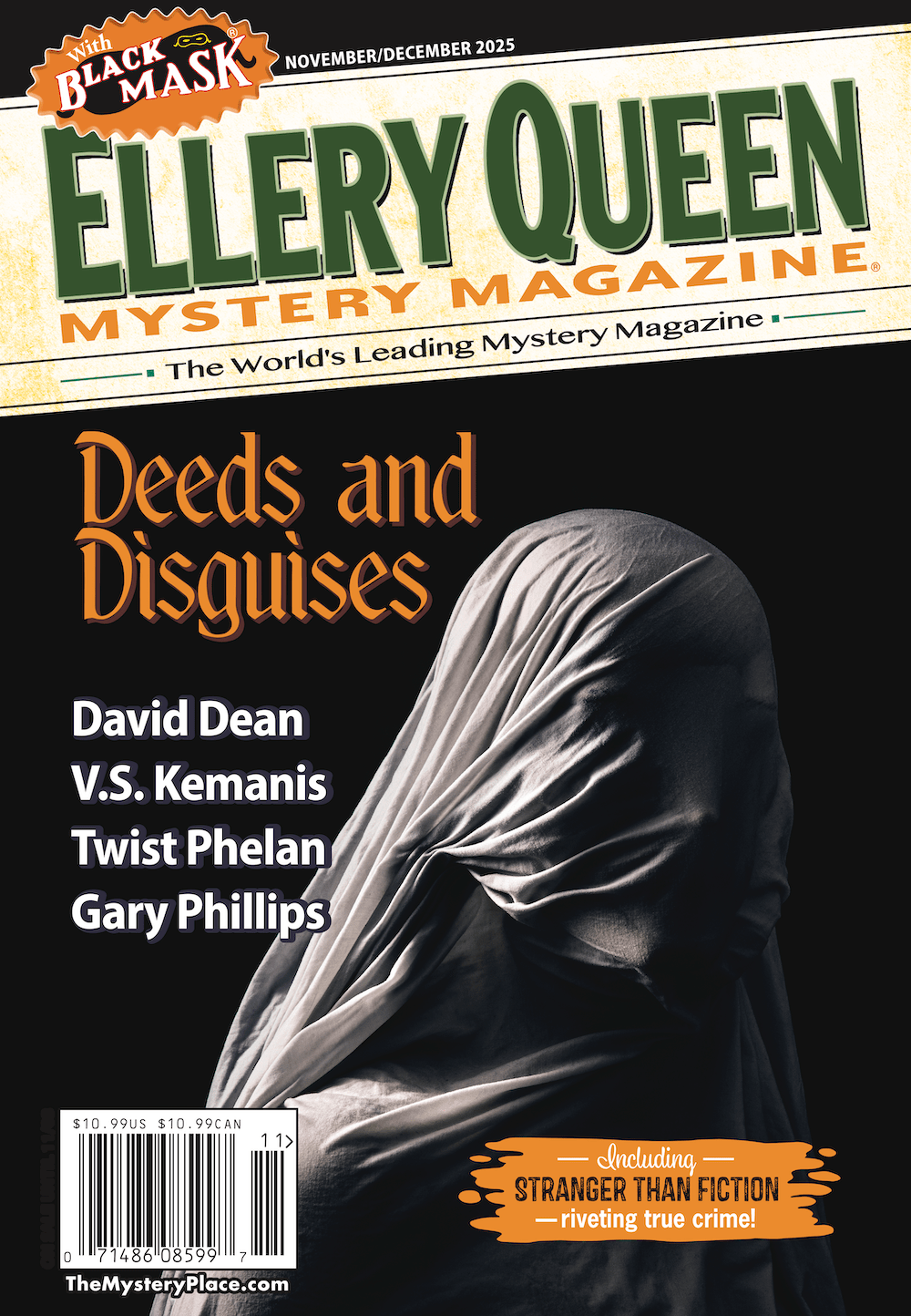
Learn about some of the uncanny similarities between writing mystery fiction and comic books in this fascinating blog post by Gary Phillips, whose story “Dr. Morbilius” appears in our November/December issue, on sale now!
I’ve published a number of crime fiction short stories, and edited several themed anthologies. These include the award-winning The Obama Inheritance: Fifteen Stories of Conspiracy Noir and South Central Noir. My efforts have also included writing comics. Most recently was Cold Hard Cash for Comixology Originals. The escapade takes my outlaw cash courier character Martha Chainey from the novels Shooter’s Point and High Hand, and transported her for the first time to comics.
Writing a comics script is different than penning a short story. Yet in both mediums, economy is key. There’s not a lot of real estate to be verbose in a short story, and in comics, the words shouldn’t get in the way of the illustrations. The writer describes the frozen action from panel to panel, page to page, for the artist to render. Additionally, the writer not only has to write slug lines of dialogue, which the letterer realizes in word balloons, but they might also be writing a character’s inner thoughts as well. These used to be lettered as thought balloons, though nowadays are presented in rectangular caption boxes. Then there’s the thrill indicating a special effect which can pop out of a panel. For instance when a character uppercuts the jaw of another.
SFX: BA-DOWW!
Like with a short story, comics scripting requires a certain spareness and efficiency. Now you may have a sub-plot like in long form in a comics story arc, but generally the writer strives for less is more, the words in harmony with the visuals. For the artist is also a storyteller. Sequentials, the panels which usually read from left to right on a given comic book page, flow one to the other as the story unfolds. Comics artist-writer and past collaborator Dale Berry (who produced the first graphic short story “Not a Creature was Stirring” for Alfred Hitchcock’s Mystery Magazine) made this pertinent observation in our essay on graphic novels in How to Write a Mystery: A Handbook from Mystery Writers of America. “The pictures can show one thing while the captions say another, different—and multiple—levels of narrative can be told at the same time.”
It’s a boon then for the writer working in prose to think visually when considering the prose to describe the characters, their actions, the settings and so on. If it comes alive in your head, this helps in making your depictions vivid. For entertaining references, I recommend the likes of artist-writer Darwyn Cooke’s graphic novel adaptations of some of Donald Westlake’s novels with his amoral professional thief Parker; Calavera, P.I., supernatural noir by Marco Finnegan Magallanes; the Stray Bullets saga by David Lapham and Maria Lapham; and The Good Asian by Pornsak Pichetshote and Alexandre Tefenkgi. These are all available in tradepaper collections and E-versions.
 SOMETHING IS GOING TO HAPPEN