
As I mentioned when Sue Parman first posted on this site a month ago, she is an anthropologist by profession. In that post she pointed out how something she learned through her anthropological work turned out to be relevant to mystery writing. Here is a second post on the theme of parallels between the work of anthropologists and mystery writers. The author’s EQMM debut, the story “Gannets and Ghouls,” appears in our current issue, September/October 2024. She’s an award-winning poet, short story writer, memoirist, and artist. Recently, she won the Travelers Tales’ Grand Prize for Best Travel Tale of 2024. —Janet Hutchings

To solve a mystery the anthropologist, like the detective, must decipher codes. Codes are rules, both explicitly stated and implicit in a culture. Sometimes they are written down (local building codes), sometimes unwritten but understood and shared by a group (the code of the Samurai), and often they are secret (Dan Brown’s The DaVinci Code). Genetic codes, spy codes, computer codes, area codes, bar codes, Morse Code, alphabets, language, culture itself—all depend on a system of replacing one message with another, which no one understands unless they know the system.
Mystery writers have a lot of fun with codes. They play with the alphabet (The ABC Murders by Agatha Christie) or hang clues on different meanings of words (The Word is Murder by Anthony Horowitz). A surprising bestseller was Umberto Eco’s dense semiotic mystery, The Name of the Rose, in which his medieval Sherlock Holmes, William of Baskerville, analyzes ancient texts and wrestles with issues of interpretation and truth in order to solve murders.
As an anthropologist, I’m especially interested in mystery novels set in different cultures: Laos in Colin Cotterill’s Dr. Siri Paiboun books beginning with The Coroner’s Lunch; Botswana in Alexander McCall Smith’s No. 1 Ladies’ Detective Agency series; Nigeria (Easy Motion Tourist by Leye Adenle and Lightseekers by Femi Kayode); Finland in Leena Lehtolainen’s Maria Kallio books; any book set in Scandinavia (Jo Nesbø, Henning Mankell, Arnaldur Indriðason, Maj Sjöwall and Per Wahlöö’s Martin Beck mysteries such as The Laughing Policeman, Peter Høeg’s Smilla’s Sense of Snow, and Stieg Larsson’s Girl with the Dragon Tattoo trilogy). And of course Scotland, where I studied a Gaelic-speaking community in the Outer Hebrides as described in my previous blog post of August 22, 2024. In addition to the Peter May books I mentioned there, I would add Ann Cleeves’s Shetland Island Mysteries beginning with Raven Black as well as any book set in my favorite city, Edinburgh, in particular Kate Atkinson’s Case Histories and Ian Rankin’s Inspector Rebus books.
An anthropologist must not only learn a new language (as I had to learn Gaelic in preparation for my year and a half of fieldwork in the Hebrides in 1970-71), they must learn what is left unsaid. The organization of gaps and silences is an important principle in the structure of cultural codes. In this blog I describe three examples of things unsaid that helped me decipher an underlying cultural code called “limited good.”
Unsaid Thing #1: The Mystery of Names. In the fall of 1970, a few months after I came to live in Shawbost, a village on the west side of Lewis, I was asked to serve as the village’s Secretary of the local Youth Club. Despite Gaelic being the dominant language in the village, all meetings of the Youth Club were in English, and all the minutes were in English, including the names of the participants. One of my motives for accepting the job was to get access to the minutes so I could get an idea of who the leaders were.
Individuals in the community had at least three names: their English names with which they were baptized (John MacLeod), their patronymics (Iain Iain Murchadh, or John the son of John the son of Murdo), and nicknames (Bogey, the Ghost). But the minutes included only the formal English names; and since, unlike the diversity of urban communities, there are only a handful of first names and surnames, I found myself looking at dozens of John Macleods, Murdo Murrays, and Catherine MacLeans, with no way to distinguish Iain Iain Murchadh from Iain Chonnich Murchadh or Catriona Phluic from Catriona Dubh. The minutes were useless for my purposes. When I asked why the minutes left out the means to identify the participants, I was given vague answers, such as that record-keeping required English.
Unsaid Thing #2: The Mystery of Avoiding Praise. Around that time, I read an entry in the personal notices of the Stornoway Gazette that gave me a clue to solving the mystery of minutes that followed the rules of record-keeping and yet kept hidden the identity of the participants. It took me a while to realize its significance and connect the dots.
On the anniversary of the death of a beloved elder, families frequently send little notes of remembrance to be published in the local paper, including the curious phrase, “his voice was never heard in the community.”
I was used to obituaries that praised the dead for their significant contributions, such as winning Nobel Prizes in Medicine or being nominated for Academy Awards seventeen times. Why would a culture praise their dead by saying their voices were never heard in the community? Like the minutes of the Youth Club that listed leaders in a manner that left them invisible, obituaries both recorded and erased the people they memorialized.
Unsaid Thing #3: The Mystery of the Dancing Witches. Before going to live in the village, I contacted the local minister, schoolmaster, and Harris Tweed mill owner for help in finding a place to stay. They said they would try but warned me that they would probably not succeed because no one took in outsiders. That I found someone to take me in was a matter of luck, timing, and the curiosity and kindness of a particular woman.
After being turned away by the minister and schoolmaster, I arrived, soaking wet, on the doorstep of the Harris Tweed mill. The owner’s secretary told me she was very sorry, but the owner was away on business. It was raining heavily. I commented, in Gaelic, on the heavy rain. “You speak Gaelic?” she said, surprised.
I admitted that I had studied it at the University of Edinburgh under the Reverend Willie Matheson, which led to a detailed discussion of the family connections of the Reverend to people in Lewis, and to fundamental differences between the people of Lewis and the Uists, Matheson’s home in the Hebrides. After a long moment she said she would hate to turn me away; that she was sure the mill owner would have had something in mind for me; and invited me to move in with her until he got back.
Johnina lived with her husband, Calum, their six-year-old son, Calum Beag (Wee Calum), and Calum’s unmarried sister, Annie. The house was huge, and until recently had housed Calum’s parents and four aunts. Almost a year later, after I had settled in for good with the family, I was attending a funeral wake. As the night wore on and the singing, drinking, and telling stories died down, a man sitting beside me said abruptly, “It’s no mystery how you came to live with that family. They had witches who danced on the moor.”
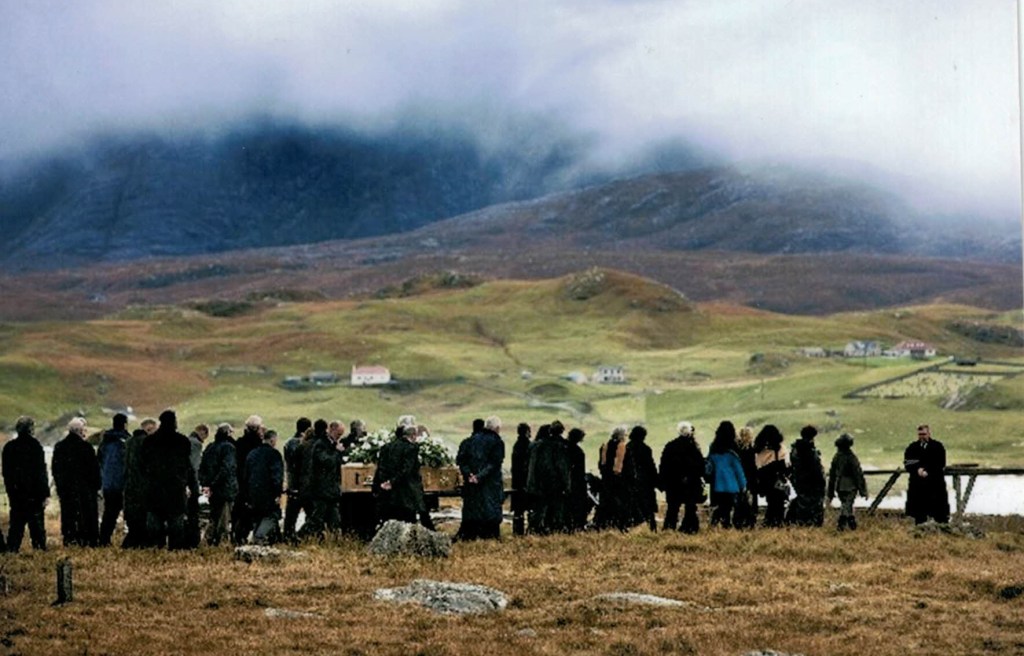
By this time, I had heard many stories with supernatural elements and had some idea of the functions they served. Tales of the each uisge, the waterhorse that lived in fresh springs out on the moor, kept young people from wandering (especially young women, who were the preferred victims of the waterhorse). Second sight, the dreams or visions in which close family and friends sent warnings of death or danger, helped to maintain a close sense of community even though people might be scattered across the globe. But this was the first I’d heard of witches, especially in the family with whom I lived.
“Luck always comes to that family,” he said. “Like Johnina taking you in. How much rent do you pay her?”
I told him and then asked, “How do you know Calum’s aunts were witches?”
“They kept cattle and took them out to the moor. On the shieling they danced naked, and everything they asked for they got. One of them stole my grandmother’s sweetheart. And how do you explain why Calum’s never without a tweed for the loom, whereas I have to beg for one every few months?”
That’s when I realized that the man was operating by a cultural code that the anthropologist George Foster called the theory of limited good in an article published in the journal American Anthropologist in 1965. According to this theory, there are certain communities in which all desirable objects (especially money and luck) exist in finite quantity. When one person gains, another loses. Crofting communities have access to communal memory that goes back hundreds of years. Crofters talk about the Clearances (when landlords, after traditional bonds of clanship weakened, removed small landholders from their lands to make way for sheep in the 18th and 19th centuries) as if they happened yesterday, and it’s common for someone to hold a grudge against someone else’s great-great-grandfather for a debt he never paid. What better way to explain why someone has more money and luck than to invoke witchcraft?
And the threat of these kinds of interpretations creates intense fear. If someone is seen as having more than their neighbor, they become the target of envy and suspicion. They pass up opportunities to succeed, or they engage in devious deceptions to conceal their success. The focus on “equality” that I first considered admirable took on a darker tone. If we are equal, we all have access to the same resources; we share in order to redistribute excess and avoid distrust. Someone lucky enough to afford a car always gives lifts to neighbors. Most of the catch from a night’s fishing gets shared. People keep their heads down. They lie about how many tweeds they get. They don’t brag about themselves or their children. They avoid taking credit for leadership positions, such as hiding behind their English names in Youth Club minutes, and after they die, they prefer to have their descendants praise them for their voices never being heard in the community.
When my book Scottish Crofters was published in the Holt, Rinehart, and Winston Cultural Anthropology Case Studies series, I went against the advice of the publisher. Usually the cover highlighted an individual performing some cultural act appropriate to that culture. Initially I selected a photograph of Calum bottle-feeding a lamb. And then I felt a wave of horror. To put Calum on the cover would hold him up for attack and ridicule. He would be mortified. Instead, I chose a photograph in which a group of men were gathered around their sheep, their backs to the camera. By the time the second edition of the book was published, crofting law had changed. Crofts could be taken out of crofting, and croft houses (owned separately from the land) could be sold. The community was being invaded by mainlanders, even Englishmen. This new cover shows two men with sheep that can be easily identified. Those who know them are more likely to talk about the price of wool, or the contrast between the weather in Scotland as opposed to the weather at their last vacation to Florida, than they are likely to talk about witches. The secrets that would have once torn apart a closed-mouth community now belong to a larger world: the concealed nature of the British royal Kate’s cancer, for example. The glue of forbidden knowledge that once helped a village community cohere is melting. The code of silence and limits is becoming a code of limitless possibility.
 SOMETHING IS GOING TO HAPPEN