
Jim Allyn doesn’t write a lot of fiction, but what he does write is always worth reading. Three of his last four stories for EQMM made best-of-the-year collections: see Best American Mystery Stories 2014 (“Princess Anne”) and 2017 (“The Master of Negwegon”) and Best Mystery Stories of the Year 2021 (“Things That Follow”). He has a new story, entitled “Everybody Pays,” coming up in our November/December 2024 issue (on sale October 15). In this post Jim takes up a topic that has proved controversial in our culture, but he has a unique perspective on it. Fiction writers should be especially interested, since the piece touches on the effects that entertainment (including fiction) can have on society. —Janet Hutchings
When I began working on this piece, I intended to explore the short-story collaboration my son and I have undertaken, our first. My son is a federal agent currently working in Europe. He’s a walking trove of experience and information. Brodie was a four-year Marine, a city cop in Michigan, and has served as a federal agent in California, Washington DC, Florida, and South Korea, and his current assignment is in Brussels, Belgium. He’s led SWAT team raids in San Francisco and Miami.
We’ve been aware of our symbiotic possibilities for a long time. We have kicked some ideas around, and are now finally taking a serious crack at it. Which means actually writing something. I thought the give and take and the learning curve involved with our new venture might be interesting. Fantasy man says hello to the real deal. How will that work? Can we come up with a workable process? Will it be any good? Will we ever get it done? Who’s in charge here?
We had an excellent way to jump-start our project. Brodie had written an article that was published in The University of Michigan College of Literature, Science, and the Arts Magazine. (We’re both Michigan grads). It was entitled “A Day in the Life: Field Notes from a Federal Agent.” I’d been aware of the article for a long time but had never thought of it as fodder. But why not? It wasn’t proprietary. It was “ours,” perfect for this deal, about his reflections upon a particularly hazardous raid on a known meth house.
The key incident in the meth house is a showdown and a twelve-gauge, sawed- off shotgun. Brodie confronts a shirtless, tatted gang member in a back hall. Between the two are several open doors, each a potential ambush. The gang member’s hands are behind his back.
“Show me your hands,” Brodie shouts, leveling his 9mm Sig Sauer at the man’s chest. The man ignores him. He writes, “His head slowly swivels back and forth as he sizes up his options. Sweat is pouring down my back underneath the accumulated weight of my bulletproof vest, equipment, and terror…Time slows. A beat passes. Two beats…” Later on he reports: “My work is mostly paperwork and procedure punctuated by moments of abject terror where a criminal’s choice can eliminate my own.”
Through long discussions, we began massaging and expanding and dramatizing that event. We were making progress. It was hard work. We added a key character and, of course, a killing. The story was taking shape and I was confident it would be an exciting, realistic tale.
But then something incredible happened. Armed with an AR 15-type semi-automatic rifle, twenty-year-old Thomas Crooks was inexplicably able to climb up on a roof and in just six seconds get eight shots off at Donald Trump. Crooks came within an inch or two of killing the former President before being killed by a single head shot from a Secret Service counter-sniper.
That event shook me a bit. It got me thinking about the omnipresence of guns in my writing, in my life, and in the marrow of America. As I thought about it, it seemed to me that I might be a bit of a one trick pony in that I’ve never written a story that didn’t involve a gun. In at least two stories, “The Tree Hugger” and “The Ozone Layer,” guns are pivotal well beyond their usual role of being used to shoot somebody.
The attempt by Crooks to assassinate a former President also brought back powerful memories of Dallas.
I was eighteen When President Kennedy was killed. It was deer season in Northern Michigan. I heard the news on the AM radio while I was driving into town in a Jeep loaded with a seven-point buck I had killed with a Model 1894 Winchester 30-30. When I rushed into the house and told my mother about the assassination, she got cross and told me not to joke about such things. It’s not funny, she said. Then she turned on the television and burst into tears. A young president dead. My mother crying in the living room.
I and my Edgar-winning, crime-fiction-superstar brother Doug, my senior by two years, grew up in the gun country of remote Northeastern Michigan on the shores of Lake Huron about 250 miles North of Detroit. It was and is hunting country… whitetail deer, black bear, a wide variety of wildfowl and small game. We lived in and around Alpena, a town of 14,000. To find a bigger town you have to drive one hundred miles. We grew up in the North Woods.
In our very early years, we were not around guns. We never saw my father with a gun. He didn’t hunt or fish or partake in the outdoor life generally. He was not a military man or a sportsman of any kind. My mother, a splendid, auburn-haired dynamo, divorced him. Doug and I lived with him for a while in a yellow New Moon trailer in a trailer park after she went on her way and we were wild kids always on the edge of trouble because he was a traveling salesman who left us alone for weeks at a time. We did what unsupervised kids are wont to do: anything we wanted.
In her second pass at life my mother won the heart of a local physician who was a different breed of cat: a deer hunter, a fly fisherman, a Jewish WWII vet who had marched through Europe. A successful man with money who wanted to live life. Living life was something my mother knew how to do but hadn’t had the chance. Together, they purchased a 200-acre hunting camp bisected by Black River, a trout stream, and, after relieving my father of his pair of juvenile delinquents, allowed the deep woods and open fields of “Camp” to become the Allyn Brothers playground for the rest of our lives. Under the occasionally watchful eyes of our new parental pair, we raised horses and hunting dogs and roses, fished the Black River, cleared forest roads, hunted deer and birds hard, and used the hell out of our own personal shooting range. In town, we lived in a modest ranch on the shores of Lake Huron’s Thunder Bay.
We went from living almost poor to living comfortably as fast as you can say “I do.” What we added to our new household was most decidedly a mixed bag.
I try not to treat guns casually in my writing because they have not been casual in my life. I try to give them their moment. Guns are not, and should not be treated as, casual things. Guns are momentous things gifted and damned with dangerous power. Beautiful. Life changing. Life ending. Life saving. Merciful. Savage. The scourge of a nation; the savior of a nation and everything in between.
My attraction to guns had a very early start. I loved and coveted toy rifles and pistols. Pored over pictures in magazines and gun catalogs. Maybe cowboys and soldiers portrayed in various media pounded something into me. Who knows? I have a feeling of nostalgia for guns that is poorly rooted, if at all, in fact. I know that, but the feeling remains nonetheless. It is a kind of longing and possessiveness that may well be typical of anybody who collects anything. I don’t fantasize about using guns but I do appreciate their function as an “equalizer.” Their defensive capability at a physical, personal level is very real. I think powerless kids are attracted to it.
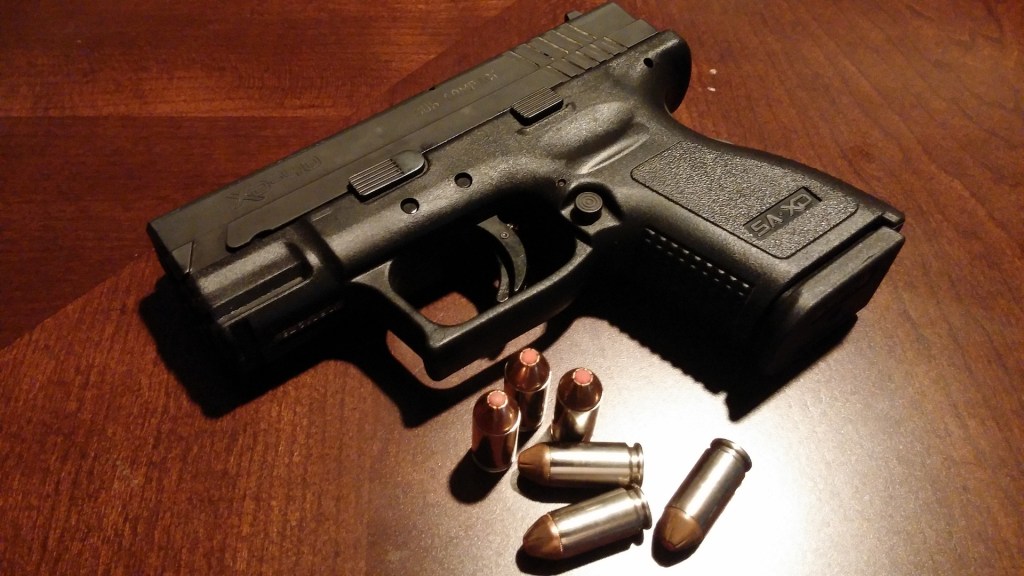
My interest in guns of a unique variety certainly feeds my writing. I have no interest in assault rifles or the “black rifles” and semi-automatic pistols so common today. And neither does my brother. We have always liked guns of the past, guns with a history, guns of well-traveled wood and steel, not black polymer machines. Probably our favorite deer rifle is the 30-40 Krag that was carried up San Juan Hill by the Rough Riders in 1898. The Krag’s tenure as the official U.S. military rifle was very brief, being replaced by the M1903 Springfield, the rifle of Sergeant York, but it is an unmistakable and fine firearm.
Doug and I shot our first gun when we were around eight and six respectively. It was a compact Browning .25 semi-automatic about the size of a pack of cigarettes. My mother took us to a little-used open dump and we plinked at bottles and cans with the solid black Belgian pistol. Shooting the little Browning was a thrill; it had quite a pop. My mother wasn’t promoting guns or pushing them at us. She just believed that a boy should learn to shoot a gun as an important part of growing up.
Once, when we visited our mother’s relatives in Missouri, we found an old, rusty double barrel shotgun in the family barn. It was just lying in a corner half-buried in the dirt floor. My mother grew up in a place where guns sprouted from the earth.
As a teenager I was involved in two incidents of potential gun violence towards men, one involving a handgun and one involving a shotgun, one involving a teenage friend and one involving an adult asshole. I had the gun. Looking back, both incidents seem impossible, unimaginable. All participants had been drinking except the cops. Teenagers, alcohol, and guns. We all just squeaked by.
When you step into what became the Allyn Camp in the Michigan north woods, there is a vertical gun rack on your immediate left. It is a foundational part of the white pine entryway, built from floor to ceiling. It was expected that people would enter and exit the cabin carrying rifles and shotguns. Back in the day, it was always full.
Once upon a time, Doug stepped into that doorway. He removed my stepfather’s scoped Winchester .270 from the rack, drew the bolt back, looked down into the chamber, saw that it was empty, pushed the bolt home, shouldered the rifle and with an ear-shattering “BANG” blew out the entire glass storm door.
“What the hell are you doing?” his wife Eve cried.
“But it was empty,” Doug shouted back, bewildered.
“Obviously not,” Eve yelled.
Someone had loaded the rifle with the wrong caliber cartridge and the cartridge was jammed. It didn’t eject when Doug worked the bolt. When Doug looked down into the open chamber and didn’t see a shell, the Winchester should have been safe.
When Doug took the gun to our family gunsmith to have the stuck shell removed, he received a colorful, royal dressing down that only this particular, meticulous gunsmith could deliver. The man had a very theatrical voice and memorable mannerisms. The whole thing was comical (to us). Could it have been tragic? Not likely. We were taught to never point guns at people. Never. If someone had been standing outside the storm door, Doug wouldn’t have pointed the gun in that direction.
When you step into that Camp doorway these days, the gun rack stands empty. It is a catch-all for hats, gloves, bug spray, dog leashes, and the like. It was full when we were hunters. We’re not hunters any more. We’re part of a trend. There are 250,000 fewer Michigan deer hunters today than twenty-five years ago. A new survey by the U.S. Fish and Wildlife Service shows that only about five percent of Americans sixteen years old and older actually hunt. That’s half of what it was fifty years ago when I was an active hunter, and the decline is expected to accelerate over the next decade.
I joined the Naval Air Force Reserve while in high school and one teenage summer wound up in boot camp at the Naval Air Station in Grosse Ile, Michigan. We had only one shooting drill. Everyone in my group—mostly city boys from the Detroit area—lined up at the range, was given a Colt 1911 .45 semi-automatic, and instructed how to use it. After the instruction, we were all given live ammo and told to shoot in unison upon command at our own individual big paper targets pinned to easels in the sand trap before us.
The Drill Instructor gave the command and everybody in my squad began shooting except me. My gun didn’t work. After the shooting concluded, the DI came over. I was so nervous and self-conscious in that kind of rigid, formal, truly panoramic situation totally alien to my casual North Woods settings that I had neglected to insert the clip. With an unnecessary amount of loud ridicule, the DI loaded my Colt, handed it to me, and told me to shoot as required…all by my lonesome with everyone watching. A few were snickering. I was embarrassed and spooked all right. But a gun in my hand…That I was used to. A Colt 1911 semi-automatic holds eight shots. My first shot visibly loosened the paper target and it slipped to an odd angle. My second shot knocked it off its easel and it fell to the sand. My next six shots, rapidly and evenly spaced, danced that target around. Everyone could see the target jump and the sand splash. It was the first time I ever heard spontaneous applause for something I alone had done. The DI chuckled and slapped me on the back. The military is a gun country.
America isn’t gun country. It’s lots of gun countries. A tapestry. There’s one for the paramilitary types who dress up and play at war, one for the shadowy homicidal berserk, one for the single-gun home-defense people, one for the competition shooter, one for the cop, one for the hunter, one for the waiting-for-dystopia apocalyptic type. The criminal, the collector, the gunsmith, and likely many more. Although these states of being can be like Venn Circles, they can also be totally separate with extremely different individuals, mindsets, and intentions. To control the relatively few dangerous categories, we cast a legal net over all. That creates resistance and resentment, particularly because horrific mass killings are increasing even though the rate of overall gun violence has been decreasing. Nevertheless, the laws we have work to a degree but they are clearly not enough.
Laws with teeth requiring that guns in the home be secured have an excellent chance to reduce gun violence. Gun safes, gun locks, locked cabinets would have prevented my stupid gun tricks as a boozed-up teenager. I would never have risked my mother’s wrath and my stepfather’s wrath to, in effect, “break in,” to obtain a family gun. They were just handy, and I grabbed them. Reducing such “casual handling” will also help instill the appropriate caution and respect firearms deserve.
Red flag laws will also work if actively applied and aggressively enforced. Even a cursory review of mass shootings reveals a variety of cases where an intervention based on previous behavior was apparent and called for and could have prevented the act. They were seen coming, but nothing was done. Manpower and will and legal justification are critical.
In 2019, deaths from gun violence in the U.S. was eight times higher than the rate in Canada, just 100 miles away from our Camp on the other side of Lake Huron. It was 100 times higher than the rate in the United Kingdom.
I never threw a baseball or a football or a frisbee around with my dad or my stepdad and I love to do all three. Never played tennis with them. Never went swimming in the sweetwater sea together or shot baskets. Never played poker or horseshoes.
But with my stepfather I did carry a shotgun and hunt partridge and woodcock over wonderful German Shorthair Pointers. We walked the woods and fields of autumn together. Golden Octobers. We took target practice at clay pigeons in the fields of Camp. My stepfather saw me yearning for a used Winchester at our favorite gun shop and bought it for me. He gave me his Browning Sweet Sixteen shotgun because I could shoot better with it than he could. He bought my wife Suzanne a 20-gauge Browning shotgun. She hunted with us sometimes and he liked her. A beautiful little person carrying a shotgun that was almost as big as she was.
At Camp we hunted deer as a family, crowding together in the cabin on the night before opening day and fanning out through the woods half-asleep in the freezing November predawn. We’d sit all day, often seeing nothing. In the evening we talked about the day’s hunt over a big supper, fire roaring in the fieldstone fireplace, dogs lounging on the couch, sleeping in the chairs, begging under the table, and lying about the floor like casually tossed blankets. A small herd of German shorthair pointers and one black labrador retriever. It was all warm and lively and comfortable and peaceful and filled with tobacco smoke.
There weren’t just “guns” standing in the rack and hanging on the wall. They were all rifles. Sue’s Ruger .44 mag, Doug’s 30-40 Krag, Jac’s .270 Winchester, Eve’s 30-30 Winchester, Brodie’s 45-70 Springfield, Jim’s Sako .308. Couldn’t have had that particular ritual without them. Some of those rifles had been carried long ago by hunters we never knew in forests we had never seen. We understood that about those rifles. Liked that about them. They were history, memories, partners.
Any discussion of factors that might affect violent tendencies in America always includes violence in the entertainment media and that must necessarily include crime fiction in all its wildly different iterations. Some have called much of today’s entertainment “propaganda for violence.” It is hard to argue that it is “propaganda for peace.”
I used to live and work in Oxford, Michigan. Brodie graduated from Oxford High School during that time. In 2021 fifteen-year-old Ethan Crumbley walked those same halls of Oxford High School armed with a 9mm semi-automatic pistol. He shot and killed four of his fellow classmates and injured seven others. He was sentenced to life in prison.
His parents, James and Jennifer Crumbley, were the first parents ever to be charged and convicted in their child’s mass shooting at a U.S. School. They were found guilty of four counts of involuntary manslaughter, one for each of the students Ethan killed. They were sentenced to ten to fifteen years in prison. The judge said the two repeatedly ignored signs that would make a “reasonable person feel the hair on the back of their neck stand up.”
The era of parents with guns as innocent bystanders is over.
Twenty-one of the thirty deadliest shootings occurred in this our new century. It is the first century of the third millennium. New heights. In 2022 the ATF reported that the annual number of firearms manufactured has almost tripled since 2000. The report revealed that since 2009, Glock-type semi-automatic handguns bought for personal protection have been outselling rifles typically used for hunting. In the last five years alone, Americans have purchased nearly 70 million firearms, 13 million more than the entire first decade of the new century.
There’s an armed populace out there that’s unlike anything that’s ever been seen before. The mass shootings are unlike anything that’s ever been seen before. They are getting closer to all of us.
We’re pouring more and more guns into our growing melting pot and some people are demanding that we do…nothing. Except arm every adult with a Glock.
Think that approach is going to help things? More guns in more hands? Really?
Every single gun is important because of the damage a single gun can do. We should support red flag laws for high-risk individuals, an assault weapons ban, gun buy-backs, safe and secure gun storage in the home, and any other practical, reasonable measure.
One evening in the 1960’s my mother was sitting at our classically rustic hunting camp table feeding a cute little mouse with bits of cheese. Tiny mice are exceedingly precious, like pixies. Sometimes you could see them basking in the sunlight on the leaves of our houseplants. Little harmless creatures. My stepfather came up behind my mother and whacked the little mouse with a heavy green Coke bottle of that era. He objected to vermin being fed at the table. Perhaps it was his medical-school training. My mother was so upset her neck turned red. My stepfather retreated to his favorite chair, lit up a Camel, and resumed reading his newspaper. I struggled with my philosophical interpretation of that incident. Initially I was in full agreement with the actions of both parties. A true conundrum. I finally decided that the mouse was being fed as an invited guest of my mother’s and therefore was entitled to protective status and so should not have been struck with a Coke bottle by a cardiologist. My stepfather should simply have asked the tiny mouse to please leave. The little mouse scampers back inside the wall and everybody lives.
If only the world could work that way.

 SOMETHING IS GOING TO HAPPEN