
Edgar Allan Poe Award nominee Janice Law created one of the first fictional female private eyes with her Anna Peters series, launched in 1976. She has continued writing in the crime fiction genre at both novel and short-story length. Her latest book is 2022’s The Falling Man, which is set in the art world—a milieu she knows about, since she is not only an author but a painter. She has an interesting story to tell about her last story for EQMM, “The Knight-Wizard” (July/August 2023), and she’s provided us with some of her art inspired by the story. For those who did not get a chance to read the story when it was published last year, we are posting it here. Enjoy! —Janet Hutchings
(Click here to download a PDF copy of Janice Law’s “The Knight Wizard”)
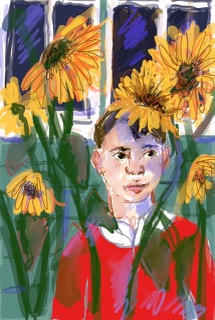
“The Knight Wizard” began with a single sentence in Helen Macdonald’s fine Vesper Flights: a note about a little boy in a secretive household who became enthralled with a fantasy novel. A gift from the Muse that took some time to arrive at a story. When it did, the characters, the house, the grounds, the beach all emerged from memories of summers seventy plus years ago.
How strange that memory, which grows increasingly faulty with age, should preserve so much detail from childhood, including the Gilded Age shingled mansion which it was my folks’ job to close up every fall. In those days, a trip to the Cape, where a massive house had to be packed up and readied for winter, was counted as a “holiday” for my parents, at least by their employers.
While Mom and Dad were bundling everything from kitchen supplies to the big white china eagle crucial to the dining room decor, I got a precious week’s reprieve from elementary school. Needless to say, I loved the place with the wraparound porches, the visiting sailors dormitory in the attic, and the living room with the vast fireplace and the interesting library. There was beach access by a track along the neighbor’s spectacular gardens and, by the house itself, an interesting border of sunflowers, cherry tomatoes, and lettuce, destined all those years later, to be Henry’s favorite hiding place.
As soon as young Henry came into mind, I knew that house was his summer home, and having given him an unhappy mother and father, I gifted him with a lovely nanny. Bella is modeled on my mother, a highly intelligent and practical woman with a real genius for both children and pet birds. She had patience, humor, and perception, as well as high standards and genuine sympathy.
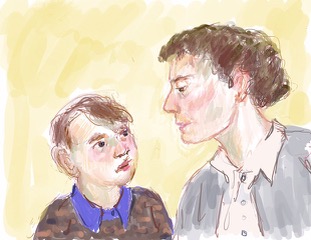
At a different time, she would have made a wonderful children’s doctor or nurse. In Edwardian Scotland, she had to leave school at fifteen to work in a laundry. Domestic service, even strenuous as it was in those days, was probably a smart move. Mother traveled from Scotland to Canada as a nanny. Later, when she found it too painful to leave the young children she had raised, she saw much of the world as a personal maid.
Writing Bella brought back a whole lost world, and I’d like to think Mom would have enjoyed the story and been amused by The Kings of Seaforth and the Knight Wizard’s difficult-to-explain parentage. (Biographical Note: My father served in the Seaforth Highlanders, a genuine Scottish regiment that had no truck with knight wizards in any era.)
Like all my fiction, “The Knight Wizard” is a mix of lucky bits of miscellaneous information, observation, and experience, but it is unusually heavy on personal details. Old age definitely weakens short term and recent recall, often with annoying results. But there is compensation for writers. A great storehouse in the neurons is still waiting to be used, and when it is called upon, the past does return, rich and precious and as mysterious as ever.
 SOMETHING IS GOING TO HAPPEN