
Andrew McAleer is the author of 101 Habits of Highly Successful Novelists and co-editor, with Gay Toltl Kinman, of the mystery anthology Edgar & Shamus Go Golden. He recently completed a short story collection featuring his father John McAleer’s Golden Age detective, entitled Henry von Stray: A Casebook of Crime (forthcoming from Level Best Books), and he is now at work with Gay Toltl Kinman on two mystery anthologies: Shamus & Anthony Commit Capers (Level Best Books) and Agatha & Derringer Get Cozy (Down & Out Books). Previously he’s contributed posts to this site about Edward D. Hoch, Rex Stout, and James M. Cain. Here he gives us a look at a few of the interviews included in 101 Habits of Highly Successful Novelists. —Janet Hutchings

While writing the 101 Habits of Highly Successful Novelists: Insider Secrets from Top Writers, I had the honor of interviewing some of crime fiction’s most successful authors. These industry giants generously shared their writing tips and secrets in order to help a new generation of mystery and suspense authors fulfill their own writing dreams. The following selected tips from Mary Higgins Clark, Bill Pronzini (MWA Grand Master), Hank Phillippi Ryan (The House Guest), William G. Tappy (Brady Coyne mysteries), Gregory Mcdonald (Fletch), Rhys Bowen (The Molly Murphy mysteries), Thomas B. Sawyer (Murder, She Wrote; A Major Production!), Peter Lovesey (Diamond Dagger winner), Michael Bracken (Black Cat Magazine [editor]; The Eyes of Texas), and William Link (Columbo) make their first online appearance anywhere—as does this vintage Polaroid of Gregory Mcdonald and Mary Higgins Clark—exclusively for EQMM’s “Something is Going to Happen” followers.
Mary Higgins Clark: Where to get the idea? Easy. Pick up your local newspaper. The odds are that on the first page or two it contains news of at least one homicide, an aggravated assault, a bank robbery, a mugging, a jailbreak. There also may be a recap on a criminal trial that merits national attention, an update on a series of unsolved murders, and an item about a child who has been missing. In other words, you’ll find material for a dozen short stories or novels.
Bill Pronzini: Always do your own work. Never try to imitate favorite or bestselling authors. Never follow current trends; what is a hot topic today may well be ice cold by the time a novel is written and submitted for publication. Imitators are seldom successful. An individual’s unique style and vision are what editors are looking for.
Hank Phillippi Ryan: During my thirty years as a television reporter, I got used to writing news stories on wet notebooks in the middle of hurricanes, with mittened hands as the snow swirled, and jouncing in the backseat of a news van on the way to make a deadline. Of course, it’s easier at my desk, and writing novels is much more civilized at your own computer or under a tree with a yellow pad or wherever your favorite spot is. Writing a novel is all about getting it done, but it’s very easy to put it off. You say, I’m at Mom’s, on vacation, too hot, too hungry, or at an unfamiliar computer, and then the time goes by, and your book is unfinished. A hundred little delays have added up to blank pages. When I’m on the trail of my own plot and the lives of my characters, nothing can keep me from writing, wherever and whenever. The thrill of having a good idea and getting it down means some chapters get written on the backs of envelopes while riding the subway or in the blank back pages of someone else’s paperback. Transcribe your ideas later. Get them down now.
William G. Tapply: Don’t be afraid to sprinkle “he said” and “she said” liberally through dialogue exchanges. Don’t let more than three dialogue exchanges happen without adding an attribution. You do not want your readers to lose track of who’s speaking, but attention-getting tags such as “he exclaimed” or “she expostulated” are cumbersome and
distracting. Write “he said” directly after the first natural pause in the spoken statement, and it will be virtually invisible to the reader while still signifying who’s speaking.
Gregory Mcdonald: People ask me how to write a book. That’s the wrong question. The question ought to be, how does one write this book? I don’t know. Only the person who conceives of a book, short story, poem, painting, or piece of music really has the ability to bear it and birth it . . . fulfill it, in accordance with itself.
Rhys Bowen: The best tip I was ever given was: If you want to be a writer, write. If you wanted to play a concerto at Carnegie Hall, you’d practice and practice, wouldn’t you? But I can’t tell you how many people have said, “oh, I plan to write a book some day’ and yet they are not writing now. Like any craftsperson, you practice until you become comfortable in the medium.
Tom Sawyer: The next time you watch your favorite sitcom or drama, observe that all of the scenes are arguments. If they aren’t, you’ll be changing channels in a hurry. Once you begin thinking of your characters in this manner—the ways in which they disagree and don’t get along with each other—you’ll quickly find that they will talk to you.
Peter Lovesey: Beware of the cliché. By this I mean not only the cliché phrase (“It’s an old trick, major, but it might just work.”), but the cliché plot (the murderer turns out to be the narrator) and the cliché style. Don’t try to be a second Raymond Chandler or J.K. Rowling. By all means learn from successful writers, but be yourself, and say it freshly.
William Link: When I lecture, I tell the mystery writers if they’re interested in clever clues and unique surprises that they should read old masters such as John Dickson Carr, Ellery Queen, and Erle Stanley Gardner. The contemporary people to study are Ross MacDonald, Michael Connelly, and P.D. James. They are experts at credible characters part and parcel of beautiful, intricate structures.
Peter Lovesey: F. Scott Fitzgerald once said “Action is character.” Make sure things are happening, and the way the characters react or speak will make them live.
Michael Bracken: Writing is an art. Publishing is a business. Once I learned to separate the two, to wear my “artist” hat while writing and my “businessman” hat the rest of the time, it became easier to deal with rejection, rewrite requests, and editorial changes.
Mary Higgins Clark: The plot, like the foundation of a house, is the structure on which all else is built. No matter how glib the writing, how enchanting the characters, if the plot doesn’t work, or if it works only because of flagrant coincidence or seven-page explanations at the climax, the book is a failure.
101 Habits also includes insider secrets from romance, western, fantasy, and science-fiction New York Times and USA Today best-selling authors. While working with these authors from many different genres and getting to know them, they had at least one universal personality trait—no matter how tough the writing world treated them they never quit.
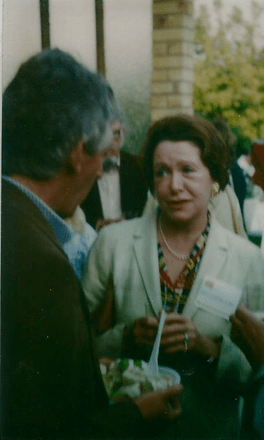
(Photo-John McAleer)

 SOMETHING IS GOING TO HAPPEN
Pingback: “Ten Questions for William Link” (with Andrew McAleer) | SOMETHING IS GOING TO HAPPEN