Pip Thompson’s first paid fiction publication, “The Ring,” appears in EQMM’s current issue, November/December 2023, in the Department of First Stories. The Virginia author has also completed a novel which is currently on submission to publishers. Her literary career is off to a good start. As you’ll see from this post, she has another long-standing career as an anthropologist. —Janet Hutchings
In her book Write Away, Elizabeth George promotes the importance of place in mysteries. For George, a book’s setting is a character like any other, because the protagonist’s journey through it reveals her worldview, character, and values. Mystery writers who privilege place thus act as participant observers, keen-eyed outsiders in adopted landscapes.
George lives in Southern California but sets her novels in England. Why? As a Shakespearean scholar and a fan of 1970s British pop culture, she immersed herself in the language and place as a young woman and never looked back. Like George, some authors set their novels in a place where their heart resides. We readers feel that connection profoundly. To borrow a phrase from anthropologist Mary Douglas, these spaces resonate with purity and danger, which makes for a good mystery.
Think of Tony Hillerman’s beloved Four Corners. Amid sandy canyons, endless potholed roads, and towering buttes, the abject poverty of the Navajo people contrasts with their rich culture. The startling beauty of the landscape stands for balance and serenity. Outsiders—white people with their strange beliefs and habits—bring discord. The desert light captivated Hillerman, and he used it to reveal both the spiritual and the dangerous: the hush of an abandoned ghost hogan, the dark cave where a rattlesnake hides. Between shadow and sky, peril waits.
Next, consider Louise Penny’s Three Pines, where Inspector Gamache and a motley crew of friends and colleagues converge on a village redolent of wood smoke and fondue, where children ice skate on a frozen pond. We find a bookstore and bakery but no bank or used car lot. The setting lulls us, trusting as Hansel and Gretel, with offerings of French onion soup and hot chocolate after we’ve trudged through the snow to Gabriel’s bistro. Yet evil slithers in, as unexpected as a copperhead in a picnic basket. But the we readers come to embrace Three Pines, and we return, ready for a welcome and a shiver.
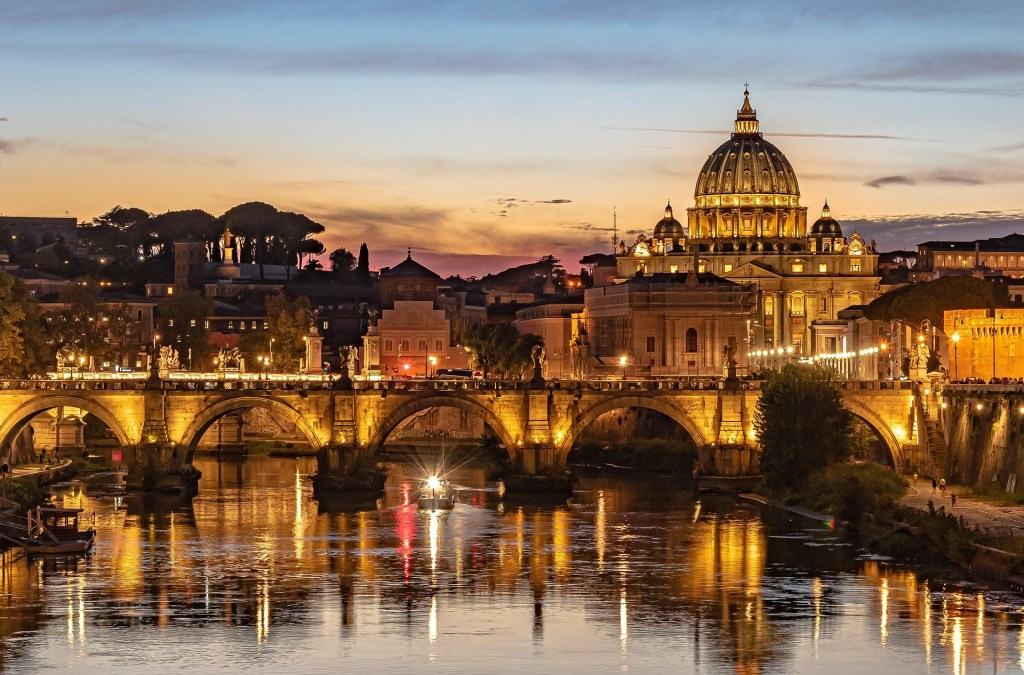
So, how did I come to set my mystery series in Italy? In college, my friend returned from her Italian semester transformed: She wore a brown mohair sweater to the thigh, a swinging wool skirt, and a pair of supple leather boots with a pointed toe. I took one look at her and decided I had to go, too. In Rome, I got my own pair of boots and a Bedouin dress and somehow befriended a group of poets. One of their number, a member of the Roman nobility, stole books for the others. At the Hotel Paradiso, two harridans ran the front desk and glared at us when we came home late. I taught English to businesspeople and modeled for a dowdy fashion house on the Piazza di Spagna. I was neither safe nor sorry.
That winter, I switched schools and became an anthropologist. My professor and I followed an Easter Monday festival, where villagers hoisted their town’s life-size statue of the Madonna onto their shoulders and carried her up a mountainside at dawn. At the summit, the statue met her sister Madonna, who’d come from the village on the other side of the mountain. Pinned-on Lira bills festooned their silk robes, one blue, one red. I carried the bags and interviewed an old woman who made an olive oil cake to honor my visit. She told me that when no rain fell, they’d parade their statue of Saint Anthony through the streets and upend him into the well in the town square, headfirst. They’d walk by, shouting insults and asking, “How do you like it being wet all the time?” I became a collector of stories.
Some years later, I traveled to Sicily to join an excavation in the countryside, where I met my archaeologist husband. One day, we went to the farrier, known as a dangerous man. My husband asked, “Would it be possible for you to sharpen this trowel?” The man answered, “It is possible to kill a man in the street in broad daylight,” then sharpened the trowel. The town drunk sat on a bench in the main piazza, stuffing his mouth with peanuts and spitting out the shells. He told rude jokes to anyone who would listen. At the small museum where we cleaned and sorted artifacts, the guards consulted our permit, often interpreting it in ways that stopped the work. Sicilians are great philosophers, and the elegance of one’s argument may trump fairness and even logic. We’d debate them over cups of coffee and biscotti, and mostly kept the work going. I sharpened my Italian and learned the power of things left unsaid.
My first mystery took shape in Venice, at the museum where I worked. I don’t pretend to rise of the heights of the masters named above. But my setting is every bit as heartfelt. That summer, the overseas staff arrived for the Biennale and quickly ran up astronomical bills at the Cipriani. We interns waited at battle stations for their onslaught. I’d splurged on a tuna and artichoke sandwich and placed it on my desk. Before I could eat it, the visiting director barged in, demanding my office and my phone. When I returned, he’d put his cigar out in my sandwich. I vowed revenge. In Blood Oranges, said director steals paintings off his museum walls, replacing them with forgeries and cashing in on the originals. My sleuth, a noble art restorer from outside Catania, solves the crime and punishes the guilty in true Sicilian style.
I write about Italy because I love the people as much as the history, the landscapes, and the food. I love their eloquent and hilarious curses, like “l’anima dei mortacci tua,” damn the souls of your ancestors (go to hell). “Muso di sorcio,” rat face, is just as good. Italian proverbs sound earthy and often refer to food, such as: “O mangiare questa minestra, o saltare da questa finestra,” either eat this soup or jump out of the window (take it or leave it). Others draw on farming life: “Chi va al mulino si infarina,” who goes to the miller will be covered in flour (do bad things and you’ll always get caught). “Tanti pampini e poca uva,” lots of leaves but few grapes (someone who promises a lot but has little substance).
So why set my first mystery short story in Point Loma, my childhood home? I even used my family nickname, Pip, drawn from a favorite book, as my pen name. For years, I came infrequently to San Diego. Having spent my adult life in the South, I find the forced informality of Californians a bit grating. I’m not too fond of the freeways and strip malls and houses built right down to the water. Yet lately, I feel I’d like to reclaim the place: the tide pools and pickleweed, native sage, and waves crashing at night. There is something a little salty about shoes without socks or swimming in the ocean in the middle of the workday. My mother and I walk along a beaten dirt path to the Heron Tree. Writing The Ring, which I’m now turning into a novel, feels vulnerable and satisfying, like ripping off a scab. Will I find a bloody mess underneath or new skin? It’s just one of life’s many mysteries—you’ll have to see for yourself.

 SOMETHING IS GOING TO HAPPEN