
A winner of the Hammett Prize for Literary Excellence in Crime Writing as well as two Mary Higgins Clark awards, Carol Goodman is the author of more than two dozen novels. Her debut story for EQMM, “A Woman in Miniature,” appears in our current issue (November/December 2023). It stars World War II-era sleuth Peggy Quinn, who also appears in the completed but as-yet-unpublished novel Midnight at the Half Moon. In this post, the author gives us a fascinating look at the predecessors (or lack thereof) in noir fiction to the type of character she’s created in Peggy Quinn. —Janet Hutchings
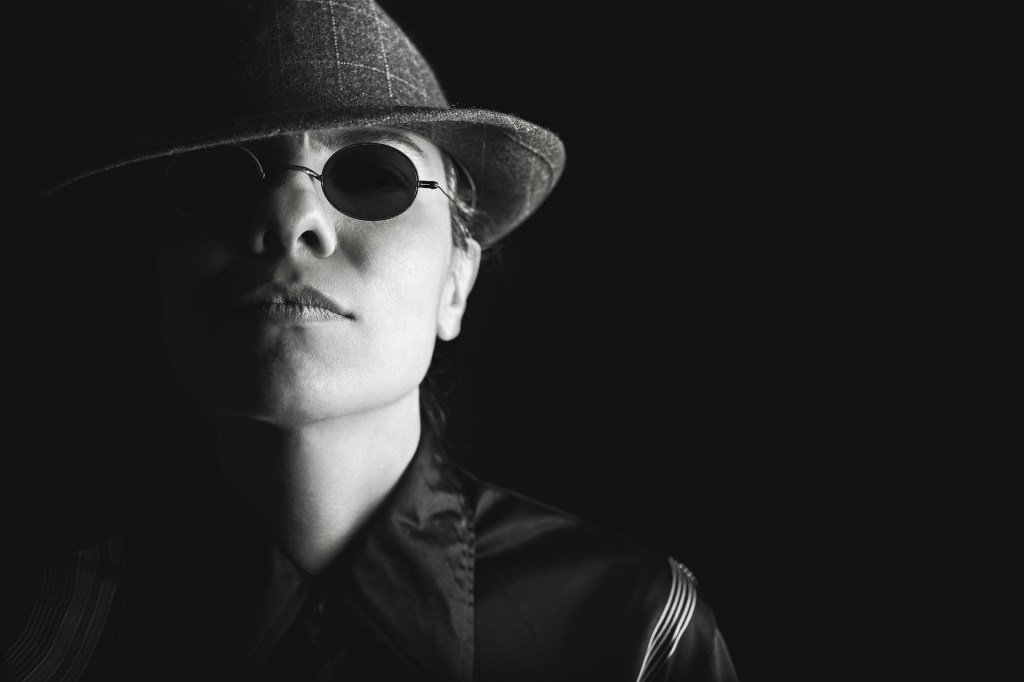
When I began writing the character Peggy Quinn, who appears first in my (unpublished) novel Midnight at the Half Moon and now in my story “A Woman in Miniature,” I knew that she would be loosely based on my mother, who was 18 in 1942 and whose life always sounded to me as if it could have been a film noir. The older sister of four brothers, she quit high school to take care of them when her mother died. She looked like a forties movie star, had the tough-but-plucky hard knocks girlhood of a Brigid O’Shaughnessy, and had brushed shoulders with Murder Inc’s “Kiss of Death Girl” and Abe Reles in Coney Island. I wanted Peggy’s story to have the feel of a noir film, so naturally I turned to the hard-boiled books, pulp magazines, and movies of the era looking for her role models. What I encountered very quickly, though, was the dilemma of creating a female noir hero. Women in noir are more often the femme fatale bad girl or the sidekick-sister-good girl—not the hero.
When I looked to the hardboiled novels that would later become the basis for the first noir films, I found the good girl/bad girl dichotomy on full display. In The Maltese Falcon (book 1930; film 1941) Sam Spade’s secretary Effie Perine is capable and fast-talking but she’s not the primary investigator. Brigid O’Shaughnessy is alluring and dynamic but ultimately double-crosses Sam Spade and is revealed to be a murderer. She’s the quintessentially self-aware bad girl spelling it out for us when she admits to Sam “I haven’t lived a good life—I’ve been bad, worse than you could know.” In Raymond Chandler’s The Big Sleep (book 1939; film 1946) there’s plenty of suggestive banter between Philip Marlowe and the older Rutledge sister Vivien, but even if she’s not as deranged as her younger sister Carmen, she hardly provides a role model for a young woman who might want to solve her own mysteries. Finding a contemporary role model for Peggy would require more detecting.
Looking at the 1930’s, the Depression era my mother grew up in, the obvious female detectives plying their trade, Nancy Drew and Miss Marple, are both worthy archetypes and ones my mother might have encountered. In fact, it was my mother’s lifelong love of Agatha Christie that probably inspired me to write mystery. Neither the teenaged sleuth nor the elderly Miss Marple, though, fit my picture of Peggy Quinn. For one thing, they were both far better off financially than my Peggy Quinn.
Better suited as a model, was Torchy Blane, girl reporter. As Philippa Gates points out in her Detecting Women: Gender and the Hollywood Detective, Torchy Blane came out of a plethora of girl reporters in 1930’s films who “were generally presented as ‘hardboiled’ by their experiences in the Depression-era city . . .” Played by Glenda Farrell in seven of the nine Torchy Blane movies, Torchy is fast-talking, daring (in one film she chases a train and vaults onto the last car), and she always outwits her male rivals to solve the case. According to Jessica Pickens in her article “Female Detectives” (Pickens) it was the actress Glenda Farrell who gave the role its dynamic quality. Farrell said of the other reporters she’d played that “They were caricatures of newspaper women as I knew them. So before I undertook to do the first Torchy, I determined to create a real human being—not an exaggerated comedy type. I met those newswomen who visited Hollywood and watched them work on visits in New York City. They were generally young, intelligent, refined and attractive . . . By making Torchy true to life, I tried to create a character practically unique in movies.”
Torchy Blane, then, provided a good model for my Peggy Quinn (and I imagined that my mother must have watched at least some of those movies) but the atmosphere of the Torchy Blane films (and many of the films that featured girl reporters in the 1930s) was more comic and antic than what I wanted for Peggy Quinn. I wanted my story to feel more like a film noir. Still on the case, one of the models I discovered was in the 1940 film Stranger on the Third Floor directed by Boris Ingster, starring Peter Lorre, John McGuire, and Margaret Tallichet. As Philippa Gates points out in her book Detecting Women: Gender and the Hollywood Detective, it was one of the first films to be identified by critics as film noir and “offers a shift in tone from the mysteries-comedies of the 1930’s . . .” (Gates, 121). From the beginning of the film, Jane suspects that something is wrong when her fiancée, newspaper reporter Mike McGuire, testifies as the lead witness in a murder trial. Jane feels sure that the accused is not guilty but Mike dismisses her hunch as an emotional response. Only later when Mike witnesses another murder and is then charged with it does he realize that she was right and Jane is left to investigate and clear Mike’s name.
The woman who is forced into the role of amateur detective to clear a loved one’s name was not uncommon in films and stories, but she’s sometimes dismissed as not qualifying as a true noir hero since her motivation is love. Philippa Gates disagrees “that such a motivation should negate the agency that such female detectives demonstrate as investigators since several male detectives in noir films—most famously Laura (Preminger, 1944)—are also motivated to investigate out of love/desire.” (Gates, 122). I agree. In her first outing, my Peggy becomes involved in a murder investigation when her brother is suspected; in “A Woman in Miniature” she can’t stand by and watch an innocent woman be accused of a theft. Here, at last, I felt like I had found the combination that could serve as a model for Peggy—the fast-talking girl reporter of the 1930s and the more nuanced justice-seeker of early film noir.
This combination took me back to the pulps—to another sister proving her brother innocent in the short story “Angel Face” by Cornell Woolrich. In her introduction to “The Dames” section of The Black Lizard Big Book Pulps, Laura Lippman calls the heroine “an avenging angel” and the “most dynamic female in these stories” (Lippman). Jerry Wheeler, a smart-talking dame who’s earned her hard-boiled credentials working in a tinseled G-string to keep her brother Chick out of the orphanage and reformatory, tries to save him from the clutches of a mobster’s moll (Woolrich). When the mobster’s moll winds up dead and Chick is tried and convicted for her murder, Jerry has to prove his innocence by going undercover as the singer “Angel Face” at the mobster’s club. While she requires a little last-minute saving from a hunky detective, she’s proved her bravery, intelligence, and heart ten times over. I felt a special connection between her and my mother since my mother had quit high school to keep her brothers out of the orphanage, was a frequent visitor to the police station to talk them out of trouble, and eventually testified for one of her brothers in a murder trial.
When I recently went back to read “Angel Face,” I noticed that while the story first appeared as “Murder in Wax” in Dime Detective in 1935 it later appeared as “Angel Face” in Ellery Queen’s Mystery Magazine in December 1946. That Peggy is now making her first appearance in the pages of Ellery Queen,where my mother might have found her own role models in sleuthing, feels like the completion of a circle and the kind of poetic justice any noir heroine could want.
Sources
Gates, Philippa. Detecting Women: Gender and the Hollywood Detective. State University of New York Press, 2011.
Lippman, Laura. Introduction to “The Dames” in The Black Lizard Big Book Pulps (ed. Otto Penzler), Vintage Crime/Black Lizard; Reprint edition, 2007.
Pickens, Jessica. “Female Detectives” https://www.tcm.com/articles/Programming%20Article/021713/female-detectives/
Woolrich, Cornell. “Angel Face” in The Black Lizard Big Book Pulps (ed. Otto Penzler), Vintage Crime/Black Lizard; Reprint edition, 2007.

 SOMETHING IS GOING TO HAPPEN