
Joseph Koenig’s first novel, Floater (1986), was nominated for an Edgar Allan Poe Award. His fiction has also brought him nominations for the Shamus and Macavity awards, and his novel Brides of Blood (1993) was named a New York Times Notable Book. The New York author has a very original new story, “High Diver,” in EQMM’s current issue (September/October 2023). It’s a return to EQMM after a long absence; his work previously appeared in our pages in 1992. In this post he mentions his occupation prior to becoming a full-time fiction writer—what he refers to as “degenerate journalism”! —Janet Hutchings
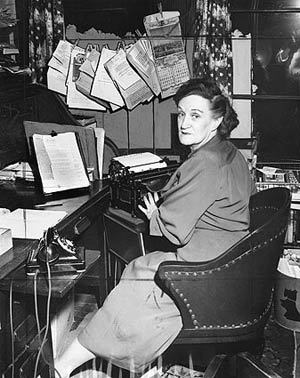
When she was starting out at the Salt Lake City Tribune in the early 1920s, Florabel Muir fought to cover the execution by firing squad of a condemned murderer at the Utah penitentiary. Because she was a woman and young, although hardly dainty—she never was accused of that—her editor assigned a male reporter as a sort of relief pitcher in case her nerves failed, and she couldn’t complete the assignment. It was her backup who revealed weak knees. Muir was awarded the byline and praise from the editor, who admitted that she was not the reporter who vomited.
Over half a century Muir built the reputation of a newshound who always went the extra mile—even when it was someone else’s last mile—to get the story. If she returned to the city room to write it spattered in their blood, she had carte blanche to put the dry cleaning on her expense account. In 1950, close to 60 and still very active, she summed up her career in the tell-all Headline Happy. Here is the first part of Kirkus’s review:
Sex and sadism, gals and gangsters, were molded into the author’s news stories for New York and Los Angeles tabloids, and Miss Muir licks the dish with reminiscent gusto in her autobiography. All the savoring of the lurid and sensational that made the stories is intensified here paced by Miss Muir’s counting o’er her successes wringing stories from reluctant celebrities, manufacturing stories from celebrated silences and keyhole interviews. There is the Charlie Chaplin-Joan Barry scoop in which the little mother is treated tenderly; the story of boyish Errol Flynn’s endearing escapes; the carryings on of Mickey Cohen and Bugsy Siegel; and the famous diary of Mary Astor which Miss Muir procured (she does not tell how) for $300. Through all the author takes pride in relating how she swept down on her prey—just and unjust—(she seems to admire the unjust more)—with one object in mind—the story.
It’s said that everyone on earth is connected to everyone else by no more than six degrees of separation. As unlikely as this seems, it works for me. Through an old girlfriend who doesn’t deny turning down an offer of marriage from a future adviser to Presidents Bill Clinton and Donald Trump I am linked to every major Democrat and Republican politico, with degrees to spare. A teammate from my college football days went on to become a top NFL exec, my portal to the world of professional sports. I knew Salvador Dali as he approached old age. If anyone prominent in the arts was a stranger to him, I can’t imagine who it might have been. I am three degrees of separation removed from Florabel Muir.
My Uncle Murray’s best friend was Neddie Herbert, a gunsel. I have no idea of what he did before becoming a gangster, or how he came to be tight with my father’s younger brother. I never asked Uncle Murray, who considered such questions tasteless. I do know that by the late 1940s, Neddie had left Brooklyn for fresh pasture in the west, gone to L. A. to work for Mickey Cohen, who was Ben Siegel’s trusted lieutenant and successor. After Bugsy was executed because of his alleged finagling of expenditures at the new Flamingo hotel in Las Vegas, Cohen filled his chair in the councils of the mob.
Cohen was no Bugsy, who some thought handsome and charming. He was short, stubby, and lacking any pretense of savoir faire. While Siegel didn’t employ bodyguards, trusting to the good nature of his underworld compadres, Cohen was never seen without several. Chief among them was Uncle Murray’s friend, Neddie.
On the morning of July 20, 1949, Mickey, Neddie, and their entourage stopped for a bite at Sherry’s, an all-night eatery on Sunset Strip. Among the entourage was Florabel Muir. As she would explain, Jack Dragna, a mobster competing for Bugsy Siegel’s vacated turf, had announced that he was gunning for Mickey, and she wanted to be around should Mickey get it. Cohen was not visibly concerned. A hard man, a former pro fighter in the bantamweight division, he could take care of himself with his fists. Neddie Herbert was there to handle business that might escalate into gunplay.
As the Cohen party was leaving Sherry’s at 3:55 a.m., shotgunners opened fire from their blind beneath a billboard across the street. Mickey was hit in the shoulder, but not seriously injured. A larger load of shot was absorbed by Neddie. A pellet ricocheting off the sidewalk or perhaps a bone inside Neddie caught Florabel Muir in what she described as her derrière. Cohen, who was being tutored in the finer usages of language by the writer and her husband, referred elegantly to the site of her wound as her tuchas.
Neddie still was breathing as he kissed the curb. A news photo shows ghouls clustered around him while a passerby tries to stanch the hemorrhaging from his guts. In another picture shot through a forest of legs a garment of some sort is clenched in Neddie’s teeth. There is blood all around. He seems accepting that he is a gone goose, apprehensive about what would come next.
Absent from the rotogravure is Florabel Muir. Ignoring directives from her husband to, “Get down, get down,” she ran from the gunfire, not out of fear, but in search of a phone to call in her greatest scoop, a first person account of the failed attempt on Mickey Cohen’s life, and incidental murder of Neddie Herbert.
Cohen subsequently appointed a new bodyguard, and fended off more assassination attempts by Dragna and his goons. Not one to take chances, the notorious germaphobe and compulsive hand-washer purchased a new Cadillac Coupe de Ville, and outfitted it with two-inch thick glass, and armor cladding.The Caddy was too ponderous for getaways, but impervious, and served its owner well until he traded it in two years later because it wasn’t street legal.
Florabel Muir’s piece in the New York Daily News, her flagship at the time, was syndicated throughout the country, cementing her place as America’s ace legman. Dripping with Adrenalin, the writing did not match this contemplative bit from Headline Happy, in which she describes entering the scene where another luckless yegg had eaten lead.
Perfume pervaded the room from the night-blooming jasmine clustered outside the window through which the deadly shots had been fired. The Los Angeles Times was lying across his knees, and on it was stamped: Good night. Sleep peacefully with compliments of Jack’s. Bloody sections of his shattered brain partially blotted out the eight column headline telling of another fatal shooting in the poorer section of Los Angeles. As I moved the newspaper to see what he had been reading, blood dripped on my satin evening slippers.
The Kirkus review concludes somewhat predictably:
Miss Muir for our money should have stood in the twenties when this type of degenerate journalism splattered on a public not yet surfeited with horrors.
I have no gripe with degenerate journalism. For many years I was also a practitioner, largely at Front Page Detective and Inside Detective magazines, nurseries for degenerate fiction writing, my current practice.
Florabel Muir died of a heart attack at 80 in 1970. Her New York Times obituary quoted her as confiding to intimates, “I was having a talk with my croaker the other day, and he said, ‘Florabel, your ticker ain’t worth a pot in hell. You take it easy.’ So I guess I will.”
Her brand was strong, but she wanted to be Damon Runyon, I suppose.

 SOMETHING IS GOING TO HAPPEN