
Thomas K. Carpenter has been contributing stories featuring Magistrate Ovid, from Ancient Alexandria, to EQMM and AHMM since 2015. In our September/October issue (on sale now) Ovid’s most complex case comes to life in the novella “Death and Omens in the Great Library.” It’s my personal favorite of the Magistrate Ovid stories. Today’s post is about a real-life figure who appears in that story, the inventor Heron. Heron is the central character in the author’s seven-book Alexandrian Saga, which started appearing in 2013. In commemoration of the tenth anniversary of the series, all seven books have been reissued with entirely new covers. If you’re intrigued by Tom’s new Magistrate Ovid story, in which Heron appears in a secondary role, you’ll likely want to see him take center stage in the books. —Janet Hutchings
As a fiction writer I have the opportunity to make up just about anything I want in pursuit of story. The excess of choice can be a hindrance at times, because too many options can be paralyzing. But that’s one of the fun things about historical fiction. The known history gives a starting point and the loose confines of what kind of tale you might tell, and sometimes the truth is stranger than your imagination.
In my latest EQMM story, “Death and Omens in the Great Library,” I give readers a taste of what it might have been like in the most famous of ancient libraries as they follow Magistrate Ovid through a tale of superstition and intrigue in Alexandria. The ancient city of Alexandria is a place of rich history with countless venues for story.
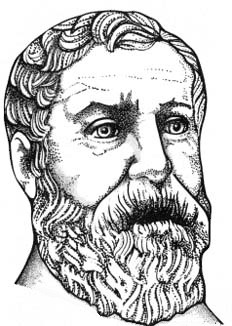
Today I want to talk about an aspect of that ancient city that is usually overlooked—the temples. Temples existed across the ancient world in every city. But the temples in Alexandria were unique because of their proximity to the Great Library, and more importantly, because of the inventor Heron, who features in my story. There were lots of inventors and scholars at this time, but Heron is one of the most prolific and forward-looking, creating inventions that wouldn’t be seen again for thousands of years. He was Leonardo da Vinci in 40 AD, inventing mind-blowing technologies like the primitive steam engine, wind operated automatons, self-contained hydrostatic fountains, or vending machines for holy water, amongst other things.
You might ask yourself why you’ve never heard of Heron of Alexandria or that a primitive steam engine was invented around the same time as the birth of Catholicism. The reason why most people have never heard of Heron or his inventions is because he was using these new technologies to create “miracles” in the temples. Competition for temple followers was fierce in the cosmopolitan city of Alexandria. Modern magicians would find these temple shows quite familiar as inventors like Heron created illusions of statues lifting, or doors opening automatically, mechanical horses being sawed in half yet maintaining their heads, or oracles providing proof to potential followers that these were the gods they should follow—and to whom, more importantly, they should offer their coin.
Not all of Heron’s inventions made their way to the temples. He created a mechanical play nearly ten minutes in length, powered by ropes, knots, and simple machines. In Automatopiotca, the inventor wrote about his design of automatic machines that were essentially programmable computers made from gears and knotted ropes. He also made a highly effective fire engine that would be a huge boon for any city that had access to it (too bad this wasn’t around a hundred years prior when Caesar inadvertently set part of the Great Library on fire!). Heron would have felt quite at ease any time after the industrial revolution, but he made all these inventions two-thousand years ago.
His output was even more remarkable when you consider that the Great Library at this time was well past its prime. While the early centuries of operation produced some of the great thinkers of history like Archimedes, Strabo, or Eratosthenes, in the later centuries the library became a place of literary critique rather than original thought. Heron wasn’t surrounded by other scholars leading the way in their disciplines as would have been the case in the early years. On the other hand, he had access to the greatest writings in the history of the world at that time and some of his ideas can be directly traced to those earlier concepts.
But it wasn’t just Heron’s ideas, but how he put them into practice. It’s one thing to sketch out ideas, but it’s another level of difficulty to turn those ideas into physical constructions, and then sell them to the temples or wealthy benefactors who wished to enjoy a glimpse of the future. I have to wonder what it would have been like at that time to witness his inventions, which had to seem otherworldly—something I tried to bring out in my story. Heron was lucky to have been born in a city that celebrated such inventive thought. In other areas of the world, or times, he might have come to an unfortunate end at the hands of superstitious folk when they saw a musical organ playing without a person at the keys, powered by the wind itself. He truly was a miracle worker.
One of Heron’s best-known tricks was a device described in his writings as “A Vessel from which Wine or Water may be made to flow separately or mixed.” It was a jug that, using ingenious internal compartments and plumbing—much as a magician would do, could alternate between pouring wine or water, depending on its use. His description of the device was: “A jar can be made . . . in such a way that, when water and wine are poured into it, it shall discharge at one time pure water, at another time unmixed wine, and again, a mixture of the two. We may pour wine for some, and wine and water for others, and mere water for those whom we wish to jest with.” I think you’ll find this description familiar and reminiscent of a contemporary of Heron’s and leave it at that.
Heron of Alexandria was so known for his inventions that he was called the Michanikos, or “Machine Man.” He was possibly the greatest engineer of Antiquity, and a great example of the scientific tradition of Hellenistic society, and this despite the fact that the majority of his writings and designs were lost. Who knows what else lurked inside this great mind?

 SOMETHING IS GOING TO HAPPEN